Sundry Links and Comments

» A Publishers Weekly review of a book about expanding human perception: We Have the Technology: How Biohackers, Foodies, Physicians, and Scientists Are Transforming Human Perception, One Sense at a Time, Kara Platoni, Author

This is a superb account of human perception and the first, clunky but potentially breathtaking efforts to expand it.

PvC #2: there is almost certainly more to the universe than what people commonly perceive. But not in any way that appeals to human nature.

\\

A nice Jerry Coyne quote in this post

The world I want is one in which the strength of one’s beliefs about matters of fact is proportional to the evidence. It is a world where it is okay to reserve judgment if one doesn’t know the answer, and where it’s not seen as offensive to doubt the claims of others.

\\

Brain researchers show that using “transcranial magnetic stimulation,” to tweak the posterior medial frontal cortex of subjects’ brains, the result is to reduce “both belief in God and prejudice towards immigrants.”. In other words, belief and prejudice are things going on in certain minds, not something about the real universe.

\\

The term “politically incorrect” is way overused – as an excuse for any kind of bad behavior.
Herb Silverman in Huffington Post:

Some Republican presidential candidates have generalized “politically incorrect” to justify any bad behavior, which includes stereotyping, offensive comments, scientific ignorance, and refusal to answer difficult questions. Some proudly consider themselves politically incorrect because they would not vote for a Muslim, or because they don’t believe in scientific theories like evolution and climate change. Since when did rejecting the overwhelming consensus of scientists around the globe become a proud politically incorrect position? I suppose I’m politically correct because I like to make evidence-based and reality-based decisions.

Posted in MInd, Provisional Conclusions, Religion, Science | Comments Off on Sundry Links and Comments

Rereading Isaac Asimov, part 4

Comments about “Nightfall”, “The Dead Past”, “The Last Question”, “The Bicentennial Man”, and “The Ugly Little Boy”.

To finish up commenting on my rereading (or in a few cases, reading for the first time) some 100 short stories, novelettes, and novellas by Isaac Asimov, over the past couple months. In part 2 I mentioned some general conclusions: Asimov’s stories are often puzzle stories; they are almost always very methodical, in that they proceed from a premise to a conclusion in step-wise fashion; and his best stories either excel along those lines, or confound that pattern. So.

“Nightfall” is still, I would guess, Asimov’s most popular story, though it was one of his earliest stories, and one which Asimov came to resent — he felt that he must have improved as a writer over the subsequent decades (the story was published in 1941, just two years after his first-published story) — and was perplexed by how fans kept gravitating to this early story.

My take is that the impact of “Nightfall” is a combination of its striking premise, which almost everyone since its first publication in 1941 has gleaned even before reading the story — that a civilization that has never seen all of its multiple suns set, until when the suns do and they see darkness and stars in the sky, it triggers mass insanity — and Asimov’s very methodical build-up to describe how that could happen.

When I reread this story a few weeks ago, I of course remembered the conclusion, and wondered, as I picked up the book, how it took Asimov nearly 40 pages to reach that conclusion. The answer is: Asimov’s characteristic method. He establishes the astronomical situation: a planet in a system of six suns, with a complex pattern of orbits that currently is leaving just one sun in the sky, and that one sun is about to be eclipsed; he establishes a history (via a religious cult!, whose records are a contorted history of what has actually happened [an idea echoed in Heinlein’s “Universe”, which I’ve also just reread recently]; he establishes ideas about what people of this world have suffered while experiencing total darkness. The story is initially dramatized as a reporter challenges the astronomers who are making the prediction of complete darkness. We are given to understand how, on this world, complete darkness, via an amusement park ‘ride’, does in fact drive some people mad. (They call the effect “claustrophobia”!) The religious angle appears as a Cultist breaks into the observatory, angry that the astronomers have ‘explained’ the passages from their “Book of Revelations”, because such explanations would remove the necessity for absolute faith. (!) And by the time Asimov invokes all these themes, and describes how the light goes out in the sky, you are convinced that the darkness — and those tiny “stars” in the sky, so inexplicable — might drive social chaos into a convulsion that destroys their entire society. Again.

The story aligns to a couple basic themes: about the end of the world, and how, despite all planning, it can’t be rebuilt; and of course science vs. religion, with the irony that the cult was right after all, but only in a vague superstitious way, that resents the details of what actually happened, or what will happen.

\\

“The Dead Past”, on the other hand, is exceptional because it is so different from the standard Asimov story. In this story something called Chronoscopy has been discovered, a way of viewing the past, but which is tightly controlled by the government. An historian, Arnold Potterly, with a passion for validating ancient Carthage [Asimov, you might recall, was a history buff, and published several books of timelines about history (and about Shakespeare and the Bible)], applies for permission to use the device, and is summarily refused.

He pursues his passion and , with the help of a physics instructor at his university, he sets about building his own time viewer. Potterly is also obsessed by the thought of viewing his own recent past, a house fire in which his young daughter was killed. They discover that the time viewer works only to about 150 years back, which means the government’s story is a fraud. Why?

The finale involves the physics instructor releasing to public view the plan for building a time viewer — and a government official confronting them, and making them understand the implication of what a time viewer means: (–spoiler!–) that looking back in time includes looking back a minute or an hour ago, which means privacy is utterly destroyed. It’s not a “dead” past — it’s the minute-ago past. The story ends as the government official, having explained this, consigns the historian and the physics instructor to hell.

Again, Asimov’s style is still rather pulpish—his characters are so impassioned, histrionic. However this is the rare Asimov story that has elements of emotional involvement, and moral complexity. As well as the cleverness that is his most common characteristic, as he follows the arguments on both sides step by step, and finds implications that lesser sf authors would not.

(I also recall a very different take on this premise: the 1976 Damon Knight story, “I See You”, which involved a similar device (in which you could view everyone’s personal space at any time in the immediate or distant past — *everyone’s* space, including all those daily activities one usually conducts in private — and decides the consequences would ultimately be benign.)

\\

One of Asimov’s most famous stories, and his own personal favorite, was “The Last Question”, which is effective in its narrative but bizarre and perhaps repulsive in its conclusion, from a modern perspective. The story is one of Asimov’s stories about Multivac, the computer (miles and miles across) that runs the world. It has succeeded in harnessing the power of the sun. Two of its operators speculate about how long that power will last, and they query it. The whole universe will run down in 20 billion years, says Multivac. They ask, is there any way around that? Can entropy be decreased? Multivac answers that there is “insufficient data for a meaningful answer.”

Subsequent episodes advance the timeline with similar requests: to a shipboard ‘microvac’ [the ‘ac’ is for ‘automatic computer’, we’re told; it’s not that ‘vac’ is short for vacuum tube]; to Galactic AC in a time when humanity has expanded (largely due to immortality) to fill the galaxy within five more years, with the prospect of filling a new galaxy in another 15,000 years; to a Universal AC, in a time when minds float free of bodies left back on physical planets; and finally to a Cosmic AC, in which the ethereal minds of Man have become one. At all of these stages, the answer is: “insufficient data” or “still working on it”.

In the final passage, the cosmic minds of Man have fused with the Cosmic AC, which thinks even more, and finds the answer: “Let there be light.”

Final line: “And there was light–”

What’s impressive about this story is about how Asimov keeps upping the stakes in each episode, to imagine higher and higher states of human existence. At the same time — for humanity to inhabit every available planet in our galaxy, and then fill up every adjacent galaxy in just another 15,000 years, ad infinitum — is that creepy, or what?

It’s true that mid-20th century science fiction presumed a sort of manifest destiny about humanity’s expansion into the universe. But I think in recent decades this presumption has been severely moderated. We are on the verge of expanding to such an extent on our own planet, that we are threatening its climate and our own viability. And recent science fiction has been moderating its assumptions about the presumed ease of our species’ expansion into interstellar and intergalactic space. (E.g. Kim Stanley Robinson’s Aurora.)

\\

And then there’s “The Bicentennial Man”, a late robot story, a very sentimental one, and an example of how the many robot stories Asimov wrote in latter decades discovered conclusions different from those established in his canonical collection I, Robot. In this one, a robot wants to become human, at least in a legal sense. In a number of other late robot stories, different conclusions are reached, about the relationship between robots and humanity. This is such a well-known story — it won the Hugo, Nebula, and Locus awards — that I’m not taking the time just now to detail it. (And ignore the film version!) Details in a future post, maybe.

\\

Finally, “The Ugly Little Boy”, an uncharacteristically emotional and non-puzzle story, with a heartbreaking conclusion. The set-up is about a woman, Edith Fellowes, who takes a job at Stasis, Inc., a government installation that employs a time travel “stasis” field to retrieve objects or people from the past into chambers inside their facility. Fellowes is brought in to care for a Neanderthal boy who’s been retrieved from 40,000 years ago, to care for him as best she can within the confines of the stasis chamber. Over several months she bonds with the boy, whom she names Timmie, in spite of interference from psychologists. She comes to understand the limitations of the stasis fields, but then is told that the previous limitation of retrievals limited to more than 10,000 years ago has been overcome, meaning that her Timmie will be given up, returned to the past, in favor of more recent subjects of interest to historians. And then what she does.

As always, the premise and its consequences are explored in methodical detail. What’s different here is that Asimov isn’t trying to justify some clever conclusion. Instead he’s following the consequences of the situation in terms of its human emotional impact.

\\

Of the stories discussed here, there are a couple whose conclusions I remember after 30 or 50 years — “Nightfall” and “The Ugly Little Boy” especially — and others, like “The Dead Past”, which I did not remember as such, but upon rereading respect them more intellectually.

I have notes on all the other nearly 100 stories by Asimov I read or reread over the past couple months, and may comment about some of them eventually, but for now this is my last Asimov post.
Posted in Isaac Asimov, science fiction | Comments Off on Rereading Isaac Asimov, part 4

My Father’s Books: and Cambridge, Illinois

Over the weekend I spent some time glancing through one of the dozen or so books I kept from my father’s small library. He was an architect, an idealistic and eventually disillusioned architect, who had great ideas but became relegated to routine corporate industrial projects. (The reason my family moved — or one reason I should say — from Southern California to Illinois, in the suburbs west of Chicago, for three years, from 1968-1971, was for his work on the Batavia Accelerator, what’s become known as Fermilab.) (And he told me more than once — never become an architect.)

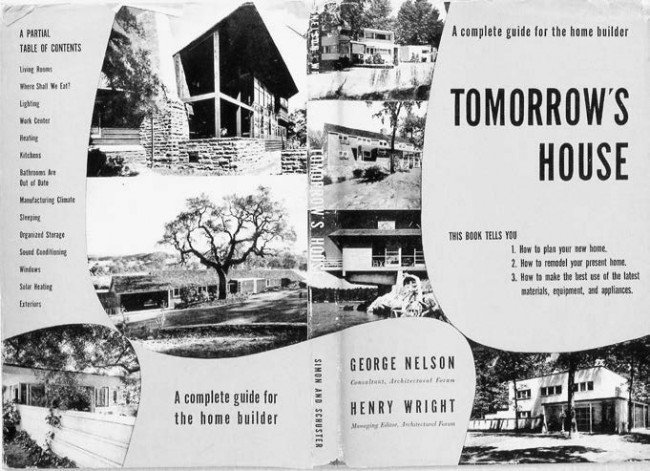
The book I’m looking at, published in 1946 (a $3.95 hardcover, with many b&w pics!) is called TOMORROW’S HOUSE, and is addresssed to families of that era planning to buy or build a new home. What’s remarkable is that the ideas and photos in this book look only slightly dated; I think this book was at the foretrend of the ‘modernist’ thinking of the mid-20th century, when ‘traditional’ values (in terms of architectural styles, at least), were being re-thought. The designs of Frank Lloyd Wright are mentioned throughout, and they are in no ways dated; if anything, they are today rare and valued, and subjects of efforts by preservationists to keep homes designed by him, and other mid-century architects, from being torn-down (as ‘tear-downs’) by rich people who have no appreciation for the original designs and only want a property to build something much larger on… This has been a theme in news stories in LA and Palm Springs. (In fact, Ray Bradbury’s house was victim to the similar trend of ignoring culturally valuable sites in favor of the newer and bigger.)

I had thought to do some scans and post some photos, but it turns out (everything is on the internet!) Google Images on this title has a fair number of images of the cover and interior illustrations: Google Images: Tomorrow’s House George Nelson. Well, several images.

I’ll record one family incident, for the sake of my own siblings and their descendants. My father’s father lived in a small house at the corner of a small town, Cambridge, Illinois, having spent his career as a farm-hand; his house had two floors and a basement, but not a fireplace. My father had a brother, Bruce, who moved to some Chicago suburb and worked as a high school shop-teacher his whole life, and had three sons who, last I heard, became missioniaries (I don’t know in what sense). My father’s sister, Betty, never left Cambridge; she married Stanley, who worked his life as the butcher in the one market in town. She was fat, he was thin, just like in that nursery rhyme. They had five kids, the second of whom, Christine, was almost exactly my age; and while they rented a house in town for many years, eventually they built their own house… right next door to my grandfather, Betty’s father. My father, the architect, volunteered to design a custom home for them. I even remember seeing the floorplans — what we would today call an ‘open floor plan’, with a large center room, the kitchen and dining off to one side, and a partial wall separating the main area from the row of bedrooms at the back. Betty and family rejected it and built two-story house from generic plans instead. And Christine, years later, built another home with her husband, on the far side of her parents’ home. They’re all visible through Google Maps, in this day and age. I haven’t been to Cambridge since 1992, to attend my grandfather’s funeral.

That small town of Cambridge, where I lived for a summer in 1968 and visited many times over the subsequent three years, made a deep impression on me. It was an idealistic small middle American town. In particular, among other things: as I discovered and read Ray Bradbury books at that age, I identified his “Greentown” with Cambridge. It fit perfectly.

Posted in Personal history | Comments Off on My Father’s Books: and Cambridge, Illinois

Links and Comments from Sunday’s New York Times

Front page article: Indian Writers Return Awards to Protest Government Silence on Violence

File this under Conservative [religious] Resistance:

…growing activism from conservative Hindu nationalists who seek to suppress forms of expression they view as offensive to their religion. They have pressured publishers to withdraw books, pushed universities to remove texts from syllabuses and filed criminal complaints against those they deem to have insulted Hinduism.

Few writers have drawn more criticism than M.M. Kalburgi, a noted rationalist scholar who enraged far-right Hindu nationalists through his criticism of idol worship and superstition. Mr. Kalburgi said he received multiple death threats, and on Aug. 30 was shot dead at point-blank range in his home in Karnataka, a state in southern India. No arrests have been made.

\\\

And in NYT’s Sunday Review, an essay by the venerable science writer Geroge Johnson: Gamblers, Scientists and the Mysterious Hot Hand.

This concerns new studies about the “gambler’s fallacy”, the idea that if you detect several coin toss heads in a row, a tail is somehow more likely than usual to come up on the next toss. Even scientists who study this can be tricked into detecting illusory patterns, as the essay explores. Bottom line, final lines:

We’re all in the same boat. We evolved with this uncanny ability to find patterns. The difficulty lies in separating what really exists from what is only in our minds.

I have Johnson’s book Fire in the Mind: Science, Faith and the Search for Order, still on my to-read shelf.

\\

And in the NYT Book Review, a “By the Book” Q&A with science writer Matt Ridley.

What are the best books ever written about science?

“The Double Helix,” by James Watson, and “The Selfish Gene,” by Richard Dawkins. Both books gave me the important message — which my teachers had somehow mostly missed telling me — that science is not a catalog of facts, but the search for new and bigger mysteries.

And this (!):

The last book that made you furious?

Al Gore’s “An Inconvenient Truth.” It uses all the tricks of a fire-and-brimstone preacher to sell a message of despair and pessimism based on a really shaky, selective and biased understanding of the science of climate change.

And then this:

Disappointing, overrated, just not good: What book did you feel you were supposed to like, and didn’t?

Easy. The Bible. Not even the fine translations of William Tyndale, largely adopted by King James’s committee without sufficient acknowledgment, can conceal the grim tedium of this messy compilation of second-rate tribal legends and outrageous bigotry.

\\

Among the reviews themselves, this by Leonard Mlodinow of two books about “making sense of the world and trying to predict the future”: Richard E. Nisbett’s Mindware: Tools for Smart Thinking and Philip E. Tetlock and Dan Gardner’s Superforecasting: The Art and Science of Prediction. Mlodinow reacts with a

reinforced conviction that books on how to think should be required reading in high schools across the country.

(I agree: see The One Book I’d Have Every College Student Read.) He likes the former book, but says,

My verdict is mixed. If you are looking for a survey of the topics covered in the book’s six sections, this is a good one. You’ll learn about our overzealousness to see patterns, our hindsight bias, our loss aversion, the illusions of randomness and the importance of the scientific method, all in under 300 pages of text. But there isn’t much in “Mindware” that is new, and if you’ve read some of the many recent books on the unconscious, randomness, decision making and pop economics, then the material covered here will be familiar to you.

These are all topics of interest to me, as reflected in one of my Provisional Conclusions…

The second book is somewhat different, but the themes are similar in that they involve drawing conclusions by trying to overcome the biases discussed in the first book. His summary:

The central lessons of “Superforecasting” can be distilled into a handful of directives. Base predictions on data and logic, and try to eliminate personal bias. Keep track of records so that you know how accurate you (and others) are. Think in terms of probabilities and recognize that everything is uncertain. Unpack a question into its component parts, distinguishing between what is known and unknown, and scrutinizing your assumptions.

Of course, astoundingly few people have the discipline to do this, including most of the electorates in, I imagine, every country on earth.

Posted in Conservative Resistance, MInd, Provisional Conclusions, Religion, Science | Comments Off on Links and Comments from Sunday’s New York Times

Jonny Quest Rewatch

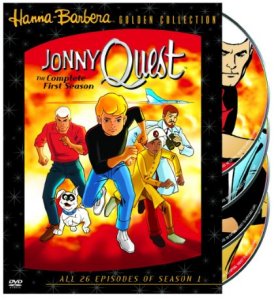
Speaking of rewatches of favorite childhood shows, I have in fact finished a ‘rewatch’ of one of my earliest favorite TV shows, the 1964 animated series ‘Jonny Quest’, via a DVD set I bought some years ago and haven’t watched until now, over the past three weeks. The show was broadcast from 1964 to 1965, lasting only one season of 26 episodes, in the same era as Bewitched, Gilligan’s Island, The Addams Family, Voyage to the Bottom of the Sea, and Flipper. In retrospect, this may have been the earliest show I saw that had science-fictional elements, a year before Lost in Space (which I only discovered about half-way through its first season) and two years before Star Trek. Somewhat like those shows, JQ has developed a long-lasting fan base, and relative immortality via DVD (and a few episodes on YouTube).

Yes, this was an animated series, thus relatively a kids’ show, but it was far more sophisticated than other animated series up until then, deliberately produced to be more realistic, in terms of characters and settings and premises, than the other animated shows of the time (Flintstones and The Jetsons).

The series was based on earlier comics books and radio series, such as Terry and the Pirates. After watching the DVD series, this past week, I discovered this remarkably sophisticated documentary about the show on YouTube, 2 hours long though broken into three parts. It provides a lot of background and context about the show that I didn’t appreciate until discovering it this week. The show’s heritage was earlier comics and radio series by Alex Toth and Doug Wildey; the studio heads William Hanna and Joseph Barbera – Hanna/Barbera – hired Wildey to create a show based on the long-running radio series Jack Armstrong: The All American Boy — and was sketched into animation in scenes still shown in the end credits of Jonny Quest (that are not from any JQ episode). The producers changed their minds, and asked Wildey to create a new show with new characters. His creation was called “The Sage of Chip Balloo” – before the producers changed the kid’s name to Jonny Quest.

So: the show is about Jonny Quest, his father Dr. Benton Quest, a world-renowned scientist, Quest’s pilot and bodyguard “Race” Bannon, and their ‘adopted son’ Hadji, an Indian boy who saved Dr. Quest’s life while visiting Calcutta. The episodes involve various investigations by Dr. Quest, who seems to have a new scientific specialty each week (sonic waves one week, lasers another, sea fish another, a rare mineral to support the space program on another) or who is challenged by alerts from old friends (a colleague who is captured by jungle natives) or threats from comic-book character Dr. Zin (via a robot spy, etc.)

The show had an international quality. The Quest team was based at Palm Key, an imaginary island off Florida, but each week’s episode took them to any number of places around the world, via their various high-tech jets. That was another key theme: the inclusion of various high-tech, for the 1960s, gadgets. Lasers, VTOL jets, personal video communicators.

There were a few science fiction and fantasy elements — anti-gravity, a robot spy, a true yeti, a true mummy, not to mention Hadji’s various magic tricks (“sim, sim, sala bim!”) — but just as often the plots involved various nefarious bad guys, evil geniuses or nonspecific representatives of various foreign governments, with no fantastic elements.

A key point about all these old TV shows (including LIS and Trek!) is this: the makers of those shows assumed they were making disposable goods, to be seen once and forgotten, like (in the words of one of the people in this JQ documentary) using a Kleenex and throwing it away. The TV era of the 1960s was long before video-casette recorders (VCRs) and DVD players, let alone YouTube; I suspect young people today don’t appreciate how transient was the TV work of half a century ago. The creators of TV shows of that era would have been amazed to think that their work would survive 50 years and be subject of analyses and documentaries. Which, among other things, is why we later viewers need to give them some slack about errors and inconsistencies. They did a pretty good job, all things considered.

Another personal point: Like LIS and Trek, and any number of other shows that affected me in my 1960s childhood: I didn’t necessarily see all the episodes of any of these shows when first broadcast. I saw most of them in syndicated reruns in later years, in the 1970s and beyond. But when syndicated, episodes were trimmed by local broadcasters, to allow for more commercial time. Which means that, even of my favorite shows (Trek), I’m not sure I’ve actually ever seen every scene of every episode. I’m fairly sure this is true for *every* show I watched from that era… which gives me some incentive to do some deliberate re-watches of those shows, via DVDs, now that I have the time to do so.

Back to JQ: The documentary also reveals that the DVD that I just watched has incorrect credits for most episodes – which credits indicate that one William D. Hamilton wrote all the episodes but the very first one, which would have been an amazing feat! But in fact there were many writers, including Walter Black, Joanna Lee, Charles Hoffman, and others. (Though Hamilton did in fact write quite a few.)

The documentary includes some interviews, with the likes of Brad Bird, expressing their appreciation for the show. Among many incidental facts discussed is the music of Hoyt Curtin, the voice work of Vic Perrin (the “control voice” of The Outer Limits, and a guest in episode of Trek, and the voice of numerous JQ villains), and the idea of “planned animation” that made weekly animated series possible.

The documentary identifies fan favorite episodes, but I will conclude with my own take on the coolest episodes: “The Robot Spy”; “Turu the Terrible”; “The Invisible Monster” (“paint it!”); “Shadow of the Condor”; and “The House of Seven Gargoyles”.

Posted in Personal history, TV Sci Fi | Comments Off on Jonny Quest Rewatch

Lost in Space, Season 4

While sorting through a couple old file cabinets today, deciding what I should keep and what I can toss, I came across a file that I must have discovered some 30 years ago, when I was obsessed with rewatching childhood favorite TV shows, back in an era before DVDs or Netflix or even VCRs. I recall the film/TV library at UCLA… is that where I found this? Don’t recall, can’t be sure. In any case, this seems to be a set of TV Guide-like descriptions for a potential fourth season of the TV series Lost in Space — which, obviously, was never produced. Judging from the recurrent themes and the simplistic episode titles, this does have a certain air of authenticity. But I cannot vouch for this, other than to reproduce here something I came across, somehow somewhere, 30 years ago.

#1, “Vaults of Infinity”
While the crew of the Jupiter 2 decide to begin using the still unopened auditorium in the lower levels of their ship, Dr. Smith discovers a vast weapons vault and seizes control. The Robinsons hide out in the gymnasium, while the Jupiter 2 plunges uncontrollably toward a black planet.

#2, “Planet of No Return”
Everything is black on the black planet – including a ferocious monster threatening our heroic travelers. Smith tries to steal the J2 while the Robinsons are out on an excursion in the Chariot, but is captured by the black monster.

#3, “Space Monster”
When the J2 escapes the black planet, they are astounded to see the black monster leap into space after them! Meanwhile, Smith tries altering the course of the J2 for Earth, but instead turns the ship directly into the jaws of the dreaded beast!

#4, “Guts In Space”
Still trapped within the dreaded space creature, the Robinsons form a daring plan to escape – but the plan requires Smith to perform a heroic maneuver in the gymnasium. Will Smith have the courage to do it?

#5, “Space Fight”
Still trapped in the space monster, the Robinsons become desperate when the creature engages in a fight with another such creature. Will they survive??

#6, “Jupiter, Jupiter”
The Robinsons discover an exact duplicate of their ship floating abandoned in space. Who built it and why? Little do they know it’s an evil plot to steal the real J2!

#7, “Planet in Space”
The Robinsons crash on a dangerous planet due to break up in 10 hours. Dr. Smith hinders repair efforts when he becomes intoxicated by local fauna.

#8, “The Lost Planet Earth”
Star fixes indicate the J2 has arrived near our solar system, but instead of Earth they find a similar, but different, planet inhabited by a hostile race of andorids. Did they conquer the real Earth, or are the Robinsons’ star charts fouled up?

#9, “Repairs in Space”
The robot is captured by an alien spacecraft in need of mechanical expertise to repair their star drive. While there, the aliens reprogram him to wreak havoc aboard the J2. Then the aliens offer to repair the J2 – for a price!

#10, “Music of the Planets”
The Robinsons land on a planet during a music festival, the prize of which is free passage to anywhere in the galaxy. Dr. Smith and the Robot begin tuning up, but when Will wins the biped semifinals, Smith resorts to scheming to accomplish his goal.

#11, “The Mysterious Cave”
Smith finds a strange coat in a cave full of ancient alien relics which transforms him into an alien leader, searching for his long forgotten followers.

#12, “Attack of Dimensions”
A meteor storm produces a strange earthquake which jolts the J2 into a strange dimension – then another, then another. Monsters from each cling to the ship to battle it, and their counterparts from other dimensions.

#13, “The Hollow Planet”
The Robinsons discover a hollow planet, but once inside, the opening seals and leaves them trapped! They discover another ship inside, ready to begin a deadly cat and mouse game.

#14, “Rock Creatures of Graniton”
The J2 crashes on the planet Graniton, and are met by the hideous rock creatures, who demand they leave immediately – or be crushed to death.

#15, “Space Race”
Dr. Smith enters the J2 in an intergalactic space race, and is faced with stiff penalities if the worn-out J-2 doesn’t meet minimum time requirements. When the race gets underway, evil alien sabotage begins.

#16, “Magnet Planet”
The J2 is drawn irresistably toward the planet Magniton, and must negotiate with the evil creatures there for release – until the robot steps in, and is captured.

#17, “The Big Space Roundup”
The Robinsons are captured by an intergalactic cowboy who is herding a herd of space cattle to roundup. As payment for frightening some of his space cattle, he demands that Smith or Will capture the renegade, legendary Lost Cow of Arcturus.

#18, “Space Fog”
A mysterious fog in space transports the J2 from one magical planet to another, until they are hopelessly lost – but suddenly Earth appears before them. Can they reach Earth before the deadly fog sucks them back in?

#19, “The Galactic Witch”
A strange sorceress casts a spell on the J2, and despite full supplies ready to reach Earth, they can’t escape their planet! Unless Smith can make a deal – trade the Robinson family for the Jupiter 2.

#20, “Hijackers of Space”
The J2 is boarded by a mysterious alien who holds a gun at Dr. Smith’s head and demands to be taken to Aldebaran. But when they arrive, another alien kills the 1st and demands to be taken to the Aderan galaxy, or he’ll shoot Will!

#21, “Robot King”
A planet run by robots offer the Robinson’s robot a chance to be their ruler—but first he must renounced all ties with his human builders.

#22, “War with the Wonder Planet”
The Robinsons land on an idyllic, beautiful planet inhabited by a peaceful civilization, but then war breaks out with another planet and our heros, are caught in the middle of it. When Judy and Don are captured by the enemy – hideous monsters – John must face a decision: help negotiate or continue to destroy.

#23, “Creature in Space”
As the Robinsons leave their latest planet, they discover that a hideous monster has snuck aboard and hidden itself in the greenhouse. As the Robinsons hunt the deadly beast, Smith discovers that it wants to take over the ship and return to Earth, and becomes its accomplice.

#24, “Feast in Space”
The Jupiter 2 visits the Intergalactic Culinary Guild, where the family samples the tastiest dishes in all of space – until one of the chefs decides for his next dish he needs…. Dr. Smith.

#25, “Slime Planet”
The Jupiter 2 lands on a planet covered with slime and electric shocks. As their ship is slowly sinking into the green goo, the Robinsons race to make their ship ready for liftoff – until Smith accidentally opens the door and the slime floods inside.

#26, “Shadows in Space”
The Jupiter 2 passes through a dark region of space which turns everyone grumpy and quarrelsome –even the robot, whose crying rusts his gears.

#27, “Space Cake”
A special birthday party for Penny is disrupted when cosmic rays from a nearby comet storm affect the ship’s course – and turn the cake into a glowing, living being.

#28, “Magenta Monster”
The dreaded creature is held capture by a passing space traveler – until Smith lets it escape, endangering the lives of Will and Penny and bringing his captors’ wrath – the space traveler turns the rest of the Robinsons into formless ghosts.

#29, “Planet of the Space Police”
The Jupiter 2 is captured by an intergalactic space patrol ship, which carried it to their planet. The Robinsons don’t know if they are suspects or merely witnesses – until Smith is discovered trying to bribe an official for passage back to Earth.

I’ve discovered a similar set of descriptions for a hitherto unknown Season 4 of Star Trek, which perhaps I might post as well.

Posted in Personal history, TV Sci Fi | Comments Off on Lost in Space, Season 4

Sean Carroll on Everything

The physicist Sean Carroll has a new book coming out next May that I’m looking forward to: The Big Picture: On the Origins of Life, Meaning, and the Universe Itself.

Carroll blogs about it here, with an outline.

A key Carroll post is this one about The World of Everyday Experience, In One Equation:

Longtime readers know I feel strongly that it should be more widely appreciated that the laws underlying the physics of everyday life are completely understood. (If you need more convincing: here, here, here.)

This theory is correct in its domain of applicability. It’s one of the proudest intellectual accomplishments we human beings can boast of. Many people resist the implication that this theory is good enough to account for the physics underlying phenomena such as life, or consciousness. They could, in principle, be right, of course; but the only way that could happen is if our understanding of quantum field theory is completely wrong. When deciding between “life and the brain are complicated and I don’t understand them yet, but if we work harder I think we can do it” and “I understand consciousness well enough to conclude that it can’t possibly be explained within known physics,” it’s an easy choice for me.

And to see a style of his thinking, see A Compilation of Sean Carroll’s Best Arguments and Comebacks (A 15-minute video.)

Posted in Philosophy, Physics, Science | Comments Off on Sean Carroll on Everything

The Martian, the movie

(posted Sunday, 4 Oct 2015, on Facebook)

Saw The Martian today (*after* reading and posting Gary Westfahl’s review this morning — and also after reading Andy Weir’s novel a couple months ago) and I think it’s a prime example of a terrific film made from a mediocre book. The book, as I said, was formula suspense: something bad happens every 30 pages that you know our hero will overcome, because he’s the hero and has to survive. This is poor form for a novel, but a standard formula for Hollywood movies, and given the realistic depiction of the space mission and the Martian landscape, and the fine acting by all concerned, it made for riveting, frequently moving film. Kudos for the positive depiction of problem-solving and resolve, in contrast villain-formulas of so many Hollywood pics, even about space travel; for the interesting casting (following from the book) and a bit of character development (not in the book) of a couple key minor players; and for the almost uniformly plausible depictions of the space ships, their movements, the launches, the movements of people in space, and so on — nothing offhand as egregiously wrong as a couple key points in Gravity. (Acknowledging the frequently observed flaw that the thin Martian atmosphere would not whip up the storm that threatened to topple over the launch vehicle in the first place.) The 3D was impressive, though at times made everything look like toy models of landscapes, ships, even people, though I assume everything was filmed live, including the rovers crawling through the deserts of Jordan.

I still don’t find the Hermes’ captain’s obsession with ’70s music at all plausible, for reasons discussed in my review of the novel.

Finally: I appreciate the take in Gary Westfahl’s review that detects the irony between the positive view of NASA’s mission, and the unexamined assumption of the story that the whole point is to get the stranded astronaut *off* Mars. No thought about the challenges of staying, of settling — unlike any number of SF literary works. The film gives a positive spin to this, in the final scenes (not in the novel) that depict the launching of the next mission to Mars. In Gary’s review, and in Kim Stanley Robinson’s novel AURORA, and no doubt other places, there does seems to be a gradual realization within in the SF community that the visions of human colonization of planets and the expansion of humanity into the universe, will be much more difficult than those fictions have imagined… if possible, at all.

Posted in Movies | Comments Off on The Martian, the movie

Lying with Phony Graphs

If the anti-abortion anti-Planned Parenthood folks had a case, you’d think they wouldn’t need to lie with transparently inept graphs that misrepresent the actual data. Scroll down on this link to see an actual chart, legitimately scaled, showing the services provided by Planned Parenthood, of which abortions are the least of them, by a factor of 10, in contrast to STI/STD testing, contraception, and cancer screening.

There’s a video of Planned Parenthood president Cecile Richards reacting to this graph, which she had not seen before, and despite Dan Savage’s commentary here, she doesn’t respond strongly enough — a 5 second examination of this chart, which shows, at the right side, two data points upside down: the one for abortions, at 327K, above the the one for cancer screenings, at 935K, would indicate that this picture is completely invalid as a chart of actual data.

It’s hard not to think that this is yet another example of the intellectual incompetence of the right.

Vox: Whatever you think of Planned Parenthood, this is a terrible and dishonest chart

As Friendly Atheist comments,

If you’re a pro-life politician who wants to use that information to make Planned Parenthood look evil, what do you do? Easy. You just have to assume your base isn’t intelligent enough to look into the details of whatever you show them. It worked with the recent anti-Planned Parenthood videos, after all.

Posted in Conservative Resistance, Culture, Mathematics | Comments Off on Lying with Phony Graphs

Lawrence M. Krauss on Ben Carson

He says it better than I can (and of course with more authority).

Ben Carson’s Scientific Ignorance

It is hard to find a single detailed claim in his diatribe that is physically sensible or that reflects accurate knowledge about science. His central claim—that the second law of thermodynamics rules out order forming in the universe after the Big Bang—is a frequent misstatement made by creationists who want to appear scientifically literate. In reality, it is completely false.

When Carson says that scientists rely on “probability theory” to explain how multiple Big Bangs, taking place over “billions of years,” have resulted in our “perfectly ordered” universe, he’s profoundly misstating the theory of the Big Bang. (In fact, he seems to have gotten his ignorant arguments confused—his metaphor about a hurricane creating a 747 in a junkyard is often used to deride evolution, to which it is equally inapplicable.)

It is one thing to simply assert that you don’t choose to believe the science, in spite of a mountain of data supporting it. It’s another to mask your ignorance in such a disingenuous way, by using pseudo-scientific, emotion-laden arguments and trading on your professional credentials. Surely this quality, which reflects either self-delusion or, worse still, a willingness to intentionally deceive others, is of great concern when someone is vying for control of the nuclear red button.

Last week, when he was confronted, during a speech at Cedarville University, about his failure to understand basic and fundamental scientific concepts, Carson responded, “I’m not going to denigrate you because of your faith, and you shouldn’t denigrate me for mine.” What Carson doesn’t seem to recognize is that there is a fundamental difference between facts and faith. An inability to separate religious beliefs from an assessment of physical reality runs counter to the very basis of our society—the separation of church and state.

This is yet another example where one might easily conclude that conservatives, who are amenable to these kinds of arguments from incredulity (or from ignorance), are simply not very bright. Or, that Carson is appealing to a least-informed/intelligent base.

Jerry Coyne responds to the Krauss essay here.

Carson continues to insist, as do many religionists, that science, like religion, is simply a form of faith. I’ve picked the meat off that canard before, both in Slate and in Faith versus Fact, and we needn’t belabor it here. What’s funny about that argument is that it boils down to this claim by believers: “See! Science is just as bad as religion!” If they truly were equivalent, theology would have made as much progress in understanding God as science has in understanding the universe. But the score is zero for the former and a gazillion for the latter.

Posted in Conservative Resistance, Politics | Comments Off on Lawrence M. Krauss on Ben Carson