Settling in, Catching up, Puppygate

I’m two or more weeks behind posting links and comments, though not without collecting them in my blogposts word doc, so I’ll be catching up eventually — I think this next week. The context is settling in to our new home in Oakland: until a couple weeks ago, I was still unpacking boxes of books, arranging bookcases, etc. Then followed preoccupation with dealing with an accountant to have our taxes done (very complicated this year, what with layoffs, severance payments, selling and buying houses, etc.) And still dealing with expensive repair issues to get our old house in LA sold.

While most of my links and comments deal with recurrent themes of interest to me in the very broad context of how science fiction informs the big issues of humanity and the universe (life, the universe, and everything), the overpowering issue in recent weeks, in the SF community, is what has come to be called ‘Puppygate’, the circumstance in which a group of right-wing writers have bought their way onto this year’s Hugo ballot.

Without making any specific commentary on this issue, I would relate this issue to my provisional conclusion #7, which says that resistance to the historical trend of inclusions of previously demonized human groups is “is driven by subconscious, evolutionary-grounded desires to maintain social cohesion among one’s group against threats that might undermine the group’s religious or ideological narrative.”

The worst member of the groups behind Puppygate is clearly extremely racist and homophobic. And he brags about it. And he’s extremely Christian.

Posted in Personal history | Comments Off on Settling in, Catching up, Puppygate

Links and Comments: Republican analogies; Hugo Awards trolling; Religious freedom laws

I’m way behind with day to day links and comments, so let me spend an hour catching up, if with minimal commentary or alignment into general issues.

First, one of many examples of Republicans unclear on the concept of analogies (are they just not very smart?): Ted Cruz Wrongly Believes Preventing Anti-Gay Discrimination is Like Forcing Rabbis to Eat Pork

No, preventing anti-gay discrimination would be like forcing Rabbis, if they are operating a public market, to sell pork to those who want to buy it.

\\

Even the science fiction community has its share of reactionaries and right-wing trolls: Salon’s Arthur Chu: Sci-fi’s right-wing backlash: Never doubt that a small group of deranged trolls can ruin anything (even the Hugo Awards)

This issue has gotten much coverage, from Slate and Salon to The Atlantic. Mike Glyer at File 770 has compiled many, many responses about this from various SF blogs including those of George R.R. Martin, Adam Roberts, Peter Watts, Elizabeth Bear, Scott Edelman, John Scalzi, David Gerrold. The issue is mostly about right-wing white males upset that their privilege has been undermined by writers who are not white and male and who have won Hugo Awards in recent years — but there’s also (surprise!) a religious component. Charles Stross quotes one of the Sad Puppies’ core members, Vox Day (aka Theodore Beale):

It’s time for the church leaders and the heads of Christian families to start learning from #GamerGate, to start learning from Sad Puppies, and start leading. Start banding together and stop accommodating the secular world in any way. Don’t hire those who hate you. Don’t buy from those who wish to destroy you. Don’t work with those who denigrate your faith, your traditions, your morals, and your God. Don’t tolerate or respect what passes for their morals and values.

Always beware those whose religious faith would determine the way everyone else should live their lives.

\\

On the whole “religious freedom” laws issue, while it’s obvious that the motivation for these laws is to permit discrimination against gays, there’s also a counter-argument that, well, gays could just go to some *other* florist or cakemaker. There are a couple problems with this: first, there are many small towns across America in which there might well be only one florist or cakemaker, leaving a hypothetical gay couple trying to be married without a nearby resource. And second, these laws might well allow even *government officials* in any sized city the license to refuse service to gay couples. This point is made by a gay couple, Rock and Ledge, who have four children (!), whose blog I follow:

Keep Your Cake and Flowers

I’m not worried about cake and flowers. I will happily go elsewhere and do business with better people that are more receptive to my family. What troubles me is how these laws are so broadly worded that they may allow for government employees to refuse service. If a county clerk has a problem with me when I apply for a marriage license or refuses to process my homestead tax exemption because they don’t agree with my family structure, that is a problem that is not as easily remedied with going somewhere else. I feel that government officials, law enforcement officers, and healthcare professionals have a duty to serve the public, and if they can’t handle working with certain minorities, then they should resign and find another more insular line of work.

This reflects my own thoughts: Florists and cakemakers should be willing to serve the entire public, not just those whose religious scruples match their own. If they cannot do that, they should find another line of work.

\\

More tomorrow.

Posted in Children, Culture, Religion, science fiction | Comments Off on Links and Comments: Republican analogies; Hugo Awards trolling; Religious freedom laws

Links and Comments: Religious Freedom and Gay Animus

I’ve been busy the last couple weeks unpacking books and arranging the house, and so am backlogged with links and comments, including this past week’s news and many commentaries about the ‘religious freedom’ laws in Indiana and elsewhere. For the moment I’ll try to gather my reactions to these.

After reading online and newspaper articles about Indiana’s and Arkansas’ “religious freedom” laws for several days, and squinting to see exactly what the purpose of these laws were *if not* to refuse service to gays and lesbians — and not finding any examples — I finally found one yesterday in a New York Times op-ed column by Gail Collins. Apparently Indiana governor Mike Pence, in a Wall Street Journal piece, referring to the Supreme Court’s Hobby Lobby decision, felt that the principle needed to be established at the state level. That is, Pence felt that Indiana businesses need to be able to refuse birth control to their female employees. Oh, well then. That’s not so bad?

Pence repeatedly rejected the idea that the Indiana law was intended to discriminate against gays and lesbians. The evidence is otherwise: the viral Facebook photo of Pence signing the original bill, with identifiable anti-gay activists standing behind him; and the reaction this past week to the Indiana pizza shop who proudly announced their intent to deny service to guys — while, dimly, simultaneously stating this was not discrimination — which brought about $50K from supporters to their anti-gay policy. So don’t believe Mike Pence’s insistance that his law is not about gays. See his interview with George Stephanopoulos for his inability to answer a direct question. Six times.

I sympathize slightly with folks who suggest that in practice, why would any gays insist that a bakery who disapproved of them make a cake for them? David Horsey has a cartoon on this point today, which suggests that such a baker might well poison any cake he would be forced to provide for a gay marriage. (Can’t find a link at the moment.)

To all of this, I will repeat my general reaction: why are Christians so thin-skinned, why do they insist on identifying themselves in the wider world as people who cannot get along, civilly, with people who are unlike themselves?

Finally for now, I think this essay at Slate today by Nathaniel Frank tries to find a deeper meaning in all this: Christian Discriminators May Not Know They’re Anti-Gay.

This pivots off the statement from that pizza shop that while they would not cater to a gay marriage, they don’t see this as discrimination, because religion. It’s tempting to raise eyebrows, see this person as obviously dumb, and illiterate. But the Slate article suggests it’s deeper than that. (I’ve added some bold emphasis.)

Now, just because it may be sincere does not make it right; it’s still discrimination. Indeed, it’s abundantly clear to anyone who thinks about it that citing religion in asserting anti-gay beliefs is prejudice pure and simple—just ask them for evidence of giving divorced people the same litmus test as gay people, and you’ll have proof of cherry-picking religious texts to suit a bias. Where, for instance, is the outcry to let adherents of the Old Testament stone adulterers to death?

And:

Prejudice is universal, but particular prejudices are learned in particular contexts. This is what too many anti-gay Christians seem not to realize — there is no religious reason why the Bible’s anti-gay passages should have come to dominate the hearts and minds of Christian conservatives more than its passages condemning divorce or environmental degradation. Christianity doesn’t require actually withholding services for same-sex weddings any more than it requires stoning adulterers.

And:

There is no doubt that many Christians truly think that by refusing to cater to same-sex marriages, they are simply being faithful to their religious tradition. They’re wrong. But they’re wrong because they lack self-knowledge, not because they are expressing socially unpopular views. And as fun as it may be to publicly sneer at their ignorance and to attribute it to malice, it may be more effective to nudge them toward self-examination, to offer a kind of amnesty for their sins of omission.

I see this as one example of how most people live their lives and acquire values and prejudices from their communities (tribes), without every thinking through the rational bases for these values and prejudices. Perhaps one in a thousand might, and grow up, and the other 999 are how religions survive.

Posted in Culture, Religion | Comments Off on Links and Comments: Religious Freedom and Gay Animus

Unpacking Books

Still unpacking boxes of books. It’s curious that, whether I packed the boxes, or the moving service’s packers packed the boxes, you’d think that boxes would be packed and stacked in a relative order to what was on the shelves. And then moved onto the moving van, in relatively the same order. And then unmoved from the van into my garage, in relatively the same order. But no. In my second or third week of unpacking boxes that were moved into the garage of our new home… I’m finding them in almost random order. (Not quite.) As I’ve unpacked boxes of ‘main sequence’ books — those novels and collections by particular authors — in the past couple weeks, and then unpacking boxes of anthologies in the past three days, I find odd gaps: I’m missing the early Dozois best-of-year anthologies (the six Dutton, and first six Bluejay/St. Martin’s volumes); almost all the Best of F&SF anthologies (in small paperbacks, SFBC editions, and later Van Gelder volumes), and the first 8 Nebula Awards anthologies, which I only have in paperback. Did I use them as fillers in boxes of digest magazines that I packed? Don’t remember; but haven’t found boxes of these, and haven’t opened the boxes of magazines yet (not sure where to put them, in our smaller house).

Posted in Personal history | Comments Off on Unpacking Books

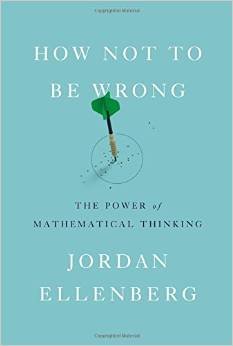
Jordan Ellenberg, How Not to Be Wrong, Post 3

Subtitled: The Power of Mathematical Thinking.

Third post (after this and then this) about this fascinating book, an examination of several basic principles (linearity, inference, expectation, regression, and existence) and how they apply to every-day, real world situations, situations that are often misunderstood by ordinary “common sense”. The author, a one-time child genius, is a professor of mathematics at the University of Wisconsin-Madison, and has written for Slate, Wired, and other publications, including an occasional column for Slate.

The third of five parts is about “Expectation”. He discusses how to calculate the ‘expected value’ of a single lottery ticket — which is not the same as the value you expect of any given ticket (which is 0). Should you play? Yes, when the jackpot is high enough that the expected value is higher than the cost of the ticket. Famous case of a Massachusetts game, WinFall, in which a bunch of MIT students figures out the odds, bought huge numbers of tickets when the odds favored it, and won. And kept winning — Massachusetts authorities didn’t care, as long as they were making money — until a newspaper uncovered the story, the state shut down that game.

(Ch12) If you never miss a plane, you’re spending too much time in airports. This balance of cost vs inconvenience applies to other areas of life, e.g. occasional reports of government waste, such as paying benefits to dead people. The cost of eliminating *all* waste outweighs the benefits of never making such mistakes. (That such incidents of government waste, no matter how rare, get media coverage, exaggerates the issue and hides the true cost/benefit analysis.)

Same logic applies to the famous “Pascal’s wager” about belief in god; the flaw in his argument is that he doesn’t consider other options, e.g. the existence of a god who damns Christians and favors others.

This discussion leads to the idea of ‘utils’, how to evaluate cost vs benefit in subjective ways, e.g. a thousand dollars is worth more to someone who has no money than to someone who already has a thousand dollars. Different people have different util curves; some people work only until they have enough money, then stop.

(Ch13) WinFall involved different strategies, which correspond to the idea of finite geometries, e.g. the Fano plane, which has just seven points and seven lines or curves, each with three points. And these correspond to winning strategies for choosing lottery numbers.

This carries over into the redundancy codes invented for transmitting signals to satellites, and analogous patterns in natural language, and the problem of packing spheres into the least possible volume.

Lotteries? Despite the odds, people play them anyway, because of some concept of ‘fun’ that is independent of those expected values. Just as people start businesses, despite the odds against.

Part IV is about “Regression”, (Ch14) beginning with a 1930s study about successful businesses that discovered that the most and least successful businesses didn’t stay that way; they ‘regressed to the mean’. This wasn’t a discovery about human nature; it was a discovery about statistics, and explains why second novels aren’t as good as first ones, and why football players perform worse in the second year after they are signed.

(Ch15) The idea of ‘scatter’ charts, their patterns, and early ideas of profiling criminals by compiling data about their head size, finger length, and so on — “bertillonage”, which eventually gave way to fingerprinting.

(Ch16) Correlation: you can find correlations between virtually any two variables. As everyone knows, that doesn’t imply causation.

Even in the 1950s, strong correlation was seen between smoking and lung cancer, but some analysts warned about drawing conclusions about causation. (Really. Maybe, e.g., having early stages of cancer, such as symptoms like a slight chronic inflammation, prompt a desire for the relief and comfort of smoking…)

Author makes a crucial point: It’s not always wrong to be wrong. The detections of correlations like that between smoking and lung cancer lead to public healthy policies that are sometimes mistaken, and have to be changed. But if you wait for absolute certainly before any such policy, you’ll never get anywhere, and people will die while you’re waiting for perfect evidence. “If you never give advice until you’re sure it’s right, you’re not giving enough advice.”

Part V is about “Existence”. These chapters address ideas that are relatively more familiar to me.

Ch17: “There Is No Such Thing as Public Opinion”. This addresses the paradoxes of opinion polls, how, depending on how questions are asked, contradictory results appear. E.g., Americans want a smaller government, but when asked which government programs they would cut, more people want to increase spending on programs than cut them (education, health, defense, etc.).

The central issue is that each voter’s stance is rational, but in aggregate, they’re nonsensical. (A prominent example: a binary poll about Obamacare shows that most are opposed; but a more nuanced poll shows that more approve or *want it expanded* than those who disapprove of it altogether.)

This leads to a discussion about voting methods — a topic I’m familiar with, given the science fiction community’s nerdish obsession with fairness in voting, in the elaborate ‘Australian ballot’ procedures applied to the Hugo Awards. (This idea has trickled down to some examples of ‘instant-runoff’ voting in some state elections.)

As has been revealed before, there is no voting system that cannot lead to counter-intuitive results. Example: a three-way presidential election; if most people prefer candidate A, or candidate B, yet most of them rate candidate C second, candidate C might well win. (There are examples.)

Ch18: “Out of Nothing I have Created a Strange New Universe”. The idea of what is *true* vs what is *right* via rules and procedures exists in many fields. The most fundamental is in math, the struggle for two thousand years to try to deduce Euclid’s fifth axiom (the one about parallel lines) from the first four. The breakthrough came in the 19th century, when several mathematicians realized that it could not—in fact, alternatives to Euclid’s fifth would be equally valid logically, and would describe different geometries! E.g., that of a sphere. This was an astonishing result; thus the chapter title’s quote.

This leads to a discussion about whether mathematical expressions *mean* or whether they should be *defined*. The parallel is in law, where issues are *defined* by the results of the voting process, never mind what voters might have meant. The famous example: the 2000 election, where Justice Scalia’s policy of deferring to the process reigned.

The problem with this is that such procedures never admit new evidence. [Not in this book, but recently in the news: cases where someone was convicted to Death Row, and despite DNA evidence of innocence, are left there, because after all the *procedures were followed*, and later evidence doesn’t matter.]

The champion of formalism in math was David Hilbert, who famously, in 1900, put forth a list of 23 great problems for math to solve. His intent was to build mathematics from the ground up, using precise formalism, and assuming that no contradictory results could emerge.

That assumption wasn’t true, as Kurt Gödel demonstrated in 1931 — his famous “incompleteness” theorem.

Conclusion: How to Be Right

Author discusses a summer job with a researcher who *wanted an answer*, never mind qualifications; quotes FDR and John Ashbery; and discusses reactions to Nate Silver, how people misunderstand his predictions of percent chance of voting results.

Conclusions? Avoid precision; it’s misleading. People are more tolerant of contradictions than computers are (citing Captain Kirk’s numerous defeats of computers through logical paradoxes). If you have an idea, try to prove your theorem by day, and disprove it by night. Apply that idea in all areas of life, and it will force you to confront the reasons why you believe what you believe.

What’s true is that the sensation of mathematical understanding – of suddenly knowing what’s going on, with total certainty, all the way to the bottom — is a special thing, attainable in few if any other places in life. You feel you’ve reached into the universe’s guts and put your hand on the wire. It’s hard to describe to people who haven’t experienced it.

…To do mathematics is to be, at once, touched by fire and bound by reason. This is no contradiction. Logic forms a narrow channel through which intuition flows with vastly augmented force.


Posted in Book Notes, Economics, Mathematics | Comments Off on Jordan Ellenberg, How Not to Be Wrong, Post 3

Link and Comments: Common Core

I don’t have a horse in this race, at least not yet, but I’m fascinated by how conservative resistance to the Common Core educational standards have swung 180 degrees since the Obama administration signed on to them. Common Core standards were originally put together by state governors, many of them Republican. But when Obama endorsed it, conservatives reflexively rejected it… because, well, anything Obama does must be evil. (Obama could discover the cure for cancer, and Republicans and conservatives would denounce it as a socialist scheme.)

I haven’t followed the Common Core standards closely, but the controversy over them reminds me of the New Math controversy in the ’60s and ’70s. I gather that the central issue is similar: an emphasis on understanding basic concepts, rather than rote procedures.

Here is an example: It’s Worth Taking a Full Minute to Learn How to Add 9 and 6: A Response to the “Common Core” Critics

His example: how do you add 99 + 47?

The smart people realize that 99 is 1 less than 100, and so add 100 to 47 minus 1, and get 146.

They don’t write down the numbers in columns, and ‘carry the 1’, and so on — the standard rote method for addition that is… traditional.

I gather that Common Core teaches such methods, that take a bit longer to learn at first, but that save much time in the long run. (Analogous to taking time to learn to type, rather than hunt-and-peck.) Yet, conservatives and right-wingers reject this reflexively. (See that post for links to examples.)

Posted in Culture, Mathematics | Comments Off on Link and Comments: Common Core

Link and Comments: Slate on Rejection of Modernity

Catching up on several items today. First, interesting article at Slate by Brad Allenby: The Return to Medievalism: Why is the world so troubled right now? Rejection of modernity and technology may be to blame.

This consolidates many of my own thoughts, and goes further, suggesting that the horrors of ISIS (or whatever it’s called) is part of the a broad issue (captured in my Provisional Conclusion #7): a rejection of modernity. What Alvin Toffler, decades ago, described as Future Shock: “too much change in too short a period of time”.

The Slate article notes several themes I’ve discussed here:

Accelerating technological, social, and cultural change undermines many strong beliefs and practices, which can be particularly damaging to individuals and weak institutions. Those who are unable to keep pace with, or accept the changes inherent in, such a world sometimes retreat to faith, which is an understandable response. Similarly, the ever-greater social and cultural complexity of an increasingly multicultural world may have the same effect, reinforcing the value of mythic cultural stereotypes and “golden ages” of the past as refuges.

And the irony that those who would reject modernity, or science, are happy to use the fruits of science to spread their anti-science word. That is, social media — using the internet, which depends on the network of orbital satellites that in turn depend on the conclusions of special relativity. The science they would deny.

Key quote:

We know from history that any technology significant enough to be interesting will also inevitably destabilize existing communities, institutions, power relationships, social structures, worldviews, and cultural assumptions. Because these psychological, social, and cultural verities are sources of comfort and identity for many people in virtually all cultures, technological change will only encourage a continuing retreat to fundamentalism.

Posted in Culture, Religion | Comments Off on Link and Comments: Slate on Rejection of Modernity

Links and Comments: Pale Blue Dot; 10 Commandments; Evolution; Tribalistic thinking; Answers for Creationists

I have a batch of links with notes from almost a month ago that I never got around to posting. Let me catch up.

On the theme in recent posts of awe-inspiring graphics or videos, here’s a piece by Phil Plait in Slate about Pale Blue Dot + 25 Years.

\\

Resource: Richard Dawkins’ site: Five Stupid Things About the Ten Commandments (a video from May 2014). This is not by Dawkins; it’s by some guy names Steve Shives.

  1. They’re unnecessary; why did God wait so long? Territory marking?
  2. They’re repetitive.
  3. They’re poorly prioritized. Why not condemn many other things, like slavery?
  4. They’re an inferior moral guide. [As I’ve discussed here, morality doesn’t derive from religion; morality derives from the evolution and social growth of humanity, and the morals in religious texts reflect only the thinking of ancient tribes, primitive and even barbaric by modern standards, who wrote them.]
  5. They’re anti-democratic. The Constitution and the Commandments are very different [a point that never ceases to amaze me: people who claim the Commandments are the basis for our culture, without noticing that only a few of these are actually enshrined in our law; on the contrary…]

\\\

NY Times article: Conservative Politicians Abroad Seem More Accepting of Evolution.

The US is the outlier concerning politicial acceptance of scientific facts; it’s not such an issue in most of the rest of the world.

Two interesting points raised by this article. First: it’s common for cultural critics of the US to cite Scandinavian countries as models of progressive societies with higher standards of living, by virtually every criterion, compare to the US. But one key difference that plays into the comparison: the Scandinavian countries are far more *monocultural* than the US…

Second, rejection of evolution by evangelicals is rote. They don’t understand it. (Of course.)

“When the people on the school board were asked to explain in Dover what they took the theory of evolution to be, they couldn’t,” Mr. Humes said. “Nor could they explain the intelligent design theory they were embracing.”

\\

One more political post, which echoes previous items I’ve mentioned about how tribal allegiance trumps acknowledgement of scientific understanding. Joel Achenbach in National Geographic, as modified for Washington Post: Why science is so hard to believe.

In the United States, climate change has become a litmus test that identifies you as belonging to one or the other of these two antagonistic tribes. When we argue about it, Kahan says, we’re actually arguing about who we are, what our crowd is. We’re thinking: People like us believe this. People like that do not believe this.

Part of my refinement of my Provisional Conclusions is to take these kinds of thinking into account. In the long run of the human race, it’s not necessarily about the advance of science and the increased understanding of humanity’s place in the universe. We will always be hobbled by tribal thinking inherent in base human nature — the default thinking in every newborn child — that, in the absence of a strong culture that acknowledges reality, and an educational system that strives to understand reality and overcome that base human nature, humanity will not necessarily ‘advance’. We may be stuck in a perpetual cycle of culture wars.

Though in a strict sense, perhaps it doesn’t matter. If survival of the species means denying or dismissing reality… then maybe all of science doesn’t matter.

\\

Another resource:

Phil Plait’s Answers for Creationists.

\\
And a prime example of the No True Scotsman fallacy, from Bryan Fischer:

OBAMA ‘NOT A CHRISTIAN’ IF HE SUPPORTS GAY MARRIAGE, SAYS BRYAN FISCHER: VIDEO

Posted in Astronomy, Evolution, Psychology, Religion, Science, Ten Commandments | Comments Off on Links and Comments: Pale Blue Dot; 10 Commandments; Evolution; Tribalistic thinking; Answers for Creationists

Links and Comments: Fox News; Jonathan Haidt; Scientology; Paul Krugman; US and Israel

First, an essay at Salon not just about Fox News and Bill O’Reilly but about Why the pundit’s fabrications are almost beside the point.

Key point: there isn’t enough ‘real’ news to sustain a 24-hour new network.

That is, the rise of cable news 20 years ago (along with, I would think, the ascendance of the Internet, which lets people read only the news that confirms their biases), have indirectly created this fractured American cultural divide, which has led to our virtually-dysfunctional political system.

Put simply, there wasn’t enough “real” news to sustain a 24-hour cycle. So cable news relied on two things to fill the hours: time spent hyping future stories and pundit reviews of news items. Both of these changes depended more on fear than facts to keep viewers tuned in. Anchors babbled on about worrying news stories, then pundits hyped them up with hysteria.

But that was just the beginning. The fear era of news was about to get much worse. In 1996, Roger Ailes founded the Fox News Channel. The station was the first explicitly conservative TV news network and its mission was to offer a partisan spin on the news. The Fox News angle was more than just a conservative take on the news. It was fear-based programming that far outpaced anything, in terms of scaremongering, that had been on television prior. Fox didn’t just shun the facts as liberal bias, it also taught viewers to be afraid. Particularly of anyone who disagreed with their extreme right views.

This is why Eric Burns, who hosted Fox’s media critic show Fox News Watch for a decade, recently explained in an interview with CNN’s Brian Stelter that Fox News is more like a cult than an actual news channel. He pointed out that O’Reilly’s lies had been well documented since Keith Olbermann went after him when he hosted a show for MSNBC. But no one cared, Burns said, because for Fox News viewers consider anything that contradicts the fear and hype they consume as liberals propaganda. There simply are not enough facts to change their minds since the only thing they trust is Fox News. “To the Fox News cult, this kind of thing doesn’t matter,” said Burns. “It’s a lie from the liberal media.”

Which is to say, cable news (and to some extent all journalism) creates its own culture in order to justify its own existence. Its hidden motivation is: Pay attention to these stories because if you don’t we’ll be out of a job! Conservative sources like Fox News play off the paranoia among many that government is incompetent, scientists are elitist eggheads, and everyone unlike you is a danger to your way of existence. And Liberal sources play off that characterization of conservatives — with some justification, it seems to me.

\\

Noted: A link to a YouTube TED talk by Jonathan Haidt, about The moral roots of liberals and conservatives. Haidt wrote a book, The Righteous Mind, on this subject, that is on my to-read shelf.

\\

Salon: a long interview with Lawrence Wright about Scientology’s “broken community,” and the complicity of Tom Cruise and John Travolta.

Wright wrote a book about the Church of Scientology that is now basis for a documentary film, Going Clear: Scientology and the Prison of Belief.

Wright notes various parallels between Scientology and Mormonism, comments about the Amish, comments about how L. Ron Hubbard’s original condemnation of homosexuality have disappeared from current editions of his books, and makes some comments about religion in general:

Craziness doesn’t have anything to do with how successful a religion might be. Religions prosper in large part because of the communities that they create. If you look at Mormonism, it’s a very appealing community. It takes care of itself, there are active charities, it’s got a successful work ethic. Whatever you might think about the authenticity of their theology or their history, it’s immaterial in terms of how the religion itself actually functions. With Scientology, it has a very strange set of beliefs, but right now it has an incredibly dysfunctional and broken community. That’s the difference. Scientologists are told not to look at anything critical of the church, most of them don’t. They put blinders on. It’s our hope that some of those blinders will come down and Scientologists will take a look, and then try to change the religion themselves. There’s very little that we can do other than bring awareness to people about what’s happening.

\\

Politics: Paul Krugman is a Nobel Prize-winning economist who takes, what seems to me, a reality-based approach to economics (i.e., look at history, look at what’s working or not in other countries), as opposed to the ideology-based approach of… Republicans.

For example: NYT: Partying Like It’s 1995.

About Republican warnings of inflation should Obama administration policies go into effect.

Needless to say, those warnings proved totally wrong. Soaring inflation never materialized. Job creation was sluggish at first, but more recently has accelerated dramatically. Far from seeing a rerun of that ’70s show, what we’re now looking at is an economy that in important respects resembles that of the 1990s.

and

Still, we’re now adding jobs at a rate not seen since the Clinton years. And it goes without saying that low inflation combined with rapid job growth makes nonsense of all those predictions that Obamacare, or maybe just the president’s bad attitude, would destroy the private sector.

Now, obviously both ends of the political spectrum have their ideologies. But for anyone paying attention to the evidence about the real world, the ideology of the conservatives seems far more out of touch with reality than that of the liberals.

\\

Politics and culture: It seems to be an unquestioned given that the US supports anything Israel might do, never mind the very difficult historical and political issues in that part of the world, and never mind how needlessly aggressive Israel has been in picking fights (building new settlements in disputed territory). [As far as I can tell, ‘settlements’ mean subdivisions.]

The largely unspoken justification for this policy is religious. Frank Bruni, in last Sunday’s New York Times, spells this out. Christians Loving Jews: Benjamin Netanyahu, John Boehner and America’s Evangelicals.

Some evangelical Christians’ interest in Israel reflects an interpretation of the Bible’s prophetic passages that’s known as premillennial dispensationalism. It maintains that the End of Days can play out as God intends only if Jews govern Israel and have reconstructed a temple on the Temple Mount, where there’s now a mosque.

But just a subset of evangelicals subscribe to that. Others are motivated by their belief, rooted in scripture, that God always intended Israel for Jews and that honoring that and keeping Israel safe is a way of honoring God. God’s blessing of America, they feel, cannot be divorced from America’s backing of Israel.

This might be the scariest, and most unrecognized, influence of religion on American politics.

Posted in Culture, Religion | Comments Off on Links and Comments: Fox News; Jonathan Haidt; Scientology; Paul Krugman; US and Israel

Links and Comments: Powers of Ten; Nineteen Eighty-Four doublespeak; Climate change; Failed conservative predictions of doom

Today’s persusing of websites. (I have more links and comments from newspapers and magazines, but not the time at this moment to post…)

First, to complement yesterday’s link to Vox’s 40 maps that explain outer space, here is the earliest, and most famous, video I know about the vast size of the universe, a film from way back in 1977 (there was also a book) called Powers of Ten.

\\

More about controlling the narrative: simply ban certain parts of speech, a la Nineteen Eighty-Four [aside: this is the correct title of the book; not “1984” with digits. See first edition image. These distinctions matter, to bibliographers and awards compilers.]

Widely reported in the past couple days, but here’s a Washington Post link: Fla. scientist told to remove words ‘climate change’ from study on climate change

Remember Orwell? “War is peace. Freedom is slavery. Ignorance is strength.”

\\

Politicians deny reality in order to appeal to their ignorant base. But a general principle for identifying the motivations for any political trend is: follow the money. In contrast to politicians appealing to their bases, *insurance companies* take climate change very seriously:

New Republic: Florida Officials Banned the Term “Climate Change,” But the Insurance Industry Knows Better

\\

Let’s venture into politics; the relatively right-wing party in the US is much more aligned with *ideology* and the denial of evidence that conflicts with that ideology, than the other. Again and again, on points of fact, they are proven wrong, and they never learn.

Here are examples at ThinkProgress: 5 Embarrassing Predictions About What Obamacare Would Do To The Economy.

It would be too easy to apply my Jack Smith Rule — take any prediction of doom, predict the opposite, and you will virtually always be a more successful prophet than those purveyors of doom. (It would be easy to do this about numerous posts at Right Wing Watch, about the imminent doom of American civilization if gays are allowed to marry. And so on. Predict the opposite; you will win.)

In current American politics, anything Obama does is reflexively opposed by conservatives and religious reactionaries, even policies originally proposed by Republicans! (Healthcare; standards for public schools.)

Posted in Astronomy, Culture, Thinking | Comments Off on Links and Comments: Powers of Ten; Nineteen Eighty-Four doublespeak; Climate change; Failed conservative predictions of doom