Reading Around the Bible, 1

I have never read any version of the Bible (or any other holy book), but over the years I’ve accumulated a couple versions of it, and several books about it. My parents were nominally Presbyterian, my mother sang in the church choir, and we kids (I was the eldest of four) attended Sunday school growing up. I decided I didn’t care to go any more at about age 15. But I still have the red-bound Bible, with fold-out genealogy pages in the center, given to me from the church in Reseda, California.

Recently, serendipitously, I noticed a glossy trade paperback in the gift shop at Andersen’s Pea Soup restaurant along Interstate 5, appearing to be a lavishly illustrated guide to the Bible. I glanced through it, noticing that it devoted several pages to each Biblical book, with summaries, sidebar discussions, and illustrations of art and photos of actual places, and lots of maps. (I love maps, and timelines.) It occurred to me that such a broad overview might be a way of easing into the Bible itself, at least of gathering an idea of its contents, before, or without, reading the ancient texts themselves. After all, the Bible is a foundational text of Western civilization and literature, aside from its roll as a religious text. So I tracked the book down on Amazon.
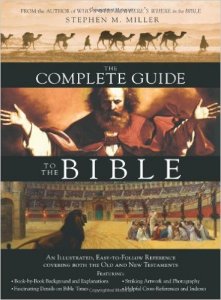
It’s The Complete Guide to the Bible, by Stephen M. Miller.

I bought the book and for the past month or so I’ve been working my way through it (I’m currently part way through the minor prophets) and several other books about the Bible already in my library. I have Isaac Asimov’s Asimov’s Guide to the Bible (in two volumes, one for each Testament); I have Richard Elliott Friedman’s Who Wrote the Bible?; and since starting Miller I’ve acquired Bart D. Ehrman’s The Bible: A Historical and Literary Introduction and John Riches’ The Bible: A Very Short Introduction (one of Oxford series of little paperback introductions on hundreds of topics), and two physical Bibles: the New Oxford Annotated Bible (4th edition, with the Apocrypha, which my unadorned childhood volume did not include) and Steve Wells’ Skeptic’s Annotated Bible (using the King James Version, and which is entirely online here, along with his annotations of the Quran and the Book of Mormon, but it’s handy to have a physical volume to consult).

Initial comments on these books:

  • Asimov, though best known of course as a science fiction writer, was an autodidact with an interest in history and culture to the degree he could analyze it, and writes his guide as strictly secular commentaries on people and places mentioned in the Biblical texts and how they relate to what is known from secular history; at the same time, he freely draws conclusions from the texts, and what is known about history, to speculate on the actual authors of the texts, and the actual times they were written, despite the nominally assigned authors. (Asimov also wrote similar guides to all of Shakespeare’s plays, and to Milton’s “Paradise Lost”.)
  • I read part of Friedman’s Who Wrote the Bible? years ago and was familiar with the basic idea: that (of course, one thinks), the Biblical texts that we know are amalgamations of many authors, passed along at first orally, over hundreds of years, and then edited into the versions we know today; Freidman describes the commonly known scheme of texts identified as J, E, D, and P. (This is why there are two origin stories in Genesis, one after the other; two accounts of Noah and his arc, stitched obviously together, and so on.) His book focuses on the Pentateuch, the first five books, traditionally attributed to Moses.
  • Friedman presents his thesis, though foreshadowed by a century or more by writers whose works were promptly put on the Catholic Church’s list of forbidden books, as still a tad controversial when he wrote in the late 1980s. But it turns out all the other books I have at hand, except Miller’s (whose point of view is that of a believer’s), acknowledge the same background, even Asimov, writing in the late ’60s.
  • The New Oxford Annotated Bible, which edition I selected to buy as the best current edition of the Bible, on the basis of the bibliography in Robert Wright’s 2009 book, has such extensive footnotes and annotations that it rivals the sums of Asimov’s texts, I suspect, albeit in much tinier print. It too is forthright about the multiple authors of the early books, later edited.
  • The Ehrman volume contrasts with Miller’s in that it discusses historical contexts, authorship, and why the early books of the Bible are best understood as myths and legends, not literal history. Ehrman is a prolific author of books that challenge simplistic readings of the Biblical texts, especially of the New Testament, exploring the political reasons why the gospels came together as they did, considering (as I’ve always known) how they weren’t written down until decades after the events they claim to document. At the same time, this Ehrman volume is a textbook, to the point of including topics for discussion at the end of each chapter, and so Ehrman seems to bend over backward to suggest [to believers who might be taking a class using this text], that it’s OK if the early Biblical books aren’t literal, that they are still meaningful.
  • And the Miller volume, to circle back around, is of course credulous, describing the events of each Biblical book with weary repetitions of how every misfortune that befalls the Jewish people is because God ‘allowed’ other peoples to invade them, etc. etc., or on the other hand renew promises of eventual redemption. The tone aside, it’s a surprisingly sloppy book — there are numerous captions in sidebar boxes that end mid-sentence, errors of layout and proofreading. And his chapter about Genesis doesn’t mention the Tower of Babel! (At the same time, I’m noticing, he dwells disproportionally on the minor prophets…) It’s fascinating to read various books *about* the Bible and see how differently they summarize and emphasize its content. A lesson in itself!

I’d intended a very brief first post about Bible reading, but let me close with a few initial reactions.

  • I’ve also browsed texts of ancient history, to understand how Israel and Judah fit into the scheme of things — to understand why, out of all the cultures that were present in the first millenium BCE, these texts that became our Bible survived while others did not. Surely the Assyrians and Babylonians and all the other enemies of “God’s chosen people” also discovered the technology of scrolls, around 600 or 500 BCE..? We have a scant few records of ancient texts, like Gilgamesh, but why no others? (Because the Library of Alexandria was burned down? Hmm.)
  • As a non-believer, with the just suggested perspective of historical context, nothing could be more obvious than that the early Biblical texts are creations myths and legends, often derived from those of other cultures and tribes, that were told and retold over centuries, orally, in ways that advance the ideals of the tribe. It’s all very interesting as self-serving history (there’s an angle here on how the current knowledge of psychological biases can inform all of this), but anyone who takes this literally is being, at best, naive.
  • And the incredible violence of the Old Testament. Why would anyone think this is any kind of guide to moral behavior? Even the heroes of Jewish history, David and Solomon, casually slaughtered enemies. I won’t attempt to draw any conclusions; this is an open question.

But on the last point, a couple quotes from Steven Pinker’s The Better Angels of Our Nature, whose thesis is that violence has, in fact, greatly declined over recorded human history — and at my casual browsing of Biblical stories this past month, I can be persuaded by. His book opens with descriptions of violence in the earliest texts that survive– Homer’s epics, and the Bible. First about the authorship, p11.2:

Modern biblical scholars have established that the Bible is a wiki. It was compiled over half a millennium from writers with different styles, dialects, character names, and conceptions of God, and it was subjected to haphazard editing that left it with many contradictions, duplications, and non sequiturs.

And about the violence, p10:

The Bible depicts a world that, seen through modern eyes, is staggering in its savagery. People enslave, rape, and murder members of their immediate families. Warlords slaughter civilians indiscriminately, including the children. Women are bought, sold, and plundered like sex toys. And Yahweh tortures and massacres people by the hundreds of thousands for trivial disobedience or for no reason at all. These atrocities are neither isolated nor obscure. They implicate all the major characters of the Old Testament, the ones that Sunday-school children draw with crayons.

So why is the Bible upheld as a moral standard..?

I will have several more posts, I think, over the next few weeks, as I finish reading *around* the Bible, and then perhaps begin to read specific books.
Posted in Bible, Book Notes | Comments Off on Reading Around the Bible, 1

Rereading HOW TO READ A BOOK

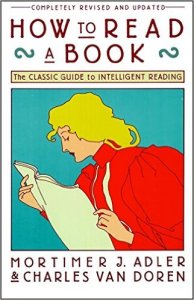
Is this book anywhere near as commonly known as, say, THE ELEMENTS OF STYLE? I have the impression it was widely known at some point, and my 1972 revised edition is subtitled “the classic guide to intelligent reading” – the original edition was published in 1940. I picked up my copy off a remainder table at UCLA nearly 40 years ago, perhaps struck by the cheeky title – if one doesn’t know how to read a book, how could one possibly read this one?

Well, to answer my first question, since drafting part of this post a couple days ago, on Monday I saw two hardcover copies of this book at my neighborhood bookseller, A Great Good Place for Books, in the general nonfiction section — face out! So apparently it’s still in circulation.

To answer my second, rhetorical, question, HOW TO READ A BOOK is about how to read and digest and process books in ways more comprehensive than a straightforward, obvious, ‘elementary’ reading.

The authors are Mortimer J. Adler and Charles Van Doren. Adler was something of a pop philosopher, among other things, who oversaw the selection of the Great Books of the Western World (a set of titles a bit analogous to the Harvard Classics, which I am in custody of a set of, courtesy my forward-thinking parents, who filled my childhood home with various sets of encyclopedia and other volumes, though they did not read themselves). And in fact HOW TO READ has an appendix of ‘recommended reading’ that begins with Homer and goes through Solzhenitsyn.

This is a 400+ page book about various ways of approaching, inspecting, analyzing, and reading one book or many books on a given topic. These reading protocols are surely familiar, and easily discovered, to most devoted readers, though Adler & Van Doren’s focus was, as indicated, on the ‘classics’. They weren’t much concerned with popular fiction, or even any kind of current nonfiction books.

They describe four levels of reading: elementary reading, which is basic understanding of reading sentences and paragraphs; inspectional reading, which is the art of gleaning, in an hour or less, the topic and point of a perhaps substantial volume of nonfiction; analytical reading, the way to thoroughly read any book, depending on its classification; and finally, syntopical reading, which is about formulating questions on some topic and examining many books for the insight they can provide in answering those questions… a bit like ‘research’, though not exactly.

I haven’t actually re-read this entire book; what I’ve done, more-or-less, this past week, is a refresher inspectional read. Here’s what they mean by that:

  1. Look at the title page and preface, if it has one, and read each;
  2. Study the table of contents;
  3. Check the index to get an idea of the range of topics covered;
  4. Read the publisher’s blurb [i.e. the dust jacket description];
  5. Look through key chapters, and read any summary opening or closing pages;
  6. Finally, turn the pages, dipping in here and there, reading a page or a few, but never any more.

Their point of inspectional reading is to decide, given one’s time constraints, whether a book is worthy of a closer, analytical reading. Much of HOW TO READ consists of describing this third technique and how it applies to various types of books. The basic principles involve 1) find out what the book is about; 2) understand and interpret the book’s contents; 3) criticize it, in terms of your agreement or disagreement, on grounds; and 4) ask what of it?, i.e., does the book require any kind of response?

Of primary interest to me are the sections on ‘imaginative literature’ (by which they mean all sorts of stories, plays, and poems), and certain sorts of nonfiction more than others, science and mathematics. (They also have chapters on history, philosophy, and social science, which actually I’m lately investigating as well.) Their approach to ‘imaginative literature’ is mostly warnings about how not to treat it as nonfiction, and to immerse oneself in the experience; their approach to ‘science and math’ is mostly to consider the intellectual exercise, i.e. they think you are going to be reading classics like original texts by Darwin or Einsten, though they do have an afterthought about what they call ‘popular science’.

Their fourth level, syntopical reading, involves formulating a question or thesis, identifying a bibliography of books that address that concern, and analytically reading them against each other. In detail:

  1. Create a tentative bibliography of your subject;
  2. Perform an inspectional reading of all books on the bibliography, to identify which are key, which might be ruled out, other titles that might be added;
  3. ‘Bring the authors to terms’ by constructing a neutral terminology to map the authors to;
  4. Frame a set of questions and issues for which the authors might provide answers;
  5. Analyze the discussion by finding relevant passages that inform your subject.

(I’m condensing and paraphrasing steps outlined on pp335-336.)

In my own history, their points about inspectional reading have stuck, even to the idea of browsing books in a bookstore (back when people actually browsed books in physical bookstores… which I still manage to do now and then). Read the title, the book flap, the ToC; glance at the index, check for selected topics which you might think would be covered in a volume on this subject, and the bibliography if there is one. I would add: consider the ‘blurbs’ on the back cover; they give you an idea of who the publisher thinks this author aligns with, which both in fiction and nonfiction can reveal a great deal about where the author of the book at hand is coming from.

Lately, on this blog, I’ve been doing what they would call analytical readings, where I closely read substantial nonfiction books, take notes while reading, write up the notes in a Word doc, summarize and paraphrase those notes in a blog post, and quote selected passages from the author that I’ve noted while reading. [I might mention here that the authors of HOW TO READ advise to you *write in your books*, underlining or highlighting key passages, writing key points on the front and back endpapers, and so on. No; I cannot bring myself to do that.]

Aside from bookstore browsing (or Amazon browsing, to the extent that works), my version of inspectional reading, of novels, it to read the first 2 or 5 or 10 pages of any new novel that comes into the house… especially if it’s an author unfamiliar to me.

More recently, in the past year, I realize that I have begun what they call syntopical reading, if not quite as ruthlessly as they describe. That is, I’ve compiled a tentative bibliography on this blog of books addressing the very broad issues of cosmology, evolution, the mind, religion, morality, psychology, the future, all issues I need to examine at least broadly to understand how ideas of science fiction inform them. I have a parallel project of identifying key SF works, in some objective (not cherry-picking) fashion.

And so coincidentally, before coming across HOW TO READ during book rearrangement last week, I’d concluded that I need to do a sort of ‘inspectional’ reading of all those nonfiction titles on my bibliography. It might 10 years to read them all analytically (or syntopically), but inspectional readings might be finished in a few months, to cull the set down to those that directly apply to my project.

And one reason I read the Jo Walton book described in previous post, is as one of several complementary strategies for compiling an SF bibliography for that same grand project. Another, in progress, is paying close attention to Gary K. Wolfe’s “Great Courses” course in How Great Science Fiction Works. And another step, which I hadn’t actually realized was relevant to this relatively more recent project, when I began it many years ago, is the completion of sfadb.com.

Posted in Book Notes, science fiction | Comments Off on Rereading HOW TO READ A BOOK

Thoughts on Jo Walton’s WHAT MAKES THIS BOOK SO GREAT

Jo Walton’s WHAT MAKES THIS BOOK SO GREAT is a wonderful book, and I wish there were more like them. It’s not a book of reviews, so much as a book of reviews about *re*-reading books, and why she does so; most of the time, though not always, because she loves those books and finds something new in them every time. It’s a book full of chapters to inspire you to seek out the books she talks about, and reconsider those you’ve already read.

(I should mention that the book is a selection of columns she posted at Tor.com from July 2008 to February 2011, but only “about a fifth of the total posts that I made during that time”.)

The striking revelation of the book is that Walton is a constant, obsessive reader, taking a book everywhere she goes throughout the day, and a fast reader. She mentions that some favorite books she reads annually, and that on a day in bed, she can get through 4 to 6 books a day. I find that incredible. (At my best, during my college-year summer vacations, I could get through a 200-page paperback every day. These days, reading more substantial books, novels that are longer than those of 40 years ago and substantial nonfiction that requires patient attention, I feel accomplished to average 2 books per week.)

I’ve taken notes on this book about the books she discusses that she impels me to seek out or reread. At the same time, she has fascinations with authors I’ve sampled whom I have no further interest in — ahem, Bujold, Cherryh, Brust. I skimmed those chapters, and skipped a few (about Brust). (At best I’m inclined to revisit and sample Cherryh, whose first three books I read before moving on, rather as I did with Anne McCaffrey; it seems now, considering Walton’s attention and Russell Letson’s reliable reviews, there is something there in Cherryh I might want to pay attention to.)

Along the way, she has chapters about skimming; about why she rereads books she doesn’t necessarily like; about rereading books she liked earlier but which “suck” in the light of her own maturity or changing social standards; and so on. I almost wish there were more of this — discussion of how and why we read.

p104: “It’s the books I love that are the hardest to write about.”

My thoughts, as recorded part way through this book:

Reading many books, or reading about others who have read many books, is like speaking to many people who have intelligent, informed backgrounds from many different perspectives. You listen to them speak, without having to respond or defend any reasons you might differ in your opinion. Yet the intelligent reader will take everything into account, and continually reformulate their world view to account, or reject, everything, everything, they have read. It’s a continuous process of thinking about the world and updating one’s worldview to take into account all those other viewpoints you have read. It’s a way of expanding one’s consciousness and awareness about the world that would otherwise be limited by personal experience and local circumstances.

Posted in Book Notes, science fiction | Comments Off on Thoughts on Jo Walton’s WHAT MAKES THIS BOOK SO GREAT

Gilovich, 2, part 2

The second half of Thomas Gilovich’s and Lee Ross’ new book THE WISEST ONE IN THE ROOM: How You Can Benefit From Social Psychology’s Most Powerful Insights is four chapters under the heading “Wisdom Applied.”

Chapter 6, “The Happiest One in the Room”, begins with an anecdote about an athlete surviving an accident that crippled him, which he nevertheless came to regard as the *best thing* that ever happened to him, and goes on to discuss how, for example, people raising children are aware of the day to day toil of doing so, yet nevertheless consider it a worthy effort. Drawing on the earlier chapters, the authors point out that people who are happier don’t dwell on the past; they don’t denigrate rejected choices. And they’re less concerned about social comparison, i.e. worried about keeping up with the Joneses (so to speak; not their phrase).

So lessons to being happy: first, act like a happy person (see Ch4, “The Primacy of Behavior”). And more specifically,

  1. Apply the peak-end rule: take a shorter, more memorable (i.e. more expensive) vacation, rather than a longer, thriftier one. This is because our later memory of such events tends to highlight just two parts: the ‘peak’ best experience of the trip, and the ‘end’ event of that trip. Some principle applies to chores: don’t leave the worst chore until last.
  2. Experiences are better than material possessions; we talk about the former with others, but rarely about the latter. Valuing possessions speaks to the ‘hedonic treadmill’ of history, how despite the obvious advances in quality of life over the centuries, people today aren’t necessarily ‘happier’ than their ancestors were.
  3. Get up and go; avoid regrets; just get started. Find a ‘flow-state’, the condition of being deeply immersed in an activity that provides a deep sense of well-being. Being active is a buffer against low self-esteem.

And: pay attention to the young; spend money on others, not yourself. People are happier in nations with smaller gaps in wealth distribution.

Chapter 7, “Why We Don’t ‘Just Get Along'”, begins by considering the Middle East, and how to be a sophisticated consumer of news reports about such conflicts. There are psychological barriers to resolving conflicts, including considerations of ‘fairness’, the cognitive dissonance that results from compromise, and how some proposals of compromise became subject to ‘reactive devaluation’, p207, just because they’re proposed by the other side. [This is the state of American politics, since Obama, is my thought.]

Lessons: manage attributes: create a situation where a resolution *must* succeed. Offer a vision of a shared future resulting from a conflict resolution. Each side must control spoilers. Don’t bother with people who are invested in the status quo of the conflict and who can’t ‘afford’ to change. And realize that a slight shift, from 49% to 51%, can radically alter behavior.

Chapters 8 and 9 consider specific problems. Chapter 8 is about academic performance in public school, from racial differences among athletics to stereotypes in classrooms. It’s largely about self-fulfilling expectations by teachers, but students also suffer from ‘stereotype threat’, that notion that since their type doesn’t usually do well, it instills self-doubt that they themselves can do well.

Lessons: it’s about being ‘psych-wise’, and the authors point out ideas that don’t involve liberal notions of addressing root causes (poverty) or conservative criticism of ‘throwing money’ at the problem.

  1. Self-affirmation: have students periodically write an essay about some aspect of their lives that’s meaningful to them, something that affirms their life – just doing that, keeping it in mind, will bolster academic performance;
  2. Wise feedback from mentors, i.e. don’t patronize poor performance, but give honest, constructive feedback;
  3. Reassurance about belonging, having students understand that abilities grow with effort; it’s not just a matter of having an ability or not.

Chapter 9 is about “An Even Tougher Problem for the World”, climate change, why people don’t seem to take it seriously, and what can be done.

The good news is that some techniques have been discovered to encourage positive behavior, e.g. ‘social proof’, the idea that reminding people that their *neighbors* are doing certain things, like saving energy, by displaying this information on their monthly bills.

The global issue is more difficult. People are given to short term priorities, swayed by special interest groups, which in turn are driven by money in politics from those who stand to lose; and in the same way, the myth that there is some controversy about the evidence of human-caused climate change.

We can understand why people have difficulty addressing the problem, if not so much about how to overcome their resistance. The time frame of the effects of climate change is too vast; most people don’t worry much about the future beyond perhaps the future of their grandchildren p252t. Changes to address it would need to be permanent. Worry about free-riders; the drop-in-the-bucket problem; the ‘noisy signal’ problem, i.e. that the consequences of the problem are not easy to notice.

Addressing it, short of some magical technical solution, will likely require a change of social norms:

  1. Celebrate heroes; shame offenders; publicize the words of deniers;
  2. Realize that some social changes can occur relatively quickly — consider the social changes of only the past generation or two: how European wars have ended; how an African American has become president; how same-sex rights have expanded to marriage.
  3. And (again), realize that younger people affect olders.

What may ultimately be necessary is the creation of a social movement of the sort that has on past occasions transformed the world—a movement like the ones that launched both Christianity and Islam, or the one that transformed monarchies to democracies, or the one that ended slavery, or the one that is now empowering women across the globe….

[[ I.e., I would say, another phase of moral progress ]]

Finally, the authors’ epilogue tells a moving story about how Nelson Mandela united South Africa through a rugby match – told in the film Invictus – by using all the 5 elements discussed in this book.

Posted in Book Notes | Comments Off on Gilovich, 2, part 2

Gilovich, 2, part 1

The new book by Thomas Gilovich (author of the 1991 volume HOW WE KNOW WHAT ISN’T SO: The Fallibility of Human Reason in Everyday Life, just discussed here) and coauthor Lee Ross is THE WISEST ONE IN THE ROOM: How You Can Benefit From Social Psychology’s Most Powerful Insights.

As in the earlier book, some 2/3 or more consists of discussion of various psychological discoveries about how people perceive things, with the balance about how these understandings can be applied to personal and social issues. (In a loose sense, then, this is a ‘self-help’ book.)

The early chapters echo subjects from the earlier book, but are more broadly applied.

Chapter 1, “The Objectivity Illusion” concerns how people aren’t so much objective observers of the world as they are subject to “naive realism”, the idea that what we experience is what is real, and somehow assume that others perceive the same ‘reality’ that we do. Whereas in fact, our perception of events (example: driving past a political protest) depends on our own prior beliefs. Interesting point I had not realized: the idea that people are subject to the ‘Lake Wobegon effect’ (everyone thinks they’re an above-average driver) is to some extent valid — because people use differing standards for what constitutes, e.g., a good driver (edit: mentioned later, p88). Example of people defending tastes in 60s vs. 80s music; their defenses use very different examples of each!

Great quote from British philosopher Isaiah Berlin, p31t — it’s the first para under the digit 1 on this page.

The general principle of perceiving bias in others, but not ourselves, affects how people regard sports announcers and debate moderators, who can never please everybody. p34b:

If you are like most people, you probably think the media generally are overly critical of the party and candidates you favor, and insufficiently critical of the party and candidates you oppose. You find media coverage of political and social issues frustrating because those on your side seem to be “telling it like it is,” while the other side’s contributions consist of little more than a series of lies, distortions, and half-truths.

And thus about the media, 35b

Because people tend to think of their own take on events not as a “take” but as a veridical assessment of what is taking place, anyone who tries to offer an even-handed account of events will tend to be seen as biased and hostile to the perceiver’s interests. This is one reason that the fourth estate is held in such low regard by the public. Right wingers in the United States curse the “lamestream” media, while those on the left complain that the major news outlets maintain a mindless neutrality by giving extreme right-wing perspectives the same coverage and treatment as much more centrist positions offered by those on their side of the political spectrum. And both groups regard the networks’ “pandering” to the other side as blatantly dishonest, whereas they see the network that shares their perspective as a source of refreshingly clear thinking.

(Well, yes, I do find Rachel Maddow, for example, a source of refreshingly clear thinking, so am I really subject to my own bias in the same a Rush Limbaugh or Glenn Beck fan is about those guys’ conspiracy theories? I’d like to not think so… especially since conspiracy theories can be understood via the same suite of psychological insights that are discussed in books like this.)

Chapter 2, “The Push and Pull of Situations”, discusses what in other books is called “priming” — we respond to situations quite differently depending on how they are presented. Examples: how war bonds were promoted and sold; how participation rates for savings plans or organ donations depend on whether they are presented as Opt-in vs. Opt-out. Eliminate obstacles: recycling is promoted by cities providing colored recycling bins.

There’s insight here into slippery-slope situations, including the famous Milgram experiment. In that case subjects were trapped in a situation with no clear way to stop. Many things happen in series of small steps; another example, how gay rights expanded to include social acceptance of same-sex marriage.

And the fundamental attribution error, FAE, whereby we attribute one’s situation to their essence; we confuse the person with the role. Leonard Nimoy was not really Spock. New Orleans residents who didn’t flee Katrina didn’t ‘choose’ not to leave (and were thereby irresponsible); they had no way to leave. Slave owners, even Thomas Jefferson, perceived slaves as unable to manage their own lives.

Lesson for the wisest one in the room: don’t rush to judgment until you appreciate situations and constraints in which people actied.

Chapter 3, “The Name of the Game”, is about how people *understand* the situation they’re in. How Social Security, signed in 1935, was framed as a type of savings plan, not a transfer of wealth; how issues like abortion are framed differently by rival sides; how organ donations and college tuitions depend on what people perceive as the meaning of their actions. Even smart people, like surgeons, choose differently depending on an option is framed. Framing can depend on how rates are expressed, the choice of denominator. Lesson: if your preference is risky, frame the issue as about which to select; if less risky, about which to reject.

Chapter 4, “The Primacy of Behavior”, is about how *acting* as if you are winning can promote the confidence in yourself and *in others*. Discussion of William James about how emotion follows the body’s response to events (cf Haidt), and how in evolution reflective thought is a later development than instinctive action (again). Self-perception theory vs. cognitive dissonance (Festinger). Lesson: just get the ball rolling; but bribes can backfire. At the same time, we’re all subject to rationalizations. Lesson: consider if someone else offered the same rationalization. Discussion of how this applies to the idea of evil, and the “banality of evil” p125-126.

This uncomfortable truth is crucial to an understanding of the link between rationalization and evil—an understanding that starts with the awareness that sane people rarely, if ever, act in a truly evil manner unless they can successfully rationalize their actions. Hollywood films notwithstanding, villains who proudly embrace evil are virtually nonexistent in real life. The problem is that people are extraordinarily adept at rationalizing. …

[[ Listening to political news just now puts this entire topic in a larger context, that is, that the ideas in books like these are subtle, and would almost certainly be dismissed by the many in the population of who perceive only simple black and white truths, about, in this example, ‘evil’. Any subtle introspection on this matter, or many another, would be dismissed by the typical conservative base as elitist university thinking, a threat to religious faith, and a liberal conspiracy. It will always be this way. ]]

Final passage in this chapter is about a book by a Holocaust survivor who tried to identify common traits of the various ‘heroes’ who helped Jews escape. There were no common traits. Heroic efforts more typically begin in a series of small steps.

Chapter 5, “Keyholes, Lenses, and Filters”, evokes some of the more specific mental biases and logical errors people are prone to, as discussed in the earlier book. Cherry-picking data (Iraq). How our range of vision is limited; how we can hold only 5 to 9 ideas in our head at any one time; how we have ideological lenses; how information is restricted by circumstances of the world. Two types of thinking: intuitive and rational. Confirmation bias, “the mother of all biases” — beware want we *want* to believe. People shown counter-evidence double-down, because we regard counter-evidence with more scrutiny than we do confirming evidence, and finds ways to dismiss the former.

Consider if the opposite might be true. Alas, the Catholic Church abandoned the idea of a “devil’s advocate”, and as a consequence the rate of confirming saints has soared in recent decades.

And so on: hidden information; self-fulfilling prophecies; pluralistic ignorance; groupthink.

Will do one more post about this book, to cover the second section, “Wisdom Applied”.

Posted in Book Notes | Comments Off on Gilovich, 2, part 1

Gilovich, 1

I just finished a new book co-written by Thomas Gilovich, author of the 1991 volume HOW WE KNOW WHAT ISN’T SO: The Fallibility of Human Reason in Everyday Life, the earliest volume in my library on the theme of that subtitle, which, from my perspective as a casual reader, seems to have matured substantially over the past two decades, judging from the increasing frequency of books such as those I’ve read in the last couple years by David McRaney, Jonathan Haidt, Jesse Bering, and Chris Mooney (all of which liberally cite many more recent specific psychological studies performed over those past couple decades).

The new book, cowritten with Lee Ross, is THE WISEST ONE IN THE ROOM: How You Can Benenfit From Social Psychology’s Most Powerful Insights. This is the second recent book — the other is Matthew Hutson’s THE 7 LAWS OF MAGICAL THINKING: How Irrational Beliefs Keep Us Happy, Healthy, and Sane (2012) — that take the lessons of all these psychological insights and present them to the reader as ideas to *use* to one’s advantage. This parallels one of the key themes of this blog: the way in which these discoveries, and other discoveries in the past couple centuries about the extent in time and space of the natural world, and in a different sense the ideas of science fiction, can be used to suggest that one’s personal experiences and social circumstances are only the tiniest sliver of reality, that reality is in fact deeply weird and unintuitive, but by using these tools, and heuristics, it’s possible to *think around the problem* and, at least intellectually, perceive a larger truth.

But first a summary of Gilovich’s 1991 book. Compared to more recent books on its general theme, Gilovich focuses not so much on human mental biases, as on real world considerations for how people do not experience balanced, objective data. Thus early chapters consider how people draw conclusions from what is actually random data, incomplete or unrepresentative data, ambiguous or inconsistent data, and so on. (Some of his examples overlap with those of mathematician Jordan Ellenberg.) He then moves on to psychological issues, ideas currently described as various biases (confirmation bias, self-enhancement bias, and so on), without those exact labels. He does mention the “Lake Wobegon effect”, the notion of reacting to confirming or challenging evidence as being about “can I believe” vs “must I believe”, and the idea of second-hand information, how a famous psychological case about “Little Albert” (from 1920) got recounted in many psychological textbooks, but with details omitted or exaggerated…to make it a better ‘story’.

This book had some ideas I had not heard about before, including considerations of what makes a ‘good story’, in the sense of a story being told by one person to another. Such accounts are subject to ‘sharpening’ and ‘leveling’, i.e. highlighting key points and leaving out extraneous points. Informative stories often omit qualifications, especially in service of promoting an agenda, e.g. in service of a ‘greater truth’. [[ Which I suppose must explain the many examples of conservative politicians and evangelical historians who seem to have no trouble bearing false witness on matters of fact. ]] And the book discusses the ‘imagined agreement of others’, how people project their own ideas and values to others, especially these days via filters of news sources.

Finally, as in the current book, the 1991 book ends with several examples of “Questionable and Erroneous Beliefs” that were current in back then: “alternative” health practices, interpersonal strategies (why people boast or name-drop or self-handicap), and especially ESP, with emphases on how news coverage claims sell, while rebuttals of claims do not, and the ‘will to believe’ in some kind of ‘transcendental temptation’.

Concluding chapters suggest that we can at least compensate what we can’t cure, p186t:

The underlying causes of faulty reasoning and erroneous beliefs will never be eliminated. People will always prefer black-and-white over shades of grey, and so there will always be the temptation to hold overly-simplified beliefs and to hold them with excessive confidence. People will always be tempted by the idea that everything that happens to them is controllable. Likewise, the tendency to impute structure and coherence to purely random patterns is wired deep into our cognitive machinery, and it is unlikely to ever be completely eliminated. …

And so we should develop habits of mind:

  1. First, be aware of trying to draw conclusions based on incomplete and unrepresentative evidence;
  2. Second, be aware of how often our role, status, or position in society can cut us off from certain classes of informative data.
  3. Third, be aware of how we are inclined to interpret data to conform to our pre-existing beliefs. E.g., consider how you would react if the opposite happened—would that also support your beliefs?
  4. Finally, — and this is my most important take-away from this book — the value of a science education, the concepts of control groups, regression, doubt, and uncertainty. For these reasons it may be more useful for students to be exposed to the ‘probabilistic’ sciences, psychology, economics, even medicine. Social scientists may have ‘physics envy’, but the social sciences have developed methodological innovations to deal with messy, real world situations – and have an obligation to pass on these lessons to students.

What social sciences might best offer both their students and the general public is their methodological sophistication, their way of looking at the world, the habits of mind that they promote—process more than content. … An awareness of how and when to question and a recognition of what it takes to truly know something are among the most important elements of what constitutes an educated person. Social scientists, I believe, may be in the best position to instill them.

P193b

In short: require every college student to take a course in a social (or medical) science, so they understand the ideas of messy data, control groups, and uncertainty. I would endorse that.

Notes and comments about the new Gilovich and Ross book in next post.

Posted in Book Notes | Comments Off on Gilovich, 1

Review: Woody Allen’s Magic in the Moonlight

I’m a bit under the weather this week, with a cold or flu that began Sunday, or Saturday night — I took DayQuil to get through our Sunday adventures in the city, with a walking tour of Nob Hill, drinks at the Top of the Mark, and V Day dinner at North Beach Restaurant. But since then, I’ve been sniffling and coughing and napping, and running behind Fb and blog posts. (I have dozens of links about current events to post.)

However I have managed to drill down my inbox a fair amount today, and just now saw this review, saved in email, of the August 2014 Woody Allen film “Magic in the Moonlight”, which apparently I never posted. (I write lots of drafts of things, reviews and comments, that never get posted.) So here it is:

We went to see the latest Woody Allen film, “Magic in the Moonlight”, despite some rather savage reviews upon its initial release that suggested Allen is coasting, or phoning it in. Really? Really? Yes, every Woody Allen film has certain familiar aspects, beginning superficially with the white on black opening and closing credits, and with any number of minor thematic tropes, and the balance one way or another between drama and comedy, and the mix of famous and near-famous actors who participate because of their desire to work with Woody Allen. And why not? Though individual films are more or less successful (depending on the writing, one would have to say), they are all beautifully directed and photographed, and almost every individual scene is a delight.

In the case of this film, I was drawn by the theme: a stage magician (played by Colin Firth), in the 1920s, is drawn to investigate and debunk a supposed psychic, Sophie (Emma Stone). This plays on reality: actual magicians, including Harry Houdini, have always been critical of ‘psychics’, who always use parlor tricks (like thumps on the bottom of the table and candles raised into the air on wires) to prey on credulous clients who want to think they are connected to their dear departed. In the film, Colin Firth’s character pursues Emma Stone’s character, Sophie, in the lovely south of France, being very critical until, after a point, he becomes convinced his skepticism has been wrong, that Sophie is the real deal, and he has been wrong in his entire life about his non-belief in the afterlife…

As a film viewer, at this point, you wonder, where is this going from here? Movies are much more predictable than literary fiction (including … SF and fantasy); movies generally reinforce audience suppositions rather than challenge them in any way. So, the simple resolution to this plot development, that would appeal to the audience credulity about psychics and the afterlife.

To the film’s credit, it does not take this easy course. On the other hand– here is where some legitimate criticism might come into play — I can’t quite appreciate that Colin Firth’s character is such a boob, sprouting insensitive remarks at every turn, as if someone who is smart must also be emotionally insensitive. And the film’s overall plot arc rather subsumes the implications of its conclusion with a…rather implausible romantic development. Not that it’s the kind of romantic development that hasn’t served many a film over the past 80 years…

Still, bottom line, despite all those critics– this is a well-done film that addresses a substantive topic about what people believe and how they live their lives.

Posted in Films | Comments Off on Review: Woody Allen’s Magic in the Moonlight

NYRoB on PKD’s The Man in the High Castle

I haven’t picked up an issue of THE NEW YORK REVIEW OF BOOKS in many years. On the one hand, it has been characterized in my reading life by the Harlan Ellison story, “The New York Review of Bird”, which dismissed and excoriated it as being snobby and up-tight; on the other hand, I do occasionally see references to some essay or review from it that covers some issue of interest to me; its contents are always very intellectual and comprehensive. I bought an issue a few weeks ago at the newsstand in Alameda and flipped through it this afternoon, and as I suspected, its contents are almost entirely about politics, culture, and art, with little or nothing about the bigger issues. (Which I generally am concerned with in this blog.)

(I do see that according to the online TOC of the Feb 25th issue, here, there seems to be a comprehensive piece by Tamsin Shaw covering numerous books about current psychological takes on various issues, including books by Jonathan Haidt, Steven Pinker, and Joshua Green, which are on my shelves. That I would read.)

So I bought the Jan. 14th issue a few weeks ago, and first of all, my impression is all the full-page ads from mostly university presses about the books they have published… books you don’t see advertised anywhere else, let alone featured on Amazon or stacked on the front tables of the few physical bookstores you might visit.

Aside from that: there is one piece of interest: a review by Adam Kirsch of the Amazon TV series The Man in the High Castle. The NYRB website offers only the beginning of the piece to nonsubscribers. I will offer a few passages quotes below.

Despite the recognition by Gary K. Wolfe in his recent lecture series about SF, that mainstream cultural magazines and reviews have mostly gotten over their snobbishness about SF, this Adam Kirsch essay evokes some familiar, snobbish themes. Kirsch begins by citing a NYT Magazine readers’ poll from last October about killing the infant Hitler, and describes the Twitter response as a “mockery of the entire idea”, and that the notion of “the idea of changing history” is “seen as a not quite respectable fantasy”, which is a blend of “fascination and condescension”; tales about alternate history “have been regarded as mere genre fiction — pulp sci-fi or mysteries”.

He mentions the works by Robert Harris and Len Deighton, Philip Roth and Michael Chabon, and then turns to the Philip K. Dick book, which — in a turn — he describes as a “masterpiece”, and then goes on with seemingly informed and insightful comparisons between the book and this TV miniseires. (I say “seemingly” because I haven’t watched the TV version.)

He charactizes the novel as “mainly internal — the story of how (white) Americans, so used to independence and supremacy, learn to think of themselves as subservient and second-rate”, while the TV series “focuses on resistance, which means that the action is mainly external”. And, “The result is that the TV version of The Man in the High Castle is much more conventional and melodramatic than the book it is based on, even as the two share many characters and scenes”.

Kirsch goes on to consider the historical variations, inside or outside of the book:

But ours is also a world in which the Holocaust took place and the atom bomb was dropped on Hiroshima and Nagasaki. The happy ending of World War II was a forty-four-year cold war in which the world stood constantly at the brink of nuclear annihilation. Perhaps, Dick leads us to wonder, we see true history only because it is the one we are used to. Seen from another perspective, we ourselves inhabit what be called “bad history”– a reality in which things occurred that ought not, by any standard of sanity and justice, to have taken place.

So: this is a very insightful essay, despite the initial dismissive remarks about genre. I don’t think I’ll subscribe to NYRoB just now, but I will look at it on the newsstand (where I buy my fresh, unmolested by USPS copies of Asimov’s and Analog every five weeks), to see if there is something of interest, and when I do, will report about it here.

Posted in Reviews | Comments Off on NYRoB on PKD’s The Man in the High Castle

Links and Comments: Susan Jacoby; Erasure; Boars and the Sixth Extinction; Jerry Brown and Jean-Pierre Dupuy

From last Sunday’s papers, the New York Times and the San Francisco Chronicle.

» NYT: Susan Jacoby: Sick and Tired of ‘God Bless America’

Well, of course; this is someone daring to point out the obvious, mostly unmentioned privilege that the faithful have in the US, despite Christians’ protestations of being persecuted (they love to feel persecuted; it’s in their prophecies). Which is to say, all the presidential candidates pander to the faithful. Despite the rise of the “nones”,

our political campaigns are still conducted as if all potential voters were among the faithful. The presumption is that candidates have everything to gain and nothing to lose by continuing their obsequious attitude toward orthodox religion and ignoring the growing population of those who make up a more secular America.

With many examples, even from the Democrats. Jacoby emphasizes what should be the larger values:

Freedom of conscience for all — which exists only in secular democracies — should be at the top of the list of shared concerns. Candidates who rightly denounce the persecution of Christians by radical Islamists should be ashamed of themselves for not expressing equal indignation at the persecution of freethinkers and atheists, as well as dissenting Muslims and small religious sects, not only by terrorists but also by theocracies like Saudi Arabia.

And points out the obvious:

As defined by many pandering politicians, “religious freedom” is in danger of becoming code for accepting public money while imposing faith-based values on others.

And ends with:

“God bless America” has become the standard ending of every major political speech. Just once in my life, I would like the chance to vote for a presidential candidate who ends his or her appeals with Thomas Paine’s observation that “the most formidable weapon against errors of every kind is Reason.”

This rise of the ‘nones’ in the population, if not yet the politicians, is yet another cultural shift in expanding morality, which, like the acceptance of same-sex marriage and the shared equality and dignity of all sexual minorities, is actually happening quite rapidly, at least in American culture, compared to the vast weight of past history. Happening within a single generation! Of course, progress in morality happens among a few at first, and gradually shifts to the majority, via that Overton Window; but politicians necessarily pander to the majority, or they would not win elections.

\\

Two items in the NYT Magazine.

An essay by Parul Sehgal, Fighting ‘Erasure’, that triggers off recent news, about how events that concern minorities, or the conquered, are systematically erased from history.

‘‘Erasure’’ refers to the practice of collective indifference that renders certain people and groups invisible. The word migrated out of the academy, where it alluded to the tendency of ideologies to dismiss inconvenient facts, and is increasingly used to describe how inconvenient people are dismissed, their history, pain and achievements blotted out. Compared with words like ‘‘diversity’’ and ‘‘representation,’’ with their glib corporate gloss, ‘‘erasure’’ is a blunt word for a blunt process. It goes beyond simplistic discussions of quotas to ask: Whose stories are taught and told? Whose suffering is recognized? Whose dead are mourned?

The casualties of ‘‘erasure’’ constitute familiar castes: women, minorities, the queer and the poor.

History is written by the winners; and journalism is written by folks, honest or dishonest, with conscious or unconscious biases. There is no such thing as purely objective history, or journalism. You have to try to understand the point of view of of who is doing the writing, and adjust.

Recent examples, the essay points out:

Texas Board of Education issued new textbooks for some five million public-school students that omitted mentions of Jim Crow and the Ku Klux Klan and made slavery a side issue in the Civil War.

Because American exceptionalism — about which I will have more anon, in a future post.

\\

And Helen Macdonald, author of the acclaimed 2015 memoir H Is for Hawk, about how wild boars in the woods of England bring to mind humanity’s relationship with nature: A Hint of Danger in the Forest.

When animals become so rare that their impact on humans is negligible, their ability to generate new meanings lessens, and they come to stand for another human notion: moral failings in our relationship to the natural world. As the boar ran up to the fence on that summer day, I felt a huge and hopeful pressure in my chest. The world has lost half its wildlife in my own lifetime. We are living through the earth’s sixth great extinction; climate change, habitat loss, pollution, pesticides and persecution have meant that vertebrate species are dying out up to 114 times as fast as they would in a world without humans. Seeing this single boar gave me a sense that our damage to the natural world might not be irreversible, that creatures that are endangered or locally extinct might one day reappear.

I’ve bolded the key point. Here’s my post about Elizabeth Kolbert’s The Sixth Extinction.

\\

Finally, a column by San Francisco Chronicle writer Joe Mathews: Why Jerry Brown is practicing ‘enlightened doomsaying’

Jerry Brown is by a large consensus an uncommonly successful governor, who has improved the California economy and initiated progressive climate change remediations, among much else. This fascinating essay claims that his philosophy derives from his long-time friend,

the French techno-philosopher Jean-Pierre Dupuy, who practices what is called “enlightened doomsaying” from perches at Stanford University and Paris’ École Polytechnique.

So what is his philosophy all about?

Dupuy’s work doesn’t just provide reassurance that there is a coherent philosophy behind our governor’s ramblings. The work itself is irresistibly thought-provoking, brilliantly connecting history, science, religion, economics and art in an open spirit. I’d recommend that all Californians — as citizens of a global hub for apocalyptic and utopian thinking — read his most accessible book, “The Mark of the Sacred.” It should be required for state workers.

Here’s a summary: We are doomed to destroy ourselves because humanity has lost touch with its sacred origins — not just faith but also rituals and traditions that remind us how many things are beyond human control.

This hubris creates two problems. First, we no longer understand our own limits, and recklessly reshape the world without anticipating the consequences. Second, without a respect for the sacred, we can’t convert our knowledge about the threats we’ve created to our own existence — from nuclear weapons to climate change — into the visceral belief necessary to galvanize humanity to save itself.

And this curious cultural tangent:

[H]e grounds his philosophy in a California classic: Alfred Hitchcock’s film “Vertigo,” a tale of humans falling, from Fort Point to Mission San Juan Bautista. Dupuy calls the film “the womb from which I am issued,” and sees humanity’s delusions in the fictions within that movie’s fictions, particularly Jimmy Stewart’s imposition of a false reality on Kim Novak’s character.

Vertigo is one of my favorite films, but I’m not sure that to say his philosophy is based on some movie does his philosophy much credit. Still, I will check out his books.

Posted in Atheism, Evolution, Morality, Philosophy, Politics, Religion | Comments Off on Links and Comments: Susan Jacoby; Erasure; Boars and the Sixth Extinction; Jerry Brown and Jean-Pierre Dupuy

Links and Comments: Living in the Real World

Salon: College students were asked simple questions about politics and history and their answers are a dramatic wake up call about the state of our education system. (The same video has been posted elsewhere.)

Street interviews with college students asked questions like “Who won the Civil War?” and responding with complete cluelessness.

An indictment of the educational system? Perhaps. There’s nothing much like a core curriculum of things (like history, like basic science, like critical thinking) that all students are expected to take, these days. That is perhaps unfortunate. At the same time, it illustrates that many people can live a functional life without knowing much about anything — about history, about the world outside their immediate environment, and so on.

\\

On a similar theme, a week or so ago there were many posts about a rapper who was aggressive in his belief in a flat earth, in tweets that were responded to by Neil deGrasse Tyson, that illustrates a similar principle: not only that people can live fulfilling lives being blissfully unaware of the reality outside their own local circumstances, but that many people cannot imagine how anything can exist that is different from their own local environment. If the Earth seems flat (more or less) in one’s immediate neighborhood, why shouldn’t it be so forever in every direction?

Similar logic applies to creationists, who can’t imagine why a universe would exist that’s any older than the myths in their holy books suggest.

There’s also elements of conspiracy theories (see that rapper rail against the scientific establishment) and anti-intellectualism, resentment of expertise and authority (a proud American tradition).

Vox: B.o.B. and Neil deGrasse Tyson’s fight over Flat Earthism, explained

At the same time, there’s a legitimate issue here: how do we know, outside are personal everyday experience, what is so?

Atlantic: In Defense of Flat Earthers: Rapper B.o.B’s theory may be ridiculous, but he’s motivated by the same questing spirit that gave us science.

In this case, however, there are easy ways to understand that the earth is not flat, as has been understood for millennia (far before Columbus).

PBS: 7 DIY experiments you and rapper B.o.B can do to prove Earth is round

I’m fascinated by the idea of watching a sunset lying down on the beach, then standing up the moment you think the sun has disappeared — and see it appear again, momentarily. If I ever have the chance, I will try it.

Finally, here is Lawrence Krauss at Slate: How a Celebrity’s Silly Belief in Flat Earth Can Be Useful

While the claim of a flat earth is at least four centuries behind the times, simply dismissing a claim by a celebrity as nonsense is not that useful. For behind the silliness lies a distrust both of science and government. B.o.B apparently believes NASA is a tool of the Defense Department, designed to distract us all from the truth.

He mentions my favorite ordinary-world experience that flat earthers can’t explain: Time Zones. Also: GPS. Unless everything, one’s entire reality, is a government conspiracy to hide the ‘truth’.

Bottom line:

It is sometimes worth sitting down and asking why we believe even the most fundamental things that science has told us about nature. Because we should all be skeptical, and we should remember that in science there is no such thing as authority. Every “fact” we assert has to have some sound, and testable, empirical reasoning behind it. Nothing should be accepted on faith.

\\

Slate: Marco Rubio’s Spinelessness: The Florida senator attacks Obama for a perfectly normal speech about Muslims

William Saletan files this under Obama Derangement Syndrome; there was also a Bush Derangement Syndrome. I’d file it under political tribalism: to some, everything Obama says or does (he could cure cancer…) must be repudiated, because he’s on the other side.

\\

More about politics v. reality:

Salon: Make them talk about evolution: Why won’t a single Republican presidential candidate admit that Darwin’s right. They don’t believe in science, and pander to evangelicals — as a result, the Republicans remain a party of stupid.

As above, there will always be people who won’t believe anything that’s not simple and immediately apparent before their eyes – who cannot be persuaded by indirect evidence and chains of reasoning – and who prefer self-enhancing mythologies. There will always be such people, and in American politics, these people align themselves with conservatives and the Republican party (which includes people who are ‘conservative’ on other grounds).

This will always be true; it is a perennial issue. Some people are this way because their mode of reasoning *works*, in some deeply biological, evolutionary sense, as a way to perpetuate the species (otherwise we might not be here). What’s different about recent centuries, compared to the previous history of the human race, is how those people who can think around this tendency, to apprehend reality and exploit it, i.e. via science and technology, have generated immeasurable results in the betterment of the human condition, and in humanity’s understanding of the actual universe around us.

\\

Another example:

Salon: Amanda Marcotte: Ted Cruz’s radical supporters: He won Iowa on the back of the scariest Bible-thumpers in the business: Cruz came on top in the Iowa caucus by presenting himself as a messiah and winning over the radical religious right.

Cruz is currently the best Republican appealing to the base: those most inclined to believe self-enhancing myths about their superiority and are willing to rewrite history to bolster that sense. With an example about the notorious David Barton:

Cruz also enjoys the support of David Barton, a powerful crank who rose in the ranks of the religious right by feeding the masses totally false but pleasing stories about American history, designed to create the illusion that our country was basically formed as a theocracy. Barton’s willingness to lie and deceive on behalf of this claim is truly breath-taking, as the SPLC demonstrates:

Another Barton whopper is his repeated claim that John Adams supported religious control of the U.S. government. To make that point, Barton quoted the following Adams passage: “There is no authority, civil or religious — there can be no legitimate government — but what is administered by this Holy Ghost. There can be no salvation without it — all without it is rebellion and perdition or, in more orthodox words, damnation.” But Barton conveniently omits the next part of the quote, in which Adams makes it crystal clear he is mocking those with this belief.

You can fool some of the people all of the time.

Posted in Lunacy, Psychology, Religion, Science | Comments Off on Links and Comments: Living in the Real World