
Item’s from Sunday’s New York Times: Pace of Change; Criticism; Religion in Politics; Creative Children

Most interesting, a review, by Paul Krugman, of a book by Robert J. Gordon, The Rise and Fall of American Growth, whose thesis is that the extraordinary growth and change brought about by technology over the past century has pretty much come to an end, especially when you contrast change from 1870 to 1970 (five great inventions: electricity, urban sanitation, chemicals and pharmaceuticals, the internal combustion engine, modern communication) to change from 1970 to now.

Krugman writes,

Is he right? My answer is a definite maybe. But whether or not you end up agreeing with Gordon’s thesis, this is a book well worth reading — a magisterial combination of deep technological history, vivid portraits of daily life over the past six generations and careful economic analysis. Non-economists may find some of the charts and tables heavy going, but Gordon never loses sight of the real people and real lives behind those charts. This book will challenge your views about the future; it will definitely transform how you see the past.

But it’s a 762 page book! Sometimes a review will do. (I’ll think about it.)

What happened between 1870 and 1940, he argues, and I would agree, is what real transformation looks like. Any claims about current progress need to be compared with that baseline to see how they measure up.

And it’s hard not to agree with him that nothing that has happened since is remotely comparable. Urban life in America on the eve of World War II was already recognizably modern; you or I could walk into a 1940s apartment, with its indoor plumbing, gas range, electric lights, refrigerator and telephone, and we’d find it basically functional. We’d be annoyed at the lack of television and Internet — but not horrified or disgusted.

By contrast, urban Americans from 1940 walking into 1870-style accommodations — which they could still do in the rural South — were indeed horrified and disgusted. Life fundamentally improved between 1870 and 1940 in a way it hasn’t since.

One might reflect that…. most of the basic ideas in science fiction were well-formed by the mid-20th century, and changes in the field since then have been mostly cultural — stylistic, more diverse participation, and so on. Could there be a connection?

\\

A.O. Scott, Everybody’s a Critic. And That’s How It Should Be

We are far too inclined to regard art as a frivolous, ornamental undertaking and to perceive taste as a fixed, narrow track along which we stumble, alone or in like-minded company. At the same time, we too often seek to subordinate the creative, pleasure-giving aspects of our lives to supposedly more consequential areas of experience, stuffing the aesthetic dimensions of existence into the boxes that hold our religious beliefs, our political dogmas or our moral certainties. We belittle art. We aggrandize nonsense. We can’t see beyond the horizon of our own conventional wisdom.

The real culture war (the one that never ends) is between the human intellect and its equally human enemies: sloth, cliché, pretension, cant. Between creativity and conformity, between the comforts of the familiar and the shock of the new. To be a critic is to be a soldier in this fight, a defender of the life of art and a champion of the art of living.

It matters less what you follow — science fiction, opera, TV — as how you approach and react to it, perhaps.

\\

Frank Bruni, The G.O.P.’s Holy War

On how the Republicans seem to be running for preacher rather than president, with doubts about Trump.

It’s impossible to know the genuineness of someone’s faith. That’s among the reasons we shouldn’t grant it center stage.

//

Adam Grant, How to Raise a Creative Child.

Back off.

One study compared the families of children who were rated among the most creative 5 percent in their school system with those who were not unusually creative. The parents of ordinary children had an average of six rules, like specific schedules for homework and bedtime. Parents of highly creative children had an average of fewer than one rule.

Creativity may be hard to nurture, but it’s easy to thwart. By limiting rules, parents encouraged their children to think for themselves. They tended to “place emphasis on moral values, rather than on specific rules,” the Harvard psychologist Teresa Amabile reports.
Posted in Book Notes, Culture, Human Progress, Religion | Comments Off on Item’s from Sunday’s New York Times: Pace of Change; Criticism; Religion in Politics; Creative Children

On Trying to Read 100 Books a Year

Here’s some advice from The Observer [a British weekly newspaper] about How to Read 100 Books a Year.

Long ago on this blog, or its precursor, I mentioned something about how I would describe the kinds of lists and statistics I keep about my reading. (Despite my recently compiled tables of contents, here and and here, I haven’t found that mention, but it must be there somewhere. I haven’t forgotten my promise to do so.)

I am the kind of person who keeps lists, in Excel spreadsheets and Access databases, of my reading, of my daily acitivities, of my purchases, of movies I’ve seen, and so on and so on. [Not to mention the comprehensive databases of books and magazines and stories that support Locus Online and sfadb.com] I’ve kept lists of books read (and books and magazine purchase) since 1970, when I was a wee 15 years old — those lists were hand-written on paper and in logbooks for many years, and eventually transferred to an Access database, and then into Excel spreadsheets, which made it easy to calculate books read per year, pages read per day, and so on.

I am not a fast reader; I’m a slow, painstaking reader, and a reader who does not have a long memory. [I’m flabbergasted by readers like John Clute and Gary Wolfe and Paul Di Filippo, who can summon memories of books they’ve read long ago enough to write about them years later.] And so for the past 30 years — beginning, actually, when I was reading and reviewing short fiction for Locus — I read with a notepad at hand, to take notes, which I would then sit down at my computer to type up, and which I would then use to write reviews for Locus, or for summaries on this blog.

So, about the lists and statistics: In my golden age, my college years, I read upwards of 100 books every year. 153 books in 1976; 136 in 1977. I was attending UCLA, as a full-time student; but my summers were mostly free, and I would spend those summers at my family’s house in Apple Valley CA, sitting for three months in the hot desert summer afternoons, reading almost a short paperback a day.

Books are longer these days, and life takes more time. But I’m acutely aware of how the idea of keeping lists, and statistics, drives behavior: when I’m obsessed about statistics of books read per year, or pages read per day, I’m more inclined to read short books or trivial books just to keep up the stats. I’m so aware of that psychological bias that I’m conscious about resisting those tendencies, and try to keep the statistics as a sideshow. It’s more important to read important books…

I still maintain an Excel spreadsheet where I log in books read, with page counts, with fields that automatically calculate pages read per day over the month and year. My gold standard is 100 books a year; or, 100 pages per day, which translates roughly to 120 books a year, given average length of books. As I’ve said, it’s been a long while since I’ve achieved either of those goals… though this year, 2016, now settled into our Oakland house, I think I might actually achieve both of those standards this year.

Psychology: I think keeping such lists actually encourages performance. When I was working out at the gym with a trainer, he ridiculed me for keeping a notebook where I would record every exercise and how many sets and how much weight I did on those sets — I couldn’t convince him that keeping those records, being able to look back at them, helped enforce my future performance. (My trainer back in LA long gone, I still keep my notebook, and use it.)

Which is to say, my keeping of lists and statistics of books read actually helps me to read more. I think there might be something along the autistic spectrum that might illuminate this. I could give other examples.

The lists are only a mechanism. It’s only the results that count. And I’m working on those results every day.

Specifically about that article:

I am not obsessive about reading everywhere. I do, more and more, try to focus on relevant books, and avoid attractive trivia. I do read several books simultaneously — I find it helps to read ‘foundational’ books — heavyweight tomes, that I take detailed upon and blog about — over a period of time when I might read several relatively lightweight ‘occasional’ books, those I can read while exercycling at the gym, and don’t need to take notes on, but which are still informative and influential.

Despite the article’s advice, I cannot write in books. I can never write in books; it’s sacrilege. And I don’t fold the corners of pages I want to remember. But I do, as it says, write down my own words, and copy quotes. With results on this blog.

Posted in Personal history | Comments Off on On Trying to Read 100 Books a Year

Syllabuses and Sfadb.com rankings

This op-ed item in Sunday’s New York Times, What a Million Syllabuses Can Teach Us, caught my eye initially because part of my long-range plans for sfadb.com involves continuing to add ‘citation’ and ‘anthology’ references to complement the awards data, and I’ve long had the thought that an interesting set of citations could be from college syllabuses, to see which SF/F titles were most frequently assigned in courses about SF (or anything else). But there are thousands, perhaps, of such college courses, and how to do such research? Now the authors of this essay have done it for me, and posted it online as their Open Syllabus Explorer beta project.

(The data on that site can be filtered by academic field, but nothing finer for my purposes than “English”, where I see that Mary Shelley’s Frankenstein ranks 2nd, Shirley Jackson’s story “The Lottery” ranks 33rd, and William Gibson’s Neuromancer ranks 183rd. I think I can still compile much useful data from them, just by using the search box on individual authors, and do that for all authors with any kind of standing in my statistics so far.)

But what caught my eye especially in the NYT essay is their description of their “teaching score” metric. Rather than tally books and essays by the raw number of appearances on college curricula, they scale those counts so that the most frequently assigned title, “The Elements of Style”, gets a score of 100, any title getting four or five class citations get a score of 1, and everything in between is ranked on a percentage scale. Thus, on their overall list, Plato’s “Republic” has a score of 99.9 — even though its raw count of 3573 is only 90.8% of “Elements of Style”‘s 3934 count. Whatever.

Still, their metric is somewhat similar to the metric, or index, or score, I’ve been setting up to combine and rank the data in sfadb.com — except mine is a little more complex. (Note that these sfadb metrics are in-work and not yet posted, but they’ve been in development for several months.)

I’ll preview this content, which I expect to go online in the next few months, as follows:

1) Each book or story accumulates various references to awards (nominations and wins), citations (references in academic volumes or expert lists, almost all about books), and anthologies and collections (almost all about short fiction).

2) Rather than just tallying raw counts of these three references, the various references are weighted by (my editorial opinion of) their importance and contribution to the site’s overall goal of identifying the most significant books and stories for each year over the past century or more. This is done by awarding each title not just a single tally for each reference, but a weighted score depending on the reference. To take a simple example, a Hugo or Nebula award is worth more than any number of relatively minor awards; a reprint in an anthology that presents itself as a definitive volume (e.g. The SF Hall of Fame, or any number of Hartwell tomes) is worth more than any individual anthology characterized by theme (i.e. a theme such as cats, or time travel).

3) Next, the combined scores of every book and story are weighted against the combined *possible* score for any work published in that particular year. This is to remove the advantage recent books and stories have, among awards, given that there are so many awards in recent decades, compared to books and stories that appeared in earlier decades, especially the 1950s and ’40s, when there were few or no awards. Citation and anthology references are similarly allotted depending on the scope of each source.

4) Finally, after the previous steps have produced a percentage score for each book or story, the highest ranking book or story is awarded a 100% score, and all lower ranking items are scaled accordingly. This is where my metric is similar to the syllabus ranking… except that my notion was to score lower titles, percentage-wise, by the accumulated score, not some adjusted score based on the span of the complete list.

My latest notion (which I recorded in my development log on November 1st) is to call the overall score an ‘ARC Score’, or perhaps an ‘ARC Index’, where ARC is Awards/Reprints/Citations. This would entail renaming the tab on the main sfadb.com site from ‘anthologies’ to ‘reprints’.

Some of this weighting already appears on the current site, as on the annual Ranked Awards Titles page, e.g. for 2015, with the weighting of various awards implicit and not explicitly defined.

Posted in science fiction, Website Issues | Comments Off on Syllabuses and Sfadb.com rankings

My memories of David G. Hartwell

(Expanded a bit from Facebook post, 20jan16)

I met David G. Hartwell​ in the mid 1990s and had lunch with him on the Queen Mary, one Nebula Awards weekend (it was 1997), where I described my idea of compiling a comprehensive book of SF/F awards data — I had a draft of such a book, printed and formatted in MS Word, a huge stack of paper. (I recall how scrupulously he cleaned his plate, a piece of bread to wipe up every bit of sauce.) He said something about Tor having a previous commitment for such a volume, by himself. Thus my notion was never published by Tor, or anyone else, as a book, and so it went online first on the locusmag.com site, and then where it’s now at www.sfadb.com. (Just as well; any physical book would have been instantly out of date. Which is why I suspect David’s book was never published either.)

Years later, the second time Locus Online was nominated for a Best Website Hugo, and lost, he leaned over to me (sitting in the nominees’ section at the ceremony) and said, “You was robbed.” A few hours later voting statistics were distributed, which revealed Locus Online had lost (to Craig Engler and Ellen Datlow’s SciFiction, a site ironically discontinued just a year or so later) by a single vote. (Meanwhile, my Locus Online site is still chugging along, after almost 20 years.)

In later years I had many friendly chats with David in passing, often in the books room at ICFA, the International Conference on the Fantastic in the Arts, held annually in Florida, in Ft. Lauderdale and then Orlando. He was always very friendly and supportive; a generous person in every way; a true mensch in the SF field, with whom I am sorry I did not have more interaction. He’d invited me.

Posted in Uncategorized | Comments Off on My memories of David G. Hartwell

EO Wilson, Consilience, 3

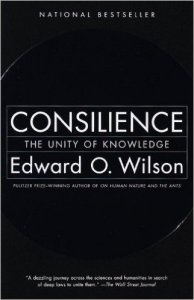
Third post about Edward O. Wilson’s 1998 book Consilience: The Unity of Knowledge.

(first post; second post)

Chapter 4, “The Natural Sciences”, focuses on the nature of science and how scientists actually work.

The great divide among cultures on Planet Earth is not political, racial, or religious; it is the divide between the scientific and the prescientific. He evokes a comparison to “intelligent fish born in a deep, shadowed pool”, without the benefits of “the instruments and accumulated knowledge of the natural sciences” —

Wondering and relentless, longing to reach out, they think about the world outside. They invent ingenious speculations and myths about the origin of the confining waters, of the sun and the sky and the stars above, and the meaning of their own existence. But they are wrong, always wrong, because the world is too remote from ordinary experience to be merely imagined.

A powerful analogy, one that has appeared in science fiction, which I will eventually explore and elaborate.

Wilson describes science, p45.8:

Science is neither a philosophy nor a belief system. It is a combination of mental operations that has become increasingly the habit of educated peoples, a culture of illuminations hit upon by a fortune turn of history that yielded the most effective way of learning about the real world ever conceived.

And later defines it, p53m; Science is

the organized, systematic enterprise that gathers knowledge about the world and condenses the knowledge into testable laws and principles.

He explores themes that appear in his later, more recently read, book, The Meaning of Human Existence, which I blogged about in several posts ending here: how we perceive only the tiniest sliver of available light, or of other electromagnetic signals, some of which are perceived by other species. Evolution explains why.

Science has five principles: repeatability; economy; mensuration; heuristics; consilience, p53b. The method of science is firstly reductionism, (which is what offends so many critics), but in the service of synthesis and integration, with the goal of universal laws.

Wilson has some insightful description into the nature of how scientists work, and what their work means. A scientist has to be compulsive, working 80 hours a week (taking into account routine academic responsibilities, teaching classes, et al, before doing actual research), and how ultimately research, and original discovery, is all that matters. It doesn’t matter how a scientist makes a discovery — in this sense it is an art form — it only matters that the claim is true and can be validated.

Then there is the question of whether scientists close in on an ultimate, objective, reality. Wilson describes the philosophies of positivism, in Europe, then pragmatism, in America, with the combination of logical positivism (p61-62), culminated in a 1939 conference at Harvard. Mathematics, they understood, is tautological: given premises, you can conclude anything. p63.2: “Pure mathematics is the science of all conceivable worlds, a logically closed system yet infinite in all directions allowed by starting premises.” (I perceive a SFnal element here.)

Logical positivism halted, because they could not agree on basic premises about fact v. concept, theory v. speculation. Wilson states:

Its failure, or put more generously, its shortcoming, was caused by ignorance of how the brain works. That in my opinion is the whole story.

And so what I realize in reading this almost 20-year-old book is that a couple key issues I’ve come to understand only recently are not in fact all that new. Wilson identifies two key points: that the mind was built for survival, and the key to perceiving reality is to take into account the biases of how the human mind was built for survival, not perception of reality.

Wilson returned to the themes in this book not only in The Meaning of Human Existence, in 2014, but also in The Social Conquest of Earth, in 2012, which I have but have not yet read. And several key themes in this current book echo issues in his earlier foundational books On Human Nature (1978) and Promethean Fire (1983), which I read back then, and has informed my thinking ever since.

Posted in Book Notes, Human Progress | Comments Off on EO Wilson, Consilience, 3

Links and Comments: Narrative; the Limits of Rationality

I seem to have not yet mentioned yet another essay about how narrative is taking over the world. James Murdoch (CEO of 21st Century Fox) a couple weeks ago in Time Magazine: Storytelling—both fiction and nonfiction, for good and for ill—will continue to define the world:

Storytelling isn’t always positive. In the midst of the chaos of Iraq and Syria, ISIS masterfully tells its story of blood-soaked vengeance against supposed oppressors in their own lands and those from the West. Its stories sow the seeds of unspeakable atrocities from Raqqa to Paris.

Entrenched and compromised interests spin the fiction that science is more divided than united, and they sow seeds of uncertainty on issues of unquestionable priority: namely, the survival of our species on this planet.

Political hopefuls, for high office and otherwise, create elaborate narratives that they themselves don’t believe.

Stories matter.

The essay also touches on how the wired world will penetrate bubbles:

In 2016, from Lhasa to Tehran to Odessa, people will continue to seek and find forbidden things. In this connected world, the game is up. Censors cannot hide, and their victims have decided, and are empowered, not to take it anymore. Italo Calvino had it right in If on a Winter’s Night a Traveler: “In the decree that forbids reading there will be still read something of the truth that we would wish never to be read.”

I read that Calvino meta-novel years ago, and perhaps should revisit it.

\\

Last week’s New York Times Magazine had a long essay, Follow Your Bliss, by Jennifer Kahn, about self-help groups in Silicon Valley (and the Bay Area) teaching methods of “cold, hard rationality” to help people make better decisions and lead more efficient lives.

The essay recognizes the central quandary:

Our minds, cobbled together over millenniums by that lazy craftsman, evolution, are riddled with bad mental habits. We routinely procrastinate, make poor investments, waste time, fumble important decisions, avoid problems and rationalize our unproductive behaviors, like checking Facebook instead of working. These ‘‘cognitive errors’’ ripple through our lives, CFAR argues, and underpin much of our modern malaise: Because we waste time on Facebook, we end up feeling harried; when we want to eat better or get to the gym more, we don’t, but then feel frustrated and guilty.

The two major groups discussed are LessWrong and http://rationality.org/ aka Center for Applied Rationality (CFAR, mentioned in the quote), and the essay describes various workshops, training camps, and methodologies designed to identify problems and find solutions. They sound interesting, and there are lots of resources on those two sites, though the writer has some misgivings:

And while some exercises seemed useful, other parts of the workshop — the lack of privacy or downtime, the groupthink, the subtle insistence that behaving otherwise was both irrational and an affront to ‘‘science’’ — felt creepy, even cultish. In the days before the workshop, I repeatedly asked whether I could sleep at home, because I lived just a 15-minute drive away. Galef was emphatic that I should not. ‘‘People really get much more out of the workshop when they stay on-site,’’ she wrote. ‘‘This is a strong trend … and the size of the effect is quite marked.’’

As it turns out, I wasn’t the only one to find the workshop disorienting. …

This mirrors to some degree the reactions of people who realize the claims of their religious traditions, about the supernatural and the nature of the world, are implausible, and leave their churches, yet still feel a need to attend a church, in the sense that they feel the benefit of being part of a community. There was a question about this issue in today’s Dear Abby! Abby’s answer: the Unitarian church.

This social need, versus the realization that religious claims about the nature of reality are obsolete, is a central issue in many thinkers on these issue, as alluded in my previous post about the EO Wilson book. About which more soon.

Posted in Narrative, Science | Comments Off on Links and Comments: Narrative; the Limits of Rationality

Film Review: JOY

From Facebook, 18jan16:

We caught up with JOY today, the third film from director David O. Russell starring Jennifer Lawrence and Bradley Cooper, following SILVER LININGS PLAYBOOK (for which Lawrence won an Oscar) and AMERICAN HUSTLE. It’s a story about a rural American housewife, in the late ’80s or so, who lives with two kids, an ailing grandmother who watches soap operas all day, and in the basement, her father and her lounge-singer ex-husband. She has a talent for inventiveness, and after an incident on a sailboat with her father’s new girlfriend (played by Isabelle Rossellini!), she conceives a kind of mop with a self-wringer handle. Her ex connects her with an exec at the QVC shopping channel to sell it on late-night TV. The initial pitch does badly; she insists on a second pitch with herself doing the pitch, and becomes wildly successful. To a point.

The story has a traditional plot arc: initial success, followed by challenges that threaten to destroy that success, in one two three fashion, until a final validation. The best scenes are showcases for the actors: especially Jennifer Lawrence, in later scenes where she confronts the people trying to take advantage of her; with Bradley Cooper as he shows off the QVC set and its production; with Isabelle Rossellini as the hard-headed business-women who’s eager to cut losses and declare bankruptcy. (Robert De Niro’s best line, “I gotta admit I’m kinda proud of you”, is in the trailer.)

My personal reaction is that this illustrates why I could never be a business person.

http://www.imdb.com/title/tt2446980/

Posted in Films | Comments Off on Film Review: JOY

EO Wilson, Consilience, 2

Second post about Edward O. Wilson’s 1998 book Consilience: The Unity of Knowledge.

(first post)

Chapter 2, “The Great Branches of Learning”, seems a bit off the mark since it doesn’t address those branches directly.

Wilson says the Enlightenment thinkers of the 17th and 18th centuries got it mostly right, and he defines ‘consilience’ quoting William Whewell: “literally a ‘jumping together’ of knowledge by the linking of facts and fact-based theory across disciplines to create a common groundwork of explanation.”

He gives an example of how environmental policy, ethics, biology, and social science all meet at some common center, yet have separate methods and terminologies. Yet there’s nothing in principle that should separate them into inseparable disciplines.

He realizes he will be accused of reductionism, of ‘scientism’… to which he pleads guilty guilty guilty!

Philosophy, he suggests, has just two issues concerning science: the questions that science can’t answer, and the reasons it can’t answer them, p11.7

But he anticipates that cultural issues will eventually be enlightened by science, including the humanities, and the creative arts.

A big problem toward this goal is that universities have abandoned the idea of any kind of common understanding — there are fewer required courses, less and less presumed shared understanding, or general understanding of scientific issues. The same is true among lawmakers, pundits, the media 13.8. Yet he’s sure the long-term trend toward unification is inevitable.

Chapter 3, “The Enlightenment”, is much more interesting. I’ve read enough glosses on the history of science, of the scientific revolution and the enlightenment, to have a general idea of how those ideas mattered, and who the general players were. Wilson’s take is to emphasize how the Enlightenment *failed*, which he illustrates with an account of the life of the Marquis de Condorcet (whom I’ve encountered in not one but two other books read this past year — those by Jordan Ellenberg and Chris Mooney).

Condorcet was a brilliant mathematician, who applied his ideas to political theories, but he took up politics, chose the wrong side, and was condemned to prison where he died. He believed in the Enlightenment idea of laws of physics and perhaps of society, thus the idea of a perfectible society.

Wilson suggests that the ideas of social perfection aligned to tyrants who attempted to enforce social perfect to the point of condemning and executing naysayers — including, collaterally, Condorcet. Followed by what became the French revolution, and then the many tyrants of the 20th century.

I don’t think that Wilson implies that the scientific ideals of the Enlightenment — he considers Francis Bacon at length, and Descartes, and Newton — directly influenced those tyrants. But he does suggests that the Enlightenment ideals failed to satisfy issues about culture, in particular about human nature, and the failure to identify a basis for morality. At the same time, the idea of social perfection was seen by some as a trap, or an upset to the natural order: thus the beginning of stories about monsters, threats to the natural order that must be defeated. (A central SF theme, I think, especially about the ‘thriller’ genre.)

And then came the Romantic revolution, with emphasis more on naturalism and metaphysics, a trend Wilson follows all the way to the professional specificity of scientists, to the 20th century idea of artists to be unique rather than part of any tradition, to the late 20th century ideas of multi-culturalism, post-modernism, and deconstructionism.

Wilson identifies a central flaw of the Enlightenment scientists and intellectuals, who were deists:

The fatal flaw in deism is thus not rational at all, but emotional. Pure reason is unappealing because it is bloodless. Ceremonies stripped of sacred mystery lose their emotional force, because celebrants need to defer to a higher power in order to consummate their instinct for tribal loyalty. In times of danger and tragedy especially, unreasoning ceremony is everything. There is no substitute for surrender to an infallible and benevolent being, the commitment called salvation. And no substitute for formal recognition of an immortal life force, the leap of faith called transcendence. It follows that most people would very much like science to prove the existence of God but not to take the measure of His capacity.

Later, Wilson considers post-modernist views all the way to Michel Foucault, and opines, “To the extent that philosophical positions both confuse and close doors to further inquiry, they are likely to be wrong.” But at the end of this history, Wilson is optimistic:

Once we get over the shock of discovering that the universe was not made with us in mind, all the meaning the brain can master, and all the emotions it can bear, and all the shared adventure we might wish to enjoy, can be found by deciphering the hereditary orderliness that has borne our species through geological time and stamped it with the residues of deep history. Reason will be advanced to new levels, and emotions played in potentially infinite patterns. The true will be sorted from the false, and we will understand one another very well, the more quickly because we are all of the same species and possess biologically similar brains.

Here I will note that ideas that I’ve only become aware of in recent years — the idea of the human mind being optimized not for perception of reality, but for survival; the emphasis of *narrative*; and so on — are clearly identified in this 18 year old book. The ideas aren’t that new, though they have become clarified in recent years. In fact, Wilson describes how Francis Bacon, way back in the early 17th century, understood aspects of what we now call psychology — he used *stories* to put forth his ideas! (p26b). And he warned against various “idols of the mind”, 27t — idols of the mind, the marketplace — clear foreshadowing of the numerous mental biases identified by psychologists in the past couple decades.

Wilson concludes by granting that postmodernist ideas are like fireworks — most of them will burn out quickly, but a few might illuminate something interesting. And they cannot help but strengthen the traditional ideas they critique, which must endure that criticism. And if somehow they bring the whole grand scheme of modern science down — then we will start over. Because we must, we must understand.

Posted in Book Notes, Human Progress | Comments Off on EO Wilson, Consilience, 2

EO Wilson, Consilience, 1

So now, after reading Edward O. Wilson’s The Meaning of Human Existence a bit over a year ago (last of five posts about it here), I’m returning nearly 20 years to one of his earlier, foundational I think, books: Consilience: The Unity of Knowledge, published in 1998, which I think I must have sampled a bit back then, but which for some reason never got around to reading through. (The cover of my first edition does not have any of the texts above or below those two lines that frame the title and author in this just-grabbed-from-Amazon cover image.)

(In general, I am sifting through my library of several hundred nonfiction books on everything from cosmology to evolution to mind to complexity theory to religion to the future of humanity in space, volumes accumulated over the past 40 years, culling them down to the essential volumes that relate [not necessarily support] to the framework of my ‘provisional conclusions’, digging up long ago compiled notes about some of them, and reading for the first time some of those I’ve yet to closely visit.)

I’m now only about a third of the way through this book, but I think I’ll begin compiling summary, and quotes, as I go. Wilson included his idea of a ‘consilience’ between science and the humanities in The Meaning of Human Existence, and so I proceed with some apprehension in this earlier book that there is no new grand insight to be discovered, only detailed justification. So far I’ve found that, yes, but also elegant, insightful writing, and detailed examinations of the historical and scientific backgrounds that support his thesis.

The first chapter is brief, autobiographical. Wilson grew up in Alabama, a Southern Baptist, enamored of critters in the woods, especially ants, frogs, and snakes, and how the 18th century Swedish naturalist Linnaeus had come up with a classification scheme (still used, of course) for all life. Then in college his mentor gave him a book on evolution by Ernst Mayr — his 1942 book Systematics and Origin of Species [Amazon — everything is on the internet!] — and it was to Wilson a revelation, an epiphany. Suddenly everything made sense in new way. He’d experienced what he calls an “Ionian Enchantment”, the notion, going back to the early Greek philosopher Thales, that the world is orderly, and can be understood.

And Wilson found himself “released from the confinement of fundamentalist religion.” He’d been raised a Baptist, had been born again, had read the Bible twice.

But now at college, steroid-driven into moods of adolescent rebellion, I chose to doubt. I found it hard to accept that our deepest beliefs were set in stone by agricultural societies of the eastern Mediterranean more than two thousand years ago…

But most of all, Baptist theology made no provision for evolution. The biblical authors had missed the most important revelation of all! Could it be that they were not really privy to the thoughts of God? Might the pastors of my childhood, good and loving men though they were, be mistaken?

He drifts away from the church, yet:

I also retained a small measure of common sense. To wit, people must belong to a tribe; they yearn to have a purpose larger than themselves. We are obliged by the deepest drives of the human spirit to make ourselves more than animated dust, and we must have a story to tell about where we came from, and why we are here. Could Holy Writ be just the first literate attempt to explain the universe and make ourselves significant within it? Perhaps science is a continuation of new and better-tested ground to attain the same end. If so, then in that sense science is religion liberated and writ large.

Here in this paragraph he displays more wisdom than any number of authors of crude atheistic critiques of religion (as I described them a couple posts ago), who think pointing out the lack of evidence for implausible supernatural claims should persuade people to abandon their faiths. It doesn’t work that way.

He concludes this introductory, autobiographical, chapter, with an evocation of Daedalus, and quotes Eddington: “Let us see how high we can fly before the sun melts the wax on our wings”.

Subsequent chapters include a fascinating history of The Enlightenment, and how it failed, and much insight into how science, and scientists, works.

Posted in Book Notes, Human Progress | Comments Off on EO Wilson, Consilience, 1

Links and Comments: Fear, Terrorism, Fear, and Religion

The New Yorker, January 2, 2016: Thinking Rationally About Terror, by Lawrence M. Krauss

How people overestimate the risk of low-probability (but highly-publicized) dangers, like terrorism, and seldom worry about more mundane dangers, like gun violence and auto crashes.

As far as the U.S. is concerned, it has been pointed out already—by the President, in fact—that about thirty-three thousand people die each year from gunshot wounds. That’s about four hundred thousand people since 2001. By contrast, setting aside 9/11, and even including the San Bernardino shootings, only fifty-four deaths have occurred because of domestic acts of terrorism during that time. Even if you include 9/11, the total death toll from terrorism amounts to less than one per cent of the death toll from gun violence.

A cynical individual might wonder who benefits more from the terror induced by terrorism: the terrorists themselves or the politicians and governments who use the public reaction to acts of terror for political gain? Hermann Göring, interviewed during the Nuremberg Trials, said, “The people can always be brought to the bidding of the leaders. That is easy. All you have to do is tell them they are being attacked and denounce the pacifists for lack of patriotism and exposing the country to danger. It works the same way in any country.” We need to be vigilant against those who seek to manipulate us—whoever they are.

The difference is that terrorism is historical rare, and thus novel — and it thus triggers emotional responses far out of proportion to the actual risk. Republicans, the party of conservatives, who are more given to fear, of course, play up the danger to score political points.

\\

Also involving politics, two examples of Republican politicians who seem unclear on the distinction between rule of law and theocracy.

Via The Morning Heresy:

Marco Rubio goes the Full Jesus in a new ad, in which he says, over a sweet and mellow piano underscore:

Our goal is eternity, the ability to live alongside our Creator and for all time, to accept the free gift of salvation offered to us by Jesus Christ. The struggle on a daily basis as a Christian is to remind ourselves of this. The purpose of our life is to cooperate with God’s plan, to those who much has been given much is expected and we will be asked to account for that. Were your treasures stored up on earth or in Heaven and to me I try to allow that to influence me in everything that I do.

This recalls an item from the David Silverman book I don’t think I mentioned: as he points out, “the US Constitution outranks everything, including religious texts”. He proposes an adaptation to official oaths, p52:

The current Presidential Oath of Office reads, “I do solemnly swear (or affirm) that I will faithfully execute the Office of President of the United States, and will to the best of my ability, preserve, protect and defends the Constitution of the United States.” Simply append “as the supreme law of the land” to the end. There! That is my kind of religious test — say yes to the supremacy of the Constitution as the law of the land or go become a preacher instead.

As it is, not just Rubio (and Santorum and Huckabee) but the vile Ted Cruz plays off the worst aspects of Christianity, not the best, as David Brooks explores in today’s paper: The Brutalism of Ted Cruz:

The best conservatism balances support for free markets with a Judeo-Christian spirit of charity, compassion and solidarity. Cruz replaces this spirit with Spartan belligerence. He sows bitterness, influences his followers to lose all sense of proportion and teaches them to answer hate with hate. This Trump-Cruz conservatism looks more like tribal, blood and soil European conservatism than the pluralistic American kind.

Posted in Culture, Politics, Religion | Comments Off on Links and Comments: Fear, Terrorism, Fear, and Religion