Carlo Rovelli, SEVEN BRIEF LESSONS ON PHYSICS

Very slender book, drawn from a newspaper column and intended for readers who know nothing about science. I read it because it’s short and because a NYT review of the book, pointed out that its final chapter is about human meaning in the universe as discovered and described by physics—with a sobering conclusion.

(Also, there’s a chapter on ‘quantum loop gravity’, one way of resolving the conflict between relativity and quantum mechanics, something I hadn’t heard of, which happens to be Rovelli’s specialty.)

One point from early in the book is how scientists by their nature express caution and doubt:

Note the wonderful initial “It seems to me…,” which recalls the “I think…” with which Darwin introduces in his notebooks the great idea that species evolve, or the “hesitation” spoken of by Faraday when introducing for the first time the revolutionary idea of magnetic fields. Genius hesitates. (p15)

And a bit later, concluding a discussion about Einstein and Bohr: “To the very last, the desire to challenge oneself and understand more. And to the very last: doubt.”

In the final chapter, “In Closing”, Rovelli asks,

What role do we have as human beings who perceive, make decisions, laugh, and cry, in this great fresco of the world as depicted by contemporary physics? If the world is a swarm of ephemeral quanta of space and matter, a great jigsaw puzzle of space and elementary particles, then what are we?

His answer, p66-67

We are also an integral part of the world that we perceive; we are not external observers. We are situated within it. Our view of it is from within its midst. We are made up of the same atoms and the same light signals as are exchanged between pine trees in the mountains and stars in the galaxies.

We have learned that our being is only a part of the universe, and a small part at that. This has been increasingly apparent for centuries, but especially so during the last century. We believed that we were on a planet at the center of the universe, and we are not. We thought that we existed as unique beings, a race apart from the family of animals and plants, and discovered that we are descendants of the same parents as every living thing around us. We have great-grandparents in common with butterflies and larches. We are like an only child who in growing up realizes that the world does not revolve only around himself, as he thought when little. He must learn to be one among others. Mirrored by others, and by other things, we learn who we are.

If we are special, we are only special in the way that everyone feels themselves to be, like every mother is for her child. Certainly not for the rest of nature.

We gradually learn the nature of the real world, in ways that are different from the mythmaking of human history. “The confusion between these two diverse human activities—inventing stories and following traces in order to find something—is the origin of the incomprehension and distrust of science shown by a significant part of our contemporary culture.” P69.

P75b “Our moral values, our emotions, our loves are no less real for being part of nature, for being shared with the animal world, or for being determined by the evolution that our species has undergone over millions of years. Rather, they are more valuable as a result of this: they are real. They are the complex reality of which we are made.”

And Rovelli gradually moves toward startling existential pessimism, p77:

We are a species that is naturally moved by curiosity, the only one left of a group of species (the genus Homo) made up of a dozen equally curious species. The other species in the group have already become extinct—some, like the Neanderthals, quite recently, roughly thirty thousand years ago.

And his conclusion:

I believe that our species will not last long. It does not seem to be made of the stuff that has allowed the turtle, for example, to continue to exist more or less unchanged for hundreds of millions of years, for hundreds of times longer, that is, than we have even been in existence. We belong to a short-lived genus of species. All of our cousins are already extinct. What’s more, we do damage. The brutal climate and environmental changes that we have triggered are unlikely to spare us.

As we know more or less well how to deal with our individual mortality, so we will deal with the collapse of our civilization. It is not so different. And it’s certainly not the first time that this will have happened. The Maya and Cretans, among many others, already experienced this. We are born and die as the stars are born and die, both individually and collectively. This is our reality. Life is precious to us because it is ephemeral.

Yet he ends on an upbeat note.

It is part of our nature to love and to be honest. It is part of our nature to long to know more and to continue to learn. Our knowledge of the world continues to grow. … Here, on the edge of what we know, in contact with the ocean of the unknown, shines the mystery and the beauty of the world. And it’s breathtaking.

Posted in Book Notes, Science, Species Reset | Comments Off on Carlo Rovelli, SEVEN BRIEF LESSONS ON PHYSICS

Links and Comments: the mystery of monogamy; why people cannot live with doubt

Los Angeles Times op-ed by [evolutionary psychologist] David P. Barash: Our biology wants us untethered. So why does society place so much emphasis on monogamy?

Monogamy is a mystery. A Martian zoologist, visiting Earth and noting our basic biology — not to mention our frequent philandering — would conclude that monogamy is not “natural” to the human species. So why is it so widely promulgated, especially in the modern Western world?

The (traditional) answer is that monogamy is a kind of social contract that limits individual freedom – the freedom of powerful men to maintain harems – in order to preserve a larger social harmony that is gained by avoiding the concomitant proportion of men who are thus deprived of female companionship. (An initial step toward *socialism* I might observe, and a case against libertarianism, wherein any alpha male would be allowed to accumulate as large as harem as he could.)

Also,

Monogamy may improve the survival rates of offspring because males will know which babies are theirs and will therefore be more likely to support them. There is much biological wisdom behind the saying “Mommy’s babies, Daddy’s maybes,” and monogamy diminishes the maybe.

Of course. This is elementary evolutionary psychology.

\\

Damon Linker, at The Week, on Why doubt is so difficult.

An existential consideration about why people believe certain narratives, vs understanding the real world, which entails provisional conclusions based on evidence and reason.

Nothing about human history or the present world gives us reason to conclude that most people are thoughtful, inclined toward standing back and judging their beliefs in a detached and dispassionate way, living in doubt, and affirming a life dominated by questions rather than answers. On the contrary, human history and the present world teach a far more muddled and troubling lesson, which is that the vast majority of people who have ever lived find it perfectly possible and even downright appealing to affirm certainty about a range of issues, including the divine.

The natural condition of humanity, you might say, is relatively passive, dogmatic belief in whatever the political, moral, and religious authorities teach in a given time and place about right and wrong, good and bad, just and unjust — and about God or the gods.

Yes, very few people actively think things through and reach conclusions based on reason, let alone evidence. Most people’s beliefs, to the extent they recognize them *as* beliefs and not merely as assumptions, are drawn from their communities or tribes, absorbed without reflection, defended without doubt.

Posted in Uncategorized | Comments Off on Links and Comments: the mystery of monogamy; why people cannot live with doubt

Reading Around the Bible, 4: Luke

Just starting the fourth gospel, John, so let me write up impressions of Luke first, beginning with some broad observations and questions:

  • The whole idea of fulfilling prophecies, which the gospels variously emphasize, becomes considerably less impressive once you notice that Jesus himself knew of the prophecies he was supposedly fulfilling — to the point of quoting Isaiah.
  • How is it that though Jesus was supposedly fulfilling Jewish prophecies, most *Jews* remained unconvinced of his messianic status and never became Christians? Did the ‘miracles’ not persuade them? Jesus’ followers were apparently mostly Gentiles, so why would they have cared about Jewish prophecies? Part of the answer seems to be that the Jews who opposed Jesus were the Pharisees, the scribes, and so on — i.e. the *establishment*, obsessed with rules, rituals, and purity, and nervous about anyone upsetting their order. Jesus was preaching not to them but to the downtrodden… in a way that resembles the appeal of certain contemporary politicians, who rail against the establishment, who promise the return of lost glory (to some, Jesus as messiah heralded the re-establishment of the Jewish state against Roman rule), and who as a consequence find plenty of followers. No doubt there have been would-be leaders like this throughout history; they only become heroes, or messiahs, when their followers prevail.

And then comments about specifics in Luke, with references to Asimov’s Guide to the Bible: The New Testament:

  • 1:28, 1:46, 1:67. Asimov describes how these phrases became common hymns.
  • Asimov, p265ff, explains the theological motives for placing Jesus’ birth in Bethlehem, and the implausibility of the Romans conducting a census that would require entire families, including pregnant women, to travel to the town of their ancestors. p267.8: “It is hard to imagine a more complicated tissue of implausibilities and the Romans would certainly arrange no such census.”
  • Asimov spends several pages describing the historical circumstances for why Christians ended up celebrating Christmas on December 25th, including the usual idea of the appropriation of existing pagan holidays, the difference between lunar and solar calendars, and the schisms that resulted from rival methods of determining the date of Easter. The fact that Easter was determined on the lunar calendar (which is why it floats in our solar calendar), while Christmas is fixed in the solar calendar, indicates Easter was established as a holy day first, Christmas much later, after A.D. 300.
  • Asimov p275 also explains how year 1 came to be established — in part because Dionysius Exiguus, hundreds of years later, took Luke 3:23 — “And Jesus himself began to be about thirty years of age…” — too literally.
  • 3:23 ff: the geneologies in Luke don’t match those in Matthew.
  • 4:31, 5:20, 5:24: Luke and people of the time believed that illness was the result either of possession by demons, or the result of sin. Do believers today believe in demons and that illness is a consequence of sin? I suppose some do. (Certainly there are occasionally those stories of parents who refuse their children medical attention in preference to prayer, with tragic results.)
  • 6:20, the beatitudes seem to be commonly thought inspired, revolutionary teachings of a gentle soul to downtrodden folks, but squint at these right and they are a kind of rabble-rousing, a reassurance to the weak and powerless that they will prevail and the rich establishment will be overthrown. Also, 6:27 and following, does anyone actually follow this advice?
  • 7:31, 32: a cliche of history: the current generation is always shiftless and spoiled (and life was so much better in the good old days!).
  • 8:10: Jesus speaks in parables deliberately to confuse people, and says so.
  • Asimov p280 emphasizes Luke’s point of view as a gentile, explaining some of the variations between this gospel and the earlier ones. Narrative!
  • 10:10 and following: If you don’t believe you will be destroyed!
  • 10:16: In this verse it’s not about the message, but about the messenger, who seems to be in effect saying, “it’s all about me”.
  • 16:25: the fires of hell just for being rich! Presumably this played to the poor, downtrodden crowds. Asimov, p285, describes how conceptions of hell, ideas of good and evil, rewards and punishment, changed over the centuries; earlier ideas of hell were more about a “gray nothingness”; it took the Christians to turn it into a place of eternal fire.
  • 18:17, “Truly I tell you, whoever does not receive the kingdom of God as a little child will never enter it.” (As in Mark.) It strikes me that there’s a big difference between the kind of ‘truths’ best understood by children versus the kinds of ‘truths’ best understood by adults. The latter can be much more difficult, yet are more likely to be real. Beware anything best understood by a child.
  • Ch24, the resurrection: how much more detail Luke has discovered since the earlier gospels!

This last item reminds me of another general issue about ancient texts like these, especially the gospels and the life of Jesus. The gospel writers were not eye-witnesses. Who were their sources, even in principle? For every story about Jesus, if it actually happened, there would have to have been some eye-witness who later told the story to others, becoming one story among many later collected and recounted in the gospels. It’s plausible enough that each of the gospel writers might have gathered a somewhat different set of stories. But has anyone ever tried to figure out who the presumed original eyewitnesses even could have been? For the three wise men (did the wise men tell the story? Did Mary?) For the 12-year Jesus hanging out in the temple impressing the teachers there (the teachers? Who could have reported that it took Jesus’ parents 3 days to find him?) Who would have first passed on such stories? …Or are many or most of these passages in the gospels related more as parables or story-lessons than as historical incidents?

Posted in Bible | Comments Off on Reading Around the Bible, 4: Luke

Links and Comments: Historical Jesus; God’s Plan; Sagan on religion v science

Relevant to some of my current reading, and the recent Easter holiday:

Salon from last year, Valerie Tarico, 5 good reasons to think Jesus never existed.

Most antiquities scholars think that the New Testament gospels are “mythologized history.”  In other words, they think that around the start of the first century a controversial Jewish rabbi named Yeshua ben Yosef gathered a following and his life and teachings provided the seed that grew into Christianity.

At the same time, these scholars acknowledge that many Bible stories like the virgin birth, miracles, resurrection, and women at the tomb borrow and rework mythic themes that were common in the Ancient Near East, much the way that screenwriters base new movies on old familiar tropes or plot elements. In this view, a “historical Jesus” became mythologized.

Familiar ideas, some of which overlap my current reading and own thoughts about reading the New Testament. Her five points are: 1) No secular evidence; 2) earliest NT writers have least to say about Jesus’ life, later ones somehow have more; 3) NT stories aren’t first-hand accounts; 4) the gospels contradict each other; 5) modern scholars disagree with each other about the nature of the putative ‘historical’ Jesus.

On the second item, she makes this key point:

Liberal theologian Marcus Borg suggests that people read the books of the New Testament in chronological order to see how early Christianity unfolded.  “Placing the Gospels after Paul makes it clear that as written documents they are not the source of early Christianity but its product. The Gospel — the good news — of and about Jesus existed before the Gospels. They are the products of early Christian communities several decades after Jesus’ historical life and tell us how those communities saw his significance in their historical context.”

So when Paul and others were writing all those epistles that fill out the NT, the gospels hadn’t been written yet! (The NRSV and Miller volumes I have do mention presumed dates of authorship of all these books, but I haven’t seen either make this it-seems-to-me crucial point. But I am still working my way through the NT; have just finished Luke.)

\\

And a reminder that the Jesus story is hardly unique, just the best-known: All the Gods That Rose From the Dead in Spring Before Jesus Christ.

In the same way many ancient Mediterranean societies told tales of gods born to virgins (some on December 25) before the time of Christ, the archetype of gods rising from the dead is likewise older than Christianity, an uncomfortable historical fact for many religious people but not necessarily unforeseeable given the power of human imagination and the long stretch of human history before the Common Era (or Anno Domini, A.D., if you prefer). …

\\

Via Facebook, here is a Twitter post with an #Easter Quiz, with answers. Sample:

1. Who first came to the tomb on Sunday morning?
One woman (John 20:1)
Two women (Matt. 28:1)
Three women (Mark 16:1)
More than three women (Luke 23:55-56; 24:1,10)
Correct answer: A, B, C, and D.

\\

Also via Fb, yet another alternate Ten Commandments:

New Ten Commandments

Sample: “Prayer is for man. I don’t need your groveling. It’s supposed to make you feel better. If it doesn’t — stop doing it.”

And:

“You don’t know as much as you think you do. When in doubt forgive. When certain use reason or set example.”

\\

Latest Jesus and Mo comic, again one from a while back, but still pertinent: plan2: “Having created sinful man, I then contrive to get myself killed in order to save him from my wrath, for it is only the spilling of my own blood that can appease me, and cleanse man’s sin…”

\\

Again, from quite some time back — 1985 — a video with Carl Sagan being interviewed by Studs Terkel, about extraterrestrials, with these key points:

It’s inevitable that humans would project their hopes and fears upon the cosmos. ….

There is a tendency in both schools of thought [science and religion] that they have a corner on the truth. I mean, a way to look at it is, science and religion on some level are after the same thing. Take the questions of our origins. Both science and religion attempt to approach this question. But the religions all contradict each other, so they can’t all be right. The Judeo-Christian Islamic religion holds that the world is about 6,000 years old, you just count up the begats in the Old Testament. It’s very clear, 6,000 years old. The Hindus have an infinitely old universe, with an infinite number of creations and destructions of the whole universe. Now those two major religions can’t both be right. How do you tell which is right and which is wrong? Well, the only way is to appeal to the natural world around us, and the natural world around us show that the Earth, for example, is about 4.6 billion years old, and nothing like 6000 years old. So a literal reading of the Bible simply is a mistake. I mean it’s just wrong, it’s just wrong. As a work of science it’s flawed, it’s the science of the Babylonians in the sixth century B.C. We’ve learned something since then.

Posted in Bible, Religion, Science | Comments Off on Links and Comments: Historical Jesus; God’s Plan; Sagan on religion v science

Links and Comments: Terrorists and Threats

Cartoon by Mark Fiore: Thank You. Love, ISIS.

Why? A piece by Nicholas Kristof in today’s NY Times explains. It’s called Overreacting to Terrorism? online and “Terrorists, Tubs and Snakes” in the print paper.

The basic problem is this: The human brain evolved so that we systematically misjudge risks and how to respond to them.

We over-estimate the danger of rare, unusual threats, while we ignore common, everyday threats that we learn to live with. Terrorists vs. car crashes. And disregard potential threats so long-range we think they won’t happen in our lifetimes.

This has been long-recognized; e.g. in the 1999 book by Barry Glassner, The Culture of Fear, subtitled “Why Americans Are Afraid of the Wrong Things…”

Just another example of how human “common sense” — a result of millions of years of evolution in relatively stable, predictable environments — goes haywire in the modern world, with so many new experiences and unfamiliar forces.

The result is our current political climate, with the Republicans, the conservatives, playing off instinctive fears of terrorist threats, highlighted and drummed up by the media (if it bleeds, it leads). The Republican hysteria about terrorists is playing into their hands; to the extent we curtail ordinary human rights and cower in fear, the terrorists have won.

Kristof again:

On the same day as the attacks, a paper by James E. Hansen and other climate experts was released arguing that carbon emissions are transforming our world far more quickly than expected, in ways that may inundate coastal cities and cause storms more horrendous than any in modern history. The response? A yawn.

Posted in Culture, Evolution | Comments Off on Links and Comments: Terrorists and Threats

Reading Around the Bible, 3: Mark

Some of these comments apply, of course, to Matthew as well.

  • All maladies are due to spirits or demons. It’s been noted by critics that the Bible contains no knowledge that was not known to its writers; that is, though supposedly inspired by God, who is omniscient, nothing he communicated to its writers includes anything that might have benefited or informed humanity beyond their local observations, such as the germ theory of disease or the idea that the sun and planets are celestial bodies, not merely lights in the sky. One ironic exception is, in Mark 7:3, the Pharisees’ complaint that Jesus and his followers were not washing their hands before eating. This is ironic because medical science didn’t actually believe in the efficacy of washing one’s hands before surgery, in order to not pass on infections to patients, until the late 19th century (IIRC). However, Mark (and Matthew too, I think), mention this only so Jesus can make a point about following the Commandments rather than the Pharisees’ Talmudic rules: Jesus thinks following the commandment that children who do not honor their parents should be killed is more important than washing one’s hands.
  • It’s remarkable how many people there are everywhere who are sick or lame.
  • 3:15, the apostles are authorized to cast out demons too!
  • 5:9, ‘My name is Legion’, a turn of phrase that SAB takes too literally (as a demon named Legion) was the title of a 1976 Roger Zelazny collection of three inter-related novellas; just one of *many* phrases in the gospels and the Bible as whole, of course, familiar in contemporary culture and discourse and as literary references, and which I won’t bother to cite.
  • 5:26, Jesus heals a woman who “had been suffering from hemorrhages for twelve years” (!) and had “endured much under many physicians”. The granddaddy of all faith healing narratives? The justification for people who to this day deny their children medical treatment, and pray instead? (Of course, medicine was rather primitive all the way up to 100 years ago or so.)
  • 8:31, Jesus obviously knows the story, or prophecy, he is to play.
  • 9:31, and other places in which Jesus himself prophecies that he will be killed and arise after 3 days: Asimov points out that, given the time of the arrest to the time of the resurrection, it wasn’t actually 3 days; it was 2 nights and one day. Asimov p236
  • 9:42, the commentator in the Oxford NRSV for Mark is different than the one for Matthew, and they say some strikingly different things to parallel passages in the two gospels. The commentator for Mark suggests the lines about cutting off one’s hand and plucking out one’s eye are metaphors and euphemisms for sins of male sexuality! (That two commentators in what is surely one of the most intellectually exhaustive annotations of the Bible currently available differ in their interpretations… speaks volumes, of course.)
  • 10:10, this time Jesus says you can divorce, but remarrying is equivalent to adultery. In any event, more advice that most Christians ignore.
  • 10:15, “Truly I tell you, whoever does not receive the kingdom of God as a little child will never enter it”. Get them while they’re young! (Children will believe anything.) Though again, the commentator thinks it’s not literal, but rather, as with so much Jesus says, a metaphor about the state of Israel under rule of the Romans.
  • Most remarkably, the end of Mark – the first gospel to be written – has none of the later sightings of the resurrected Jesus that we read about in Matthew; those passages, past 16:8, were added in the 2nd century CE (A.D.)!, according to the Oxford NRSV. Those later passages also include “signs” that “will accompany those who believe”, including speaking in tongues and picking up snakes with their hands, and how drinking deadly things will not hurt them. Sound advice for believers to this day who occasionally kill themselves as a result.

It’s been noted that Christianity is, among the general population (i.e. excluding the priests and the scholars), a tradition without much first-hand knowledge of the Bible. The atheists who seek to undermine religious fundamentalism (Sam Harris, Michael Shermer) are more familiar with the Bible than the vast majority of believers. Believers learn the traditions orally, through church sermons and Sunday School classes, and are never troubled by the grotesque, implausible passages of their holy book. So far, I find the Bible a fascinating artifact of primitive humanity, a storybook of discredited cosmologies and beliefs about how the world works, and, considering how long after the events most of its books were written, a prime example of how ‘history’ (of any kind, perhaps) is a result of the motivations of those who won and have an agenda to push.

Posted in Bible, Book Notes | Comments Off on Reading Around the Bible, 3: Mark

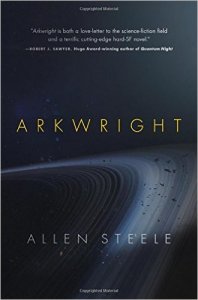
Allen Steele, ARKWRIGHT

I’ve read three recent 2016 novels in the past couple weeks, and am reading them faster than I take the time to key in notes and post summaries on my blog. But I will! First up is the last one I just read, Allen Steele’s Arkwright. Some of its content first appeared as a series of novelettes over the past couple years in Asimov’s magazine, and because of that, though its themes relate to those of Kim Stanley Robinson’s Aurora (review here; follow-up thoughts here), I don’t think it can be considered a *response* to KSR; rather, in a sort of equivalent to steam-engine time, both authors are rethinking standard assumptions about interstellar travel and colonization, and coming up with different solutions.

Steele imagines a famous science fiction writer named Nathan Arkwright, whom he describes as among the ‘big four’ along with Asimov, Clarke, and Heinlein, and known for his ‘Galaxy Patrol’ series beginning around 1950. The novel opens with his death in 2006, and his granddaughter’s attendance at his funeral, where she, Kate Morressy, meets three of his long-time associates: his agent Margaret Krough, fellow author Harry Skinner, and fellow traveler George Hallahan, a physicist. Kate learns that her grandfather established a foundation to invest his savings into a venture to build a starship within 100 years.

And because of problems with generation starships, and hibernation etc., (p100, which echoes KSR’s thinking), Arkwright’s scheme is to sent a starship full of eggs and sperm, to be combined into a set of infants to be raised by robots once the starship reaches its destination.

The book follows generations of Arkwright’s descendants as his idea for a starship is funded, built, and launched — it’s called Galactique, and its destination, a planet around star Gleise 667C-e, is dubbed Eos. This is a “generation starship” novel in the sense that it is about a starship whose launch involves generations — not because generations of passangers live on the starship.

The highlights of the book are the first part and the last part. (The middle parts are charming, though they involve many idealistic romances and little discussion of consequences, e.g. once the foundation’s ‘beamer’ saves the planet from the destruction, wouldn’t they become world heroes? No mention.)

The first part is an imaginary description of the first World Science Fiction Convention, in 1939, where there actually was a dispute (documented in real nonfiction books by Asimov and Knight) between the ‘Futurians’, who believed science fiction could be a force for social progress, and the leaders of the convention, notably Sam Moskowitz, who thought the Futurians communists. In Steele’s version, Arkwright and his friends — Krough, Skinner, and Hallahan — sit in a diner across the street from the convention, and invent their own league, the ‘Legion of Tomorrow’.

And the last section, which shifts perspective to a culture of 4-legged beings with a rigid religious society run by Disciples who believe in the unchanging ‘Gal’ in the sky, lore about the ‘chosen’ who came from Erf to Eos, and belief in the afterlife. This section completes the novel in a way that invokes the classic science fictional trope of the conceptual breakthrough, in this case, ‘everything you’ve been taught is wrong’, done here effectively and dramatically.

If I were to quibble about this book, it would be about the slightly too-easy dramatics of the middle sections, the generations of romances, and the predictable interference by religious zealots. But overall, I think this is a worthy epic that updates and reimagines science fiction’s ‘faith’ in the future in which humanity will expand beyond the physical scope of our planet, and the idea that human ‘faith’ in ancient stories can give way to acknowledgement and understanding of reality. This is what science fiction is all about.

Posted in Book Notes, science fiction | Comments Off on Allen Steele, ARKWRIGHT

Reading Around the Bible, 2: Matthew

Having finished the Old Testament a couple weeks ago, and passing over the Apocrypha for now, I decided to proceed with the New Testament by not only reading *around* it via commentaries by others, but to in parallel read the books themselves. I’ve finished Matthew. Of the commentators mentioned earlier, Miller is now of little use, while Asimov (who has 137 pages of commentary about just Matthew!) is of the most use, along with the very detailed footnotes in the Oxford NRSV.

Without pretending any kind of thorough analysis, I’ll list some initial thoughts of reading Matthew below. First, context from Pinker, p12:

Just as the Hebrew Bible offers a glimpse into the values of the middle of the 1st millennium BCE, the Christian Bibles tells us much about the first two centuries CE. Indeed, in that era the story of Jesus was by no means unique. A number of pagan myths told of a savior who was sired by a god, born of a virgin at the winter solstice, surrounded by twelve zodiacal disciples, sacrificed as a scapegoat at the spring equinox, sent into the underworld, resurrected amid much rejoicing, and symbolically eaten by his followers to gain salvation and immortality.

Asimov makes a related point, in his discussion of Matthew 24, p212:

It is important to remember that, in the century after the fall of the Maccabees, many men with Messianic pretensions arose and that every one of them had some following. Concerning every one of them, there rose wonder tales of miraculous feats and cures, tales that grew in the telling.

‘Grew in the telling’ indeed.

Pinker goes on to describe the Roman Empire and its Colosseum and its gruesome form of execution, crucifixion, which Pinker details in order to wonder how this punishment of Jesus was regarded by early Christians. Not with horror.

In allowing the crucifixion to take place, God did the world an incalculable favor. Though infinitely powerful, compassionate, and wise, he could think of no way to reprieve humanity from punishment for its sins (in particular, for the sin of being descended from a couple who had disobeyed him) than to allow an innocent man (his son no less) to be impaled through the limbs and slowly suffocate in agony. By acknowledging that this sadistic murder was a gift of divine mercy, people could earn eternal life. And if they failed to see the logic of all this, their flesh would be seared by fire for all eternity.

Pinker’s point is largely how this gruesome violence was thought perfectly ordinary in that era, and he goes on to describe the equally gruesome deaths (which “Christian martyrologies described … with pornographic relish”) of various early Christian saints, but my point in quoting the passage is because it points out what has always struck me as the essential incoherence of Christian theology — that given an omniscient God who could have arranged the initial conditions for humanity to be *anything*, he set it up the way he did, to bring about ‘sin’ upon his creations and then somehow to require the blood sacrifice of his ‘son’ in order to somehow ‘redeem’ believers. So much more plausible to understand it all as just one of many primitive myths, that happened to be preserved through the accidental preservation of written records (some of them at least; also been reading Elaine Pagels). That such stories of messiahs were going around is consistent with the apparent historical fact that no Roman history, for example, mentions Jesus (though one does mention John the Baptist); all of them might have been forgotten had the contingencies of history been slightly different…

So, Matthew:

  • Matthew is obsessed with how his story fulfills Old Testament prophecy; indeed, that seems to be why New Testament authorities placed it first among the four gospels, though the consensus of modern scholars is that Mark was written first, Matthew and Luke deriving from Mark and a now-lost document called Q.
  • It’s ‘tradition’ that the author of Matthew was the tax collector in 9:9, but only tradition, with no evidence. And all the gospels were written decades after the events they describe. (Again, one wonders what compelled those writers, decades after the fact, to do so.)
  • Matthew is so preoccupied with justifing his version of Jesus with OT prophecies, he is deliberately or accidentally not especially accurate, for the sake of a better story: thus the symmetry of three sets of 14 generations, which isn’t accurate, and if Joseph is not literally the father of Jesus, irrelevant.
  • It seems the only NT source for Mary being a virgin is Matthew’s deliberate or accidental misinterpretation of a story (not intended as a prophecy) from Isaiah 7:14 concerning what in the original was a Hebrew word that could have meant merely “young woman”. We suppose Matthew was motivated by the similar stories, as Pinker describes above, and needed the added force of Jesus’ mother being a virgin to place his story among them. (And from such a slender thread hang thousands of years of veneration of the Virgin Mary.)
  • As Asimov notes, p120.2: “But the Jews were, in those days, surrounded by a vast world of Gentiles who had traditions of their own. It was quite customary and usual in Gentile legend (almost necessary, in fact) that any great hero, any wonder-worker be the son of a god. A virgin could be impregnated by a god in magical fashion–this would not be impossible in the Greek tradition.”
  • Matthew, like the OT writers, is fond of the dream as a device for receiving wisdom or warnings.
  • Asimov has much fascinating speculation about the “historic Jesus”, i.e. suggesting social and political background of the time as plausible circumstances for how Jesus’ life developed as it did. Similarly, later in Matthew he speculates that Judas’ motives keyed off his being the only disciple who was Judean, not Galilean.
  • Not only is Matthew preoccupied with fulfilling OT prophecy, so is Jesus himself! (At least according to Matthew.) Thus does Jesus summon a donkey on which to enter Jerusalem. (So what’s the point? It’s not as if *all* those old prophecies were fulfilled.)
  • Jesus’ sermons were in the context of his insistence that the ‘second coming’ would occur in the lifetimes of his followers. Thus, an admonition to a wealthy man to give away all his riches (and follow Jesus) might make a bit of sense if the world was about to end. But considering…
  • Again, the tradition of Judas receiving 30 pieces of silver is found only in Matthew, and apparently only so Matthew could allude to an OT passage about 30 pieces of silver.
  • Less specifically, more broadly, the teachings of Jesus, e.g. the sermon on the mount, are full of broad directives that aren’t much better than OT laws and the harshest of which virtually all Christians today ignore. Divorce? Pluck out your eye or cut off your foot?
  • Asimov points out that one of Matthew’s OT fulfillment passage is simply wrong, p226, the one concerning the potter’s field where Judas threw his 30 pieces. “The two passages are therefore not parallel, as Matthew apparently felt, but, on the contrary, antithetical.”
  • The first witness of Jesus’ empty tomb, and thus supposedly the Resurrection, was Mary Magdalene, who was not, despite tradition, a prostitute, but rather a mad woman, “out of whom he [Jesus] had cast seven devils”. Of the disciples she told, even Matthew admits some of them doubted (28:17). (Asimov has a plausible reconstruction for how events surrounding a “historical Jesus” and a madwoman might, as they say, grow in the telling.)

Miller’s Skeptical Annotation makes a few additional interesting points: how repeated use of the phrase “unto this day” indicates that the book was written down later than the events it portrays; how a couple specific passages (7:6 and 18:15) have been used to justify practices of the Jehovah’s Witnesses to not speak truth and not investigate incidents of child molestation. And of course 27:25, used to justify condemnation of Jews forever as being to blame for the death of Jesus. [Which, it’s always seemed to me, is a paradox: if this whole blood sacrifice and resurrection of Jesus is arranged by God to redeem humanity’s sin, then how can anyone be to *blame* for Jesus’ death? It was supposed to happen!]

My purpose in all this isn’t to debunk the Bible (that’s too easy, and wouldn’t matter to ‘believers’ — which is a crucial point itself), it’s to examine it as the greatest single set of documents that must demonstrate both motivated reasoning and the biases of narrative. That is, why did these stories, the gospels in particular, get written as they did? What do the differences between them indicate about the motivations of the authors? Why did it not occur to someone to write these stories down until decades after the fact? Presumably social and political circumstances surrounding the followers of this one particular would-be messiah — in contrast to the follows of all the others — triggered something. Or was it mere chance, that the messiah around whom the first set of gospels were written were spread first merely because they were first? (Other gospels were lost or left out of the cannon.)

So the gospels are just the most prominent examples of histories written, innocently or deliberately, to serve some purpose that is distinct from the recording of nominally objective history. That idea of how stories matter, and why certain stories become more important than others, ideas which lie at the root of all of history, is what interests me. That speaks to why humans believe such stories at all, even those based on the slimmest of evidence, over, for example, the endlessly documented evidence for things in the real world but which humans prefer to ignore or deny.

Coincidentally, quite remarkably coincidentally, there’s a new book by Bart D. Ehrman, just published March 1st and which I didn’t see until last week, about precisely this subject: how stories of the past get written and how this applies to the gospels.. The book is Jesus Before the Gospels, subtitled “How the Earliest Christians Remembered, Changed, and Invented their Stories of the Savior”. I’ll be reading this one too.

Posted in Bible, Book Notes | Comments Off on Reading Around the Bible, 2: Matthew

Links and Comments: Trump; Democrats v Republicans; American exceptionalism; government regulations

As Donald Trump seems to be on the path to claiming the Republican nomination for president, Republicans who are appalled by him are increasingly expressing misgivings. Salon has this fascinating article about how some Republican pundits admit that the crude characterizations by Democrats of Republicans — “courting racists, placating religious lunatics, and using the culture wars as a political wedge” — turn about to be pretty accurate, based on the support for Trump.

Salon: The right’s shocking admission: Stunned by Trump’s dominance, some GOP pundits concede that Dems have been right about Republicans all along

The article quotes Bret Stephens, a “conservative columnist for the Wall Street Journal”:

Liberals may have been fond of claiming that Republicans were all closet bigots and that tax cuts were a form of racial prejudice, but the accusation rang hollow because the evidence for it was so tendentious. Not anymore. The candidacy of Donald Trump is the open sewer of American conservatism… It would be terrible to think that the left was right about the right all these years.

And Max Boot:

I’m a lifelong Republican but Trump surge proves that every bad Democrats have ever said about GOP is basically true.

Hmm.

This is, I’m thinking, rather analogous to protestations by theologians to attacks against religion, by Coyne, Carroll, et al, who accuse those writers of not being acquainted with sophisticated theology. Coyne et al respond with allusions to the Emperor’s New Clothes, and also to point out that, sophisticated theologians aside, the vast majority of believers do in fact accept basic fundamental myths, the 6-day creation, Noah’s ark, and so on, all the things the ‘sophisticated theologians’ (Coyne’s phrase) try to downplay as myths or legends.

And, it seems, a sizeable majority of Republicans are in fact racist, misogynist, hyper-religious, and anti-science.

This is not to say all Republicans are. But to understand that those people who are racist, misogynist, hyper-religious, and anti-science, are virtually all Republicans.

\\

Earlier– the Marco Rubio complaint that Obama has been trying to change America, as if that is a bad thing. It’s not; in fact, America is behind much of the rest of the world on many counts. Why do conservatives relish that? American exceptionalism?

From January, Salon: We’re No. 16! Why Donald Trump’s boorish American exceptionalism is so wrong

Just the latest example of much evidence about this. Americans like to think of themselves as exceptional — but so do citizens of other countries around the world. It’s human nature. When Obama pointed this out some time ago, he was accused of being anti-American.

\\

Finally, here is an essay by Nicholas Kristof that addresses the complaints by conservatives that America is over-regulated by big government.

New York Times: ‘Big Government’ Looks Great When There Is None.

Americans take for granted the benefits of ‘big government’, without realizing the alternative. Kristof travels to South Sudan:

In a country where to belong to the wrong tribe can be lethal, South Sudanese watch American aid workers arrive — a mixed salad of blacks and whites, Asian-Americans and Latinos, men and women — with some astonishment. These Americans come in all flavors of faith: Christians, Jews, Muslims, atheists and more. And while they may snap at one another, they don’t behead one another.

And

One lesson of South Sudan is that government and regulations are like oxygen: You don’t appreciate them until they’re not there.

Two political scientists, Jacob Hacker and Paul Pierson, argue that America’s achievements rest on a foundation of government services but that we Americans suffer from “American Amnesia” (that’s also the title of their book coming out this month) and don’t appreciate this.

“We are told that the United States got rich in spite of government, when the truth is closer to the opposite,” they write. Every country that journeyed from mass illiteracy and poverty to modernity and wealth did so, they note, because of government instruments that are now often scorned.

I think there’s a general principle here, which is my own idea and not something Kristof implied: that any society, no matter how advanced, will find things to argue about; the relative conservatives will complain about *something*, to appeal to tradition and to be wary of anything that would challenge the status quo, while the relative liberals will keep trying to expand options, push the boundaries, improve conditions. Human social evolution will always be two steps forward, one step back. But over the long run, liberals win; else we’d all still be living in caves.

Posted in Conservative Resistance, Culture, Politics, Religion, Social Progress | Comments Off on Links and Comments: Trump; Democrats v Republicans; American exceptionalism; government regulations

Links and Comments: Trump; Magic; Scalia and science; Cruz; God of the gaps

Partly because I’ve had a cold, or a couple different colds, for much of the past month, I’m behind on links and comments. So relatively briefly, here’s what I’ve collected. In reverse order, from most recent date.

\\

Slate: “How Trump Happened: It’s not just anger over jobs and immigration. White voters hope Trump will restore the racial hierarchy upended by Barack Obama.”

I think this is a large part of it. As the US, as throughout its history, attracts immigrants from many nations, the ‘white’ immigrants that for a while held majority status are getting sore that their privilege is being lost. (Recall that for a while that majority did not include the Irish.) At the same time, Trump is tapping into a base that is present in every population: the ‘authoritarian’ element that is paranoid and assigns blame to everything wrong to outsiders, those nameless ‘other’, whom Trump promises to get tough with.

\\

Triggered by this book: The Last Days of Magic, by Mark Tompkins. I compile new books listings every week, and for years have been struck with how fantasies, of one sort or another, far outnumber SF. This book asks, what became of magic in the world? A perennial theme. Answer: there never was magic in the world. There was human misunderstanding, and the projection of human protocols and values onto the inanimate world. There is an analog here to the Trump theme above.

\\

Jerry Coyne, among others, took note of a law clerk’s recollection of the late Antonin Scalia: A former law clerk: Antonin Scalia “generally detested science”.

Not surprising. Scalia was a Biblical literalist who actually believed in the devil. It’s my observation that the thinking behind Biblical literalism is rather the same as that of Constitutional originalism, the idea that the words of the Constitution need to be taken at face value, without any effort to understand the context in which it was written, or how words have changed. Coyne quotes:

Antonin Scalia generally detested science. It threatened everything he believed in. He refused to join a recent Supreme Court opinion about DNA testing because it presented the details of textbook molecular biology as fact. He could not join because he did not know such things to be true, he said. (On the other hand, he knew all about the eighteenth century. History books were trustworthy; science books were not.) Scientists should be listened to only if they supported conservative causes, for example dubious studies purporting to demonstrate that same-sex parenting is harmful to children. Scientists were also good if they helped create technologies he liked, such as oil drills and deadly weapons.

\\

Amanda Marcotte at Salon: Cruz’s last stand: Ted Cruz thinks he’s a messiah, but he’s a pathetic dunce about to fall on his face.

One of many, many articles about Cruz and his father, who are as certain of themselves as the Biblical prophets were about themselves (I say, as having been catching up on the Bible recently), and no more plausible, and just as scary, as they were.

\\

Connor Wood’s Science on Religion: No Space for God of the Gaps. A nice explanation for how whatever science can’t at the moment explain (like, I will add, the extraordinary series of steps needed for the process of blood coagulation) doesn’t justify belief in a god to do it. Appeals to this argument have fallen again and again over the past centuries, and will continue to fall, as more and more abstruse issues become explained by science. More at Wikipedia: God of the gaps.

\\

Another example of using familiar scales to visualize unfamiliar scales: Our Solar System: Scale Model in a City | Brain Candy TV

\\

No, the two parties are not equally bad. Sean Illing on a David Brooks column: Delusional David Brooks: His blind spot for Republican nihilism has become pathological

\\

Slate’s Phil Plait on Sean Carroll about the beginning of the universe, i.e., that there may not have been one. With a link to Closer to Truth.

\\

Thought during the night, three weeks ago: You have to leave the comfort of the light for the danger of the dark before you can see the stars.

Posted in Cosmology, Politics, Religion, science fiction | Comments Off on Links and Comments: Trump; Magic; Scalia and science; Cruz; God of the gaps