Sean Carroll Interview

Phil Torres talks to Sean Carroll, author of a book coming out Tuesday that I’m greatly looking forward to, The Big Picture

Salon: “The evidence is pretty incontrovertible that he doesn’t exist”: Stephen Colbert’s favorite scientist on the universe, naturalism and finding meaning without God.

Torres writes,

American culture is deeply infused with an anti-intellectual distrust of scientific knowledge, a failure to understand the nature of peer-review, and an unwavering predilection for conspiracy theories and pseudoscience.

Aside from the existential importance of understanding science, there’s also a purely aesthetic issue. The scientific worldview offers, I would argue, a far richer and more elegant picture of the cosmos than any ancient myth or grand narrative conjured up by the human imagination during the Iron Age. As Charles Darwin would put it, there is grandeur in this view of the universe. And he’s right. Consider a few nuggets of mind-boggling truths, courtesy of science’s ongoing investigation into the arcana of reality: the cosmos has no center and no boundaries. The fastest moving organism travels more than half the speed of sound — and it’s a plant. You very likely have some DNA from an ancient Neanderthal in your cells. Earth rotated faster when the dinosaurs were alive, meaning that the days used to be shorter. The universe is, in other words, an endless playground for curious minds.

I’ve posted several times about Sean Carroll; here’s a post from January 2015 with a link to a Sean Carroll talk that addresses many of his themes, with my own outline summary of key points.

In this Q&A about his new book I like his notions of “poetic naturalism” and “planets of belief”, and his answer to the question of why you don’t need God (or anything else) to serve as the “cause” for the existence of the universe. Carroll:

It’s not true that every effect has a cause! That’s just a convenient way of talking about certain features of the macroscopic world of our everyday experience, one that is not applicable to how nature works at a deeper level.

When you want to tackle questions about the fundamental nature of reality, it’s necessary to leave behind concepts of “cause and effect” and replace them with “the laws of physics.” Those laws take the form of patterns relating different parts of the universe to each other, not relationships of causality.

So a better question is: what does our best understanding of the laws of physics tell us about the origin of the universe, and why it might exist at all? The answer is “not much.” This is a case where we have to be humble. The universe might have had a beginning, or it might have existed forever, we just don’t know. There’s certainly no reason to think that there was something that “caused” it; the universe can just be.

Posted in Cosmology, Meaning, Science | Comments Off on Sean Carroll Interview

Links and Comments: Truth and Slavery

This article in The New Yorker, After the Fact by Jill Lepore, considers the current US presidential race in light of a new book by Michael Patrick Lynch, The Internet of Us, subtitled “Knowing More and Understanding Less in the Age of Big Data”. The whole concept of ‘truth’ is in play.

Lepore:

No matter the bigness of the data, the vastness of the Web, the freeness of speech, nothing could be less well settled in the twenty-first century than whether people know what they know from faith or from facts, or whether anything, in the end, can really be said to be fully proved.

(To my mind this issue is perfectly well settled, and well expressed, e.g. in Jerry Coyne’s book Faith vs. Fact. But Coyne’s is an intellectual argument that does not much affect the lives of most people, much less politics.)

In this world, Lepore goes on, Trump is a bully who doesn’t need to reason, Cruz appeals to God, and Rubio appeals to Google. The essay ends:

Is there another appeal? People who care about civil society have two choices: find some epistemic principles other than empiricism on which everyone can agree or else find some method other than reason with which to defend empiricism. Lynch suspects that doing the first of these things is not possible, but that the second might be. He thinks the best defense of reason is a common practical and ethical commitment. I believe he means popular sovereignty. That, anyway, is what Alexander Hamilton meant in the Federalist Papers, when he explained that the United States is an act of empirical inquiry: “It seems to have been reserved to the people of this country, by their conduct and example, to decide the important question, whether societies of men are really capable or not of establishing good government from reflection and choice, or whether they are forever destined to depend for their political constitutions on accident and force.” The evidence is not yet in.

Isaac Asimov once wrote (somewhere) that to persuade him that reason does not work or is insufficient to arrive at truths, some kind of argument would be required that would itself constitute reason. QED. Or, perhaps he might have said, show evidence (e.g. divine revelation) of truths that could not be reached through reason, something such critics conspicuously cannot do.

Another point, as I often repeat here, is that the modern world around us is physical evidence of things built on principles discovered by empiricism and reason. And not, conspicuously, by miracles or faith. The essay asks for evidence, but the evidence is all around us. The remaining issue is something I’ve not yet gotten a handle on: how it is different people are more or less ‘gullible’, for lack of a better word, about what evidence or authority they use to arrive at what they consider ‘truth’. (Is it the authoritarian impulse, for things to be black or white? The soft-minded unthinking acceptance of revealed wisdom and divine truths? The paranoid impulse to reject ‘elitist’ knowledge, i.e. by anyone who’s smarter and presumes to know better than ‘common sense’? Working on it.)

\\

It would be easy to collect outrageous comments about the right-wing political candidates, but here’s one that’s hard to pass up. Ted Cruz, and David Barton, apparently, are supporters of something called Christian “dominionism”, the idea that Christians are justified, via Bible of course, in dominating all non-Christians, to the point of… slavery.

Here’s an essay at AlterNet: Cruz Super PAC Head Promotes ‘Biblical’ Slavery for Non-Christians by Bruce Wilson.

Does Texas U.S. Senator Ted Cruz yearn to rule and reign over America like a God-anointed king from Old Testament scripture? Short of Cruz himself shouting it from the rooftops, who can say for sure? Still, nothing says “dominionism” quite as forcefully as “biblical” slavery.

Back in 2011, an open letter to Dr. Laura Schlessinger (concerning her radio show statement that, per Leviticus 18:22, homosexuality was an “abomination”) began, “Thank you for doing so much to educate people regarding God’s Law,” then popped the question,

Leviticus 25:44 states that I may possess slaves, both male and female, provided they are from neighboring nations. A friend of mine claims that this applies to Mexicans, but not Canadians. Can you clarify? Why can’t I own Canadians?

For David Barton, Cruz’ super PAC head (and the top evangelical power broker behind Cruz by one media account), this is no joke. It’s a serious question for which Barton’s website offers a serious, bible-based answer—an American may enslave both Mexicans and Canadians, but only if they’re pagans.

How nice.

Much more, of which I’ll quote just one more slice:

Barton’s lifetime endeavor has been the wholesale fabrication of American history—a decades-long propaganda effort to convince evangelicals that scheming secularists and non-Christians have “stolen” America’s rightful heritage and birthright and hounded God from the public square.

It’s the key narrative that has motivated America’s politicized religious right—the movement which now dominates numerous state legislators, that propelled the Newt Gingrich-led takeover of congress in 1994 and the Tea Party-driven takeover of congress and the senate in 2010, that has blocked proactive national legislation to address a wide range of pressing issues, from campaign finance reform to climate change.

In short, David Barton’s pseudo-history has helped to politically paralyze the most richest and  powerful nation on Earth.

Barton’s books, videos, presentations, and “walking tours” of the capital undergird and support a right wing narrative of cultural complaint (a modern-day American analog of the post-WW1 German Dolchstoßlegende) which motivates a range of constituencies on the Christian right inclined to back Ted Cruz.

Scary stuff. And not, of course, unrelated to the first item above.

Posted in Culture, Religion, Thinking | Comments Off on Links and Comments: Truth and Slavery

Reading In and Around the Bible: Acts

Latest set of notes on my readings, for the first time in my life, of the books of the New Testament, reading as a non-believer, inclined to skepticism, often to simple bemusement. The history of the world of supernatural claims is too broad to take any of them, even one that has inspired millions of adherents throughout history, seriously without any kind of thinking about their likely origin, and all the psychological and historical factors that went into their composition.

This post is about the book of Acts, i.e. The Acts of the Apostles, a longish book that describes what the apostles did immediately following Jesus’ death and supposed resurrection, but which is largely about Saul, later Paul, who created a chain of churches in reverence of Jesus over the following decades and who thus, almost single-handedly, created the Christian religion.

Sources of commentary are again Asimov’s Guide to the Bible: The New Testament (1969) and the extensive annotations and footnotes to the New Oxford Annotated Bible, New Revised Standard Edition (2010), that I’m reading from. (I also have a King James Version I consult, for comparison, on occasion.)

I think that in terms of modern understanding of “why people believe weird things” and the protocols of narrative, how stories are changed over time depending on the audience and on the motivations of the tellers, the NT gospels and this book in particular, are an exquisite case study. I’ll explore that idea in future posts, but for now, here are my transcribed notes about Acts, by chapter and verse, noting especially inconsistencies with other NT books, passages about claims that wouldn’t seem plausible today, and others that strike me as extraordinary improbable, or revealing of the thinking of the time.

  • Acts is assumed to have been written by Luke; thus a sequel to the third gospel, addressed to the same “Theophilus” [lover of God].
  • Asimov spends 100 pages of his book commenting on this, largely because of all the historical content
  • 1:3 Jesus offers “many convincing proofs” after his resurrection – but only to his apostles
  • 1:8 Much emphasis in this book on the ‘Holy spirit’ which is, what exactly? Not just metaphorical for the presence of God, but a third manifestation of Him, apparently, as has come to be understood as the ‘trinity.’ (Seems like an unnecessary multiplication of entities.) In practice, it seems as if any incidence of seeing visions, speaking in tongues, or otherwise generally acting crazily, is referred to as being possessed of the Holy Spirit.
  • 1:16, again this obsession with fulfilling prophecy, as if nothing happening now, at the time, is valid unless it can be related to some aspect of ancient holy texts.
  • 1:18, a different story of Judas’ death
  • 2:4, speaking in tongues; why is it holy inspiration appears only via completely irrational ways? (Dreams, visions, etc.) Asimov notes p338: “The utterance of incoherent sounds under the influence of religious ecstasy is an effect common to many religions. … a common feature of the ecstatic frenzies of the bands of prophets that were a feature of Israelite religious practices under the judges and the kings. In fact, such ecstatic and incoherent speech was what was usually meant by the term ‘to prophesy’ in the early books of the Bible.” Hmm. Again and again, commentaries (including even those in the NSRV I’m reading) point out how various striking aspects of the world of the Bible – that is, aspects like miraculous prison breaks and ‘prophecies’ and so on, that we think of as part of that ancient time, special to that holy time, and not occurring today (except as claimed among certain extreme sects) – were, in fact, common to other religious practices of the time, and not special to the history of Israel or the story of Jesus. This one branch of history and its messiah are just the ones that have, for whatever reason, happened to have survived.
  • 2:5, “every nation”, well all the nations the writer was aware of, perhaps. (Obviously, the culture of the Bible knew nothing of Africa, the vast majority of what we now call Asia, the Americas and Australia, and so on.)
  • 2:8, the Holy Spirit causes a crowd to speak in various languages, and each person hears the babble in his own language. (Wasn’t there a Star Trek episode with a similar incident?) Asimov, p340, points out that, despite the numerous countries and races mentioned, most of them at the time would have spoken Greek, Aramaic, or both (being traders), and so this incident is not so miraculous as it sounds.
  • 2:12 ff, aren’t they just drunk? No, prophecy! (Truly, motivated thinking.)
  • 2:23, Acts is especially explicit about it being a *plan* that Jesus died, something I don’t think was in the earliest gospels.
  • 2:40, “Save yourselves from this corrupt generation”, another citation of this historical cliché. (Everyone thinks the current generation is debased, that life was better in the old days.)
  • 2:43, and Ch3, now the apostles begin performing “wonders and signs”!
  • 3:17, they acted in ignorance – but it was part of the plan, right? The narrative tries to have it both ways.
  • 4:4, many who hear Peter and John’s sermon, 5000 of them, believe; seems all it takes is a passionate sermon. Or is it because they healed the lame man? Throughout this book both or either seem sufficient, but if the Word is so powerful, why are the parlor tricks of miracles necessary? And weren’t other would-be messiahs performing such parlor-tricks?
  • 4:22, odd comment about being more than 40 years old.
  • 4:32, In this group of believers “no one claimed private ownership of any possessions, but everything they owned was held in common.” Communism! A practice I haven’t noticed many Christians today following. (In contrast, there’s a “prosperity gospel” theology, that keys off a few very selective passages of the NT, to justify the efforts of the wealthy to become more wealthy.)
  • 5:2, two members of this group try to cheat the rules, and when found out, simply drop dead. Really? It’s easy to ridicule the apparent plain meaning of these stories from a contemporary perspective; what’s fascinating is to ponder why such unlikely stories were told and recorded presumably because they seemed plausible to listeners at the time.
  • 5:12, more signs and wonders performed by the apostles. Doesn’t this rather undermine the claims of Jesus based on the miracles he performed? I understand this is why some of them, e.g. Peter, became saints…
  • 5:19, a miraculous prison break via an angel. Later there’s one via a convenient earthquake.
  • 5:34 ff, these passages, Asimov points out, describe how there were many other sects, with their own miraculous leaders, that had died out. Perhaps the Christians would too.
  • Ch6: political infighting
  • Ch7: Appeal to scripture. (Recurrent thought: the entire concept that a god – who created the entire world, the entire universe – would have a ‘chosen people’ is simply incoherent – much more plausibly a reflection of simple tribalistic self-importance, who invented this idea of “God”, of which *they* were the chosen people. (Does anyone believe in a god whose chosen people is some other group?) Why wouldn’t such a god communicate directly with *all* his creations? As with the First Commandment, this theme is an obvious vestige of polytheism, the assumption in those days that every tribe had their own local god.)
  • Ch7: So Stephen is the first Christian martyr – as approved of by Saul. (Later Paul.)
  • Ch8: Philip does miracles too, driving out ‘unclean spirits’
  • 8:9, curious the writer identifies the works of this Simon, Simon Magus, as ‘magic’, even though it “amazed the people of Samaria”. Asimov, p349, discusses how Simon Magus was mentioned in later writings outside the NT, and inspired a heretical sect, the Simonians, that lasted two centuries.
  • 8:26ff, a man from Ethiopia is (easily as always) converted just by hearing Philip’s story. Asimov has much to say about the appearance of an Ethiopian at this point in the story.
  • Ch9, the famous conversion of Saul on the road to Damascus – a story so critical it’s told in full *three times* in Acts – by a light from heaven and voice no one else could hear. NSRV notes the story “incorporates various features of theophanies and stories of the call of prophets”, suggesting an awareness of how these stories were written to certain patterns (i.e. not, needless to say, based on any kind of eye-witness testimony). According to this story, Saul is converted by virtue of being blinded and then restored to sight—not because of any kind of “good news” that persuades so many others.
  • 9:22, Saul becomes powerful “by proving that Jesus was the Messiah”, a rather question-begging use of the word “prove”.
  • Asimov, p359.2, notes about Saul’s conversion that he becomes “as fanatical an upholder of the belief as, earlier, he had been fanatical in opposing it” and then notes wryly “(This is by no means uncommon in conversions.)”
  • 9:36ff, now even Peter can raise the dead.
  • Ch10, Peter has a strange, symbolic vision of a sheet holding all kinds of animals, and is inspired to convert Cornelius, someone who’s not already a Jew.
  • 10:39, Jesus was “put to death by hanging him on a tree” ?
  • 10:43, “everyone who believes in him receives forgiveness of sins”, a core concept perhaps not spelled out earlier? Always struck me as a weird deal. Why is belief – without any more than hearsay evidence – so important that it’s rewarded with “forgiveness” of “sin”, i.e. release from the rules that presumably God set up in the first place?
  • Ch11, Peter repeats his vision.
  • 11:28, reference to the Roman emperor Claudius; this verse also predicts a famine “over all the world”.
  • Ch12, a divine escape from prison; NRSV notes “Miraculous escapes were a staple of ancient literature.”
  • 13:12, these stories conflate teachings with miraculous tricks or spells, a peculiar mix of standards of evidence. Then we get a lengthy recitation of ancient history!
  • 13:6, they met “a certain magician, Jewish false prophet”; one gets the impression there were a lot of would-be prophets at the time.
  • 13:9, in a quite understated way, Saul becomes Paul; Asimov p378-9 describes the significance of this conversion from a Hebrew name to a Gentile name, after which Paul quite takes charge.
  • 14:3, more signs and wonders. Again, is it the message, or the magic tricks, that converts people? The text implies they’re both equally persuasive.
  • 14:5, 14:18, riots! Given that the writer of Acts is presumably an apologist for the followers, one can only imagine what might actually have been going on at this time.
  • Aside about Christian persecution, which is described in the NT as something believers must endure as a price for their faith, something, in fact, to be *proud* of as a mark of that faith. What’s not described in the NT is what is described elsewhere, e.g.:
     

    Early Christianity was periodically persecuted in the Roman empire, because its votaries refused to observe the empire’s public religion, which was a responsibility of citizenship. They were therefore thought to be subversives, whose loyalties were such that they refused to participate in the state’s observances of civic cohesion; and because they refused to believe in the [Roman] gods, they were dubbed atheists.

    (This is from A.C. Grayling, Ideas That Matter, in his chapter about Christianity.) Roman intellectuals of the time at least made the pretense of observing the Roman gods. One can try to read between the narratives to imagine the early Christians as a truly rebellious cult… but why? Why did their apparent conversion to followers of Christ cause them to so explicitly defy Roman customs? Via the zealousness of Paul? Will be reading through the epistles, and elsewhere about the history of Christianity, to see if there is an answer.

  • 14:11, the crowd is just as willing to believe that Zeus and Hermes appear in human form.
  • Asimov p384, cites the Roman poet Ovid as evidence that Paul was in fact a rather weakly person, hardly charismatic (which confounds my comments just above), unless this was Socratic irony; and speculates that the incident on the road to Damascus was due to epilepsy.
  • Ch15, much concern about circumcision. Why is this so important, and why did the practice arise in the first place? I glanced at Wikipedia about this but tl;dr.
  • Ch16, and so Paul relaxes the rules about circumcision and strict dieting, in order to attract converts who need not follow Jewish law.
  • 16:6-7, odd passages about how Paul and company were deterred from speaking in certain towns in Asia [Minor]; the writer attributes this to the “Holy Spirit” (huh? Why?) Asimov, p393, speculates what might have been going on.
  • 16:11, “We” !! Is this evidence of the writer Luke? Or, more likely, is this simply bad editing by those who, decades later, might have assembled parts of oral accounts? There are two more groups of verses told in the first person like this.
  • 16:25 ff, another magical jailbreak.
  • 17:3, more “proof” based on citation of scripture. Standards of evidence were different in those days.
  • 17:5, more riots
  • Ch17, the arrival in Athens; Asimov has much background about the philosophers of that time (not mentioned in Acts, of course): Epicurius, Zeno, the Stoics
  • 17:34, Asimov, p403t, notes that “later tradition built enormously upon this single verse”, unto the 6th century. (Upon such slender reeds…)
  • 18:26, “they took him aside and explained the Way of God to him more accurately”. There were by this time all these local “churches”, each telling followers the stories they had been told, with inevitable embellishments and variations. This verse seems to suggest that Paul and group are helping this guy his story straight.
  • 19:6, “they spoke in tongues and prophesied” – because of Holy Spirit. As in previous item, so often a single verse will inspire traditions that last hundreds of years, can we assume that this verse is the inspiration for all the modern Christian cults who think “speaking in tongues” is an essential part of their faith? No doubt a crucial passage.
  • 19:11, more miracles through Paul
  • 19:15, an evil spirit talks back to a false exorcist
  • 19:28ff, more riots. The shrines of Artemis, as Asimov points out, the Greek/Roman fertility goddess, portrayed in statues as a woman with a couple dozen breasts. :35 about “the statue that fell from heaven” have led some, Asimov 410t, to speculate is was a meteorite.
  • 20:10, another resurrection, via Paul.
  • 20:25, Jesus is quoted as saying, “It is more blessed to give than to receive”, but it’s a saying not found in the gospels.
  • Ch21, more riots.
  • 21:38, reference to some other pseudo-messiah, this one an Egyptian
  • The story of Paul takes him before trials and finally being sent to Rome, via a treacherous voyage and shipwreck on the island of Malta.
  • 26:24, Paul tells his conversion story yet again, and gets this response: “You are out of your mind, Paul! Too much learning is driving you insane!”
  • 27:30, adrift at sea, sailors try to escape the ship. NRSV notes, “Escape of the crew is a popular motif found in Greco-Roman novels.”
  • 28:4, magical thinking: when Paul is bitten by a snake, the natives say “This man must be a murderer”… but then when Paul does not die, “they changed their minds and began to say that he was a god”.
  • 28:23ff, Paul preaches in Rome and some are not convinced; fortunately, every circumstance can be justified as foretold by the prophets!
  • Asimov notes how Acts ends some three decades after Paul’s conversion, after he’d established many churches in Asia Minor and Greece, but some three years before he died. Perhaps, Asimov suggests, that the story deliberately ended at the high spot in his career, before his downfall.
Posted in Bible | Comments Off on Reading In and Around the Bible: Acts

Reading In and Around the Bible: Divorce and Homosexuality

Still writing up notes on the Biblical book of Acts, which I finished reading last Friday, and working my way through Ehrman’s JESUS BEFORE THE GOSPELS, which I’ve returned to after having read the four gospels. Ehrman’s comments about Jesus’ several, inconsistent, admonitions about divorce reminded me of a passage I found a few weeks ago about why the early Jews (in Leviticus) would have had such harsh penalties for homosexuality. This is from Louis Crompton’s HOMOSEXUALITY & CIVILIZATION (Harvard, 2003), an exhaustive account of how there have always been homosexuals throughout all of recorded human history. (That is, it’s not the result of some contemporary falling of American culture from some idealized past, or from a past Biblical foundation, as some simplistic right-wingers claim.)

Let me record this for now, because it relates to my theme of “the arc of moral progress”, especially how morality is often a reflection of environmental and social pressures and constraints at any given time.

Early in the book, Crompton address early Greece, and then, Judea. p34-35:

Most writers who have tried to understand the fierce homophobia of ancient Judea have sought an explanation, understandably enough, in its political and military situation. The Israelites, according to the Bible, were originally a nomadic people desperately seeking land on which to settle.

As a small tribe facing mighty and hostile powers — Egypt, Assyria, Babylonia, Persia — the Jews naturally strove to increase their numbers: military security demanded this. The concern for procreation has been the most commonly suggested rationale for the anti-homosexual legislation of Leviticus. Jewish popular tradition put great emphasis on marriage and large families. In Talmudic times unmarried men were censured and, on occasion, could be forced to wed. The ancient Jews frowned on celibacy and, the presumption is, on exclusive homosexuality. Yet it seems difficult to believe that this, in itself, would lead to so draconian a measure as the death penalty. …

Author goes on to explore this issue, discussing Nazi Germany, the Hebrew Bible’s silence on masturbation (Onan’s sin wasn’t about spilling his seed, but about not fulfilling the obligations of his marriage), and so on.

Despite the heated rhetoric of some Talmudists and medieval theologians who equated loss of sperm through masturbation with homicide, no society has ever been willing to legislate on this principle.

Not to get enamored in details, but the obvious point is that ancient tribes struggling for survival, needing children to expand their tribes, would need to discourage any practice that did not encourage the production of children.

Related, but not quite analogous, insights might be suggested for issues about divorce — and adultery, and men marrying their deceased brothers’ wives to have children by them, and so on, to recall other rules from Leviticus. It’s all about maintaining and expanding the tribe — and maintaining patriarchy. The problems with divorce, I suspect, can be understood because any incident of divorce would complicate tribal life with questions about which children were born of which fathers. And that complicates paternal allegiance. Better just to prohibit any practices that would raise those complications.

Posted in Bible, Morality | Comments Off on Reading In and Around the Bible: Divorce and Homosexuality

Links and Comments: Irrational Voters; Republicans and Gays; Religious Liberty v Progress

Robert Sapolsky in last week’s Los Angeles Times: We’re rarely rational when we vote because we’re rarely rational, period.

How various discoveries about mental biases and motivated thinking play out in elections.

Probably the most striking thing about any of these biases is that they are already in place long before we understand the first thing about economics or geopolitics. This was shown in a 2009 paper published in the prestigious journal Science, a paper that should be required reading just before election day each year. Show kids pairs of faces of candidates from various obscure elections. Tell them that they are about to take a long journey by boat; which of these two people would they want as their captain? And kids, ages 5 through 13, picked the winner a boggling 71% of the time.

The implications of these studies are so broad, one has to wonder, what’s on the other side of this understanding? No individual lives their life by objectively studying every issue they might need to make a decision about. The heuristics represented by these biases are necessary to some degree — which doesn’t mean we cannot understand that they lead to conclusions that are not rational.

\\

Frank Bruni in New York Times: The Republicans’ Gay Freakout

OUR infrastructure is inexcusable, much of our public education is miserable and one of our leading presidential candidates is a know-nothing, say-anything egomaniac who yanks harder every day at the tattered fabric of civil discourse and fundamental decency in this country.

But let’s by all means worry about the gays! Let’s make sure they know their place. Keep them in check and all else falls into line, or at least America notches one victory amid so many defeats.

That must be the thinking behind Republican efforts to push through so-called religious liberty laws and other legislation — most egregiously in North Carolina — that excuse and legitimize anti-gay discrimination. They’re cynical distractions. Politically opportunistic sideshows.

But Bruni explains why theirs is a losing game.

They will lose in the end — whether that’s 10, 20 or 30 years from now. Meanwhile they’ll do undeniable harm to the Republican Party nationally and force tough, coalition-straining choices upon it.

They’ll also steal oxygen from matters more central to this country’s continued vitality and prosperity.

\\

And in today’s NYT, Timothy Egan on the southern states’ zeal to repeal progressive policies by individual cities within them: A Mason-Dixon Line of Progress.

Essentially, this Republican-controlled block has decided that it’s better to be poor, sick and bigoted than prosperous, healthy and open-minded. And its defense is precisely that: The region is too economically distressed and socially backward to accept progress, so why change? Discrimination, as they see it, is just another term for religious freedom.

\\

This reminds me of a comment by one of my favorite nonfiction writers, Jesse Bering, that I just ‘liked’ on Facebook:

Who are we kidding, “religious freedom” is essentially the right to have a 17th-century, incurious, superstitious mind in the modern world.

Posted in Conservative Resistance, Culture, Human Progress, MInd, Religion | Comments Off on Links and Comments: Irrational Voters; Republicans and Gays; Religious Liberty v Progress

Reading In and Around the Bible, 5: John

Latest set of notes on my readings, the first in my life, of books of the New Testament, finishing yesterday the Gospel According to John. (I earlier skimmed the OT but have been reading the NT itself.) Sources of commentary are mostly Asimov’s Guide to the Bible: The New Testament (1969) and the extensive annotations and footnotes to the New Oxford Annotated Bible, New Revised Standard Edition (2010), that I’m reading from. (I also have a King James Version I consult, for comparison, on occasion.)

These are initial impressions and reactions from this first reading, not necessarily any final conclusions about the book’s meaning or the Bible in general.

John is quite different from the three ‘synoptic’ gospels, primarily in its portrayal of Jesus as aware of his messiah-hood from the very beginning, and insistent about it to anyone who will listen. It’s as if Hollywood producers read the three earlier drafts [gospels] and sent them back with the admonition to make its central figure more aggressive and heroic, not so meek and cautious. In reality, we all understand, the four gospels were written over a period of some decades, and decades after the life of Jesus, and each writer had a different audience in mind and narrative points to make; John, the last of them, was writing for a broader audience beyond the community of believers, so his message and theme is that Jesus has come to save the entire world, not just those who first believed in him. (Thus does the motivation of the narrator affect the story told, the characterizations made, the purported events included or omitted.)

I understand that believers somehow rationalize the four (at times quite different) gospels as in some way all being simultaneously accurate and true, but I can’t quite imagine how that can be done without a good deal of motivated thinking and selective mental editing of contradictory passages.

Comments and reactions by chapter and verse:

1:1, John begins portentously with an introduction about “the Word” and how God, and Jesus, have existed since before the beginning of time. Asimov, p298, provides some insightful background about the Greek philosophers, beginning with Thales, and their gradual conception of ‘laws of nature’, regularities that can be understood, 299.6, and the subsequent emergence of the ‘Gnostics’, who identified God with wisdom and perfection but who was unknowable. Their explanation for the apparent imperfection of the world was that some other being, an evil Demiurge, created the world. John’s point in talking about the “Word” is to explicitly reject this idea of a separation between truth and wisdom and the creator of the world, insisting instead that God the creator and the world are one. John is also insistent that John the Baptist was in no way a precursor Messiah, nor was Elijah.

And, as already mentioned, John portrays Jesus, contrary to Mark and Matthew, as being recognized as the Messiah at once, by John the Baptist, and then repeatedly for a period of three years until his execution. Asimov notes, p306.5, “From the standpoint of realistic history, this view is quite impossible…”

1:35-49,Thoughout John, it strikes me that witnesses to Jesus’ presence are very easily convinced they have found their Messiah.

In general: There is no virgin birth in John. One might wonder why such an important detail would have been left out, unless perhaps (my speculation) it’s because myths of saviors who were born of virgins were pretty common in that era (see Pinker quote in this post), and this rather incredible yet commonplace part of Jesus’ story might have undermined John’s loftier goals. (Narrative)

3:16, “For God so loved the world that he gave his only Son, so that everyone who believes in him may not perish but may have eternal life” (NRSV omits KJV’s “begotten”). This perhaps most famous passage in the bible is spoken by Jesus himself, something I’d never realized. So what does “gave” mean here? That Jesus knows his fate and the future is pre-written? I’m guessing that’s what is meant here, but it also seems a tad like a self-fulfilling prophecy, and throughout this book both John and his character Jesus are obsessed with fulfilling prophecy.

3:18 ff, If you don’t believe me you must be evil, Jesus says. And 3:36, you will be punished! A recurring theme in John and to a lesser extent in the earlier gospels is how Jesus explains things, often in parable, and the people hearing him do not understand. One wonders, per my comment at the end of this post, who might it have been who did witness these incidents and nevertheless *did* understand Jesus’ point well enough to pass the stories on to others, and eventually to the gospel writer.

4:18-42, Because Jesus can somehow tell that the Samaritan woman has had five husbands, she decides he’s the savior of the world.

5:16, The Jews (as John groups all of them) repeatedly condemn Jesus for performing miracles on the Sabbath. Are these not real miracles then, that they do not impress the Jews? Or is the writer here engaging in some easy storytelling by assigning the Jews to be black-hat villains?

Ch 6, the loaves and fish miracle– the one miracle repeated in all four gospels, remarkable in itself. My thought: if Jesus was attracting crowds where ever he went, why isn’t this a recurrent problem?

6:42, The Jews knew of Jesus’ parents and wondered how he could now claim to have come down from heaven. Good question. (Apparently they not heard about the virgin birth.)

6:51, Ritual cannibalism, retained to this day in the Catholic church.

7:40, More obsession with fulfilling prophecy… prophecies everyone involved were aware of. (It’s not as if Jesus were unwittingly fulfilling prophecies he knew nothing about.)

8:3, A woman has been “caught in adultery” and the crowd is about to stone her. What about the *man* caught in adultery? Isn’t he guilty too? (Apparently not, in this primitive patriarchal world.) Jesus cautions the crowd with the famous line about “let he who is without sin cast the first stone”, a nice sentiment, but doesn’t this rather undermine the entire authority of the OT laws? Because everyone is a sinner, right? So how can anyone carry out any kind of punishment? Anyway, NRSV notes that this entire passage, 8:1-11, is missing from earliest sources and seems to be a later addition.

8:13, The Pharisees note that Jesus’ testimony is on his own behalf and therefore invalid. Yes, exactly, is my thought. Jesus replies with sophistry.

8:24, Believe or die, because I say so.

8:32, “The truth will make you free” but again, typically, the crowd does not understand.

9:2, Yet again, an illness or condition, in this case being blind, is equated with sin. This is medical understanding (or superstition) of the time.

9:25, “I was blind, now I see”. Is this the source of the “Amazing Grace” lyric?

9:31, “We know that God does not listen to sinners..” Isn’t everyone a sinner? Or was this concept a later development?

10:6, Yet again Jesus is misunderstood, but somehow his point survives to be written down by John.

10:27, Jesus’ followers are (mere) sheep, but they will have eternal life, for being unthinking followers.

Ch 11, All about Jesus’ raising Lazarus from the dead, the climactic miracle that triggers authorities to try and execute him. Isn’t it odd that this event is not mentioned in the earlier gospels?

11:6, Jesus *lets Lazarus die* so that he can subsequently show off “God’s glory”, 11:15; just as the earlier blind man was blind from birth so that Jesus could cure him.

11:38, Lazarus is put in a tomb, a cave blocked by a stone, just like the one Jesus will later be put in. How many of these caves are there?

11:48, Worries that if authorities don’t reign in Jesus, the Romans will come down on the Jews. It’s fortunate, or clever, how political motivations of the time mesh with God’s larger plan to sacrifice his son and save mankind.

12:28, God speaks from heaven. Why doesn’t He intervene directly like this more often? [A larger point, to be explored later: if an omniscient ‘God’ were really present and watching over mankind, why wouldn’t his interventions be strikingly obvious, not just in this ancient day, but to this day? –Later.]

12:38, The Jews don’t believe, despite all the supposed evidence, because prophecy!

Again in general: No last supper as described in the other gospels.

12:20 ff, Asimov, p325, identifies this event, as Greeks come to see Jesus and the Jews turn away, as the turning point in John’s narrative to indicate that the direction of Christianity is toward the Gentile and away from the Jew. (Narrative)

13:1, Jesus knows his hour has come. Or is he consciously fulfilling prophecy?

13:2, etc., The devil enters Judas and Judas is set up to betray Jesus — but when the time comes, 18:5, Jesus gives himself up! There is no betrayal.

14:2 “In my father’s house there are many mansions” in KJV becomes “…many dwelling places” in NRSV

14:9 Again, the disciples are a bit dim. This whole section is repetitious.

14:16, Jesus advises that “another Advocate” (NRSV) or “Comforter” (KJV) will come, and mentions this four times. Asimov, p326, offers some fascinating historical consequences: in AD 160 a Christian in Asia Minor named Montanus claimed to be the incarnation of this Comforter, a sort of new Messiah, and though rejected by Christian authorities of the time, gathered a cult of followers that lasted over 500 years.

15:18 ff, Odd that Jesus seems to welcome the world’s hatred. Oh wait– prophecy.

16:16, etc — Again, his followers don’t understand. 16:25 Jesus finally decides to speak plainly. Why wait so long to speak plainly of such very important matters?

18:10, The right ear. Only Luke claims Jesus then healed the ear. Odd how some little details like this, the right ear being cut off, get repeated in the gospels — but not major details, like the virgin birth or the raising of Lazarus.

18:38, “What is truth?” Indeed. (“Is mine the same as yours?”)

19:17, Jesus carries his own cross (unlike the other gospels)

19:35, John is repeatedly coy about who the witness is, who the beloved disciple is. Asimov, p328, points out that John is going out of his way to justify his claim that the blame for Jesus’ execution rests entirely on the Jews. Again in 19:36 John appeals to scripture, this time alluding to Exodus, to emphasize the new and great sacrifice — for all mankind — that Jesus undergoes.

Ch 20, The obvious observation about Jesus’ supposed resurrection is that the evidence provided is circumstantial, about a missing body, not any kind of eyewitness testimony of a visibly rising corpse — as we saw with Lazarus (11:44). The disciples don’t initially believe because “they did not understand scripture” (!),

20:9, Another appeal to prophecy. When the angels appear, only Mary Magdalene (whom a previous gospel implied had been cured of demons, by Jesus, and so was perhaps not entirely right in her mind) is there to witness them. Subsequently Jesus appears only to his disciples — and even they don’t immediately recognize him — and not to anyone not inclined (given they understand scripture!) to believe in his resurrection. All of this circumstantial and hearsay evidence would not get Jesus’ case very far in a court of law.

20:29, Better to believe without evidence, Jesus says.

Ch 21, Yet more details of post-execution appearances. As Asimov notes, “Apparently, the later the gospel, the more detailed the story of the resurrection”.

21:20, Again, why so coy abut the identity of the disciple?

All of this is fascinating, but to me only as the earliest and most elaborate example of how stories become legends and myths, how stories change as their tellers change their stories (for decades before they were written down) to suit their audiences and their own motivations, and how simplified versions of such stories take residence among people for cultural reasons, ‘believed’ without any close examination of their details.

I see the next book, Acts, follows from Luke and tells about the early disciples and how they spread and established the church — all before the gospels themselves were written down. One might conclude that the gospels were finally written as justification for what was until that point a social movement … and how historical contingencies played a large part into why that movement, and these stories, came to dominate subsequent millennia of human history.

Posted in Bible | Comments Off on Reading In and Around the Bible, 5: John

Founding Father Thomas Paine and the Bible

I haven’t subscribed to Free Inquiry magazine for years, but I picked up the latest issue last week and was fascinated by a piece about Thomas Paine, one of the Founding Fathers of the United States, whom the modern religious right likes to claim were all Christians and were intent on making the US a Christian nation (despite what the founding documents actually said).

The article is about Paine’s last work, The Age of Reason, in which he challenged the authority of the Bible by making some elementary observations of its inconsistencies. (I’ve said before that such observations should be obvious to anyone who bothers to look and is not blinkered by uncritical faith, and this is an example of such an observation that long precedes the past century’s Biblical scholarship and current understanding of the Bible’s multiple authors.)

The article, not available online to non-subscribers, begins with the observation that Genesis 14 describes a pursuit “unto Dan”, in a book traditionally written by Moses; but the place called Dan was, according to Judges 18, called Laish by the Gentiles until the name changed to Dan at a time we can deduce occurred some 331 after the death of Moses. So. Paine minces no words:

Take away from Genesis the belief that Moses was the author, on which only the strange belief that it is the word of God has stood, and there remains nothing of Genesis but an anonymous book of stories, fables, and traditionary or invented absurdities, or of downright lies. The story of Eve and the serpent, and of Noah and his ark, drops to a level with the Arabian tales, without the merit of being entertaining; and the account of men living to eight and nine hundred years becomes as fabulous as the immortality of the giants of the Mythology.

He also points out the horrific nature of the character of Moses, by citing Numbers 31:13-18.

Paine was controversial for all his books, but especially this one, which even many of his admirers downplayed or ignored.

Posted in Bible, Narrative | Comments Off on Founding Father Thomas Paine and the Bible

Trump, Abortion, Conservatives, and Guns

(From two posts on Facebook over the past week, somewhat edited.)

31 March:
I confess a bit of bewilderment at the outrage over Donald Trump’s comments about abortion, not just from the pro-choice left, but also the anti-abortion (‘pro-life’) right. If conservatives really believe abortion is the moral equivalent of infanticide, then why shouldn’t the women who procure abortions be punished? Amanda Marcotte at Salon has this explanation:

The official stance that Republicans are supposed to take is that women are victims of abortion and therefore cannot be held responsible for it. Yes, it’s true that women pick up the phone, make the appointment, talk through their decisions with medical professionals, sign paperwork and then either take a pill or let the doctor perform an abortion, but none of this should be taken, in conservative eyes, as evidence that women are the people responsible for the abortion happening. Women are regarded by conservatives as fundamentally incapable of making grown-up decisions. If they choose abortion (and by implication, if they choose sex), it’s because the poor dears were misled.

Yes, the same people that conservatives treat as literally too stupid to understand what making a medical decision entails are then expected to raise children.”

Nicholas Kristoff makes some related points in NYT: Trump and Abortion

This penalizing approach has been tried before and failed. A dozen years ago, I went to Portugal to cover such an effort. The police staked out women’s health clinics, looking to arrest women who appeared likely to have just had abortions based on being pale or seeming upset. Some 48 women and a 16-year-old girl were prosecuted, along with accomplices such as husbands, boyfriends, parents and even a taxi driver who drove a woman to a clinic.

The women were humiliated on trial, their most intimate gynecological history revealed to the public. And the public was revolted. The women were all acquitted, and the public turned decisively in favor of abortion rights, by a majority of 79 percent to 14 percent.

\\

In the following days there there were many other commentaries I could have linked to, including this op-ed in the LA Times on April 1st, Trump doesn’t get it: Abortionists are criminals, women aren’t, by Clarke D. Forsyth, president of “Americans United for Life”, which makes precisely the point Amanda Marcotte illustrates above; but I didn’t get around to commenting again until later, 5 April:

Fb post:

Last week I commented about Donald Trump’s remarks about abortion and whether the women who procure them should be punished. He said yes; oddly, most conservatives reacted by claiming that women should *not* be punished, blaming the abortion providers instead, an idea I found peculiar considering that conservatives equate abortion with murder, e.g. infanticide. Many others have commented on the issue in the past week, nowhere more explicitly following conservative ‘logic’ to its ultimate conclusion than in this piece at Slate by William Saleton.

The Pro-Life Case for Murder, subtitled “Donald Trump suggested punishing women who get abortions. The response exposed the incoherence of the pro-life right.”

Another thought occurs to me, that the conservative rational about abortion is opposite their rational about gun control. To conservatives, guns, the instruments of many murders (of fully grown human beings), are not to be restricted in any way; the users of those weapons, the murderers, are to be held accountable. With abortions it’s the opposite: the abortion providers, clinics where procedures are conducted by medical professionals, are the villains, to be restricted by as many state laws as possible to make it inconvenient and expensive, if not effectively impossible, for women to procure abortions (of *embryos that are not the equivalent of fully grown human beings*, which anyone familiar with biology and embryology, who is not committed to the religious superstition that embryos are invested with ‘souls’ from the moment of conception, should understand), while the women themselves are absolved as ‘victims’ of the men controlling their lives, tender souls who can’t be held accountable for their own actions.

Similar illogical conservative thinking is exhibited by right-wingers in North Carolina who feel oppressed if they can’t oppress gays. Amanda Marcotte again:

Salon: This will make you even madder about North Carolina’s anti-LGBT law: Right-wing backers have the gall to say they’re the victims, subtitled, “Under fire for a pro-discrimination bill, North Carolina conservatives say they’re oppressed if they can’t oppress”

By similar logic, *any* laws could be ignored by virtue of ‘religious liberty’, if the devout object to any law. *Any* law. If not any law, then there must be something distinct about anti-LGBT laws that the religious right wants to be exempt from, and what would that be? That takes us back to simple bigotry.

\\

A bit more comment today on the contrast between conservative ‘thinking’ on abortion vs. guns. Current psychological research, as represented in Jonathan Haidt’s book, (e.g. discussion here) and Chris Mooney’s book, commented here, provide insights into the moral foundations that motivate conservatives vs. liberals.

Conservatives, more so than liberals, are motivated by sanctity — of e.g. childbirth — and its opposite, disgust, of the physical act of abortion. Conservatives are more often authoritarian, given to thinking in absolutes and less comfortable with gradations of truth; thus they are more prone to thinking in terms of black v white, e.g. the idea that embryos are fully human from day 0, resistant to the messy gradations of biology and embryology.

Similarly, some people are given to paranoia and fear of others that motivates them to an almost pathological need to arm themselves against every possible threat, and a parallel paranoia of government conspiracies to take their weapons away, despite the murders and suicides that result from the easy accessibility of firearms in all these homes… all of this is somehow acceptable collateral damage.

P.S. 9 April: A couple more.

Gail Collins’ April 2nd column, Trump, Truth and Abortion, has this frank admission from a Trump supporter:

“You never blame the woman, you paint her as a victim. … That conservative orthodoxy has been born out of political expediency rather than logic”

They admit their rationales make no sense.

The column touches on another area of conservative irrationality: if abortions are to be avoided by any means possible, why not fund sex education and contraception? The evidence shows abstinence-only curricula don’t work.

In reality, the anti-abortion movement is grounded on the idea that sex outside of marriage is a sin, and the only choice a woman should have is between abstinence and the possibility of imminent parenthood. It may be politically unwise to say that the sinner ought to pay, but she should at minimum have to carry an unwanted child to term.

Look at it this way and it’s easy to understand why abortion opponents have shown virtually no interest in working to make contraceptives and family planning universally available. It’s the sex, at bottom, that they oppose, and the politicians they support feel no pressure — or even any freedom — to try to reduce the number of unwanted pregnancies through anything but high school abstinence lectures. Contraception may not be illegal, but it’s certainly not something you want to treat with respect.

We’re back not to reason, but to religion.

Posted in Conservative Resistance, Religion | Comments Off on Trump, Abortion, Conservatives, and Guns

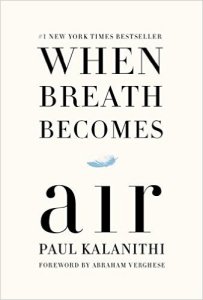
Paul Kalanithi, WHEN BREATH BECOMES AIR

This is an almost unbearably sad, yet poignant and moving and thoughtful, memoir by a young Stanford neurosurgeon who is diagnosed with stage IV lung cancer at the age of 36. His life changes from being the physician to being the patient, as he wrestles with how to plan the little time he has left, and what there is about life that means anything.

That last theme ties this to the two earlier books just reviewed. Kalanithi is an over-achiever, studying neuroscience and going to medical school but also well-read as a child (courtesy his concerned mother) and taking time for an MA in English literature. The first half of the book recounts his growing up in Kingman, Arizona, where his father was a surgeon and worked long hours. At Stanford he’s struck by the insight that the brain is an organ too:

…the mind was simply the operation of the brain, an idea that struck me with force; it startled my naive understanding of the world. Of course, it must be true–what were our brains doing, otherwise? Though we had free will, we were also biological organisms–the brain was an organ, subject to all the laws of physics, too! Literature provided a rich account of human meaning; the brain, then, was the machinery that somehow enabled it. It seemed like magic.

So here is, unexpectedly, begins a recurring theme that appeals to a science-fictional sensibility: how knowledge of the world informs the meaning of human existence. He pursues degrees in English lit and human biology:

I was driven less by achievement than by trying to understand, in earnest: What makes human life meaningful? I still felt literature provided the best account of the life of the mind, while neuroscience laid down the most elegant rules of the brain. Meaning, while a slippery concept, seemed inextricable from human relationships and moral values.

And he ponders Eliot and Nabokov and Conrad.

His English degree helps but,

I was also increasingly certain that I had little desire to continue in literary studies, whose main preoccupations had begun to strike me as overly political and averse to science. One of my thesis advisers remarked that finding a community for myself in the literary world would e difficult, because most English PhDs reacted to science, as he put it, “likes apes to fire, with sheer terror.”

Heh. (There is the special province of science fiction that traditional literature does not understand.)

The bulk of the first half of the book, then, recounts his lab work; his residency; the grind of long days of surgery; learning how to make medical decisions, where there are options, based on what each patient values most in life.

Part II picks up with the prologue left off, as the author and his wife confront the CT scans showing evidence of his cancer. He begins courses of treatment, rethinks the trajectory of his life, and revisits the struggle for what makes life worth living.

Remarkably, he and his wife decide to have a child — even though he can’t know how much longer he has to live.

It had been something we’d always wanted, and we were both impelled by the instinct to do it still, to add another chair to our family’s table.

Though not religious, he revisits his family’s rituals, visiting church, pondering whether without God there is any basis for meaning.

Yet the paradox is that scientific methodology is the product of human minds and thus cannot reach some permanent truth. We build scientific theories to organize and manipulate the world, to reduce phenomena into manageable units. Science is based on reproducibility and manufactured objectivity. As strong as that makes its ability to generate claims about matter and energy, it also makes scientific knowledge inapplicable to the existential, visceral nature of human life, which is unique and subjective and unpredictable…

He decides there will always be a gap between “core passions” and scientific theory. He finds compelling the central values of Christianity–“sacrifice, redemption, forgiveness”, and the tension in the Bible between justice and mercy. But he rejects any kind of revelation as a source of epistemic authority. His conclusion, for the moment, is that

In the end, it cannot be doubted that each of us can see only a part of the picture. The doctor sees one, the patient another, the engineer a third, …. Human knowledge is never contained in one person. It grows from the relationships we create between each other and the world, and still it is never complete.

We know how the story will end, and at the end he is left with thoughts of his daughter Cady’s future, a final source of meaning for him.

Posted in Book Notes, Meaning, Religion, Science | Comments Off on Paul Kalanithi, WHEN BREATH BECOMES AIR

Oliver Sacks, GRATITUDE

An even shorter book than Rovelli’s, this is a collection of four short essays written by the neurologist and author after learning he had only a few months left to live, all of which originally appeared in the New York Times.

On learning how little time he has left (p18):

I feel a sudden clear focus and perspective. There is no time for anything inessential. I must focus on myself, my work, and my friends. I shall no longer look at the NewsHour every night. I shall no longer pay any attention to politics or arguments about global warming.

This is not indifference but detachment—I still care deeply about the Middle East, about global warming, about growing inequality, but these are no longer my business; they belong to the future. I rejoice when I meet gifted young people—even the one who biopsied and diagnosed my metastases. I feel the future is in good hands.

His valedictory (p20):

I cannot pretend I am without fear. But my predominant feeling is one of gratitude. I have loved and been loved; I have been given much and I have given something in return; I have read and traveled and thought and written. I have had an intercourse with the world, the special intercourse of writers and readers.

Above all, I have been a sentient being, a thinking animal, on this beautiful planet, and that in itself has been an enormous privilege and adventure.

The last essay, “Sabbath”, describes his cultural and religious background and the value he places on the idea of a day of rest. P37:

I gradually became more indifferent to the beliefs and habits of my parents, thought there was no particular point of rupture until I was eighteen. It was then that my father, enquiring into my sexual feelings, compelled me to admit that I liked boys.

“I have done anything,” I said, “it’s just a feeling—but don’t tell Ma, she won’t be able to take it.”

He did tell her, and the next morning she came down with a look of horror on her face, and shrieked at me:

“You are an abomination. I wish you had never been born.” …

The matter was never mentioned again, but her harsh words made me hate religion’s capacity for bigotry and cruelty.

Decades later he accepts an invitation to a family event in Israel, before he realizes what the trip entails, p43:

I had felt a little fearful visiting my Orthodox family with my lover, Billy—my mother’s words still echoed in my mind—but Billy too was warmly received. How profoundly attitudes had changed, even among the Orthodox, was made clear by Robert John when he invited Billy and me to join him and his family at their opening Sabbath meal.

And he closes by comparing the Sabbath to his imminent rest from life.

And now, weak, short of breath, my once-firm muscles melted away by cancer, I find my thoughts, increasingly, not on the supernatural or spiritual but on what is meant by living a good and worthwhile life—achieving a sense of peace within oneself. I find my thoughts drifting to the Sabbath, the day of rest, the seventh day of the week, and perhaps the seventh day of one’s life as well, when one can feel that one’s work is done, and one may, in good conscience, rest.

Posted in Atheism, Morality, Philosophy, Religion | Comments Off on Oliver Sacks, GRATITUDE