Equus, part 1

From Peter Shaffer’s play Equus, written in 1973 and later adapted into a film directed by Sidney Lumet, starring Richard Burton and Peter Firth. Burton played a psychiatrist investigating a young man played by Firth, who had inexplicably attacked and blinded six horses in a stable where he worked. (Based loosely on a real event.)

I saw the film in 1979, a couple years after its release, and its theme and some key scenes resonated with my perceptions at that time, and deeply informed my thinking, for its theme and investigation into how random events in people’s lives influence their worldviews. Key quote, by Burton’s psychiatrist:

A child is born into a world of phenomena all equal in their power to enslave. It sniffs—it sucks—it strokes its eyes over the whole uncountable range. Suddenly one strikes. Why? Moments snap together like magnets forged in a chain of shackles. Why? I can trace them, I can even with time pull them apart again. But why at the start were they ever magnetized at all. Why those particular moments of experience and no others, I do not know! And nor does ANY BODY ELSE!

And if *I* don’t know, if I can *never* know, what am I doing here? I don’t mean clinically doing, or socially doing, but fundamentally. These whys, these questions, are fundamental. Yet they have no place in a consulting room. So then do I? Do any of us?

Richard Burton’s reading of this in the film is passionate and moving, and he deserved the Oscar that year. (He lost to Richard Dreyfuss in the relatively light-hearted and inconsequential The Goodbye Girl.)

I’ll have more to say about this play’s and film’s themes, in future posts.

Posted in Uncategorized | Comments Off on Equus, part 1

Links and Comments: Luck; Facebook and social bubbles; being openly secular

One author with a new book currently making the circuit of talk shows and newspaper op-ed pages is Robert H. Frank, whose book is Success and Luck: Good Fortune and the Myth of Meritocracy, and who turned up on KQED’s Forum program last month. His piece from last Sunday’s NYT summarizes his thesis: Are You Successful? If So, You’ve Already Won the Lottery.

Chance events play a much larger role in life than many people once imagined.

Most of us have no difficulty recognizing luck when it’s on conspicuous display, as when someone wins the lottery. But randomness often plays out in subtle ways, and it’s easy to construct narratives that portray success as having been inevitable. Those stories are almost invariably misleading, however, a simple fact that has surprising implications for public policy.

He goes on with examples — the Mona Lisa; the date of one’s birth; even the first letter of one’s last name — and goes on to the implications of these ideas to public policy.

This notion is analogous to President Obama’s observation some time back that success in, say, building a factory, depends on the public infrastructure that the factory owner himself didn’t build. Conservatives resented that observation, and they resent Frank’s ideas as well. Just this morning is Meghan Daum’s column in the LA Times, Why the right hides from its own good luck. Apparently Obama made some comments along these lines in a commencement speech at Howard University. Daum:

Nonetheless, conservative critics, with their highly trained noses for cherry-pickable quotes from a president they abhor, sniffed out offense anyway.

“Progressives by definition,” Mike Huckabee began on his blog, “must believe that the wealthy and successful among us have ‘won life’s lottery’ and are ‘fortunate’ to be where they are.” The Weekly Standard excerpted 400 words of the 5,000-word speech and slapped it with a troll-baity headline and subhead that repeated Obama’s line: “Pet peeve of mine: people who have been successful and don’t realize they’re lucky.”

In a new book, “Success and Luck: Good Fortune and the Myth of Meritocracy,” economist Robert H. Frank does his level best to disabuse the bootstraps crowd of at least some of their Horatio Alger fantasies. Allowing (as any reasonable person would) that “success is extremely difficult to achieve without hard work,” Frank suggests that we are all nonetheless at the mercy of accidents of timing and twists of fate. These range from big factors (being born in a prosperous country) to the barely perceptible (being born in a month that allows you to enroll earlier in a youth sport, thereby gaining an advantage of more practice and coaching than others in your age group).

The flip side of this disbelief in luck is the belief that *un*successful people aren’t merely unlucky, but to blame for their fate. (McRaney identifies this as a specific bias.) Thus conservatives undermine the social infrastructure. WWJD?

\\

Frank Bruni, How Facebook Warps Our Worlds.

The recurrent theme of cultural bubbles, and how Facebook reinforces them, citing Jonathan Haidt about social media and the internet:

They’re not so much agents as accomplices, new tools for ancient impulses, part of “a long sequence of technological innovations that enable us to do what we want,” noted the social psychologist Jonathan Haidt, who wrote the 2012 best seller “The Righteous Mind,” when we spoke last week.

Last para:

But that’s not about a lopsided news feed. It’s not about some sorcerer’s algorithm. It’s about a tribalism that has existed for as long as humankind has and is now rooted in the fertile soil of the Internet, which is coaxing it toward a full and insidious flower.

(The issue about the supposed anti-conservative bias in Facebook’s trending topics might be explained by the tendency of conservatives to more often cite unsubstantiated sources…the way Donald Trump cites National Enquirer, as if it’s a legitimate source for news.)

\\

And in the San Francisco Chronicle a couple weeks ago appeared Entertainer John Davidson: Why I’m openly secular.

I’d never heard of John Davidson, but apparently he’s been a TV game show host, among other things, and his ‘coming out’ as secular seems to be a big deal for himself and many others. I note it as an example of very basic observations about why some people find faith unnecessary and commonly-held religious beliefs not just unconvincing but repulsive.

If people believe that the Bible is a book of facts and not myths, then they are a danger to me and my loved ones, because the Bible, if taken literally, says people should kill anyone who does not agree with their faith (Deuteronomy 13), that women must submit to men, that slavery should be accepted, that homosexuality is wrong and that the end of the world is imminent. And, if people advocate for prayer instead of modern medicine, they are a drain on our health care emergency centers, not to mention a danger to themselves and their own children.

It is clear to me that the world would be more sane if all religions, all primitive superstitions, were abandoned. We are not capable of knowing all the mysteries of life. But science and the empirical method of discovery are the “candle in the dark.” Blind faith cannot be allowed to win out over rational thought.

As children, we were told that the Easter Bunny, Jack Frost, Mother Nature, Santa Claus and God were real. We owe it to our children, when they come of age, to explain that these were all imaginary friends.

Posted in Conservative Resistance, Culture, Religion | Comments Off on Links and Comments: Luck; Facebook and social bubbles; being openly secular

Links and Comments: Innovation, Optimism, Conspiracy Theories, and Liberals

Four items from the New York Times, Sunday before last.

Neil Irwin: What Was the Greatest Era for Innovation? A Brief Guided Tour.

What strikes me about this is not so much which era was greatest, as how much things have changed in only a century or so. In 1870, for instance,

People lit their houses with candles and whale oil, and heated them with wood or coal-burning stoves that kept homes unevenly heated and smelling of smoke.

They ate pork. Lots and lots of pork — 131 pounds of it per person per year in 1870 (that number was half as much by 1929 and is around 55 pounds today). Unlike other meat-producing animals, pigs could live almost anywhere and could survive largely on food scraps. Their meat, easily salted or smoked, could be preserved in an era without refrigeration.

Most rural adults had two sets of work clothes, both made at home, and better-off families had a nicer set of clothing for church or social outings. There was not much in the way of consumer goods, and department stores were in their infancy, just starting to appear in large cities.

Instead of a toilet, you used a chamber pot or an open window in the city, an outhouse with an open pit underneath in the country. Modern toilets were an invention that was in its earliest phases during the decade of the 1870s. Big cities had sewers for both rainwater and human waste, but they flowed into rivers unfiltered.

The online version has a lot of huge photographs that weren’t with the print article.

\\

Not unrelated to the previous item, here’s Gregg Easterbook: When Did Optimism Become Uncool?

Even in any kind of ‘utopia’, I imagine, people will find things to complain about, and politicians — especially the conservative ones — will feed on those complaints and stoke peoples’ fears. Sometimes you need to step back and gain a little perspective.

The country is, on the whole, in the best shape it’s ever been in. So what explains all the bad vibes?

Social media and cable news, which highlight scare stories and overstate anger, bear part of the blame. So does the long-running decline in respect for the clergy, the news media, the courts and other institutions. The Republican Party’s strange insistence on disparaging the United States doesn’t help, either.

The perspective:

Job growth has been strong for five years, with unemployment now below where it was for most of the 1990s, a period some extol as the “good old days.” The American economy is No. 1 by a huge margin, larger than Nos. 2 and 3 (China and Japan) combined. Americans are seven times as productive, per capita, as Chinese citizens. The dollar is the currency the world craves — which means other countries perceive America’s long-term prospects as very good.

Pollution, discrimination, crime and most diseases are in an extended decline; living standards, longevity and education levels continue to rise. The American military is not only the world’s strongest, it is the strongest ever. The United States leads the world in science and engineering, in business innovation, in every aspect of creativity, including the arts. Terrorism is a serious concern, but in the last 15 years, even taking into account Sept. 11, an American is five times more likely to be hit by lightning than to be killed by a terrorist.

(Conservatives are always discovering new things to panic about, and religious conservatives seem ever anxious to detect the imminent end of the world. Currently they’re alarmed by transgendered people, who, like gays, have always been with us.)

\\

George Johnson on conspiracy theorists: Why We Keep Dreaming of Little Green Men

Prompted by Hillary Clinton’s interest in UFOs and Area 51.

It’s easy to get carried away, your reptilian brain fueling your cybernetic cerebrum, as click, click, click, you feel the pieces snapping together. The followers of Lyndon LaRouche, the world-class conspiracy theorist who runs periodically for president, propound a cracked and erudite worldview that has included conspirators like Aristotle, John Maynard Keynes, Werner Heisenberg and Timothy Leary — all linked through an internal logic that makes, for its believers, a scary kind of sense.

To me the appeal of conspiracy theories is evidence of the narrative bias of the human mind — the need to have everything, including things that are really random, make sense, in the way humans impose sense on the world.

\\

And Neil Gross, Why Are the Highly Educated So Liberal?

I’ve discussed this topic before, but let’s just see what the writer says…

What explains the consolidation of the highly educated into a liberal bloc? The growing number of women with advanced degrees is part of it, as well-educated women tend to be especially left-leaning. Equally important is the Republican Party’s move to the right since the 1980s — at odds with the social liberalism that has long characterized the well educated — alongside the perception that conservatives are anti-intellectual, hostile to science and at war with the university.

It is probably right that something like a culture of critical discourse can be found in the workplaces and households and in the publications read by Americans who have attended graduate or professional school. The challenge for the Democrats moving forward will be to develop appeals to voters that resonate not just with this important constituency, but also with other crucial groups in the Democratic coalition. Some of the draw of Donald Trump for white working-class male voters, for example, is that he does not speak in a culture of critical discourse. Indeed, he mocks that culture, tapping into class resentments.

Gross has written a whole book on this subject… Why Are Professors Liberal and Why Do Conservatives Care?

Posted in Culture, Human Progress, Politics | Comments Off on Links and Comments: Innovation, Optimism, Conspiracy Theories, and Liberals

Dan Barker on Meaning without Divine Dictates, and the Slave Mentality

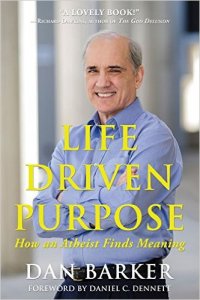
Dan Barker’s Life Driven Purpose (Pitchstone, April 2015), is much more cheerful than Lindsay’s book just reviewed. It’s an explicit response to religious superstar Rick Warren, and his ‘purpose-driven life’, in which everything about your life is in service to God — none of it is yours, beyond the trivial details of, well, everything about your life. Because your life isn’t about you, it’s about Jesus.

The subtitle of Barker’s book is “How an Atheist Finds Meaning” and so it echoes a number of other books, basically boiling down to: you find meaning in your interactions with other human beings, and not in some mythology about some god figure in the sky.

Barker uses some striking rhetorical flourishes. In Chapter 1, he describes a hypothetical man on a roof shouting at passers-by about how he has sent his son down in a basement to be tortured, in order to convince that passer-by that he, the man on the roof, should be worshipped.

All your have to do is come up here on my porch and thank my bleeding son for what he did for you. Tell him you love him. We’ll forgive your arrogance. Give us a big hug, and come into my housse, and we’ll live up in the attic [[ by which he means heaven, of course ]] together, and you can spend an eternity of gratitude telling me How Great I Am, while your ingrate friends and relatives are screaming down in the basement.

Which captures the incoherence of Christian theology, in my view, as I’ve mentioned before. Such beliefs and theologies are not coherent; they serve evolutionary, survival motivations for tribal cohesion, mostly.

What especially struck me about this book is the analogy of religious subservience, and Christian theology in particular, to the slave-mentality, which is something I’ve thought for years. The idea that there is a god who needs both to be *worshiped* and *feared* is like the slave who both fears his master yet nevertheless praises him, no matter what happens, no matter how harshly he is treated — because it could have been worse! Hurricanes, tornadoes? The survivors praise God for their survival, but never criticize him for their travails. (The nonsurvivors are dead, of course, and have no say.)

Barker, p27.5:

Asking, “If there is no God, what is the purpose of life?” is like asking, “If there is no Master, whose slave will I be?”

The theme of the book is that there is no purpose *of* life — but much purpose *in* life, which one can find for oneself; a purpose that might find you. This is great news: you can create your own purpose. Purpose comes from solving problems. Author describes a job he had as a programmer, and dealing with bugs; how that “state of uncertainty” can always be overcome, sometimes by avoiding the problem, simplifying the system. (This echoes my own comments about how programming and computer science are so ultimately fulfilling, because *any* problem can eventually be solved.)

A striking portion of this book is in the early chapters where Barker cites Paul of the New Testament epistles — which I’ve just been reading, coincidentally. Paul mentions how people are “empty pots” who are only fulfilled through the presence of Jesus. Barker’s characterization: “If you think your purpose must come from outside yourself, you are a lifeless implement or a slave to another mind.” p22.8

Barker’s Chapter 3 is about “Religious Color Blindness”, in which he attempts to characterize the believer’s mind: as binary, or polarized, unable to see shades of gray, and authoritarian. Thus concepts of sexuality, geology, evolution, language, abortion, there are no gray zones, no nuances, nothing to be interpreted — everything is right or wrong, black or white, and only their opinions on the matter are correct.

Chatper 4 is about the “deepity” question (i.e. it suggests it is about a genuine subject when it may just be the wrong question) of why there is something rather than nothing. The standard religious answers beg the question, or appeal to the god of the gaps — whatever we don’t currently completely understand must be due to God — which of course is continually shrinking. I like his comment about how Bertrand Russell and others dismiss the ontological argument (a perfect being must necessarily exist) as basically a matter of bad grammar is to apply the same argument to any other perfect thing we can imagine (e.g. a perfect island, observed Anselm).

The final chapter returns to the book’s main theme: there is meaning *in* life rather than *of* life. To find meaning in life, learn something, or create something.

Posted in Atheism, Meaning | Comments Off on Dan Barker on Meaning without Divine Dictates, and the Slave Mentality

James A. Lindsay on the Obsolescence of Theism

Two posts today, both about slender trade paperbacks of the genre that includes, earlier reviewed, John Loftus’s THE OUTSIDER TEST FOR FAITH (review) and titles by Greta Christina, Adam Lee, and Peter Boghossian (links to those reviews in that review): books published by Prometheus, or Pitchstone, or occasionally self-published, that appeal to the niche crowd of readers focused on atheism and related matters. For me to focus on such books might suggest that my convictions — er, provisional conclusions — are wavering, or need defending, but neither is the case. Rather, much like theism itself (a subject that consists of endless commentaries about itself, and in defense of any input from the actual real world), the ideas around atheism and what meaning in life means, without supernatural dictates, consists of interplay between various thinkers, as well as — quite unlike theism — reaction to continued new understanding about the real world.


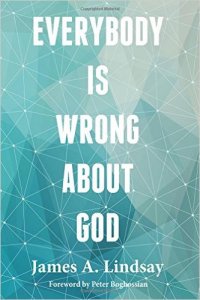
James Lindsay’s Everybody Is Wrong About God (Pitchstone, Dec. 2015), came to my attention, IIRC, via an Amazon suggestion, and the title was certainly provocative. Wrong how? Glancing through the notes for each chapter [there is no index, or bibliography] was encouraging — Lindsay has read his Jonathan Haidt, his Sam Harris; which is what I mean by thinkers in dialogue with other thinkers.

One key theme is in the back cover description: “theism has been so thoroughly and utterly discredited — philosophically, sociologically, and scientifically — that it no longer warrants serious consideration”.

And this certainly strikes a chord. No matter how many believers there might be among the general population, the concept of ‘theism’ plays no part in any intellectual enterprise of mankind — not since Laplace’s famous if perhaps apocryphal “I have no need of that hypothesis”. No course study at university in physics or biology or cosmology, or any topic that studies the natural world, makes the slightest accommodation to concepts from theism. (Though I recall a biology class I took at UCLA where the instructor apologized in advance to any topics that might offend any student’s religious sensibilities.) As far as the scientific and technology advancement of mankind is the issue, theism is irrelevant.

And, of course, where theism is relevant, it is only among many communities of mutually contradictory belief systems.

Lindsay’s premise is in part that, since theism is mythology, atheism is senseless; we should stop using the term, change the conversation.

Lindsay makes the disctinction between “God” — the idea, or cluster of ideas, that people think of when they use the word, and God, the literal supernatural being. By “God” most people mean a set of moral values, which is why the idea of atheism repels them, and makes them distrust atheists. He spends a substantial portion of the book exploring these moral attributes of “God”, where different ideas are like different settings on a mixer board, where the master volume knob is ‘transcendence’, which for some is turned all the way up, equating with faith, that which cannot be questioned.

The second half of the book concerns how to shift to a post-theistic world. Key suggestions: Maintain secularism. Improve society so that religious belief drops [as evidence has shown that religious belief drops in prosperous nations]. Undermine faith via street epistemology (cf. Boghossian), the outsider test for faith (Loftus), and satire.

Make ‘atheism’ not a thing, and avoid squabbling between atheist groups. Support humanist groups. Ignore religious apologists, and don’t ‘promote atheism’.

And then: fill the religion gap. Promote humanism. For purpose: Find fulfilling work, focus on the here and the now, make other people happy, cope with the reality of death. (Which leads to Dan Barker’s book, next.)

Go post-theistic: promote education — especially on the internet — on such topics as comparative religion, ethics, logic, critical thinking, civics. (Trying to change school/universities is too political and slow to change.)

[[ My thought here is that much of this is simply the result, in the long long run, of the interconnectedness of groups around the world who were previously isolated, coming into contact; leading to panic and paranoia of those frightening of change or whose insupportable worldviews are challenged. ]]

At the end, I endorse the author’s position: when discussing humanity’s understanding of its place in the universe, and its potential futures, theism — all religious ideas– can be ignored (except in the context, perhaps, of how humanity might divide and destroy itself). Yet I have to say that the book, at only 240 pages, is repetitious and long-winded. The issues aren’t that complicated. I was hoping for a crisp suggestion of how non-theistic thinkers might describe themselves without using the word ‘atheist’; his answer is basically, just don’t bring up the topic. (Which suggests the analogy to stamp collectors — those who are not don’t feel the need to describe themselves as ‘non-stamp-collectors’, and the same dismissal should apply to people who are not believers, theists.)

(Update–next post about Dan Barker’s Life Driven Purpose, tomorrow.)

Posted in Atheism, Religion | Comments Off on James A. Lindsay on the Obsolescence of Theism

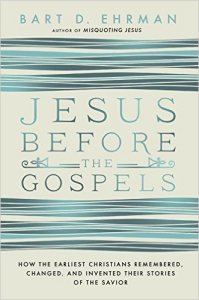
Ehrman, JESUS BEFORE THE GOSPELS: Memories, Stories, and the Gospels

I’ve read eight or ten books in recent weeks that I haven’t yet blogged about here (including three SF novels), but I plan to catch up. First, mentioned earlier as remarkably coincidental considering my recent Bible reading, is a new book by Bart D. Ehrman, a prolific Bible scholar with several books that seem to deconstruct, if not actually discredit, common Biblical narratives — books with titles like Jesus, Interrupted: Revealing the Hidden Contradictions in the Bible (And Why We Don’t Know About Them) and Misquoting Jesus: The Story Behind Who Changed the Bible and Why. Without having read those, my guess is, from what I have read by him, he’s engaging in close reading of the Bible in various translations, of contemporary manuscripts that didn’t make it into the Bible, and so on, to bolster his thesis that, while Jesus was likely a real person in history, he didn’t believe himself to be a Messiah, and it was only later storytellers, apostles, and the church, who made him so.

With this new book, just published in March, Ehrman seems to have discovered a new tool (tempting to say ‘toy’) he can use to explore the Bible and deduce which parts are fancy and which might have basis in fact. His new tool is one familiar to skeptics and psychologists and anyone who understands that ancient history needs to be taken with at least a grain of salt: the fallibility of memory. As is commonly known, the New Testament gospels were written decades after the events that are supposed to describe, so one necessarily wonders, how accurate were those accounts, given that they were told orally across those decades, even if originally based on supposed witnesses to the resurrection? And how is it that, even after decades of presumably being able to compare notes, did the four gospels turn out so differently, with many portions similar but other incidents, like the virgin birth, completely absent from some? (Paul the writer of NT epistles never mentions the virgin birth, hmm.)

While I found this book very interesting, it was also annoying: Ehrman uses his new idea to a fault, shoehorning anything he can into the idea of flawed “memories”, in many cases where I think what he means is how stories, told and retold over generations, succumb to motivations of the human bias toward *narrative*, never mind whether these are matters of any kind of *memory*. He conflates all these matters into that one idea.

He acknowledges this, p11.7, “We all know from personal experience how much news stories get changed in the retelling…”, but then goes on to discuss these issues as matters of memory.

A fascinating aspect of this book (which I presume he’s covered in other books) is his discussion of those other manuscripts that didn’t make it into the official Bible (when it was finalized in, when, the 300s?) E.g. a Proto-Gospel of James; an Infancy Gospel of Thomas (addressing Jesus’ life from ages 5-12); the Gospel of Thomas discovered in 1945, with a collection of 114 sayings. He treats these as rival “memories” when, it seems to me, these are rival *stories*, versions of stories told and retold over decades, then finally selected or discarded for consistency or usefulness by the church officials who finalized the NT.

To give the book credit, Ehrman does explore the plausibility of whether stories can be transmitted orally across generations, with evidence of such modern day practices that do not, in fact, maintain story integrity; how eyewitness testimony (even if you believe the first story-tellers) has been shown not to be accurate in most cases; and then the contemporary study of memory, and how it is often unreliable.

Also interesting: how long it took for the four canonical gospels to be finalized, and given names — not until 185 AD/CE, and only four were chosen, out of all those available, on numerological grounds!

And Ehrman examines several specific stories from the gospels to suggest how implausible they are on their face — e.g. Jesus’ commotion in the temple market, in a temple that was *huge* and not so easily disrupted; about the descriptions of the trial before Pilate, that shift gradually to absolve him and place the blame on the Jews; how Jesus could possibly have told his Sermon on the Mount to such a large crowd, outside on a hill (with no megaphone), and who took notes? — but discusses why the stories might have later been told the way they were. (Again, not about *memory* per se.) And he notes, as I’ve mentioned in my posts about reading the NT, even if these stories are true, who witnessed them?, that they would later be told to the gospel writers.

He cites interesting examples of modern day primitive tribes who tell oral stories, and how their stories are told differently depending on context, the audience, and so on. Which is to say — they have entirely different ideas of ‘tradition’ than we do.

There’s more, more about divergences among the gospels, and the gospels that didn’t make it in to the NT, including disputes about whether Jesus was human, whether there were two gods, etc. etc., and how it wasn’t until the Council of Nicea, in 325 (!), that the ‘church’ settled on a proper theological stance amidst all these competing ideas. Or as Ehrman would say, ‘memories.’

My general reaction is that all this elaborates what I’ve assumed is obvious, to anyone who thinks about the matter at all (and not blinkered by childhood inculcation and thus unable to think critically): that ancient holy books cannot be counted on to be accurate histories, accurate accounts of the truth of the history of the world, let alone reliable accounts about miraculous events that happen to privilege the tribe or cult promoting these accounts, on any number of grounds. They are fascinating in an archaeological sense, as remnants of primitive humanity, and reveal more about human psychology than they do anything about actual history or the nature of the real world.

Posted in Bible, Religion | Comments Off on Ehrman, JESUS BEFORE THE GOSPELS: Memories, Stories, and the Gospels

Links and Comments: Two from Today’s NYT

First, fascinating essay by Michael P. Lynch (author of just-released The Internet of Us: Knowing More and Understanding Less in the Age of Big Data): Trump, Truth and the Power of Contradiction.

How is it Trump can say completely contradictory things, and no one seems to care? It’s all about confirmation bias.

Blatant contradiction puts the responsibility back onto the shoulders of the listener. If I simply deny what I earlier affirmed and act as if nothing has happened, then you are left having to decide what I really meant. And psychology, as well as common sense, tells us that human beings are prone to “confirmation bias.” That is, we tend to interpret evidence so that it conforms to what we already believe.

Because, given that a candidate, such as Trump, might say opposite things at different times, leaves different listeners the ability to respond to whichever version they prefer to accept:

…when a person says something as well as its opposite, his listeners can infer that he really believes whichever statement they wish him to believe.

A familiar idea, from our internet-fragmented bubbles:

It is only natural that we’ll hear those voices that are most similar to our own, shouting what we already believe, and as a result Google can find you confirmation for almost anything, no matter how absurd.

(Anti-vaxxers, unite!)

\\

Second, Nicholas Kristof: A Confession of Liberal Intolerance

The idea is that universities, in particular, do not represent conservative values and ideas nearly so often as they do ‘liberal’ ones.

This theme has popped up before, and I confess I’m sympathetic to the response quoted here, “Much of the ‘conservative’ worldview consists of ideas that are known empirically to be false.” That is, for example, conservatives/Republicans seem wed to economic policies that have proven not to work; to reverse the angle, the many in this country aligned to empirically false ideas about the age of the Earth and of the human species, or who do not understand evolution or climate change, are not liberals, they are conservatives. Why would anyone expect such conservatives to be common in our universities, where learning and truth, as opposed to ideology, presumably prevail?

Put another way: education, the exposure to new ideas and challenges to “common sense”, is itself a liberal idea. Conservatives, at the least the religious ones, are more likely to stay at home, lead their churches, protect their children from outside ideas that would challenge scripture through home-schooling, and so on. Or perhaps attend explicitly religious colleges.

Still, Kristof gamely thinks there is an issue here. The essay ends:

Should universities offer affirmative action for conservatives and evangelicals? I don’t think so, partly because surveys find that conservative scholars themselves oppose the idea. But it’s important to have a frank discussion on campuses about ideological diversity. To me, this seems a liberal blind spot.

Universities should be a hubbub of the full range of political perspectives from A to Z, not just from V to Z. So maybe we progressives could take a brief break from attacking the other side and more broadly incorporate values that we supposedly cherish — like diversity — in our own dominions.

Perfectly valid point, yet I have to wonder: how often in history have ‘conservative’ claims turned out to be true — based on some kind of *empirical* evidence, not force of ideology — against challenges to orthodoxy, i.e., liberal claims? It seems to me that the entire history of human understanding of itself, and of the universe, is about overturning status quo ideas based on primitive knowledge, with ‘liberal’ ideas based on reality… which has a liberal bias.

Posted in MInd, Thinking | Comments Off on Links and Comments: Two from Today’s NYT

Reading In and Around the Bible: Epistles of Paul, 2

First Corinthians:

  • 1:7, “as you wait for the revealing of our Lord Jesus Christ”. Another allusion to Paul’s prediction of the imminent Second Coming, which has conspicuously failed to happen for some 2000 years now. Again, why hasn’t this most egregious example of a failed prophecy undermined everything else Paul said? Because selection bias, as we now understand it: people are sensitive to prophecies that come true, no matter how vaguely, thus Paul’s numerous citations of Hebrew scripture, while ignoring all the ancient prophecies that never managed to come true. For contemporary Christians, it’s a matter of ignoring the ones that don’t come true, including this one. Only the hits count.
  • 1:18, “For the message about the cross is foolishness to those who are perishing, but to us who are being saved…” Another appeal to tribalism; us v. them, and how Paul’s followers should feel very special for being among the chosen elite.
  • 1:19, appeal to scripture, and anti-intellectualism. (Because the more you know, the less susceptible you are to the power of magical tales of miracles.)
  • 1:22, “For the Jews demand signs and Greeks demand wisdom” – as opposed to Paul’s followers; in other works, we don’t need evidence! We don’t need reason!
  • 1:26-27, All about upstaging those elites – how this does resemble contemporary American politics, with a certain candidate appealing to the ignorant base against the ‘establishment’! – which leads me again to wonder, if there was this god, how it is he didn’t manage to reveal his truth to everyone, if it’s really the truth? Why play favorites? Why does it not instead *seem exactly* like the conceited fantasies of a tribe or cult who fancied themselves the chosen of their particular, local god?
  • 3:19, “for the wisdom of the world is foolishness with God”. Again…
  • Ch5, again, Paul is much concerned with sex. This suggests more about him than about god or Jesus.
  • 5:5, “destruction of the flesh”, Oxford’s annotators seem to bend over backwards to explain how it doesn’t really mean that.
  • 5:9, “not associate with sexually immoral persons…” Really? WWJD? From later letters Paul seems familiar with the various “sayings” of Jesus, but not, of course, with the NT gospels as we know them.
  • Ch6, Don’t associate with non-believers! Very tribal, and self-righteous.
  • 6:9, rather obsessed with ‘wrongdoers’. [I never realized until now that George Bush’s phrase ‘evildoers’ came out of his close attention to the themes of these ancient religious manuscripts which have, alas, informed so much of human history for the past two millennia.]
  • ch7, more about sex! This is about Paul. Apparently he is unmarried and finds the whole idea of sex rather distasteful, and would just as soon counsel everyone else to consider it just as distasteful. Who is he to lay down such rules…? Apparently the one who won.
  • 7:26, “impending crisis”, again, Paul predicts the Second Coming is happening soon.
  • 7:31, “For the present form of this world is passing away.” Yet another statement of the most failed prophecy of all time.
  • 10:20, Our god is real, theirs is not.
  • Ch11, So many rules! Who says?
  • 11:9, “Neither was man created for the sake of woman, but woman for the sake of man”. Obviously, antiquated gender roles, which many adhere to, to this day. Is there some atavistic evolutionary reason for this belief? Is this something that can be, or should be, overcome? Obviously US laws cites equality before the law, yet that “equal rights amendment” never passed.
  • 11:14, “Does not nature itself teach you that if a man wears long hair, it is degrading to him…” Really?? Why?? Doesn’t that iconic portrait of Jesus show him with long hair? (And how, and how often, did men cut their hair in those days…? Do we know?)
  • 12:8, a ranking in descending order of the values of wisdom, knowledge, faith, gifts of healing, then miracles, and so on. But later, 12:28, these are aligned with apostles, prophets, teachers and so on, so the ideas of wisdom and knowledge didn’t mean what we think of them now.
  • 13:1, in NRSV, “a noisy gong or a clanging cymbal”, to mean saying without love; KJV says “I am become as sounding brass, or a tinkling cymbal”, a phrase adapted by SF author Robert Silverberg for essay about his career up to a point: Sounding Brass, Tinkling Cymbal
  • Throughout these passages, NRSV uses the word “love” where KJV uses “charity”. Asimov, p444-447, discusses the original Greek word, “agape”, and how neither translation exactly matches its meaning.
  • 13:8, everything will end but love. Often-quoted: “When I was a child, I spoke like a child, I thought like a child, I reasoned like a child; when I became an adult, I put an end to childish ways.” (I think this is true, or should be true, in a greater way, as our species learns about the reality of the universe around us, and puts away childish, mythical beliefs of our tribal ancestors.)
  • 13:12, KJV’s famous “through a glass, darkly” becomes in NRSV “in a mirror, dimly”.
  • 14:1-2, seems to equate ‘prophesy’ with ‘speaking in tongues’, which is not commonly understood, I’d guess.
  • 14:34, the famous injunction against women speaking in churches – but the Oxford annotators think these passages were later additions, not by Paul (for what that’s worth)
  • Ch15, Paul goes on about the resurrection, which the Oxford annotators think is derived from “the philosophical proof of the immortality of the soul” in Plato’s Phaedr and others. Of course, Paul’s entire argument begs the question.
  • 15:6, Jesus appeared to some 500 people?? First mention of this I’ve read. (And curious that the four Gospels, written later, didn’t describe any such thing.)

Second Corinthians

In this book especially, it struck me when I read it, it seems that Paul is using lots of words to say very little; that his prose is obsequious with flattery to his followers on Corinth on the one hand, boasting with unseemly self-importance, while at the same time reproving those followers like a father to unruly children, and almost desperate in his repeated appeals to the coming eternal life in the heavens.

Fewer specific notes. By Ch3, Paul has a new theme: he’s decided that the covenant of Moses is a “ministry of death” and only belief in Jesus is the way. Ch8 is a beg for money, like any contemporary preachers – as a “proof of love”. All the commentators seem to agree that Chs 10-13 come from an earlier, angrier, letter, that was grafted into this scroll by later editors. 10:10 describes Paul’s unimpressive appearance and presence. 10:5 insists that a believer’s every thought must be subsumed to Christ. 11:5, Paul is worried about the appeal of other “super-apostles”, as if is followers might be easily swayed. (By rhetoric, of course, not by any kind of evidence.) And 12:7, Paul’s apparently infamous “thorn”, about which no one really knows what he means, but about which Miller, anxious to justify every biblical passage through allusion to any kind of contemporary knowledge, speculates wildly.

Posted in Bible | Comments Off on Reading In and Around the Bible: Epistles of Paul, 2

Reading In and Around the Bible: Epistles of Paul, 1

Working my way through the New Testament; after the four gospels, and Acts, much of it is the epistles of Paul, seemingly the creator of the Christian religion.

(My current plan is to read through the rest of the NT over this next month, then return to the OT to closely read selected books — Genesis, maybe all of the first five, and Job, Psalms, Ecclesiastes, Proverbs, maybe a few others — then to finish the commentaries (Ehrman et al), to complete this examination of ancient history and cultural influences and primitive thinking, before returning to more contemporary, enlightened, thoughts.)

I’m reading Paul’s epistles in approximate chronological order as written, according to sources; so far I’ve read 1 Thessalonians, 2 Thessalonians, Galatians, 1 and 2 Corinthians, Romans, and couple others.

It’s revealing to realize, as I mentioned earlier, that Paul was roaming around the Mediterranean converting people to the ‘gospel’ i.e. ‘good news’ of Jesus the savior, based on his own conversion experience, his relatively brief meetings with a couple of Jesus’ apostles, and his interpretation of prophecies from the Hebrew Bible. But *not* any of the four written ‘gospels’ we now know of in the New Testament — because they hadn’t been written yet. (Presumably oral versions of the stories that eventually were written down as the four gospels were floating around, in scattered fashion, but we all know how much stories change in the telling, especially over decades!) In that context, what is most striking in reading these letters is how certain Paul is of the religion he is trying to promulgate. He lays down the law to his followers, at times obsequious and at times scolding, creating an entire theology derived from selective reading of the Hebrew Bible and apparently based on his own predilections for proper behavior, much more than based on anything Jesus might have said or counseled. Paul is described as humble, perhaps ugly, and not well-spoken, but in his writings, he’s as zealous as they come. Jesus may have been his hero, but the religion is the creation of Paul.

As always, what follows are my immediate comments mostly about the implausibility of what Paul claims, and/or revealing circumstances that suggest how and why these stories came to be, driven by psychological motivations to selectively interpret data and create narratives that serve social and political purposes.

1 Thessalonians: Presumed to have been written about 50, and the earliest of Paul’s letters.

  • 2:2, ‘shamefully mistreated’. Themes of persecution arise immediately. Commentators (Ehrman) point out that the early Christians’ refusal to observe Roman rituals was why they were persecuted — not because of anything inherent about the new ‘gospel’. Yet to this day, Christians love to feel persecuted.
  • 2:10, Paul insists he is ‘blameless’ in his conduct toward his believers. Doth he protest too much?
  • 2:13, “you received the word of God that you heard from us…what it really is, God’s word.” Paul presumes to know, for certain, God’s word.
  • 2:18, Paul blames his failure to visit earlier on Satan.
  • 3:13, Paul is preoccupied with the imminent return of Jesus.
  • 4:3 ff, Paul is very concerned about the sexual habits of his followers, initiating a theme throughout the history of Christianity. Or perhaps revealing something about Paul, a bachelor too busy proselytizing to marry. He’d just as soon his followers live as he does: be pure, live quietly, work hard, pray.
  • 4:15 Most of those alive now will see Jesus return. Why doesn’t this failed prophecy, the most spectacular failed prophecy of all time, completely undermine everything Paul ever said? Paul’s description of the “trump of God” has instead become the template for all imaginings of the second coming. How did he know it would happen like that?
  • 4:17 is apparently the source of the now common idea of the ‘rapture’, when believers will be lifted into the heavens and all others will be “left behind”.
  • 5:23, again, he’s coming soon!

2 Thessalonians: some authorities doubt the authenticity of this.

  • 1:8-9, nonbelievers will “suffer the punishment of eternal destruction” … ‘Gospel’ may mean ‘good news’, but there’s a huge element of macabre delight by Paul in his insistence that anyone who does not take his word for God’s workings of all creation will be tormented forever. One wonders what a contemporary psychiatrist might say about this. Or is this all about mollifying believers, so they feel self-satisfied about being among the chosen?
  • Ch2, Paul seems to backtrack a bit about the overdue second coming of Jesus, now claiming that some kind of rebellion needs to occur first, including the appearance of a “lawless one” (KJV “man of sin”), apparently never further identified. Asimov, p475, points out these passages as the source of the idea of an “Antichrist”, a theme still much discussed today about anyone the Christian devout does not like.
  • 2:11, In my reading of the Bible, I am sometimes startled to read commentaries that point out individual verses that have over the millennia come to take on enormous meaning, when — reading them in context — they do not seem especially significant. Here’s one that is likely not quoted out of context: “For this reason God sends them a powerful delusion, leading them to believe what is false.” God created the world and people in it to worship him, and now he’s sending them delusions? Context is everything, no doubt.
  • 3:6, Paul is much concerned about idleness.

Galatians

  • 1:1 Now Paul claims himself to be an apostle, with as much authority as the twelve who actually knew Jesus.
  • 1:4, “the present evil age”, another appearance of this historical cliché
  • 1:7, Paul alludes to other ‘gospels’, presumably meaning not texts, but rival teachings. Of course, Paul insists his followers believe him, and not his rivals, lest they be “accursed”.
  • 1:12, Paul claims to have received his gospel “through a revelation of Jesus Christ”, i.e. his experience on the road to Damascus. But how many other preachers were wandering around with their own revelations? A number if seems, or Paul wouldn’t protest.
  • 1:17, Paul says he went to “Arabia” before he went to Damascus, which doesn’t seem consistent with Acts.
  • 2:1, Somehow 14 years passed which Paul doesn’t bother to account for. What was he doing?
  • 2:6-9, Paul is obsessed with circumcision, or perhaps people of the day were, for some reason I still don’t quite understand. That it should have been such a marker of tribes suggests that male urination was not a very private affair in those days, else how would anyone know whether anyone was circumcised or not?
  • 2:15, Paul’s message now shifts a bit to claim that faith in Jesus trumps the “works of the law”, i.e. the Hebrew Bible, i.e. Leviticus. (Didn’t Jesus claim he came to uphold the law, not overthrow it? –But that’s someone else’s version of the story.) One assumes Paul is adjusting his message to appeal to his crowd, who are skeptical about adhering to strict Hebrew law — including circumcision. Strange standards to base a religion on.
  • 3:2, Paul admonishes his followers to “receive the Spirit” by “believing what you heard”. Here is a frank admission that people were converted by the power of the story, the lecture, the sermon, and not, of course, any kind of claim to eyewitness testimony, let alone evidence.
  • 3:16, appeal to scripture, of course. One gets the impression the story of Jesus appeals to Paul especially since he can attribute the few details he knows to cherry-picked verses from the enormous Hebrew Bible (i.e. OT).
  • Ch5, Paul now advises that succumbing to circumcision would be to be obliged to obey the “entire law”, and he doesn’t want them to do that!
  • 5:16, contrasting Spirit vs flesh. A note in the Oxford* NRSV says that “the idea of two opposing forces leading either to righteous or wicked behavior was prominent in the Qumran sect”. So many sects; Qumran.
  • 6:7, “God is not mocked”. One of those isolated phrases people like to quote, without context.
  • Asimov’s chapter on Galatians, p452ff, discusses the controversy about circumcision, and the Council of Jerusalem, held in 48, about this matter. Since Paul doesn’t mention it here, perhaps this letter was written before that.

Will post about Corinthians next time.

*I realize I should designate the Oxford edition of the NRSV when referring to their annotations; the Oxford annotators are not the translators of the NRSV. Sometimes the annotations quibble with the NRSV translation.

Posted in Bible | Comments Off on Reading In and Around the Bible: Epistles of Paul, 1

Religious Liberty and Christian Theology

Salon: Republicans have turned God upside down with their so-called “religious liberty”.

The “liberty” part in “religious liberty” is not intended to empower the believers of a dominant religion, such as, say, Christianity, to give them the “liberty” to impose their beliefs upon everyone else. No. This is a perversion of the term “religious liberty.”

Instead, the “liberty” part is intended to protect minority NON-believers to ensure that they have the liberty to maintain their own independent beliefs without suffering any disadvantages imposed upon them by the dominant believers.

And

And Christians are hardly under attack here. No one is taking away their rights. No one is seeking to force them to be gay themselves, or to force birth control upon them. No. They are perfectly free to hold their own religious beliefs and live their lives accordingly.

My take on the matter is to observe that these religious liberty laws all seem to be about gay and transgender people, and Christians who recoil at dealing with people they think are sinners on those grounds. But, according to Christian theology, aren’t we *all* sinners about something or another? So why is it Christians need these laws just to avoid dealing with gays and transgender people? Because it’s really about their difficulty of living civilly with people who are unlike themselves – especially those icky gays and transgenders.

The essay does conclude this way:

Good afternoon Mr. & Mrs. Customer. Are you gay? Oh thank goodness. But, do you believe in God? Which God? Did you attend church this past Sunday? Have either of you ever committed adultery? When you have sexual intercourse with each other, do you use birth control? Madam, have you ever had an abortion? Do you as a couple engage in any sexual activity that would be regarded as deviant?

Oh, I’m sorry, we don’t serve your kind.

Posted in Conservative Resistance, Religion | Comments Off on Religious Liberty and Christian Theology