Family & Personal History, 2016/1

After a couple year’s gap — the interval being occupied by the move from SoCal to Oakland, among many other things — I’m resuming my family history project of scanning old photos taken by myself, or more importantly scanning photos taken by my father, of my early family and family history before I was born. To kick this off, here are four photos from my early childhood. I realize these are unlikely to be of any interest to anyone outside my family…except perhaps for their window into how people lived 50 years ago, and what people then thought important.

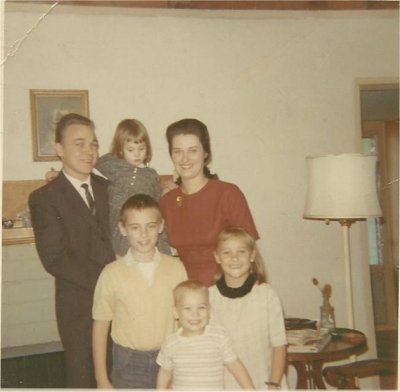
First, here is a family photo from February 1966 (according to the tag at the top of this print).

My parents and four children: I am in the yellow shirt; others are my younger siblings Susan, Lisa, and Kevin; Kevin was about 2 years old here.

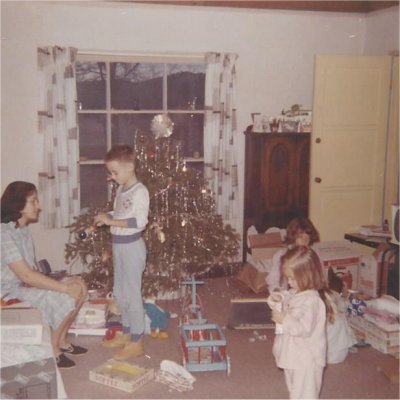
Next, Christmas 1964. I think this was at the house in Apple Valley, where my grandmother was then living. You can tell my the mountain view through the window.

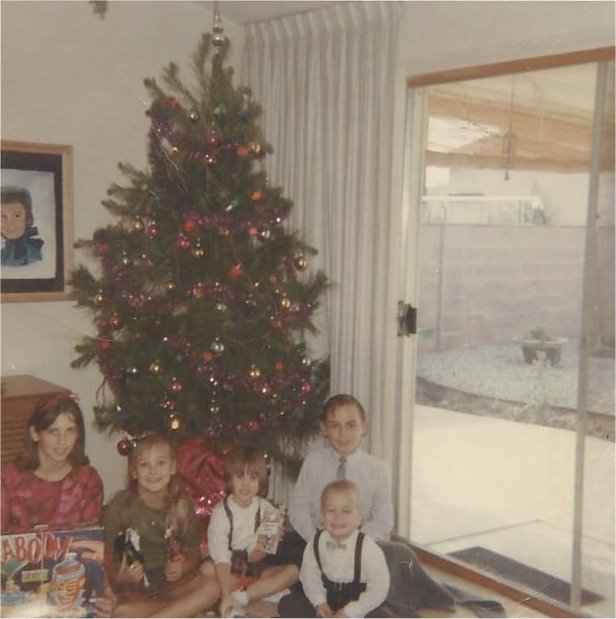
Then, Christmas 1966. This is in our home in Reseda, with my slightly older cousin Paula and us four kids: Sue, Lisa, me at the top, Kevin below.

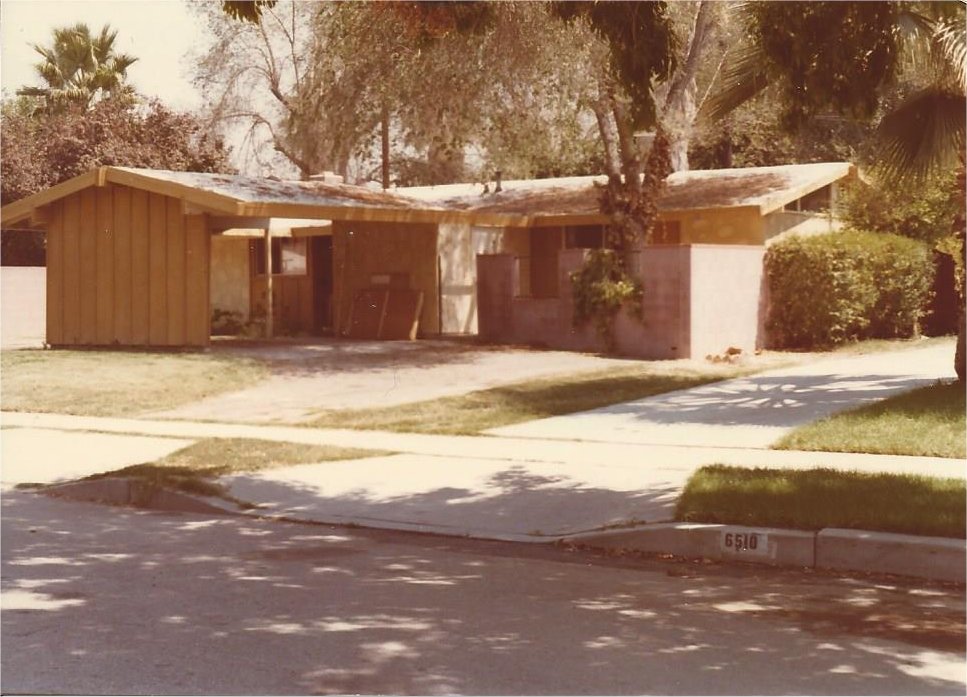
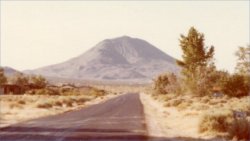
Finally, here is a street view of the house where we lived from roughly 1962 to 1968 — when I was in 2nd through 7th grade — at 6516 Rhea Avenue, in Reseda, Ca.

The house had a semi-circular driveway, with a carport in the middle, no garage. Connecting the carport to the house was a toolshed, with a locked door. It was a 4-bedroom, 1200 square foot house. My bedroom was at the front, in the closest corner to that toolshed.

Earlier family history posts:

Personal History, Part 1, about by parents and my birth in England;

Personal History, Part 2, about how my family settled in Apple Valley, CA;

Personal History, Part 3, with photos from where my parents lived when I was born, taken by me in a visit there in 1990

Posted in Personal history | Comments Off on Family & Personal History, 2016/1

Never Be the Same Again

Best song from the elusive Darren Hayes album WE ARE SMUG…, released online back in 2009, but not available on CD until last year, and which I finally caught up with via Amazon last month.

I am not generally a fan of generic pop music, but a chance encounter in a Time Magazine article, back in 1999 or so, about Hayes and his then group Savage Garden, led me to check them out (partly because Hayes in the accompanying photo was so cute ;), and resulted in a firm devotion. Their tunes were catchy, and many of Hayes’ lyrics were actually pretty smart. About love and romance and genetic drives; a two-CD set, This Delicate Thing We’ve Made, a song-cycle involving time travel and visiting one’s past.

https://en.wikipedia.org/wiki/Darren_Hayes

http://www.dhdepot.net/lyrics/neverbethesame

You can take a broken heart
And smash it through a windowpane
It will break right through
But it’ll never be the same again

Posted in Music | Comments Off on Never Be the Same Again

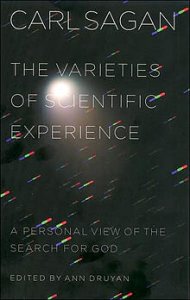
Carl Sagan, THE VARIETIES OF SCIENTIFIC EXPERIENCE (2006): History is a battle of inadequate myths

Here’s a book I had forgotten I had, relatively speaking; I obviously bought it back in 2006 or so, but I didn’t read it right away and so it sat on my shelves among many other books (by Sagan and many others) for years. As I was packing and unpacking books during our move a year and half ago, I noticed it anew, especially since it appeals to my current interest in the grand scheme of things, how science and religion and science fiction intersect and relate. So I pulled the book off the bookshelf, and onto my to-read-shelf, and finally read it last month.

The book compiles a series of lectures Sagan gave in 1985, just five years after his TV series Cosmos was broadcast to great acclaim and made him a media star and frequent Tonight Show guest. The book didn’t appear until 10 years after Sagan’s death in 1996. It’s subtitled “A Personal View of the Search for God”, and is edited by Ann Druyan, his wife, and later writer of Neil deGrasse Tyson’s recent reboot of the Cosmos. All those beautiful words, in that series, that I sometimes quoted at length (e.g. here, were narrated by deGrasse Tyson — but written by Druyan.

And in fact Dryan’s introduction is gorgeous and inspiring, but for the moment I’ll focus on Sagan’s lectures.

The irony is that the lecture series in which Sagan was invited to participate back in 1985 was on the topic of “natural theology”, i.e. the idea that theological knowledge can be established by reason and experience and experiment alone, not by revelation or mystical experience, as Sagan describes in lecture 6. It’s ironic because Sagan, delicately but repeatedly throughout these lectures, dismisses the notion of such theological knowledge. Sagan, throughout his many books, avoided any direct discussion of his opinions about God, or any implication of his atheism. He preferred to dwell on the positive, so to speak — what experience and experiment tell us about the universe itself, and how grand it is. So without ever directly challenging any religious beliefs, in these essays, he repeatedly, politely, mentions such notions and then wonders if we should not perhaps seriously consider that there might be better explanations. In so many words, or less.

The book is a tad dated in its preoccupation with issues that were important to Sagan, and to society, at the time: UFOs, ancient astronauts, the threat of nuclear war.

Brief outline with some quotes:

Lecture 1, “Nature and Wonder: A Reconnaissance of Heaven”

Sagan quotes Plutarch, Carlyle, Einstein, discussing the region between godlessness and superstition, and how the best way to induce awe is by looking up at night. Apparently during this essay there were lots of photos of nebula and diagrams of the solar system, which are captured in the book. p27.6:

And this vast number of worlds, the enormous scale of the universe, in my view has been taken into account, even superficially, in virtually no religion, and especially no Western religions.

Science, Sagan suggests, is informed worship.

Lecture 2, The Retreat from Copernicus: A Modern Loss of Nerve

We tend to “project our own knowledge, especially self-knowledge, our own feelings, on others” and we have a sense of privilege, thinking ourselves the center of the universe. Yes! — here is Sagan, 30 years ago, anticipating what psychologists have been confirming and crystallizing in recent decades, about human mental biases (as posted here about David McRaney, among several related posts). Thus Aristotle presumed a privileged Earth, stationary, around which everything else turned. He was wrong; nor were the heavens perfect. More recently resistance to evolution is an “assault to human vainglory” 39.3; special relativity in the 20th century; dismissing the argument from design; explanations for the anthropic principle; quoting Rupert Brooke’s poem “Heaven” about a fish’s view of reality and eternity.

Lecture 3, The Organic Universe

There are no crystal spheres. 64.2: “The history of science in the last five centuries has done that repeatedly, a lot of walking away from divine microintervention in earthly affairs.” We’re left with a God of the Gaps, a do-nothing king. Evolution is not intuitive because it involves vast amounts of time. Why the objection about the odds against complex molecules randomly forming, like a Boeing 747 forming by a whirlwind, is misguided and ignores the reality of evolution.

Lecture 4, Extraterrestrial Intelligence

We have concepts for more *powerful* beings than us (angels, demigods), but not for beings more intelligent than us. Even scientists can get things wrong, lured by a predisposition to believe: Schiaparelli and his (mistranslated) ‘canali’. What kind of evidence would convince us of demigods, or ETs? Plausibility, to begin with. The Drake equation, failures of imagination, and a Clarke quote about the threat to Christianity of the discovery of ETs.

Lecture 5, ET Folklore: Implications for the Evolution of Religion

Addresses the then (in the ’70s and ’80s) popular notions that “ancient astronauts”, i.e. aliens, visited Earth and were responsible for the pyramids and other artifacts, popularized by the books of Erich von Däniken. Why do people want to believe in such things? Perhaps in hopes of someone to save us from ourselves. There isn’t even one good example of a UFO, and plenty examples of fraud. 134.3: “I maintain, that we are dealing with some combination of psychopathology and conscious fraud and the misapprehension of natural phenomena, but not what is alleged by those who see UFOs.”

People get angry when ‘miracles’ are explained. History of failed prophecies, e.g. charismatic leaders who predict the end of the world, and whose believers still believe even when the world doesn’t end! Discusses the emotional stakes people have in wanting to believe, comparing it the the skepticism inherent in buying a used car.

And you do this for something as unimportant as an automobile. But on issues of the transcendent, of ethics and morals, of the origin of the world, of the nature of human beings, on those issues should we not insist upon at least equally skeptical scrutiny?

Lecture 6, The God Hypothesis

Many ideas of God over the centuries. Suppose there were proof of a god who, say, originated the universe but was indifferent to prayer?

Proofs of God? Sagan cagily starts with a list of 11th century Hindu proofs of their God, among them: Things must have a cause; an argument from atomic combinations; from the suspension of the world (we aren’t falling); the existence of human skills; the authoritative knowledge in the Hindu holy books—surely God must have written them. (Example of Sagan understatement, 154.8, “…these arguments are not always highly successful.”)

Western examples: cosmological, design, morals. He mentions various logical possibilities, then remarks, p157.5, “And it’s curious that human myth has some of these possibilities but not others. I think in the West it’s quite clear that there is a human or animal life-cycle model that has been imposed on the cosmos.” [Yes, exactly!] Followed immediately by his trademark understatement, “It’s a natural thing to think about, but after a while its limitations, I think, become clear.”

Then Anselm’s ontological argument, which Bertrand Russell dismissed as ‘bad grammar’. Personal experiences of God are no more reliable than witnesses of UFOs. Problem of evil. Why long lists of things God tells people to do? 165.3:

Why didn’t God do it right in the first place? You start out the universe, you can do anything. You can see all future consequences of your present action. You want a certain desired end. Why don’t you arrange it in the beginning? The intervention of God in human affairs speaks of incompetence.

Why not clear evidence of his existence? Phrases in the holy books we’d only understand later. Engrave the ten commandments on the moon. Concerning the convergence between revelation and knowledge of the natural world, why is this convergence so feeble when it could easily have been so robust? (Echoes of the Sean Carroll book I just read.)

Lecture 7, The Religious Experience

Our emotional predispositions were set millions of years ago, to some selective advantage. We can examine them by studying modern primitives. Hunter-gatherers. Some are highly hierarchical; others more democratic. One scientists analyzed them against characteristics of whether they hug their children and whether they permit premarital sexual activity among adolescents. Where these things are not permitted, powerful hierarchies emerge; where they do, such hierarchies don’t exist yet everyone’s happy.

Other characteristics: animism; sacrifice (propitiation to the gods) that devolved into prayer, neither of which actually influence the gods, or God, as pointed out beginning in late Victorian times. Not that anyone who believes is convinced. That says something about ourselves. P177b:

I maintain that everyone starts out with that sort of attitude. We all grow up in the land of the giants when we are very small and the adults are very large. And then, through a set of slow stages, we grow up, and we become one of the adults. …

The formative experiences of propitiating adults lingers into adulthood. “Could that have something to do with prayer specifically and with religious beliefs in general?” 178.4. As Freud suggested.

Moving on to discussion of chemicals in the brain. Hormones. LSD. Suppose something called “theophorin”, a material that makes you feel religious. Wouldn’t be useful, for social conformity? Submission to the alpha male, the ruling classes, the biblical God?

Lecture 8, Crimes Against Creation

We cherish tradition, but the world is changing fast. P193t how things have changed from a couple centuries ago. The wisdom of the ancients does not necessarily still apply. Thus, 193.9, “wisdom may lie not in simply the blind adherence to ancient tenets but in the vigorous and skeptical and creative investigation of a wide variety of alternatives.”

Thus science, unprecedented from previous eras. Evidence of extinctions 65mya. The current threat is nuclear war—but how have religions reacted to the threat? The most dangerous are the Christians who see the prospect as consistent with Revelation, and welcome it. The nations of the world stockpile more weapons; what about the Christian dictum to love thy enemy? No nation takes that view.

Lecture 9, The Search

The search for meaning is two-pronged: to understand the universe, and to understand ourselves, p213m.

We are still a world of tribes growing into city-states, nations, empires. We need new alternatives; “We run the danger of fighting to the death on ideological pretexts.” 216.8. History is a battle of inadequate myths, everyone feeling threatened that their own worldview might be exposed as a lie, willing to fight to prevent that, p217t. The prevailing conclusions of science are poorly accommodated by religion, 218. But things have changed: we’ve abandoned the divine right of kings, we’ve abandoned slavery.

We need more than one example of a planet, of an intelligence, before we can understand ourselves better. The search is endless; it

goes with a courageous intent to greet the universe as it really is, not to foist our emotional predispositions on it but to courageously accept what our explorations tell us.
Posted in Book Notes, Cosmology, Culture, Evolution, Human Progress, Provisional Conclusions, Religion, Science | Comments Off on Carl Sagan, THE VARIETIES OF SCIENTIFIC EXPERIENCE (2006): History is a battle of inadequate myths

Growing Up with Books

My parents weren’t readers themselves, but they were conscientious enough in raising their four children to stock our modest home with sets of encyclopedia and other resources. Many of these were adult resources, not the children’s books that fill large sections of bookstores, though there must have been a few of those too.

We had an Encyclopedia Britannica, of the kind common in households in an era long before the internet. We had a set of Harvard Classics, 50 volumes compiled and edited by authorities at Harvard University in 1909, an edition printed in 1961. I still have the set of Harvard Classics. We had a 10-volume set called The Book of Popular Science, probably the 1961 edition seen here; grey-bound volumes with articles about how atoms are like solar systems and how room-sized computers were revolutionizing the world. Alas, I don’t know what happened to those (they probably moved with the family to Tennessee, in 1978, when I stayed on my own in California).

I was told in later years that I was the type of boy who would sit and read the encyclopedia, for fun. I don’t actually recall being so diligent.

And we had a one-volume “red letter edition” of all of Shakespeare’s plays, published by John C. Winston in 1952, “with the most famous quotations printed in red”. I still have this.

We also had a set of children’s books called The Bookshelf for Boys and Girls, like this, nine volumes with stories in some and games and crafts in others. I don’t know what happened to that set either, but I was intrigued enough by my memory of one volume, Things To Make and Things To Do, that I searched the web to identify it and found a used copy via Abebooks a couple years ago and browsed through it. I recalled the instructions for making flowers out of crepe paper, and rebus puzzles.

Finally there was a set of story books called Book Trails, eight slender volumes bound in embossed red leather, ranging from elementary fables in the early volumes (with vivid color illustrations typical of children’s books of the era) to longer tales and myths in later volumes. Somehow I acquired only six of the eight, and I’ve never been able to track down the two separate missing volumes. (I’ve seen complete sets on sale…)

There were also a handful of books in the house that had been my mother’s when she was a girl, notably one Nancy Drew novel, and three novels in a similar series about a detective’s daughter named Penny Nichols. And there was one called Blondie and Dagwood’s Snapshot Clue, based on the comic strip characters. Of these I read and reread the Penny Nichols volumes especially.

I discovered public and school libraries by the time I was in second grade, in Santa Monica, and a few of the books I read from those became lifelong favorites that I tracked down my own copies of years later as an adult. By far my favorites were Enid Blyton’s Adventure series, novels about a family of two boys and two girls living in Britain in the 1940s and 50s, who during ‘holidays’ or convalescence trips were always getting into ‘adventures’ involving criminals, often in semi-exotic locales (e.g. Scotland, Wales, even Europe and northern Africa). The books were alluring in part for their exoticism—the children’s terms of speech and habits of dress and assumptions about school vacations and proper meals were utterly unlike anything in my experience.

One of the volumes, The Mountain of Adventure, included a couple scenes that may have been the first science-fictional notions I ever encountered. [Edit: well…in print. Not counting kiddy cartoon shows like Space Ghost.] The story concerned a holiday trip to Wales, where the children go off on a donkey ride into the mountains and encounter a mad scientist (of German vintage) and his secret laboratory inside a mountain, where he is trying to invent wings that enable men to fly, via some sort of anti-gravity substance. A key scene involves the children’s discovery of a laboratory where some glowing substance exudes a range of colors – including “a color the children did not know!”. The idea that there could be *another* color struck some chord of awe within me.

A second point about Enid Blyton’s Adventure series is one that echoed over the next few years, and indeed to an extent, throughout my life. That is: I was never there at the beginning, or if there at the beginning, missed some of it along the way. Meaning in this sense, the Adventure books I discovered in my school and public library (Vanalden Avenue Elementary, in Reseda, and the West Valley Regional Branch Library, also in Reseda, that I used to walk to from our house, only had five of what I came to realize were eight volumes in the series. The five were Castle, Valley, Mountain, Sea, and Circus, i.e. “The Castle of Adventure” and so on. It wasn’t until the 1980s, in my late 20s, that I learned how to order books directly from the UK, where Blyton was (and still is) much more popular and her books had always been in print, and ordered the three volumes I’d missed: Island (the first one! the origin story!), River, and Ship. I still reread the entire set once every ten years or so, and have blogged about it…

My grandmother’s house, the Apple Valley house, was decorated by a couple rows of Reader’s Digest Condensed Books. These were popular in their day, but seen to have gone extinct in 1997 (they began in 1950), according to Wikipedia (everything is on the internet these days!). They were anthologies, published every two or three months, of abridged versions of current popular novels and nonfiction works, four or five per volume, shortened for casual readers who might be intimidated by full-length books, or who simply liked the convenience of having current popular books pre-selected and condensed for them. One of them, the Autumn 1961 volume, included a condensation of Arthur C. Clarke’s novel A Fall of Moondust (published earlier that year). I’m sure I read that, not in 1961 but likely a few years late – again, one of my earliest exposures to science fiction.

My grandmother had one set of encyclopedia herself: a 10-volume set called The American Educator Encyclopedia, published in Chicago in 1938 (when my mother and her brother were three or four). I managed to ‘inherit’ these after my grandmother’s death in 1984. These are fascinating, partly for the overtly, uh, nationalistic and rather clichéd view of the world outside the US, and partly as a prism into how cultural values have changed since then. There is no article in this set about Gustav Mahler, for example, who died in 1911 and whose reputation was fairly obscure until the 1950s, since when he has become one of the most popular symphonic composers of all time. But not in 1938.

Next post in this autobiographical thread will be about how methods of buying books have changed so many times since I first discovered ways of buying books, in the sixth grade.

Posted in Personal history | Comments Off on Growing Up with Books

Reading In and Around the Bible: Genesis, part 2

A bit more Genesis, before pausing on this subject for a while.

  • 2:9, And in the garden were two trees. An extremely potent metaphor: one is a tree of life, one is a tree of knowledge, and the latter is forbidden. I’m reflecting on the latter item today while beginning to read Yuval Noah Harari’s SAPIENS, but I’ll discuss that later.
  • Asimov spends several pages speculating on the identity of the four rivers flowing out of Eden. Two are obvious, two obscure.
  • 2:17, God promises they will die if they eat of the tree of knowledge of good and evil. Later they do, and God does not kill them, thus breaking his promise.
  • 2:19, In this version animals are created as potential ‘companions’ for man/adam, and man/adam names them all. It would be churlish to point out the number of species on the planet as we now understand, and the obvious implausibility of these passages that presume man/adam can inspect and name them all. Yet, there are people who believe the Bible literally true.
  • 2:22, woman made from the rib of the man. Miller, annotator of his Skeptical Annotated Bible (SAB), points out that 16th century anatomist Vesalius shocked the faithful by pointing out that women really do have the same number of ribs as men.
  • 2:24, Wait, what, what? At this point, the sudden discussion of father and mother and how a man “clings to his wife”, seem premature and out of context, since so far in this narrative there’s only one man and one woman. Hmm.
  • Ch3, Asimov points out how the story of the talking serpent, a talking animal, is one of only two such incidents in the Bible (the other is a story about Balaam’s ass), is quite un-Biblical, more likely a vestige of a more primitive nature myth. (Asimov p31.7)
  • 3.8, the Lord God is “walking in the garden” and so the man and his wife “hid themselves”. This is oddly anthropomorphic on the first point, and beggars God’s omniscience on the second. This entire parable is perhaps related to early humanity’s concern about agriculture, which might have been thought a kind of slavery compared to the freedom of hunter-gathering. (Asimov p32). Thus, for eating fruit from the tree, the man [not yet named Adam in NRSV until 4:25] is cursed to work the ground and eat the plants of the field (3:17-18). But note that God blames first the serpent, and then the women, before getting around to the man.
  • Ch4, Oxford notes that the name Cain derives from the Hebrew word for create, while Abel is the same word translated as “vanity” in Ecclesiasites. On the agricultural theme, it is Cain, tiller of the ground, who is jealous of his brother the sheepherder. Asimov, p33, says Cain is taken to mean “smith”, since metal-working was important in early civilization. (And a smith is a kind of creator.)
  • 4:7, “sin is lurking at the door”, another example of this obsession
  • 4:15, the Lord puts a “mark on Cain” before sending him a way, a handful of words that have inspired long traditions of racism. (The Mormon church, in particular, long prohibited blacks to be priests, because the mark of Cain was taken to mean black skin.)
  • 4:17, “Cain knew his wife”, a famous phrase about which it is completely fair to ask, where did she come from? The context (of the second creation story) implies the Garden and the area where Cain and Abel lived was imagined to be the creation of one particular god, suggesting other tribes in other lands (such as Nod), presumably with their own gods.
  • 4:17… Cain presumably remains a nomad; it is his son who builds a city. Asimov, p34, compares notions of farming vs roaming to the 19th century ideal of being a cowboy.
  • Ch5, the descendants of Adam listed here (from the priestly source) do not match those listed in Ch4 (from the Yahwistic source)…of course!
  • 5:3 and other verses: not only are the long lives of these generations implausible, so is how old all the men were before they had their first sons. Except that such exaggerations were common in the myths of other cultures at the time, I haven’t seen any good explanation or suggestion for such inflated numbers. Asimov, p36: “These ages were legendary, reflecting parts of earlier Babylonian tales picked up the Jews during the Exile…” And, as Asimov goes on to explain, these figures were used by some to deduce the time since creation: the Jews, in the Middle Ages, figured it to be 3761 B.C.; Bishop Ussher, in 1654, figured it to be 4004 B.C.

Enough for now. Taking a break from this reading, but will get back to it.

Posted in Bible | Comments Off on Reading In and Around the Bible: Genesis, part 2

Two Interviews about Current Books, about Reproductive Technologies and Social Cohesion

Two radio interviews this week worth noting, in part just for the pleasure of listening to smart people, in contrast to what we dutifully hear every day from our politicians.

First, this KQED forum interview in which Bioethicist Hank Greely Forecasts ‘The End of Sex’ and the Future of Reproduction.

His book is called The End of Sex and the Future of Human Reproduction, and concerns potential reproductive technologies in which parents may “stop having sex for the purpose of reproduction” and instead use various technologies to generate multiple embryos and choose the best one, with all the attendant ethical and legal issues (not to mention in inevitably religious reactions). (His byline on the book is Henry T. Greely.) Whatever your views about such topics might be, Greely is obviously such an intelligent and cogent person, he is a pleasure to listen to.

(And, on these particular matters, I wish such options, or even the current surrogacy options for gay couples, had been available 20, or even 10, years ago.)

There was also this useful interview with Sebastian Junger, about his new book TRIBES, which is short enough that I bought it and will likely actually read it. It was on KQED’s Forum program Friday, hosted by Mina Kim: War Reporter Sebastian Junger Turns Attention to Veterans’ Lives at Home.

His subject is cultural cohesion, and in this way he sounds a lot like recent David Brooks op-eds, but his perspectives (as in many of his books), is that of a war veteran, and his take in this book is how returning vets from Afghanistan or Iraq, where they lived among units with strong cohesion (i.e. what might be called a tribal mentality), are appalled upon their return home to the US, to see such bitter cultural and political divisions. The vitriol with which one side attacks the other, from both directions he said, is truly harming our society.

(Also: an NPR interview with Junger about his book)

Posted in Conservative Resistance, Social Progress, Technology | Comments Off on Two Interviews about Current Books, about Reproductive Technologies and Social Cohesion

Sean Carroll, THE BIG PICTURE

Sean Carroll’s THE BIG PICTURE: On the Origins of Life, Meaning, and the Universe Itself, just published May 10th, is an ambitious, wide-ranging book not so much about cosmology (Carroll’s specialty at CalTech), as about the perspective we gain through cosmology and science in how we view our world and our place in it. Briefly, it’s about how to understand the universe and ourselves in purely materialistic, non-supernatural, terms, and how that’s OK.

The book is divided into six sections — Cosmos, Understanding, Essence, Complexity, Thinking, and Caring — and among those a total of 50 chapters, in about 430 pages of text (so the chapters are relatively short).

The first part defines Carroll’s idea of ‘poetic naturalism’, by which he means that while the world can be understood in purely naturalistic terms, we can use different kinds of ‘stories’ to describe the world at different levels of complexity. He summarizes these on page 20:

Naturalism:

  1. There is only one world, the natural world.
  2. The world evolves according to unbroken patterns, the laws of nature.
  3. The only reliable way of learning about the world is by observing it.

Poetic naturalism:

  1. There are many ways of talking about the world.
  2. All good ways of talking must be consistent with one another and with the world.
  3. Our purposes in the moment determine the best way of talking.

The implications of this approach are straightforward. Yes, everything ultimately boils down to physics, but it makes little sense to speak of biological systems, for example, in terms of general relatively, quantum mechanics, and the Higgs boson. This strategy lets him, for example, discuss the notion of free will, which commentators in recent years (e.g. Sam Harris) almost gleefully like to claim does not exist in the intuitive sense most people share. Maybe so, Carroll says, but those insights are academic; there are still useful reasons to entertain the notion of free will when it comes to discussing human decisions and responsibilities.

I don’t think I’ll outline the entire book the way I often do in this blog, because the author has already done it for me, on *his* blog. But I will add a few words of description for each section.

  • Big Picture Part One: Cosmos. About the nature of reality, the ideas of naturalism and poetic naturalism, entropy and time’s arrow.
  • Big Picture Part Two: Understanding. How we learn about the world, Bayes’ theorm and updating credences, beliefs and doubts, different levels of complexity as ’emergences’, the idea of ‘planets of belief’, ideas of God and the divine, how different we’d expect the world to be if there *were* a God. [Note 1]
  • Big Picture Part Three: Essence. How what we know about the laws of physics rules out the possibility of psychic powers; about quantum mechanics and the Core theory (with, in an appendix, a deconstruction of what he calls The World of Everyday Experience, In One Equation, recently completed by the confirmation of the existence of the Higgs boson); constraints on whatever unknown physics remains to be discovered; the origin of the universe and the cosmological argument [about which Carroll has debated William Lane Craig]; why we can dismiss astrology, and… life after death.
  • Big Picture Part Four: Complexity. How complexity arises in the interplay between entropy and emergence; what life is, and about ATP, and whether metabolism or replication came first; evolution and lack of ‘purpose’ or goal; the fine-tuning argument for god and alternative explanations. [Note 2]
  • Big Picture Part Five: Thinking. About consciousness, Kahneman’s two modes of thinking, the idea that awareness brings about the ability to imagine alternatives [I see a pointer to SF here!]; mental biases; AI consciousness (with example from Heinlein’s Mistress); the mind-body problem; Chalmers’ philosophical zombie [as Robert J. Sawyer imagined in his latest novel]; and free will.
  • Big Picture Part Six: Caring. About morality, and how it cannot be derived from science or pure reason, and how anyway to find meaning in life. [Much like Dan Barker‘s notion; Carroll even quotes Rick Warren as Barker does.] Ending with a list of “Ten Considerations”, things to keep in mind while deciding how we want to live. And how the average human life span consists of three billion heartbeats.

Note 1: Carroll wonders, for example, whether evil, or the absence of evil, would affect the argument for the existence of God, in a Bayesian way. Moreover, it’s easy to imagine other worlds that would better support theism, p147.6: a world where miracles happen frequently; in which all religious traditions around the world come up with the same doctrines; a world in which the world is small, just Earth and the stars above; a world in which religious texts provided nonintuitive scientific information; a world in which humans were apart from the biology of all other creatures; a world in which souls obviously survived after death and communicated with living; a world of the just.

And here is how such ideas inform the thesis of my own contemplated book about science fiction and its intersection with science and naturalism: science fiction supplies grist for the Bayesian mill. Science fiction supplies endless examples of how the universe might be, or could be, different, that undermine the assumptions most people make about the nature of the reality and the presumptions that humans (and the American way of life!) are ordained by some god.

Note 2: Carroll asks, what did theism actually predict about the nature of the universe? A Hebrew dome, a patch of land surrounded by water.

On a related point, the fine-tuning argument keys off the supposed suitability of the universe to support life. This argument would be more persuasive if the universe really were just a patch of land surrounded by a dome of water. In fact, the universe is enormous, really really enormous, and only the most infinitismal portion of it, so far as we can tell, is suitable for life.

I’ll go ahead and list his ‘Ten Considerations’, with (glosses) and [a comment or two of my own].

  1. Life isn’t forever. (And that’s what makes it special; eternity would be boring.)
  2. Desire is built into life. (From desire comes caring, and our potential to choose to make the world a better place.)
  3. What matters is what matters to people. (The universe doesn’t care. But we care about it, and ourselves.)
  4. We can always do better. p422b:


    We nevertheless make progress, both at understanding the world and at living within it. It may seem strange to claim the existence of moral progress when there isn’t even an objective standard of morality, but that’s exactly what we find in human history. Progress comes, not from new discoveries in an imaginary science of morality, but from being more honest and rigorous with ourselves…

  5. It pays to listen. (Don’t ignore whatever wisdom might be found in the ancient religions, just because their ontology is obsolete.)
  6. There is no natural way to be. (We are unavoidably ‘natural’, but nature is not a guide.)
  7. It takes all kinds. This insight is new to me, p424b:


    Much of what has been written about the quest to lead a meaningful life has been produced by people who (1) enjoy thinking deeply and carefully about such things, and (2) enjoy writing down what they have thought about. Consequently, we see certain kinds of virtues celebrated: imagination, variety, passion, artistic expression. .. But a fulfilled life might alternatively be characterized by reliability, obedience, honor, contentment… The right way to live for one person might not suit someone else.

    [Of course of course, different strokes for different folks –but it’s striking to realize that the values of people who write about values are the values of writers…]

  8. The universe is in our hands. (At one level we’re all just physics and chemistry, but at another level we’re capable of reflection and making decisions about how to behave.)


    We won’t be able to stave off the heat death of the universe, but we can alter bodies, transform our planet, and someday spread life through the galaxy.

  9. We can do better than happiness. (Is a pill to be perfectly happy the ideal goal? Life is a process, and perhaps a life is better characterized by its achievements than how happy it was.)
  10. Reality guides us. (Beware mental biases that aren’t true but make you happy. It takes effort, but it’s worth it.) 427e:


    We have aspirations that reach higher than happiness. We’ve learned so much about the scope and workings of the universe, and about how to live together and find meaning and purpose in our lives, precisely because we are ultimately unwilling to take comforting illusions as final answers.

The final chapter of the book recounts the author’s childhood churchgoing experience (mine was very similar) and a couple key incidents that triggered his doubt. (Mine were similarly incidental, yet crucial.) Why he prefers wonder over awe. How the universe is intelligible.

And in the final pages, beginning 431.7:

Poetic naturalism offers a rich and rewarding way to apprehend the world, but it’s a philosophy that calls for a bit of fortitude, a willingness to discard what isn’t working…

Facing up to reality can make us feel the need for some existential therapy. We are floating in a purposeless cosmos, confronting the inevitability of death, wondering what any of it means. But we’re only adrift if we choose to be. Humanity is graduating into adulthood, leaving behind the comfortable protocols of its childhood upbringing and being forced to fend for itself. It’s intimidating and wearying, but the victories are all the more sweet.

In summary, this is a book with many familiar ideas from my reading of other books, but which is valuable for assembling them all into one place, and placing them into a coherent, even inspiring, framework, about a non-supernatural understanding of the universe our species lives in. The future of humanity, if we survive, is to acknowledge the reality of our universe, giving up primitive, childish myths that privilege one tribe over another. As an overview of many ideas in a naturalistic framework, as a capture of the best thinking by one of the best science writers on the planet, this is a top shelf book, and highly recommended.

Posted in Atheism, Evolution, Heinlein, Human Progress, Meaning, Morality, Philosophy, Physics, Provisional Conclusions, Religion, Ten Commandments | Comments Off on Sean Carroll, THE BIG PICTURE

Personal History: The Radio at Sunset

I am spending time again exploring my early family history, and my early personal history, as I started about two years ago, before my partner and I began the lengthy process of packing up in SoCal, moving to a new home, and unpacking, and settling, here in Oakland. The last part was here, but more pertinent is part 2, about living in Apple Valley.

Here is one of my earliest memories, from when I was less than 10. In Apple Valley, in the early ’60s, there was one local radio station, KAVR. Every evening, at sunset, they would close their broadcast by playing a recording of the Lord’s Prayer, sung in a magnificent baritone. Today, via Google and YouTube, I have found what that recording must have been: an iconic recording by one John Charles Thomas.

While the sun sets, as the afternoon winds die down, over the desert landscape.

Posted in Personal history | Comments Off on Personal History: The Radio at Sunset

Reading In and Around the Bible: Genesis, part 1

I finished up the New Testament a couple weeks ago, and have notes and comments on those latter epistles, and Revelation. I then circled back to the beginning, to read Genesis itself, rather than merely comments about it, and since it’s fresher in my mind, and arguably more important than the latter books of the NT, I’ll post comments about Genesis now, before catching up on the NT.

Also, I’ve been reading Thomas Paine’s THE AGE OF REASON; more about that later.

Genesis:

  • 1:1, the traditional “In the beginning God created…” is more usually translated, these days as “In the beginning when God created” or even “began to create”.
  • 1:2, note that before “let there be light”, there were waters (over which “a wind from God swept over the face of”). Thus, something existed before God got creation going, it seems. Why is this not generally acknowledged or understood, while everyone who thinks for the universe to exist, something or someone, thus God, must have gotten it going? This passage seems to undermine every claim that for the world to exist, God must have caused it. This passage explicitly describes a world of water before God began his creation.
  • 1:6, and so we live in a dome with waters above and waters below.
  • 1:9, with the waters gathered in one place. One can imagine the limited view of the world of those who told these myths, who might know that the sea was over in that direction (e.g. west) and have no knowledge of any other seas or oceans, let alone the true immensity of the planet.
  • 1:16, “God made the two great lights—the greater light to rule the day and the lesser light to rule the night—and the stars”. This might be plausible if the moon were actually in the sky all night; but of course, on average it’s only in the sky at night half the time. (This reminds me of how often filmmakers depict the moon, for whatever phase its shown in, in the wrong place in the sky. I seem to recall E.T. as sinning in this regard, but I haven’t seen the film in ages.)
  • 1:21, “So God created the great sea monsters…” Sea monsters? KJV says “great whales”. You have to wonder what experience with large sea creatures the tellers of these myths had.
  • 1:26, “Then God said, ‘Let us make humankind in our image, according to our likeness…” People are pleased to think of themselves as the image of the creator of the entire universe (with arms and legs and everything else, presumably). A cat deity would presumably resemble a cat. (Cf. Jerry Coyne’s ‘ceiling cat’, and the poem by Yeats I quoted here.)
  • But a second point about 1:26 is that the phrase “Let us make man in our image” (KJV) or “Let us make humankind in our image” (NRSV) is that the two different words there are translations of the Hebrew word adam -! That is, the first man being called Adam wasn’t necessarily a name given to him, but a generic word for man, or mankind. Looking carefully through the early chapters of Genesis, there is a point at which the first man is referred to as Adam, a proper name, without comment, a rather slippery elision.
  • 1:28, “Be fruitful and multiply, and fill the earth and subdue it; and have dominion…” A useful policy for any group in competition for survival with other groups, or with nature itself. The part about dominion and subduing alas justifies many people’s attitudes that are leading to the extermination of a large proportion of other species inhabiting the planet. (Cf Kolbert’s The Sixth Extinction)
  • 2:4, Here begins the second version of creation. The first one was about the seven days, in which on the fifth day God created humankind of both sexes—“male and female he created them” (1:27). The second version of creation involves shaping the first man out of mud, creating the female from his rib, and planting them in the garden of Eden. Here I pause for some general discussion.

It’s well established by now, well-known by all scholars of the Bible, that the early books of the Bible, perhaps most of the Old Testament, is a collage of writings by different authors over hundreds of years, written hundreds or even thousands of years after the events they purport to record, edited together sometime in the 6th or 5th century BCE. (Cf Who Wrote the Bible?, but Friedman’s 1980s thesis is reflected by Asimov’s volumes and by the Oxford annotators of their NRSV and even by believer Miller.) Moses did not write the Pentateuch. In particular, without going into detail, the Genesis we have is composed of two or more distinct sources, later edited together, sometimes bluntly, sometimes more subtly. The blunt example is the two creations, one after the other; a subtler example is the story of Noah, in which two accounts are knitted together in sequence (to avoid the impression of two separate floods), yet resulting in repetitive and sometimes contradictory passages in the course of that story.

Why would the compilers of these ancient texts preserve multiple such obviously contradictory accounts? Why not settle on one? That had some kind of internal consistency?

Here’s my original thought, something I’ve not read among any of the commentators I’ve been reading (Oxford, Asimov, Miller, and lately Thomas Paine), but which I can’t help think has been noticed by them: differing traditional accounts of ancient myths and legends were edited together by priestly leaders of a church at a time when most of their followers *could not read*, and copies of these accounts, as scrolls, were rare and available only through church leaders. The differing versions were compiled together in part as a resource for those priests – priests who of course were motivated to preserve and grow the church – as a resource to be used as needed. They could do this without concern that some curious civilian might read the scriptures on their own and notice the contradictory semi-repetition. On the contrary, like any preacher throughout history, a priestly leader could select the passage for sermonizing that suited the moment. The scriptures were, and are, an anthology.

Wasn’t the Protestant Reformation, in the 16th century, in part about the (Catholic) Church’s resistance to the idea of printing up copies of the Bible (via Guternberg’s printing press, in the 15th century), and the translation of the Bible into native languages? Was not the Church perhaps alarmed by the idea of letting the Bible into the hand of ordinary people, rather than filtered through the lessons of priests?

Ironically – this is a huge irony – the free availability of scholarly understanding of the Bible seems to have not made a whit of difference, despite the fears of the Church at that time, to followers of Christianity, here in the 21st century. That there is abundant evidence that the Bible was cobbled together from multiple sources, that Moses did not literally write the first five books of the ‘Old Testament’, that the ‘New Testament’ gospels were written by anonymous sources and later attributed the authors we designate them by, that the contents of the NT were decided by vote by church leaders in the 3rd century to omit those ‘gospels’ that did not support a more-or-less consistent story … makes no difference to the average Christian. Religion is about community and shared values – a kind of groupthink, is my thought, that is more important than any kind of intellectual integrity about truth or reality. (While science is the reverse.)

Posted in Bible, Culture, Religion | Comments Off on Reading In and Around the Bible: Genesis, part 1

Links and Comments: The Literary Canon and the Bible; Americans Compared to the Rest of the World; Rush

Slate, last week: The Canon Is Sexist, Racist, Colonialist, and Totally Gross. Yes, You Have to Read It Anyway, by Katy Waldman. Specifically discussing the curriculum at Yale, in New Haven, Connecticut.

This addresses the efforts for some decades now to expand English major college curricula to include multicultural voices, as opposed to the standard lists of works by “dead white men” — Shakespeare, Chaucer, Milton, Wordsworth, Eliot. The writer’s point is in the title, with some defense of particular writers, e.g. Shakespeare.

My first thought on reading this is, that to the extent that our American culture is derived from centuries or even millennia of European history, it’s inescapable that our literary history is dominated by ‘white men’, who of course by now are dead. (Presumably literary culture and curricula in other countries are quite different.) It is only in the past century or two that American culture (the Slate article is about Yale) has been greatly influenced by non-white people. And I have no problem with curricula that might expand to include non-white and worldwide voices, in addition to those voices who were prominent at the time of America’s founding.

But my second thought is that I have exactly the same reaction about the Bible, which I’ve been working my way through (for the first time in my life). I truly think the world would be a better place if scrubbed clean of this ancient artifact of violent, primitive times and transparently childish myths, but if your job (as an English major, or as a student of culture or history) is to understand where the present came from, you can’t avoid examining what happened in the past.

\\

Alternet: Compared to Rest of World Americans Are Delusional, Prudish, Selfish Religious Nuts: Study

Yet another study that invites one to wonder what Americans mean when they think their country is the greatest in the world.

… if all the world’s a stage, America is a prime player: a rich, loud, attention-seeking celebrity not fully deserving of its starring role, often putting in a critically reviled performance and tending toward histrionics that threaten to ruin the show for everybody else. (Also, embarrassingly, possibly the last to know that its career as top biller is in rapid decline.) To the outside onlooker, American culture—I’m consolidating an infinitely layered thing to save time and space—is contradictory and bizarre, hypocritical and self-congratulatory. Its national character is a textbook study in narcissistic tendencies coupled with crushing insecurity issues.

Examples:

  • America is in the middle of the pack, right at the global median, about the importance of religion in people’s lives. (Poor African and south Asian countries rank highest; wealthy European and Asian countries rank lowest.)
  • The US has the highest teen pregnancy rate among wealthy countries. (Due no doubt to religious objections in the US to sex education and birth control.)
  • On the theme of luck and Robert H. Frank’s book, recently mentioned, the US, among advanced nations, disagrees most with the idea that success is determined by outside forces. That is, Americans are more likely to believe in self-determination, that the wealthy deserve their lot in life, that they built it.
  • Americans believe in the freedom to pursue life’s goals without interference, over society’s role to guarantee that nobody is in need, by a wide margin over other European nations. (Irony, as the article notes: “Red states, the poorest and neediest in the country, are the recipients of the most federal dollars. Those conservative sections of the country vote overwhelmingly for politicians who want to cut Medicare and Social Security or who believe we should increase the retirement age…”) WWJD?
  • In contrast to these obvious trends, the US is almost at the top of the list of nations who would allow citizens to criticize their governments.

\\

Finally, in case you need a reason to discredit anything Rush Limbaugh might ever have to say, and ignore him forever more:

Rush Limbaugh: Evolution is False Because That Cincinnati Zoo Gorilla Never Turned Into a Human

Posted in Culture, Religion | Comments Off on Links and Comments: The Literary Canon and the Bible; Americans Compared to the Rest of the World; Rush