Links and Comments: Good News about the state of the world; cultural concepts; science; religion and fantasy

Catching up on links and comments from the past three weeks or so, given the holiday lapse.

*

First some Good News:

Slate: Steven Pinker and Andrew Mack: The World Is Not Falling Apart

In the world is getting more and more peaceful, and less violent. This essay echoes Pinker’s book The Better Angels of Our Nature: Why Violence Has Declined (2011), an enormous, exhaustive volume examining world history and the pattern of violence across the centuries.

That people have the impression that the world is getting scarier every year (the Slate article quotes examples) is an artifact of how journalism works. Bad news leads; if there were only one murder in the entire world on a given day, that would lead all the news broadcasts, because news is exceptional, and news is about what’s exceptional. This is not to condemn journalism (well, except perhaps for Faux News), but to understand how it works, and what the motives are for those who produce it, and those who consume it.

*

The New Yorker: John Cassidy on Twelve Lessons for 2015.

The writer identifies trends from this past year — the economy is growing; monetary policy works; Obamacare is working; Obama is far from a lame duck, and so on — and speculates about which of these trends will continue into 2015. Another is that the GOP can’t yet be written off. (Alas)

Next, general cultural issues.

Mother Nature Network: 7 cultural concepts we don’t have in the U.S.

I got this from a Facebook post, and responded that Kaizen is, actually, a common concept among US high tech industries; my former employer Pratt & Whitney, and its parent company United Technologies, had an elaborate ‘operating system’, called ACE (for Achieving Competitive Excellence), that was largely based on the Japanese concept of Kaizen.

—-

Science

Salon: God is on the ropes: The brilliant new science that has creationists and the Christian right terrified

This is an interesting piece about an MIT professor who has a thermodynamic theory about how the emergence of life is inevitable; it compliments the general theory of evolution, popularly proposed by Darwin but since much expanded, which addresses how lifeforms evolve over time, but not how the earliest life appeared in the first place.

This is actually not news; similar theories have been proposed before. As PZ Myers notes, this article is Bafflingly hyperbolic, implying that this abstruse research will somehow send fundamentalist creationists shaking in their boots, despite their inability to understand basic evidence and logic.

Creationists don’t understand thermodynamics. Heck, they don’t understand basic logic. You think an obscure bit of theory by some brilliant wonk, written up in journals they’ll never read? My dog, man, I’ve still got creationists asking me, “If man evolved from monkeys, why are there still monkeys?” and you think they’re going to be stunned into silence by a technical paper in a physics journal on entropy, heat dissipation, and molecular self-organization?

*

Then there is the editorial that appeared on Christmas Day in the Wall Street Journal by a Christian apologist who declared that science has increasingly been making the case for the existence of ‘God’ — based on the ‘fine-tuning’ argument of universal constants.

His argument was bogus — my favorite comparison, to arguments of this type, and to the banana argument put forth by the dimwit Kirk Cameron — is to think that the fact one’s legs are long enough to reach the ground must prove — God! Jesus!

This Addicting Info post reproduces the astrophysicist Lawrence Krauss’ letter to the editor, which concludes,

Religious arguments for the existence of God thinly veiled as scientific arguments do a disservice to both science and religion, and by allowing a Christian apologist to masquerade as a scientist WSJ did a disservice to its readers.

*

Salon: The truth about free will: Does it actually exist?

An interview with Daniel Dennett. This has been a debate among scientists/philosophers for some years now, one I’ve not followed closely. But one point, which has been repeatedly validated through scientific experiment of brain scans and whatnot, is that our minds make decisions before we are consciously aware of them. And I have found myself experiencing this myself. You get out of bed; did you consciously *decide* to get out of bed? Or did you get out of bed and realize a moment later that this was an appropriate thing to do? The debate is partially about whether ‘free will’ is a fact or a socially useable concept. EO Wilson, in his recent book, concluded (p170),

So, does free will exist? Yes, if not in ultimate reality, then at least in the operational sense necessary for sanity and thereby for the perpetuation of the human species.

And finally, religion, fiction, and fantasy. [All pretty much the same thing.]

From a while back, a post by Hemant Mehta about a book by Greta Christina about death. He quotes her:

And I haven’t even gotten to the monotony of Heaven. I haven’t even started on how people need change, challenges, growth, to be happy, and how an eternity of any one thing would eventually become tedious to the point of madness. Unless, again, our personalities changed so much we’d be unrecognizable.

I’m with Christopher Hitchens on this one. Heaven sounds like North Korea — an eternity of mindless conformity spent singing the praises of a powerful tyrant.

I had a similar reaction to the portrayal of heaven in the film The Tree of Life, when I reviewed the film here on my blog a couple years ago:

Yet the beach scenes near the end were a bit too reminiscent of naive images of heaven, when everyone you’ve ever known will gather together for…endless strolling?

*

The Friendly Atheist blog captures a tweet by pastor Joel Osteen: Don’t let facts get in the way of your fiction.

He endorses faith over facts. My take, my theme in this blog: to human beings stories are more important than reality. Especially stories that place *you* as the central subject, as religions of course do.

*

Salon: Religion’s sinister fairy tale: Extremists, the religious right, Reza Aslan and the fight for reason

Subtitle: “We must no longer ignore the propagation of apocalyptic fables that large numbers of people take seriously”

The writer, Jeffrey Tayler, challenges the author Reza Aslan for his demarcation and dismissal of the non-religious into “atheist” and “antitheist”. And Karen Armstrong.

Aslan has often argued that we atheists are eschewing interpretation and reading religious texts too literally. Well, if we want to see religion as the majority of believers do, we should continue to do so: three-fourths of Americans believe the Bible to be the word of God – numbers that, to the shame of the Republic, find reflection in our resolutely anti-science Congress.

—-

I have more, but will finish for tonight.

Posted in Atheism, Cosmology, Culture, Evolution, Lunacy, Religion | Comments Off on Links and Comments: Good News about the state of the world; cultural concepts; science; religion and fantasy

The Imitation Game

(copied from Facebook post, 22 Dec 2014)

We caught up with THE IMITATION GAME yesterday, the film about Alan Turing, staring Benedict Cumberbatch and Keira Knightley. Turing was the British mathematician who famously cracked the Nazi “Enigma” code during World War II, and who in effect built the first ‘computer’, and who was later convicted of gross indecency for his homosexuality, and who committed suicide at age 41 by eating an apple laced with cyanide.

The film is very good, in a standard Hollywood way; it’s exceptional because Turing’s life and achievement were exceptional, though as a drama you can’t help but suspect aspects of the story are exaggerated for dramatic effect: the conflict between Turing and his coworkers, the persistent skepticism of his superiors; the pseudo-romance with one of his co-workers. In particular, as I’ve read in some of the reviews, there was no single “ah-ha” moment in which Turing has a great insight based on some casual remark in the pub. It makes for good drama, but as always with scientific endeavors, accomplishments like this are usually the result of team efforts, not the singular momentary brilliance of a particular person.

Yet the film also addresses the moral quandary that follows the inevitable success of Turing’s machine. Once they’ve learned how to decode the Nazi signals, they must use that knowledge sparingly, or risk the Nazi’s realization that their code has been broken. And so they apply mathematical analysis, to determine which signals to react on (to save convoys, e.g.), and which to ignore (despite the inevitable losing of such convoys), in order to maximize the eventual winning of the war while minimizing losses. It’s a dramatic example of cold-blooded mathematical analysis that sacrifices some for the eventual greater good. And it worked.

Despite the familiar Hollywood dramatic effects, there are some great moments in this film, especially near the end of the framing interview, in which Turing is telling his secret life to the police prosecutor who is investigating his indecency charge. He tells his story about what he did during the war, still a state secret at that time, and he explains his idea of the ‘imitation game’, what we now call the ‘Turing test’ — how do you tell if the answers to any of your questions are coming from a human, or a machine? Is he himself, he asks rhetorically, a man, a machine, a war hero, or a criminal? Also quite affecting are flashbacks to the youthful Turing, and his friendship/attachment to another boy. There is a final scene in this sequence in which the young Turing reacts to news about what has happened to his friend — remarkable for the young actor’s performance, and the ability of the actor and the director to hold the scene for so long.

The end of the story is that Britain in the early ’50s convicted Turing of indecency for having committed homosexual acts, and gave him the choice of prison or ‘hormone therapy’. He chose the latter, but after a couple years of it, committed suicide.

Titles at the end of the film indicate that Turing’s efforts cut the war short by 2 years and saved 14 million lives.

Society has evolved; a year ago Queen Elizabeth issued a retroactive pardon of Turing (though not of the thousands of other homosexuals similarly convicted over the previous century). Yet to do this day, there are still “Christians”, especially in America, who publicly advocate the execution of homosexuals.

http://en.wikipedia.org/wiki/The_Imitation_Game

Posted in Films, Science, The Gays | Comments Off on The Imitation Game

Chef

(Copied from Facebook post, 26 Dec 2014)

On Christmas Day evening the four of us — me and Yeong and his two boys — watched a charming ‘foodie’ movie from earlier in 2014, CHEF, starring writer/director Jon Favreau as a chef who loses his job at a high-end LA restaurant (owned by villain Dustin Hoffman) after a YouTubed encounter with restaurant critic Oliver Platt, and takes up a job on a food truck in Miami, making Cubanos (Cuban sandwiches), along with John Leguizamo and the chef’s son Percy (played by the adorable Emjay Anthony), until they achieve far greater success. With Scarlett Johansson and Robert Downey, Jr., in more than cameo roles, and a finale that mixes culinary issues and family values into a heartwarming (if a bit too sweet) conclusion. Recommended for anyone who enjoys seeing how chefs work.

www.imdb.com/title/tt2883512/

Posted in Films | Comments Off on Chef

Birdman

(Copied from Facebook post, 1 Jan 2015)

We saw BIRDMAN today, the film starring Michael Keaton as a fading action hero movie star trying to redeem himself by staging a Broadway adaptation of Raymond Carver’s short story “What We Talk About When We Talk About Love”; starring also Edward Norton, Emma Stone, Zach Galifianakis, Naomi Watts, and Lindsay Duncan (as the vicious theater critic); directed by Alejandro González Iñárritu. It resembles the film BLACK SWAN it its subject of artistic obsession and its style that blends fantasy and reality, with mixed signals about whether the fantasy is entirely in the mind of the protagonist or not. This blurring of perception is underscored by the film’s staging as a more-or-less continuous take, with only lacunae for lapses of time, aside from a few short scenes at the very beginning and end. Technically stunning, the film is also a provocative examination of the fuzzy boundaries between creativity, obsession, and imaginary powers.

http://www.imdb.com/title/tt2562232/

And, as Terry Bisson commented to my Facebook post, it’s very funny.

Posted in Films | Comments Off on Birdman

It’s a Wonderful Life

We watched the film “It’s a Wonderful Life” this past week, as a holiday event, for the umpteenth time, as everyone does, and what I was most struck by this time is one of the most obvious points: how long it takes George Bailey (James Stewart) to realize that, after his contemplated suicide by jumping into a frozen river, and his intervention by an angel, and his reappearance in a truly *alternate* Bedford Falls (called Pottersville) that exists because he himself never existed, that he is not experiencing some mental fantasy or conspiracy; he truly is in some different place.

Because of course, this idea, of some alternate reality, the idea that alternate realities might exist depending on different decisions made at some point in the past, was not so common in 1939 as it is today, by virtue of today’s culture’s absorption of the ideas of science fiction and fantasy.

In the film it’s not until Jimmy Stewart confronts his putative wife (Donna Reed), who in his nonexistence has been relegated to a spinster librarian (a crude, vicious cliché, but leave that for now), before he realizes he is truly in some other place where he himself has not existed.

The same idea of characters being mind-boggled by changes in their reality they cannot understand was also typical in many of those Twilight Zone episodes, in the early 1960s.

The point being that those Twilight Zone characters had obviously never watched The Twilight Zone, just as George Bailey had never read stories or seen movies about the idea of alternate realities.

Has this changed? I don’t watch much TV these days, or see very many films. Are there any self-aware characters or situations about people who *do* realize they are in situations anticipated by the ideas of SF and fantasy? I’m guessing not, with perhaps some exceptions; to acknowledge such ideas would be weirdly self-referential, and perhaps too complex for the general audience.

http://en.wikipedia.org/wiki/It%27s_a_Wonderful_Life

There are, of course, many other possible takes on this film, including the obvious one that the idea of an ‘angel’ watching over one is fatuous. But the idea of alternate histories, based on the idea that any particular decision in one’s life can lead to different outcomes, is a basic philosophical notion.

Posted in Culture, Films, Philosophy | Comments Off on It’s a Wonderful Life

John Legend: Save the Night

Current ear-worm. I listened to this half a dozen times on the CD before I looked it up on YouTube. I thought for sure, listening to it, that the recurrent lyric transitioned from “save the night” to “stay the night”… but apparently not; mondegreen. Though I’m thinking that might have made a more interesting song.

Posted in Music | Comments Off on John Legend: Save the Night

Phil Zuckerman, Living the Secular Life

Subtitled: New Answers to Old Questions.

This is a book that addresses the growing trend of non-religious people especially in the US, and how they live their lives without the assumptions that the faithful think are necessary for living a good life. The author is a professor of sociology and secular studies at Pitzer College in Claremont, California, and this book is the result of hundreds of interviews he did with people who are not religious, about explaining how they live their lives.

The book is a blend of general conclusions, citations to academic and news references to specific points, and summaries of selected interviews the author has done over the years with many ordinary people who are in one way or another not religious.

The introduction describes his motivation: two personal encounters he had with women who, while not especially religious themselves, felt they had to take their children to religious events, otherwise they would be “nothing”.

This is not a book about condemning religion; it’s a book that explores how people live their lives without religion, and a guide to how people can live their lives without religion if they aren’t sure it can be done.

The author recognizes the widespread belief, in the US, that atheism is somehow equivalent to having no morals at all, which results in a mistrust of atheists to hold political offices, even below trust of other groups – Muslims, Jews, Homosexuals, et al.

The author advises:

People who don’t believe in God are not immoral; most have very sound ethical orientations and moral principles, and in fact, on certain measures, secular people appear more tolerant, more law-abiding, less prejudiced, less vengeful, and less violent than their religious peers.

Chapter 1, Morality, explores this idea in detail.

In this chapter Zuckerman addresses the common assumption that morality must be derived from religion.

[That this is obviously not true is a subject I’ve alluded to in previous posts, on two specific points. First, those who make this claim are invariably Christian, and who apparently don’t take into consideration the billions of people around the world who follow traditions that do *not* align to the Jewish/Christian Bible. Are their societies immoral and chaotic, consisting of people who randomly go around murdering because they are not acquainted with the Ten Commandments? No, they are not. Second, do they truly believe that adherents to their own faiths have no instinctive sense of what is right and wrong, without having to thumb through their Bibles to check out the Ten Commandments or passages from Leviticus to instruct them what is right or wrong? No they do not, and I don’t believe they truly think that either, if they stopped to think about it; and I would further note that many of those passages in Leviticus are ignored, even as others are emphasized, in a manner reflecting not the Bible’s incoherent composite of antiquated morality, but rather reflecting their adherents’ personal fears and prejudices. –-At the same time, that most of the world’s conflicts are religious in nature, and the worst atrocities (think ISIS) are explicitly based on religious principles, is a condemnation of religion, not an endorsement of it.]

So, Zuckerman asks, what underlies morality among secular people? His answer: culturalization, living in a society and recognizing that life involves interacting with other people, a process that leads to the ‘Golden Rule’ – being good means treating others as you would like to be treated.

He describes results of interviews (as he does throughout the book) to illustrate how ordinary people think about these things. One considers the issue of ‘moral outsourcing’ – if the source of morality is the Bible, e.g., doesn’t this imply that those who follow it have no inner morality of their own?

Author cites numerous studies (footnoted to references) that, contrary to the prejudice, secular people are less likely to be racist, vengeful, support torture, be militaristic, oppose women’s’ equality and gay rights, than religious people. There are very few atheists in prisons.

Another case study concerns Brian, an ER nurse, whose appeal to existentialism and evolutionary biology (p25-6) echoes E.O. Wilson’s ideas of group selection. Brian:

So natural selection has selected for humans who believe ‘I’ll watch your back if you watch mine and I’ll do unto you as I want you to do unto me and if we don’t, we’re fucked.’ To me, that’s how human morality started and that’s what we’ve inherited. Being a moral person means not screwing over my fellow tribe members, because I wouldn’t want them to screw me over. It’s that simple. I don’t need to complicate the issue with the notion of a God.

Author cites further cases, and suggests that when someone asks a nonreligious person “Where do you get your morals?” the answer is:

I get my morals from the people who raised me, the culture in which I live, the kind of brain and I have, and the lessons I have learned from things I experience as I navigate life.

Ch 2, The Good Society, addresses how secularization affects society, and the recurring theme is that the more secular countries around the world tend to score better on virtually every measure of societal health – crime, corruption, STDs, literacy rates, healthcare, freedom of speech, and on and on – compared to more religious societies (p48, again, with lots of footnoted references to various studies which support these claims). The same trend holds true among the states of the US. This is the very opposite trend of what would be expected were morality derived from religious faith. Author cites the likes of Bill O’Reilly and Newt Gingrich who make the traditional religious claims – e.g. Gingrich claims that secularism is a “ruthless, destructive force threatening to ruin the country”; they are flatly wrong.

The author acknowledges two criticisms of these conclusions. First, of course, is that correlation is not causation. But it is a pattern of history. Second is the accusation that plenty of atheistic regimes have been pretty horrible (the Soviets under Stalin, Cambodia under Pol Pot). But the problem with them is totalitarianism, many of which societies have been explicitly religious: Uganda under Idi Amin, the Third Reich under Hitler, many more examples.

The underlying trend seems to be that as societies become more democratic, and less authoritarian, their standards of living improve, and so:

Many people living in open, democratic societies simply stop finding religious beliefs sustainable or compelling, they lose interest in participating in religious organizations, and they maintain values, exhibit virtues, finds meaning, and develop a sense of identity outside the canopy of religious faith.

Ch 3, Irreligion Rising, explores the question of *why* secularism is increasing. There have been secularists throughout history, but never more than tiny fractions of their societies. Today the numbers show high percentages of secularism among many European countries, as well as Japan and other advanced nations around the world. The US is an outlier; but even the US, the “nones” are now running 20-30%.

The split is not binary; there are categories in between. There are ‘fuzzy fidelists’, many who believe but don’t participate, and vice versa(!); many who don’t care one way or the other (‘apatheists’).

The causes of increased secularism, the author discusses, are not philosophical – they are not the result of folks thinking through these ideas and coming to some conclusion. They are mostly political and sociological.

First, the backlash against the religious right, beginning in the 1980s.

Second, reaction against the Catholic Church’s pedophile scandal.

Third, the rise of women in the workforce, and the resultant diminishment of their religious family involvement (historically, women have kept their families interested and involved with religious moreso than their husbands; there’s even a sardonic line on this point in “Inherit the Wind”).

Fourth, the increasing acceptance of homosexuality, resistance to which is now solely religious.

And Fifth, the Internet, exposing anyone who cares to look (when not sheltered within various cultural bubbles, or sealed off from the outside world like the citizens of North Korea and Cuba) to critiques of their cultures and their religious, and further enables people to connect with others might share their doubts.

Author goes on the address the common assumption that the religious impulse is a natural part of human nature, and secularism is unnatural. Perhaps true to some extent – every society has religion. But not in every person, any more than every person dances or is given to crime. That would suggest that ‘doubt’ or the ‘reason’ instinct are also components of the human condition.

[Here I would cue McRaney and all the other psychologists, who’ve demonstrated that all humans are subject to biases that distort their understanding of the reality around them, and in particular that all children are given to various phases of magical thinking as they grow up. The religious impulse is surely related to that, which some people outgrow more than others do.]

The rest of the book explores how secular people deal with various aspects of their lives, and I won’t detail these quite so much. Subjects include:

–How secular people live in highly religious communities [don’t try this in the South, per one interview] and raise their kids;

–(with a fascinating aside, p91-92, about how humans pass through various stages of moral development as they grow up: the earliest stage is understanding right and wrong in terms of punishment. As kids grow older they realize other factors: social approval; negative consequences of actions, and finally moral reasoning based on universal ethical principles, such as justice, equality, respect for all people, and the Golden Rule.

And that, with its holy books of rules to follow under threat of God’s punishment, religion is stuck at the earliest, least developed of these stages.)

–the kinds of traditions secular people adopt in lieu of religious ones;

–the kinds of communities secularists create, from summer camps to campus humanist groups;

–how secularists face hard times of illness, injury, death, etc. (an aside: it’s easier for nonbelievers in some cases to not have to be burdened with awful guilt about *why* bad things happen, which some religious people assume must because of some ‘reason’);

–and how they think about the fact of their own deaths—by appreciating life for what it is in the here and now, and not counting on some kind of afterlife.

In the final chapter the author becomes more personal, addressing the feeling many nonreligious people have that the word “atheist” is a poor label, because it emphasizes a negative. (It’s like calling oneself a non-stamp collector.) Author says ‘agnostic’ is a bit better, but too intellectual; ‘secular humanist’ is OK, but it’s more about a social agenda, rather than about positions one supports.

So the author (after citing a famous Einstein quote) comes up with the term ‘aweist’:

A lack of belief in God does not render this world any less wondrous, lush, mystifying, or amazing. A freethinking, secular orientation does not mean that one experiences a cold, colorless existence, devoid of aesthetic inspiration, mystical wonder, unabashed appreciation, existential joy, or a deep sense of connection with others, with nature, and with the incomprehensible. Quite the contrary. One need not have God to feel and experience awe.

One just needs life.

Conclusion – Author reiterates the difficulty of being secular in a society that frequently assumes one must be religious to be moral, or that America is inherently Christian. He quotes and rejects statements from GHW Bush and Marco Rubio, e.g. “Senator Rubio is simply wrong in his insistence that a shared faith in God is what unites us as Americans.” And cites the many times the founding fathers were clear about this.

It is essential to assert, both publicly and privately, that religion is clearly not the sole source, arbiter, or purveyor of morality and values. For to equate religion with morality, or to conflate theism with “having values,” is to commit a grave historical, sociological, and philosophical fallacy.

Because the bottom line is that many of the world’s problems need a secular approach to solve – climate change, inequality, terrorism, and so on. Author disputes Christopher Hitchens about his claim that “religion poisons everything”, and cites Alain de Botton, who wrote a book about “religion for atheists” – about ways to retain the communal, tradition-based practices of religion, without clinging to invalidated views of the nature of the world. [A book a I have on my shelf to read.]

It is the reality that more and more people prefer to live their lives without religion. This does not render them any less normal, natural, American, human, or humane than their religious counterparts. … Such secular men and women value reason over faith, action over prayer, existential ambiguity over unsupportable certitude, freedom of thought over obedience to authority, the natural over the supernatural, and hope in humanity over hope in a deity.

Sam Harris has an interview with Phil Zuckerman here

Salon has an excerpt from the book here

And the New York Times Book Review has this review by Susan Jacoby of the book.

Posted in Atheism, Book Notes, Culture, Humanism, Quote at Length, Religion | Comments Off on Phil Zuckerman, Living the Secular Life

Hawking’s Theory of Everything

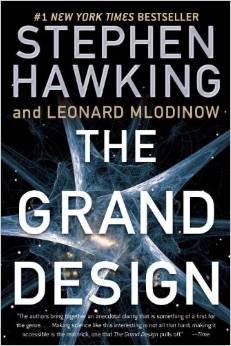
Stephen Hawking & Leonard Mlodinow, THE GRAND DESIGN (2010)

This is the most recent book authored (or co-authored) by Stephen Hawking, the well-known brilliant physicist, subject of the recent film The Theory of Everything. The film depicts (in addition to his personal life) his life’s work to identify a unifying theory of physics, the so-called theory of the title, which for several decades now has remained unresolved to everyone’s satisfaction.

So I read this book, which I had already on my shelves, and took fairly detailed notes, which I’d planned to post here. But then I tried to do a high-level, introductory summary, this evening, and it got so long that I will post only that, and leave my detailed notes to my PC archives.

So, the summary:

It took the Greeks to realize that happenings in nature were not the products of capricious gods, but could be understood as consequences of basic forces. The modern concept of laws of nature emerged in the 17th century. The authors emphasize the idea of ‘model-dependent’ realism; many models might ‘explain’ observations, though some models might be considered superior to others in their simplicity.

By the early 20th century the forces of electricity and magnetism had been understood to be united, and other fundamental forces of nature, gravity, and the weak and strong nuclear forces, had been identified and, in the case of gravity, described by Einstein in terms of the speed of light, and how time and space were related.

But a different understanding of these ‘classical’ theories came from exploration by Heisenberg of interactions at the very very small, where particles seemed to behave like waves, and how there are no deterministic laws, just laws of probability about the likelihood of a particle being at any position at any time, like a wave.

So the traditional ‘classic’ theories of physics gradually were superseded by more complex theories that took these ‘quantum’ effects into account. These theories entailed ideas of bosons (e.g. photons), fermions (matter particles, in turn made of of quarks, with various properties), that superseded the traditional notions that atoms were composed merely of protons, electrons, and neutrons.

Physicists then searched for ‘grand unified theories’ (GUTs), that connected all these particles and forces. A potential solution was found in the 1970s, an idea called ‘supersymmetry’, and the attendant idea of ‘string theory’, in which what we think of as ‘particles’ are actually vibrations in one or two dimensions in a universe of ten or more dimensions. (It’s conceptually difficult to imagine; it’s more a matter of how the mathematics works out.)

But it turned out there were several solutions to the concept of string theories. The idea of “M-theory” is that it is a higher-order theory, involving *eleven* space-time dimensions, that places the various five solutions of the string theories into a context that implies that there are many different universes, each with different laws of nature. (Wikipedia actually summarizes all this even more briefly at Introduction to M-theory.)

These different universes, some 10^500 of them (!), have different laws of nature, and different numbers of dimensions, involving lower-order realities that exist within higher-order spaces: vibrating strings, point particles, 2-D membranes, 3-D blobs, and other multi-dimensional ‘branes’ [a term used in THE SCIENCE OF INTERSTELLAR], as well as rules about *how* these extra dimensions are ‘curled up’, which in turn imply values for various physical particles, such as the charge of an electron. I.e., the laws of nature.

And so the authors endorse the ‘strong’ anthropic principle — the fact that since we exist, that the human race exists on a planet able to support life, this has reverse-implications about the physical laws of the universe, the so-called ‘fine-tuning’ of the universe. It’s not that some ‘God’ fine-tuned the universe for our existence; it’s that, because we exist, we must exist in a universe that allows for our existence, while at the same time there are infinitely many *other* universes, with different physical laws, most of which would not allow our kind of life to exist.

It’s not just about the ‘Goldilocks zone’ and so on; it’s the recognition that in universes with more than three physical dimensions, stable orbits of planets around suns would not exist. That we exist implies that our universe is one of only three physical dimensions.

The authors conclude by invoking the “game of life”, a computer simulation invented way back in 1970 – a two-dimensional grid with squares that are on (‘alive’) or off (‘dead’), and a simple set of rules about how these squares propagate themselves. [Wikipedia has this page about it.] Amazingly, with a very simple set of such rules, basic initial states develop into relatively complex states, rather lifelike, according to patterns not reduced to simple rules. This is a profound implication, that very simple rules produce complex features like those of intelligent life.

This has implications about free will.

And this is analogous the idea that our universe has spontaneously come into existence.

Because there is a law like gravity, the universe can and will create itself from nothing in the manner described in Chapter 6. Spontaneous creation is the reason there is something rather than nothing, why the universe exists, why we exist. It is not necessary to invoke God to light the blue torch paper and set the universe going.

M-theory is the only candidate for a complete theory of the universe. It is the unified theory Einstein was hoping to find.

The fact that we human beings—who are ourselves mere collections of fundamental particles of nature—have been able to come this close to an understanding of the laws governing us and our universe is a great triumph. But perhaps the true miracle is that abstract considerations of logic lead to a unique theory that predicts and describes a vast universe full of the amazing variety that we see. If the theory is confirmed by observations, it will be the successful conclusion of a search going back more than 3,000 year. We will have found the grand design.

At the same time, Wikipedia has this page about the book, with a relatively brief synopsis, but with extensive reactions, pro and con, from various readers.

Finally, a couple personal comments of my own, which I wrote while partly way through the book.

>> Taking the broadest speculative point of view, I suspect that the difficulty humans have with conceptualizing and integrating these theories is that our own experience and perspective is limited, not just to the scale at which we live (whereas existence is so much different at the very large and very small), but in the way we interact with the world, familiar with certain kinds of sources and not others. (Remember, humans are not very good at perceiving actual forces; it took Newton to disprove the intuitive notion that heavier objects fall faster than lighter objects.) This limitation in how we think of and perceive the world, in terms of physics, is analogous to the limitations of human experience of the world in terms of pheromones and our very narrow perception of the electromagnetic spectrum, as discussed by EO Wilson in the book I summarized over several blog posts.

>> Another possibility: perhaps mathematics, as conceived by human beings, actually *doesn’t* work. It’s been often remarked about how amazing it is that the universe is susceptible to principles we humans can summarize in terms of mathematics we have conceived. But our difficulty in resolving the various pieces of these theories into a unified whole suggests that perhaps this is not entirely true. What could *that* possible mean?

Posted in Book Notes, Cosmology, Philosophy, Physics, Science | Comments Off on Hawking’s Theory of Everything

Christopher Hitchens’ Ten Commandments

Christopher Hitchens’ Ten Commandments, via Hemant Mehta’s Friendly Atheist blog.

I’m fascinated by the obvious irrelevancy of the traditional, Biblical, commandments, and have collected here on my blog various alternate versions (I need to create and retroactively tag those earlier posts on this subject.)

Christopher Hitchens, who died in 2011, was of course a famous author and raconteur, given to heavy drinking and smoking, habits which he realized contributed to his relatively early death at age 62. He’s best known in popular culture as one of the three ‘atheist horsemen’ (along with Richard Dawkins and Sam Harris) who published books in the 2000s about the pernicious effects of religion and faith; Hitchens’ book was god is not Great (2007), with its deliberate un-capitalization of the first word of the title.

Here’s a summary and gloss on his talk, at that link.

Hitchens presents his ideas as opposed to the *four* versions of the commandments that Moses released. (I was aware of two; I’ll have to check out his reference.)

He discusses the problem of ‘graven images’ and Christian art. And other obvious problems with the traditional ten.

(As I’ve said before, half of the traditional ten are simply special cases of the general “Golden Rule”: do unto others what you would have them do unto you.)

Either God, Hitchens says, or the people who invented him, the early Jews, improvises, is jealous, is inconsistent, and is short-tempered.

And so here is Hitchens’ Ten:

#1 Do not condemn people on the basis of their ethnicity or their color;
#2 Do not ever even think of using people as private property, or as owned, or as slaves;
#3 Despise those who use violence, or the threat of it, in sexual relations;
#4 Hide your face and weep if you dare to harm a child;
#5 Do not condemn people for their inborn nature; Why would God create so many homosexuals only in order to torture and destroy them?;
#6 Be aware that you too are an animal, and dependent on the web of nature. Try to think and act accordingly.
#7 Don’t imagine that you can escape Judgement if you rob people with a false prospectus, rather than with a knife;
#8 Turn off that fucking cellphone; you can have no idea how unimportant your call is to us;
#9 Denounce all Jihadists and Crusaders for what they are: psychopathic criminals with ugly delusions, and terrible sexual repressions;
#10 Be willing to renounce any God, or any faith, if any Holy Commandment should contradict any of the above.

In short: Don’t swallow your moral code in tablet form.

My comment: he’s a bit off the rails with his 8th, which almost undermines his entire project (of course he might have stated it more generally, e.g. don’t be so selfish; be considerate of others), but in general his suggestions, as with most of the alternatives I’ve linked here previously, are superior to the traditional ten, which were born of illiterate desert tribes who thought the world was flat.

Posted in Culture, Religion, Ten Commandments | Comments Off on Christopher Hitchens’ Ten Commandments

Stephen Prothero on ‘why liberals win’ America’s culture wars

Stephen Prothero is a religious scholar at Boston University, who gave a talk on October 23rd called Why Liberals Win: America’s Culture Wars from the Election of 1800 to Same-Sex Marriage.

It’s a preview of Prothero’s upcoming book of nearly the same title; — Why Liberals Win: The Story of America’s Culture Wars and the Lost Causes of Conservatism — to be published in April 2015. (There’s no cover image yet, on Amazon, to display here.)

(I have two of Prothero’s earlier books, Religious Literacy and God Is Not One, one of which I’ve read, and the other is in my to-read stack.)

The video link of his talk reveals that he is not the greatest public speaker; his speech is slow and deliberate, like the careful university professor that he is. Here’s a summary of his talk:

The ‘culture wars’ are nothing new. They are no longer confined to politics; Prothero’s current project examines these issues from Jefferson to Obama. These cultural wars have four features: public disputes, in magazines and newspapers; that these disputes are not purely economic; third, they give rise to larger questions about the meaning of America; and fourth they are heated disputes, with convictions that one’s enemies are enemies of the nation. “A fundamentalist is an evangelical who is angry about something.”

This is the arc of history, as Prothero describes. He reviews five episodes of American history: the election of 1800 (in which he describes partisanships far more severe than in our time), which keyed off Jefferson’s religion.

The second is the battle between Protestants and Roman Catholics in the 1830s and 1840s.

The third is anti-Mormonism, mostly after the Civil War.

The fourth episode is the battle of the Prohibition era of the 1920s and early 1930s.

And the fifth: the ‘cultural wars’ that began in the 1970s, over segregation, and IRS rules about tax-exemption, that galvanized the ‘religious right’. (Roe v. Wade wasn’t an issue to the RR, at the time.) This issue pivoted to issues of ‘family values’, to issues of gender and abortion and homosexuality; and to the idea that the IRS was discriminating against religion, in that people who could not discriminate felt themselves to be the victims – not those they were discriminating against [how very familiar, in the current religious right rage against the legalization of same-sex marriage].

It’s all about anxiety about a way of life that’s passing away, the end of the traditional family, or the end of white supremacy. Monoculture vs. Multiculture. Family vs Families. The one or the many.

He disputes several misconceptions about the motives behind the ‘culture wars’.

He has three conclusions:

1, cultural wars are cultural, not issues of morality, or religion, or economics alone;

2, cultural wars are conservative projects; they are morality plays in which actual liberals play very minor roles. “Modern conservatism is rooted in a narrative of loss and restoration; a form of culture is passing away, and it is worth fighting to revive.” Cultural battles are typically started by conservatives – not in reaction to some liberal plot, but by cultural changes in immigration, or progressive social changes.

3, America’s cultural wars have been won by pluralists on the left. Look at the evidence, in all these episodes. Why does this happen? Because conservatives attach themselves to lost causes; they pick fights they were already losing. Their goal is not to win, it’s to “preach a gospel of the fallen and the lost; to demonstrate how far America has descended from the glory of its founding….”

Prothero describes the cycle of cultural wars: it starts on the right, with some anxiety about social change; the left strikes back, often appealing to the principle of liberty; then rhetoric of no-compromise; but always resolved with some degree of accommodationism. And then the liberals win, most of the time. (Exceptions: conservatives defeated the ERA; they reduced budget for the arts; they succeeded in making talk of God more acceptable among politicians; and somehow made ‘liberalism’ a dirty word, as a moral threat.) But conservatives lost the cultural wars overall, badly: tax exemptions for segregation academies, Clinton’s impeachment, school prayer, killing the NEA, casual sex, the counterculture, abortion [which is still legal, barely], marijuana, the traditional family, and about same-sex marriage.

Liberals control the agenda. “Having lost one culture war, conservatives become even more convinced that other Americans are out to get them; they become more fearful that American society is going to Hell. And so they cast about for another complaint, something else that that is precious and is passing away.”

All conservatism begins with loss, says Andrew Sullivan. And so it goes for America’s culture wars…

Posted in Culture, Religion | Comments Off on Stephen Prothero on ‘why liberals win’ America’s culture wars