Sunday’s New York Times: Links and Comments

Opinion column by Curt Stager: Tales of a Warmer Planet.

This relates to my suspicion and prediction that efforts to ameliorate climate change will come too little and too late — because human nature cannot respond to a potential threat until it actually happens, until it actually affects people who don’t pay attention to long-range political issues until those issues affect their daily lives.

It is now too late to stop human-driven warming altogether. Even if we wean ourselves from fossil fuels within the next few decades, our descendants will still face temperatures significantly higher than they are now — for millenniums to come.

We are changing, through inaction, not only our immediate future, but far futures.

In that far future, there will be no more fossil fuels left to burn in order to sustain the artificial hothouse, and only a reduced, heat-tolerant fraction of today’s cultural and biological diversity will remain to face an age of global cooling that could last as long as half a million years, far more than the entire history of anatomically modern humans up until now.

We are in the geological Anthropocene, as Elizabeth Kolbert described in The Sixth Extinction (post review here).

As pioneers of the Anthropocene, we are an immensely powerful force of nature and can accomplish great things if we not only learn what is scientifically true, but also do what is morally right. Pope Francis tells us that “there is nobility in the duty to care for creation.” As a climate scientist who welcomes international action to address climate change, I offer a heartfelt “Amen” to that.

\\

Sunday’s New York Times Book Review has reviews of two especially interesting books.

On Lisa Randall’s Dark Matter and the Dinosuars, review by Maria Popova. I’ve mentioned this book before, and its thesis, and how Randall evokes the interconnectedness of everything.

Randall calls the force driving that fraction “dark light” — an appropriately paradoxical term confuting the haughty human assumption that the world we see is all there is. … Therein lies the book’s greatest reward — the gift of perspective. The existence of parallel truths is what gives our world its tremendous richness, and the grand scheme of things is far grander than our minds habitually imagine.

Popova concludes,

Science, after all, isn’t merely about advancing information — it’s about advancing understanding. Its task is to disentangle the opinions and the claims from the facts in the service of truth. But beyond the “what” of truth, successful science writing tells a complete story of the “how” — the methodical marvel building up to the “why” — and Randall does just that.

\\

And a review by Frank Rose of Matt Ridley’s The Evolution of Everything, another book on my to-read stack. Ridley’s book is an exploration of how the idea of evolution, of natural selection, applies to much more than organic evolution. Ridley’s thesis is that many things we think are planned or determined in some way are in fact the result of ’emergent’ results, “unplanned and undirected behavior unfolding over time”.

The word for this is “emergent,” and with “The Evolution of Everything” Ridley has set out to construct a sort of grand unified theory of emergent behavior.

Meaning,

As humans, we like to think we control events. We accept, at least in theory, that there is a degree of randomness in the world, but we still try to read some kind of portent into whatever happens. Any explanation is more comforting than the stark possibility that things occur without purpose. Even an inscrutable deity who deals out death and torment for reasons we can’t fathom is preferable to the profound disorientation of chance. We want — need — to believe that someone or something is in charge.

The review goes on to discuss Lucretius (“swerve”), public morals and Adam Smith, but with a reservation or two:

He makes a good case that education would be better off without bureaucrats. But elsewhere he overreaches. His insistence that climate- change arguments are overwrought is rather suspect, especially for someone with a working coal mine on his country estate.

(Always take into account the motivations of any writer.)

The review concludes:

Why are emergence and randomness so hard for people to accept? Could it be that the human brain is such a pattern-­seeking organ that it can barely acknowledge unguided developments as an option? “The belief in the will and in the immortal soul themselves emerged as evolutionary consequences of how the brain changed,” Ridley writes. It’s a thought he might well have explored further.

Well, yes, the human brain is a pattern-seeking organ…

Posted in Culture, Evolution, Morality, Religion, Science | Comments Off on Sunday’s New York Times: Links and Comments

Links and Comments: Sacred truths, Catholic priorities, and Santorum advice, vs. Individualism and the arc of moral history

A number of items in recent days about issues of society and culture vs. individualism, which I will compile and quote without necessarily trying to draw any conclusions just yet… These issues renovate with the Jonathan Haidt book I’m still working my way through.

Starting with Jeffrey Tayler’s latest Salon ‘sermon’ (as Jerry Coyne calls them), David Brooks’ sanctimonious piffle: Sad trees die for gauzy, Hallmark-card nonsense, responding to Brooks’ column from Tuesday the 17th, Finding Peace Within the Holy Texts, in which Brooks suggests that the resolution to current conflict with ISIS, et al, can be resolved by properly interpreting ancient holy books. Tayler objects, of course, but suggests that we *should* read the holy texts:

The danger comes from reading these texts as historical documents, as possessing “truths” that came to man as the product of revelation — the vilest, most improbable notion around. Just pause and consider revelation for a moment. Why would the Lord have chosen to disclose His plan for humanity only to those storied few, and so long ago? Why would he not “reveal” Himself to each one of us? Or at the very least, issue an updated edition of his “holy” texts, perhaps in digital format with hyperlinks to make following their mad plot twists and often crazed characters easier? Seriously, though, the real problem is that those revering “scripture” as something more than of this world can and often do veer into fundamentalism. The Abrahamic canon lends itself to literalist readings, with the tragic outcomes we know so well. The answer to religious violence lies not “within these ancient texts,” but in dumping religion.

No “sacred” truth exists; there is only epistemologically sound, verifiable truth and its counter, falsehood.  Either a proposition is true or it is not. Either there is a god or there is not. There exists no sound, objective evidence that there is. We therefore conclude that there is no god, which means all religious texts positing his existence are wrong, and whatever value they have is merely cultural, anthropological or otherwise accidental. All dogmas arising from these texts, thus, deserve to be evaluated rationally and without prejudice, on the basis of the ideas they contain. This means that Brooks’ hallowed “scriptures” merit no more a priori respect than Lewis Carroll’s “Alice’s Adventures in Wonderland” or Georges Bataille’s gross chronicle of incest or Sarah Jessica Parker’s musings in “Sex and the City” or Justin Bieber’s Twitter feed.

I have to mention again that Tayler, in his many essays at Salon over the past year, is spelling out, in blunt language, what seems obvious to many people, including me, who see adherence to ancient ‘holy’ texts as lazy and incoherent, as *obviously* a sort of psychological submission to cultural standards, supported by social cohesion, but without any support by evidence or fact. (Yet my take, my PvC, is that society survives on this sort of delusion, despite its disconnect with what, through evidence and logic, we can conclude is empirically real.)

Religion seems to be a force contrary to the arc of history about the expansion of individual rights, as opposed to the submission of individual behavior that would challenge groups — families, tribes, faith groups, cultures.

\\

Catholic Bishops Release Anti-Pornography Report (As If You Were Expecting Anything Else)

Because, the article explains, as if it’s not obvious, the Catholic Church disapproves of *everything* that could possibly threaten the expansion of the Catholic Church, that is the expansion of its tribe, i.e. more babies. Thus, all the prohibitions about masturbation, contraception, abortion, and same-sex marriage.

The Catholic Church is a wee bit obsessed with sex in that they believe it’s only acceptable on their terms. No birth control because reproduction is important. No abortion because reproduction is important. No sodomy because reproduction is important. No same-sex marriage because reproduction is important. Don’t worry about physical attraction or orgasms because none of it has to do with reproduction.

Shorter version: “MAKE MORE BABIES, PLZ.”

This position is understandable in the context of ‘group selection’, as Haidt describes and how E.O. Wilson has described. It’s fairly obvious: why wouldn’t groups who promote reproduction at all costs, including reproduction at the expense of the freedoms of individuals to live their lives in ways that might not expand the tribe’s population, prevail over other groups/tribes that are not as adament about these priorities.

And so we see comments like this from Rick Santorum, here.

On the issue of family, I’m a big supporter of marriage and the family. Why? Because it’s best for society. Stable marriages in which children grow up in is, without a doubt, the best situation for a child to be raised in America.

You don’t have to be religious. You don’t believe in the sacrament of marriage. You don’t have to believe that marriage is a religious institution. You can believe it’s a civil institution, but it’s important for children to be raised by what I would say is the birthright, their natural mom and their natural dad in a stable and healthy home.

Setting aside for the moment the factual evidence that children raised by gay parents — who are just an anxious to raise children as straight parents (believe me, I know) — are as happy and healthy as any others, look at what Santorum is saying: Because it’s best for society. For all that conservatives reject any kind of governmental economic control that they would reject as “socialism”, these same conservatives are eager to deny individual rights (of gay parents, for example), in order to promote a social cause, a social welfare, for the betterment of a group, of “society”.

Along these same lines, here’s an Adam Lee essay In Defense of Radical Individualism. He addresses how Christians might respond to the Obergefell decision that legalized same-sex marriage across the US, and how evangelicals define individualism.

The way I see it, there’s not a lot of middle ground here. You either own yourself, or you don’t; either you can make your own choices, or you can’t. How could there be a compromise position on this?

And:

In this context, it’s exactly right to say that radical individualism is a threat to the dominance of Christianity and other religions. The world’s major faiths have always preached that people have a duty to obey their betters and follow the rules, no matter the suffering it may cause. It’s a good thing that people are rejecting this bleak message and taking their happiness into their own hands in this, the only life we ever have.

The Haidt book, though I haven’t quite finished it, identifies aspects of human nature that he sees as crucial to what many people around the world think of as ‘morality’. They entail ideas about sanctity and purity and loyalty as being as essential to morality as ideas about fairness and doing no harm to others are to members of the so-called ‘advanced’ western cultures (US, Europe, et al.) I will summarize his ideas shortly — and explore how his ideas align with the idea (of mine, of Shermer, of Pinker, of Harris) of moral progress, a ‘moral arc’ of history.

Posted in Conservative Resistance, Culture, Morality, Religion | Comments Off on Links and Comments: Sacred truths, Catholic priorities, and Santorum advice, vs. Individualism and the arc of moral history

Links and Comments: Haidt, Krugman, Cruz and Swanson, Evolution v Creationism and Iowa Home-Schoolers

I am 3/4 of the way through that Jonathan Haidt book, The Righteous Mind: Why Good People Are Divided by Politics and Religion, which is almost revelatory in the sense that it provides a vocabulary and a theoretical framework for how different people think about morality, and how those differences inform debates about politics and religion. More when I finish the book.

But here’s an example, better understood given the theorectical framework Haidt provides. (More prominent examples, include, frankly, the ISIS attacks on France.) Today’s Paul Krugman column: The Farce Awakens. About how conservative panic over Syrian refugees fits a familiar pattern.

What explains the modern right’s propensity for panic? Part of it, no doubt, is the familiar point that many bullies are also cowards. But I think it’s also linked to the apocalyptic mind-set that has developed among Republicans during the Obama years.

Think about it. From the day Mr. Obama took office, his political foes have warned about imminent catastrophe. Fiscal crisis! Hyperinflation! Economic collapse, brought on by the scourge of health insurance! And nobody on the right dares point out the failure of the promised disasters to materialize, or suggest a more nuanced approach.

And

The point is that at this point panic is what the right is all about, and the Republican nomination will go to whoever can most effectively channel that panic. Will the same hold true in the general election? Stay tuned.

\\

I missed this yesterday — a rare example of coverage in major media of the several Republican candidates who appeared at a rally a couple weeks ago led by one Kevin Swanson, who literally advocates deaths for gays (because Bible).

NY Times, Katherine Stewart, Ted Cruz and the Anti-Gay Pastor

When they hail religious liberty, they do not mean the right to pray and worship with other believers. Instead, the phrase has become a catchall for tactical goals of seeking exemptions from the law on religious grounds. To claim exception from the law as a right of “religious refusal” is, of course, the same as claiming the power to take the law into one’s own hands.
The leaders of this movement are breathtakingly radical. Like Mr. Swanson, they feel persecuted and encircled in a hostile world. Like him, they believe that America will find peace only when all submit to the one true religion.

(Submit!)

Right Wing Watch has followed up: GOP Candidates Really Don’t Want To Talk About ‘Kill The Gays’ Conference

A spokesperson for Huckabee, who at the event deflected a question about Swanson’s extremism, told Basu after viewing video of some of Swanson’s remarks that Huckabee “appreciated the opportunity” to speak at the conference. The Cruz and Jindal campaigns didn’t bother to reply at all. (Before the conference, Cruz had been asked about his participation by CNN’s Jake Tapper, but brushed off the question.)

\\

On another topic, there is this, at Slate: Evolution Is Finally Winning Out Over Creationism: A majority of young people endorse the scientific explanation of how humans evolved.

There are many reasons for this shift. One is improving science education (more on that later). But another is that, in some ways, they don’t have a choice, argues Daniel Dennett, co-director of the Center for Cognitive Studies at Tufts University and co-author of Caught in the Pulpit: Leaving Belief Behind. He credits the rise of the Internet and the fact that today’s young people are more interconnected than ever before. “What is particularly corrosive to religion isn’t just the newly available information that can be unearthed by the curious,” Dennett wrote in April, in an op-ed entitled “Why the Future of Religion is Bleak” in the Wall Street Journal, “but the ambient knowledge that is shared by the general populace.”

Which is one reason why conservatives home-school – to shield children from the ambient knowledge of the general population. To preserve the myths, shield them from the reality that would shatter them.

On the other hand, Salon has this essay by Robert Leonard, I went to church with Ted Cruz. He is building an army of young Christian voters in Iowa, which demonstrates how small town communities and home schooling helps righteous evangelical parents shield their kids from such “ambient knowledge”.

While many say the members of the Republican party is aging, I see a youth movement in Iowa. The homeschool movement is growing here and in much of the nation, and many homeschoolers are devout Christians. Christian schools are thriving as well. Much of this is at the expense of public schools. … In a remarkably ignored yet transparent self-fulfilling prophecy, Republicans claim austerity, cut public funding to schools, and then say the schools are failing. Rinse and repeat.
The goal ultimately is to legislate that public money not to go to public schools directly, but to follow the child into the home if home schooled, or into charter, or Christian schools. The destruction of public schools is therefore a “good” thing.

See also the dialogue with a local, a young woman at a coffee shop, near the end of this piece.

“Who do you like for president?” I asked.

“Cruz,” she replied, sitting down at the table with me, putting her coffee down. “He’s the only true conservative, and a godly man. A true leader.”

“But he hasn’t done anything,” I said.

“Of course he has,” she replied. “Lots of proposed reforms the RINOs and Democrats wouldn’t accept, and he nearly brought the government down.”

“And almost bringing the government down is good?”

She looked puzzled. “Of course it is. And he’s the only one without a big ego.”

“Cruz? No ego?”

“No, it’s not about him,” she said. “He’s doing the Lord’s work.”

Yup. Iowa.

Posted in Conservative Resistance, Culture, Evolution, Morality, Politics, Psychology, Religion | Comments Off on Links and Comments: Haidt, Krugman, Cruz and Swanson, Evolution v Creationism and Iowa Home-Schoolers

Links and Comments: Bruni on Cruz; Flip-flopping presidents are most effective; political persuasion; Republicans’ economic narrative; Lisa Randall, a new Trek

From last Sunday’s New York Times: Frank Bruni on Ted Cruz’s Laughable Disguise

He emphatically recalls how his father’s embrace of Jesus Christ led him back to his mother — and to him — after his parents had separated.

He tends to skip over the part about his parents eventually divorcing nonetheless. It was his father’s second failed marriage. That detail doesn’t fit Cruz’s moralizing on the subject of holy matrimony. It doesn’t buttress his extravagant lamentations about the tradition-shattering, God-insulting unions of two men or two women.

But then his education and his station in life don’t exactly buttress the disdain he heaps on intellectuals and the affinity he claims with the hourly laborers of the world.

During the most recent debate, he twice disparaged the people in Washington who set monetary policy as haughty, disconnected “philosopher-kings.”

From such cunningly chosen, strategically deployed words, you’d never guess that Cruz was known at Harvard Law School for a reluctance to “study with anyone who hadn’t been an undergrad at Harvard, Princeton, or Yale,” according to a 2013 profile of Cruz in GQ by Jason Zengerle.

One of Cruz’s law-school roommates, Damon Watson, told Zengerle: “He said he didn’t want anybody from ‘minor Ivies’ like Penn or Brown.”

My impression is that conservative politicians rely on idealistic narratives, even moreso than liberal politicans do. This also explains why Ben Carson has been so adamant about the veracity of his story that, in his youth, he tried to stab someone. Because his narrative is that Christianity saved him, and informs his entire life since then, and thus justifies all the nonsensical things he’s been saying recently.

\\

Also NYT, Adam Grant on The Virtue of Contradicting Ourselves. Politicians get accused of being ‘flip-floppers’ if they ever change their minds– but people open to new evidence *should* be allowed to change their minds; it’s a sign of intellectual integrity.

Essay discusses cognitive dissonance, with the odd effect that sometimes it doesn’t bother people at all to hold inconsistent beliefs. New studies show

that inconsistent beliefs really bother us only when they have conflicting implications for action. People have little trouble favoring both abortion rights and tax cuts. But when it comes time to vote, they confront a two-party system that forces them to align with Democrats who are abortion rights advocates but against tax cuts or Republicans who are anti-abortion but for tax cuts. If I’m socially liberal and fiscally conservative, and I want to vote for a candidate with a decent shot at winning, my beliefs are contradictory. One way to reconcile them is to change my opinion on abortion or tax policies. Goodbye, dissonance.

Flip-flopping turns out to be a predictor of presidential success.

When historians and political scientists rate the presidents throughout history, the most effective ones turn out to be the most open-minded. This is true of both conservative and liberal presidents. Abraham Lincoln was a flip-flopper: He started out pro-slavery before abolishing it. Franklin Delano Roosevelt was a flip-flopper, too: Elected on a platform of balancing the budget, he substantially increased spending with his New Deal.

One person’s flip-flopping is another’s enlightenment. Just as we would fear voting for candidates who changed their minds constantly, we should be wary of electing anyone who fails to evolve. “Progress is impossible without change,” George Bernard Shaw observed, “and those who cannot change their minds cannot change anything.”

\\

And then this week’s “Gray Matter” column, The Key to Political Persuasion, by Robb Willer and Matthew Feinberg.

You persuade people by appealing to their values, not yours, but how hard this is to do. Examples about liberals and conservatives asked to write persuasive arguments for some issue — same-sex marriage, making English the official language of the US — that would appeal to the other side, and most fail.

Maybe reframing political arguments in terms of your audience’s morality should be viewed less as an exercise in targeted, strategic persuasion, and more as an exercise in real, substantive perspective taking. To do it, you have to get into the heads of the people you’d like to persuade, think about what they care about and make arguments that embrace their principles. If you can do that, it will show that you view those with whom you disagree not as enemies, but as people whose values are worth your consideration.

\\

Fascinating interview, on San Francisco’s KQED’s “Forum” program, with Lisa Randall, Harvard theoretical physicist and author of new book Dark Matter and the Dinosaurs. The specific subject is how the solar system’s wobbling passage through a presumed disk of dark matter (Randall says a better term would be ‘invisible matter’) lying along the plane of the galaxy might explain the periodic mass extinctions throughout Earth’s history. More generally, she’s very well-spoken, and I particularly noticed her comments about appreciating the scope of reality not readily available to human experience, how the expanses of reality are so much more interesting than any ancient tribal myths.

\\

Reality check, at Vox: Republicans think America is doing terribly, but it isn’t, by Ezra Klein.

Anyone watching the fourth Republican debate would be excused for thinking America is mired in a deep recession — that the economy is shrinking, foreign competitors are outpacing us, more Americans are uninsured, and innovators can’t bring their ideas to market.

Example quotes from Trump, Cruz, Fiorina, Rubio.

They would be surprised to find that unemployment is at 5 percent, America’s recovery from the financial crisis has outpaced that of other developed nations, the percentage of uninsured Americans has been plummeting even as Obamacare has cost less than expected, and there’s so much money flowing into new ideas and firms in the tech industry that observers are worried about a second tech bubble.

Narrative trumping reality, in the service of human nature and tribal identity.

\\

Science Daily: Yet another study that demonstrates that people are reluctant to change their minds, even when facts don’t match what they believe

\\

Cool video at Business Insider: This 3-minute animation will change your perception of time.

\\

Podcast show Thinkery has Episode 18, with several speakers (including Paul Fidalgo of Morning Heresy fame), discussing the potential of a new Star Trek series, perhaps starting from scratch. How would cultural assumptions now differ from those 50 years ago? Could a new Trek be used to advance the idea that ‘gods’ are obsolete and the reality of the vast universe is so much more interesting? And so on.

Posted in Narrative, Politics, Psychology, Science | Comments Off on Links and Comments: Bruni on Cruz; Flip-flopping presidents are most effective; political persuasion; Republicans’ economic narrative; Lisa Randall, a new Trek

Review of Alastair Reynolds’ SLOW BULLETS

Alastair Reynolds’ short novel SLOW BULLETS – the latest in a series of short novels from Tachyon Publications, following among others Nancy Kress’s Yesterday’s Kin and Daryl Gregory’s We Are All Completely Fine, both awards winners – is a spectacular far future space opera whose main defect is that it’s too short, and a bit skimpy near the end. Reynolds is one of those authors whose works I’ve admired, those I’ve read, but whom I’ve been unable to keep up on over the years, partly because most of his novels are quite long, and mainly because of my own erratic attention over the past decade. I particularly admired House of Suns (2008, Wikipedia), a spectacular saga of competing multi-generational families that hold reuinions, via clones, every circuit of the galaxy or so; he makes the drama work within the constraints of non-FTL travel in a way I’ve not seen any other hard SF author do.

SLOW BULLETS is also set in some remote, intergalactic future, as a long-term war between the Central worlds and the Peripheral worlds is winding down, has reached a truce. News of the truce is slow to spread, and so the opening of the novel involves Scur, a warrior on one side, being captured by Orwin, a sadistic warrior on the other side who hasn’t heard about the truce, who injects her with a second ‘slow bullet’, in additional to the one she already has; a memory device all warriors carry, to preserve their memories, but which application causes excruiciating pain.

Scur awakes in a ‘hibo’ capsule aboard a prisoner starship with no recollection how she got there. Aboard are hundreds of other ‘prisoners’ from both sides of the conflict, along with a few crew members who seem to have no idea of what has happened – how the ship has apparently traveled for longer than intended, and how they do not know where they are.

And so the story evokes, on a couple counts, a basic SF theme – the resetting of humanity without memory of a past, first on the starship, cut off from everything they’ve known, forced to rebuild some kind of internal society on their own terms; and second, with the gradual realization about where they’ve arrived, and what’s happened to the rest of humanity across its worlds, with an example of an SF encounter with an inexplicable alien ‘other’. The titular notion of the ‘slow bullets’ becomes crucial, as a threat to the loss of cultural knowledge, via decay of their starship, is resolved through self-sacrifice.

Reynolds writes clean clear prose, in a way that doesn’t beg appreciation for his wide-scale cosmic depictions; he lets his cosmic expanses appear matter-of-factly, to speak for themselves. Yet his prose is occasionally quite striking, as when the villain Orvin confronts our hero Scur, about her need for revenge:

Be honest with yourself, as one solder to another. We both know what hate feels like. It hasn’t gone away just because we spent a little time in hibo. It’s like a light filling you up from inside. It’s leaking through your skin.

A fine short novel, and one which invites attention to his longer works.

Posted in science fiction, Species Reset | Comments Off on Review of Alastair Reynolds’ SLOW BULLETS

The World’s Young: a review of Robert Charles Wilson’s THE AFFINITIES

Robert Charles Wilson’s THE AFFINITIES is ‘social’ science fiction in the most literal sense. (I seem to recall how Isaac Asimov made the distinction between hard SF, social SF, and social satire – the latter being Huxley, Orwell, and the like – though I may be misremembering this, since I can’t find a reference to this triplet anywhere just now, either in print or online.)

The book is about a very near-future social-networking option, run by an organization called InterAlia, which conducts various tests to classify applicants into one of 22 ‘affinities’, groups of like-minded people. It’s not a dating service, and Wilson perhaps conspicuously avoids comparing these classifications to Myers-Briggs or any similar psychological testing options.

The early chapters depict Adam Fish, a Toronto graphic artist, who applies to InterAlia and is assigned to the Tau tranche. (Affinity groups are named after 22 letters of the Phoenician alphabet.) His loose social connections, his discomfort with members of his family in Schuyler NY, his chats with autistic step-brother Geddy, illustrate his need (and Geddy’s need) for some new kind of social connections. And when he attends his first meeting of fellow Taus, he feels an instant psychological resonance, an intuitive sense of common understanding and trust. And one of the people he meets gives him a job.

Part II: Seven years later, Adam is involved with affinity politics, as a movement grows to liberate the technology of the tests from the company InterAlia, as the inventor Meir Klein has quit and is subsequently murdered, and as a rival group, the Hets, seem to be challenging the Taus for political dominance, perhaps to the point of murder.

Part III: And four years after that, a political threat to the affinities is interrupted by a conflict – effectively, if obviously, foreshadowed – between Pakistan and India that brings down the internet and power infrastructure around the entire world. [I’m reminded of how the plots of so many traditional horror and thriller films would be undermined if only the characters had cellphones. This development removes cellphones from how the plot might otherwise play out.]

And the book ends with various plot resolutions and the recognition that things will keep changing.

This book resonates with my current preoccupations about big issues much more so than I had expected. It’s about humanity’s problems in the 21st century and ways they might be addressed. Wilson recognizes the issue, and the context, p26b:

We’re the most cooperative species on the planet — is there anything you own that you built entirely with your own hands, from materials you extracted from nature all by yourself? And without that network of cooperation we’re as vulnerable as three-legged antelopes in lion territory. But at the same time: what a talent we have for greed, for moral indifference, for wars of conquest on every scale from kindergarten to the U.N. Who hasn’t longed for a way out of that bind? It’s as if we were designed fro life in some storybook family, in a house where the doors are never locked never need to be. Every half-baked utopia is a dream of that house. We want it so badly we refuse to believe it doesn’t or can’t exist.

And, p140, about the issues facing humanity in the 21st century.

The problems confronting us are the obvious ones – climate change, resource competition, population stress, and all the human conflicts arising from those problems. What makes these questions especially difficult is that they cannot be dealt with comprehensively by individual action. We need to act collectively, on a global scale. But we have very limited means of doing that. We are a collaborative species, the most successful such species on the planet, but we collaborate as individuals, for mutual gain, under systems established to promote and protect such collaboration. Our global economic and social behavior is largely unconstrained. Which means that, under certain circumstances, it can run away with us. It can carry us all unwilling into the land of unforeseen consequences.

And, Rebecca on the arc of human history, and how New Socionome will succeed the affinities:

Our algorithms of connection favor non-zero-sum transactions, as the Affinities do, but they also facilitate long-term panhuman goals: prosperity, peace, fairness, sustainability. The arc of human history is long but our algorithms bend toward justice. We aren’t just falling. We’re FALLING FORWARD.

At the beginning of Part III, Adam talks with the autistic Geddy, who asks, “Is the world old or is it young?”.

It’s like, is everything all used up? Is history almost over? Or is it just getting started?

And then, movingly, a late passage, p291, Geddy answers his own question:

The Affinities were, like, the Model T of socionomic structures. We’re building better ones! Evolutionary algorithms to enhance non-zero-sum exchanges of all kinds! A way to address the big problems! … The world’s young! We’re at the beginning of something, and it’s big, and it’s scary, but in the end it might be– Beautiful!

Here is the essence of the progressive optimism of science fiction. And here is how, weirdly, this book echoes Isaac Asimov’s Foundation series: both are about attempts to analyze human psychology in order to anticipate history, avoid human calamities, and drive history toward long-term benefits.

Posted in science fiction | Comments Off on The World’s Young: a review of Robert Charles Wilson’s THE AFFINITIES

Reading Haidt, arcs of history, false balance, how liberal views are closer to the truth, and science fiction

Beginning to read Jonathan Haidt’s The Righteous Mind: Why Good People Are Divided by Politics and Religion today, an eloquent, insightful exploration into how the parameters of human psychology explain the range of political and religious differences. I wrote a blog post just a few days ago in which I tried to summarize my tentative take on these issues, before I read this book, and Chris Mooney’s, and others by Greene and Shermer and Kahneman. Haidt is echoing some of what I already understand, but he’s also providing some new perspective: in particular, how my ‘social arc of history’ (here) applies primarily to what he calls ‘individualistic’ societies, characteristic of post-Enlightenment societies in Europe and the US, as opposed to ‘sociocentric’ societies, such as those that dominated the ancient world (as well as some modern societies like China, it seems to me). Does the arc of history bend sociocentric societies toward the individualist? Not sure. I do note, for now, that ‘sociocentric’ tendencies seem to align with conservative politics.

But this book does not seem to be about whether any one tendency of human psychology is ‘correct’ in the sense of aligning with empirical reality (as I discussed in that earlier post). That’s another issue, but it’s a real one. (And if anything Haidt’s psychology suggests that this range of human psychology exists because it’s advantageous for survival, whether or not it’s ‘correct’ about reality; again, as I speculated about in that post.)

This recalls an issue raised in the New York Times a week or two ago. First, an op-ed by Arthur C. Brooks, president of the [right-wing] American Enterprise Institute, about how universities are dominated by liberals/progressives and why, in the name of diversity, they should strive to include more conservatives.

(This strikes me as a similar problem to that of false balance, in which the media feels obliged to present both sides of issues even where one side has obviously less credibility, e.g. is the Earth round or flat?.)

Thus, this letter responding to the Brooks op-ed captures my reaction. My bold.

Arthur C. Brooks is asking the wrong question. The question is not whether we need more conservative viewpoints in academia but why there are so few conservatives in academia. Not all ideas are of equal validity and thus deserving of equal time in college classrooms. Some ideas are empirically better than others.

The liberal version of reality predominates in academia because, quite simply, it is closer to the truth.

For example, the conservative view of biology and geology (that humans are a product of divine creation and the world is 6,000 years old) is just flat-out wrong.

And the conservative view of economics (that cutting taxes and expenditures during a recession results in greater prosperity) has been proven time and again to be false.

Another reason for the prevalence of liberal thought on college campuses was given long ago by a social scientist: It is just more humane. Liberals seek to treat all races, religions, classes, genders and so on equally compared with conservatives, who want a pre-1960 America.

And whereas all humans are created equal, the same cannot be said for all ideas.

While I’m fascinated by exploring the patterns of the human mind, how its biases and intuitions exist for evolutionary reasons, I’m actually more interested in what is real, and how we can step around those biases, through reason and science, and perceive what lies beyond common human perception. And this is where science fiction is a useful heuristic.

Posted in Conservative Resistance, Culture, Evolution, MInd, Morality, Politics, Provisional Conclusions | Comments Off on Reading Haidt, arcs of history, false balance, how liberal views are closer to the truth, and science fiction

Links and Comments: Raising Kids with or without faith; Benford hosts evolution debate; the Lake Wobegon Effect

Slate: “Why Hold a Child Hostage to My Doubts?” The confusing, complicated desire of parents with no religion to raise their kids with faith.

Why would parents with no religion think their kids need to be raised into a faith culture? (And why one particular faith culture as opposed to any other?, is my thought, not addressed, though I do understand why.)

Because religion offers easy answers to the difficult questions that children tend to ask, perhaps.

The trouble with children, of course, is that they want to know what’s real and what’s just a story. I dread the day when my daughter asks me if the stories in the Bible are true. My real answer is that some of them are and some of them sort of are and some of them aren’t and that even the ones that aren’t at all are still important because they are our stories. That should work for a 3-year-old, right?

In contrast, there are in fact books about “How to Raise Moral, Ethical and Intelligent Children, Free from Relgious Dogma”, to take one example: Dan Arel’s Parenting without God.

\\

Gregory Benford, in the latest issue of The New York Review of Science Fiction [Subscribe!], describes his task at UC Irvine, over the decades, of hosting various speakers to the campus. Here’s one, with Benford’s gloss on the perennial evolution/intelligent design “debate”:

In 1993 my friend, the biologist Michael Rose, and I assembled a public debate between him and the leading anti-evolutionist in America, Phillip Johnson, a professor of law at UC Berkeley and author of Darwin on Trial in 1992. Michael and I were both astonished by the rise of antiscience in our culture, and we sought a way to take on “intelligent design,” an attempt to put a patina of secularity on top of what is a fundamentally religious belief.

I opened the debate by saying I had no strong religious beliefs because I was an Episcopalian. That got the expected laugh because the crowd was quite fundamentalist. Unlike previous biologists who debated Johnson, Rose used offense, not defense, taking Johnson to task for what he thought a theory of life’s development should be. This revealed that the alternatives to evolution were laughable.

Rose wore a small, calm smile. At the half hour point John­son’s face began to twitch, eyes narrowed, ears reddened. I watched the audience, having little to do. They resembled a slow-motion crowd at a tennis match, attention swaying lazily, but now watching Johnson as Rose spoke. Rose scored points and Johnson’s face clouded, vexed.

At the end, Johnson, blocked from his favorite arguments by having to fend off Rose’s reasoned points, was visibly angry. Rose walked across the platform and shook Johnson’s hand, but Johnson refused to shake mine. I felt grand, since I made him do it in full view of the crowd. A bit more than 1500 paid $10 each to get in, with 300 UCI students getting in free. So UCI made $15,000 out of fundamentalist Chris­tians, and Johnson got blunted. Plus, it was fun.

\\

Last Friday’s Science Friday broadcast, with Ira Flatow, had a segment on Are ALL Minnesotans Above Average?, an allusion to Garrison Keillor’s “Prairie Home Companion” in which “all the women are strong, all the men are good-looking, and all the children are above average.” It’s a joke, but it keys off a fundamental human mental bias, about motivated reasoning and self-enhancement. Why people think they are special, a bit better than everyone else; why people think they are safer than the average driver, and so on. (It has an obvious survival advantage.) Some academics actually describe this as the “Lake Wobegone Effect”.

David McRaney’s second book, You Are Now Less Dumb, reviewed and summarized here, concludes with a long chapter about the “self-enhancement bias”, which is generally about the idea that people feel they are rather more special than everyone else. Better drivers, etc. And it occurs to me since Friday that this might explain what I’d always thought was a quandary: why people are so confidant that their religion must be the correct one, despite the evidence of so many other people in the world who adhere to different religions and are apparently just as confidant that theirs is the one true faith. How can that possibly be rationally justified? Is it just a matter of good luck, to have been born and raised in a community that happened to have identified the one true religion?? Well, no, it’s because of this perception by every person that they’re a little bit better, more special, than everyone else, and this feeling slides into a rationalization that their own religion is surely the one true religion, despite whatever all those billions of other people, who are not so special, must think.

Again, these mental biases promote survival. They are not about accurate perception of reality, which is actually not necessary for survival, but which some of us find interesting nevertheless.

Posted in Children, Evolution, MInd, Provisional Conclusions, Religion | Comments Off on Links and Comments: Raising Kids with or without faith; Benford hosts evolution debate; the Lake Wobegon Effect

Rereading Early Heinlein, part 3: If This Goes On

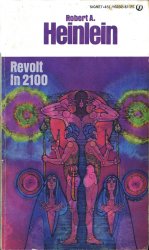
Heinlein’s earliest serial — that is, a long story requiring a split into parts across two or more issues of a magazine — was “If This Goes On–“, published in the February and March 1940 issues of Astounding magazine. He had only published three stories before this, from August 1939 to January 1940 (“Life-Line”, “Misfit”, and “Requiem”). It was later published in the 1953 Shasta collection Revolt in 2100, the 1970s Signet paperback reprint edition of which is scanned here, with cover art by Gene Szafran.

“If This Goes On–” is set in a future in which America has become a theocracy, ruled by a Prophet Incarnate, leader of the church that rules America, and who lives in a Palace and Temple in New Jerusalem, somewhere in the eastern US. The point-of-view character is one John Lyle, a personal guardian to the Prophet, whose faith is gradually shattered by his attraction a woman in the temple, Sister Judith, who becomes “chosen” by the Prophet for what Lyle gradually realizes — he’s a bit naive — is a sexual initiation. He hears her scream.

The balance of this long story is how John Lyle is recruited into a resistance movement, the Cabal, and participates in a long revolutionary plot to overthrow the Prophet, which involves undermining the Prophet’s scheme in maintaining his image via special-effects that portrays himself as the recipient of the ultimate Prophet, Nehemiah Scudder, an image which the revolutionaries foil to reveal the subterfuge to the mass population. An invasion of the capital follows, in which Lyle takes charge to bring about success, though they discover that the Prophet has been torn apart by his own concubines.

What’s most remarkable about this story, after all these decades, is what’s implied by the title – that the US seems to be perpetually teasing with the idea of slipping into a theocracy (despite its Constitution). Writing this in November 2015, watching the Republican candidates for president, especially Carson and Cruz and (off to the side, not serious players anymore) Huckabee and Santorum, it’s easy to the seeds of such a movement, that have never gone away after all these decades. Will they ever prevail? One can hope not, but an essential factor in the history of science fiction is Heinlein’s Future History, in which he projected this idea into a future that, in consequence, the US renounced all technology progress (exploration into space) and fell back into a dark ages, from which it took a century to overcome. It’s a theme that has recurred again and again in science-fictional future histories.

Look at Cruz’s megalomaniac certainty, his comment just in the past couple days about how a president should kneel down every day in prayer, and how he attended a conference led by a right-wing radio host who advocates putting gays to death.

I’d like to think that extremists like Cruz, or Santorum, or for that matter Trump and Carson, might attract a portion of the right-wing electorate, might possibly even win the Republican nomination — but could never win the general election. In fact, I’d think it advantageous for a religious extremist to win the Republican nomination, since that would favor the Democratic nominee, bound to be someone more sensible and reality-based, in the general election.

Heinlein wrote a postscript, “Concerning Stories Never Written”, in which he discussed the reasons why he never wrote a couple stories included in his “Future History” outline, including one about the rise of the evangelist Nehemiah Scudder. I will quote liberally:

I am aware that the themes of the unwritten stories linke the second and this the third volume thus briefly stated above have not been elaborated sufficiently to lend conviction, particularly with reference to two notions; the idea that space travel, once apparently firmly established, could fall into disuse, and secondly the idea that the United States, could lapse into a dictatorship of superstition.

(Score one: space travel, once established, has fallen into disuse, if not to quite the extent that Heinlein imagined; not, to be fair, due to religious resistance.)

There is a latent deep strain of religious fanaticism in this, our culture; it is rooted in our history and it has broken out many times in the past. It is with us now; there has been a sharp rise in strongly evangelical sects in this country in recent years, some of which hold beliefs theocratic in the extreme, anti-intellectual, anti-scientific, and anti-libertarian.

It is a truism that almost any sect, cult, or religion will legislate its creed into law if it acquires the political power to do so, and will follow it by suppressing opposition, subverting all education to seize early the minds of the young, and by killing, locking up, or driving underground all heretics. This is equally true whether the faith if Communism or Holy-Rollerism; indeed it is the bounden duty of the faithful to do so. The custodians of the True Faith cannot logically admit tolerance of heresy to be a virtue.

This was Heinlein writing in 1953. Little has changed. And this is as true as ever: “It is a truism that almost any sect, cult, or religion will legislate its creed into law if it acquires the political power to do so…” Just listen to Santorum, and Huckabee, and Cruz.

He goes on,

I imagined Nehemiah Schudder as a backwoods evangelist who combined some of the features of John Calvin, Savonarola, Judge Rutherford and Huey Long. … No, I probably never will write the story of Nehemiah Scudder; I dislike him too thoroughly. But I hope that you will go along with me in the idea that he could happen…

And, indeed, to imagine the likes of Ted Cruz or Rick Santorum gaining the presidency, it likely would happen. (Well, not really — no matter how reactionary a president might be, he’d have to balance his goals with the votes of Congress, and the judgments of the Supreme Court. That’s the brilliance of our political system.) Why is it that American culture has not grown beyond the demands of religious fundamentalism? Something about the sense of American exceptionalism, I suspect.

Posted in Conservative Resistance, Heinlein, Religion, science fiction | Comments Off on Rereading Early Heinlein, part 3: If This Goes On

Jeffrey Tayler on Ben Carson; Frank Bruni on lies about gays and transgenders and Houston; Lee McIntyre on science denialism; how Einstein, proved right again and again over the past century, was resisted on political grounds

Salon: You know Ben Carson is crazy, right? Let’s discuss the craziest things he actually believes

Jeffrey Tayler summarizes Carson’s Seventh Adventist faith — a faith built upon a failed prediction of the end of the world, back in 1843, by a group that resembles the recent Harold Camping chieftan who foresaw the end of the world in 1994, and then again in May 2011, and then again in October 2011, none of which came true, just as all the similar predictions by religious cults over the centuries have never come true. But the Seventh Adventists are apparently still anticipating the end of the world any day now. Is this someone you would elect President of the United States?..?

Jeffrey Tayler has ways with words: (my bold)

Incontrovertibly, the “real aspects” of Christianity are a ludicrous creation myth that science long ago debunked, barbaric human sacrifice (the crucifixion), and a Lord so vain he drew up the Ten Commandments so that the first three were all about Himself. I won’t go on, except to say that God so misjudged His creation that He had to send His kid down to Earth to be tortured to death to save us, which speaks volumes about the “divine wisdom” with which all Christians credit Him.

And

Carson commits semantic fraud when he then tells the reporter that “people need to understand that everybody is a person of faith. It’s just a matter of what they decide to put their faith in.” He later in the interview muses that “everybody has their own personal faith. Even atheists and secular progressives have their faith. It’s just in something different.”

No, Dr. Carson (and all who use this crass subterfuge to try and sneak religion into the Halls of Respectability), unsubstantiated belief in the supernatural has nothing to do with rationalist convictions standing upon evidence, or falling if the evidence changes. It’s very much your decision to ignore the science that gave you your profession and throw your lot in with devotees of the supernatural. It’s very much not the same sort of decision to prefer evidence-based conclusions to wishful thinking. Rationalists would accept the existence of God were there any evidence for it. There is not. Rationalists are adults.

\\

Today’s New York Times: Frank Bruni: Sex, Lies and Houston

And we’ll someday cringe about this, just as most Americans now cringe about the verbal garbage that was thrown at gay people, the lies that were told, the lies that were believed. I recently ran across some research that made reference to a 1970 survey in which 73.5 percent of Americans agreed that ‘homosexuals are dangerous as teachers or youth leaders because they try to get sexually involved with children’ and 71.1 supported the statement that ‘homosexuals try to play sexually with children if they cannot get an adult partner.’”

The arc of history: things do change, culturally, though there will always be isolated hold-outs.

\\

And this: The Price of Denialism, by Lee McIntyre, author of Respecting Truth: Willful Ignorance in the Internet Age.

A good first step would be to distinguish between skepticism and what has come to be known as denialism. In other words, we need to be able to tell when we believe or disbelieve in something based on high standards of evidence and when we are just engaging in a bit of motivated reasoning and letting our opinions take over. When we withhold belief because the evidence does not live up to the standards of science, we are skeptical. When we refuse to believe something, even in the face of what most others would take to be compelling evidence, we are engaging in denial. In most cases, we do this because at some level it upsets us to think that the theory is true.

And

In scientific reasoning, there is such a thing as warrant. Our beliefs must be justified. This means that we should believe what the evidence tells us, even while science insists that we must also try our best to show how any given theory might be wrong. Science will sometimes miss the mark, but its successful track record suggests that there is no superior competitor in discovering the facts about the empirical world. The fact that scientists sometimes make mistakes in their research or conclusions is no reason for us to prefer opinions over facts.

\\

And this: How Politics Shaped General Relativity.

Einstein’s theory of general realitivy was resisted on political grounds…

Sadly, events quickly proved Einstein right. Just months after Eddington’s announcement, right-wing political opportunists in war-ravaged Germany began to organize raucous anti-Einstein rallies. Only an effete Jew, they argued, could remove “force” from modern physics; those of true Aryan spirit, they went on, shared an intuitive sense of “force” from generations of working the land. Soon after the Nazis seized power in 1933, they banned the teaching of Einstein’s work within the Reich. Einstein settled in Princeton, N.J.; the German relativity community was decimated.

To this day, they are deniers, about general relativity and of course evolution and anything that would challenge religous myths: see Conservapedia. Despite the evidence, as this article concludes, (my bold)

Twenty years later, theoretical physicists briefed United States Air Force generals on a subtle complication with a new military technology, the Global Positioning System. Effects from Earth’s gravity would be stronger on the ground than in orbit, the physicists explained, and hence clocks on the ground would tick more slowly than those aboard satellites. If the clocks disagreed on time, they would also disagree on space, and that could spell trouble for this technology. If left uncorrected, the tiny differences in clock rates would snowball into enormous errors in determining distances. With GPS, the warping of time that Einstein imagined assumed operational significance. (Later, GPS was opened to the commercial market, and now billions of people rely on general relativity to find their place in the world, every single day.)

Posted in Lunacy, Physics, Psychology, Religion | Comments Off on Jeffrey Tayler on Ben Carson; Frank Bruni on lies about gays and transgenders and Houston; Lee McIntyre on science denialism; how Einstein, proved right again and again over the past century, was resisted on political grounds