Notes on Adam Lee

A final set of book notes for the moment, this one the fourth of several books about atheism, humanism, and why people believe what they do (which last item is my central concern). Adam Lee is a blogger who writes the blog Daylight Atheism in the Atheist Channel of the vast Patheos website. In his book of the same title, Daylight Atheism, he’s not ‘angry’ like Greta Christina, but he’s frank and unapologetic; his theme is that not believing in any religion is nothing to be ashamed of, and it’s time for those of us who think that way to “step out our closets and into the daylight” (p13).


The structure of his book is similar to A.C. Grayling’s The God Argument; the first half explains why religious faith is a nonstarter; the second half explores the benefits of free thought and honest engagement with the world.

Though the book’s themes are similar to those in the past couple I noted here, Lee of course offers distinct perspectives. Here’s one right away: in chapter one, he compares religion to fossil fuel. Just as our 21st century technology is still based on an 18th century economy based on fossil fuels — which are becoming a lethal threat to our climate — so do the fossilized dogmas of religion, contaminated with tribalism, hate, and fanaticism, threaten the future of human culture. Nice metaphor.

As other authors have done, Lee spells out the evil that religion brings to the world: Islam and 9/11; Christian fundamentalism intent on remaking society into their own theocratic image (and if not here, then in Nigeria, Uganda). He explores the relative ignorance of the Christian devout of their own Bible, noting the many passages in that book that describe what most modern people would call atrocities. “These stories send a moral message about a deity who’s petty, insecure, malicious, short-tempered, violent and cruel.”

Is the New Testament better? It was Jesus who introduced the idea of Hell, an eternal punishment, far worse than any punishment in the Old Testament.

And the argument from evil. Why terrible things happen, and the rationalizations the devout muster.

The second half of the book describes life without superstition; the values available to atheists not constrained by holy books. He addresses the stereotypes about what most people think about atheists.

And he describes his concept of a morality independent of religion and derived from our existence as a social species. He calls this “universal utilitarianism”, a slight variation on the utilitarian idea of seeking to produce the greatest good for the great number of people. His definition, which he then explores, is, “Always minimize both actual and potential suffering; always maximize both actual and potential happiness.” [A theme which dovetails into Sam Harris’ The Moral Landscape, which I’ll get to eventually.]


If I have a couple slight reservations about this book, one is that the book is self-published, and I can’t see anywhere what Lee does for a living, or what academic credentials he might have, aside from writing this book, and his blog, and being a speaker at various events. Perhaps these days this is an unfair comment in these days when, occasionally, self-published books are as good as any others.

My second reservation is that, actually, Lee’s site Daylight Atheism has better essays than any of the chapters in this book, which perhaps try to summarize too many points in too little space. Lee’s site is a wealth of resources, especially in his essays, which I suspect in toto far exceed the length of this book. And in his ongoing blog, he addresses current social issues of day, for example, recently, the misogyny of the Santa Barbara shooter a few weeks ago, and the latest discovery about the atrocities committed by the Catholic church in Ireland.

But overall, this is a fine book that covers issues of interest, especially, I would think, to any of my devout readers who don’t understand why everyone doesn’t accept the obvious truth of their faith. A nice complement to A.C. Grayling’s book.

Posted in Atheism, Book Notes | Comments Off on Notes on Adam Lee

Notes on Peter Boghossian

Peter Boghossian’s book has an aggressive title, A Manual for Creating Atheists, though it is in no way as ‘angry’ as Greta Christina’s book, discussed last time. Boghossian is a faculty member in Portland State University’s philosophy department, and his modus operandi is Socratic dialogue in the service of what he calls “street epistemology”. This means that every chance he has, he engages in a conversation with people he meets on the street, in the supermarket, in prisons (he does this outreach thing), and so on, about what they believe and why.

He doesn’t challenge people about “evidence” for what they believe; in fact, his first rule of engagement is: avoid facts. Don’t discuss evidence. The people you engage are not used to thinking based on evidence. It’s not about changing beliefs, but about changing how people form beliefs.

And he distinguishes between faith and religion. Religion is a social institution with many admirable qualities – the social community of churches, the recognition of life milestones. He wants to focus on faith, which he defines as “pretending to know things you don’t know”.

He gives numerous examples of what he calls “interventions” – those conversations he strikes up with people about what they believe and why. My takeaway from these is that most people acquire faith and religion without thinking about it in any deep way – they accept whatever the conventional wisdom of their local community is, or the parameters of particular beliefs, without any awareness of their religion’s past, or why their traditions may be historically suspect. Over and over again, his “interventions” do (or sometimes do not) simply instill a shadow of a doubt. A young lady is sorry the author won’t be “saved” by Jesus. He asks, if you had some reason to think Jesus was a myth, does that mean you are a bad person? Pause.

Boghossian, like many of the writers of these books, has a chapter devoted to “anti-apologetics” – supplying reasonable responses to the typical challenges from believers about the need for faith and the supposed illegitimacy of science.

There is one chapter, chapter 8, on a topic that I’ve not seen in any similar books and makes this book worth reading. He examines the culture of “academic leftism”, and traces the history of liberalism, from John Locke in the 17th century, though the 19th century’s social liberalism, to the academic liberalism of the 20th century. Multiculturalism, the acceptance of other cultures and cultural practices, has spilled over into rote acceptance of all points of view about systems of knowing the world, as if faith in the Koran and the scientific method are just two equally valid ways of knowing the world. This has translated into an academic taboo from criticizing any cultural process or practice; such criticism is tantamount to hate speech.

But this means that faith becomes immune to criticism; that academics are robbed of the opportunity to make moral and epistemic judgments. The result is that students are left without a capacity for critical rationality – and, ironically, believing they’re better people as a result for suspending judgment on irrational ways of thinking about the world.

The author, obviously, thinks this is a tragic situation that needs correcting. Academics should support what works, and point out to their students the ways of thinking that don’t.

I agree obviously; and on his terms, I am a classical/social liberal, but not a leftist.

Coincidentally, David Brin just a few days ago posted on his blog A Thumbnail Political Bestiary, which distinguishes between liberal, libertarian, leftist, and rightist, which I’ll have to read more closely before commenting.

Posted in Atheism, Book Notes, Culture, Religion | Comments Off on Notes on Peter Boghossian

Notes on Greta Christina

As a follow-up to the last post, I’ve read three other books in the past several months about the theist/rationalist divide. Here are some note and comments, one at a time. (The other two, to follow, are books by Adam Lee and Peter Boghossian.)

The most aggressive of these three books is Greta Christina’s Why Are You Atheists So Angry?, subtitled, “99 things that piss off the godless”. Her opening chapter is a litany of these 99 things, from which I’ve captured a representative sample (with a couple editorial highlights):

Atheists are mistrusted for public office and denied certain positions; how priests and parents terrorize children; at priests who rape children; that the Catholics have protected them; at 9/11; at Jerry Falwell blaming it on the gays and the ACLU; at circumcision; the protocols of the elders of Zion; at honor killings; parents who use faith healing; belief in creationism – because they embrace a lie that contradicts the evidence; battles against evolution in schools; the author’s wife Ingrid’s grandparents; bigotry against LGBT people; Mormons who ‘lie for the lord’; girls told to be submissive; modesty patrols; the holocaust, and blaming it on atheists; the caste system in India; Galileo; the church opposing condoms in Africa; making abortion illegal; abstinence-only sex ed; glorifying faith with no good evidence; accusing atheists of being arrogant; the idea that the enormous universe was made just for humans (and then accuse atheists of being arrogant); that religious people often don’t know the tenants of their own religion; that Christians claim to be victims; policy based on ancient religious texts; never questioning one’s religious beliefs; the Magdalene laundries in Ireland [related to the Philomena story]; exorcism; justification for slavery; revisionist history; Salman Rushdie; Quiverfull families; scientology practices; “I feel it in my heart” (#83); the double standard in attributing good to God and bad to ‘mysterious ways’; the self-centered pettiness of most prayer; the idea that religious faith is a virtue, and to reject reality, or that it doesn’t matter whether their beliefs are really true; at believers who reject *other* beliefs and imply they alone are doing it right; including treating some things in the Bible as not literal (how do they know?); at the hatred expressed toward atheists (e.g. on her blog); at people asking why she’s angry.

Following chapters acknowledge questions she anticipates, e.g.

    • Your anger is just hurting yourself
    • Your anger is just hurting your cause
    • Atheism is just another religion…
    • Just because religion has done some harm doesn’t mean it’s mistaken
    • All religion isn’t like that. You’re not being fair….
    • All believers aren’t like that. That’s not the true faith.
    • How can you be so hateful? …
    • People need religion…
    • Why do you care what other people believe? …
    • What about all the good things religion has done?
    • You wouldn’t be so angry if you just accepted Jesus Christ as your personal savior
    • If you’re so angry, what are you doing about it?

The author of course provides cogent responses to these naïve questions.

The next few chapters address why the author thinks various soft forms of religion – moderate and progressive; new age; spiritual but not religious; ecumenicalism and interfaith – are just as problematical. Because they all promote reliance on some kind of faith, as opposed to dealing with the actual, real world.

Chapter 8 lists the author’s “top ten reasons I don’t believe in God”

  1. The consistent replacement of supernatural explanations of the world with natural ones.
  2. The inconsistency of world religions
  3. The weakness of religious arguments, explanations, and apologetics
  4. The increasing diminishment of God
  5. The fact that religion runs in families
  6. The physical causes of everything we think of as a soul
  7. The complete failure of any sort of supernatural phenomenon to stand up to rigorous testing
  8. The slipperiness of religious and spiritual beliefs
  9. The failure of religion to improve or clarify over time
  10. The complete lack of solid evidence for God’s existence

The final chapters address atheist activism. Does trying to argue people out of religion ever work? Well, yes, it does, and she provides evidence from email responses to various atheist authors from their readers.

The strategy that works? Discussing the absurdity of beliefs; the immorality of them; their diversity; the similarity of myths; that science as a better explanation; realizing that non-belief is an option; realizing that religious apologists are cherry-picking; how cognitive biases support religion. And so on.

One of the next books to discuss, by Peter Boghossian, extends this theme: it’s called A Manual for Creating Atheists.

Posted in Atheism | Comments Off on Notes on Greta Christina

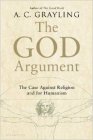
Notes on A.C. Grayling: The Case Against Religion and for Humanism


A.C. Grayling is a British philosopher whose 2013 book The God Argument: The Case Against Religion and for Humanism, is a clear and concise summary of why religion is best abandoned and why humanism (as he describes it) is a preferable alternative. (I mentioned before that the book’s title is a bit crude…I suspect imposed by his publisher.) His book is thus somewhat in contrast to the famous or infamous titles by Richard Dawkins, Christopher Hitchens, and others, that are aggressively anti-religion; Grayling, rather like Sam Harris’ more recent book The Moral Landscape (which I also have read recently, and will blog about), is discussing religion mostly as the basis for a case that an alternative is more reasonable, more realistic, and more humane.

Grayling’s book comprises two tasks:

  • To deal with what religious apologists say in defending religion
  • To show that there is a beautiful and life-enhancing alternative outlook… based on the best, most generous, most sympathetic understanding of human reality.

I quoted his first paragraph a while back.

To put matters at their simplest, the major reason for the continuance of religious faith in a world which might otherwise have long moved beyond it, is indoctrination of children before they reach the age of reason, together with all or some combination of social pressure to confirm, social reinforcement of religious institutions and traditions, emotion, and (it has to be said) ignorance — of science, of psychology, of history in general, and of the history and actual doctrines of religions themselves.

The first half of the book is about religion, and summarizes, in clear and beautiful prose, all the various arguments – many of them obvious to those of us who’ve read these arguments many times before, but perhaps unfamiliar to those faithful who don’t realize why anyone would question their faith – about why religion is a nonstarter. To summarize these arguments:

Faith means beliefs held independently of any testable evidence, or even in the face of counter-evidence—the latter often regarded as a virtue. The central faith of religions is the existence of a supernatural, divine being, and the consequent need for worship and praise, submission and obedience. Also, typically, that this being is the universe’s creator, ruler, and moral law-giver. Beyond that details are vague; religious apologists resort to vagueness about mysteries the human mind cannot comprehend.

Most people assume that the word ‘god’ refers to something that can be believed in, worshiped; that explains the origin of the universe; that lays down rules for behavior. That different religions make different claims about their god or gods is evidence they are man-made… but religious people think this insight applies to other religions, not their own.

Atheists reject the various myths of the Greeks, Babylonians, etc., and then add that they regard Christianity and Islam as similar myths. It’s just one more god to stop believing in.

The first half of Grayling’s book addresses debates about theism, secularism, and morality; basic issues about rationality; about agnosticism, atheism, and proof; and then addresses the classic philosophical arguments for the existence of a god, and discusses how philosophers and scientists over the ages have dismissed them. Arguments by design, by definition. Cosmological arguments. Pascal’s wager.

(He makes a crucial point that I’ve made here on my blog, but is not generally appreciated: even if one of these classical arguments were valid, it would say nothing about which of the many gods humans have imagined corresponds with the presumably-proved creator. Why isn’t the creator by first cause Zeus? A similar argument reveals the narcissism of many Christian apologists (Craig, Plantinga, et al) who think morality or the human sense of awe necessarily implicates the reality of *their* idea of God, i.e. the Christian one. What about the majority of humanity that is not Christian? Are they immoral, or lacking a sense of awe? This does not pass the reality-check test.)

Grayling goes on about creationism and intelligent design, which merely push the idea of origins back one step (who created God? Claiming God is the exception from needing a cause is special pleading).

He concludes Part I (page 127)

The cumulative case against religion shows it to be a hangover from the infancy of modern humanity, persistent and enduring because of the vested interests of religious organizations, proselytisation of children, complicity of temporal powers requiring the social and moral policing that religion offers, and human psychology itself. Yet even a cursory overview of history tells us that it is one of the most destructive forces plaguing humanity.

While the first half of this book treads ground many other books before have covered, the second half focuses on the positive: the case for humanism. Grayling distinguishes between three debates:

  • theism vs atheism, which is about metaphysics, what does or does not exist;
  • secularism, which is about the place of religion in the public square; and
  • the source of morality; from divine command, or human realities?

The secular position is that religions are entitled to exist, but deserve no privileged place in society; there should be no “respect due to faith”, since religions “derive ultimately from the superstitions of illiterate herdsmen living several thousands of years ago” (p135.5) (discussed again p238)

Humanism is the ethical outlook that says each individual is responsible for choosing his or her values and goals, is responsible for living considerately of others.

Humanism is above all about living thoughtfully and intelligently, about rising to the demand to be informed, alert and responsive, about being able to make a sound case for a choice of values and goals, and about integrity in living according to the former and determination in seeking to achieve the latter.

p138b. Like being a good guest at a dinner party.

Grayling lists two fundamental premises of humanism:

  • First, there are no supernatural agencies in the universe.
  • Second, our ethics must be drawn from the nature and circumstances of human experience.

A key requirement of Humanism is that individuals should think for themselves… it has no metaphysics. It is not about ‘faith’ in reason or science; science is open to challenge and refutation, faith is not.

Grayling examines the history of Humanism and boils it down to the criteria for living good lives. They are:

  • Life seems meaningful or purposeful
  • They are lived in relationships with others
  • They are lives of activity
  • They are marked by honesty and authenticity
  • They manifest autonomy
  • The experience of living them is rich or satisfying
  • They have integrity
  • Life seems meaningful or purposeful
  • They are lived in relationships with others
  • They are lives of activity

There is no single ‘meaning of life’. It is what you make it. Loving someone, raising children, succeeding in one’s field are common themes. Conventional values are not always bad, but need to be honestly examined, with those no longer suitable being abandoned.

(An aside mentions an aspect of religious history I had not appreciated: that New Testament ethics were for people who thought they lived in the last weeks or months of history (p156b), thus instructions to give away all your property, turn the other cheek to your enemies, and so on. Of course, 2000 years later, there are still people who think they live in the end times, apparently never having learned the lesson of history and failed prophecies.)

He discusses the difference between ethics and morality, and notes that certain human needs are basic to everyone; thus morality is an objective matter, concerning common themes across societies. (Cue here to Sam Harris’ The Moral Landscape, which I’ve read, which addresses these issues, and which I’ll blog about soon.) Morality concerns matters such as marriage, divorce, sexual behavior, abortion, euthanasia, drugs.

For the humanist it matters to ask this: if interest in and concern for one’s fellows is a reason for being moral, what relevance does the existence of a deity have? Why cannot we accept that we are prompted to the ethical life by these natural human feelings? The existence of a god adds nothing, other than as an invisible policeman who sees what we do always and everywhere, even when alone in the dark, and who rewards and punishes accordingly. Such an addition to ethical thought is hardly an enrichment, since among the under-pinnings to the moral life they offer are threats – of fear, of exclusion, even of violent sufferings: which are, among other things, exactly what the moral life seeks to liberate us from. These threats characterize the state of mankind under religion for most of history; liberation from them, and therefore from religion, is a desideratum of humanist morality. (p242t)

There is a beautiful, poetic final chapter, from which I will only quote excerpts, beginning p255:

The fact is persistently overlooked that those who are not religious have available to them a rich ethical outlook, all the richer indeed for being the result of reflection as opposed to conditioning or tradition. Its roots lie in rational consideration of what humankind’s cumulative experience teaches; and that is a great harvest of insight.

And, discussing a wide variety of belief systems (astrology, feng shui, religion, etc):

But with the exception of the individuals who promote these systems when they should know better, humanism is not against the majority who subscribe to them, for it recognizes that they were brought up in them as children, or turn to them out of need, or adhere to them hopefully (and some, too often, unthinkingly). These are fellow human beings, and humanists profoundly wish them well; which means too that they wish them to be free, to think for themselves, to see the world through clear eyes. If only, says the humanist, they would have a better knowledge of history! If only they would see what their own leaders think of the simple version of the faiths they adhere to, substituting such sophistry in its place! For whereas the ordinary believer has somewhat misty and incomplete notions of the religions they subscribe to, their theologians deploy such a labyrinthine, sophisticated and complex approach, that some go so far as to claim that a god does not have to exist to be the focus of the faith.

And, echoing Neil deGrasse Tyson:

Having the intellectual courage to live with open-endedness and uncertainty, trusting to reason and experiment to gain us increments of understanding, having the integrity to base one’s views on rigorous and testable foundations, and being committed to changing one’s mind when show to be wrong, are the marks of honest minds.

If I were to recommend one book to believers who have doubts, or to believers who simply want to understand why nonbelievers cannot accept what they feel to be the obvious truth of their faith, it would be this one. (Rather than the books by Hitchens, Dawkins, et al.)

Posted in Atheism, Book Notes, Humanism, Philosophy | Comments Off on Notes on A.C. Grayling: The Case Against Religion and for Humanism

Unafraid of the Dark: Highlights from the last episode of Cosmos

Passages from the last episode of Neil deGrasse Tyson’s “Cosmos”.

Early in the episode, he describes a thought experiment:

Pick a star, any one of the hundreds of billions of stars in our Milky Way galaxy, which is just one galaxy out of a hundred billion in the known universe.

How about that star, or that one? Okay, this one. It’s orbited by dozens of planets and moons. Suppose on one of them, there lives an intelligent species, one of the ten million life forms on that planet, and there’s a subgroup of that species who believe they have it all figured out: their world is the center of the universe, a universe made for them, and that they know everything that they need to know about it—their knowledge is complete.

How seriously would you take their claim?

[pull steadily back to reveal millions of other stars…]

Toward the end of the show, there is a long (famous and moving) quotation/narration by Carl Sagan, about how everyone we’ve ever known or known of has existed on the tiny pale blue dot of Earth as seen looking back from the outer solar system by the Voyager spacecraft. Here it is on YouTube. (The episode plays this over animation of the Voyager moving outward through the solar system, passing Mars, Jupiter, Saturn…)

At the end of the episode, Tyson looks back to summarize the principles that have allowed humankind to perceive and understand the vast cosmos we live in, and then draws it all to a close. The understanding we have so far has been the work of generation of searchers, who took “five simple rules to heart”:

(1) Question authority. No idea is true just because someone says so, including me.

(2) Think for yourself. Question yourself. Don’t believe anything just because you want it. Believing something doesn’t make it so.

(3) Test ideas by the observations gained from evidence and experiment. If a favorite idea fails a well-designed test, it’s wrong! Get over it.

(4) Follow the evidence wherever it leads. If you have no evidence, reserve judgment.

(5) And perhaps the most important rule of all: Remember, you could be wrong. Even the best scientists have been wrong about some things. Newton, Einstein, and every other great scientist in history—they all made mistakes. Of course they did—they were human.

Science is a way to keep from fooling ourselves, and each other.

Have scientists known sin? [image of atom bomb] Of course—We have misused science, just as we have every other tool at our disposal, and that’s why we can’t afford to leave it in the hands of a powerful few. The more science belongs to all of us, the less likely it is to be misused.

These values undermine the appeals of fanaticism and ignorance, and, after all, the universe is mostly dark, dotted by islands of light.

Learning the age of the earth or the distance to the stars, or how life evolves—what difference does that make?

Part of it depends on how big a universe you’re willing to live in. Some of us like it small. That’s fine. Understandable.

But I like it big. And when I take all of this into my heart and my mind, I’m uplifted by it. And when I have that feeling, I want to know that it’s real, that it’s not just something happening inside my own head, because it matters what’s true, and our imagination is nothing compared with Nature’s awesome reality.

I want to know what’s in those dark places. And what happened before the big bang. I want to know what lies beyond the cosmic horizon, and how life began. Are there other places in the cosmos where matter and energy have become alive … and aware?

I want to know my ancestors—all of them. I want to be a good, strong link in the chain of generations. I want to protect my children, and the children of ages to come.

[scenes shifts to the California coast, where the series began]

We, who embody the local eyes and ears and thoughts and feelings of the cosmos, we’ve begun to learn the story of our origins, star stuff contemplating the evolution of matter, tracing that long path by which it arrived at consciousness.

We and the other living things on this planet carry a legacy of cosmic evolution spanning billions of years.

If we take that knowledge to heart, if we come to know and love nature as it really is, then we will surely be remembered by our descendants as good, strong links in the chain of life.

And our children will continue this sacred searching, seeing for us as we have seen for those who came before, discovering wonders as yet undreamt of in the cosmos.

Posted in Astronomy, Cosmology, Culture, Evolution, Philosophy, Religion, Science, Thinking | Comments Off on Unafraid of the Dark: Highlights from the last episode of Cosmos

Salon on Cosmos, Neil deGrasse Tyson, science, and conservative denialism

Several posts at Salon lately about “Cosmos”, Neil deGrasse Tyson, science, and conservative denialism.

5 Most Important Lessons from “Cosmos”
Which are:

  1. It’s OK to not know all the answers
  2. Climate change is happening, and it’s made-made.
  3. Evolution: How did we get here?
  4. The danger of ignoring science, or following special-interest science.
  5. Discovery starts with an open mind and the scientific method.

Another list article: Five “Cosmos” moments that made creationists’ heads explode

These concern the age of the universe, the age of the Earth, the origins of Christmas, anything about evolution, climate change, and… basically the entire series.


And a third article compares Tyson’s frank defense of science and reality with Thomas Piketty’s book Capital in the 21st Century, which is getting a lot of (world-wide) attention for its challenges to conservative denial that rising inequality is not something to worry about (and undermining the dogma of trickle-down economics): Rise of the myth busters: Why Piketty and Tyson are the icons America needs. Here are a couple nice passages — not about Piketty, but about how Tyson’s worldview unsettles conservatives.

And that’s really the deepest terror that conservatives have when encountering Tyson, and the whole sweep of scientific discovery he articulates. (William James, who was a graduate student when Darwin’s “Origin of Species” was published, had a similar view of our place in the universe. Consequently, he reframed the analytical truths of math and philosophy as a sort of backdoor empiricism: What our brains perceive as necessary truths reflects the empirical influence of how they evolved.) It’s one thing if science confirms our predetermined religious dogmas, but quite another if it challenges them. Yet, it’s worst of all for religious dogmatists if it threatens to replace those dogmas by providing its own sense of meaning, order and purpose in the universe. And that’s just what Tyson is suggesting.

Here [Piketty says], specifically, as is generally the case, openness is a requirement for the advancement of knowledge.

This reflects back onto one of the broadest findings in political psychology, as discussed by Chris Mooney in “The Republican Brain: The Science of Why They Deny Science—And Reality.” Namely: Liberalism is correlated with the “big five” personality trait of openness to experience. The exploration of novelty is a recurrent theme linking liberalism and science to one another, just as the veneration of tradition is a recurrent theme linking conservatism and religion. Yet, several centuries on, science and liberalism have their own venerable traditions as well, and this has been a recurrent theme in Tyson’s “Cosmos” series. “Science is a cooperative enterprise, spanning the generations,” he said in one “Cosmos” segment. “It’s the passing of a torch from teacher, to student, to teacher. A community of minds reaching back to antiquity and forward to the stars.” One can even go so far as to say that Tyson preaches a kind of scientific faith: a faith in doubt, in a philosophy “unsettled daily,” as he put it. In another “Cosmos” segment, he said:

There seems to be a mysterious force in the universe, one that overwhelms gravity on the grandest scale, to push the cosmos apart. Most of the energy in the universe is bound up in this unknown force. We call it ‘dark energy’, but that name, like ‘dark matter’, is merely a code-word for our ignorance. It’s OK not to know all the answers. It’s better to admit our ignorance than to believe answers that might be wrong. Pretending to know everything closes the door to finding out what’s really there.

This evokes the conservative discomfort with science, which some seem to think that, because science doesn’t (claim to) have all the answers, and some current scientific conclusions are subject to change, it therefore can’t be trusted at all. As Andrew Sullivan mentioned last week,

A figure as respected on the right as Charles Krauthammer has been reduced to claiming that no reigning scientific theory should be taken seriously because it might one day be adjusted in light of new data or new experiments.

A curiously backwards route to thinking that only unchanging faith can be trusted. Such arguments, of course, do not bear up to reality-check scrutiny for a moment.


A fourth article is 5 demented conservative attempts to hijack and discredit science:

  1. Climate Change Isn’t Happening, but if It Is That’s Fine Because It Means Jesus Is Coming
  2. Creationism, Dinosaurs, and the Loch Ness Monster
  3. Neil deGrasse Tyson
  4. AIDS Has Been Weaponized to Doom Heterosexual Culture
  5. Gay Parents Are Worse Than Straight Parents (If You Lie)

The last item addresses, yet again, the discredited Regnerus study, commissioned by conservative groups specifically to create evidence to use in court cases against same-sex marriage.


One more: a long book excerpt which I have so far only skimmed: Science can’t tell us everything: Faith, physics and the origin of the universe, from a book by Marcelo Gleiser called The Island of Knowledge: The Limits of Science and the Search for Meaning. Salon’s subtitle is, “Recognizing the limits of science doesn’t mean surrendering to religion, but being free to understand ourselves”.

Posted in Astronomy, Cosmology, Culture, Science, Thinking | Comments Off on Salon on Cosmos, Neil deGrasse Tyson, science, and conservative denialism

Mathematics and Economics

Both Slate and Salon have run excerpts from Jordan Ellenberg’s book How Not to Be Wrong: The Power of Mathematical Thinking,. A new one at Salon, Math vs. Reaganomics: Why GOP’s anti-tax hysteria falls flat, examines economic relationships, and Laffer curve, and tax rates. (And being too Swedish.) General lesson: simplistic correlations are attractive to ideologues, but life is usually more complicated than that.

Conclusion:

There’s nothing wrong with the Laffer curve—only with the uses people put it to. Wanniski and the politicians who followed his panpipe fell prey to the oldest false syllogism in the book:

It could be the case that lowering taxes will increase government revenue;

I want it to be the case that lowering taxes will increase government revenue;

Therefore, it is the case that lowering taxes will increase government revenue.

With an amusing aside part way through.

(Aside: it’s important to point out here that people with out-of-the-mainstream ideas who compare themselves to Edison and Galileo are never actually right. I get letters with this kind of language at least once a month, usually from people who have “proofs” of mathematical statements that have been known for hundreds of years to be false. I can guarantee you Einstein did not go around telling people, “Look, I know this theory of general relativity sounds wacky, but that’s what they said about Galileo!”)

Posted in Economics, Mathematics, Science | Comments Off on Mathematics and Economics

Clarke, Childhood’s End, part 3 – passages

Passages from Clarke’s Childhood’s End.


The early part of the book involves a faction of the public that objects to the Overlords’ presence, on the grounds that their influence deprives them of “Freedom to control our own lives, under God’s guidance.” (p16.6) The religious right is ever-present.

The Overlords actually intervene very little, but one case where they do is described, to defeat a racial strike in South Africa. So that “full civil rights would be restored to the white minority”. (Sic!) This is a classic example of an SF writer casually overturning the reader’s expectations about how things will or won’t be in the future. (p20.2) (Another intervention later in the book concerns the Overlords’ directive to stop killing animals, except for food, i.e. to stop hunting for sport. This strikes me as another example of the tendency of SF to bequeath attitudes on superior aliens that humans, or at least the author, idealize themselves.)

Later, the UN secretary-general challenges his Overlord liaison, Karellen, about the Overlords’ refusal to reveal themselves. Karellen replies, “They know that we represent reason and science, and however confident they may be in their beliefs, they fear that we will overthrow their gods…” (p23.4) And, “Believe me, it gives us no pleasure to destroy men’s faiths, and all the world’s religions cannot be right, and they know it.” (p23.8)

Clarke, over his career well-known for his interest in the sea-depths and in scuba-diving, and who wrote at least one whole novel about it (The Deep Range), manages to get an underwater scene in this book. (chapter 11)

Once the Overlords have revealed themselves, we get more description of [Clarke’s] notion of an idealized world (chapter 10): The age of reason arrives; humans have great amounts of leisure time, and are well-educated; most people have two homes; there’s little crime, and no militaries. Sports are big, and entertainment. But people ask, Where do we go from here?

(The key failure of prediction here is the idea that higher standards of living lead to greater amounts of leisure time. Our present society has standards of living unimaginable only a century ago… but human nature drives competition, and people seem busier, not less busy, these days compared to the past — a past which is now, ironically, idealized.)

Later, more about how culture develops (chapter 15), on an island colony called New Athens, that has rejected the 500 hours of radio and TV available every day (p141t, a remarkable anticipation). On this island with no vehicles, only bicycles, painting languishes, music is experimental, and cartoon films become indistinguishable from photography. (Another anticipation.) And a new medium of “total identification” seeks to expand film to all the senses.

There is a passage near the end, as Jan, the last man, who witnesses the dissolution of the Earth, is all alone, and listens to music to find peace. (p209m) He listens to Bach. There is a similar passage in 2001.

It turns out the Overlords’ initial purpose was to keep humanity from destroying itself, and secondarily, to stop early 20th century investigation into paranormal phenomena, those hints of humanity’s true destiny. They explain how, tragically, they cannot participate in a similar uplift; but describe what they understand this destiny to be:

We have glimpsed only the vague outlines of the truth. You called us the Overlords, not knowing the irony of that title. Let us say that above us is the Overmind, using us as the potter uses his wheel.

And your race is the clay that is being shaped on that wheel.

We believe—it is only a theory—that the Overmind is trying to grow, to extend its powers and its awareness of the universe. By now it must be the sum of many races, and long ago it left the tyranny of matter behind. It is conscious of intelligence, everywhere. When it knew that you were almost ready, it sent us here to do its bidding, to prepare you for the transformation that is now at hand.

All the earlier changes your race has known took countless ages. But this is a transformation of the mind, not of the body. By the standards of evolution, it will be cataclysmic—instantaneous. It has already begun. You must face the fact that yours is the last generation of Homo sapiens.

(p183-184)

So here is what the best science fiction does: it alerts your mind to the possibility that everything you know and assume about what you think is true is but a tiny fraction of what may be real. We, the human race, may be as fish living in a pond who are not aware of the presence of water, much less that there are other realms apart from water, like air — not to mention other ponds.

In the final pages, the last human narrates, for his Overlord sponsors, the dying moments of Earth.

Everything we ever achieved has gone up there into the stars. Perhaps that’s what the old religions were trying to say. But they got it all wrong: they thought mankind was so important, yet we’re only one race in—do you know how many?

Posted in Arthur C. Clarke, Cosmology, Evolution, science fiction | Comments Off on Clarke, Childhood’s End, part 3 – passages

Clarke, Childhood’s End, part 2 – themes

Last week I started my discussion of re-reading several classic Arthur C. Clarke novels, and summarized the plot of Childhood’s End, in this post.


Now some comments on themes. My purpose in these rereadings is not to explore the history of science fiction necessarily, in the sense of identifying influences (in Clarke’s case, of course, Olaf Stapledon was a huge influence), or of following the development of ideas in these books through the history of the genre. Rather, I’m taking these texts at face value, as examples of science-fictional thinking, and relating such thinking to current issues of how humanity understands or thinks of the universe, especially, to put it crudely, the divide between science and faith – the theme of this blog. And between the speculation of these 50 and 60 year old novels, and how reality turned out.

So as I reread Clarke’s Childhood’s End last month, I took extensive notes, and will here summarize them into some broad themes.

First — the book’s central premise is that humanity’s current state is but a prelude to a higher order of being — an ethereal, non-physical realm of pure intellect. Given this idea’s prominence in the later 2001 (1968), I suspect this is an idea that Clarke held dear [perhaps inspired by Stapledon], rather than extrapolated. Because while in this book, he tries to justify this premise with the history of mankind’s ‘paranormal’ experiences, there’s no allusion to that in the later book.

So here’s the first big issue: A central theme of this book is that the history of humanity’s parapsycholical events presages this ‘uplift’. That is, incidents of precognition, telepathy, and so on, are taken as evidence by the visiting Overlords that humanity is on the verge of transitioning to this higher state of being. The idea that there was something supernatural about mankind’s mental state was a theme taken very seriously in the science fiction of the 1940s and 1950s, to the extent that even the hard-headed editor of the pre-eminent ‘hard SF’ magazine of the era, John W. Campbell of Astounding Science Fiction (renamed Analog Science Fiction/Science Fact in the early ’60s), promoted this theme well into the 1960s.

Without claiming to be a scholar on this subject, my impression is that this theme has been abandoned by serious SF writers. After all these decades, the actual scientific evidence for precognition, telepathy, and so on, has not materialized. On the other hand, these themes are taken as assumed premises for the currently very popular genres of paranormal romance, in which young female protagonists have various paranormal powers. (This is just one reason I have no interest in these books.)

A secondary theme is how science fiction imagines aliens — that is, other intelligent races who have evolved independently on other planets. There’s always the recognition that it’s impossible to imagine truly alien aliens. As human beings, anything we can imagine about other intelligences, independently evolved, is necessarily filtered through our own understanding of what such an intelligence might be. In the history of SF, a number of writers have done impressive jobs about such imaginings — but as readers, we always understand this fundamental understanding is likely impossible. If we truly meet other intelligences, it is just likely that they will be completely incompressible to us.

(On the other hand, there are arguments that suggest that intelligence necessarily drifts to certain correspondence with reality; Voltaire-like, perhaps — only certain kinds of intelligence are possible.)

Still, it’s a common meta-theme in science fiction to see portrayals of alien beings as idealized imaginings of how human beings might be better. In this book, examples include an Overlord order to stop killing animals for sport, and a mention that they read very fast, a page every 2 seconds.

A third theme is how Clarke himself imagines an idealized future. In a crucial sense, science fiction isn’t about prediction — not about what SF writers *predict* will happen — but about what they might like to imagine will happen. It reveals their own idea of what they would like to come to pass. In this novel, there is a revealing chapter about the effect on human culture of the Overlords’ appearance. This is in the first chapter of the novel’s Part II, after the Overlords have revealed themselves as devil-like:

War and poverty are gone; production is automated; life has slowed. Education continues through life. Contraceptives and certain identification of fathers change sexual mores. Aircars take anyone anywhere. The world becomes secular. A device from the Overlords that images any event from the past 5000 years — revealing the true origins of all the messiahs — undermines religion.

And in this world, creative art diminishes.

The idea the religion would diminish as humanity matures is a central Clarke theme through all his books — and it is one that impressed me, at an impressionable age. (I’ve since had back and forth opinions about the plausibility of this premise. I would like this to be so as well, but I suspect a fundamental premise of the human genome, given lack of education, is a susceptibility to superstition and thus religion.)

Other thoughts about this book:

  • Technology — however far-ranging some SF writers are about the vast future, they tend to under-imagine technological advances. In this book [though remember, this was relatively near-future, from 1953], we have references to fax machines (page 29.6 in my Ballantine edition), and a whole roomful of them (37b, i.e. bottom of page 37), though on page 38.6 we see that words typed appear on a screen.
  • A very interesting and rather progressive social premise appears several times: on p79b it is mentioned the men are fundamentally polygamous. Later it is mentioned that one of the main characters, George, while he is committed to his wife Jean, has “no intention” of abandoning his other girlfriends (p105m). There is a repeated understanding about what we would now call open relationships.
  • [On the other hand, while we know now that Clarke was openly gay, as far was possible in his time, there are no hints about that in this book, as there were in his later novels, beginning at least with Rendezvous with Rama (1973), in which one character is described as having a very close male friend, without any further explicit details; an idea that reappeared, not much more explicitly than that, in his later novels.]
  • There are other social speculations, some of which did, or did not, play out. While in stories by Asimov and Heinlein of that era and before, men were always smoking cigars (!), Clarke barely mentions this, only once, i.e. that people still smoke, on p89t (top of page 89 in my edition).
  • And on p90.7, he indicates that the word ‘nigger’ is no longer taboo — a big fail, as it’s turned out.
  • This book indicates that terminology about the universe was not so precise as what we use today, e.g. p136m: “You are looking at your own Universe, the island galaxy of which your sun is a member…” indicating that “universe” was a synonym for what we today call “galaxy”.

As I reread this book, I hit upon one passage that I have remembered all my life, without necessarily remembering from what book it was from. There is a passage at the end in which a human stowaway takes passage to the Overlords’ home planet. He discovers that they have a museum devoted to mankind, and he is taken in and asked for advice.

Jan spent several hours there, talking into a recording device while the Overlords presented various terrestrial objects to him. Many of these, he discovered to his shame, he could not identify, His ignorance of his own race and its achievements was enormous: he wondered if the Overlords, for all their superb mental gifts, could really grasp the complete pattern of human culture.

We fantasize about alien beings and cultures, without appreciating the diversity of human culture here on Earth. I am certain that I could not pass Jan’s test, and I doubt than anyone else on Earth could, either. (Though in the microculture of the SF field, I gather that the diversity of SF writers and stories has been expanding, much for the better, in the past couple decades.)

Finally, let me summarize. Despite its easily antiquated aspects, Childhood’s End is still effective after all these years. Its dramatic arc plays on two emotional themes — the tragedy of the “uplift” involve the death/disappearance of children, and the tragedy of the Overlords, who however advanced, are intrinsically unable to participate in the transcendence they can only witness.

For all their achievements, thought Karellen, for all their mastery of the physical universe, his people were no better than a tribe that had passed its whole existence upon some flat and dusty plain. Far off were the mountains, where power and beauty dwelt, where the thunder sported above the glaciers and the air was clear and keen. There the sun still walked, transfiguring the peaks with glory, when all the land below was wrapped in darkness. And they could only watch and wonder; they could never scale those heights.

(As always with substantial posts like this one, this is a first draft, which I might well revise in the day or two.)

Posted in Arthur C. Clarke, Book Notes, Personal history, Reviews, science fiction | Comments Off on Clarke, Childhood’s End, part 2 – themes

Mathematics and Reality

A new book called How Not to Be Wrong: The Power of Mathematical Thinking, by University of Wisconsin professor Jordan Ellenberg, is getting some attention.

Here’s an NPR interview.

And Slate has been posted several excerpts of the book by Ellenberg (I see there are earlier posts on Slate by Ellenberg as well), including How to Lie With Negative Numbers and Does 0.999… = 1? And Are Divergent Series the Invention of the Devil?.

This second item reminds me of the suspicion of the concept of infinity expressed by Christian apologist William Lane Craig (in this previous blog post) over certain non-intuitive results of dealing with infinite series. I’ve gathered there is a whole strain of doubt among religious conservatives about not just modern science (evolution, cosmology, etc), but also about certain branches of mathematics, including the notion of infinity — because, you know, the only infinity is *God*, and therefore any abstract consideration of the idea of infinity is… blasphemy. While I can’t find, offhand, a link to any particular article about this, I suspect Conservapedia has something to say about this.

It seems the notion of parallel worlds is true, at least subjectively. The divide between those who try to honestly negotiate with reality and those who filter existence through ideology is so extreme (it seems, these days), that it indicates a de facto set of parallel worlds, in which visible reality is but a superficial shared illusion behind radically different fundamental realities.

I shall be reading the Ellenberg book soon.

Posted in Mathematics, Religion, Thinking | Comments Off on Mathematics and Reality