The Perception of Patterns in Nature

Fascinating essay by science-writer George Johnson in Tuesday’s NYT Science section, Creation, in the Eye of the Beholder, about the eternal tendency of humans to perceive patterns in nature as evidence of some designer. Whereas in fact, it’s evidence of natural selection. Johnson responds to an image of the HIV virus:

When we see such intricate symmetry, our brains automatically assume there was an inventor. Overcoming that instinct took centuries, and it was only then that the living world began to make sense.

And then goes on about William Paley:

Writing in the early 1800s, the English clergyman William Paley argued that if you were walking in the countryside and found a watch on the ground, you would be right in inferring that there was a watchmaker. By the same token, he argued, the intricacy of a living organism implies the existence of a creator.

What creationists and conspiracy theorists share is a deep disbelief in accidents like the ones that drive evolution, and a certainty that everything that happens was somehow intended.

Since that time scientists have found clocks far tinier and more delicate than Paley’s ticking inside living cells, governing the rhythms of life. Evolution is fully capable of making machines. For that matter, the brains and hands that design civilization’s artifacts are products of the same evolutionary algorithm — random generation and testing.

He [Paley] almost had it all: variation and natural selection, survival of the fittest, the possibility of vast stretches of time. But then he rejected the idea. That is not how he would have made a world. Surely the same was true of his God.

Posted in Evolution, Science | Comments Off on The Perception of Patterns in Nature

What Would Make Someone Change Their Mind

Fascinating essay in The New Yorker by Maria Konnikova, I Don’t Want to Be Right, which addresses the various results that show you just can’t change people’s minds with evidence.

Could various pro-vaccination campaigns change parental attitudes toward vaccines?

They tried four different campaigns, and none of them worked.

The result was dramatic: a whole lot of nothing. … “It’s depressing,” Nyhan said. “We were definitely depressed,” he repeated, after a pause.

Similar results have been covered before, but this essay goes a bit into the circumstances of when and how people might actually change their minds.

It’s the realization that persistently false beliefs stem from issues closely tied to our conception of self that prompted Nyhan and his colleagues to look at less traditional methods of rectifying misinformation. Rather than correcting or augmenting facts, they decided to target people’s beliefs about themselves. In a series of studies that they’ve just submitted for publication, the Dartmouth team approached false-belief correction from a self-affirmation angle, an approach that had previously been used for fighting prejudice and low self-esteem. The theory, pioneered by Claude Steele, suggests that, when people feel their sense of self threatened by the outside world, they are strongly motivated to correct the misperception, be it by reasoning away the inconsistency or by modifying their behavior.

In the lab, when people were asked to write essays about a time they felt good about themselves, “attitudes became more accurate”…

Still, as Nyhan is the first to admit, it’s hardly a solution that can be applied easily outside the lab. “People don’t just go around writing essays about a time they felt good about themselves,” he said. And who knows how long the effect lasts—it’s not as though we often think good thoughts and then go on to debate climate change.

Posted in Culture, MInd, Thinking | Comments Off on What Would Make Someone Change Their Mind

My Sect Is Right and Yours Is Wrong — Obviously

This Skepticblog post has a review of a book called God Bless America: Strange and Unusual Religious Beliefs and Practices in the United States by Dr Karen Stollznow, has this opening passage:

When I grew up in the Presbyterian Church, we were given a slim little paperback book about the various religious cults and what they believed. We had all heard about the Mormons, the Jehovah’s Witnesses, Scientology, and Christian Science, but as naïve high school kids, we knew nothing about them. It was truly an eye-opener to read all about their strange beliefs, as the book preached why they were wrong and why the Presbyterians were right. At no point did the book turn the mirror on itself, and examine the weird ideas espoused by the Presbyterians and other mainstream Christians.

Yes, exactly. My own religious upbringing was relatively mild. My parents had grown up at Methodists, IIRC, but when we settled in the San Fernando Valley, when I was 7 or so, the nearest convenient church was a Presbyterian one – in fact, via Google, here it is: Kirk O’ the Valley — and so that’s where we went every Sunday. My mother sang in the choir, for two services each Sunday. Father and kids attended the first service – I went to Sunday school, being taught Bible stories with pretty illustrations – and while waiting out my mother’s singing for the second service, father and kids went to the nearby Piggly-Wiggly, at Vanowen and Tampa, to eat donuts.

A few years later we moved to a suburb of Chicago, Glen Ellyn, and attended a Presbyterian Church there. What the quoted passage above recalls is that I attended a young-adults group on Sunday evenings (as always, IIRC, meaning I’m not sure now which night it was on). And here were my first awkward moments with what religion was trying to tell me. One evening involved the group leader’s reading the lyrics of Simon & Garfunkel’s song Mrs. Robinson. (So this was 1968 or so, when I was 13.) Because of, you know, the lyrics about “Jesus loves you more than you will know”. To this day I remember the sardonic, rather uncomfortable, way he recited these words.

But more to the point was a later session of this same group, in which the group leader was discussing what our religion’s beliefs were about… IIRC, destiny, and whether life is predestined. Though he raised the issue in a way to invite student feedback, he guided the discussion to make it clear that *obviously* what those *other* religions felt was wrong, and what *our* Presbyterian sect believed was obviously right. It was a matter of social dynamics at that moment and groupthink, carefully managed. But as I realized even at that time, without any intellectual justification, one way or the other.

Posted in Personal history, Religion | Comments Off on My Sect Is Right and Yours Is Wrong — Obviously

Thoughts about Family Pics

In the past couple weeks I’ve been looking through metal boxes and plastic carousels and mail order packages of the slides I inherited from my father 10 years ago, and have the following thoughts.

In my father’s days — and up until the past 10 or 15 years of digital cameras and smartphones — people took photos very carefully, sparingly, and then got them all developed, because there was no alternative. These days you can take dozens of digital pics and edit them at your leisure, never having to print them out, and the wastage doesn’t cost you anything.

As for the photos themselves: landscape pictures are worthless 40 years later. There was a time, in those days, when vacationers would return home and invite friends over for ‘slide shows’ to show off all of the fantastic places they had been to, since their friends had not likely been there themselves.

And here is something of a revelation I’ve had. I’ve always rather disdained those tourists who insist on taking picture of *themselves* in front of every possible landmark. [Especially Asian tourists, including Yeong’s family, when they visited the US just over a year ago.] To some extent it strikes me as egotistic — as if the place only matters because *you* were there — and to some extent it’s bothered me because the compulsion to snap pics overrides the in-the-moment experience of actually being in the place that you are. This latter reason is why I stopped taking photos on trips, with only a few exceptions. I’d rather enjoy the moment, than be preoccupied with trying to record it.

But: I now realize the pics of tourists themselves, with landmarks in the background, will be more meaningful in future decades than bare pics of those landmarks would be. Because, as I scan through my father’s endless landscape pics of the Great Smokey Mountains, or Rocky Mountain National Park (destinations of family camping trips, when I was a teenager), it’s only those pics that show family members, or our car or our campsite, that I am tempted to scan and keep digitally. Landscape pics, anyone can find online these days.

Update Sunday 25 May: another crucial point I forget when posting the other day. The vast majority of my father’s pics *are not labeled*. This isn’t so bad for those landscape pics — but for family pics, especially of older relatives, it’s frustrating to have no idea who the people are in many of those photos from the ’50s or before, or any way now of finding out.

I compiled several albums of print photos in the ’70s and ’80s, some of friends and family, some of trips I took, before I transitioned to digital photos in the ’90s, photos stored in various directories on my harddrive. While I did carefully label the photos in those print albums, I admit I haven’t done so for the digital files. I suppose one assumes, or realizes, that most personal photos will be of no interest to anyone, after oneself is gone. This isn’t necessarily true, which is why I’m currently taking the effort to mine my father’s pics, and to some extent my own, as a legacy for my own various branches of family, just in case they are ever interested.

Posted in Personal history | Comments Off on Thoughts about Family Pics

Philip Kitcher: Soft Atheism?

Fascinating interview with Philip Kitcher, a professor of philosophy at Columbia University, about how he rejects religious doctrines but feels nevertheless that religious practice has certain features that are best not abandoned. Some quotes: [emphases mine]

So asserting the doctrines of a particular religion, or family of religions, requires denying other contrary doctrines. However, when you consider the historical processes underlying the doctrines contemporary believers accept, those processes turn out to be very similar: Long ago there was some special event, a revelation to remote ancestors. Religious doctrine has been transmitted across the generations, and it’s learned by novice believers today. If the devout Christian had been brought up in a completely different environment — among aboriginal Australians or in a Hindu community, say — that person would believe radically different doctrines, and, moreover, come to believe them in a completely parallel fashion. On what basis, then, can you distinguish the profound truth of your doctrines from the misguided ideas of alternative traditions?

And

But these atheists [Dennett and Dawkins] have been rightly criticized for treating all religions as if they were collections of doctrines, to be understood in quite literal ways, and for not attending to episodes in which the world’s religions have sometimes sustained the unfortunate and campaigned for the downtrodden. The “soft atheism” I defend considers religion more extensively, sympathizes with the idea that secularists can learn from religious practices and recommends sometimes making common cause with religious movements for social justice.

And:

I think there’s a version of religion, “refined religion,” that is untouched by the new atheists’ criticisms, and that even survives my argument that religious doctrines are incredible. Refined religion sees the fundamental religious attitude not as belief in a doctrine but as a commitment to promoting the most enduring values. That commitment is typically embedded in social movements — the faithful come together to engage in rites, to explore ideas and ideals with one another and to work cooperatively for ameliorating the conditions of human life. The doctrines they affirm and the rituals they practice are justified insofar as they support and deepen and extend the values to which they are committed. But the doctrines are interpreted nonliterally, seen as apt metaphors or parables for informing our understanding of ourselves and our world and for seeing how we might improve both. To say that God made a covenant with Abraham doesn’t mean that, long ago, some very impressive figure with a white beard negotiated a bargain with a Mesopotamian pastoralist. It is rather to commit yourself to advancing what is most deeply and ultimately valuable, as the story says Abraham did.

The trouble with this generous view of the faithful, as people like Jerry Coyne keep pointing out, is that a huge portion of the US population (for example), when polled, do insist on the literal interpretation of the Bible [despite its many internal contradictions]. The refined ‘nonliteral’ interpretations of holy books seem to be confined to university professors and what Coyne calls, sardonically, Sophisticated TheologistsTM…not the general population.

There are more passages in this interview I’m tempted to quote, but perhaps in another post.

Posted in Atheism | Comments Off on Philip Kitcher: Soft Atheism?

Mining Family History

When my father died in 2001, I acquired his boxes of slides. The earliest were in three or four metal boxes with rows of slots that would hold two slides each. These were mostly taken from my early childhood and before – many of them early family pics from before I was born, of relatives I never met. Some of them are of road trips my parents took in England, when I was a babe. Some are from later back in the US, where we settled in Apple Valley, the high desert northeast of Los Angeles. Many of these I recall seeing as I was growing up, in evening ‘slide shows’, when we would set up the slide projector to look at them, projected on a portable screen, sometimes for ourselves, sometimes for visiting friends. (There was a social cliché for a while, perhaps now obsolete, about boring your friend with slides from your latest vacation.)

It turns out there are more than those three or four boxes of slides. There are several ‘carousels’ of slides that were taken later than those in the metal boxes. (One of Don Draper’s moments of genius, according to an early episode of Man Men, was coming up with the word ‘carousel’ to describe what before were termed merely ‘wheels’.) I haven’t looked these carefully, because the carousel projector itself is malfunctioning; the carousel doesn’t advance in order to move to the next slide automatically. Which means I will have to manually take the slides out the carousel and either insert them directly into the projector one at a time, or look at them via the slide sorter that I fortunately acquired along with all the pics. (It’s a big square plastic tray, illuminated from behind by a light bulb, mounted upright at an angle with ledges to place the slides on. Enough ledges to look at 20 or 30 slides at a time.)

Most of these slides were I think from trips my family took after I’d moved out and was living on my own, and they’d moved from Los Angeles back east to Tennessee.

There are also, I hadn’t appreciated until now, lots of loose boxes of developed slides (little boxes that hold 10 or 12 slides in two stacks each), that were never loaded into metal boxes or carousels, and mostly slides that I’ve never seen, I am discovering. Some are from events after I’d moved out… but some are from years before. My college grad pics! Alas, many of them are faded and completely reddish… though amazingly, some older slides, of my brother and sisters in the early ‘60s, still have full color.

Posted in Personal history | Comments Off on Mining Family History

Climate Change, Denialism, and History’s Judgment: With a Prediction

I love Andrew Sullivan’s blog, The Dish, since he gathers comments about many topics as well as responses to them, and is willing to post long reader comments that challenge earlier posts. (Sullivan is gay, but he’s also a self-described conservative, and Catholic, so his blog’s content does not align along any simple left/right divide.) A recent thread about “science, climate, and skepticism” included this batch of reader responses, with some comments I’m inclined to quote. (Emphases mine; I think I’ll start doing this.)

From an unnamed reader:

I have to say that I was a bit miffed by your statement, “I favor maximal skepticism toward scientific theories that might prompt us to change our lives.” Of course you should be skeptical! It goes without saying. That’s the scientific method! So many deniers say, “Scientists disagree.” Of course we do! It’s our job! We are always challenging each other; it’s a service we provide to each other, as a way to keep us from slipping up. Knowing that my community will be skeptical, that they will challenge me as soon as I open my mouth at a conference, forces me to be as accurate and careful as possible.

But there are also a lot of things we do not disagree about. We all accept Newtonian mechanics as a means to describe dynamics in the physical world. That “theory” is used all the time: to design the suspension on your car, to keep the office you sit in from plummeting to the ground, and so on. The Navier Stokes equations of fluid mechanics are used to design better airplanes. We all fly around in planes and trust the Navier Stokes equations to describe lift and drag. Anybody who visits a doctor is accepting scientific knowledge.

What we disagree about are the smaller things at the very leading edge. No computer is powerful enough to predict climate, so researchers are forced to make simplifying assumptions. They argue about that – which assumptions are least inaccurate and so on. The fundamentals are not in question; it’s the details.

You wrote, “And of course there’s always a chance that we’ll stumble upon some new evidence or theory that would throw this entire edifice into doubt (it happens).” Umm, no. Not like that. The basics are too solid.

Other reader comments go after Republicans in general –

These people make a mockery of thought. They are 21st-century Luddites motivated by stupidity and greed.

–and George Will and Charles Krauthammer in particular.

If there’s any issue that everyone left, right, and center should be fighting to address, it’s climate change, and the tagging of the science as a liberal plot by such undoubtedly intelligent men is far too tragic to be even darkly funny.

Here’s my perspective: David McRaney, and many other psychologists, have identified numerous psychological biases that all humans are prone to. For example: it’s difficult for humans to take long-term changes personally; it’s easy to think that bad things won’t happen to you; and it’s too easy to align your opinions to your social groups’, for the sake of social cohesion, which is one reason (aside from the obvious) why politicians are motivated to appeal to their base.

Climate change is a perfect storm of a relatively imminent threat to human existence that is so (relatively) gradual, the humans, as a society, are apparently unable to recognize the threat in time to do anything about it, but will suffer the consequences within the lifetimes of those now living. (As some have remarked, it’s not the *planet* that’s threatened – it has undergone massive changes over the past hundreds of millions of years, including several mass extinctions. It’s our *species* that’s threatened.)

Here’s a prediction: climate change will bring about catastrophic effects (including the flooding of several coastal US cities over the next century) before any mitigating measures will be taken against it. And people a century from now will look back at all those denied that anything was happening for so long, or privately realized something was happening but didn’t do anything about it for fear of losing their social privilege, and pass their historical judgment on them, and on us, as a society.

Posted in Culture, Science | Comments Off on Climate Change, Denialism, and History’s Judgment: With a Prediction

Favorite Songs – Natalie Merchant

Listening the new, self-titled, album by Natalie Merchant, but haven’t listened to it quite enough to pick out a favorite song.

So here are two from her 1995 first solo album Tigerlily.

First, San Andreas Fault:

San Andreas Fault
Moved its fingers
Through the ground
Earth divided
Plates collided
Such an awful sound

O, promised land
O, wicked ground
Build a dream
Tear it down

A sentiment very much in the mind of anyone who lives in Southern California.

And the finale on the album, Seven Years:

How did I love you?
There was no measuring
Far above this dirty world
Far above everything
In your tower over it
You were clean

But for seven years
You were loved
I laid golden orchid crowns
Around you feet

For seven years
I bowed down
To touch the ground
So wholly your devotee

You were
All that I could see

Quoted lyrics, I realize, mean little, without hearing the song and placing them in that context. And then they mean everything.

Posted in Music | Comments Off on Favorite Songs – Natalie Merchant

Personal History, part 3 (photos)

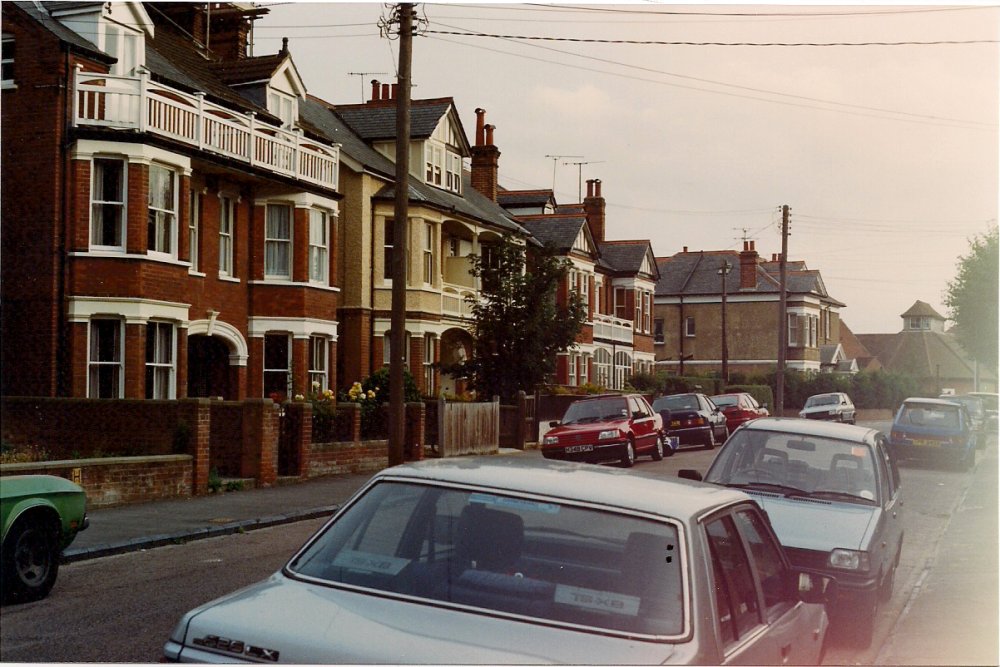
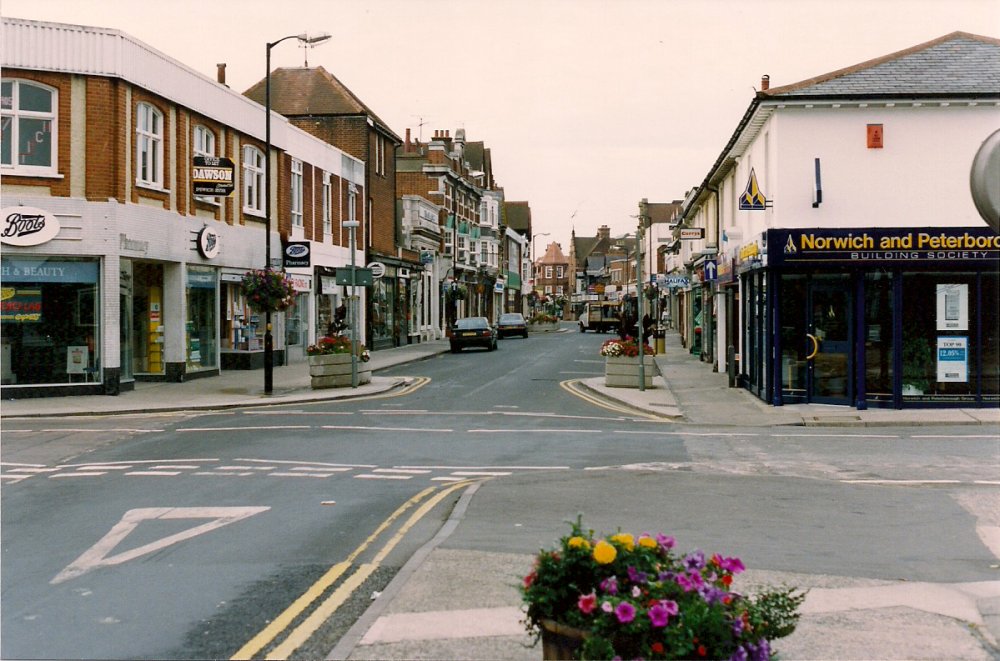
Again before moving on, let me mine my own photo albums for relevant print photos. As I said in the first installment of this personal history, I visited England for the first time (since my birth) in 1990, and made a point of renting a car (driving on the left!), and drove from London out to Felixstowe and that area to see what it was like. As I said, it looked pretty much identical to my father’s slides from nearly 40 years before. I have yet to mine his slides, but for now I’ll scan and post a few photos from my album.

For this first set of scanned photos from my own photo albums, I’ll save larger scans at 1000 pixels wide, and ‘thumbnails’ for display here at 500px wide. Click on the displayed images for the larger ones.

First: here’s the house where my parents lived in Felixstowe, England: 10 Bath Road. First a street view:

Then a front view:

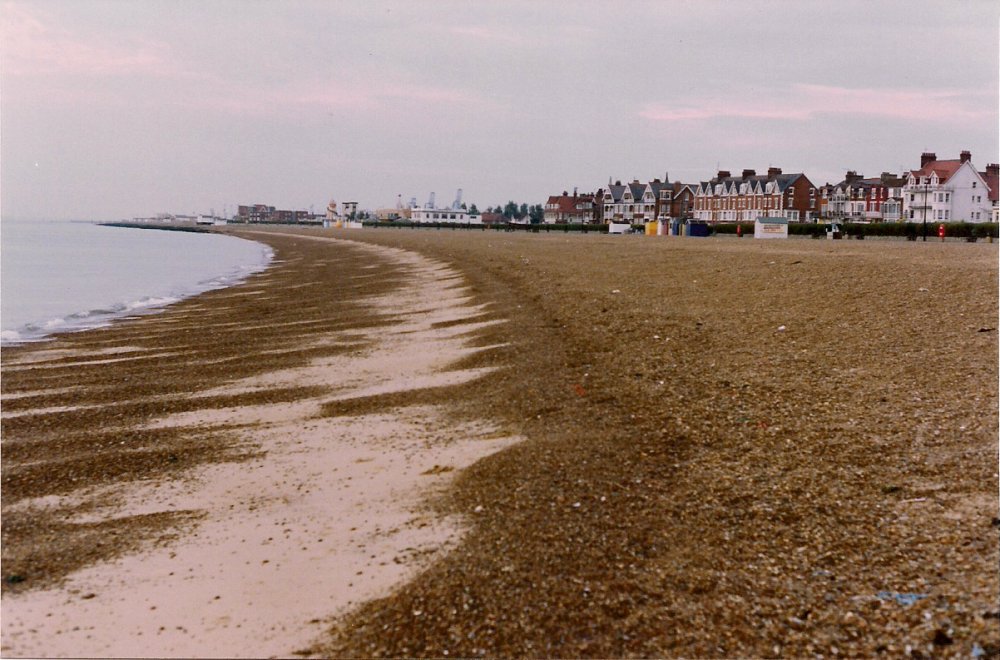
Here’s a view of the pebble beach (what they call a ‘strand’?)

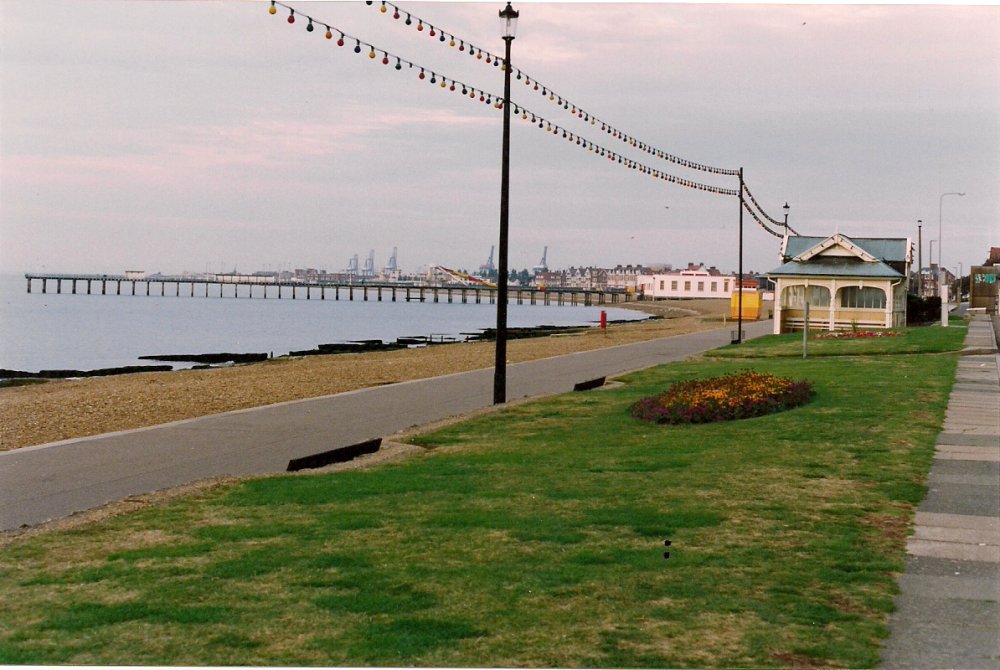
And then a pic of the grassy strip just above the beach, with those strings of lights. In the distance are the gantries of Felixstowe harbor.

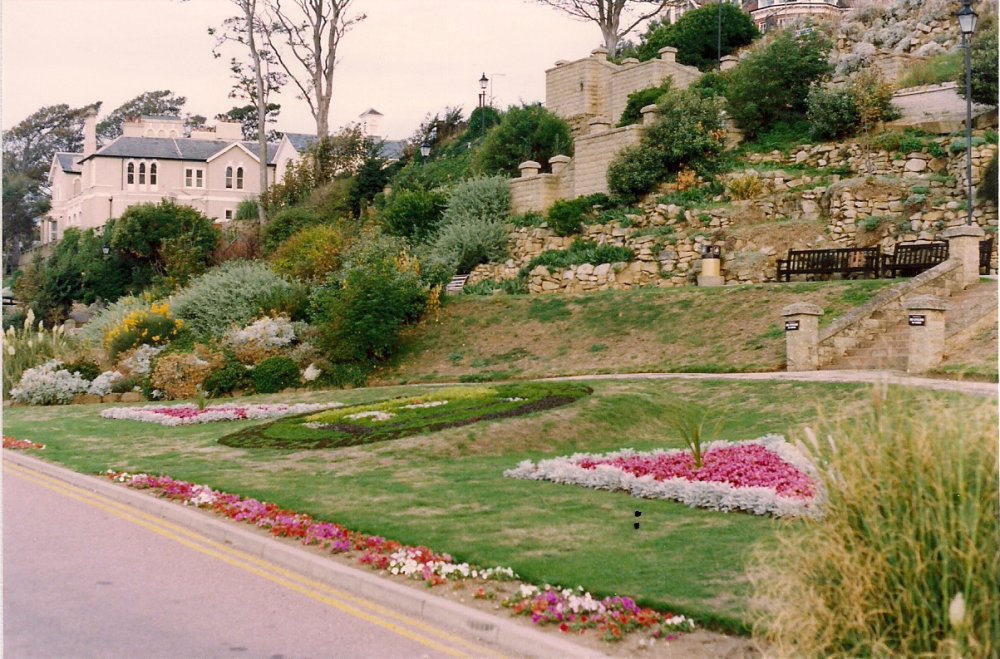
The town sits on a bluff somewhat above the beach; here is a section of garden just above beach level, at the base of the bluff.

And here’s a section of downtown, very quiet on a Sunday morning.

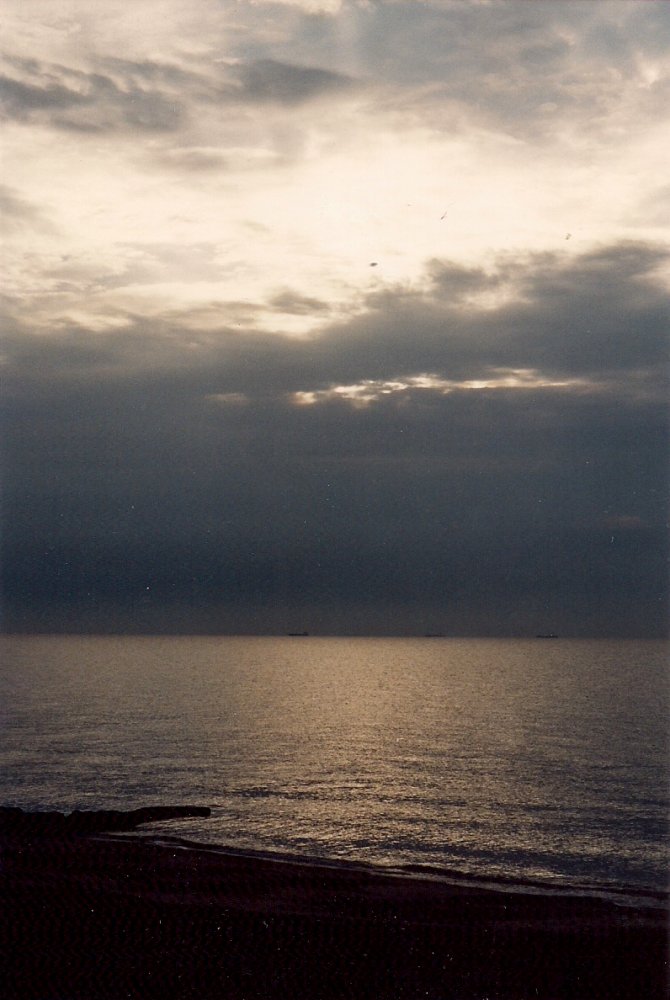
Then, a shot looking out over the North Sea. It must have been morning, since the view must have been the northeast.

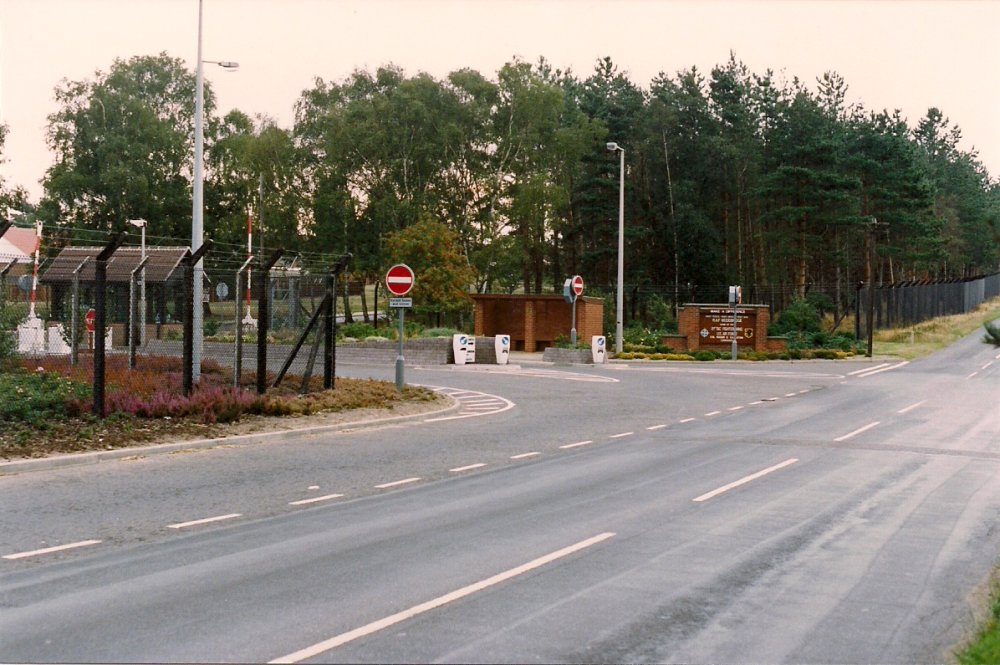
Two more. Driving north from Felixstowe, here is the entrance to R.A.F. (Royal Air Forcebase) Woodbridge, where my father worked as a weatherman in the early/mid 1950s.

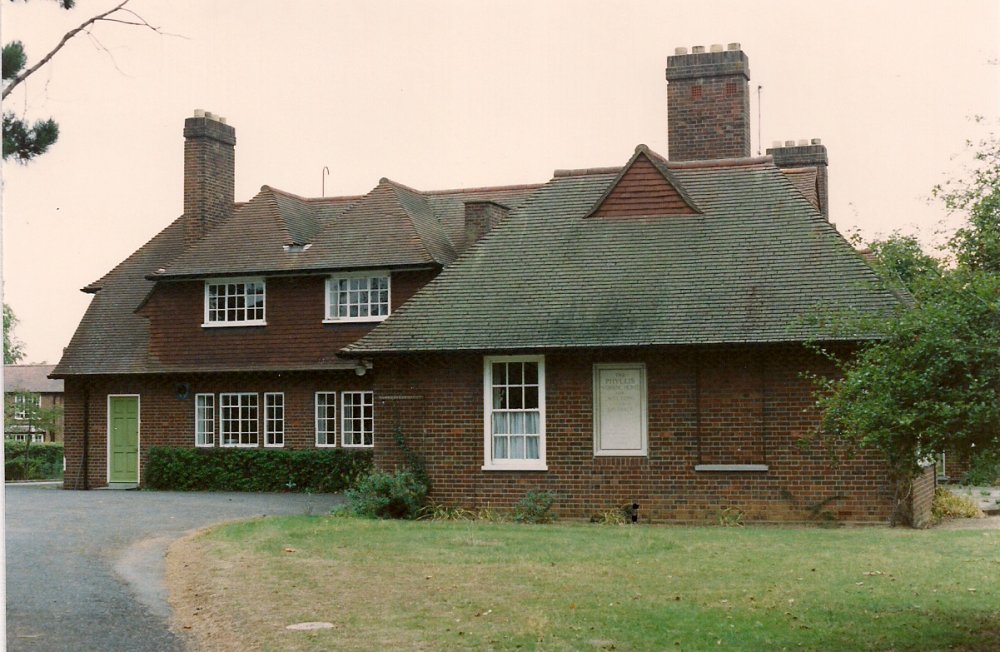
And then, Phyllis Memorial Home, my birthplace, looking unchanged since 1955.

Posted in Personal history | Comments Off on Personal History, part 3 (photos)

Personal History, Part 2

A bit more family history, as far as I can recall it, before I get to my personal memories of growing up in the high desert, and how that affected me.

In Felixstowe [England, where I was born], the family friend was a neighbor woman named Ruby. (When I delve into my half dozen metal boxes of family slides, I think I will find photos or her, and us at that time.) And one of the stories I remember [again: in a crucial sense, everything we remember about our past are stories, told over and over again in our minds or whenever we relate them to others, and not necessarily reliable as actual history — but nevertheless meaningful, as meaningful as anything from our past can be] is that my mother would leave me outside in a pram during the day, despite the weather being (since we were right on the coast) cool and damp. I have always attributed this to my relative tolerance of cool weather. I am the last one to put on a coat. In the mild SoCal weather, I can go a whole year without putting on a coat. (At the same time, given my high desert experience, I withstand dry heat easily as well. It’s hot humidity I have difficulty with.)

Thinking back, I think my father was not completely out of the Air Force when my family returned to the US. This was when I was about 1 ½ years old I’ve been told; late 1956 or early 1957. The reason we settled in Apple Valley (despite the name, a rather desolate desert town 100 miles northeast of Los Angeles) is that it was near George Air Force Base, just west of the larger town of Victorville, CA. (The base was decommissioned in 1992.) I think my father must have finished his Air Force commission there, and chosen to return there (as opposed to someplace in the Midwest, where he grew up) since it was relatively near the friend he’d met in the service, Rollin Bigbee, who lived in Burbank.

Let’s do a map. I’ve always been obsessed with maps, knowing where I am, knowing where places are. It’s common for me, reading a book, to check the atlas (I have several) or, these days, Google, to see where these places are. So, where is Apple Valley? It’s northeast of Los Angeles, thus:
SoCal map (Click on the image for a larger one.)

Apple Valley is in the upper right, near Victorville and Hesperia. The big green bands between there and Los Angeles below are the San Gabriel Mountains, with Big Bear Lake, Mt Baldy, the Angeles Crest Highway, and more. The world to the north is utterly different from the world to the south. It is an area of sand and rocky hills and vast expanses, at an elevation of roughly 3000 feet. The western end of that desert, between Victorville and Palmdale, is the area the rock band U2 took as the setting for their 1986 album “The Joshua Tree” – which included the song “Where the Streets Have No Names”. (This is true: all the roads out across the desert there have designations like Avenue F, or 152nd St east. No names.)

So: I believe my father finished out his Air Force commission at George Air Force Base. Then he got a job as a draftsman, for a man named John Blesch, who had an office in the area of Apple Valley called ‘the village’, about midway along the stretch of Highway 18 that runs straight west-east, in what is actually the southeastern end of the valley.

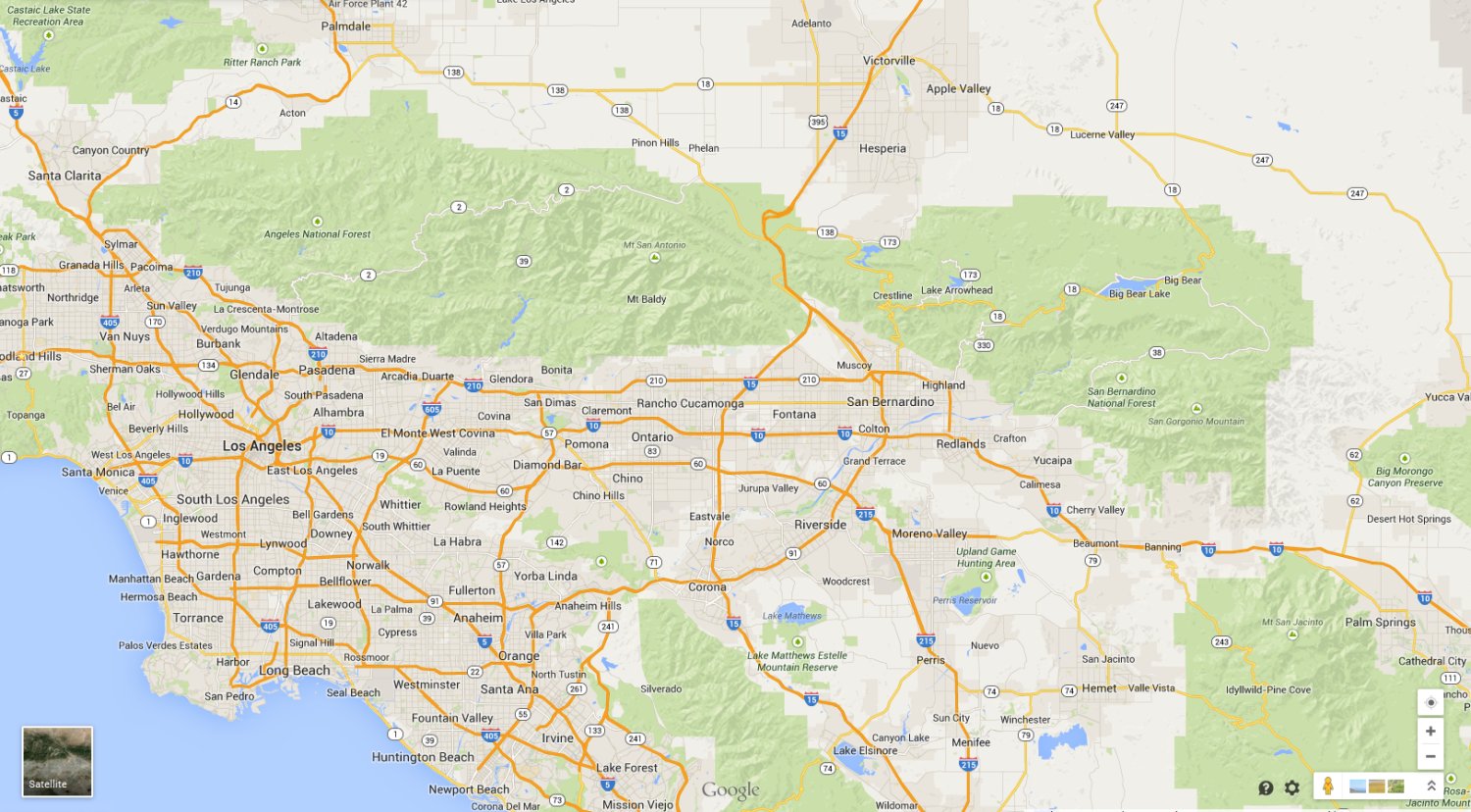
At first, we lived in what must have been a rented house, in the northeast corner of the valley, out by Fairview Mountain – a cinderblock house, and this is the place where I have my earliest memories… of lying in a crib with my parents in the other room; of a dog called Tammy running up the driveway. Everything was sand and scrub brush, alongside rocky hills.

In a pattern that was to be repeated, we moved from a rented house into a house that we bought: on Winnebago Road, to the southwest of the rented house and just north of what was then the small Apple Valley airport. This is the house where I lived for four years or so, through kindergarten and the 1st grade, and where later my maternal grandmother lived into her 80s. My family visited her many times over the years, and after they moved back east, I visited her over the years, until her death in 1984. My long-time connection to this place is why I list it as my hometown on Facebook. I have many pics, which I will scan and post eventually.

But a little bit more family background. My mother had one brother, Robert (my ‘Uncle Bob’), who I think must have also been in the service at some point, though I don’t think I ever knew the details, and who settled in the Los Angeles suburbs (the San Fernando Valley) afterwards. Because both he and my mother’s family settled in southern California, my grandmother on that side, who’d previously lived her entire life in a small northwestern Illinois town, relocated to southern California herself. For a time she lived in an apartment in Costa Mesa, down in Orange County. To get just a bit ahead of my personal timeline: when my own family moved from Apple Valley down to Santa Monica, when I was in 1st or 2nd grade, my grandmother moved in with us, in an apartment that was adjacent to the garage at the back of the property along the alley. And when, after 6 months, my father gave up that Santa Monica rental and bought a house in the San Fernando Valley… my grandmother moved out to Apple Valley, to take possession of the house my father had not been able to sell.

End of part 2.
Posted in Personal history | Comments Off on Personal History, Part 2