Inherit the Wind

Saw the movie INHERIT THE WIND today for the first time in many years. This is the 1960 film version of the 1955 play by Jerome Lawrence and Robert E. Lee, as directed by Stanley Kramer, about the famous 1925 ‘monkey trial’ in a small town, Dayton, Tennessee, in which a high school teacher was accused of teaching Darwin’s theory of evolution in spite of a state law prohibiting such instruction.

(I’d put the film on my Netflix quere literally years ago, and somehow last week, without my having noticed my queue in a while, the DVD appeared in my mailbox…)

The subsequent trial attracted national media attention and two big-name lawyers. (That the teacher violated the letter of the law was barely the issue; of course he did. The big-name attention was about whether the law was justified.) The play and movie fictionalizes the characters, but their identities are easily mapped to their real-life counterparts. The prosecuting attorney in the play/movie is Matthew Harrison Brady, counterpart of the actual William Jennings Bryan, the three-time (losing, obviously) presidential candidate, who speaks for the literal word of the Bible; the defense attorney in the play/movie is Henry Drummond, counterpart of the actual Clarence Darrow, a firebrand attorney known for defending unpopular clients. And attending the proceedings is a sarcastic newspaper reporter, E.K. Hornbeck, counterpart of the real life H.L. Mencken. (In the film, Brady is played by Fredric March, Drummond by Spencer Tracy [an Oscar nominee for this], and Hornbeck by none other than Gene Kelly. And Dick York, later known for his husbandly role on the TV series Bewitched, played the school-teacher, Bertram Cates. Also notable is Claude Akins as the overly-zealous Reverend Jeremiah Brown — father of the young woman in love with Bertram Cates.)

The story pits small-town Bible-thumpers — “simple folk”, “plain folk”, they are repeatedly described as, who need the comfort of their Bible stories, against outsiders from the ‘northern cities’ and foreigners — resisting ideas of ‘evil’-ution, which to them means humans descended from apes and ultimately slime [a gross misunderstanding and mischaracterization, needless to say]. The town crowd repeatedly marches through the streets, singing “Give Me That Ol’ Time Religion”, and carrying signs (e.g. “Brady and Bible, Drummond and Devil”), that are too well-spelled (considering the actual recent record of reactionary protest marches) to be realistic. The town crowd is much like the hysterical mobs of “The Crucible” — at one point they parade through the streets singing about hanging and burning the teacher, Bertram Cates, as he waits in his jail cell.

Which is to say, the movie overplays it, exaggerating the ignorant zealousness of the townspeople, and for that matter the zealousness of Matthew Harrison Brady, who in his passion and small-mindedness comes across as a buffoon, and dies himself to a heart-attack in the midst of a passionate oration just after the trial ends.

I say this even after, obviously, not being on the town’s or Brady’s side in this debate. But maybe this exaggeration was dramatically necessary when this film was made, at a time when these issues were not so visible as they are today.

Of course, as with pretty much all plays and movies based on real events, this story takes liberties with historical facts. (Bryan died five days after the trial ended, not on the last day of the trial, for example.)

Dramatically, however, the story is incendiary. It’s mostly about the trial, and it takes off when, after Brady and the judge have ruled out testimony from various university experts in zoology, geology, and whatnot, Drummond calls *Brady* to the stand, to interrogate him about the Bible and “Mrs. Cain” and about whether the first day was literally a 24-hour day, a dialogue that leads to Brady’s claim that God speaks to him. It’s a long, impassioned scene that culminates in Brady’s breakdown, the crowd’s subtle turn against him, and how the ultimate verdict against Cates seems like a joke. (After so many days or weeks of media attention, the town’s leaders realized that the country, and even the world, was treating Dayton as a laughing-stock. And so the judge minimized the sentence as best he could.) [Not mentioned in the play or film: the verdict was later overturned on a technicality.]
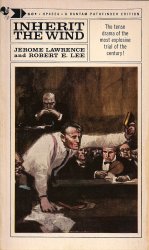
I read this play in my teens, long before I saw the movie. It was published in a paperback Bantam Pathfinder edition, for 60 cents, that I bought off a junior-high school book cart, and which I’ve scanned here (without color correcting). In those days the junior high school “home room” class hosted a book cart, like a large library cart, that was wheeled into home room once a week, from which one could purchase books. I was especially attracted to Bantam Pathfinder editions, and bought this one (along with William Gibson’s play The Miracle Worker, Leonard Wibberley’s The Mouse That Roared, C. S. Forester’s Sink the Bismark!, and others, including my first few Ray Bradbury books).

As I watched the movie today, I couldn’t help but pick up the book, and track the film to the play. And I was surprised to discover that the film is actually *longer* and more developed than the play; there is some rearrangement of scenes from the play, but there are also entire scenes in the film that were not in the play, especially a couple involving the preacher and his daughter, and some rearrangement of the final scenes with Hornbeck and Drummond. At the same time, considerable portions of the film are taken word for word from the play. So I’m surprised to see that, according to Wikipedia, the film’s scriptwriters were not the playwrights; most scriptwriters take much more liberty with their source material than these two obviously did.

Reading the play at age 15 was just one ingredient among many that formed my worldview in those impressionable years. Later, I saw a performance of the play at UCLA, while I was a student there, and eventually the movie.

Here’s a key passage — among many — from the play.

Brady:
We must not abandon faith! Faith is the most important thing!

Drummond:
Then why did God plague us with the power to think? Mr. Brady, why do you deny the one faculty which lifts man above all the creatures on the earth: the power of his brain to reason. What other merit have we?

Fun facts and asides:

  • I understand there is a museum in Dayton, Tennessee, about the Scopes Trial, that emphasizes the historical inaccuracies between the play/movie and what actually happened. As if.
  • According to Wikipedia, the Cowardly Lion in L. Frank Baum’s The Wonderful Wizard of Oz was a satirization of Bryan.
  • Bryan was a Democrat, who “champion[ed] the ideas of the farmers and workers” [Wikipedia] while also being a religious zealot who “actively lobbied for state laws banning public schools from teaching evolution” [ditto]. How times have changed.
  • Surprised to note that according to Wikipedia there have been three subsequent TV films of the play, in 1965, 1988, and 1999
  • And interesting to note that Wikipedia characterizes the play as a parable about the McCarthy ‘witch-hunt’ trials concerning communists, since of course the content of the story’s subject can be taken at face value — there are in fact battles ongoing in school boards to this day (especially in Texas and other southern states) about whether science should be prohibited in school classrooms in favor of religious myths.
  • Here’s a very weird coincidence, which I will note but not explain in this venue; according to my book of the play, which lists the cast of the 1955 NYC production, the first character on stage, in the character of Melinda, was played by Mary Kevin Kelly.
  • FWIW, in that original production, Tony Randall played E.K. Hornbeck, Ed Begley played Matthew Harrison Brady, and Paul Muni played Henry Drummond.

Edited 24nov14: added a couple sentences above about how the teacher did actually violate the letter of the law, and how the town was made a laughing-stock through all the media attention.


Posted in Culture, Evolution, Films, Personal history, Reviews | Comments Off on Inherit the Wind

Resuming SFADB Development

I’ve had concepts for what I want to implement on my science fiction awards site, what was first the Locus Index to Science Fiction Awards (http://www.locusmag.com/SFAwards/) and which has been superseded by the Science Fiction Awards Database (http://www.sfadb.com/), since at least 2000, when I first posted the former site and when I started to play with the idea of tallying up entries in Bill Contento’s Locus Index to Science Fiction, the entries for how many anthologies and collections any particular short story was reprinted in. I specifically remember jogging around the running track at the North Hollywood Bally’s (acquired three years ago by LA Fitness) thinking about it. Contento at that time had a crude tally of the number of such reprints, with stories by Ellison and Clarke and Keyes topping the list, but my vision was to scale those data by the kind of reprint book, and combining those data with the awards data already compiled, in order to come up with a balanced set of data about the most essential SF/fantasy novels and short fiction of all time.

(My motivation is not a technogeek issue about statistics. It’s about trying to identify a set of novels and stories that are at the core of the SF/fantasy genres, a set of titles that can be objectively identified as those that anyone interested in these genres should aspire to be familiar with. This notion of a common core of SF/F literature is perhaps an old-fashioned idea, but one which I still think is worth pursuing.)

This project is huge and I wish I were more efficient about implementing it. (And I’m boggled by all the work that’s gone into the vastly larger project of the Science Fiction Encyclopedia.) Currently, with no day job but while dealing with the sale of our house here in LA and the search for a new home in the San Francisco Bay Area, I have lots of free time, though it’s difficult to focus on a big project like this with these other matters in the foreground.

Despite which, I have resumed work on sfadb today, on one of the three major open threads on the site. (One: citations. Two: anthologies. Three: Tallies and rankings of novels and stories by year. And four, only barely begun: selected bibliographies in my preferred format.) I haven’t posted another round of ‘Citations’ (http://www.sfadb.com/Citations_Directory) since April, though I’ve off and on been working the next round of a couple three dozen additional sources. The issue for adding new citation references is verifying bibliographical information on the titles cited by each source. That is, if some citation source links to some title, I need to have the year and country and publisher of that title’s first edition in my database, before I can include those data in the dataset for sfadb, and update all the citation and title pages. (And I’m also revising the way in which I indicate first publication for books that were first published in non-English languages in some year, and published in English in some later year.)

As of today, I have 256 Books Records to verify in that way. In the past couple years I’ve taken the Science Fiction Encyclopedia as being the primary source for such bibliographical information (superseding my traditional sources, such as L.W. Currey’s Science Fiction and Fantasy Authors: A Bibliography of First Printings of Their Fiction, and other sources by St. James and Robert Reginald and Donald H. Tuck). The only problem with SFE is that it does not include some specifically fantasy authors, and for those, I resort to Bill Contento’s Locus Index, or Wikipedia, or Abebooks.com, or as a last resort a general Google search, to identify first publication data. So far, there are only a handful I’ve not been able to verify even through those methods. It should take only two or three full days to work through those 256, so another general update of Citations references on sfadb should be forthcoming in the next week or two.

Posted in Website Issues | Comments Off on Resuming SFADB Development

Scientific fidelity vs narrative; anti-gay bigotry and socialism; the ecology of faith; Valerie Tarico on religion; Hans Zimmer and conceptual breakthrough

Here’s one of several articles in the past week or so about why we should not nitpick the science in Interstellar:

Slate: Back Off, Scientists: Don’t be so nitpicky about the technical details of sci-fi movies like Interstellar

I have yet to see the movie so this is not about that. It’s about a larger theme: why human beings value *story* over fidelity to the real world. Again and again, Hollywood science fiction films that are dumb to some degree about how the universe actually is, are forgiven by apologists who say that it’s really all about the story, that’s what’s most important.

In my thinking the larger theme is why we so value story over reality, and this keys to the psychological biases discussed by David McRaney (and Jesse Bering and EO Wilson and many others), about how we interpret the world in terms of narrative. (Aside from the fact that it’s just so much simpler to defer one’s intellect to whatever holy book is at hand, rather than engage in a life-long thought-process about the ever-expanding and at times changing evidence for what is true about the real world.) This is also, of course, a primary underlying explanation for why the vast majority of the human race prefers religion — stories — over understanding of the real world. (The secondary explanation is that this narrative mindset truly does enhance reproductive fitness. Humans don’t need to ‘understand’ the real world as it actually is, in order to survive and reproduce; they only need to interpret it in the context of stories that play to their sense of worthiness and superiority compared to other family groups or social groups, providing them an incentive to perpetuate their line.)

Towleroad has this interesting profile from a few days ago: Meet Cathi Herrod, Arizona’s Leading Anti-gay, Pro-Discrimination Bigot: VIDEO. Quoting her:

The social science data shows that marriage between a man and a woman is still the best family unit for men, women and children. This is never aimed at any individual, but it’s aimed at what’s the best public policy.

There are two problems with this. First, the social science data does *not* show that. She is lying, or is misinformed. (See my blog post Regnerus, Same-Sex Marriage, and False Witness and its reference on Slate, The Shamelessness of Professor Mark Regnerus.)

Second, she is taking a socialist stance — a huge irony, given that most right-wing/conservative/evangelicals bristle at anything they can condemn as socialist, like healthcare. She is saying we need to deny certain rights to gays *for the good of public policy*.

Needless to say, she does not perceive the irony. She implicitly presumes that Life, Liberty, and the pursuit of Happiness applies only to people she approves of.

The ecology of faith: what makes societies religious?

Jerry Coyne chimes in about the recent study that examines religious beliefs as a function of social dysfunction. The more uncertain and worse off a society is, the more religious it is. (One might also observe the US states that are relatively poorest in terms of social standards – those in the South – are also the most religious.) Much more detail at the link.

[Not mentioned by Coyne, but this is consistent with the evidence that many countries in Europe, including the relatively, er, socialist Scandinavian countries, score highest on various standards of living and health, while having the lowest rates of religious belief, across the entire world.]

Meanwhile, here are two articles by Valerie Tarico, on Alternet and Salon, who valiantly explores the interfaces of religion and society.

6 Ways Religion Does More Bad Than Good

With a provocative subtitle: “What if harming society is part of religion’s survival strategy?”

(Of course the strategy suggested here makes sense in terms of EO Wilson’s dialogue between individual and group selection; religion is about enforcing conformity within groups…but only small groups that can withstand variation among larger groups, and their interaction with the real world.)

Her points:

  1. Religion promotes tribalism
  2. Religion anchors believers to the Iron Age
  3. Religion makes a virtue out of faith
  4. Religion diverts generous impulses and good intentions
  5. Religion teaches helplessness
  6. Religions seek power

Another Valerie Tarico article: 10 signs that religious fundamentalism is going down

One can only hope.

Again, to bulletize her points (though of course the complete article is worth reading):

  1. Coming out atheist is up and coming
  2. The cutting edge of freethought is less cutting and edgy
  3. Biblical sexuality is getting binned. Finally
  4. Recovering believers are reclaiming their lives
  5. Communities are coming together
  6. Secular giving is growing
  7. The Religious Right is licking wounds
  8. Texas is evolving!
  9. Millenials are taking up the torch
  10. Rebuilding the wall of separation isn’t the only place Millennials are leading the way

Finally, here is the best track from Hans Zimmer’s score for The Da Vinci Code.

In science fiction there is the idea of the conceptual breakthrough — the moment in which one’s world opens up and expands to something previously unsuspected, into a grand and glorious greater reality. This is music for that.

Posted in Evolution, Films, MInd, Music, Psychology, Religion, The Gays | Comments Off on Scientific fidelity vs narrative; anti-gay bigotry and socialism; the ecology of faith; Valerie Tarico on religion; Hans Zimmer and conceptual breakthrough

EO Wilson, The Meaning of Human Existence, part 2

Second of several posts about Edward O. Wilson’s book THE MEANING OF HUMAN EXISTENCE, which as I described earlier both here on my blog and on Facebook, is a concise summary of this important scientist’s views on the big issues of science and philosophy, as elaborated in his many earlier books. (Part 1)

Chapter 4, The Unity of Knowledge

[This was the theme of one of Wilson’s most essential books, CONSILIENCE (1998).]

Modern culture assumes (and endlessly probes) a presumed divide between the ‘sciences’ and the ‘humanities’, but the idea that the humanities and science share a basic foundation — that of cause and effect — was the basis for what Western culture called the Enlightenment, in the 17th and 18th centuries. The idea faltered in the early 1800s; science expanded rapidly but came nowhere near accounting for everything; thus the Romantics gave up and focused on private experiences of meaning, especially in poetry. Thus the split into the ‘two cultures’. Scientific specialties multiplied. But now, the author says, the quest for unification should be resumed. Many of the big problems of modern life depend on it.

The successful scientist thinks like a poet and works like a bookkeeper… the opposite is true in poetry and other creative arts.
d
In a fundamental sense the creative arts and humanities scholarship are just the same old story – reflecting a boundless anthropocentricity, a fascination with ourselves. It’s a result of social intelligence.

We are devoted to stories because that is how the mind works—a never-ending wandering through past scenarios and through alternative scenarios of the future.

(p43)

Whereas science

is totally committed to fact without reference to religion or ideology. It cuts paths through the fever swamp of human existence.

Science offers another property unlike the humanities: the idea of the continuum. Processes in one or more dimensions that occur continuously – temperature, pressure, spin, wave length. Of the variety of exoplanets. Of the continua of biodiversity. Of the evolutionary relationship of species.

The humanities do not appreciate how tiny our perceptions of these continua are—especially those of our senses. The range of light we can see, sounds we can hear; humans have one of the poorest senses of smell among all organisms on Earth. (The vast majority of animal species, Wilson notes, live their lives with their faces and noses much closer to the ground than do humans.) Science can explore all these continua in a way the humanities cannot perceive:

We are a very special species, perhaps the chosen species if you prefer, but the humanities by themselves cannot explain why this is the case. They don’t even pose the question in a manner that can be answered. Confined to a small box of awareness, they celebrate the tiny segments of the continua they know, in minute details and over and over again in endless permutations. These segments alone do not address the origins of the traits we fundamentally possess…

(p51)

[[ Comment: the way the human mind filters and channels experience and perception into narratives, i.e. stories, echoes themes of David McRaney’s books (e.g. as summarized here). Re: Wilson: of all the humanities it is the literary genre of *science fiction* that attempts to step outside the comfortable boundaries of what is known, and imagine things outside the ordinary experience of human beings. (Here is the core of my interest and what I’m exploring in this blog.) ]]

Chapter 5, The All-Importance of the Humanities

Wilson makes the provocative point that, were ‘real’ aliens to show up in a first contact scenario, it is not our science they would be interested in — because they would already know the science, since it’s the same everywhere, the physics, the principles of evolutionary biology, and so on. What aliens would value from human society is… our humanities.

Human history has given birth to thousands of cultures, languages, religious beliefs, social practices. [[ This variation, I would say, is like art; endlessly variable perceptions of how to live within the unchanging fundamental reality of the world. ]]

Science, Wilson suggests, will eventually reach a mature size and complexity, and advances will slow. Science will be the same across all cultures, everywhere in the world. In the next few decades we can expect advances in BNR—biotechnology, nanotechnology, and robotics. We will be able to correct mutant alleles that cause hereditary diseases. The worldwide population will homogenize; how will we handle the decrease in genetic diversity? And as robots advance, what will be left for humans to do? These are issues for humanities to solve — which is why humanities, in the long run, will remain important.

Chapter 6, The Driving Force of Social Evolution

This chapter explores in more detail the idea of ‘eusociality’ brought up earlier, in Chapter 2 (see earlier post), and the conflict or balance between individual-level selection and group selection. Wilson gives the example of a thief, who may by his actions further the interests of his offspring, but at the same time weakens the rest of his group. Whereas a warrior who is killed in battle helps preserve his own group, even at the expense of his own offspring. Inclusive fitness has been shown to apply to only extreme situations, and its method of regressive analysis has been invalidated (p64). Wilson reviews the history of these ideas: Haldane, Hamilton; kin selection; Dawkins and the idea of the ‘selfish gene’.

The author says that within the past decade, the theory of inclusive fitness has been shown to be fundamentally wrong. Doubts became frequent by 2005. Author wrote 2010 paper with two others at Harvard advancing the alternate theory about group selection, which got a fair amount of criticism, including from Dawkins.

And so, author concludes, the driving force was the creation of groups.

Posted in Book Notes, Culture, Evolution, Religion, Science | Comments Off on EO Wilson, The Meaning of Human Existence, part 2

EO Wilson, The Meaning of Human Existence, part 1

Here’s the first of several posts about Edward O. Wilson’s book THE MEANING OF HUMAN EXISTENCE, which as I described earlier both here on my blog and on Facebook, is a concise summary of this important scientist’s views on the big issues of science and philosophy, as elaborated in his many earlier books.

(Though this book is a finalist for this year’s National Book Awards, it’s hard to think of this as a great book unto itself, since it derives so much of its content from the author’s earlier works. Maybe that’s a plus?)

These are issues that have informed my own worldview for over 30 years, ever since reading his seminal book ON HUMAN NATURE (1979), which won the Pulitzer Prize for nonfiction. That Wilson has revised some of the ideas expressed in his earlier books — or rather, expanded and matured them on the basis of further evidence and analysis — is an example of the process of science and intellectual inquiry (as opposed to ideology and religion).

Chapter 1 is about “The Meaning of Meaning”. Wilson acknowledges that the ordinary use of ‘meaning’ is about intent and design. The broader definition of ‘meaning’, which he applies here, is that the accidents of history are the source of meaning; each event in the evolutionary past of the human race is random, yet each alters the probability of later events. Humanity’s existence is the consequence of adaptations amidst other potential possibilities that have driven us to our current existence, and those probabilities and consequences, as opposed to all the theoretical others, is a kind of ‘meaning’.

Wilson advises that we as a species approach a great moral dilemma: to what extent do we retrofit the human genotype, and direct our own evolution. The essays in this book invoke both proximate and ultimate causation, both as conditions for the ‘meaning’ of human existence. Humanity arose on its own:

We are not predestined to reach any goal, nor are we answerable to any power but our own. Only wisdom based on self-understanding, not piety, will save us. There will be no redemption or second chance vouchsafed to us from above. We have only this one planet to inhabit and this one meaning to unfold…

Chapter 2: Solving the Riddle of the Human Species

Here Wilson explores his latest, perhaps substantial, contribution to evolutionary theory, the idea of group or social selection. It’s an idea that’s been around for years and remains controversial, but one which according to Wilson has been validated by recent mathematical theorems and proofs. (Much more detail in his book THE SOCIAL CONQUEST OF EARTH.)

His idea is that ‘eusociality’ is a principle that explains the advanced social behavior of human beings — as well as a small number of other species, only 19 others in the history of life on Earth in fact, mostly insects (termites and ants), a few rodents, and a few marine species.

“Eusociality” is the condition in which members of a group cooperatively rear their young across multiple generations. They also divide labor in a way that reduces the “reproductive fitness” of some members but that increases that of other members. [It’s the opposite of the far more common pattern in which a male and female mate and the mother subsequently raises the young on her own, sometimes with the assistance of the father, but never within a group of other parents and offspring. Think of dogs or cats in the wild, birds in the nests — almost but not quite the entire animal kingdom.]

This is a result of a competition, or balance, between individual selection and group selection, and it is this understanding that is key to the ‘meaning’ of human existence: that we have “adapted to live in a biological world”:

Human existence may be simpler than we thought. There is no predestination, no unfathomed mystery of life. Demons and gods to not vie for our allegiance. Instead, we are self-made, independent, alone, and fragile, a biological species adapted to live in a biological world. What counts for long-term survival is intelligent self-understanding, based upon a greater independence of thought that that tolerated today even in our most advanced democratic societies.

(page 26)

Chapter 3: Evolution and Our Inner Conflict

The understanding of those conflicting forces of evolution leads to this great insight.

Are human beings intrinsically good but corruptible by the forces of evil, or the reverse, innately sinful yet redeemable by the forces of good?

Wilson’s answer: We are both simultaneously, as a result of the multilevel selection that pits kin selection against group selection. The results of this multilevel selection are aspects of human nature that seem like elemental forces of nature, but are in fact idiosyncratic traits of our species.
One is our obsessive interest in other people, what they are thinking and what their intentions are.
A second is the instinctual urge to belong to groups.

Individual-level selection works among individuals of the same group. Group-level selection is about competition among groups, promoting altruism and cooperation of all members of a group, not just kin, leading to ideas of morality and conscience and honor:

Within groups selfish individuals beat altruistic individuals, but groups of altriuists beat groups of selfish individuals. Or, risking oversimplification, individual selection promoted sin, while group selection promoted virtue.

(p33)

And so humans are forever conflicted by rival urges.

To give in completely to the instinctual urgings born from individual selection would be to dissolve society. At the opposite extreme, to surrender to the urgings from group selection would turn us into angelic robots –- the outside equivalents of ants.

And to conclude:

The eternal conflict is not God’s test of humanity. It is not a machination of Satan. It is just the way things worked out. The conflict might be the only way in the entire Universe that human-level intelligence and social organization can evolve. We will find a way eventually to live with our inborn turmoil, and perhaps find pleasure in viewing it as the primary source of our creativity.

(p34)

[[ Personal comment, not to be taken as any gloss on Wilson’s words, just my own ancillary thoughts as I was reading this book, and in the context of my themes of this blog. So: It is tempting to align the priorities of individual and group selection, as Wilson describes them, with the dualistic nature of human social and political tendencies, with ‘conservatives’ prioritizing fidelity to the family and small local groups, and ‘liberals’ prioritizing interactions and the health of larger groups. “It takes a family” to raise a child, one side says; “it takes a village”, the other side says.

In which direction does human society as a whole advance?

Without the more ‘advanced’ group priorities, there would be no society at all. ]]

More to follow.

http://www.amazon.com/Meaning-Human-Existence-Edward-Wilson/dp/0871401002/

Posted in Book Notes, Culture, Evolution, Religion, Science | Comments Off on EO Wilson, The Meaning of Human Existence, part 1

Hans Zimmer and Interstellar, again

Very happy to see this post on Slate by J. Bryan Lowder: Music of the Spheres: In Interstellar, Hans Zimmer scores the universe.

This is to follow up my earlier post, Interstellar…Music, which concerned complaints that the music overwhelmed to the film to a distracting degree.

I’ve also seen newsgroup posts about how the entire soundtrack obscures the dialogue, and makes the film hard to understand. I think this is all a matter of sound editing, or perhaps the director’s prerogative about the sound of the film. It makes me inclined to wait to see the film until it’s on DVD, when I can turn on subtitles.

Despite these kinds of issues, Hans Zimmer is one of my favorite film composers, as I mentioned in that earlier post. And I’m fascinated by the comment in the linked article that Zimmer deliberately delayed the release of the soundtrack for Interstellar, so that people would hear the score in the context of the film, before hearing it on its own.

Conflicted about whether I want to see the film now, despite all the complaints, aesthetic and otherwise.

Posted in Films, Music | Comments Off on Hans Zimmer and Interstellar, again

And the moon rose over an open field

Here’s one of Paul Simon’s best songs, “America”, from Simon & Garfunkel’s 1968 album Bookends; a song that is recently getting play on a certain TV commercial… Has Simon sold out? Well, the TV commercial is about patronizing local, small-town businesses. So I suspect Simon must have licensed the song for that message, which is consistent with the song’s theme of searching for the true America.

“Kathy, I’m lost,” I said, though I knew she was sleeping.
“I’m empty and aching and I don’t know why”
Counting the cars on the New Jersey Turnpike
They’ve all come to look for America

While we’re at it, here’s the YouTube of what I think of as the Ur-Simon & Garfunkel song — Scarborough Fair, with its gorgeous overlapping counterpoint melodies. (And its fundamental Italian sauce ingredients: parsley, sage, rosemary, thyme.)

Wikipedia on the ballad: Scarborough Fair (ballad)

But then we may as well link Simon & Garfunkel’s greatest song.

…All your dreams are on their way…

Wikipedia

Paul let Art sing this.

Lyrics

Posted in Music | Comments Off on And the moon rose over an open field

Interstellar… Music

Gary Westfahl’s reviews save me lots of time and money. Whenever I think a new SF film might be interesting enough to see…. his review often persuades me otherwise. (And when I do see them, my reaction is much the same as Gary’s, which is why I rely on him for reviews.) Thus, Interstellar. Worth seeing? I go to see so few new movies anyway, it takes some convincing to get me to get to the theater. At the same time, that Neil deGrasse Tyson has taken this film seriously enough to tweet about it, suggests it’s worth taking seriously. At least seriously enough to see. If only to keep up with what all the other SF filmgoers are seeing, and how the broader culture perceives science fiction, via films like this.

But even without seeing Interstellar, I do have a reaction to one criticism of the film, about the music. I’ve already posted this on Facebook:

The 7 biggest problems with “Interstellar”

“Hans Zimmer is a monster who must be stopped” is among the complaints.

If the soundtrack overwhelms the dialogue, this is not the composer’s fault; it’s the sound editor’s, or perhaps the director’s.

Several of my favorite film scores are by Zimmer – especially scores for “The Thin Red Line” (a film I like), “Beyond Rangoon” (a film I’ve never seen), and “The Da Vinci Code” (a film I saw but don’t care about). The scores I like, independent of the films. How the scores are used in those films is not within the composer’s control.

I remember seeing “The Hours”, over a decade ago, with an Oscar-nominated score by Philip Glass. I’m a Philip Glass fan, but as I watched the film I was aware about how relatively *loud* the score was, and wouldn’t this turn off movie-goers who found his music distasteful? Even as a Glass fan, I found the music obtrusive.

I’ve just listened to several YouTube tracks of Zimmer’s score to Interstellar, and I find them quite intriguing. If they interfere with the film, it’s not his fault.

Posted in Films, Music, science fiction | Comments Off on Interstellar… Music

Sibelius 1 and Mahler 6

I did a post a couple weeks back about how I tend to like the later albums by pop/rock singers and groups over their earlier ones. Springsteen, REM, Darren Hayes. This applies generally to classical composers as well, though the distinction isn’t quite as clear-cut. Beethoven is great from the 3rd onward; Mahler is great from the 2nd onward; Tchaikovsky, ironically, is best-known from the 4th onward, though his first three are pretty good too, if you listen to them. Some composers, like Shostakovitch, are intermediate; their middle symphonies, in his case the 5th, 8th, 10th, 12th… are terrific; others are interesting but you have to give them much more attention to appreciate them. –And his 11th, a special case, via Cosmos. Later composers like Alan Pettersson, exhibit similar patterns; his 7th and 8th and 9th are gorgeous and intriguing, but his earlier and later symphonies seem like trials for later ones, or experimental offshoots that don’t quite compel.

But Sibelius is the exception, in my perception — his 1st symphony is my favorite of his 7 symphonies. It’s grand and mysterious, from the opening clarinet solo to the two ‘plump plump’ conclusions of the first and last movements. Yet the dynamic range across these movements is so vast that the music is hard to listen to, in certain contexts — e.g. my car CD player. Turn it up loud enough so that you can hear those quiet conclusions, and the loud passages blast you away.

And the same is true, perhaps, in the most grandiose of symphonies with such a dynamic range — Mahler’s 6th. The final movement, nearly half an hour long, is a dynamic interplay between passages (that begin with a gorgeous, uplifting, string theme) that build to aggressive conclusions, only to be smashed into silence by huge hammer blows… and then trying to rebuild. It does this, tries this, three times. And then the fourth, final passage has no hammer blow; it seems to give up, cautiously rebuilding, and then sighing back. The music gets so ever quiet. And then — after a full minute of nearly calm silence — the orchestra smashes back, in a huge abrupt loud chord, that startles you no matter how times you’ve heard this symphony and are expecting this to happen… a chord of mixed triumph and resignation and defeat… a final last breath… before it sighs back into nothingness.

As I said, the final loud chord is always startling when listening to this on a recording. In a concert hall — and in fact I heard this symphony live, in a performance in Albert Hall, in London, on a trip there in 1990 — you would see all the performers lift up their instruments near the very end, and you could tell that something was about to happen, even as the music seemed to be getting quiet, and dying down.

When Mahler was composing, in the early 1900s, of course, there were no recordings. In his worldview, the only people hearing his music would be those sitting in a concert hall… and seeing the musicians pick up their instruments in anticipation of that final chord, and knowing that the audience would see that. I wonder if he might have thought differently, if he knew the audience would not have seen that anticipation.

I suspect not.

Posted in Music | Comments Off on Sibelius 1 and Mahler 6

Fundamentalist Beliefs, the Real World, and Science Fiction

“Those of us in the U.S. think we’re amazing at everything… mostly because we’re blissfully ignorant about how the rest of the world operates.”

Here’s a fun video of a fundamentalist pastor from an Atlanta suburb whose mind is boggled by the discovery – upon visiting Sweden and Denmark – that everyone in the world doesn’t possess the same religious beliefs as his own. See him struggling to wrap his mind around the idea. Wow, he keeps saying. He can’t quite believe it.

http://www.patheos.com/blogs/friendlyatheist/2014/11/06/watch-this-conservative-pastors-mind-get-blown-as-he-discovers-how-secular-norway-is/

The point is not to make fun of this guy (though it would be easy to do so — see him parroting bogus references to ‘missing links’, which obviously he does not actually understand); he is, as I suggested in a recent post, a member of most of the population of Earth who lives comfortably within their like-thinking communities and who otherwise doesn’t get out much, intellectually. It’s to cite another example of how most human beings are blissfully unaware of the true scope of the universe, of the Earth, the billions of years of history, the vast numbers of cultures that have lived on the Earth (even within the past few thousand years, for those who don’t ‘believe’ the evidence about the true age of the Earth and the universe).

It works for most people — they live comfortable lives within their communities, their tribes, and they die with calm assurance in their beliefs in religious myths about everlasting life. Does it matter in the end? Only if you care about what is truly real, and the evidence in the world for that.

This is not a frivolous post; in fact it keys in with a fundamental theme of this blog, which is an awareness of what is real, beyond any local tribal beliefs, social assumptions, and political stances, which are all trivial and transient in the big scheme of things. A consciousness, if you like, about how vast human culture, the world, the universe is. This is what I appreciate about the writings of Edward O. Wilson, for example, as I alluded in my previous post; he’s a scientist who addresses the huge scope of human existence, and what it ‘means’, in a way few writers have attempted. (But in a way that science fiction, in its finest examples, strives for.)

Posted in Culture, Religion, Thinking | Comments Off on Fundamentalist Beliefs, the Real World, and Science Fiction