
Hawking’s Theory of Everything

Stephen Hawking & Leonard Mlodinow, THE GRAND DESIGN (2010)
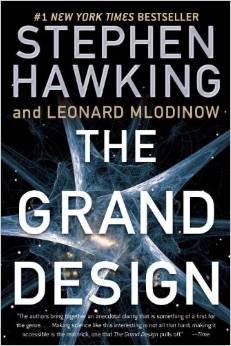
This is the most recent book authored (or co-authored) by Stephen Hawking, the well-known brilliant physicist, subject of the recent film The Theory of Everything. The film depicts (in addition to his personal life) his life’s work to identify a unifying theory of physics, the so-called theory of the title, which for several decades now has remained unresolved to everyone’s satisfaction.

So I read this book, which I had already on my shelves, and took fairly detailed notes, which I’d planned to post here. But then I tried to do a high-level, introductory summary, this evening, and it got so long that I will post only that, and leave my detailed notes to my PC archives.

So, the summary:

It took the Greeks to realize that happenings in nature were not the products of capricious gods, but could be understood as consequences of basic forces. The modern concept of laws of nature emerged in the 17th century. The authors emphasize the idea of ‘model-dependent’ realism; many models might ‘explain’ observations, though some models might be considered superior to others in their simplicity.

By the early 20th century the forces of electricity and magnetism had been understood to be united, and other fundamental forces of nature, gravity, and the weak and strong nuclear forces, had been identified and, in the case of gravity, described by Einstein in terms of the speed of light, and how time and space were related.

But a different understanding of these ‘classical’ theories came from exploration by Heisenberg of interactions at the very very small, where particles seemed to behave like waves, and how there are no deterministic laws, just laws of probability about the likelihood of a particle being at any position at any time, like a wave.

So the traditional ‘classic’ theories of physics gradually were superseded by more complex theories that took these ‘quantum’ effects into account. These theories entailed ideas of bosons (e.g. photons), fermions (matter particles, in turn made of of quarks, with various properties), that superseded the traditional notions that atoms were composed merely of protons, electrons, and neutrons.

Physicists then searched for ‘grand unified theories’ (GUTs), that connected all these particles and forces. A potential solution was found in the 1970s, an idea called ‘supersymmetry’, and the attendant idea of ‘string theory’, in which what we think of as ‘particles’ are actually vibrations in one or two dimensions in a universe of ten or more dimensions. (It’s conceptually difficult to imagine; it’s more a matter of how the mathematics works out.)

But it turned out there were several solutions to the concept of string theories. The idea of “M-theory” is that it is a higher-order theory, involving *eleven* space-time dimensions, that places the various five solutions of the string theories into a context that implies that there are many different universes, each with different laws of nature. (Wikipedia actually summarizes all this even more briefly at Introduction to M-theory.)

These different universes, some 10^500 of them (!), have different laws of nature, and different numbers of dimensions, involving lower-order realities that exist within higher-order spaces: vibrating strings, point particles, 2-D membranes, 3-D blobs, and other multi-dimensional ‘branes’ [a term used in THE SCIENCE OF INTERSTELLAR], as well as rules about *how* these extra dimensions are ‘curled up’, which in turn imply values for various physical particles, such as the charge of an electron. I.e., the laws of nature.

And so the authors endorse the ‘strong’ anthropic principle — the fact that since we exist, that the human race exists on a planet able to support life, this has reverse-implications about the physical laws of the universe, the so-called ‘fine-tuning’ of the universe. It’s not that some ‘God’ fine-tuned the universe for our existence; it’s that, because we exist, we must exist in a universe that allows for our existence, while at the same time there are infinitely many *other* universes, with different physical laws, most of which would not allow our kind of life to exist.

It’s not just about the ‘Goldilocks zone’ and so on; it’s the recognition that in universes with more than three physical dimensions, stable orbits of planets around suns would not exist. That we exist implies that our universe is one of only three physical dimensions.

The authors conclude by invoking the “game of life”, a computer simulation invented way back in 1970 – a two-dimensional grid with squares that are on (‘alive’) or off (‘dead’), and a simple set of rules about how these squares propagate themselves. [Wikipedia has this page about it.] Amazingly, with a very simple set of such rules, basic initial states develop into relatively complex states, rather lifelike, according to patterns not reduced to simple rules. This is a profound implication, that very simple rules produce complex features like those of intelligent life.

This has implications about free will.

And this is analogous the idea that our universe has spontaneously come into existence.

Because there is a law like gravity, the universe can and will create itself from nothing in the manner described in Chapter 6. Spontaneous creation is the reason there is something rather than nothing, why the universe exists, why we exist. It is not necessary to invoke God to light the blue torch paper and set the universe going.

M-theory is the only candidate for a complete theory of the universe. It is the unified theory Einstein was hoping to find.

The fact that we human beings—who are ourselves mere collections of fundamental particles of nature—have been able to come this close to an understanding of the laws governing us and our universe is a great triumph. But perhaps the true miracle is that abstract considerations of logic lead to a unique theory that predicts and describes a vast universe full of the amazing variety that we see. If the theory is confirmed by observations, it will be the successful conclusion of a search going back more than 3,000 year. We will have found the grand design.

At the same time, Wikipedia has this page about the book, with a relatively brief synopsis, but with extensive reactions, pro and con, from various readers.

Finally, a couple personal comments of my own, which I wrote while partly way through the book.

>> Taking the broadest speculative point of view, I suspect that the difficulty humans have with conceptualizing and integrating these theories is that our own experience and perspective is limited, not just to the scale at which we live (whereas existence is so much different at the very large and very small), but in the way we interact with the world, familiar with certain kinds of sources and not others. (Remember, humans are not very good at perceiving actual forces; it took Newton to disprove the intuitive notion that heavier objects fall faster than lighter objects.) This limitation in how we think of and perceive the world, in terms of physics, is analogous to the limitations of human experience of the world in terms of pheromones and our very narrow perception of the electromagnetic spectrum, as discussed by EO Wilson in the book I summarized over several blog posts.

>> Another possibility: perhaps mathematics, as conceived by human beings, actually *doesn’t* work. It’s been often remarked about how amazing it is that the universe is susceptible to principles we humans can summarize in terms of mathematics we have conceived. But our difficulty in resolving the various pieces of these theories into a unified whole suggests that perhaps this is not entirely true. What could *that* possible mean?
Posted in Book Notes, Cosmology, Philosophy, Physics, Science | Comments Off on Hawking’s Theory of Everything

Christopher Hitchens’ Ten Commandments

Christopher Hitchens’ Ten Commandments, via Hemant Mehta’s Friendly Atheist blog.

I’m fascinated by the obvious irrelevancy of the traditional, Biblical, commandments, and have collected here on my blog various alternate versions (I need to create and retroactively tag those earlier posts on this subject.)

Christopher Hitchens, who died in 2011, was of course a famous author and raconteur, given to heavy drinking and smoking, habits which he realized contributed to his relatively early death at age 62. He’s best known in popular culture as one of the three ‘atheist horsemen’ (along with Richard Dawkins and Sam Harris) who published books in the 2000s about the pernicious effects of religion and faith; Hitchens’ book was god is not Great (2007), with its deliberate un-capitalization of the first word of the title.

Here’s a summary and gloss on his talk, at that link.

Hitchens presents his ideas as opposed to the *four* versions of the commandments that Moses released. (I was aware of two; I’ll have to check out his reference.)

He discusses the problem of ‘graven images’ and Christian art. And other obvious problems with the traditional ten.

(As I’ve said before, half of the traditional ten are simply special cases of the general “Golden Rule”: do unto others what you would have them do unto you.)

Either God, Hitchens says, or the people who invented him, the early Jews, improvises, is jealous, is inconsistent, and is short-tempered.

And so here is Hitchens’ Ten:

#1 Do not condemn people on the basis of their ethnicity or their color;
#2 Do not ever even think of using people as private property, or as owned, or as slaves;
#3 Despise those who use violence, or the threat of it, in sexual relations;
#4 Hide your face and weep if you dare to harm a child;
#5 Do not condemn people for their inborn nature; Why would God create so many homosexuals only in order to torture and destroy them?;
#6 Be aware that you too are an animal, and dependent on the web of nature. Try to think and act accordingly.
#7 Don’t imagine that you can escape Judgement if you rob people with a false prospectus, rather than with a knife;
#8 Turn off that fucking cellphone; you can have no idea how unimportant your call is to us;
#9 Denounce all Jihadists and Crusaders for what they are: psychopathic criminals with ugly delusions, and terrible sexual repressions;
#10 Be willing to renounce any God, or any faith, if any Holy Commandment should contradict any of the above.

In short: Don’t swallow your moral code in tablet form.

My comment: he’s a bit off the rails with his 8th, which almost undermines his entire project (of course he might have stated it more generally, e.g. don’t be so selfish; be considerate of others), but in general his suggestions, as with most of the alternatives I’ve linked here previously, are superior to the traditional ten, which were born of illiterate desert tribes who thought the world was flat.

Posted in Culture, Religion, Ten Commandments | Comments Off on Christopher Hitchens’ Ten Commandments

Stephen Prothero on ‘why liberals win’ America’s culture wars

Stephen Prothero is a religious scholar at Boston University, who gave a talk on October 23rd called Why Liberals Win: America’s Culture Wars from the Election of 1800 to Same-Sex Marriage.

It’s a preview of Prothero’s upcoming book of nearly the same title; — Why Liberals Win: The Story of America’s Culture Wars and the Lost Causes of Conservatism — to be published in April 2015. (There’s no cover image yet, on Amazon, to display here.)

(I have two of Prothero’s earlier books, Religious Literacy and God Is Not One, one of which I’ve read, and the other is in my to-read stack.)

The video link of his talk reveals that he is not the greatest public speaker; his speech is slow and deliberate, like the careful university professor that he is. Here’s a summary of his talk:

The ‘culture wars’ are nothing new. They are no longer confined to politics; Prothero’s current project examines these issues from Jefferson to Obama. These cultural wars have four features: public disputes, in magazines and newspapers; that these disputes are not purely economic; third, they give rise to larger questions about the meaning of America; and fourth they are heated disputes, with convictions that one’s enemies are enemies of the nation. “A fundamentalist is an evangelical who is angry about something.”

This is the arc of history, as Prothero describes. He reviews five episodes of American history: the election of 1800 (in which he describes partisanships far more severe than in our time), which keyed off Jefferson’s religion.

The second is the battle between Protestants and Roman Catholics in the 1830s and 1840s.

The third is anti-Mormonism, mostly after the Civil War.

The fourth episode is the battle of the Prohibition era of the 1920s and early 1930s.

And the fifth: the ‘cultural wars’ that began in the 1970s, over segregation, and IRS rules about tax-exemption, that galvanized the ‘religious right’. (Roe v. Wade wasn’t an issue to the RR, at the time.) This issue pivoted to issues of ‘family values’, to issues of gender and abortion and homosexuality; and to the idea that the IRS was discriminating against religion, in that people who could not discriminate felt themselves to be the victims – not those they were discriminating against [how very familiar, in the current religious right rage against the legalization of same-sex marriage].

It’s all about anxiety about a way of life that’s passing away, the end of the traditional family, or the end of white supremacy. Monoculture vs. Multiculture. Family vs Families. The one or the many.

He disputes several misconceptions about the motives behind the ‘culture wars’.

He has three conclusions:

1, cultural wars are cultural, not issues of morality, or religion, or economics alone;

2, cultural wars are conservative projects; they are morality plays in which actual liberals play very minor roles. “Modern conservatism is rooted in a narrative of loss and restoration; a form of culture is passing away, and it is worth fighting to revive.” Cultural battles are typically started by conservatives – not in reaction to some liberal plot, but by cultural changes in immigration, or progressive social changes.

3, America’s cultural wars have been won by pluralists on the left. Look at the evidence, in all these episodes. Why does this happen? Because conservatives attach themselves to lost causes; they pick fights they were already losing. Their goal is not to win, it’s to “preach a gospel of the fallen and the lost; to demonstrate how far America has descended from the glory of its founding….”

Prothero describes the cycle of cultural wars: it starts on the right, with some anxiety about social change; the left strikes back, often appealing to the principle of liberty; then rhetoric of no-compromise; but always resolved with some degree of accommodationism. And then the liberals win, most of the time. (Exceptions: conservatives defeated the ERA; they reduced budget for the arts; they succeeded in making talk of God more acceptable among politicians; and somehow made ‘liberalism’ a dirty word, as a moral threat.) But conservatives lost the cultural wars overall, badly: tax exemptions for segregation academies, Clinton’s impeachment, school prayer, killing the NEA, casual sex, the counterculture, abortion [which is still legal, barely], marijuana, the traditional family, and about same-sex marriage.

Liberals control the agenda. “Having lost one culture war, conservatives become even more convinced that other Americans are out to get them; they become more fearful that American society is going to Hell. And so they cast about for another complaint, something else that that is precious and is passing away.”

All conservatism begins with loss, says Andrew Sullivan. And so it goes for America’s culture wars…

Posted in Culture, Religion | Comments Off on Stephen Prothero on ‘why liberals win’ America’s culture wars

Links and Comments: Gay Marriage; Evangelical Doomsday; Natural Selection is not a guide to life; Jibbers Crabst; the power of faith, and science, and physics

Slate’s William Saletan: A Conservative Case for Gay Marriage, subtitled, “How to talk to your antigay religious relatives about same-sex unions”.

Key points: homosexuality is not a sin, because it’s not a choice; it’s not harmful, but is in fact natural [like being left-handed, I would interject; a natural condition among a certain percentage of the population]; that marriage between gays can be treated like infertility between heterosexuals. And so on.

(Saletan is being very polite and deferential. My bottom line, why is the anti-gay crowd so obsessed with this subject? It *doesn’t matter* whether it’s a choice or not — What about the right, in the Declaration of Independence, to “life, liberty, and pursuit of happiness”, whatever that pursuit might entail about how one lives one’s own life, compared to how other people live theirs? I think I know why some people are obsessed with this subject, as I’ve detailed in previous posts, but will not spell out again at the moment.)

//\\

Now, this is scary:

Salon, Why millions of Christian evangelicals oppose Obamacare and civil rights

It’s because evangelicals think the world is about to end — as certain factions have expected for two thousand years now, to no avail. The author says,

My argument in a nutshell is that the apocalyptic theology that developed in the 1880s and 1890s led radical evangelicals to the conclusion that all nations are going to concede their power in the End Times to a totalitarian political leader who is going to be the Antichrist. If you believe you’re living in the last days and you believe you’re moving towards that event, you’re going to be very suspicious and skeptical of anything that seems to undermine individual rights and individual liberties, and anything that is going to give more power to the state.

Let’s think again about how “moral” Christians think themselves to be, as opposed to everyone else.

//\\

Natural selection explains why we’re here, but it’s not a guide to life:

Richard Dawkins gives a great answer as to whether evolution should be our guide in social policy:

Evolution by natural selection is the explanation for why we exist. It is not something to guide our lives in our own society. If we were to be guided by the evolution principle, then we would be living in a kind of ultra-Thatcherite, Reaganite society. … Study your Darwinism for two reasons, because it explains why you’re here, and the second reason is, study your Darwinism in order to learn what to avoid in setting up society. What we need is a truly anti-Darwinian society. Anti-Darwinian in the sense that we don’t wish to live in a society where the weakest go to the wall, where the strongest suppress the weak, and even kill the weak. We — I, at least — do not wish to live in that kind of society. I want to live in the sort of society where we take care of the sick, where we take care of the weak, take care of the oppressed, which is a very anti-Darwinian society.

(via http://www.centerforinquiry.net/blogs/entry/12_9_14/)

//\\

In line with the post about Joel Osteen a couple posts ago, Choose Faith in Spite of the Facts, here is a very funny video from cartoonist Matt Inman about how he doesn’t believe in Darwin’s theory of evolution, but rather in something he calls Jibbers Crabst, who lives behind the rings of Saturn. Key passage, at about the 10 minute mark:

A friend of mine said, I’m showing you all the finger on my hand, how many fingers am I holding up?

I looked, and I said, you’re holding up three.

He said, no, I’m holding up five, look, one two three four five.

He said, how can you believe there’s three when I’m showing you five right now?

I said: That’s the power of faith.

//\\

Here’s a post on John Scalzi’s blog, one of his frequent “Big Idea” posts, this time about author Chad Orzel’s new book Eureka!: Discovering Your Inner Scientist.

Key idea: how we all use the concept of science every day, even if we don’t call it that.

You look at the world around you,
You think about why it might work the way it does,
You test your theory with experiments and further observations, and
You tell everyone you know the results.

//\\

Finally, coincident to my posts about the film Interstellar (and an upcoming post about reading a Stephen Hawking book), here is an XKCD comic, linked from Wired, about the Universe’s most bizarre physics (actually, fairly basic compared to the cutting-edge physics explored in Interstellar; but still rather mind-bending).

The XKCD Guide to the Universe’s Most Bizarre Physics

Posted in Evolution, Humanism, Links, Philosophy, Physics, Religion, The Gays | Comments Off on Links and Comments: Gay Marriage; Evangelical Doomsday; Natural Selection is not a guide to life; Jibbers Crabst; the power of faith, and science, and physics

The Science of Interstellar

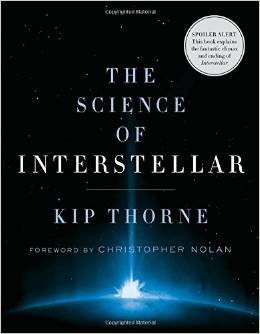
Just finished reading Kip Thorne’s THE SCIENCE OF INTERSTELLAR, a big trade paperback with lots of diagrams and a few photos. Takeaways:

1) Thorne was one of the creators of the initial premise for the film, long before Christopher Nolan came along. (At one point Steven Spielberg was slated to direct.) Thorne’s collaborator was Lynda Obst, whose books include Hello, He Lied — and Other Tales from the Hollywood Trenches (1996).

2) Yes there’s lots of science informing the film, but much of it is after-the-fact, as Nolan and his brother rewrote earlier versions of the script and allowed Thorne to justify their new scenario as best he could. Thorne did push back on some points — famously, about not allowing the script to use faster-than-light space travel.

3) For example, Nolan dictated how much time should pass on the first planet, due to relativity, compared to the outside world — several years for every hour — and to justify it Thorne imagined a black hole of such parameters that it was just barely within the limits of physical reality.

4) Second example, to explain the ‘blight’ that affects the Earth (or at least the north american midwest, since there’s no hint in the film of what’s going on in the rest of the world), Thorne brainstormed over dinner with several Caltech biologists to explore ideas how such a worldwide catastrophe might happen. Thorne concludes with a rationale that is far-fetched, but barely possible (the idea of a worldwide blight). As I said in an earlier Fb post: the filmmakers should have gotten a bunch of science fiction writers in a room to brainstorm such ideas, e.g. Nancy Kress, Gregory Benford, Kim Stanley Robinson, David Brin, Robert J. Sawyer, and David Gerrold, to take the first few names that pop into my head, who have scientific and/or cinematic experience, and they could have come up with a far more interesting scenario than what we saw in this film.

No, there’s nothing in the book about ‘love’ as a physical force, or anything to justify floating ice clouds, and scant little about how enormous waves form on a planet with a knee-deep ocean (there is something about tidal forces and the fact that the planet is so close to the black hole — but still, apparently the idea came first, the rationale second).

And there’s nothing about the most peculiar passage in the film, early on, in which a school representative explains to Cooper (Matthew McConaughey) how the textbooks have been rewritten to explain that the Apollo moon-landings were a hoax. Say what? Yes, there are people who believe this, as there are people who believe that 9/11 and JFK’s assassination were government conspiracies, or that the world was created 6000 years ago, or who believe the world is flat, but of course their case, not just being an insult to the scientific and engineering prowess of our civilization, has been thoroughly debunked; so when I saw this scene, I thought, *why even bring this up??* To make a slight point about how contemporary culture in the film’s era has given up on overcoming challenges, spurring MM’s character into action? I can’t help but think that a certain fraction of the audience for this film will see this scene and have their suspicions reinforced, subtly, and come away with the thought that yeah the Apollo landings probably were a hoax, and all those other conspiracy theories, yeah there’s probably something to them too…

Still: Thorne’s book is fascinating, with glosses on the major developments of 20th and 21st century physics — relativity, warped time and space, black holes, wormholes, higher dimensions, our universe as a ‘brane’ within a higher-dimensional ‘bulk’, how gravitational ‘anomalies’ lead to advances (Einstein, dark matter, dark energy), singularities (not just one type but three), the tesseract, and whether time travel is possible via wormholes.

And cool details: all that scrawl on Professor Brand’s chalkboard (shown in this book on page 220), is valid stuff, written there by Kip Thorne himself, and represents equations with variable factors that Brand, and later the adult Murph, were exploring solutions for those factors and thus trying to solve.

Ditto sheets of data about evidence of life on the planets — they were written by experts in various fields of what real data would look like. I doubt any previous film in history has gone to such trouble to depict realistic fake evidence…

And there’s even some speculation about how, once Brand and then Murph ‘solve’ gravity, that knowledge could have ‘lifted’ colonies of survivors off the Earth. Though not how many were actually saved, and at what expense, as I wondered in my earlier Interstellar review.

Posted in Book Notes, Cosmology, Films, Physics, Science, Space | Comments Off on The Science of Interstellar

Links and Comments: Memory, Math, Church and State, Faith, Facts, Stories

New York Times: Why Our Memory Fails Us

A fascinating NYT op-ed about the fallibility of memory, led by a notorious example from Neil DeGrasse Tyson.

\/\/\/\/

Math Anxiety: Why Hollywood Makes Robots of Alan Turing and Other Geniuses

How Hollywood films – including the current Alan Turing biopic THE IMITATION GAME [which I haven’t yet seen], and earlier films GOOD WILL HUNTING and THE SOCIAL NETWORK, depict math geniuses. It’s almost a genre.

There is a shot of a genius staring rapturously at mind-bending numbers. He is an insufferable person. There will be much drama about whether he can learn to value human emotion over cold fact.

As with every other Hollywood genre, these conventions are shortcuts to audience identifiability; they are not necessarily realistic portrayals of actual math geniuses.

For what it’s worth, I was a math major. BA, UCLA.

\/\/\/\/

I haven’t made fun of the right-wing theocrats and demagogues lately, so let’s catch up.

Paul Fidalgo’s take (here) on the latest from Rick Santorum is better than mine would have been.

Rick Santorum, who still exists, declares, unoriginally, that the concept of church-state separation is a Communist fabrication. So which church should not be separated from the state? I’m going to guess Rick’s.

\/\/\/\/

Here is Daylight Atheism’s invitation to Meet the American Religious Right Figures Thrilled by Russia’s Brutal Anti-Gay Laws.

These include Linda Harvey, Peter LaBarbera, Scott Lively, and Bryan Fischer.

\/\/\/\/

Salon reviews/profiles a book of hate mail from Christians to the Military Religious Freedom Foundation (MRFF). (Christian love!) The book is called To the Far Right Christian Hater … You Can Be a Good Speller or a Hater, But You Can’t Be Both: Official Hate Mail, Threats, and Criticism From the Archives of the Military Religious Freedom Foundation. A book demonstrating how so many

Self-professed Christians deny the fundamental humanity of other people they don’t even know.

The reviewer says the book

offers an unflinching examination of a subset of American fundamentalism, created by a segment of our society that is whiter, more conservative and a lot angrier than the rest of America.  For some people the future of their faith and of the nation are in danger, threatened by secular forces controlled by Satan himself.  This existential threat to Christian supremacy justifies the most offensive, vulgar and cruel letters I’ve ever read.  Think I’m overstating it?  Read the book.

\/\/\/\/

Adam Lee cites a tweet by Joel Osteen, Choose Faith in Spite of the Facts, pointing out how the advice is a tacit admission that facts conflict with what he wants people to have faith in. Hmm.

/\/\/\

Right Wing Watch offers yet another Devastating Review Of David Barton’s Pseudo-History

This repeated discrediting of David Barton’s pseudo-history hasn’t seemed to diminished his influence or reputation, among those who need only to believe in his stories, never mind the facts. (Stories are more important than facts! I think this is becoming an overarching theme.)

\/\/\/\/

Speaking of facts, faith, and David Barton, Salon has this article, Thomas Jefferson vs. the Bible: What America’s founding father really thought about religion, describing how Jefferson famously took scissors to the Bible, keeping the portions he thought worth saving and discarding all the “dross”. (The results are online.)

To Jefferson’s mind, Jesus was a wise and beneficent moral teacher. The dross was the fabric of mythic stories that made him into a magical being, stories like the virgin birth, miracle healings, and the resurrection. He  also loathed what he saw as superstition buried in Christian teachings about sin and salvation—the idea that we all are born into sin because of Adam and Eve, for example, or that a special few, the “elect” are chosen for an eternity in Heaven.

/\/\/

Salon has this article: Evolution of a messiah: The story behind Christianity’s founding trauma (an excerpt from a book, Holy Resilience: The Bible’s Traumatic Origins, by David M. Carr)

Nothing would surprise me less than to learn that the origin of the gospels, documents written about the life and death of Jesus, based on hearsay decades after the fact, were in fact politically motivated to express the fulfillment of prophecies made in even earlier holy documents — again, written decades or hundreds of years before.

It strikes me as ironic that fundamentalists, who take this conflicting accounts at face value, nevertheless are suspicious of most news media (except, perhaps Faux News), on the basis of some kind of bias. Pretty ironic indeed.

\/\/\/\/

And again Salon: Why are these clowns winning? Secrets of the right-wing brain

A fascinating discussion of the cognitive biases that afflict both Republicans – who can’t run the country (cf George W. Bush) -– and Democrats – who can’t win elections (cf the recent 2014 elections).

As I’ve written before, a growing body of literature reveals that liberals and conservatives think differently from one another in ways that can even be traced back, in part, to the level of instinctual response, reflecting conservatives’ heightened sensitivity to threat bias.

And discussing Chris Mooney:

Mooney argued that liberals, still fundamentally inspired by the Enlightenment promise of ever-growing knowledge about the world, are fundamentally mistaken about the nature of human reason, which they see as knowledge- and truth-seeking. But modern cognitive science teaches us that our brains are much more fundamentally shaped by the need to make persuasive arguments, which only require the appearance of rational argument.

Modern cognitive science is all about the biases that afflict everyone, eg as David McRaney has explored.

There’s much more in this article including Karen Armstrong’s idea of contrasting mythos and logos; and the idea that the fundamentalist’s insistence that mythos is literally true defeats the traditional purpose of mythos.

\/\/\/\/

And then there’s the Christian pastor in Arizona who’s announced his solution to AIDS — just execute all the gays, just like the Bible instructs. Curiously, though his remarks have been widely reported and followed up, none of the follow up articles seem to be from fellow Christians denouncing him.

/\/\/\/\/

Finally, the Internet in the past few days has made much fun of this woman, whose YouTube video ridicules the Chicago Field Museum of Natural History’s evolution exhibit.

Creationist Mother “Debunks” Evolution Exhibit at Chicago’s Field Museum.

I can only feel sorry for her [home-schooled, of course] children.

Posted in Book Notes, Culture, Lunacy, Mathematics, MInd, Religion, Science | Comments Off on Links and Comments: Memory, Math, Church and State, Faith, Facts, Stories

EO Wilson, The Meaning of Human Existence, Part 5 and last

Fifth and final of several posts about Edward O. Wilson’s book THE MEANING OF HUMAN EXISTENCE, which as I described earlier both here on my blog and on Facebook, is a concise summary of this important scientist’s views on the big issues of science and philosophy, as elaborated in his many earlier books. (Part 1, Part 2, Part 3, Part 4)

Chapter 13 is about “Religion”

This is a topic widely addressed in books by evolutionary psychologists over the past 20 years or more. The key insight is that ‘religion’ is not something external to human experience, it’s something *built in* to human experience, for evolutionary reasons. I.e., there seem to be genes for religiosity.

The brain was made for religion and religion for the brain. In every second of the believer’s conscious life religious belief plays multiple, mostly nurturing roles. All the followers are unified into a vastly extended family, a metaphorical band of brothers and sisters, reliable, obedient to one supreme law, and guaranteed immortality as the benefit of membership.

(p149)

Throughout prehistory and most of history, people needed religion to explain the occurrence of most phenomena around them. Torrential rain and flooding, a lightning bolt streaking across the sky, the sudden death of a child. God caused it. He or She was the cause in the cause-and-effect required for sanity.

Science has brought understanding of the interrelation of natural phenomena, and replaced supernatural explanations, though the instinctive appeal of religion remains.

The great religions perform services invaluable to civilization—bringing solemnity to rites of passage and the cycle of life and death; churches presiding over centers of community life.

The great religions are also, and tragically, sources of ceaseless and unnecessary suffering. They are impediments to the grasp of reality needed to solve most social problems in the real world. Their exquisitely human flaw is tribalism. The instinctual force of tribalism in the genesis of religiosity is far stronger than the yearning for spirituality. People deeply need membership in a group, whether religious or secular. From a lifetime of emotional experience, they know that happiness, and indeed survival itself, require that they bond with others who share some amount of genetic kinship, language, moral beliefs, geographical location, social purpose, and dress code—preferably all of these but at least two or three for most purposes. It is tribalism, not the moral tenets and humanitarian thought of pure religion, that makes good people do bad things.

p150-151

At the core of the religious group is the creation story, and the teaching that God favors them, that other religions worship the wrong gods and follow the wrong rituals.

Faith is biologically understandable as a Darwinian device for survival and increased reproduction. It is forged by the success of the tribe, the tribe is united by it when competing with other tribes, and it can be a key to success within the tribe for those members most effective in manipulating the faith to gain internal support…

p151-152

Obviously no two creation stories can both be true. All of those invented by the many known thousands of religions and sects in fact have certainly been false. A great many educated citizens have realized that their own faiths are indeed false, or at least questionable in details. But they understand the rule attributed to the Roman stoic philosopher Seneca the Younger that religion is regarded by the common people as true, by the wise as false, and by rulers as useful.

Should science politely avoid these issues? No, because religious tribalism is the motivating force behind most conflicts around the world, conflicts between those faithful to different myths.

Nowhere do people tolerate attacks on their person, their family, their country—or their creation myth.

In America, disparaging anyone’s creation myth, however absurd, is considered “religious bigotry”. (p155)

As Carl Jung once said, some problems can never be solved, only outgrown. … The best way to live in this real world is to free ourselves of demons and tribal gods.

(p158)

Chapter 14 is a short one, about “Free Will”

This is recently a contentious topic, with scientists/authors like Sam Harris and Daniel Dennett and Jerry Coyne taking diverse views, and challenging each other. (This is how science works.) On the one hand, the understanding of the physical basis of the mind seems to imply that ‘free will’ is an illusion; in some deep fundamental sense, everything is determined through the interaction of physical forces. On the other hand, the vast number of physical interactions that determine any particular decision is so incalculable, that for practical purposes, you might as well suppose that free will exists.

Wilson notes that humans frame everything in terms of stories, with causes and effects.

Conscious mental life is built entirely from confabulation. It is a constant review of stories experienced in the past and competing stories invented for the future. By necessity most conform to the present real world as best it can be processed by our rather paltry senses. Memoires of past episodes are repeated for pleasure, for rehearsal, for planning, or for various combinations of the three. Some of the memories are altered into abstractions and metaphors, the higher generic units that increase the speed and effectiveness of conscious thought.

(p167-8)

And Wilson concludes,

So, does free will exist? Yes, if not in ultimate reality, then at least in the operational sense necessary for sanity and thereby for the perpetuation of the human species.

In the final chapter, Chapter 15, Alone and Free in the Universe, Wilson summarizes the themes of this book that has in turn summarized themes from his many earlier books.

Wilson hopes that our recognition that we are one species among millions, with no demonstrable destiny or purpose, means we are free, free to pursue the unity of the human race.

What is the meaning of human existence? The epic of our species through evolution, prehistory, recorded history, and the potential for what we choose to become.

The humanities describe the human condition; the scientific worldview encompasses the meaning of human existence.

The problem holding everything up thus far is that Homo sapiens is an innately dysfunctional species. We are hampered by the Paleolithic Curse: genetic adaptations that worked very well for millions of years of hunter-gathered existence but are increasingly a hindrance in a globally urban and technoscientific society. We seem unable to stabilize economic policies or the means of governance higher than the level of a village. Further, the great majority of people worldwide remain in the thrall of tribal organized religions, led by men who claim supernatural power in order to compete for the obedience and resources of the faithful.

(p177)

We possess a heredity myopia:

People find it hard to care about other people beyond their own tribe or country, and even then past one or two generations.

–a point precisely expressed, if a bit crudely, in the film Interstellar.

The instability of the emotions is a quality we should wish to keep. It is the essence of the human character, and the source of our creativity.

Wilson discusses the idea of a ‘tolerable parasite load’, such as the bacteria that live inside our bodies. The parallel in human nature are these obsolete genetic adaptations, e.g. religion, which could be reduced by examining them objectively, or even challenging faith leaders to defend the supernatural details of their faiths in competition with other faiths. Another is the religion-based denial of organic evolution. About half of Americans, mostly Christians, believe no such process has ever occurred—

As Creationists, they insist that God created humankind and the rest of life in one to several magical mega-strokes. Their minds are closed to the overwhelming mass of factual demonstrations of evolution, which is increasingly interlocked across every level of biological organization from molecules to ecosystem and the geography of biodiversity. They ignore, or more precisely they call it a virtue to remain ignorant of, ongoing evolution observed in the field and even traced to the genes involved. Also looked past are new species created in the laboratory. To Creationists, evolution is at best just an unproven theory. To a few, it is an idea invented by Satan and transmitted through Darwin and later scientists in order to mislead humanity.

Why should we care what some people think?

Because it represents a triumph of blind religious faith over carefully tested fact. It is not a conception of reality forged by evidence and logical judgment. Instead, it is part of the price of admission to a religious tribe. … The explicit denial of evolution presented as a part of a ‘creation science’ is an outright falsehood, the adult equivalent of plugging one’s ears.

Wilson wraps it all up with his appeal to the consilience of the humanities and science. Last line:

If the heuristic and analytic power of science can be joined with the introspective creativity of the humanities, human existence will rise to an infinitely more productive and interesting meaning.

Posted in Book Notes, Culture, Evolution, Science | Comments Off on EO Wilson, The Meaning of Human Existence, Part 5 and last

EO Wilson, The Meaning of Human Existence, Part 4

Fourth of several posts about Edward O. Wilson’s book THE MEANING OF HUMAN EXISTENCE, which as I described earlier both here on my blog and on Facebook, is a concise summary of this important scientist’s views on the big issues of science and philosophy, as elaborated in his many earlier books. (Part 1, Part 2, Part 3) One more post to follow.

Chapter 11 is about “The Collapse of Biodiversity”

This is a topic that most people, even those who think themselves relatively well-informed about science topics, are not generally aware of: the fact that the human race’s propogation across the planet in the past few centuries has resulting in a huge dying off of other species, an extinction event to rival the four or five others across the vast history of the planet Earth.

Wilson has addressed these issues in previous books Biophilia and The Diversity of Life and The Creation (subtitled: An Appeal to Save Life on Earth).

In this chapter, he notes the paradox that the more species humanity extinguishes, the more new ones scientists discover. The current estimate of *known* species is about 2 million, but the estimate of actual species on Earth is more like 5 to 100 million. There are three levels of biodiversity: ecosystems, species, and genes. The way species are lost is summarized by HIPPO: habitat loss; invasive species; pollution; population growth; over-harvesting.

The next three chapters of the book are grouped by the heading “Idols of the Mind”, and concern Instinct, Religion, and Free Will.

Chapter 12, “Instinct”, quotes the Vercors novel You Shall Know Them: “All of man’s troubles have arisen from the fact that we do not know what we are and do not agree on what we want to be.” The human mind emerged as an instrument of survival that employs both reason and emotion. As late as the 1970s, the prevailing view was that human behavior is entirely cultural; there was no such thing as ‘human nature’. This view has changed… [dramatically, I have noticed over the past decades].

Wilson reviews summaries of human traits that are present among *all* societies around the world — a key point made way back on his 1978 book ON HUMAN NATURE. To quote a selection of those traits here:

athletic sports, bodily adornment, decorative art, etiquette, family feasting, folklore, funeral rites, hairstyles, incest taboos, inheritance rules, joking, and the propitiation to supernatural beings.

Human nature, he concludes, is

the ensemble of hereditary regularities in mental development that bias cultural evolution in one direction as opposed to others and thus connect genes to culture in the brain of every person.

And he gives one more memorable example (again from ON HUMAN NATURE), about the habitats in which people prefer to live. Adults prefer the kind of environment in which they grew up. But children, all around the world, not yet acculturated, when evaluating photos of alternative living situations, prefer choices with three factors: a vantage point on a rise looking down, a vista of parkland with grassland and trees, and a proximity to a body of water.

As Wilson notes, this archetype happens to reflect the actual savannas of Africa where our ancestors evolved over millions of years.

As humans converge into cities these preferences have not gone away.

As landscape architects and high-end real estate agents will tell you, the rich prefer habitations set on a rise that looks out over parkland next to a body of water. None of these qualities have practical value, but people with sufficient means will pay any price to have them.

[Actually, Wilson in that earlier book does explore what the ‘practical’ values of such a location might have been. Which is why those preferences evolved.]

And I have to say, while being aware of these biases ever since reading that 1978 book, I feel this motivation very strongly myself. That’s why I have for 11 years lived in a house with the view that it has — right up there at the top of my blog — and why Yeong and I are focused on finding a home in the Bay Area with a water view. Yeong’s ideal is to live by the ocean; my ideal is a view of the bay and the San Francisco skyline. Why is that so important to us? Even understanding this evolutionary tendency, this preference is not easily dismissed.

Posted in Book Notes, Culture, Evolution, Science | Comments Off on EO Wilson, The Meaning of Human Existence, Part 4

Interstellar

To begin with, I haven’t seen anyone note the coincidence that recent two films, Interstellar and The Theory of Everything (the Stephen Hawking biopic), both key off a major unsolved problem of physics, the unification of gravity and quantum theory. Who’d have thunk it? Physics in the filmhouse!

http://en.wikipedia.org/wiki/Interstellar_%28film%29

http://en.wikipedia.org/wiki/The_Theory_of_Everything_%282014_film%29

Yet Interstellar oversimplifies it. In the film, Michael Caine’s character implies that the solution will be a single equation (which is likely a gross oversimplification), and that the solution will… enable anti-gravity? He doesn’t spell it out, but how else to implement the film’s Plan A, of saving everyone left alive on Earth. (And how much would that *cost*? To build all those anti-grav spaceships to save everyone left alive on Earth?)

I’d heard enough about this initial premise of the film to distrust it going in, and I didn’t see anything that ameliorated that distrust, on this specific point. The film never spells out exactly how many human beings are left alive after all these plagues that have killed off all these crops. In fact, the film displays a rather typical American/Western culture-centric bias: it focuses on the problems of farmers in some unidentified midwestern state [from the film’s credits, the scenes were apparently filmed in Alberta], without bothering to explore how these plagues have affected the *entire rest of the planet* and what people in those other countries might be doing to save themselves. In this film, American culture, and specifically NASA, is what will save the entire world. (Alas, a not atypical myopic viewpoint of US films, though less so of literary SF.)

And were there perhaps one or two too many scenes with John Lithgow sitting on the porch?

But let’s switch the film’s stronger points. There is a huge amount of relatively intelligent physics here, moreso than any SF film ever, I would think. Kip Thorne, a CalTech physicist, was brought in early on as a consultant, and apparently advised the director, Christopher Nolan, and his brother Jonathan, who co-wrote the script, to consider and develop plot points they had not previously thought about.

Thus we have in this film a wormhole, a planet orbiting a black hole, the effects of relativity (how time is relative to travel near the speed of light, including close orbit around a black hole), and what could happen by diving into the singularity of a black hole. And the speculation of what would happen should gravity and quantum theory be merged — the film suggests this would result in the manipulation of gravity across time.

And this leads to my tentative take on this film: it tries to do *too much*. A human catastrophe *plus* traveling through a wormhole *plus* the effects of relativity around a black hole *plus* the manipulation of time via an understanding of gravity *plus* how humanity can propogate itself *plus* the human stories of all involved.

Even without Gary Westfahl’s review of this film, that I posted a while back on Locus Online, any experienced film-goer can’t help but notice the huge number of allusions and parallels between Interstellar and 2001: A Space Odyssey, Stanley Kubrick and Arthur C. Clarke’s 1968 film, that is widely regarded as not just the greatest SF film of all time, but one of the greatest films of all time. Both 2001 and Interstellar depict an initial primary state; a central state depicting a space exploration flight; and a final state depicting some kind of transcendence into a higher state, or dimension, or reality. As Gary Westfahl suggested, it is as if Christopher Nolan wanted to remake 2001 with an emotional content — the content 2001 specifically lacked, though not without intention. And here’s where several key scenes play…

I won’t try to detail them all, but here is one that comes to mind. In Interstellear, there is a scene in which Matthew McConaughey’s character, after he has survived a trip that has relativistically aged him a couple decades compared to his kids back home, watches backlogged video transmissions from his kids. His boy is now a man, with a kid of his own. And MM’s character can’t help but weep, seeing scenes of his children who are decades past his own experience, and whom he realizes he might never see again.

It’s a powerful scene, and one that I couldn’t help but respond powerfully to myself.

In 2001, there is a scene in which Frank Poole watches a transmission from his parents, wishing him a happy birthday. Poole watches without any visible emotional reaction whatsoever, more concerned about asking HAL to adjust the angle of his headrest. He’s watching his parents, not his kids, but still.

This was of course not a flaw in Kubrick’s film; it was an intention; and it was a very different intention than Nolan’s.

How many other allusions to 2001?

Well, just to enumerate a few I can think of off-hand:

  • The rotating space station, to produce artificial gravity;
  • The presence of an AI robot, named here TARS (cf 2001’s HAL) (One criticism I do have of this film is that TARS’s voice is not sufficiently distinct from the other human voices. There were scenes where I wasn’t quite sure who was speaking, TARS or one of the human astronauts. 2001‘s HAL voice, by Douglas Rain, was distinct, and brilliant.)
  • A huge credit to this film, Interstellar, is that it does not pretend that there are *sounds* in space; there are numerous scenes of spaceships moving about and interacting, with no sound, which is of course realistic, since sound does not travel in a vacuum, in outer space. I’m not sure there has been any SF film that has done this correctly since 2001. OTOH, there is a scene involving an explosion that depicts visible flames erupting, albeit briefly; but visible flames depend on oxygen…

I like Hans Zimmer’s score just fine, and am listening to it again right now as I prepare this post. Yes, there were two or three spots in the film where the score might have been turned up rather too loudly — though as I said earlier on Facebook, that is not the composer’s fault, rather the sound editor’s or the director’s. At the same time, those spots where the score came to be overwhelming, were sections of the film where intercuts between the spaceship scenes, and the scenes back on Earth, were especially effective in building a dramatic climax.

What else?

Well, the film indulges in some relatively sophisticated acknowledgement of the conflicting motivations of individual humans beings that derive from the forces of evolutionary natural selection. Matt Damon’s character expounds these ideas, if rather crudely; he asks McConaughey’s character why should anyone care about saving the whole human race, as a species, as opposed to saving their own children?

This is the difference between the film’s Plan A and Plan B. Plan B involves a societal, group effort, across all of civilization, to save humanity, via fertilized embryos, frozen, on the spaceships, so that if no one from Earth survives, at least the *species* will survive, via a few spaceship survivors who subsequently grow these fertilized embryos into life and into subsequent generations. Plan A is all about saving one’s own families, one’s relatives, one’s communities. One of the emotional tensions in the film is about the conflict between these two plans. There’s an obvious relationship between these two plans and the divisions as identified by current social science about individual vs group selection, conservatism vs liberalism, capitalism vs socialism…

This leads to my thought every time I see a Hollywood big budget SF film– why do these Hollywood film producers think they can write an intelligent science fiction film? When there are so many actual SF authors who could step in and advise them on plot points and correct their characters’ dialogue to not sound quite so dumb? (E.g. why does Interstellar‘s wormhole have to lead to another *galaxy*? Why not a couple hundred light years across our own galaxy? Because, I’d guess, the filmmakers don’t actually understand what galaxies are, in the vast scheme of things, compared to solar systems and stars and the vast regions of the Milky Way. Or perhaps it’s just so much simpler to say, another ‘galaxy’, for dramatic effect, without worrying about what that actually means.) The obvious answer is that Hollywood films are made for an audience who has no knowledge of, and doesn’t care about, the thought that has gone into generations of literary SF and its development of ideas. Yet the effort to improve a Hollywood film’s script with some intelligent input from an actual SF author would take an infinitesimal portion of that film’s budget.

Only Kubrick, who hired Arthur C. Clarke, got this right, with 2001.

Any other problems?

Well, yes, I think Anne Hathaway’s character’s going on about love being a primal force of the universe is a bit of woo, i.e., an invocation of an unjustified, non-scientific supernatural force. Yes, love may in fact be a primal force among human relationships, but to equate it with the fundamental physical forces of the universe is a huge category error. (io9’s Annalee Newitz captured this in her November 5th post, Interstellar Is the Best and Worst Space Opera You’ll Ever See, which I just read today.)

Back to the plus side: I had no problem with the film’s conclusion, given Matthew McConaughey’s narration, that describes how future human beings, having solved the relationship between gravity and time, have generated this infinite matrix of possible states of his daughter’s bedroom… specifically to allow him to send a message into the past, to allow her to produce that solution. Once you realize what you are seeing, that huge matrix of all states of her bedroom across time, it’s rather awesome, very cool. OTOH, that McConaughey uses the power of *love* to guide him to the one spot where he can send a message rather unfortunately depends on that woo component.

I’ve ordered Kip Thorne’s book about the science of this film, and I wonder if he will address this in any way.

To sum up: Interstellar is an amazing film with many pluses and a few issues. I will read Kip Thorne’s book about it, I will order it on DVD or Blu-Ray when it comes out, and I will watch it again, likely more than once.

Posted in Astronomy, Cosmology, Culture, Films | Comments Off on Interstellar

EO Wilson, The Meaning of Human Existence, part 3

Third of several posts about Edward O. Wilson’s book THE MEANING OF HUMAN EXISTENCE, which as I described earlier both here on my blog and on Facebook, is a concise summary of this important scientist’s views on the big issues of science and philosophy, as elaborated in his many earlier books. (Part 1, Part 2) There will be one or two more.

I mentioned before that since this book is largely a summary and consolidation of Wilson’s early books, over the past 30+ years, it’s hard to consider this a substantial book on its own, or an award-worthy book — it was a nominee (it did not win) for this year’s National Book Awards. But I would update that comment to say, for anyone who has not read all of Wilson’s earlier books (including me!), and who would appreciate an elegant, precise summary of the current scientific stance on the big issues of evolution, instinct, religion, free will, and as the title says the “meaning of human existence”, this is an excellent primer, and highly recommended.

Chapter 7 is about how humans experience only a tiny part of the world through our senses, compared to 99% of the species across the earth who depend on chemicals (pheromones), for interaction among others of their species. Humans, like few other species, are primarily audiovisual. It’s because we evolved into a species whose heads are farther from the ground, and from the other species who live there, than most others.

Chapter 8 discusses ‘super-organisms’, like ants, termites, etc., in which each individual plays a role in a larger ‘organism’, without being aware of that role. The way ants live has nothing to suggest about how humans should live, Wilson advises. (Wilson is an expert on ants, and won a Pulitzer Prize for an enormous book about them — The Ants, Belknap Press, 1990.) The current collapse of honeybees around the world may be due to the vulnerability of such complex, fragile, organisms.

Chapter 9 concerns the potential of life on other planets, and the likelihood of microbes everywhere, even in extreme environments on Earth, and what the discovery of life on other planets would entail — primarily, solving the puzzle of whether their genetic code is the same as that of life on Earth, or different.

Chapter 10 is “A Portrait of E.T.” in which Wilson speculates — based on his understanding of the range of animal species across the Earth — the characteristics of a hypothetical intelligent species of extra-terrestrials. He concludes that such a species would be: land-dwellers, not aquatic; relatively large animals; biologically audiovisual; with a big, distinct head, located up front; with light to moderate jaws and teeth; with very high social intelligence; with a small number of appendages, with segments, and with one pair that has sensitive tips for touch and grasping; and who are moral (in the way he explains). p117

A final section of this chapter explains why aliens could never successfully invade Earth (or for that matter why humans could never successfully settle an alien planet), an insight that undermines thousands of science fiction stories (and films). (p120)

All E.T.s have a fatal weakness. Their bodies would almost certainly carry microbiomes, entire ecosystems of symbiotic microorganisms comparable to the ones that our own bodies require for day-to-day existence. … The reason is that the two living worlds, ours and theirs, are radically different in origin, molecular machinery, and the endless pathways of evolution that produced the life-forms then brought together by colonization. The ecosystems and species of the alien world would be wholly incompatible with our own.

The result would be a biological train wreck. The first to perish would be the alien colonists…

Posted in Book Notes, Culture, Evolution, Religion, Science | Comments Off on EO Wilson, The Meaning of Human Existence, part 3