Prothero on The Unpersuadables

Another review of a review: Donald Prothero (a geology professor at Occidental College in LA, and a lecturer at Caltech), has a review of a new book by Will Storr, The Unpersuadables: Adventures with the Enemies of Science, that develops the argument of recent months that evidence simply will not dissuade true believers from any number of dogmatic beliefs, from UFOs to homeopathy to Holocaust denialism to creationism.

According to the review, the author spends considerable time interviewing and hanging out with deniers of various sorts, letting them speak, and eventually – but let me quote his words:

He describes the events in a non-judgmental way, and lets the people speak for themselves—and hang themselves with their own words, especially as his questions lead them to say weirder and weirder things. This is especially apparent as he spends many days with Holocaust denier David Irving and his pack of neo-Nazis, watching them delude themselves as they spout one racist statement after another—and then they claim they’re not prejudiced or anti-Semitic.

And the author arrives at the current understanding that

As many other people have shown, despite our best efforts our brains are not “objective” or “rational” in any way. Instead, we form a “belief network” around ourselves, and use confirmation bias to resolve the inherit conflict caused by the cognitive dissonance of what we want to be true, and what the world shows us. We easily fall for anecdotal thinking.

What makes this review notable is that reviewer thinks the author goes a bit too far; the author is skeptical of the skeptics. The reviewer quotes the author:

His monoculture we would have, if the hard rationalists had their way, would be a deathly thing. So bring on the psychics, bring on the alien abductees, bring on the two John Lennons—bring on a hundred of them. Christians or no, there will be tribalism. Televangelists or no, there will be scoundrels. It is not religion or fake mystics that create these problems, it is being human.

Then everything is relative to personal preference and nothing is true? I am on the side of the reviewer, who concludes,

Storr seems to be saying that since no individual has a clear view of the world, therefore there is no reality out there, and any truth or view is as good as the next. Unfortunately, he misses a key point here. Yes, individual scientists are not perfect, and have a viewpoint limited by their backgrounds and assumptions. Yes, small communities of scientists could be wrong. But Storr never discusses the real reason that he (and most people in the world) accept that there is a scientific reality outside of us: because it works. Science is the only method we know to get past individual blind spots, and subject our cherished ideas to the harsh gantlet of peer-review. Scientific ideas are unlike anything that an individual believes, because they are scrutinized and tested and criticized by the rest of the scientific community. Scientific ideas lead to predictions about the real world that can be tested, which would not be true if the scientific world were only a construct of our brains (as some allege). Only if ideas survive this intense testing phase do they eventually become part of our canon of “scientific reality”—and thanks to that scientific reality, we can launch spacecraft into the unknown and predict what they will do; we can conquer most diseases and physical ailments; we can have technology and inventions that were not possible before the scientific revolution, and our world is vastly different since then.

Science is the way to overcome individual human imperfection. Because (again quoting the author):

We are all creatures of illusion. We are made out of stories. From the heretics to the Skeptics, we are all lost in our own secret worlds.

Except for those willing, and having demonstrated, that they are capable of changing their minds, because evidence. Says I.

Posted in Book Notes, Lunacy, Religion, Science | Comments Off on Prothero on The Unpersuadables

Rereading Gene Wolfe’s “The Fifth Head of Cerberus”

Gene Wolfe is one of the most intelligent, albeit ambiguous in effect, writers in science fiction (and fantasy). He was an industrial engineer, famously for having partly invented the machine that made Pringle potato chips, before he began writing in the late 1960s. He had early successes, including the short story “The Island of Doctor Death and Other Stories” in 1970, which famously lost the Nebula Award to “no award”. (You can look it up.)


Aside from that story and a couple others, Wolfe’s earliest big hit was the novella “The Fifth Head of Cerberus”, published in 1972, in the anthology Orbit 10, edited by Damon Knight. Wolfe later that year published a “novel”, The Fifth Head of Cerberus [cover image and link at right], which added two additional novellas to the first one, associated stories that played off the first one to achieve a more complex vision. Not exactly a novel; a trilogy of novellas that provided different perspectives on a common theme and subject.

The original novella, by itself, is still regarded as one of the best SF novellas of all time. As I’m reading through classic short fiction these past few months, it’s fascinating to revisit this story (some 40 years since I first read it!), since it both challenges and appeals to my current concerns, on this blog.

Here’s a rough summary [spoiler alerts, obviously].

The story is a first-person account by a young boy, whose name is avoided, who lives with his brother David in a big house in the city of Port-Mimizon, on a planet that has a sister planet, Sainte Anne. The opening line:

When I was a boy my brother David and I had to go to bed early whether we were sleepy or not.

Wolfe is a sophisticated, well-read writer, and this opening, as many have noted, is an obvious allusion to the opening of Marcel Proust’s A Remembrance of Things Past [in the traditional English translation]. Which isn’t gratuitous; it’s a nod to a theme in this story about memory.

The narrator and his brother have a tutor, Mr. Million, a robot who glides on wheels and whose screen displays a face like the narrator’s father’s. It develops that this large house is a brothel.

Wolfe’s narrative is brilliant, as it is in so many other stories, in that the main character describes his surroundings at face value, leaving it up to the reader to understand, or not, and make value judgments, or not.

This technique recurs through most if not all of his works, IIRC; a first person narrator, or at least central point of view character, from whose point of view we are told the story. And almost always, there is an *underlying* story, a ‘real’ story, that the pov character does not necessarily understand, but which Wolfe counts on the reader to being able to deduce.

Some readers have seen this as trickery, but today as I write, I think perhaps this is a very honest way of telling a story. Because all stories are about the experience of one person in the life that they lead. The ‘third person omniscient’ narrative of many authors is in some sense a fantasy; it does not replicate the real world experience of actual people.

It is difficult to find a paragraph in any of Wolfe’s works that is not both precise and poetic. I will page through this story and quote a paragraph almost at random:

This, then, was my world at seven of our world’s long years, and perhaps for half a year beyond. Most of my days were spent in the little classroom over which Mr Million presided, and my evenings in the dormitory where David and I played and fought in total silence. They were varied by the trips to the library. I have described or, very rarely, elsewhere, I pushed aside the leaves of the silver trumpet vine occasionally to watch the girls and their benefactors in the court below, or heard their talk drifting down from the roof garden, but the things they did and talked of were of no great interest to me. I knew that the tall, hatchet-faced man who ruled our house and was called “Maitre” by the girls and servants was my father. I had known for as long as I could remember that there was somewhere a fearsome woman — the servants were in terror of her — called “Madame”, but that she was neither my mother nor David’s, nor my father’s wife.

The narrator is summoned to a series of late-night interviews with his otherwise remote father, who dubs him “Number Five”, and who subjects him to drug-induced episodes to impress the father’s own episodes of memory. He meets his aunt, the “Madame” of the establishment, who tells him about “Veil’s Hypothesis”, the idea that the aboriginal natives of the sister planet Sainte Anne are perhaps shapeshifters, who killed off the earliest human settlers on these planets and took their places. (This is a reality-check hypothesis worthy of Philip K. Dick. What is real? How do we know who we really are?)

And then there is a visitor to the house, an anthropologist, Dr. Marsch, supposedly from Earth, who has come to investigate the rumor about the Sainte Anne aborigines. Near the end of the novella, the narrator accuses Marsch of being an abo from Sainte Anne–an imposter.

The reveal [again, spoiler alert], is that the narrator is a clone of his father, in fact the fifth generation clone of a series of ancestors [thus the title], generated to understand his family’s place in this society.

But why? For what purpose? When I first read this story, some 40 years ago (I have not re-read it again until now), I was left with the impression that the clone/guardian theme was in place to *protect* the human society on this planet from the aboriginal danger on Sainte Anne. Rereading it now, I don’t think that idea is in the text. Rather, I gather from various commentaries, the idea of the abos having replace humanity, or not, is deliberately left ambiguous. Which may or may not be clarified by the two subsequent novellas in the book of the same title.

The one exegesis I have at hand of this story is by Joan Gordon, author of a thin Starmont Press paperback about Gene Wolfe’s works, published way back in 1986. She has a whole chapter about this novella, and book. She focuses on the idea that the story depicts a family that has stagnated, that the reason for the repeated clones is to try to understand the family’s influence (or lack thereof) in society. The father, through the late-night drug sessions, tries to remove any aspect of individually from his clone, the narrator, “Number Five” — in order to replicate his own experience in life. Here is where the theme of memory is cued. Gordon goes on to explain how the novella’s theme of denying human individuality is underscored by small details in the text: the address of the house at 666… as one of several clues about what the author implies is evil, principally the denial of human individuality.

And I can appreciate this interpretation. The human motivation of parents is to reproduce exactly their life experience in their children; they don’t want them to learn, exactly, or to change; they’d rather overlay their children’s experiences with their own traditions. Religion! Thus the scenes in which Number Five’s father is instilling him with video and drug-induced impressions of the father’s own experiences.

This is a powerful theme, and certainly brings a closure to this novella. Yet I am still wondering… was I reading too much in to the idea that the generations of clones was built with the intent of protecting the colonists from the abo invaders?

Setting this aside for the moment, here is my take away, as Joan Gordon suggests. In Gene Wolfe — I think in general in his works, and not just in this one story — it’s not about absolute understanding. It’s about living with uncertainty, and ambiguity. And that’s a value that, in fact, is aligned with science and humanist values, more than the certain values of religions.

OTOH, it’s well known that Wolfe is a dedicated Catholic, and that his faith infuses his works, especially his grand four volume The Book of the New Sun, widely regarded as one of the great extended SF novels of all time.

Does this mean I am misinterpreting his works? Or more likely, as I’d like to think, that he is a skillful enough writer to leave his works ambiguous enough to allow themselves open to multiple interpretations?

And yet—I gather that Wolfe does have very specific ideas behind his works, yet likes to leave them ambiguous for readers. Is this a tease, or a challenge? Or an invitation to investigate, and explore? I remember that many SF readers in the ‘70s, when Wolfe’s best works were published, were frustrated and dismissive of his works. His is not the same style of story-telling as the plain-speaking texts of Asimov, Clarke, and Heinlein. And that is why Wolfe is perhaps a prime example of how science fiction can be literature, and not just a mere pulp genre.

For a perspective on Wolfe, by Kim Stanley Robinson, see his introduction to The Very Best of Gene Wolfe, at this NYRSF link.

Posted in science fiction | Comments Off on Rereading Gene Wolfe’s “The Fifth Head of Cerberus”

Two Books to Look Forward to

From reviews a couple days ago in Publishers Weekly.

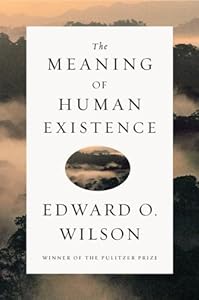
Coming in October: E.O. Wilson’s The Meaning of Human Existence.

Wilson, Harvard biologist, is one of the most intelligent people on the planet, author of On Human Nature, Consilience and many, many other books. I’m looking forward to a more philosophical summary of his worldview.


Coming in September: Steven Pinker’s The Sense of Style: The Thinking Person’s Guide to Writing in the 21st Century, from Viking.

Pinker is the Harvard evolutionary/cognitive psychologist and author of The Language Instinct, How the Mind Works, and most recently The Better Angels of Our Nature, which argues that the arc of human history is toward less and less violence, and humanity’s state is thus improving. It will be fascinating to see how he applies his intellect to ideas about effective writing.

Posted in Book Notes, Thinking | Comments Off on Two Books to Look Forward to

Nature’s God

Book review sections, especially the weekly ones in the Los Angeles Times and New York Times, are useful for reading glosses on books of interest that I know I’ll never find the time to read in their entirely. Nonfiction books, especially, because reviews of nonfiction books tend to be largely (sometimes too largely) summary, without much evaluation, in contrast to reviews of novels, which tend to be more analytical and judgmental.

Here’s an LA Times review from last Sunday of a book by Matthew Stewart called Nature’s God: The Heretical Origins of the American Republic, published by W.W. Norton.

Checking, I see that Stewart is a philosopher with degrees from Princeton and Oxford.

A few passages from the review:

Matthew Stewart wants to make one thing perfectly clear: The United States was not founded as a Christian nation. The principles that inspired the American Revolution, he argues in “Nature’s God: The Heretical Origins of the American Republic,” belong to an intellectual tradition dating to ancient Greece and reviled by every variety of Christian — early church fathers, Catholic clergy and Protestant divines alike.

His main point is serious. The tradition the deists honored was opposed to the religious doctrines of their day, and they knew it. Epicurus asserted that nature operates according to laws that can be discovered and defined. As Copernicus and Galileo learned, discovering natural laws that contradicted Catholic dogma was a risky business, and Protestant sects were equally insistent on divine judgment as exempt from explanation.

Jefferson was one of many deists appalled by the Calvinist God, doling out salvation and damnation in a manner human beings must accept but could not understand. In place of this punitive figure, deists proposed “Nature’s God … a God of publicly promulgated laws, not of private and inscrutable acts.” For them, Stewart states, “belief [was] a matter of evidence, not choice.” When American deists applied that concept to the civil sphere, they found contemporary political systems as unsatisfactory as revealed religion.

The first thing to note, of course, is that this contradicts the dogma of the religious right, who (see previous post) are happy to twist history and evidence and facts to fit their own pre-conceived worldview — and justify their own self-righteousness.

The second thing to note, and my main reason for noting this review and this book, is how contemporary the themes of these “deists” who founded the US in opposition to religious tradition are. Another passage from the review:

Natural law was the basis for the core ideas of the Revolution: People are free and equal in nature. Government is a compact between human beings, not something handed down from above.

Most important, we must always have the liberty of thought to examine received wisdom, evaluate its utility, and change our ideas — and our institutions. This freedom is the essence of what Stewart unabashedly and repeatedly calls liberalism. “A genuinely liberal political system,” in his view, aims to “hold the actions of an entire collective accountable to reason. … It is both a republic of learning and a learning republic.”

Stewart spells out the present-day implications of all this in his closing chapter, “The Religion of Freedom.” The government created by our deist Founding Fathers does of course protect religious belief, he writes, “but only insofar as that belief is understood to be intrinsically private. It does not and ought not tolerate any form of religion that attempts to hold the power of the sovereign answerable to its private religious belief.”

These ideas, the valuation of “liberty of thought”, the notion that ideas are subject to examination and change, and that religious belief should be private and not thrust into the public sphere– are not new. But these are enlightenment ideas, ideas of maturity and education, and they will forever struggle against ignorance and tribalism and religious inculcation. Because every new child is born fresh, subject and prone to its culture and beliefs, and education to a larger worldview is hard — and rare.

Posted in Book Notes, Culture, Humanism, Religion | Comments Off on Nature’s God

Lies and False Witness

There’s a theme here, in three posts from last week.

Salon: Rise of a right-wing quack: Faux-historian David Barton’s shocking new influence

This is the quality of constitutional scholarship that pervades the conservative movement these days: simple, outright lies that allege that this country was not founded on certain Enlightenment principles and the hard won experience of men and women who were exceedingly familiar with the bloody consequences of church and state being entwined.  It was, in their reckoning, conceived as a straight-up Christian nation, full stop.

David Barton marches on. There are some people you can fool all of the time, apparently.


Patheos: Another Christian Movie All About How Christians Are Persecuted in America

Rarely is an entire movie invalidated by the first few seconds of its trailer.

But that’s the case with One Generation Away, a film produced by Rick Santorum‘s EchoLight Studios that’s all about how Christians are being “persecuted” because they don’t get to push their faith in places like public schools.

(Just one example of many, documented on several websites I follow, about Christianity’s persecution complex.)


Alternet: Why Do Right-Wing Christians Think ‘Religious Freedom’ Means Forcing Their Faith on You?

Christian conservative circles have become awash in legends of being persecuted for their faith, stories that invariably turn out to be nonsense but that “serve to bolster a larger story, that of a majority religious group in American society becoming a persecuted minority, driven underground in its own country.” This sense of persecution, in turn, gives them justification to push their actual agenda of religious repression under the guise that they’re just protecting themselves.

You can see this play out in the legends that PFAW details out. Do Christian conservatives want to force their religious hostility to gays onto the military? Tell a lie about how a sergeant was persecuted for simply holding that religious belief to paint yourself as the “real” victim. Want to justify forcing non-believing kids to pray to your god in school? Tell lies about how kids are being punished for having private prayers all to themselves. Want to force people in the VA hospital to sing your religious songs and worship your god? Spread a false tale claiming that people aren’t allowed private ownership of religious cards. Tell enough of these stories and people on the right can convince themselves the only way they can protect their own right to worship is to force their religious practice on everyone else.

Posted in Culture, Religion | Comments Off on Lies and False Witness

Primitive Values, Mature Ethics, and the Failure of Religious Texts

A point that bears repeating: there is nothing in the Bible that couldn’t have been written by ordinary people

On the point of the previous post: it has been frequently observed that the Bible contains nothing that could not have been written by the people who lived at the time of its writing.

The values of those “Ten Commandments” reflect a primitive tribe’s values for surviving and cohesiveness. It is hardly a mature ethic for maximal human happiness. (At the same time, their values can be seen as an evolutionary-validated strategy for success. Their values *have* succeeded into becoming one of the largest set of values in the world. Though not the only one. Another topic for another time.)

Atheists are sometimes asked, is there any evidence that would convince you of the reality of God? A few say nothing can. But in this context, it’s easy to speculate that, if the Bible, or any other holy book, contained passages which, though perhaps inexplicable at the time of its writing, later became apparent messages about the reality of the universe that those living at the time could not have perceived. Trivial examples: the actual value of pi (there is some passage in the Bible, I gather, that defines it as 3, exactly), the fact that the Earth orbits the sun, and not vice versa — and that it’s not *flat*; the idea that basic hygiene, like washing hands following certain activities, would reduce disease. But the fact of the matter is, there is nothing like this in the Bible. (The New Testament gospels are preoccupied with validating earlier prophecies, and advising people on how to live given the assumption the world would end within their lifetimes.) Which is why there’s no reason to think the Bible is divinely inspired, rather than, as should be obvious, a hobble gobble of myths and histories from oral traditions selected to validate the tellers, and so on and on.

Posted in Atheism, Culture, Religion | Comments Off on Primitive Values, Mature Ethics, and the Failure of Religious Texts

Another Ten Commandments – Actually, Two

Ten Commandments That Would Have Changed the World

Who knew? Valerie Tarico points out, in this post, that there is a second set of Ten Commandments a bit later in Exodus following the ones from Exodus 20 most often cited. According to Wikipedia, Ten Commandments (scroll down, and down), this second set is regarded as “The Ritual Decalogue”, in contrast to the familiar “Ethical Dialogue”.

My point here is that neither version of these 10 commandments demands very much respect in contrast to the many, many other ethical proscriptions that have been created over the centuries. Replace the traditional ten with “Do unto others….”, and you would have a more ethical, humane society.

I’ve blogged before about a couple other alternate 10 commandments, and the blogger here has how own, written in Biblical language…

1. This above all shall ye take as my first command: Thou shalt treat living beings as they want to be treated. And the second commandment is like unto it:

2. In as much as be possible, thou shalt avoid afflicting pain or sorrow, which shall be unto thee my signs of ill and evil.

3. Thou shalt honor and protect all of creation, for I the LORD have created it that thy days may be long upon the land which the Lord thy God giveth thee.

4. Thou shalt have sexual relations with neither human nor beast who chooseth not freely what pleasures thou mayest offer.

5. Thou shalt not beat the child, but by admonition and instruction with kindness shall teach both wisdom and skill.

6. Thou shalt do unto members of other religions and tribes as thou dost unto thine own.

7. I, the LORD your God, forbid thee to own other persons be they woman, man or child; neither shall ye subject any gender nor race one to another, but shall honor my image in all.

8. Thou shalt not destroy the lands of thine enemies, nor poison their well, nor salt their earth, neither shalt thou cut their shade tree nor burn their vineyard, nor wantonly slaughter the beast of their field.

9. Thou shalt wash thy hands before eating and shalt boil the drinking water that has been defiled by man or beast.

10. Thou shalt ask the questions that can show thee wrong, so that through the toil of many, from generation unto generation, ye may come to discover the great I AM.

These commands, she notes, might have “changed the course of history. Think Crusades, or the Inquisition, or Salem, or the American Holocaust, or the slave trade, or Northern Ireland, or the Iraq War.”

The 56 percent of Americans who think the Bible is “the actual or inspired word of God with no errors” are stuck, anchored to the Iron Age. Many, when they get trapped by the ugly contradictions inherent in this position, do whatever moral gymnastics are necessary to defend the Book.

Posted in Culture, Religion, Ten Commandments | Comments Off on Another Ten Commandments – Actually, Two

Ann Druyan on Cosmos

Salon’s film critic Andrew O’Hehir interviews the actual creator and author of the recent Cosmos TV series– not Neil deGrasse Tyson, who was just the on-screen host, but Carl Sagan’s widow Ann Druyan.

“Why is God telling me to stop asking questions?”: Meet the woman behind Neil deGrasse Tyson’s “Cosmos”

I particularly appreciated this Q&A:

You’ve been pretty outspoken over the years about your views of religious myth and its relationship to science. You’ve talked at times about the desire to reclaim some of the sense of mystery or daring or even spirituality that could hypothetically be associated with science. Is this show to be considered as part of that struggle, as an attempt to recapture the mystery and power of science in the public imagination?

That’s beautifully said. And you know, I could speak to that. Yes, I mean, what always has surprised me personally is that the revelations about nature and the universe that science has presented to us are not just, you know, more likely to be better approximations of natural reality than we’ve gotten from any other source, but they’re also way more spiritually satisfying than anything we’ve ever been able to make up. You know, our interpretations of nature that are not rooted in nature at all and that are anthropocentric are kind of the infantile idealized visions of us as the center of the universe. As the children of a very disappointed father. [Laughter.]

You know, that stuff just leaves me cold. I’m sorry; it doesn’t really do anything for me. But the idea, you know, that we are, in my view, a species in search of fulfillment is something very real. And we used to get it from theory, you know, that we were literally special. That we were created apart from all of nature. We can’t get that anymore once you understand a mountain of evidence from DNA and many other independent causalities, which seems to create our oneness with all of life. I think we’re being brave. We’re looking at reality as it really is, we’re being brave enough and grown-up enough to know how tiny we truly are. “Cosmos,” in the original and in this incarnation, is intended to teach and familiarize the broadest possible audience with some of the insights and methods of science and some of its heroes, but also to make you feel what science is telling us. Personally, I think that’s important. We’re embracing these challenges that can only be solved through science. We’re looking at the universe and trying to understand how it’s put together, and you can’t see that without science. There’s only one way to see that.

Posted in Cosmology, Religion | Comments Off on Ann Druyan on Cosmos

Science Fiction and the perception of a greater truth

Here’s a passage from an early 1960s science fiction story, a story later incorporated into a novel, about a young man who works as a yardboy in a small town in a pre-industrial society near the “Katskil border”. One morning he gets up early enough to watch the sun rise.

For the first time that I can remember, I wanted to know, Where does it come from, the sun? What happens over there when it’s set afire every morning? Why should God go to all that trouble to keep us warm?

Understand, at that time I had no learning at all. I’d scarcely heard of books except to know they were forbidden to all but the priests because they’d had something to do with the Sin of Man. I figured Old Jon was the smartest man in the world because he could keep accounts with the bead-board that hung in the taproom. I believed, as the Amran Church teaches everyone to believe, that the earth is a body of land three thousand miles square, once a garden and perfect, with God and the angels walking freely among men, until the time almost four hundred years ago when men sinned and spoiled everything; so now we’re working out the penance until Abraham, the Spokesman of God, who died on the Wheel at Nuber in the year 37, returns to judge His people, saving the few elect and sending the rest to fry forever in the caverns of Hell. And on all sides of that lump of land spread the everlasting seas all the way to the rim of world. The Book of Abraham, said the teacher-priests, doesn’t tell how far away the rim is, because that’s one of things God does not wish men to know.

The author is Edgar Pangborn, and this 1961 story, “The Golden Horn”, was incorporated into his 1964 novel Davy, which I read decades ago, though I’ve just reread this story this past week. If the reader of this novel can’t guess from “Katskil” and similar references, it’s not set in the past, but in the future. It’s one of the better novels on the fairly common SF theme in the ’50s and ’60s about… what would happen after the apocalypse? Meaning, then, the likely nuclear war between the US and the Soviet Union. What kind of society would the survivors rebuild? What would they think about their past? A recurrent thread in such stories was the idea of an official church, or at least an official dogma, to explain to ordinary people where they came from and why they’re here. Often, of course, with proscriptions about questions not to ask, in order to maintain the sovereignty of the church, and social order.

The novel, as I vaguely recall, is about the main character Davy leaving his small town to see what the world is really like. (I’ll have to reread the complete novel soon.) And discovering, of course, it’s not at all like what his church said.

The lesson for any prescient reader is obvious. And the theme occurred in SF not just in post-apocalypse settings, but in outer-space settings as well, e.g. Robert A. Heinlein’s novella “Universe” and Harlan Ellison’s aborted “Phoenix without Ashes” TV series, both about residents of enclosed societies, with traditions to discourage freethinkers, who eventually discover that they are passengers on “generation” starships that will not arrive at their destinations for centuries, and who have lost all memory of their original missions.

The insight of these authors, and the lessons for readers, obviously, is, you must be willing to step outside of your society’s assumptions and comfort zones in order to learn the truth about your existence and reason for being. Whatever you think your society’s truth is, the real truth is likely far grander.

Posted in science fiction | Comments Off on Science Fiction and the perception of a greater truth

Links, Quotes, Comments: 20 June

A post today by Amanda Marcotte, on both Salon and Alternet–

Salon: Reason vs. the right: Have conservatives abandoned science and rationality?
Alternet: Have Conservatives Abandoned Rationality, Skepticism and Truth?

The possibility that rationality itself has become a partisan issue is disquieting to many who prefer to believe that “both sides” have topics that they are irrational about and irrationality is evenly distributed among all political stripes. That may have been true in the past, but increasingly, Americans are rearranging their political views and their views on empiricism so that liberals are putting much more of an emphasis on rationality. Indeed, many of the irrational notions floating out there that are assumed to be “liberal” are, in fact, becoming more associated with the right as this reshuffling takes place.

The recent reboot of the show Cosmos on Fox further demonstrated how partisan the very idea of science and empiricism has become. The show, which features astrophysicist Neil deGrasse Tyson taking over the host role from the original’s Carl Sagan, was aggressive in defending science, curiosity, and following the evidence from people who would rather rely on faith or authority, but it took no partisan positions. Nonetheless, it was immediately understood by Americans both left and right as a “liberal” show, merely for its strong insistence that facts should not be ignored in favor of wishful thinking.

Even though the show was hosted on the Fox network channel, Fox News, the conservative cable channel, did not hold back in the slightest from attacking Tyson for perceived liberalism. In a shockingly racist segment, host Greg Gutfeld and guest Gavin McInnes dogged relentlessly on Tyson, insinuating that he can’t really be an astrophysicist and making fun of “white liberals” for being enthusiastic about Tyson and his work. It only grew uglier with McInnes claiming that Tyson deserved to be mistreated based on his race when he was young because he “fit the profile” by having “a huge afro.”

Is this a surprise? The political right is dominated by the religious, who are, virtually by definition, irrational.


And about the National Organization for Marriage (NOM) — meaning, organization against gay marriage — which held a rally in Washington DC this week. Which attracted… hundreds.

Think Progress: Religion Motivates The Few Participants In National Anti-Gay Marriage Rally

Of course it does. I’m not sure there’s one cogent or accurate statement in this article. They are all misinformation, religious bigotry, or childish squeamishness.

At Slate, J. Bryan Lowder has a mildly sarcastic take.

Four of the five stages of grief—denial, anger, bargaining, and depression—were on full display today at the March for Marriage, a rally outside the U.S. Capitol organized by the National Organization for Marriage and other co-sponsors.

Former Sen. Rick Santorum offered a particularly frothy mix of rhetoric on this point, suggesting that, “first and foremost in this movement, we have to reclaim marriage for what it is. Marriage is the union of a man and a woman for the purpose of making two people as one—a unity—and secondly, to have and raise children. No other union can accomplish those two purposes.” Those who have happily co-parented a child after an accidental pregnancy will be surprised to learn that their arrangement is impossible, but then their existence was not the only one to be denied entirely at the March for Marriage.

And at another point, Bishop Harry Jackson noted, in what seemed to be an unwitting moment of lucidity, that this conflict represented “one group trying to impose their issue, their agenda, on another group of Americans. That’s not right and that’s not fair.”

The irony of the last paragraph.


A great political cartoon by David Horsey. There is a significant segment of the US population who reflexively reacts to any accomplishment by the Obama administration in this way. Anything, no matter how good, must be bad, if done by Obama. Scroll down to see the cartoon.

GOP criticism of Khattala’s capture hits level of pure silliness


And two great posts at io9 this week.

10 Pseudo-Science Theories We’d Like to See Retired Forever

Including the vaccinations and autism hoax, homeopathy, intelligent design, and… “toxins”.

Here is a scientific definition for a toxin: It’s a poisonous substance produced by living cells, especially one that, when introduced into a new body, spurs the creation of antibodies. That’s a toxin. That’s what it is, where it’s made, and what it does.

Here is a definition for a “toxin”: It’s a mysterious bad thing that’s in all the stuff I don’t like. I don’t know what it actually looks like, or its chemical composition. I don’t know exactly how it’s produced. I don’t know the precise process it sets off in the body. I only know that it definitely, definitely causes the awful thing that I always thought would, and indeed should, happen to people doing stuff I don’t like.

We need to step on the idea of “toxins.” We need to step on it until it’s dead. We’re not going stop people from blasting woo at us any time we eat anything that’s not kale or live anywhere that’s not the windswept peak of a mountain, but with concerted effort, we can at least make them sound ridiculous when they do it. I think the new term for toxins should be “evil pixie dust.”

And: 10 Scientific Ideas That Scientists Wish You Would Stop Misusing

Proof. Theory. Natural. Survival of the Fittest. Organic.

Posted in Culture, Evolution, Lunacy, Religion | Comments Off on Links, Quotes, Comments: 20 June