
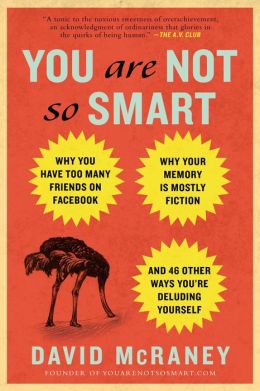
Review of David McRaney’s You Are Not So Smart

As I mentioned in a Facebook post last night, without bookstores to browse through, I discover titles and authors I might not otherwise have seen most often through web excerpts and interviews — at sites like Slate and Salon, Huffington Post, various science and skeptic blogs. As I recall my first exposure to David McRaney was an excerpt from his latest book, YOU ARE NOW LESS DUMB, on Salon a couple months ago — I quoted from it, here.

I then bought that book, and then his first book, YOU ARE NOT SO SMART from 2011 (both published by Gotham Books), and paused reading the second to read the first first.

It was reading these books that prompted me to recall LOGIC AND CONTEMPORARY RHETORIC, which I posted about here; these McRaney books appeal to interests I’ve had for decades: how to think logically, and how to see through illogical arguments; pseudoscience and why people believe things so passionately for which there is such dubious evidence at best; and, more grandly, the limits of human perception about reality, if the human mind is capable of perceiving what is real instead of basking in illusions of its own making (which in my recent reading is most acutely addressed by Jesse Bering’s THE BELIEF INSTINCT, which I’ll blog about eventually).

I’ve read books along this spectrum over the decades — books by Carl Sagan, Michael Shermer, Thomas Gilovich, and others — but in just the past couple three years it seems like there is a relative wealth of such books, McRaney’s and Daniel Kahneman’s big book (which I haven’t read yet), and others (or, just as likely, it’s my confirmation bias ticking in that I notice such books now that I’m attuned to them…)

Enough preamble. The difference between any of those earlier books that I read and the two by David McRaney is that McRaney isn’t focused so much on logical fallacies or the tricks used by others (advertisers, politicians) to sway you, as the way your mind is biased to *trick yourself*.

McRaney’s YOU ARE NOT SO SMART has 48 chapters in 300 pages. Each chapter, and the introduction, is headed by a two-part summary of its theme, contrasting the common misconception and the ‘truth’, e.g., for the introduction:

THE MISCONCEPTION: You are a rational, logical being who sees the world as it really is.
THE TRUTH: You are as deluded as the rest of us, but that’s OK, it keeps you sane.

Each chapter then follows with an expansion of the theme: a mixture of psychological case studies, the author’s interpretive elaboration, and occasional anecdotes from the author’s own life.

It’s a mix of cognitive biases, heuristics, and logical fallacies. Many of these, in this first book, are very familiar: confirmation bias, argument from authority, the straw man fallacy, the ad hominem fallacy.

This is principally a book about psychology, how the mind works, and it’s grounded in the many psychological experiments the author describes. To take the first chapter, about ‘priming’, which is how you are influenced (without being aware of it) by past experiences and your immediate environment into making decisions. One case study was a game that involved splitting $10, with greedier behavior observed by those who had just seen business related photos or items in the room they were in — and then who later confabulated rationalizations for why they made the decisions that they did.

Later chapters cover a couple very famous (and terrifying) psychological experiments — the 1971 experiment in which students were randomly assigned prisoner or guard roles, and over several days came to exploit those roles; and the 1963 Stanley Milgram experiment in which subjects kept giving higher and higher electrical shocks to a person in another room, as long the professor [the authority figure] kept telling them to do so. [Not mentioned in the book, but I recall the made-for-TV movie with none other that William Shatner dramatizing this study — The Tenth Level.] These experiments, and others, have huge implications about social policy that have yet to be incorporated into legal policy.

This is a terrific book for becoming more self-aware about how you think, and how what you believe may or may not reflect what is real.

McRaney is a journalist, not a psychologist himself, but this book is as compelling as anything by a university Ph.D. And his second book, YOU ARE NOW LESS DUMB, is even better — it’s deeper. (Yes let me mention that these rather flip titles don’t do the books justice; though if they attract casual readers, then I suppose they’re justified.)

I’ll address the second book in a later post.
Posted in Book Notes, Thinking | Comments Off on Review of David McRaney’s You Are Not So Smart

TNT for 2

My favorite song on the Neil Finn/Pajama Club album of a couple years ago, for some reason running through my head in that half-awake, half-dreaming state just before the alarm went off this morning.

Posted in Music | Comments Off on TNT for 2

Links and Comments, 6 Oct 13

Many interesting posts this past week, some already posted on Facebook, collected here mostly for my future reference.

Andrew Sullivan (The Dish) responds to a report about tea party voters. Sullivan:

The bewildering economic and social and demographic changes have created a cultural and existential panic among those most heavily concentrated in those districts whose members are threatening to tear down the global economy as revenge for losing two presidential elections in a row. They feel they have already lost and have nothing to gain from any constructive engagement with a president they regard as pretty close to the anti-Christ of parasitic minorities. They feel isolated in a more multi-cultural country. They feel spied upon and condescended to. They have shut out any news sources apart from Fox. It does not occur to them, for example, that Obamacare might actually help them. And you get no actual specifics on policies they like or dislike. It is all abstractions based on impressions.

More to the point, the bulk of these Republicans no longer believe in the Republican party. They identify more strongly with the Tea Party or Evangelical groups or Fox News than the GOP. On social issues, the defining issue is homosexuality – not abortion. That intransigence will alienate them them even further from the future mainstream. Their next big issue: denying climate change. Right now, I see no way to integrate these groups and people into the broader body politic or conversation. Their alienation is so deep it is close to unbridgeable. And further defeats will make their isolation worse, not better, their anger more, not less, intense.


Examples of telling lies to promote political/religious agendas: Texas fundamentalists want to teach Garden of Eden in science class


The Futurist magazine’s top 10 forecasts for 2014 and beyond (via Slate)
Big data, shrinking populations, AI, amateur science, and more


Sometimes you only need to read the headline…
Christian Group Promotes Upcoming Summit with a James Madison Quotation So Fake That Even David Barton Disavows It


Adam Lee at Daylight Atheism nicely summarizes the current Government Shutdown Blues.

There’s only one possible reason they’re so absolutist in their resistance to Obamacare: not because they think it’s going to fail, but because they believe it’s going to succeed. If they really believed that the law would be a huge failure, they could just sit back, wait for it to collapse under its own unpopularity, and then gloat and say “we told you so”. The fact that they’re fighting so tenaciously implies that they’re worried people are going to like it, and they know that if it’s a success, their original opposition will haunt them. They chose to redouble their opposition, trying to prevent voters from getting a chance to make up their own minds about it.


This is likely the most alarming and not entirely implausible post of the week: The Yale political scientist died this week. His life’s work tells us that American democracy is doomed.

Which is to say, the current US crisis may decay the status of American democracy, irrevocably.

And his analysis has a disturbing message for residents of the contemporary United States. The current atmosphere of political crisis isn’t a passing fad and it isn’t going to get better. In fact, it’s very likely to get worse. Much worse. And lead to a complete breakdown of constitutional government and the democratic order.


John Scalzi explains why the ACA [aka Obamacare] is of crucial interest to writers and other artistic types who, traditionally, live on the brink of desperation.
Why The ACA Matters to Me

I don’t have enough fingers and toes on my body to count off the writers in my own personal sphere who are hardworking, who are hustling as much as they can with their work, who had the medical boom dropped on them by life and were screwed because they didn’t have health insurance, or couldn’t get health insurance was even remotely within their financial means. I can’t tell you the number of writers I know personally who have gone begging online or to family and friends to cover a catastrophic medical issue. Not to mention musicians, artists, actors, and any other sort of creative people.

Later this post at ThinkProgress, Why The Affordable Care Act Matters To Artists, which quotes Scalzi’s post among others.


1st October saw this brilliant post on Slate, If It Happened There … the Government Shutdown, presenting the current crisis as it happened in another country, reported by American journalists. Note the loaded wording — “sleepy capital city”, “regime”, “intensely proud and nationalistic people”, “rule”, “a young fundamentalist lawmaker from the restive Texas region”, “its vast stockpiles of weapons of mass destruction”.

The capital’s rival clans find themselves at an impasse, unable to agree on a measure that will allow the American state to carry out its most basic functions. While the factions have come close to such a shutdown before, opponents of President Barack Obama’s embattled regime now appear prepared to allow the government to be shuttered over opposition to a controversial plan intended to bring the nation’s health care system in line with international standards.


Media Matters: What Epic Propaganda Looks Like:

There’s nothing wrong with being passionate and dedicated to a cause. But the right wing’s almost hypnotic, monomaniacal focus on opposing health care reform has been matched, if not outstripped, by its relentless desire to purposely lie about the new law year after year after year. That’s not passion, that’s propaganda.


I was tempted to Facebook this post by Bill Maher, but did not.

New Rule: Conservatives Who Love to Brag About American Exceptionalism Must Come Here to California

New Rule: Conservatives who love to brag about American exceptionalism must come here to California, and see it in person. And then they should be afraid — very afraid. Because while the rest of the country is beset by stories of right-wing takeovers in places like North Carolina, Texas and Wisconsin, California is going in the opposite direction and creating the kind of modern, liberal nation the country as a whole can only dream about. And not only can’t the rest of the country stop us — we’re going to drag you along with us.

Posted in Commonplace Book, Culture, Lunacy | Comments Off on Links and Comments, 6 Oct 13

Gravity

[Capturing my Facebook post as a blog post.] Just back from seeing Gravity. It’s quite a ride — spectacular in many ways. Terrific effects, portrayal of people in orbit over Earth, and even the simulated zero-G (or micro-G) movements look great, considering that they filmed it with actors suspended from cables. (This film must have been quite a physical feat for Sandra Bullock. This kind of acting is not easy.)

I do have two qualms. One is the aforementioned convenience of the shuttle and the Hubble space telescope being in the same orbits; more than that, it’s the shuttle and the Hubble and two (or was it three?) space stations all being rather implausibly close together (and in the same orbit as the debris). In fact, there’s no reason to think they wouldn’t be half way around the planet from each other, not to mention in different orbital heights and inclinations.

Second — something I haven’t seen mentioned anywhere: George Clooney did not have to let go. In that key scene, he and Sandra Bullock are attached by cable and get tangled up in cables dangling from the ISS. Once tangled, their momentum has stopped, relative to the ISS. It is not, as the film implies, as if George is ‘hanging’ and is about to pull Sandra after him. Once they’re tangled, they’re all in free fall next to the station.

Minor quibbles could address the luck with which Sandra Bullock manages to hit the right buttons. But, it’s that kind of movie.

I am still in the position of wishing that, someday, the technology of modern film making could be harnessed in the service of a truly great story. It hasn’t happened since 2001.

http://www.imdb.com/title/tt1454468/

–Update 6Oct13: Phil Plait and Neil deGrasse Tyson have both posted and tweeted about these faults and others. Are we nitpicking and missing the point? Or is this more evidence that people value story over scientific fidelity — a crucial point in the ongoing development of my theme?

Posted in Science, science fiction, Space | Comments Off on Gravity

Gone with Inherit the Wind

The oddest thing about this post is, why would a community college think to schedule a performance of “Inherit the Wind” with involvement of a director and support by a religious college, Martin Luther College, in the first place?

After seeing the poster for the audition, several MLC professors raised objections about the play’s subject to the administration.

“We felt it was not compatible with what [the school] teaches the Bible says about the universe and the world,”? said [MLC’s VP of Student Life Jeffrey] Schone. “This is a ministerial school. People employing our students need confidence about their views.”

Blogger Hemant Mehta, posting this story, responds,

I love that final line. As if what potential employers seek from these students is not a weakly-held truth but a confidently-held lie. Students won’t be employable if we keep challenging their firmly-held and completely-discredited views! So stop making them think! (Though I guess the statement makes sense, given what pastors say from the pulpit on a regular basis…)

I read the play Inherit the Wind in my teens, saw the movie a couple times, even saw a stage performance at UCLA when I was a student there. It’s dismaying that society has not much progressed in all these decades. The battle between faith and science is still being played out. And may forever play out. It’s part of inescapable human nature.

Posted in Religion | Comments Off on Gone with Inherit the Wind

Is the Younger Generation Turning away from Organized Religion?

Skeptic Blog:

http://www.skepticblog.org/2013/09/25/losing-our-religion/

We can all speculate about why younger generations are alienated from organized religion, and certainly there are many reasons. But knowing the current political trends in this country, we might suggest that one factor of great importance is how “organized religion” in this country is largely driven by the shrill and intolerant evangelicals (including the extreme Catholics like Rick Santorum), and their hate-filled message against gays, women, and sometimes minorities.

But Hemant Mehta argues that the regressive social policies of fundamentalists isn’t the only factor. He points to the fact that younger generations are more likely to learn from the internet, and less likely to obey everything their parents tell them, especially when they have questions that organized religion has no good answers for. Certainly, the virtual community of web-enabled young people can explore and learn about topics like atheism and evolution in a way that would have been impossible in many small religious American towns just a generation ago. Even if the social pressure of the conservative community censors or hushes up these topics in school and at the library, the internet opens a window that cannot be shut by local authorities—and younger people are more likely to find their own answers this way than ever before.
For those of us who value science and science education in this country, this is good news. As I’ve argued in several previous posts, the single biggest factor that causes us to fall behind nearly all the other westernized industrial nations (including Japan, South Korea, China, and Singapore, along with most of Europe) is religion. When you break down the polling, it’s always questions about evolution, the age of the earth, cosmology, and human evolution that nearly always cause Americans to flunk science literacy tests compared to other nations. These are all questions that reflect the creationist-evangelical influence on our culture. Thank gods, it is apparently declining.

In contrast to this discussion,

http://www.alternet.org/belief/breaking-their-will-sick-biblical-literalism-leads-child-abuse-and-even-death

Child protections have become established in most countries, and conversations about child-friendly religion are gaining ground. Even so, many children are subject to patriarchal groups that take parenting priorities from the Iron Age. Evangelical Christians, fearing that their religion is losing ground, have ramped up recruiting activities targeting high school and college students but also young children. Their tool bag includes afternoon club programs and enticing camps. Some churches, like that of TV’s Duggar family, promote a high birth rate, adding young sheep to the fold the old fashioned way. Many churches encourage members — even those who already have numerous children — to adopt.

Posted in Culture, Religion | Comments Off on Is the Younger Generation Turning away from Organized Religion?

Thoughts of a Thursday Afternoon: After the Apocalypse

Every human being starts from scratch: he or she comes equipped with a mind honed by evolution for survival, prone to superstitious, self-interested thinking for the same reason, but ill-equipped to accurately perceive reality, the reality that can be deduced by observation and logic.

Here is a general conclusion I would make based on all the recent evidence I’ve seen from psychology and religious practice…

Suppose a big reset button was hit on the human race. This could be the standard nuclear war in science fiction stories (Walter Miller, Pat Frank, that Twilight Zone episode), in which a few survive but without the technology and accumulated knowledge of past generations.

The same could apply to a group of people shipwrecked on a remote island, without any resources.

Humanity would eventually build a new civilization. This civilization would create lots of new religions — but none of them exactly like any of the religions we know today (any more than their languages would be exactly like those we know today), though similar to those we know, and to each other in the usual broad parameters. (Still, each religion would no doubt insist it’s the one true faith, unlike all the others.) These broad parameters, of course, are driven by the cognitive biases of the human mind, and the tribalistic nature of small human societies, and not by anything ‘true’ in religious claims — because the details of the factual claims of religions are generally easily dismissed, for complete lack of evidence, or disproven in the case of those claims about the nature of the world and the universe.

Science, too, would eventually be recreated. And it would be pretty much the same, given the contingencies of historical circumstance in terms of what gets discovered where or first or by whom, as the science we know. Because science is answerable to the real world. It’s about reality.

Every child and every family is to a degree a replay of that reset-humanity button. The accumulated knowledge of humanity, alas, does not pass automatically to each new member. If parents keep a child isolated from the rest of the world, through home-schooling or by denying access to books or TV or the internet or radio or movies, they can channel the child’s mind in whatever direction they like. And give it a few years, that direction will likely stick, throughout their lives. As the Catholic Church says…”Give me a child until he is seven and I will give you the man” (And Lenin said “Give me a child for the first 5 years of his life and he will be mine forever”). Or Proverbs: “Train up a child in the way he should go and when he is old he will not depart from it.” This is because, we can now understand, there are cognitive biases in all of our minds that make it difficult to acknowledge threatening information, or challenge the standards of our tribe/community, or damage one’s ego by recognizing that you might have been wrong about something.

The way around this is science, the process which is the essence of science — if you can handle it, and think independently. If you’re interested in what really is true, and not merely content with the traditions of your tribe/community or with the illusions projected by your mind. You can’t escape those biases and illusions, which affect scientists’ minds too. But you can try to think around them, and participate in a discipline which functions to check and double-check and challenge every new claim, and correct things that are wrong.

The existence of our technological world is testament that science works. There is a noticeable lack of historical progress by religion.

Tradition may make you happier. I’m more curious about what is real, and true.

Posted in Culture, Philosophy, Religion, Space | Comments Off on Thoughts of a Thursday Afternoon: After the Apocalypse

Motivated Reasoning and Religion

Applying motivated reasoning [or confirmation bias] to religion…

http://www.salon.com/2013/09/27/why_are_so_many_christians_so_un_christian_partner/

As much as liberals would often wish it otherwise—and no matter how much conservative Christians may claim their beliefs all come from the Bible—the truth of the matter is there’s no real relationship between what a person believes and what their religion ostensibly teaches them to believe. In practical terms, the word “Christian” is an empty term that can basically mean whatever the believer wants it to mean. Christians decide what they want to believe first and then, after they’ve chosen their beliefs, search for any excuse, no matter how thin, to claim that their belief is consistent with their chosen religion.

It’s a process called rationalization or motivated reasoning, and to be perfectly fair, it’s how most people think about most things most of the time: They choose what to believe and then look for reasons to explain why they believe it. Huge reams of psychological research show this is just how the human brain works. Almost never do we look over a bunch of arguments and choose what to believe based on reasoning our position out.

While most people engage in motivated reasoning most of the time, injecting religion into a situation only makes this process worse. That’s because, unlike most other belief systems, religion is impervious to empiricism. …
With religion, however, there’s no limits about what you can claim to believe. Jesus is a mythological character: he believes whatever the person speaking for him says he believes. For one person, Jesus believes we should feed the hungry and clothe the naked. For another, Jesus didn’t really mean it when he said that stuff; he was just handing out goodies in order to recruit new believers. We weren’t there (and it probably didn’t even happen), so the sky’s the limit when making up reasons why what you believe counts as “Christian.” If you want to believe Jesus was actually a space alien brought here by Martians to teach us how to fly, you have as much right as anyone else to believe what you want. It all has equal amounts of evidence to back it up.

The point here reminds me of an essay I read somewhere by the author of How to Create Your Own Religion (http://www.amazon.com/Create-Your-Own-Religion-Instructions/dp/1938875028/ref=wl_it_dp_o_pd_nS_nC?ie=UTF8&colid=33YD48C1GB6Q6&coliid=IV58JTSMAS2DI) — the point in the article (and presumably the book) being that no religious person endorses every single passage of whatever Holy Book they claim to follow. They pick and choose. (So many obvious examples…) In effect creating their own, unique, personal religion.

Posted in Culture, Religion | Comments Off on Motivated Reasoning and Religion

Odds and Ends, 23Sep13

Scientific American has this Michael Shermer essay about struggling with motivated reasoning–

http://www.scientificamerican.com/article.cfm?id=why-we-should-choose-science-over-beliefs

Give him credit — he struggles with ideological convictions in the light of evidence, and changes his mind. But finds that others at a Libertarian conference are not so flexible.


Here’s a nice essay on Huffington Post by Matthew Hutson, author of a book called The 7 Laws of Magical Thinking. It strikes me as a rather simplified version of the argument in Jesse Bering’s The Belief Instinct, currently the best case I’ve seen for taking the human mind’s reasoning biases as explanations for the basic religious/spiritual inclinations of all human cultures.

www.huffingtonpost.com/matthew-hutson/all-paths-lead-to-magical-thinking_b_3942656.html

I recently re-read Jesse Bering’s book, but will wait to blog about it until I finish David McRaney’s second book — since his psychological cases serve as clinical bases for Bering’s argument.


Andrew Sullivan links to a post about gun control, which quotes Jared Diamond’s Collapse, about why societies persist in irrational policies…

Most of the time, he points out, the simple sunk cost of the irrationality helps it persist: we have always believed this, and to un-believe it is to lose our faith in ourselves.

Which principle applies to say many things about current US policies.


And to unsettle philosophical certainties…

http://io9.com/9-philosophical-thought-experiments-that-will-keep-you-1340952809@AnnaleeNewitz
 

Posted in Philosophy, Science, Thinking | Comments Off on Odds and Ends, 23Sep13

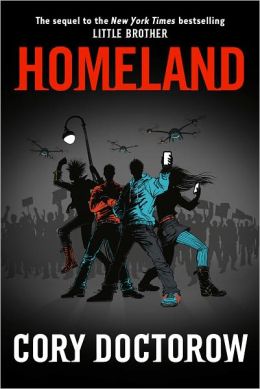
Review of Cory Doctorow’s Homeland

I’d meant to write more reviews on this blog, so let me catch up with a review of a novel I read a few weeks ago – Cory Doctorow’s Homeland. I confess that after the longueurs of his novel Makers, which was preoccupied by theme parks, I didn’t immediately jump on Cory’s subsequent novels, even though I’m generally a fan and admire him greatly as a really smart person doing really good work. But finally I read Homeland, and I’m glad I did.

It’s a sequel to his well-received Little Brother, in which Bay Area teenager Marcus Yallow is subject to DHS — Department of Homeland Security – interrogations following a terrorist attack on San Francisco.

In this book Marcus is attending the annual Burning Man event in Nevada, and runs into a DHS operative he met earlier, Masha, who hands him a UBS stick containing all sorts of incriminating files. In passing.

Marcus explores the files on this UBS stick, meanwhile getting a job as webmaster for an independent California senate candidate. The files on the UBS stick reveal government atrocities – torture by waterboarding and the like – and he decides to release the files to the web before having examined all of the 800K+ documents.

This results in attention from thugs, and demonstrations across the country. Marcus is caught up in one demonstration in San Francisco, and spends an unpleasant night in a detention facility.

As Gary Wolfe mentioned in his Locus Magazine review, one attraction of this book are the elaborate asides; Cory is a geek about so many things. The first 60 or so pages of the book describe Burning Man in great detail, fascinating for anyone like me who’s never been there (or frankly never had any interest in going). Later there are detailed passages about how to defeat lie detectors (p188ff), about software defined radio (p268), about randomness (p153ff), and the miracle of cold-brewed coffee (p56-58).

More significant perhaps are passages that are political. When Marcus first contacts the senate candidate, Joe Noss, he gets an earful (p85-86) about what’s wrong with both parties – though the Republicans are “dunces”—

There are important movers and shakers in the RNC who believe that the Earth is five thousand years old. And these are the people who made their fortunes pumping sweet crude in Texas!

Much later near the end of the book Marcus reflects about whether it really matters who’s elected or not; you get the sense that Doctorow is disillusioned with the current administration.

After all, wasn’t the system the problem? No matter who we voted for, the government always seemed to win. What was the point of living out my little fantasy of democratic change and justice when the real action was being fought out in secrecy, with anonymous envelopes of cash, encrypted whispers, secret bunkers, and secret deals?

So while there’s a definite political subtext to this novel (and Doctorow’s others), it is moderated by other attractions – the geekery, and the remarkable emotional scenes that he provides in scenes with Marcus and his girlfriend. I’m currently half-way through his novel Pirate Cinema, and will have more to say about his range when I cover that book.

The spoiler isn’t quite the point, but I’ll mention a bit below the link.

[ show/hide spoiler discussion ]

The files on the UBS stick reveal how a government contractor, Zyz [read Blackwater] got into the business of selling bonds and buying student loans (which never expire), acting like a mafia to collect on loan payments, to the point of claiming parents’ and grandparents’ estates and ruining their lives. The Zyz guys were the thugs mentioned in the summary. At the end of the book, Masha returns and helps him resolve the threat from Zyz.

Posted in Reviews | Comments Off on Review of Cory Doctorow’s Homeland