
Stories, Narratives, Facts

Salon has an excerpt from a new book by David McRaney, You Are Now Less Dumb. I think I’ll quote from the excerpt, just because (at the moment) I can.

The people who came before you invented science because your natural way of understanding and explaining what you experience is terrible. When you believe in something, you rarely seek out evidence to the contrary to see how it matches up with your assumptions. That’s the source of urban legends, folklore, superstitions, and all the rest. Skepticism is not your strong suit. In the background, while you crochet and golf and browse cat videos, people using science are fighting against your stupidity. No other human enterprise is fighting as hard, or at least not fighting and winning.

When you have zero evidence, every assumption is basically equal. You prefer to see causes rather than effects, signals in the noise, patterns in the randomness. You prefer easy-to-understand stories, and thus turn everything in life into a narrative so that complicated problems become easy. Scientists work to remove the narrative, to boil it away, leaving behind only the raw facts. Those data sit there naked and exposed so they can be reflected upon and rearranged by each new visitor.
Posted in Quote at Length, Science | Comments Off on Stories, Narratives, Facts

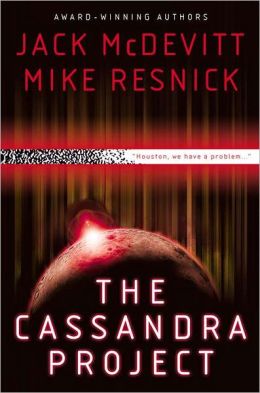
Review of McDevitt & Resnick’s The Cassandra Project

Jack McDevitt and Mike Resnick’s The Cassandra Project (2012) is set in 2019 at a time when NASA funding is being cut and many worry that NASA may be disbanded altogether.

It begins with a routine release of old records from the 1960s that includes voice recordings from an early Apollo mission in which a LEM pilot is heard saying “approaching launch point” and Houston replying “go for launch”. Reporters pounce — does this mean someone landed on the moon before Apollo 11?

The central character is Jerry Culpepper, NASA public affairs director, who’s caught unprepared for this sudden controversy. Worse, circumstantial evidence keeps mounting to support the idea of an earlier landing [it’s clever how the authors deftly avoid naming by number those earlier missions; they never say Apollo 9 or Apollo 10], even as officials, all the way to the president, dismiss the idea.
Continue reading

Posted in Reviews | Comments Off on Review of McDevitt & Resnick’s The Cassandra Project

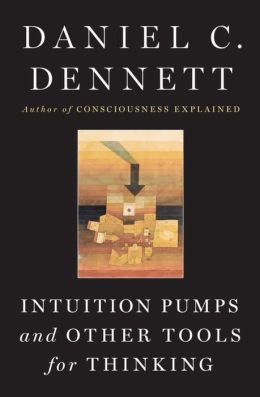
Notes on Daniel Dennett, 1

I plan to post various kinds of responses to books I’ve read or am reading; some will be reviews, some will be notes with comments. This entry is one of the latter. (Note this only covers the first 60 pages or so of a 400+p book.)

Daniel Dennett is a well-known philosopher (Wikipedia) who’s applied his thinking to cutting edge issues of science – evolution, consciousness, free will — and has written numerous tomes on these subjects and others.  This book is something of a hodgepodge, but a useful one. It starts by describing various thinking tools, including ‘intuition pumps’, and then applies those tools to issues of meaning, mind, and free will. Some of the ‘tools’ are negative ones, to be avoided, since they are most often used to mislead and deflect critical thinking. Thus this book is of interest to me not just for its application to those studies, but as a compilation of thinking tools that can be applied in any area of daily life.

Following is a summary, with occasional comments by me in [brackets].

Continue reading

Posted in Book Notes, Philosophy, Thinking | Comments Off on Notes on Daniel Dennett, 1

Twitter So Far

So I created a Twitter account a couple weeks ago, initially to track someone posting comments about Locus Online, but mostly just to come up to speed with this form of online social media, as a publisher of an [online] website myself. Yes, I’m a couple years behind the times; but I try not to be *more* than a couple years behind the times.

I’ve quickly ‘followed’ over the past couple weeks some 300 fellow tweeters, and have been followed by 69 folks currently.

Comment 1: At least half of those 69 are folks I’ve never heard of, and have no idea why they would have seen my account and chosen to follow me. [This is not that much different than Facebook, where I have some 260 friends whom I’ve approved, and at least another 200 friend requests that I’ve ignored, since I have no idea who they are.]

Comment 2: I have a correspondent, a contributor to Locus Online, say about Twitter, “It’s responsible for the ongoing downfall of our civilization. I pity the necessity for you to follow it.” Obviously he is not on Twitter.

Comment 3: I think Twitter is like being in a convention party room, with dozens of people standing around holding conversations, and being able to follow all those conversations at once, more or less. It’s fun to follow, but if you walk out of the room to go elsewhere, you will miss these conversations, just as ignoring Twitter for a while means you will miss analogous tweets. I.e., you’re not necessarily missing anything important. You can’t follow everyone all the time. Life is short.

Comment 4: The best thing about Twitter is that you can follow folks who don’t need to approve you as ‘friends’, as on Facebook; thus I can follow Barack Obama, Ricky Gervias, and Wil Wheaton. And discover, through re-tweets (RT), fascinating, provocative people like @Anti_Intellect.

I think I’ve figured out how to embed Twitter posts in a blog post like this. Here are a couple examples that struck me in the past couple days (posting these mostly to see if these work).

Posted in Personal history | Comments Off on Twitter So Far

Today’s Pet Peeve

Folks who pronounce the T in often. Even some very intelligent folks. But do they also do so in listen or moisten, words with similar derivations? They do not. Lose the T, please.

Posted in Pet Peeves | Comments Off on Today’s Pet Peeve

Today’s favorite song – Moby

Posted in Music | Comments Off on Today’s favorite song – Moby

Cory Doctorow on Father’s Day, and Scientific Method

Popular Mechanics: What My Father Taught Me: Cory Doctorow

My dad was really good at making me think everything through. The scientific method is a totally counterintuitive thing because it begins by saying: You can’t trust your memory or your senses. You have to measure things empirically and write them down because otherwise everything you remember and everything you know is colored by your biases and experiences and hopes and aspirations. And essentially your brain lies to you all the time. This is a very hard thing to get a 5-year-old to understand.

Posted in Commonplace Book, Quote at Length, Science | Comments Off on Cory Doctorow on Father’s Day, and Scientific Method

More Views

This is the initial post on my new blog, a sequel to the Locus Online editorial blog Views from Medina Road.

Posted in Personal history | Comments Off on More Views