Plinks: Coyne responds to Frank; Religion becoming obsolete?; Dawkins’ response

Jerry Coyne responds to Adam Frank’s op-ed piece in NYT last week about science illiteracy. Coyne doesn’t dispute Frank’s points, so much as his recommendations.

But after reading it, I was disappointed, for although Frank’s piece is pro-science, it’s merely another op-ed calling our attention to the pervasiveness of creationism and climate-change denialism, decrying the decline of science in the U.S. in an unconvincing way, and failing to propose another solution beyond “get more kids interested in science.”

He’s not so sure as Frank is that science denialism is that much different today that in past decades.

So I’m not sure I agree with Frank’s assessment that our culture is now “less engaged with science and technology as intellectual pursuits than at any point I can remember.” There are tons of popular science books on the shelves these days, and although Carl Sagan and Steve Gould are no longer with us, we have Richard Dawkins, Brian Greene, Neil deGrasse Tyson, Dan Dennett, Steve Pinker, Lee Smolin, E. O. Wilson, Jared Diamond, and many others, as well as tons of nature shows on television. We are literally awash in popular science, as a visit to any bookstore can confirm.

So Coyne’s solution begins,

1. Weaken America’s hold on religion, which is largely responsible for climate-change denialism and completely responsible for creationism. These movements are brushfires that will re-ignite so long as faith is there to fuel them. We’re in a war not for science, but against superstition, which enables nonscientific views.

///

HuffPo:
Religion Becoming Obsolete? It Could Happen!

Research has shown that religion declines not just with rising national wealth but also with all plausible measures of the quality of life, including length of life, decline of infectious diseases, education, the rise of the welfare state, and more equal distribution of income.

The delusion of religion is not whether or not God exists, but in the absolute certainty of knowing the unknowable.

Like that last line especially.

///

Richard Dawkins created a twitterstorm last week over a comment about how few Muslims have ever won Nobel Prizes. He got a lot of flack for the implied racism of that comment, but to his credit, he responded in detail, taking some blame while expanding on his remarks and trying to put his tweet in context. It’s about what modern Muslims claim, as opposed to what they have done.

Calm reflections after a storm in a teacup

If you are so numerous, and if your science is so great, shouldn’t you be able to point to some pretty spectacular achievements emanating from among those vast numbers? If you can’t today but once could, what has gone wrong for the past 500 years? Whatever it is, is there something to be done about it?

His point meshes with the Donald Prothero comment that Arabic culture was, 1000 years ago, a pinnacle of civilization; what happened that caused it to fade? (Answer: religious extremism)

Dawkin’s response is a model of responsible, patient consideration for the points of his critics. The kind of thing you never see from the reckless predictions and accusations of the those on religious right, who are always wrong.

Posted in Religion, Science | Comments Off on Plinks: Coyne responds to Frank; Religion becoming obsolete?; Dawkins’ response

An Irish Poem

As a follow-up to my two posts of photos from Ireland. At a lovely Dublin bookshop called Hodges Figgis [no website of their own, but apparently associated with Waterstones], I bought a copy of Joyce’s DUBLINERS and a slim volume of poetry by W.B. Yeats. I’d thought, on those three days Yeong was in his conference, to sit in St. Stephen’s Green, only a couple blocks from the hotel, and read classic Irish literature. Alas, the weather did not cooperate; too drizzly. But I did read some of each book.

Here is the very first poem in the Yeats volume:

I passed along the water’s edge below the humid trees,
My spirit rocked in evening light, the rushes round my knees,
My spirit rocked in sleep and sighs; and saw the moorfowl pace
All dripping on a grassy slope, and saw them cease to chase
Each other round in circles, and heard the eldest speak:

Who holds the world between His bill and made us strong or weak
Is an undying moorfowl, and He lives beyond the sky.
The rains are from His dripping wing, the moonbeams from His eye.

I passed a little further on and heard a lotus talk:

Who made the world and ruleth it, He hangeth on a stalk,
For I am in His image made, and all this tinkling tide
Is but a sliding drop of rain between His petals wide.

A little way within the gloom a roebuck raised his eyes
Brimful of starlight, and he said:
                             The Stamper of the Skies,
He is a gentle roebuck; for how else, I pray, could He
Conceive a thing so sad and soft, a gentle thing like me?

I passed a little further on and heard a peacock say:

Who made the grass and made the worms and made my feathers gay,
He is a monstrous peacock, and He waveth all the night
His languid tail above us, lit with myriad spots of light.

From 1889. [I added some line breaks not in the original.]

Now, to my sensibilities this strikes me as an obvious mockery of human vanity. Other animals, imagining god, would imagine him in their image. (cf Jerry Coyne’s ‘ceiling cat’)

And so I was struck, in my Google searching for a copy of this poem, by this site where the poster thinks this poem is about…

pantheism, the concept that God is everything. If man rightly discerns that God created human beings in His image, then God, in fact, created everything else that exists in His image. If all things are reflections of one Creator, then each thing created can rightly aver that it is made in the image of the Divine.

This strikes me as a non sequitur. If everything exists in His image, then the concept of being created in His image doesn’t mean much of anything, does it? Certainly not anything humanity can take credit for.

Posted in Quote at Length, Religion | Comments Off on An Irish Poem

More Ireland Pics

From Yeong’s iPhone.

We were staying at the Conrad Hilton, which is just south of St. Stephen’s Green, as on this map.

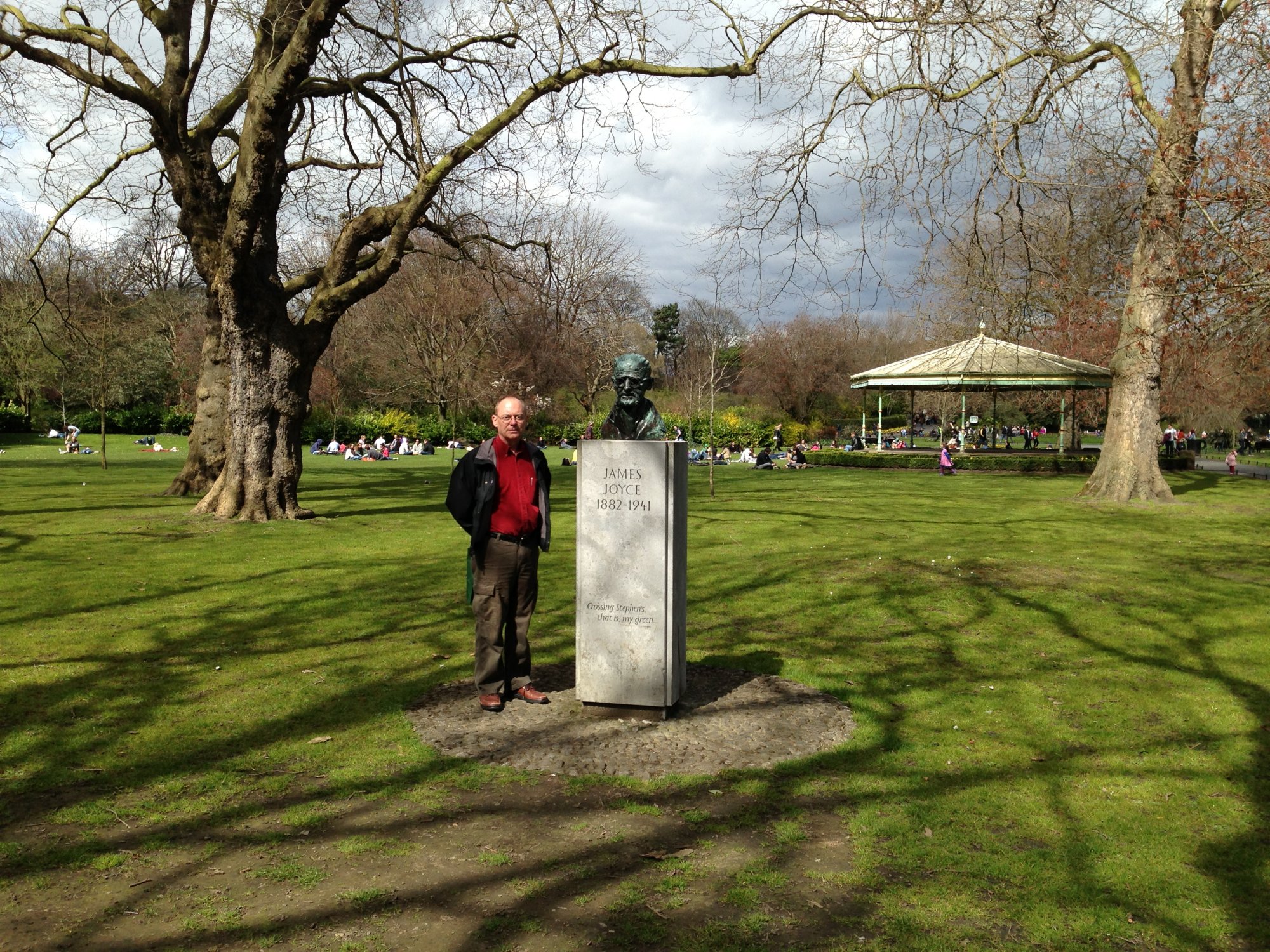
St. Stephen’s Green, the Central Park of Dublin, was just a short walk from our hotel. Wikipedia has details and a map. The park includes a bust of James Joyce. (Click on any of these thumbnails for much larger images.)

005

Here I am by the bust of James Joyce.

026

It has a couple ponds; here’s one.

006

At the northwest corner of the park is the Stephen’s Green Shopping Mall, an ornate structure that looks like this inside–

012

Though its contents are not as impressive as its venue; a lot of standard tourist souvenir shops, mostly.

Here I am standing (not very upright) at the corner of Dame Street and Grafton Street, just across the street from Trinity College (to the right) and nearby a used bookstore, on the left, whose name I don’t remember and can’t quite make out from the Google image searches. A kind of used bookstore that has virtually vanished from large American cities, but that had lots of fascinating books on various art/literature/gay topics.

017

Here’s the River Liffey, which runs through the center of the city.

020

The central library at Trinity College is this modernist, cubist structure, with a Pomodoro Sphere sculpture in the front–

029\

(Coincidentally, we saw another Pomodoro sculpture in the front of the UN building in New York City, just a few weeks later — http://en.wikipedia.org/wiki/File:NYC_UN_Gift_of_Italy.jpg)

Trinity College is, somewhat like Harvard, which I visited briefly maybe 20 years ago, a campus of large rectangular structures surrounding greenworks and trees.

033

In the center of the campus is the Campanile.

035

It was a cloudy day.

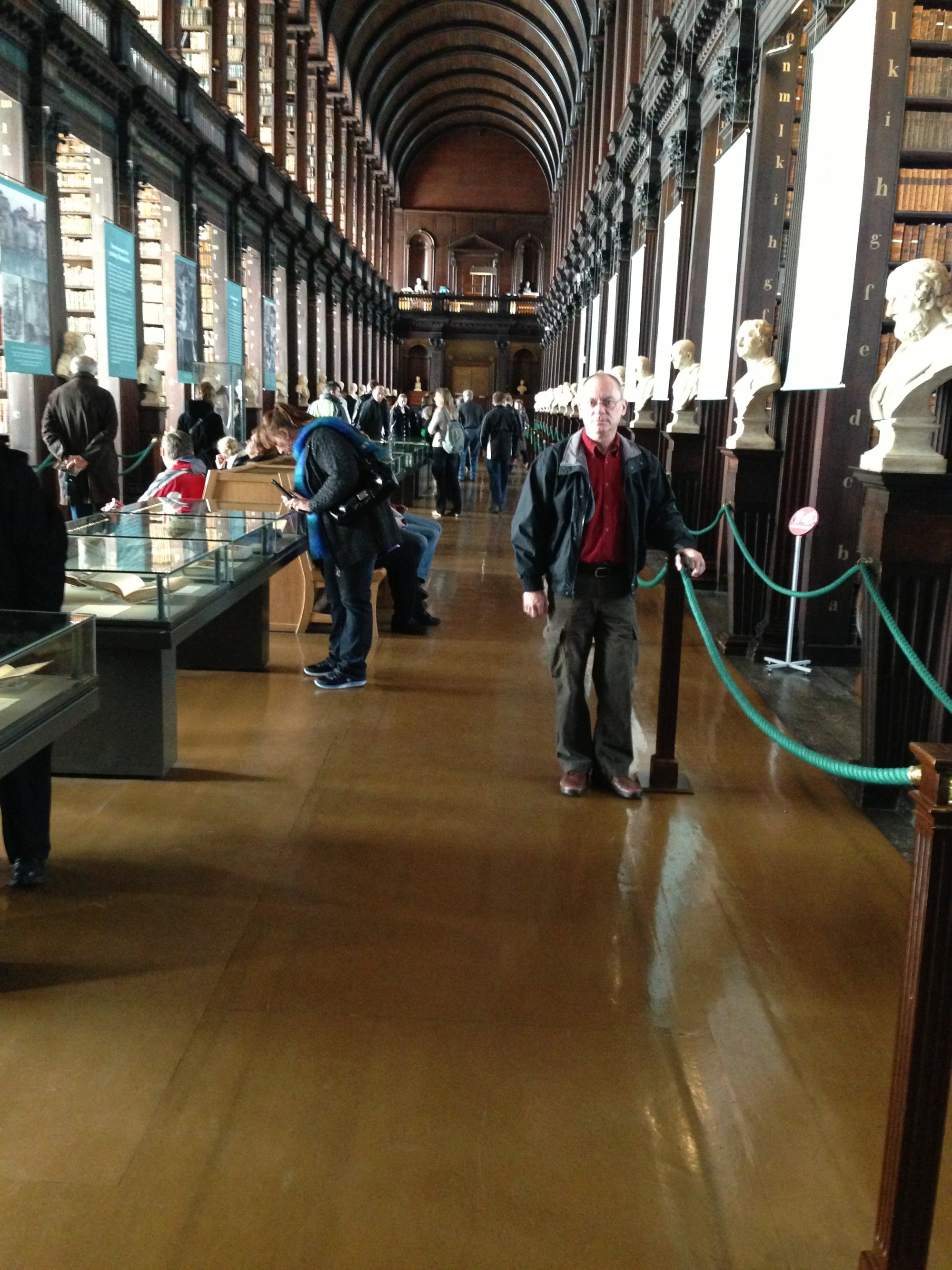
Then we went inside the Trinity College Library, a vast hallway with alcoves and shelves of varying heights. As the guide explained, tall books were put on the lower shelves, slightly less tall books on the shelves above those, and so on, with the smallest books on the top shelves. This seemed to be the the scheme, regardless of book subject or author.

Here’s a slightly crooked view, with me at right.

038

We visited Dublin Castle, but it was closed to visitors because of some diplomatic event. We were allowed to walk around the central gardens.

053

And we visited Christ Church Cathedral, across the street, with interesting catacombs.

064

All of this precedes the day trip to the Cliffs of Moher. Here’s a picture of me in front of Dunguaire Castle.

080

And here’s a picture of our driving along the Ireland country roads.

085

Here’s a pic of our very nice rental car — an Audi A6.

123

And here is one final pic from the Cliffs of Moher.

113

Posted in Travel | Comments Off on More Ireland Pics

Dublin Notes and Photos

Only four months late, here are some notes and observations I had about our trip to Dublin in late April. Yeong had a business conference for three days, Tuesday to Thursday. We flew in the previous weekend, and stayed through the following weekend. I jotted these notes in an email at the time…

Overcast/rainy most of the time. The tour guide at Trinity College said they have four days of sunlight per year. Joke? Perhaps not.

People walk quickly along the sidewalks. I walk fast, and kept being by overtaken women of a professional air.

I realize downtown Dublin is a tourist hub, but why all the streets so full of pedestrians at midday? Especially young 20-somethings of mixed races. Trinity College students? Didn’t strike me as student types, judging from the guide we had.

Aside from these younger energetic folk, population overwhelmingly white, pale, to the point of being pink, with a noticeable portion of ‘gingers’ – red-haired people. Not unattractive.

Every fourth person or so on the sidewalk smokes, a much higher percentage than in any American city I’ve been to lately.

Everything here is built of stone or brick, as pointed out by our Trinity College tour guide; earlier buildings of wood rotted away. The complete opposite of building construction in LA, of course, where stone and brick crumble in earthquakes.

Everyone jaywalks whenever possible, but then this is true in most cities, except LA.

And, apparently in a tacit concession to tourists and visitors from countries who drive on the ‘right’ side of the road, crosswalks routinely have stenciled instructions on the pavement to ‘look left’ or ‘look right’ before jaywalking.

I’ll also try to upload a few photos from my iPhone here. I don’t take many photos anymore; I find the preoccupation of many tourists with taking photos (often of themselves) as opposed to just experiencing the place they’re in, to be perverse. Also, I’m just not a very good photographer; I stopped trying to take photos of awards winners at conventions after one photo in particular was ridiculed online (because I could not control that the subjects were looking off in other directions, or had funny expressions on their faces). So I stopped taking an SLR camera with me on trips years ago. But now I have an iPhone, which brings a camera along with it.

I don’t have any photos of Dublin, actually, just a few from the day trip we took to the Cliffs of Moher, and along the way we stopped at Dunguaire Castle (which I Facebooked about earlier). Here’s a pic. (Click for much larger image.)

IMG_0142

If I can find my Facebook post about this, I’ll link or quote it, but Fb does not seem easy to search among older posts.

Here is a view outward from the top.

Img_0144

Here is Yeong from the top, the view looking back toward the road.

Img_0146

The top floor is lavishly furnished, and was occupied until only a few decades ago…

Img_0148

And the steps from floor to floor are narrow and spiral.

Img_0149

Onward to the Cliffs of Moher.

Img_0151

The cliffs are beds of shale and sandstone, some 300 million years worth, having been eroded by the continuous onslaught of the Atlantic Ocean. There are trails along the edges of the cliffs for a mile or two in either direction from the visitor center. We spent a couple hours walking back and forth. It’s easy to see how daredevil tourists might get too close and fall over, and there are signs warning about this. At the visitor center, I asked a clerk if anyone had fallen over recently. Not this year, she said.

Img_0152

Finally, a view toward the visitor center from the cliff edge trail (with the cliffs just off camera to left). The visitor center and cafeteria are built into the hillside, much like Hobbiton.

Img_0157

That’s all for now. There are more pics, including some from Dublin, on Yeong’s iPhone. I’ll track them down.

Posted in Travel | Comments Off on Dublin Notes and Photos

Stuff Christian Culture Likes

http://www.stuffchristianculturelikes.com/

I happened upon this site recently, and was compelled to click through the 80 or so pages — there are now 234 posts, and only three posts per page, with no easy way to skim or search through all of them, except by clicking backwards page by page. It’s been posted since 2008.

The author says she is “a preacher’s kid and I’m also married to a preacher’s kid” but she writes now like an outsider, rather like an anthropologist. Her tone is occasionally wry, but not snarky.

I was fascinated by this site mostly because I have family living in Tennessee who are part of a Christian community. In fact, several posts on this site rung bells considering my family’s Facebook posts. Such as these, here with comments by the blogger.

Bible verse as Facebook status

When Facebook asks “What’s on your mind?” the Christian’s answer is often a verse. And just as often, dozens of people (presumably also Christians) click that they “like” it, no matter how obscure the reference. It begs the question, if their pastor or his wife made Ezekiel 23:20 their status, would everyone still be compelled to like it? Unfortunately we will probably never know.

Africa

Christian culture sure does like Africa. It is their continent of choice for missions work. If you grow up in American Christian culture you hear so much about Africa that you have a strong suspicion that God will make you a missionary there when you grow up. You learn in Sunday school that Amy Carmichael prayed for blue eyes every day and then she grew up to be a missionary in India and thus her brown eyes help her blend in better and that’s why God didn’t give her blue eyes. You are pretty sure God will do something like that to you even though your eyes are blue, but he’ll probably send you to Africa and not India like Amy.

Taking pictures with poor foreign children on missions trips

Kirk Cameron

Knowing beyond a shadow of a doubt

Evangelicals like to invoke the shadow of doubt whilst discussing God’s existence and his will. Being certain feels awesome. But Christian culture’s very favorite thing to know beyond a shadow of a doubt is where one will spend eternity. Where will you spend eternity? That person happens to know beyond a shadow of a doubt.

Homeschooling

Studies show that homeschooling is preferred two to one amongst Christian culture families. They often cite a reason for homeschooling is a way to protect their kids from the world.

There are many other posts that I would expect in this context.

Michele Bachmann

Saying “Love the sinner, hate the sin”

When pressed, a person in Christian culture will often concede that it’s okay to be gay as long as you don’t act on said gayness. You know, because of Leviticus. And they won’t think twice about saying this to you over shellfish after working on Saturday while wearing clothes with two types of fibers and after cutting the hair on the sides of their heads. Then after all this they might remind you that they love that sinner but sure hate that sin. If you choose this moment to tell them they’re quoting a Hindu, expect them to be defiant, or at the very least confused. They may be just as baffled by another of his quotes: “I like your Christ. I do not like your Christians. They are so unlike your Christ.”

Not Secular Humanism

Perceiving Persecution

Christian culture sees persecution in all sorts of things and they often say they’re under attack. The institution of marriage is under attack, the right to life is under attack, free speech is under attack and on top of all that, the liberal media tries to make them look dumb. Although they say free speech is under attack, they have no use for the ACLU. Some of them call it the Anti-Christian Liberals Union or Anti-Christian Litigation Unit.

Countering the Gay Agenda

Christian culture is deeply afraid of some sort of indoctrination by homosexuals. At this website they say “Gay activists realize that if they can capture the hearts and minds of the next generation, they will, for all practical purposes, have won the culture war.” There’s that culture war again. The fact that Christian culture is so invested in the idea of a culture war is interesting because the Jesus they claim to follow didn’t promote a culture, but rather a consuming love that casts out all fear. The fact that Christian culture is so frightened makes you wonder what their motivation is.

Proposition 8

With the overturning of Prop 8, Christian culture is certain the end times* are upon us.

*The “end times” are the eschatological writings which depict a time of tribulation that precedes the return of the Messiah, i.e., what the Left Behind series was about.

Mike Huckabee’s stance on gay marriage

The possibility of donkey marriage becoming legal is terrifying to people who hold moral conventions close to their hearts. But Jesus did not endorse morals or politics. Jesus endorsed love and relationship. In particular, he endorsed showing unmerited favor (i.e., grace) to members of society whom the Pharisees deemed unsavory (i.e., tax collectors and prostitutes. Do homosexuals fall in this category?). Making same-sex marriage legal would mean Christians would have to relinquish some political and moral control and trust the issue to God. It is quite a conundrum for the Christian culture, indeed.

Biblical inerrancy

Christian culture is adamant about Biblical inerrancy. Sometimes it’s better to not get them started.

Not healthcare reform [a post from 2009]

Christian culture is rather unhappy about the proposals for healthcare reform. They’d threaten to move to Canada like they did when Obama won, but Canada has socialized medicine, so they’re up a creek on this one.

Not Obama

With Barack Obama as president, Christian culture is certain the end times are upon us.

Not Environmentalism

Not Legalizing Gay Marriage

Beliving that America is a Christian nation

Sarah Palin

White European Jesus

and of course,
Fox News

and of course,
Being Politically Conservative

At the same time, there are many posts about things I’ve never heard of at all — or would never have suspected were essential to Christian culture, or am surprised to see, such as this first one.

Disclaiming Pat Robertson

In an event of staggering rarity, Christian culture and non-Christians currently agree on something. Almost everyone seems to think that Pat Robertson is certifiably insane.

Sufjan Stevens

The Ungame

Screen printed dress shirts

Lost

Saying “Great Insight”

Worship leaders saying the lines before they are sung

The iPad

The Duggar family

Not Harry Potter

Getting rid of their secular music

Spanking

Astroglide

Pukka shells

Coldplay

But enough! I’ve spent another hour accumulating these links. (Why? See comment to previous post.)

Posted in Religion | Comments Off on Stuff Christian Culture Likes

Plinks: Adam Frank, PZ Myers, Hendrik Hertzberg

Just after yesterday’s post about Donald Prothero, on “The Serious Consequences of Science Illiteracy”, comes this op-ed by scientist Adam Frank in the New York Times, which says pretty much the same thing….

http://www.nytimes.com/2013/08/22/opinion/welcome-to-the-age-of-denial.html

The triumph of Western science led most of my professors to believe that progress was inevitable. While the bargain between science and political culture was at times challenged — the nuclear power debate of the 1970s, for example — the battles were fought using scientific evidence. Manufacturing doubt remained firmly off-limits.

Today, however, it is politically effective, and socially acceptable, to deny scientific fact. Narrowly defined, “creationism” was a minor current in American thinking for much of the 20th century. But in the years since I was a student, a well-funded effort has skillfully rebranded that ideology as “creation science” and pushed it into classrooms across the country. Though transparently unscientific, denying evolution has become a litmus test for some conservative politicians, even at the highest levels.

Meanwhile, climate deniers, taking pages from the creationists’ PR playbook, have manufactured doubt about fundamental issues in climate science that were decided scientifically decades ago. And anti-vaccine campaigners brandish a few long-discredited studies to make unproven claims about links between autism and vaccination.

The list goes on.

*

PZ Myers notes that Muslim fundamentalists are just as assertive about the veracity of the Qur’ān as Christian fundamentalists are about the Bible–

http://freethoughtblogs.com/pharyngula/2013/08/22/hamza-tzortzis-can-learn/

And there are Muslims who think that the Qur’ān is “not inaccurate or wrong” and therefore science must be rationalized in its context.

Myers quotes quotes his conclusions, and responds,

#1 and #2 are correct. #3 is assuming what they want to demonstrate. #4 is an exercise in rationalization, and cannot generate new knowledge; it’s an admission that science will drive progress and understanding, while the religious apologists will follow along behind and try to steal the credit.

*
One of the most incisive writers in The New Yorker, bylined in “The Talk of the Town” section, with the lead item every time I’ve noticed, is Hendrik Hertzberg. This past week I clicked through links and found his blog, and this particular post, about the Pope’s recent comments about atheists. The whole post is worth reading, but I was struck by this passage:

Something that has always puzzled me is the stated belief of some Christians in a God who is simultaneously (a) good, kind, forgiving, etc., and (b) capable of condemning people who lead virtuous lives to eternal torment (or even some lesser punishment) solely because they do not happen to believe He exists; or because they do believe He exists but decline to accord Jesus the status of supernatural savior, personal or otherwise; or because they regard the Bible as an admirable collection of folktales but no more divinely authored than any other purportedly sacred text or, for that matter, than the works of Shakespeare or the music of Mozart; or because they do not agree with this or that tenet of a particular religion.

If such a cruel, vain, and tyrannical God did exist, I can’t for the life of me see how the proper response would be to worship or even praise Him. Wouldn’t a more logical, more morally sound, more self-respecting response be to join a rebellion against Him—the Hell Liberation Front or some such—and try to overthrow Him?

I can’t help feeling pleased and grateful that Pope Francis doesn’t believe in that kind of God, even if for other reasons (lack of evidence, plus an inability to formulate a question or questions to which a God or gods would be a satisfactory answer) I can’t join him in believing in any sort of God at all.

PS. I should note that part of my purpose in this blog is simply to gather links and quotes that I might otherwise lose, as happened a while back when I was let go from a job and lost everything I had bookmarked on a work computer. That is, I don’t post these *necessarily* to be provocative, to anyone easily provoked. I have half a mind to write a book someday about how science fiction is an analog to the great philosophical debate of existence, to which religion and atheism are sideshows.

Posted in Philosophy, Quote at Length, Religion, Science | Comments Off on Plinks: Adam Frank, PZ Myers, Hendrik Hertzberg

How to Be a Successful Prophet: Applying The Jack Smith Rule

Jack Smith was a long-time columnist for the Los Angeles Times — here’s his Wikipedia entry — who died in 1996. What I remember after all these years from his reign, as a long-time reader of the LA Times since the 1970s, is his recurring suggestion that you can take any prophecy — he was focusing on psychics’ predictions — and become a more successful prophet than the psychics simply by taking any of their predictions, and predicting the opposite. No, the world will not end on such and such a date; no, Elizabeth Taylor will not marry Prince Rainier of Monaco, and so on.

(Here is an example from 1986 of one of his columns that discusses this, though I cannot find an earlier first source.)

Now, while Jack Smith was focusing on psychics, the same rule easily applies to religious fundamentalists, who are always predicting the end of the world, or various other calamities they would like to blame on liberal policies. Whenever you see one of these predictions — from Pat Robertson predicting the end of the world back in 1982, to Harold Camping‘s two recent end of world predictions that failed to come true, you can easily predict the opposite, and you will be a more successful prophet than they were.

As time has progressed, this principle seems to apply not just to fundamentalist pastors, but to popular figures in the conservative/Tea Party/Republican wing of American politics. One of my favorite, humorous (to me) websites, Right Wing Watch, daily documents loony statements by the likes of Glenn Beck, David Barton, Mike Huckabee, Kirk Cameron, and their like, about the imminent end of Western Civilization or the collapse of American society because of Obama, the gays, or the atheists.

So I here establish what I’ll call the Jack Smith Rule. I will use this in future posts. Take any prediction by a psychic, by an evangelical preacher, or by a right-wing spokesman, about the end of western civilization, the collapse of society due to gays being allowed to serve in the military, the consequences of same sex marriage, and so on and so on.

Predict the opposite.

You will win.

Their paranoid fears will not happen.

Here’s an easy one. Orson Scott Card’s latest rant has gotten much publicity [though it was posted in May], especially his comment that Obama is about to form some national police force…

Obama will put a thin veneer of training and military structure on urban gangs, and send them out to channel their violence against Obama’s enemies.

Instead of doing drive-by shootings in their own neighborhoods, these young thugs will do beatings and murders of people “trying to escape” — people who all seem to be leaders and members of groups that oppose Obama.

By the Jack Smith rule, let us predict: no, this will not happen.

Let us check back in three years, say, and see whose prediction, Card’s or mine, will come true.

(There have been similar predictions from right-wing politicians that Obama will somehow circumvent the Constitution and get himself elected for a third term. No, this will not happen either.)

There are so many more opportunities to apply this Jack Smith Rule. I am lining them up.

Posted in Thinking | Comments Off on How to Be a Successful Prophet: Applying The Jack Smith Rule

Donald Prothero on science illiteracy, the Dunning-Kruger effect

Another interesting blogger I’ve run across is Donald Prothero, author of a recent book called Reality Check: How Science Deniers Threaten Our Future, and a contributor to Skepticblog.

This post reads like an introduction to the theme of that book. The US thinks of itself as the #1 superpower in the world, with a monopoly on scientific achievement. But others were #1 in science in past centuries and millennia — the Greeks before Rome, the Arabs from roughly 800-1100 A.D., the Soviet Union in the mid-20th century. They were undone by Roman conquerors, Muslim religious extremism, and Soviet allegiance to ideology (Lysenkoism). And there are similar ominous trends in the US.

…the Bush Administration actively interfered with legitimate scientists, rewriting reports by federal scientists that disagree with their right-wing ideology, encouraging fringe scientists to testify as legitimate equals with well-regarded scientists in order to cancel out their politically inconvenient message, and generally ignoring the conclusions of scientists who don’t agree with them. As we saw in previous posts, the House “Science” Committees are run by creationists and climate deniers. The current Republican House majority asks global warming deniers and other fringe scientists to testify in front of Congress, and passes bills denying obvious scientific facts. Stem-cell research in the United States has been set back compared to that in other countries, as our best scientists go to countries with less political oppression.

On another topic, here he is on The Dunning-Kruger Effect, which says that

ignorant or unskilled people tend to overestimate their level of competence and expertise, while those who are truly expert sometimes underestimate their true level of expertise

Or as he quotes Bertrand Russell,

The trouble with the world is that the stupid are cocksure and the intelligent are full of doubt.

It seems to be a common effect lately, what with

non-experts trying to shout down people with expertise, or demagogues using the label of “elitism” to push their policies as they ridicule the experts who challenge them

He gives examples: Deepak Chopra, creationists like Duane Gish, the Bush administration, purveyors of quack medicine, climate change deniers, and the author of Conservapedia — about whom Prothero has this post in which said author tries to discredit Einstein and relativity by… quoting Bible verses.

Posted in Science | Comments Off on Donald Prothero on science illiteracy, the Dunning-Kruger effect

Plinks: Steven Pinker, Carl Zimmer, Anti-Intellect, History Chart, Weigel on Card

A collection of quotes from what I thought were interesting articles and posts and tweets, over the past week or more (I should post more often). (And actually, I’m saving a few for later posts.) Perhaps I will call posts like this Plinks — Personal links, and in analogy with the Blinks I do on Locus Online.

*

The most important item recently is this provocative essay by Steven Pinker about the tension between science and the humanities — and those who accuse science of ‘scientism’.

http://www.newrepublic.com/article/114127/science-not-enemy-humanities

(I know the eyes glaze over long quoted paragraphs. But I wouldn’t do this if I didn’t think these long paragraphs were worth reading.)

The moral worldview of any scientifically literate person — one who is not blinkered by fundamentalism — requires a radical break from religious conceptions of meaning and value.

To begin with, the findings of science entail that the belief systems of all the world’s traditional religions and cultures—their theories of the origins of life, humans, and societies—are factually mistaken. We know, but our ancestors did not, that humans be4long to a single species of African primate that developed agriculture, government, and writing late in its history. We know that our species is a tiny twig of a genealogical tree that embraces all living things and that emerged from prebiotic chemicals almost four billion years ago. We know that we live on a planet that revolves around one of a hundred billion stars in our galaxy, which is one of a hundred billion galaxies in a 13.8-billion-year-old universe, possibly one of a vast number of universes. We know that our intuitions about space, time, matter, and causation are incommensurable with the nature of reality on scales that are very large and very small. We know that the laws governing the physical world (including accidents, disease, and other misfortunes) have no goals that pertain to human well-being. There is no such thing as fate, providence, karma, spells, curses, augury, divine retribution, or answered prayers—though the discrepancy between the laws of probability and the workings of cognition may explain why people believe there are. And we know that we did not always know these things, that the beloved convictions of every time and culture may be decisively falsified, doubtless including some we hold today.

And:

The phenomena we experience may be explained by principles that are more general than the phenomena themselves. These principles may in turn be explained by more fundamental principles, and so on. In making sense of our world, there should be few occasions in which we are forced to concede “It just is” or “It’s magic” or “Because I said so.”

*

Carl Zimmer, at National Geographic, takes on evolution denialists who keep changing the terms of what evidence they would acknowledge…

http://phenomena.nationalgeographic.com/2013/08/16/experimental-evolution-and-the-false-solace-of-theyre-still-bacteria/

Re: Darwin:

He pointed out, for instance, that natural selection was a logical — even inescapable — fact of life. Individuals varied in their traits. Some of those variations influenced how many offspring they had. And those traits could also be passed down to offspring. Under such conditions, natural selection just happens.

This captures a point not generally appreciated — never mind all the evidence or disputations thereof. The principles of natural selection only require what he describes, and it’s inevitable — which is why the principles apply not only to biological history, but in many other arenas, and why it’s been called perhaps the single greatest idea of all time.

*

The Anti-Intellect Blog on Facebook
https://www.facebook.com/pages/The-Anti-Intellect-Blog/346440785368116?ref=stream&hc_location=stream

Belief or disbelief in god is not about intelligence, though that factors. It’s about the serviceability of myths. Who needs them and why. Belief in god also has a lot to do with ignorance and indoctrination. A person is not necessarily dumb because they believe in god or intelligent because they do not. Some “smart” people believe in god. Some “dumb” people do not. The problem with belief in god is that it is a human idea, subject to whim. Or at least that is one of the problems. There’s also no evidence to back up the claim, but people love believing things without evidence.

Whoever this guy is, he seems to tweet constantly, about religious, gay, and feminist issues, and he has a book of essays coming out next February, under this alias. (Which alias is obviously some kind of irony.)

*

These I already posted on Facebook:

Cool chart:

http://www.slate.com/blogs/the_vault/2013/08/12/the_1931_histomap_the_entire_history_of_the_world_distilled_into_a_single.html

A 1931 chart of human history since 2000 BC. It’s remarkable for how slender the two centuries of the United States is, against 4000 years of history — not to mention the millions and billions of years of Earth history before that.

*

David Weigel of Slate comments about Orson Scott Card’s “fascinating political paranoia” — in a long column Card presents as a “thought experiment” about “how American democracy ends”.
http://www.slate.com/blogs/weigel/2013/08/14/orson_scott_card_worries_about_obama_turning_urban_gangs_into_his_personal.html

Card:
Obama is, by character and preference, a dictator. He hates the very idea of compromise; he demonizes his critics and despises even his own toadies in the liberal press. He circumvented Congress as soon as he got into office by appointing “czars” who didn’t need Senate approval. His own party hasn’t passed a budget ever in the Senate.

In other words, Obama already acts as if the Constitution were just for show. Like Augustus, he pretends to govern within its framework, but in fact he treats it with contempt.

To which Weigel responds:
Here on Earth, Obama has actually signed off on a series of compromises that fell short of what he demanded—the health care law, the debt limit increases — and he’s only the latest president to appoint a series of advisers who are termed “czars.”

Weigel goes on. I can’t bring myself to read the entire Card piece.

Posted in Commonplace Book, Quote at Length, Science, Thinking | Comments Off on Plinks: Steven Pinker, Carl Zimmer, Anti-Intellect, History Chart, Weigel on Card

Review of Lauren Beukes’ The Shining Girls


Having just posted Gary K. Wolfe’s Locus review of The Shining Girls by Lauren Beukes, it’s timely for me to spend a few minutes adding my own reaction.

To summarize very briefly (since you can read Gary’s summary right there), the novel is about a serial killer, Harper Curtis, in Chicago who occupies a run-down house (‘The House‘) in a deserted part of the city. The house enables him to move back in forth in time — from 1931 to 1993, at least — and inside the house is a room with names of women on the wall. These are the ‘shining girls‘ that Curtis becomes compelled to seek out and murder. The novel alternates, roughly, between Curtis and a young woman, Kirby Mazrachi, who, unbeknownst to Curtis, survived one of his attacks. Kirby subsequently takes a job as an intern at the Chicago Sun Times to try to track him down.

As in any serial killer novel, I suppose, some descriptions of violence are pretty brutal. But Beukes can write tenderly and movingly too, in passages like this, in which she describes the consequences of one victim’s murder:

Her father will never recover. His weight drops away until he becomes a wan parody of the loud and opinionated estate agent who would pick a fight at the barbecue about the game. He loses all interest in selling houses. He tapers off mid-sales pitch, looking at the blank spaces on the wall between the perfect family portraits or worse, at the grouting between the tiles of the en-suite bathroom. He learns to fake it, to clamp the sadness down. At home, he starts cooking. He teaches himself French cuisine. But all food tastes bland to him.

Gary’s review sort of gives away what I might have thought would be a spoiler. No, not whether the bad guy is caught at the end — rather, what’s up with this House, why *these* girls and not others, say. But I’ll continue under the link…

[ show/hide spoiler discussion ]

It’s not a spoiler partly because of the comparison of this book to Audrey Niffenegger’s The Time Traveler’s Wife. Which is to say: there is no explanation for the time travel in this book, any more than there was in that one. It just is. No explanation for why those girls and not others. They just are, they’re victims.

However…. as Gary did not mention in his review… there are suggestions of a Heinleinian “By His Bootstraps” closed loop of causality. The first hint I saw was on page 188 — Curtis gives an old woman the same coat he takes from her later in time (but earlier in the book) — the coat in which he found the key to the House. And then at the very end, when Curtis has been vanquished, a by-passer finds the key that he has dropped, and uses it to enter the house — and this is Bartek, who Curtis earlier/later killed when *he* found the house. So.

Does this ‘explain’ anything, or is it just a bit of cleverness? I think these are nods to readers who might recognize such allusions — as Gary mentioned, Beukes is apparently genre-savvy — but aren’t actually intended as explanations in the Heinleinian sense, or any science fictional sense. So I guess the point is, and Gary’s point in his review is, that devices like time travel are so taken for granted in popular culture that they don’t need ‘explanation’ or justification anymore.

Unless you’re expecting hard-headed rational science fiction, which this book obviously isn’t. The result instead is, here we have a time travel novel that is not, as most time travel novels are, science fiction.

Posted in Reviews | Comments Off on Review of Lauren Beukes’ The Shining Girls