David Barton, Just this once

Life is too short for this kind of post very often, but once in a while I can’t resist.

Discredited historian David Barton (whose book about Jefferson was withdrawn by its [Christian] publisher Thomas Nelson, for gross inaccuracies), claims that good scientists and mathematicians must first have a proper fear of the Lord.

This would explain why science (and therefore technology) in non-Christian nations like China and India doesn’t work.

Oh, wait.

(Or are scientists in those countries ‘bad’? What would that mean? Science works the same everywhere. There is no Christian science vs Muslim science vs Buddhist science. Science works independently of, and despite, any kind of religious faith.)

In his latest pronouncement, Barton claims that Everything The Bible Says Will Eventually Be Confirmed By Science.

No, it won’t. (A trivial application of the Jack Smith rule.) If anything, the trend is pretty obviously in the opposite direction.

As Right Wing Watch comments,

Obviously, it is now only a matter of time before modern science conclusively proves that adulterers, homosexuals, heathens, blasphemers, and rebellious children must be put to death, just like the Bible says.

As far as I can tell, Barton makes a living telling credulous Christian fundamentalists what they want to hear.

Posted in Lunacy, Religion | Comments Off on David Barton, Just this once

Another favorite song from May: Empire of the Sun: Alive

Though I rather liked it better before I saw the video.

Posted in Music | Comments Off on Another favorite song from May: Empire of the Sun: Alive

Favorite song from May; Mr Little Jeans – Oh Sailor

Posted in Music | Comments Off on Favorite song from May; Mr Little Jeans – Oh Sailor

Religion and Community

Another provocative, insightful essay by Connor Wood, expanding on the theme of the earlier essay I linked, this one keying off the conclusion of a study done by three psychologists.

http://www.patheos.com/blogs/scienceonreligion/2013/09/ritual-creates-tribesand-tribalism/

The study concludes it’s not religious belief, per se, that drives violence and intolerance of others — it’s religious *practice*, the rituals that reinforce belonging to a tribe, and a concomitant distrust of other tribes.

Wood concludes with a contrast between worldviews similar to the one in the previous essay:

In a lot of ways, then, religion is a Catch-22. It primes us to be strongly bonded to the people around us, which is one of the single biggest predictors of personal happiness, health, and life satisfaction. We’re evolved to be tribal animals, after all – it makes sense that living in a strong tribe would make us feel warm and fuzzy. But the stronger our tribes get, the more outsiders look like aliens, or like enemies. Ritual per se doesn’t produce this effect, but instead piggybacks on it and intensifies it. The result is that religious people the world over are a bit more likely to be parochial, local-minded, and suspicious of outsiders than their non-religious peers. In its extreme manifestations, this dynamic produces religious wars – such as the 30 Years War that helped kick off the European Enlightenment.

Enlightenment and humanistic values, in contrast, tend to look askance at strong ingroup bonds and ritual, and to preference universalistic values that shatter tribal boundaries. In fact, this post-tribal value system may the knotty root of the religion-science schism; just like religion piggybacks on our tribal tendencies, science historically has piggybacked on our anti-tribal instincts, valorizing a culture-free, objective picture of reality and making many scientists coolly suspicious of ritual, religion, and most tribal identifiers. (When was the last time you saw a famous scientist wearing Denver Broncos facepaint? Never, that’s when.)

This makes sense to me; religion is largely about tribalism — or to use less loaded terms, community; culture. The corollary, is that, ironically, the exact nature of religious beliefs isn’t that important. It’s that everyone in the tribe (group, community) shares them.

This explains the paradox [which I’ve never entirely understood] of why it apparently doesn’t bother most religious people that people of other religions have diametrically, contradictory, different beliefs. They have *some* beliefs, and thus can be respected, in a sense, as members of different tribes.

Whereas atheists! This analysis also explains why atheists are the least trusted of any social, religious, or ethnic group. They’re loose cannons; you don’t know what they’re thinking; you can’t assign them to a tribe; you can’t trust them to conform to some pre-assigned set of beliefs and values.

One can one do with this insight? Just as being aware of the mind’s inherent biases can enable one to *try* to overcome them, would knowledge of this tribalistic connection to religious ritual help a religious person to understand that it’s not about the content — that, you know, all those things about gods and miracles, angels and demons, don’t have to be literally true?

Posted in Culture, Quote at Length, Religion | Comments Off on Religion and Community

Progressives and Regressives

The passage cited in the previous post reminded me of a Facebook post from Robert Reich, several weeks ago, which I managed to track down via Google and capture here for my reference.

Why is it that most progressives live in cities and on the coasts where there are major ports, while most regressives live in rural areas far removed from the nation’s major ports and cities? The same pattern holds in other nations and regions of the world. Historically, fascist movements have begun inland; liberal movements, around major seaports and cities. It’s probably because major ports and cities are far more exposed to the rest of the world, and to a diverse range of people and a broad range of ideas, while rural inland areas are more homogeneous and insular. America’s regressives — trying to stop abortions, prevent gay marriages, keep their guns, hold back immigration, militarize the border, limit voting rights, prevent the teaching of evolution, deny climate change, tear down the wall between church and state, and cut safety nets — reflect the values and views of those who are cut off from the realities of the 21st century. Our problem is they have disproportionate political power, and are determined to hold onto it as long as they can.

This verges on caricature; yet. The reason folks who live in rural areas tend to be ‘homogenous and insular’ is because the kids who grow up there — I’m especially thinking of the kids who realize at some some point they are gay — [this is not something they can control, something that is ageless throughout human culture, though this is a topic for another post] — tend to *move away* from those small town places, to the big cities. This is a long-recognized pattern. Thus the big cities become more diverse, and the small towns they left remain homogeneous, and insular.

A similar effect explains why journalists and university professors and show biz folks are more progressive. Partly first, because they are exposed to more diverse types of people and necessarily shed their prejudices about anyone who is different from themselves. And second, frankly, it’s because journalists and university professors are more informed about the world around them, not just within their specialties. The reason most journalists are liberal is because they know more about the world than most of their readers. The reason most university professors are liberal is because they know more about the world than the conservatives who, thinking they already have the answers to everything through their religion, don’t go to those universities in the first place. 😉 Or only go to ‘universities’ that exist to confirm their religious convictions — Christian universities — without challenging anything they might already think or believe… which deny, I would think, what universities should really be about.

Posted in Culture, Quote at Length | Comments Off on Progressives and Regressives

Conservatives and Liberals, and why we need both

I came across new blog on the vast Patheos website, Science on Religion, and this post by one Connor Wood, a PhD student at Boston University in religion and science, a post called Calling an End to the Culture Wars, which in turn links to his essay at CivilPolitics.org, from which I quote…

Conservatives are, for my purposes, people who exist close to the heart of a traditional culture, whatever that culture is. They tend to be invested in religion, because religion is another way of saying culture. They are not bigots per se, but they tend to distrust or act coolly toward those who live beyond the warm bubbles of their own traditions. Tribal beings, they are cocooned in worlds of constructed social meaning: culture.

Liberals, in contrast, are those who dwell at the flickering edges of their cultures, in the strange and eerie space between the spheres of the world’s traditions, religions, belief systems. They tend to be cosmopolitan, to live in places where many different cultures rub up against one another daily. Because of this exposure, liberals have perceptive, even burdensome insight into how each culture is flawed and deluded in its own, often very serious, way, and so they cannot allow themselves to buy into any of them wholesale. From a liberal perspective, to belong to a culture unthinkingly means to accept that culture’s injustices and stupid horrors: to grin blithely at the binding of women’s feet and the redlining of black neighborhoods. And so the liberal can never fully trust human culture. She is destined to live just at its peripheries, in the weird interstices between worlds.

Conservatives are microscopes. Liberals are macroscopes.

But conservatives, reliably, are happier.

The difficulty with being a progressive, radical, or liberal is that the scale of the world is far larger than a woman or man can ever be. There is a basic mismatch between the aspirations and dilemmas of liberal-leaning people and their meager status as individual, warm-blooded mammals who must live in family and tribe.

Posted in Culture, Quote at Length, Religion | Comments Off on Conservatives and Liberals, and why we need both

Frederik Pohl

I’m not sure it’s generally appreciated the extent to which Frederik Pohl underwent a sea change in the mid-70s, much as Silverberg had done a decade before [partly under Pohl’s editorship]. Pohl had been a significant writer in the ’50s, more of a significant editor in the ’60s, and then after a quiet period re-emerged as a major writer, an order of magnitude beyond his previous work. Initially with short fiction like “The Gold at the Starbow’s End” and “Shaffery Among the Immortals”, then with novels, first Man Plus (1976) and Gateway (1977), then with JEM and The Years of the City, with The Cool War and the Gateway sequels, and so on, with at least one substantial, if not always major, novel pretty much every year for another 25 years.

He was like Asimov, Clarke, and Heinlein, in that respect, all of whom had periods of silence in the ’60s and early ’70s until they reappeared with major works. As if to reassert the dominance of traditional SF after the passing turbulence of the New Wave. Not everyone welcomed their return. (I liked Gateway well enough, but at the time was more impressed by Benford’s In the Ocean of Night.)

I’ve read Pohl since the 1970 Ballantine release of collection Day Million, with reissues of several earlier collections, all with Escher-esque cover art by Ian Robertson. I only met Pohl twice, I think, once in ’78 at a book signing, because I have signed first editions of Man Plus and Gateway, and again about a decade ago, when I finagled my way to having dinner with Fred, his wife, and Charles Brown, on the last night of a convention, by offering to pay. (That works.) They were good conversationalists, as I recall, but finicky eaters.

Posted in Personal history, science fiction | Comments Off on Frederik Pohl

Does anyone ever change their minds about anything?

Via Andrew Sullivan

Why Even Your Best Arguments Never Work

The arguments people make are those that appear the strongest to themselves and the people who already agree with them. But such arguments tend to be meaningless to people who disagree.

How does this happen?

It starts with the universal desire to protect against threats to your self-image or self-worth. People are driven to view themselves in a positive light, and they will interpret information and take action in ways that preserve that view. The need to maintain self-worth is one reason we attribute our failures to external factors (bad luck), but our success to internal factors (skill.)

One line of research has found that self-affirmation—a mental exercise that increases feelings of self-worth—makes people more willing to accept threatening information. The idea is that by raising or “affirming” your self-worth, you can then encounter things that lower your self-worth without a net decrease. The affirmation and the threat effectively cancel each other out, and a positive image is maintained.

I find this kind of thing fascinating in a way even more than any particular political or scientific issue. Because it speaks to how human minds work, how they engage with the world. Every opinion or belief about science or religion or politics is hosted in a human mind, and human minds — so it seems — are riddled with biases that make it difficult to engage with the world as it ‘really’ is. And everybody does it; our minds all work basically the same way. This is why I’m fascinated by books like David McRaney’s, which explore cognitive biases, heuristics, and logical fallacies. Here’s a quote from the one I’m part way through — “You have a deep desire to be right all of the time and a deeper desire to see yourself in a positive light both morally and behaviorally. You can stretch your mind pretty far to achieve these goals.”

We all do this. We all engage in confirmation bias to seek out evidence to justify what we already believe, and ignore evidence that challenges it. We all use heuristics to simplify complex issues and get on with our lives.

But that doesn’t mean it’s hopeless to try to be aware of these biases and overcome them. I like to think that if I’m wrong about something, I’d like to know about it, and am willing to hear reasons why I should change my mind. At least I like to think that I am.

Posted in Quote at Length, Science, Thinking | Comments Off on Does anyone ever change their minds about anything?

Endeavour

Both boys are in town this holiday weekend, so the four of us headed (via lunch at a Korean BBQ place in a dicey part of town) to the California Science Center — one of a cluster of museums just south of downtown and USC and north of the Coliseum (focus of the 1984 Olympics) — where the space shuttle Endeavour has found its home, after the trip, almost a year ago now, on the 747 over Los Angeles, and the slow tow across the city from LAX to the Center.

The Science Center is largely an aerospace museum comparable to the Smithsonian’s in DC, or the Space Center in Huntsville AL, which I’ve been to several times — all of them preserving Mercury and Gemini and Apollo capsules, with mockups of satellites and rockets, and jet and experimental aircraft, such as the SR-71. Endeavour is obviously CSC’s crowning attraction. The facility is temporary, basically a large warehouse just big enough to hold it. An expansion of the center is planned, where the shuttle will sit upright.

I hadn’t planned to take pics, but started doing so on my iPhone when I saw this…

(Click or double-click to see huge photos)

IMG_0229

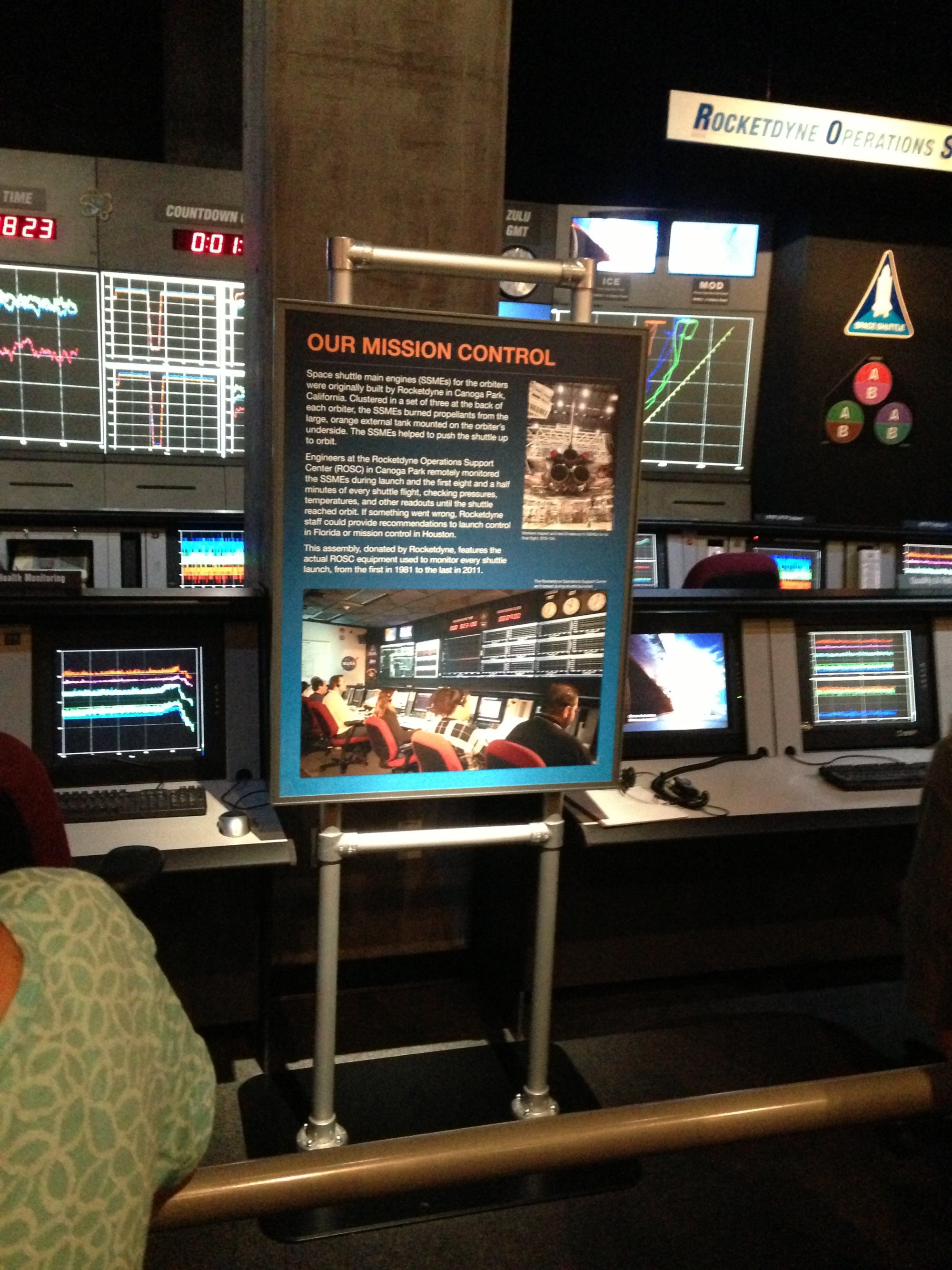
Not a great pic, but. This is the Rocketdyne Operations Support Center — ROSC — a set of computer consoles and screens that used to be a large room at my place of employment, in Canoga Park, CA. For the duration of the shuttle program, we maintained a sort of mini-Mission Control, where technicians would monitor the shuttle — in particular all the sensors in the SSMEs, Space Shuttle Main Engines — from before launch and especially for the 8 minutes of the launch while the SSMEs fired to put the Shuttle in orbit.

When the Shuttle program ended, Rocketdyne donated the whole facility — complete with desk chairs and Rocketdyne mugs — to the California Science Center.

(I never served duty in that room, being, as a software programmer, a couple steps removed from actual operations. But I’d been through the room several times.)

Here’s another pic of the ROSC, with the poster about where it came from.

Img_0232

Endeavour fills the space, so it’s hard to get good pics. Here are a couple.

IMG_0245

IMG_0242

And, at the back, the three SSMEs.

IMG_0238

In the northwest corner — about where I was standing to take previous pic — is a mounted SSME. (Not in great focus, sorry.)


Img_0234

Img_0235

And in this pic, the black box in the middle center of the frame, about the size of a microwave oven, is the Controller, which contained the software that monitored the sensors, 60 times a second (IIRC), and sent commands to the engines from the cockpit to throttle up, down, and so on. The software for this Controller is what I spent most of the ’80s maintaining.

Img_0233

By ‘maintaining’ I mean, making small changes to the operating instructions as NASA decided such changes were needed. But also, occasionally, redesigning entire sections of the logic to make it more efficient. This box had 16K memory -! Every word counted. The biggest thing I did in the late ’80s was to redesign the entire sensor processing module, which had been patched over several years, to make it more efficient and save some 10 or 20% of memory that it had taken up.

At the back end of the shuttle, under the tail and behind the landing gear hatches, were two open panels…

Img_0240

We deduced these were the connections from the fuel tank to the SSMEs. Both liquid oxygen and hydrogen.

Not a very clear pic, but–

IMG_0236

These are Jimmy, Michael, and Yeong, looking at the SSME. Michael is finishing his second summer internship at Rocketdyne, and is more knowledgeable by now than I am, about how rocket engines work. He’s headed to UCLA for grad school next month.

Finally,

IMG_0244

A schematic of what the eventual display of the shuttle will be, when it’s built. Upright, with fuel tanks and solids.


Posted in Personal history, Space | Comments Off on Endeavour

Respectful Insolence on the anti-vaxers; the healthcare crisis

Orac’s Respectful Insolence blog explores the motivations of anti-vaxers, via the recent news of the Texas church whose anti-vaccination advice resulted in an outbreak of measles (widely reported in the past few days).

Measles outbreaks, religion, and the reality of the antivaccine movement.

Orac (nom de plume of surgeon/scientist David Gorski) is brave enough to have read comments on various anti-vaxer sites. I almost never read comments on sites of any kind, since they mostly seem to be from trolls and loonies… (though at Little Green Footballs, Charles Johnson is frequently happy to reproduce numerous vile, vicious, racist comments from various right wing sites, and I do see those from time to time.)

Anyway, Orac draws this conclusion from those comments:

According to these people, parents who vaccinate their children are “ramming their beliefs down their children’s throats.” They also believe that vaccines are pure evil, entities whose only purpose is to kill, maim, and sicken, although why scientists who develop vaccines would want to kill, maim, and sicken children is never really explained. Usually it’s some sort of vague conspiracy theory in which these scientists and pediatricians, usually in the thrall of big pharma, want to ensnare children for the rest of their lives in pharma dependency, such that they have to take pills for diabetes, hypertension, asthma, and various other chronic health conditions. These are the people who are trying to influence others into not vaccinating. They are fanatical, and they are relentless. Indeed, they are very much like a religion.

Let’s emphasize this passage: “although why scientists who develop vaccines would want to kill, maim, and sicken children is never really explained”.

This rings bells with me, based on general attitudes about Obamacare and the long tradition of American anti-intellectualism on the right — as well as posts from my Tennessee family about their distrust of ‘big pharma’. (Those eggheads just can’t be trusted.)

It’s worth stepping back, and appreciating the bigger context. Which is, as I see it, that lifespans have increased over the past century, because medicine [like all science] has steadily improved, by its nature. But of course improved medical coverage comes at a cost. It involves more and more checkups, more tests, and more treatments. Those costs help people live longer and healthier, and of course they also benefit doctors and pharmaceutical companies, who provide those services. That’s what capitalism is all about; how could it not be so?.

It’s also the essence of the healthcare ‘crisis’ — as people live longer, more and more treatments are more and more expensive, and who’s going to pay for it?

So what do anti-vaxxers think is the problem with this? We live in a Capitalist society. What would be the alternative to the medical profession profiting from advanced treatments (including vaccines) to help everyone live longer, healthier, lives? Some kind of Socialism, in which taxes cover these services? Well, yes, perhaps that’s what Obamacare is about, to some extent. It’s worked well enough in various European countries. Otherwise those left out get sick and die on the streets, or are treated in emergency rooms, whose costs are passed on the rest of us as healthcare premiums. [I have to mention that objectors to Obamacare didn’t seem to mind nearly so much when it was Romneycare, inspired by a Republican think thank, in Massachusetts. It’s only when it’s associated with our black president that it become so objectionable.] (And of course I always wonder where the Christian response is, whose tenants apparently are about helping the poor, yet whose current response about any kind of social welfare programs seems to dismiss the poor as deadbeats.)

Posted in Religion, Science | Comments Off on Respectful Insolence on the anti-vaxers; the healthcare crisis