
Subtitle: Why evolution hid the truth from our eyes
(Norton, 2019, 250pp, plus color plates, including 45pp acknowledgements, notes, and index.)
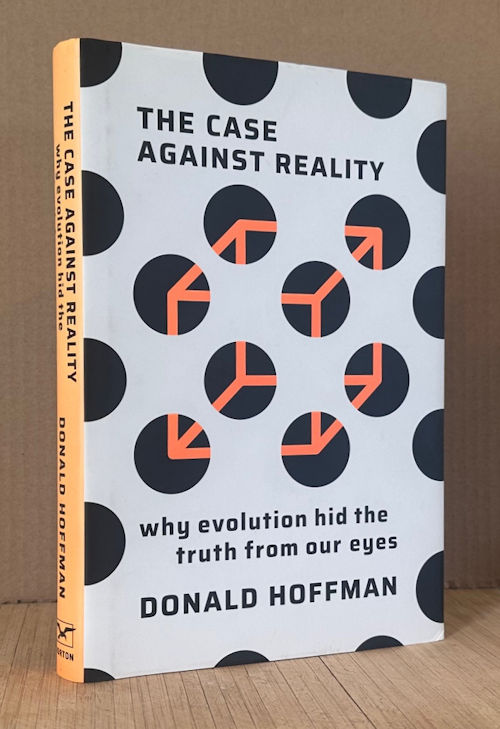
This is the first of three books I read in January, all with ostensibly similar themes, but actually quite different from one another in their perspectives and ultimate intents.
This one, for example, isn’t about evolution per se, as the subtitle suggests; it’s about how humans don’t perceive “true” reality, but only perceive reality in the sense of what is necessary for humans to survive and reproduce. OK, fine. I’ve made the same general point before. But he goes farther: he suggests that when we’re not looking at the moon, for example, the moon doesn’t exist. This goes back to certain philosophers, and sounds fatuous, and can only be true in the sense that humanity’s *conception* of what the moon is – filtered through our senses and our priorities for survival – ceases to exist when we’re not looking at it. It can’t mean that the physical object, the moon, that triggered our perceptions in the first place, ceases to exist. Yet he doesn’t want to spell this out; he leaves us with the impression that the actual moon ceases to exist when we’re not looking at it. Which I think is fatuous, and solipsistic.
Now the notion that we only perceive what’s necessary for survival is an old one. Humans are sensitive to potential dangers, and to potential friends and family, and so we are always perceiving things in the worst or best possible way. The rustle in the grass might be a snake; the shape of a cloud or a piece of bark might be a face. But Hoffman is going beyond that, into rather useless pedantry, it seems to me.
It reminds me of the reductionist trap of writers like Alex Rosenberg, who suggested that thoughts cannot actually be about anything, since thoughts consist only of activity between neurons. Just as, I suggested in my review of his book, words of the Bible can’t actually mean anything because they consist only of different arrangements of 26 letters.
Whereas other writers, like Pinker and Carroll, understand that reality exists on levels, or in phases, that can best be understood with language appropriate to each. The basic example being the sequence from physics to chemistry, biology, psychology, history. Chemistry has its own principles that needn’t be reduced to physics, and so on. You don’t understand history through the movements of elementary particles. That doesn’t mean that understanding history makes the elementary particles disappear.
Key Points
- Hoffman insists that the idea our senses tell us the truth, in order to enhance survival, is wrong. We don’t perceive objective reality.
- His metaphor is that what we perceive are like icons on a computer desktop; we don’t see the details of how the computer actually works.
- He focuses on what he calls FBT, Fitness-Beats-Truth, theories.
- Examples include how what we call ‘colors’ are just different wavelengths of light; how certain illusions (like the Necker cube) imply different understandings (so if we close our eyes, which version of the Necker cube is still there?); common misperceptions have been that the Earth is flat and at the center of the universe.
- Example of how signs of ‘beauty’ are actually indicators of fitness, for purposes of reproduction.
- He acknowledges examples of how truth and fitness are different things. Evolution works via algorithms; true perception can be counter-productive.
- Evolutionary strategies vary depending on the proportion of predator and prey using such strategies.
- He calls the idea of icons on the computer desktop the interface theory of perception, ITP. The icon hides all the tiresome details that we don’t need in order to make survival decisions. What ‘disappears’ when we cease looking is the icon.
- He extends these ideas to physics, recalling quantum theory. Reality is local. And so on, predicting that the concept of “spacetime” must go before a TOE (theory of everything) is achieved.
- Physics must be about something more fundamental than spacetime. Our three-dimensional world is a result of data compression, thus redundancy. Some visual illusions illustrate the principle.
- And how these ideas extend to colors, and ‘chromatures’, and how some people are synesthetes, another example of how our perceptions are not ‘true’.
- And so cause and effect are fiction, as are neurons, as our time and space. What to do? Author settles on the idea that consciousness is fundamental. Not panpsychism, but conscious agents that perform perceive/decide/act loops. And how this relates to entropy. And how this conscious realism can bring science and spirituality together. An infinite conscious agent sounds like God, even if it’s not omniscient. But don’t forget the message of the Copernican universe: it’s not about us.
Comments
I found the book generally unsatisfying, a mix of obvious points about how human perceptions can’t be completely ‘real’ (because of our limited senses, mostly), with pedantic points about how reality ceases to exist when not observed. Familiar examples of visual illusions are thrown in. He insists until the end that objects are destroyed when you look away. Perhaps I should have been forewarned by the blurbers on the back cover, none of whom I’ve heard of, except for… Deepak Chopra.
Detailed Notes
Preface, p xi
- Our senses help keep us alive, but is it because they tell us the truth? Why would our senses tell us the truth? Because of evolution. Those with more accurate senses survived, and so on.
- But these hunches are wrong. Our perceptions do not reveal objective reality. The idea that they mislead us about reality has been around for centuries: Democritus, Plato. What we perceive are instead metaphors, or icons, of reality, like a desktop icon hiding the details of how a computer works. Evolution has in effect given us simple icons that enable us to survive long enough to raise offspring. Perceiving raw truth would drive the species extinct. We still need to take those icons, our perceptions, seriously [because they work at the level of survival]. Seriously—but not literally. That’s what this book is about. This idea dovetails with discoveries in physics that are equally counterintuitive.
- The preface then summarizes each of the following chapters.
- Ch1: the great unsolved mystery of how brain activity generates conscious experience;
- Ch2: beauty and attraction through the lens of evolution;
- Ch3: some experts claim our senses do report some truths about reality, at least those that we need to raise kids; (Crick, Marr, Trivers)
- Ch4: other experts favor the Fitness-Beats-Truth (FBT) theories, that natural selection drives true perceptions to extinction, with confirmations from computer simulations;
- Ch5: then why are our senses useful if they don’t report truth? Because what we experience is a kind of virtual world;
- Ch6: similarly physicists admit that space, time, and objects are not fundamental either; that space-time is a kind of hologram. Something else is more fundamental;
- Ch7: spacetime is just a data format that serves to keep us alive, and our senses use ‘error-correcting codes’ to detect and correct data errors. Some visual illusions will demonstrate this.
- Ch8: colors are codes that compress data similar to how photos are compressed digitally. And “chromatures”, textured colors, trigger specific emotions and associations. About synesthetes who perceive the world differently from the norm.
- Ch9: perceptions take calories, so our senses cut corners, e.g. our vision is sharp only in a narrow central area.
- Ch10: So what is reality? We don’t know. But perhaps conscious experiences are fundamental, and perhaps consciousness does not arise from matter, as much as spacetime arises from consciousness—as a perceptual interface. [[ ok I can buy that, but interface to what? ]]
- So the purpose of this book is take off the VR headset—the red pill—and then to take off the next headset, the one we haven’t known that we’re wearing.
Ch1, Mystery: the scalpel that split consciousness
Beginning in 1962, Joseph Bogen and Philip Vogel sliced people’s brains in half, to cure epilepsy. Corpus callosotomy. Generally successful. It also changed consciousness. How the Helmholtz club met at UC Irvine beginning 1995. About consciousness. People have properties that rocks don’t. but the connection between these properties and activities in the brain is not clear. Leibniz in 1714. Thomas Huxley in 1869. William James in 1890. And others. The current question is, what is the biological basis of consciousness? Which presumes there is one. Already, the notion of an ‘elan vital’ had been discredited. Crick wrote his book but had no answer to the fundamental question. Experiments with split-brain patients; they recognize some things with their eyes, other things with their hands. Roger Sperry explained this; it’s about communication between the two hemispheres of the brain. Crick explained this as split consciousness. The two hemispheres have separate consciousness. One side can believe in God, the other not.
We know that specific activities in the brain correlate with specific mental states. Color. A certain type of stroke leaves one color-blind only in one hemisphere. Activity in a certain region of the brain corresponds with touch. Etc. Such regions are called NCCs. Necker cube. Phobias can be removed by manipulating how the NCCs are triggered. But we have no idea how any kind of physical activity gives rise to conscious experience. This is the “hard problem” of consciousness. 14b. We can say what a theory should contain, but no ideas have been proposed. [[ Actually *lots* of ideas have been proposed. ]] We want laws and principles that apply across species. Hand waving won’t do. Perhaps someday the double helix of neuroscience will be discovered. Or perhaps we simply won’t be able to understand it. Chomsky suggested there might be limits to human understanding. Author suspects he’s right, 16m. Or perhaps we’re hindered by a false belief. And perhaps the false belief is: we see reality as it is.
Of course we already realize we don’t see all of reality, e.g. wavelengths of light. Example of a tomato a meter away. When we close our eyes, the tomato is still there, right? But when we test this against ideas from various fields, and discover this belief is false, 17b. [[ ç ]] Consider that Necker cube. Which cube is still there, A or B? Depends on the observer, perhaps. The cube is a construction of your system of creating a reality… There have been other misperceptions: that the earth is flat, that it stands unmoving at the center of the universe. We believe what things “look as if.” We will see that our perceptions were shaped by natural selection of hide reality and report fitness. Galileo and the church. We must understand the evolution of perception in order to solve the problem of consciousness.
Ch2, Beauty: sirens of the gene.
Hume said it was in the eye of the beholder. Darwin explained that beauty was a judgment of fitness for reproduction. Evolutionary psychology makes new predictions. Begin by considering the perception of beauty in the animal kingdom. Jewel beetles. Beauty involves an unconscious computation. We make such judgments in a fraction of a second: a feeling that varies from hot to not. And if they’re wrong, those genes go extinct. It’s all about fitness. The genes are invisible; we judge the phenotypes. And often trifles. E.g. the limbal ring in the eye. They signal fitness and youth. Makeup. Some species mimic others. Examples. Women and iris sizes. Fertility implies that men should find women most beautiful at age twenty. But teen males prefer *older* women. Anime has depicted female characters with large irises for years. All of this is about parental investment. The greater one’s investment, the fussier your choice of mate. Examples. … there’s a tradeoff between testosterone and commitment. Experiments. The whites of the eyes, unique in humans, reveals the direction of a gaze. Twinkles in eyes. Examples. Kin selection. Inclusive fitness. Altruistic behaviors. … With this background we can move on the bigger question: do we perceive reality as it is?
Ch3, Reality: capers of the unseen sun, p40
Quote by Stephen Palmer about the accuracy of sight.
Author recalls challenging Crick’s ideas in his book. Do we construct our vision of the world, or perceive what’s really there all the time? Do we also construct the neurons? Crick summons Kant. We can’t know the thing in itself, but it’s still there. Things exist even when we’re not looking at them. The tomato again. Our minds are nothing but a pack of neurons. Qualia and conscious experiences. Discussion of David Marr. Who said vision generally matches reality due to evolutionary pressure. Author went to MIT to study with him. Marr died young, at 35. … author went to Irvine. Author recalls standard argument about the usefulness of accurate perceptions. Still, author doubts that our perceptions perceive objective reality. Our lexicon is powerless to describe reality. Example of what a fly perceives. It doesn’t matter as long as it successfully mates. Pinker explained why natural selection may not favor veridical perceptions. How the Mind Works. Quote 50.8. [[ the basic claim I’ve made too ]] Hawking and Mlodinow in The Grand Design. But what is true about a table may not be true about a neuron.
Ch4, Sensory: fitness beats truth, p53
Quotes by Dennett and Dawkins
Does natural selection favor true perceptions? We suppose a peach still exists when we don’t look at it, but we can’t test the idea either way. But we can test similar things, like the spin of an electron. But does evolution favor true perceptions? But fitness depends on the organism, the competition, etc. Payoffs can vary widely. Truth and fitness are different things. But evolution assumes that physical objects exist… But evolution works via algorithms. Evolution applies to languages, and scientific theories. And memes. Maybe even universes, via black holes. These ideas are ‘universal Darwinism.’ We can answer the key questions abstractly with this. Dennett’s universal acid. So in fact, natural selection drives true perception to extinction. We use the abstract algorithm via evolutionary game theory; Example of a particular scorpion. Some animals kill their rivals. There are two strategies: hawk, and dove. Summarized in a matrix, p59. The strategy favored by natural selection depends on the proportion of hawks and doves.
There are other strategies: domination, bistability, neutrality. There can be cycles, like rock/paper/scissors. Triggered by tiny changes; the butterfly effect. The FBT, fitness beats truth, theorem says that fitness drives truth to extinction, 61m. It’s been confirmed in many simulations. Consider how the amount of stuff can be too small or too large for fitness. It’s not true that humans’ larger brains perceive more truth. Actually brain sizes are shrinking, from 1500 cc to 1350 cc over 20,000y. As social complexity has increased. There is an objective reality, but we don’t perceive it correctly, e.g. in our terms of DNA, chromosomes, and so on. We model evolutionary games on graphs. Author’s student did a study that demonstrated some of all this. Is there a mistaken assumption somewhere? … example of state lottery. We don’t need all the details to predict how many people will win, just general principles. It’s not that our senses lie; they guide useful actions. The senses adapt to new contexts. Logic and communications theory deals with sets and messages without caring what their contents are. Trivers and Pinker sum up these conclusions. P74.
Ch5, Illusory: the bluff of a desktop, p75
Quote from The Matrix about the pills.
Suppose perceptual systems are user interfaces, like the desktop of a laptop. Call this the interface theory of perception, ITP. Recall the letter icon. The icon hides all the tiresome details. It lets us get complicated things done easily. So evolution shapes our senses to be user interfaces. We take our senses seriously, but not literally. Consider biohazard signs. Author objects to an objection by Michael Shermer. Author explains. Thus an object ceases to exist when we don’t look, because the object is only an icon. Recall the Necker cube; which cube remains when you don’t look? Answer: no cube. Is this preposterous? Surely a spoon is still there on the table. But different people see different spoons. Same for all objects, even spacetime itself. Something may be there all along, but not a spoon. This may align with Kant; things exist only in our perceptions. We understand this via evolution. Different species might well construct different interfaces, or umwelts. ITP doesn’t deny an objective reality, only that our perceptions describe that reality. Some things exist, others exist even when unperceived. Our problem is that we reify our perceptions. Consider a molecule of vanillin, and its taste. Recall Plato’s allegory of the cave. It doesn’t go far enough. Author counters objections. What are illusions? Perceptions that fail to guide adaptive behavior. E.g, a beetle that woos a bottle.
Consider how the tastes of different animals vary. Coprophages. So how is perception veridical? [[ it seems to me he’s creating a problem that doesn’t exist; things depend on context; our senses are limited, etc. that doesn’t mean real things don’t actually exist. ]] Other examples. What about our perceptions of math and logic? Are there selection pressures for them? Author disagrees with statement by Shermer. Scientific theories are only about interfaces. But can we refute ITP with physics?
Ch6, Gravity: spacetime is doomed, p94
So spacetime is the desktop of our interface and physical objects are its icons. A spoon ceases to exist when we look away. [[ he can’t literally mean this. He means that our conception of a spoon no long exists when we’re not looking at whatever it is we perceive as a spoon. ]] Our icons are similar, but not necessarily always the same. [[ all of this reminds me of the argument in that book by Alex Rosenberg. ]] Can we test these predictions? Einstein believed that objects still exist… local realism. But experiments in quantum theory are incompatible with local realism; Bell in 1964. Spins of electrons. Entanglement. Various theorems. … Carlo Rovelli has tried to explain this. Others argue on different grounds. Reality differs from one agent to another. Just as fitness values may vary for different people. Thus quantum theory and evobio are consistent, and analogous. 100b. Wheeler and Popper in 1987. The double-slit experiment, with a delayed-choice variation. And gravitational lenses. Wheeler thus undercut Einstein. Or that information, not matter, is fundamental. Our intuitions are wrong. Example of storing computer memory in spheres. Information corresponds to the area of surface of a sphere, not the volume. And spacetime has pixels, of Planck length. This is the holographic principle. The 3d world is a hologram coded on a 2d surface. Quantum theory assumes that information is never eradicated. But general relativity says information that crosses the event horizon of a black hole is erased. This is a paradox. Leonard Susskind resolved with complementarity. Then there’s a firewall paradox. And other ideas to avoid it. … Quantum states are beliefs of observers. So… physics does not proscribe ITP. But spacetime must go before a TOE is achieved. So, what is the bedrock of reality?
[[ This all goes to the idea that humans don’t perceive reality as it is… but not due to evolution, exactly. Mostly due to limited sensory organs ]]
Ch7, Virtuality: inflating a holoworld, p115
So, then, what is physics about? Something more fundamental than spacetime. No one knows what. But it’s an exciting idea, for physicists. Consider ideas of perception. Consider data compression. It’s the way we compress data that gives us a three dimensional world. Consider error correction. Which relies on redundancy. And so spacetime is redundant. Our third dimension is redundancy of the 2 d’s that contain all the information needed. While vision scientists assume vision is veridical. Yet our perception of symmetry does not require symmetry in objective reality. Symmetry is a kind of data compression and error correction. … others disagree. Casual interactions are fiction, 123m. then is consciousness also a fiction? See the PDA loop, p125, for how the fitness-payoff function works. Examples. Hose and snake. Visual illusions. Disks with a missing line, 128. Similar erasure errors p129, and a square. P130 with a cube. We perceive ‘entanglements’ and even glows in the connecting lines, and holographic inflation a third dimension. Similarly, shading of disks gives the illusion of a third dimension. Or curved lines in a circle. According to ITP, these are all codings for messages about fitness. Similarly photos of a person in jeans… So: spacetime and the objects in them are pre-existing; they are data structures of our own making to track fitness payoffs.
Ch8, Polychromy: mutations of an interface, p136
About color. We see only a narrow band; we delete data. Some of what we don’t see can kill us… but usually after we’ve raised children. We have three kinds of cones, plus rods; each is sensitive to different wavelengths, p137. Much data compression. The brain fixes errors, as in the Olympic rings illusion. Example figures. Other illusions. How we fill in colors we perceive are missing. Some colors align with specific emotions, p143. There are of course many different shades. Plants have photo receptors too. Some plants have more photoreceptors than we do. Of course we associate colors with familiar objects. We most often see colors not as flat areas, but areas of ‘chromatures.’ And some people are synesthetes, who associate colors with words or sounds or many other things. Music. Smells. Letters. Examples of individual artists. The effects are associated with particular genes. It can help with memory. In one way or another, it may help fitness behaviors. And yet another example of how our perceptions are not ‘true.’
Ch9, Scrutiny: you get what you need, in both life and business, p155
We’re alert for fitness, not truth. Yet we’re barraged by information, billions of bit each second. Compressed down. Change blindness. We have a visual spam-filter that ruthless deletes. Our visual focus is quite small. But our eyes keep moving. Saccades. This is applied to visual advertising. Some things ‘pop out.’ Photographers learn to avoid them, or edit them out. We group items together. 162-5. Grouping is a form of data compression. By shape, by color. Our focus can be derailed by movement, e.g. Again, advertisers use these principles. We tend to focus on eyes. Advertising icons can mimic them. And supernormal stimuli can divert us from fitness behaviors. … we remember locations where we found food, especially high calorie food. Recap 173.5. Another technique is scripted attention. As in ads, to focus on the product. We follow the gaze of other people. …He repeats his main thesis, e.g., he doesn’t believe the sun existed before there were creatures to perceive it. Yet for various reasons we do sometimes need to understand the objective reality behind what we perceive…
Ch10, Community: the network of conscious agents, p178
We still can’t fathom the mystery of how our minds understand experience. We’ve been duped into thinking that the brain understands things. We understand cause and effect in many situations, but it’s a fiction. Like playing a video game. Spacetime and its objects are doomed. Neurons are a fiction, etc. we can’t transcend the interface. So what do we do? Start with that PDA loop: perceive, decide, act. But suppose we are conscious agents. What is the objective world? Perhaps we’re simulations in some virtual world. But there’s no actual evidence that this is so. Does our knowing stop at some point? Recall Occam’s Razor. We should rely on a physical basis for consciousness. Or, conscious agents that are not objects in spacetime. Figure p184. Conscious realism. Consciousness is fundamental. But this is not panpsychism. … menu options. Measurable space. Author suggests that every aspect of consciousness can be modeled by conscious agents, 190.2. Kahneman. The simplest agent is ‘one-bit,’ with two experiences and two actions. … how this relates to entropy. And roots of these ideas in famous philosophers. About science as a method of inquiry. Two realms of human experience; Dawkins disagreed. Science is not an ontology. Author sees how conscious realism can bring science and spirituality together. The idea of an infinite conscious agent sounds like God. Even if not omniscient, etc etc. But all this misses the message of the Copernican universe: it’s not about us. Yet, there are countless conscious agents that may not be human. …
Appendix: Precisely: the right to be wrong.
Mathematical details about conscious agents.