Links and Comments: Jonathan Haidt; Religious presumption; Hanlon’s razor; H.L. Mencken; Mark Lilla on prophecy

The Atlantic: Jonathan Haidt Is Trying to Heal America’s Divisions: The psychologist shares his thoughts on the pandemic, polarization, and politics.

Great profile, though long, of Jonathan Haidt, author of one of the best books I’ve ever read, The Righteous Mind, subtitled “Why Good People Are Divided by Politics and Religion”.

Again, different people’s reactions to events may be differently appropriate depending on circumstances. Everyone isn’t the same; and circumstances change.

\\

Friendly Atheist: Believers Who Overestimate Their Religious Knowledge Like Violence the Most.

About a curious survey given to believers: a list of topics from the Bible, with some fake ones thrown in, to see how many survey-takers claim familiarity with the fake ones. This isn’t so much about the Biblical familiarity of believers (let alone their taste for violence), as it is another example of how many people feel the need to claim knowledge, or have opinions, about things they really know nothing about. Like those man-on-the-street interviews that do the same (e.g. as done by Jimmy Kimmel, 10 Times Jimmy Kimmel Found Out Interviewing People on the Street Can Be Disappointing). The corrective to this is: it’s OK not to have opinions about things you know nothing about. Just say, “I don’t know.”

The list of 73 Bible items, with 13 of them made up, is at the bottom of the post.

\\

Famous quote that I may have mentioned before: “It is difficult to get a man to understand something when his salary depends upon his not understanding it.” – Upton Sinclair. This applies to politicians who take certain positions (e.g. about climate change) because their wealthy donors require them to; it’s not a matter of considering the evidence and understanding the issues.

\\

Attendant thought of mine from a few days ago: Avoid crowds. You cannot think clearly in a crowd; you will not recognize truth, as opposed to consensus fantasies, when you’re in a crowd, whether a political rally or a church congregation. (This touches why, I think, in the current pandemic situation, it’s so important for so many people to go to church. For social reinforcement, presumably, never mind the Gospels’ admonitions to pray in private). In crowds, group thinking takes over, and the individual’s ability to reason is overwhelmed. That’s why many scientists, and artists, are loners.

\\

Another pertinent thought: Hanlon’s razor: Never attribute to malice that which is adequately explained by stupidity. Or, to cite variations, to incompetence. Or, I’d suggest, simple human error. Yet some people are attuned to perceive conspiracy theories everywhere.

\\

And yet one more, floating around for years, precisely pertinent now. H.L. Mencken:

As democracy is perfected, the office of president represents, more and more closely, the inner soul of the people. On some great and glorious day the plain folks of the land will reach their heart’s desire at last and the White House will be adorned by a downright moron.

\\

Somewhat related to this: Vox: Is America too libertarian to deal with the coronavirus?

Americans, who feel even more exceptional about themselves than how all peoples around the world feel themselves special and exceptional in some way, have a contrarian streak that resents expertise and authority. Thus the second wave of Covid 19.

\\

New York Times: Mark Lilla, author of The Once and Future Liberal (which I reviewed here): No One Knows What’s Going to Happen: Stop asking pundits to predict the future after the coronavirus. It doesn’t exist.

The best prophet, Thomas Hobbes once wrote, is the best guesser. That would seem to be the last word on our capacity to predict the future: We can’t.

But it is a truth humans have never been able to accept. People facing immediate danger want to hear an authoritative voice they can draw assurance from; they want to be told what will occur, how they should prepare, and that all will be well. We are not well designed, it seems, to live in uncertainty. Rousseau exaggerated only slightly when he said that when things are truly important, we prefer to be wrong than to believe nothing at all.

Trump! Coronavirus conspiracy theories! The essay considers historical methods of predicting the future (all of them of course phony):

In religions where the divine was thought to inscribe its messages in the natural world, specialists were taught to take auspices from the disposition of stars in the sky, from decks of cards, dice, a pile of sticks, a candle flame, a bowl of oily water, or the liver of some poor sheep. With these materials, battles could be planned, plagues predicted and bad marriages avoided.

And ends by advising a sense of perspective.

A dose of humility would do us good in the present moment. It might also help reconcile us to the radical uncertainty in which we are always living. Let us retire our prophets and augurs. And let us stop asking health specialists and public officials for confident projections they are in no position to make — and stop being disappointed when the ones we force out of them turn out to be wrong. (A shift from daily to weekly news conferences and reports would be a small step toward sobriety.)

Which echoes a point in my previous post — don’t be obsessive about consuming news. (And my corollary: and never get your news from social media.)

Posted in Culture, Religion | Comments Off on Links and Comments: Jonathan Haidt; Religious presumption; Hanlon’s razor; H.L. Mencken; Mark Lilla on prophecy

Rutger Bregman’s Ten Rules to Live By

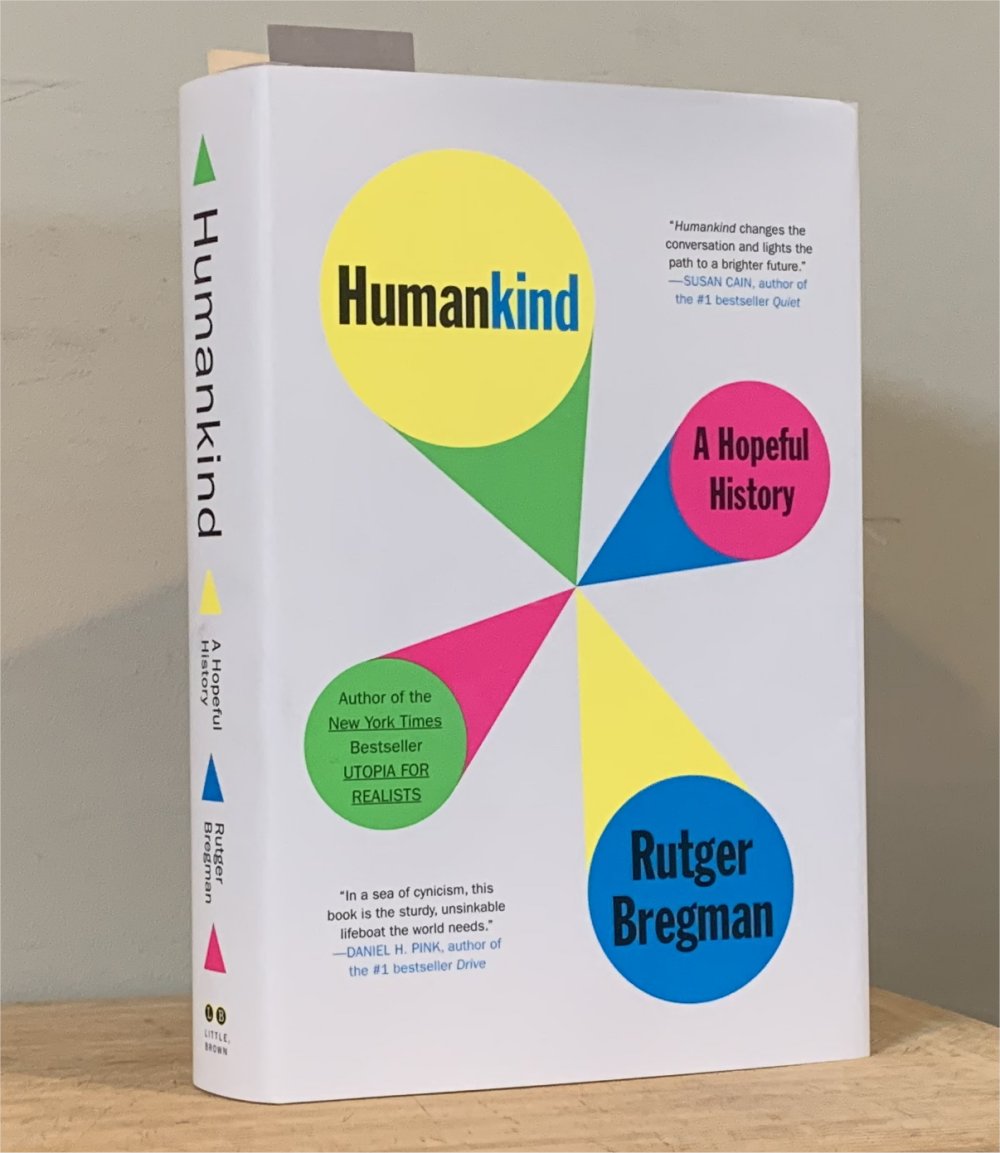
I do love lists, especially of principles, and a new one comes with a book called HUMANKIND: A HOPEFUL HISTORY, by Rutger Bregman, whose previous book was the provocative UTOPIA FOR REALISTS (which discussed, among other things, the idea of universal basic income). I haven’t read this new book yet, just done the preliminary inspection—glanced at the table of contents, glanced through the index for particular names and subjects, noted how substantiated it appears to be in some 50 pages of notes. Read the prologue. And of course read his epilogue, “Ten Rules to Live By.”

First, his thesis is that the common assumption is that people are bad and must be corralled and subjugated lest they run wild and civilization crumbles, is wrong. Rather, humans are good most of the time and should be given credit for being so. With that perspective, much about society could change.

OK, we’ll see. The premise does immediately evoke two ideas. First, the thinking in recent decades that the key skill that enabled humans to evolve and dominate the world isn’t, as was long thought, tool-making (as depicted, e.g., in 2001: A Space Odyssey), but sociability, the way humans (unlike other primates) cooperate with each other in groups and accomplish more than any individual could. (See E.O. Wilson’s books, especially The Social Conquest of Earth.) Such cooperative groups would be difficult if every person was “bad” and constantly looking for ways to cheat on others; the idea that most people are not like this is therefore plausible.

Second, religions invariably presume that humans are bad and must be repaired (a convenient thesis for maintenance of the clergy). The problem is “sin” – everyone is bad from birth! – and the solution is salvation (the need to be “saved”); or the problem is pride; the cure is submission (Islam); or the problem is chaos, and the cure is social order (Confucianism). And so on. These religious ideas are millennia old, and perhaps merely reflect issues that faced humanity as it abandoned the hunter-gatherer lifestyle in favor of fixed villages, for the support of agriculture and herding, and the consequent competition between such villages and thus instinctive suspicious of outsiders. Yet the growth over centuries of our species into a global culture has required cooperation, not knee-jerk demonization of others. Another reason religion is obsolete (but won’t go away). But I’m speculating; we’ll see where Bregman’s argument goes.

Anyway, I wanted to capture his “Ten Rules to Live By” and make some initial comments. These are in the epilogue beginning on page 381.

  1. When in doubt, assume the best
  2. Think in win-win scenarios
  3. Ask more questions
  4. Temper your empathy, train your compassion
  5. Try to understand the other, even if you don’t get where they’re coming from
  6. Love your own as others love their own
  7. Avoid the news
  8. Don’t punch Nazis
  9. Come out of the closet: don’t be ashamed to do good
  10. Be realistic

Bregman calls out Trump on #2; Trump thinks in order to win, the other side must lose. In fact, as Robert Wright described in NON-ZERO, and to parallel the idea of sociability and cooperation, the arc of history has been driven by non-zero-sum games, not Trump’s zero-sum games. Michael Shermer’s THE MORAL ARC describes a parallel path in the evolution of morality; granting oppressed groups equal rights doesn’t deprive anyone else of their rights (except where some, in the name of “religious liberty,” perversely insist on the right to deny rights to others).

The one that jumps out at me is #7, because I’ve been sounding this idea for a while. One reason many people think other people are bad, is because they’re always seeing people being bad on the news, especially on TV news. (Granted it’s ironic this book is being published just as “Black Lives Matter” protests have devolved into riots in so many places.) That’s because news shows what’s exceptional! I’ve said before something like, no matter how perfect society becomes, there will always be incidents that prove to some people that society is falling apart and needs a strong leader to make it great “again”… while all the evidence (Pinker, Rosling) is that, by any measure you can name, the world is a better place than it was 50, or 100, or 2000 years ago. And as I’ve also said before, it’s not that journalism is mendacious (well, some of it is); it’s a business, and you just have to understand its business goals and take them into account when consuming its product.

And my corollary to #7 is: Don’t get your news from social media!

I’ll expand on these ideas as I read through the book.


Posted in Book Notes, Culture | Comments Off on Rutger Bregman’s Ten Rules to Live By

Notes for the Book: Hierarchy of Attitudes about Gender and Sex

I’m rethinking a lot of matters, about epistemology, about culture and politics, as ranges of attitudes, from the intuitive and simplistic, to the informed and complex. Are some of these spectra, rather than hierarchies? A hierarchy implies that the top level is the superior one, and I would defend that take on the subjects outlined so far. Including this one, for now.

Here’s a hierarchy about sex and gender.

1. The simplest take is that sex, between male and female humans, is for the purpose of reproduction, period. It’s not about anything else, and therefore all occasions of such relations must be open to the possibility of reproduction. (Since obviously *every* instance of human sex doesn’t result in pregnancy. If this take was true, why wouldn’t it? Why didn’t God arrange for human pairs to have sex only a few times in their lives, each time resulting in a child? There are some animal species like this.) This is the Catholic Church’s position, as I understand it; thus its opposition to birth control, and to sexual relationships other than heterosexual ones (as “evil”).

2. The next level is recognizing that sexual relations between men and women have another –not purpose, that’s teleological– but function. Which is to bond two people together, simply to continue to enjoy the pleasures of sex (and daily living) together; the unconscious function is that they therefore stay together long enough to raise the children some of those encounters result in. (Very primitive human tribes, some of them in existence today in isolated parts of the world, do not actually understand the relationship between sex and children.) Still, this understanding can entail the stricture that sex should only be between one male and one female. Because that’s what’s “natural.”

3. The next level is recognizing what’s actually “natural.” Homosexuality isn’t some weird perversion of human beings; in fact, many animal species other than humans exhibit homosexual behavior. Here’s a list on Wikipedia: https://en.wikipedia.org/wiki/List_of_animals_displaying_homosexual_behavior. Years ago on Locus Online, back when I posted pages of “Aether Vibrations” (i.e. links and quotes about nonfiction articles and books of presumed interest to science fiction readers) I listed a a book about homosexual behavior in the animal kingdom. (Can’t find it just now, but will pursue.) Now, the question of *why* humans and other animals exhibit homosexual behavior is still open, I think; part of it is due the pair-bonding effect noted above. Sexual behavior has different functions among many species. See: bonobo, a pygmy chimpanzee closely related to humans.

4. And the next level is to recognize that human sexual behavior is about what’s possible. Humans are the most inventive animals on Earth. We are not constricted by pure biological functions. The identification of sex and gender is extremely fluid. (Imagine the opposite: if reality were like take 1, above, every male would be equally attracted and responsive to every female, and vice versa. But that obviously isn’t the case. Why does any one person, seeing the range of potential mates, click on *that* one, or *this* one, as opposed to all the others? I think to some extent it’s about childhood upbringing and experience, to contingency, and to an inherent exogamous instinct that drives attraction to the *other*, to people from other towns, to people from other cultures — because this instinct is built into the human race — no, again, that’s teleological — has evolved in the human race to increase diversity in the species, which works for long-term survival. …This fluidity of gender identification and sexual attraction is real, there’s further evidence of this every year, every decade. And this freaks out the fundamentalist adherents of level 1.

Of course it’s worth understanding context. The Biblical strictures of level 1 were set down thousands of years ago by desert tribes in an age before refrigeration or sanitation, in a violent age when tribes fought for resources, and arguably the survival of the tribe trumped any issues of personal choice or autonomy. Also, infant mortality has been high across history until the past century. Thus, all those barbaric rules from Leviticus might have made some kind of sense, even the ones about the handling of food, given the circumstances. But that was then, this is now. The Catholic church still behaves as if it’s humanity’s mission to fill up the planet as quickly as possible. That, of course, has led to the Sixth Extinction and the ongoing climate crisis that could well bring humanity to extinction. Circumstances have changed. But flexibility of thought is not a fundamentalist hallmark.

Years ago, back in 2014, I posted, as a footnote, some comments about the Christian opposition to homosexuality. It’s at the bottom of this post. I’ll reproduce those comments here.

You wouldn’t necessarily think there’s a connection between antipathy toward homosexuality and with being Christian (*footnote below), and I have no particular animosity against Christianity any more than other religions (all of which I find unpersuasive and obsolete, if not oppressive), yet again and again the hostility toward gays, especially in recent weeks and months, turns out to be religiously inspired –- by Christianity. It is hard for me to find much respect for a religion whose most outspoken representatives devote their lives (they have nothing better to do?) to marginalizing if not criminalizing people like me.

footnote:

*There are two or three other general reasons people seem to object to homosexuality. One, a (rather childish) squeamishness about people who do things one finds personally distasteful. Many people get past this reflexive attitude that people who are different from them are therefore inferior by the time they become adults, but not everyone.

Two, an existential panic on the part of parents that their kids being gay would preclude them having grandchildren. This is an attitude honed by the elementary logic of natural selection, of course; members of a population indifferent to having offspring, and their offspring having offspring, would not, to the extent this attitude is genetic, last long in the population.

A third would be the deep-seated biological protocols of species survival, which homosexuality would seem to (but in practice does not always) violate. This too, ironically, is an instinct built by evolution, a concept those who express this objection most strongly no doubt don’t “believe” in.

(So evolutionary speaking, why does homosexuality exist? An unsolved question, though with several potential explanations. Humans are not simple reproductive machines, optimized to generate offspring above all else, would be the general answer.)

Posted in Religion, The Book | Comments Off on Notes for the Book: Hierarchy of Attitudes about Gender and Sex

Notes for the Book: Hierarchy of Science Fiction

(updated 8jul20, with additional para’s at the end)

What is science fiction? Many things, and what interests me about science fiction is not reflected in all its forms, any more than any particular music fan, interesting in dance, say, or complex harmonization, embraces all styles of music. (Just as some people aren’t science fiction fans in any sense; some people aren’t interested in music in any more than an incidental sense–for example Isaac Asimov famously liked Gilbert & Sullivan musicals, but only for their librettos). And so a fan of “classical music” or “rock music” does not respond equally to the many examples even within those genres. There is insipid classical music, and elevator rock music, and there are also the highest forms and the classics in these genres, and there is always (this is perhaps the most important point) how any individual responds to varieties of music depending what they are exposed to as a child or teenager, or what they actively pursue as adults, which forms their particular tastes. I can certainly trace mine–how my tastes in various kinds of music formed mostly by chance exposures as I grew up, and only belatedly through any systematic exploration.

Similarly, I struggle to define my scope of what science fiction is all about, in this blog and in my imagined book, without seeming judgemental. Of course I am being judgmental, but only to the degree that there are forms of pop sci-fi (an abbreviation I would never use about literary SF) that simply don’t interest me, that I find… degraded? I’ll keep struggling to express this more respectfully.

In any social context, when I say that I read science fiction, or that I’m a science fiction reviewer, or that I run/contribute to a website about science fiction, there is usually the presumption that… I’m a Star Wars fan, or a Star Trek fan*, or an X-Files fan. Because these are the pop culture versions of science fiction. I try to be polite and clarify, but I cringe a little. (There’s also the occasional presumption that science fiction writers and readers are susceptible to the various forms of pseudoscience, especially about “belief” that UFOs are alien spacecraft. This is not true. Science fiction writers, and readers, are more savvy about science and pseudo-science than the average person, as I written about elsewhere.)

Thus my attempt at another hierarchy.

I’ve considered definitions and descriptions of science fiction before — some gathered on this page — but more work needs to be done. In particular, I’m attracted to the hierarchies of ideas I’ve posted recently, about awareness, about understanding, about knowledge and human affairs. Each of these proceeds in phases, or perhaps dimensions, from the most simple or intuitive, to the more complex or intellectual. In this light, let me draft a hierarchy of science fiction, from its most superficial, to its most complex.

  • The most superficial science fiction is simple-minded space opera: stories about battles between good vs. evil, about heroes vs. villains, translated into interplanetary and galactic settings, with no regard to scientific plausibility. (These used to be called “space opera,” as the counterpart to “horse opera,” when Western movies and TV shows about cowboys and Indians were popular, in the 1940s and ’50s and ’60s.) This includes the worst of Star Trek and perhaps all of Star Wars.
  • A step up are those stories about the consequences of fictional technology, even if not rigorously scientific (e.g. about space warps and time travel), and that avoid simplistic good-guy/bad-guy plots. I would guess the vast majority of classic science fiction novels and stories lie here. Much of science fiction, over the eight past decades, has presumed the existence of ESP and telepathy, of FTL drives, of time travel, all of which seem to have been invalidated by the best understanding of modern science.
  • And so the next step up is to be rigorous about avoiding those technologies that our best current understanding of the universe would say is impossible. Thus, stories about travel to planets around other stars without FTL, stories that take into account the relativistic effects of near-light travel. Recent examples are by Gregory Benford, Alastair Reynolds, and Kim Stanley Robinson.
  • And the highest form of science fiction, analogous to the idea that the nature of reality perhaps cannot be conceived by humans, would be how science fiction peaks around the corner of human existence to suggest the existence of a higher reality. At its rare best, Star Trek did this, in its early series; films like 2001 and Arrival did this; and offhand, writers who do this are Ted Chiang and Greg Egan.

And a key point is that, any one of these levels can be written across any range of literary techniques.

There’s another dimension to the relationship between science fiction, “realistic” mainstream fiction, and SF’s associated genres of fantasy and horror. As on the linked page above, my take, roughly, is that fantasy indulges in stories about the world that reflect human desires and emotions, in specific disregard to what logic and science indicates is actually true about the world. There are, for example, so so many fantasy novels set in worlds where magic has disappeared, and the plot is about restoring that magic to the world. (For two decades I’ve compiled short descriptions of newly-published  SF, fantasy, and horror books, posted every Tuesday on Locus Online, and so I have an acute sense of how many such books are published on these different themes.) Many people would prefer that magic existed in the world — just as they cling to supernatural religious beliefs about angels and saviors. This is human nature, and these presumptions about how the world works have promoted human survival over the millennia, even if they’re not actually…true.

Fantasy is easy; science fiction is hard. (Religion is easy; science is hard.)

And so there might be another dimension, or hierarchy, about the range from science fiction, realistic fiction, and fantasy, in their assumptions about not only what is true, but what is important.


* Of course I am a Star Trek fan, but only in the limited sense that I grew up with Star Trek and see it in a nostalgic sense, much the way I do Lost in Space. Though I do admire Trek‘s vision of an egalitarian future that has overcome issues of politics and religion that plague our own age.

Posted in science fiction, The Book | Comments Off on Notes for the Book: Hierarchy of Science Fiction

Silverberg, DYING INSIDE (1972)

This is Silverberg’s most highly-regarded novel, and one of his most unusual. It was published in 1972, near the end of a period during which Silverberg wrote one or two critically acclaimed novels a year, from roughly 1967 to 1976. This one was followed by just two others (THE STOCHASTIC MAN and SHADRACH IN THE FURNACE) before he retired for several years. When he returned to writing he had different ambitions, shifting to a more crowd-pleasing mode with the sf/fantasy of LORD VALENTINE’S CASTLE.

DYING INSIDE is often likened to contemporaneous mainstream novels that focused on character and that didn’t have simple, linear plots. In particular, this one drew comparisons to the work of Philip Roth: urban, Jewish, full of angst.

The 1960s were a transitional period in science fiction, with the “New Wave” writers trying out literary techniques on traditional SF themes, others, like Silverberg, becoming increasingly sophisticated and getting books like this one published that would have been unthinkable in SF a decade earlier.

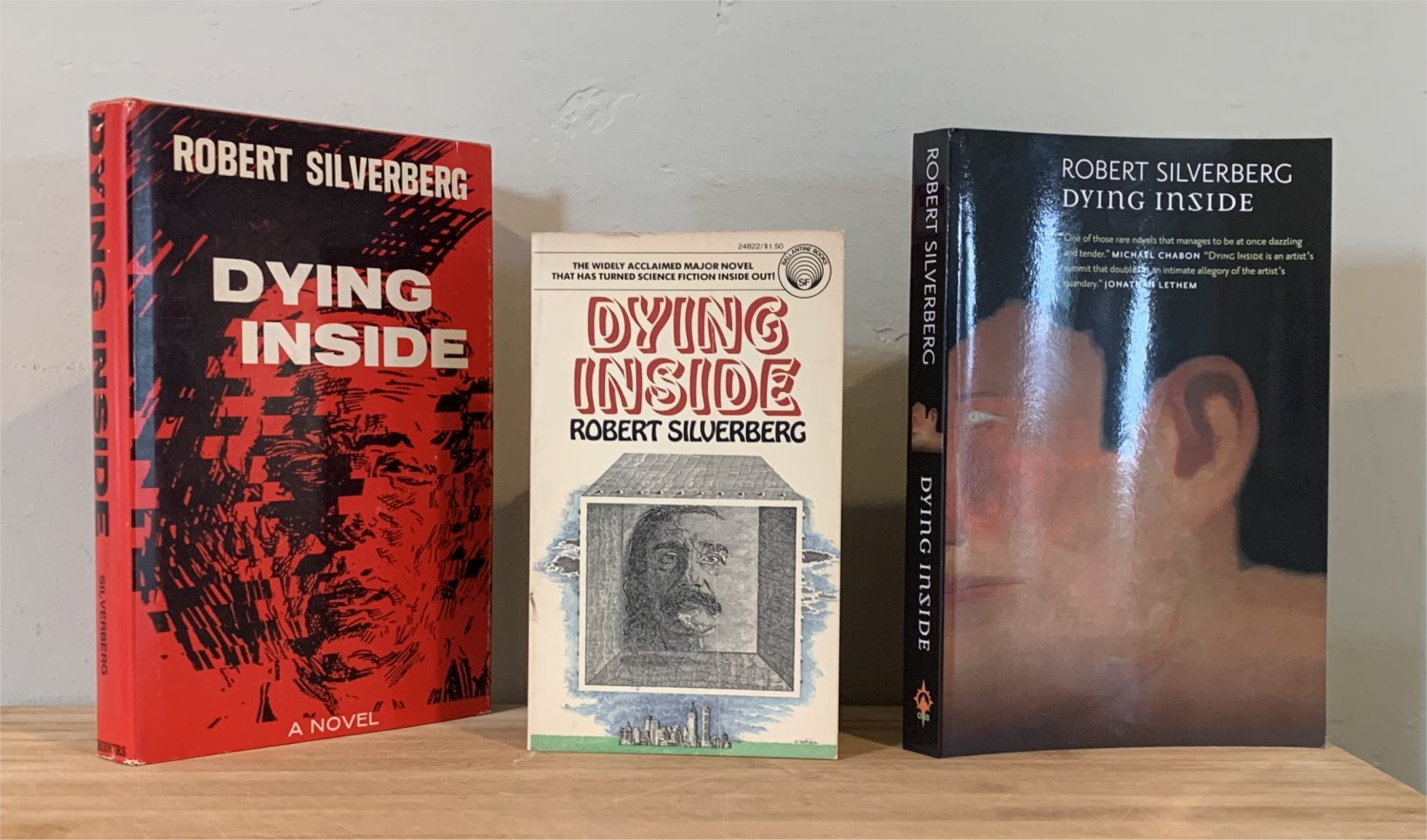
(The photo shows the 1972 Scribner’s first edition, a 1976 Ballantine paperback edition, and the 2009 Orb trade paperback edition, referenced here. In the introduction to the 2009 edition, he lamented that the book had always had dour covers, which discouraged bookstore sales. Apparently this has always been true.)
Overview:

It’s a non-linear novel with very little plot; it’s about a 40-something year old man, David Selig, pretty much a loser, who makes a living ghost-writing college papers for Columbia students. The key fact about Selig is that he’s been able to read minds for all his life, and is now losing this power.

The narrative alternates between present and past, between first person and third (and second in one section). We learn about his sister and the two women he had brief relationships with. And about how he meets another man with his power, and learns that a tiny handful of people like them exist across the country. The plot, such as it is, involves a dissatisfied customer of a term paper who, with his friends, beats Selig up; Selig wakes in the hospital, is discharged and brought before the college dean. He has an intense telepathic insight into this man—and then his power goes out, forever.

The closing sections indicate that people, whether they knew of his power or not, have always felt slightly uncomfortable around him, and now they don’t. Is this the root cause for Selig’s shiftlessness his whole life? You’d think a smart man like Selig (he easily learns how to be a stockbroker at one point), with the added insights provided by reading minds, could go far in life. Yet when he gets that stock-trading job, he gets bored and quits.

Occasional chapters feature the essays Selig writes for those college students. These surely reflect essays Silverberg himself wrote as a student at Columbia, though in the intro to 2008 editions he mentions that he researched and wrote an essay on entropy specifically for this book.

The scenes of most science-fictional interest are those when Selig gains insight into how other minds work, even those of insects. Here’s a passage about a bee. He’s wandering around a farm one summer. (Page 111 of the Orb edition.)

A sense of contact. His questing mind has snared another mind, a buzzing one, small, dim, intense. It is a bee’s mind, in fact: David is not limited only to contact with humans. Of course there are no verbal outputs from the bee, nor any conceptual ones. If the bee thinks at all, David is incapable of detecting those thoughts. But he does get into the bee’s head. He experiences a strong sense of what it is like to be tiny and compact and winged and fuzzy. How dry the universe of a bee is: bloodless, desiccated, arid. He soars. He swoops. He evades a passing bird, as monstrous as winged elephant. He burrows deep into a steamy, pollen-laden blossom. He goes aloft again. He sees the world through the bee’s faceted eyes. Everything breaks into a thousand fragments, as though seen through a cracked glass; the essential color of everything is gray, but odd hues lurk at the corners of things, peripheral blues and scarlets that do not correspond in any way to the colors he knows. The effect, he might have said twenty years later, is an extremely trippy one, But the mind of a bee is a limited one. David bores easily. He abandons the insect abruptly…

And just a few pages later he perceives the mind of a dour farmer who in fact has a rich internal life. And earlier, reflecting the racial tensions of the time, he peers into the mind of a black dude named Yahya Lumumba and is overwhelmed by a blast of hatred for whites and Jews—and him in particular.

Summary outline

Here’s a brief chapter by chapter summary of the whole book.

1, Set in the present, 1st person. David Selig, thinking of his telepathic inner self as a separate person, heads to Columbia to get work from students there ghost-writing term papers. He was born in 1935 and he’s 41 years old, so the book is set in the slight future as Silverberg writes. Selig watches the Puerto Rican women in his building. Once on campus he makes a contact and a job: $3.50 a typed page, guarantee B+ or higher.

2, Set in the past, 3rd person; at 7 years old he’s taken to see Dr. Hittner to test his psychic abilities. Why doesn’t he have any friends? David is smart enough to tell the doctor what he wants to hear.

3, Present, 1st. He can’t transmit. He’s learned that the deep inner thoughts of all people are the same universal language.

4, A paper on the novels of Kafka.

5, Mixed POV: about Huxley and his notion of a cerebral reducing valve that drugs could lift. Or perhaps flagellation.

6, Why not let it fade? Because it’s what make him special, different.

7, Present 1st. His sister Judith calls, inviting him over for dinner. He’s borrowed money from her before but has resisted lately.

8, About Toni, one of his relationships. He was doing research for an author, and she was his assistant. They lived together a few weeks. He only peeped her 3 times. She moves in with him.

9, Dr. Hittner convinced his parents a sibling would do David good. They tried, had a miscarriage, finally adopted a girl—Judith. David hated her. He tried to wish her dead, but it didn’t work.

10, He recalls his one acid trip, in 1968. He recalls the events of that year. Toni brings home two tabs. Do they do it at the same time? He’s cautious, convinces her to go first, he’ll do it tomorrow. She goes first… and he can’t help but feel it, and can’t escape it. Desperately he tries to explain that he’s reading her mind, but maybe she misunderstands, that he’s making some excuse. He goes to stay with friends, and when he returns, she’s moved out.

11, Campus again, gets orders for five more papers, one from a black dude, Yahya Lumumba. Thinking to peak into his mind to get an idea of the language he would use, DS is overwhelmed by a blast of hatred to whites and Jews and him in particular. He’s thrown out of the contact.

12, The power brought ecstasy. The best years were ages 14-25. He recalls summer 1950, in the country; eavesdropping on a girl Barbara having sex with a neighbor; viewing the world as a bee, then the farmer, a dour man who has a rich internal life.

13, DS visits sister Judith for dinner; she has a 4-year-old, Paul, who seems to hate him. Judith is one of only three he’s ever told. She’s seeing a guy, Karl Silvestri, a PhD.

14, He starts the paper for the black guy but can’t find the voice; it’s terrible.

15, He recalls 1961, visiting his parents when Judith was 16, and perceives she had sex for the first time the night before, and can’t help blurt it out. She’s furious, and never wants to see him again.

16, He visits Nyqvist on a night the city is snowed in. Nyqvist can read minds too. They discovered each other in 1958, living in the same building. Nyqvist perceives that DS feels sorry for himself; why? They become friends. Now, snowed in, Nyqvist locates two single ladies and they get together for sex.

17, He recalls how it started to fade. He free associates. He writes, or imagines writing, a letter to Kitty. Can they get back in touch? She was seeing Nyqvist too. He imagines a short sermon based on lines of Eliot, about beginnings and ends.

18, Toni didn’t come back, but tracks her down, staying with a gay guy, David Larkin. He goes over there, pleads; she can’t come back, she’s too scared. (He perceives she didn’t quite understand his admission, but doesn’t explain.) He leaves.

19, An imaginary guided tour of his room, on Broadway and 228th. His books, letters, some to famous people, letters never sent, until he imagines one from Kitty and becomes upset.

20, How he was worried about being found out. A frumpy biology teacher with an interest in parapsychology. One day she tested the class with Zener cards. David is careful not to guess correctly—and so gets them all wrong, which is just as odd. She tests him again the next day, and this time he randomizes his answers more plausibly.

21, A string of days. He doesn’t vote. He works on the paper. He goes to a party, probes the host, thinks he overhears familiar names. Has a hangover. A girl comes over for sex, he almost doesn’t make it. He delivers the papers, and Lumumba is upset, feeling insulted, and assaults Selig, his friends joining in.

22, He met Kitty in 1963. He’d become a stockbroker, memorizing all the terms, passing the tests easily. Most of his clients were old ladies, and he gets quickly bored with it, but one was a young girl, Kitty, who he finds to his amazement he can’t read at all. He invites her out, and later tells Nyqvist, perhaps to understand how someone can’t be read.

23, Essay on entropy, how humans fight against the chaos, how evil is entropy, about isolation, about the monogamous fallacy.

24, Second person to Kitty recalling their relationship. Perhaps she has a power? She moves in. She does computer work. He tries to expand her literary education. She doesn’t believe in ESP. He suggests trying various experiments, and persists. They attend a party at Nyqvist’s. DS sees her via Nyqvist, and is astounded by how she sees him: as a stern taskmaster. Then JFK is shot, and he finds a letter from her, she’s left. He writes a letter and confesses everything, but he never hears from her again.

25, He wakes in the hospital. He’s not badly hurt; an intern tells him to leave, they need the bed. A security guard takes him to see Dean Cushing—an old fellow classmate! Cushing implies there may be charges—again Selig, for ghost-writing papers. But no; Cushing merely finds DS sad, pitiful. He offers DS help reforming his life. DS probes Cushing, has another deep experience, then comes out of it—and his power is completely gone.

26, Winter. He visits Judith, imagines meeting Toni in the street for a pleasant reunion. He recalls attending camp in the Catskills, using his power to deftly avoid an aggressive boy boxer. Judith reports she’s no longer seeing Karl. He reflects about everything: what is God’s justice? He doesn’t want pity, just for things to make sense. He must accept. Both Toni and Judith notice how he’s changed somehow. Outside a storm rages, and Judith startles him coming up behind him—something she could never do before.

Posted in Book Notes, Robert Silverberg, science fiction | Comments Off on Silverberg, DYING INSIDE (1972)

Notes for the Book: Hierarchy of Knowledge and Human Affairs

[updated 8 Jul 2020]
[updated 26 Jun 2020]

  • Everything you need to understand the reality of the world, as discovered over centuries, and especially in the past century and past few decades, is out there, available to you. All the mysteries of the ancient world have been explored, and many solved, if not always to the satisfaction of the intuitive mindset. This knowledge is not hidden. It’s more easily available to the average person than it has ever been in all of history. It’s there–perhaps haphazardly, on Wikipedia; it’s there more authoritatively (if not in as much detail on many topics) online at Encyclopedia Britannica; it’s there in tens of thousands of books available from Amazon and in libraries, books written by sincere people who have dedicated their lives studying history, biology, cosmology, and dozens and hundreds of specialty topics, examining the world as it is and not how primitive people thought it was. It’s there in online courses, in the great museums, in TED talks. You don’t have to attend university (though that helps, to channel your studies). To ignore this vast collective knowledge and discoveries of the human race, or renounce it in favor of the religious myths of ancient tribes who thought the world was flat, is to be at best intellectually dishonest, at worst to renounce the heritage of the species.
  • As writers like Sean Carroll and Alex Rosenberg have pointed out, we know virtually everything there is to know about how the world works, at least at local levels, in terms of physics and biology and chemistry. Any new discoveries will be at the fringes of our perceptions, and won’t overthrow what is known to be true at local levels, e.g. how physics can predict eclipses thousands of years in the future, or allow us to fly and navigate spacecraft among the planets, to pinpoint accuracy. And in turn, how physics explains chemistry, chemistry explains biology, and so on. No undiscovered magical forces are needed to explain these things. And conversely, our knowledge of physics rules out undiscovered magical forces that would be required for telepathy, or astrology, or whatever to be true; for them to work (or for an incorporeal “soul” to exist), the physics we’ve established thus far would have to not be true. It’s like knowing where all the states are in the US, and knowing therefore you’re not about to stumble upon a previously unknown state on your cross-country drive. The science-deniers and conspiracy theorists would tell you there’s some unknown state, that’s being denied by the authorities, that “they” don’t want you to know about. (Or that some place you’ve never been to actually doesn’t exist. This has happened! About Finland: https://www.google.com/search?client=firefox-b-1-d&q=finland+doesn%27t+exist.)
  • The irony—perhaps—is that most people don’t care, and don’t need to. Living a life as a functional human being, raising a family to propagate the next generation, being a citizen in the society you live in, has nothing to do with understanding the reality of the world outside your immediate experience. And in fact, most people are woefully uninformed about basic science, history, civics, even current events; see the man-on-the-street interviews by late night talk show hosts (for example, by Jimmy Kimmel: https://time.com/5200561/jimmy-kimmel-lie-witness-news-street-interviews/). People claim knowledge of things they don’t actually know; some of these quizzes ask about fictitious terms, and a certain proportion of people will claim familiarity with things that don’t actually exist. The average person is unclear on the difference between a planet and a star, a moon or a planet, a comet or an asteroid, a galaxy or a nebula—despite the prevalence in recent decades of science fiction franchises like Star Trek and Star Wars. What do the flat-earthers think about those adventures in the stars? And yet, all these people, even the flat-earthers, manage to get along with their daily lives, do their jobs, raise their children.
  • To the extent that some people do knowingly reject the accumulated human understanding of the world in recent decades and centuries in favor of the naive cosmologies of ancient holy books, and analogously reject the growing world’s evolving moral standards in favor of the strictures of those ancient holy books, it’s because doing so makes life so much simpler.  No need to think, or learn; no need to adjust to a changing world as you advance through life; just put your faith in your favorite holy book with the calm assurance that it provides all the answers to life’s questions (pretty much any answer you wish, given the many contradictory passages of these books.) “God said it, I believe it, that settles it.”
  • It’s now well understood, increasingly so over the past three decades, why people perceive supernatural things and why they prefer supernatural explanations to scientific ones. And, as Rosenberg points out, it’s ironically due the very same evolutionary processes that the supernatural partisans don’t “believe” in. (This is all about perception of agency, the tendency to detect cause and effect where none actually exists, and how we live our lives as stories, all of which evolved as shorthand heuristics to support the survival of our species.)
  • The understanding of the world the average person has is derived from social and religious conventions. The numerous religions have a vast, centuries or millennia long, momentum, of parents inculcating their children, generation after generation, into the beliefs or superstitions of ancient tribes, that cannot easily be overcome, and may never be, by education. This religious “knowledge” serves to bind families, communities and tribes, but has little to do with the actual reality as revealed by the systematic investigation of centuries. Further, virtually no one examines the evidence for every fact about the world independently; rather, each person learns whom to trust, whose expertise or authority to accept. Perhaps a problem of the modern age is that the internet (especially YouTube and Facebook) make fringe theories, many of them mendacious, others just dimwitted, easier to circulate. Thus adherents to such fringe ideas (formerly isolated in their towns as the local loonies) can now easily find compatriots on the internet to reinforce their views.
  • The discoveries of the modern age that are most resisted by those who defer to ancient teachings are those that impinge upon psychological biases. People more concerned about purity and contamination are more inclined to resist vaccines, and then use motivated reasoning to lawyerly justify their instinctive bias. These are matters where the evidence and conclusions can seem counter intuitive. People more concerned with hierarchical relationships and authority resist the idea the humans are related, over evolutionary eons, to all life on the planet, and then use motivated reasoning to lawyerly justify their instinctive bias. There is no conservative resistance to the idea of teaching cosmology; there are no right-wing institutes devoted to undermining geology. Because these studies don’t impinge on human vanity, in the way that evolution does.
Posted in The Book | Comments Off on Notes for the Book: Hierarchy of Knowledge and Human Affairs

Heinlein’s First: For Us, the Living

Almost on a lark, I picked up the first novel by Robert A. Heinlein a few days ago, and read it through. It’s a fascinating book on several levels.

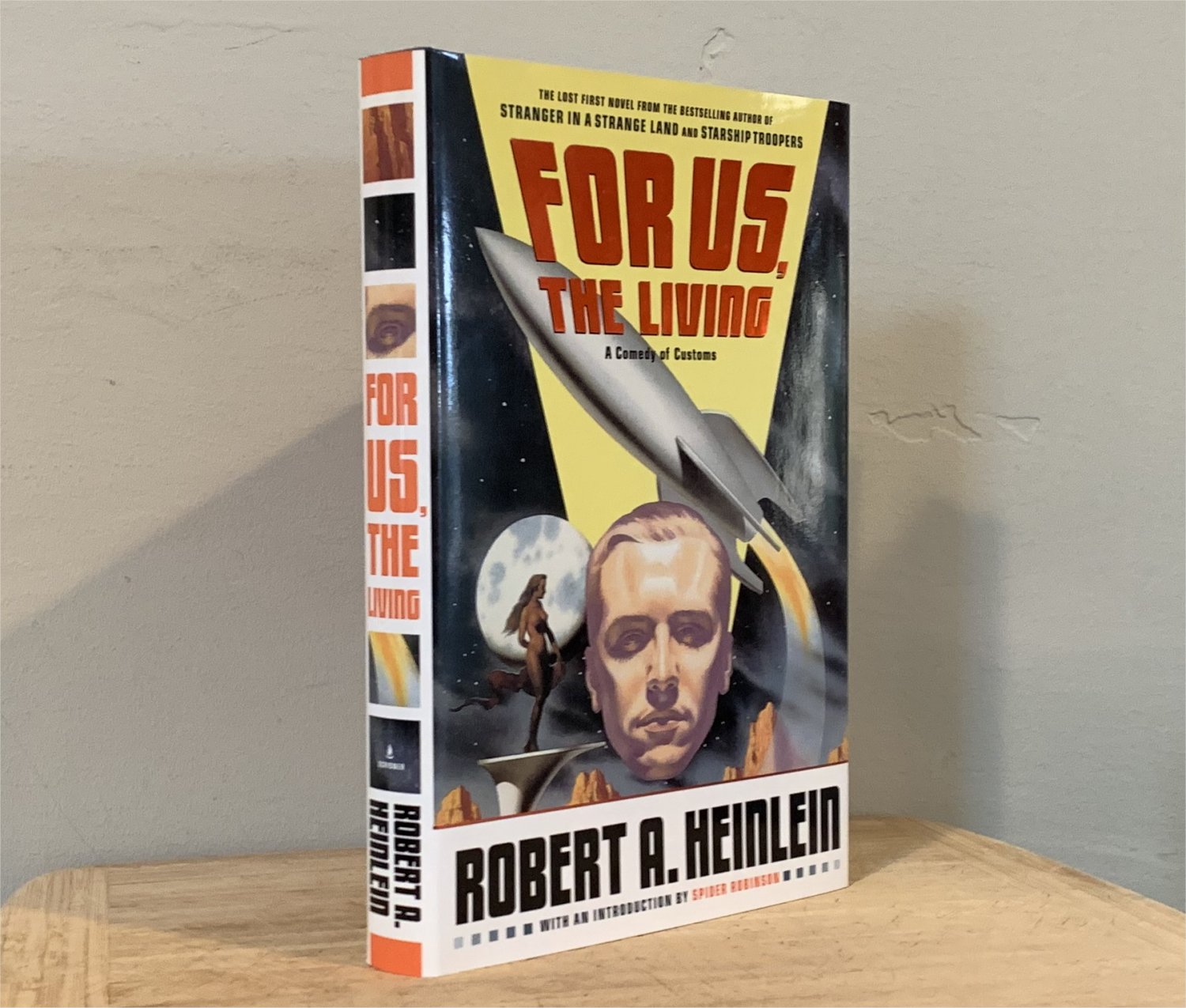
First, it’s Heinlein first novel in that it’s the first one he wrote, way back in 1938 and 1939. But it didn’t sell, was never published at the time, and went unknown for decades. The manuscript was thought lost; Heinlein and his wife had destroyed copies in their possession in the approach to Heinlein’s death. Yet another copy was found long after his death event in 1988, and published in 2004, with an introduction by Spider Robinson and an afterword by Robert James. (Spider Robinson would later publish Variable Star, based on a Heinlein outline, in 2006; I have not read this.) I read For Us, the Living, when it first came out, in late December 2003, but didn’t remember the details of its future society until rereading it this week.

Second, Heinlein repurposed many of its ideas in later stories and novels, some written only a year or two later (he quickly learned how to write saleable stories). And third, it’s remarkable how so many of these ideas anticipated real-world discoveries and ideas of recent decades. He was ahead of his time, in many, if not all, ways.

This first novel is in the tradition of didactic utopias, like Edward Bellamy’s Looking Backward: 2000-1887 (published in 1888) and H.G. Wells’ The Sleeper Awakes (1899), both of which involve characters from the author’s time who become comatose in some way and wake centuries later. There were many similar novels, says Wikipedia; the motives of these weren’t to write dramatic stories, but to use fictional frames around authorial lectures about how things ought to be in the future. Many of these were socialist in nature, and they dealt with matters of politics, society, morals, and much else.

So Heinlein provides a framework for much discussion of history, religion, economics, and human nature. A cursory outline of the plot:

  • In 1939, pilot Perry Nelson, driving down the California coast toward San Diego, swerves to avoid an oncoming passing car in his lane, goes off a cliff, and dies. With an image about a girl on the beach below.
  • He is found, alive, by a young woman named Diana, recognizing her as the woman on the beach (!), in the year 2086. (The coincidence of the two women, or the method of time travel to the future, is never explained.) Diana lives in the Sierra mountains with a spectacular view, and casually walks around her home naked. (Perry is obliged to do the same.) They exchange stories, and Perry gathers many things have changed in 150 years, and they quickly fall in love.
  • Perry reads available books about history, to understand what’s happened since his time, while Diana has a Master from UC Berkeley visit to fill in details of that history and discuss issues, at great length.
  • Diana, using her private copter, takes Perry to see San Francisco, where the streets are moving strips, and then to Monterey, where they swim. They become, in effect, married.
  • A colleague/former boyfriend of Diana’s visits (they are both professional dancers doing a joint project), and Perry jealously slugs him. Perry is taken to a city hall and then remanded to a hospital, where he undergoes psychological counseling to help him overcome the inappropriate attitudes of his past. He is encouraged to think about meanings of words, and the nature of human nature, and how it reacts to the current environment.
  • He’s visited by another master, this one to explain the economics of the era, and the mistakes made by earlier eras, at very great length.
  • Perry and one of the hospital attendants, Olga, travel to the Grand Canyon, then experimental grounds where a moon rocket is being developed. Perry visits Washington DC to see how the government now works.
  • Perry takes to studying rocketry. He reconciles with both Diana and Olga and realizes he has overcome the attitudes of the past (i.e. they’re in a three-way relationship).
  • Later, having developed a new powerful rocket fuel, Perry himself climbs into a rocket for the first trip to the moon.

Key themes and ideas:

  • The history after 1939 includes a second world war, a 40-year European war, and an evangelical movement in the US called the New Crusade, led by Nehemiah Scudder, whose eventual defeat results in a new Constitution. This Constitution limits laws to those prohibiting only actions that harm others, limits rights of corporations, and enshrines a right of privacy for all personal affairs. As a consequence, it also removes all laws derived merely from religious morality.
  • The big economic idea is that everyone, even children, get “heritage checks,” monthly grants for life; as a result, there is no unemployment, and everyone enjoys a high standard of living. The key is money: what is it? No, not gold, that was a big mistake of the early 20th century. Money is a medium of exchange that works because everyone believes it works. —This is exactly Harari’s thesis in SAPIENS. And the idea of a universal basic income, floated around for decades, has gained prominence recently from Rutger Bregman and Andrew Yang.
  • Over-production, not the profit system, was the problem in 1939. Knowledge accumulates. The answer is to create new money as needed to balance the production cycle. Further, value is not, as Marx thought, the number of work-hours to produce a given article. Value is about customer desire, how much the customer wants a particular article. —And this correlates with modern psychological thought about happiness, which doesn’t have an objective measure, but rather depends on the circumstances around you; thus “keeping up with the Jones.”
  • But doesn’t this system subsidize laziness? No, the way to look at it is to consider that modern humans are living off the accumulated knowledge and discoveries of the past; there isn’t enough drudgery to go around. —Again, anticipates Harari and others in worrying whether machines will render many jobs obsolete. Perhaps so; the answer is that universal basic income. In 2086, Heinlein suggests, most people aren’t indolent and work anyway, or find some private project to pursue. [[ My own thought, which I can’t point to a source just at the moment, is that the cost of subsidizing a minority of lazy people is far less than the cost of the infrastructure to decide who’s eligible for government “assistance” and prevent the lazy from getting it. Dismantle the infrastructure—shrink the government—and just given everyone the money, as Alaska does. The problem then becomes the “moral” one of rewarding people who don’t work; work, now matter what kind, is supposedly virtuous. ]]
  • On matter of human nature, as Perry is “treated” he is asked to define terms, first common ones like apple and cat, then abstract ones like patriotism, duty, honor, society, and truly think about what these mean. This future society has developed a Code of Customs based on conclusions reached through understanding of the real world—the only alternative being revelation. These conclusions have always been available, but were resisted. Still, Perry can’t help feeling jealous. His mentor explains that while “human nature” may exist, the environment changes and how human nature responds changes. Thus flying despite fear of heights; thus belly hunger doesn’t trigger ravenous reactions to the sight of food. Males and females have different reasons for sexual jealous–males, to defeat other males for the right to mate; females, to ensure her partner remains loyal to her and her children. —And this is remarkably like the conclusions of sociobiology of recent decades, about the differing reproductive strategies of males and females (and thus to indicate why male and female brains are not identical, nor that they are “blank slates.”)
  • And so with personal affairs matter of privacy (i.e. no one possesses anyone), and everyone including children take care off by the state, the old jealous reactions can be unlearned or disregarded. [[ As a personal aside, this is how, in my experience, the gay community works. Two men can date for a while, call it off, and still be good friends, still mix with the same groups of friends together, in a way unthinkable for most straights. ]]

Some of these ideas about economics, I gather, show up in Heinlein’s 1942 novel BEYOND THIS HORIZON, which I haven’t read in decades. Other specific ideas which turned up in later stories:

  • The moving streets were the subject of “The Roads Must Roll,” published in 1940.
  • Perry is given the choice of psychological treatment or deportation to “Coventry,” a reservation for non-compliant individuals that one enters and never leaves (in effect, an anarchy). An entire story about it, with that title, was published also in 1940.
  • And the narrative about the religious takeover of the US is told in “If This Goes On—” also published in 1940! Though it’s not the story of Nehemiah Scudder himself (Heinlein never did write that story, he admitted, disliking the character too thoroughly.) I blogged about this story here: http://www.markrkelly.com/Blog/2015/11/09/rereading-early-heinlein-part-3-if-this-goes-on/
  • More incidentally, everyone smokes constantly in this novel. I don’t recall if that was true in later stories.
  • And Heinlein was always attracted, throughout his career, to the idea of casual nudity and to open and multiple relationships. I’m afraid I don’t buy the casual nudity for a moment, except possibly among partners in a sexual relationship. Otherwise, it would be too distracting! And likely disgusting. How many of your colleagues, or neighbors, would you want to see naked?

Finally I’ll quote a long passage, spoken by the historian from Berkeley, about religion and its role in society. Some of these lines did show up in “If This Goes On—,” as quoted in my post linked above. Pages 83-84:

“All forms of organized religion are alike in certain social respects. Each claims to be the sole custodian of the essential truth. Each claims to speak with final authority on all ethical questions. And every church has requested, demanded, or ordered the state to enforce its particular system of taboos. No church ever withdraws its claims to control absolutely by divine right the moral life of the citizens. If the church is weak, it attempts by devious means to turn its creed and discipline into law. If it is strong, it uses the rack and the thumbscrew. To a surprising degree, churches in the United States were able, under a governmental form which formally acknowledged no religion, to have placed on the statutes the individual church’s code of moral taboos, and to wrest from the state privileges and special concessions amount to subsidy. Especially was this true of the evangelical churches in the middle west and south, but it was equally true of the Roman Church on its strongholds. It would have been equally true of any church; Holy Roller, Mohammedan, Judaism, or headhunters. It is a characteristic of all organized religion, not of a particular sect.”

This is the sort of matter-of-fact attitude about religion that pervades most science fiction about the future, though it’s rarely stated as explicitly as this. It’s not controversial, or contentious, just stating what’s obvious.

Posted in Book Notes, Heinlein, science fiction | Comments Off on Heinlein’s First: For Us, the Living

Notes for the Book: A Hierarchy of Understanding

Next, a hierarchy of stages about the extent to any of us understands the universe. (Which is distinct from simply being aware of it, though it overlaps it somewhat.)

  1. At the base level is the understanding of primitive tribes about the world and its extent, especially those in isolated valleys (e.g. Borneo) or isolated island (e.g. North Sentinel Island, https://en.wikipedia.org/wiki/North_Sentinel_Island). They know only what they explore on foot or can see from the highest mountain. (The language in the Old Testament reflects such a view of the world.) These tribes engage in story-telling to explain where things came from and how things work, applying instinctive attitudes of human nature to “explain” their existence, the weather, and so on, revealing the innate need for narrative, i.e. cause and effect, to everything in sight.
  1. Next, learning the world is bigger than just your local tribe. There are worlds beyond the hill, other tribes with different languages and customs. Broadly, then, learning that the things in your experience aren’t the best just because they’re yours. Understanding that followers of all religions think theirs is true and all the others false. Being cosmopolitan. Being, to an extent, savvy. (But: the preference for narrative explanation still prevails here.)
  1. Third, possible only in the past century or so, becoming aware of the age extent of the universe, how vast it really is, how tiny our Earth is within it, and given this, how naïve and parochial it is to think that our world or our tribe is somehow special in the eyes of that agency-detected creator. Analogies of the extent of time—fitting 14 billion years into a single day, in which humanity appeared on Earth in the last few hours or minutes on December 31st (the Cosmic Calendar, https://en.wikipedia.org/wiki/Cosmic_Calendar)—help to intellectually understand this, but it’s difficult for anyone with a human brain to appreciate these scales emotionally. The lesson is that reality is larger than human intuitions; be humble, be savvy.
  1. Fourth, finally perhaps the intellectual understanding that cause and effect simply don’t apply at cosmic scales. Again, quantum mechanics, or Hawking’s notion that time and space are intertwined in the sense that time began at the big bang, so there was nothing before it; it doesn’t make sense to ask what “caused” the big bang, or what happened before it, than it does to ask what’s north of the North Pole. Here is where the intellect is needed in place of actual understanding. And somewhere here is the recognition of certain human geniuses, like Feynman, like Ramanujan, seem able to perceive (perhaps understanding isn’t the right word) things as impenetrable and counter-intuitive to ordinary humans, as human understanding of mathematics would be to dogs.

So science fiction informs this hierarchy at every level, though it’s most effective in evoking the third and suggesting the fourth. (The first level is reflected in a certain set of SF stories about primitive or enclosed societies that discover they are, for example, actually on a generation starship, and have forgotten their origins.) The third, the discovery of the vastness of time and space, is what the hoary phrase “sense of wonder” is about. And the fourth is suggested by those few science fiction tales that suggest realms of time and space that are incomprehensible to humans (if perhaps not to aliens).

Posted in The Book | Comments Off on Notes for the Book: A Hierarchy of Understanding

Links and Comments: Wars on Science; Epistemology; Conspiracy Theories

A facebook friend comments:

“Research” isn’t just googling to find someone saying what you want to hear. That’s confirmation bias, and cherry picking.

\\

My own thought, a week ago: The big political conflicts aren’t about asking the same questions and reaching different conclusions; it’s about thinking some questions and their answers are more important than others.

Comment now: the central one of these is the conflict between freedom and equality. Both may be enshrined in the US founding documents. But they’re not consistent. Conservatives are more concerned about freedom (to discriminate if it pleases them), liberals more about equality and justice, even if those require regulations to entail freedoms.

\\

Vox, Sean Illing: Inside corporations’ war on science: A new book explains how corporations create a climate of doubt around science and expertise.

Keyed off the recent decision by Johnson & Johnson, looking back at the history of Big Tobacco and the fossil fuel industry. It’s not the *scientists* who are trying to fool you, it’s the industries and their cherry-picked “scientists” to support corporate profits. This is why there are industry regulations (which Republicans are always trying to undermine).

“The Republican base,” Michaels told me, “has been acclimatized to be skeptical of mainstream science, and easily believe accusations that they are being manipulated by the deep state, the liberal media, and pointy-headed scientists.”

\\

In its broadest sense one of my key interests is epistemology, how we know what we know, how we know what we think is true, more loosely about how people in general think they know what is true, which is why I keep emphasizing contingency and circumstance, why I don’t believe that everything happens for a reason, and why I’m fascinated by the attraction of conspiracy theories, virtually all of which are self-serving fantasies.

In NYT, long-time technology writer Farhad Manjoo writes, The Worst Is Yet to Come, subtitled, The coronavirus and our disastrous national response to it has smashed optimists like me in the head.

Key comment:

In a book published more than a decade ago, I argued that the internet might lead to a choose-your-own-facts world in which different segments of society believe in different versions of reality. The Trump era, and now the coronavirus, has confirmed this grim prediction.

As I said in a recent blog post, we seem to be living in different alternate realities, with different opinions about the facts of reality, simultaneously.

\\

Another strong essay:

Religion News, Tara Isabella Burton: How Americans’ ‘tell it like it is’ attitude renders us vulnerable to conspiracy theories

The mythos of American self-making — that with the right amount of grit and cunning, the individual can determine his own truth and fate — lends itself to the view that civil bureaucracies and establishments, by contrast, are inherently sclerotic and corrupt: the information they provide automatically suspect.

This tendency can be glimpsed in the contrarian programs of investor and PayPal founder Peter Thiel, who founded and funded a Thiel Fellowship designed to coax promising would-be entrepreneurs to drop out of college and go straight into solitary startup life. It is this tendency, too, that underlies our collective obsession with “fake news” — and with alternative news outlets and conspiracy theorists, like Alex Jones, who claim to “tell it like it is” — in coded contrast to the wisdom of the establishment.

Conspiracy theories tie into a wider mistrust of civic life, combined with an optimistic belief that the individual is capable of “discovering” — through a cursory YouTube search or other research in the digital landscape — truths about the world order that the establishment is trying to hide.

\\

And one more:

The Atlantic: Ellen Cushing: I Was a Teenage Conspiracy Theorist. Subtitle: Want to know why wild conspiracism can be so irresistible? Ask a 14-year-old girl.

Conspiracy thinking is incredibly compelling. It promises an answer to problems as small as expired light bulbs and as big as our radical aloneness in the universe. It is self-sealing in its logic, and self-soothing in its effect: It posits a world where nothing happens by accident, where morality is plain, where every piece of information has divine meaning and every person has agency. It makes a puzzle out of the conspiracy, and a prestige-drama hero out of the conspiracist. “The paranoid spokesman sees the fate of conspiracy in apocalyptic terms,” the historian Richard Hofstadter wrote in his seminal 1964 essay, “The Paranoid Style in American Politics.” “He is always manning the barricades of civilization.” What Hofstadter declined to put a finger on is the intoxicating feeling of having insider knowledge about the fate of the world, or at least believing you do.

Posted in Conservative Resistance, Lunacy, Science | Comments Off on Links and Comments: Wars on Science; Epistemology; Conspiracy Theories

Link and Comments: Ezra Klein on the Psychology of Coronavirus Response

Vox:
Why are liberals more afraid of the coronavirus than conservatives?
: Covid-19 and the complex politics of fear.

By Ezra Klein, co-founder and editor-at-large of Vox (and whose recent book, WHY WE’RE POLARIZED, I’ve just begun reading).

Good question. You’d think conservatives, being more sensitive to contamination and conscientious about purity, would freak more about a deadly disease. Why don’t they? Before reading the article, my guess is their sense of autonomy overrides personal concerns; they resent authorities, especially experts (whom they mistrust, or simply don’t understand), telling them what to do. Also, the relatively off-stage progression of the virus, where the majority of Americans still don’t know anyone affected (I know only one), helps to diminish its apparent threat.

The article talks about the numerous psychological studies into the psychological foundations of political differences, e.g. Jonathan Haidt’s (cf. THE RIGHTEOUS MIND), that inform the difference between conservatives and liberals. E.g. “Liberalism and conservatism are rooted in stable individual differences in the ways people perceive, interpret, and cope with threat and uncertainty.” How dangerous the world is. Then why do conservatives downplay the coronavirus?

Klein speaks to various political psychologists and summarizes their ideas.

First: Liberals are more caring about others. Conservatives do fear, but of economic devastation.

Or: It’s partisanship, and a Republican is in charge, downplaying the threat. Haidt: “When Obama was president and America was threatened by Ebola, it was conservatives freaking out, demanding a more vigorous government response to protect us, while Obama kept steady on following scientific advice.” Trump was at the forefront of the Ebola panic (because he could criticize Obama).

Or: Trump followers are more afraid of threats from human outsiders (e.g. “welfare cheats, unpatriotic athletes, norm violators, non-English speakers, religious and racial minorities, and certainly people from other countries”), than of disembodied threats like climate change and Covid-19. Thus Trump responds the pandemic by attacking China.

The concluding section is worth quoting at length, with discussion of motivated reasoning and that famous Upton Sinclair quote.

Here’s my view: Political psychology is like the soil in politics. There are differences in the liberal and conservative soil — particularly in how they view threat, change, tradition, outsiders, and diversity — so different kinds of politicians, tactics, and movements take root on the two sides.

Trump is, at his core, a suspicious, threat-oriented, traditionalist figure — he’s nostalgic for the way things were, hostile to outsiders, angry over demographic change (he’s even, in normal times, a germaphobe). There’s a reason he took root in conservative soil.

By contrast, former President Barack Obama is optimistic, cosmopolitan, and temperamentally progressive — he looks at change and sees hope, he looks at other countries and sees allies, he sees diversity as a strength. There’s a reason he took root in liberal soil.

But once a politician captures a party, other dynamics take over. For one thing, partisans trust their leaders and allied institutions. Very few of us have personally run experiments on the coronavirus, or gone around the world gathering surface temperature readings over the course of decades. We have to choose whom to believe, and once we do, we’re inclined to take their word when describing contested or faraway events.

For another, we all fall prey to motivated reasoning, in which we shape evidence, arguments, and values to align with our incentives. As Upton Sinclair said, “It is difficult to get a man to understand something when his salary depends upon his not understanding it.”

Many Republican officeholders, led by Trump, think the coronavirus threatens their reelection because the lockdown threatens the economy. As such, they’re motivated to believe that reopening the economy sooner is better, and attracted to evidence and arguments that support that position. Sometimes that means downplaying the coronavirus. Sometimes that means accepting its risk but suggesting the costs of reopening are worth it. In both cases, the argument is working backward from the desired conclusion.

Posted in Politics, Psychology | Comments Off on Link and Comments: Ezra Klein on the Psychology of Coronavirus Response