Only in a country with a long history of anti-intellectualism, it seems, could a billionaire ignoramus like Donald Trump continue to be seen as a “man of the people.”
(I have to note that Salon seems determined to make its site difficult to read, with pop-up videos that obscure the text of the article.)
\\
Slate: Dahlia Lithwick on A Prayer for the Real Victims. Subtitle: “For Jeff Sessions and the Supreme Court, the battle for Christians’ religious liberty is one of the only fights that matters.”
The battle for “religious liberty” is only about promoting Christianity, to the point of allowing Christians free passes to ignore the law. Because, as I’ve noted before, extremist Christians seem intent on defining themselves as people who cannot get along with anyone unlike themselves.
Posted inConservative Resistance, Culture|Comments Off on Links and Comments: Trump’s anti-intellectualism; ‘religious liberty’
“The most expensive health care cost in America right now, by far, individually, is for homosexuals. They cost more in the system than any other, hands down.”
With no evidence whatsoever. (Because of course there is none.) This is pure animus, bigotry, and ignorance.
Posted inConservative Resistance|Comments Off on Link and Comment: What a Contemptible Person
William Saletan, at Slate, takes inspiration from John McCain’s recent speech, during last week’s health care debate: Words to Live By. Subtitle: “McCain’s speech gives us a map for escaping the moral rot of Trumpism.”
He says, “To escape the moral rot of Trumpism, all of us should follow these rules.”
Tell the truth.
Focus on helping, not winning.
Resist proudly.
Respect the process.
Ignore the outrage industry.
Fight for values, not for the tribe.
Don’t be obnoxious.
Seek acceptance, not just conquest.
Do what’s right, even if it’s unpopular.
Heal thyself.
#6 is striking because Trump himself obviously has no values; for him, it’s all about making a deal, winning in whatever circumstances present themselves.
\\\
Phil Torres, a supporter of the ‘new atheist’ movement and its prominent authors (Sam Harris, Richard Dawkins, Daniel Dennett, Christopher Hitchens), is upset, in Salon: From the Enlightenment to the Dark Ages: How “new atheism” slid into the alt-right. Subtitle: “A movement supposedly committed to science and reason has decayed into racism, misogyny and intolerance. I’m done.”
He’s done? With what? Where is he going? I read the article with this subtitle (which, like most article titles, was likely written by the site’s editors, not him) in mind.
Yes, people are people, and even people with your tribe or on your side intellectually are people, and exhibit flaws and human biases and prejudices just like all other people. Torres seems to be taking objection to evidence of such and throwing the baby out with the bathwater. Here’s his conclusion:
I should still be the new atheist movement’s greatest ally, yet today I want nothing whatsoever to do with it. From censoring people online while claiming to support free speech to endorsing scientifically unfounded claims about race and intelligence to asserting, as Harris once did, that the profoundly ignorant Ben Carson would make a better president than the profoundly knowledgeable Noam Chomsky, the movement has repeatedly shown itself to lack precisely the values it once avowed to uphold. Words that now come to mind when I think of new atheism are “un-nuanced,” “heavy-handed,” “unjustifiably confident” and “resistant to evidence” — not to mention, on the whole, “misogynist” and “racist.”
And while there are real and immensely important issues to focus on in the world, such as climate change, nuclear proliferation, food production, ocean acidification, the sixth mass extinction and so on, even the most cursory glance at any leading new atheist’s social-media feed reveals a bizarre obsession with what they call the “regressive left.” This is heartbreaking, because humanity needs thoughtful, careful, nuanced, scientifically minded thinkers more now than ever before.
Where’s he going? He doesn’t say.
\\
How to counter existential dread — the reality of an ancient, infinite universe in which our lives flash into existence and then disappear forever — with optimistic nihilism.
“It seems very unlikely that two hundred trillion trillion stars have been made for us.”
“We became self-aware only to realize this story is not about us.”
(By ‘nihilism’ we of course mean the acknowledgment that we don’t live in a fantasy universe of gods who determine our meaning of life — as, for example, slaves whose lives should be devoted to worshiping our creator, or that those trillions of stars were created merely as the background setting for *us*. Rather, the meaning of life is what we make it. There are no gods.)
This reminds me of this extraordinary video, posted here, about a visit to Chernobyl.
Posted inAtheism, Culture, Meaning|Comments Off on Links and Comments: Rules to Escape Trump’s Moral Rot; Escaping New Atheism(?); Optimistic Nihilism
The Enterprise discovers a “sleeper ship” full of hibernating superhuman refugees from 1990s Earth, whose leader tries to take over the Enterprise.
This is a classic episode – even disregarding its inspiration for the second Trek movie – with a striking theme and a powerful performance by guest star Ricardo Montalban.
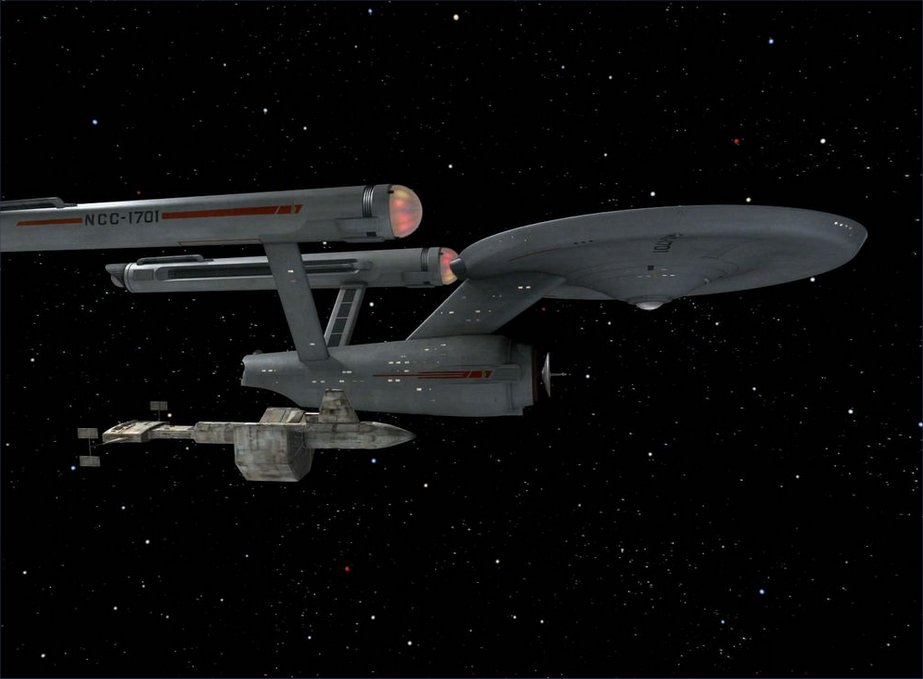
The opening has the Enterprise pursuing a signal of some ship ahead, in a seldom visited region of space. They discover an old Earth ship, of type DY-100, built in the 1990s (!), built only for interplanetary travel, with signals of life aboard. There’s a bit of malarkey about Morse code.
The enhanced graphics show the ship, the Botany Bay, idly in space, slowly rotating as if in unguided freefall. This is a nice touch, in a universe in which all spaceships are uncritically assumed to be traveling in the same plane, always level with each other. (In the original graphics, the Enterprise pulls up alongside the Botany Bay, like a larger naval ship coming alongside a smaller ship.)
The striking premise emerges: in Trek history, the 1990s was the era of Earth’s last ‘World War’, the ‘Eugenics Wars’, in which “a group of ambitious scientists” intent on improving the species created a race of superior men, who then took over the world, for a while, until they were overthrown. The Enterprise crew soon realizes that the passengers on this ship, in suspended animation ‘sleep’, are refugees from that race.
First point here: this history is unusually dark for Trek, in which Roddenberry especially emphasized how by the 23rd century many of humanity’s problems should have been overcome. Also, it paints scientists as villains, a not unusual theme for Trek, but a disconcerting one given that future ideal.
Second point here: If these superior genetically enhanced people took over the world in the 1990s, they must have been generated in the 1970s, at latest. Not very long in the future for when this episode was made. A point I haven’t seen observed anywhere else.
We are introduced to the ship’s ‘historian’, Lt. Marla McGivers, whose quarters are filled with statues and paintings of famous military men throughout history. Does the Enterprise really have a full-time historian? Wouldn’t it be more plausible that she were some ordinary crewman who happened to have a passion for history?
This episode has McCoy’s famous line, as he is obliged to enter the transporter: “I signed aboard this ship to practice medicine, not to have my atoms scattered back and forth across space by this gadget.”
They beam over the Botany Bay, and realize it is a ‘sleeper ship’, a ship in which the passengers were put into suspended animation, since “until 2018” it took years just to travel between planets.
McGivers is immediately entranced by the sight of the leader [Montalban]: north Indian, she guesses, a Sikh. The sleeper mechanism failing, Kirk smashes the glass and pulls him out. He barely speaks: “How long?” He understands immediately the implication of his waking up. Kirk replies: “Two centuries.”
Back on the Enterprise, Spock is irritated by the lack of facts. Kirk teases him; Spock pretends not to understand what irritation means. This exchange is typical of the first season (and likely lines written by Gene L. Coon); did these exchanges continue in the 2nd and 3rd seasons? I’m guessing not, but as I’m rewatching all these episodes in order, after not having seen most of them in 30 or 40 years, I’ll wait to see.
As the Enterprise heads for Starbase 12 – a planet in the Gamma 400 star system, Kirk later mentions, a designation that makes no sense.
Khan wakes up in sickbay…stretching… and then using a knife handily found on a wall display to threaten McCoy. One might think that Khan should have been restrained immediately, for this attack, but no, Kirk is summoned and asks barely a question before Khan pleads fatigue except for wanting access to the starship’s technical manuals. Hmm.
Spock does research: by 1993 those ‘supermen’ had seized power in 40 nations. And when they were overthrown, some 80 remained unaccounted for…
Kirk and crew, ignoring these warning signs, hold a stately dinner for Khan, wearing dress uniforms. Some good dialogue here: Spock asks questions; Khan gets annoyed, yet admires Kirk for sitting back, and observes, “It has been said that social occasions are only warfare concealed.”
The success of this episode keys off Montalban’s acting, and Madlyn Rhue’s acting (she plays Lt. McGivers), in two key scenes. The first is before the dinner: Khan comes to her quarters, admires her artwork – including a painting of him. He kisses her – and the music score is that intense, swelling theme we’ve heard earlier in “Miri” (notes below).
And then after dinner, she comes to his cabin to apologize. He invites her to stay; she hesitates; he turns it into a demand for a request; “This grows tiresome. You must now *ask* to stay.” She takes his hand. He clenches her hand, so hard that he forces her down onto the floor onto her knees. That music again. He tells her he intends to take the ship, and he needs her help. She is shocked, tries to refuse. He insists. And meekly she agrees. She gives in. All else follows. If the acting didn’t work here — and it does — the following story wouldn’t have worked.
Later, Kirk visits Khan with some direct questions. Some interesting dialogue here about the supposed ‘evolution’ of the human race. In two centuries.
And then Khan escapes his quarters, revives the others from his ship, and takes over the Enterprise, cutting off life support to the bridge, until everyone there passes out.
There’s an interesting captain’s log entry here, which I think illustrates how these monologues by William Shatner were recorded separately, later, than filming of the episode occurred – because the expression and tone of these log entries is so different from what Kirk might have said in the action at the time. This log entry begins with the bitter pronouncement: “They have my ship.” For Captain Kirk, one can hardly imagine a more humiliating circumstance.
He then states commendations for the various bridge crew active at that time, before collapsing.
The showdown commences: the bridge crew, except for Kirk, are held in the briefing room, as Khan lectures them about the inevitability of his success, and asks any of them to join him – if they don’t, he threatens, Kirk, being held in a decompression chamber, will suffocate. Uhura, threatened with physical violence, refuses to cooperate, good for her. McGivers, her allegiance to Khan threatened by the spectacle of watching Kirk die, sneaks out – and saves him. And so on.
There’s a physical fight between Khan and Kirk in the engineering room, in which Kirk manages to win, despite Khan’s claiming “I have five times your physical strength”… Is this plausible? Well, it’s TV, and the stars of the show must win.
And in a final, provocative scene, Kirk holds a hearing to pronounce judgment on Khan, and McGivers. He will strand Khan and his crew on a remote planet, and offers McGivers a chance to join them, to avoid court-martial. She accepts.
The planet he mentions is in the ‘Ceti Alpha star system’. The standard designation would be Alpha Ceti; the brightest star in the constellation Cetus. I note that Wikipedia’s entry for this, https://en.wikipedia.org/wiki/Alpha_Ceti, offers a redirect for Star Trek’s mention of “Ceti Alpha”.
The final moments cite Milton’s lines: “It is better to rule in hell than serve in heaven”.
And: about how it might be interesting to return in 100 years “to learn what crop has sprung from the seed you planted today.“
For once, there is no cute, humorous final scene (from Gene L. Coon).
Cushman’s book describes the long journey from initial story idea by Carey Wilbur – reacted to by Trek production staff as being too Flash Gordon, about an evil villain initially describes as the kind of criminal who was sent to the Australian Botany Bay colony – to the final script, with rewrites by Coon and Roddenberry, with Roddenberry’s idea about the eugenics wars and how to reconceive the central character as not a criminal but a kind of refugee (see p.518 of Cushman).
This confirms to me yet again about the generally unrecognized role TV show producers have in producing a unified product (at least for producers of TV series at that time). Script writers, who don’t know about all the other scripts written for the series, and who may not have even seen earlier episodes of the series (especially in the first season of Trek), submit scripts with wildly variant ideas about the characters, and unrealistic notions of what kind of special effects and extra sets can be produced within a budget.
Music Notes:
Twice, when Khan wakes up in sickbay and again when he forces open the door of his quarters, we hear the Talosian theme, the twangy guitar theme, from “The Menagerie”.
The two prominent themes here are the main Romulan theme, from “Balance of Terror” – when we see the Botany Bay – and the secondary “Mudd’s Women” theme.
And as mentioned above, in two key scenes with Khan and Marla McGivers, an extra cue written by Joseph Mullendoor, previously heard in “Miri”.
Blish adaptation, in ST2:
Again, Blish condenses the opening scenes to summary, a chief difference from the broadcast script being that Lt. Marla McGivers is a control systems specialist who happens to be a historian on the side. I always wondered why the Enterprise needed a full-time historian, as implied in the broadcast episode.
Better than Trek generally did, Blish makes a smart deduction from the position of an interplanetary vessel being out in interstellar space. “They must have been trying for the Tau Ceti system,” the navigator says. A star only 12 light years from Earth. So that a ‘sleeper ship’ would reach there eventually, without taking forever.
Blish has more background about the Eugenics Wars and those behind them, e.g. how the selective breeding was among the scientists responsible themselves; how the “sports and monsters” appeared later, the result of “spontaneous mutations erupting from all the ambient radioactivity” once the war had already started. And that Khan – Blish gives his full name as Sibahl Khan Noonien [though elsewhere throughout, Blish’s version spells it “Kahn”] – was one of those scientists’ children.
Per policy, Blish doesn’t include any of the scenes between Khan and McGivers.
During the dinner party scene, Blish has Spock challenge Khan about never being afraid. Spock asks, “And does that not frighten you?” Khan thinks this is a contradiction. Spock replies, “Not at all. It is a null class in the class of all classes not member of the given class.” Now that’s logic.
Blish makes the focus of the story more on the question of why Khan and his people fled Earth, with Spock trying to apply psychology to draw Khan out—if he wasn’t afraid of anything, why did he flee? The broadcast version focused more on Khan seducing McGivers.
Blish condenses the action scenes – omitting Kirk and Khan’s fight in engineering altogether – into one short paragraph, before commencing with the trial scene. Beginning with an answer to the question of why they fled: “To free themselves of the rabble, and start fresh.” But Spock thinks, “In my opinion they would never have succeeded, even had they made it to a habitable world. The man who cannot know fear is gravely handicapped.”
The trial ends with Khan and McGivers exiled to a planet – which here Kirk does not name – and Khan invoking Milton. But Blish adds a line apparently scripted but left out of the broadcast version. After Spock says it would be interesting to return in 100 years, “to learn what crop has sprung from the seed you planted today,” Kirk replies: “I only hope than in a hundred years, that crop won’t have sprung right out of the ground come out looking for us.”
A last line that inspired the second Trek film.
Posted inStar Trek|Comments Off on The Best of the Tyrants: TOS #23: “Space Seed”
That is, an authoritarian, conservative government that determines the truth, and no one else is allowed to say respond or criticize, or point out evidence to the contrary. Nineteen Eighty-Four. (Except that it couldn’t work now, since the internet is beyond the control of … well, except authoritarian governments like North Korea. Hmm. Maybe it could happen.)
Breitbart not only led the right’s obsessive, hostile focus on immigrants, it was also the first to attack professional reporting such as the New York Times and Washington Post. Breitbart’s disruptive template fueled the political and information universe we now inhabit, where the right dismisses facts and embraces fantasies.
There is a long-standing intersection between mysticism and conservatism in America. This marriage extends back to the late 19th century when globetrotting occultist and Russian noblewoman Madame H.P. Blavatsky depicted America as the catalyst for a revolution in human potential in her 1888 opus “The Secret Doctrine.” “It is in America that the transformation will take place,” Blavatsky wrote, “and has already silently commenced.”
This strikes me as an example of how humans more susceptible to the “I’m so very special, and the place I live in and the religion I believe in are obviously the mostest special things in the world” mental bias are, of course, conservatives, prone to dismissing real world evidence and attracted to anything that confirms their biases. And lacking any understanding of the actual, physical world, are prone to fairy-tales about how it might work, as long as it they confirm those biases.
Science fiction can help. Maybe you associate it with spaceships and aliens, but science fiction offers more than escapism. By presenting plausible alternative realities, science fiction stories empower us to confront not just what we think but also how we think and why we think it. They reveal how fragile the status quo is, and how malleable the future can be.
…
Science fiction isn’t useful because it’s predictive. It’s useful because it reframes our perspective on the world. Like international travel or meditation, it creates space for us to question our assumptions. Assumptions locked top 19th-century minds into believing that cities were doomed to drown in horse manure. Assumptions toppled Kodak despite the fact that its engineers built the first digital camera in 1975. Assumptions are a luxury true leaders can’t afford.
With references to William Gibson, Kim Stanley Robinson, and others. This blog’s essential theme: science fiction is a way of thinking about reality, about identifying what exists outside the bubble of everything human.
Interesting that Richard Dawkins’ The Selfish Gene leads the list — ahead of any book by Darwin himself! Comments on the web about this poll suggest problems: it’s a ‘public poll’, popular vote, and therefore skewed most likely to what books the public has read, i.e. recently published books. Also, there was a predetermined shortlist for the public to vote on, apparently.
On the other hand, I’ve made the point before that old books, no matter how influential in their time, are not necessarily especially influential to readers now. No one reads Newton’s Principia these days for an understanding of physics; it’s an historical document. Similarly with Dawkins and Darwin — Darwin, for all the brilliance of his insight into natural selection, had no clue about genes, the very mechanism by which natural selection occurs, and the primary subject of Dawkins’ book.
I’m a bit curious about the inclusion of Bryson’s book, a good one, but more a popular summary by a non-scientist, than a science book. I do approve and endorse the books by Carl Sagan and David Deutsch.
Posted inScience, science fiction|Comments Off on Links and Comments: Science and Science Fiction
On Saturday we saw the play “The Curious Incident of the Dog in the Night-time”, on its US National Tour leg just ending here in San Francisco, with a different cast than the Broadway version, or any previous version, but using the same “production” (set design etc.) as the original 2012 Royal National Theatre version. It’s based of course on the celebrated 2003 short novel by Mark Haddon about a special-needs teenager in contemporary Britain (who is perhaps autistic though that term is never used in the novel, or the play) who sets out, to the consternation of his father, to investigate who killed a neighborhood dog that was stabbed to death with a pitchfork (thus the Sherlock Holmes title allusion). The story develops in surprising ways with great emotional payoffs.
The stage version employs a three-sided set of electronic display walls that variously illustrate scenes with graphics or images; the dramatization uses lighting and quick changes by the actors to juxtapose or overlap scenes from the book. Having reread the book recently, I would say that there is virtually nothing in the play that is not in the novel, though of course not every scene in the novel is captured in the play.
(I did notice that Christopher’s matter-of-fact statements about the non-existence of God — which have caused parents in some states to object to the book being taught in school — were not included in the play.)
The play even reproduces the novel’s appendix of Christopher’s proof of a math problem, in a sort of post-credits scene that is played after the cast has taken their bows and the audience has started to leave — a dazzling three-minute monologue with mathematical graphics, that keeps the audience sitting back down.
This story appeals to me mostly because it is about how differently perceptive human beings understand the world. The universe is not obviously objective. And because a few — not many, but a few — of Christopher’s characteristics resonate with me.
my husband is dead and it’s lonely now
though still i enjoy the bright
sun in my morning kitchen where i
sit and drink coffee and remember.
the kids are gone off with their own
lives and don’t need me anymore
though once i thought i could still teach them
a thing or two.
but now i’m only unfashionable, even embarrassing.
people are so young now.
they are all so busy with things
i don’t understand, the world
confusing and forgetting things that were important.
my friends have all died or moved away.
i wonder sometimes who would notice
if i were to vanish, how long
it would take anyone to tell
the difference. we all sleep and eat
and listen and watch and remember and
dream but only some of us make
a difference to others. i don’t
think i make a difference. who will
remember me when i’m gone? how long
will any of us be remembered? comfort
can seem so fragile. i’m not so sure
of the things i believed when i was younger.
when i die and have been gone ten
thousand years –! how could anything i’ve
done made any difference?… ultimately
it is all pointless.
ah, but it can’t end now. or i’ll never find out
if mrs. hielmann’s daughter downstairs marries
that nice young man
of if the petunias i potted
come up next spring
or how my programs ever come out.
— 13 October 1980
I didn’t write anguished poetry as a teenager, like most people do; I wrote anguished poetry in my 20s. I was a late-bloomer. I’ve been inventorying my file cabinets, the past couple days. I have piles of this stuff. After nearly 40 years, this one strikes me as not half bad. It makes a point. I’d been reading e.e. cummings.
I’m tickled by the line, “people are so young now”.
Also, WordPress doesn’t like blank spaces, or many returns; I had to manually insert nbsp and break characters, for this spacing.
While editing the ‘excerpts’ from Cory Doctorow’s long interview in the current issue of Locus Magazine, excerpts that I posted online on Sunday (here), I captured several other passages from that interview that particularly appeal to the themes of this blog.
Rebecca Solnit is this amazing historian, who wrote this book called A Paradise Built in Hell, which documents the distance between how we remember disasters and what happened in them. For historians, their gold standard is contemporaneous first-person accounts, what people present at the event said when it was happening. When you examine the contemporaneous first-person events from Katrina, the 1906 earthquake, the Haiti earthquake, and all these other disasters that are remembered as times where humanity displayed its least noble, most capricious, most violent and unhinged side, what you find is that people who were there really witnessed humanity at its finest. There was this enormous outpouring of kindness and selflessness, people rising to the occasion, against the backdrop of the certainty by the elites that the poors were coming to eat them.
This concerns the optimistic theme of his new novel Walkaway, about how people would react to a disaster. It challenges my PvC #9, that a worldwide catastrophe would reduce humanity to superstitious, primitive tribes — a conclusion based on numerous classics works of SF. Cory thinks that results is a cliche; I think it’s still likely in some circumstances. We’re at odds about matter of degree, I think.
And this:
What’s interesting for me about this, in the context of fiction, is that I understand why fiction writers follow disaster with catastrophe. In terms of plotting, there’s this amazing thing you get for free if the earthquake is followed by looting. But that creates what behavioral economists call the ‘availability heuristic.’ When you try to assess the probability of an event, the vividness with which you can picture it influences the probability you ascribe to it. We are habitually large overestimators of the likelihood of a child being abducted by a stranger, and massive catastrophic underestimators of the likelihood of a child dying in a car crash. Listeria kills more people than terrorism in America, but we do not have a trillion dollar war on poor refrigeration. That’s because it’s easy to picture a terrorist death, in part because we’ve seen it in the movies, and it’s hard to picture death from food poisoning, because it’s unglamorous, and it goes unreported and unremarked upon.
This is partly an incrimination of storytelling; how human nature wants there to be story in every understanding of the world, even though many things in the world are completely random. And partly about how journalism works, focusing on the exceptional negative, by definition, and how many people, no matter how much the world gets better by objective standards (as discussed in recent essays by Nicholas Kristof), think the world is still on the verge of anarchy because of the news story anecdotes they see nightly on TV… and drummed up by the conservatives, who play to such fears to win elections.
And:
When they say, ‘no one is ever the villain of their own story,’ that raises the question: how did they become the villains then? The answer is in large part about self-deception. That’s the other thing about Walkaway: the walkways are an offshoot of the current rationalist movement, people who are trying to operationalize behavioral economics, to identify and counter their own cognitive biases, and to understand that self-serving bullshit is the origin of all wickedness. They want to find a way call each other on that behavior, and call themselves on it without becoming dysfunctional, awful people who have no fun and spend all their time shouting ‘Strawman!’ and ‘Availability heuristic’ at each other. They want to retain the playfulness that makes the place they’ve gone to better than the place they came from.
There is no ‘good’ and ‘evil’. No one thinks they are doing evil; they think they are doing what must be done, usually for some greater (religious, ideological) cause. Cory has a nice insight here: it’s also about self-deception, i.e. another variety of human mental bias.
About Trump voters:
The reality is that within us we have a nature that is shortsighted, self-serving, wicked, and mean-spirited, and we have a nature that’s noble, kind, and clear-eyed. Those natures fight themselves within us. One of the things that holds our wicked nature in check is the idea that there are social consequences for letting it out. Maybe intellectually you know there are some things you shouldn’t say or do to people, but when you are really angry, it may not be the intellectual part of you that stops you from doing that. It may be that same emotional factor, and the belief that if I give public vent to this dark nature of mine, I will face a social consequence that is real and pervasive. So when Trump gets elected, and we see a rise in hate crimes, it’s not because all of the sudden there are lots more haters. It’s because the social cost of doing otherwise unthinkable things was dramatically lowered. Suddenly that was an acceptable thing.
This echoes E.O. Wilson’s distinction between individual and group selection (e.g. quoted here); “Individual selection favors what we call sin and group selection favors virtue.”
And it’s the Overton Window. Whether or not Obama was smart enough to anticipate it, once he introduced expanded health coverage, it became the new normal for tens of thousands of people, and it’s difficult and perhaps impossible for the other party to now roll it back. At best they can tweak it. As we are seeing happening now. But it can never go back to pre-Obamacare.
1) Why don’t Trump supporters turn against Trump even though he is doing things that hurt them? (like taking away their healthcare)
2) Why do Republicans hate the Affordable Care Act, and why are they so transparently acting to give wealthy people a tax break by making healthcare unaffordable?
Here is the short answer: All politics is moral.
Because Trump supporters feel he is on their side, even if they personally might be disadvantaged.
Lakoff’s piece is long, and goes into brain science, and it ends with a crisp summary of what he calls “The Conservative Moral Hierarchy”:
• God above Man
• Man above Nature
• The Disciplined (Strong) above the Undisciplined (Weak)
• The Rich above the Poor
• Employers above Employees
• Adults above Children
• Western culture above other cultures
• America above other countries
• Men above Women
• Whites above Nonwhites
• Christians above non-Christians
• Straights above Gays
His analysis aligns with Jonathan Haidt’s more abstract analysis of how moral values depends on six moral “foundations” (see my discussion here), but Lakoff identifies the implications of one range of these foundations into how it plays out in contemporary American politics.
(And, let’s see, how many items in that hierarchy could I argue with or do not believe in? Maybe all but one.)