Links and Comments: Petty Rage; EO Wilson; Rutger Bregman; Conservative Causes; Zealots

Paul Krugman’s March 11 column, The Power of Petty Personal Rage discusses incidents about plastic straws, hamburgers, and Captain Marvel.

The point is that demented anger is a significant factor in modern American political life — and overwhelmingly on one side. All that talk about liberal “snowflakes” is projection; if you really want to see people driven wild by tiny perceived slights and insults, you’ll generally find them on the right. Nor is it just about racism and misogyny. Although these are big components of the phenomenon, I don’t see the obvious connection to hamburger paranoia.

Just to be clear: To paraphrase John Stuart Mill, I’m not saying that most conservatives are filled with rage over petty things. What I’m saying instead is that most of those filled with such rage are conservatives, and they supply much of the movement’s energy. Not to put too fine a point on it, pathological pettiness almost surely put Donald Trump over the top in the 2016 election.

What caught my eye was the Mill quote, in which one could replace ‘stupid’ with numerous other characteristics – racist; xenophobic; paranoid; scientifically illiterate – and the formulation would also be true.

\\

Here’s the NY Times Book Review weekly Q&A from February 28th, with E.O. Wilson: By the Book: Edward O. Wilson. What caught my eye was his comment about what he reads or does not read.

I read about writers of fiction but I almost never read fiction. I’ve always felt, as I believe T. S. Eliot put it, that the artist is engaged in a continual self-sacrifice, a loss of the personal perception of reality. It depends on someone else’s emotional responses. The surprise in nature and the understanding of reality that science provides offer the only real independence.

Because, as evidenced by his recent book The Origins of Creativity, he certainly sees a lot of movies! In that book, which I’ll summarize here eventually, he has a chapter on archetypes — the hero, the monster, etc. — with examples for each that are almost entirely films, many of them SF films. (He does mention a book, Neal Stephenson’s Seveneves, but in a way that suggests he hasn’t read it himself.)

\\

Profile of Rutger Bregman — He Took Down the Elite at Davos. Then He Came for Fox News. — author of the book Utopia for Realists, which I read recently and will discuss soon, a book that puts forth ideas about universal basic income, a 15-hour-work-week, and the inadequacy of the GDP as a measure of social health.

A highlight of the profile is how in an interview for Fox News he so enraged Tucker Carlson that the interview almost didn’t air.

\\

Op-ed: Do American Women Still Need an Equal Rights Amendment?. Sidebar: We’re already living in Phyllis Schlafly’s nightmare. Sidebar in the print version: “Much of what Phyllis Schlafly warned against in the 1970s has come to pass.” And the world hasn’t ended! Recalls Stephen Prothero’s book Why Liberals Win the Culture Wars (Even When They Lose Elections), in which his explanation is that by the time conservatives become aware of a trend they don’t like and rally around it, the cause is already lost.

\\

Here’s a cartoon citing part of a famous Abraham Lincoln quote to explain the support for Donald Trump, a notion that I’ve had for some time.

\\

And here’s an article about a radio host in Britain who argues with supporters of Brexit: Fighting Brexit, One Caller and 100,000 YouTube Clicks at a Time. The point here is that zealots for a cause aren’t rational; they will hear your evidence and arguments and simply dismiss it.

Typical was a recent exchange with a caller named Julian, who contended that the Tory government had failed to convince the bloc that it was ready to leave without a deal — a common lament among Brexiteers unhappy with the government’s negotiating tactics.

Not true, Mr. O’Brien countered.

“March 2018, the European Union published 80 ‘no deal’ notices explaining the preparations they were making,” Mr. O’Brien said. “That’s nearly a year ago.”

Julian was unpersuaded. Mr. O’Brien repeated his case, then dropped the placating approach. He raised his voice and brought out the shiv.

“For you to sit here on national radio and say we never really made them fear that no deal was a possibility, it’s not even silly, Julian,” Mr. O’Brien said, barely suppressing his anger. “It’s like arguing that the moon is made of cheese” — and the next words he seemed to put in italics — “while sitting on the moon.”

There was a long pause.

“I don’t agree,” said Julian.

“Oh, my days, man!” Mr. O’Brien exclaimed. And on it went.

Posted in Changing One's Mind, Conservative Resistance, Lunacy, Politics | Comments Off on Links and Comments: Petty Rage; EO Wilson; Rutger Bregman; Conservative Causes; Zealots

Links and Comments: Anti-Vaxxers

From Sunday’s New York Times, essay by Frank Bruni: The Real Horror of the Anti-Vaxxers, subtitled “This isn’t just a public health crisis. It’s a public sanity one.” (The print title was “The Anti-Vaxxers’ War on Truth”.)

How many studies do you have to throw at the vaccine hysterics before they quit? How much of a scientific consensus, how many unimpeachable experts and how exquisitely rational an argument must you present?

That’s a trick question, of course. There’s no magic number. There’s no number, period. And that’s because the anti-vaccine crowd (or anti-vaxxers) aren’t trafficking in anything as concrete, mundane and quaint as facts. They’re not really engaged in a debate about medicine. They’re immersed in a world of conspiracies, in the dark shadows where no data can be trusted, nothing is what it seems and those who buy the party line are pitiable sheep.

And, boy, are they living at the right time, when so much information and misinformation swirl by so quickly that it’s easy to confuse the two and even easier to grab hold and convince yourself of whatever it is you prefer to believe. With Google searches, you find the ostensible proof you seek. On social media, you bask in all the affirmation you could possibly want.

This is a key point:

I should also add that alternative facts had currency long before Kellyanne Conway christened them such and that junk science, nutty hypotheses and showy apostasies have been around forever. Humans aren’t rationalists. We’re romantics, and the world is wondrous when you believe that you belong to some brave and special tribe and have experienced enlightenment — about the assassination of John F. Kennedy, about the existence of extraterrestrials, about the 9/11 attack on the World Trade Center, about vaccines — that all the less perceptive, more gullible conformists out there simply can’t comprehend.

And so they are

Beneficiaries of wisdom that prior generations lacked, they toss it away, wasting and mocking progress itself.

Posted in Conservative Resistance, Lunacy, Psychology | Comments Off on Links and Comments: Anti-Vaxxers

Links and Comments: The Smart Ones Figure It Out; Coyne on Yet Another Religious Apologetic

I’ve mentioned before how I think “the smart ones figure it out,” even as traditionally it’s been impolite to discuss it. The smart ones are generally smart enough not to make an issue of it; to not challenge their friends or loved ones for the sake of getting along in the world; it’s a private revelation, broached in scandalous books by intellectuals like Voltaire and Thomas Paine for centuries, but in the broader culture only in the past 10 or 15 years, as we see in the rise of the “nones.”

He Went from Fundamentalist Christian to Vocal Atheist. Here’s How.

One could see how this guy’s rather Sheldon Cooper-like smarminess might put people off; but it’s his nerdy self-confidence that has enabled his YouTube channel.

\\

It’s always fun to see yet another religious apologetic, like this NYT op-ed, What Science Can Learn From Religion, by David DeSteno, and then see how clearer-minded folks like Jerry Coyne respond: New York Times op-ed: Science can learn from religion. With data. And a long response that discusses how the points in DeSteno’s essay are not necessarily religious.

As for the other two, I am not so sure they come from religion. Ritual probably long preceded present-day religions, and may have had little to do with belief in divine beings. The origins of ritual are lost in the irrecoverable past of our species. Indeed, religion may have adopted rituals like singing and dancing from the teenage phase of our evolutionary history.

And, of course, there are other ways of bonding. Do soccer fans derive their chants and solidarity from observing religion? I don’t think so. There are many things that help us bond, and many rituals that facilitate that, and surely some of those don’t come from religion. I won’t go into this in detail as readers can think of these on their own. But why not write an article like “What science can learn from soccer”?

(I’m always impressed by how Coyne, a professor at the University of Chicago, finds time to write such lengthy posts like this, sometimes more than once a day.)

Posted in Culture, Religion | Comments Off on Links and Comments: The Smart Ones Figure It Out; Coyne on Yet Another Religious Apologetic

Links and Comments: Scientific Humanism; the Socialist Menace; Border Crisis

Michael Shermer’s final Scientific American column, in January, summarizes The Case for Scientific Humanism, a “blending of scientific naturalism and Enlightenment humanism,” echoing my own Provisional Conclusion #5:

Modern science arose in the 16th and 17th centuries following the Scientific Revolution and the adoption of scientific naturalism—the belief that the world is governed by natural laws and forces that are knowable, that all phenomena are part of nature and can be explained by natural causes, and that human cognitive, social and moral phenomena are no less a part of that comprehensible world. In the 18th century the application of scientific naturalism to the understanding and solving of human and social problems led to the widespread embrace of Enlightenment humanism, a cosmopolitan worldview that esteems science and reason, eschews magic and the supernatural, rejects dogma and authority, and seeks to understand how the world works. Much follows. Most of it good.

Human progress, which has been breathtaking over the past two centuries in nearly every realm of life, has principally been the result of the application of scientific naturalism to solving problems, from engineering bridges and eradicating diseases to extending life spans and establishing rights.

\\

Paul Krugman on how Trump and conservatives are demonizing the idea of socialism: Trump Versus the Socialist Menace, subtitled, “The Commies are coming for your pickup trucks.”

And in case you haven’t been there, the Nordic countries are not, in fact, hellholes. They have somewhat lower G.D.P. per capita than we do, but that’s largely because they take more vacations. Compared with America, they have higher life expectancy, much less poverty and significantly higher overall life satisfaction. Oh, and they have high levels of entrepreneurship — because people are more willing to take the risk of starting a business when they know that they won’t lose their health care or plunge into abject poverty if they fail.

On the other hand, we should never discount the power of dishonesty. Right-wing media will portray whomever the Democrats nominate for president as the second coming of Leon Trotsky, and millions of people will believe them. Let’s just hope that the rest of the media report the clean little secret of American socialism, which is that it isn’t radical at all.

\\

And Thomas L. Friedman on why “Building a border wall won’t solve our immigration problem”: What if Trump Could Explain as Well as He Inflames?

He explains how a real president would explain how the so-called border crisis is the result of numerous historical forces, among them corruption and gang warfare in Central American countries, and…

That’s why, among other things, a smart U.S. immigration policy would promote family planning in rural areas in Central America. Letting America’s religious right limit U.S. family planning assistance abroad is stupid.

The only thing more stupid is not working to mitigate climate change, which Trump refuses to do. Extreme weather has been disrupting small-scale farming in Central America. And when small-scale farming weakens or collapses, people leave the countryside and flock to the city. And if they find high unemployment and high crime rates there, they head to America.

But of course demagogues like Trump reduce everything to simplistic talking points: build wall because scary brown people. Appealing to fear, and tribalism.

Posted in Culture, Politics, Science | Comments Off on Links and Comments: Scientific Humanism; the Socialist Menace; Border Crisis

Oliver Sacks on Forster and Rees

There’s a short essay by the late Oliver Sacks in current issue of The New Yorker: The Machine Stops.

He muses about people walking down the street staring at their phones.

Much of this, remarkably, was envisaged by E. M. Forster in his 1909 story “The Machine Stops,” in which he imagined a future where people live underground in isolated cells, never seeing one another and communicating only by audio and visual devices. In this world, original thought and direct observation are discouraged—“Beware of first-hand ideas!” people are told. Humanity has been overtaken by “the Machine,” which provides all comforts and meets all needs—except the need for human contact. One young man, Kuno, pleads with his mother via a Skype-like technology, “I want to see you not through the Machine…. I want to speak to you not through the wearisome Machine.”

And then contemplates whether the Earth will go on or face catastrophe, citing Marin Rees.

Nonetheless, I dare to hope that, despite everything, human life and its richness of cultures will survive, even on a ravaged earth. While some see art as a bulwark of our collective memory, I see science, with its depth of thought, its palpable achievements and potentials, as equally important; and science, good science, is flourishing as never before, though it moves cautiously and slowly, its insights checked by continual self-testing and experimentation. I revere good writing and art and music, but it seems to me that only science, aided by human decency, common sense, farsightedness, and concern for the unfortunate and the poor, offers the world any hope in its present morass. This idea is explicit in Pope Francis’s encyclical and may be practiced not only with vast, centralized technologies but by workers, artisans, and farmers in the villages of the world. Between us, we can surely pull the world through its present crises and lead the way to a happier time ahead. As I face my own impending departure from the world, I have to believe in this—that mankind and our planet will survive, that life will continue, and that this will not be our final hour. 

Posted in Culture, Human Progress, Science, science fiction | Comments Off on Oliver Sacks on Forster and Rees

Lilla: THE ONCE AND FUTURE LIBERAL

THE ONCE AND FUTURE LIBERAL: After Identity Politics (Harper, 2017) is by Mark Lilla, a professor at Columbia University, and is much more explicitly about politics than most books I read. (Because my concerns extend far outside the relatively narrow realm that divides the political parties in the US.) But it links to the previous books reviewed in its reaction to the current president.

And it’s a critique about the side I’m on, and I need to know where or if my side needs to improve. It’s a theme that’s become common; Francis Fukuyama has a recent book on this subject called IDENTITY, and the theme is a recurrent refrain in David Brooks’ columns in the New York Times, where he expresses regret at the loss of common American values of community. (Which I don’t think ever existed, in the MAGA formulation, precisely because the population of the US has become more multicultural and inclusive of anyone other than heterosexual Protestant white families.)

Summary:

The author’s thesis is that liberals have ‘abdicated’ their traditional role of leading the country, despite notes of ‘resistance’ to Trump and his right-wing media complex. The basic reason is that liberals have become the party of identity, wherein recognizing differences is more important than finding a unified set of values. [I’ll give him that point – it’s hard to win elections without having some kind of unifying set of values for the electorate to rally around.]

He considers the past century or so as having been formed by two ‘dispensations’ – the first was Roosevelt’s, which set a tone and set of expectations that lasted until the ‘60s disrupted them; and then Reagan’s. Despite changes in presidencies, these two eras are distinct. One was about shaking hands; the other about a rainbow. Neither side now has any common goals; they live in caves. Compare the homepages of the Republicans – a list of values – and Democrats – a list of constituencies.

It *should* be about shared citizenship. The liberals need a new orientation.

P21. Recalls how it felt when Reagan was elected, denying the malaise detected by Carter. And then in ’89, when the Berlin Wall came down. Reagan’s themes were about self-reliance, building wealth, the free market, and that government *was the problem* — i.e. the individual, the entrepreneur, was the most important element of society. This trend got worse under Clinton; Republicans became hysterical, shutting down the government, impeaching Clinton for trivia, and became even worse under Obama, reacting to the recession, and giving the likes of Glenn Beck audiences for conspiracy theories.

P59. Liberals responded largely by retreating to the universities. The original American identity was to both country and church. With the civil rights movements, personal identity became more important. Images from the 1950s—suburbs, traditional families—led to early ‘60s ‘identity crisis’. It was a political romanticism, 71b, the search for meaning, that everything connects.

And so in universities, both students and curricula focused on personal issues – not wider ones, not engagement with the world. Personal brands became important, the Facebook model.

And the locution “Speaking as an X…” as if one’s identity as an X made one immune from criticism or argument. There was no objective basis for discussion. [ The latest book by Jonathan Haidt, with Greg Lukianoff, which I haven’t read yet, The Coddling of the American Mind, seems to be precisely on this topic. ] At least Marx looked at the big picture, the historical forces, p92.

P99. Now neither side has a political vision of American destiny. Liberals have an opportunity under Trump, but are sabotaging themselves by the continued focus on identity. It could be a ‘reset moment.’

Author offers four lessons: about institutional vs. movement politics (i.e. it’s about winning elections); the priority of democratic persuasion over self-expression; the priority of citizenship over personal identity. And the need for civic education in an increasingly individualistic nation.

Thus: Black Lives Matter is not the way. Most voters are clueless—Trump’s followers are mobs, not citizens who could pass a citizenship test. Both sides now actively undermine the idea of citizens.

And so: passion and commitment, knowledge and argument, curiosity about the world outside your head and about people unlike yourself. Willingness to sacrifice for fellow citizens; ambition to imagine a common future.

\\
Now if only he dared image what that common future might be – what would make both sides happy? Harari’s humility might be a step…

Posted in Book Notes, Politics | Comments Off on Lilla: THE ONCE AND FUTURE LIBERAL

Gladstone: THE TROUBLE WITH REALITY

The Trouble with Reality: A Rumination on Moral Panic in Our Time (Workman, 2017) is by Brooke Gladstone, co-host of a syndicated radio program, “On the Media,” that I occasionally hear on my NPR station. The book is small, 91 pages with sources, published as a chapbook-sized paperback. It overlaps Kakutani’s book in some of its themes and its occasional references to science fiction – which, of course, is frequently concerned with the nature of reality.

Summary:

Asking the existential question, what is reality?, she quotes PKD: “that which, when you stop believing in it, doesn’t go away.” P3. Note that PKD quote goes on, about he creates fake realities for a living, and about how society today creates fake realities and fake people.

Fake reality begins in the head. It is your umwelt, what the individual perceives, a small subset of the world, the bigger reality of which is called the ungebung, p6.

We necessarily live in a world guided by stereotypes, including the one about progress; an attack on them shakes the foundations of our world. William James describes how accommodating a new idea is done as minimally as possible. How the brain reacts. Le Guin quote: learn which questions are unanswerable, and don’t answer them. Defer judgment.

P19, Neil Postman’s book, and his contrast of Orwell and Huxley [also cited by Kakutani]. Orwell seemed spot on; but Huxley seems to have prevailed. Milton thought truth would prevail; thus Jefferson and the 1st amendment, the idea that the press could provide enough information; but later James Fenimore Cooper found the press to be about making mischief.

There are four criteria for a demagogue: they pose as a mirror for the masses; they ignite waves of emotion; they use that for political gain; they break the rules that govern us. P27. Trump wrote as much in The Art of the Deal. Trump didn’t seem to qualify, until he ran for president, mirroring the masses and breaking the rules.

Was his rise a conspiracy, by the Russians? While conservatives are usually more inclined toward conspiracy theories, liberals seem more inclined to believe the Russia story. Trump presented that mirror, to make America great again, rousing emotion, and demonizing various groups. He flouted the law, and common values. Those values included the idea that most citizens participate; that those who are indifferent don’t matter, the lumpen.

Trump’s values are that nonwhite and non-Christians are the chief threats to law and order. [Despite the evidence that majority of attacks in the past couple decades in the US are by far-right white men.] And so he struck a bargain to his supporters: he would lead them, and they would believe whatever he would say.

P47, Lying is the point. The barrage of lies; both Trump and Putin. Steven Bannon understood. Without a consensus about facts, politics is a raw power struggle between the weak and the strong. Thus Trump discounts all facts, the investigations, the media. The war on media, the ‘enemy of the people’. Negative news is fake news. His epithets against his rivals.

–So, how is reality recovered? P60. Self-deception will undermine him. The press erred in not taking him seriously. The old scripts for political news, e.g. that in return for quotes the press would omit certain juicy facts, vanished. But the press is recovering. George Lakoff describes the taxonomy of Trump Tweets: preemptive framing; diversion; trial balloon; deflection. The solution is not to dwell on them.

And so what do we do. Protests are good, but don’t answer the question.

Author indulges in a long description of Gulliver and his interactions with the Laputans and the Houyhnhnms.

Author claims that her facts reflect the world as it is; Trump’s do not; and author cannot conceive of his world. But we admit that our facts are incomplete. We only know our own facts. Facts are real and will reassert themselves eventually. The real world will catch up with us. Even if we cannot see that real world.

And so we might try to see the reality in that other person’s eyes. And that begins the end of our reality problem.

\\

Thus ends my summary; the book gets a little vague at the end. I would characterize it as: recognize that none of us knows all the facts, and so we can’t apprehend complete reality; but that there is a reality out there, which will catch up with us, especially those whose ‘facts’ belie reality.

And I reflect that there is apparently *always* a portion of the public inclined to follow demagogues, the portion given to group/cult thinking, a portion that always exists within the range of human personality types and moral tendencies. I read recently how even when Joseph McCarthy was defeated and humiliated, some 30% of the public still supported him. And some will always support Trump. This aligns with the famous quote, “you can fool some of the people all of the time…” But perhaps it’s simply not about alliance to reality; it’s human nature to function within a bubble, to align with one’s group or community, which as long as it survives, is indifferent to reality. Until it bites back and kills them.

Again, politics is mostly about struggles between rival groups, and rarely is about response to reality.

And the swings between which faction is in charge from year to year may be due to random circumstances. It’s likely never, as winners like to claim, because the populace has endorsed the winner’s agenda.

Still, there is an arc to history, — evidently. The evidence is there.

Posted in Book Notes, Morality, Politics | Comments Off on Gladstone: THE TROUBLE WITH REALITY

Kakutani: THE DEATH OF TRUTH

Michiko Kakutani’s THE DEATH OF TRUTH: Notes on Falsehood in the Age of Trump (Tim Duggan Books, 2018) is, remarkably, the first book by the long-time and influential book reviewer for the New York Times, now retired. It has extensive notes (citations) and a list of additional sources, but no index.

Questions going in: does she suggest how we recover? And whence his supporters?

Ways to recover? Not many suggestions; it’s not the subject of the book. She mentions, at the close, citizen action, and protecting the branches of government, education, and the free press.

The subject is the analysis of how we got here. It’s a combination of the American tradition of anti-intellectualism, the cultural relativism of the 1960s and postmodernist attitudes on the left (now co-opted by the right), and a cultural narcissism also arising in the 60s. The rise of right-wing media propaganda in Limbaugh, Fox News, Breitbart, and others, feeding off their audiences worst fears. And of course Trump’s shameless, endless lies. And, yes, the internet, which makes all this worse, due to its anonymity and appeal to base emotions. (Incidentally notable are that chapter epigraphs include quotes by Philip K. Dick, William Gibson, and Robert A. Heinlein.)

Summary:

Intro

The two most monstrous regimes in human century came in the 20th century, and both relied on ways of making people susceptible to lies and totalitarian rule. Hanna Arendt’s analysis sounds like conditions today, as we see similar ‘danger flags’ to use Margaret Atwood’s term. Now we have fake news, alternative facts, and now ‘truth decay’ p13.

How did all this happen? It’s not only Trump. There are deeper issues: the news media since the advent of Fox News; the rise of social media; and even, on the left, the rise of relativism in the 1960s.

Ch1, The Decline and Fall of Reason

Lincoln, in 1838, understood that the nation was founded on Enlightenment values. Yet there’s also been an irrational counterpart, a ‘paranoid style’ that reoccurs in waves: the Know-Nothings, Joseph McCarthy, and now the modern right, founded on grievance over changes that seem to be taking America away from them. How that Yeats quote has become so popular again; the sense that things are falling apart, 26t.

Trump followed the fringe right since the 1990s with paranoid fantasies about Clinton and Tea Party alarmists. Large percentages of Republicans believe things that are not true. Trump began his career by playing off false beliefs.

Trump embodies anti-Enlightenment principles, repudiating rationalism, tolerance, and empiricism, 27b, getting his information from partisan sources like Fox News and Breitbart. (Like Chauncey Gardiner.) Books by Jacoby and Gore trace these trends. Trump criticized the Iraq war, but learned nothing from it.

Larger attitudes in American society: Andrew Keen’s 2007 book; Tom Nichols’ 2017 book.

Trump relies on loyalty and reverse-engineering his conclusions for evidence, the very opposite of the scientific method, p37, and reminiscent of Orwell, whose 1984 has no word for ‘science’.

April 2017 saw the March for Science, in DC and around the world. Comment about how attacks on science are like turning off the headlights, and driving blind, p39.

Recalls memoir by Austrian Stefan Zweig of Hitler’s rise, and how no one then took him seriously, until too late. How the Nazis moved slowly, seeing how much they could get away with…

Ch2, The New Cultural Wars

Cultural relativism began in the 1960s, with ideas fashionable on the left, but has been co-opted by the right, ironically adopting attitudes seemingly counter to their firm stances on law and order. Post-modernism rejected the Enlightenment; it suggested that truth depended on perspective and cultural background, and every statement could be different interpreted, p47b. This led to some fine art, but also a steady loss of faith in institutions and official narratives. By the 1990s it seemed earlier cultural wars were over, but this was premature. They came back with hard-core rightists—Tea Party, birthers, evangelicals, white nationalists—in part reacting to Obama and his policies. Trump plays on all their fears. Now the right is indifferent to violations of decency and standards they ironically upheld in the ‘80s and ‘90s. This relativism is not the same as multi-culturalism, p53.

Postmodernist views of science reflected the ambivalence of the cold war: science as hawkish, pro-business, etc. Attitudes reflected in Orwell, who suggested there was no science, but German science, Jewish science, etc.

Postmodernism also emphasized the instability of language, with ‘deconstruction,’ the idea that all texts are complex and variable in meaning and can never be said to represent what the author meant to say, p57t. A scandal involving one supporter, Paul de Man, over anti-Semitic comments, was dismissed as merely being ironic; who could tell? Thus undermining the idea that any statement can mean anything, employed by Trump supporters who dismiss his outrageous claims as not being meant literally.

Ch3, “Moi” and the Rise of Subjectivity

Parallel with the rise of postmodernism was the advent of a culture of narcissism, reacting to the pace of social change, or perhaps as Tom Wolfe claimed, hedonism granted by increasing disposable income. The “Me Decade” and the rise of celebrity news, or subjectivity and the celebration of opinion over fact. Trump exemplifies this trend: three statements about how his feelings trump apparent facts, and Gingrich’s defense of how public feelings trump evidence of reality (about crime statistics).

This myopic tendency among Americans was noted by de Tocqueville, later exploited by Norman Vincent Peale, and Ayn Rand. Serious writers reflected this in literature that became self-conscious; Tom Wolfe wrote fiction in reaction, but not many followed. [[ science fiction, of course, can be seen as the very opposite of self-involved fiction about oneself. ]] Thus the rise of memoirs, and blogs, 69t, the James Frey scandal; no one really cared whether his book was memoir or fabricated.

Personal testimony became fashionable—even in biographies of other people.

This subjectivity has been exploited by those who “want to equate things that cannot be equated” p73.6, thus creationists who want to “teach the controversy.”

Trump did this with his “both sides” comments. Climate deniers, anti-vaxxers, all depend on this ploy, by attempting to manufacture doubt, as did the tobacco lobby in the ‘60s. The media has been irresponsible in promoting such false equivalence.

Some have reacted: stop inviting the cranks onto BBC, said one. Long quote from Christiane Amanpour, p76.

Ch4, The Vanishing of Reality

Epigraph by Philip K. Dick, from “The Electric Ant”.

Trump’s presidency represents a warping of reality, of the surreal, in which reality is stranger than fiction. Politicians have always spun reality, but Trump is worse, lying reflexively and shamelessly, lying to appeal to fears, p80, attacking news he doesn’t like as ‘fake news’. Trump used lies as a business tool; all that mattered was making the sale. Recalls PT Barnum, who relied on the willingness to believe, rather than whether something was a fact.

Borges, Gibson, Lem, PKD, Fellini grappled with similar theme; Borges’ Tlon about a fictional planet imagined by a secret cabal. And Pynchon, with themes of paranoia.

And “The Matrix”, exploited by the far right to imagine selling their own inside-out alternative reality. 86.6 Of conspiracy theories and fake news, on sites like 4chan and Reddit, internet bubbles that don’t just reflect reality, but shape it.

Ch5, The Co-opting of Language

Language is like water; we think and live in it. This is why Trump and other authoritarians coopt language. Again, Orwell, his Newspeak, satirizing the ‘wooden language’ of the Soviet Union, with tautologies, bad metaphors, and Manicheanism. Hitler, like Trump, was obsessed with speaking directly to the people, and subtly redefined certain words, p92, and how the Nazis were obsessed with the best or the most; any event had to be about the biggest elephant ever killed or the coldest water Napoleon fought in.

Trump uses words to mean the opposite of what they really mean, calling news fake, assigning nicknames based on the sins he is guilty of himself – lying, crooked, crazy – and how his administration bolsters these lies—to assert power over truth itself.

Similarly to 1984, Trump changes the past to suit the present; White House websites were revised to remove pages on climate change, etc.

And Trump’s incoherence – “his twisted syntax, his reversals, his insincerity, his bad faith, and his inflammatory bombast” p98.7 – are “a bully’s efforts to intimidate, gaslight, polarize, and scapegoat.” He’s more concerned about how he looks than what he says.

And his Tweets. His assault about ‘fake news’ have been picked up by other countries.

Eco on Mussolini: he did not have any philosophy, only rhetoric. Trumps echoes him.

Ch6, Filters, Silos, and Tribes

Arthur Miller on Bush. Growing divisions between political sides; each demonizes the other; they can’t agree even on the idea of college. People now seek out like-minded communities, special interests. Both sides are ideological; like sports teams.

The chief reason: the explosion of right-wing media, p110. Limbaugh in ‘90s, and his “four corners of deceit” and his charge of scientists as frauds, p111. Then came Fox News, Breitbart News, Sinclair Broadcasting and its Orwellian scripts; they all spin “truth-based content” into narratives that ratify their audiences’ worst beliefs or fears. Shameless, solipsistic, and insulated.

This is tribal politics, all about party loyalty despite evidence, p113. Reasons behind confirmation bias; how group dynamics makes it worse. Conservative Charles Sykes stepped away from his radio show and wrote a book called HOW THE RIGHT LOST ITS MIND; listeners simply rejected how conspiracies they believed in were “demonstrably false.”

There are no more common TV shows that ‘everyone’ watches; news sources and social media filters everything into silos, so it’s harder and harder to agree on facts.

Ch7, Attention Deficit

Gibson quote, from his novel ZERO HISTORY, p119

The world wide web was, in 1989, a noble project; it’s gone sour, due to its anonymity and posts that appeal to base emotions.

Fake news is mostly conservative [[ this is a key point – the conservative worldview is about retaining traditions in the face of the reality about the universe ]] and more pro-Trump than pro-Hillary. Trump’s hate-fueled messages were tailor made for social media; thus mob chants of ‘lock her up’. Targeted posts; Russian accounts; fake accounts, to deflect bad news about Trump.

It will only get worse, with fake video…

Ch8, “The firehouse of Falsehood”: Propaganda and Fake News

Heinlein quote about appealing to prejudices, from “If This Goes On”, p135.

Russia is at the center of much of this, following Lenin’s model of revolution—not to improve the state, but to smash it. One tactic is to simply lie; “ordinary morality does not apply to them.” [[ another key point about some conservatives; they excuse everyday lies because they believe they have a ‘higher cause’ ]]

Steven Bannon, too, wanted to destroy the state, p138.

Both Nazi Germany and the Soviet Union offered simply solutions to complex problems, 139m; ends justify means. Hitler in Mein Kampf.

Hannah Arendt on how they gaslighted their populations, wearing people out, to cynicism. Propaganda isn’t about misinformation; it’s about exhausting critical thinking and truth, 143t.

Russian propagandist Vladislav Surkov described how it wasn’t so much about ideology, as about power and wealth. How there is no objective truth, inspired by Derrida, to undermine western ideas of truth and transparency. The goal was to replace the republic by a CEO…as predicted in comic books.

Ch9, The Schadenfreude of the Trolls

Quote from The Dark Knight.

In American, cynicism has been growing into a nihilism, “partly a sense of dislocation in a world reeling from technology change, globalization, and data overload…”

Trump is a symptom. His is a dog-eat-dog world; quote from his book. He defines himself by those he attacks, and relentless negativity. Republicans have followed suit, or lose donors.

There’s also a growing loss of faith in institutions, the respect for the rule of law, civility, 155m; that life is random and devoid of meaning. The Great Gatsby, et al, 156t.

Note again how fake news projects didn’t take with liberals, 156b.

This nihilism is shone in the writer who compared Trump’s campaign to the 9/11 flight: charge the cockpit or you die.

And how Trump and others dismiss their worst comments, as jokes. Daily Stormer: always blame Jews for everything, etc., claimed as self-deprecating humor in one place, true belief in another. 159.

There’s an echo here of deconstruction, also deeply nihilistic, as if the search for truth is futile. A kind of post-modern irony, like the 1980s ad star Joe Isuzu, and Rush Limbaugh.

Epilogue

Recalls Neil Postman, AMUSING OURSELVES TO DEATH, 1985, considering BRAVE NEW WORLD and 1984, and that Huxley was prescient and Orwell applied to the Soviet Union. As it’s turned out, Orwell applies to us too, in Trump. It will take years to repair his damage, 168.

Washington’s farewell address anticipated this, warning against undisciplined men who would subvert the power of the people, and about foreign influences.

No easy remedies, but among them: the Parkland students who took action. Citizens must protect the institutions of our founders: the three branches of government, and two other foundation stones: education and a free and independent press, 172t. And Jefferson and Madison both made statements that support the need to find agreed-upon facts, without which there is no way to debate, or conduct democracy.

Posted in Book Notes, Conservative Resistance, Politics | Comments Off on Kakutani: THE DEATH OF TRUTH

Levitan: NOT A SCIENTIST

Journalist Dave Levitan’s NOT A SCIENTIST: How Politicians Mistake, Misrepresent, and Utterly Mangle Science (Norton 2017) addresses a dozen or so kinds of mistakes that are typically behind any politician’s use of the phrase “I’m not a scientist, but…”, and illustrates each kind of mistake with two or three very-detailed examples – too detailed, perhaps, unless we take that to be the point of the book, his defense of these mistakes as mistakes. Thus there are 33 pages of notes, mostly citations, for just over 200 pages of text.

With some books it’s useful to formulate a question or two going in, if only not to lose track of what you think the book is about, in effect challenging the author to follow through on the promise of the title and subtitle. Here I had two basic questions. Are the kinds of mistakes here accidental (the way people commit logical fallacies without realizing it) or deliberate? And second, is this mostly about Republicans?

Answer to the first: author claims he doesn’t try to attribute motives to most of these, but in most cases possible motivations are obvious: maintain the status quo, protect the interests of big business, promote xenophobic or religious agendas.

Answer to the second: yes.

The topic here dovetails with the previously read book about experts, as well as the ideas of intuitive physics, that ‘common sense’ trumps anything science might reveal. The categories of mistakes here, of course, align to the various logical fallacies and mental biases we’ve read about in other books. But there’s a good dose of mendacity here too. In fact, this mendacity, which the author notes goes back decades, at least to Reagan, is a principal reason I’ve never had any respect for most Republican politicians, or those who support them.

Summary:

Foreword

There’s not a lot about Trump in this book, because it was mostly finished before his election. Also, “his errors on scientific topics are so blatant, so crude, so lacking in even the most basic understanding of physics or biology or chemistry or any other discipline that debunking them often requires essentially no effort at all” (p. x.4) In contrast to the categories of errors discussed in this book, his brand is FIREHOSE.

Intro

It began with Reagan in 1980, claiming “I’m not a scientist but…” and then opining that the sulfur dioxide from a volcano surely contributes more to the problem of acid rain that all the pollution from cars, etc. These days we hear similar claims from Rubio, Scott, Boehner, and McConnell. This book largely doesn’t try to attribute motives to these various mistaken claims. And yes, the “vast bulk” of them are from Republicans.

Ch1, Oversimplification

Examples: claims that a fetus feels pain at 20 weeks, when in fact various studies are nowhere near so specific; evidence ranges up to 23 or 27 weeks. Beware any such claim that can’t cite evidence.

Another: Christie on marijuana, stating flatly that it’s a gateway drug. Evidence is mixed and more complex; correlation is not causation, etc.

Obama: claiming that 2014 was the warmest year on record, when actually the reports claimed only a high probability that 2014 was the warmest. (This seems nitpicky, as if author felt compelled to include a Democratic sin or two, and this was the best, or worst, he could come up with.) A small matter perhaps, but any mis-statement gives critics an edge. (Thus his defense.)

Ch2, The Cherry-Pick

Inhofe and his snowball in congress, as if the one example of a cold day in DC somehow invalidated all the claims about climate change. This is anecdotal evidence. [ Or maybe, I wonder, Inhofe is just not very smart and thinks he really made a point; otherwise he thinks his audience is not very smart. ]

Author coins term TOADS to refer to climate skeptics/deniers to mean Those who Oppose Action/Deniers/Skeptics.

In fact, climate shift predict that record-setting high temps will outpace record-setting low temps by 20 to 1 by the middle of the century.

Cruz made a claim about there being a 17-year hiatus of rising temps, based on satellite data. This was a deliberate misrepresentation: satellite data are less reliable; other data don’t show the hiatus; and the specific claim (not 18 years or 20 years) is cherry-picking. (And the U of Alabama scientists who provide the satellite data are tied to climate change denial.)

And Palin citing one glacier that’s growing, not shrinking. In fact, many others are shrinking, and it’s understood why rising temps might cause some to grow: because shifting patterns of rainfall and snow might land on certain glaciers.

Ch3, The Butter-Up and Undercut

Cruz: praises NASA in congress before mentioning he wants to cut their budget for climate research. He was wrong in his claim that NASA’s mission didn’t involve the atmosphere—it’s right there in its founding statement. And he implied that the budget was somehow limited, that spending on climate research somehow deprived spending on space science. Further, the launch sites in Florida are in fact endangered by rising sea levels. And he was wrong to imply that space science is somehow ‘harder’ than atmospheric science.

Avian flus: GW Bush and the NIH, claiming funds to fight avian flus while in fact cutting the NIH budget over the years.

Ch4, The Demonizer

Mo Brooks claiming that illegal immigrants bring diseases, such as measles—fear-mongering. He also suggested that children from these other countries were less well-protected from disease that Americans. In fact, ironically, many of those countries have better vaccination rates—because Americans are still scared by the debunked Wakefield study supposedly linking vaccines to autism (or opposed to vaccines for other vacuous reasons). Such bad info remains on the internet for people to find…

Ben Carson made similar claims, as does Trump to defend his wall.

This is an old technique. Pat Buchanan made similar claims about immigrants and exotic diseases; but the data show incidental actual cases.

And OK senator Don Nickles wanted to limit HIV-positive immigrants, in the 90s. These sentiments to back to the Immigration Act of 1917, with its long list of maladies (idiots, imbeciles, etc.) that foreigners were supposedly prone to.

Ch5, The Blame the Blogger

There are good and bad internet sites, of course. Some politicians are not shy about citing dubious sources.

AL congressman Gary Palmer made a claim about manipulated climate data…based on a blog post by a hobbyist with no expertise in anything; yet somehow the Telegraph picked up the story and called it “the biggest science scandal ever.” It wasn’t; it was about homogenization of data from various sources, like having four thermometers in your kitchen and adjusting the data from the one sitting in the sun.

Santorum, challenging the claim that 97% of climate scientists agreed that rising temps are caused by humans, based a site called Fabius Maximus by a group of retirees, not climate scientists, who chewed a set of data about probabilities and certainties to try to undermine the 97%. Santorum misrepresented their analysis.

Cruz and others have cited 1970s articles about global cooling, as if the scientists can’t make up their minds. But there were only two popular magazine articles about it, and the author of the Newsweek article has distanced himself from those claims. Climate science has progressed since 1975.

Then there are the covert videos that purported to depict Planned Parenthood as profiting from fetal tissue – Fiorina, Rand Paul, Rick Perry all promoted this, though that practice is not illegal, and the videos were highly edited. Fiorina’s characterization of the videos in a 2016 was an outright lie, describing a scene that never existed. (Nevertheless, the controversy triggered a shooting attack on a PP clinic a couple months later.)

Ch6, The Ridicule and Dismiss

Huckabee, challenging Obama, that a beheading (the threat of ISIS et al) was greater than that of a sunburn (climate change), which completely mischaracterizes the nature of climate change.

Tom Coburn and his ‘WasteBook’, cited by Rand Paul to ridicule studies on fruit flies – when in fact fruit flies have been used for decades to make advances in biology that later apply to human treatments.

Goes back to Proxmire (a Democrat from Wisconsin) with his ‘Golden Fleece’ awards.

Ch7, The Literal Nitpick

A claim made with careful wording to imply more than the specific case cited. Inhofe’s claim about fracking, technically correct on a specific point, but used to fight back against regulations against the entire process of drilling oil and gas wells, p119.

Another: the DEA’s claim (in the Obama administration) that marijuana was in no way medicinal, implying that smoking it is the issue, when actual research focuses on the active ingredients, which do, it seems, have medical benefits.

Ch8, The Credit Snatch

Politicians who try to take credit for things that happened ‘on their watch’—even though they’re the result of policies set forth by their predecessors. [[ 2018: Trump taking credit for the economy, currently. ]]

Rick Perry taking credit for environmental gains that were the effects of policies from 1990, and the fact that Texas has a lot of wind. In fact, Perry brings lawsuits against EPA, and prays daily against the EPA, 131t.

Christie, 2015, resisting cap and trade policies but taking credit for solar power use – an effect such ‘market-based solutions.’

Bush in 2008, bragging about his environmental record that was actually the result of technological progress and actions by states.

Ch9, The Certain Uncertainty

Again, usually about climate change, politicians who claim that nothing should be done because we don’t yet understand the problem fully. (They didn’t stop jumping to conclusions in the case about fetal pain.) “We don’t know everything; therefore we should do nothing” p150.3; author compares this to a doctor refusing any cancer treatment until cancer is fully understood.

Bush in 2000: need a “full accounting” “before we react”

Jeb Bush in 2015: “it’s convoluted” and to say science is decided is “just arrogant”

In fact, much evidence is very clear.

Rubio in 2015: he *can* be certain that taking actions against climate change “would have a devastating impact on our economy” – whereas, in fact, the cost of taking no actions will have far higher costs; he’s simply wrong.

Reagan made similar arguments about acid rain in the ‘80s.

In 2007 a Texas rep argued against the HPV vaccine as an “experiment” on young girls; whereas in fact it was well tested. You get the impression these arguments aren’t about science, but about ideology that prefers business or abstinence.

Ch10, The Blind Eye to Follow-Up

Politicians who cite outdated or debunked studies, when they should know better. Science does march on: in 1949 lobotomies seemed reasonable, but no one would cite those studies today.

Obama cited the benefits of the study to map the genome, but should have cited a later study that gave more conservative returns. (Too many details!)

Climategate: a misinterpretation of emails that was studied and found without controversy, yet still cited as some kind of scandal, by Palmer, Inhofe, to intentionally mislead.

And Frankenfish, a FMO salmon, opposed by two Alaska senators not so much for health concerns as for the threat to the wild salmon industry; actually there had been 2 decades of studies showing them safe, and as farmed fish, there was no competition.

Ch11, The Lost in Translation

Santorum misrepresented, or flatly misunderstood, statistics about the risks of mercury in fish by claiming the study targeted pregnant women who consumed six pounds of fish per week. It didn’t, but Santorum was against mercury standards. The chain of confusion goes back to a Wall Street Journal piece based on two CATO Institute studies that got conflated.

And Rand Paul ridiculing an EPA case in 2015 in which a Mississippi man was sent to jail for “putting dirt on his own land.” In fact, he had filled in wetlands and built housing, which was dangerous because septic systems are unreliable and leak in swampy areas.

Ch12, The Straight-Up Fabrication

Todd Akin’s “legitimate rape.”

Ben Carson’s claim that straight men go into jail and come out gay, that therefore being gay is a choice. No evidence.

Huckabee claiming that one volcano blast contributes more to global warming that 100 years of human activity. Not by a million percent. (And anyway, volcano blasts tend to cool temps, not raise them.)

Michelle Bachman, 2011, with an anecdote about how an MMR vaccine caused mental retardation; similar anecdotal claims by Rand Paul, and Trump.

Conclusion, The Conspicuous Silence

A bonus error is this, as when President Reagan said nothing about HIV and AIDS for some six years after the crisis began.

Things have changed slightly; in 2012 Obama and Romney each answered, in print, questions about science policy. And then in 2015 Obama said in a speech, “Well, I’m not a scientist either. But you know what, I know a lot of really good scientists at NASA, and at NOAA, and at our major universities. And the best scientists in the world are all telling us that our activities…” and so on. Which perhaps might shame everyone else from using the “not a scientist” defense to mislead or misunderstand.

Posted in Book Notes, Politics, Science | Comments Off on Levitan: NOT A SCIENTIST

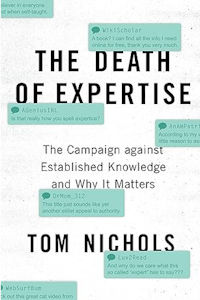
Nichols, THE DEATH OF EXPERTISE

Tom Nichols’ THE DEATH OF EXPERTISE: The Campaign against Established Knowledge and Why it Matters (Oxford, 2017) is one of the better in the batch of recent books I’ve read about current events and how they reflect issues of science and human nature. Nichols is a professor and former aide in the US Senate, with several previous books on Russian and nuclear policy. (Also – see https://en.wikipedia.org/wiki/Tom_Nichols_(academic) – he’s a five-time Jeopardy champion, and member of the Never Trump movement, who left the Republican party after the confirmation of Brett Kavanaugh.)

Again, my notes on this run over 3000 words, and I’ll post them here, with a paragraph summary on the reviews page.

Continue reading

Posted in Book Notes, Conservative Resistance, Culture | Comments Off on Nichols, THE DEATH OF EXPERTISE