Levitin: A FIELD GUIDE TO LIES

Daniel J. Levitin’s A FIELD GUIDE TO LIES: Critical Thinking in the Information Age (Dutton, 2016) is a nice complement to the book previously reviewed. Levitin an academic at UC Berkeley and has written three previous books, including This Is Your Brain on Music: The Science of Human Obsession (2006).

Most of the content here is familiar from easily available material about how statistics can be misleading and about issues of very basic epistemology, i.e. how to evaluate the world and know what is likely to be so. Though he uses the words “believing things that aren’t so” he has no mention or references to Thomas Gilovich or Michael Shermer, who’ve written books on related topics.

The book is fairly casual, with many good examples of the points it summarizes. It easily could have been longer. It covers many issues that I first read about in a college textbook, Logic and Contemporary Rhetoric, that remains for me the granddaddy of all books about logical fallacies and mental biases in politics and culture. (Blog post about that book)

Levitin’s book includes a glossary, notes, and index. Rather than summarize generally, I’ll just post my chapter by chapter notes, even though some topics are here only mentioned.

Part One, Evaluating Numbers

Quoting Mark Twain: “It ain’t what you don’t know that gets you into trouble. It’s what you know for sure that just ain’t so.”

Page 3, Plausibility

Examples of statistics that fail basic plausibility, e.g. a salesperson made 1000 sales a day. Pays to stop and think if the claim is remotely plausible, let alone correct.

Counting pregnancies not births. A Fox News chart that adds up to way over 100%.

P11, Fun with Averages

Mean, median, mode. Examples of meaningless averages. 18b the ecological and exception fallacies. Examples involving life expectancy, and shifting baselines.

P26, Axis Shenanigans

Axes that are unlabeled, or truncated to exaggerate a claim by hiding the context. Example, another Fox news chart p29. Examples of crime rates, home prices, double Y axes. Notorious chart put up in congress about Planned Parenthood, to imply abortions far outnumber cancer screenings (the villain is a Republican of course), p40.

P43, Hijinks with How Numbers are Reported

Cola sales by themselves may not tell the story; it’s more about market share. Or if sales drop, show a chart of *cumulative* sales instead—Apple did this, p48.

One can find unrelated correlations, e.g. drownings and Nicholas Cage movies, p49. Deceptive illustrations, p52.

Framings issues, e.g. water usage s/be per acre or whatever. Better to use proportions.

Beware extrapolations that lead to nonsensical results, e.g. coffee cooling.

Precision v accuracy. Comparing apples to oranges. How to display birth rates by state, using different sized bins, p68ff.

P75, How Numbers Are Collected

People collect numbers; they don’t just appear.

Sampling: must be representative. Example of how to sample pedestrians in San Francisco. People aren’t always honest. Be aware of margin of error.

Sampling bias: led to famous wrong prediction that Landon would defeat Roosevelt. Thus the Gallup poll.

Sometimes it helps to disguise the purpose of a poll; to account for non-responses; to account for biases in reporting (what people say isn’t necessarily what they do).

Standardization, measurement error, definitions: of rain, of the homeless.

P95, how to ask political polls; everyone will gripe. And how to realize that some things are simply unknowable, about how many suicides were gay, or how many readers a magazine actually has, p96. [[ points like these are much more crucial than most items here ]]

P97, Probabilities

Different kinds: classic, as in a die with six sides; frequentist, as in an experiment with a drug; and subjective, as when a person estimates his likelihood of doing something. These can be confused, e.g. weather forecasts. Combining probabilities involves multiplication. Some are conditional, and can be confused by prosecuting attorneys and juries.

Visualizing: a fourfold table can help portray conditional prob’s – this is Bayesian thinking, to see how results change as conditions change, e.g. about breast cancer. These conditionals do not work backwards, e.g. p115.

People are uncomfortable with statistics and graphs, and some information is confused, deliberately or not.

Part Two, Evaluating Words

P123, How do we know?

We discover information ourselves, or acquire it implicitly, or are taught it explicitly. There are skills we can learn to help analyze claims, skills that should be taught to 14-year-olds, p124.2.

Recall Twain epigram again, p125. Did Twain really say it? Author relates the details of tracking it down.

P129, identifying expertise

First ask what is their authority. Experts can be wrong, but are more likely right than nonexperts, 131.4. definition p130. Expertise is often quite narrow. Work is peer reviewed. Experts are recognized by prizes and grants.

Be aware of source hierarchy – some are more reliable than others, e.g. major newspapers compared certain websites like TMZ.

137, website domain: .gov or .edu or org likely more reliable than .com. Ask who’s behind a site; some are deliberately misleading (another Republican example p140).

Institutions can be biased. Also can look at who links to a page, p143.

Certain journals exercise rigorous peer review, as do textbooks and encyclopedia; not so much claims by food companies, say.

Beware out of date webpages, or stories that have been discredited but remain available. E.g. Trump’s discredited claims.

Some people copy information and claim it as their own.

Some make citations in footnotes that don’t actually support their claims (most people won’t look).
And beware confusing terminology, e.g. incidence vs. prevalence of a disease, p149.

P152, Overlooked, Undervalued Alternative Explanations

Beware assuming a cause or outrageous claims that might have ordinary explanations. This applies to magicians, fortune-tellers, and so on, 153.

And claims about ancient astronauts, etc.; what is more likely.

Some claims are missing control groups, e.g. that listening to Mozart increases a baby’s IQ. The real explanation was that boredom temporarily decreases it, 158.

Cherry-picking and selective windowing bias the data toward a particular hypothesis. Beware the gambler’s fallacy…

Small samples are usually not representative, and statistical literacy misleads in tricks and red/white cards, p167.

P168, Counterknowledge

This is misinformation packaged to look like fact, such as celebrity gossip or pseudo-history, including many conspiracy theories. Consider 9/11: what’s the probability of the various claims that 9/11 was a conspiracy; a handful of unexplained anomalies does not discredit thousands of other pieces of evidence.

Reporters can mislead; some report what one expert says, better ones will interview more than one. Different than breaking news mode, where news is gathered from eyewitnesses. These can be confused.

Perception of risk can be skewed when ordinary risks are not reported, e.g. drownings, while unusual ones are in the news. [[ the standard availability bias ]]

And association can mislead, as in an argument about bottled water, 176.

Part Three: Evaluating the World

P181, How science works

We are all human with imperfect brains, and there are some scientists who are frauds – examples include Andrew Wakefield.

It’s a myth that science is neat and tidy, that scientists never disagree; and a myth that a single experiment ever settles anything. What counts is the meta-analysis, the results of many experiments, to reach a consensus, with attendant risks about samples.

Deduction and induction; the syllogism; how a syllogism can be true even if the premise is false. ‘Modus ponens’ p186, with three variations: the contrapositive, the converse, the inverse, p188-89.

Sherlock Holmes did *abduction*, making clever guesses from specifics to conclude another specific, to a degree of likelihood—but not logical certainty.

What we call ‘arguments’ are premises, or evidence, with conclusions. Example of a deduction about maternity wards and how mortality rates went down not because of initial hypotheses, but when doctors washed their hands.

P198, Logical fallacies

Illusory correlations, as when you get a phone call from someone after just thinking of them. You don’t consider all the times that didn’t happen, or how many people there are in the world…

Framing probabilities: chance encounters on a vacation.

Framing risk: need to look at rates, not absolute numbers, about plane crashes or immigrant risk. [[ politicians play up specific anecdotes to undermine this ]]

Belief perseverance is that we have a hard time letting go of a belief despite evidence to the contrary; we maintain allegiance to low-fat diets, or the link between autism and vaccines, p207.

P211, Knowing What You Don’t Know

Rumsfeld’s known unknowns. Uncovering unknown unknowns is the principal job of scientists: “The B-movie characterization of the scientist who clings to his pet theory to his last breath doesn’t apply to any scientist I know; real scientists know that they only learn when things don’t turn out the way they thought they would.’ P213.2

Fourfold table, p214. It’s the unknown unknowns that are the most dangerous.

P216, Bayesian Thinking in Science and in Court

Scientists update their confidence in ideas based on new evidence; they move from prior probability, of a hypothesis, to posterior probability. Unlikely claims require stronger evidence. Examples from forensics.

Technically, it’s not true that a person is innocent (prior prob of 0); it’s always some tiny number, based on the possible number of perpetrators in a city, say. Example of fourfold table of guilt based on a blood match…

P222 Four Case Studies

Rather lengthy examples of:

  • The author’s dog, who made have had cancer;
  • Whether the moon landing was faked, p229, with reference to Rocketdyne;
  • Whether David Blaine’s stunts are real, p231, with mentions of James Randi and Peter Popoff;
  • And of the universe, its layers of particles, and whether Higgs is really the end.

P251, Conclusion: Discovering Your Own

Recalls Orwell’s 1984. Experts vs. the anti-science bias in public discourse, when we need expertise to make critical decisions. Also an anti-skepticism bias, in which people figure if it’s on the internet, it must be true. We all must apply careful thinking… We’re better off knowing a moderate number of things with certainty, than a large number of things that might not be so, 254.
Posted in Book Notes, Culture, Politics, Psychology | Comments Off on Levitin: A FIELD GUIDE TO LIES

Ariely: PREDICTABLY IRRATIONAL

Dan Ariely’s PREDICTABLY IRRATIONAL: The Hidden Forces That Shape Our Decisions (Harper 2008) is one of the earliest popular books that summarizes various findings of experimental psychology in recent decades that reveal the biases of human nature.

Key point: traditional economics assumed that people are rational individuals. But in fact, humans are not only irrational, they are irrational in predictable, systematic ways.

The thirteen chapters explore examples, in the Malcolm Gladwell mode of telling stories and drawing conclusions (though without much underlying interest in the mechanisms that explains *why* we behave like this, e.g in terms of evolutionary psychology; there are other books for that). Here’s one bullet per chapter summary.

  • Everything is relative: how subscription forms plant decoys, or surveys anchor with photos of handsome students or houses. We make choices based on comparisons, not by any absolute standards. How to control this? Reduce the circle of comparison. Realize that the more we have, the more we want; so consciously reduce one’s expectations.
  • The fallacy of supply and demand. How to increase the demand by simply raising the price. People imprint on the first idea they see: anchoring. The initial anchors can be arbitrary. Thus: realize that life decisions may be based on ‘arbitrary coherence’ – contingencies, randomness. And so question such decisions. And: “a free market based on supply, demand, and no friction would be the ideal if we were truly rational. Yet when we are not rational but irrational, policies should take this important factor into account.” P48.
  • The cost of zero cost: it’s fun to get free stuff, and so Amazon sales boomed when they offered free shipping, and cars sold better with deals for free oil changes. So apply this to social policy: make wise preventable measures free.
  • The cost of social norms. We’re happy to do things, but not when we’re paid to do them, e.g. working for a cause rather than for cash. Fining parents for being late to pick up their kids made the problem worse, because it removed the social obligation factor and reduced it to a cash transaction. So: Education might be enhanced by switching to social goals, rather than focusing on taking tests. Example of Burning Man, and its gift exchange economy.
  • The influence of arousal. We take greater risks when aroused or angry, confirmed in psychology tests. So: take this into account in advance; carry condoms, even if pledging to say no; don’t drive or make decisions when upset.
  • The problem of procrastination and self-control. Over and over again experiments show that people put things off – even when allowed to set their own deadlines in advance! Solutions: force commitment in advance, e.g. regulations to enforce health checkups; how auto makers bundle maintenance into periodic service checks. [Everyone does this now.]
  • The high price of ownership – why we overvalue what have. An experiment with basketball tickets given by lottery; once the winners had their tickets, how much would they take to sell them? Vs. how much would those who didn’t get them pay to get one? The former valued them much more. When we have something, especially if we’ve put work into it (like assembling Ikea furniture) we value it more. Similar comments about ownership of ideas, and why we’re reluctant to change our minds; ideologies. (No cure for this, except to try considering transactions from the POV of a non-owner.)
  • Keeping door open – why options distract us from our main objective. Examples of choosing a major, or a boyfriend; we’re reluctant to commit when many options are available. Solution: start small, close some doors, and move on. The consequences of not deciding at all can be worse in the long run.
  • The effect of expectations – why the mind gets what it expects. How opposing fans watching the same game interpret it very differently. How taste tests turn out differently when products are described beforehand, or afterwards. Caterers and advertisers know this; it’s called priming. Solution: consider both sides of a conflict without knowing who’s on which side.
  • The power of price. How various surgical procedures have been revealed as mere placebo exercises. (It’s apt to realize that *all* early medical procedures – eye of newt, etc. – relied on placebo effects.) Prescriptions drugs vary in effect on how they are described and priced. If placebos work, why not enjoy them? Because they drive up the cost of health care.
  • The context of our character – why we’re dishonest. When given a chance to cheat, everyone cheats – but just a little. Experiments show that when reminded of the 10 commandments – or any other ethical standard, like a professional oath – people cheat less. Professions were de-regulated in the ‘60s, and has led to declines in standards. What to do? Perhaps practices like signing a code of honor will actually lead to better behavior. [ Matthew Hutson describes this as one of his 7 laws of magical thinking, in a book whose theme is that you can be aware of these effects *and still employ them* to lead to better behavior. ]
  • The context of our character part 2 – why dealing with cash makes us more honest. Students take Cokes left in dorm refrigerators – but not dollars from a plate of cash. Cheating is easier if it’s removed from actual money. Thus complex financial schemes enable corporate misdeeds, e.g. Enron. Upton Sinclair, quoted p227: “It is difficult to get a man to understand something when his salary depends upon his not understanding it.” This is a problem because cash is going away in the modern economy, and schemes like airline frequent flier miles and credit card interest rates, all very abstract, make cheating easier.
  • Beer and free lunches – what is behavioral economics, and where are the free lunches? When people in a group place their orders in a pub, they are affected by the orders of those who spoke first – not to be the same, but to be different, to the point of not ordering what they truly want, out of a ‘need for uniqueness’.

This final section concludes how we’ve seen how economics is not about rational decisions. So shouldn’t economics be about how people actually behave? Here’s the free lunch: do we take these recognitions of irrationality and recognize them as opportunities to improve? Page 243:

If I were to distill one main lesson from the research described in this book, it is that we are pawns in a game whose forces we largely fail to comprehend. We usually think of ourselves as sitting in the driver’s seat, with ultimate control over the decisions we make and the direction of our life takes; but, alas, this perception has more to do with our desires—with how we want to view ourselves—than with reality.

Posted in Book Notes, Psychology | Comments Off on Ariely: PREDICTABLY IRRATIONAL

Keen: HOW TO FIX THE FUTURE

Andrew Keen’s How to Fix the Future (Atlantic Monthly Press, 2018) is a breezy book in the Thomas L. Friedman mode, as the author travels the world speaking to various experts, and describing his trips and circumstances as he goes. P109b: “I am having afternoon tea with the writer Parag Khanna in Singapore’s Goodwood Park Hotel. …” He even chats with Uber drivers, just as Friedman chats with taxi drivers. (Ch 9)

Keen has written several earlier books, including The Cult of the Amateur (which I read back in 2007) and The Internet is Not the Answer, and this new book is one of a genre by alarmists and futurists worrying about the impact of the latest technologies. There have always been books warning about the latest technologies – for centuries, since the first print books, since radio, since TV — so I came to this book a tad skeptical, needing to understand what he thinks the problems are, and his solutions would be.

And so, it’s a decent book. Obviously there are issues about how the Internet is affecting our world, our social interactions. (But these are changes; are they necessarily bad? Some people think any change is bad.) The book’s strengths are its appeal to historical examples and how they have been solved by the five tools he describes and explores at length; and his appeal to Thomas More’s Utopia, of 500 years ago, and how its ideals might be realized in the 21st century. The epigram is long quote from Thomas More’s Utopia (which becomes a running theme through the book).

So with a title like this, what does the book claim are the problems that need to be fixed?

The early chapters identify the problems — briefly, as if common knowledge. Industry withering, inequality, unemployment, cultural malaise, etc. By both elites and populists there is resentment. Reactionaries want to destroy the new order; idealists believe technology will fix everything on its own (cf. Kevin Kelly). Author sees the issues similar to those of the Industrial Revolution. He states that only people, not tech, can fix problems.

He contrasts Moore’s Law, from 1965, about the doubling of processing power in silicon chips every eighteen months, with [Thomas] More’s Law, the lesson of his Utopia: Our duty is to make the world a better place. (He mentions that 8 of the 10 goals of the Communist Manifesto have been reached, all by themselves.)

The answer to these problems is not free-market libertarianism — the attitude of Silicon Valley — but rather five tools:

• Regulation
• Competitive innovation
• Social responsibility
• Worker and consumer choice
• Education

These techniques have been applied before to solve problems, as in the meat-packing industry a century ago, and the food industry from the mid 19th century to the early 20th, p49.

His travels take him to Estonia, one of the most internet dependent countries in the world, with electronic ID cards and complete transparency so that people trust the government, because you always know who’s accessed your data. (In contrast to Putin’s post-truth philosophy, wherein Russia’s chief role is the manufacture of fake news.)

And to Singapore, whose goal is to create a ‘Smart Nation’ in which everything is connected. The focus is on intelligence; a post-privacy world. With a social credit system, where good behavior is rewarded and the untrustworthy are punished – very 1984.

(I especially appreciated these sections, because so much of the US media, and popular opinion in the US, treats the rest of the world as irrelevant, as if nothing important could be discovered or learned outside the most exceptional country on the planet, which of course is the USA.)

The balance of the book examines the five tools, in detail. About regulation, he visits Brussels. On innovation, he recalls Corvair and Ralph Nader and how regulations since then have reduced auto deaths by 80%. About social responsibility, he visits the ethics of Silicon Valley – ruthless businessmen, not unlike Carnegie and past business tycoons – and visits the Kapor Center, in Oakland (https://www.kaporcenter.org/). On worker and consumer choice, Century City and artist strikes, ad blockers, Uber drivers. And on Education: the idea of a Universal Basic Income, Rutger Bregman, and wondering, what are humans good for? Humans, unlike smart machines, can handle ambiguity, and have intuition. He visits Palo Alto High School, whose famous instructor Esther Wojcicki trains students to think, not follow instructions. Trust the kids.

And the book’s conclusion is about ‘our kids’. The left/right division has given way to nationalists vs. globalists, with the young disproportionately on the progressive side. And he anticipates how epochal changes happen: “nothing, nothing, nothing… and then something dramatic.”

Posted in Book Notes, Culture, Technology | Comments Off on Keen: HOW TO FIX THE FUTURE

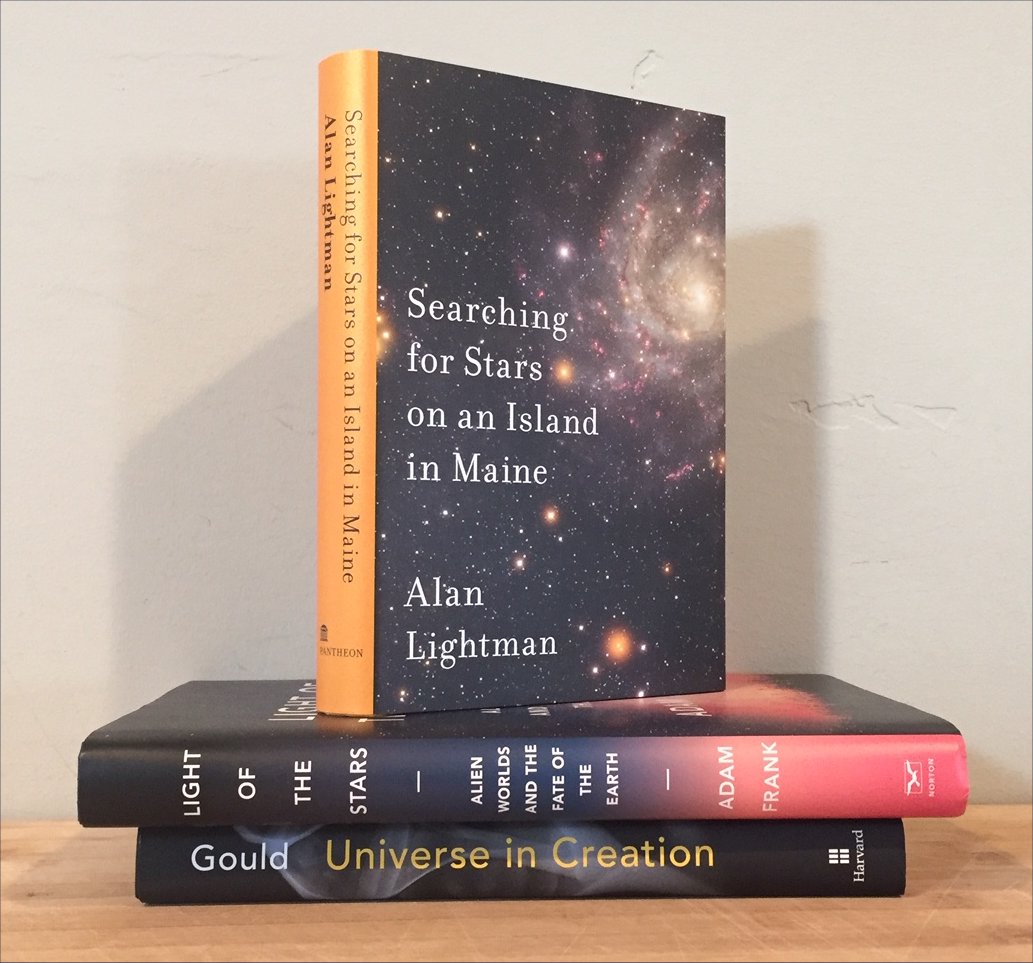
Lightman: SEARCHING FOR STARS ON AN ISLAND IN MAINE

Alan Lightman is the best known of the three authors reviewed today; he’s published numerous books before, including the novels EINSTEIN’S DREAMS and THE DIAGNOSIS, as well as numerous volumes of essays, out of all of which I’ve only read a couple. SEARCHING FOR STARS ON AN ISLAND IN MAINE (Pantheon, 2018) is a book of linked essays, or reminiscences, on the themes of science and religion and the yearning for meaning. Several sections are inspired by his summers on an island off the coast of Maine, watching bugs, hummingbirds, looking at the stars. So there’s an E.O. Wilson naturalist’s flavor here.

It’s a book of lovely writing, wise reflection on the protocols of nature and science, and mushiness about how the evidence of reality isn’t ‘meaningful’, and how there must be something *more*.

The first longish section is called “Longing for Absolutes in a Relative World,” and contrasts the scientist’s materialist views with what he says is the allure of Absolutes: “ethereal things that are all-encompassing, unchangeable, eternal, sacred.” These are ideas that have been around since antiquity, and cannot be proved or disproved, he says, though some have been given up, e.g. the notion that the Earth is not fixed.

–My reaction, that I wrote down at the time, only 17 pages in: Hopelessly mushy. What he’s really describing is the way our human nature relies on and imagines such ideas, even when as he admits they don’t exist in the simple-minded way the ancients believed, let alone in the sophisticated way we currently understand the universe. He’s too preoccupied by what those ancients (and later in the book various classics authors) supposed; we are now in a position to know better, and identify the reality our biased human nature isn’t inclined to perceive. Yet humanity in its aggregate really does learn new things, verifiable new things, even as only a very few pay attention.

Returning to a summary. He ponders how there must be more than “Just atoms and molecules”. [Why? My favorite analogy is that he doesn’t make the same argument about how the greatest books in the world can’t be merely arrangements of just 26 letters; where does the wisdom come from? There must be something *more*.] He recalls Galileo, Aquinas, Kepler, Bruno, Emily Dickinson, Lucretius.

He cycles back and forth: he understands how humans feel the need to see patterns, and that any claims from prophets be subject to the experimental testing of science — but then claims that “the transcendent experience is the most powerful evidence we have for a spiritual world.” [ Whose transcendent experiences, I wonder; those of any number of murderous psychotics one might cite? Transcendent experiences are irreproducible anecdotes, not evidence. ] He describes the central ‘doctrine’ of science but then claims there are realms in which that doctrine does not apply. How does he know? The Central Doctrine must be accepted on faith, he says. No, no, no; it’s not faith, it’s confidence, based on all the evidence to date, and always subject to revision. But, like Gould in the previous book, Lightman *wants* there to be something more.

And so on. He wends his way through Starry Night, Einstein, how we’ve deduced there are billions of other planets. He reads the Harvard Classics, Augustine, Kierkegaard, discusses the expanding universe, the multiverse, fine-tuning. (Again, overlapping topics with the previous two books.) The multiverse would be an Absolute.

He ends with a relatively homely anecdote about connecting with his kids via Facetime, pondering Homo techno and Bacon’s New Atlantis, and (Harari-like) speculation on human cybernetics. Why do people resist the idea of evolution, he wonders; species chauvinism. And the sacred books, which so many cannot let go of. Anything humans do is natural. The dignity of our species may be the final Absolute.

\\

A frustrating book. Like the maundering of a wise professor who is lapsing into self-indulgent senility. The book can be taken as an example of how naive human perception of the universe persists despite the rigor of logic and evidence. He may as well be arguing for the simplicity of belief in a flat earth, because it’s easier to understand, more comforting.

At best, this is a nice walk-around of modern ideas about how science works and what humans have learned about the universe as observed through evidence; and how, in counterpart, these revelations upset the ways humans have understood their surroundings as projections of human biases and values.

The classics of that Harvard bookshelf offer deep insights into the naïve way humans have viewed the world. They are historical artifacts. They do contain, in fact, many deep insights — into human nature (I especially recommend Montaigne). But to need to take them into account now, to assess our best understanding of the world and the universe, is like asking freshmen for their opinions to give them equal weight to the learned professors.

\\

P.S.: On page 15 Lightman cites sociologist Elaine Howard Ecklund about how 25 percent of scientists at elite universities believe in God. No; Jerry Coyne has debunked this. Ecklund is funded by the religiously motivated Templeton Foundation, and she is biased toward simplifying a range of results into bins that most support its mission. Here’s an example: Ecklund and Long: Scientists are totally spiritual. An object lesson in how to ask a question and how to tally the results, and motivated reasoning. (Others)

Similar comments could be made about Christian apologist Alvin Plantinga, whom Lightman cites on page 121.

Posted in Book Notes, Religion, Science | Comments Off on Lightman: SEARCHING FOR STARS ON AN ISLAND IN MAINE

Gould: UNIVERSE IN CREATION

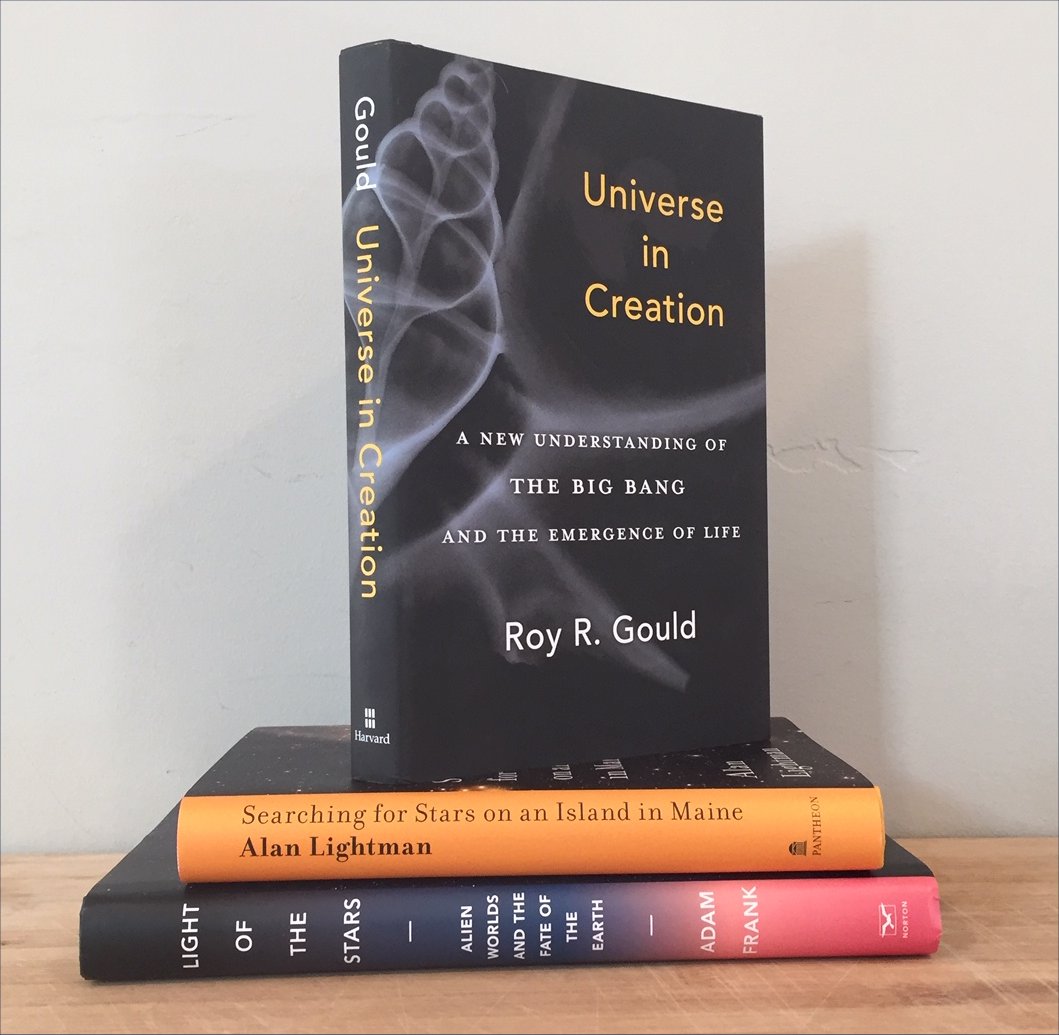
Roy R. Gould’s UNIVERSE IN CREATION: A New Understanding of The Big Bang and the Emergence of Life (Harvard, 2018) overlaps on a couple topics with the Adam Frank book reviewed previously. But.

Gould would like to claim that the universe has a ‘story’, a plan in its infrastructure of particles, forces, and rules (laws of nature), and this ‘building plan’ and its consequences suggest the universe is going somewhere; it’s trying to accomplish something (p5.6).

Many scientists have pondered such questions; is the universe guaranteed to produce intelligent life? Most have said no; this would be teleological. Or is intelligence necessary as an observer effect in physics? Author takes two approaches: examine the history of the universe to the present; and consider the properties of life especially since we know thousands of extra-solar planets have been discovered.

And so author summarizes the history of understanding our local planets, their distances; the galaxy and its extent; the discovery that there are billions of others. The discovery of the expansion. Einstein and relativity and gravity. Dark matter and dark energy. The discovery in 1988 that the expansion is speeding up.

The laws of nature; if they were anything else, we wouldn’t be here. The fine-tuning problem. Several possible answers.

A brief history of the universe: how stars create elements; the emergence of life. And then the idea that life was built into the universe’s building plan.

–And here, in Chapter 11, the book goes off the rails. Where do the ‘applicants’ for evolution comes from? he wonders, and decides “In other words, we evolved a new feature because we needed it” p159. No no no!

He considers chance and predictability; information; the idea that physical sensations are the strongest evidence that life is written into the universe’s script. (How does this follow?)

He ends by claiming the universe “behaves as though it was a purpose” and that we “may” be fundamental to the universe’s existence.

\\

And this from an academic publisher! (I did notice that none of the three blurbers on the book’s back cover are people I’ve heard of.)

The author never makes an argument that there is some reason the universe’s ‘rules’ or laws of nature *have* to be this or that to produce life; he doesn’t even demonstrate how life would inevitably result, which would be a great claim.

He continually begs the question by referring to nature’s ‘building plan’ to imply intent, when there’s no reason to think other than we are in the one random universe that happened to have conditions that created life — by an accident that might as well not have happened — compared to others in the multiverse with conditions that would make our complex universe impossible. It’s a book of wishful thinking, and rather dim-witted awe.

Repeatedly he contrasts the idea of a ‘building plan’ with the alternative of ‘blind chance’ when neither need to be true; evolution is a continual feedback process to advance things that work and let pass away those that don’t. Not a plan, or random chance. Note p144, where the author comes across as a bit dim.

Note also how many of his footnotes are to obscure, and old, references, e.g. books from the ‘50s about some scientist or philosopher who must have made an impression on the author at the time.

I did learn at least one thing: that many different proteins can arise to accomplish the same thing. This means that the supposed amazing properties of organisms can have arisen by multiple routes; the properties of organisms aren’t quite so amazing when you realize there are many ways they might have come about. (This topic recalls the discussion in one of Dawkins’ books about how the DNA sequence isn’t a blueprint for creating a body; it’s a set of instructions for unfolding it, like a work of origami.)

This persistent misunderstanding of evolution is yet another example of how the world works in ways unlike human intuition. People need things to make sense in terms of story and purpose, and many are inclined to believe, and try to rationalize, what they wish to be true.

Posted in Book Notes, Cosmology | Comments Off on Gould: UNIVERSE IN CREATION

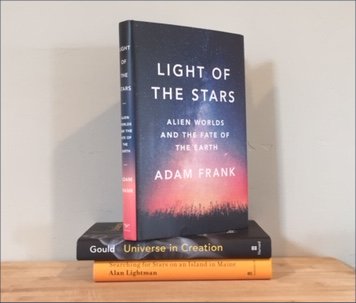
Frank: LIGHT OF THE STARS

Adam Frank’s LIGHT OF THE STARS: Alien Worlds and the Fate of the Earth (Norton, 2018) asks, what can thinking about the prospect of alien civilizations tell us about our own fate? Currently our species’ story (by those of us paying attention, at least) is that humanity is wrecking the planet, having initiated the Anthropocene and triggered climate change that is wiping out thousands of species and threatening our own survival. Must it always be so? If other planets support intelligent life, did those civilizations come to some coevolution with their planets?

He reviews the history of our ideas about alien worlds, from Epicurus to Fermi, and then our knowledge of nearby planets, as our studies of Venus and Mars have influenced our understanding of our own Earthly climate. The ancient Earth couldn’t support our kind of life; there was a ‘great oxidation event’ in the Archean eon when life discovered how to use sunlight, and changed the atmosphere of the planet. And then the recent discoveries of thousands of planets around other stars — some 1800 planets discovered as of 2015. The famous Drake Equation was then rethought, to ask how many civilizations have *ever* existed — or the converse: what is the likelihood humans are alone in the universe? With estimates of 10 to the power of -22; that is, extremely extremely unlikely that there has never been another intelligent species in the universe.

We can then ask, how often can civilizations become sustainable, i.e. surviving their Anthropocenes? The author analyzed various energy sources and their impacts, then built models with different starting conditions. And found three classes of results (p196): the first, an abrupt die-off of the population as planetary temperature rises. Second, a ‘soft-landing’ in which the population plateaued and an equilibrium was reached with planetary temperature. And third, a complete collapse–extinction–with or without changing to different energy resources, because the planet had reached a point of no return and could not recover.

Real data, of course, show rising population, energy consumption, and CO2 concentration (p199), with our eventual outcome among those options unknown.

What would a sustainable civilization look like? For a civilization to ‘wake up’ and become self-aware of its destiny? In 1971 a conference that included Carl Sagan created the Kardashev Scale (https://en.wikipedia.org/wiki/Kardashev_scale), identifying three types of civilizations based on how much energy they use: the planet’s, the sun’s, or the galaxy’s. The second type embodies the notion of the Dyson sphere, and the first is reflected in naive SF visions of planets turned into vast cities – Asimov’s Trantor; Star Wars. These did not understand that civilizations are part of a planet’s history, and this history is about energy *transformations* — the heat from any energy use has to go somewhere. Thus the key to sustainability is developing a cooperative relationship with the planet. P214, “Planets are nature’s way of turning starlight into something interesting.” Transferring energy is the domain of thermodynamics, and this science says there is always some waste. The components of planets – from rock balls to those with atmospheres, etc. — are ways of transferring energy, 216b.

Author and collaborators propose a different classification of planets.

Class 1: an airless world, such as Mercury.
Class 2: a world with atmosphere but no life, like Venus or Mars.
Class 3: planets with a ‘thin’ biosphere, with a start of life, like Earth in the Archean eon.
Class 4: planets with ‘thick’ biospheres, with deep networks of life; like Earth before civilization appeared 10,000 years ago.
Class 5: planets with ‘agency-dominated’ biospheres, where a civilization is actively managing the biosphere to enhance both itself and the biosphere.

We are now part way between class 4 and class 5. Vernadsky had the idea of a ‘noosphere’, a shell of thought surrounding the planet; this is what a class 5 planet would be.

An essential lesson: planets are the engines of innovation. They are the result of physical laws; no teleology is involved. But when a civilization triggers its Anthropocene, a new age ensues: the completion of Gaia, worlds where the planet as a whole has an evolutionary direction, a goal; an ‘agency-dominated’ biosphere.

And so the new human story must be our understanding that we are not the first species to have changed Earth’s climate. Right now humanity is a kind of cosmic teenager; we must gain the astrobiological perspective to face the Anthropocene. It’s not that we’re at fault for creating climate change; we need to understand that, of course, our civilization is changing the climate, that’s what planet-spanning civilizations do. Yet we must realize that our effect on the planet does not guarantee our own existence, or what the planet will be in 1000 or 10,000 years from now.

\\

I recommend this book as doing a nice job of summarizing and integrating material, much already familiar, in its first half; and then for revealing some interesting new analyses of potential futures in its second. Its bottom line is that the ‘cosmic perspective’ of science — and of science fiction — will be necessary to manage our future, lest we stumble into that future without thinking (as our current political leaders would have us do) and risk extinction. (Not the demolition of the planet; it will survive.)

Posted in Astronomy, Book Notes, Cosmology, Species Reset | Comments Off on Frank: LIGHT OF THE STARS

H.G. Wells: THE TIME MACHINE

H.G. Wells’ THE TIME MACHINE is one of the foundational science fiction novels. Published in 1895, it was Wells’ first novel, though it’s short enough that later anthologists have reprinted it as a novella (e.g. in the second volume of THE SCIENCE FICTION HALL OF FAME). But compilers of reference books and reading guides overwhelmingly consider it a novel, if only because it’s been published as an independent book so many times over the past years.
It’s one of the earliest SF novels I read, in part because the 1960 film version, by George Pal, was one of the earliest SF movies I saw — in late 1966, I think, when I was in the 7th grade. (The junior high school I was attending showed the film in 15 or 20 minute increments during lunch breaks, and I missed the first couple installments at the time, not seeing the entire film until years later.) I just watched the film again, a couple months ago, and so picked up the novel one more time. I read it every decade or so, because it’s short, evocative, and I need to keep it clear in my mind against the memory of the film.

I shouldn’t need to summarize the novel for anyone reading this blog, but the bare bones are worth repeating: a lone genius gentleman in 1895 expounds to his friends about the fourth dimension; he’s taken 2 years to build a machine to travel through time; and when he uses it, he travels to the far future, to the year 802,701 AD, where he finds a social order split into passive Eloi and monstrous Morlocks, in a reflection of the social trends the author perceived when he wrote. The Time Traveler (he is never named) escapes the Morlocks and travels even further into the future, arriving on a cold beach where a dying sun shines on monstrous crabs, and then even further to when an eclipse masks the sun and leaves the world in total darkness, before returning to his present and telling his story. And then departs again, leaving fragmentary flowers. “One cannot choose but wonder,” concludes the narrator.

This time I read an edition from Oxford University Press with an introduction and copious notes by Roger Luckhurst, the British writer and academic (https://en.wikipedia.org/wiki/Roger_Luckhurst). His comments emphasize the extent to which Wells was influenced by the great discoveries of the 19th century — the geologists’ discoveries of the age of the Earth; Darwin’s discovery of the evolution and changing of species, and how these portended a distant future of change and changes in mankind. Elsewhere I’ve essayed about science fiction as the branch of literature that responded to technological and social change, but this broader perspective reveals how SF is part of the greater shift in humanity’s perspective and understanding of the universe. (Olaf Stapledon, whom I’m reading now, took an even more expansive view.)

This time I summarized the ways in which the book and film are different.

How the book is different than the movie:

  • It has the famous end of time scenes at the end (in the film, the Time Traveler escapes the Morlocks and returns immediately to his own time)
  • The TT explores the Palace of Green Porcelain — a counterpart to an actual museum in Wells’ day — though in the film there is a scene with speaking books that resembles the discoveries there
  • The TT accidentally starts a forest fire that blinds the Morlocks, then has to wrestle them away during the night
  • The book is infused with themes of evolution, class differences, and the future of humanity

How the movie is different that the book:

  • The movie has early scenes of the TT stopping a couple decades into the future, and watching fashions change in a store window
  • The movie has the TT engulfed in volcanic rock, which takes time to erode
  • The movie has a futuristic dome instead of the large structure Wells describes
  • The movie has the Eloi speak broken English
  • The movie employs the gimmick of the air raid siren to draw in the Eloi, and then the term ‘all clear’, which might have seemed familiar to audiences 15 years after World War II, but which seem ludicrously anachronistic today, especially as projected hundreds of thousands of years into the future
  • The movie has the TT destroy the underground lair of the Morlocks — as if this one area is the whole world — because, in Hollywood, the good guys must defeat the villains, not merely escape them.
  • The movie has the TT advance at the end, but only far enough to see a corpse disintegrate, before returning to the past
  • As the TT leaves again at the end, he takes three books with him.

In this novel Wells can be fairly said to have invented the idea of time travel, an idea that would be endlessly explored by later science fiction writers. Curiously, in the introduction Wells mentions one implication of time travel — the idea of compounding interest — which the film omits.

What I especially noticed on this reading, triggered partly by Luckhurst’s notes, is how sophisticated Wells’ speculation about the potential future of humanity were, given his time, compared to modern nonfiction analyses of human evolution and psychology. A few passages from Chapter 6. Page 32:

Strength is the outcome of need: security sets a premium on feebleness. This work of ameliorating the conditions of life–the true civilizing process that makes life more and more secure–had gone steadily into climax. One triumph of a united humanity over Nature had followed another.

Page 33:

What, unless biological science is a mass of errors, is the cause of human intelligence and vigour? Hardship and freedom: conditions under which the active, strong, and subtle survive and weaker go to the wall; conditions that put a premium upon the loyal alliance of capable men, upon self-restraint, patience, and decision. And the institution of the family, and the emotions that arise therein, the fierce jealously, the tenderness for offspring, parental self-devotion, all found their justification and support in the imminent dangers of the young. Now, where are these imminent dangers? There is a sentiment arising, and it will grow, against connubial jealousy, against fierce maternity, against passion of all sorts; unnecessary things now, and things that make us uncomfortable, savage survivals, discords in a refined and pleasant life.

Indeed, a theme of much current evolutionary and psychological thought is that human nature reflects the protocols of primitive life on the Savannah, when people lived in small tribes; and this nature is sometimes at odds with the protocols of modern life, of living in large cities with multicultural neighbors. (This discomfort is reflected in current politics.)

Wells goes there, page 34:

Under the new conditions of perfect comfort and security, that restless energy, that with us is strength, would become weakness. Even in our own time certain tendencies and desires, once necessary to survival, are a constant source of failure. Physical courage and the love of battle, for instance, are of no great help–may even be hindrances–to a civilized man.

And so Steven Pinker has described how the reduction of violence over the past few centuries has been the dismissal of ‘honor culture’ that glorifies personal valor at the cost of killing others. A curious trade-off, which Wells’ novel might be seen as exploring the consequences of.

Posted in Book Notes, science fiction | Comments Off on H.G. Wells: THE TIME MACHINE

Specialists

For years I’ve been bemused by TV commercials that show shiny happy people living glorious lives, with a narrator who claims the benefits of some prescription drug that you should consult your [particular specialist] about.

(I gather that such commercials are allowed in the US but prohibited in the rest of the world. That’s a separate issue.)

But now, at age 63, I find myself in exactly the audience for such commercials; I’m now old enough to have such specialists, who can prescribe various special drugs. I now have both a gastroenterologist, and a cardiologist.

This is a good thing. The reason life expectancy is rising in the world is that medical technology is advancing, and people have access to it (even with the dicey access to medical care in the US).

See your doctor, take care of yourself, take their prescriptions. (And, don’t read the internet for diagnosis or prescriptions.) And we can all live to be 90.

Posted in Personal history | Comments Off on Specialists

Eric Frank Russell: SINISTER BARRIER

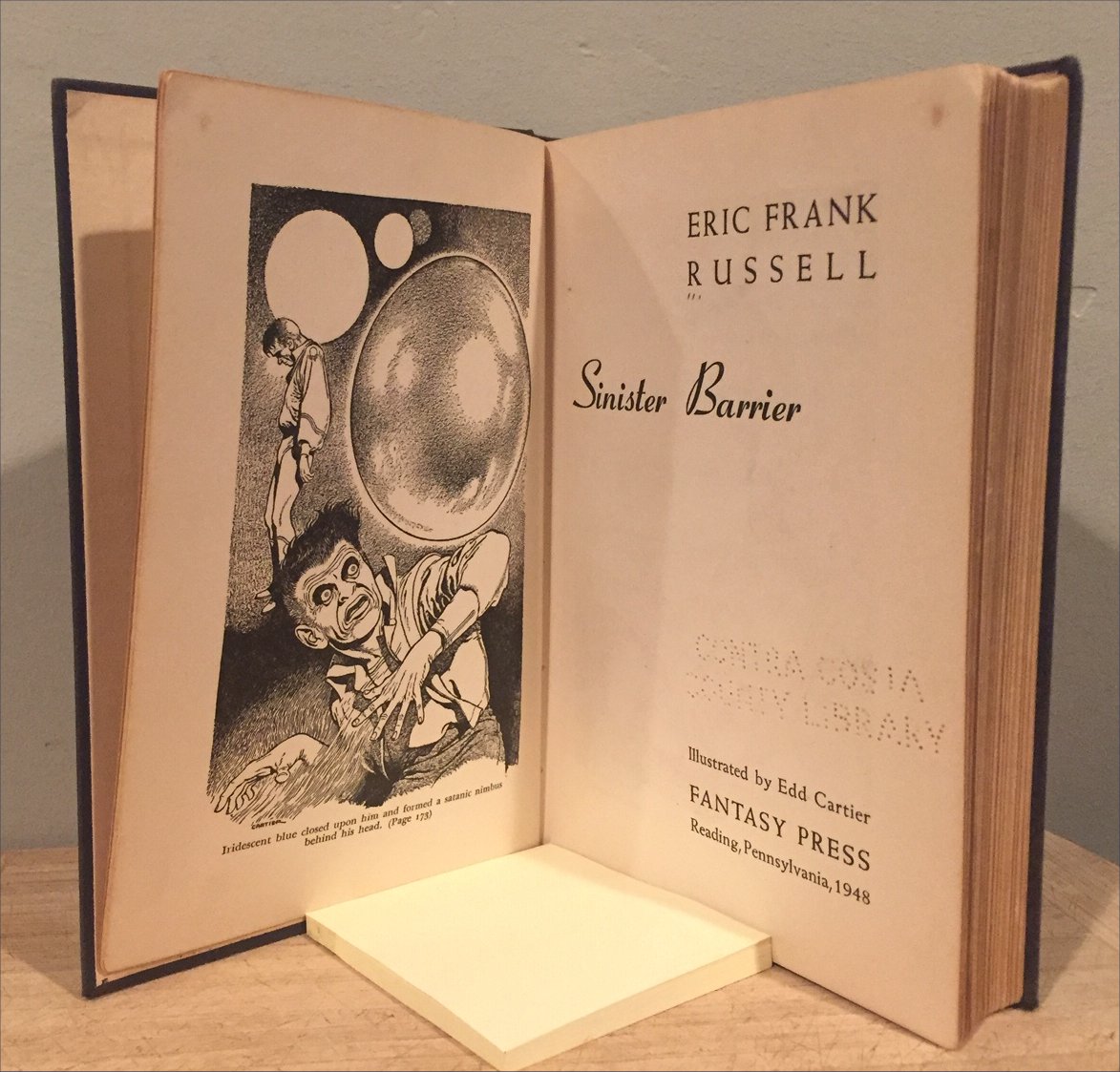
This is an early genre science fiction novel, first serialized in Unknown magazine in 1939, later revised and expanded and published in 1948 by Fantasy Press. I have the latter edition, in a used copy I picked up about six months ago at a bookshop in Oakland. (And this copy is a library discard, from the Contra Costa County Library, in a county inland from Oakland and including Walnut Creek and Mt. Diablo.)

I had two immediate thoughts as I read this novel – indeed, from reading just the first few pages.

First, none of the encyclopedia entries for this book – e.g. SFE, Wikipedia – indicate how execrably badly written this book is – at least, by modern standards. It’s awful, on a sentence by sentence basis. The prose is exaggerated, in a pulpish comic-book sense, and words are used helter-skelter, with too many words that don’t all go together in most sentences, that no careful writer would ever consider. Examples below.

Yet this was typical for much SF of its time – the 1940s and before, judging from what relatively little of it I’ve read. (Some Gernsback, some E.E. Smith; even the earliest Asimov stories had notes of the same pulpish prose.)

And so the second thought: when we read about how ‘literary’ critics of the ’50s and ‘60s sneered at science fiction as subliterary trash, we have to admit they were right in many cases. Obviously as we know they were most alarmed by the worst cases; if it’s SF, it’s not good, if it’s good, it’s not SF, as the refrain went. But you can understand their point if you go back and look at the more commonplace examples of the ‘30s, ‘40s, and ‘50s, works which were not considered unusual or harshly by readers at the time. (Except by critics like Knight and Blish, as I’ve noted in my summaries of their books, which is precisely what made those critics stand out.)

SINISTER BARRIER, despite its era and style, claims a certain significance in Sf history for its theme and for its popularity at the time. The 1948 Fantasy Press edition that I have – perhaps because the earlier 1939 serial was already well-known – even gives away the premise in the author’s foreword! Which is this: “we’re property.” That is, the human race is owned and manipulated by unseen beings, for their own purposes. And furthermore, virtually every mysterious event you can think of from throughout history – and here Russell draws heavily on the work of Charles Fort – can be explained as machinations of these unseen beings for the purpose of inciting violent emotions in humans, which is what these ethereal energy beings feed upon, or to prevent humans from detecting their existence. It’s the ultimate conspiracy theory SF novel. (A secondary premise of the book is that these energy beings may have cordoned Earth off from extraterrestrial contact, in effect saying “Keep off the grass.”)

The story begins, in the year 2015, with a series of similar incidents in which an eminent scientists abruptly go mad and commit suicide. Bjornsen; Sheridan, Luther, then Mayo, who leaps out of a building, and Webb, who fires futile gun blasts at the wall of his office before collapsing. We eventually gather that they have detected or suspected parts of this unknown control of humanity. But the prose interrupts.

Page 5 (the first page of the novel, about Professor Peder Bjornsen):

Raising his hands, he pushed, pushed futilely at thin air. Those distorted optics of his, still preternaturally cold and hard, yet brilliant with something far beyond fear, followed with dreadful fascination a shapeless, colorless point that crept from window to ceiling. Turning with a tremendous effort, he ran, his mouth open and expelling breath soundlessly.

Page 7b, about Doctor Hans Luther:

Carrying his deceptively plump body at top speed across his laboratory, he raced headlong down the stairs, across the hall.

Deceptively? (And of course the grammar implies the carrying extends to the stairs and hall, despite the first phrase.)

Page 10.8:

Leaving the window open, he searched hastily through the papers littering the dead professor’s desk, found nothing to satisfy his pointless curiosity.

I’d think his curiosity is entirely justified.

Page 26.8:

Wohl refrained from further comment while he concentrated on handling his machine. William Street slid rapidly toward them, its skyscrapers resembling oncoming giants.

The street is moving?

Several times, for example 12.2, we have this said-ism:

’What?’ ejaculated Graham.

Later, page 99b:

Whizzing high over jagged points of the Rockies which speared the red dawn, the pilot levelled off. Graham gaped repeatedly as he suppressed more yawns, stared through the plastiglass with eyes whose utter bleariness failed to conceal their underlying luster.

OK then, this is antique, pulp SF. We already know the premise; how is it played out?

The story gets underway as a banker, Sangster — because his bank has funded Mayo and Webb in their research — assigns one of his men, Bill Graham – in a coincidence typical of pulp fiction, because he witnessed Mayo’s suicide jump – to investigate. Graham teams up with a police investigator, Art Wohl, and the story has them follow lead after lead, at first to find other scientists who’ve committed suicide, then about the strange combination of iodine and other chemicals on their bodies, to an asylum where the author indulges in some speculation about schizophrenics (p37). Graham is promoted to official government Intelligence, which entails him receiving an encoded identity ring. The next lead, about a Professor Beach in Silver City, Idaho, is frustrated by the abrupt destruction of the entire city.

The narrative alternates between car chases (an extraordinary one in Ch2 about two-wheeled gyrocars outmaneuvering old four-wheel ‘jalopies’ on a ‘skyway’ accessed by a corkscrew ramp from the surface, with passengers pressed back and forth sans seatbelts), and gathering evidence that research into expanding the range of human visual perception – the “sinister barrier” of the title – has revealed previously unseen creatures perceptible only via infrared. (This was long before astronomers devised instruments to see IR, UV, etc.).

Page 87-88 in this edition:

The scale of electro-magnetic vibrations extends over sixty octaves, of which the human eye can see but one. Beyond that sinister barrier of our limitations, outside that poor, ineffective range of vision, bossing every man jack of us from the cradle to the grave, invisibly preying on us as ruthlessly as any parasite, are our malicious, all-powerful lords and masters—the creatures who really own the Earth!

(This is the one insight I give this story credit for – the idea that humans do not perceive everything there is to perceive. Cf. E.O. Wilson and many others. [But the conspiracy theories are nonsense.])

Once this discovery is made; what to do? The unseen manipulators, whom someone dubs Vitons, trigger the “Asian races” to start a world war, and much chaos ensues. (Reflecting racist attitudes of his time, Russell seems to think that Asiatic races are especially susceptible to suicidal group thinking – see page 49, with remarks about the Malaysians, the Japanese, the Hindus.) Then follow lots of scenes of bombings and mayhem, from the New York City setting. Later the Vitons abduct victims, rather than simply killing them, and return them to Earth as ‘dupes’ [in a prefiguring of stories like Heinlein’s Puppet Masters and Finney’s Invasion of the Body Snatchers] to kill suspect humans. These Vitons are telepathic, you see, but only over short distances, and they can’t distinguish one human from another, only whether a human has perceived too much and is dangerous to them.

Various experts are gathered to work on weapons to destroy the Vitons, and because of the Viton’s limited range of perception, they work in underground labs. Their progress is statused in passages of technical jargon. This was an era of SF in which it was still possible to appeal to readers’ understanding of optics or chemistry or radio electronics to justify the inventions the author imagines.

P201: “It was the iodine that made the difference. Methylene blue was the catalyst causing fixation of an otherwise degeneratable rectifier. He agreed that mescal served only to stimulate the optic nerves, attuning them to a new vision, but the actual cause was iodine.”

P239: “Here, a worker bent over a true-surfaced peralumin disk and silver-plated it by wire-process metallization. While his electric arc sputtered its rain of minute drops, another worker close by plated another disk with granulated silver by-passed into an exoacetylene flame and thus blast-driven into the preheated surface. Any method would do so long as there was someone capable of doing it with optical accuracy.”

Their efforts succeed, of course. The story ends as a method of destruction of the Vitons is discovered, and the world war evaporates.

Of course we can’t not notice the social attitudes of the era, as reflected in this book. There is a single female character in the book, a Dr. Harmony Curtis, introduced on p22 as the half-sister of the deceased Webb, who is met with leers between Graham and Sangster. Then p24:

Dr. Curtis had a strict, professional air of calm efficiency which Graham liked to ignore. She had also a mop of crisp black curls and a curvaceousness which he liked to admire with frankness she found annoying.

Later, p76, Graham tries to distract himself from Viton detection by thinking of her.

He drew a woman from his memory, let his mind enjoy her picture, the curl of her crisp, black hair, the curve of her hips, the tranquil smile, which occasionally lit her heart-shaped face. Doctor Curtis, of course. Being male, he had no trouble in considering her unprofessionally. She’d no right to expert status anyway; not with a form like that!

No right!

The war over, Graham and Harmony conclude the story. There is a genuine insight here, about a change in the human condition—

“Up there, Harmony, are the stars,” he continued. “There may be people out that way, people of flesh and blood like us, friendly people who’d have visited us long ago but for a Viton ban. Hans Luther believed they’d been warned to keep off the grass. Forbidden, forbidden, forbidden—that was Earth.” He studied her again. “Every worthwhile thing forbidden, to those folk who’d like to come here, and to us who were imprisoned here. Nothing permitted except that which our masters considered profitable to themselves.”

“But not now,” she murmured.

“No, not now. We can emote for ourselves now, and not for others. At last our excitements are our own.”

This echoes any number of conceptual breakthrough events in SF, in which the true nature of reality becomes available.

The final page quickly closes to a budding romance. (The Smith and Gernsback titles I’ve read ended in actual marriage!)

“Has it struck you that in the truest sense we’re now alone?”

“We–?”

“Her face turned toward him, her eyebrows arched.

“Maybe this isn’t the place,” he observed, “but at least it’s the opportunity!” He bent her across his lap, pressed his lip on hers.

She pushed at him, but not too hard. After a while, she changed her mind. Her arm slid around his neck.

The End.

Posted in Book Notes, science fiction | Comments Off on Eric Frank Russell: SINISTER BARRIER

Links and Comments: Progress; San Francisco Values; Value of Literature

From earlier this month.

New York Times, Nicholas Kristoff: Why 2018 Was the Best Year in Human History!: Once again, the world’s population was living longer and living better than ever before.

Kristof does a version of this column every year.

One reason for this column is that journalism is supposed to inform people about the world, and it turns out that most Americans (and citizens of other countries, too) are spectacularly misinformed.

For example, nine out of 10 Americans say in polls that global poverty is worsening or staying the same, when in fact the most important trend in the world is arguably a huge reduction in poverty. Until about the 1950s, a majority of humans had always lived in “extreme poverty,” defined as less than about $2 a person per day. When I was a university student in the early 1980s, 44 percent of the world’s population lived in extreme poverty.

Now, fewer than 10 percent of the world’s population lives in extreme poverty, as adjusted for inflation.

Likewise, Americans estimate that 35 percent of the world’s children have been vaccinated. In fact, 86 percent of all 1-year-olds have been vaccinated against diphtheria, tetanus and pertussis.

I suspect that this misperception reflects in part how we in journalism cover news. We cover wars, massacres and famines but are less focused on progress.

Again – this is partly about how journalism works, but also how human nature works, attentive to exceptions and anecdotes and not to statistical trends. As I’ve said, no matter what paradise or utopia you can imagine, there will always be disputes, conflicts, and outrage (by those easily outraged) led by authoritarian leaders who play on the fear of the proportion of the population (given the range of traits in human nature) given to such fears, which are always relative.

\\

San Francisco Chronicle: S.F. a leader in family values. Online headline: “What are much maligned ‘San Francisco values’? Prioritizing the welfare of families and children.”

Despite conservative rhetoric, cities like San Francisco exemplify family values over the red states – lower divorce rates, lowest teen birth rates (because “red regions of the country have higher teen pregnancy rates, more shotgun marriages and lower averages ages of marriage and first birth”).

Nationwide, there are about 20.3 births per 1,000 adolescents, versus only 7.4 per 1,000 in San Francisco.

Many more examples.

Family values are core Democratic values, and in no major American city are they more cherished, and not just preached but actually practiced, than in San Francisco.

\\

This was the final article in the Dec 24/31 issue of Time Magazine, by novelist Jennifer Egan: We Need Writers Now More Than Ever. Our Democracy Depends On It (the print title was “Facts Still Exist”). It concerns fake news, of course, but also the role literature can play.

Literature is an antidote to the blunt distortions—good vs. evil, us vs. them—that are so easily exploited by those who would manipulate us. … Writers tend to fare badly under autocrats. Dictators understand very well that the strength of thought and analysis that literature embodies is a threat to the mind control that is an essential feature of tyranny. In countries like China, Russia, Turkey, Myanmar and Bangladesh, writers are routinely jailed or killed for creating work their governments find threatening. For American writers, the reality of such scrutiny and peril can be hard to fathom. We need to write now, write well—tell the truth in all its messy complexity. It’s our best shot at helping to preserve a democracy in which facts still exist and all of us can speak freely.

Posted in Culture, Human Progress | Comments Off on Links and Comments: Progress; San Francisco Values; Value of Literature