And Nothing Is More Important Than My Ship: TOS #14 “Court Martial”

Kirk faces court martial over the death of a crewman with whom he had a history, in a confrontation that pits human rights against a computerized culture.

  • The enhanced graphics are especially effective in this episode, showing both the Enterprise and another starship in orbit around this starbase, a shuttlecraft flying past, and even repair crew at the hole in the Enterprise hull where the ‘pod’ that was jettisoned had been (something we never saw in any way in the original episode). Given that this is a starbase, and we shortly see a chart of some dozen starships and their maintenance status, it’s nice to see more than just the Enterprise in orbit.
  • Also much improved: the groundside views of the starbase, with narrow mushroom-like towers in the distance. One shot at the beginning of one of the acts shows a ground-view promenade with pedestrians, amidst those towers.
  • The Enterprise is at the starbase for repairs due to damage suffered in an “ion storm,” whatever that is. I never got the impression that the producers or writers had any idea what that was (as with Lost in Space and their “cosmic storms”).
  • Much more is made here of the loss of a crewman in that storm than we ever see about the death of any other crewman throughout the series.
  • This episode has two or three fundamental implausibilities that can’t be rationalized. The first is why there’s an issue about jettisoning the pod before or after going to red alert. Both events are results of Kirk’s subjective judgment of the danger at any given moment. What is there about a red alert that allows Kirk to jettison the pod? Just a permissions thing?
  • The second implausibility is at the heart of the episode’s debate over human rights versus machines. Everyone presumes that computers can’t be wrong. If the “computer transcript” says something is so, it must be so. But the evidence from the computer that impugns Kirk isn’t any kind of electronic log of what happened when – it’s a frame from a video recording of what happened on the bridge, showing Kirk’s finger punching a button labeled (conveniently) “jettison pod”. (As if that’s something so routinely done that it needs a dedicated button on the captain’s chair.)
  • Which leads to the biggest implausibility – that Finney, the records officer, somehow having altered that image to implicate Kirk (whom he blamed for reporting an error that Finney made years before, crippling his career), also accidentally altered the computer’s chess programming, as Spock deduces by playing several games against the computer and repeatedly winning. What do they have to do with one another? (You have to conclude that familiarity with what computers actually were was very hazy among Hollywood scriptwriters back in the mid 1960s, a theme that would recur through this series, and undercut an otherwise very dramatic 2nd season episode, “The Ultimate Computer”.)
  • And then there’s the silliness about how they locate a man presumed dead who is instead hiding somewhere aboard the ship: They beam down virtually the entire crew to get them off the ship, leaving only senior Enterprise staff, and the courtroom officers and lawyers, on the bridge, and McCoy produces a device that one by one ‘removes’ the sound of their heartbeats from the cumulative audio feed of all sounds aboard the ship. Well, not all sounds — not their breathing, not any noise from walking around, not their voices. It’s dramatically played, as McCoy finishes and… there’s one heartbeat left! – but it’s a ridiculous way to locate a missing crewman.
  • There are also plot infelicities. How the beautiful woman Kirk encounters in the starbase’s lounge, Areel Shaw, is an old flame of his – and also the attorney who then prosecutes his case. How the best defense lawyer for the job, the eccentric Samuel T. Cogley, happens to be available on the starbase (never mind the anachronism of how Cogley values physical books over computers). And how Finney’s daughter, Jamie, also happens to be here at this starbase. And how her attitude toward Kirk abruptly changes part way through the story [this is in part due to scenes that were written but cut due to time constraints].
  • Cogley does have some good lines, as when he speaks passionately for Kirk’s right to be confronted by the witness against him (i.e. the computer): “Rights, sir. Human rights! The Bible, the Code of Hammurabi, and of Justinian, Magna Carta, the Constitution of the United States, Fundamental Declarations of the Martian Colonies, and Statutes of Alpha Three.” Suggesting that even our venerated Constitution might be overtaken by later documents.
  • But Kirk has the best lines, or at least Shatner makes the best delivery, as when he defends his actions in testimony, measuredly, frankly, unapologetically, firmly: “Given the same circumstances, I would do the same thing without hesitation. Because the steps I took, in the order I took them, were absolutely necessary if I were to save my ship. And nothing… is more important than my ship.”
  • A bit of mathematical illiteracy: as the ship’s orbit begins to decay (they were maintaining “orbit by momentum” but apparently that doesn’t last long) Spock says something about “on the order of one to the fourth power.” Yup.
  • Two more understated dialogue deliveries that endure. First, as the court reconvenes aboard the Enterprise, it is Cogley who first suggests that Finney may not be dead after all, but hiding. Is there room to hide aboard a ship this size? Kirk, stunned by the implication of this suggestion, almost whispers “Possibly.”
  • And later, as the one heartbeat is left on the audio, Commodore Stone concludes, rather stonily, “So, Finney is alive”, and Kirk quietly replies with only the barest trace of vindication, “It would seem so.”
  • And then we have the requisite fist fight, as Kirk finds and confronts Finney, who’s been alive all along. [There was a filmed but omitted scene in which Cogley brings Jamie on board to help subdue Finney, which explains Cogley’s quick exit from the bridge with some errand to run in the previous scene.]
  • And finally, after Finney is subdued and the Enterprise is saved and the case against Kirk dismissed, we have Kirk kiss Areel on the bridge, for old time’s sake, as she departs. The crew around them are careful not to react. Then Kirk sits in his chair, and says defensively to Spock and McCoy, “She’s a very good lawyer”. And they respond impassively, “Obviously” and “Indeed she is”. The abruptly cheerful music underscores this bit of closing Gene Coon humor.

Blish’s adaptation, in ST2:

  • Blish’s version of this story seems to be derived from a draft or two before the final script. Kirk’s romantic background with Areel is missing; the key issue is whether the ship was a “double red alert” rather than just “red alert”; and Finney, at the end, doesn’t sabotage the ship, requiring Kirk’s quick work to repair it.
  • Rather, we get a better resolution of the subplot concerning Jame, Finney’s daughter. In the broadcast script we see her twice: at the very beginning, angry at Kirk for apparently killing her father; and then later, when she’s much calmer and concerned for Kirk’s well-being. She explains her change of attitude as the result of having “read through some of the papers he [her father] wrote, letters to mother and me.”
  • Blish saves those lines for later, and has Jame show up on the ship just as Kirk finds Finney in engineering, resolving that scene in an emotional, rather than violent manner.
  • This may be a case where a character-development plot was sacrificed for the sake of a fist-fight – between Kirk and Finney – an action sequence that NBC always appreciated.
  • Blish retains most of Cogley’s speech about the rights of men in the face of the machine, but omits the specific examples given in the final script: “Rights, sir. Human rights! The Bible, the Code of Hammurabi, and of Justinian, Magna Carta, the Constitution of the United States, Fundamental Declarations of the Martian Colonies, the Statues of Alpha Three.”
  • Blish does not try to rationalize what I’ve always felt were two huge flaws of this episode: how the altered video of the ship’s bridge, when it was or was not at red alert, has anything to do with changed computer logic for playing chess; and the clumsy, implausible manner of locating a missing crewman, by masking out the heartbeats of the last few others left on board.
Posted in Star Trek | Comments Off on And Nothing Is More Important Than My Ship: TOS #14 “Court Martial”

Correct and Logical Decisions: TOS “The Galileo Seven”

The shuttlecraft Galileo, commanded by Spock, crash-lands on a planet in the midst of a quasar-like phenomenon, where the crew fends off hostile aliens as Kirk on the Enterprise is forced to abandon its search for them.


  • This has never been a favorite episode. It focuses on Spock and his reliance on ‘logic’ to the point of caricature, and ends with a plot development that undercuts that logic in favor of impulsive human emotions, thus undermining the character (in a way no story would dare undermine Kirk’s steely command resolve).
  • At the same time, I have a new appreciation for one aspect of this episode – the shuttlecraft. The background given in Marc Cushman’s book indicates that the producers waited until mid-season, when NBC would or would not pick up the show for a full season run, to greenlight this episode—because of the expense of building the shuttlecraft full-size mockup, exterior and interior. But once NBC gave them the go and the producers went forward, the model kit company AMT volunteered to build the shuttle mock-up for free – provided they got licensing rights for the Enterprise plastic model kit. Which they did, and which they got. (As an aside, at around this time in my life, I was very much into building model cars, and favored those by AMT.)
  • The enhanced effects in the remastered episode shows a fairly plausible “quasar-like phenomenon” for what is named here as Murasaki 312, at least compared what’s depicted in the Wikipedia entry: https://en.wikipedia.org/wiki/Quasar.
  • One might wonder why Scott, chief engineer, and McCoy, chief medical officer, are doing on a mission to explore this astrophysical phenomenon. Because they are regular cast, presumably. (And to accentuate the logic v. emotion debate as one between Spock and McCoy.)
  • Trek physics: Spock orders a crewman to “stop forward momentum” and the crewman tries to do this by punching a button. (Not by, e.g., firing thrusters in a forward direction, or somesuch.)
  • The quasar-like phenomenon is described as encompassing four star systems, one of which has a habitable planet, named Taurus II. An odd name, to be named after an Earth constellation, in a previously unexplored phenomenon.
  • The plot bears some ironic comparison to “The Enemy Within”, an earlier episode that did not recognize the existence of the shuttlecraft. Here, the transporters aren’t working because nothing works within this “electromagnetic phenomenon,” – until they do, at the end of the story, just in time.
  • The enhanced effects show a cool flight deck, but are not very convincing in showing the launch of the shuttlecraft. Shouldn’t it push out on some kind of thrust, or be dragged outward by a towhook under the deck (as on an aircraft carrier), rather than be obviously picked up by strings?
  • Trek engineering: replace lost shuttlecraft fuel by downloading energy from the phasers? Really?
  • I won’t belabor the many exchanges between Spock and the crewmen about his strategy for repairing the shuttle or dealing with the hostile aliens, about Spock’s “logical” approach versus the others’ gut reactions. But they never ring true, in the context of the entire series. For one, the other crewmen – Boma, Latimer, and Gaetano especially, since Yeoman Mears doesn’t say much and McCoy and Scott are privileged – really do border upon insubordination in their reactions to Spock’s orders. And Spock seems genuinely astonished when he reflects and says, “Step by step, I’ve made the correct and logical decisions – and yet two men have died!”
  • Trek physics: somehow the shuttle *lifts off* from the planet by rising into the air without any apparent forward or downward thrust; and then, having achieved orbit and run out of fuel, the orbit begins to decay. There’s no reason a genuine orbit would decay in such a short period unless they were brushing the atmosphere – but Trek repeatedly thinks you need to keep powering the ship to maintain an orbit. (This happens in the next episode too, “Court Martial”.)
  • And then Spock jettisons and “ignites” the fuel. While in orbit. Ignites? Are they burning something in an atmosphere?
  • Kirk follows the letter of his order, by the pesky Commissioner who orders him to abandon the search, by heading away from the planet at “space-normal speed”, presumably meaning sub-light – so they can linger in order to catch any possibly signal from the stranded shuttlecraft. Which they do!
  • And Spock, acknowledging their likely failure as they try to escape the planet, and imminent deaths, says, “I, for one, do not believe in angels.”
  • There are two big insights I’ve had in rewatching these episodes in production order. One is about the music, which I’ll address in a separate post. The second is about how much effect the individual line producers had on the show. When you watch the series in endless reruns, usually in random order, they all mix together and you don’t notice, e.g., that certain themes of the show are confined to a run of episodes done by a single producer. The effect I notice now is that of producer Gene L. Coon, brought in by Roddenberry mid-first season, and who lasted IIRC until mid or late second-season. Coon wrote several iconic Trek episodes, such as “The Devil in the Dark”, but he was also the one responsible– as I realize now – for introducing humor into the show, even to its detriment. Think of all the Trek episodes that ended with some light-hearted moment on the bridge, or even with the entire bridge crew cracking up in laughter. Those were the result of final script edits by Gene Coon. And the first one is here in this episode, in which Kirk forces Spock to admit he acted impulsively, while never admitting he acted illogically. The entire bridge crew cracks up; music up and out.
  • Seeing these episodes again, I find these humorous finales annoying. Fortunately the third season producer, Fred Freiberger, explicitly disavowed such humorous moments.
  • One final point about this episode: when we see the shuttlecraft Galileo, it has a designation of NCC 1701/7, as if it’s the 7th shuttlecraft of the Enterprise, which itself is designated NCC 1701. Thus, “The Galileo Seven”. But no – the title could equally describe the fact that the Galileo embarks on this expedition with seven crewmen – Spock, McCoy, Scott, Latimer, Boma, Gaetano, Mears. The Galileo Seven. That understanding of the title had never occurred to me until now.

I keep thinking my comments on these episodes will become briefer, because somehow the earliest episodes seemed fundamental and somehow authentic to the series, in a way later episodes were not, the later ones seemingly cranked out as long as the network funded the show. (And indeed, the star SF writers Roddenberry recruited for the show usually worked for him once, near the show’s beginning, and then not again.) But maybe I’ll keep having detailed comments as long as new elements keep getting introduced, as indeed they did at least through the early second season. We’ll see.


Lawrence adaption, in ST10:

  • Note the adaptation – published in 1974 – describes Boma as a “Negro astrophysicist.”
  • There’s a bit more dialogue in the early scene in which the shuttlecraft loses control. As they’re drawn in, Spock orders “full power astern!” and Boma explains that they’ve “underestimated the strength of the nucleonic attraction” (whatever that means).
  • The adaptation follows the broadcast script closely, though as usual there are a few extra lines, as if scripted, perhaps filmed, and cut for time.
  • P64, The adaptation includes a brief scene as the first victim is buried, with the lines “Dust thou art and to dust shalt thou return. Amen” – which is more explicitly religious than anything ever actually seen in Trek.
  • P71, the dialogue in the key scene where Spock doesn’t understand why things aren’t going OK, is slightly different; in particular the words “and yet two men have died!” are missing in the adaptation.
  • P85, as the shuttle crew scrambles to reach the Galileo, when Spock is hit by a boulder, it’s because he paused to look at an artifact: “A most intriguing artifact…a hand axe, Doctor, reminiscent of those used by the Lake People of Athos IV.”
Posted in Star Trek | Comments Off on Correct and Logical Decisions: TOS “The Galileo Seven”

Links and Comments: Tyson v. Douthat

I started writing up a few notes about the new (small) Neil deGrasse Tyson book, ASTROPHYSICS FOR PEOPLE IN A HURRY, and got sidetracked by a passage that reminded me of a Ross Douthat column from a few weeks ago.

In the first chapter Tyson outlines the events that occurred in the few seconds following the Big Bang. Then on p32 he says:

What happened before all this? What happened before the beginning?

Astrophysicist have not idea. Or, rather, our most creative ideas have little or no grounding in experimental science. In response, some religious people assert, with a tinge of righteousness, that something must have started it all: a force greater than all the others, a source from which everything issues. A prime mover. In the mind of such a person, that something is, of course, God.

But what if the universe was always there, in a state or condition we have yet to identify—a multiverse, for instance, that continually births universes? Or what if the universe just popped into existence from nothing? Or what if everything we know and love were just a computer simulation rendered for entertainment by a superintelligent alien species?

These philosophically fund ideas usually satisfy nobody. …

Cue Ross Douthat! – the NYT’s conservative religious op-ed writer. For the past couple three months, he’s been writing a series of essays that entertain what he concedes are an ongoing series of implausible proposals. Back in April he wrote one imploring “many of this newspaper’s secular liberal readers” to go the church. Like he does.

Once somewhere I read that any author’s reason for writing any kind of book is to some degree to tell other people “how to be more like me”.

This column is a prime example. Ross Douthat is sure that if everyone were more like him, and went to church, the world would be a better place.

Near the end of this column, Douthat mocks nonbelievers.

Finally, a brief word to the really hardened atheists: Oh, come on. Sure, all that beauty and ecstasy and astonishing mathematical order is because we’re part of a multiverse or a simulation or something; that’s the ticket. Sure, consciousness and free will are illusions, but human rights and gender identities are totally real. Sure, your flying spaghetti monster joke makes you a lot smarter than Aquinas, Karl Barth, Martin Luther King. Sure.

Which resulted in a riposte from Herman Mehta: The Worst Part of Ross Douthat’s Easter Column Urging Liberals to Go Back to Church (Annotated), with an annotated graphic of the paragraph just posted here.

Mehta annotation is snarky, but then so was Douthat. And as Mehta notices, Douthat’s appeal to authorities includes no one alive today with a current understanding of the vastness of the universe, the history of the human race, or the complexities of the human mind — an appeal to ancient authority, is the best he can manage.

Posted in Book Notes, Religion, Science | Comments Off on Links and Comments: Tyson v. Douthat

Link and Comments: Kids These Days

From Sunday’s New York Times Book Review, a review by Jennifer Szalai of a book by new Nebraska senator Ben Sasse, THE VANISHING AMERICAN ADULT: Our Coming-of-Age Crisis — and How to Rebuild a Culture of Self-Reliance. The review is called To Make America Great Again, Give Your Kids Chores.

Sasse sounded pleasant and charming on NPR’s Wait Wait Don’t Tell Me on Saturday, but the reviewer of his book is not impressed. Indeed, from this description it sounds like another “life was better in the good old days” rant, along with the attack on “kids these days” – both complaints that echo across the generations. It’s a fallacy that a golden age ever existed, except in the fog of nostalgia and forgetfulness of what life was really like generations ago. Quotes from the review:

It should also be said that Sasse’s children are home schooled, and that he unequivocally praised Betsy DeVos — who sponsored unregulated charter school expansion in Michigan, with poor results — as an “excellent pick” for secretary of education.

Alarm bells begin ringing. And

…he’s writing not “as a senator, but rather as a citizen, as a dad, as a reader, and as a former college president.” What he’s advising is simply so much “common sense.”

Beware ‘common sense’. That’s usually an excuse for favoring one’s experience and biases and not taking the time to think about other people’s experiences and points of view.

And considering how in fact older Americans favored Trump, in contrast to younger Americans, the reviewer notes:

To read “The Vanishing American Adult” is to reside in a parallel universe where older Americans stoically uphold standards of decency and responsibility, instead of electing to the country’s highest office a reality-TV star with six business bankruptcies to his name who brazenly flouts both.

And

Still, there is something politically coherent in this. The Republican Party has been pushing a hyperindividualistic ideology for decades, fixated on the idea that the solution to every problem lies with each American falling back on his or her own personal reserves of “self-discipline and self-control.” In this unforgiving cosmology, there isn’t much room for forces that aren’t so amenable to an individual’s will — and sure enough, there isn’t much room for them in Sasse’s book either. Economic scarcity? We’re an “exceptionally prosperous nation” whose biggest problems are the “surplus creature comforts” that “make a civilization fat and unambitious.” (He approvingly quotes a friend whose travels to Ecuador made him “realize that America’s poor are rich by comparison.”) Racism? The United States is now “free of the racist legal barriers that held back many Americans” and is “finally transcending our slaveholding past.” Sexism? What’s that?

On the one hand, he’s right that many people erroneously think society is far worse off than it is, considering current levels of health and standards of living (brought to you buy… science and technology) compared to all previous generations — compared to that mythical past golden age. But that’s a sort of mental bias, not a judgment on the current population compared to our stalwart ancestors. Furthermore his reliance on individual self-discipline and control will fail when big issues, like climate change, arise than can only be solved cooperatively not just by one nation but by all nations.

Posted in Children, Conservative Resistance, Culture | Comments Off on Link and Comments: Kids These Days

Links and Comments: Reality and Fantasy about Abortion

I don’t have any horse in the race about abortion, per se, except how it is an example of right-wing authoritarian, anti-science thinking. (I’ve seen but need to document the historical background about how abortion wasn’t on the conservative religious agenda at all, until the mid-1960s, when the right realized it was losing the civil rights debate and needed another cause to rally around. Certainly there’s nothing in the Bible railing against abortion; on the contrary, in the OT causing the death of an unborn child is considered a relatively minor offense.)

As I mentioned a few posts ago, in Wishing Things Away, “like it or not, women throughout history have occasionally been put in situations in which there seems no better option than to terminate a pregnancy. Laws won’t make such circumstances go away; they will merely drive the procedure underground, making it far more dangerous for the women’s survival.”

I would expand this a bit to consider the primitive history of the race. When humans were mostly nomads and hunter/gatherers, women, instinctively or intuitively, likely understood that some times were better to bring forth a child, and other times were not. A woman realizing she were pregnant in, say, Spring, understanding that the child would be born in the depth of winter… might realize that her survival, and the survival of a potential child, would be better off if she delayed the situation until the appropriate season. Elementary natural selection: tribes in which women did not realize this, suffered more infant deaths. Tribes in which women did realize this…–and procured some means to abort one pregnancy in favor of a later one– had more infants who survived and grew to adulthood.

Enough speculation.

So from Sunday’s New York Times, an op-ed by Renee Bracey Sherman: Who Should You Listen to on Abortion? People Who’ve Had Them

In states like Indiana, Georgia, Tennessee and Virginia, elected officials are willing to imprison people for administering their own abortions because they simply couldn’t afford care nearby. Vice President Mike Pence is a man so obsessed with abortion that as governor of Indiana, he signed every anti-abortion bill that crossed his desk, including mandating funerals after abortions and requiring medically unnecessary ultrasounds. He also awarded millions of taxpayer dollars to fake pregnancy centers.

Anti-abortion policies like these aim to bring about an end to abortion; but history has shown us there’s no such thing. Abortion will continue. The only question is whether it will be safe or unsafe.

The crux of the issue is not whether you would have an abortion yourself. It’s whether you would stand in the way of someone else’s decision. Everyone loves someone who has had an abortion, though we may not know it.

The conservative position should be, it seems to be, to do everything possible to avoid women being put in situations where the feel the need to terminate a pregnancy. Sex education. Prophylactics. Surely they are less bad than terminating what they imagine is the moral equivalent of a human being. But religious conservatives are against these, too.

On the contrary, Amanda Marcotte at Salon: Baby born clutching IUD? Free abortion vacations? Nope — but such urban legends are very useful to the right. Subtitle: Titillating stories can be more persuasive than facts, and the anti-choice movement loves its nutty urban myths.

Because myth is more powerful than fact.

…the anti-choice movement has been battling scientific fact for decades now by exploiting a human weakness to pay more attention to wild and titillating stories than to facts.

Posted in Conservative Resistance, Evolution | Comments Off on Links and Comments: Reality and Fantasy about Abortion

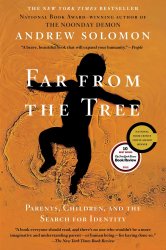
Parents, Children, Identities: Andrew Solomon’s FAR FROM THE TREE

This is an enormous book, 962 pages long, 702 of that text (with the remainder consisting of encyclopedic notes, a lengthy bibliography, and an index).

The book is about how parents deal with exceptional children, covering ten categories of exceptionality, in the titles their chapters: Deaf, Dwarfs, Down syndrome, Autism, Schizophrenia, Disability, Prodigies, Rape, Crime, and Transgender.

Two bookend chapters — “Son” and “Father” — touch on the author’s own relationships to his father, as a son; and then his late-in-life decision to become a father himself, which, as a gay man, he did via surrogacy.

I haven’t read the whole book, just the bookend chapters and the chapters about autism and prodigies. I knew of Andrew Solomon, best known before this book for one on depression (The Noonday Demon), and had heard his TED talk several months ago discussing the themes of this book and his journey to becoming a father himself, Love, No Matter What. Then a couple months ago there was an essay in Slate, For Gay Parents, Deciding Between Adoption and Surrogacy Raises Tough Moral Questions, that mentioned Solomon’s book and waggled a finger at him for not taking the option of adoption more seriously. (Well, everyone in such a situation considers these things, and reaches their own decision; who is John Culhane to judge? Was my reaction.)  So I ordered the book and over the past few weeks have read significant chunks of it.

Solomon is a mesmerizing writer, and he spent 10 years researching this book, interviewing 300 families (including on many topics not included in the final cut of the 10 categories listed above). His narrative alternates been journalistic accounts of the conditions themselves, their histories, and how society deals with them, with anecdotal accounts of the families or individuals he meets. Those case studies range from excruciating to revelatory. Solomon’s narrative is a blend of cogent summarizing of exhaustive research, with matter-of-fact reflection that displays striking insights.

A few highlights and quotes from the chapters I read. (If I had more time today, I would have condensed it.) In the middle two chapters, I’m mostly omitting the many case studies he relates.

Chapter I, “Son” (pp 1-47)

  • This chapter is both an introduction and conclusion to the book — the remaining chapters can be read in any sequence — with some details about the author’s childhood, as a son.
  • There’s no such thing as reproduction; children are at best blends. People pride themselves on being different from their parents, yet are sad at how different their children are from them.
  • ‘Vertical’ identities are those we share with our parents– skin color, language, usually religion.
  • ‘Horizontal’ identities are those we acquire otherwise – being gay, disabled, genius; in these cases we find identities from peer groups.
  • Thus the distinction between ‘defects’ or illnesses and ‘identities’ can blur.
  • Author is dyslexic, and also gay. Often asked when he knew he was gay. Gradually. He recalls awkward parties with classmates; being teased on a schoolbus; living in Manhattan and easily finding sex but then being ashamed about it, ready to die if anyone found out.
  • In 1963 homosexuality was an illness (e.g. Time Magazine quote, p15.7); yet everyone had friends they knew to be gay.
  • Today being gay is still regarded by many as a crime, illness, or sin, p16, with debate on whether it’s chosen or not. If so, can it be unchosen — thus the religious right and its deprogramming efforts. If not, then is it a kind of debilitation? [[ The correct answer is: it doesn’t matter; let people live the lives they want to, whatever the reason. ]] Many parents would abort a gay child if they could. Author would regret the disappearance of this identity.
  • But eventually the author accepts himself. “Keeping homosexuality locked away within me nearly destroyed me, and bringing it forth has nearly saved me.”
  • Other conditions might be subject to ‘selective abortion’ or ‘commercial eugenics’, thus eliminating variety. At the same time, the internet allows groups of like-interested people to contact one another. p20.9 “Social progress is making disabling conditions easier to live with just as medical progress is eliminating them.”
  • Parents blame themselves differently depending on conditions regarded as hereditary v environmental, 21-22. Difficulties in caring for disabled kids their entire lives. Out-of-home placement used to be common, until a 1972 revelation of the horrible conditions inside a home for the mentally retarded led to the closure of most such institutions. This book is about families who accept their exceptional children.
  • Social movements have debuted in sequence; p27 for trends; the disability movement aims to find accommodation of differences, rather than erasure. p28m Multiculturalism [[ which the right rejects ]] “rejects the 1950s vision of a world in which everyone is subsumed by uniform Americanness, and chooses one in which we all inhabit our own treasured particularities.”
  • Is ability to avoid certain disabilities a kind of eugenics? p29m. A collision between these ideas and the right of legal abortions. Some argue against the entire Human Genome Project, as implying there is some perfect genome.
  • And so on, discussing ethical qualms, reactions of different kinds of parents, and how insurance companies decline to treat some conditions as ‘cosmetic’.
  • People interviewed for this book, the author found, were uncomfortable about being grouped with those suffering other conditions. (See list above.)
  • Writing this book has largely cured author of a sadness, a lingering resentment of how his parents treated him for being gay. We come to accept even our hardships; how the concept of nirvana means accepting every part of life, 47t. “This book’s conundrum is that most of the families described here have ended up grateful for experiences they would have done anything to avoid.”

Chapter V, Autism (pp 221-294)

  • “The hallmark of progress is the retrenchment of diseases. Countless infectious illnesses are now prevented by vaccines or cured with antibiotics; HIV can be controlled for many people with antiretroviral therapy; deadly cancers can be forced into permanent remission.” But some conditions are not diseases. “Genius and criminality continue to appear at a constant rate. But, mysteriously, autism seems to be on the rise.”
  • It’s a syndrome, not an illness. The rate has gone up from 1 in 2500 births in 1960 to 1 in 88 today. It seems rooted in the disruption of social function, 222.4 – see list of symptoms 222.5; include difficulty understanding metaphor, humor, irony, and sarcasm .6; arranging things by size; food rituals; sensory overload .8
  • The cliché is that the syndrome impeded the ability to love. It can be difficult for parents to love a child who apparently does not love them back; or are they just unable to express it? It’s Pascalian, 223.9
  • But another perspective is that of neurodiversity, p224. It’s not just a disability, but another kind of identity.
  • The word was first used in 1912. Asperger in 1944 described a similar condition, but his work didn’t become known until 1981; to him subject were often highly competent in certain ways, dubbed ‘little professors’, often hype-engaged, talking incessantly or standing too close, and yet have to learn what facial expressions mean.
  • Author gives example of friend who played the same Philip Glass CD all weekend, p233. And who liked to drive around the city for 10 hours a day, getting to know it. [[ I like Philip Glass, but I never play the same CD all day or all weekend. ]]
  • Some autistics are completely nonverbal. Some may abruptly begin speaking later; or type but not speak, 242t.
  • There is no one condition, or core deficit. One notion is ‘mindblindness’, the inability to understand that other people have independent minds. Other suggestions 246t.
  • 249m or an inability to avoid brain overload.
  • There’s correlation to older fathers. The rise in cases might be an effect, in this era of online connectivity, of ‘associatative mating’, or prospective parents with limited social skills nevertheless finding each other and have children, p250m.
  • There’s a 60-90% correlation among identical twins; 20-30% about fraternal.
  • Progress has been made to ameliorate various specific behaviors, 253 – and then they become non-autistic behaviors (!). So some behaviors can be treated.
  • More males are autistic; perhaps if women are empathizers and males are systemizers, males are more prone to extremes of the latter behaviors.
  • Bruno Bettelheim, working with inmates and Dachau, mistakenly concluded that autism was linked to parental abuse; some today condemn him for that mistake.
  • P260 are the numbers increasing? Apparently; factors why. Possibly some combination of environmental factors.
  • But likely not vaccines – p261, the notion of ‘regression’, how children seem normal up to a point, then ‘regress’, rather than displaying symptoms from birth. Since vaccines are given early on, the link was suspected. Wakefield was soundly discredited, but the two sides continue to debate, each accusing the other side of spreading false information. Example of passionate parent, p264b; author notes 265.7 “except that much of the science he cites has been soundly refuted, and much of the science he disparages appears to have a strong empirical basis”.  [[ I.e., it’s easy to see why anti-vaxxers often have strong emotional reasons for their beliefs; they are not dispassionate observers. ]]
  • P266 how autistic look at mouths, not eyes.
  • Treatments have been largely behavioral, 266.5 – ABA, applied behavior analysis. There are also many quack therapies, e.g. chelation, 269f.
  • Public less aware that autistics sometimes have major abilities – certain tests etc. savants. Prime example: Temple Grandin.
  • And now there’s the neurodiversity movement, which celebrates some aspects of autism. “Conservatives complain that asking the larger society to accept autistic people’s atypical social logic undermines the very principles that make it a society…” 275.9
  • Author discusses terminology – deaf person, or person who’s deaf? Similar for autistic v person with autism. 276m [[ Since autism is not an infectious condition, the former term seems appropriate; you wouldn’t say person with smartness or person with bilingual talent. ]]
  • How the internet is a prosthetic device for people who can’t socialize without it, 278.6
  • If there were a genetic test to detect autism, would selective abortions lead to a ‘genocide’? 279. [same logic for gayness]
  • The irony of expanded research is that as specific traits are identified and treated, they become non-autistic… 279.
  • 283, Grandin: “If you got rid of all the autism genetics, you’d get rid of scientists, musicians, mathematicians, and all you’d have left is dried-up bureaucrats… Social people don’t make technology.”
  • Retrospective diagnosis suggests Mozart, Einstein, Jefferson, Newton, et al, 284b, would now be diagnosed on the spectrum.
  • Chapter ends with examples of how some parents give up and kill their autistic children, or try.

Chapter VIII, Prodigies (pp 405-476)

  • A prodigy is a child who who’s able to function at an advanced adult level in some domain before the age of 12; as opposed to genius, an extraordinary adult.
  • Typically appear in four areas: athletics, math, chess, and music. Author confines cases here to music.
  • Narrative recounts many famous examples: Evgeny Kissin, Leon Fleisher, Drew Petersen, Jay Greenberg, Ken Noda, Lang Lang, Marc Yu, Kit Armstrong, Joshua Bell, Conrad Tao, Nico Muhly, Gabriel Kahane among them. Note how a couple never married, and lived with their mothers. How a couple others are gay. Some speak awkwardly or are misanthropic (but nicer on their blogs). And cases are sometimes linked to dyslexia, autism, etc., 425b.
  • IQ tests not necessarily indicators, 413. Communist v fascist perspectives 413.7 about geniuses and society.
  • Some parents financially exploit prodigies. Others hold their kids back, in order to be more ‘normal’. Some prodigies seem affected by having suffered the loss of a parent, 445m.
  • The 10,000 hour rule isn’t really true; without the core talent, you’re unlikely to succeed. More like 10% v 90%, 450b.
  • Classical music is a meritocracy, these days dominated by Asians.
  • Public education offers little to support prodigies, and even discourages them, 458t; a product of American anti-elitism, a bias similar to general notions of assimilation, like efforts to make gay kids straight.
  • P462.7, How sound recordings have made live performances less special… “Although the causal relationship is more oblique, new science is clouding the future prospects of musical prodigies as surely as it is threatening Deaf and gay cultures and the neurodiversity perspective on the autism spectrum. The arguments about adaptation and extinction are as relevant here as to many so-called disabilities.”
  • 472.3, Lucretius defined the sublime as the art of exchanging easier for more difficult pleasures.
  • 475.3, Nice paragraph: “In the grand scheme, however, genius is only marginally more astonishing than development itself. Small children go from nonverbal to verbal in two years, and to literate in five more. They can master several languages at the same time. They learn how the shapes of letters relate to both sound and meaning. They grasp the abstract idea of numbers and the means by which numbers characterize everything around us. They ace all this while they are learning to walk, chew, perhaps throws a ball, perhaps develop a sense of humor. Parents of prodigies are intimidated and awestruck at what their children can do—but so, fittingly, are parents of children who are not prodigies. Remembering that is the surest way to remain sane when parenting a child whose skills dramatically differ from or radically exceed one’s own.”

Chapter XII, Father (pp 677-702)

  • “I started this book to forgive my parents and ended it by becoming a parent.”
  • “For a long time, children used to make me sad. The origin of my sadness was somewhat obscure to me, but I think it came most from how the absence of children in the lives of gay people had repeatedly been held up to me as my tragedy.”
  • And he sensed it somehow wrong to create a child who would have a gay father, even if he could, an attitude that changed as other gay people start having children, p678.
  • Considers how people with disabilities have children and pass on those disabilities – e.g. Bree Walker; A lesbian deaf couple who find a deaf sperm donor and have two deaf children. William Saleton on ‘deformer babies’. 683. The many judgments about who should or should not have kids.
  • P688, the author’s complicated personal story. He met John as he began working on this book; they later married. Author had thought about children in an abstract way. John already had a biological son, via sperm donation to a lesbian coworker and her partner, and their arrangement entailed no legal responsibility for the child, though everyone remained friends and they occasionally saw each other. The couple asked John again, and had a daughter. These children were Oliver and Lucy.
  • Meanwhile the author, in 1999, had met an old college friend, Blaine, who’d floated the idea of having a child, and took author’s lighthearted offer to be the father seriously. In 2003 they followed through, making plans for the author to become the legal father of a child with his last name though living in Texas with Blaine, over John’s initial objections. In 2007 author and John got married, and several months after that Blaine’s child by the author was born, in Fort Worth.
  • Even after all that, the author wanted to have and raise a child with John. John resists, but gives in: “If it’s a boy, can we call him George, after my grandpa?”
  • They go through IVF, get pregnant on the second protocol, and George is born in 2009. There is a panic when a CAT scan is needed, but everything turns out OK.
  • Author describes the power of love for a child. How the common view used to be that nurture decided almost everything, and how that view has changed. He reflects on Roger Penrose and the idea of the anthropic principle makes our existence inevitable, that somehow resonates with parenting.
  • The various relationships among different parental groups arrange themselves, as they necessarily have to invent their roles, as if sailing uncharted waters. They send out birth announcements and a cousin of John’s cuts off contact: “Your lifestyle is against our Christian values.” P699.
  • Author ends on reflective notes, echoing the theme of the entire book. (p700, 702)

One resolves cognitive dissonance by assimilating what it is too late to change, and in that spirit I wonder whether I would have found as much joy in marriage and children if they had come easily—if I had been straight or had grown up thirty years later in a somewhat more welcoming society. Perhaps I would; perhaps all the complex imagining I’ve had to do could have been applied to broader endeavors. I believe, however, that the struggle has given me a vision as a parent that I would not have had without it. So much of me had been consecrated to loneliness, and now I am not lonely anymore. Now, children make me happy. A generation ago, this love would have stayed dormant and unrealized. But so, too, would much of the love described in this book, the love of all these parents for children who would once have died young or been put away or lived unacknowledged as fully human. My family is radical for a different reason from most of the others I have chronicled, but all of us are exponents of revolutionary love against the odds.

Given how unimaginable my family would have been fifty years ago, I have no choice but to champion progress; change has been good to me, and I am indebted to it. I hope these stories will contribute to the cataract that is honing the rough surface of the world. Until the planet grows smooth, however, love will continue to toughen under siege; the very threats to love strengthen it even as they suffuse it with pain.


Posted in Children, Culture, MInd, Psychology, The Gays | Comments Off on Parents, Children, Identities: Andrew Solomon’s FAR FROM THE TREE

Sapolsky on religion, and human behavior

Via today’s Morning Heresy blog by Paul Fidalgo, this item from Robert M. Sapolsky, a short video on a site called Big Think, called Atheism vs. Religion: Which Is the Healthier Viewpoint?.

His thesis is that religious belief, in eternal life, in a caring god, etc etc., serves an evolutionary advantage to calm the nerves of a species that has become intelligent enough to realize we’re all going to die.

[Religions] are a wonderful method for reducing stress. It is an awful, terrifying world out there where bad things happen and we’re all going to die eventually. And believing that there is something, something responsible for it at least at least gives some stress reducing attributes built around understanding causality. If on top of that you believe not only that something out there is responsible for all this but that there is a larger purpose to it, that’s another level of stress reducing explanation.

My attendant thoughts: Believing in religion is easy, and comes naturally; understanding the world as it is, is hard. Religion may in fact be healthier for communities/groups/tribes/cultures, but it requires acceptance of certain kinds of group illusions, and the concomitant inability to perceive reality as it is.

Sapolsky, a professor at Stanford, has a big new book out, Behave: The Biology of Humans at Our Best and Worst (which I have sitting on my to-read table), and apparently he’s doing a publicity circuit. He was also on the Bay Area’s NPR station, KQED, a couple days ago, for an hour-long discussion with Michael Krasny on his nationally-syndicated Forum, and can be streamed here: Robert Sapolsky Tackles Best and Worst of Human Nature in ‘Behave’.

I have to say, seeing his photo there and on Wikipedia, I’m a bit boggled that he’s two years *younger* than me. Perhaps he cultivates the look.

(Sapolsky’s Wikipedia page also led me to this list of Emperor Has No Clothes Award recipients, given by the Freedom From Religion Foundation. Interesting list!)

Posted in MInd, Religion | Comments Off on Sapolsky on religion, and human behavior

Link and Comment: Religion v. Reality

One more item from last Sunday’s New York Times: the weekly “Modern Love” column, reader-submitted essays about “the joys and tribulations of love.”

White Shirt, Black Name Tag, Big Secret

It’s about a young Mormon man sent into the world on his church’s characteristic ‘mission’, to spend two years abroad proselytizing his religion. He and his fellow missionary “companion” or “Elder” spend the first 10 weeks at a Missionary Training Center, where they learn (in this case) Italian and are obliged to spend every night and day within arms’ reach of each other. He learns to like his fellow Elder, and eventually agonizes whether to come out to him.

More to the point are the details about how Mormon missionaries’ activities are regulated by the companions, presumably as a way to shield them from the temptations of the secular, or non-Mormon, world.

Mormon missionaries are assigned to companions they have to stay with all day, every day. Usually the more experienced missionary is the senior companion and the other is the junior, but your first companion, the one you meet on Day 1 at the Missionary Training Center, the school where you learn your language, is just as new and afraid as you are.

There are a lot of rules on Mormon missions: Stay with your companion at all times, don’t call home except for Christmas and Mother’s Day, exercise for 30 minutes every morning, etc. Following them is almost always a good idea, but obedience for the wrong reasons can be toxic. Missions are supposed to be difficult; they’re supposed to change you.

Earlier, he relates, he saw a therapist at age 13, who tells him there’s nothing wrong with him. But he struggled for a while.

The acceptance that I really would be gay forever did not come until seven years later, and was accompanied by the liberating realization that I was O.K. with that. I became, instantly, happy. The second year of my mission will always be one of the most magical times of my life, and not just because I spent most of it with Elder Ellsworth. I finally liked myself. I finished my mission triumphantly, and just as gay as the day I was born.

Back in Utah, though, my sexuality had to stay a secret. Feelings of same-sex attraction are not against Mormon rules, but acting on those feelings is. I was still leading a devoutly Mormon life, so the risk of being discovered was low, but if administrators at Brigham Young suspected that I was acting on my homosexual feelings, I could be expelled, fired from my part-time job as an Italian teacher at the training center, evicted and even excommunicated.

The piece has a resolution that is predictable, yet touching.

Posted in Religion, The Gays | Comments Off on Link and Comment: Religion v. Reality

Link and Comment: Modern Conservatism

From a review in Sunday’s NYT Book Review, by Damon Linker, of a book about the famous conservative intellectual William F. Buckley, and his relationships to various presidents of the United States. The review is titled “William F. Buckley and the Odyssey of Conservatism”.

The review references

what Buckley himself described as his greatest achievement: purging the conservative movement of “extremists, bigots, kooks, anti-Semites and racists.”

Fast forward to now, as conservatives defend Donald Trump, and by implication all the extremists, bigots, racist, etc., who support him. An op-ed essay, in the same paper. If Liberals Hate Him, Then Trump Must Be Doing Something Right, by Charles J. Sykes.

There is no intellectual basis for conservatives, or at least the Republicans, any more. Trump isn’t a conservative; yet

While there are those like Sean Hannity who are reliable cheerleaders for all things President Trump, much of the conservative news media is now less pro-Trump than it is anti-anti-Trump. The distinction is important, because anti-anti-Trumpism has become the new safe space for the right.

Here is how it works: Rather than defend President Trump’s specific actions, his conservative champions change the subject to (1) the biased “fake news” media, (2) over-the-top liberals, (3) hypocrites on the left, (4) anyone else victimizing Mr. Trump or his supporters and (5) whataboutism, as in “What about Obama?” “What about Clinton?”

For the anti-anti-Trump pundit, whatever the allegation against Mr. Trump, whatever his blunders or foibles, the other side is always worse.

And

Not surprisingly, the vast majority of airtime on conservative media is not taken up by issues or explanations of conservative approaches to markets or need to balance liberty with order. Why bother with such stuff, when there were personalities to be mocked and left-wing moonbats to be ridiculed?

There is no intellectual debate anymore in American politics (outside perhaps op-ed essays in the various papers and magazines); American conservatives especially are a prime example of sticking up for one’s tribe, no matter how intellectually or morally bankrupt, and demonizing the other.

Posted in Politics, Psychology | Comments Off on Link and Comment: Modern Conservatism

Link and Comment: The Changing US Demographic

Essay in Sunday’s NYT: The Census and Right-Wing Hysteria, by Herbert J. Gans

The “right-wing hysteria” concerns the predictions, for several years now, than within a few decades the US would become a “majority-minority” nation by the 2040 — i.e., that (non-Hispanic) whites would become the minority.

Last year the census underlined its prediction by announcing that non-Hispanic white babies under the age of 1 were already in the minority.

These numbers have become a handy data point for whites fearful that they are being threatened and “overwhelmed” by a growing tide of darker-skinned people. In this way, the census may have unintentionally increased white racism, thereby justifying the longstanding Republican strategy of turning itself into a whites-first party. White fears probably even helped Donald Trump win the 2016 election.

Gans counters with reasons, not that this shift won’t happen, but by the time it does happen, it won’t be perceived as feared. Details concern how different ethnic groups are counted, how mixed-race people do or do not consider themselves ‘white’, and how the definition of ‘white’ has shifted over the past centuries.

The census forgot American history — specifically the long history of the whitening of populations previously labeled nonwhite. In the 18th century, when the first Swedish and German immigrants arrived here, Benjamin Franklin and others complained that their skin color was endangering Anglo-Saxon racial purity. A generation or two later, their descendants, now Americanized, looked perfectly Anglo-Saxon.

In the 19th century, the Irish, particularly poor ones, were described as black or swarthy, as were the equally poor Eastern and Southern European immigrants who followed. But by the 1960s, their grandchildren were called white ethnics.

The same whitening is now taking place among the descendants of Asian and light-skinned Latinos, particularly those already in the middle class. But native-born African-Americans, Afro-Caribbeans and African immigrants are still excluded.

This relates to my PvC #10, that “the [human] race will become more homogeneous as previously separated groups intermix”, and also to the notion that the things conservatives and reactionaries fear most will not happen in the way they imagine. (Or, to put this another way…the people who are by nature most worried how about future changes in society will cause them problems or disadvantage their previously privileged positions in life, tend to be conservatives and reactionaries.)

The essay ends,

The census cannot say this, but whites should fear instead that many of them are increasingly suffering some of the same economic and political pains as nonwhites. All are victims of an economy that has computerized many jobs and sent others overseas. All are victims of a political system that is ever more dominated by business and a donor class that funds many election campaigns.

However, most whites do not see their common victimhood and too many blame blacks, Latinos and now Middle Eastern and other recent immigrants for their troubles.

The Census Bureau’s majority-minority prediction could be interpreted as contributing to this blaming practice. The bureau will need to address this in case the forecast becomes a weapon in the country’s political battles, impairing its credibility.

The census could start by pointing out that rising intermarriage, whitening and other cultural changes could affect and even invalidate its prediction for the 2040s.

Or it could go further and abandon that forecast and the entire majority-minority idea. The country will be better off if the Census Bureau does so as soon as possible.

Posted in Conservative Resistance, Culture | Comments Off on Link and Comment: The Changing US Demographic