Elizabeth Kolbert on Trump and Climate Change

Elizabeth (The Sixth Extinction) Kolbert, in The New Yorker: Earth Day in the Age of Trump.

She wonders how “A White House characterized by flaming incompetence has nevertheless managed to do one thing effectively: it has trashed years’ worth of work to protect the planet.” She lists examples of actions the current administration has taken.

My initial reaction is that this is a case study of how this current administration, and conservatives in general, prioritize near-term benefits (e.g. jobs for coal miners) at the expense of long-term benefits. They cannot imagine sacrifices to anyone living right now, even if those sacrifices might prevent catastrophe to the entire planet, including the lives of all the grandchildren of everyone living right now, in 50 or 100 years. This is a tendency, or flaw, of human nature, but it’s most prevalent in conservatives — in fact, there is an essay about this today at Slate: Our Puny Human Brains Are Terrible at Thinking About the Future.

Kolbert’s take is twofold.

The simplest answer is that money focusses the mind. Lots of corporations stand to profit from Trump’s regulatory rollback, even as American consumers suffer. Auto manufacturers, for example, had argued that the 2022 fuel-efficiency standards were too expensive to meet. (This is the case even though, when they accepted a federal bailout, during the Obama Administration, the car companies said that the standards were achievable.) Similarly, utilities have argued that the power-plant rules are too costly to comply with. Coal companies will probably benefit from the rollbacks. So, too, will oil companies, and perhaps also ceiling-fan manufacturers, though, in the case of the appliance standards, the affected manufacturers were at the table when the proposed regulations were drafted.

Though there’s arguably more money to be made by investing in alternative energy sources…

Perhaps there’s another explanation.

Combatting a global environmental problem like climate change would seem to require global coöperation. If you don’t believe in global coöperation because “America comes first,” then you’re faced with a dilemma. You can either come up with an alternative approach—tough to do—or simply pretend that the problem doesn’t exist.

Kolbert concludes,

Almost a hundred days into Trump’s Presidency, it’s obvious that he has no agenda or coherent ideology. But two qualities that clearly have no place in his muddled, deconstructive Administration are caution and restraint. As a result, the planet, and everything on it, will suffer.

Posted in Conservative Resistance | Comments Off on Elizabeth Kolbert on Trump and Climate Change

Science Fiction as Engagement with Inhuman Reality

A thought for the day. I’ve seen a post by SF critic Paul Kincaid wondering how a film like Hidden Figures — a historical film about the early US space program — can be nominated for a Hugo Award, an award for science fiction.

Because SF is about the future, or alternate realities, and whatnot.

I think my conception of what SF is answers that. The meaning of SF isn’t that it ‘predicts’ or anticipates potential futures. The meaning of SF is that it’s the only form of literature that in any way considers how human values and priorities are not closed systems — that is, how they relate to the larger, objective real world, however alien that world may be to human values. (As just discussed in my post about Lawrence M. Krauss’ book.) That’s why historical examples, like Hidden Figures and Apollo 13 (both have been nominated for Hugos) seem to qualify as SF, even if they’re not about the future. It’s because they’re engaging with exploration of a realm still outside the ordinary experience of humanity.

Posted in science fiction | Comments Off on Science Fiction as Engagement with Inhuman Reality

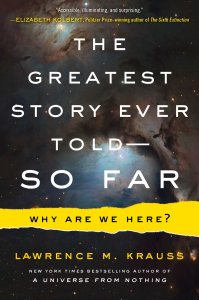
Lawrence M. Krauss: THE GREATEST STORY EVER TOLD — SO FAR

Lawrence M. Krauss’ new book is a book by a theoretical physicist, and so the greatest story turns out to be — a history of physics, especially of the last few decades.

He begins by emphasizing how this is a story of how science reveals a world that is profoundly nonintuitive, and undermines the simple assumptions humans have made about their world throughout history. Some sample lines from the prologue:

“It’s a story that deserves to be shared far more broadly. Already in the first world, parts of this story are helping to slowly replace the myths and superstitions that more ignorant societies found solace in centuries or millennia ago.” 1b. (1b means bottom of page 1, etc.)

2.8, “…what cosmic arrogance lies at the heart of the assertion that the universe was created so that we could exist?”

3.1, “Everything about our evolutionary history has primed our minds to be comfortable with concepts that helped us survive, … Evolution didn’t prepare our minds to appreciate long or short timescales or short or huge distances that we cannot experience directly…

3.7, “Surely that is the greatest contribution of science to civilization: to ensure that the greatest books are not those of the past, but of the future.”

A major step was humanity’s realization that there’s more to the universe than meets the eye, 4.8; we need a narrative to make sense of our existence; 6t, “We cannot understand that hidden world with intuitions based solely on direct sensation. That is the story I want to tell here.”

Then he begins with Plato’s cave as a powerful metaphor for how its residents do not perceive the outside world directly, but only as shadowed projected on the cave walls. Jumping forward, the first hints of a non-intuitive world were experiments in the 19th century showing that light behaved like particles in some contexts, like waves in others. Then Einstein a century ago, considering the points of view of observers moving relative to one another. Then quantum mechanics, and the uncertainty principle.

Along the way Krauss humanizes the scientists who did this work, with anecdotes about Feynman, about Fermi, Sheldon Glashow, Steven Weinberg, and others.

The story moves through the discovery of new forces, the advent of fission and the H-bomb, the understanding of fusion as what powers the sun; the idea of symmetry breaking, how all the various subatomic particles relate to each other and to field. And then to speculation about other particles, a potential unification, the construction of larger and larger colliders, culminating recently with the detection of the Higgs boson in 2012.

This gets a bit abstruse at times — symmetry breaking, gauge theories –and I did not follow every detail. (I was an astronomy major in college, until I hit physics for which I had no intuition for and couldn’t force myself through with math. So I became a math major, focusing on very different kinds of math.) I wasn’t familiar with the notion of spontaneous symmetry breaking, and how an apparent accident in the history of the universe resulted in our actual set of forces and their interactions, which had that breaking gone randomly a different direction, nothing we know of in the universe would exist. Krauss offers a couple elegant metaphors: a round dining table set with wine glasses; do diners pick up the glasses to their right, or left? Never mind convention — in principle it could be either way, and once a single diner makes a choice of left or right, that determines the choice for everyone else. Also, the way ice crystals form on a glass window, in treelike patterns in which the crystal lattice structure makes forces along the spine of a crystal quite different than a force perpendicular to that.

Krauss makes only brief mention of theories that attempt to extend the Standard Model of physics that has been vindicated by detection of the Higgs boson — superstring theory, M-theory. He calls them “mostly speculation”. He ends with the detection of gravity waves, portending something called quantum gravity, which might finally relate gravity to all the other forces wrapped up in the Standard Model. All the questions are not answered yet.

He concludes by considering the philosophy of what all this means and why we should care. He cites two contrasting views of the world, as humans wonder, why is there a universe at all? And why are we here? The first view is to assume we have special significance, that the world was creating for us; and that is the conventional, comfortable view of most people throughout history. The second view is to assume nothing, examine the evidence, and discover “a universe whose laws exist independently of our own being.” (303t) “The answer seems all the more remarkable because it reveals explicitly just how deeply the universe of our experience is a shadow of reality.” (303.7)

p309:

If we now ask why things are the way they are, the best answer we can suggest is that it is the result of an accident in the history of the universe in which a field froze in empty space in a certain way…

Our primitive ancestors survived in large part because they recognized that nature could be hostile and violent, even as it was remarkable. The progress of science has made it clear just how violent and hostile the universe can be for life. But recognizing this does not make the universe less amazing. Such a universe has ample room for awe, wonder, and excitement. If anything, recognition of these facts gives us greater reason to celebrate our origins, and our survival.

To argue that, in a universe in which there seems to be no purpose, our existence is itself without meaning or value is unparalleled solipsism, as it suggests that without us the universe is worthless. The greatest gift that science can give us is to allow us to overcome our need to be the center of existence even as we learn to appreciate the wonder of the accident we are privileged to witness.

Posted in Book Notes, Physics | Comments Off on Lawrence M. Krauss: THE GREATEST STORY EVER TOLD — SO FAR

Apple Valley History

Apple Valley was not quite so obscure a place as I may have implied. Even as a child, I was aware of a couple exceptional circumstances. First, it was the home of then famous (if by now likely forgotten) singing movie and TV stars Roy Rogers and Dale Evans. Their signature song was “Happy Trails to You…” (YouTube). My family even met them once, outside after church, at Church of the Valley along Highway 18. (My parents were nominally Methodists, but were not hard-line about it the way so many people are now; they took their kids to church, as I grew up, more as a matter of social habit than out of any motivation toward religious inculcation.)

Years later after Rogers and Evans died, there was a Roy Rogers Museum in Apple Valley, along Highway 18, that stood for many years. It later relocated to Missouri (http://www.royrogers.com/museum.html) and eventually closed. A few of their artifacts remain at the Victor Valley Museum, in Apple Valley, (http://www.sbcounty.gov/museum/branches/vvm.htm), that I visited in 2011.) Their legacy lives in the names of roads in Apple Valley: “Happy Trails Highway” (Highway 18, as it runs through the valley) and “Dale Evans Parkway”.

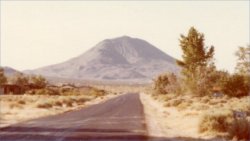
Apple Valley was also noted for its “house on the hill”. The hill is that narrow ridge that parallels the angled portion of Highway 18. At the top of which had been constructed a modernist house with a pool split between the indoors and the outdoors. The house was built by Newt Bass, one of the founders of Apple Valley, who along with Bud Westlund had developed the valley by buying 6300 acres of desert land with the intention of developing a cattle ranch; instead they sold the land as real estate, and became wealthy. There’s more background and many photos of the house in this article, Newt’s Paradise – Apple Valley’s Spectacular Hilltop House, on a blog devoted to historic southern California architecture.

The house was built in the 1950s (the article doesn’t say exactly when), and when my family lived there for several years in the late 1950s and early ‘60s, my father even took us on a tour of the house (enabled by the local real estate firm, Apple Valley Ranchos, if I recall). I remember that indoor/outdoor pool especially.

Years after we’d moved away, the house was nearly destroyed by fire in 1967. It was partially rebuilt, but never sold as a house, and was used as office space for some years, before being abandoned and falling into complete disrepair. The shell of the house is still there. I found this YouTube video of a local guy hiking up to the house in 2010, and discussing its history, and giving us views of the surrounding valley.

A story I heard later, from my father, was that a James Bond movie, Diamonds Are Forever (1971), had been filmed in that house. This was not true, I later discovered; the claim was some confusion with a similarly spectacular house in Palm Springs, the Elrod House, designed by John Lautner. (You can find a clip from that film, shot inside the Elrod House, on YouTube. And anyway the hilltop house in Apple Valley had burned down by then.)

*

I knew about Roy and Dale, and the hilltop house, as a child. More recently, in researching the area, and revisiting it in 2009 and 2011, I learned a bit more. Wikipedia’s Apple Valley entry tells us its history, including the railroad station established where Victorville is now, and how ranching and farming in Apple Valley fell off after World War I and the Depression. The last few apple groves were killed off by fungus infections in the 1940s.

In the ‘50s and ‘60s Apple Valley promoted itself as a desert resort town, a sort of cut-rate Palm Springs that was a bit shorter drive from LA and Hollywood, by 50 miles or so. Nestled below the Newt Bass hilltop house was the Apple Valley Inn, a high-end, for its time, collection of bungalows surrounding parking lots and a swimming pool. Wikipedia’s Apple Valley Inn page notes that that the Inn, which opened in 1948, “originally allowed only white Christians as patrons”. It closed to the public in 1987, though part of it still remains (www.historicapplevalleyinn.com/) as a facility that can be rented out for events.

The Wikipedia page for Apple Valley shows a long list of “notable people” who lived in or spent time there, evidence of its proximity to LA and its attraction as a desert resort. One example: none other than Richard Nixon spent three months at Newton Bass’s hilltop house, in 1961 (while we were living there!), writing his first book.

The Wikipedia page also has a list of films and TV episodes filmed there, including an episode of the popular TV series Perry Mason, and the film Ordinary People (the golf course scene perhaps? I’ve seen the movie a couple times and can’t now recall what scene might have been shot there).

The larger town of Victorville (Wikipedia), now cut through by Interstate 15 and traffic back and forth between LA and Las Vegas, has similar credits for films, if not residents. One notable Victorville event: in 1940 the screenwriters for Citizen Kane, Herman J. Mankiewicz and John Houseman, spent 12 weeks working on their script at the Kemper Campbell Ranch, in Victorville along the Mojave River and virtually on the border of Apple Valley.

On one of my return visits to the area, I think in 2009, I drove far into the still desolate north end of Apple Valley, to where my GPS map indicated a town named “Bell Mountain”, centered on an intersection of two roads a bit east of the actual mountain of that name. Little was there. Some web sleuthing turned up the fascinating information that a “community” had once settled there, by people who’d been rejected from staying at the Apple Valley Inn! There was even a post office there, for a while. But in 2009 there was no visible community (no commercial buildings at all, no shops, no gas stations, no diners), just remnants of old settlements, houses, and trailers. As ‘standards’ at the Apple Valley Inn relaxed over the decades, the need for segregation dwindled and vanished, presumably.

(As always — this is a first draft, potentially to be revised for later use.)
Posted in Personal history | Comments Off on Apple Valley History

Both Proud of Our Ships: TOS “The Corbomite Maneuver”

The Enterprise encounters an enormous alien vessel that blocks its path and threatens its destruction.

  • Now watching the episodes in production order; this one is production order #2, after “Where No Man Has Gone Before”; this was the first episode to feature DeForrest Kelley as Dr. McCoy, Nichelle Nichols as Uhura (wearing a tan uniform, though), and Grace Lee Whitney as Yeoman Rand. (And I have to say, in this and other early episodes, I’m impressed by the subtlety and complexity of Kelley’s characterization of McCoy. He was the equal of Shatner and Nimoy, even though he wasn’t given nearly as much to do.)
  • Along with “The Naked Time”, this has always been one of my favorite episodes, in part because it shows so much relatively routine interaction aboard the Enterprise; it details how things play out in a crisis, in ways elided in most later episodes.
  • Example of this: how systematically Kirk orders various changes to the ship’s speed – quarter speed, half speed, warp one, etc. – and thereby establishing the relationship between sub-light speeds and the warp speeds.
  • At the beginning of the episode the Enterprise is “star mapping”, a legitimate if rather routine task for such a big ship. Wouldn’t a smaller ship do just as well? Or automated probe? Also, with the stars, as usual, passing by the viewscreen pretty quickly, you wonder how it works when they time a star mapping shot to a particular moment. Aren’t they ‘filming’ or taking stills continuously? Bit of failure of imagination here, I’ve always thought.
  • Trek effects: the turbo-lifts are famous people moving devices, and the impression of the lifts moving quickly is illustrated entirely by the moving bars of light that presumably represent floors, or decks. But in almost every scene inside a turbolift, we see way too many of those moving bars than can be plausible, considering the number of decks imagined in the Enterprise – even before detailed schematics were developed after the show ended.
  • Bailey is a loose cannon, clearly unstable from the beginning, and I’m surprised how long he lasts. At first encounter with the alien ship, he says “I vote we blast it” and Kirk replies sardonically about the bridge not being a democracy. More to the point, this shoot-first and ask questions later attitude is typical of crude media science fiction, and one arc of this episode is how this attitude can be overcome – Kirk’s diplomacy and earnest appeals, trumping Bailey’s panic — into one of understand and mutual comprehension. [Conservative fear vs. humanistic acceptance, I am inclined to think.]
  • It’s fascinating in two or three scenes to see Kirk, not so concerned about the apparent danger from the alien ship, as he is curious about Bailey’s behavior, as Kirk eyes him.
  • At the end of Act 1, this is the first time we see the Enterprise fire its phasers. In typical Trek FX, the resulting explosion knocks everyone around aboard the Enterprise, and we see shots of crewmen in a corridor being tossed over to one side, and then the other.
  • In Act 2, more routine yet personal discussions, as McCoy counsels Kirk as they have a drink in Kirk’s quarters.
  • Yeoman Rand is introduced as bringing Kirk’s lunch, a “dietary salad” at McCoy’s direction. It was years after I first saw Trek before I understood that, in real life, a “yeoman” is not necessarily a woman. Kirk makes a remark here about how it’s irritating that he was assigned a female yeoman, but as the series went on, *all* the yeomen were female.
  • One of the great Trek FX shots is when the second ship, the Fesarius, approaches, appearing first as a small dot growing larger as it comes nearer… and keeps coming, until we realize that compared to the Enterprise, it’s *enormous*. A terrific sense of wonder moment. (Let me see if I can link to this image from the Memory Alpha page for this episode — though this isn’t as big in this shot as it gets.)
  • This episode has two great, memorable musical cues: the first, energetic and a bit frantic, when the initial cubical buoy is first seen; the second, a 2 by 4 note ominous theme, when the huge Fesarius appears. Music by Fred Steiner; I think the second theme may have been reused in later episodes, though I don’t think the first one was. [Later edit: it was]
  • The enhanced graphics versions of the Enterprise, from various interesting angles, and the Fesarius, are terrific; though I appreciate how the original cubical buoy was left deliberately fuzzy and multicolored, growing more and more fuzzy as it spun faster.
  • Interesting though uncharacteristic compared to later episodes, are how Kirk, several times, makes general announcements to the ship’s crew reminding them of the Enterprise’s noble mission, how misunderstands can be overcome, and so on. They serve of course also to inform viewers of what this show is about, as distinct from most movies and TV SF before it. And we never saw any such similar announcements in later episodes, as the series went on.
  • Balok, the voice from Fesarius – seen as a weird white bald head, through a fishy lens effect – informs the Enterprise that it will be destroyed. And it says, “We make assumption you have a deity, or deities, or some such beliefs which comfort you.” And so it gives them 10 minutes to prepare. This line represents a key theme throughout most of Trek, where time and time again we saw stories about how ideas of gods were obsolete, or how entities once thought to be gods were actually aliens, or computers, etc. (Though at least once there was dialogue in a later episode that implied an assumed monotheistic belief, as well.)
  • Kirk’s appeals to reason, to explain why the Enterprise is there, why they destroyed the buoy, and so on, grow frantic. “If you’ve examined our records… you know this to be true!!”
  • It’s nice how the Bailey/McCoy/Kirk character arc dovetails with Spock’s reference to chess, to inspire Kirk to another game, poker, which inspires the episode’s central conceit – the claim to Balok that the Enterprise is equipped with a special substance, corbomite, that reverses any attack on the ship to destroy the attacker. OTOH, his tone as he makes this claim (“We grow annoyed at your foolishness”) is so different from his earlier appeals, that anyone sensitive to human speech might immediately suspect some dishonesty.
  • Right after this there are a couple lines between Spock and Scott about Spock’s father and his human mother. One senses the insertion of these lines (likely by Roddenberry) to establish this key aspect of Spock’s character early on.
  • In Act 4 we see, again, a much more detailed rendition of an extreme ship event, in this case straining the engines, increasingly for several minutes, in an attempt to break the tractor beam hold from the alien ship towing them to their doom. Spock recites dangerous engine temperatures; everyone on the bridge shakes slightly, then moreso, as the ship vibrates dangerously; in the corridors, those crewmen fall over.
  • And so the threatening alien situation is redeemed: the Enterprise returns to assist the now disabled alien vessel that was towing it. The boarding party discovers that the weird white alien head was just a prop; the real Balok is a short little boyish creature. On the one hand, points here for supposing that the inside of an alien ship would not have the same dimensions as the Enterprise – the three who beam over and told to bend over, for the low ceiling at their destination, a consideration that I don’t think ever happened again in the entire series. On the other hand, the alien commander *assumes* that the humans would not have been frightened by his real form, thus the weird puppet prop – but surely it assumes too much to imagine what an alien race would be frightened, or comforted, by.
  • And while it’s striking to be told that this small Balok is in charge, without additional crew, of the whole Fesarius ‘complex’, we get no clue as to the purpose of such an enormous complex; or why Balok is suddenly so eager to recruit a companion for his travels. There’s a lot of unexplained backstory here – how big is his First Federation? When will they meet up again? And so on and on.
  • Yet the ultimate payoff is the comity between Balok and the Enterprise crew, representing the successful testing of unknown intentions and the defeat of xenophobic thinking, to the point where Balok offers to give them a tour of his ship. Last line: “Yes we’re very much alike, captain. Both proud of our ships.

The Blish/Lawrence adaptation, in ST12:

  • This very late adaptation is literal to the point of absurdity; we get words about characters crossing the room, or how the turbo lift comes to a stop and starts moving horizontally, p106.
  • And questionable wording, as in the first line: “Spock was making a map of the galaxy’s planet [sic] systems.”
  • And p110, “in the bridge”.
  • And in places there are a few extra lines, as if lines from the script were omitted during filming or edited out later:
    • Sulu warns Bailey about both Spock and Kirk
    • An explanation of what flypaper was (a reasonable thing to explain, in the 23rd century, perhaps)
    • Sulu says “this is for real” rather than, as broadcast, “this is not a drill”.
    • Near the end, Scott says “On your hunkers” rather than “Bend low”.
  • Most oddly, there are several passages that read as if the adapter is describing what was seen on TV, not what the characters were seeing, e.g. p117, referring to the bridge screen, “In the lower quadrant of its frame, the immense Enterprise hung motionless, and in the distance, the other ship (for it was a ship) was still small but was continuously growing.” And a similar passage later as Balok’s small ship tows the Enterprise. Just after that, the adaption has Kirk say to the bridge crew what he said, in the broadcast, as a captain’s log.
  • A striking scene not broadcast comes after Sulu utters the line, “I knew he would” [a continuity error; Sulu was responding to a line of Balok’s that wasn’t actually recorded], in which Kirk comments about Sulu not being “a very inscrutable Oriental” and Sulu responding—for half a page—about his watching movies from the time of the “Sino-Western trouble” in which the villains were Oriental and how Sulu was unable to mimic them. Cut from the script or cut for time in editing? And was that really appropriate banter during the last 60 seconds of a countdown that might have ended in the destruction of the Enterprise?
Posted in Star Trek | Comments Off on Both Proud of Our Ships: TOS “The Corbomite Maneuver”

Links and Comments: Expertise, Dunning-Kruger, Tactics of Denialists

NPR’s Adam Frank on Why Expertise Matters, commenting in part about Tom Nichols new book The Death of Expertise: The Campaign Against Established Knowledge and Why it Matters.

Frank quotes a couple key passages from Nichols:

Nichols is profoundly troubled by the willful “know-nothing-ism” he sees around him. Its principle cause, he argues, are the new mechanisms that shape our discussions (i.e. the Internet and social media). He writes:

“There was once a time when participation in public debate, even in the pages of the local newspaper, required submission of a letter or an article, and that submission had to be written intelligently, pass editorial review, and stand with the author’s name attached… Now, anyone can bum rush the comments section of any major publication. Sometimes, that results in a free-for-all that spurs better thinking. Most of the time, however, it means that anyone can post anything they want, under any anonymous cover, and never have to defend their views or get called out for being wrong.”

Nichols also points to excesses of partisanship in politics, the weakening of expectations in schools and, finally, to human nature. The last cause, he says, is particularly troubling. As he puts it:

“Its called the Dunning-Kruger effect, which says, in sum, that the dumber you are, the more confident you are that you’re not actually dumb. And when you get invested in being aggressively dumb…well, the last thing you want to encounter are experts who disagree with you, and so you dismiss them in order to maintain your unreasonably high opinion of yourself.”

Frank concludes,

More importantly, being a true expert means having a healthy dose of humility. If you have really studied something and really gone deep into how it works, then you should come away knowing how much you don’t know. In a sense, that is the real definition of an expert — knowing the limits of one’s own knowledge.

\\\\

From New Scientist, Links and Comments: Expertise, Dunning-Kruger, Tactics of Denialists

“Denialism is inevitable whenever powerful financial, governmental, cultural or religious interests come into conflict with scientific reality.”

Six tactics used by those who would deny climate change, the efficacy of vaccines, or challenges to the policies of the Trump administration:

  • Allege that there’s a conspiracy. Claim that scientific consensus has arisen through collusion rather than the accumulation of evidence.
  • Use fake experts to support your story. “Denial always starts with a cadre of pseudo-experts with some credentials that create a facade of credibility,” says Seth Kalichman of the University of Connecticut.
  • Cherry-pick the evidence: trumpet whatever appears to support your case and ignore or rubbish the rest. Carry on trotting out supportive evidence even after it has been discredited.
  • Create impossible standards for your opponents. Claim that the existing evidence is not good enough and demand more. If your opponent comes up with evidence you have demanded, move the goalposts.
  • Use logical fallacies. Hitler opposed smoking, so anti-smoking measures are Nazi. Deliberately misrepresent the scientific consensus and then knock down your straw man.
  • Manufacture doubt. Falsely portray scientists as so divided that basing policy on their advice would be premature. Insist “both sides” must be heard and cry censorship when “dissenting” arguments or experts are rejected.
Posted in Conservative Resistance, Psychology | Comments Off on Links and Comments: Expertise, Dunning-Kruger, Tactics of Denialists

Links and Comments: Bannon’s historical cycles; the Myth of Main Street; Late Bloomers

Interesting stories and essays from Sunday’s New York Times.

Bannon’s Worldview: Dissecting the Message of ‘The Fourth Turning’

A news article about a book that has influence Steve Bannon’s thinking about the world, a book by two amateur historians, that

makes the case that world events unfold in predictable cycles of roughly 80 years each that can be divided into four chapters, or turnings: growth, maturation, entropy and destruction. Western societies have experienced the same patterns for centuries, the book argues, and they are as natural and necessary as spring, summer, fall and winter.

This idea of inevitable cycles of history is almost certainly bogus. It plays upon the gullible by appeal to human nature’s tendency to understand the world through *narrative* — some kind of explanatory story that explains why otherwise random events happen. It’s also telling that such prophecies, when suitable vague, can be later cited to explain anything. And it’s also telling that stories like this are used to justify conservative conformity. (“Conform, or Else” is one of the example passages given in the article.)

The danger of this kind of thinking is that, like religious fundamentalists who believe the end of the world (and the second coming) is approaching, such believers may, even if unconsciously, strive to *bring about* the destruction they think is merely inevitable. That makes such crazies dangerous to the rest of us.

\\\

The Myth of Main Street, an op-ed by Louis Hyman, about the notion that small-town main streets represent the ideal state of American being.

Yet another example of the fallacy that some ideal state existed in the past; it’s a conservative fallacy. (Make America great again!) In fact, as the essay discusses, not only has this yearning been around for nearly a century, but the ideal of main street makes no economic sense.

It’s worth noting that the idealized Main Street is not a myth in some parts of America today. It exists, but only as a luxury consumer experience. Main Streets of small, independent boutiques and nonfranchised restaurants can be found in affluent college towns, in gentrified neighborhoods in Brooklyn and San Francisco, in tony suburbs — in any place where people have ample disposable income. Main Street requires shoppers who don’t really care about low prices. The dream of Main Street may be populist, but the reality is elitist. “Keep it local” campaigns are possible only when people are willing and able to pay to do so.
In hard-pressed rural communities and small towns, that isn’t an option. This is why the nostalgia for Main Street is so harmful: It raises false hopes, which when dashed fuel anger and despair. President Trump’s promises notwithstanding, there is no going back to an economic arrangement whose foundations were so shaky. In the long run, American capitalism cannot remain isolated from the global economy. To do so would be not only stultifying for Americans, but also perilous for the rest of the world’s economic growth, with all the attendant political dangers. The only choice is turning to the future.

And as an example of his first paragraph, the area of Oakland where I live is close to Montclair Village, a charming neighborhood of shops and restaurants just as described above. (It’s where we shop to support the ‘local economy’ and to stroll down pleasant streets, but not for the cheapest prices.)

\\\

Another op-ed: To Be a Genius, Think Like a 94-Year-Old

The essay discusses the notion that, like athletes and mathematicians, STEM students and technology innovators peak early.

On the contrary, there’s plenty of evidence to suggest that late blooming is no anomaly. A 2016 Information Technology and Innovation Foundation study found that inventors peak in their late 40s and tend to be highly productive in the last half of their careers. Similarly, professors at the Georgia Institute of Technology and Hitotsubashi University in Japan, who studied data about patent holders, found that, in the United States, the average inventor sends in his or her application to the patent office at age 47, and that the highest-value patents often come from the oldest inventors — those over the age of 55.

And note the graph.

(And for what it’s worth, my personal achievements of the past 5-7 years — sfadb.com and my reconception of science fiction around my set of ‘provisional conclusions’ — are, if yet incomplete, more significant than anything I did earlier.)

Posted in Culture, Narrative, Religion | Comments Off on Links and Comments: Bannon’s historical cycles; the Myth of Main Street; Late Bloomers

Religious Zealotry in Science Fiction

There has been a controversy within the SF field over the past few years about how groups called the “sad puppies” and the “rabid puppies”, for various reasons, have mounted campaigns to influence the Hugo Awards nominations. (They succeeded two years ago, had a lesser influence one year ago, and have still had an influence on this year’s ballot.) This isn’t a single campaign; some of these people are sad that all SF is not basic space opera, with obvious good guys and bad guys; others are right-wing racists, who think that any fiction by women or non-white men is somehow depleting the strength of the genre and Western civilization in general; and some of them are fundamentalist Christians, who think that any writers who do not think their way are enemies of the state.

An example of the last came to the attention of many of my Facebook friends this past week: an interview with an SF/fantasy author on a site called National Catholic Register: An Interview with Catholic Sci-Fi Author John C. Wright.

John Crowley, an esteemed author of science fiction and fantasy with literary bona fides, reacted to the interview on a Facebook post on April 3rd,

The most egregious thing about such notions is that the writers do not understand what fiction is. As they see it, it can only be a sort of fanciful representation of notions, thoughts, or programs. The concept of using strands out of intellectual or other history for the purposes of sheer play is inconceivable to them.

Among the many comments to Crowley’s post, author and editor Scott Edelman commented,

As this is the same writer who insisted, “I have never heard of a group of women descended on a lesbian couple and beating them to death with axhandles and tire-irons, but that is the instinctive reaction of men towards fags,” his blather is to be ignored. There are no life lessons of his worth minding.

This author’s interview describes his early ‘atheism’, or indifference toward religion, followed by a growing antipathy toward non-religious thinking.

My faith in faithlessness eroded over a period of years when I slowly realized that my loyal allies, the atheists, were not merely wrong, but brain-meltingly, blindingly, foam-at-the-mouth barking moonbat wrong on all the major political and social issues of the day, from war and peace to abortion to homosex to contraception.

As if these attitudes, which obviously disregard the slightest respect for how others might have different attitudes, are not bad enough — he then has a heart attack, and visions:

I went to the hospital to see what had happened. At the time, I thought it an attack of pleurisy. The doctor said I had five blocked arteries leading to my heart and I should be dead. I said I did not know I had five arteries.

While I was waiting, the Holy Spirit entered my body. The sensation was like a physical sensation, but it was not. It was spiritual. It was like wine being poured into a dirty cup.

And of course this medical incident, which one might suppose involved some kind of brain damage, confirmed his predispositions. And now he is so absolutely certain of his convictions, that he passes judgements on other writers for their lack of similar convictions — who are therefore “enemies of the camp”.

More dangerous are writers of real skill and talent whose spiritual vision is awake, but whose loyalty is in the enemy camp: I put the remarkably talented Ursula K LeGuin in this category, for she can capture the spiritual look, feel, and flavor of Taoism without ever once revealing her own spiritual preferences; and likewise Mr. John Crowley, who is a gnostic, and peppers his work with themes that make the heresy seem quite inviting and new.

Religious zealots are common throughout history, but here is one nesting in the heart of the science fiction field. I don’t dwell on this (to spend half an hour composing this post) except to note this conclusion: the more absolutely certain anyone is of their convictions, especially religious convictions, the more likely they are wrong, that their convictions are derived from psychological issues, and certainly not based on any kind of rational conclusion about empirical evidence from the real world.

(I might note that as editor of Locus Online, I’ve had no trouble reviewing Mr. Wright’s novels — e.g. this review by Paul Di Filippo.)

Posted in MInd, Religion | Comments Off on Religious Zealotry in Science Fiction

No Beach to Walk On: TOS “The Naked Time”

An infection brought on board the Enterprise causes crew members to reveal their innermost fears and desires, as the ship spirals in toward a disintegrating planet.

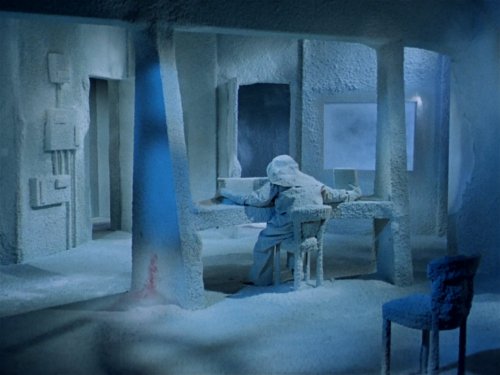
  • This time the planet is blue, appropriately, since it’s a cold ice-planet. In the enhanced graphics, there’s a new shot of the domed building of the scientific outpost.
  • The story is triggered by a doofus move – an idiot plot device – in that not only are the suits that Spock and Tormolen beam down in not sealed (so that any airborne contagion could still infect them), but Tormolen takes his glove off, to scratch his nose, and then touches a surface and gets infected.
  • Trek physics: the crisis of the episode depends on the idea that this planet, Psi 2000, is “breaking up”, which somehow means that its mass and magnetic fields are changing, which affects the Enterprise’s orbit, which is problematic because people on board are infected with a disease that renders them unstable and that puts the ship in jeopardy. What were they thinking of? What does it mean for a planet to “break up”? Real astrophysics suggests planets are extremely stable unless they are hit by something, in which case chunks might be blown out of them, yet would still remain largely stable (as Earth perhaps survived an impact that split off the Moon). Otherwise… even if a planet were disintegrating for some reason, its mass would have to go *somewhere*; that mass wouldn’t somehow just disappear, disrupting the Enterprise’s orbit.
  • Later in the show there’s a line about how, as the planet shrinks, the Enterprise adjusts its orbit to “maintain the same distance” from the planet’s surface. Why would it need to do that?
  • The enhanced graphics exacerbate the problem: we see the planet surface spinning past so fast, beneath the Enterprise, on the view monitor, that it’s amazing the ship doesn’t slingshot away into space. The new graphics aren’t any more valid scientifically than the old.
  • There’s a serious ethical theme here, as Tormolen wonders “if man was meant to be out here…” It’s not as trivial an issue as it might have seemed at the time, as here in the 21st century we realize what humanity has done and is doing to this planet.
  • This has long been a favorite episode – it was a Hugo nominee – mostly I suppose for its revelations of character among the crew: Sulu and his rapier; Riley and his song; Spock and his confessions; Kirk and his anguish.
  • Sexism: Riley, infected, locked into the engineering room, gives out fanciful orders over the intercom to the entire ship, focusing on women’s makeup and how their hair should be worn loosely around their shoulders.
  • It’s been one of my favorite episodes for one particular reason: the rhythm and pacing, especially of the second half of the show, maintains a tension unmatched in any other episode. You see it ratchet up, in a yin and yang of competing forces: routine communications alternating with increasingly emotional outbursts: Uhura to Kirk rather blandly: “Have you found Mr. Spock?” Kirk responds, almost hysterically: “YES I’VE FOUND MR. SPOCK I’M TALKING TO MR. SPOCK RIGHT NOW!” at which point Kirk realizes he’s infected too.
  • There are plot issues, of course – any show, like a series produced every week, is done so quickly it’s amazing they get so much done that still seems right decades later – but I couldn’t yet notice that, why weren’t Kirk and Spock infected earlier, when they brought Sulu down, instead of later via Nurse Chapel’s tears?
  • Famous line: Sulu, infected and playing swashbuckler, presumes to protect Uhura, calling her a “fair maiden”. To which Uhura replies, so quickly you almost don’t notice, let alone absorb the implications of what she says, “Sorry, neither.”
  • First time we see the (first season) engine room. I think. I really should watch these episodes in production order, rather than broadcast order.
  • And first time we see Scott’s “Jeffries Tube”. I think.
  • And first time we see Spock’s neck pinch, or nerve pinch, I think.
  • Trek physics: talk about the engines having been turned off, the “intermix formula” for matter and antimatter, and having to raise the temperatures of those without risking “implosion”.
  • The enhanced graphics include a chronometer on the nav panel where Sulu sits – it shows not only a clock but a *stardate* counter, which, in keeping with the dialogue and story line, changes from 1705.0 back to 1702.0.
  • Trek physics: the “theoretical relationship between time and antimatter”, as Spock says, results in the ship going back in time, and moving “faster than is possible for normal space”, as they start the engines anyway and escape from the planet. This sets up the later episode, “Tomorrow Is Yesterday”, in which they accidentally go back in time to Earth in the 1960s.
  • Still, the enduring highlight of this episode is the revelation of the characters. Spock’s breakdown was a last minute story idea (according to Memory Alpha), was shot in a single take, and resulted in fan mail to Nimoy going exponential.
  • The end: calm. They acknowledge the potential for time travel, to any era, any planet, and suppose they might try it someday. And Kirk says, “steady as she goes.”

Blish’s adaptation, in ST1:

  • Blish avoids the contamination scene, in which Tormolen takes off his glove and exposes himself to an infection, entirely. Blish has Kirk make some plausible speculation about why the dead members of the observation station behaved the way they did, in response to having some infection (e.g., someone would take a shower with clothes on in a hurried attempt to decontaminate themselves).
  • Blish has the planet named some long technical string, and the nicknamed “La Pig”, rather than the Psi 2000 of the script.
  • Blish tries to rationalize the idea of the planet’s breakup, and how it would affect the Enterprise orbit, p79t: “As the breakup proceeded, the planet’s effective mass would change, and perhaps even its center of gravity – accompanied by steady, growing distortion of its extensive magnetic field – so that what had been a stable parking orbit for the Enterprise at one moment would become unstable and fragment-strewn the next.”
  • There are substantial differences between Blish’s version and the broadcast story, since the latter involved some elements introduced in the last stages of production. In particular: Spock’s breakdown in the briefing room, and the entire time travel sequence at the end, are not here. Nor is Scott’s phasering through the wall to get into the engineering room. Instead, McCoy’s antidote to the disease involves a gas spray into the ship’s ventilation system. Riley recovers in the response to that, and lets the others into engineering himself.
  • At the same time Blish has some remarkably implausible sequences in which, Kirk having thrown emergency bulkheads inside the ship, to stop the spread of the disease, has Uhura crawl between the hulls and communicate the McCoy by knocking on the metal in “prisoners’ raps”…! The crews’ communicators don’t work inside the ship?
  • Instead of Spock’s breakdown and recovery seen in the broadcast version, in Blish’s story Spock experiences a “general malaise” and excuses himself to his quarters. At the end of the story, he is heard crooning to himself in his cabin and playing some instrument that “nobody else on board could stand to listen to it”.
Posted in Star Trek | Comments Off on No Beach to Walk On: TOS “The Naked Time”

You Can’t Know What It’s Like: TOS “Where No Man Has Gone Before”

In this second series pilot, the Enterprise encounters an energy barrier at the edge of the galaxy that triggers ESP in two crewmembers.

  • Watching the current CBS blu-ray set of these episodes, here we see nicely enhanced graphics of the galaxy, the haze of the Milky Way, as the Enterprise approaches the “edge of the galaxy”.
  • Trek physics: the whole concept of the “edge of the galaxy” is ludicrous, of course; it’s like speaking about taking a walk to half a yard outside a valley. There’s no edge of a galaxy, or a valley, that is that distinct. None other than Isaac Asimov wrote an article in TV Guide, around late 1966 or so (he’d at least seen this episode of Trek, and had seen Lost in Space), criticizing this point, though of course the errors in Lost in Space were worse.
  • This was the second pilot, to NBC, after “The Cage” [which was later incorporated into “The Menagerie”], though not the first episode shown as it ran on TV. By the time the show went into regular production, things had changed, like the uniform colors and trim, the shape of the viewscreen monitor on the bridge, and so on. Spock’s make-up here is relatively crude; Scott has an oddly colored tan shirt; Spock wears a gold shirt, like Kirk, not the blue one he wore later, throughout the series.
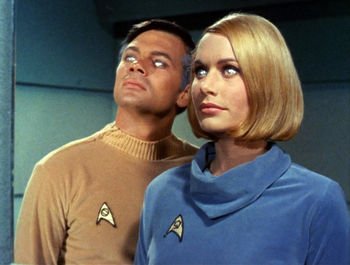
  • The two guest stars here were relatively prominent actors: Gary Lockwood, who played Gary Mitchell, later starred in 2001: A Space Odyssey, and Sally Kellerman, who played Elizabeth Dehner, later starred in the film MASH.
  • As in other early episodes, we see lots more crewman in the corridors, as well as ladders and overhead panels that weren’t bothered with in the later shows.
  • Sexism: there’s a “Yeoman”, Smith, on the bridge in the early scenes, whose job is merely to serve coffee apparently; she doesn’t do anything else. In a later scene, as the ship is endangered, Gary Mitchell reaches behind him to hold her hand, implying I’m not sure what – that they know each other? Or more likely that he feels compelled to offer comfort to the nearest frail woman?
  • (It was some years after watching Trek in its first run before I learned that the word “yeoman” didn’t automatically mean female… They always were on Trek.)
  • More sexism: when female crewmen appear (I think this is true throughout the show), they are either taken for granted as service providers (bringing lunch, or coffee, as Yeoman Rand does in “Charlie X”), or are treated an exceptional to the acceptable routine of male experts. When Elizabeth Dehner appears on the bridge to discuss ESP, Gary Mitchell asks sarcastically if her job is to “improve the breed” and then, when she says, “I heard that’s more your specialty” Gary turns away and remarks to the nearby helmsman, “Walking freezer unit”. (Because they couldn’t say the b word on 1960s TV.)
  • As Spock listens to tapes from the Valiant, the ship whose recorder they’ve picked up, which preceded them exiting the galaxy (by half a light-year!), he talks about a “magnetic space storm”. Is this a real thing? Trek repeatedly invokes such events, and Lost in Space did all the time (more often as “cosmic storms”), and I’ve never understood what they meant, if those were real things. (We do hear about solar flares that affect Earth’s magnetic field, but such ‘storms’ are surely a problem only relatively close to a star, compared to the Enterprise being out in interstellar space.)
  • It’s odd how the barrier becomes visible only as the Enterprise approaches it. Interstellar and intergalactic space is remarkably transparent — that’s how we can see galaxies a billion light years away. And why is it a band that happens to be horizontal with respect to the Enterprise’s current orientation? (Trek physics: because the writers and producers project movements and events that we experience on a subjectively ‘flat’ Earth into three-dimensional space, without thinking about it.)
  • The SFnal premise here is about ESP, extra-sensory perception. In the story, the lost Valiant had been investigating the topic, in their last hours. Now Kirk asks Dehner what she knows. “It’s a fact that some people can sense future happenings – read the backs of playing cards and so on.” This is an obsolete premise; it’s not a fact, as we know in 2017, that people can do that. ESP, telepathy, and the like, were fads in the 1950s and 1960s, when there seemed to be some reputed evidence. In SF literature, such themes were routine, even in the “hard SF” magazine Analog. But as the decades passed, reliable evidence never showed up, and modern understanding of neurology and the mind rules such powers out. There is no telepathy, no psychokinesis, no visions of the future, none of it.
  • After the Enterprise retreats from its exploration into the force field at the edge of the galaxy, its warp ability gone, Kirk comments in his log that “Earth bases that were only days away are now years in the distance.” This is a nice, and rare, acknowledgement of the difference between their warp drive, that allows fast transit between stars, and lack of warp drive, which is far less than the speed of light.
  • Watching this episode now on Blu-ray, on a big TV, I can see details I never saw before. You know those medical panels above the beds in sick-bay, with several vertical scales that display various medical conditions? Now I can see them: the scales are for Temp, Brain, Lungs on the left; Cell Rate, Blood, Blood, on the right. [Or are these enhanced graphics?]
  • Gary Mitchell, having been zapped by something in the force field at the edge of the galaxy, develops superpowers. He lies in bed in sickbay, and reads Spinoza on a small monitor that extends on an arm over his bed. To Kirk, he calls Spinoza “simple, childish”, and says he doesn’t agree with him at all. In the next scene on the bridge, Spock monitors Gary’s reading, as he reads faster and faster, a page every second. Now I can see that the pages are headed “The Ethics”. Which is in fact a work of Spinoza’s. Give the production team points for attending to such details. (OTOH I didn’t try to read the text on those screens.)
  • Dehner is assigned to monitor Mitchell. Mitchell complains to Kirk that with 100 women on board, couldn’t he do better? Point here, 100 women is about ¼ of the entire crew.
  • Sexism: Dehner tries to mollify Mitchell: “Women professionals do tend to overcompensate”. Argh.
  • Dehner challenges Mitchell’s reading retention, and he quotes a sonnet: “My love has wings, slender feathered things with grace and upswept curve and tapered tip”, that he attributes to Tarbolde from 1996 (!).
  • When Spock examines personnel records for Dehner and Mitchell, we see typewritten cards that display, among other things, dates of birth. Dehner’s is 1089.5, Mitchell’s is 1097.7. Are these… star dates? More about this below.
  • The Enterprise travels to Delta Vega, somehow only a few days away (without warp), that has an impressive lithium cracking station – impressive in the visual. At Spock’s cold advice, Kirk realizes he has to maroon Mitchell there, before his powers enable him to take over the ship, and the Earth colony they might next go to. It doesn’t go well. Mitchell escapes; Dehner develops similar powers, and Kirk chases after them. He tries to negotiate with Dehner, about the danger Mitchell portends: “You know the ugly savage things we all keep buried that none of us dare expose. But he’ll dare–!”
  • Mitchell makes tombstone appear, for Kirk, and it reads 1277.1 to 1313.7. The latter date coincides with the log entry star dates in this episode. But meaning what? I think that by this time the production staff had not decided what stardates meant. The eventual meaning was that one stardate meant one day… but this tombstone implies *years*. More about star dates in later episodes.
  • Despite Mitchell’s godlike powers, Kirk defeats him in a fistfight, with a laser rifle and a handy block of stone. Dehner, drained from fighting Mitchell, dies: “You can’t know what it’s like to be almost a god.”
  • Broad theme: would humans with superpowers be a good thing, or not? Would such beings threaten those without those powers? This theme is still very much with us.
  • Memory Alpha notes that the fistfight at the end is what sold NBC the show. -!! This was the primary way in which “Where No Man Has Gone Before” was superior to “The Cage,” in NBC’s view, apparently, and Trek TOS repeatedly staged such action scenes, in the manner of westerns at the time, since that was how real men dealt with their disputes.
    • In contrast, such crude violence went out of style in succeeding decades; did Picard ever get into a fistfight with anyone? (Not rhetorical; I don’t recall.) Steven Pinker, in his study of the history of violence The Better Angels of Our Nature, cites this diminished taste for physical violence in (certain kinds) of popular entertainment as one of many such trends of just the past 50 years.
  • We learn that “The Man Trap” was chosen as the first episode to be broadcast, because for various reasons the other episodes completed by then had issues, and the issue with “Where No Man Has Gone Before” was that it was too expository…
  • The episode ends on a reflective note, with Spock admitting that he too “felt” for Gary Mitchell, and Kirk wryly replying that “I believe there’s some hope for you after all, Mister Spock.” This is the first of many acknowledgments throughout the show, and especially in the first season, of Spock’s dual nature, though in ways that have always struck me as a tad patronizing. Spock’s heritage is one of subduing his emotions in the service of logic and rationality, and presumably this attitude has got him where he is, as science officer on a ship full of what amount to him as alien beings. (One might wonder, why didn’t Spock stay on Vulcan, or join the Vulcan starship we hear about in a later episode?) Yet those alien beings are always ready to rub in any example of his internal discipline slipping in any way. Hmm. May revisit these thoughts in later episodes.


The Blish/Lawrence adaptation (in ST 8, p85):

  • Being in a later book, this ‘adaptation’ is much more literal than those in Blish’s first three or four volumes. Discrepancies from the broadcast script are mostly incidental – a few extra or missing lines here or there, as if the adapter didn’t have the very final version of the script, or because changes were made during filming that were never documented in a script.
    • E.g. p86, reference to a “Q signal” before the Valiant’s recorder begins transmitting.
    • P108, more lines from Gary Mitchell as he and Dehner have escaped into the hills: “Soon we will fully control our bodies. We’ll never grow old. You’re woman enough now to like that. Always young, as beautiful as you desire to be.”
    • 6, Kirk’s plea to Dehner is “In God’s name, Doctor, make you prognosis!” using a phrase I think never uttered in the broadcast show.
    • P111, it’s missing Dr Dehner’s last line in the broadcast, “You can’t know what it’s like to be almost a god” in favor of “It’s—all over, isn’t it?” This seems like a last-minute inspiration on the part of the director or actor.
    • P111, and Kirk’s final line is different: as broadcast, “I believe there’s some hope for you after all, Mr. Spock” while the adaptation has “Watch yourself, Mr. Spock. Your compassion is showing.”
  • The adaptation does try to ‘explain’ the changes roles of some regular characters: how Sulu is now a physicist; how another doctor is on board because McCoy is on ‘special study leave’ p88. At the same time the adaptation retains obsolete terminology: “materializer” instead of transporter.
  • There are a couple passages in which one wonders how familiar the adapters were with the show, in odd choices of words: p105.8, after repairs the Enterprise is ready for “takeoff”.
Posted in Star Trek | Comments Off on You Can’t Know What It’s Like: TOS “Where No Man Has Gone Before”