
James A. Lindsay on the Obsolescence of Theism

Two posts today, both about slender trade paperbacks of the genre that includes, earlier reviewed, John Loftus’s THE OUTSIDER TEST FOR FAITH (review) and titles by Greta Christina, Adam Lee, and Peter Boghossian (links to those reviews in that review): books published by Prometheus, or Pitchstone, or occasionally self-published, that appeal to the niche crowd of readers focused on atheism and related matters. For me to focus on such books might suggest that my convictions — er, provisional conclusions — are wavering, or need defending, but neither is the case. Rather, much like theism itself (a subject that consists of endless commentaries about itself, and in defense of any input from the actual real world), the ideas around atheism and what meaning in life means, without supernatural dictates, consists of interplay between various thinkers, as well as — quite unlike theism — reaction to continued new understanding about the real world.
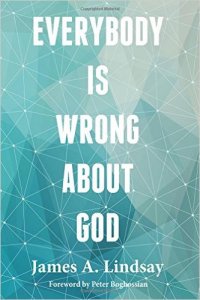

James Lindsay’s Everybody Is Wrong About God (Pitchstone, Dec. 2015), came to my attention, IIRC, via an Amazon suggestion, and the title was certainly provocative. Wrong how? Glancing through the notes for each chapter [there is no index, or bibliography] was encouraging — Lindsay has read his Jonathan Haidt, his Sam Harris; which is what I mean by thinkers in dialogue with other thinkers.

One key theme is in the back cover description: “theism has been so thoroughly and utterly discredited — philosophically, sociologically, and scientifically — that it no longer warrants serious consideration”.

And this certainly strikes a chord. No matter how many believers there might be among the general population, the concept of ‘theism’ plays no part in any intellectual enterprise of mankind — not since Laplace’s famous if perhaps apocryphal “I have no need of that hypothesis”. No course study at university in physics or biology or cosmology, or any topic that studies the natural world, makes the slightest accommodation to concepts from theism. (Though I recall a biology class I took at UCLA where the instructor apologized in advance to any topics that might offend any student’s religious sensibilities.) As far as the scientific and technology advancement of mankind is the issue, theism is irrelevant.

And, of course, where theism is relevant, it is only among many communities of mutually contradictory belief systems.

Lindsay’s premise is in part that, since theism is mythology, atheism is senseless; we should stop using the term, change the conversation.

Lindsay makes the disctinction between “God” — the idea, or cluster of ideas, that people think of when they use the word, and God, the literal supernatural being. By “God” most people mean a set of moral values, which is why the idea of atheism repels them, and makes them distrust atheists. He spends a substantial portion of the book exploring these moral attributes of “God”, where different ideas are like different settings on a mixer board, where the master volume knob is ‘transcendence’, which for some is turned all the way up, equating with faith, that which cannot be questioned.

The second half of the book concerns how to shift to a post-theistic world. Key suggestions: Maintain secularism. Improve society so that religious belief drops [as evidence has shown that religious belief drops in prosperous nations]. Undermine faith via street epistemology (cf. Boghossian), the outsider test for faith (Loftus), and satire.

Make ‘atheism’ not a thing, and avoid squabbling between atheist groups. Support humanist groups. Ignore religious apologists, and don’t ‘promote atheism’.

And then: fill the religion gap. Promote humanism. For purpose: Find fulfilling work, focus on the here and the now, make other people happy, cope with the reality of death. (Which leads to Dan Barker’s book, next.)

Go post-theistic: promote education — especially on the internet — on such topics as comparative religion, ethics, logic, critical thinking, civics. (Trying to change school/universities is too political and slow to change.)

[[ My thought here is that much of this is simply the result, in the long long run, of the interconnectedness of groups around the world who were previously isolated, coming into contact; leading to panic and paranoia of those frightening of change or whose insupportable worldviews are challenged. ]]

At the end, I endorse the author’s position: when discussing humanity’s understanding of its place in the universe, and its potential futures, theism — all religious ideas– can be ignored (except in the context, perhaps, of how humanity might divide and destroy itself). Yet I have to say that the book, at only 240 pages, is repetitious and long-winded. The issues aren’t that complicated. I was hoping for a crisp suggestion of how non-theistic thinkers might describe themselves without using the word ‘atheist’; his answer is basically, just don’t bring up the topic. (Which suggests the analogy to stamp collectors — those who are not don’t feel the need to describe themselves as ‘non-stamp-collectors’, and the same dismissal should apply to people who are not believers, theists.)

(Update–next post about Dan Barker’s Life Driven Purpose, tomorrow.)
Posted in Atheism, Religion | Comments Off on James A. Lindsay on the Obsolescence of Theism

Ehrman, JESUS BEFORE THE GOSPELS: Memories, Stories, and the Gospels

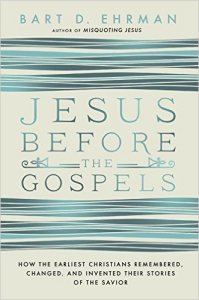
I’ve read eight or ten books in recent weeks that I haven’t yet blogged about here (including three SF novels), but I plan to catch up. First, mentioned earlier as remarkably coincidental considering my recent Bible reading, is a new book by Bart D. Ehrman, a prolific Bible scholar with several books that seem to deconstruct, if not actually discredit, common Biblical narratives — books with titles like Jesus, Interrupted: Revealing the Hidden Contradictions in the Bible (And Why We Don’t Know About Them) and Misquoting Jesus: The Story Behind Who Changed the Bible and Why. Without having read those, my guess is, from what I have read by him, he’s engaging in close reading of the Bible in various translations, of contemporary manuscripts that didn’t make it into the Bible, and so on, to bolster his thesis that, while Jesus was likely a real person in history, he didn’t believe himself to be a Messiah, and it was only later storytellers, apostles, and the church, who made him so.

With this new book, just published in March, Ehrman seems to have discovered a new tool (tempting to say ‘toy’) he can use to explore the Bible and deduce which parts are fancy and which might have basis in fact. His new tool is one familiar to skeptics and psychologists and anyone who understands that ancient history needs to be taken with at least a grain of salt: the fallibility of memory. As is commonly known, the New Testament gospels were written decades after the events that are supposed to describe, so one necessarily wonders, how accurate were those accounts, given that they were told orally across those decades, even if originally based on supposed witnesses to the resurrection? And how is it that, even after decades of presumably being able to compare notes, did the four gospels turn out so differently, with many portions similar but other incidents, like the virgin birth, completely absent from some? (Paul the writer of NT epistles never mentions the virgin birth, hmm.)

While I found this book very interesting, it was also annoying: Ehrman uses his new idea to a fault, shoehorning anything he can into the idea of flawed “memories”, in many cases where I think what he means is how stories, told and retold over generations, succumb to motivations of the human bias toward *narrative*, never mind whether these are matters of any kind of *memory*. He conflates all these matters into that one idea.

He acknowledges this, p11.7, “We all know from personal experience how much news stories get changed in the retelling…”, but then goes on to discuss these issues as matters of memory.

A fascinating aspect of this book (which I presume he’s covered in other books) is his discussion of those other manuscripts that didn’t make it into the official Bible (when it was finalized in, when, the 300s?) E.g. a Proto-Gospel of James; an Infancy Gospel of Thomas (addressing Jesus’ life from ages 5-12); the Gospel of Thomas discovered in 1945, with a collection of 114 sayings. He treats these as rival “memories” when, it seems to me, this are rival *stories*, versions of stories told and retold over decades, then finally selected or discarded for consistency or usefulness by the church officials who finalized the NT.

To give the book credit, Ehrman does explore the plausibility of whether stories can be transmitted orally across generations, with evidence of such modern day practices that do not, in fact, maintain story integrity; how eyewitness testimony (even if you believe the first story-tellers) has been shown not to be accurate in most cases; and then the contemporary study of memory, and how it is often unreliable.

Also interesting: how long it took for the four canonical gospels to be finalized, and given names — not until 185 AD/CE, and only four were chosen, out of all those available, on numerological grounds!

And Ehrman examines several specific stories from the gospels to suggest how implausible they are on their face — e.g. Jesus’ commotion in the temple market, in a temple that was *huge* and not so easily disrupted; about the descriptions of the trial before Pilate, that shift gradually to absolve him and place the blame on the Jews; how Jesus could possibly have told his Sermon on the Mount to such a large crowd, outside on a hill (with no megaphone), and who took notes? — but discusses why the stories might have later been told the way they were. (Again, not about *memory* per se.) And he notes, as I’ve mentioned in my posts about reading the NT, even if these stories are true, who witnessed them?, that they would later be told to the gospel writers.

He cites interesting examples of modern day primitive tribes who tell oral stories, and how their stories are told differently depending on context, the audience, and so on. Which is to say — they have entirely different ideas of ‘tradition’ than we do.

There’s more, more about divergences among the gospels, and the gospels that didn’t make it in to the NT, including disputes about whether Jesus was human, whether there were two gods, etc. etc., and how it wasn’t until the Council of Nicea, in 325 (!), that the ‘church’ settled on a proper theological stance amidst all these competing ideas. Or as Ehrman would say, ‘memories.’

My general reaction is that all this elaborates what I’ve assumed is obvious, to anyone who thinks about the matter at all (and not blinkered by childhood inculcation and thus unable to think critically): that ancient holy books cannot be counted on to be accurate histories, accurate accounts of the truth of the history of the world, let alone reliable accounts about miraculous events that happen to privilege the tribe or cult promoting these accounts, on any number of grounds. They are fascinating in an archaeological sense, as remnants of primitive humanity, and reveal more about human psychology than they do anything about actual history or the nature of the real world.

Posted in Bible, Religion | Comments Off on Ehrman, JESUS BEFORE THE GOSPELS: Memories, Stories, and the Gospels

Links and Comments: Two from Today’s NYT

First, fascinating essay by Michael P. Lynch (author of just-released The Internet of Us: Knowing More and Understanding Less in the Age of Big Data): Trump, Truth and the Power of Contradiction.

How is it Trump can say completely contradictory things, and no one seems to care? It’s all about confirmation bias.

Blatant contradiction puts the responsibility back onto the shoulders of the listener. If I simply deny what I earlier affirmed and act as if nothing has happened, then you are left having to decide what I really meant. And psychology, as well as common sense, tells us that human beings are prone to “confirmation bias.” That is, we tend to interpret evidence so that it conforms to what we already believe.

Because, given that a candidate, such as Trump, might say opposite things at different times, leaves different listeners the ability to respond to whichever version they prefer to accept:

…when a person says something as well as its opposite, his listeners can infer that he really believes whichever statement they wish him to believe.

A familiar idea, from our internet-fragmented bubbles:

It is only natural that we’ll hear those voices that are most similar to our own, shouting what we already believe, and as a result Google can find you confirmation for almost anything, no matter how absurd.

(Anti-vaxxers, unite!)

\\

Second, Nicholas Kristof: A Confession of Liberal Intolerance

The idea is that universities, in particular, do not represent conservative values and ideas nearly so often as they do ‘liberal’ ones.

This theme has popped up before, and I confess I’m sympathetic to the response quoted here, “Much of the ‘conservative’ worldview consists of ideas that are known empirically to be false.” That is, for example, conservatives/Republicans seem wed to economic policies that have proven not to work; to reverse the angle, the many in this country aligned to empirically false ideas about the age of the Earth and of the human species, or who do not understand evolution or climate change, are not liberals, they are conservatives. Why would anyone expect such conservatives to be common in our universities, where learning and truth, as opposed to ideology, presumably prevail?

Put another way: education, the exposure to new ideas and challenges to “common sense”, is itself a liberal idea. Conservatives, at the least the religious ones, are more likely to stay at home, lead their churches, protect their children from outside ideas that would challenge scripture through home-schooling, and so on. Or perhaps attend explicitly religious colleges.

Still, Kristof gamely thinks there is an issue here. The essay ends:

Should universities offer affirmative action for conservatives and evangelicals? I don’t think so, partly because surveys find that conservative scholars themselves oppose the idea. But it’s important to have a frank discussion on campuses about ideological diversity. To me, this seems a liberal blind spot.

Universities should be a hubbub of the full range of political perspectives from A to Z, not just from V to Z. So maybe we progressives could take a brief break from attacking the other side and more broadly incorporate values that we supposedly cherish — like diversity — in our own dominions.

Perfectly valid point, yet I have to wonder: how often in history have ‘conservative’ claims turned out to be true — based on some kind of *empirical* evidence, not force of ideology — against challenges to orthodoxy, i.e., liberal claims? It seems to me that the entire history of human understanding of itself, and of the universe, is about overturning status quo ideas based on primitive knowledge, with ‘liberal’ ideas based on reality… which has a liberal bias.

Posted in MInd, Thinking | Comments Off on Links and Comments: Two from Today’s NYT

Reading In and Around the Bible: Epistles of Paul, 2

First Corinthians:

  • 1:7, “as you wait for the revealing of our Lord Jesus Christ”. Another allusion to Paul’s prediction of the imminent Second Coming, which has conspicuously failed to happen for some 2000 years now. Again, why hasn’t this most egregious example of a failed prophecy undermined everything else Paul said? Because selection bias, as we now understand it: people are sensitive to prophecies that come true, no matter how vaguely, thus Paul’s numerous citations of Hebrew scripture, while ignoring all the ancient prophecies that never managed to come true. For contemporary Christians, it’s a matter of ignoring the ones that don’t come true, including this one. Only the hits count.
  • 1:18, “For the message about the cross is foolishness to those who are perishing, but to us who are being saved…” Another appeal to tribalism; us v. them, and how Paul’s followers should feel very special for being among the chosen elite.
  • 1:19, appeal to scripture, and anti-intellectualism. (Because the more you know, the less susceptible you are to the power of magical tales of miracles.)
  • 1:22, “For the Jews demand signs and Greeks demand wisdom” – as opposed to Paul’s followers; in other works, we don’t need evidence! We don’t need reason!
  • 1:26-27, All about upstaging those elites – how this does resemble contemporary American politics, with a certain candidate appealing to the ignorant base against the ‘establishment’! – which leads me again to wonder, if there was this god, how it is he didn’t manage to reveal his truth to everyone, if it’s really the truth? Why play favorites? Why does it not instead *seem exactly* like the conceited fantasies of a tribe or cult who fancied themselves the chosen of their particular, local god?
  • 3:19, “for the wisdom of the world is foolishness with God”. Again…
  • Ch5, again, Paul is much concerned with sex. This suggests more about him than about god or Jesus.
  • 5:5, “destruction of the flesh”, Oxford’s annotators seem to bend over backwards to explain how it doesn’t really mean that.
  • 5:9, “not associate with sexually immoral persons…” Really? WWJD? From later letters Paul seems familiar with the various “sayings” of Jesus, but not, of course, with the NT gospels as we know them.
  • Ch6, Don’t associate with non-believers! Very tribal, and self-righteous.
  • 6:9, rather obsessed with ‘wrongdoers’. [I never realized until now that George Bush’s phrase ‘evildoers’ came out of his close attention to the themes of these ancient religious manuscripts which have, alas, informed so much of human history for the past two millennia.]
  • ch7, more about sex! This is about Paul. Apparently he is unmarried and finds the whole idea of sex rather distasteful, and would just as soon counsel everyone else to consider it just as distasteful. Who is he to lay down such rules…? Apparently the one who won.
  • 7:26, “impending crisis”, again, Paul predicts the Second Coming is happening soon.
  • 7:31, “For the present form of this world is passing away.” Yet another statement of the most failed prophecy of all time.
  • 10:20, Our god is real, theirs is not.
  • Ch11, So many rules! Who says?
  • 11:9, “Neither was man created for the sake of woman, but woman for the sake of man”. Obviously, antiquated gender roles, which many adhere to, to this day. Is there some atavistic evolutionary reason for this belief? Is this something that can be, or should be, overcome? Obviously US laws cites equality before the law, yet that “equal rights amendment” never passed.
  • 11:14, “Does not nature itself teach you that if a man wears long hair, it is degrading to him…” Really?? Why?? Doesn’t that iconic portrait of Jesus show him with long hair? (And how, and how often, did men cut their hair in those days…? Do we know?)
  • 12:8, a ranking in descending order of the values of wisdom, knowledge, faith, gifts of healing, then miracles, and so on. But later, 12:28, these are aligned with apostles, prophets, teachers and so on, so the ideas of wisdom and knowledge didn’t mean what we think of them now.
  • 13:1, in NRSV, “a noisy gong or a clanging cymbal”, to mean saying without love; KJV says “I am become as sounding brass, or a tinkling cymbal”, a phrase adapted by SF author Robert Silverberg for essay about his career up to a point: Sounding Brass, Tinkling Cymbal
  • Throughout these passages, NRSV uses the word “love” where KJV uses “charity”. Asimov, p444-447, discusses the original Greek word, “agape”, and how neither translation exactly matches its meaning.
  • 13:8, everything will end but love. Often-quoted: “When I was a child, I spoke like a child, I thought like a child, I reasoned like a child; when I became an adult, I put an end to childish ways.” (I think this is true, or should be true, in a greater way, as our species learns about the reality of the universe around us, and puts away childish, mythical beliefs of our tribal ancestors.)
  • 13:12, KJV’s famous “through a glass, darkly” becomes in NRSV “in a mirror, dimly”.
  • 14:1-2, seems to equate ‘prophesy’ with ‘speaking in tongues’, which is not commonly understood, I’d guess.
  • 14:34, the famous injunction against women speaking in churches – but the Oxford annotators think these passages were later additions, not by Paul (for what that’s worth)
  • Ch15, Paul goes on about the resurrection, which the Oxford annotators think is derived from “the philosophical proof of the immortality of the soul” in Plato’s Phaedr and others. Of course, Paul’s entire argument begs the question.
  • 15:6, Jesus appeared to some 500 people?? First mention of this I’ve read. (And curious that the four Gospels, written later, didn’t describe any such thing.)

Second Corinthians

In this book especially, it struck me when I read it, it seems that Paul is using lots of words to say very little; that his prose is obsequious with flattery to his followers on Corinth on the one hand, boasting with unseemly self-importance, while at the same time reproving those followers like a father to unruly children, and almost desperate in his repeated appeals to the coming eternal life in the heavens.

Fewer specific notes. By Ch3, Paul has a new theme: he’s decided that the covenant of Moses is a “ministry of death” and only belief in Jesus is the way. Ch8 is a beg for money, like any contemporary preachers – as a “proof of love”. All the commentators seem to agree that Chs 10-13 come from an earlier, angrier, letter, that was grafted into this scroll by later editors. 10:10 describes Paul’s unimpressive appearance and presence. 10:5 insists that a believer’s every thought must be subsumed to Christ. 11:5, Paul is worried about the appeal of other “super-apostles”, as if is followers might be easily swayed. (By rhetoric, of course, not by any kind of evidence.) And 12:7, Paul’s apparently infamous “thorn”, about which no one really knows what he means, but about which Miller, anxious to justify every biblical passage through allusion to any kind of contemporary knowledge, speculates wildly.

Posted in Bible | Comments Off on Reading In and Around the Bible: Epistles of Paul, 2

Reading In and Around the Bible: Epistles of Paul, 1

Working my way through the New Testament; after the four gospels, and Acts, much of it is the epistles of Paul, seemingly the creator of the Christian religion.

(My current plan is to read through the rest of the NT over this next month, then return to the OT to closely read selected books — Genesis, maybe all of the first five, and Job, Psalms, Ecclesiastes, Proverbs, maybe a few others — then to finish the commentaries (Ehrman et al), to complete this examination of ancient history and cultural influences and primitive thinking, before returning to more contemporary, enlightened, thoughts.)

I’m reading Paul’s epistles in approximate chronological order as written, according to sources; so far I’ve read 1 Thessalonians, 2 Thessalonians, Galatians, 1 and 2 Corinthians, Romans, and couple others.

It’s revealing to realize, as I mentioned earlier, that Paul was roaming around the Mediterranean converting people to the ‘gospel’ i.e. ‘good news’ of Jesus the savior, based on his own conversion experience, his relatively brief meetings with a couple of Jesus’ apostles, and his interpretation of prophecies from the Hebrew Bible. But *not* any of the four written ‘gospels’ we now know of in the New Testament — because they hadn’t been written yet. (Presumably oral versions of the stories that eventually were written down as the four gospels were floating around, in scattered fashion, but we all know how much stories change in the telling, especially over decades!) In that context, what is most striking in reading these letters is how certain Paul is of the religion he is trying to promulgate. He lays down the law to his followers, at times obsequious and at times scolding, creating an entire theology derived from selective reading of the Hebrew Bible and apparently based on his own predilections for proper behavior, much more than based on anything Jesus might have said or counseled. Paul is described as humble, perhaps ugly, and not well-spoken, but in his writings, he’s as zealous as they come. Jesus may have been his hero, but the religion is the creation of Paul.

As always, what follows are my immediate comments mostly about the implausibility of what Paul claims, and/or revealing circumstances that suggest how and why these stories came to be, driven by psychological motivations to selectively interpret data and create narratives that serve social and political purposes.

1 Thessalonians: Presumed to have been written about 50, and the earliest of Paul’s letters.

  • 2:2, ‘shamefully mistreated’. Themes of persecution arise immediately. Commentators (Ehrman) point out that the early Christians’ refusal to observe Roman rituals was why they were persecuted — not because of anything inherent about the new ‘gospel’. Yet to this day, Christians love to feel persecuted.
  • 2:10, Paul insists he is ‘blameless’ in his conduct toward his believers. Doth he protest too much?
  • 2:13, “you received the word of God that you heard from us…what it really is, God’s word.” Paul presumes to know, for certain, God’s word.
  • 2:18, Paul blames his failure to visit earlier on Satan.
  • 3:13, Paul is preoccupied with the imminent return of Jesus.
  • 4:3 ff, Paul is very concerned about the sexual habits of his followers, initiating a theme throughout the history of Christianity. Or perhaps revealing something about Paul, a bachelor too busy proselytizing to marry. He’d just as soon his followers live as he does: be pure, live quietly, work hard, pray.
  • 4:15 Most of those alive now will see Jesus return. Why doesn’t this failed prophecy, the most spectacular failed prophecy of all time, completely undermine everything Paul ever said? Paul’s description of the “trump of God” has instead become the template for all imaginings of the second coming. How did he know it would happen like that?
  • 4:17 is apparently the source of the now common idea of the ‘rapture’, when believers will be lifted into the heavens and all others will be “left behind”.
  • 5:23, again, he’s coming soon!

2 Thessalonians: some authorities doubt the authenticity of this.

  • 1:8-9, nonbelievers will “suffer the punishment of eternal destruction” … ‘Gospel’ may mean ‘good news’, but there’s a huge element of macabre delight by Paul in his insistence that anyone who does not take his word for God’s workings of all creation will be tormented forever. One wonders what a contemporary psychiatrist might say about this. Or is this all about mollifying believers, so they feel self-satisfied about being among the chosen?
  • Ch2, Paul seems to backtrack a bit about the overdue second coming of Jesus, now claiming that some kind of rebellion needs to occur first, including the appearance of a “lawless one” (KJV “man of sin”), apparently never further identified. Asimov, p475, points out these passages as the source of the idea of an “Antichrist”, a theme still much discussed today about anyone the Christian devout does not like.
  • 2:11, In my reading of the Bible, I am sometimes startled to read commentaries that point out individual verses that have over the millennia come to take on enormous meaning, when — reading them in context — they do not seem especially significant. Here’s one that is likely not quoted out of context: “For this reason God sends them a powerful delusion, leading them to believe what is false.” God created the world and people in it to worship him, and now he’s sending them delusions? Context is everything, no doubt.
  • 3:6, Paul is much concerned about idleness.

Galatians

  • 1:1 Now Paul claims himself to be an apostle, with as much authority as the twelve who actually knew Jesus.
  • 1:4, “the present evil age”, another appearance of this historical cliché
  • 1:7, Paul alludes to other ‘gospels’, presumably meaning not texts, but rival teachings. Of course, Paul insists his followers believe him, and not his rivals, lest they be “accursed”.
  • 1:12, Paul claims to have received his gospel “through a revelation of Jesus Christ”, i.e. his experience on the road to Damascus. But how many other preachers were wandering around with their own revelations? A number if seems, or Paul wouldn’t protest.
  • 1:17, Paul says he went to “Arabia” before he went to Damascus, which doesn’t seem consistent with Acts.
  • 2:1, Somehow 14 years passed which Paul doesn’t bother to account for. What was he doing?
  • 2:6-9, Paul is obsessed with circumcision, or perhaps people of the day were, for some reason I still don’t quite understand. That it should have been such a marker of tribes suggests that male urination was not a very private affair in those days, else how would anyone know whether anyone was circumcised or not?
  • 2:15, Paul’s message now shifts a bit to claim that faith in Jesus trumps the “works of the law”, i.e. the Hebrew Bible, i.e. Leviticus. (Didn’t Jesus claim he came to uphold the law, not overthrow it? –But that’s someone else’s version of the story.) One assumes Paul is adjusting his message to appeal to his crowd, who are skeptical about adhering to strict Hebrew law — including circumcision. Strange standards to base a religion on.
  • 3:2, Paul admonishes his followers to “receive the Spirit” by “believing what you heard”. Here is a frank admission that people were converted by the power of the story, the lecture, the sermon, and not, of course, any kind of claim to eyewitness testimony, let alone evidence.
  • 3:16, appeal to scripture, of course. One gets the impression the story of Jesus appeals to Paul especially since he can attribute the few details he knows to cherry-picked verses from the enormous Hebrew Bible (i.e. OT).
  • Ch5, Paul now advises that succumbing to circumcision would be to be obliged to obey the “entire law”, and he doesn’t want them to do that!
  • 5:16, contrasting Spirit vs flesh. A note in the Oxford* NRSV says that “the idea of two opposing forces leading either to righteous or wicked behavior was prominent in the Qumran sect”. So many sects; Qumran.
  • 6:7, “God is not mocked”. One of those isolated phrases people like to quote, without context.
  • Asimov’s chapter on Galatians, p452ff, discusses the controversy about circumcision, and the Council of Jerusalem, held in 48, about this matter. Since Paul doesn’t mention it here, perhaps this letter was written before that.

Will post about Corinthians next time.

*I realize I should designate the Oxford edition of the NRSV when referring to their annotations; the Oxford annotators are not the translators of the NRSV. Sometimes the annotations quibble with the NRSV translation.

Posted in Bible | Comments Off on Reading In and Around the Bible: Epistles of Paul, 1

Religious Liberty and Christian Theology

Salon: Republicans have turned God upside down with their so-called “religious liberty”.

The “liberty” part in “religious liberty” is not intended to empower the believers of a dominant religion, such as, say, Christianity, to give them the “liberty” to impose their beliefs upon everyone else. No. This is a perversion of the term “religious liberty.”

Instead, the “liberty” part is intended to protect minority NON-believers to ensure that they have the liberty to maintain their own independent beliefs without suffering any disadvantages imposed upon them by the dominant believers.

And

And Christians are hardly under attack here. No one is taking away their rights. No one is seeking to force them to be gay themselves, or to force birth control upon them. No. They are perfectly free to hold their own religious beliefs and live their lives accordingly.

My take on the matter is to observe that these religious liberty laws all seem to be about gay and transgender people, and Christians who recoil at dealing with people they think are sinners on those grounds. But, according to Christian theology, aren’t we *all* sinners about something or another? So why is it Christians need these laws just to avoid dealing with gays and transgender people? Because it’s really about their difficulty of living civilly with people who are unlike themselves – especially those icky gays and transgenders.

The essay does conclude this way:

Good afternoon Mr. & Mrs. Customer. Are you gay? Oh thank goodness. But, do you believe in God? Which God? Did you attend church this past Sunday? Have either of you ever committed adultery? When you have sexual intercourse with each other, do you use birth control? Madam, have you ever had an abortion? Do you as a couple engage in any sexual activity that would be regarded as deviant?

Oh, I’m sorry, we don’t serve your kind.

Posted in Conservative Resistance, Religion | Comments Off on Religious Liberty and Christian Theology

Sean Carroll Interview

Phil Torres talks to Sean Carroll, author of a book coming out Tuesday that I’m greatly looking forward to, The Big Picture

Salon: “The evidence is pretty incontrovertible that he doesn’t exist”: Stephen Colbert’s favorite scientist on the universe, naturalism and finding meaning without God.

Torres writes,

American culture is deeply infused with an anti-intellectual distrust of scientific knowledge, a failure to understand the nature of peer-review, and an unwavering predilection for conspiracy theories and pseudoscience.

Aside from the existential importance of understanding science, there’s also a purely aesthetic issue. The scientific worldview offers, I would argue, a far richer and more elegant picture of the cosmos than any ancient myth or grand narrative conjured up by the human imagination during the Iron Age. As Charles Darwin would put it, there is grandeur in this view of the universe. And he’s right. Consider a few nuggets of mind-boggling truths, courtesy of science’s ongoing investigation into the arcana of reality: the cosmos has no center and no boundaries. The fastest moving organism travels more than half the speed of sound — and it’s a plant. You very likely have some DNA from an ancient Neanderthal in your cells. Earth rotated faster when the dinosaurs were alive, meaning that the days used to be shorter. The universe is, in other words, an endless playground for curious minds.

I’ve posted several times about Sean Carroll; here’s a post from January 2015 with a link to a Sean Carroll talk that addresses many of his themes, with my own outline summary of key points.

In this Q&A about his new book I like his notions of “poetic naturalism” and “planets of belief”, and his answer to the question of why you don’t need God (or anything else) to serve as the “cause” for the existence of the universe. Carroll:

It’s not true that every effect has a cause! That’s just a convenient way of talking about certain features of the macroscopic world of our everyday experience, one that is not applicable to how nature works at a deeper level.

When you want to tackle questions about the fundamental nature of reality, it’s necessary to leave behind concepts of “cause and effect” and replace them with “the laws of physics.” Those laws take the form of patterns relating different parts of the universe to each other, not relationships of causality.

So a better question is: what does our best understanding of the laws of physics tell us about the origin of the universe, and why it might exist at all? The answer is “not much.” This is a case where we have to be humble. The universe might have had a beginning, or it might have existed forever, we just don’t know. There’s certainly no reason to think that there was something that “caused” it; the universe can just be.

Posted in Cosmology, Meaning, Science | Comments Off on Sean Carroll Interview

Links and Comments: Truth and Slavery

This article in The New Yorker, After the Fact by Jill Lepore, considers the current US presidential race in light of a new book by Michael Patrick Lynch, The Internet of Us, subtitled “Knowing More and Understanding Less in the Age of Big Data”. The whole concept of ‘truth’ is in play.

Lepore:

No matter the bigness of the data, the vastness of the Web, the freeness of speech, nothing could be less well settled in the twenty-first century than whether people know what they know from faith or from facts, or whether anything, in the end, can really be said to be fully proved.

(To my mind this issue is perfectly well settled, and well expressed, e.g. in Jerry Coyne’s book Faith vs. Fact. But Coyne’s is an intellectual argument that does not much affect the lives of most people, much less politics.)

In this world, Lepore goes on, Trump is a bully who doesn’t need to reason, Cruz appeals to God, and Rubio appeals to Google. The essay ends:

Is there another appeal? People who care about civil society have two choices: find some epistemic principles other than empiricism on which everyone can agree or else find some method other than reason with which to defend empiricism. Lynch suspects that doing the first of these things is not possible, but that the second might be. He thinks the best defense of reason is a common practical and ethical commitment. I believe he means popular sovereignty. That, anyway, is what Alexander Hamilton meant in the Federalist Papers, when he explained that the United States is an act of empirical inquiry: “It seems to have been reserved to the people of this country, by their conduct and example, to decide the important question, whether societies of men are really capable or not of establishing good government from reflection and choice, or whether they are forever destined to depend for their political constitutions on accident and force.” The evidence is not yet in.

Isaac Asimov once wrote (somewhere) that to persuade him that reason does not work or is insufficient to arrive at truths, some kind of argument would be required that would itself constitute reason. QED. Or, perhaps he might have said, show evidence (e.g. divine revelation) of truths that could not be reached through reason, something such critics conspicuously cannot do.

Another point, as I often repeat here, is that the modern world around us is physical evidence of things built on principles discovered by empiricism and reason. And not, conspicuously, by miracles or faith. The essay asks for evidence, but the evidence is all around us. The remaining issue is something I’ve not yet gotten a handle on: how it is different people are more or less ‘gullible’, for lack of a better word, about what evidence or authority they use to arrive at what they consider ‘truth’. (Is it the authoritarian impulse, for things to be black or white? The soft-minded unthinking acceptance of revealed wisdom and divine truths? The paranoid impulse to reject ‘elitist’ knowledge, i.e. by anyone who’s smarter and presumes to know better than ‘common sense’? Working on it.)

\\

It would be easy to collect outrageous comments about the right-wing political candidates, but here’s one that’s hard to pass up. Ted Cruz, and David Barton, apparently, are supporters of something called Christian “dominionism”, the idea that Christians are justified, via Bible of course, in dominating all non-Christians, to the point of… slavery.

Here’s an essay at AlterNet: Cruz Super PAC Head Promotes ‘Biblical’ Slavery for Non-Christians by Bruce Wilson.

Does Texas U.S. Senator Ted Cruz yearn to rule and reign over America like a God-anointed king from Old Testament scripture? Short of Cruz himself shouting it from the rooftops, who can say for sure? Still, nothing says “dominionism” quite as forcefully as “biblical” slavery.

Back in 2011, an open letter to Dr. Laura Schlessinger (concerning her radio show statement that, per Leviticus 18:22, homosexuality was an “abomination”) began, “Thank you for doing so much to educate people regarding God’s Law,” then popped the question,

Leviticus 25:44 states that I may possess slaves, both male and female, provided they are from neighboring nations. A friend of mine claims that this applies to Mexicans, but not Canadians. Can you clarify? Why can’t I own Canadians?

For David Barton, Cruz’ super PAC head (and the top evangelical power broker behind Cruz by one media account), this is no joke. It’s a serious question for which Barton’s website offers a serious, bible-based answer—an American may enslave both Mexicans and Canadians, but only if they’re pagans.

How nice.

Much more, of which I’ll quote just one more slice:

Barton’s lifetime endeavor has been the wholesale fabrication of American history—a decades-long propaganda effort to convince evangelicals that scheming secularists and non-Christians have “stolen” America’s rightful heritage and birthright and hounded God from the public square.

It’s the key narrative that has motivated America’s politicized religious right—the movement which now dominates numerous state legislators, that propelled the Newt Gingrich-led takeover of congress in 1994 and the Tea Party-driven takeover of congress and the senate in 2010, that has blocked proactive national legislation to address a wide range of pressing issues, from campaign finance reform to climate change.

In short, David Barton’s pseudo-history has helped to politically paralyze the most richest and  powerful nation on Earth.

Barton’s books, videos, presentations, and “walking tours” of the capital undergird and support a right wing narrative of cultural complaint (a modern-day American analog of the post-WW1 German Dolchstoßlegende) which motivates a range of constituencies on the Christian right inclined to back Ted Cruz.

Scary stuff. And not, of course, unrelated to the first item above.

Posted in Culture, Religion, Thinking | Comments Off on Links and Comments: Truth and Slavery

Reading In and Around the Bible: Acts

Latest set of notes on my readings, for the first time in my life, of the books of the New Testament, reading as a non-believer, inclined to skepticism, often to simple bemusement. The history of the world of supernatural claims is too broad to take any of them, even one that has inspired millions of adherents throughout history, seriously without any kind of thinking about their likely origin, and all the psychological and historical factors that went into their composition.

This post is about the book of Acts, i.e. The Acts of the Apostles, a longish book that describes what the apostles did immediately following Jesus’ death and supposed resurrection, but which is largely about Saul, later Paul, who created a chain of churches in reverence of Jesus over the following decades and who thus, almost single-handedly, created the Christian religion.

Sources of commentary are again Asimov’s Guide to the Bible: The New Testament (1969) and the extensive annotations and footnotes to the New Oxford Annotated Bible, New Revised Standard Edition (2010), that I’m reading from. (I also have a King James Version I consult, for comparison, on occasion.)

I think that in terms of modern understanding of “why people believe weird things” and the protocols of narrative, how stories are changed over time depending on the audience and on the motivations of the tellers, the NT gospels and this book in particular, are an exquisite case study. I’ll explore that idea in future posts, but for now, here are my transcribed notes about Acts, by chapter and verse, noting especially inconsistencies with other NT books, passages about claims that wouldn’t seem plausible today, and others that strike me as extraordinary improbable, or revealing of the thinking of the time.

  • Acts is assumed to have been written by Luke; thus a sequel to the third gospel, addressed to the same “Theophilus” [lover of God].
  • Asimov spends 100 pages of his book commenting on this, largely because of all the historical content
  • 1:3 Jesus offers “many convincing proofs” after his resurrection – but only to his apostles
  • 1:8 Much emphasis in this book on the ‘Holy spirit’ which is, what exactly? Not just metaphorical for the presence of God, but a third manifestation of Him, apparently, as has come to be understood as the ‘trinity.’ (Seems like an unnecessary multiplication of entities.) In practice, it seems as if any incidence of seeing visions, speaking in tongues, or otherwise generally acting crazily, is referred to as being possessed of the Holy Spirit.
  • 1:16, again this obsession with fulfilling prophecy, as if nothing happening now, at the time, is valid unless it can be related to some aspect of ancient holy texts.
  • 1:18, a different story of Judas’ death
  • 2:4, speaking in tongues; why is it holy inspiration appears only via completely irrational ways? (Dreams, visions, etc.) Asimov notes p338: “The utterance of incoherent sounds under the influence of religious ecstasy is an effect common to many religions. … a common feature of the ecstatic frenzies of the bands of prophets that were a feature of Israelite religious practices under the judges and the kings. In fact, such ecstatic and incoherent speech was what was usually meant by the term ‘to prophesy’ in the early books of the Bible.” Hmm. Again and again, commentaries (including even those in the NSRV I’m reading) point out how various striking aspects of the world of the Bible – that is, aspects like miraculous prison breaks and ‘prophecies’ and so on, that we think of as part of that ancient time, special to that holy time, and not occurring today (except as claimed among certain extreme sects) – were, in fact, common to other religious practices of the time, and not special to the history of Israel or the story of Jesus. This one branch of history and its messiah are just the ones that have, for whatever reason, happened to have survived.
  • 2:5, “every nation”, well all the nations the writer was aware of, perhaps. (Obviously, the culture of the Bible knew nothing of Africa, the vast majority of what we now call Asia, the Americas and Australia, and so on.)
  • 2:8, the Holy Spirit causes a crowd to speak in various languages, and each person hears the babble in his own language. (Wasn’t there a Star Trek episode with a similar incident?) Asimov, p340, points out that, despite the numerous countries and races mentioned, most of them at the time would have spoken Greek, Aramaic, or both (being traders), and so this incident is not so miraculous as it sounds.
  • 2:12 ff, aren’t they just drunk? No, prophecy! (Truly, motivated thinking.)
  • 2:23, Acts is especially explicit about it being a *plan* that Jesus died, something I don’t think was in the earliest gospels.
  • 2:40, “Save yourselves from this corrupt generation”, another citation of this historical cliché. (Everyone thinks the current generation is debased, that life was better in the old days.)
  • 2:43, and Ch3, now the apostles begin performing “wonders and signs”!
  • 3:17, they acted in ignorance – but it was part of the plan, right? The narrative tries to have it both ways.
  • 4:4, many who hear Peter and John’s sermon, 5000 of them, believe; seems all it takes is a passionate sermon. Or is it because they healed the lame man? Throughout this book both or either seem sufficient, but if the Word is so powerful, why are the parlor tricks of miracles necessary? And weren’t other would-be messiahs performing such parlor-tricks?
  • 4:22, odd comment about being more than 40 years old.
  • 4:32, In this group of believers “no one claimed private ownership of any possessions, but everything they owned was held in common.” Communism! A practice I haven’t noticed many Christians today following. (In contrast, there’s a “prosperity gospel” theology, that keys off a few very selective passages of the NT, to justify the efforts of the wealthy to become more wealthy.)
  • 5:2, two members of this group try to cheat the rules, and when found out, simply drop dead. Really? It’s easy to ridicule the apparent plain meaning of these stories from a contemporary perspective; what’s fascinating is to ponder why such unlikely stories were told and recorded presumably because they seemed plausible to listeners at the time.
  • 5:12, more signs and wonders performed by the apostles. Doesn’t this rather undermine the claims of Jesus based on the miracles he performed? I understand this is why some of them, e.g. Peter, became saints…
  • 5:19, a miraculous prison break via an angel. Later there’s one via a convenient earthquake.
  • 5:34 ff, these passages, Asimov points out, describe how there were many other sects, with their own miraculous leaders, that had died out. Perhaps the Christians would too.
  • Ch6: political infighting
  • Ch7: Appeal to scripture. (Recurrent thought: the entire concept that a god – who created the entire world, the entire universe – would have a ‘chosen people’ is simply incoherent – much more plausibly a reflection of simple tribalistic self-importance, who invented this idea of “God”, of which *they* were the chosen people. (Does anyone believe in a god whose chosen people is some other group?) Why wouldn’t such a god communicate directly with *all* his creations? As with the First Commandment, this theme is an obvious vestige of polytheism, the assumption in those days that every tribe had their own local god.)
  • Ch7: So Stephen is the first Christian martyr – as approved of by Saul. (Later Paul.)
  • Ch8: Philip does miracles too, driving out ‘unclean spirits’
  • 8:9, curious the writer identifies the works of this Simon, Simon Magus, as ‘magic’, even though it “amazed the people of Samaria”. Asimov, p349, discusses how Simon Magus was mentioned in later writings outside the NT, and inspired a heretical sect, the Simonians, that lasted two centuries.
  • 8:26ff, a man from Ethiopia is (easily as always) converted just by hearing Philip’s story. Asimov has much to say about the appearance of an Ethiopian at this point in the story.
  • Ch9, the famous conversion of Saul on the road to Damascus – a story so critical it’s told in full *three times* in Acts – by a light from heaven and voice no one else could hear. NSRV notes the story “incorporates various features of theophanies and stories of the call of prophets”, suggesting an awareness of how these stories were written to certain patterns (i.e. not, needless to say, based on any kind of eye-witness testimony). According to this story, Saul is converted by virtue of being blinded and then restored to sight—not because of any kind of “good news” that persuades so many others.
  • 9:22, Saul becomes powerful “by proving that Jesus was the Messiah”, a rather question-begging use of the word “prove”.
  • Asimov, p359.2, notes about Saul’s conversion that he becomes “as fanatical an upholder of the belief as, earlier, he had been fanatical in opposing it” and then notes wryly “(This is by no means uncommon in conversions.)”
  • 9:36ff, now even Peter can raise the dead.
  • Ch10, Peter has a strange, symbolic vision of a sheet holding all kinds of animals, and is inspired to convert Cornelius, someone who’s not already a Jew.
  • 10:39, Jesus was “put to death by hanging him on a tree” ?
  • 10:43, “everyone who believes in him receives forgiveness of sins”, a core concept perhaps not spelled out earlier? Always struck me as a weird deal. Why is belief – without any more than hearsay evidence – so important that it’s rewarded with “forgiveness” of “sin”, i.e. release from the rules that presumably God set up in the first place?
  • Ch11, Peter repeats his vision.
  • 11:28, reference to the Roman emperor Claudius; this verse also predicts a famine “over all the world”.
  • Ch12, a divine escape from prison; NRSV notes “Miraculous escapes were a staple of ancient literature.”
  • 13:12, these stories conflate teachings with miraculous tricks or spells, a peculiar mix of standards of evidence. Then we get a lengthy recitation of ancient history!
  • 13:6, they met “a certain magician, Jewish false prophet”; one gets the impression there were a lot of would-be prophets at the time.
  • 13:9, in a quite understated way, Saul becomes Paul; Asimov p378-9 describes the significance of this conversion from a Hebrew name to a Gentile name, after which Paul quite takes charge.
  • 14:3, more signs and wonders. Again, is it the message, or the magic tricks, that converts people? The text implies they’re both equally persuasive.
  • 14:5, 14:18, riots! Given that the writer of Acts is presumably an apologist for the followers, one can only imagine what might actually have been going on at this time.
  • Aside about Christian persecution, which is described in the NT as something believers must endure as a price for their faith, something, in fact, to be *proud* of as a mark of that faith. What’s not described in the NT is what is described elsewhere, e.g.:
     

    Early Christianity was periodically persecuted in the Roman empire, because its votaries refused to observe the empire’s public religion, which was a responsibility of citizenship. They were therefore thought to be subversives, whose loyalties were such that they refused to participate in the state’s observances of civic cohesion; and because they refused to believe in the [Roman] gods, they were dubbed atheists.

    (This is from A.C. Grayling, Ideas That Matter, in his chapter about Christianity.) Roman intellectuals of the time at least made the pretense of observing the Roman gods. One can try to read between the narratives to imagine the early Christians as a truly rebellious cult… but why? Why did their apparent conversion to followers of Christ cause them to so explicitly defy Roman customs? Via the zealousness of Paul? Will be reading through the epistles, and elsewhere about the history of Christianity, to see if there is an answer.

  • 14:11, the crowd is just as willing to believe that Zeus and Hermes appear in human form.
  • Asimov p384, cites the Roman poet Ovid as evidence that Paul was in fact a rather weakly person, hardly charismatic (which confounds my comments just above), unless this was Socratic irony; and speculates that the incident on the road to Damascus was due to epilepsy.
  • Ch15, much concern about circumcision. Why is this so important, and why did the practice arise in the first place? I glanced at Wikipedia about this but tl;dr.
  • Ch16, and so Paul relaxes the rules about circumcision and strict dieting, in order to attract converts who need not follow Jewish law.
  • 16:6-7, odd passages about how Paul and company were deterred from speaking in certain towns in Asia [Minor]; the writer attributes this to the “Holy Spirit” (huh? Why?) Asimov, p393, speculates what might have been going on.
  • 16:11, “We” !! Is this evidence of the writer Luke? Or, more likely, is this simply bad editing by those who, decades later, might have assembled parts of oral accounts? There are two more groups of verses told in the first person like this.
  • 16:25 ff, another magical jailbreak.
  • 17:3, more “proof” based on citation of scripture. Standards of evidence were different in those days.
  • 17:5, more riots
  • Ch17, the arrival in Athens; Asimov has much background about the philosophers of that time (not mentioned in Acts, of course): Epicurius, Zeno, the Stoics
  • 17:34, Asimov, p403t, notes that “later tradition built enormously upon this single verse”, unto the 6th century. (Upon such slender reeds…)
  • 18:26, “they took him aside and explained the Way of God to him more accurately”. There were by this time all these local “churches”, each telling followers the stories they had been told, with inevitable embellishments and variations. This verse seems to suggest that Paul and group are helping this guy his story straight.
  • 19:6, “they spoke in tongues and prophesied” – because of Holy Spirit. As in previous item, so often a single verse will inspire traditions that last hundreds of years, can we assume that this verse is the inspiration for all the modern Christian cults who think “speaking in tongues” is an essential part of their faith? No doubt a crucial passage.
  • 19:11, more miracles through Paul
  • 19:15, an evil spirit talks back to a false exorcist
  • 19:28ff, more riots. The shrines of Artemis, as Asimov points out, the Greek/Roman fertility goddess, portrayed in statues as a woman with a couple dozen breasts. :35 about “the statue that fell from heaven” have led some, Asimov 410t, to speculate is was a meteorite.
  • 20:10, another resurrection, via Paul.
  • 20:25, Jesus is quoted as saying, “It is more blessed to give than to receive”, but it’s a saying not found in the gospels.
  • Ch21, more riots.
  • 21:38, reference to some other pseudo-messiah, this one an Egyptian
  • The story of Paul takes him before trials and finally being sent to Rome, via a treacherous voyage and shipwreck on the island of Malta.
  • 26:24, Paul tells his conversion story yet again, and gets this response: “You are out of your mind, Paul! Too much learning is driving you insane!”
  • 27:30, adrift at sea, sailors try to escape the ship. NRSV notes, “Escape of the crew is a popular motif found in Greco-Roman novels.”
  • 28:4, magical thinking: when Paul is bitten by a snake, the natives say “This man must be a murderer”… but then when Paul does not die, “they changed their minds and began to say that he was a god”.
  • 28:23ff, Paul preaches in Rome and some are not convinced; fortunately, every circumstance can be justified as foretold by the prophets!
  • Asimov notes how Acts ends some three decades after Paul’s conversion, after he’d established many churches in Asia Minor and Greece, but some three years before he died. Perhaps, Asimov suggests, that the story deliberately ended at the high spot in his career, before his downfall.
Posted in Bible | Comments Off on Reading In and Around the Bible: Acts

Reading In and Around the Bible: Divorce and Homosexuality

Still writing up notes on the Biblical book of Acts, which I finished reading last Friday, and working my way through Ehrman’s JESUS BEFORE THE GOSPELS, which I’ve returned to after having read the four gospels. Ehrman’s comments about Jesus’ several, inconsistent, admonitions about divorce reminded me of a passage I found a few weeks ago about why the early Jews (in Leviticus) would have had such harsh penalties for homosexuality. This is from Louis Crompton’s HOMOSEXUALITY & CIVILIZATION (Harvard, 2003), an exhaustive account of how there have always been homosexuals throughout all of recorded human history. (That is, it’s not the result of some contemporary falling of American culture from some idealized past, or from a past Biblical foundation, as some simplistic right-wingers claim.)

Let me record this for now, because it relates to my theme of “the arc of moral progress”, especially how morality is often a reflection of environmental and social pressures and constraints at any given time.

Early in the book, Crompton address early Greece, and then, Judea. p34-35:

Most writers who have tried to understand the fierce homophobia of ancient Judea have sought an explanation, understandably enough, in its political and military situation. The Israelites, according to the Bible, were originally a nomadic people desperately seeking land on which to settle.

As a small tribe facing mighty and hostile powers — Egypt, Assyria, Babylonia, Persia — the Jews naturally strove to increase their numbers: military security demanded this. The concern for procreation has been the most commonly suggested rationale for the anti-homosexual legislation of Leviticus. Jewish popular tradition put great emphasis on marriage and large families. In Talmudic times unmarried men were censured and, on occasion, could be forced to wed. The ancient Jews frowned on celibacy and, the presumption is, on exclusive homosexuality. Yet it seems difficult to believe that this, in itself, would lead to so draconian a measure as the death penalty. …

Author goes on to explore this issue, discussing Nazi Germany, the Hebrew Bible’s silence on masturbation (Onan’s sin wasn’t about spilling his seed, but about not fulfilling the obligations of his marriage), and so on.

Despite the heated rhetoric of some Talmudists and medieval theologians who equated loss of sperm through masturbation with homicide, no society has ever been willing to legislate on this principle.

Not to get enamored in details, but the obvious point is that ancient tribes struggling for survival, needing children to expand their tribes, would need to discourage any practice that did not encourage the production of children.

Related, but not quite analogous, insights might be suggested for issues about divorce — and adultery, and men marrying their deceased brothers’ wives to have children by them, and so on, to recall other rules from Leviticus. It’s all about maintaining and expanding the tribe — and maintaining patriarchy. The problems with divorce, I suspect, can be understood because any incident of divorce would complicate tribal life with questions about which children were born of which fathers. And that complicates paternal allegiance. Better just to prohibit any practices that would raise those complications.

Posted in Bible, Morality | Comments Off on Reading In and Around the Bible: Divorce and Homosexuality