Curious Play

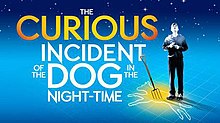
The Curious Incident of the Dog in the Night-Time (play).jpgOn Saturday we saw the play “The Curious Incident of the Dog in the Night-time”, on its US National Tour leg just ending here in San Francisco, with a different cast than the Broadway version, or any previous version, but using the same “production” (set design etc.) as the original 2012 Royal National Theatre version. It’s based of course on the celebrated 2003 short novel by Mark Haddon about a special-needs teenager in contemporary Britain (who is perhaps autistic though that term is never used in the novel, or the play) who sets out, to the consternation of his father, to investigate who killed a neighborhood dog that was stabbed to death with a pitchfork (thus the Sherlock Holmes title allusion). The story develops in surprising ways with great emotional payoffs.

The stage version employs a three-sided set of electronic display walls that variously illustrate scenes with graphics or images; the dramatization uses lighting and quick changes by the actors to juxtapose or overlap scenes from the book. Having reread the book recently, I would say that there is virtually nothing in the play that is not in the novel, though of course not every scene in the novel is captured in the play.

(I did notice that Christopher’s matter-of-fact statements about the non-existence of God — which have caused parents in some states to object to the book being taught in school — were not included in the play.)

The play even reproduces the novel’s appendix of Christopher’s proof of a math problem, in a sort of post-credits scene that is played after the cast has taken their bows and the audience has started to leave — a dazzling three-minute monologue with mathematical graphics, that keeps the audience sitting back down.

This story appeals to me mostly because it is about how differently perceptive human beings understand the world. The universe is not obviously objective. And because a few — not many, but a few — of Christopher’s characteristics resonate with me.

Wikipedia

Blog post about the book

Posted in Culture | Comments Off on Curious Play

Mrs. McPherson’s Antidote to Despair

my husband is dead and it’s lonely now
     though still i enjoy the bright
sun in my morning kitchen where i
     sit and drink coffee and remember.
the kids are gone off with their own
     lives and don’t need me anymore
though once i thought i could still teach them
     a thing or two.
but now i’m only unfashionable, even embarrassing.
     people are so young now.
they are all so busy with things
     i don’t understand, the world
confusing and forgetting things that were important.
     my friends have all died or moved away.

 i wonder sometimes who would notice
if i were to vanish, how long
 it would take anyone to tell
the difference. we all sleep and eat
 and listen and watch and remember and
dream but only some of us make
 a difference to others. i don’t
think i make a difference. who will
 remember me when i’m gone? how long
will any of us be remembered? comfort
 can seem so fragile. i’m not so sure
of the things i believed when i was younger.
 when i die and have been gone ten
thousand years –! how could anything i’ve
 done made any difference?… ultimately
it is all pointless.

ah, but it can’t end now. or i’ll never find out
if mrs. hielmann’s daughter downstairs marries
that nice young man
                            of if the petunias i potted
come up next spring
                           or how my programs ever come out.

— 13 October 1980


I didn’t write anguished poetry as a teenager, like most people do; I wrote anguished poetry in my 20s. I was a late-bloomer. I’ve been inventorying my file cabinets, the past couple days. I have piles of this stuff. After nearly 40 years, this one strikes me as not half bad. It makes a point. I’d been reading e.e. cummings.

I’m tickled by the line, “people are so young now”.

Also, WordPress doesn’t like blank spaces, or many returns; I had to manually insert nbsp and break characters, for this spacing.

Posted in Personal history, Writing | Comments Off on Mrs. McPherson’s Antidote to Despair

More from Cory Doctorow’s Locus Interview

While editing the ‘excerpts’ from Cory Doctorow’s long interview in the current issue of Locus Magazine, excerpts that I posted online on Sunday (here), I captured several other passages from that interview that particularly appeal to the themes of this blog.

Rebecca Solnit is this amazing historian, who wrote this book called A Paradise Built in Hell, which documents the distance between how we remember disasters and what happened in them. For historians, their gold standard is contemporaneous first-person accounts, what people present at the event said when it was happening. When you examine the contemporaneous first-person events from Katrina, the 1906 earthquake, the Haiti earthquake, and all these other disasters that are remembered as times where humanity displayed its least noble, most capricious, most violent and unhinged side, what you find is that people who were there really witnessed humanity at its finest. There was this enormous outpouring of kindness and selflessness, people rising to the occasion, against the backdrop of the certainty by the elites that the poors were coming to eat them.

This concerns the optimistic theme of his new novel Walkaway, about how people would react to a disaster. It challenges my PvC #9, that a worldwide catastrophe would reduce humanity to superstitious, primitive tribes — a conclusion based on numerous classics works of SF. Cory thinks that results is a cliche; I think it’s still likely in some circumstances. We’re at odds about matter of degree, I think.

And this:

What’s interesting for me about this, in the context of fiction, is that I understand why fiction writers follow disaster with catastrophe. In terms of plotting, there’s this amazing thing you get for free if the earthquake is followed by looting. But that creates what behavioral economists call the ‘availability heuristic.’ When you try to assess the probability of an event, the vividness with which you can picture it influences the probability you ascribe to it. We are habitually large overestimators of the likelihood of a child being abducted by a stranger, and massive catastrophic underestimators of the likelihood of a child dying in a car crash. Listeria kills more people than terrorism in America, but we do not have a trillion dollar war on poor refrigeration. That’s because it’s easy to picture a terrorist death, in part because we’ve seen it in the movies, and it’s hard to picture death from food poisoning, because it’s unglamorous, and it goes unreported and unremarked upon.

This is partly an incrimination of storytelling; how human nature wants there to be story in every understanding of the world, even though many things in the world are completely random. And partly about how journalism works, focusing on the exceptional negative, by definition, and how many people, no matter how much the world gets better by objective standards (as discussed in recent essays by Nicholas Kristof), think the world is still on the verge of anarchy because of the news story anecdotes they see nightly on TV… and drummed up by the conservatives, who play to such fears to win elections.

And:

When they say, ‘no one is ever the villain of their own story,’ that raises the question: how did they become the villains then? The answer is in large part about self-deception. That’s the other thing about Walkaway: the walkways are an offshoot of the current rationalist movement, people who are trying to operationalize behavioral economics, to identify and counter their own cognitive biases, and to understand that self-serving bullshit is the origin of all wickedness. They want to find a way call each other on that behavior, and call themselves on it without becoming dysfunctional, awful people who have no fun and spend all their time shouting ‘Strawman!’ and ‘Availability heuristic’ at each other. They want to retain the playfulness that makes the place they’ve gone to better than the place they came from.

There is no ‘good’ and ‘evil’. No one thinks they are doing evil; they think they are doing what must be done, usually for some greater (religious, ideological) cause. Cory has a nice insight here: it’s also about self-deception, i.e. another variety of human mental bias.

About Trump voters:

The reality is that within us we have a nature that is shortsighted, self-serving, wicked, and mean-spirited, and we have a nature that’s noble, kind, and clear-eyed. Those natures fight themselves within us. One of the things that holds our wicked nature in check is the idea that there are social consequences for letting it out. Maybe intellectually you know there are some things you shouldn’t say or do to people, but when you are really angry, it may not be the intellectual part of you that stops you from doing that. It may be that same emotional factor, and the belief that if I give public vent to this dark nature of mine, I will face a social consequence that is real and pervasive. So when Trump gets elected, and we see a rise in hate crimes, it’s not because all of the sudden there are lots more haters. It’s because the social cost of doing otherwise unthinkable things was dramatically lowered. Suddenly that was an acceptable thing.

This echoes E.O. Wilson’s distinction between individual and group selection (e.g. quoted here); “Individual selection favors what we call sin and group selection favors virtue.”

And it’s the Overton Window. Whether or not Obama was smart enough to anticipate it, once he introduced expanded health coverage, it became the new normal for tens of thousands of people, and it’s difficult and perhaps impossible for the other party to now roll it back. At best they can tweak it. As we are seeing happening now. But it can never go back to pre-Obamacare.

Posted in Conservative Resistance, Culture, Psychology, Species Reset | Comments Off on More from Cory Doctorow’s Locus Interview

George Lakoff on the Conservative Moral Hierarchy

Retired UC Berkeley professor George Lakoff answers Two Questions About Trump and Republicans that Stump Progressives, a piece that has gotten some circulation the past couple weeks.

The questions are:

1) Why don’t Trump supporters turn against Trump even though he is doing things that hurt them? (like taking away their healthcare)

2) Why do Republicans hate the Affordable Care Act, and why are they so transparently acting to give wealthy people a tax break by making healthcare unaffordable?

Here is the short answer: All politics is moral.

Because Trump supporters feel he is on their side, even if they personally might be disadvantaged.

Lakoff’s piece is long, and goes into brain science, and it ends with a crisp summary of what he calls “The Conservative Moral Hierarchy”:

    • God above Man
    • Man above Nature
    • The Disciplined (Strong) above the Undisciplined (Weak)
    • The Rich above the Poor
    • Employers above Employees
    • Adults above Children
    • Western culture above other cultures
    • America above other countries
    • Men above Women
    • Whites above Nonwhites
    • Christians above non-Christians
    • Straights above Gays

His analysis aligns with Jonathan Haidt’s more abstract analysis of how moral values depends on six moral “foundations” (see my discussion here), but Lakoff identifies the implications of one range of these foundations into how it plays out in contemporary American politics.

(And, let’s see, how many items in that hierarchy could I argue with or do not believe in? Maybe all but one.)

Posted in Conservative Resistance, Evolution, MInd, Morality | Comments Off on George Lakoff on the Conservative Moral Hierarchy

Links and Comments: Science v Stories; Religion, Conservative Resistance, and Reality; a Freeway

Science Fiction, Science, and Storytelling

Tor.com: Nancy Kress: Science and Science Fiction: the Good, the Bad, and the Ugly

Many, many more people see science fiction movies than read print SF.

Almost all SF movies, and much print SF as well, depicts science that is misleading at best, harmful at worst.

The misleading first. Whenever I have taught science fiction as literature, I have had students who believed the following…

She goes on with examples about clones, alien contact, settling other planets, and black holes. And how “Writers and scriptwriters often make science itself the villain.” (She doesn’t mention Michael Crichton, but he made a career off that theme.)

My take: this is because the protocols of storytelling — conflict, a threat that must be vanquished — are fundamentally at odds with the goals and conclusions of science. Human culture, politics, and especially religion are all powered by stories, that satisfy psychological needs, while science tries to identify the reality that exists aside from human psychological needs. Yet there are SF stories (even a few films) that manage to satisfy science and psychology. (That’s what my book will be about.)

\\

Religion

The Secular Web, essay by Matthew Wade Ferguson, Griffin Beak, Mermaid Fin, and Dragon Blood Stew, about what could possibly be considered sufficient evidence for believing in, for example, the resurrection of Jesus. With the Bayesian thinking.

Vox, Sean Illing: Can we be religious without God? Alain de Botton on “atheism 2.0.”.

Subtitle: “Why ‘is God real?’ is the most boring question you can ask.”

Because it’s not really about metaphysical truths; it’s about shared myths that bind together communities and tribes, especially in spite of outsiders (intellectuals, the elites) who try to tell you different.

Religions are not just a set of claims about the supernatural; they are also machines for living. They aim to guide you from birth to death and to teach you a whole range of things: to create a community, to create codes of behavior, to generate aesthetic experiences. And all of this seems to me incredibly important and, frankly, much more interesting than the question of whether Jesus was or wasn’t the son of God.

\\

Anti-Intellectualism; Conservative Resistence

Not unrelated to the previous items:

Salon: America hits peak anti-intellectualism: Majority of Republicans now think college is bad
Patheos.com: A Majority of Republicans Think Higher Education is Bad for the Country

Because education dispells the myths and narratives that conservatives live by, especially religious conservatives; myths and narratives that by definition are known to be true and cannot be affected by evidence.

The best colleges teach students to think critically and ask tough questions. They bring together a diverse student body to offer different perspectives. They make it difficult for anyone to remain in an ideological bubble. Sure, there are exceptions to all of that — we often hear examples of liberal students refusing to listen to (and/or outright boycotting or disrupting) conservative speakers — but those are the ideals.

No wonder today’s Republicans don’t like that. They thrive on misinformation, isolation, and Jesus. They can’t handle facts and assume reality is a conspiracy theory. They dislike colleges for the same reason evangelical Christians dislike public schools — they fear exposure to people whose values differ from their own because they know they’ll always lose a battle of ideas. It’s easier to demonize the other side and create a bubble of their own.

Hmm, “Evangelical Christians dislike public schools — they fear exposure to people whose values differ from their own because they know they’ll always lose a battle of ideas.” Thus home-schooling, I imagine.

And how tribalism and allegiance to one’s ideological tribe trumps acknowledgement of reality.

Vox, Brian Resnick: Trump supporters know Trump lies. They just don’t care.

The backfire effect, yes; but also reluctance. With examples of things Trump has said that aren’t true. “Facts sink in. But they don’t matter. Let that sink in.”

My take: another example of how the human mind, and human nature, isn’t optimized to seek out truth, or reality: it’s about aligning with others in one’s community or tribe.

\\

Personal History

On a completely different matter, the San Francisco Chronicle published an editorial last Sunday called High Desert Corridor project could transform California.

This is striking because I just mentioned in my Trip Report: Apple Valley 2017 a week ago that there had been talk for decades about building a freeway to connect Highway 14 in Palmdale to Interstate 15 at Victorville. Apparently they’re still talking about it!

Posted in Conservative Resistance, Personal history, Religion | Comments Off on Links and Comments: Science v Stories; Religion, Conservative Resistance, and Reality; a Freeway

Apple Valley Dreams

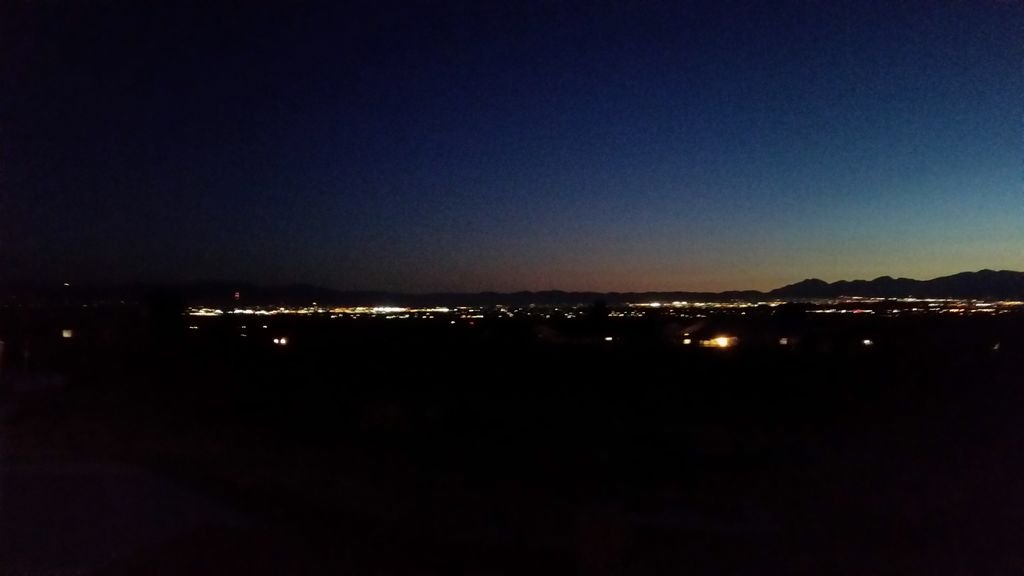
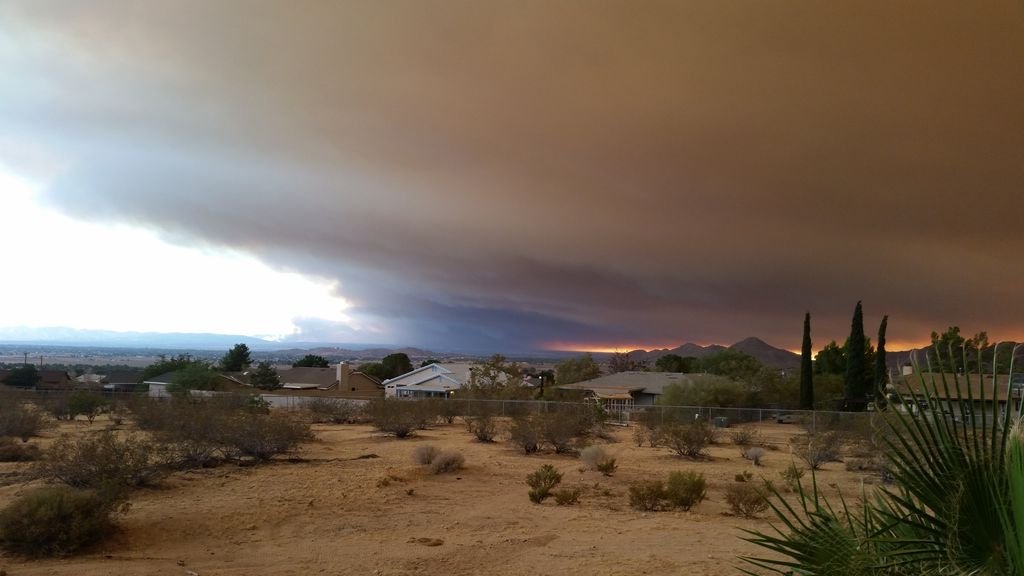
From the northeast corner of Apple Valley — where the first, now disappeared, Apple Valley house where my family lived, was — you get views to the south and southwest of the hills and mountains, during the day and at night. And the occasional desert storms.

These are from real estate photos on Zillow.com for 17358 Candlewood Rd.

This area seems relatively upscale — large, newer homes, an area called Sycamore Rocks, with its own elementary school, just within the Apple Valley Town borders. For $300K or $400K one could buy a very nice home.

Just a dream.

Everyone is deeply drawn to their childhood homes, I suppose.

Posted in Personal history | Comments Off on Apple Valley Dreams

Trip Report: Apple Valley 2017

Since I finished a couple posts of photos and commentary (e.g. http://www.markrkelly.com/Blog/photos/first-apple-valley-house/) about the house in Apple Valley, California, where my family lived when I was three or four years old, I’ve been gathering photos of the second Apple Valley house we lived in when I was in kindergarten and 1st grade, a house which remained in the family, so to speak, until the mid-1980s. I’ve been reading my old personal journals about the times spent at that house. I mentioned a couple trips I took, in 2009 and 2011, to revisit the area. But on the last trip in 2011, I supposed that there would never be another reason, perhaps not even an opportunity, to visit the area ever again.

But last week I had a sudden reason for a quick drive to LA for a Thursday afternoon appointment, a one-night stay-over, and a drive home on Friday. So on the return trip, I took a long detour in part to revisit the area one more time — and to perhaps confirm my deductions about the likely location of the first Apple Valley house. I hit a couple other spots as well:

First, Vasquez Rocks. For all the decades that I lived in southern California, for all that Vasquez Rocks were famous as being the backdrop to two or three Star Trek episodes and many other films, TV episodes, and TV commercials, for all that, I never actually visited the park to see the rocks up close. They’re visible from the 14 freeway, of course, so I knew exactly where they were. But every time I traveled through the area from LA out to the desert, it was either on the 14 freeway, or through Soledad Canyon (all my bike rides) paralleling the freeway to the south, or, rarely, along Sierra Highway that parallels the freeway along the north. (Before the 14 freeway was built 1963-1965, Sierra Highway was the main route through those hills.)

Clear sunny morning, 9am. Only a handful of vehicles there. Down a dirt road, leading past a small visitor center that looked closed, then to one large parking area, then beyond, through the rocks, to a larger parking area below.

I got out and breathed the air and took a couple photos. The area is actually larger than I might have thought, with three or four distinct hills of angled sandstone slabs, and large enough that I could not tell exactly which one was used in the various scenes of those Trek episodes. I did not climb on any of the rocks. (There was a group of climbers a couple ridges away.) I was there only a few minutes, then got back in my car, drove slowly out the dirt road, and back along the highway to the freeway.

Second, Pearblossom Highway to Victorville. On my two relatively recent trips to Apple Valley, in 2009 and 2011, I don’t think I took the direct route, the one we always took driving on those family weekends in the ’60s, in either direction on either trip. Partly yes. This time I took it all the way across, noting that the westernmost sections, between the ‘Four Corners’ junction and first Little Rock and then Pearblossom, were divided highways, two lanes in each direction, shrinking to ordinary streets only through each town. Past Pearblossom the divided highway ran out, the road reduced to its original two-lane highway as it headed eastward across the desert. Most of the severe ‘dips’ in the original highway – where the road crossed dry stream beds running northward off the San Gabriel foothills to the south – have long since been filled in and leveled out. Years ago there was speculation about building a true freeway across this stretch of desert, connecting State Highway 14 near Palmdale to Interstate 15 near Cajon Pass, but that has never happened.

Third, the Area of the 1st Apple Valley house. I wasted a bit of time exploring the lake southeast of Victorville that I could see on Google Maps but didn’t recall from living there in the ‘60s or any later visits in the ‘70s and ‘80s. It’s called Spring Valley Lake and is the centerpiece of a large subdivision of houses built in the ‘90s and 2000s (judging from browsing sample properties on Zillow.com), with marinas housing small boats. The houses seem upscale though are of generic style, and could be anywhere in the US; given the area, they’re inexpensive for their sizes, with prices running from under $300K to $800K right on the lake. (Curiously, the subdivision seems to be neither within the city limits of Victorville, nor Apple Valley, according to Google Maps.)

Just north of this lake, but still below the Ridge separating Victorville from Apple Valley, is an undeveloped area called Mojave Narrows Regional Park, with another lake of sorts. Years ago as a child my father took me a fish hatchery there. There doesn’t seem to be such a thing anymore. Despite the maps, there’s no road through the park from Yates Rd up to Highway 18, according to the ranger. I did not linger.

Instead, I took the opportunity to follow up on my speculation about the location of the first Apple Valley house. I drove out to that northeast corner of the valley, and then went slowly up and down those roads – Century Plant, Candlewood, Joshua – looking for any structure that could be imagined to match, even after remodels, the cinderblock house from my family photos. And saw nothing. However, I did get the impression that the two water tanks (now painted brown) on the nearby hill were much too close from those streets compared to their apparent distance in that backyard photo with my father and the dog…

This morning, using Google Maps street view again, and considering that the house faced away from the hills, I now conclude the house most likely faced Mesquite Road, a couple roads west of those others, about half-way up that block, say around 17105. From there, using Google Street View, the view to the east shows the two ridges overlapping in just the same way they do in the backyard photo.

What would the house to the west be, the one I thought might be on Century Plant Rd? Well, possibly the place at 17096 Ocotilla Rd, to the west, a house built in 1951. So it would have been there. So would 17243 Sycamore Lane, built in 1951, a bit farther north and on the line of site to Bell Mountain, in that same photograph.

But there’s no way to be sure, and it doesn’t really matter. You can’t go home again. But I’ll need to update that photos page, with latest conclusions of the likely location of that house.

Fourth, around Bell Mountain. I’ll post just one photo of Bell Mountain, one I took that morning from the end of Winnebago Avenue, just north of the first house — an iconic symmetric bell curve profile. The irony is that from other angles it is not so pretty, and there is apt metaphor in how Bell Mountain looked from the house where I grew up and visited often in the mid 1960s, and how I later discovered the mountain to appear from other directions. So on this trip, from the previous stop, I drove north to Quarry Road, then west to Stoddard Wells road, which goes around the back of Bell Mountain, and took a couple photos from there. I’ll post those when I’m ready for a full discussion of those later years in Apple Valley.

Finally the long drive home. I took I15 north to Barstow, then Highway 58 west across the desert, through Kramer Junction, past Boron with its borax-mining operation to the south, past turn-offs to Edwards Air Force Base. Then through Mojave, deciding to delay a lunch stop until I needed gas, and continuing on Highway 58 up into the hills, past the windmill farm, through Tehachapi, and down into the Central Valley to Bakersfield. Then north, to Oakland, with a fair amount of pre-July 4th weekend traffic.

Posted in Personal history | Comments Off on Trip Report: Apple Valley 2017

You Mean Yet!: TOS #21: “Tomorrow Is Yesterday”

The Enterprise accidentally travels back in time to Earth in the 1960s, where it’s seen as a UFO, and then struggles to erase records of its visit and to return to its own time.

  • This is a fun episode that doesn’t bear close examination of its plot points or theoretical basis.
  • The episode opens, as “The Conscience of the King” did, with a brief scene without reference to the Enterprise – in this case, a contemporary US Air Force base reacting to the appearance of a UFO, and scrambling a jet to approach it. (No date is mentioned, but it’s presumed it’s contemporaneous with the viewer’s present, in early 1967.)
  • And then it’s quite striking to see that the UFO is – the Enterprise! One of the best episode teasers ever.
  • Despite Memory Alpha (http://memory-alpha.wikia.com/wiki/Tomorrow_is_Yesterday_(episode)), Kirk does *not* say ‘subjective time’ in his log entries. After all, in the first one, he doesn’t yet realize the ship has been thrown back in time. It does however raise the question of what ‘stardate’ actually means, but this is a topic that, though raised many times, has no satisfactory resolution.
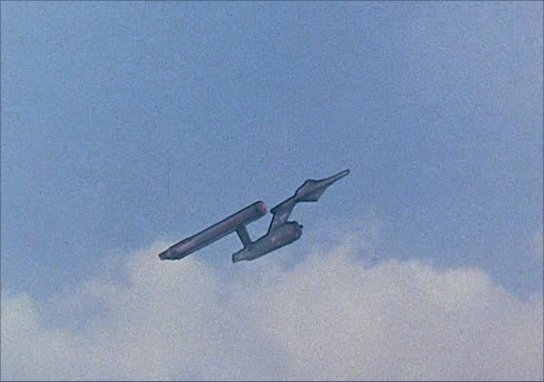
  • There are two areas of mind-boggling coincidence in this story. The first is the sheer physical exactitude with which the Enterprise, having encountered a “black star” and then been thrown some light-years, presumably, off its course, should happen to land *just within the extremely thin atmosphere* of Earth – not smashing into the planet, not arriving at some random point in space billions of miles away – and furthermore, not still moving at some great speed — but rather, as we see, limping slowly upward into Earth’s sky. (The image above is from the original show; the enhanced graphics on the currently available Blu-Ray discs greatly improve the images of the Enterprise among the clouds.) And over the US, another coincidence!
  • Later, at the end of the episode, similar miraculous exactitudes are achieved when the Enterprise, having slung-shot around the sun to accelerate and reproduce the time effect (though for some reason this time in the other direction, toward the future), passes quickly by the Earth and while doing so manages to time the beaming down of both its accidental tourists from this era who’ve managed to get aboard the Enterprise—to exactly the spots, or close enough, from where they were first beamed up. And via a chain of vocal commands! To achieve such precision is, to put it mildly, amazing.
  • A nit: Captain Christopher is beamed out of his jet in flight position, yet appears on the transporter pad standing up.
  • Christopher, 1960s US Air Force pilot, is appropriately amazed by appearing aboard the Enterprise, as he gradually gathers what kind of ship it is. Cushman suggests this is part of the charm of this episode – it visualizes a viewer fantasy for a contemporary person to actually *be* on the Enterprise.
  • A female crewman? Wow. Kirk mentions that there are only 12 like this ship in the fleet. It was an accident that the Enterprise is here; Christopher replies, “You seem to have a lot of them,” referring to the prevalent speculations about UFOs at the time.
  • Spock quickly realizes the consequences of Kirk’s rather rash decision to beam Christopher aboard: now that Christopher has seen the future, he cannot be returned to Earth of this time, lest he use that knowledge to make certain speculations that might change history – and wipe the Enterprise and all aboard out of existence, like a soap bubble. There are of course many, many theories of time travel among science fiction stories, of which Spock’s worry is a common one, but far from the only one; there are many other possibilities. (Examples: the past is fixed and cannot be changed, so that Christopher’s efforts were he returned would have no effect; or, the past might be changed and branch a separate timeline.)
  • This episode features a gratuitous humor element that I’ve never cozied to: the computer Kirk speaks to replies in a sultry, female voice, and calls him “dear”. Cpt. Christopher, hearing this in Kirk’s cabin, observes how people of his era have such interesting problems. Spock drolly explains that the computer system was programmed by the female society on Cygnet XIV, which gave it, of course, a female personality. And that to fix it would require a complete three-week overhaul at a starbase. But really: three weeks?? Whereas now we can change the voice option on our phone or in our car with a few swipes, in a few seconds. Failure of imagination.
  • Anyway, the voice is sexist. But fans at the time – and the producers, and NBC – loved it.
  • Act 1 ends as Scotty repairs the engines, but observes: “We have no place to go in this time!”. A startling observation, but… how could this be true? Did the entire Federation of Planets, as we later understand it, arise only because *Earth* emerged into the galaxy? Weren’t there other races who’d developed space flight and colonized other worlds before humans, whom the Enterprise might have sought out in Earth’s 1960s? Surely one would think so, but Trek producers and writers never thought very deeply in these directions, or avoiding doing so to not complicate scripts.
  • In a sloppy bit of plotting, as in “The Alternative Factor”, Cpt. Christopher is allowed to wander around the Enterprise decks on his own. Allowing him to knock out a crewman, steal his phaser, and use it to try ordering the transporter room guy to beam him down. Kirk shows up to belt him.
  • Leading to the scene in which Spock reveals that Captain Christopher’s *son* — not yet born! – will have an effect on history, heading the first successful Earth-Saturn probe. Christopher says he doesn’t have a son. McCoy, with a twinkle in his eye, says “You mean yet!” And Christopher realizes what this means. “I’m going to have a son…!” It’s a legitimately charming moment.
  • Then we have Kirk and Sulu beaming down to the base to try to retrieve whatever camera recordings and other data that would leave evidence of the Enterprise’s visit. It’s always struck me as amazingly coincidental that, by opening up a computer unit with tape reels, they can identify which reels contain evidence of their visit; and a bit later, find the photographic evidence too, so easily.
  • This episode is regarded as the first deliberately semi-comedic episode – the result of D.C. Fontana’s script. The next scene (after the female computer voice) that displays this is Kirk’s being captured and playing dumb. “I popped in out of thin air.” He’ll be locked up for 200 years. “That ought to be just about right.”
  • The episode’s endgame has the Enterprise trying to recreate the slingshot/time travel effect by swinging around Earth’s sun (though, as above, they think it will throw them forward in time, not back). In the original episode, there were no special effects to support this – we never saw the sun itself, just the Enterprise jiggling in space. The enhanced graphics for this episode do show the sun, and in fact shows the Enterprise banking closely around the sun – but in a nonsensical way that echoes the way the Enterprise has always been shown to ‘bank’ around planets it orbits – visibly arcing, and banking like a jet fighter would do in an atmosphere.
  • A recurrent Trek bad physics theme: “Since we passed Mercury… the sun’s pull has increased on us greatly.” No. The Enterprise is flying though space; the “sun’s pull” is only a matter of being in orbit, or doing a flyby; it’s a matter of the trajectory the Enterprise will take around the sun. It’s not a matter of the sun *pulling* on the Enterprise, as if it were an object not moving relative to the sun.
  • Anyway, this sun flyby works, as the Enterprise accelerates through the warp drive, and then passes Earth and achieves those amazing precise beam downs….
  • The Enterprise “passed Pluto”. Well, no; this presumes that the planets around our sun are somehow lined up, so that the Enterprise entering the solar system, or leaving it, would pass by the planets in order. While of course, at any given moment, the planets are in their orbits but scattered around the sun in their orbital arcs. Would have been better to say, “passed Pluto’s orbit.”
  • Of course, the Enterprise might well have been heading somewhere in the galaxy not along the Sun’s ecliptic; that is, at some acute or right angle to the plane of the planets. So ‘passing Pluto’ or ‘passing Pluto’s orbit’ would be an academic point, since the ship might well be headed in some relatively perpendicular direction. Trek routinely assumed – to the point of visualizing the Enterprise’s encounter with other spaceships, and the way it departed planets at the end of episodes – that the galaxy lay in some flat plane. Yet even the Milky Way galaxy’s plane doesn’t match the solar system’s. A prominent Trek example of how complicated physics and astrophysics is simplified for intuitive, non-scientific viewers.
  • And finally, the story ends as the Enterprise winds down its warp-drive thrust into the future… and gets voice confirmation from Starfleet that they are back in their age. Really? Exactly back in their age? The exact time they left from, before encountering that ‘black star’? Don’t ask.
  • Again, a fun episode that does not bear too close examination.


  • Music notes: the whirling music as the Bluejay 4 pursues the Enterprise is the ‘spinning cube’ music from The Corbomite Maneuver; and in the next scene, Cpt. Christopher’s view of the Enterprise is underscored with the ‘Fesarius’ theme from that same episode score.
  • The music as Kirk and Sulu slowly wander the hallways of the air force base is the slow, creepy version of the main Mudd’s women theme. We hear the “Shore Leave” bunny music as a wandering security policeman is beamed up.
  • The fight in the photo lab is scored with Finnegan’s fight theme from “Shore Leave”.
  • When the security policeman gets his chicken soup in the transporter room, we hear a version of the “Shore Leave” theme; the following scene, back at the base, opens with Courage’s “No Man” theme.

Blish’s adaptation, in ST2:

  • Blish omits the initial off-ship scenes of the US air base detecting the ‘UFO’ and sending up a fighter to bring it down. But he does spend a couple long paragraphs at the beginning providing some astrophysical background about the notion of “black star.”
  • In passing, Blish establishes that warp 4 is 64 times the speed of light.
  • On the one hand Blish describes the Enterprise as being in a “fixed orbit” around Earth, but on the other hand that the ship is “too low in the atmosphere to retain this altitude,” which doesn’t sound like an orbit at all. So even Blish doesn’t seem to have a reasonable understanding of orbits or how things move through space.
  • As Blish does several times in his books, he describes Uhura as a “beautiful Bantu girl,” which surely was never in any script.
  • In the scene in which Spock relates his research in the future contributions of this Air Force pilot, Cpt. John Christopher, Blish (unlike the scriptwriters) has Spock note that “There was a popular author by that name, but it was a pen name; you are not he.” He’s referring to http://www.sf-encyclopedia.com/entry/christopher_john.
  • Similarly, Blish adds a bit of background or perspective that didn’t occur to the scripters. When Scott says the engines are working, but “we’ve no place to go in this era,” Blish has him go on: “Mister Spock tells me that in the 1970s the human race was wholly confined to the Earth. Space outside the local group of stars was wholly dominated by the Vegan Tyranny, and you’ll recall what happened when we first hit them.” Fascinating.
  • And Kirk clarifies, for Christopher: “There is no such solar planet as Vulcan… Mr. Spock’s father was a native of The Vulcan, which is a planet of 40 Eridani.” 40 Eridani being a real star, only about 16 light years from the sun (https://en.wikipedia.org/wiki/40_Eridani). But no Trek episode ever established Spock’s Vulcan as being a planet of 40 Eridani. Anyway Spock warns: “If we took the Enterprise there, we would unwrite their future history too.”
  • Blish omits the entire subplot of Kirk and Sulu beaming down to retrieve Air Force evidence of the Enterprise, their capture by a policeman, and the inadvertent beaming up of yet another local.
  • As they discuss the idea of slingshotting back into the future, Blish has Kirk made an extraordinary concession: “I would rather destroy the Enterprise than the future.”
  • And as Christopher expresses distress for possibly losing his memories of this glimpse of humanity’s future, McCoy offers some advice, which at first repulses Christopher, then deeply impresses him. McCoy: “In perhaps sixty more years, or a few more, you will forget things many times more important to you than this—your wife, your children… You will forget every single thing you ever loved, and what is worse, you will not even care.” Christopher is shocked; but McCoy goes on: “I’m only trying to remind you that regardless of our achievements, we all at last go down into the dark. …I’m trying to call to your attention the things that are much more valuable to you than the fact that you’ve seen men from the future and a bucketful of gadgetry. You will have those still…” He goes on; it’s quite a passage.
  • Blish, more than once, refers to a “navigation tank” located presumably at the helm and nav station – a suggestion that a depiction of 3-dimensional space would need a 3-dimensional image, not a flat, round panel.
  • And Blish implicitly acknowledges the absurdity of the crew manually timing the beam down of Christopher as the Enterprise flings past Earth: “This was going to have to be the most split-second of all Transporter shots. No human operator could hope to bring it off; the actual shift would be under control of the computer.”
  • And Blish avoids the question of whether the Enterprise returns precisely to its own time, by not mentioning it at all, nor having the Enterprise contact star fleet command. Instead Blish ends with Spock alluding to the poet Omar, and the passage about the moving finger that, having writ, moves on.
Posted in Star Trek | Comments Off on You Mean Yet!: TOS #21: “Tomorrow Is Yesterday”

Links and Comments: Tribal Loyalty and Values v. Reality

NY Times: The 15 Best-Educated Congressional Districts in the U.S..

All but two of which, including the just contested Georgia district north of Atlanta, are solidly Democratic. Hmm.

\\

Also: Trump’s Lies, a comprehensive, up-to-date list. It’s not surprising that Trump lies (or at least shades what he says to fit the moment, or the crowd, without any concern for intellectual honesty or self-consistency), it’s that so many people, still, don’t seem to care.

\\

And they don’t care because politics is about tribal loyalty and subjective ‘values’, not recognition or reality or respect for truth.

Vox, Matthew Yglesias: he health bill might pass because Trump has launched the era of Nothing Matters politics, subtitled, “When in doubt, lie and distract.”

The watchwords of Trump-era politics are “LOL nothing matters.” If you’re in a jam, you just lie about it. If you’re caught in an embarrassing situation, you create a new provocation and hope that people move on. Everything is founded, most of all, on the assumption that the basic tribal impulses of negative partisanship will keep everyone on their side, while knowing that gerrymandering means Republicans will win every toss-up election. If you happened to believe that Republicans in office would deliver on their health care promises, well, you might be interested in a degree from Trump University.

And, Slate, Food Evolution Is Scientifically Accurate. Too Bad It Won’t Convince Anyone., subtitled, “The new documentary misses that the debate over GMOs isn’t about facts. It’s about values.”

When the topic of GMOs comes up at dinner parties, I am the skunk who will gently remind everyone of everything Tyson says about GMO safety in Food Evolution. I have a litany of facts and studies that I cite. After listening politely and patting me on the head like a child out of his depth, they always checkmate me with, “What about Monsanto?”

It’s hard to overstate the significance of that albatross on the GMO debate. …

Of course, the reality is that it is possible for Monsanto to be terrible and for GMOs to still be safe. …

\\

Via, Laura Huss at Rewire: Study: Anti-Abortion State Laws Deny Science, subtitled, “Are you surprised? A recent Guttmacher Institute report systematically documents anti-choice laws and the research that debunks their claims.”

Because conservatives and the faithful *know* things to be so, no matter any evidence otherwise.

\\

Yet it’s that this is essentially *tribalistic* thinking — not motivated by faith — is the only way I can understand the paradox captured in this article.

Forward Progressives: A 5-Step Guide: Explaining Christianity to Republicans, by Allen Clifton.

The five steps (with paragraphs of explanation):

  1. Help the helpless, provide for the needy
  2. Be kind to others and don’t judge those who are different than you.
  3. Be hopeful
  4. Don’t be a hypocrite
  5. Stop being driven by greed

I will quote his expansion of item #3, since it resonates with the quote from LA Times at the bottom of this post, about how NRA conventioneers are so motivated by fear. Here’s Clifton (with his links retained):

Republicans are nothing if not paranoid and afraid of damn near everything. From immigrants invading the United States, to Muslims enacting Sharia law to President Obama confiscating guns – I could spend hours dissecting how many conspiracies I’ve seen Republicans perpetuate over the years and how none of them actually came true. Besides, as people of faith, what’s there to be so scared of? If you truly have faith that God’s in control, shouldn’t your faith always be that blanket of hope that guides you through life? I’m not quite sure how someone can say they have the utmost faith in their God – while seemingly having no faith in that same God’s “plan.”

Posted in Conservative Resistance, Politics, Science | Comments Off on Links and Comments: Tribal Loyalty and Values v. Reality

Absolute Annihilation: TOS #20: “The Alternative Factor”

Kirk wrestles with a bizarre pair of near-duplicate antagonists whose meeting threatens to wipe out the entire universe.


  • This is in the running for worst Trek episode ever, with an incoherent premise, overwrought acting, and sloppy writing and direction.
  • The story set-up is routine: the Enterprise is conducting a survey of an ordinary, albeit arid, planet. (With an “oxygen-hydrogen” atmosphere, says Spock – really? Presumably scripters meant oxygen-nitrogen.)
  • Then some violent event rocks the ship, and who knows what else, which we see depicted as an image of the Trifid Nebula (https://en.wikipedia.org/wiki/Trifid_Nebula) – not the galaxy, as Cushman says – that is superimposed over our view of the bridge, and whirls in and out for a few moments, then stops. What was that? Spock announces that it’s as everything suddenly ‘winked-out’ – a moment of nonexistence. Moreover, the formerly barren planet below now shows evidence of a single human on the surface.
  • Three plot lines commence.
  • First, a crew beams down to the planet surface – yet another episode filmed at Vasquez Rocks – where they discover a lone human, a crazed man named Lazarus who talks about battling an enemy in a ‘holy cause’, an enemy who destroyed an entire civilization and who must be killed. They take him up to the Enterprise.
  • Second, a Lt. Commander Charlene Masters reports to Kirk that the event has drained the ship’s dilithium crystals, without which the ship’s orbit will decay in 10 hours. [Another instance of the Trek physics issue that orbits decay unless the ship maintains constant power.] Kirk orders her to ‘reamplify’ the crystals, and subsequently we see Masters and her assistant doing so in a special Engineering set we’ve not seen before.
  • Third, Kirk learns from a commodore at Starfleet Command (apparently they have instantaneous communication) that this blinking-out effect has appeared over a wide area, “and far beyond”, and this commodore is ordering evacuation of all Starfleet units and personnel within 100 parsecs. (Really?? 100 parsecs? *Evacuation*? Of hundreds and people and facilities out of an area 100 parsecs around?) Leaving the Enterprise to handle this problem all by itself.
    • Because it was dumb luck that the Enterprise just happened to be near the planet where this cosmos-threatening winking-out event occurred. What greater coincidence could there be in all of literature or pop-culture?
  • Sloppy writing: once aboard the Enterprise, Lazarus is allowed to just roam around the ship. We see the ‘blinking out’/Triffid Nebula effect again and again, and though no one else apparently notices, we see that Lazarus changes: the raving maniac with a bandage on his forehead is switched for a calmer, rational Lazarus with no wound to the forehead. McCoy does notice, but by the time he notifies Kirk, the effect has happened again.
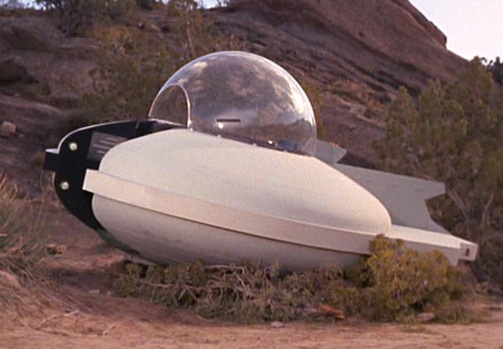
  • For some reason Lazarus hears about the dilithium crystals, and for some reason they are exactly what he needs for his own little ship – a bubble-headed saucer prop perched down among Vasquez Rocks – and plots to steal them. (Curiously, there’s never a plot point about investigating this little spaceship.) This involves Masters and her crystal recharging room.
  • Once Lazarus installs the crystals in his own ship, he’s able to activate his ship and appears in some kind of negative/magnetic corridor, fighting another person – these scenes shot in negative effect, with a tilting camera to make the scene look unsteady.
  • In a scene with Spock and Kirk in the briefing room, the two make a series of remarkable deductions: that since there are (they realize by now) two Lazaruses, and since the radiation they detect from the planet is not from their universe…that there are therefore two parallel universes. That they must be positive and negative. Like matter and antimatter. Meaning if the two Lazaruses meet, that would result of complete annihilation – of *everything*.
    • This is a series of analogies masquerading as scientific deduction. For instance – why might there not be an infinite series of parallel universes?
    • Anyway, no, the two Lazaruses meeting would not result in complete annihilation – it would only result in the annihilation of the pair of Lazaruses.
    • Ironically, the idea of anti-matter shows up later in the series, not mentioned as yet, as being the source of power of the Enterprise engines, i.e. a fuel source, not a danger to the existence of the universe.
  • Further scenes on the planet, i.e. at Vasquez Rocks, involve Lazarus falling off a high rock a second time, Kirk accidentally transporting into the ‘magnetic corridor’ that connects the two universes, and Kirk wrestling the evil Lazarus into that same corridor – with two security guards standing placidly in the background – in order to trap him there.
  • Kirk meets the rational Lazarus, who explains what’s going on, how his civilization discovered the existence of a parallel, opposite universe, and this so enraged the maniac Lazarus, he became obsessed with destroying his duplicate.
  • The plan to resolve this is to trap the two Lazaruses in the corridor, and then for the Enterprise to destroy Lazarus’ ship on the planet, so they can’t escape. Leaving the two trapped in the corridor forever.
  • Which they do.
  • Why not just destroy the ship in the first place, cutting off the transfer?
  • Why is there one scene, the one with Kirk and the sane Lazarus, obviously filmed on a sound stage? And why in this scene is Kirk standing with casually folded arms, as if they are not talking about the existence of all existence?
  • Cushman’s book has two back-stories to the production of this episode that are more interesting than the episode itself.
  • First, the character of Charlene Masters was written in early drafts to be a love-interest to Lazarus. This was rejected by Coon because of the similarity to a plot point in another script in development, “Space Seed”; and thus some of the scenes here, such as the one in the rec room, are stubs of their original selves. Also, it was a tad daring for the time, apparently, for the actress to appear with a natural ‘afro’ hair-style, however short, rather than the stylized straight hair that black actresses at the time, including Nichelle Nichols, typically wore.
  • Second, the actor who played Lazarus, Robert Brown, was a last-minute recruit to replace the actor originally hired, John Drew Barrymore, who objected to late changes in the script and refused to show up for filming. Brown was hired the Monday night before filming with his character began on Tuesday.

Lawrence adaptation, in ST10:

  • Another late adaptation that follows the broadcast script very closely.
  • The adaptation reverses the order of the early scenes between Kirk and McCoy and Kirk and Charlene Masters.
  • The first meeting of Kirk and Lazarus occurs in sickbay, not in Kirk’s quarters.
  • The adaptation omits the scene between Lt. Masters and her assistant. Instead, there’s a scene between Lazarus and Spock, in which Lazarus describes his civilization, and Spock refers to an experiment he has in progress (which is his discovery of the ‘rip’ in the universe).
  • But we do get the scene of Lazarus breaking into the engineering room and subduing Masters and her assistant.
  • In Act Four as Kirk meets the second Lazarus in the alternate universe – at the point where the dialogue lapses and the scenes dissolves to a bit later with the same two characters – the adaptation has a short scene in which Spock beams down to the original planet and confronts the mad Lazarus.
Posted in Star Trek | Comments Off on Absolute Annihilation: TOS #20: “The Alternative Factor”