A Most Promising Species: TOS #19: “Arena”

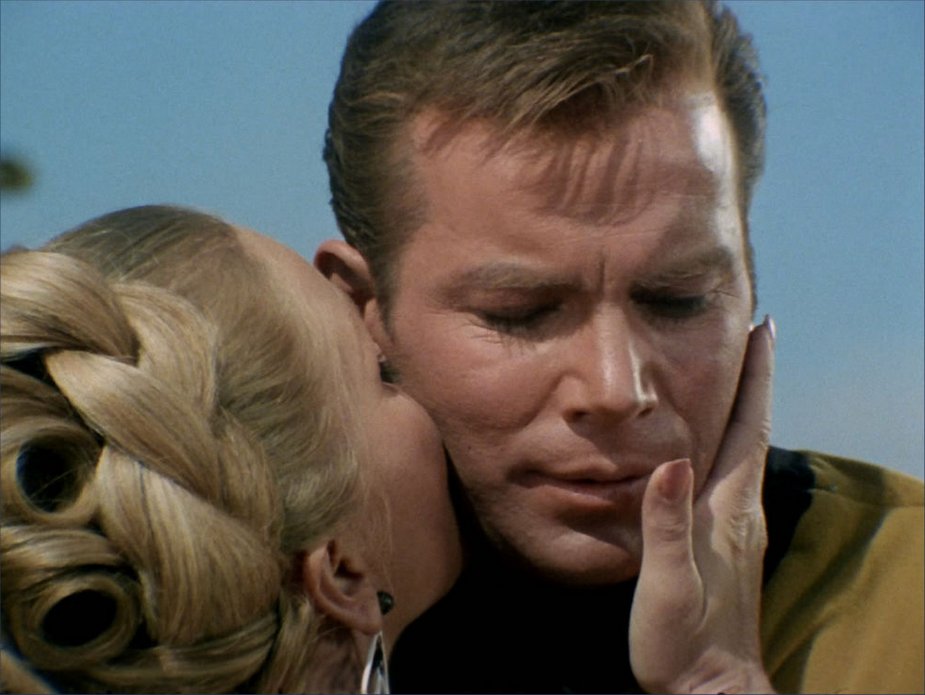
Kirk is pitted in a one-on-one contest with the reptilian alien captain of a starship that destroyed a Federation outpost.
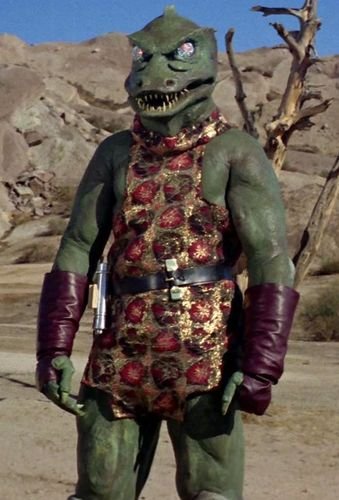
  • This is the famous episode, filmed on location (again at Vasquez Rocks), in which Kirk battles this green reptilian (though standing upright in humanoid fashion) ‘Gorn’ in hand-to-hand combat, with stunts and effects that look dated 50 years later, but which became classic and remains instantly recognizable. There was nothing else like it, in Trek, or any other show up until then.
  • Fully half the episode, though, is padding—the events leading up to Kirk and the Gorn being isolated. These scenes begin as the Enterprise arrives at a Federation outpost on Cestus III and discovers that the base has been wiped out.
  • (So the voice messages from Commodore Travers on the base inviting them down were faked? There’s a lot of that going around in recent episodes; and this time they must have been faked by the Gorns!)
  • The impressive live set of the Cestus III outpost had been built in 1956 for a TV series about a British Calvary unit in India, per Cushman’s book. It remained for many years before being torn down when Vasquez Rocks became a county park.
  • These early scenes include several innovations, first-time mentions of familiar concepts in Trek, including the first use of ‘photon torpedoes’ (with their distinctive sound) by the Enterprise, and the first mention of the term ‘Federation’, both contributions of scriptwriter Gene L. Coon. We also see Spock wearing an earpiece like Uhura, and uses of the terms ‘azimuth’ (for directions on the ground) and ‘parsecs’ (for distances in space); also some odd nomenclature in which the ship position is specified as 2279 PL, which a planetary system ahead is placed at 2466 PM. No idea what these were supposed to mean.
  • Trek astronomy vs. rote special effects: as the Enterprises approaches a solar system ahead, and stars still stream past in the special effects.
  • The set up scenes strike me as rather hasty in jumping to the conclusion, based on a destroyed base and a fleeing alien ship, that the Federation faces invasion—and, Kirk decides, the Enterprise must therefore pursue and destroy the alien. Spock does caution concern for other sentient life, in a nod toward Trek humanistic values.
  • In a dramatic if implausible scene, both the alien ship and the Federation are forced to an abrupt halt, rapidly decelerating from high warp speeds to a complete standstill. Sulu calls out their falling warp velocities. (Does dropping in warp speed involve everyone on the bridge being thrown forward somewhat, but not enough to splatter them against the front wall of the bridge? Apparently.)
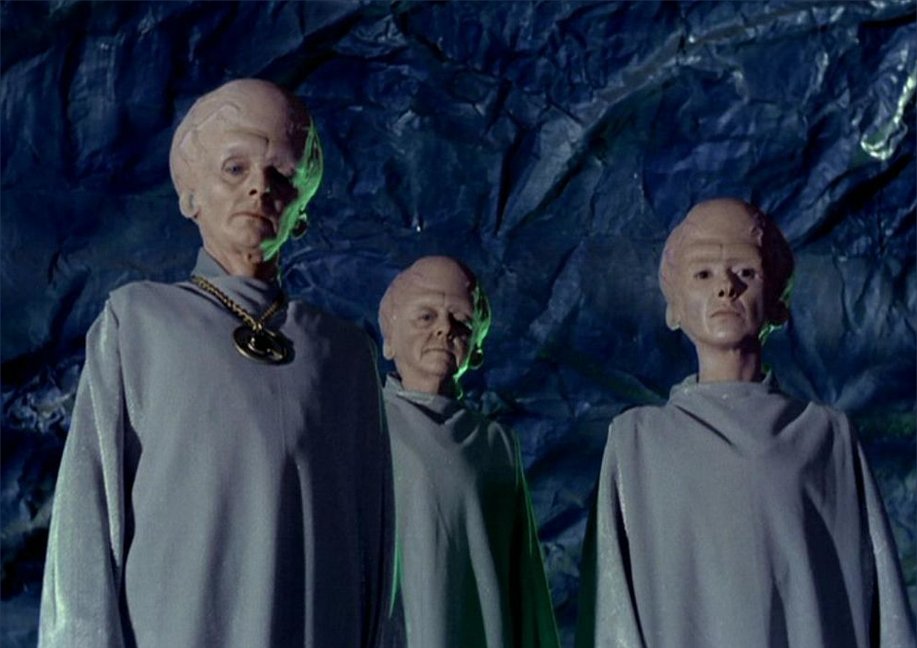
  • And then an alien presence appears on their screen, a Metron, accusing both ships of invading their planet’s territory. We don’t see the alien itself, just some rapidly swirling lights, but hear the voice, in English, a calm, placid, wise voice. Somehow I haven’t remembered, if I ever knew, that the voice here is that of Vic Perrin, most famous for narrating the “Control Voice” opening of the earlier TV series “The Outer Limits” – in fact, here it is — and just as in that narration, the voice says “We are controlling transmission…” in this episode the Metron, explaining the duel to commence, says, “We will control them…”
  • Cushman’s book even states that the producers deliberately wanted to emulate the Outer Limits Control Voice, and so hired Perrin.
  • In a sexist bit, as Kirk vanishes from the bridge, Uhura, the only woman around, screams.
  • The clever and arresting premise of the show, alas, was not original, and famously the screenwriter, producer Gene L. Coon, wrote the first draft over a weekend and sent it to the network, NBC, for initial approval, after which NBC’s staff discovered that the script shared the basic premise and many plot points with a 1944 short story by Fredric Brown with the same name. So the studio contacted Brown for approval. He gave it, and was given retroactive ‘story’ credit for the show. Coon, presumably, had read the story years before and remembered the idea, but not the source.
  • Another new device: both Kirk and the Gorn are given handheld translator devices to communicate with each other. These props turned up in later episodes as standard issue Enterprise equipment, for the same purpose.
  • The groundside battle commences. The Gorn is strong, but slow; Kirk is nimble, but not strong enough to land effective blows.
  • At some point the Enterprise bridge crew is given a view of the battle on their main monitor. They see, as Kirk discovers, deposits of various minerals and other substances strewn among the rocks: white powder, yellow powder, diamonds, coal, bamboo. The Metron advised that resources would be present to make weapons. And so as Kirk deduces what can be done with them, Spock watches in admiration, and says to McCoy: “He knows, Doctor, he has reasoned it out.” (But how many people today, let alone 300 years from now, would know enough basic chemistry to be able to recreate gunpowder?)
  • Meanwhile time Kirk and the Gorn talk, and the Gorn accuses the Federation base of intruding on the Gorn territory. McCoy, watching, is taken aback: “Then we could be in the wrong.” The Gorn were just protecting their territory.
  • This is a nice sentiment, another nod toward Trek values that don’t automatically assign aliens to be the bad guys; but it doesn’t quite excuse why the Gorn would have simply wiped out the human outpost without warning.
  • In the finale, Kirk creates a weapon, a kind of cannon, and brings the Gorn down. Kirk can use a diamond blade to stab the Gorn to death… but does not. He pauses, and calls up into the sky, to the Metrons, No, I won’t do it!
  • And so the Metron appears, in the guise of young boy (with Vic Perrin’s voice), casually mentioning that he is 1500 years old, and expresses admiration for Kirk’s compassion. “By sparing your helpless enemy who surely would have destroyed you, you demonstrated the advanced trait of mercy. Something we hardly expected.” And, “You are still half savage. But there is hope.”
  • This, as with the previous episode, is one of the great Trek reveals, and a signal indicator of the broad vision Trek takes of humankind’s capability for growth, and its junior presence in the galactic scheme of things.
  • And both Kirk and the Gorn captain are returned to their ships, with an implication of later diplomatic contact.
  • In a final, almost gratuitous plot twist (made presumably just to avoid the imminent diplomatic contact just implied), the Enterprise is hurled 500 parsecs across space. Sulu is shocked at the positions of Sirius, Canopus, and Arcanis. (The last star name is fictitious.) And so the Enterprise sets off, back to Cestus III (why?), at warp 1 (i.e. the speed of light, which will entail some 1700 years to travel 500 parsecs; but Trek was never very careful about these issues).

Blish’s adaptation, in ST2:

  • Blish jumps to the chase, so to speak, omitting nearly the entire first half of the broadcast episode that concerned the discovery of the destroyed outpost on Cestus III and the pursuit of the alien vessel. All of this is summarized in the first page of Blish’s prose. (Blish makes no attempt to rationalize how alien beings could have faked voice recordings of the outpost’s commander inviting the Enterprise crew down.)
  • After that, the dialogue and action follow the broadcast script pretty closely. Per the focus on Kirk, though, we never see that the Enterprise bridge crew gets to watch the action down on the planet.
  • One big plot difference: Blish retains a line (from an earlier version of the script, presumably), in which, as the Metron reveals himself at the end, he explains that he lied earlier – that the Metrons’ plan all along was the destroy the winner of this battle, since the winner would obviously be the greater threat to the Metrons.
  • But since Kirk refused to kill the Gorn, the Metrons were left with no clear winner. The Metron does offer, after all, to destroy the Gorn ship—and Kirk hastily explains that that’s not necessary.
Posted in Star Trek | Comments Off on A Most Promising Species: TOS #19: “Arena”

Frequency Interactions

When I was a teenager, in the Fall of 1971 just after I turned 16 years old, and just a few months after my family had returned to California from a three-year stay in Illinois, I took a typing course at James Monroe High School, in the 11th grade, and my family (for some reason I don’t recall) acquired a small, portable typewriter, which I immediately took possession of, and kept in my room. To practice my typing, I began a sort of journal. The early months and year of this ‘journal’ consisted of much japery — spoofs of strange meanings of made-up foreign words, riffs on songs and TV lines. Over the next couple years, it congealed, if that’s the word, to a more conventional diary-like journal.

(Irony: the reason I took a typing course was that, entering a new school and despite having exemplary grade reports from my high school in Illinois, the staff at James Monroe was reluctant to enroll me in too many academic courses, let alone advanced placement courses. Thus, between my years in high school in Illinois and California, I never did have a formal American History course, or Biology course. The irony is that having learned typing at that age proved a great advantage in later years.)

In those early years, sitting in my bedroom in our house on Hayvenhurst Avenue, with my parents and three other kids younger than me, I can’t now imagine what my parents must have thought, as I sat banging away on that typewriter in the afternoons and evenings and weekends. (Did my mother peak into my room when I was away at school to see what I was doing? It never occurred to me at the time, but in retrospect it seems inevitable.)

As my typing settled into a conventional journal, I would write as if addressing some hypothetical person interested in what I thought and what I was doing. Is that the typical stance? Who does one write a diary to?

Of course I now, as perhaps I realized even then, understand that the person I was writing to was me, myself decades years later. And I deeply appreciate my early effort.

I’ve been preoccupied this past week — to the point of neglecting posts on other topics on this blog — with reviewing these early journals, in concert with my gathering of old family photos, especially of Apple Valley, and reflecting on what it all means, and how my living there influenced, or perhaps reflected, my personal inclinations and the life I was to lead.

My typewritten journal went through the mid-1980s, until it was overtaken by learning to use computers (at work, at first), and keeping logs and journals electronically, rather than on a noisy typewriter. The typewritten journal got fairly sophisticated over the years, combining the requisite angst of young adulthood with perception and understanding of the greater world that, all these years later, is not dis-respectable.

In particular, every entry in my journal had a title. Trends in titles changed over the years. Early ones were nonsensical, that is playful ploys on languages; some later years used single words, or two word ‘the xx’ phrases. Later ones — by 1980 and following — employed fanciful poetic or philosophical terms, phrases with suggestive meanings but no obvious allusion to the topic under discussion in that post, mixed in with quotations from songs or plays that had come to my attention. All these years later, looking back on them, I’m impressed. How can I re-use them? Well, here’s one.

And some similar ones, all from 1980:

Clouds, from the Four Quarters of the Universe

Collective Extremities

Science Fiction Distillations [years later, my short fiction review column in Locus, beginning 1988, was called “Distillations”]

Depth Structures

The Whiteness of the Dawn

Sublime Disparities

Transient Continuities

Conjectures on Ships that Sail the Moon

Shadows of Starlight and Symphonies of Mind

Prickling Dissonance

Tapestry of Refulgent Fuligin [my review of Gene Wolfe’s The Shadow of the Torturer]

Circular Explorations

The Last Day of the Old World

Always There Will be Greater

Transparency Contexts

Presence Fixes

Dreams that Can’t Come True

…and many more. In retrospect, it’s sad, I admit, that I was unable to channel these creative urges, for whatever they might have been worth, to anything beyond my personal journal.

Posted in Personal history | Comments Off on Frequency Interactions

Carl Sagan’s “Baloney Detection Kit”

Carl Sagan, one of the great scientist-communicators to the general public of the past century, author of the 1980 book Cosmos and host of the 1980 TV series of that name, has a list of ideas for how to evaluate any kind of claim, a “Baloney Detection Kit”, described many times and recently posted again here: 9 questions Carl Sagan encourages you to ask before believing anything anyone has to say.

Briefly:

  1. Independently confirm ‘facts’
  2. Encourage debate
  3. There are no authorities, but there are experts
  4. Spin more than one hypothesis
  5. Don’t become attached to a hypothesis because it’s yours
  6. Quantify
  7. Examine every link in a chain of arguments
  8. Occam’s Razor
  9. Always consider if a given hypothesis can be falsified; beware if not
Posted in MInd, Psychology, Science | Comments Off on Carl Sagan’s “Baloney Detection Kit”

Studying My Predators: TOS #18: “The Squire of Gothos”

The Enterprise encounters a remote planet where a foppish ‘squire’ insists on entertaining (and studying) them and challenging them to the death when they refuse.

  • I’m fascinated in retrospect by how episodes open, about what is going on before the Enterprise and its crew encounter whatever challenge will form the basis of this week’s story. Sometimes these are just as interesting as the main story, for what they reveal about how daily life aboard the Enterprise works, or what the writers and producers imply about the ship’s mission.
  • In this case, the opening establishes that the Enterprise is crossing some kind of ‘star void’ on its way to Beta VI, which it will reach in 8 days, and that they’re 900 light years from Earth. Routine on the bridge: we see a (female) yeoman passing out coffee; we have yet another navigator, this time DeSalle (for some reason they didn’t settle on a regular navigator character – Chekov – until the second season).
  • The ‘star void’ notion is a curious one, of no particular importance (and such an idea is never mentioned in any other episode), except presumably to underscore how odd it is for the Enterprise to come across a lone planet ahead in their path, as they do. As they approach the planet, Sulu, trying to change course, abruptly vanishes from the bridge, and then so does Kirk. Spock shouts out “full reverse power!” a bit oddly since they haven’t actually reached the planet yet. End of Teaser.
  • Spock orders the ship to orbit the mysterious rogue planet, as messages begin to appear on their screens, e.g. “Greetings and Felicitations.” Spock sends a landing party down to the planet, to the one small area that seems livable – McCoy, DeSalle, and a geologist named Jaeger – and the planet we see, in this episode, is a staged planet set (unusually, featuring numerous trees instead of sand and fake boulders). Nearby is the front of a small castle.
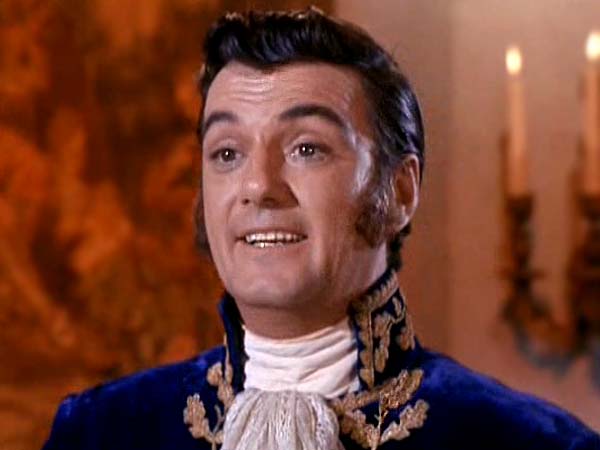
  • They enter the castle and discover Kirk and Sulu, frozen in position, and then Squire Trelane, playing a harpsichord, a foppish chatterbox who releases the frozen men and welcomes them all as examples of the savage Earth culture he’s been studying. As he admires humans for their missions of conquest, noting them as a “predator species that preys even on itself,” Kirk and the others realize Trelane knows only what Earth was like 900 years ago, given the distance this planet is from Earth. The subtext here is in line with Trek’s progressive vision of the future: that the violent past of the human species has been overcome.
  • William Campbell is great in the role; Cushman’s book mentions that Roddy McDowell was originally considered, and he would have been good too.
  • Spock, disapproving of Trelane’s antics, has a good line: “I object to you. I object to intellect without discipline. I object to power without constructive purpose.” To which Trelane replies, delightedly, “Why, Mr. Spock, you do have one saving grace after all—you’re ill mannered!”
  • Kirk keeps insisting they be allowed to depart, and Trelane keeps forcing them to stay, until the situation devolves into a personal duel between Trelane and Kirk, with antique pistols. Kirk takes the opportunity to destroy a mirror he thinks is the source of Trelane’s power.
  • The Enterprise departs, only to have the planet Gothos appear in their path again and again, as if by magic (or superfantastic alien powers). There’s some typically wrong intuitive physics going on here, as the Enterprise veers first one way, then another, to evade the planet, and everyone on the bridge *sways* first one way, then the other, as this happens. As if the velocities and accelerations involved have only that very minor effect on the bridge crew’s ability to keep standing.
  • A brief trial scene between Kirk and Trelane leads to a chase through the woods outside, until Kirk realizes he can call Trelane’s bluff, and simply breaks Trelane’s sword. Trelane reacts in childish hurt, and Kirk scolds him like a child. “You have a lot to learn about winning, Trelane. In fact, you’ve got a lot to learn about everything, haven’t you?”
  • Which sets up the story’s resolution, with a blatant deus ex machina that is also one of the best Trek reveals: two glowing lights appear above them, shining a light down upon Trelane, and speak as his parents, “It’s time to come in now, come along.” Trelane complains, “I haven’t finished studying my predators yet!” and the parents reply, “This is not ‘studying’ them. If you cannot take proper care of your pets, you cannot have them at all.” Trelane whines, “I was winning! I coulda won!” The parents apologize to Kirk, and let him return to his ship, as Trelane fades away.
  • This is great because it undermines the simple premise that Trelane is some powerful, malicious alien – he is that, but he’s also a child, and that explains what’s gone on so much more completely. It also echoes a recurring Trek theme, one also just mentioned regarding “Shore Leave”– that the universe is filled other powerful races whose presence only incidentally overlaps human exploration of space. It’s this repeated demoting of humanity as being the boss of outer space that gives the Enterprise’s missions their own special but limited significance, a certain humbleness to the human endeavor, and gives the show such open-ended potential. (A potential that, I think, was lost in later Trek series that devolved into politics between the Federation and the Klingons, e.g.)
  • Music notes: “Vina’s theme” underscores Trelane’s parents; the cat and mouse between Enterprise and Gothos is set to the Fesarius theme. A lengthy post about TOS first season music will soon be posted.
  • And then the episode ends with the by-now obligatory humorous note. Kirk wonders if Spock didn’t also play pranks as a boy—“Dipping little girls curls in inkwells. Stealing apples from the neighbor’s trees. Tying cans on…”, before Spock gives him a droll look. Anachronistic, too.
  • Final thought, watching the end credits of this episode: I wonder if anyone has explored the idea that the stills of scenes from other episodes, shown under the end credits, often revealed episodes that had not been aired yet. Teasers of a sort, for not just next week’s episodes, but for other episodes yet to come! In this case, the end credits show a scene from “The Return of the Archons”, four episodes on from “The Squire of Gothos” in production order, though presumably done by the time final post-production of “Gothos” got it ready to air.

Lawrence’s adaptation, in ST11:

  • The adaptation omits the opening lines discussing the ‘star desert’ and the urgency of getting to Beta 6; the latter is summarized.
  • Also omitted: Spock’s shouting “Emergency! Full reverse power!,” and the Act One log entry. Instead he initiates the full search of the ship mentioned by Scott at the beginning of Act One.
  • (Again, we might wonder why the navigator, De Salle, is suitable to lead a search party, but that’s a routine Trek issue. At the same time, at least Spock allows that both he and Scott are needed on the ship.)
  • The opening scene of Act Two on the bridge is included, by oddly has Spock refer to the planet as Gothos—something he has no way of knowing.
  • In the following scene on the planet, the adaptation has Kirk call Spock to update him—even though earlier it was established that their communicators weren’t working.
  • A couple scenes later, back on the bridge, Uhura also mentions the name Gothos.
  • When the Enterprise crewmembers are taken back to the planet, McCoy has some lines about how Trelaine would have been considered a little god of war, 3000 years ago on Earth.
  • (We might wonder, at the beginning of Act Three, how Kirk has the time to make this log entry, while apparently about to duel with Trelaine. Or is he retroactively retelling the story?)
  • The adaptation condenses, or is missing, much of the dialogue between Trelaine and his parents; in the broadcast version Trelaine had about a dozen lines; in the adaptation, only half a dozen.
Posted in Star Trek | Comments Off on Studying My Predators: TOS #18: “The Squire of Gothos”

Gary K. Wolfe, How Great Science Fiction Works

This is a course released by The Great Courses (http://www.thegreatcourses.com/) in early 2016. The course consists of audio or video downloads or discs (as lead Locus reviewer Gary K. Wolfe delivers lectures on a set), and comes with a 200-page booklet summarizing the 24 lectures.

The following compiles principle titles mentioned in each text lecture, omitting titles mentioned only in passing, and adding titles in the “Readings” section at each chapter end that were not already mentioned in the text. (And omitting some titles listed there that seem egregiously misplaced, including two or three reference to Gene Wolfe’s The Book of the New Sun which nevertheless is not mentioned in the text.) Titles that get multiple paragraphs and have subheaders are indicated with *s.

1, Mary Shelley

  • *Mary Shelley, Frankenstein
  • Other readings:
  • Brian Aldiss/ David Wingrove, Trillion Year Spree
  • Adam Roberts, The History of Science Fiction


2, 19th Century Science Fiction

  • *Edgar Allan Poe, e.g. “The Unparalleled Adventure of One Hans Pfaal” and The Narrative of Arthur Gordon Pym
  • *Jules Verne, From the Earth to the Moon
  • *H.G. Wells, The Time Machine; The War of the Worlds


3, Science Fiction Treatments of History

  • Mark Twain, A Connecticut Yankee in King Arthur’s Court
  • Sprague de Camp, Lest Darkness Fall
  • Michael Moorcock, Behold the Man
  • *Connie Willis, Doomsday Book
  • *Isaac Asimov, The Foundation Trilogy
  • *James Blish, Cities in Flight
  • *Philip K. Dick, The Man in the High Castle


4, Evolution and Deep Time in Science Fiction

  • *Olaf Stapledon, Last and First Men; Star Maker
  • *Arthur C. Clarke, Against the Fall of Night
  • *Gregory Benford, In the Ocean of Night, and subsequent novels
  • *Stephen Baxter, Evolution; Xeelee sequence


5, Utopian Dreams, Dystopian Nightmares

  • *Ursula K. Le Guin, “The Ones Who Walk Away from Omelas”
  • *Sir Thomas More, Utopia
  • Francis Bacon, The New Atlantis
  • *Jack London, The Iron Heel
  • *Yevgeny Zamyatim, We
  • *George Orwell, Nineteen Eighty-Four
  • Other readings:
  • Margaret Atwood, The Handmaid’s Tale
  • Ray Bradbury, Fahrenheit 451


6, Rise of Science Fiction in the Pulps

  • Edgar Rice Burroughs: A Princess of Mars
  • Hugo Gernsback, Ralph 124C 41+
  • E. Smith, The Skylark of Space
  • Stanley G. Weinbaum, “A Martian Odyssey”
  • Lester del Rey, “Helen O’Loy”
  • John W. Campbell, Jr., “Twilight”; “Who Goes There?”
  • Other readings:
  • Mike Ashley, The Story of the Science Fiction Magazines, vol. 1
  • F. Bleiler, Science-Fiction: The Early Years


7, The Golden Age of Science Fiction Stories

  • Campbell’s influence as editor; Asimov “Trends”; Heinlein “Misfit” and “The Roads Must Roll”
  • *A.E. van Vogt, Slan
  • *C.L. Moore & Henry Kuttner, “Vintage Season”
  • Other readings:
  • Mike Ashley, The Story of the Science Fiction Magazines, vol. 1
  • John Huntington, Rationalizing Genius


8, The Spaceship as a Science Fiction Icon

  • Jules Verne, From the Earth to the Moon; Around the Moon
  • *Robert A. Heinlein, “Universe” (expanded as novel Orphans of the Sky)
  • Harry Harrison, Captive Universe
  • James Blish, Cities in Flight
  • Kim Stanley Robinson, Aurora
  • Robert Reed, Marrow
  • Anne McCaffrey, The Ship Who Sang
  • Frank Herbert, Destination: Void
  • Cordwainer Smith, “The Game of Rat and Dragon”


9, The Robot: From Capek to Asimov

  • *Karel Capek, R.U.R. (Rossum’s Universal Robots)
  • Lester del Rey, “Helen O’Loy”
  • L. Moore, “No Woman Born”
  • *Isaac Asimov, I, Robot; and two later novels
  • Jack Williamson, “With Folded Hands”


10, The Golden Age of the Science Fiction Novel

  • *Ray Bradbury, Fahrenheit 451
  • *Frederik Pohl & C.M. Kornbluth, the Space Merchants
  • *Arthur C. Clarke, Childhood’s End
  • Other readings:
  • Alfred Bester, The Stars My Destination


11, From Mars to Arrakis: The Planet

  • David Lindsay, A Voyage to Arcturus
  • S. Lewis, Out of the Silent Planet; Perelandra
  • *Ray Bradbury, The Martian Chronicles
  • *Kim Stanley Robinson, Red Mars; Green Mars; Blue Mars
  • *Frank Herbert, Dune


12, The Science Fiction Wasteland

  • *Jack London, The Scarlet Plague
  • *George Stewart, Earth Abides
  • *Walter M. Miller, Jr., A Canticle for Leibowitz
  • Cormac McCarthy, The Road
  • Neal Stephenson, Seveneves


13, Invasions, Space Wars, and Xenocide

  • *George Tomkyns Chesney, “The Battle of Dorking”
  • G. Wells, The War in the Air; The World Set Free; The War of the Worlds
  • Garrett P. Serviss, Edison’s Conquest of Mars
  • Thomas M. Disch, The Genocides
  • Orson Scott Card, Ender’s Game
  • Greg Bear, The Forge of God; Anvil of Stars
  • *Robert A. Heinlein, Starship Troopers
  • *Joe Haldeman, The Forever War
  • Other readings:
  • F. Clarke, Voices Prophesying War [nf]
  • Bruce Franklin, War Stars [nf]


14, Religion in Science Fiction

  • *James Blish, A Case of Conscience
  • *Mary Doria Russell, The Sparrow
  • *Robert A. Heinlein, Stranger in a Strange Land
  • *Octavia Butler, Parable of the Sower; Parable of the Talents


15, Science Fiction’s New Wave

  • G. Ballard, Crash; Concrete Island; High Rise
  • *J.G. Ballard, “The Terminal Beach”
  • *Pamela Zoline, “The Heat Death of the Universe”
  • Other readings:
  • Colin Greenland, The Entropy Exhibition


16, Encounters with the Alien Other

  • *Jack Finney, The Body Snatchers
  • Murray Leinster, “First Contact”
  • *Larry Niven & Jerry Pournelle, The Mote in God’s Eye
    *Stanislaw Lem, Solaris
  • *Karen Joy Fowler, Sarah Canary
  • *James Tiptree, Jr., “The Women Men Don’t See”


17, Environmentalism in Science Fiction

  • *Johanna Sinisalo, The Blood of Angels
  • *Philip Wylie, The End of the Dream
  • *John Brunner, The Sheep Look Up
  • *Ursula K. Le Guin, The Word for World is Forest
  • *Kim Stanley Robinson, Forty Signs of Rain, and sequels
  • *Sheri S. Tepper, Shadow’s End
  • *Paolo Bacigalupi, The Water Knife


18, Gender Questions and Feminist Science Fiction

  • *Ursula K. Le Guin, The Left Hand of Darkness
  • *Joanna Russ, The Female Man
  • Suzy McKee Charnas, Walk to the End of the World
  • James Tiptree, Jr., “The Women Men Don’t See” and “Houston, Houston, Do You Read?”
  • Doris Lessing, The Four-Gated City
  • Margaret Atwood, The Handmaid’s Tale
  • Other readings:
  • Brain Attebery, Decoding Gender in Science Fiction
  • Justine Larbalestier, The Battle of the Sexes in Science Fiction
  • Sarah Lefanu, In the Chinks of the World Machine: Feminism and Science Fiction


19, Cyberpunk and the 1980s

  • *William Gibson, Neuromancer
  • *Bruce Sterling, Islands in the Net; Holy Fire; Zeitgeist
  • Neal Stephenson, Snow Crash
  • John Kessel & James Patrick Kelly, Rewired: The Post-Cyberpunk Anthology (anthology)


20, The 1990s: The New Space Opera

  • *M. John Harrison: The Centauri Device; Light; Nova Swing; Empty Space
  • *Iain M. Banks, Culture novels: Consider Phlebas; The State of the Art
  • Dan Simmons, Hyperion Cantos
  • Alastair Reynolds: Revelation Space
  • Peter F. Hamilton, The Reality Dysfunction and following
  • Ken MacLeod, Newton’s Wake and following
  • J. Cherryh: Downbelow Station
  • Lois McMaster Bujold, novels
  • David Hartwell & Kathryn Cramer, The Space Opera Renaissance (anthology)


21, The Artifact as a Science Fiction Icon

  • *Arthur C. Clarke, “The Sentinel”; Rendezvous with Rama
  • Larry Niven, Ringworld
  • Bob Shaw, Orbitsville
  • Stephen Baxter, Ring
  • *Algis Budrys: Rogue Moon
  • *Boris & Arkady Strugatsky, Roadside Picnic
  • Gregory Benford: In the Ocean of Night, and sequels


22, Science Fiction’s Urban Landscapes

  • John Brunner, Stand on Zanzibar
  • Robert A. Heinlein, “The Roads Must Roll”
  • G. Wells, The Sleeper Awakes
  • *E.M. Forster, “The Machine Stops”
  • Robert Silverberg, The World Inside
  • *Arthur C. Clarke, The City and the Stars


23, Science Fiction in the 21st Century

  • *Nalo Hopkinson, Brown Girl in the Ring; Midnight Robber
  • *Nnedi Okorafor, Zahrah the Windseeker; The Shadow Speaker; Who Fears Death; The Book of Phoenix
  • *Lavie Tidhar, Osama, and others


24, The Future of Science Fiction

  • Jonathan Lethem
  • Michael Chabon
  • Emily St. John Mandel, Station Eleven
  • Junot Diaz, The Brief Wondrous Life of Oscar Wao
  • *Daniel Keyes, Flowers for Algernon


Posted in Book Notes, Science Fiction Nonfiction | Comments Off on Gary K. Wolfe, How Great Science Fiction Works

Linkdump: Science, society, conspiracy theories, the fear of NRA conventioneers

Science:

The Atlantic: Are We Living in a Giant Cosmic Void?. Maybe.

Scientific American: How the Science of “Blue Lies” May Explain Trump’s Support. Subtitle: “They are a very particular form of deception that can build solidarity within groups”

Guardian: Oldest Homo sapiens bones ever found shake foundations of the human story. (Well, newspaper headlines often exaggerate; but the history of science is a steady progression of filling in details and expanding the limits of what was previously thought settled.)

Sam Harris interview with Siddhartha Mukherjee: The Moral Complexity of Genetics. Mukherjee wrote the acclaimed book The Gene.

New York Times Sunday Review, Gray Matter column: You’re Not Going to Change Your Mind. It’s not just about confirmation bias:

But what if confirmation bias isn’t the only culprit? It recently struck us that confirmation bias is often conflated with “telling people what they want to hear,” which is actually a distinct phenomenon known as desirability bias, or the tendency to credit information you want to believe. Though there is a clear difference between what you believe and what you want to believe — a pessimist may expect the worst but hope for the best — when it comes to political beliefs, they are frequently aligned.

Jerry Coyne comments on Sean Illing’s interview of Robert Sapolsky

Psychology Today, via Alternet: The Deep Roots of Left vs. Right. Subtitle: And how to get both wings to fly together.

(This relates to my thought that, no matter what I might personally think is true or right, it takes a range of personalities and psychologies for a society to be functional. If everyone were just like me — or you– it wouldn’t work.)

Remembering that what we’re all really negotiating—the right balance of constraint and freedom, security and liberty—may make us more receptive to negotiation, and smarter negotiators too, not taken in by hyperbolic half-truths about the one true way.

Society:

QZ.com: A ‘coastal elite’ named Marie Myung-Ok Lee takes a car trip across southern US with her autistic son, and concludes, My road trip through Trump country taught me that staying in the liberal bubble has its advantages.

ThinkProgress: The strange origins of the GOP ideology that rejects caring for the poor. Subtitle: “No, that’s not what Jesus says.”

Handy term: Overton Window: the range of ideas the public will accept. It shifts over time, generally in a progressive direction — you don’t see conservatives campaigning against women’s suffrage, as they might have done a century ago — but lately the alt-right has made claims that their views — of nationalism, racism, white purity, etc., — has shifted this window back.

Is this an example?

Patheos.com: Wisconsin State Rep: ‘The Earth Is 6,000 Years Old, That’s A Fact’

Skeptoid.com: There Is No Finland: Birth of a Conspiracy Theory. Some people will believe anything.

LA Times Op-Ed: What happened when a 64-year-old liberal attended his first NRA convention

One common thread among the conventioneers I met was fear. Real, genuine fear. But that’s no accident. Protecting yourself from crime, real and imagined, is what the NRA is all about. The NRA’s America, unrecognizable to the vast majority of Americans except from television, is a very dangerous place. Lawlessness, crime and violence reign. Rioters rule the streets. Islamic terrorists are coming to your town. Unarmed women are rape bait. Unarmed men are cowards. It is twilight in America and no one is going to defend you. Except you.

NY times, Masha Gessen: Trump’s Incompetence Won’t Save Our Democracy. “History shows that stupidity and autocracy aren’t mutually exclusive. In fact, they go hand in hand.”

Posted in Conservative Resistance, Cosmology, Lunacy, MInd, Psychology, Science | Comments Off on Linkdump: Science, society, conspiracy theories, the fear of NRA conventioneers

The Need for Play: TOS #17: “Shore Leave”

The Enterprise visits a lovely planet where the crew discover that their daydreams and memories become instant reality.

  • This is a fun episode, but also sort of a kitchen-sink episode, in which many colorful things happen without much relationship to one another. You could swap out any of these independent storylines with any similar random events, and it wouldn’t matter.
  • This is a rare episode shot on location – not on a soundstage and not even on a backlot, like “Miri”, but away from the studio in a real natural setting. I didn’t know, until now, via Cushman’s book, where that location was. It’s a place called Africa USA, https://en.wikipedia.org/wiki/Marine_World/Africa_USA, north of Los Angeles in Soledad Canyon. It’s a wide spot in the Santa Clara river where an animal training compound was established in 1962. Coincidentally, I knew the area well, in the late 1970s and early ‘80s, when I was very into bicycling, and would ride long trips on weekends in every direction from the San Fernando Valley. I both bicycled and drove through Soledad Canyon many times; it was a backroad route on the way to Apple Valley, as well. (The area is also near where Steven Spielberg’s “Duel” was filmed.)
  • The compound was washed out in 1969, according to Wikipedia, and never rebuilt. As you watch this show, you see the river (not a lake) in several shots, and in the background, the dry desert-like hills on either side of this river valley.
  • A secondary location in this episode is the famous Vasquez Rocks (which was also used for two of the following three Trek episodes). Vasquez Rocks (https://en.wikipedia.org/wiki/Vasquez_Rocks) is likely one of the most familiar locations in TV and movie in history – those big slabs of angled sedimentary layers are instantly recognizable. You still see them routinely used in TV car commercials.
  • The episode’s story is familiar: the crew prepares to beam down to this idyllic planet to enjoy a shore leave after a weary three months in space, but strange things start happening: McCoy see a large white rabbit and little girl, straight out of Alice in Wonderland; Sulu finds a police pistol like one he always wanted; Yeoman Barrows meets Don Juan; Kirk meets both an old Academy prankster, Finnegan, and an old flame from 15 years before, Ruth.
  • It takes them a while to deduce the obvious: that these things appear in response to their thoughts about them, whether those things are imaginary or are memories from their pasts. And these things can be dangerous: both McCoy and a female crewman are apparently killed!
  • On the other hand, they all get some kind of emotional satisfaction from these events. Kirk has a five-minute brawl with Finnegan (surely the most spectacular fist-fight in the entire series), and realizes, at the end, that he enjoyed it – it was something he’d always wanted to do.
  • The story also features a recurring element necessary for story tension: the landing party gets cut off from the Enterprise via some convenient energy field, or radiation, or whatever. ‘Convenient’ because otherwise the landing party could just pull out their communicators and say “beam me up”! Time and again in these Trek episodes, you can see that such a random story element occurs precisely to prevent this from happening; otherwise the story would quickly be over. (We’ve already seen this in “Miri”, where the communicators get stolen; “The Galileo Seven”, where the effects of the “quasar-like phenomenon” cut off communications between the shuttlecraft and the Enterprise; and “Dagger of the Mind”, where a force field prevents a rescue party from beaming down.)
  • McCoy’s death in this episode was a legitimate shock, as Cushman points out. While in general, long before Game of Thrones, you could trust that the lead characters in an ongoing TV series could not die – if they seemed to, somehow it would be a trick, or they would be brought back – at this point in Trek’s first season, DeForest Kelley was not a named star in the series’ opening credits, and regular viewers had already seen one recurring character, Yeoman Rand, disappear from the show without explanation (as mentioned earlier, it was mostly about the difficulty of maintaining her suggestive relationship with Kirk). So anyone watching this episode when first broadcast might have legitimately been shocked by McCoy’s death. Of course, the guarantee of returning stars didn’t stop this gimmick from being used in future episodes – Kirk’s death, at Spock’s hands, in 2nd season “Amok Time”, for instance. You knew that Kirk couldn’t die, so the suspense was more about how his apparent death would be rationalized.
  • Cushman also describes an interesting production decision, by the film editor for this episode, Fabien Tordjmann. Filming of the show at Vasquez Rocks included numerous shots of Finnegan (played by Bruce Mars) taunting Kirk from various spots over the rocks, and when Tordjmann got all the footage, he had a hard time piecing it together to look like a coherent straight line action sequence. So he decided to emphasize the randomness of Finnegan’s appearances, adding a bit of surrealism to the show, as if various versions of Finnegan were taunting Kirk from different places. When the producers and director saw the result, they loved it.
  • At the end a kindly caretaker appears, a member of the advanced race that built this planet as a kind of ‘amusement park’. He explains that none of the effects are permanent: McCoy and Angela are just fine (and they both reappear, unscathed). It’s a planet for ‘play’. Kirk provides the key insight, and the central line of this episode: “The more complex the mind, the greater the need for the simplicity of play.”
  • This is another example of how in Trek the human crew on the Enterprise encountered advanced aliens whose presences only incidentally overlap with human exploration of space. I think this was a constant theme throughout the series, one perhaps not as appreciated as the humanistic idea that mankind had solved its own internal conflicts and had built an idealistic society.
  • Cushman provides considerable background about the development of the script, written by the famed SF author Theodore Sturgeon but then heavily rewritten by Gene Coon and Gene Roddenberry, the latter rewriting scenes on location as the show was being filmed. Sturgeon’s concept was over-the-top and potentially very expensive (showing, e.g., mechanical arms reaching up out of the surface of the planet to remove the dead or deposit imagined artifacts). And the network wanted the fantasy elements toned down. And the network didn’t want another ‘illusion’ show after “The Menagerie”, an obvious concept the crew might have considered anyway, but is brushed aside with a single line of dialogue.
  • The episode ends with another humorous tag, as the bridge crew chuckle about something Spock says; another Gene Coon touch, presumably, here more appropriate than most, as Spock repeats his objection to the idea of spending energy to relax.
  • The music is by Gerald Fried, his first for the series, and resembles the episode: a variety of interesting components that have very little to do with one another. I’ll discuss the score in a separate post about the first season TOS music.

Lawrence’s adaptation, in ST12:

  • The adaptation refers to Yeoman Barrows as ‘the girl.’
  • This very late adaptation is typically extremely literal, to the point of having Kirk recite his log entry from the beginning of Act One – though the order of this, and the scene with Sulu and McCoy on the planet, is reversed.
  • The first few lines of Rodriguez and Teller’s dialogue are omitted.
  • Does it omit the scene w/R&T and tiger? Also Sulu’s Samurai—he reports it, but we don’t see it.
  • The adaptation does correct the odd line of Sulu’s: “Someone beaming down from the bridge.” To say “from the ship.”
  • The scene near the end when the tiger appears to Kirk and Spock is longer, with several lines of dialogue; as the two men leave, the tiger “turned itself off.”
  • Also, Angela returns to the living just after McCoy sends away his two chorus girls, with a couple lines of dialogue. In the broadcast show, she just sort of appears in the background; perhaps cut for time.
Posted in Star Trek | Comments Off on The Need for Play: TOS #17: “Shore Leave”

Links and Comments: Tribal Epistemology

Out of all the links compiled for my previous links post, this is the most substantial, the one I have enough comments on to put in a separate post.

19 May: Vox, David Roberts: Donald Trump and the rise of tribal epistemology

Very long essay about how the media should or can respond to the problems of fake news and a divided American culture.

Over time, this leads to what you might call tribal epistemology: Information is evaluated based not on conformity to common standards of evidence or correspondence to a common understanding of the world, but on whether it supports the tribe’s values and goals and is vouchsafed by tribal leaders. “Good for our side” and “true” begin to blur into one.

Includes that diagram of news sources that shows how Trump supporters rely on Breitbart, Daily Caller, and Fox News.

The devolution of the right into unchecked tribal epistemology has involved, among other things, an absolute torrent of nonsense.

Millions of self-identified conservatives, in many cases majorities, believe that the Clintons have been involved in multiple murders, Sharia law has taken hold in the US, Obama is a Muslim (and a socialist) who was born in Kenya and seeks to destroy the US, Obama was planning a coup in Jade Helm, Democrats are running a child-trafficking ring out of a DC pizza restaurant, the UN’s Agenda 21 is an international conspiracy to increase urban density, climate change is a hoax, and on and on and on.

This is a very long essay that ends in despair — the writer asks, is there a solution?

The answer is … ha ha, jk

If you waded through all 7 million words of this post, you were probably hoping I’d finish with a solution, or at least some good suggestions. I am here to disappoint you.

This recalls the conclusion of Yuval Noah Harari’s review of THE KNOWLEDGE ILLUSION: Why We Never Think Alone, by Steven Sloman and Philip Fernbach, which I blogged about in this post. Perhaps there is no consensus reality, only allegiance to tribes, with self-serving notions about reality.

And to some degree, as I’ve maintained, it doesn’t matter; most humans get by and survive no matter what crazy things (superstitions, conspiracy theories, religious beliefs) they think are really true.

Or, perhaps the US is splintering into rival factions, as the SF author Marta Randall suggested in a recent Fb post:

There is a long and respected trope in science fiction speaking of a post- apocalyptic future in which the US no longer exists, and has been replaced by a number of semi-independent entities. In most of these stories the entities battle one another for scarce resources or maintain shaky alliances based on momentary advantages. We’ve all read these, or written these.

When I look at what this country has lurched through since January 20th, it comes to me that the transformation is already in progress, especially since Trump’s repudiation of the Paris Agreement and the response by individual states and municipalities to repudiate his repudiation and step forward on their own to support the Agreement. Regardless of what you may think of the Agreement itself, we are seeing a certain dis-uniting of the United States … The Balkanization of the country.

Maybe we are living in two disparate, overlapping countries, with truly different understandings of reality.

Actually, I do have suggestions for how not to become trapped inside a tribal bubble.

First — rely on news sources that existed before the internet. It’s the internet, and its ability to target communities of like-thinkers (on everything from politics to tastes in porn [Rule 34]) that has fragmented, or Balkanized, our culture.

Second — beware any news source that claims to stand up for a ‘truth’ that it claims is misrepresented by the so-called ‘mainstream’ media. Some of them may have a point, but many of them are in essence scams, playing to a base they know they can draw viewers, and make money, from.

Third — get out of the US bubble by checking news sites of other countries: BBC; Le Monde; Der Spiegel; Australia’s The Age. It’s fascinating to see how much they pay attention to US politics, and what they say. If you look at them and think they’re all part of a conspiracy to hide ‘the truth’, then the problem is probably yours.

\\

For example!

18 May: Vox, Alvin Chang: We tracked the Trump scandals on right-wing news sites. Here’s how they covered it. We’re experiencing these historical events very differently.

Posted in MInd, Politics | Comments Off on Links and Comments: Tribal Epistemology

Illusion and Reality: TOS #16: “The Menagerie, Part II”

In the second half of this two-part episode, revelations from an earlier Enterprise visit to Talos IV reveal why Spock has hijacked the Enterprise to take earlier Captain Pike, now crippled, back to that forbidden planet.

  • The second half of this episode is weighted toward the original Trek pilot, with less of the frame story. We begin with a long log entry by Kirk recounting the situation (for viewers who didn’t see the earlier show, in part). Note how Spock refers to the lead Talosian as the ‘Keeper’ though I never heard that term in the dialogue. (It recalls a ‘Keeper’ in Lost in Space, the year before, who also collected specimens of various species, including humans.) Instead, his fellow Talosians call him ‘magistrate’.
  • Pike makes a pointless and unnecessary reference to having come from the “other end of this galaxy.” The writers of the show were cavalier about the plausibility of distances traveled.
  • It’s fun how the Talosians anticipate Pike’s reactions as he realized he’s trapped in his cell. “Next, frustrated into a need to display physical prowess, the creature will throw himself against the transparency.” Pike hears this, pauses a moment, then does it anyway.
  • The first fantasy scene has Pike reappearing at the fortress on Rigel VII that the Enterprise just visited a couple weeks before. Vina is there, he realizes; why? It doesn’t matter, she assures him – everything he thinks is happening now will affect just as it did before. So Pike fights the barbarian ‘Kalar’ and kills him. We get a throbbing version of the iconic “Vina’s theme” as this scene opens, before fight music (with a thumping tuba) takes over.
  • So here’s the nub: Pike is given to understand scenes like this are illusions. In fact, he’s back in his cell. Is he really then, running around and potentially getting killed? Is this something like the holodeck in NextGen? No doubt others have thought about these things — there have been innumerable books written about the physics, philosophy, religion, etc., of Star Trek — but in this case I’ve never completely understood how this would work. Presumably Pike is lying in his cell, like a brain in a vat, and his potential for actually being killed, say, in such an illusion is directly related to whether he believes he is being killed.
  • Vina explains how difficult it is to resist their illusions, and how the Talosians, having destroyed their planet in an ancient war, took refuge in mental powers. Plaintively: “But they found… it’s a trap. Like a narcotic. Because, when dreams become more important than reality, you give up travel, building, creating. You even forget how to repair the machines left behind by your ancestors. You just sit… living and reliving other lives, left behind in the thought records.”
  • Thus we have the danger of contact with Talos IV, and the reason for the death penalty. (But not, yet, why Spock is taking Pike back there.)
  • Second illusion: picnic back home, a spacey city in the distance. Vina suggests that Pike can stay here, if he wants, forever. Pike resists; can’t they block the illusion control with emotion? Vina admits they can but, in tragic anguish: “But you can’t keep it up for long enough. I’ve tried! They keep at you, year after year, tricking and punishing. And they won. They own me.”
  • Third illusion: Vina as a green Orion slave girl, dancing lasciviously for Pike, who here owns some elaborate establishment, where he can afford to entertain a couple associates with such a dancer. Pike, realizing he’s being played, stomps out. Vina follows, alluringly…
  • This scene is interrupted by the Enterprise crew – or least two women of the landing party — managing to beam down into the Talosian facility. Vina, coming out of the illusion, cries, “No! Let me finish!”
  • The first time I saw the original pilot, “The Cage”, which had never been broadcast on TV, was at a special screening at UCLA, sometime between 1973 and 1977 when I attended there. It was a packed audience. This line got a big laugh.
  • There’s a scene in which the Talosian keeper, having clumsily opened a panel in Pike’s cell to place food inside, is captured by Pike, who tries strangling him. The keeper becomes an illusory monster—your standard issue sci-fi/horror movie monster. Trek, at least in its early years, was never above this.
  • The frame story has the ‘transmissions’ of these earlier events on Talos IV stop, mostly for the sake of a commercial break, and for a dramatic scene in which Commodore Mendez insists on a vote on the charges against Spock. They all, even Kirk, reluctantly, vote guilty.
  • But after the commercial break, the ‘transmissions’ resume, and we see the end story—why the Talosians wanted a human pair in the first place. To rebuild their planet. Pike and Vina are to lead “carefully guided lives”. But Number One resists, insisting that humans aren’t meant to become a slave race, and threatens to overload a phaser to explosion.
  • The Talosian Keeper realizes, finally, that humans aren’t suitable for their purpose. The Talosians realize that humans have a “unique hatred of captivity”, and that makes humans unsuitable for the Talosians’ purpose – to save their race by rebuilding their planet.
  • Pike has a lame line about not being apologized for his capture, as if it’s all about him.
  • The Keeper explains, humans were their last hope. “Your unsuitability has condemned the Talosian race to eventual death. Is this not sufficient?”
  • “Your race would learn our power of illusion, and destroy itself, too”.
  • As Pike and party prepare to depart, Vina holds back—she can’t go with them. In an elaborate (for the time) special effects transition shot (which took several hours to shoot, via Cushman’s book), we see her beautiful form change by stages into a disfigured, old hag. She explains that as the sole survivor of the Earth ship that crashed here, she was found a dying lump of flesh; they had no guide for “putting her back together”. This is a striking way to explain why Vina can’t return with the Enterprise crew – but, the Talosians are seen as humanoid, what other guide did they need?? This has always struck me as an egregious flaw.
  • There’s a bit of a mismatch in what scenes mean, in the original story, and in that story reconstituted as a flashback. In the original story the Keeper advises that not only will Vina resume her “illusion of beauty”, but will have “more”… and we see a shot of Vina, climbing back up the rocks to the elevator down into the Talosian compound, along with an illusion of Pike –! But in the frame story of “The Menagerie”, this line is followed only by a lingering shot of Vina in her youthful beauty.
  • Because, in the end story of the frame story, Kirk dramatically realizes what this has all been about, why Spock has brought Pike back to this forbidden planet: because Pike, disabled and immobile in a kind of life-support wheelchair, has a chance to live an illusory life as a healthy young man – and to save the Talosian race! As the Talosians intended all along. And so the scene of Vina and Pike climbing up the rocks is shown after the wheelchair-bound Pike, asked if he wants to go there as the trial on the Enterprise ends, and answering ‘yes’ (one beep), has been beamed down.
  • We end with some fine lines, as the Keeper responds directly to Kirk: “Captain Pike has an illusion, and you have reality. May you find your way as pleasant.”
  • Yet, as fine and dramatic as these revelations and final scenes are, I am still bothered by the central premise. If the disabled Pike is to live a beautiful illusory life with a lovely Vina, how does that help the Talosians rebuild their planet and save their civilization?

Blish’s adaptation, in ST4:

  • In a footnote Blish explains that he hasn’t tried adapting the two-part episode with the framing story in the present; only the historical story of Captain Pike.
  • The point about it taking 18 years for the signal to reach them is odd, because 18 light years is incidental considering the long distances they routinely travel among the stars.
  • Blish condenses the opening, omitting Pike’s hesitation and Dr. Boyce’s martini in Pike’s quarters. Even though as broadcast the scene sets up some of Pike’s fantasies later in the story.
  • Blish maintains the policy of these early books in maintaining the POV on a single character, in this case Pike. Thus, the briefing room scenes back on the Enterprise are omitted.
  • Blish provides some background about the Kalars, one of whom Pike fights in the fortress: “Breaking the Kalars’ hold over their serfs had been a bloody business, and made more so by the hesitancy of Starfleet Command over whether the whole operation was not in violation of General Order Number One. Luckily, the Kalars themselves had solved that by swarming in from Rigel X in support of their degenerate colony…” (Ellipses in original.) I suspect the reference to General Order Number One is anachronistic; when was that concept introduced? Surely not by the first pilot.
  • Blish also omits the scene on the planet as Spock and the others try to blast away the rocky knoll with a huge laser.
  • In the picnic scene Blish has Pike recall the conversation with Dr. Boyce, about wanting to retire to a place like this. Blish also has Pike identify the city in the distance as Mojave, implying the greenery around them is a desert reclamation project; this was not suggested in the broadcast version. (And Mojave remains a wide spot in the road today; at best a junction of two highways, and a large airfield nearby full of decommissioned passenger jets.) [[ but wait – do we have a recording of The Cage? Was it there possibly? ]]
  • Blish has more detail about the Orion traders, more conversation; perhaps from the original Cage script?
  • Blish restores the original ending, in which the Talosians not only restore Vina’s youthfulness, but provide her with an illusory copy of Pike himself. This shot was used in “The Menagerie” but was re-purposed to show the actual Pike, beamed down from the Enterprise, restored to youth along with Vina.
Posted in Star Trek | Comments Off on Illusion and Reality: TOS #16: “The Menagerie, Part II”

Linkdump: May to June 2017

I’m far behind on posting “Links and Comments”, and think I should try to do so daily. For now, I’m catching up on everything I’ve copied to my notepad documents for blog use, listing them in reverse chrono order, with only the barest of commentary, or none at all.

3 June: Salon, Amanda Marcotte: Climate change as culture war: Trump’s Paris pullout is a giant middle finger to the left. As Paris makes clear, right-wing attitudes on climate change are largely driven by hatred of tree-hugging liberals.

“The right-wing media views the world in us-vs.-them terms, win-lose terms,” Lisa Hymas, the director of the climate and energy program at Media Matters for America, said over the phone. “Liberals like the Paris agreement, so conservatives reflexively hate it.”

2 June: Religion Dispatches: Don’t Ignore the Role of “Christian Values” in Conservative Conspiracy

2 June: Vox, David Victor: Trump’s Paris climate agreement speech, annotated by an expert in energy and foreign policy: “…essentially every substantive paragraph in the president’s speech is anchored in sand.”

2 June: Slate, Ian Prasad Philbrick: Trump Thinks We Spend “Billions and Billions and Billions” on the Paris Climate Deal. We Don’t.

(My thought: Trump is a person who counts one, two, three, enormous.)

2 June: Slate, Oliver Milman: An Annotated Version of Trump’s Climate Speech: He got pretty much everything wrong.

2 June: Vox, David Roberts: The 5 biggest deceptions in Trump’s Paris climate speech. It wasn’t easy narrowing these down.

Here we come to the root of the matter: tribalism. The tribalist (or “nationalist” as they are often called) sees all relationships, including relationships among nations, as zero-sum contests. There are only strong and weak, dominator and dominated, winners and losers.

1 June: Slate, Susan Matthews: The Planet’s Loss Is Trump’s Gain. Pulling America out of the climate accord serves his short-term needs. To him, that’s all that matters.

\\

On other topics:

29 May: Salon, Keith A. Spencer: Watch these conservatives do mental gymnastics to convince themselves “The Handmaid’s Tale” isn’t about them

And the worst take of all:

“How ‘The Handmaid’s Tale’ May Be Too Close to Reality in California” by Collin Garbarino, also in The Federalist

This last item compares the system of slavery of fertile women in The Handmaid’s Tale to the process of gestational surrogacy in California, a process increasingly used by gay men.

Because the author apparently doesn’t distinguish between slavery and paid, voluntary, medical services.

You read that right: Garbarino is comparing the systematic rape of enslaved women in “The Handmaid’s Tale” with women who serve as surrogate mothers for gay men, to illustrate how in California “the ideology of gay rights speak with religious authority.”

Garbarino has achieved a rare feat: He has managed to offend and mischaracterize five constituencies in one article: sexual assault victims, gay men, surrogate mothers, LGBTQ rights advocates, and Californians. Impressive.

\\

30 May: The New Yorker, Manu Saadia: For Alt-Right Trolls, “Star Trek: Discovery” Is an Unsafe Space.

Because the trailer for the new CBS Star Trek series doesn’t show any white men.

\\

29 May: Slate, Mario Vittone: Drowning Doesn’t Look Like Drowning

Not politics! Rather, how humans idealize certain situation into story-patterns that often don’t jibe with reality.

\\

27 May: Salon, Conor Lynch: It’s not just Bernie: Socialism is back, and right-wingers have good reason to worry. Decades after socialism became a death zone in American politics, its surprise comeback has conservatives scared.

\\

26 May: Friendly Atheist, Hemant Mehta: The “Conceptual Penis” Prank Pulled By Skeptics Shouldn’t Be Taken Seriously

\\

26 May: Slate, Ben Mathis-Lilley: The Republicans Are the Party of Thugs and Nazis

(That is, it’s not that that’s how Republicans define themselves; it’s that thugs and Nazis are drawn to the Republican party. Why would that be?)

\\

26 May: The Conversation, via Alternet, John Baird: Our ‘Selfish’ Genes Contain the Seeds of Our Destruction—but There Might be a Fix. Are our genes leading to humanity’s downfall?

This keys off Stephen Hawking’s recent comment that humanity needs to find another planet within 100 years or face extinction, and discussing ideas of Richard Dawkins and Daniel Kahneman.

\\

27 May: Friendly Atheist, Hemant Mehta: A Public School Rightly Rejected an 8th Grader’s Graduation Sermon

An example of how an ordinary incident about how separation of church and state, the latter being a public school, is taken as an example of Christian persecution by Todd Starnes of (of course) Fox News.

\\

Seen recently but posted 10 Nov 2016: The Week, Damon Linker: Liberals think history is on their side. They couldn’t be more wrong.

Linker seems to be a non-conservative who nevertheless likes to shake up liberal and progressive presumptions. He’s right that there are no guarantees in history; but history does, overall and despite pockets of resistance and regression, have a liberal, progressive trend. I’ve only glanced through this and should read it in detail, and see if he addresses this.

\\

30 May: Slate, Daniel Denvir: Canada Figured Out How to Win the Drug War. Don’t fight it.

About how US Attorney Jeff Sessions is cracking down on the failed war on drugs; an example of how conservatives just *know* things to be so, despite evidence.

\\

19 May: New York Times Magazine, Martin E.P. Seligman and John Tierney: We Aren’t Built to Live in the Moment

Recent research revises earlier assumptions about what makes humanity unique.

What best distinguishes our species is an ability that scientists are just beginning to appreciate: We contemplate the future. Our singular foresight created civilization and sustains society. It usually lifts our spirits, but it’s also the source of most depression and anxiety, whether we’re evaluating our own lives or worrying about the nation. Other animals have springtime rituals for educating the young, but only we subject them to “commencement” speeches grandly informing them that today is the first day of the rest of their lives.

A more apt name for our species would be Homo prospectus, because we thrive by considering our prospects. The power of prospection is what makes us wise. Looking into the future, consciously and unconsciously, is a central function of our large brain, as psychologists and neuroscientists have discovered — rather belatedly, because for the past century most researchers have assumed that we’re prisoners of the past and the present.

\\

15 May: Slate, Ruth Graham: Shalts and Shalt-Nots: Why do the Ten Commandments occupy such a lofty place in the American sensibility?

Review of a book by Jenna Weissman Joselit, Set in Stone: America’s Embrace of the Ten Commandments.

\\

14 May: Vox, Sean Illing: How this 30-year-old book predicted todays’ politics. How TV has trivialized our culture and politics.

About Neil Postman’s book Amusing Ourselves to Death: Public Discourse in the Age of Show Business

\\

12 May: HuffPost, Ed Mazza: Stephen Fry Explains Why Some People Believe Everything Donald Trump Says. “The incompetent are often blessed with an inappropriate confidence.”

About the Dunning-Kruger effect

\\

8 May: Salon, Amanda Marcotte: Baby born clutching IUD? Free abortion vacations? Nope — but such urban legends are very useful to the right. Titillating stories can be more persuasive than facts, and the anti-choice movement loves its nutty urban myths.

As I’ve noted before, if there was a legitimate, intellectual, scientifically valid case against abortion, it could be made without resorting to misrepresentation and lies (like those covert videos intended to discredit Planned Parenthood). But that never seems to happen.

\\

6 May: New York Times Sunday Review, Seth Stephens-Davidowitz: Don’t Let Facebook Make You Miserable

The lives of your Facebook friends are not as great as what they portray; take solace, and don’t become depressed. Applies to you, and to me.

(I think I already posted about this on Fb.)

Posted in Uncategorized | Comments Off on Linkdump: May to June 2017