Mmhm. That’s going to be counter-productive. They don’t seem to learn much from research or data.
And a couple days later, I’m struck by this comment by Dan Savage:
One of the things I like to say is that we’re told this lie when we’re children that one day we’re gonna grow up and have sex, when in reality one day we grow up and sex has us.
It can make it hard to talk about, because we’re all implicated and we’re all powerless in the face of our sexual desires and interests. Not in acting on them, we all have the ability to make our own choices and be sure that we’re acting consensually. But powerlessness in the face of desires existing within us. Our sexual interests, whether we’re talking about genders that people are attracted to, or even our kinks and what turns us on, in a way those are all assigned to us whether we like it or not. And that experience is always going to be a little alienating. It makes sex a little difficult for everyone to talk about.
From a few days ago… Case study of how right-wind media misrepresent or simply lie about an essay (by Jerry Coyne) on the philosophical implications of euthanasia…
(As always my thought about conservative panic and alarm is that, if they had reasonable cases to make for their positions, they wouldn’t need to misrepresent and lie about their opponents positions.)
The usual suspects: Brietbart, Daily Caller, TownHall, NewsMax, and even a couple sites (I’m not going to look them up) called “Evolution News” which I would bet are anything but.
The Enterprise visits a planet run by a computer in the guise of religious belief to the all-seeing “Landru”, a computer Kirk defeats through a battle of logic.
This is a fascinating episode because it encapsulates, as well as any episode does, the tension between the supposed ideals of the Federation, and Kirk’s mission, with the ideals of the writers and producers of 1960s TV.
It begins in media res: Sulu and another crewman, O’Neil, dressed in, what, 19th century?, period clothes, are on the run from some threat, in some town on an alien planet. (These scenes were filmed on the same Desilu backlot as “Miri” was.) Sulu calls the ship for an immediate beam-up, but it doesn’t come quickly enough: sinister men in robes, carrying long metal rods, steadily approach him, and touch him with a rod. Sulu experiences some kind of transition – a relaxation of all his worries – just as he is beamed up.
(Why is Sulu in a landing party? He’s the ship’s helmsman. Well, just to give Sulu, i.e. George Takei, something interesting to do, most likely. In the context of the show’s premise, it doesn’t make much sense.)
Sulu appears in the transporter room, now rather spacey. He sees Kirk and the others, and observes “You’re not of the Body!” Kirk asks what he means. Sulu replies, “They’re wonderful. They’re the sweetest… friendliest people in the universe… It’s paradise, my friend… paradise.”
Watching these episodes slightly out of order, I’m struck now by the similarity of the theme in this episode with that in “This Side of Paradise.” Both episodes feature some kind of ideal world, in which everyone is happy and content. But at what expense? And in both cases, the suggested philosophical explanation is arguable.
The Act I captain’s log reveals the backstory: this planet, “Beta III” (pronounced Beta Three), was where the starship Archon disappeared 100 years ago; that’s why the Enterprise is here to investigate.
A starship named Archon? A peculiar name.
100 years ago? Were there starships like the Enterprise 100 years before the era of the series we’re watching? Or does ‘starship’ refer to some earlier kind of craft?
A captain’s log at the end of the episode mentions that Beta III is in the star system C-111 (pronounced See One Eleven). Trek never settled on a consistent scheme of naming planets, and designations like these were especially uninformative. Note comments about Bayer designations in previous post.
And so, two of his crewmen having been lost or somehow converted, *Kirk* himself, along with Spock, McCoy, and others, beam down to the planet. The notion that Kirk, the captain of the ship!, and senior staff would continually put themselves in danger was a flaw in the premise of Trek TOS, one which David Gerrold examined in his book The World of Star Trek, and one which Trek TNG tried to address.
Like many other episodes, this one assumes that locals on an alien planet speak English. This was another grievous flaw that I’m not sure even later Trek series fully addressed. (At some point in Trek TOS it was alluded that landing parties carried some kind of translator devices.)
Kirk and party beam down and observe all the locals walking through the town in zombie-like slow motion. Spock notes they exhibit “mindlessness” and “a vague contentment.”
But then the clock strikes 6pm, and suddenly a ‘Festival’ ensues – in which all the slow motion zombies burst out into exuberance and violence, smashing windows, assaulting each other.
Kirk and company take refuge in a local house, and watch the violence outside throughout the night. At 6am it abruptly stops – all the rioting locals suddenly revert to their previous slow, zombielike, states.
Interesting aside: Spock apparently sleeps with his eyes open. If you can draw that conclusion form the brief shot we see of Kirk, in the morning, waking up the others.
The most interesting thing about these opening scenes is that, as Kirk and his crew pursue the identity of “Landru” and the fate of the starship Archon, the idea and purpose of the “Festival” is never referred to again.
In a tightly controlled society, it’s easy to understand that citizens might need some kind of relief valve, a way of releasing their pent up emotions, periodically. It’s a reasonable premise. Yet it’s odd that this idea is never addressed later in the episode, with this or any other explanation.
This episode has as provocative a theme as any in the series in that it challenges passive religious dogma (by revealing that that dogma is based on delusion and trickery). When Kirk and the landing party take refuge, and ask about the violence outside, they are told “It’s the will of Landru”; when one of the men in that house, Hacom, is suspicious about these newcomers, he asks “Do you say that Landru is not everywhere??” Another, timid, man, Tamar tries to assuage Hacom’s suspicions. “Surely the Lawgivers already know. Are they not infallible?” Hacom spits back, “You mock them! You mock the Lawgivers!” A more potent mocking of puritanical religious fundamentalism could hardly be imagined; it’s one of many examples of how Trek dealt with political and philosophical issues by placing them in the context of science fiction, where they seemed nonthreatening compared to analogous stories set in the present of 1960s TV.
Reger, head of the safehouse where Kirk and party have spent the night, is alert to their strange appearance. He asks, “Are you… are you..?” but can’t quite say it. But Hacom realizes, “You are *not* of the Body!” And runs off to alert the Lawgivers. We quickly gather that the society here, all these zombie-like people, are part of some group-mind, ‘the Body’, that is overseen by someone or thing named Landru. And later Reger has the courage to ask, “Are you…Archons?” That starship’s visit a century ago has attained legendary, prophetic status.
The Lawgivers – two men in robes, carrying long metal staffs – show up to challenge the meek Tamar, and kill him. The Lawgivers then tell Kirk and his party that “You will be absorbed. The good is all. Landru is gentle. You will come.” We gather that this metaphor of ‘the body’ treats any threat, outsiders, as infections to be absorbed, or destroyed.
Kirk refuses. The Lawgivers don’t know how to respond. Kirk and his party leave the house, walking slowly outside through the town to try to fit in, until they see all the townspeople freeze — Reger explains that Landru is “summoning the Body” – and these townspeople slowly pick up weapons and then converge on Kirk and his party. It’s a very creepy scene. Kirk and party use a couple phaser blasts to escape.
Reger takes them to an underground room, built of large stone blocks, where he takes out a flat square panel that exudes light – obviously an example of high tech. “From a time before Landru.” Further dialogue explains that the earlier starship Archon was “pulled out the sky”; later dialogue that Landru was a savior, some 6000 years ago, who rescued a war-torn world by returning it to a simpler way of life.
Kirk checks in with the Enterprise and learns from Scott that the Enterprise is under attack from some kind of heat rays, that could pull the ship down from its orbit in 12 hours. Is this plot development a reasonable consequence of the Landru theme – or an excuse for Kirk to take extreme measures to bring down the local society in order the save his ship? (The latter.)
And then, the image of Landru appears – a truly striking image, a calmly voiced man with hugely swept back hair, preternatural. “I… am Landru,” he says, calmly and confidently. “You have come to a world without hate, without fear, without conflict. No war, no disease, no crime. None of the ancient evils. Landru seeks…tranquility. Peace for all. The universal good.”
But Landru treats Kirk and party as infections, and knocks them out with hypersonics. When the party awakes, their phasers and communicators have been taken, and McCoy and two others are gone. McCoy soon returns, spaced out like the locals. “Can I help you, friend? We all know one another in Landru. He knows. He watches.”
Kirk is taken next, and then Spock. But they meet Marplon, a dissident aligned with Reger, who only pretends to ‘absorb’ them. Kirk and party manage to overcome a couple Lawgivers, don their robs, and have Marplon lead them to the “Hall of Audiences” where they might speak with Landru. Except that Spock has already deduced that Landru is not an actual person.
Marplon and Reger, despite their dissidence, are afraid in their cores; somehow they still ‘believe’. Marplon is obsessed by prophecy. Kirk brushes his concerns aside.
Spock mentions the prime directive, the Federation’s non-interference directive; and Kirk replies that that only applies to a “living, growing culture.” This is the core of the problematic thesis of this episode. (What’s wrong with a living, stagnant culture, that might be stable forever? A living, growing culture might easily outlast its planetary resources, and die.)
Kirk and Spock are led the “Hall of Audiences” and use phases to blast out the wall to see that – Landru is a computer. Of course. One created by the original Landru, 6000 years ago; but a computer that regulates a human society as a computer would.
Then we get the climactic scene, in which Kirk argues into destruction a computer – a theme that recurs three or four times in the series.
Landru argues that “the good of the Body is the prime directive”. “The harmonious continuation of the Body. The good is peace, tranquility.”
Kirk challenges Landru: “The body is dying. *You* are destroying it. … Without freedom of choice, there is no creativity. Without creativity, there is no life. The Body dies. The fault is yours.”
–There’s a huge philosophical issue presumed here. Landru is sustaining a calm, orderly society – without freedom of choice or creativity. Is that bad? The culture sustains, perhaps indefinitely. There’s a parallel here to the calm colonists in “This Side of Paradise”; the presumption, here and there, is that such societies are ‘stagnant’ and thus somehow inhuman. Kirk presumes that individual creativity, self-determination, is key to a healthy society. I think this is a luxury of 20th and 21st century western cultures; many Asian cultures might disagree, those that stress social conformity, as well as religious communities in the US that try to be insular and resist outside secular influences.
The interaction between Kirk and the computer Landru derails logically when Kirk states “You must create the good. That is the will of Landru. Nothing else.” And then Landru replies, “But there is evil!”.
Non sequitur. Evil? At what point did Landru think there was some ‘evil’ present? Landru might otherwise have reasonably argued that its strategy for maintaining social order was more important than individual creativity and self-determination. Certainly some actual societies have determined that.
Nevertheless, Kirk’s battle with the machine plays out dramatically. The computer Landru, confronted with an apparent paradox, self-destructs, dramatically – not by simply freezing up, as our PCs do occasionally, but by bursting into flames and emitting smoke.
And in the final scene, back on the Enterprise bridge, Kirk repeats the central theme about computers having no ‘wisdom’, or ‘soul’. Spock replies, “Predictably metaphysical. I prefer the concrete, the graspable, the provable.” And then Kirk responds with a Gene Coon joke: “You’d make a splendid computer, Mr. Spock.”
And we hear from the crewman left behind on the planet: “Already this morning we’ve had half a dozen domestic quarrels and two genuine knock-down drag outs. It may not be paradise, but it’s certainly human.”
Spock: “How often mankind has wished for a world as peaceful, and secure, as the one Landru provided.”
Kirk: “Yes. And we never got it. Just lucky, I guess.”
Music notes:
As Sulu appears in the transporter room in the teaser, we hear Vina’s theme. Same them when the townspeople are ‘summoned’ to attack Kirk and his party.
As Kirk and company watch the ‘Festival’ violence outside, we here the “Corbomite Maneuver” cube theme.
When the light panel appears, we hear the Corbomite child theme.
Lawrence adaptation, in ST9:
The adaptation briefly sets the scene, with background about the starship Archon. Then in the scramble by Sulu and O’Neill, Sulu actually refers to their pursuers as ‘lawgivers’, which he didn’t in the broadcast episode.
There are some additional scenes: after Reger wonders who they are and departs, Lindstrom expresses eagerness to study the locals, Kirk constrains him, and they check in with the Enterprise about Sulu’s condition.
After the group is led to the hidden quarters and O’Neill is put back to sleep, there’s more dialogue between Kirk and Spock about the nature of Landru, before Kirk asks Reger how they’ve survived.
The adapters here cheerfully switch location and POV just as the TV scripts did, something Blish astutely avoided.
There’s a major addition at the end, as Kirk calls Lindstrom back on the planet: he asks if Lindstrom has found anything to account for the festival, and Lindstrom replies with speculation about the festival as a kind of cancer that would address population control. Spock concurs. One wonders why the festival was never addressed at the end of the broadcast story; perhaps the explanation was cut for time.
Posted inStar Trek|Comments Off on The Good of the Body: TOS #22: “The Return of the Archons”
The Enterprise visits an Earth colony whose inhabitants, infected by alien spores, live in idle contentment, one of whom met Spock and fell in love with him years before.
The Enterprise approaches the planet Omicron Ceti III, where a group of colonists from Earth settled several years before, prior to the discovery of deadly “Berthold rays” there that by now should have killed them all. But when Kirk and company beam down, they’re greeted by the happy, healthy head of the colony, Elias Sandoval.
It’s curious to see on the bridge yet another navigator, this time named Painter. Chekov became the regular navigator in the 2nd season, but the first season, perhaps it was cheaper to pay bit players to say a line or two each than to pay a regular cast member; and of course the expansion of regular cast members only came as the show succeeded to get to a 2nd season.
Naming the planet here Omicron Ceti III is curious, because Omicron Ceti is a real star, more commonly referred to by the name Mira, and perhaps the most famous variable star in the sky. (https://en.wikipedia.org/wiki/Mira) It’s fairly unlikely a habitable planet would be in orbit there. It’s also odd that the settlers on the planet, or any planet with a Bayer designation (e.g. Alpha Centauri, Gamma Orionis, etc.), wouldn’t have invented a single commonplace place for their new home (like “Earth” instead of “Sol III”).
The episode is shot on location, partly at Golden Oak Ranch (https://en.wikipedia.org/wiki/Golden_Oak_Ranch), a large facility owned by Disney specifically for film and TV production, and located just off Highway 14 in Newhall (on the way to Vasquez Rocks, from LA). The script has the colony devoted to a ‘simple way of life’ to justify the appearance of wooden farm buildings, and lack of 23rd century technology.
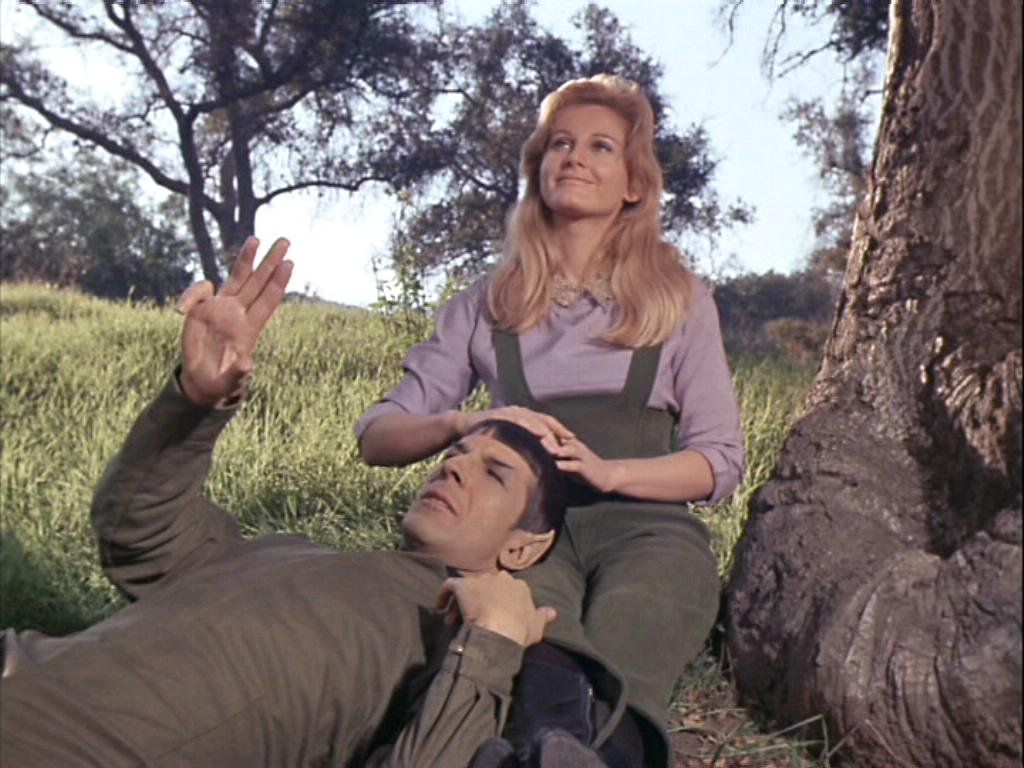
Coincidence! One of the colonists is a young woman named Leila Kalomi, who met Spock on Earth 6 years ago – and fell in love with him, despite his inability to reciprocate. Spock recognizes her but remains impassive.
The landing party notices the lack of animals. McCoy gives the settlers physicals and is amazed by their excellent health. Kirk gets orders from Starbase to evacuate the colonists – but Sandoval, unconcerned, refuses.
And then Leila takes Spock to ‘explain’, and takes him into a field where the large flowers explode their pods into Spock’s face. Spock collapses in pain – “I am not like you!” – but the effect takes hold, and Spock realizes to his amazement he can respond to Leila’s feeling for him. “I love you… I can love you!” And they kiss.
This episode has a nice balance of threat, emotion, and humor, as in the next scene when Kirk comes looking for Spock, finding him hanging from a tree branch, and can barely believe his eyes. “I gave you an order to report!” he barks. Spock replies casually, “I didn’t want to.”
McCoy and Uhura both get turns expressing the effects of the spores; McCoy turns into a southern gentleman, drinking mint juleps; Uhura into a spacey saboteur, as she wrecks the communications panel (so Kirk can’t call for help).
Kirk, the last one left uninfected, tries debating. Sandoval talks about their “complete health and peace of mind.” And that’s paradise, Kirk asks? They have no wants or needs. “We weren’t meant for that,” Kirk says, “Man stagnates if he has no ambition, no desire to be more than he is.” This is an interesting philosophical premise – though not an inarguable one. So what if “man stagnates”? Most of human history has been only about getting enough to eat, surviving diseases, and ensuring the next generation. It’s only the adventurers like Kirk who think that’s stagnation.
At the same time, the issue reflects the difficulty of telling stories without conflict. Trek had by this time already established the idea of “prime directive”, the idea that the Federation should not interfere with other societies – but individual episodes keep finding reasons to ignore it, as in “The Return of the Archons”, and in 2nd season’s “The Apple”.
Kirk has a great scene on the bridge, as he realizes he’s the only one left on board. He can’t pilot the ship by himself; he’s marooned. “I’m beginning to realize just how big this ship really is, how quiet.”
But then he’s blasted by the spores and converted, just like all the others. “I’ve joined you” he tells Spock. There’s a strong undercurrent in the theme here of the effects of drug culture – remember this is the 1960s.
But then there’s a scene I’ve never entirely understood – despite summaries of it. Kirk is ready to activate the transporter, to beam himself down. He flicks some switches; something seems to be wrong. Some kind of fury wells up within him, and he cries out in frustration, “I… can’t… LEAVE!”
Wait, why? I’ve understood this before as Kirk reacting to some problem with the transporter. (But why?) Or is it instead that Kirk’s inner devotion to his ship wells up against the idea that he is about to leave the ship forever? If the latter, I don’t think it was well enough played.
In any case, something gives – you see Kirk realize it — and he realizes he’s free of the spores’ effects. And quickly realizes how to make this happen for the others.
And then the famous scene in which Kirk instigates a fight with Spock, via crude insults, to instill powerful emotions that will overcome the spores. And then the plan to beam subsonic transmissions to make everyone on the planet irritable and fight-prone.
Meanwhile there’s the very sad scene in which Leila is beamed aboard the ship and realizes that Spock is free of the spores. Spock seems genuinely sorrowful, and tries to explain. “I am what I am, Leila. And if there are self-made purgatories, then we all have to live in them. Mine can be no worse than someone else’s.”
And Leila’s anguish and sorrow causes her to be freed from the spores as well.
She asks Mr. Spock if he has another [first] name. Spock ruefully replies, “You couldn’t pronounce it.”
The concluding scenes confirm Kirk’s opinion of this supposed paradise. After a scene in which Sandoval tells McCoy his services as a doctor will no longer be needed, and McCoy replies, with one of his best lines in the entire series, “Would you like to see how fast I can put you in a hospital?”, they fight, and Sandoval comes to. And immediately realizes, about their original plans for the colony, “We’ve done nothing here.”
And Kirk underscores it as the Enterprise departs. “Maybe we weren’t meant for paradise. …”
But Spock gets the last line, asked about his experience on the planet, he says, almost wistfully, “I have little to say about it, captain. Except that for the first time in my life, I was happy.“
Music notes:
We hear the “Charlie X” wonder theme as the landing party initially is led through the settlement.
Most of the scenes with Leila Kalomi are scored with the one prominent love theme Trek had by that point, the one written by Gerald Fried for “Shore Leave”.
Sights of the pod flowers are accompanied by the twangy Talosian theme from “The Menagerie”.
Two or three times with hear the “Miri theme”, the library track by Joseph Mullendore first heard, IIRC, when Kirk discovers the girl Miri hiding in a closet.
Spock’s infection by the spores, and his pain, is scored to “Vina’s theme” with a throbbing pulse underneath.
As fights break out on the planet, we hear the “Corbomite” cube theme.
Blish adaptation, in ST5:
The landing party has a couple different characters: Lt. Timothy Fletcher, a biologist, and a crewman named Dimont. (in the show it was De Salle and Kelowitz.)
Blish has Spock, when meeting Leila, say “The years have seemed twice as long.”
(note Spock’s line about the beauty of rainbows)
Blish passes over Spock’s scene hanging from a treelimb, and only summarizes how the other crewmembers are also hit by the spores, before Kirk returns to the ship. Blish actually claims Kirk was hit by the spores too, but implies his anger at the situation kept the effect away. (In the filmed show the spores did *not* seem to hit him on the planet.)
Blish completely rewrites the scenes in which Kirk is first hit by the spores, is overcome, and then is frustrated in the transporter room and thereby recovers. Instead, Kirk takes a sample of the spores to McCoy’s lab and discovers that the spores are soluble in adrenaline. He gets a plan—and then he calls Spock (claiming) to have joined them, and asking for Spock’s help aboard the ship.
But then Blish plays out the confrontation with Spock as filmed.
Blish passes over the scenes on the planet where the subsonics cause people to start fights; in fact he mentions the “modified Feinbergers” used to generate signal, using Trek production slang for the props designed by Irving A. Feinberg.
And then Blish totally omits Spock and Leila’s farewell scene. Jumping straight to the bridge with McCoys comments about being thrown out of paradise. Blish does at least include Spock’s final line, about being happy.
Posted inStar Trek|Comments Off on Complete Health and Peace of Mind? TOS #25: This Side of Paradise
Only in a country with a long history of anti-intellectualism, it seems, could a billionaire ignoramus like Donald Trump continue to be seen as a “man of the people.”
(I have to note that Salon seems determined to make its site difficult to read, with pop-up videos that obscure the text of the article.)
\\
Slate: Dahlia Lithwick on A Prayer for the Real Victims. Subtitle: “For Jeff Sessions and the Supreme Court, the battle for Christians’ religious liberty is one of the only fights that matters.”
The battle for “religious liberty” is only about promoting Christianity, to the point of allowing Christians free passes to ignore the law. Because, as I’ve noted before, extremist Christians seem intent on defining themselves as people who cannot get along with anyone unlike themselves.
Posted inConservative Resistance, Culture|Comments Off on Links and Comments: Trump’s anti-intellectualism; ‘religious liberty’
“The most expensive health care cost in America right now, by far, individually, is for homosexuals. They cost more in the system than any other, hands down.”
With no evidence whatsoever. (Because of course there is none.) This is pure animus, bigotry, and ignorance.
Posted inConservative Resistance|Comments Off on Link and Comment: What a Contemptible Person
William Saletan, at Slate, takes inspiration from John McCain’s recent speech, during last week’s health care debate: Words to Live By. Subtitle: “McCain’s speech gives us a map for escaping the moral rot of Trumpism.”
He says, “To escape the moral rot of Trumpism, all of us should follow these rules.”
Tell the truth.
Focus on helping, not winning.
Resist proudly.
Respect the process.
Ignore the outrage industry.
Fight for values, not for the tribe.
Don’t be obnoxious.
Seek acceptance, not just conquest.
Do what’s right, even if it’s unpopular.
Heal thyself.
#6 is striking because Trump himself obviously has no values; for him, it’s all about making a deal, winning in whatever circumstances present themselves.
\\\
Phil Torres, a supporter of the ‘new atheist’ movement and its prominent authors (Sam Harris, Richard Dawkins, Daniel Dennett, Christopher Hitchens), is upset, in Salon: From the Enlightenment to the Dark Ages: How “new atheism” slid into the alt-right. Subtitle: “A movement supposedly committed to science and reason has decayed into racism, misogyny and intolerance. I’m done.”
He’s done? With what? Where is he going? I read the article with this subtitle (which, like most article titles, was likely written by the site’s editors, not him) in mind.
Yes, people are people, and even people with your tribe or on your side intellectually are people, and exhibit flaws and human biases and prejudices just like all other people. Torres seems to be taking objection to evidence of such and throwing the baby out with the bathwater. Here’s his conclusion:
I should still be the new atheist movement’s greatest ally, yet today I want nothing whatsoever to do with it. From censoring people online while claiming to support free speech to endorsing scientifically unfounded claims about race and intelligence to asserting, as Harris once did, that the profoundly ignorant Ben Carson would make a better president than the profoundly knowledgeable Noam Chomsky, the movement has repeatedly shown itself to lack precisely the values it once avowed to uphold. Words that now come to mind when I think of new atheism are “un-nuanced,” “heavy-handed,” “unjustifiably confident” and “resistant to evidence” — not to mention, on the whole, “misogynist” and “racist.”
And while there are real and immensely important issues to focus on in the world, such as climate change, nuclear proliferation, food production, ocean acidification, the sixth mass extinction and so on, even the most cursory glance at any leading new atheist’s social-media feed reveals a bizarre obsession with what they call the “regressive left.” This is heartbreaking, because humanity needs thoughtful, careful, nuanced, scientifically minded thinkers more now than ever before.
Where’s he going? He doesn’t say.
\\
How to counter existential dread — the reality of an ancient, infinite universe in which our lives flash into existence and then disappear forever — with optimistic nihilism.
“It seems very unlikely that two hundred trillion trillion stars have been made for us.”
“We became self-aware only to realize this story is not about us.”
(By ‘nihilism’ we of course mean the acknowledgment that we don’t live in a fantasy universe of gods who determine our meaning of life — as, for example, slaves whose lives should be devoted to worshiping our creator, or that those trillions of stars were created merely as the background setting for *us*. Rather, the meaning of life is what we make it. There are no gods.)
This reminds me of this extraordinary video, posted here, about a visit to Chernobyl.
Posted inAtheism, Culture, Meaning|Comments Off on Links and Comments: Rules to Escape Trump’s Moral Rot; Escaping New Atheism(?); Optimistic Nihilism
The Enterprise discovers a “sleeper ship” full of hibernating superhuman refugees from 1990s Earth, whose leader tries to take over the Enterprise.
This is a classic episode – even disregarding its inspiration for the second Trek movie – with a striking theme and a powerful performance by guest star Ricardo Montalban.
The opening has the Enterprise pursuing a signal of some ship ahead, in a seldom visited region of space. They discover an old Earth ship, of type DY-100, built in the 1990s (!), built only for interplanetary travel, with signals of life aboard. There’s a bit of malarkey about Morse code.
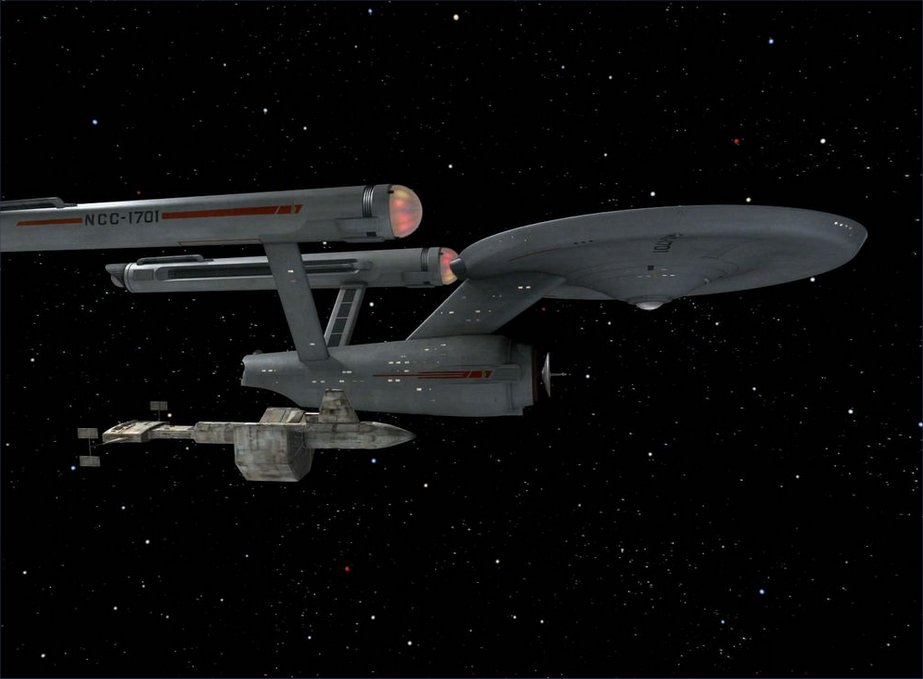
The enhanced graphics show the ship, the Botany Bay, idly in space, slowly rotating as if in unguided freefall. This is a nice touch, in a universe in which all spaceships are uncritically assumed to be traveling in the same plane, always level with each other. (In the original graphics, the Enterprise pulls up alongside the Botany Bay, like a larger naval ship coming alongside a smaller ship.)
The striking premise emerges: in Trek history, the 1990s was the era of Earth’s last ‘World War’, the ‘Eugenics Wars’, in which “a group of ambitious scientists” intent on improving the species created a race of superior men, who then took over the world, for a while, until they were overthrown. The Enterprise crew soon realizes that the passengers on this ship, in suspended animation ‘sleep’, are refugees from that race.
First point here: this history is unusually dark for Trek, in which Roddenberry especially emphasized how by the 23rd century many of humanity’s problems should have been overcome. Also, it paints scientists as villains, a not unusual theme for Trek, but a disconcerting one given that future ideal.
Second point here: If these superior genetically enhanced people took over the world in the 1990s, they must have been generated in the 1970s, at latest. Not very long in the future for when this episode was made. A point I haven’t seen observed anywhere else.
We are introduced to the ship’s ‘historian’, Lt. Marla McGivers, whose quarters are filled with statues and paintings of famous military men throughout history. Does the Enterprise really have a full-time historian? Wouldn’t it be more plausible that she were some ordinary crewman who happened to have a passion for history?
This episode has McCoy’s famous line, as he is obliged to enter the transporter: “I signed aboard this ship to practice medicine, not to have my atoms scattered back and forth across space by this gadget.”
They beam over the Botany Bay, and realize it is a ‘sleeper ship’, a ship in which the passengers were put into suspended animation, since “until 2018” it took years just to travel between planets.
McGivers is immediately entranced by the sight of the leader [Montalban]: north Indian, she guesses, a Sikh. The sleeper mechanism failing, Kirk smashes the glass and pulls him out. He barely speaks: “How long?” He understands immediately the implication of his waking up. Kirk replies: “Two centuries.”
Back on the Enterprise, Spock is irritated by the lack of facts. Kirk teases him; Spock pretends not to understand what irritation means. This exchange is typical of the first season (and likely lines written by Gene L. Coon); did these exchanges continue in the 2nd and 3rd seasons? I’m guessing not, but as I’m rewatching all these episodes in order, after not having seen most of them in 30 or 40 years, I’ll wait to see.
As the Enterprise heads for Starbase 12 – a planet in the Gamma 400 star system, Kirk later mentions, a designation that makes no sense.
Khan wakes up in sickbay…stretching… and then using a knife handily found on a wall display to threaten McCoy. One might think that Khan should have been restrained immediately, for this attack, but no, Kirk is summoned and asks barely a question before Khan pleads fatigue except for wanting access to the starship’s technical manuals. Hmm.
Spock does research: by 1993 those ‘supermen’ had seized power in 40 nations. And when they were overthrown, some 80 remained unaccounted for…
Kirk and crew, ignoring these warning signs, hold a stately dinner for Khan, wearing dress uniforms. Some good dialogue here: Spock asks questions; Khan gets annoyed, yet admires Kirk for sitting back, and observes, “It has been said that social occasions are only warfare concealed.”
The success of this episode keys off Montalban’s acting, and Madlyn Rhue’s acting (she plays Lt. McGivers), in two key scenes. The first is before the dinner: Khan comes to her quarters, admires her artwork – including a painting of him. He kisses her – and the music score is that intense, swelling theme we’ve heard earlier in “Miri” (notes below).
And then after dinner, she comes to his cabin to apologize. He invites her to stay; she hesitates; he turns it into a demand for a request; “This grows tiresome. You must now *ask* to stay.” She takes his hand. He clenches her hand, so hard that he forces her down onto the floor onto her knees. That music again. He tells her he intends to take the ship, and he needs her help. She is shocked, tries to refuse. He insists. And meekly she agrees. She gives in. All else follows. If the acting didn’t work here — and it does — the following story wouldn’t have worked.
Later, Kirk visits Khan with some direct questions. Some interesting dialogue here about the supposed ‘evolution’ of the human race. In two centuries.
And then Khan escapes his quarters, revives the others from his ship, and takes over the Enterprise, cutting off life support to the bridge, until everyone there passes out.
There’s an interesting captain’s log entry here, which I think illustrates how these monologues by William Shatner were recorded separately, later, than filming of the episode occurred – because the expression and tone of these log entries is so different from what Kirk might have said in the action at the time. This log entry begins with the bitter pronouncement: “They have my ship.” For Captain Kirk, one can hardly imagine a more humiliating circumstance.
He then states commendations for the various bridge crew active at that time, before collapsing.
The showdown commences: the bridge crew, except for Kirk, are held in the briefing room, as Khan lectures them about the inevitability of his success, and asks any of them to join him – if they don’t, he threatens, Kirk, being held in a decompression chamber, will suffocate. Uhura, threatened with physical violence, refuses to cooperate, good for her. McGivers, her allegiance to Khan threatened by the spectacle of watching Kirk die, sneaks out – and saves him. And so on.
There’s a physical fight between Khan and Kirk in the engineering room, in which Kirk manages to win, despite Khan’s claiming “I have five times your physical strength”… Is this plausible? Well, it’s TV, and the stars of the show must win.
And in a final, provocative scene, Kirk holds a hearing to pronounce judgment on Khan, and McGivers. He will strand Khan and his crew on a remote planet, and offers McGivers a chance to join them, to avoid court-martial. She accepts.
The planet he mentions is in the ‘Ceti Alpha star system’. The standard designation would be Alpha Ceti; the brightest star in the constellation Cetus. I note that Wikipedia’s entry for this, https://en.wikipedia.org/wiki/Alpha_Ceti, offers a redirect for Star Trek’s mention of “Ceti Alpha”.
The final moments cite Milton’s lines: “It is better to rule in hell than serve in heaven”.
And: about how it might be interesting to return in 100 years “to learn what crop has sprung from the seed you planted today.“
For once, there is no cute, humorous final scene (from Gene L. Coon).
Cushman’s book describes the long journey from initial story idea by Carey Wilbur – reacted to by Trek production staff as being too Flash Gordon, about an evil villain initially describes as the kind of criminal who was sent to the Australian Botany Bay colony – to the final script, with rewrites by Coon and Roddenberry, with Roddenberry’s idea about the eugenics wars and how to reconceive the central character as not a criminal but a kind of refugee (see p.518 of Cushman).
This confirms to me yet again about the generally unrecognized role TV show producers have in producing a unified product (at least for producers of TV series at that time). Script writers, who don’t know about all the other scripts written for the series, and who may not have even seen earlier episodes of the series (especially in the first season of Trek), submit scripts with wildly variant ideas about the characters, and unrealistic notions of what kind of special effects and extra sets can be produced within a budget.
Music Notes:
Twice, when Khan wakes up in sickbay and again when he forces open the door of his quarters, we hear the Talosian theme, the twangy guitar theme, from “The Menagerie”.
The two prominent themes here are the main Romulan theme, from “Balance of Terror” – when we see the Botany Bay – and the secondary “Mudd’s Women” theme.
And as mentioned above, in two key scenes with Khan and Marla McGivers, an extra cue written by Joseph Mullendoor, previously heard in “Miri”.
Blish adaptation, in ST2:
Again, Blish condenses the opening scenes to summary, a chief difference from the broadcast script being that Lt. Marla McGivers is a control systems specialist who happens to be a historian on the side. I always wondered why the Enterprise needed a full-time historian, as implied in the broadcast episode.
Better than Trek generally did, Blish makes a smart deduction from the position of an interplanetary vessel being out in interstellar space. “They must have been trying for the Tau Ceti system,” the navigator says. A star only 12 light years from Earth. So that a ‘sleeper ship’ would reach there eventually, without taking forever.
Blish has more background about the Eugenics Wars and those behind them, e.g. how the selective breeding was among the scientists responsible themselves; how the “sports and monsters” appeared later, the result of “spontaneous mutations erupting from all the ambient radioactivity” once the war had already started. And that Khan – Blish gives his full name as Sibahl Khan Noonien [though elsewhere throughout, Blish’s version spells it “Kahn”] – was one of those scientists’ children.
Per policy, Blish doesn’t include any of the scenes between Khan and McGivers.
During the dinner party scene, Blish has Spock challenge Khan about never being afraid. Spock asks, “And does that not frighten you?” Khan thinks this is a contradiction. Spock replies, “Not at all. It is a null class in the class of all classes not member of the given class.” Now that’s logic.
Blish makes the focus of the story more on the question of why Khan and his people fled Earth, with Spock trying to apply psychology to draw Khan out—if he wasn’t afraid of anything, why did he flee? The broadcast version focused more on Khan seducing McGivers.
Blish condenses the action scenes – omitting Kirk and Khan’s fight in engineering altogether – into one short paragraph, before commencing with the trial scene. Beginning with an answer to the question of why they fled: “To free themselves of the rabble, and start fresh.” But Spock thinks, “In my opinion they would never have succeeded, even had they made it to a habitable world. The man who cannot know fear is gravely handicapped.”
The trial ends with Khan and McGivers exiled to a planet – which here Kirk does not name – and Khan invoking Milton. But Blish adds a line apparently scripted but left out of the broadcast version. After Spock says it would be interesting to return in 100 years, “to learn what crop has sprung from the seed you planted today,” Kirk replies: “I only hope than in a hundred years, that crop won’t have sprung right out of the ground come out looking for us.”
A last line that inspired the second Trek film.
Posted inStar Trek|Comments Off on The Best of the Tyrants: TOS #23: “Space Seed”
That is, an authoritarian, conservative government that determines the truth, and no one else is allowed to say respond or criticize, or point out evidence to the contrary. Nineteen Eighty-Four. (Except that it couldn’t work now, since the internet is beyond the control of … well, except authoritarian governments like North Korea. Hmm. Maybe it could happen.)
Breitbart not only led the right’s obsessive, hostile focus on immigrants, it was also the first to attack professional reporting such as the New York Times and Washington Post. Breitbart’s disruptive template fueled the political and information universe we now inhabit, where the right dismisses facts and embraces fantasies.
There is a long-standing intersection between mysticism and conservatism in America. This marriage extends back to the late 19th century when globetrotting occultist and Russian noblewoman Madame H.P. Blavatsky depicted America as the catalyst for a revolution in human potential in her 1888 opus “The Secret Doctrine.” “It is in America that the transformation will take place,” Blavatsky wrote, “and has already silently commenced.”
This strikes me as an example of how humans more susceptible to the “I’m so very special, and the place I live in and the religion I believe in are obviously the mostest special things in the world” mental bias are, of course, conservatives, prone to dismissing real world evidence and attracted to anything that confirms their biases. And lacking any understanding of the actual, physical world, are prone to fairy-tales about how it might work, as long as it they confirm those biases.
Science fiction can help. Maybe you associate it with spaceships and aliens, but science fiction offers more than escapism. By presenting plausible alternative realities, science fiction stories empower us to confront not just what we think but also how we think and why we think it. They reveal how fragile the status quo is, and how malleable the future can be.
…
Science fiction isn’t useful because it’s predictive. It’s useful because it reframes our perspective on the world. Like international travel or meditation, it creates space for us to question our assumptions. Assumptions locked top 19th-century minds into believing that cities were doomed to drown in horse manure. Assumptions toppled Kodak despite the fact that its engineers built the first digital camera in 1975. Assumptions are a luxury true leaders can’t afford.
With references to William Gibson, Kim Stanley Robinson, and others. This blog’s essential theme: science fiction is a way of thinking about reality, about identifying what exists outside the bubble of everything human.
Interesting that Richard Dawkins’ The Selfish Gene leads the list — ahead of any book by Darwin himself! Comments on the web about this poll suggest problems: it’s a ‘public poll’, popular vote, and therefore skewed most likely to what books the public has read, i.e. recently published books. Also, there was a predetermined shortlist for the public to vote on, apparently.
On the other hand, I’ve made the point before that old books, no matter how influential in their time, are not necessarily especially influential to readers now. No one reads Newton’s Principia these days for an understanding of physics; it’s an historical document. Similarly with Dawkins and Darwin — Darwin, for all the brilliance of his insight into natural selection, had no clue about genes, the very mechanism by which natural selection occurs, and the primary subject of Dawkins’ book.
I’m a bit curious about the inclusion of Bryson’s book, a good one, but more a popular summary by a non-scientist, than a science book. I do approve and endorse the books by Carl Sagan and David Deutsch.
Posted inScience, science fiction|Comments Off on Links and Comments: Science and Science Fiction