Harper’s on Environmentalism, etc.

More from the November Harper’s.

Fascinating article by James K. Boyce, Rethinking Extinction, subtitled “Toward a less gloomy environmentalism”.

This is best-read in the context of understanding the impact of humanity on the planet, not just in recent decades, but over the past 10 or 20 thousand years [as described in Elizabeth Kolbert’s The Sixth Extinction, my review here, a book this author cites]. Boyce’s take seems to be accepting the inevitable and doing what we can to ameliorate the situation.

A recurrent theme in the narratives of American environmentalism is that people are bad. Humans, in this telling, are sinners, a cancerous growth on the face of the planet. The traditional goal of the environmental movement has been to restore a baseline, a state of nature that existed before human defilement. But however well these people-versus-nature narratives served environmentalism over the past century, the time has come to dismantle them and erect a new intellectual scaffolding.

And his conclusion, bottom-line:

The quest to preserve or restore a baseline state of nature, always a mirage, is slowly being abandoned; ecologists have begun to think in terms of maintaining valuable processes rather than trying to freeze the biological landscape.

Humans are part of the web of life, and we can and sometimes do have positive impacts on the rest of nature. The old people-are-bad, nature-is-good formula, which was so central to the environmentalism that was born when Martha died, is too glib, and too often counterproductive. For when the choice before us is framed as humans versus nature, it turns out that most people, with however much regret, will choose humans.

\\

From the Harper’s Index, example of self-enhancement bias:

Portion of U.S. college freshmen who rate themselves above average in academic aptitude : 7/10

Posted in Evolution, MInd | Comments Off on Harper’s on Environmentalism, etc.

John Crowley on Narrative

From the November issue of Harper’s magazine, a lovely essay on narrative by [the acclaimed sf/fantasy author] John Crowley: A Ring-Formed World. It begins (my bold):

I have recently developed a crank theory, for which I can adduce no real evidence, that the human sense of time has its origins in story, or is at least bound up with the telling of stories. If, as science suggests, we were nomadic creatures for a very long time, changing place often — as the mountain gorilla, one of our fellow primates, does today — then the lives of our ancestors would have been shaped by the sense of leaving one place and moving on a path toward a new place. As we went on, we would form a memory of the earlier place and what we did there, and we would begin to imagine the new place. Would it be better? Would we regret leaving the old place? Once, we were there; now we are here; soon we will be elsewhere. Passing between Here and There, we are in narrative.

This appeals to my sense that narrative is an essential part of human cognition; it is a bias, in the sense that we force narrative (“everything happens for a reason”) onto random events; it is a feature, in the sense that it is a heuristic for exercising how we understand the world, and how we would deal with hypothetical situations.

Crowley has some interesting things to say about ‘story’ vs. ‘plot’, and how narratives, novels, establish causes to bring about effects (while in the real world, we understand it through observation of causes that *produce* effects).

This is essentially what Alfred Hitchcock’s concept of the MacGuffin implies: if the workings of the MacGuffin — the gimmick in a story, the thing sought or feared by its characters — will not bring about the desired ending, it’s not the ending but the MacGuffin that must be changed.

And Crowley discusses the apparent ‘freedom’ of fictional characters.

I want to show that the limits that fictional characters seem to suffer are what make them finally more free than we are, not less, and more consequential in their realm than we are in ours. This is why we are drawn to them, why we never forget them and their acts.

And how fiction embodies meanings not often found in real life.

Time in fiction, like love in fiction and streets and houses and blood and money in fiction, is made only of meaning, unlike the ribbon that we ride, or that rides through us, which is indifferent to human need.

Posted in Narrative | Comments Off on John Crowley on Narrative

Links and Comments from last Sunday’s New York Times

First, a Sunday Review front page essay by Maria Konnikova, Born to Be Conned. It’s about how people are “suckers for belief”, about confidence games, with insights into human nature, e.g.

Monte operators, like all good con men, are exceptional judges of character, but even more important they are exceptional creators of drama, of the sort of narrative sweep that makes everything seem legitimate, even inevitable.

We are all susceptible to attractive narratives. Again:

Stories are one of the most powerful forces of persuasion available to us, especially stories that fit in with our view of what the world should be like. Facts can be contested. Stories are far trickier. I can dismiss someone’s logic, but dismissing how I feel is harder.

And

It is no accident that the Bible, probably the most influential Western book of all time, teaches through parables and stories and not through philosophical discourse.

And

human nature is wired toward creating meaning out of meaninglessness

And

Before humans learned how to make tools, how to farm or how to write, they were telling stories with a deeper purpose. The man who caught the beast wasn’t just strong. The spirit of the hunt was smiling. The rivers were plentiful because the river king was benevolent. In society after society, religious belief, in one form or another, has arisen spontaneously. Anything that cannot immediately be explained must be explained all the same, and the explanation often lies in something bigger than oneself.

This is all about, as I’ve mentioned, the human perception of reality isn’t about physics, or biology, or chemistry — it’s about psychology.

\\

Sam Wang: Let Math Save Our Democracy.

About how gerrymandering is most often used by Republicans. There’s a current Supreme Court Case about this.

\\

The weekly ‘Gray Matter’ essay, this time by Scott Slovic and Paul Slovic: The Arithmetic of Compassion.

About how we respond more strongly to individual incidents, like the Syrian child who washed up on a beach, when we see an image of such an event, than to news with statistics about far worse events.

Again, psychology.

Posted in Culture, Psychology | Comments Off on Links and Comments from last Sunday’s New York Times

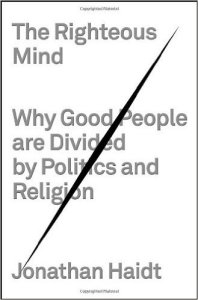
Jonathan Haidt’s THE RIGHTEOUS MIND: Why Good People Are Divided by Politics and Religion, 3

First, an aside that I didn’t mention earlier, in the chapter about how people are more concerned about reputation than actually being virtuous. In the discussion about how you can use ‘reason’ to reach any conclusion (based on whatever you might find out on Google), he contrasts the cognitive mechanisms involving strange beliefs. (Citing work by Tom Gilovich.) When we *want* to believe something, we ask, *Can* I believe it? For this you need only a single piece of pseudo-evidence. Whereas if you’re not inclined to believe something, you ask *Must* I believe it? And then no matter how much supporting evidence you find, if you find a single reason to doubt the claim, you dismiss it. This is the essence of motivated reasoning, and Haidt illustrates it by observing that conspiracy theories operate on the former strategy (*can* I believe it? give me one example) while science operates on the latter (if all the evidence supports an idea, you must believe), and non-scientists are adept at finding some reason to quibble. p85.6:

Whatever you want to believe about the causes of global warming or whether a fetus can feel pain, just Google your belief. You’ll find partisan websites summarizing and sometimes distorting relevant scientific studies. Science is a smorgasbord, and Google will guide you to the study that’s right for you.

Second, I wanted to summarize my reactions to Haidt’s thesis and conclusions in the context of where his book *doesn’t* go. In particular, he observes without much comment that Western, educated, industrialized, rich, and democratic (‘WEIRD’) societies focus morality along axes of fairness, harm, and liberty (libertarians especially on that single last axis), whereas much of the rest of the world is equally concerned about the axes of loyalty, authority, and sanctity. Why might this be?, is a question Haidt does not ask. He does observe that these elements may have evolved in order to enable group selection. And he observes how, for instance, sanctity is the flip side of disgust, which ultimately responds to elements of the environment that are physically dangerous — dead bodies, animal wastes, and so on, that are more a problem in ‘primitive’ societies than in modern industrial ones. (For example, think of middle-eastern rules about using the left hand for one purpose, the right hand for another. In environments without readily available running water for cleaning.) He also observes that humanity is structured for hierarchy, but has become more egalitarian as group size grew — this is the loyalty and authority axes.

So: isn’t it reasonable to suppose, as I’ve done in my ‘provisional conclusions’ and many western thinkers have done, including those recent books by Harris and Shermer, that as humanity expands to fill the planet, becomes more inter-connected, that some of the more tribal elements of morality might fade, and the overall concerns of utilitarianism — care and fairness — (as Haidt himself suggests) will rise to the fore? That is, for the moment I’m clinging to my provisional conclusion that the moral arc of history is about the expansion of the inclusion of greater and greater elements of humanity, with the attendant diminishment of hostility to foreigners and anyone who is unlike one’s own tribe.

At the same time, current US politics illustrates how stressful times can reduce large groups to base tribal behavior, including, for example, demonization of entire ‘other’ populations. I need to revise my ‘provisional conclusion’ about a ‘reset’ of humanity to include the many potential incidents in history in which ideals (in the US case, our Constitution) threaten to be discarded, in light of current events which trigger the harm/fear sensitivity of conservatives. Trump!

Third, I will grant that Haidt’s book gave me some second thoughts about the stress of social changes, in his terms, the threat to ‘moral capital’, and how this might justify conservative concern over changing social standards (e.g. same-sex marriage) that might undermine social stability. Haidt cites an interesting example — one about how when all jewelry shops (IIRC) in New York City were owned by Jews, they operated under loose restrictions with implicit understanding and trust based on shared cultural values; whereas a set of shops run by diverse owners would require more rules and procedures to ensure that no one would cheat. Well, OK, I see his point, and I can see this effect in the many small towns across America, in which most people know and trust one another because they share common values (and at least similar religions).

At the same time, it’s relevant to observe how quickly some social changes — e.g. the idea of same-sex marriage, unthinkable 20 or 30 years ago, even in the US, and now the law of the land — come to pass without violent social revolutions, or much apparent social stress, outside of the extreme conservative social bubble, who (harm/fear!) are stressed out about everything. I think Haidt’s idea of ‘moral capital’ is an inevitable victim of increased social diversity and globalization; it’s an artifact of tribalism, being diminished in those WEIRD cultures, and perhaps inevitably around the world (is my provisional conclusion).

Fourth, and finally for now, some of these moral parameters, the six foundations of morality that Haidt describes, will inevitably conflict with reality, as humanity expands to fill the planet, and confronts its effects on the planet (e.g. climate change). Mightn’t ideas about divinity, for example, fade as the importance of responding to such reality undermines the supernatural premises of religions? One might think so, and many thinkers and SF authors have supposed so, but based on the current thinking of current thinkers I’ve been reading, I’m guessing not. Human nature is what it is.

Posted in Book Notes, Changing One's Mind, Morality, Politics, Religion | Comments Off on Jonathan Haidt’s THE RIGHTEOUS MIND: Why Good People Are Divided by Politics and Religion, 3

More notes and comments about Haidt’s THE RIGHTEOUS MIND

I like the way Haidt outlines his thesis in the introduction, provides central metaphors for each of the three main sections, and provides a 1-2 page summary at the end of each of the 12 chapters. (Academic books do this to excess; Haidt’s outline and summaries are just right.)

The first part is that “Intuitions come first, strategic reasoning second” and the central metaphor is that the mind is divided, like a rider on an elephant, and the rider’s job is to serve the elephant, without having much if any control of what the elephant does or where it goes. He describes studies that show moralities based only on fairness and harm are incomplete, contrasting the West with much of the rest of the world, and how moral reasoning is based on gut feelings, with post hoc fabrications constructed as necessary. He contrasts the ideas of Plato, Hume, and Jefferson about the relationship of reason and emotions: Plato said reason should prevail; Hume said reason is the servant of the passion; Jefferson said they were co-rulers. 20th century advances in evolutionary thought have resolved this, after a period of resistance due to fears of ‘social Darwinism’ and the political attraction of the idea of the ‘blank slate’. EO Wilson’s ‘sociobiology’ was reviled in many quarters, until it was recharacterized in the ’90s as ‘evolutionary psychology’ with accumulated evidence supporting it, including how brain injuries affect cognition, e.g. how the absence of emotion cripples ‘thinking’. [I remember the ‘blank slate’ orthodoxy of the ’60s and ’70s, in particular to justify equal rights for women. That minds aren’t blank slates after all, as much research has shown, doesn’t mean everyone shouldn’t have equal rights, of course; humans should and do aspire to transcend our biology.]

The contrast isn’t emotion vs. reason; it’s that intuition and reasoning are both kinds of cognition, with that model of the elephant and its rider. He presents a diagram of his ‘social intuitionist model’, in which the rider’s job is to justify the elphant’s action — especially to others. Reasoning is about persuading other people, by appealing to their elephants. Haidt notes what’s become increasingly clear in recent years of psychological studies and political developments: “you can’t change people’s mind by utterly refuting their arguments” p48.6. So: Hume was right.

Haidt goes on to provide several specific examples of how this works: how our brains make snap judgments, how they are affected by our immediate environment. He notes that psychopaths reason but don’t feel; babies feel but don’t reason. Reason can overcome intuition in certain situations. But why did our minds evolve this way? Why not to perceive truth? [This thread expands on my own point that our minds are evolved for survival, not for perceiving reality.] p71: “That depends on which you think was more important for our ancestors’ survival: truth or reputation.” (Ah ha!)

Haidt again revisits Plato, concluding he was wrong, his brother Glaucon right, p74.3: “The most important principle for designing an ethical society is to make sure that everyone’s reputation is on the line all the time, so that bad behavior will always bring bad consequences.” [I’m reminded of David Brin’s The Transparent Society] He goes on with more specific examples: how we are obsessed by polls; our in-house press secretary automatically justifies everything we do; how ‘reasoning’ and Google can [via confirmation bias] take us anywhere we want to go; how we can believe almost anything that ‘supports our team’. Thus he says: rationalism is a delusion. Reason is a tool for persuading others; confirmation bias is a feature, not a bug. Good reasoning, however, can be emergent, through exchanges of ideas with others — which is why diversity is good within any group devoted to finding truth, e.g. universities. [This resonates with the bit a few posts ago about conservatives complaining they are under-represented in universities.] My thoughts are that *science* is this principle exemplified, but Haidt barely mentions the word, though he does say, p92.3, “Eventually, if the scientific community works as it is supposed to, the truth will emerge as a large number of flawed and limited minds battle it out.”

Part II is about how “There’s more to morality than harm and fairness” with the central metaphor: the righteous mind is like a tongue with six taste receptors.

Author describes his own studies in India, his awareness that morality is about more than what are emphasized by Western, educated, industrialized, rich, and democratic (WEIRD) societies. He evokes the metaphor of The Matrix, suggesting that each society is a different combination of fundamental moral intuitions. p109m: “I cannot overstate the importance of this… We are multiple from the start.” It is like the many cuisines all employing the same set of taste receptors. He develops a “moral foundation theory”, along five foundations: care, fairness, loyalty, authority, and sanctity. And then, especially fascinating to me, he describes the evolutionary reasons these foundations likely developed:

  • Care/harm evolved for the challenge of caring for vulnerable children.
  • Fairness/cheating evolved in response to the challenge of cooperation without being exploited, open to reciprocal altruism, punishing of cheaters.
  • Loyalty/betrayal to the forming and maintaining of coalitions, team players, with punishment of those who betray the group.
  • Authority/subversion about forging relationships in social hierarchies; sensitive to rank or status and proper behavior for one’s position.
  • Sanctity/degradation is about the omnivore’s dilemma (see p148t), then the challenges of avoiding pathogens and parasites, leading to veneration of symbolic objects and threats that bind groups together.

But then, after getting some strong feedback to his first version of this theory, he added a sixth foundation: liberty vs. oppression. With, again, the conclusion that liberals are sensitive mostly to three of the six, conservatives more or less to all six (and libertarians most strongly to the liberty v oppression foundation).

Part III is about how “Morality Binds and Blinds” with the central metaphor: we are 90 percent chimp and 10 percent bee.

The author has concluded so far that “Our righteous minds were shaped by kin selection plus reciprocal altruism augmented by gossip and reputation management”, but this is incomplete. People are groupish — we love teams and clubs and fraternities. We’re adept at promoting the interests of our own group against those of others. [Politics!] This comes about via mechanisms that enable some groups to out-compete other groups — i.e., ‘group selection’, an idea floated by Darwin and others, but which went out of fashion in the ’70s, partly because of arguments about how groups would not be able to manage ‘free riders’, selfish cheaters who, by avoiding risks, would have more children than others and whose genes would thus wipe out the tendency for group cooperation.

The solution, to jump ahead a bit, is exactly the elements of human morality that are sensitive to fairness and loyalty. As a matter of fact, human groups are extremely sensitive to cheaters, and extremely ready to celebrate the heroes who, in contrast, sacrifice themselves. That is, human morality evolved in part to enable group selection, thereby promoting larger and larger groups, with the resultant expansion of the species across the planet in the last few thousand years.

Haidt again offers examples, of how such evolutionary changes might have happened relatively quickly (citing ‘ultrasociality’ [what EO Wilson calls ‘eusociality’]); the way humans share tasks in a way chimps, our closest relatives, never do; and then circumstances of a “hive switch” that triggers groupish behavior and the feeling of being part of a greater whole: sports fandom, military solidarity on the battlefield, ecstatic dancing in ‘primitive’ cultures and raves in ‘advanced’ ones; awe in nature; psychedelic drugs that involve oxytocin and trigger the mirror neuron system. Happiness, he concludes, comes from getting the right relationships between yourself and others, yourself and your work, yourself and something larger than yourself.

And thus religion. In contrast to the ‘new atheists’ — Harris, Dawkins, Dennett, Hitchens — who criticized religious beliefs themselves (and their consequences, which do in fact play out in the daily news), Haidt claims religion is as much about belonging to a group with shared beliefs. The various religions themselves evolved, in ways to create communities, to discourage selfish behavior, to encourage the idea of collective punishment for transgressions — i.e. God is watching you! and if you sin, we will all suffer! [ — as fundamentalist politicians are always claiming that hurricanes or mass shootings are due to gay marriage or abortions. These are delusions, mind you, but they are useful delusions for promoting a kind of group/tribal cohesiveness.] Thus, the evidence that in fact religious people are better citizens, and on the other hand adherence to specific beliefs in scripture are not actually all that important. Haidt claims the absence of religion leads to a kind of anomie, citing the lower birth rate of secular European nations — though on this point I and I’m sure others can identify other factors that explain that. [E.g. that in advanced nations with better health care, women don’t need to have as many children as those in primitive societies with higher infant mortality rates.]

And so Haidt finally offers a definition, not of morality, but of “moral systems”, p270

Moral systems are interlocking sets of values, virtues, norms, practices, identifies, institutions, technologies, and evolved psychological mechanisms that work together to suppress or regulate self-interest and make cooperative societies possible.

He acknowledges this is a functional definition, about what works, not what is ‘right’. If pressed, he admits that there “is no compelling alternative to utilitarianism” as the basis for morality, i.e. that which promotes the great well-being for the greatest number. Here, finally, though he doesn’t spell this out, he aligns with the projects of Sam Harris and Michael Shermer on the arc of moral progress.

In the final chapter Haidt discusses the divided political process in the US, that between the ‘left’ and the ‘right’, and why it’s been getting worse. He describes how any one person’s moral development comes in three levels: first, the foundational traits (the six axes described above); then characteristic adaptions that depend on life circumstances; and finally broad ‘life narratives’. At the most basic, conservative minds react more strongly to threat and fear [I think this is an essential point, echoed every day by the Republican candidates for president] (p279), liberals are more responsive to variety and new experiences. These traits support broad narratives that “are not necessary true stories — they are simplified and selective reconstructions of the past, often connected to an idealized vision of the future” (p282t). And, p282m:

When asked to account for the development of their own religious faith and moral beliefs, conservatives underscored deep feeling about respect for authority, allegiance to one’s group, and purity of the self, whereas liberals emphasized their deep feelings regarding human suffering and social fairness.

And then he quotes two cogent summaries of the Grand Narratives of the left and the right, on pages 284 and 285. The former is about the struggle for equality and happiness, the latter about the struggle to return to a golden past. These descriptions are creepy in the way they echo current campaign rhetoric.

Haidt describes another personal experience that led him to reconsider his previous assumptions — i.e. that liberalism was obviously right, that conservatism simply meant orthodoxy. He reads a book by Jerry Muller that explores the idea that conservatism is about “the search for human happiness based on the use of reason”. Conservatives, he says, believe that people need external constraints to behave well and cooperate. [And given Donald Trump’s popularity with a base of uneducated, racist voters, who happily applaud his suggestions to subvert the Constitution in oh so many ways, it’s hard to disagree.] Haidt discusses the idea of ‘moral capital’, the shared convictions of society, that make cooperation possible. It means a trade-off between homogeneity and diversity, and when liberals don’t take this idea of moral capital into account, their changes often backfire.

Rather, Haidt suggests, liberalism and conservatism are a yin and yang, complementary, and both necessary. He goes on to explore several current political issues and how, given the basis for the elements of human morality and how they inform these issues, addresses the constraint of corporations, the utility of regulations, the benefit of markets (with a cute yet profound comparison of how government-run healthcare, and socialist economies in general, are like ‘intelligent design’, not giving enough credit to markets [evolution]), and finally, along the social conservative moral matrix, about guarding against threats to moral capital, i.e. how changes in social equality and ethnic diversity threatens moral capital.

It’s not a Manichaean battle between good and evil. He concludes,

Morality binds and blinds. This is not just something that happens to people on the other side. We all get sucked into tribal moral communities. We circle around sacred values and then share post hoc arguments about why we are so right and they are so wrong. We think the other side is blind to truth, reason, science, and common sense, but in fact everyone goes blind when talking about their sacred objects.

This is a fascinating book for exploring the parameters of actual human morality, for providing a vocabulary about the motivations of people different from ourselves. (Just recall the justifications of the ISIS attacks in Paris, on the basis of gross immorality.) I’ll have some comments about the book in one more future post, especially about how it does or does not inform the idea of an arc of moral history.


Posted in Book Notes, Changing One's Mind, Morality, Politics, Religion | Comments Off on More notes and comments about Haidt’s THE RIGHTEOUS MIND

Jonathan Haidt’s THE RIGHTEOUS MIND: Why Good People Are Divided by Politics and Religion, 1

Jonathan Haidt’s The Righteous Mind: Why Good People Are Divided by Politics and Religion is a fascinating, insightful book. It uses psychological studies into moral sentiments around the world to develop ideas about the ‘foundations’ of morality, especially to expand the standard ‘liberal’ ideal that focuses on egalitarianism, with the idea that morality is all about care vs. harm and fairness vs. cheating.

Rather, he identifies these priorities with Western societies, those he calls WEIRD — Western, educated, industrialized, rich, and democratic. In other parts of the world — and he discusses his own studies in India as an example — other sentiments are just as important: loyalty vs. betrayal, authority vs. subversion, sanctity vs. degradation, and (added later, in his development of his hypothesis of “moral foundation theory”) liberty vs. oppression. And these priorities are present in conservative factions of even WEIRD societies. That is, he identifies liberals as sensitive to three (the first two and the last) of the six moral sentiments, and conservatives to all six, which leads him to conclude that conservatives have an advantage in American politics (even though, as he confesses, he was a lifelong liberal) because politicians have that many more ways of appealing to their values.

His goal is to understand these foundations in terms of evolutionary psychology and recently revived theories of group selection, ideas discounted for many decades by biologists but recently revived by E.O. Wilson and others, along several lines of evidence that the author describes.

He develops group selection ideas to identify humans as “conditional hive creatures”, in which humans operate separately but in certain situations — military duty, sports fandom, submission to psychedelic drugs, rites of passage — they find great joy in becoming part of a larger whole. This is how religion works, he says, contra the ‘new atheist’ critiques of religious beliefs themselves; religion is all about belonging, and religions themselves have been subject to group selection for the benefits clusters of beliefs provide to those groups.

And then he uses the understanding of the bases for the six moral foundations to examine several current political issues, and suggest how one or another set of moral foundations can offer resolutions: about corporations, regulations, markets, and the liberal threat to ‘moral capital’.

Just one quote for now, a concluding one. I have many more specific notes about the book, and how it informs (or does not) my own provisional conclusions, that I might post next week. (In particular, the sense in which Haidt does not in any way suggest any kind of ‘arc of history’ about morality.)

This book explained why people are divided by politics and religion. The answer is not, as Manichaeans would have it, because some people are good and others are evil. Instead, the explanation is that our minds were designed for groupish righteousness. We are deeply intuitive creatures whose gut feelings drive our strategic reasoning. This makes it difficult—but not impossible—to connect with those who live in other matrices, which are often built upon different configurations of the available moral foundations.

Posted in Book Notes, Morality, Politics, Religion | Comments Off on Jonathan Haidt’s THE RIGHTEOUS MIND: Why Good People Are Divided by Politics and Religion, 1

Sunday’s New York Times: Links and Comments

Opinion column by Curt Stager: Tales of a Warmer Planet.

This relates to my suspicion and prediction that efforts to ameliorate climate change will come too little and too late — because human nature cannot respond to a potential threat until it actually happens, until it actually affects people who don’t pay attention to long-range political issues until those issues affect their daily lives.

It is now too late to stop human-driven warming altogether. Even if we wean ourselves from fossil fuels within the next few decades, our descendants will still face temperatures significantly higher than they are now — for millenniums to come.

We are changing, through inaction, not only our immediate future, but far futures.

In that far future, there will be no more fossil fuels left to burn in order to sustain the artificial hothouse, and only a reduced, heat-tolerant fraction of today’s cultural and biological diversity will remain to face an age of global cooling that could last as long as half a million years, far more than the entire history of anatomically modern humans up until now.

We are in the geological Anthropocene, as Elizabeth Kolbert described in The Sixth Extinction (post review here).

As pioneers of the Anthropocene, we are an immensely powerful force of nature and can accomplish great things if we not only learn what is scientifically true, but also do what is morally right. Pope Francis tells us that “there is nobility in the duty to care for creation.” As a climate scientist who welcomes international action to address climate change, I offer a heartfelt “Amen” to that.

\\

Sunday’s New York Times Book Review has reviews of two especially interesting books.

On Lisa Randall’s Dark Matter and the Dinosuars, review by Maria Popova. I’ve mentioned this book before, and its thesis, and how Randall evokes the interconnectedness of everything.

Randall calls the force driving that fraction “dark light” — an appropriately paradoxical term confuting the haughty human assumption that the world we see is all there is. … Therein lies the book’s greatest reward — the gift of perspective. The existence of parallel truths is what gives our world its tremendous richness, and the grand scheme of things is far grander than our minds habitually imagine.

Popova concludes,

Science, after all, isn’t merely about advancing information — it’s about advancing understanding. Its task is to disentangle the opinions and the claims from the facts in the service of truth. But beyond the “what” of truth, successful science writing tells a complete story of the “how” — the methodical marvel building up to the “why” — and Randall does just that.

\\

And a review by Frank Rose of Matt Ridley’s The Evolution of Everything, another book on my to-read stack. Ridley’s book is an exploration of how the idea of evolution, of natural selection, applies to much more than organic evolution. Ridley’s thesis is that many things we think are planned or determined in some way are in fact the result of ’emergent’ results, “unplanned and undirected behavior unfolding over time”.

The word for this is “emergent,” and with “The Evolution of Everything” Ridley has set out to construct a sort of grand unified theory of emergent behavior.

Meaning,

As humans, we like to think we control events. We accept, at least in theory, that there is a degree of randomness in the world, but we still try to read some kind of portent into whatever happens. Any explanation is more comforting than the stark possibility that things occur without purpose. Even an inscrutable deity who deals out death and torment for reasons we can’t fathom is preferable to the profound disorientation of chance. We want — need — to believe that someone or something is in charge.

The review goes on to discuss Lucretius (“swerve”), public morals and Adam Smith, but with a reservation or two:

He makes a good case that education would be better off without bureaucrats. But elsewhere he overreaches. His insistence that climate- change arguments are overwrought is rather suspect, especially for someone with a working coal mine on his country estate.

(Always take into account the motivations of any writer.)

The review concludes:

Why are emergence and randomness so hard for people to accept? Could it be that the human brain is such a pattern-­seeking organ that it can barely acknowledge unguided developments as an option? “The belief in the will and in the immortal soul themselves emerged as evolutionary consequences of how the brain changed,” Ridley writes. It’s a thought he might well have explored further.

Well, yes, the human brain is a pattern-seeking organ…

Posted in Culture, Evolution, Morality, Religion, Science | Comments Off on Sunday’s New York Times: Links and Comments

Links and Comments: Sacred truths, Catholic priorities, and Santorum advice, vs. Individualism and the arc of moral history

A number of items in recent days about issues of society and culture vs. individualism, which I will compile and quote without necessarily trying to draw any conclusions just yet… These issues renovate with the Jonathan Haidt book I’m still working my way through.

Starting with Jeffrey Tayler’s latest Salon ‘sermon’ (as Jerry Coyne calls them), David Brooks’ sanctimonious piffle: Sad trees die for gauzy, Hallmark-card nonsense, responding to Brooks’ column from Tuesday the 17th, Finding Peace Within the Holy Texts, in which Brooks suggests that the resolution to current conflict with ISIS, et al, can be resolved by properly interpreting ancient holy books. Tayler objects, of course, but suggests that we *should* read the holy texts:

The danger comes from reading these texts as historical documents, as possessing “truths” that came to man as the product of revelation — the vilest, most improbable notion around. Just pause and consider revelation for a moment. Why would the Lord have chosen to disclose His plan for humanity only to those storied few, and so long ago? Why would he not “reveal” Himself to each one of us? Or at the very least, issue an updated edition of his “holy” texts, perhaps in digital format with hyperlinks to make following their mad plot twists and often crazed characters easier? Seriously, though, the real problem is that those revering “scripture” as something more than of this world can and often do veer into fundamentalism. The Abrahamic canon lends itself to literalist readings, with the tragic outcomes we know so well. The answer to religious violence lies not “within these ancient texts,” but in dumping religion.

No “sacred” truth exists; there is only epistemologically sound, verifiable truth and its counter, falsehood.  Either a proposition is true or it is not. Either there is a god or there is not. There exists no sound, objective evidence that there is. We therefore conclude that there is no god, which means all religious texts positing his existence are wrong, and whatever value they have is merely cultural, anthropological or otherwise accidental. All dogmas arising from these texts, thus, deserve to be evaluated rationally and without prejudice, on the basis of the ideas they contain. This means that Brooks’ hallowed “scriptures” merit no more a priori respect than Lewis Carroll’s “Alice’s Adventures in Wonderland” or Georges Bataille’s gross chronicle of incest or Sarah Jessica Parker’s musings in “Sex and the City” or Justin Bieber’s Twitter feed.

I have to mention again that Tayler, in his many essays at Salon over the past year, is spelling out, in blunt language, what seems obvious to many people, including me, who see adherence to ancient ‘holy’ texts as lazy and incoherent, as *obviously* a sort of psychological submission to cultural standards, supported by social cohesion, but without any support by evidence or fact. (Yet my take, my PvC, is that society survives on this sort of delusion, despite its disconnect with what, through evidence and logic, we can conclude is empirically real.)

Religion seems to be a force contrary to the arc of history about the expansion of individual rights, as opposed to the submission of individual behavior that would challenge groups — families, tribes, faith groups, cultures.

\\

Catholic Bishops Release Anti-Pornography Report (As If You Were Expecting Anything Else)

Because, the article explains, as if it’s not obvious, the Catholic Church disapproves of *everything* that could possibly threaten the expansion of the Catholic Church, that is the expansion of its tribe, i.e. more babies. Thus, all the prohibitions about masturbation, contraception, abortion, and same-sex marriage.

The Catholic Church is a wee bit obsessed with sex in that they believe it’s only acceptable on their terms. No birth control because reproduction is important. No abortion because reproduction is important. No sodomy because reproduction is important. No same-sex marriage because reproduction is important. Don’t worry about physical attraction or orgasms because none of it has to do with reproduction.

Shorter version: “MAKE MORE BABIES, PLZ.”

This position is understandable in the context of ‘group selection’, as Haidt describes and how E.O. Wilson has described. It’s fairly obvious: why wouldn’t groups who promote reproduction at all costs, including reproduction at the expense of the freedoms of individuals to live their lives in ways that might not expand the tribe’s population, prevail over other groups/tribes that are not as adament about these priorities.

And so we see comments like this from Rick Santorum, here.

On the issue of family, I’m a big supporter of marriage and the family. Why? Because it’s best for society. Stable marriages in which children grow up in is, without a doubt, the best situation for a child to be raised in America.

You don’t have to be religious. You don’t believe in the sacrament of marriage. You don’t have to believe that marriage is a religious institution. You can believe it’s a civil institution, but it’s important for children to be raised by what I would say is the birthright, their natural mom and their natural dad in a stable and healthy home.

Setting aside for the moment the factual evidence that children raised by gay parents — who are just an anxious to raise children as straight parents (believe me, I know) — are as happy and healthy as any others, look at what Santorum is saying: Because it’s best for society. For all that conservatives reject any kind of governmental economic control that they would reject as “socialism”, these same conservatives are eager to deny individual rights (of gay parents, for example), in order to promote a social cause, a social welfare, for the betterment of a group, of “society”.

Along these same lines, here’s an Adam Lee essay In Defense of Radical Individualism. He addresses how Christians might respond to the Obergefell decision that legalized same-sex marriage across the US, and how evangelicals define individualism.

The way I see it, there’s not a lot of middle ground here. You either own yourself, or you don’t; either you can make your own choices, or you can’t. How could there be a compromise position on this?

And:

In this context, it’s exactly right to say that radical individualism is a threat to the dominance of Christianity and other religions. The world’s major faiths have always preached that people have a duty to obey their betters and follow the rules, no matter the suffering it may cause. It’s a good thing that people are rejecting this bleak message and taking their happiness into their own hands in this, the only life we ever have.

The Haidt book, though I haven’t quite finished it, identifies aspects of human nature that he sees as crucial to what many people around the world think of as ‘morality’. They entail ideas about sanctity and purity and loyalty as being as essential to morality as ideas about fairness and doing no harm to others are to members of the so-called ‘advanced’ western cultures (US, Europe, et al.) I will summarize his ideas shortly — and explore how his ideas align with the idea (of mine, of Shermer, of Pinker, of Harris) of moral progress, a ‘moral arc’ of history.

Posted in Conservative Resistance, Culture, Morality, Religion | Comments Off on Links and Comments: Sacred truths, Catholic priorities, and Santorum advice, vs. Individualism and the arc of moral history

Links and Comments: Haidt, Krugman, Cruz and Swanson, Evolution v Creationism and Iowa Home-Schoolers

I am 3/4 of the way through that Jonathan Haidt book, The Righteous Mind: Why Good People Are Divided by Politics and Religion, which is almost revelatory in the sense that it provides a vocabulary and a theoretical framework for how different people think about morality, and how those differences inform debates about politics and religion. More when I finish the book.

But here’s an example, better understood given the theorectical framework Haidt provides. (More prominent examples, include, frankly, the ISIS attacks on France.) Today’s Paul Krugman column: The Farce Awakens. About how conservative panic over Syrian refugees fits a familiar pattern.

What explains the modern right’s propensity for panic? Part of it, no doubt, is the familiar point that many bullies are also cowards. But I think it’s also linked to the apocalyptic mind-set that has developed among Republicans during the Obama years.

Think about it. From the day Mr. Obama took office, his political foes have warned about imminent catastrophe. Fiscal crisis! Hyperinflation! Economic collapse, brought on by the scourge of health insurance! And nobody on the right dares point out the failure of the promised disasters to materialize, or suggest a more nuanced approach.

And

The point is that at this point panic is what the right is all about, and the Republican nomination will go to whoever can most effectively channel that panic. Will the same hold true in the general election? Stay tuned.

\\

I missed this yesterday — a rare example of coverage in major media of the several Republican candidates who appeared at a rally a couple weeks ago led by one Kevin Swanson, who literally advocates deaths for gays (because Bible).

NY Times, Katherine Stewart, Ted Cruz and the Anti-Gay Pastor

When they hail religious liberty, they do not mean the right to pray and worship with other believers. Instead, the phrase has become a catchall for tactical goals of seeking exemptions from the law on religious grounds. To claim exception from the law as a right of “religious refusal” is, of course, the same as claiming the power to take the law into one’s own hands.
The leaders of this movement are breathtakingly radical. Like Mr. Swanson, they feel persecuted and encircled in a hostile world. Like him, they believe that America will find peace only when all submit to the one true religion.

(Submit!)

Right Wing Watch has followed up: GOP Candidates Really Don’t Want To Talk About ‘Kill The Gays’ Conference

A spokesperson for Huckabee, who at the event deflected a question about Swanson’s extremism, told Basu after viewing video of some of Swanson’s remarks that Huckabee “appreciated the opportunity” to speak at the conference. The Cruz and Jindal campaigns didn’t bother to reply at all. (Before the conference, Cruz had been asked about his participation by CNN’s Jake Tapper, but brushed off the question.)

\\

On another topic, there is this, at Slate: Evolution Is Finally Winning Out Over Creationism: A majority of young people endorse the scientific explanation of how humans evolved.

There are many reasons for this shift. One is improving science education (more on that later). But another is that, in some ways, they don’t have a choice, argues Daniel Dennett, co-director of the Center for Cognitive Studies at Tufts University and co-author of Caught in the Pulpit: Leaving Belief Behind. He credits the rise of the Internet and the fact that today’s young people are more interconnected than ever before. “What is particularly corrosive to religion isn’t just the newly available information that can be unearthed by the curious,” Dennett wrote in April, in an op-ed entitled “Why the Future of Religion is Bleak” in the Wall Street Journal, “but the ambient knowledge that is shared by the general populace.”

Which is one reason why conservatives home-school – to shield children from the ambient knowledge of the general population. To preserve the myths, shield them from the reality that would shatter them.

On the other hand, Salon has this essay by Robert Leonard, I went to church with Ted Cruz. He is building an army of young Christian voters in Iowa, which demonstrates how small town communities and home schooling helps righteous evangelical parents shield their kids from such “ambient knowledge”.

While many say the members of the Republican party is aging, I see a youth movement in Iowa. The homeschool movement is growing here and in much of the nation, and many homeschoolers are devout Christians. Christian schools are thriving as well. Much of this is at the expense of public schools. … In a remarkably ignored yet transparent self-fulfilling prophecy, Republicans claim austerity, cut public funding to schools, and then say the schools are failing. Rinse and repeat.
The goal ultimately is to legislate that public money not to go to public schools directly, but to follow the child into the home if home schooled, or into charter, or Christian schools. The destruction of public schools is therefore a “good” thing.

See also the dialogue with a local, a young woman at a coffee shop, near the end of this piece.

“Who do you like for president?” I asked.

“Cruz,” she replied, sitting down at the table with me, putting her coffee down. “He’s the only true conservative, and a godly man. A true leader.”

“But he hasn’t done anything,” I said.

“Of course he has,” she replied. “Lots of proposed reforms the RINOs and Democrats wouldn’t accept, and he nearly brought the government down.”

“And almost bringing the government down is good?”

She looked puzzled. “Of course it is. And he’s the only one without a big ego.”

“Cruz? No ego?”

“No, it’s not about him,” she said. “He’s doing the Lord’s work.”

Yup. Iowa.

Posted in Conservative Resistance, Culture, Evolution, Morality, Politics, Psychology, Religion | Comments Off on Links and Comments: Haidt, Krugman, Cruz and Swanson, Evolution v Creationism and Iowa Home-Schoolers

Links and Comments: Bruni on Cruz; Flip-flopping presidents are most effective; political persuasion; Republicans’ economic narrative; Lisa Randall, a new Trek

From last Sunday’s New York Times: Frank Bruni on Ted Cruz’s Laughable Disguise

He emphatically recalls how his father’s embrace of Jesus Christ led him back to his mother — and to him — after his parents had separated.

He tends to skip over the part about his parents eventually divorcing nonetheless. It was his father’s second failed marriage. That detail doesn’t fit Cruz’s moralizing on the subject of holy matrimony. It doesn’t buttress his extravagant lamentations about the tradition-shattering, God-insulting unions of two men or two women.

But then his education and his station in life don’t exactly buttress the disdain he heaps on intellectuals and the affinity he claims with the hourly laborers of the world.

During the most recent debate, he twice disparaged the people in Washington who set monetary policy as haughty, disconnected “philosopher-kings.”

From such cunningly chosen, strategically deployed words, you’d never guess that Cruz was known at Harvard Law School for a reluctance to “study with anyone who hadn’t been an undergrad at Harvard, Princeton, or Yale,” according to a 2013 profile of Cruz in GQ by Jason Zengerle.

One of Cruz’s law-school roommates, Damon Watson, told Zengerle: “He said he didn’t want anybody from ‘minor Ivies’ like Penn or Brown.”

My impression is that conservative politicians rely on idealistic narratives, even moreso than liberal politicans do. This also explains why Ben Carson has been so adamant about the veracity of his story that, in his youth, he tried to stab someone. Because his narrative is that Christianity saved him, and informs his entire life since then, and thus justifies all the nonsensical things he’s been saying recently.

\\

Also NYT, Adam Grant on The Virtue of Contradicting Ourselves. Politicians get accused of being ‘flip-floppers’ if they ever change their minds– but people open to new evidence *should* be allowed to change their minds; it’s a sign of intellectual integrity.

Essay discusses cognitive dissonance, with the odd effect that sometimes it doesn’t bother people at all to hold inconsistent beliefs. New studies show

that inconsistent beliefs really bother us only when they have conflicting implications for action. People have little trouble favoring both abortion rights and tax cuts. But when it comes time to vote, they confront a two-party system that forces them to align with Democrats who are abortion rights advocates but against tax cuts or Republicans who are anti-abortion but for tax cuts. If I’m socially liberal and fiscally conservative, and I want to vote for a candidate with a decent shot at winning, my beliefs are contradictory. One way to reconcile them is to change my opinion on abortion or tax policies. Goodbye, dissonance.

Flip-flopping turns out to be a predictor of presidential success.

When historians and political scientists rate the presidents throughout history, the most effective ones turn out to be the most open-minded. This is true of both conservative and liberal presidents. Abraham Lincoln was a flip-flopper: He started out pro-slavery before abolishing it. Franklin Delano Roosevelt was a flip-flopper, too: Elected on a platform of balancing the budget, he substantially increased spending with his New Deal.

One person’s flip-flopping is another’s enlightenment. Just as we would fear voting for candidates who changed their minds constantly, we should be wary of electing anyone who fails to evolve. “Progress is impossible without change,” George Bernard Shaw observed, “and those who cannot change their minds cannot change anything.”

\\

And then this week’s “Gray Matter” column, The Key to Political Persuasion, by Robb Willer and Matthew Feinberg.

You persuade people by appealing to their values, not yours, but how hard this is to do. Examples about liberals and conservatives asked to write persuasive arguments for some issue — same-sex marriage, making English the official language of the US — that would appeal to the other side, and most fail.

Maybe reframing political arguments in terms of your audience’s morality should be viewed less as an exercise in targeted, strategic persuasion, and more as an exercise in real, substantive perspective taking. To do it, you have to get into the heads of the people you’d like to persuade, think about what they care about and make arguments that embrace their principles. If you can do that, it will show that you view those with whom you disagree not as enemies, but as people whose values are worth your consideration.

\\

Fascinating interview, on San Francisco’s KQED’s “Forum” program, with Lisa Randall, Harvard theoretical physicist and author of new book Dark Matter and the Dinosaurs. The specific subject is how the solar system’s wobbling passage through a presumed disk of dark matter (Randall says a better term would be ‘invisible matter’) lying along the plane of the galaxy might explain the periodic mass extinctions throughout Earth’s history. More generally, she’s very well-spoken, and I particularly noticed her comments about appreciating the scope of reality not readily available to human experience, how the expanses of reality are so much more interesting than any ancient tribal myths.

\\

Reality check, at Vox: Republicans think America is doing terribly, but it isn’t, by Ezra Klein.

Anyone watching the fourth Republican debate would be excused for thinking America is mired in a deep recession — that the economy is shrinking, foreign competitors are outpacing us, more Americans are uninsured, and innovators can’t bring their ideas to market.

Example quotes from Trump, Cruz, Fiorina, Rubio.

They would be surprised to find that unemployment is at 5 percent, America’s recovery from the financial crisis has outpaced that of other developed nations, the percentage of uninsured Americans has been plummeting even as Obamacare has cost less than expected, and there’s so much money flowing into new ideas and firms in the tech industry that observers are worried about a second tech bubble.

Narrative trumping reality, in the service of human nature and tribal identity.

\\

Science Daily: Yet another study that demonstrates that people are reluctant to change their minds, even when facts don’t match what they believe

\\

Cool video at Business Insider: This 3-minute animation will change your perception of time.

\\

Podcast show Thinkery has Episode 18, with several speakers (including Paul Fidalgo of Morning Heresy fame), discussing the potential of a new Star Trek series, perhaps starting from scratch. How would cultural assumptions now differ from those 50 years ago? Could a new Trek be used to advance the idea that ‘gods’ are obsolete and the reality of the vast universe is so much more interesting? And so on.

Posted in Narrative, Politics, Psychology, Science | Comments Off on Links and Comments: Bruni on Cruz; Flip-flopping presidents are most effective; political persuasion; Republicans’ economic narrative; Lisa Randall, a new Trek