Freedom of Media and Partisan Divide

From the opening essay in the March issue of Harper’s, Tyranny of the Minority by Rebecca Solnit. It’s about Repubican efforts to disenfranchise people unlikely to vote Republican, with this interesting aside:

In 1987, for example, Republican appointees eliminated the rule that required radio and TV stations to air a range of political views. The move helped make possible the rise of right-wing talk radio and of Fox News, which for twenty years has effectively served the Republican Party as a powerful propaganda arm.

Yes, I remember that now. One can see how such a rule would seem to violate free speech; who is the government to ‘enforce’ a range of political views? At the same time, the consequences have been dire. Nor was the web imagined in that earlier rule. Not just partisan websites, but the way in which Facebook and other filtering sites limit viewers to seeing only things that confirm their predispositions.

Can’t help but quote the following paragraphs also, which speak to conservative animus toward social programs that support civic good for the entire population (i.e. the larger ‘tribe’ beyond the immediate ‘tribe’ of one’s compatriots).

Democracy thrives best in a society whose water is drinkable, whose schools impart a decent education, whose denizens have adequate incomes and hope for the future. People have less time, less energy, and fewer resources to participate in civic life when they lack reliable access to food and shelter, when they are overworked and scrambling to stay afloat, when they have been burdened with immense debt by the cost of an education or housing or health care, when they have been criminalized, marginalized, terrorized.

You and I are equal in theory to people like Thiel and Sheldon Adelson, the billionaire casino magnate and G.O.P. supporter, but not in practice. Their wealth buys them influence, and lately that influence has only increased, as Republicans have pushed to open the floodgates for money in politics. They are creating economic inequality — which inevitably results in social and political inequality.

This speaks toward the liberal priority for equality and social good, and the conservative priority for freedom and individuality. Cf., again, Haidt.

Posted in Economics, Politics | Comments Off on Freedom of Media and Partisan Divide

Science v Religion: New v Old

Here’s another way in which religion and science are unalike. (Aside from one being a deference to the supposed wisdom of the ancients and to primitive myths about the nature of the universe and the centrality of humanity within it; and the other being, virtually by definition and practice, the best, ongoing, possible attempt by humanity to represent and understand reality as it is.)

It’s this: for religion, the oldest, earliest books are taken as authoritative, and nothing, to the fundamentalist faithful, can trump or supplement them. Whereas science does not venerate old books of any sort, except for historical interest (prime example: Darwin’s books); rather, the best thinking about any topic is likely to be found only in very recent books. That’s because the sum of understanding of scientific topics keeps expanding, and occasionally earlier ideas get revised, so that older books become superseded.

Thus, for example, Edward O. Wilson’s 2012 book The Social Conquest of Earth, which I’m reading now, both summarizes and supersedes several of his earlier books, including the Pulitzer Prize winner On Human Nature (1978). And Daniel C. Dennett’s just-published From Bacteria to Bach and Back: The Evolution of Minds represents decades of work on the topic, as captured in previous volumes like Consciousness Explained; but it’s not necessary to read those earlier books in order to understand the best current thinking on the topic.

Posted in Religion, Science | Comments Off on Science v Religion: New v Old

Zuckerberg and Harari

Mark Zuckerberg’s new Facebook manifesto has been much in the news lately; Vox’s Ezra Klein characterizes it as Mark Zuckerberg’s theory of human history.

“History is the story of how we’ve learned to come together in ever greater numbers,” Zuckerberg writes, “from tribes to cities to nations. At each step, we built social infrastructure like communities, media and governments to empower us to achieve things we couldn’t on our own.”

Klein notes,

The theory reads as heavily informed by the book Sapiens, which Zuckerberg has recommended on, well, Facebook.

Which caught my eye since I just read Yuval Noah Harari’s Sapiens last month — a book about the history of the human race, a perhaps unlikely topic for a title that’s been on bestseller lists for two years since first published in the US two years ago.

Next in my book notes queue is that one. But I’ll quote a bit more Klein, who summarizes Harari’s theses:

Sapiens, which is written by the Israeli historian Yuval Harari, is a mind-bending look at why and how homo sapiens took over the earth. It begins by establishing our species’ lowly beginnings. “The most important thing to know about prehistoric humans is that they were insignificant animals with no more impact on their environment than gorillas, fireflies or jellyfish,” Harari writes.

So what changed? Humans learned how to cooperate, and nothing else did. But cooperation, Harari emphasizes, is no easy task. The basic way humans form and sustain groups is by using language to tell common stories about their community — gossip, in other words. But he cites research suggesting that “the maximum ‘natural’ size of a group bonded by gossip is about 150 individuals.” Harari continues:

How did Homo sapiens manage to cross this critical threshold, eventually founding cities comprising tens of thousands of inhabitants and empires ruling hundreds of millions? The secret was probably the appearance of fiction. Large numbers of strangers can cooperate successfully by believing in common myths.

The key word there is “common.” For the purpose of human cooperation, the issue isn’t whether people believe true things, or good things, but whether enough of them believe the same things. Human beings — through stories, through religion, and eventually through governments, laws, and political ideologies — create common understandings of reality that provide the basis for massive, evolutionarily unprecedented levels of cooperation. And that’s why humans dominate the earth.

Harari’s book is terrific, an expansive view of the human race that supersedes the details of mere ‘history’ — kings and battles and conquests — much in the way Jared Diamond’s Guns, Germs, and Steel did. Harari can seem glib at times, but his central thesis is striking: that humanity learned to cooperate, and come to overpower the globe, through the invention of three great ‘fictions’: religion, nations, and money.

But more about that when I finish writing up my notes on it.

Posted in Uncategorized | Comments Off on Zuckerberg and Harari

Max Tegmark: Our Universe Has Finally Awoken

Every year the editor and agent John Brockman, who specializes in works by scientists, hosts an annual question at Edge.org, soliciting hundreds of brief essay responses, and then publishing them in a book. The responses are also posted on the site, but the books are great browsing material, terrific ways to sample many different brilliant thinkers, far far away from the mire of political fake news.

The latest book is Know This: Today’s Most Interesting and Important Scientific Ideas, Discoveries, and Developments, which Amazon.com suggested to me a few days ago and which I bought, for browsing.

One of the first essays that caught my eye is this one by MIT physicist Max Tegmark, The Wisdom Race Is Heating Up, which is generally about the ever-expanding scope of technological progress (c.f.), but with this central perspective:

From my perspective as a cosmologist, something remarkable has just happened: after 13.8 billion years, our universe has finally awoken, with small parts of it becoming self-aware, marveling at the beauty around them, and beginning to decipher how their universe works. We, these self-aware life forms, are using our new-found knowledge to build technology and modify our universe on ever grander scales.

This is one of those stories where we get to pick our own ending, and there are two obvious ones for humanity to choose between: either win the wisdom race and enable life to flourish for billions of years, or lose the race and go extinct. To me, the most important scientific news is that after 13.8 billion years, we finally get to decide—probably within centuries or even decades.

Posted in Uncategorized | Comments Off on Max Tegmark: Our Universe Has Finally Awoken

Links and Comments: Trump’s Lies; Right Wing Media; Christian Education Agenda; Blowfish Fallacy

Slate’s Will Oremus compiled The Lies, Exaggerations, and Obfuscations That Came Out of Trump’s Mouth While He Called the Media “Dishonest”. Bottom line:

When Trump or his advisers say things that aren’t true, it’s not their fault; the real villains are the media who report on it.

\\
Different audiences hear very different versions of the same event. The Atlantic: One Press Conference, Two Audiences, subtitled, “Viewers who watched it themselves saw a rambling, misleading performance. But those who relied on conservative cable newscasts or talk radio hosts got a very different impression.”

With examples from the press conference, Rush Limbaugh’s version, Matt Drudge’s version, and so on. The article ends,

The American right complains about the media as much as any ideological movement ever has, even as it wallows in a right-of-center media ecosystem far more dishonest and less rigorous than The New York Times on its worst day. Some of its most popular figures pander and mislead and constantly vilify the other side. Insofar as that other side writes off their entire audiences, the populist right-wing will keep winning. Its Achilles’ heel is that it relies on blatant misinformation to win. Can conservatives or libertarians or liberals pierce the bubble? Are they even trying?

\\
Among many other notices of this (e.g. Washington Post), here is Jerry Coyne: A theocracy in America? Influential conservative group calls for injecting God into American public schools. Coyne displays images of their “four assumptions and one pledge” and Phase II plans, which include posting the Constitution, the Declaration of Independence, and the 10 Commandments in K-12 public schools (*public* schools) and implementing select Bible classes.

I’m trying to imagine how proponents of this plan imagine they will explain the First Amendment to the Constitution to their students on their way to Bible class.

\\
Another article on a commonly identified logical fallacies: What do gorilla suits and blowfish fallacies have to do with climate change?, including how these are used deliberately to detract from the scientific consensus about human-caused climate change, such as the “blowfish fallacy”, how pointing out some minor inconsistency supposedly invalidates the whole enterprise:

“…it’s not much more substantial than claiming the Apollo 11 astronauts failed to file some paperwork and pretending this casts doubt on the veracity of the Moon landing.”

Posted in Conservative Resistance, Lunacy, Psychology, Religion | Comments Off on Links and Comments: Trump’s Lies; Right Wing Media; Christian Education Agenda; Blowfish Fallacy

Rereading LORD OF THE FLIES

Even before the reaction to Tr*mp’s election brought renewed attention to the famous dystopian classics like Nineteen Eight-Four [that’s the proper, bibliographic, title; ‘1984’ is a sort of nickname] and Brave New World, I had contemplated returning to some of these classic novels that bridge the literary and SF worlds, part of my program to revisit classic SF novels that inform my grand project via my ‘provisional conclusions’.
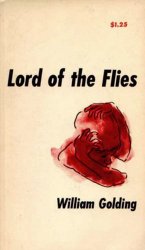
And even before the Orwell and Huxley novels, I decided, a good place to start would be that perennial highschool assignment, William Golding’s Lord of the Flies. It’s always been in the back of my mind as exhibit A to PvC #9: “In the event of any kind of species ‘reset’ … humankind would be left only with the evolutionary motivations given toward tribalism, the value of narratives over evidence, and the susceptibility toward supernatural perceptions, that preceded them – i.e., baseline human nature, optimized for animalistic survival.”

Lord of the Flies doesn’t exhibit that full range, but it does illustrate the erosion of social community into tribalistic savagery.

The book is so well-known I needn’t provide more than a cursory summary. Published in 1954, it describes a planeload of kids, all boys, all British, whose passenger cabin [apparently not the plane itself] crashes on a remote Pacific island, with no adults. The main characters, all about 12 years old or younger, are fair-haired Ralph, who assumes command with a totemic conch; fat Piggy, with asthma and specs; red-haired Jack, leader of a group of choirboys; and Simon, one of the choirboys who suffers some medical condition, perhaps epilepsy. The initial goals of the boys include building shelters and maintaining a fire at the top of the island’s mountain, to generate smoke and attract rescue. But there are rumors of a ‘beast’ on the island, and rivalry grows between Ralph and Jack.

(The book is just barely science fiction, in that it implies an atomic war that has both stranded the boys on the island and inhibits their rescue.)

A dead airman from some overhead battle parachutes onto the island, at night, and when glimpsed by the boys seems to confirm rumors of a ‘beast’. Meanwhile Jack and his choirboys become hunters, withdraw their group from the others, wearing clay warpaint, and become termed ‘savages’ in the book’s narrative.

Simon, the mystic, has a (perhaps epileptic) vision of a “Lord of the Flies”, a dead pig’s head mounted on a spike, that speaks to him of the real beast within them all; later, Simon ascends the mountain, discovers the truth about the dead airman, and descends to the beach to tell everyone about it, just as the hunters are reveling in meat and dance and chants — “Kill the beast! Cut his throat! Spill his blood!” — and, mistaking him for the beast, attack and kill him.

With Piggy’s specs the only source of generating fire, Jack’s forces raid Ralph’s friends on the beach, and then reject Ralph’s appeal for civility by rolling a boulder from their “castle rock” [fun fact: thus the name of Stephen King’s production agency] that kills Piggy. Ralph realizes he is their next target, and wakes in the morning to discover the hunters have set the entire jungle on fire, to smoke him out. He flees through the burning forest, landing on the beach, to discover a Naval officer there, rescue having been attracted by smoke from the fire.

\\

The book is popular in high schools because of its startling theme — being stranded on a desert island away from adults seems a lark, but it quickly turns sour, then savage — and for its relatively easy parsing into symbols, via the characters, the conch, the social roles. I remembered all that.

What struck me this time (the last time I read the book was in 1991) was that it’s a book full of mysterious passages. Some of these make more sense later on; others just provide perspective in a way that is only tangential to the book’s theme. These include:

  • The end of Ch3, a detailed passage about how Simon crawls into the bushes, to be alone, for the first time, and you don’t quite understand why;
  • p103-104 [page numbers are in the ancient Capricorn Books edition that I have, as yellowed as the internet image of the book I found and is pictured above, in which the entire text of the novel goes only 187 pages], as Ralph recalls his family’s house on the moors, and his childhood comforts;
  • Most especially, a long passage in which Ralph, on the far side of the island from the reef, looks out onto the ocean, p102:


    Down here, almost on a level with the sea, you could follow with your eye the ceaseless, bulging passage of the deep sea waves. They were miles wide, apparently not breakers or the banked ridges of shallow water. They traveled the length of the island with an air of disregarding it and being set on other business; they were less a progress than a momentous rise and fall of the whole ocean.

    This is the perception of wonder, of the mysterious, of the inhuman.

This last recalls to me Einstein’s famous quotation:

The most beautiful thing we can experience is the mysterious. It is the source of all true art and science.

To know what is impenetrable to us really exists, manifesting itself as the highest wisdom and the most radiant beauty, which our dull faculties can comprehend only in their most primitive forms—this knowledge, this feeling is at the center of true religiousness.

I would characterize, or extend, this as: the mysterious is the perception of an order of things that exists independently of humanity, and our wonder about what that order might be. It seems illustrated in Ralph’s perception of the vast, uncaring ocean.

Then of course there is a central key scene, in which Simon seems to talk to the “Lord of the Flies”, a dead pig’s head mounted on a stick and covered with flies. As Simon sees it, “his gaze was held by that ancient, inescapable recognition”, p128.2, and the Lord speaks to him, p132-133, “Fancy thinking the Beast was something you could hunt and kill! … You knew didn’t you? I’m part of you?”

This is mysterious, but it’s also pretty plain, and the author isn’t coy in revealing his theme. Another thing I noticed this time are the recurrent mentions of Ralph, ostensibly the sensible leader, feeling that his own thinking is going haywire. p70.7: “He lost himself in a maze of thoughts that were rendered vague by his lack of words to express them.”; p100.1: “A strange thing happened in his head. Something flittered there in front of his mind like a bat’s wing, obscuring his idea.”; p131.4: he is “puzzled by the shutter that flickered in his brain”. He has to keep reminding himself how to think rationally, as his compatriots become more and more irrational.

\\

Two technical comments: first, the island is described as being built of pink granite. This seems unlikely for a remote Pacific island, which are more typically, uniformly I think, volcanic.

Second, I’m sure I read somewhere how Piggy’s specs could not have been the types of lenses that could have been used to focus the sunlight and light a fire.

Story trumps.

\\

Then we come to the book’s central theme, or thesis, which the author spelled out, handily enough, shortly after publication (given in E.L. Epstein’s notes in my edition):

The theme is an attempt to trace the defects of society back to the defects of human nature. The moral is that the shape of a society must depend on the ethical nature of the individual and not on any political system however apparently logical or respectable.

He goes on to compare the rescue by the adults from the Naval cruiser with the “same evil” as life on the island, since the cruiser itself is built to act in a larger, global, conflict, to hunt enemies. “And who will rescue the adult and his cruiser?”

Based on the evidence of late 20th century and early 21st century science, though, I think his central premise is backwards, his moral quoted above. The evidence of modern neuroscience, of evolutionary psychology, suggests that this “same evil” is not actually a defect. It’s not a bug, it’s a feature.

The ‘savagery’ that the boys descend into isn’t “evil” or some kind of primal “sin” – it’s a survival strategy. And it’s present in all of us (just as Simon perceives), along with a vast suite of other survival strategies, built into us by evolution, ready to manifest themselves as needed depending on the circumstances the individual finds itself, whether alone in a jungle or forced to cooperate with a family, a tribe, a larger group. It *is* a function of social and political systems to temper individual selfishness (which survives in everyone, everyone’s temptation to cheat whenever they can, in minor and major ways), which sure enough would erupt in the event of a complete breakdown of social order (e.g. a worldwide catastrophe of some sort).

This survival strategy, this final resort to last-resort measures, isn’t “evil”, except in a context in which it does not apply. It’s what’s needed for individuals stranded in desperate situations to survive, at all, and then to survive and be able to reproduce — which would happen to pass that strategy on. Without it, calm, ‘civilized’ individuals and tribes, faced with circumstances of starvation in the face of, say, an ice age, would have perished. Did perish. The ones who didn’t perish, and are still here, are the ones who had those ‘savage’ resources to stay alive, and perpetuate the race that exists today.

(This reminds me that Golding’s second novel, after Lord of the Flies, was The Inheritors, a fiction of ancient history about a tribe of calm Neanderthals facing the onslaught of Homo sapiens, which might well illustrate the point I just made; but I read that one too long ago, and need to revisit it.)

E.O. Wilson described this tension between civility and savagery as a result of multilevel selection that pits kin selection against group selection – as quoted in this post (scroll down to chapter 3) reviewing one of his books,

Within groups selfish individuals beat altruistic individuals, but groups of altruists beat groups of selfish individuals. Or, risking oversimplification, individual selection promoted sin, while group selection promoted virtue.

Posted in Book Notes, Evolution, Species Reset | Comments Off on Rereading LORD OF THE FLIES

Zuckerman on Evangelical Immorality

Phil Zuckerman on The Immorality Of Evangelical Christians In The Age Of Trump.

Donald Trump has proven himself – by the hour – as a cold, heartless lover of lies and hater of humanity.

And 81% of white Evangelicals voted for him.

That’s right: those Americans among us who claim to love Jesus the most, who attend church the most, and read the Bible the most, and pray the most, and claim to be the most loving of God, are largely responsible for making this pock of a man the leader of our country, who is already causing – and will continue to cause — an inordinate amount of flagrant deception, pain, misery, violence, and immorality in our nation and the world.

And to top it all off, these Evangelical Christians have the perpetual gall to take the moral high-ground. They claim that they vote their values. They claim that secular people are immoral. The sanctimony reeks almost as bad as the hypocrisy.

(…)

Morality is a very simple thing: it is about alleviating the pain or suffering of sentient beings, helping when one can, not harming others, and treating people the way you yourself would want to be treated. End of story. Given this very simple and obvious explication of morality, we can clearly see Evangelical Christianity for what it really is, at least in its North American, early 21st century incarnation: immoral, uncaring, and blatantly harmful. Let’s consider some obvious examples…

He goes on to discuss banning refugees, healthcare, global warming, and so on.

Oh, well, they do care about fetuses. That’s true. They care about them so much, that everything else – from global warming to a lying, incompetent twitter president, from racism to gun violence, from Native American rights to corporate cronyism – don’t matter at all.

Recommended by this author: Living the Secular Life: New Answers to Old Questions. My review here.

Posted in Morality, Religion | Comments Off on Zuckerman on Evangelical Immorality

Anne Fadiman: EX LIBRIS

Here’s a pleasant, ‘occasional’ book of short essays about reading and books — a book about books. The author is the daughter of the famed Clifton Fadiman, an editor for Encyclopedia Britannica, an editor for Book-of-the-Month Club back in the day, and author of, among other things, The Lifetime Reading Plan, one of those volumes comprising intellectual ambition that I have occasionally dipped in to over the course of my life, and a radio and TV personality.

Anne Fadiman, one of his two children, was editor of The American Scholar for a time and published a small handful of books, including an award-winner about a Hmong family dealing with the American medical system.

I saw a reference to this book, Ex Libris, in the paper a week or two ago, and realized I had a copy of it, on my own shelf of books about books. It’s a small tidy book, like the image here except without the “National Bestseller” brag at the top or the review quote at the bottom, since mine seems to be a first edition.

It comprises 18 short essays on various bookish topics, such as:

  • How two bookish people combine their libraries upon getting married and living together; how to decide which ‘duplicates’ to dispose of;
  • Confronting a set of multisyllabic words which most people didn’t know (diapason, grimoire, mephitic, aspergill, etc.)
  • How most bibliophiles have an ‘odd shelf’ on some specific topic; hers is about polar explorations
  • Writing sonnets, and how she realized as an adult that her early work didn’t cut it
  • How people treat books—leaving them face down, etc—as a contrast between courtly love vs carnal love; the latter write in their books, turn down the page corner, etc. [I am courtly. I never write in books, never turn down page corners. If you see a book in my entire, vast library, that looks as if it’s been read, it’s because I bought it, used, that way.]
  • An old book from 1886 about ‘true womanhood’
  • Flyleaf inscriptions, and how they survive when books are sold or given away
  • Reading books in the location where their events took place, e.g. Thoreau at Walden Pond, etc.
  • The problem of gender pronouns; author disapproves of most solutions; how she encountered the word ‘ms.’ without realizing how to pronounce it, back in the day.
  • How her family proofreads restaurant menus, and signs, and instruction manuals
  • Fine pens with black ink, not pencils or computers
  • Books about food
  • About plagiarism, in an essay that uses footnotes and elaborate references to justify anecdotes or instances of reference or tribute
  • How the author loves to read catalogs that come in the mail
  • Building castles from books as children; children who grow up w/o books
  • Reading out loud
  • A pamphlet by 19th century English prime minister Gladstone about arranging books – anticipating the shelving system on wheels invented much later, and famously used by Charles N. Brown (and Robert Silverberg) in their home libraries
  • Visiting a used bookstore and how opportunities there are unlike shops with new books
  • Recommended reading – other books about books

I have two takeaways. First is the one reference in the book to science fiction. Anne’s father had a vast library, and on p124 she discusses it, and mentions, “The only junk, relatively speaking, was science fiction.” She doesn’t say what books.

Second — the running theme of the book is her childhood as growing up in a family that was literate, that reveled in books, that gained a thorough, pervasive, assumed state of familiarity about world literature. (Not including certain genres…) That’s a fascinating alternative-history fantasy for me; I’m the only one in my family, and the only one in my adult family, who’s interested in books and literature. I’m the outlier.

Posted in Book Notes | Comments Off on Anne Fadiman: EX LIBRIS

Links and Comments: Loyalty, Defiance, Imagined Realities

A revealing piece in today’s Slate: The Only Truth Is Trump, in which William Saleton reveals the subtext of Kellyanne Conway’s response to the Flynn debacle. His points:

  1. Loyalty within Trump’s circle is more important than loyalty to country.
  2. The only information that matters is what comes from Trump’s circle.
  3. The only standard of right and wrong is what Trump thinks.
  4. Trump’s secrets are as sacred as the country’s secrets.

This is autocracy, not democracy. Tribal loyalty, not adherence to the constitution, the law, reality.

On every principle—loyalty, secrecy, truth, right and wrong—Trump’s circle acknowledges only one standard and one master: Trump. That’s why the catastrophe of this administration won’t end with Flynn’s departure, or even with an investigation of Trump’s ties to Russia. It will end only when Trump is impeached and convicted.

\\

Related is a piece on one of the NPR/PRI radio shows I listen to most days, a talk with Yale University professor Jason Stanley, author of a book called How Propaganda Works.

He quotes Hannah Arendt (author of The Origins of Totalitarianism):

What convinces masses are not facts, and not even invented facts. But rather, open defiance. The movement is, the leader speaks, and you’re a follower if you repeat what the leader says. And that’s attractive.

This goes back to Bush’s “we’re not a reality based administration.” Karl Rove: “We’re an empire now, we create our own reality.” Always rooted in conservative, Republican administrations. (Since conservatives in general are more prone to imagined realities, and almost no scientists, whose devotion is to reality, are conservatives.)

Thus the familiar phrase, “Reality has a liberal bias.”

Posted in Conservative Resistance, MInd | Comments Off on Links and Comments: Loyalty, Defiance, Imagined Realities

Links and Comments: Human Biases and Christian Superstition

Friendly Atheist: What Caused the Oroville Dam Crisis? Some Christians Online Blame CA Liberals for Defying God.

Here in California our several years of drought have ended (at least in the northern part of the state) in so much rain that an enormous reservoir is threatened to overflow.

The reaction of some Christians is a typical self-serving superstition, the flip side of the claim by numerous evangelical leaders that the election of Donald Trump was due to divine intervention, e.g. Todd Starnes: ‘I Believe That We Experienced Divine Intervention Last November’. The way this mental fallacy works is that, whenever anything you approve of happens, you attribute it to God being on your side; whenever something bad happens to people you don’t like, it’s God taking his revenge. (And you ignore all the contrary cases, either way, like California’s abundant economy or tornadoes demolishing churches in southern states.)

Yes all humans are susceptible to such self-serving patterns of thought. But some cases like this it’s hard not to conclude that Christians who say such things are just not too bright. The area threatened by the dam overflow is inland California, a region far more conservative (and Trump supporting) than the coastal cities… which are in no way threatened.

Posted in MInd, Supernatural | Comments Off on Links and Comments: Human Biases and Christian Superstition