Links and Comments: Autism and the Perception of Reality

Two recent items about autism. First, at Alternet, Florida Principal Tries to Quietly Ban Book to Appease Christians, Sets off Sh*tstorm Instead, in which said principal responded to a “handful of Christian parents” who objected to the acclaimed 2003 novel The Curious Incident of the Dog in the Night-Time by Mark Haddon, a mystery story about an autistic boy. The parents objected because of the boy’s matter-of-fact skepticism about “adults’ struggles with faith and a belief in God”.

And then this, in Time Magazine: Autism Is Not a Disorder — It’s an Opportunity. (Alas, it’s subscriber content only.) The short piece reflects the growing understanding that autism is not some horrible affliction that ruins your child’s life forever (and jeopardizes any potential progeny), but rather just “one end of a bell curve” of human character traits, by way of a new book by Steve Silberman, NeuroTribes: The Legacy of Autism and the Future of Neurodiversity. The flip side of the current alarm over autism is that many geniuses of music and math throughout history would have been diagnosed, by current standards, as autistic. Time: there are

families learning to embrace the challenges that define autism–because along with those challenges comes a ferocious focus that could produce a musician or a computer whiz or even a genius like [Henry] Cavendish. … Of course, raising a wunderkind is hardly the reward that awaits every parent of an autistic child. But raising a child who will touch and move and mystify you like no other person in your life, who can see the world through a slightly inclinced prism and show you colors beyond the visible spectrum — that’s not so rare. Neurodiversity..isn’t always easy. But it is often grand.

Somewhere a while back I linked an item that made the point that autistics were not only less adept at social interactions, but also less inclined to believe in God or accept other supernatural explanations. There’s a crucial link here, in that — as outlined — human culture depends on certain biases of the human mind that are advantageous for evolutionary survival, but are not in fact accurate perceptions of the real world.

On a related note, the frequent complaints by religious parents who don’t want their children exposed to any views that would challenge the parents’ religious faith is analogous to the issue of “trigger warnings” on college campuses, about which there’s a big essay in the current issue of The Atlantic, the idea that students should be shielded from any concept they might upsetting — in effect, a kind of “conservative resistance” from the left. I can see points to make on both sides of this issue, and will do so in a future post.

I read the Haddon novel some time ago, and I think I need to reread it.

Posted in Children, Conservative Resistance, Culture, MInd, Religion | Comments Off on Links and Comments: Autism and the Perception of Reality

PvC Bibliographies

I’ve begun expanding the Resources and Bibliography sub-page to my Provisional Conclusions, this past week, and have discovered how compiling such a bibliography helps to focus my thoughts about what books, out of my sizable library, are most relevant to my ongoing project. (Note that in this bibliography there are a few titles I have not actually read yet, but intend to, before drawing any conclusions.)

On the same note, Sunday, yesterday, while busy with family matters, I realized I needed to re-examine and sort my shelves of sf/f-related nonfiction. (There’s a certain benefit in moving the focus of one’s daily activities from the matter at hand; somehow the mind processes issues in the background and presents conclusions one might not have reached deliberately; which is why weekends mostly away from my desk and computer can often result in conceptual progress (as well as, of course, providing attendant worthwhile virtues.) There is a section of my library, occupying not quite two full bookcases, of some — let me pause to do a typical shelf count and multiplication — 500 volumes ranging from author biographies and studies, to encyclopedia, to histories of sf/f/h, to books about how write sf/f/h, to collections of reviews (Blish, Knight, Clute, Wolfe), to bibliographic compilations and reading guides, to — finally, what I think I’m most interested in currently — general studies about the meaning and intent of the literary forms of sf/f/h. It’s these last, currently, that I find most relevant to my exploration and expansion of my Provisional Conclusions. Though I think that, unlike the nonfiction references on the Resources & Bibliography page, I will not post partial in-work bibliographies of SF/F/H fiction works, and how they relate/illustrate/inform those PvCs. That will be a slow and steady long-range project.

Posted in Provisional Conclusions | Comments Off on PvC Bibliographies

Bay Heat

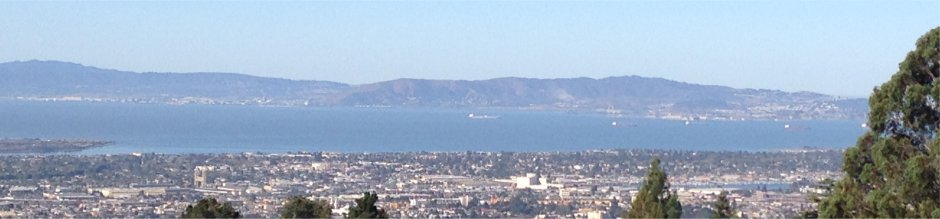
It was a hot and hazy weekend, very unusual for the Bay Area. When I stepped outside at 7am Saturday morning to pick up the newspapers from the driveway, there was a distinct smell of smoke in the air, as of nearby fireplace smoke (though surely no one uses wood-burning fireplaces anymore, not in California, not in the drought) or a nearby brush fire. I didn’t see any smoke in the air, and I checked the local news sites and found nothing, so it wasn’t until mid-day that I saw news about how the big fires 100 miles north of the SF Bay Area were still burning and because of weather patterns, the smoke was blowing south all across the bay.

We (Yeong, I, and Jimmy, Yeong’s older son, now living with us) attended a surprise birthday party for friends, down in Los Gatos, in the unusually warm heat. Because of the heat — in the 90s around the Bay, over 100 inland (Livermore etc), very rare — there was a smog advisory, officials asking people to drive less. Sunday was a bit less hazy, but still warm, and so we skipped our usual weekly hike, and watched the DVD of “The Lego Movie” in the early afternoon instead, before shopping and dining in the Pacific East Mall.

Posted in Personal history | Comments Off on Bay Heat

Ken MacLeod on Science Fiction

Terrific essay by Ken MacLeod, at a site called OpenDemocracy/Transformation, which is called Science fiction: taking science personally.

I say it’s terrific because it expresses my own thoughts that science fiction is mainly a way of thinking about the world. The essay describes Ken and Iain Banks chatting in a pub with another writer.

We explained that SF was the language we used to engage with big questions: the dizzying vistas opened by science and technology; how societies work and how they change; what might yet be and what might have been. At its strongest, strangest moments SF gives its readers what some of them call ‘the sense of wonder’ – that distinctive, addictive kick of the sublime which comes from vividly imagining oneself in the presence of the immense: deep time, deep space, and natural or artificial objects of gigantic scale or fascinating complexity.

This other writer thinks, “It sounds like science fiction is your religion.” Well, in a sense, as MacLeod says:

Like religion, SF gives us a symbolic relationship with a reality beyond, and yet intrinsic to and underlying, everyday life. That reality is the universe as we’ve come to understand it through science: vast, ancient, and indifferent; and inarguably there.
Where SF differs from religion is that the reality isn’t apprehended by faith, but by everyday sense and reason.

Exactly.

I’ll resist quoting more, but I appreciate the observation that in contemporary fiction, outside the SF genre, the realities of the universe “are barely acknowledged”. OK, one more quote:

In literary fiction, unless the plot demands Australia, the Earth might as well be flat. A novel as much influenced by the findings of current psychology and neuroscience as some 20th-Century fiction was by psychoanalysis has yet to be written…

And the para “These three features…”

Posted in science fiction | Comments Off on Ken MacLeod on Science Fiction

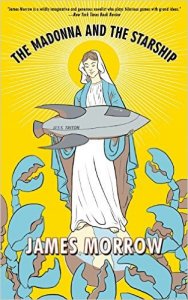
James Morrow, THE MADONNA AND THE STARSHIP

James Morrow’s short novel The Madonna and the Starship is one of a handful of short novels or long novellas released by San Francisco-based Tachyon Publications in the past couple years, others including two Nancy Kress titles that both won the Nebula and Locus Awards: After the Fall, Before the Fall, During the Fall and Yesterday’s Kin.

This Morrow short novel exhibits the author’s well-known skeptical worldview and satirical stance; see the excerpts from his recent Locus Magazine interview.

The book is a satirical, almost farcical, novel about 1950s TV, alien contact, and science vs. religion.

The narrator, Kurt Jastrow, is the lead writer of a ’50s live TV show called Brock Barton and His Rocket Rangers, whose each episode ends with a science lesson set in “Uncle Wonder’s Attic”, where Uncle Wonder is played by Jastrow himself. One day his TV monitor on that set is interrupted by an image of lobster-like creatures who announce that they, the Qualimosons, having monitored several TV transmissions from Earth, have decided to give him, Kurt Jastrow, their Zorningorg Prize, given to those who “champion reason”. They show up in person on Friday’s show, to present him with a crystalline trophy.

But then the Qualimosons chance upon the rehearsal of a religious show, Not by Bread Alone, written by Jastrow’s associate (and potential girlfriend) Connie Osborne, and, alarmed by the apparent existence of irrational people on planet Earth, offer to exterminate them.

Kurt and Connie are alarmed by that word. The aliens counter: how about “annihilate” or “massacre”? (p62)

The subsequent plot involves Kurt Jastrow amd Connie Osborne in a scramble to re-write the script within some 40 hours to convince the alien Qualimosons that Earth is not a cesspit of religious superstition. They succeed, of course, (by creating an alternate script for Sunday’s show, with the book’s title, that strives to find a middle-ground between the numinous and the nihilist), but with ironic consequences.

A delightful book, highly recommended.

Some citations. On p6, KJ’s uncle describes his pulp magazine collection: “The church of cosmic astonishment, Kurt. It’s the only religion you’ll ever need”

Here’s a typical example of the book’s arch dialogue, a passage in a taxi between the aliens and Connie, as Kurt and Connie are still trying to pretend to the aliens that Earth is entirely rational (p72-73):

“As I told your audience this afternoon, Qualimosa is in the throes of a civil war,” said Wulawand. “The first shots were fired two hundred years ago, after a clever young scientist, Professor Squatront, advanced a persuasive theory concerning the origin of our planet’s premiere species – and all its other life-forms as well.”

“Squatront argued that we could account for ourselves entirely through materialist evolutionary processes,” said Volavont. “Narratives of special creation by a Supreme Being were tales for children.”

“I’m thankful that no such controversy ever emerged here on Earth,” said Connie.

“You don’t know how lucky you are,” said Wulawand.

And this parody of S-fnal assumptions, p110, in which *of course* the aliens understand poker.

“The rules are so logical and self-evident that the game has evolved independently on many worlds, as did chess and mahjong,” said Volavont. “Seven-card stud, I daresay, is a universal constant, rather like electron mass and the speed of light.”

Another note: Saul Silver, the claustrophobic editor of SF mag Andromeda, for whom Kurt writes, who never leaves his apartment [I think this is based on a real 1950s editor, HL Gold? Not sure.], a couple times answers the phone with sarcastic phrases, e.g. “Planet Mongo, Ming the Merciless speaking.” (p165b).

This is funny because *my father* did this sort of thing when I was a kid, at least in jest; he would say “Kelly’s Pool Hall, Eight Ball Speaking.” I didn’t remember that until reading this book.

Posted in Book Notes, Religion, science fiction | Comments Off on James Morrow, THE MADONNA AND THE STARSHIP

Links and Comments: Fermi Paradox; books by Brian Attebery and Frank Wilczek; Religious suppression; Religious fantasy

NY Times, Dennis Overbye: The Flip Side of Optimism About Life on Other Planets. (The print version was titled “A Case for Why We’re Alone”.)

A consideration of the “Fermi paradox”: why, if by reasonable estimates there are likely millions of other intelligent species in our own galaxy alone, we’ve not seen any evidence of them. The angle of the piece is the take of Oxford philosopher Nick Bostrom, who thinks detection of any kind of life outside the Earth would be a “crushing blow”.

There must be something, he concludes, that either stops life from starting at all, or shuts it down before it can conquer the stars. He calls it the Great Filter.

You can imagine all kinds of bottlenecks in the evolution of life and civilization — from the need for atoms to first combine into strands of RNA, the genetic molecule that plays Robin to DNA’s Batman, to nuclear war, climate change or a mishap of genetic engineering — that could constitute a Great Filter.

The big question for Professor Bostrom is whether the Great Filter is in our past or our future, and for the answer he looks to the stars. If there is nothing else out there, then maybe we have survived whatever it is. As bizarre as it sounds, we are the first ones in the neighborhood to have run the cosmic obstacle course.

If there is company out there, it means the Great Filter is ahead of us. We are doomed.

This is a staggeringly existential piece of knowledge to have obtained at what seems to be a tender age as a species, based on a cursory examination of a sliver of our cosmic neighborhood. It is also a truly brave exercise of the power of human reason.

\\\\

Not sure I’ll read this, but this book, which just won a Mythopoeic Award, has a description that seems relevant to my PvC that fantasy, being the modern equivalent of myth-making, is about the subjective understanding of humanity’s place in the universe, as is religion; while science fiction is about the *attempt* to objectively understand humanity’s place in the universe, as is science. (Thus, I reject the occasional claim the SF is a subdivision of fantasy, just because they both deal with things that aren’t literally real.)

Amazon: Stories about Stories: Fantasy and the Remaking of Myth, by Brian Attebery.

The publisher’s description:

Myth is oral, collective, sacred, and timeless. Fantasy is a modern literary mode and a popular entertainment. Yet the two have always been inextricably intertwined. Stories about Stories examines fantasy as an arena in which different ways of understanding myth compete and new relationships with myth are worked out. The book offers a comprehensive history of the modern fantastic as well as an argument about its nature and importance. Specific chapters cover the origins of fantasy in the Romantic search for localized myths, fantasy versions of the Modernist turn toward the primitive, the post-Tolkienian exploration of world mythologies, post-colonial reactions to the exploitation of indigenous sacred narratives by Western writers, fantasies based in Christian belief alongside fundamentalist attempts to stamp out the form, and the emergence of ever-more sophisticated structures such as metafiction through which to explore mythic constructions of reality.

\\\

Slate reviews another book that sounds fascinating, and which I may or may not read. (Life is short.)

Slate: Wonder: A theoretical physicist searches for the design behind nature’s beauty

This is about A Beautiful Question: Finding Nature’s Deep Design by Frank Wilczek (a Nobel Prize winner in physics, for what that’s worth).

History books reveal that humans have always built their civilizations around two things: an obsessive desire for beauty and an analytical quest for truth. It’s a classic tale—the artist and the scientist, two halves of society. Wilczek tries to marry the two, arguing that they are one and the same: A search for the scientific is a hunger for the beautiful. Beauty is order, and order is beauty. His argument isn’t spiritual, but based on fact—as an agnostic, the author steers well clear of religion, and the result is a bracing meditation that leans convincingly on hard science.

\\\

PvC support: BBC: Bangladesh blogger Niloy Neel hacked to death in Dhaka. This is the fourth murder of a secularist blogger in the past year, in Muslim Bangladesh. Center for Inquiry responds here.

\\\

One political post for today (I’m saving up others): Mike Huckabee loves science, as long as he can make it up in support of his predefined worldview.

Fusion.net: There was a gross misunderstanding of basic science during the GOP debate

The writer comments,

I have a PhD in neuroscience and have never heard the term ‘DNA schedule’ before. This appears to be a concept that Huckabee — who has a degree in religion — has invented.

Posted in Conservative Resistance, Cosmology, Narrative, Physics | Comments Off on Links and Comments: Fermi Paradox; books by Brian Attebery and Frank Wilczek; Religious suppression; Religious fantasy

The Lottery and Jim and Mary G

I reread Shirley Jackson famous/infamous short story “The Lottery” this morning (you can find the full text here) and was struck by this passage, about 2/3 the way through:

“They do say,” Mr. Adams said to Old Man Warner, who stood next to him, “that over in the north village they’re talking of giving up the lottery.”

Old Man Warner snorted. “Pack of crazy fools,” he said. “Listening to the young folks, nothing’s good enough for them. Next thing you know, they’ll be wanting to go back to living in caves, nobody work any more, live that way for a while. Used to be a saying about ‘Lottery in June, corn be heavy soon.’ First thing you know, we’d all be eating stewed chickweed and acorns. There’s always been a lottery,” he added petulantly. “Bad enough to see young Joe Summers up there joking with everybody.”

“Some places have already quit lotteries.” Mrs. Adams said.

“Nothing but trouble in that,” Old Man Warner said stoutly. “Pack of young fools.”

The story (not this particular passage as such) reminded me of a relatively obscure story by James Sallis, a one time SF writer (albeit in the soft, ‘new wave’ fashion of the late ’60s) called “Jim and Mary G”, that first appeared in one of Damon Knight’s Orbit anthologies — you can read it via a Google Books excerpt.

“It’s best this way,” she said. “He won’t have to suffer. It’s the only answer.”

What’s similar about the two stories is that in each case there’s some unspoken justification for the rules of society or behaviors of the characters, that play out in ways that are deeply unsettling to contemporary readers looking in on those societies. (In the Library of America’s Shirley Jackson volume, there’s an essay by the author about that story and the reactions it provoked from readers of The New Yorker, where it first appeared in 1948, reactions mostly along the lines of “I’m cancelling my subscription!” and “How dare you?”, and a few such as “Are there actual places where kind of thing happens?”, but virtually none of them infering any kind of insight about the assumptions of society that they obviously felt so violated. And I dimly recall there being shocked reader reactions to Sallis’ story too.)

Posted in Culture, Morality, science fiction, Short Fiction | Comments Off on The Lottery and Jim and Mary G

Stephen King, REVIVAL

I enjoy Stephen King’s novels, but he writes too many of them (one or two every year) for me to keep up with all of them, and so I tend to get to only every third or fourth book, whenever the book’s theme appears at least vaguely science-fictional (the last one I read was 11/22/63), or some other aspect of the book seems interesting. I decided to read Revival because a key plot point — hardly a spoiler, it’s alluded to in the front flap description — involves a small-town minister’s ‘deconversion’ from faith following a family accident. I was curious how this would play out fictionally, since I’m always fascinated by how people (not just religious people) justify their beliefs or unbeliefs.

The story is narrated by Jamie Morton, beginning in 1962 when he’s 6 years old [and thus very close to my own age], and then forward across the decades to the present year. In 1962 Rev. Charles Jacobs, a new, young, minister comes to Jamie’s small Maine town of Harlow, with a beautiful wife and charming kid and a hobbiest obsession with electricity. A couple years later tragedy befalls, as alluded to, which leads to Jacobs’ delivery of what becomes known in town lore as the “Terrible Sermon”. Jacobs stands before his congregation and recites a litany of other senseless accidents (which challenge the idea of a loving, benevolent God) and then draws a series of conclusions (familiar to those of us who never found religious claims particularly plausible in the first place), e.g., he describes the many branches of Christianity — Catholics, Episcopalians, Methodists, Baptists, and on and on — and then says (p71m):

“Here in Harlow, w’ere all on party lines, and it seems to me that religion is the biggest party line of them all. Think how the lines to heaven must get jammed on Sunday mornings! And do you know what I find fascinating? Each and every church dedicated to Christ’s teaching thinks it’s the only one that actually has a private line to the Almighty. And good gosh, I haven’t even mentioned the Muslims, or the Jews, or the theosophists, or the Buddhists, or those who worship America itself just as fervently as, for eight or a dozen nightmare years, the Germans worshipped Hitler.”

Members of the congregation begin to walk out. Jamie, our narrator, narrates (p72.2):

My mother was sobbing audibly, but I didn’t look around at her. I couldn’t. I was frozen in place. By horror, yes, of course. I was only nine. But there was also a wild, inchoate exultation, a feeling that at last someone was telling me the exact unvarnished truth.

Jacobs goes on, and concludes (p73.3, 74.3):

“But as I stood in the back room of Peabody’s [the funeral parlor] and looked down at the mangled remains of my boy, who wanted to go to Disneyland much more than he wanted to go to heaven, I had a revelation. Religion is the theological equivalent of a quick-buck insurance scam, where you pay in your premium year after year, and then, when you need the benefits you paid for so–pardon the pun–so religiously, you discovery the company that took your money does not, in fact, exist.”

“Just one more thing. We came from a mystery and it’s to a mystery we go. Maybe there’s something there, but I’m betting it’s not God as any church understands Him. Look at the babble of conflicting beliefs and you’ll know that. They cancel each other out and leave nothing. If you want the truth, a power greater than yourselves, look to the lightning — a billion volts in each strike, a hundred thousand amperes of current, and temperatures of fifty thousand degrees Fahrenheit. There’s a higher power in that, I grant you. But here, in this building? No. Believe what you want, but I tell you this: behind Saint Paul’s darkened glass, there is nothing but a lie.”

After which Jacobs walks out, and shortly the church deacons fire him, and Jacobs leaves town forever….almost. As the last-quoted passage suggests, the “Terrible Sermon” is a motivator for what Jacobs does over subsequent decades; the book isn’t about the validity of religious faith, it’s about the obsession of one person who’s lost his faith to pursue, via his obsession with electricity, a particular goal, and how his path, and the narrator Jamie’s path, come together again and again over the years.

Over those years, Jamie joins rock bands, becomes a druggie, encounters Jacobs and is cured of his addition to heroin via “secret electricity”, gets a job at a music studio in Colorado, attends a family reunion, and finds himself eventually drawn into Jacobs’ employ; Jacobs, meanwhile, uses his electrical apparatus (which he used to apparently cure Jamie’s brother of a lost voice, early on), goes from carnival sideshow event, to revival preacher who cures people’s ailments, with millions of followers, eventually to wealthy recluse back near Jamie’s hometown. And so the two characters come together at the end, with a Grand Guignol climax involving lightning strikes (see book cover) and Jacobs’ obsession with the fate — in light of his loss of faith — of his wife and son.

Here’s what I like about Stephen King books, no matter what the subject. King has an ironclad grip on American culture and its people: he understands how all kinds of people think and interact, as if he’s been everywhere and seen everything; he evokes times and places with specific references to places and product names in ways that underscore his authority as a storyteller [yet which might prove problematic for future readers who don’t recognize such references], again, as if he’s been there and done that. And there’s always a complexity to his characters with emotional repercussions. In this book, the protocols of small town life; a charming family reunion in which Jamie’s grand-niece takes to him; a heartbreaking coda concerning one of Jamie’s family members…

Let me quote a couple more passages. This one, p373m, out of context, by narrator Jamie:

At the heart of every established religion is one sacred mystery that supports belief and induces fidelity, even to the point of martyrdom. Did he [Jacobs] want to know what lay beyond death’s door? Yes. But what he wanted more — I believe this with all my heart — was to violate that mystery. To drag it into the light and hold it up, screaming Here it is! What all your crusades and murder in the name of God were for! Here it is, and how do you like it?

Another, p270m, in which Jamie has challenged Jacobs’ role as a faith healer. Jacobs says

“They don’t deserve the truth. You called them rubes, and how right you are. They have set aside what brains they have — and many of them have quite a lot — and put their faith in that gigantic and fraudulent insurance company called religion. It promises them an eternity of joy in the next life if they live according to the rules in this one, and many of them try, but even that’s not enough. When the pain comes, they want miracles. To them I’m nothing but a witch doctor who touches them with magic rings instead of shaking a bone rattle over them.”

To which narrator Jamie thinks,

My researches with Bree had convinced me that Fox Mulder was right about one thing: the truth is out there, and anyone in our current age, where almost everyone is living in a glass house, can find it with a computer and an Internet connection.

At the risk of closing this review on a discordant note, I appreciate this last sentiment. In one sense, it’s true: the internet provides information and knowledge on absolutely everything. But what King’s characters don’t note is that most people don’t care — at most they’re only interested in finding other like-minded ‘truths’ out there on the Internet that correspond with their own. This is a whole ‘nother subject.

So final note: Jacobs’ obsession with “secret electricity” is attributed to his research into various “forbidden books” by the Catholic Church, including especially De Vermis Mysteriis, “supposedly the bases of H.P. Lovecraft’s fictional grimoire, called The Necronomicon” (p336t). In the novel, Jamie verifies all this on Google. But of course, this is a novel; it’s fiction. Wikipedia: De Vermis Mysteriis was in fact the invention of author Robert Bloch, later best-known for the novel Psycho, basis for the Alfred Hitchcock film. But which did inspire H.P. Lovecraft.
Posted in Book Notes, Religion | Comments Off on Stephen King, REVIVAL

Links and Comments: Biblical Literalism; the Manhattan Option; the excessive optimism of 2001; Neil de Grasse Tyson explains everything

Adam Lee: So Wrong For So Long: On Liberal Biblical Reinterpretation

Lee discusses the cognitive dissonance of those who espouse progressive social views while maintaining fealty to their Biblical-based religions. They rely on relativistic interpretation of scripture, as if the words of the Bible don’t actually mean what people for most of two millennia have thought they meant.

If God wants LGBT people to be given equal rights, why didn’t he say so thousands of years ago? Why is that something he revealed only in the modern era – say, within the last forty years – ensuring that they were objects of hate, harassment and persecution for centuries before that? Why did he allow that injustice to continue for so long before finally delivering the revelation that would gradually end it? Whether you believe that the anti-gay verses in the Bible were God’s word but have been misinterpreted all along, or whether you believe God never had anything to do with them but that they were put there by fallible humans, the problem holds either way.

The same thing could be said about slavery, or the inequality of women, or racial segregation, or anti-Semitism, or any of the countless other evils that were justified in their day by citing holy books and the will of God.

Adam Lee also explores the idea of The Manhattan Option, a follow-up to the “Benedict Option”, in which Christians withdraw from wider society into their own, insular communities. [Though isn’t this mostly true in practice in most small towns throughout the ‘heartland’, especially in the South? is my thought.] The “Manhattan Option” is

a defiant pledge to engage in civil disobedience against any law that transgressed their “religious conscience”. While the Manhattan Declaration pays lip service to the idea of helping the poor or ending oppression as religious duties, the two causes it treats as paramount are, of course, banning abortion and ending gay marriage.

(One more example of one of my PvCs.)

\\

Re: film, science fiction, the future.

This article at The Space Review, 1997, 2001, 1999: a science fiction calendar from the Apollo era makes the likely valid criticism of the canonical SF film 2001: A Space Odyssey was wildly over-optimistic, even for 1968, about its vision of huge orbiting space stations and cavernous landing pads on the Moon. With additional discussion of Lost in Space (a childhood favorite of mine) and Space: 1999 (which I never watched after the first episode, which took place on a Moon base “on the dark side of the moon”).

I have a small stack of books about past visions of the future, which in retrospect range from wildly optimistic (like the vision of 2001) to ludicrously implausible. This article might go with those.

\\

Physicist Sean Carroll responds to an io9 post by George Dvorsky, asking Why is the Universe So Damn Big?.

Whenever we seem surprised or confused about some aspect of the universe, it’s because we have some pre-existing expectation for what it “should” be like, or what a “natural” universe might be. But the universe doesn’t have a purpose, and there’s nothing more natural than Nature itself — so what we’re really trying to do is figure out what our expectations should be.

The universe is big on human scales, but that doesn’t mean very much. It’s not surprising that humans are small compared to the universe, but big compared to atoms. That feature does have an obvious anthropic explanation — complex structures can only form on in-between scales, not at the very largest or very smallest sizes. Given that living organisms are going to be complex, it’s no surprise that we find ourselves at an in-between size compared to the universe and compared to elementary particles.

File this under: why human perception is not necessarily an accurate guide to reality.

\\

Here is a video by Neil de Grasse Tyson that explains everything in the universe [as we currently understand it] in under 8 minutes.

Watch Neil deGrasse Tyson explain literally everything in the universe in under 8 minutes

This dovetails with the previous post — naive human ideas about how the universe should exist, according to human values. Anyone interested in reality, outside the tribal narratives that drive their evolutionary survival, should be curious about this.

File this under: the universe is large; human perception is not necessarily etc., especially on the point of the vast scale of the universe compared to what humans comfortably perceive.

I like this quote at the end:

“We’ve been empowered by the universe to figure itself out.”

Posted in Conservative Resistance, MInd, Religion, Science, science fiction, Space | Comments Off on Links and Comments: Biblical Literalism; the Manhattan Option; the excessive optimism of 2001; Neil de Grasse Tyson explains everything

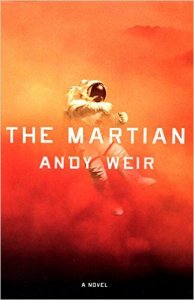
Andy Weir, THE MARTIAN

I don’t have a lot to say about Andy Weir’s THE MARTIAN, which I finally picked up because 1) it’s popular, having been on bestseller lists for months, and 2) Ridley Scott’s film version arrives on October 2nd (which Gary Westfahl will review for Locus Online). The book is much like the film Gravity — a series of disasters and survival challenges that you know our hero will overcome because he’s the hero and has to survive by the end (or else, in each case, there wouldn’t be the Hollywood movie). It might well make a brilliant, tension-filled, extravagantly staged Hollywood film. But as a novel…it’s boring. There are a couple unexpected plot twists, but little suspense given the set-up. The plot is about our stranded hero on Mars facing one challenge after another, every 30 pages or so, and of course he overcomes them all. It’s a great book for techies into endless details of jury-rigging broken-down spacecraft, or setting up chemical conditions to grow potatoes in Martian soil. I’ll be fascinated to see how that plays out in the film. The book grates in two ways: the character’s persistent wise-acre attitude, no matter what the circumstances; and the book’s obsession with 1970s pop culture, as if all the astronauts involved were born in the ’60s [as I’m guessing the author was, of course], rather than, presumably, about now. It’s easy to imagine these issues disappearing in the film.

Posted in Book Notes, science fiction | Comments Off on Andy Weir, THE MARTIAN