
Links and Comments: Religion and Science

The latest essay by Jeffrey Tayler at Salon, Bill O’Reilly’s nonsense “nihilism”: Now the Fox News host is even lying about God, addresses common misperceptions not just about the abstruse philosophical concept of nihilism, but about the general perception that atheists have no moral compass and so are given “anything goes”. Dangerous nonsense, as Tayler explains. It’s the religious extremists who are most willing to kill (and violate the Constitution, I would add, but that’s another post).

The gist of [O’Reilly’s] wrongheaded “Talking Points” memo is that atheists — or, in his twisted verbiage, nihilists — are self-centered, dangerous and even potentially murderous, because, for them, “anything goes.” This is a blundering, volitional misrepresentation of reality. It goes without saying that the terrorists of, for instance, Al Qaida and Boko Haram very much do not believe that “anything goes,” are among the most devout believers around, and, of course, are most willing to kill. As far as the United States goes, it is high religiosity itself that correlates with bad crime rates, deadbeat tax payers, poverty, rampant teen pregnancy, low education, a dearth of life opportunities, early death, and so on. Faith is, in short, part and parcel of a congeries of nasty ills every society should strive to extirpate.

And

The central tenets of the three Abrahamic faiths, which amount to statements about the nature of the world we live in, our place in it and how we are to treat one another, stem from no evidence whatsoever. Toss aside the magic books, the hocus-pocus prayer, the supernatural visions and the unverifiable instances of “salvation,” and you are left with a void. The words of the late Christopher Hitchens come to mind: “That which can be asserted without evidence, can be dismissed without evidence.” Rational individuals are not in the least obligated to take seriously, much less respect, (faith-based) propositions advanced without proof. And we may dismiss with especial vigor the solipsistic, quasi-deluded New-Age “My religion is true for me” dodge — which even O’Reilly has used, and in one of his (deeply self-embarrassing) interviews with Richard Dawkins, no less.

And concluding

Morality has arisen as evolutionarily propitious: that is, wherever there are humans, there are prohibitions against murder, rape, theft and so on. We would not have survived our plodding progression from African savannah to everywhere else, including the moon, without such prohibitions, which exist in all societies, Christian or not, and including those far older than our own. (Think India and China.) Now that we have developed enough to see through the sham religious norms we inherited from preceding generations, we can create our own — and we are doing so.

\\\

Meanwhile, there’s recently more alarm about scientific studies that aren’t replicated. Here’s a NYT op-ed essay, Psychology Is Not in Crisis, that provides a patient explanation of how science works.

Much of science still assumes that phenomena can be explained with universal laws and therefore context should not matter. But this is not how the world works. Even a simple statement like “the sky is blue” is true only at particular times of day, depending on the mix of molecules in the air as they reflect and scatter light, and on the viewer’s experience of color.

Psychologists are usually well attuned to the importance of context. In our experiments, we take great pains to avoid any irregularities or distractions that might affect the results. But when it comes to replication, psychologists and their critics often seem to forget the powerful and subtle effects of context. They ask simply, “Did the experiment work or not?” rather than considering a failure to replicate as a valuable scientific clue.

Posted in Religion, Science | Comments Off on Links and Comments: Religion and Science

Puppygate and the Progressive Nature of Science Fiction

Locus’ own Gary K. Wolfe pens an article for the Chicago Tribune about this year’s Hugo Awards/Puppygate kerfuffle: Hugo Awards: Rabid Puppies defeat reflects growing diversity in science fiction (if the site asks you to subscribe, try logging in with your Facebook or similar account; worked for me).

This strikes me as a reasonably balanced account of the past several months’ events, though similar accounts (from Blinks: Summaries of Hugo Awards results and attendant issues at Wired, Boing Boing, Wall Street Journal, and Slate) have been criticized — of course — by the Puppies as insufficiently sympathetic to their cause. What I appreciate about Gary’s take is summarized in the last three paragraphs, which note that history has left the Puppies behind, that science fiction is inherently progressive, and always has been.

The final irony in all this is that the Hugo Awards, while more diverse and international in recent years, have never really disdained the kind of adventure fiction that the Puppies claim to champion. I met the winning novelist, Cixin Liu, when he was in Chicago earlier this year, and he made it clear that his idols are classic writers like Robert A. Heinlein and Isaac Asimov. “The Three-Body Problem” itself concerns communications with an alien race, the Trisolarans, whose plan is to invade the Earth as a refuge for their own endangered civilization — surely one of the oldest plots in science fiction. John Scalzi, who became one of the chief targets of Puppy vituperation, is a white male who won the Hugo in 2013 for “Redshirts,” a space opera adventure with knowing references to “Star Trek.” Among the novellas bumped off the ballot this year by the Puppy slate was Nancy Kress’ “Yesterday’s Kin,” a well-written tale that begins with an alien spaceship parking itself over New York harbor.

The problem, I suspect, is that none of these works are only about revisiting these favored old tropes. Sometimes they satirize them (as with Scalzi). Sometimes they introduce political themes (as with Cixin Liu, whose novel opens with a harrowing account of China’s Cultural Revolution). Sometimes they focus on character and family relationships (as with Kress). What seems to threaten the Puppies is not that science fiction has forsaken its origins (which it clearly hasn’t), but that readers have come to expect more and to welcome different voices. The old-fashioned modes of space adventure and military science fiction still have substantial markets, but it’s probably true that such works show up less on Hugo or Nebula award ballots than their supporters would like.

There will always be readers in any genre who seek to celebrate the past, but awards — not always, but often — go to works that are seen as moving the genre forward in some way — they “ask the next question,” as the classic science fiction author Theodore Sturgeon once put it. Women, LGBT writers, international writers, writers of color, all have made measurable progress in the past few years of Hugo voting — but many still find it hard to get published, or are expected to focus on certain kinds of fiction simply because of who they are. The outright rejection by Hugo voters of the Puppy slate — a few of whom, it must be said, might deserve recognition on their own merits — is not a rejection of a particular mode of writing, but of bullying and bad behavior — and, frankly, bad fiction — and of an almost desperate effort to unravel the progress that has already been made, and that is still far from complete.

Posted in Human Progress, science fiction | Comments Off on Puppygate and the Progressive Nature of Science Fiction

Links and Comments: Religion and Education; Religions around the world; deGrasse Tyson on the history of the universe

ABC News: latest example of how religious groups reject education, because, of course: NYC to Probe Secular Education at Jewish Schools.

There was no science, no geography and no math past multiplication at the ultra-Orthodox Jewish school Chaim Weber attended. And the only reason he ever heard of the American Revolution was when a seventh-grade teacher introduced it as “story time.”

cf. Boko Haram, and any number of Christian colleges who swear fealty to the Bible, that compilation of Iron Age texts, ahead of any later understanding or acceptance of reality.

\\

Fascinating map by Business Insider about how the major religions have spread across the world, over the past millennia:

This animated map shows how religion spread across the world.

Virtually all peoples’ religious convictions are based on where they were born and bred. It’s about culture and tradition; not about reality.

\\

Neil deGrasse Tyson Explains the universe in 8 minutes. (Also via.)

Posted in Conservative Resistance, Religion, Science | Comments Off on Links and Comments: Religion and Education; Religions around the world; deGrasse Tyson on the history of the universe

Rereading Isaac Asimov, part 1

In the past three weeks I’ve read or reread (mostly reread, after decades) some 50 short stories by Isaac Asimov — not yet all of his most notable stories, by criteria of awards or number of reprints or critical discussions, but many of them.

Asimov, of course, was one of the most popular SF authors of the mid-20th century, especially for stories built around a couple big ideas — robots, and his far future Foundation stories, driven by his idea of psychohistory, that describe the downfall and rebuilding of a Galactic civilization. These ideas have had profound consequences on subsequent SFnal thinking, and the influence of SF on the greater world: many current, famous technologists and economists (e.g. Paul Krugman!) still cite these as influential to their careers.

Yet, after all these years, re-reading these stories, the first and most obvious thing to say is that many of these stories, especially those written at the very beginning of Asimov’s career, from 1939 and into the early 1940s, display crude pulp techniques that are embarrassing by contemporary standards. In particular, his characters were exaggerated and he was given to overuse of dramatic adverbs: characters are always speaking “savagely” or “viciously”; they drop their cigars (yes) to the floor in alarm; they pound their fists on the table in emphasis. Examples, from two stories, “Reason” and “Catch that Rabbit”, with page references in my SF Book Club edition of I, Robot [one of the earliest SF books I acquired!]:

P41.4: “There was still a yellowed square of parchment in his hip pocket, and he slapped it down on the desk with vicious force, spreading it flat with the palm of his hand.”
P42.2: “Donovan rubbed his red mop of hair savagely and expressed himself with bitterness.”
P79.6: “’Shut up!’, said Powell savagely.”
P80.0: “Donovan passed out the door, shaking his head viciously.”

Alas, this kind of prose is also evident in his most famous story, “Nightfall”, also written and published quite early in his career. The first line of that story is:

Aton 77, director of Saro University, thrust out a belligerent lower lip and glared at the young newspaperman in a hot fury.

Belligerent! Hot fury!

Asimov toned down this style fairly quickly, by the mid-1950s, as he either matured or recognized that there was a market for stories with relatively less histrionic prose, but this issue is the first sign that these stories would be difficult to recommend and relate to current readers.

Nevertheless– I would say, despite these issues, both “Reason” and “Nightfall” are significant stories, even important and profound stories, for reasons independent of their prose. As I will describe in subsequent posts.

(And I’ll note for now that, despite this issue, “Reason”, one of his earliest Robot stories, is reprinted in The Wesleyan Anthology of Science Fiction, published in 2010.)

Posted in Isaac Asimov, science fiction | Comments Off on Rereading Isaac Asimov, part 1

Links and Comments: Hand-Picked Truths and Moral Progress

First, taking the high road, an op-ed by NYT science writer George Johnson, in yesterday’s NYT Science section: The Widening World of Hand-Picked Truths. (The title in print was “The Gradual Extinction of Accepted Truths”.)

This speaks to the increasing divide between religious traditionalists and those who accept the “stunning advances in science”, triggered, Johnson suggests, by the infamous 1966 Time Magazine essay given the cover title “Is God Dead?”. The essay was not a denunciation of religion, Johnson says, but a calm consideration of “how society was adapting to the diminishing role of religion in an an age of secularization, urbanism, and, especially, stunning advances in science.”

Faith would steadily give way to the scientific method as humanity converged on an ever better understanding of what was real.

Of course this has not only not happened, the divide has gotten worse, fueled, as so much else, by the internet and the ability to filter reality to what other like-minded people think, never mind the eventually self-correcting process of science. I’m thinking this must be a consequence of some fundamental aspect of human nature, which, per PvC #2, is evidence of how the human mind is optimized not to perceive what is real, but to understand the world in only the terms that are advantageous for survival, in its many aspects.

Viewed from afar, the world seems almost on the brink of conceding that there are no truths, only competing ideologies — narratives fighting narratives. In this epistemological warfare, those with the most power are accused of imposing their version of reality — the “dominant paradigm” — on the rest, leaving the weaker to fight back with formulations of their own. Everything becomes a version.

With references to creationists (of course), anti-vaxxers, new thinking about autism [the new book by Steve Silberman, mentioned earlier and to be mentioned again], and native resistance to a new telescope on Mauna Kea.

The widening gyre of beliefs is accelerated by the otherwise liberating Internet. At the same time it expands the reach of every mind, it channels debate into clashing memes, often no longer than 140 characters, that force people to extremes and trap them in self-reinforcing bubbles of thought.

In the end, you’re left to wonder whether you are trapped in a bubble, too, a pawn and a promoter of a “hegemonic paradigm” called science, seduced by your own delusions.

My own thought is that people who can see outside their bubble understand that science *works* (thus technology), and appreciate the irony of all those who reject the “hegemonic paradigm” of science while using the internet, and the global positioning satellites that link it, which all depend on the science of the past century that refutes the ancient religious myths, to naively spread their bubble worldview.

//

Fascinating essay by Adam Lee, Is Religion Inherently Authoritarian?, which I missed a few weeks ago when it appeared on Alternet. Subtitle: “Compared to secular reasoning, the religious establishment has been slow to act when it comes to moral progress.” This supports my own PvC about the arc of moral progress, and how, of course, resistance to such progress is generally religious. Quotes:

Human history is a story of gradual moral enlightenment. Over the ages, we’ve become less violent, less xenophobic, more tolerant, more committed to the ideals of democracy and equality under the law. Of course, moral progress is painfully slow, with many holdouts and local reversals, and we have a very long way left to go. But it’s hard to deny that the world we live in today is less prejudiced and more peaceful than the world five hundred years ago, or even just one hundred.

But a noteworthy exception to this trend of progress is religion. Secular moral reasoning, founded on considerations of fairness and human good, allows for continual self-questioning and improvement as less-privileged groups speak out to demand justice and call our attention to evils that we’d been overlooking. In sharp contrast to this, the immutable doctrines of religion are supposed to be elevated above skepticism. Even if we know more or see farther than the clerics who once came up with them, religious authorities tell us that we should submit our wills and believe without questioning.

The result is that, in most cases, moral progress has left the churches behind. Like the tide going out and leaving once-submerged rocks high and dry on the shore, the archaic doctrines of conservative religion are increasingly isolated and exposed as the immoral and vicious absurdities they are.

Followed by many examples and links.

Posted in Culture, Morality, Religion | Comments Off on Links and Comments: Hand-Picked Truths and Moral Progress

Links and Comments: David Barton; Jeffrey Tayler

Salon calls out phony baloney historian David Barton: Meet the Tea Party’s evangelical quack: David Barton is Glenn Beck’s favorite “historian”

The larger issue here, of course, is about *narrative*: about how people need to adjust and retell history in order to make themselves feel special and important; and an example of how influential he is within certain Christian bubbles, who view history and reality as something special that they can control. Somehow it doesn’t matter to them that there is plenty of evidence, outside their bubble, that their narrative is self-serving and false.

Beginning in about 2011, two conservative Christian professors from Grove City College, Warren Throckmorton, professor of psychology, and Michael Coulter, professor of humanities and political science, published a critique of Barton’s The Jefferson Lies entitled Getting Jefferson Right: Fact Checking Claims about Our Third President. The book was received well by scholars, and the authors’ credentials as conservative Christians undermined Barton’s defense that criticism of his work was ideological rather than factual. The Jefferson Lies was withdrawn by its publisher. One might expect under the weight of such resounding rejection, Barton would disappear into obscurity. Yet Barton’s supporters remain as devoted as before. Criticism from scholars (whether Christian or not) is dismissed as liberal, socialist, and even pagan. Discredited in the larger culture, Barton remains influential in the conservative Christian subculture.

\\

Jeffrey Tayler at Salon keeps us grounded: Hatred is weaponizing Jesus: How violent evangelicals, faith-based con artists & serial abusers are using religion for the purpose of evil.

Such are the questions the tragicomic farce of religion presents us with. We know the answers. We need to act on the strength of our convictions, which must exceed in firmness the determination of the faith-deranged to impose their will on us.

This time, if we fail, we have everything to lose.

Posted in Religion | Comments Off on Links and Comments: David Barton; Jeffrey Tayler

Links and Comments: Dated and Offensive SF; Puppygate summaries

Will get back to posting about rereading Isaac Asimov shortly, but an initial comment I have is how embarrassing Asimov’s prose of the early 1940s was. I suppose it was the style of the era, and Asimov did grow out of it. Examples in my Asimov post. But it resonates with this:

Barnes & Noble: Jeff Somers on 8 Dated Science Fiction Novels That Are Still Essential Reading

Re: Asimov, Somers notes:

Although the scale of information dealt with is immense (the plot concerns the preservation of the sum total of human knowledge through a technological Dark Age), it’s somehow all stored on microfilm, and computers are basically depicted as larger versions of the 1950s-era machines Asimov was familiar with.

This entire piece suggests an intriguing paradox: the history of science fiction, being a history of often overtaken visions of the future, is as much a history of the past as it is a history of increasingly progressive visions of the future.

\\

Also relevant is this New Statesman piece by Liz Lutgendorff, I read the 100 “best” fantasy and sci-fi novels – and they were shockingly offensive. The list she read was compiled by NPR in 2011 by popular vote, which especially reveals nostalgia for older “classics”.

Nostalgia permeates the list. Of the books I read, there were more books published before 1960 than after 2000. The vast majority were published in the 1970s and 1980s. There were also many sci-fi masterworks or what were groundbreaking novels. However, groundbreaking 30, 40, 50 or 100 years ago can now seem horribly out of date and shockingly offensive.

Of course, the very fact that a modern reader has such reactions is evidence of the arc of moral progress —the greater inclusion of classes that were ignored or take for granted a century ago — in society in general, and of course in science fiction, which can’t help but reflect the social standards of the time when it was written.

\\

Several good summaries of the Hugo Awards results and the Puppygate kerfuffle at Wired, Boing Boing, Wall Street Journal, and Slate. The last item, by Jacob Brogan, is “What Ray Bradbury’s FBI File Teaches Us About Science Fiction’s Latest Controversies”.

Though Bradbury’s files speak to his commercial success, they offer no suggestion that it was driven by the introduction of any ideology, a communist one least of all. Instead, they show that his work was capable of upsetting established dogmas of many kinds. His Martian Chronicles, for example, feature the “repeated theme that earthmen are despoilers and not developers.” Elsewhere, the documents note—“without irony,” as MuckRock’s JPat Brown puts it—that Russian authorities had banned “The Fireman,” an early version of Bradbury’s Fahrenheit 451.

And

As Amy Wallace explains in her thorough account of the saga in Wired, the Puppies’ leaders claim they’re trying to bring SF back to simpler times. Pushing back against what they perceive as an elitist wave of liberal propaganda, they claim they “want sci-fi to be less preachy and more fun.” The Puppies’ brand of “less preachy and more fun” conservatism includes reactionary misogyny, homophobia, and racism, as Wallace and others have documented. At core, however, the Puppy movement was a call for a return to an imagined childhood—perhaps that of the genre, perhaps that of its readers. … Much as they might whine to the contrary, the Puppies aren’t angry about what science fiction has become—they’re uncomfortable with what it has always been. Science fiction has always made us imagine the world differently.

An earlier piece at Yes! Magazine, Sad Puppies, Rabid Chauvinists: Will Raging White Guys Succeed in Hijacking Sci-Fi’s Biggest Awards?, includes links to and excerpts from the writings of the ringleaders, including John C. Wright on proper gender roles and Theodore Beale on Blue SF vs Pink SF.

\\\

Ironically, a significant early Asimov story that betrays those pulpish prose patterns alluded to above, “Reason”, is included in the relatively modern The Wesleyan Anthology of Science Fiction, published in 2010. Useful link: Teacher’s Guide for The Wesleyan Anthology of Science Fiction, a 66-page PDF guide including, beginning page 33, “Discussion Questions” for each story in the book, e.g. for Asimov,

1. Is QT’s logic reasonable? Why or why not?
2. Robots are not supposed to experience emotions, yet QT often seems to do so. Also, the three laws of robotics mandate obedience to human beings, yet QT seems to flout these laws. How do you account for this apparent contradiction?

Also lots of Resource links….

\\\

One more item about China and SF:

Vox: Ezra Klein, How Google convinced China’s Communist Party to love science fiction. He recounts a story from Neil Gaiman’s conversation with Kazuo Ishiguro about genre fiction. The Chinese realized that

They were making things incredibly well but they weren’t inventing. And they’d gone to America and interviewed the people at Google and Apple and Microsoft, and talked to the inventors, and discovered that in each case, when young, they’d read science fiction. That was why the Chinese had decided that they were going to officially now approve of science fiction and fantasy.

Posted in Human Progress, Morality, science fiction | Comments Off on Links and Comments: Dated and Offensive SF; Puppygate summaries

Links and Comments: Reason; Morality; Wesleyan; Timeline; The Onion; Jeffrey Tayler

Today, a collection of posts I’ve not read in detail, or do not have time to comment upon in detail, but wish to save for future reference.

Science on Religon: Connor Wood: Reason™ is not going to save the world

Alternet: Valerie Tarico: Why Atheists Are as Moral as Any Religious Group: An interview with a sociologist of religion and non-belief

And here are a couple useful links about science fiction.

PDF Teacher’s Guide for The Wesleyan Anthology of Science Fiction

io9: Look At How Science Fiction Maps Out Our Future World: someone’s timeline about numerous SF novels and stories mapped out along a future timeline. At first glance, it seems an odd mix of significiant, and insignificant, works. (Ben Elton? And who are these “Gregory D. Bear” and “Kim S. Robinson”?)

This sounds good to me, at The Onion: God Announces Plans To Slowly Wean Humans Off Religion:

Saying that the various belief systems had a “good run” over the last few millennia but that it was probably time for humans to get by on their own, the Lord Our God, He Who Is Seen And Unseen, proclaimed Monday that He would begin slowly weaning humanity off religion.

And Jeffrey Tayler’s latest Sunday Salon essay says things more and more of us believe, and have been reluctant to say so: These religious clowns should scare you: GOP candidates’ gullible, lunatic faith is a massive character flaw.

For example: If I went to a dentist and she diagnosed my periodontal disease and her advice for the cure was “to pray”… I would find another dentist. Remarkably, large segments of the American population seem willing to accept similar advice from the various conservative/Republican politicians about much more major issues. (Rick Perry, Bobby Jindal, et al.)

Tayler:

The advances of science have rendered all vestigial belief in the supernatural more than just obsolete. They have shown it to indicate grave character flaws (among them, gullibility, a penchant for wish-thinking and an inability to process information), or, at the very least, an intellectual recklessness we should eschew, especially in men and women being vetted for public office. One who will believe outlandish propositions about reality on the basis of no evidence will believe anything, and is, simply put, not to be trusted.

Posted in Atheism, Morality, Science, science fiction | Comments Off on Links and Comments: Reason; Morality; Wesleyan; Timeline; The Onion; Jeffrey Tayler

The Methodical, Cheerful, Bluntness of Isaac Asimov

I switched gears a couple weeks ago, after reading several recent (2014 and 2015) novels, to spend some time revisiting one of the 20th century’s most acclaimed science fiction authors, Isaac Asimov. It’s hard to tell, at this point about 1/8th of the way into the 21st century, how his legacy is holding up. For much of the 20th century, Asimov was regarded as one of the three pillars of science fiction: Asimov, Clarke, Heinlein. (With Bradbury, more of a fantasy author, off to the side.) Asimov was of course one of the first SF authors I discovered, back in my late-’60s teenage years, ironically (as I’ve remarked before), via a movie tie-in novel, that for Fantastic Voyage. Between paperback shops and the Science Fiction Book Club, I quickly acquired and read as many Asimov books as I could, as I also did for Ray Bradbury and Arthur C. Clarke, with Heinlein coming along somewhat later.

Isaac Asimov has been revered for decades as one of the greatest authors of science fiction. He wrote hundreds of stories, and hundreds of books (!) — not all of them science fiction: he had a PhD in biochemistry, but he was an autodidact, conversant in all fields of science, as well as culture; he wrote volumnuous guides to Shakespeare, and the Bible, for instance, applying his rational worldview to the analyses of these texts for what they indicate about the real world. He lived all his late life in a high-rise apartment in New York City, seldom traveled, and worked every day, taking no holidays. He loved to write. (At the same time, his interest in music did not extend beyond Gilbert and Sullivan operettas.)

His legacy thus involves many hundreds of books, and many dozens of stories, most of which are negligable in the long run. His run of published books, somewhere around 500, included short books for children and anthologies co-edited with others, especially Martin H. Greenberg. But the couple three dozen stories and novels that might endure established concepts that have become landmarks of the SF field, and in recent decades, popular culture; he was the great rigorous thinker of early science fiction, and it is to him we attribute some basic concepts as the laws of robotics and the pattern of galactic civilization, should it ever take place.

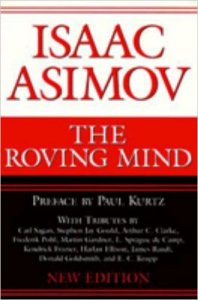
This is the first of several posts I’ll do about Asimov, beginning with a book of essays I picked up a couple months ago, a volume on my shelves I had not previously read, called The Roving Mind. The edition I have was assembled after Asimov’s death, with a preface by Paul Kurtz, and tributes by Carl Sagain, Arthur C. Clarke, Martin Gardner, and many others.

It’s a collection a short essays Asimov wrote for various publications — from Christian Science Monitor to New Jersey Bell Journal to Washington Post to TV Guide to Mechanix Illustrated — all mostly in the early 1980s, as well as a few that were commissioned but not accepted, as Asimov ruefully notes.

As in his fiction, it’s apparent that Asimov published virtually all his works from first-draft, with rare rewriting or editing; I’ll have more to say about this when discussing his early short fiction.

The collection of essays at hand begins with six essays on “The Religious Radicals”, and this is notable because these address issues that still plague us now, via the Religious Right and various other conservatives. Asimov was never a blunt atheist, in the sense modern writers like Richard Dawkins and Sam Harris are, but he was blunt in his dismissal of those who would attempt to intrude religous concepts into modern classrooms. The first essay in the book, “The Army of the Night”, begins “Scientists thought it was settled.”, and then goes on to efficiently address and dismiss the common arguments by creationists against evolution: the arguments from analogy, from general consent, from belittlement, from imperfection, from distorted science, from irrelevance, from authority. This essay is from the New York Times Magazine in 1981. There remains, and I suspect will always remain, a portion of the population immune to logical arguments in favor of adherence to the traditional religous narratives of their local society.

Further on, there’s an essay called “Don’t You Believe?”, in which Asimov replies to the common thoughts of people about science fiction authors, that they surely “believe” in flying saucers, telepathy, the Bermuda triangle, and so on. It displays the methodical rigor Asimov applied to any such question. He replies,

I believe in evidence. I believe in observations, measurement, and reasoning, confirmed by independent observers. I’ll believe anything, no matter how wild and ridiculous, if there is evidence for it. The wilder and more ridiculous something is, however, the firmer and more solid the evidence will have to be.

And then he goes on to consider telepathy, in several methodical steps, which I will summarize here:

1, If telepathic ability existed, it would have great survival value; “Telepaths would be better off, would live longer, and would have more children (who would also be telepathic, most likely)”;
2, The mere fact that we are trying to find out if telepathy exists is strong evidence that it does not exist — because if it did, it would be an overriding ability we would take for granted.;
3, Or perhaps telepathy requires advanced brains that have only recently begun to exist, such that initial efforts are only barely detectable in some people;
4, But if telepathy is possible and has survival advantage, it should have developed far earlier;
5, Yet if it does require advanced brains, might it explain how leaders in politics, business, religion, and science came to be such leaders?
6, Yet there are so many examples of such leaders who have been fooled, deceived, and betrayed. Julius Caesar; Napoleon; Hitler

And so, “we see a world that simply doesn’t make sense if telepathy exists.”

This is a basic example of Asimov’s methodical thinking, which also informs many of his stories, about which I will describe in future posts.

Posted in Atheism, Book Notes, Conservative Resistance, Isaac Asimov, Personal history, Science | Comments Off on The Methodical, Cheerful, Bluntness of Isaac Asimov

Links and Comments: Derek Muller and the Beauty of Nihilism

Via, a lovely video by YouTube vlogger Derek Muller, who runs a channel called Veritasium — “a channel of science and engineering videos featuring experiments, expert interviews, cool demos, and discussions with the public about everything science”. “The first principle is that: you must not fool yourself.” This one is about the acceptance of nihilism, the realization that there is no higher purpose, which is otherwise “Our Greatest Delusion”, i.e….

The thought that we are in any way eternal. We want to believe that some part of us, consciousness, or, our soul, will last forever. But, what do you make of it when you see stone is not even so permanent. Walking around Chernobyl I think it’s understandable that I started contemplating not only the permanance of rocks but also their decay, and by extension, our decay, death.

The hardware I am running has been developed over billions of years, with the only requirement being that it frequently and accurately makes copies of itself. .. and it would help, not in the slightest, in the goal of making copies, if the hardware could accurately simulate its own non-existence.

We are left hardwired for denial, the selected inability to imagine true nothingness, an ephemeral sack of particles that thinks itself eternal. This delusion is comforting and it makes living easier. Might drive you crazy, to be confronted with the ultimate meaninglessness of everything all the time… what we call nihilism.

And then why this is a good thing:

But the same delusion, I’d argue, is also debilitating. It lulls you into a false sense of security. …There’s always tomorrow, so we procrastinate living the life we truly desire. And we live in more fear. The sense that your soul is eternal makes you cowardly, because failure would stick with you forever… for really ever. Shame, embarrassment, disappointment, it would never leave you. A distant horizon encourages you to play it safe, live to fight another day. For after all, there is always another day.

And this is why I find nihilism liberating and emboldening. If you can really picture the nothingness that awaits you, then what is there to be afraid of? Errors and humiliations will be forgotten, but great achievements may not. We may have no meaning in the cosmic context of the universe, but we make our own meaning with each other. And this is the thought that leads to action. Your days are numbered. You don’t know what that number is but it’s finite, so: get busy with what it is that you want to do. Time is running out.

Which is my thought currently, and my current preoccupation.

Posted in Atheism, Religion | Comments Off on Links and Comments: Derek Muller and the Beauty of Nihilism