
About Ben Carson

Ben Carson is the Republican presidential candidate, a non-politician (like Trump and Fiorina), who has a calm demeanor and is reportedly a brilliant neurosurgeon. And is also a creationist, who dismisses evolution and the Big Bang as “fairy tales”. How to account for this? Several bloggers have had their way with him today.

Astronomer Phil Plait, at Salon: Ben Carson: Evolution Is Satanic and the Big Bang Is a Fairy Tale

Wow. Where to start?

OK, how about this: The Big Bang is not something you believe in. It’s a scientific model, supported by a truly vast amount of evidence. It doesn’t take faith, it takes science (and, despite Carson’s claims, science is not faith-based).

Creationists who dismiss the Big Bang usually do so because they think the Earth is young, 6,000–10,000 years old. This belief is, to put it simply, wrong. We know the Earth is more than 4.5 billion years old, give or take a few million years. The evidence for this is overwhelming.

We also know the Universe itself is old; a huge number of independent lines of evidence make this clear. It doesn’t take faith to think the Big Bang is true, it takes a profound dismissal of all of science to think it isn’t.

Key point: science is not about “belief”. Science is about being intelligent enough to evaluate all the available evidence and reach rational conclusions. (A number of links in Plait’s article are worth following up on, e.g. at TalkOrigins. But let’s go on.)

Next is Jerry Coyne, another actual scientist, (as opposed to a politician appealing to an ignorant base): Ben Carson on evolution: an ignorant (or duplicitous) Presidential candidate.

I think this is in fact the answer: the man is a flat-out, bull-moose creationist, and, soaked in faith, ignores any evidence to the contrary.

Coyne’s post is long, and challenges Carson’s claims on several points; I’ll quote just one.

Carson’s accusation that evolutionists are engaged in “circular reasoning” that has “no scientific validity” is simply an old creationist canard, and is blatantly false. Yes, layers are collated from place to place by the presence of the fossils in them, but the layers are dated using radiometric dating. And when you line up the layers by their radiometric dates, you see a progression of organisms absolutely consistent with evolution. Geological layers are not dated by the fossils in them!

And in conclusion, about Carson suggesting that Charles Darwin was inspired by “the adversary” (i.e. the Devil), and that “there are a significant number of scientists who do not believe it but they are afraid to say anything”:

As far as scientific opposition to evolution, I know a lot of biologists, but I’ve never met one who has told me that they don’t accept evolution but are scared to admit it. If there was copious and compelling evidence against evolution, in fact, the person who presented it would become famous. But there isn’t such evidence, and that—and not intimidation—is why reputable scientists don’t question evolution.

This echoes my comments in several previous posts — if there *really was* substantial evidence against the idea of evolution and the theory for how it happened (which theory has advanced far beyond what Darwin perceived, e.g. in terms of genetics), then anyone with such evidence should present it in a rigorous, peer-reviewed manner, and if substantianted, that person would revolutionize science and win a Nobel Prize.

This does not seem to have happened.

And then at The Week: How is Ben Carson both so incredibly smart and so spectacularly stupid?.

This piece explores, more than the others, about how a person, so intelligent in specific ways, can be so dumb in others. Is it only about pandering to the ignorant, to win elections?

Training in science is also training in how to think — what sorts of questions can be answered in what sorts of ways, and how you know what you know and what you don’t.

And

Carson’s entire campaign for president is built on the rejection of knowledge and experience, in that he argues that all you need to succeed as president is common sense, even if you’ve never spent a day in government. That opinion, unfortunately, is widely held. As is, we should mention, belief in Satan — according to polls, a majority of Americans believe in the devil, so Carson is hardly alone.

So, at this point I have no provisional conclusion about how apparently intelligent people can defer themselves to religious myths in opposition to rational thinking. But it does seem to be pattern in all human societies.

P.S. — Carson’s dismissive and derogatory remarks about evolution echoed with me in my recent re-reading of Isaac Asimov’s early robot story “Reason”, discussed in my previous post.

Posted in Culture, Evolution, Provisional Conclusions | Comments Off on About Ben Carson

Rereading Isaac Asimov, part 3: “Reason” — a Creationist Robot!

Asimov began writing stories about robots very early in his career; the first one, “Robbie”, was published in September 1940, only a year and a half after his first-published story, “Marooned Off Vesta”, in March 1939, and the second robot story, “Reason”, was published in April 1941. This is notable because in Asimov’s iconic book I, Robot, published in 1950, the story is placed third in the sequence of nine stories, which were arranged in a kind of future history sequence, and — I’m not sure this is generally known or appreciated — *revised* from their magazine appearances, to make consistent their adherence to the “Laws of Robotics” that Asimov, with editor John W. Campbell’s guidance, had not formulated until several stories in.

(As far as I can tell, there were only two robot stories written to that point *not* included in I, Robot — they were “Robot AL-76 Goes Astray” (1942) and “Victory Unintentional” (also 1942), both semi-farces that were not as serious as the others that were included in the book.)

So: it’s curious that “Reason” was only the second robot story that Asimov wrote, and that it was written before Asimov and Campbell had crystallized the three laws. That may or may not be of significance to the story’s theme.

In “Reason”, a new robot has been assembled on a space station, somewhere out in the outer solar system, that has been built to gather sunlight and beam the power to Earth and other settlements. The robot, designated QT-1 and nicknamed Cutie, is first of its model and exhibits unusual curiosity. When one of the two human technicians, Powell, tells the robot that “One week ago, Donovan and I put you together”, the robot ponders and replies, “For you to make me seems improbable.” It goes on to say “Call it intuition. That’s all it is so far. But I intend to reason it out, though. A chain of valid reasoning can end only with the determination of truth. and I’ll stick till I get there.”

So Powell takes Cutie to an observation port, looking out at the stars. Powell explains about stars and how they come from Earth, how the space stations were built, why robots were built to replace human workers on the stations, and so on.

Cutie replies,

Do you expect me to believe any such complicated, implausible hypothesis as you have just outlined? What do you take me for?

Globes of energy millions of miles across! Worlds with three billion humans on them! Infinite emptiness! Sorry, Powell, but I don’t believe it. I’ll puzzle this thing out for myself.

And so, in this story, Cutie recruits the lower-order robots on the station to worship what Cutie perceives as obviously what they all serve — the “Master”, the Energy Converter. Cutie presumes that, obviously, the Master created humans first, then the simple robots, then the robots like itself, to take the place of humans. Cutie creates a cult, and shuts the humans out of the control room.

Powell and Donovan try to argue. Cutie accuses them of an obsession. “Why should you insist so on an absolutely false view of life?”. An energy storm threatens; the men need to take action, and Cutie is preventing them. Cutie replies, “The beams are put out by the Master for his own purposes. There are some things – he raised his eyes devoutly upward – that are not to be probed into by us. In this matter, I seek only to serve and not to question.”

The men realize: “He’s a reasoning robot. He believes only reason, and there’s one trouble with that… You can prove anything you want by coldly logical reason—if you pick the proper postulates. We have ours and Cutie has his.”

And then, the story resolves with the storm hitting, and despite the men being shut out of the control room, Cutie takes appropriate action to prevent damage to Earth. Why? The men realize, Cutie was acting according to the First Law (to not harm humans, or through inaction, allow humans to come to harm).

They realize — it doesn’t matter what Cutie *believes* — as long as he acts in accordance with the laws.

In other words, to be an effective member of society.

I think this is a profound story on some level. It’s a perfect analogy, almost a parody, of the self-centered views of human creationists, who reject explanations of things about the universe they cannot personally verify and therefore consider absurd (“Were you there??” as the brain-washed, querulous creationist child asks the evolutionary biologist), in favor of theology centered myths, which, of course, place themselves as the center and reason for all existence. Asimov’s conclusion is that *it doesn’t matter* what such a robot or human thinks, as long as it or he or she is a functional member of society. This is perhaps a profound conclusion, and in the context of my PvCs, suggests that the ‘meaning of life’ lies entirely within the bubble of human culture, and is independent of any knowledge or understanding of the actual outer universe.

And, of course, this theme anticipates the creationists of the 21st century, who after all these centuries of scientific exploration and understanding of the history of our planet and its life, respond with childish rejection. Most notably in recent months, Republican candidate Ben Carson, who, despite being a talented neurosurgeon, is either too dumb to understand the readily available explanations of why, for example, the eye developed evolutionarily across many lines and to many degrees, or is simply being deferential to his factually challenged religious base. E.g, Ben Carson: Evolution Is An Absurd Myth, ‘Give Me A Break’. This isn’t an aside; the persistence of these anti-intellectual trends in the 21st century is the main reason I find this Asimov story, published more than *70 years ago*, so significant.

I don’t want to find this depressing. I want to take this into account as an inevitable aspect of human nature.

Posted in Isaac Asimov, science fiction | Comments Off on Rereading Isaac Asimov, part 3: “Reason” — a Creationist Robot!

We Are in a Post-Reality [Science-Fictional!] World

I saw (part of) the Republican debate this past week, and the responses, and saw how the obvious lies and misrepresentations did not seem to matter to the crowd; it was how the candidates played to the crowd. This seems to be the increasing trend in politics over the past decade or more. For what it’s worth, my thoughts about the current political landscape, the Republicans specifically, are echoed and amplified by this New York Times editorial — Crazy Talk at the Republican Debate

Peel back the boasting and insults, the lies and exaggerations common to any presidential campaign. What remains is a collection of assertions so untrue, so bizarre, that they form a vision as surreal as the Ronald Reagan jet looming behind the candidates’ lecterns.

It felt at times as if the speakers were no longer living in a fact-based world where actions have consequences, programs take money and money has to come from somewhere. Where basic laws — like physics and the Constitution — constrain wishes. Where Congress and the public, allies and enemies, markets and militaries don’t just do what you want them to, just because you say they will.

— And by Friday’s column by Paul Krugman, Fantasies and Fictions at G.O.P. Debate, where he makes points similar to those he’s been making for years…

You’re probably tired of hearing this, but modern G.O.P. economic discourse is completely dominated by an economic doctrine — the sovereign importance of low taxes on the rich — that has failed completely and utterly in practice over the past generation.

And:

The real revelation on Wednesday, however, was the way some of the candidates went beyond expounding bad analysis and peddling bad history to making outright false assertions, and probably doing so knowingly, which turns those false assertions into what are technically known as “lies.”

Many were impressed by Carly Fiorina’s performance – that word, “performance”, came up time and time again in disucssions of the debates – but as many commentators have done in the past couple days, Krugman calls her out:

Some of Mrs. Fiorina’s fibs involved repeating thoroughly debunked claims about her business record. No, she didn’t preside over huge revenue growth. She made Hewlett-Packard bigger by acquiring other companies, mainly Compaq, and that acquisition was a financial disaster. Oh, and if her life is a story of going from “secretary to C.E.O.,” mine is one of going from mailman to columnist and economist. Sorry, working menial jobs while you’re in school doesn’t make your life a Horatio Alger story.

But the truly awesome moment came when she asserted that the videos being used to attack Planned Parenthood show “a fully formed fetus on the table, its heart beating, its legs kicking while someone says we have to keep it alive to harvest its brain.” No, they don’t. Anti-abortion activists have claimed that such things happen, but have produced no evidence, just assertions mingled with stock footage of fetuses.

False witness, conservatives and fundamentalists? Have you no shame?

As always, I’m interested in the broader implications of how current political issues inform the way humans interpret the world, acknowledge reality, or fall back on tribal allegiances. And so I’m especially receptive to these last paragraphs of Krugman’s column:

I began writing for The Times during the 2000 election campaign, and what I remember above all from that campaign is the way the conventions of “evenhanded” reporting allowed then-candidate George W. Bush to make clearly false assertions — about his tax cuts, about Social Security — without paying any price. As I wrote at the time, if Mr. Bush said the earth was flat, we’d see headlines along the lines of “Shape of the Planet: Both Sides Have a Point.”

Now we have presidential candidates who make Mr. Bush look like Abe Lincoln. But who will tell the people?

So– *why is this happening?* This trend in American politics suggests a retreat into personal reality bubbles… which is, actually, a science-fictional theme about the attraction of virtual realities, in which one can live a dream life apart from interactions with other people or the crude aspects of real life.

It seems this dream life is happening. No matter what happens in daily news, there are conservatives (and racists, casually impugning the current President) who are willing to reinterpret events, on the basis of nothing whatsoever, except their need to make things fit into their cultural narrative, in which their tribe is true and everything else is a threat or a conspiracy. So: the Texas boy with an Arabic name, arrested for building a clock? There are people out there who see this as yet another conspiracy:

Conservatives warn Ahmed Mohamed’s arrest was terrorist ‘setup’ to make Islamophobia seem racist

It seems to me that American culture is increasingly splitting into subcultures with narratives that are completely independent and resistant to evidence or rational thinking.

My very provisional hypothesis – much less than a provisional conclusion – for what has happened in the past decade or two is twofold. First of all, that the attacks on the US in 2001, and the repeated evidence that many populations around the world hate the US, were both evidence of the poisonous nature of religious belief as well as a shock to the US population, especially the jingoistic hoi poiloi who wave their flags and assume the US is the greatest nation in the history of the world because, after all, that’s where they live!—and second of all, the internet has enabled people to find like-minded others who share their tastes, their opinions, their beliefs, and their prejudices, and to filter out all others, in a way more effective than any other way in human history. Thus, to an extant more than ever, there is no longer any consensus reality, or shared cultural values.

This is a science-fictional issue! SF, at its base, is about the perception of the real world, and how assumptions about that world are overtaken by exposure to new evidence about reality. But at the same time, the persistence of humanity is more dependeant on tribal allegiances, even when that entails fantasies about reality. As seen in current politics.

Further examples:

Slate: Of Course Trump Won’t Correct Birthers: It’s called pandering, and Republicans do it on everything from climate change to the debt ceiling.

Salon: The GOP’s bullsh*t campaign: Why they’re drowning the country in an ocean of lies

New York Times, Gail Collins: The Fight for Unplanned Parenthood

Alternet: The GOP’s Debate’s Terrifying Alternate Reality: Inside the Political Delusions of a Party On the Edge

The New Yorker: Trump and the Man in the T-Shirt

Posted in Conservative Resistance, Culture, Lunacy, Social Progress, Species Reset | Comments Off on We Are in a Post-Reality [Science-Fictional!] World

Rereading Donald A. Wollheim’s THE UNIVERSE MAKERS

Donald A. Wollheim’s The Universe Makers, published way back in 1971, is one of the earliest books that could be described as a history of SF, though Wollheim’s take is distinctly personal and even partisan. Wollheim was an occasional writer but mostly an editor throughout his career, an editor for the paperback publisher Ace in the ‘50s and ‘60s, later founding his own imprint, DAW [his initials], in 1972, which is still going strong after 40+ years under the direction of his daughter Betsy Wollheim.

In this book Wollheim discusses, in the first chapter, how his relationship with science fiction reached a sort of culmination with an invitation to participate in a radio program to discuss the dropping of the first atomic bomb [in 1945]… and he could not bring himself to do it. It was too momentous an occasion, such a shock to what science fiction had been anticipating, in the most awful manner.

I first read this book from a library shortly after its publication in 1971, then bought a copy from the lamented Dangerous Visions bookstore in 1989, and read it again in 1993. It’s a slim hardcover volume, spanning only 122 pages, including the index.

I picked up this volume again this week, partly because of my survey of histories of SF, and partly because of my recollection of Wollheim’s characterization of a consensus ‘future history’, what he calls a “Cosmogony of the Future”, in chapter 9, which has these eight parts:

  1. Exploration of the solar system
  2. Flights to the stars
  3. Rise of galactic empire
  4. Galactic empire in full bloom
  5. Decline and fall of galactic empire
  6. Interregnum
  7. Rise of permanent galactic civilization
  8. Challenge to God

Wollheim makes the case that this was, at least for the decades through the mid-1960s, a consensus, presumed, future history, in which to one degree or another, the majority of science fiction – especially stories published in John W. Campbell’s Astounding / [retitled in the early ‘60s] Analog, and at least many of the SF novels to that time, were set. Wollheim takes this as a thesis for his entire book, characterizing authors who ascribed to this framework as “universe makers”, and responding differentially to various challengers.

(Thus Wollheim’s project is closer to my own than I had remembered, the main difference that my plan is to be systematic in a survey of core SF texts rather than picking and choosing those that support a pre-determined thesis.)

Thus: he begins his story with Verne and Wells, Verne being nationalistic and technology oriented, Wells being utopian and idealistic. Wollheim swiftly tracks this dichotomy to his current day, describing the editor of Analog [he does not name him, but it’s John W. Campbell, Jr.] as the descendant of Verne: “whose editorials, which dominate the magazine and color its contents, reflect a similarly small-minded nationalist thinking, whose stress is on gadgets and inventions, and which consciously reject Utopianism and the change of ‘human nature’ to adjust to changing technologies and infinite worlds.” And points out his [Campbell’s] “arguments in favor of slavery (Yes, I said slavery!), and insists on the deliberate revision of stories to include statements of the right of financial greed to triumph over idealistic ideas.”

After Verne and Wells, Wollheim identifies Ray Cummings as the writer who bridged the gap between them and the formalization of SF in the pulp magazines beginning in 1929 or so. [Cummings is virtually forgotten today, except as a curioso with his book The Girl in the Golden Atom, whose premise was that atoms are miniature solar systems.)

Wollheim goes on to identify Edmond Hamilton as the inventor of the galactic civilization, the idea that humans are just one member of many races who exist through many star systems throughout the galaxy. (Before this, most SF – think Verne and Wells – were limited to the planets in our solar system.)

He calls out Olaf Stapledon for his hugely visionary novels — Last and First Men and Star Maker — but explains why their publication in the 1930s, in the UK, with much later publication in the US, did not influence American SF.

Wollheim then identifies Isaac Asimov, specifically his Foundation stories/novels, as crystallizing the cosmogony Wollheim now outlines. Wollheim repeats a theme that earlier writers were bound by a ‘mechanistic’ view of the universe, without any appreciation for psychology, sociology, or economics, much as Marxism did.

Following chapters discuss various writers of the ‘50s and ‘60s in that context. A.E. van Vogt imagines godlike characters, with a belief in humanity that verges on megalomania, which Wollheim doesn’t entirely dismiss. Wollheim discusses some specific novels by Philip Jose Farmer – the ones that support his thesis – about the “makers of universes” – and here incidentally, mentions that, as a publisher, he’s noticed that novels that challenge traditional religious dogma [in the late 1960s] don’t get the kind of reader flack that would have happened a decade before. By the same token, the religiously informed novels of C.S. Lewis seem to him, at this point, “painfully dated”. The idea of God, the creation of the universe, is now a valid subject for science fiction [again, as of 1971 or so].

At the same time, in this chapter and following, Wollheim expresses a concern, even an alarm, about what’s happening in then current society – he discusses the current ‘crisis’ (p52.3) and ‘troubled times’ (p53.3) and even implies that the lack of objections to religious verities is a *bad* thing…

Wollheim identifies three barriers to his vision of an expansive future – pollution, overpopulation, and The Bomb – and goes on to discuss various other SF writers in the context of how they addressed these issues, as opposed to envisioning the galaxy-populating expansion of humanity. He discusses catastrophe novels, in particular expressing alarm about the generation of young readers who must have grown up having read Andre Norton’s novel Daybreak: 2250 AD [a book Wollheim published himself] since it was first published in the early ‘50s. He discusses Kingsley Amis’ book New Maps of Hell; he considers Kurt Vonnegut, Jr.; he considers John W. Campbell’s career as a pattern of luck (he attracted the first generation of SF authors who’d grown up with SF, and so assumed a life of editorship at exactly the right time) and failed aspirations (his attraction to pseudo-science from Dianetics to ‘psi’ and then later to various political issues), and then addresses the crises among the Wellsians: how Kornbluth was bitter and cynical; how Sheckley was despairing but funny; how Delany never lost faith in art, song, and beauty.

He returns to writers who support his optimistic, galaxy-expansive vision: Simak, Chandler, Cordwainer Smith; considers Poul Anderson on the Right, Arthur C. Clarke as being neither Left or Right, but expressing in certain books “faith in man’s immortality”; Bradbury, not really on SF author at all, with his doomsday take on future technology; and finally Robert A. Heinlein, whose mixture of political stances is trumped by attitudes, as in Have Spacesuit Will Travel, that humanity will triumph “or die trying”.

And then the New Wave, a trend that began in the mid 1960s, just a few years before Wollheim wrote this book. The New Wave involved both the structure of fiction – the narrative techniques, adopted from mainstream, experimental, literature – but mostly a renunciation of the assumed dreams of SF about the expansion of humanity into space, into the galaxy. In that era of increased pollution, the threat of overpopulation, and most of all the threat of imminent nuclear doom, the New Wave attracted writers who presumed that the world might end at any moment. And so, in Wollheim’s take, they are dismissed as not being “universe makers”.

Finally among SF writers he considers Harlan Ellison, who breaks all the rules about writing, and whose stories are most often downbeat—but whose stories often express a resolute command to not give up, to find the better future that can be had.

And heroic fantasy: why is Lord of the Rings so popular? [The mass market paperbacks of those novels, from Ballantine, had just appeared in the mid-1960s, and were wildly popular, especially among college students.] Because, Wollheim suggests, they were stories in the fashion of the ancient epics, in which there was no confusion between pure Good and pure Evil. And this popularity, Wollheim, concludes, is evidence for the hope of humanity.

Finally, Wollheim claims that space flight is an essential condition of nature, and describes at length the idea of bacteria on a petri dish. Humanity, filling up the planet, is like that, and must eventually break out of the dish, or Earth. All of us alive today are survivors of all the crises humanity has faced over the past millions of years. And, he concludes, we’re not going to end.

Posted in Book Notes, Human Progress, science fiction | Comments Off on Rereading Donald A. Wollheim’s THE UNIVERSE MAKERS

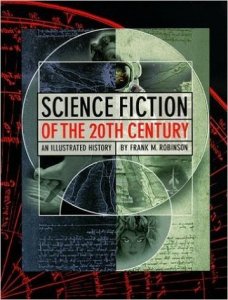
Frank M. Robinson’s SCIENCE FICTION OF THE 20TH CENTURY: AN ILLUSTRATED HISTORY

I’m beginning to explore and read or reread various histories of science fiction. Robinson’s is a coffee-table book, published in 1999, that had sequels from the same publisher about fantasy and horror, by different hands: Randy Broecker and Robert Weinberg, respectively. They are all heavily graphic, the text arranged around pages of cover images of (mostly) magazines and (incidentally) books, since the histories of these genres was born of the pulp fiction magazines in the era before television, and genre books.

Thus, while this volume is indirectly a history of science fiction, it’s focused largely on the history of the early sf magazines. Unlike any other history or overview of science fiction you might see – the more popular of which focus on SF in media, movies and TV – Robinson’s book has eight chapters about various incarnations of magazines, only two about books (paperbacks, and then hardcovers), and just one about movies and TV.

It’s a beautiful book, with impeccable images of magazine and book covers – it’s hard to imagine that these might be scans of actual books; they look too perfect. The text around these covers focuses on the histories of these magazines – e.g. this title ran for two issues then expired; this editor ran four magazines at the same time; this magazine was edited by so-and-so but was not the same magazine as this other one by the same title published in Britain, etc. – and details page counts, paper stock, the size of the magazine, what kinds of ads they ran, the colors used on the covers…and then, almost incidentally, the authors who were published in those magazines. At the same time, the occasional mentions of those authors is frequently revealing, how famous stories by, e.g., Arthur C. Clarke (“The Sentinel”) appeared in obscure magazines that last only a couple issues.

Robinson, obviously a collector of these magazines not just SF/F genre, also published a similar coffee-table book, Pulp Culture — which I also have on my shelves, and will eventually peruse through. And Richard A. Lupoff, apparently Robinson’s editor for this book, published himself a volume called The Great American Paperback, in 2001 – another volume on my shelves, which I will eventually peruse.

Posted in Personal history, science fiction | Comments Off on Frank M. Robinson’s SCIENCE FICTION OF THE 20TH CENTURY: AN ILLUSTRATED HISTORY

Links and Comments: Scale of the Universe; Core SF novels and stories and media

I’m in a gradual process of compiling links and references to my Provisional Conclusions, including a number of sites I’ve bookmarked in various places about the size of the universe. Today, David Brin has posted a set of links about just such sites, including the famous “Powers of 10” video — by Charles & Ray Eames (yes, the furniture designers), which is also at YouTube at Powers Of Ten (Charles & Ray Eames), and which Brin links to their own site here.

The universe is vast in size, age, and scale.

More broadly, I’m contemplating how to explore how science fiction supports, or illustrates, my ‘provisional conclusions’. Obviously, there is no one set of conclusions within science fiction about the future, or how humanity relates to reality; but though I think there is *general* trend on these topics, I couldn’t defend such a thesis without exploring a relatively objective set of ‘core’ SF novels and stories, identified by some means other than my intuition about whether or not they support my thesis. That would be cherry-picking. On the other hand, it might be just an example of gathering available evidence to support one’s theory, the way science works. (Though of course science, to pass any kind of peer review, cannot ignore conflicting evidence.)

For now, I’ve begun to revisit and read various science fiction histories and encyclopedia that I’ve accumulated over the years in my library, with the intent of identifying the ‘core’ works alluded to above, as well as the various ideas of what ‘science fiction’ is, and how its preoccupations and themes have changed over the decades.

All of which is context for mentioning this link, at io9: 11 Science Fiction Books That Are Regularly Taught in College Classes.

Despite what critics and historians think about what are the most important or best works, popular culture often identifies other works — especially films and TV works — that form culture’s idea of what science fiction is about. I think that my exploration of my thesis will limit itself to print works (and with a focus more on short fiction rather than novels, except for the couple hundred ‘core’ novels), but I can’t not take into account media works in any survey of what science fiction means.

Posted in Science, science fiction | Comments Off on Links and Comments: Scale of the Universe; Core SF novels and stories and media

Links and Comments: Scientism; the Arc of Moral Progress; Conservative Resistance and Certain Republicans

What we read from this morning’s newspapers…

New York Times, Simon Critchley, There Is No Theory of Everything.

An essay (which is longer online than the version in print) about science and the humanities and about a teacher of his, Frank Cioffi, who wrote a book about Wittgenstein, with a thesis about the gap between “how we experience the world — our subjective, conscious experiences (qualia) — and the scientific explanation of the material forces that constitute nature; and, second, that such a gap can potentially be closed through one, overarching theoretical explanation.”

Well, yes; this is science, and it’s been working pretty well all these past few centuries. Critchley thinks this is a problem. (My bold, about the part I agree with him.)

This is the risk of what some call “scientism” — the belief that natural science can explain everything, right down to the detail of our subjective and social lives. All we need is a better form of science, a more complete theory, a theory of everything. Lord knows, there are even Oscar-winning Hollywood movies made about this topic. Frank’s point, which is still hugely important, is that there is no theory of everything, nor should there be. There is a gap between nature and society. The mistake, for which scientism is the name, is the belief that this gap can or should be filled.

One huge problem with scientism is that it invites, as an almost allergic reaction, the total rejection of science. As we know to our cost, we witness this every day with climate change deniers, flat-earthers and religious fundamentalists. This is what is called obscurantism, namely that the way things are is not explained by science, but with reference to occult forces like God, all-conquering Zeus, the benign earth goddess or fairies at the bottom of my garden. Now, in order to confront the challenge of obscurantism, we do not simply need to run into the arms of scientism.

Other intellectuals have worried about ‘scientism’ (there was a Leon Wieseltier/Steven Pinker kufuffle a few months ago), needlessly it seems to me, out of some fear that subjective ideas about the humanities will be reduced to some crude reductionism. But that is not what science is only about; science entails finding basic principles, but it also acknowledges emergent principles of complexity. All that ‘scientism’ entails is thinking rigorously about issues of the humanities, if only in terms of comparative cultures, or what science can tell us about the limitations of our perceptions, rather than the standard deference to cultural standards, authority, and tradition.

\\

Elsewhere in today’s NYT, Steven Erlanger asks Are Western Values Losing Their Sway?. This has been a topic since Francis Fukuyama’s “end of history” was overtaken by Islamic fundamentalist attacks on the west…. as well as the odd resurgence of fundamentalism Christianism in the US. It’s not so much about political systems or economic injustices, Erlanger claims, but rather basic issues of humans rights, as I’ve described as the progressive arc of moral history (which description presumes that the fundamentalists will eventually lose).

The fight over values is not limited to democracy. “We think the world is divided by individualism and democracy, but it’s the sexual divide,” Mr. Krastev said — with radical disagreements over the proper place of women and the rights of homosexuals.

In its rejection of Western liberal values of sexual equality and choice, conservative Russia finds common cause with many in Africa and with the religious teachings of Islam, the Vatican, fundamentalist Protestants and Orthodox Jews.

Extreme interpretations of religion, especially in areas of great instability and insecurity, can be a comforting or inspiring response to the confusions of modern life, and can soon become an enemy to religious freedom and tolerance for others…

And of course we see this every day in modern American political discourse, with the curious alignment of conservative fundamentalists and their political champions (Huckabee, Santorum, Cruz) with rival fundamentalists of other religions, an alignment they would no doubt disavow, but which is obvious to the rest of us free of fundamentalist shackles.

\\

So to close with Jeffrey Tayler’s latest at Salon, Ted Cruz and Kim Davis, true love forever: The right-wing theocracy that threatens the rule of law. Subtitle: “Even The Donald knows the law trumps religion. It is time for someone to explain the Constitution to Ted Cruz.”

“Today, judicial lawlessness crossed into judicial tyranny,” writes Cruz. “Today, for the first time ever, the government arrested a Christian woman for living according to her faith. This is wrong. This is not America.”

No, senator. America is not a theocracy; in America, the First Amendment inoculates affairs of state against the malady of faith. Davis works for the government – and does so by choice. She has every right to practice her religion, but no right at all to behave in ways that impose it on gays or anyone else she encounters while performing her official duties.

Tayler goes on to address the fantasy industry of fundamentalists who, by cherry-picking and outright lying (cf. David Barton), like to pretend that America’s founding fathers were Christians as ardent as the current fundamentalists.

Nowhere in the Constitution or the Declaration of Independence do the Founding Fathers mention anything about Judaism, Christianity, or “Judeo-Christian values.” The United States is not, therefore, a Judeo-Christian country. That a majority are Christian and Jewish matters not; the system of government is what we’re discussing, and it is decidedly secular.

This is no accident. Some of the Founding Fathers held Christianity in contempt. Thomas Jefferson mused that, “Christianity is the most perverted system that ever shone on man . . . There is not one redeeming feature in our superstition of Christianity. It has made one half the world fools, and the other half hypocrites.” Whether he said this before or after taking scissors to his Bible and cutting out every reference to Jesus’ divinity and the supernatural is worth investigating. John Adams wrote that, “the Government of the United States of America is not, in any sense, founded on the Christian religion.” Bonus quotes: Ben Franklin observed that, “Lighthouses are more useful than churches.” Abraham Lincoln, a truly old-school Republican, if not a Founding Father, let it be known that “The Bible is not my book, nor Christianity my profession.”

This whole Kim Davis thing is just another example, to me, of how extremist Christians seem to be intent on defining themselves as people who cannot get along in a civil manner with people unlike themselves. And are proud of it.

Posted in Conservative Resistance, Human Progress, Morality, Science | Comments Off on Links and Comments: Scientism; the Arc of Moral Progress; Conservative Resistance and Certain Republicans

Links and Comments: Conservative Resistance and Fears; Narratives; Reality Checks

Salon: Kim Davis is the new face of the religious right: Angry, marginalized and increasingly desperate

No doubt Davis is a comical figure whose self-righteousness is only equaled by her ignorance both of the text of the Bible she clings to and what it means to have a job as a government employee. But she’s being used by her legal team and other religious right leaders to spread the idea that religious conservatives are entitled to ignore — or even overthrow — democracy and seize power just because they feel like it.

and

Mike Huckabee has been at the frontlines of pushing the claim that Christian conservatives simply have the right to ignore or overturn democracy to impose their will, and not just because he’s been running around Kentucky, trying to get himself on camera as much as possible in support of Davis’s attempt to ban gay marriage by fiat. He’s also been using the campaign trail to argue that the president should be able to simply end rule of law and start ruling like a dictator.

\\

This essay at Vox by Todd VanDerWerff claims M. Night Shyamalan’s The Village is an underrated masterpiece. This is not unrelated to the previous item; the story is about an attempt to retreat from the perceived threats of reality into a mythical, idealized past.

The desire to retreat into an imagined past in the wake of trauma is an understandable one, but The Village shows just how empty this idea ultimately is. See, this is a story about what happens when you abandon logic in the name of safety.

\\

And one more on this theme–another piece from Vox, this by Adam Mongrain: I thought all anti-vaxxers were idiots. Then I married one. Bottom line: it’s all about fear.

\\\\

Next, via File 770, excerpt from a Facebook post by David Gerrold about how the ideal of the electronic global village hasn’t quite worked out — and about how we are driven by certain kinds of narratives.

We have built the kind of technology that gives every person on the planet access to vast libraries of information and the ability to communicate with people all over the globe. But even if we’ve built a global village, we haven’t yet learned how to live in it. We’ve brought our prejudices and our beliefs and our parochial world-views.

Here, on this continent, we’ve built a cultural monomyth that carries within it the seeds of our own destruction — the mythic hero. We believe in John Wayne, the strong man who comes to rescue us. It’s a variation on the Christ myth. Or Superman. Or Batman. We’re incapable of being responsible, we need a daddy figure to sort things out for us. (The savage deconstruction of this monomyth is a movie called “High Noon.” It’s worth a look.)

Belief in superheros is an adolescent fantasy — it’s a way of abnegating personal responsibility. Whatever is wrong with the world, the Justice League, the Avengers, SHIELD will fix it.

The counterpoint is that whatever is wrong with the world — it’s not us. It’s THRUSH or SPECTRE or HYDRA or some other unnamed conspiracy. It’s always a conspiracy. …

The underlying idea here is perhaps why I’ve never been interested in superhero movies or stories, any more than I have religious saviors.

\\

Reality checks:

The True Size of… shows why Greenland is much smaller than the familiar Mercator projection world maps imply, and Africa is much larger.

Interesting YouTube channel: Stated Clearly

And a website: How Do We Know?

Posted in Conservative Resistance, Narrative, Science, Thinking | Comments Off on Links and Comments: Conservative Resistance and Fears; Narratives; Reality Checks

Rereading Isaac Asimov, part 2

So over the past four or five weeks, I’ve read (or re-read, in most cases, some 40 years or so since I first read most of these stories in the late-’60s/early-’70s) some 100 Isaac Asimov stories, including the complete contents of (in roughly this order) The Best of Isaac Asimov, I, Robot, Nine Tomorrows, Asimov’s Mysteries, Eight Stories from The Rest of the Robots, The Bicentennial Man and other stories, Earth Is Room Enough, Nightfall and other stories, and — [I read The Martian Way just a couple years ago, and so did not reread the four stories in that book in these past weeks] — and along the way other collections that mostly overlapped those, with a few extra stories in each: Robot Visions, Robot Dreams, and The Complete Robot. I also read Harlan Ellison’s I, Robot screenplay, published in 1994, and segueing from that, his script for “Phoenix without Ashes”, published in original script form in a 1975 anthology Faster than Light, edited by Jack Dann and Gardner Dozois [though its premise is contrary to the book’s title…], glanced through Edward Bryant’s novelization, Phoenix Without Ashes (published in 1975), which I read way back when but did not reread just now, and read for the first time the graphic novel version of Phoenix Without Ashes, just published in 2012, with illustrations by Alan Robinson, that is extremely loyal to the original script version.

But Harlan Ellison is a tangent to Asimov (one I might follow up on presently), and I’ve promised to blog about rereading Isaac Asimov. I will drill through many of these stories in subsequent posts, but for now, I will note these general conclusions:

  • Many Asimov stories are basically puzzle stories: descriptions of circumstances that defy obvious explanation, with decontruction and explanations by experts like Susan Calvin (the robot stories) or Wendell Urth (several of the “Asimov’s Mysteries”).
  • The stories collected in I, Robot are the selected robot stories Asimov had written up until that time (the book was published in 1950, collecting stories written over the previous decade) that fit into a common framework of future history, that were relatively consistent among themselves. Reading the many other robot stories Asimov wrote over the decades, it’s remarkable how they reach conclusions different to one degree or another from the canonical I, Robot stories, and from one another.
  • Most Asimov stories proceed on a very methodical fashion, as alluded in my previous post. One of the most remarkable, the late story “The Winds of Change”, is virtually a monologue that, methodically, step by step, undermines his listeners’ apprehension of reality.
  • As a general rule, one appreciates the best stories in any context by reading the many other stories that might have been considered; in Asimov’s case, I’d initially thought to revisit only The Best of Isaac Asimov and perhaps I, Robot. But as methodical and almost predictable as his stories might be, they are at the same time addictive– they’re easy to read, and you can’t read just one, there’s always another at hand. All that extra reading, seeing how Asimov composed his stories, seeing his recurrent themes and patterns, makes one appreciate the truly exceptional stories all the more.
  • And so, for the moment, I would say the best Isaac Asimov stories are: “Nightfall”, “Reason”, “The Dead Past”, “The Ugly Little Boy”, and “The Bicentennial Man”, for various reasons different for each story. There are many other notable stories, worth reading, especially several later stories in which Asimov responded to social developments of the ’70s and ’80s, and I will describe those five, and the others, in a couple subsequent posts.
Posted in Isaac Asimov, science fiction | Tagged | Comments Off on Rereading Isaac Asimov, part 2

Links and Comments: Lawrence M. Krauss, Mike Huckabee, Rick Santorum, confirmation bias

A fine essay by Lawrence M. Krauss, at The New Yorker: All Scientists Should Be Militant Atheists.

He’s reacting both to the current embarrassing kerfuffle about Kim Davis, the Kentucky court clerk who thinks her sincerely held religious convictions trump the law she swore to uphold when she took office, and the general trend in recent years to react against the so-called “militant atheists” by finding some sort of “accommodationist” stance between science and religion. (Jerry Coyne’s latest book addresses and disposes of this succinctly.) In this essay, Krauss is having none of that, in effect calling a spade a spade, and explaining why any thinking person who understands the basis and protocols of science can not at the same time defer to ancient religious myths.

It’s not a long essay and very much worth reading. I’ll resist quoting passages except for this last one:

I see a direct link, in short, between the ethics that guide science and those that guide civic life. Cosmology, my specialty, may appear to be far removed from Kim Davis’s refusal to grant marriage licenses to gay couples, but in fact the same values apply in both realms. Whenever scientific claims are presented as unquestionable, they undermine science. Similarly, when religious actions or claims about sanctity can be made with impunity in our society, we undermine the very basis of modern secular democracy. We owe it to ourselves and to our children not to give a free pass to governments—totalitarian, theocratic, or democratic—that endorse, encourage, enforce, or otherwise legitimize the suppression of open questioning in order to protect ideas that are considered “sacred.” Five hundred years of science have liberated humanity from the shackles of enforced ignorance. We should celebrate this openly and enthusiastically, regardless of whom it may offend.

If that is what causes someone to be called a militant atheist, then no scientist should be ashamed of the label.

But I will quote this again: “Five hundred years of science have liberated humanity from the shackles of enforced ignorance. We should celebrate this openly and enthusiastically, regardless of whom it may offend.

\\

Meanwhile, there are, of course, the right-wing demagogues who either misunderstand the Constitution and its principles, or are (more likely) simply playing to their ignorant base. Today’s best example (of too many to compile and list):

Salon: Mike Huckabee’s cynical zealotry: The rank opportunism in his Kim Davis demagoguery.

Too obvious to bother quoting.

On a slightly different topic, two examples, both about Rick Santorum and climate change, about how the right wing — despite their presumed allegiance to that Commandment about false witness — are happy to misrepresent, and even outright lie, about any scientific conclusion that does not fit their ideological presumptions and religious convictions. Santorum appeared on Real Time with Bill Maher a few days ago, and made a couple claims that Politifact.com has easily discredited:

Santorum: UN climate head debunked widely cited 97% climate change consensus figure

Santorum cites flawed climate change figure, and misquotes it

Actually, I’m not sure that I attribute such incidents to conscious venality. I think rather that these are examples of mental biases, specifically the confirmation bias that we are all prone to, that makes anyone inclined to interpret new information in the context of their previously held religious convictions (or provisional conclusions). It’s hard work to try to understand new information and be ready to change one’s mind (as I like to think that I do try to do). But in the cases of Huckabee and Santorum, I suspect they are smart enough to know, on some deep level, that they are lying to themselves about the conflict between their convictions and what they can’t help but perceive as reality. But they are politicians. It’s their job to lie to themselves, or to their base, to whatever extent is necessary to win an election. It doesn’t matter to them what’s real, and what that reality might affect humanity in future generations, as long as they can try to win the current election.

Posted in Atheism, Conservative Resistance, Science | Comments Off on Links and Comments: Lawrence M. Krauss, Mike Huckabee, Rick Santorum, confirmation bias