
David McRaney 2, Gravity, Haiyan, GRR Martin


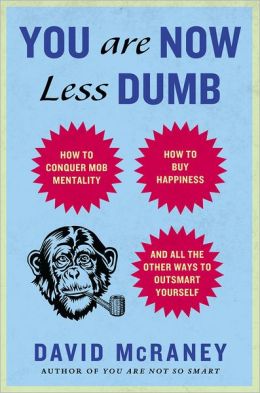
I’ve been meaning to close out my thoughts on David McRaney’s brilliant second book, YOU ARE NOW LESS DUMB, which I first posted about a month ago.

First, let me follow up on his ‘narrative bias’ described in the first part of the book. A prime example of how human beings prefer story over reality is, to take something very topical, the commentary over the film Gravity. It is a brilliant film in many ways, but, to anyone schooled in basic physics, has a few obvious flaws. I mentioned a couple of these in my own blog and Facebook posts (especially about the scene in which George Clooney does *not have to let go*), but it was Neil deGrasse Tyson’s Twitter posts that raised the issue for most people. The common response was — who cares? It would compromise the *story*, so don’t be so finicky.

QED. “Human kind cannot bear very much reality” (T.S. Eliot)

And just recently, there is the depressingly frequent response to tragedies as in the Haiyan typhoon that struck the Philippines. It’s a paradoxical effect that the people who survive such tragedies (those who don’t aren’t around to offer their opinions), perversely claim their faith in God has *increased*. This strikes me as yet another example of confirmation bias and narrative bias. Survivors cling to what they think they understand, because, if they lose that, what else is left?

Second, I don’t think I mentioned this before, but there are ideas in McRaney’s two books that I had *not* heard about before, in any sense. One is the “Normalcy Bias”, in which people subjected to sudden catastrophes react in an oddly passive manner. The famous Canary Island crash of two 747s is one example that he describes; many passengers did not escape because the shock of the crash paralyzed them, if for only a minute — long enough for them to die in the explosion of the fuel tanks. The same principle explains why people in disaster-prone or threatened areas do not evacuate. They don’t think the threat will apply to them.

The finale of the second book is about the “Self-Enhancement” bias, about how everyone over-estimates their own abilities. The key point is that this is functional — without this bias, people might not keep functioning. With this bias, even if you’re ‘fooling yourself’, you will be happier. Everyone thinks they are above average — better drivers, more attractive, than the average.

This bias serves an evolutionary advantage — those who feel superior, for whatever reason, may reproduce more often, and pass this attitude on to future generations.

Which of course parallels the idea that religious people, while being deluded about the nature of reality, may actually be happier in life than those who perceive reality for what it is.

Now, I’ve threatened to write a book about how science fiction informs this great divide between what people think – the whole psychological narrative of biases that disguise true motivations while promoting (an in evolutionary sense, ahem) human behavior and existence – and what people, mostly scientists, perceive as the reality of the universe. If I were to do so, I would mine examples of stories that push the boundaries of what humans think of as reality – the assumptions of time and space – that indirectly challenge why humans should think we, living on one planet in an immense universe, should think that, for example, the conclusions of bronze-age desert tribes living in a tiny part of our planet, two or three thousand years ago, should have, coincidentally and magically, discovered the singular truth about the origin and purpose of the universe.

There are many such examples.

But recently I’ve been reading a rereading a number of classic short stories in the SF field, and here is one that speaks directly to the function of religion… as a sap, for those who can’t handle the truth.

It’s a Hugo winning story by George R.R. Martin, famous these days as the author of Game of Thrones and its sequels, basis for the TV series. The story is “The Way of Cross and Dragon”, (here’s a link) and it’s about a future Catholic church that investigates a heretical sect that proclaims Judas a saint. It turns out [– spoiler alert –] the author of this heresy just made it up. Because all faiths are Lies invented to make people happy.

The truths, the great truths—and most of the lesser ones as well—they are unbearable for most men. We find our shield in faith. Your faith, my faith, any faith. It doesn’t matter, so long as we believe, really and truly believe, in whatever lie we cling to.” He fingered the ragged edges of his great blond beard. “Our psychs have always told us that believers are the happy ones, you know. They may believe in Christ or Buddha or Erika Stormjones, in reincarnation or immortality or nature, in the power of love or the platform of a political faction, but it all comes to the same thing. They believe. They are happy. It is the ones who have seen truth who despair, and kill themselves. The truths are so vast, the faiths so little, so poorly made, so riddled with error and contradiction that we see around them and through them, and then we feel the weight of darkness upon us, and can no longer be happy.

Yes, exactly my theme. Human kind cannot bear very much reality. (Or perceive it to begin with, as the psychological studies increasingly show.)

So this post turns out not to be so much an examination of Mr. McRaney’s book – which, in any case, is brilliant, and which I recommend highly.

Enough for tonight.

Posted in Book Notes, Lunacy, Philosophy, Religion, science fiction | Comments Off on David McRaney 2, Gravity, Haiyan, GRR Martin

Why Science Is Not About Faith

Great post at Slate by Jerry Coyne — the original headline on the homepage has disappeared, so I’m reproducing from memory in this link:

Why Scientists Have No Faith in Science

The point is science isn’t about faith, not even ‘faith’ in the scientific method or ‘faith’ that scientific laws are valid. Science is about evidence and presumptions, such as the method and the ‘laws’, that have been proven themselves as valid and effective. (Thus our technological society.)

What about the public and other scientists’ respect for authority? Isn’t that a kind of faith? Not really. When Richard Dawkins talks or writes about evolution, or Lisa Randall about physics, scientists in other fields—and the public—have confidence that they’re right. But that, too, is based on the doubt and criticism inherent in science (but not religion): the understanding that their expertise has been continuously vetted by other biologists or physicists. In contrast, a priest’s claims about God are no more demonstrable than anyone else’s. We know no more now about the divine than we did 1,000 years ago.

The constant scrutiny of our peers ensures that science is largely self-correcting, so that we really can approach the truth about our universe.

Spelling it out for the many, many, who remain unclear on this concept, if they’ve bothered to think about it at all.

Posted in Religion, Science | Comments Off on Why Science Is Not About Faith

Why People Believe in Conspiracies

With the JFK 50th anniversary upon us, there have been numerous stories lately about this. Here’s one in Slate that wonders why so many people are so taken by outlandish conspiracy theories.

http://www.slate.com/articles/health_and_science/science/2013/11/conspiracy_theory_psychology_people_who_claim_to_know_the_truth_about_jfk.html

How can this be? How can so many people, in the name of skepticism, promote so many absurdities?

The answer is that people who suspect conspiracies aren’t really skeptics. Like the rest of us, they’re selective doubters. They favor a worldview, which they uncritically defend. But their worldview isn’t about God, values, freedom, or equality. It’s about the omnipotence of elites.

But it boils down to cognitive biases… seeing intents where only coincidences exist.

The common thread between distrust and cynicism, as defined in these experiments, is a perception of bad character. More broadly, it’s a tendency to focus on intention and agency, rather than randomness or causal complexity. In extreme form, it can become paranoia. In mild form, it’s a common weakness known as the fundamental attribution error—ascribing others’ behavior to personality traits and objectives, forgetting the importance of situational factors and chance. Suspicion, imagination, and fantasy are closely related.

Conspiracy believers are the ultimate motivated skeptics. Their curse is that they apply this selective scrutiny not to the left or right, but to the mainstream. They tell themselves that they’re the ones who see the lies, and the rest of us are sheep. But believing that everybody’s lying is just another kind of gullibility.

It’s also worth quoting an earlier Slate article from a few days ago, by Fred Kaplan, who was attracted to JFK conspiracy notions for a while, until he read some of those books.

Then, one day, I looked up the footnotes in those books, most of them leading me to the multivolume hearings of the Warren Commission. I was shocked. The authors had taken witnesses’ statements out of context, distorted them beyond recognition, and in some cases cherry-picked passages that seemed to back their theories while ignoring testimony that didn’t. It was my first brush with intellectual dishonesty.

Check your sources.

Posted in Culture, Lunacy, Thinking | Comments Off on Why People Believe in Conspiracies

Another Fermi Paradox idea

The Fermi Paradox is the observation that, while calculations of the number of likely planets in the galaxy (or universe) that can support life suggests that there might be millions or billions of them — recent news stories, e.g. CNN, increase the number, if anything — nevertheless, no SETI signals have been detected. So, where are they?

A post a few days ago by Sean Carroll about the recent estimates of billions of potential habitable planets suggests a reason: the Enlightentment/Boredom Hypothesis (EBH).

The EBH is basically the idea that life is kind of like tic-tac-toe. It’s fun for a while, but eventually you figure it out, and after that it gets kind of boring. Or, in slightly more exalted terms, intelligent beings learn to overcome the petty drives of the material world, and come to an understanding that all that strife and striving was to no particular purpose. We are imbued by evolution with a desire to survive and continue the species, but perhaps a sufficiently advanced civilization overcomes all that. Maybe they perfect life, figure out everything worth figuring out, and simply stop.

I’m not saying the EBH is likely, but I think it’s on the table as a respectable possibility. The Solar System is over four billion years old, but humans reached behavioral modernity only a few tens of thousands of years ago, and figured out how to do science only a few hundred years ago. Realistically, there’s no way we can possibly predict what humanity will evolve into over the next few hundreds of thousands or millions of years. Maybe the swashbuckling, galaxy-conquering impulse is something that intelligent species rapidly outgrow or grow tired of. It’s an empirical question — we should keep looking, not be discouraged by speculative musings for which there’s little evidence. While we’re still in swashbuckling mode, there’s no reason we shouldn’t enjoy it a little.

As always, the scale of history and of humanity’s tiny presence in this history is my point of interest.

Posted in Cosmology | Comments Off on Another Fermi Paradox idea

To put matters at their simplest

Reading A.C. Grayling’s The God Argument, a simplistic title that might be better replaced by its subtitle: “The Case Against Religion and for Humanism”. Grayling is a British philosopher who has written on many topics; i.e. he’s not just a ‘new atheist’ railing against religion; he’s a substantial philosopher taking time to spell out, in almost simplistic terms, why religion should be obsolete and ‘humanism’ is the best plan for a mature global society.

Let me just quote the opening paragraph.

To put matters at their simplest, the major reason for the continuance of religious faith in a world which might otherwise have long moved beyond it, is indoctrination of children before they reach the age of reason, together with all or some combination of social pressure to confirm, social reinforcement of religious institutions and traditions, emotion, and (it has to be said) ignorance — of science, of psychology, of history in general, and of the history and actual doctrines of religions themselves.

Precisely.

My own intent is not to be an anti-religion polemicist — for one thing, I’m not sure anyone is reading this blog. I’m collecting posts here mostly as, er, ‘research’ into a book I am thinking of writing, about the limitations of human judgement of reality (religion being an egregiously wrong-headed example), how reality exceeds the ability of human perception to perceive it, and how science fiction can help inform that divide.

I’m more than half way through Grayling and have seen many more succinct passages I may quote here presently.

Posted in Philosophy, Religion | Comments Off on To put matters at their simplest

Man in the Sky

Via The Dish, Embracing the Void.

Making the sky into a humanlike God is a shortcut to making it legible. If you believe that there is a man in the sky, you can interpret its unpredictable cinema, its colour shifts and stormy whims, as symbolic messages, communications from the cosmic creator. You can graft human traits and desires onto the sky’s impenetrable infinities, and soothe yourself with the comforting notion that the great unknown resembles you in some important way. This philosophical trick is hard for the order-seeking mind to resist, because it leads to a coherent picture of the world. And so, since antiquity, sky gods have gushed from the human imagination, and several of them survive to this day.

Posted in Philosophy, Quote at Length, Religion | Comments Off on Man in the Sky

12 Years a Slave

Saw 12 YEARS A SLAVE on Sunday, a gripping, brilliantly directed and acted film that is at times difficult to watch – but not because you don’t think it’s telling you the truth. It’s about a free black man kidnapped in 1841 from New York and sold into slavery in Louisiana. He passes through several slave owners, and handlers, the worst of whom display their assumption of racial superiority and their legal entitlement to own human beings as property through ruthless beatings and whippings and casual hangings of their owned ‘niggers’ – with, I can’t help but notice, Biblical justification, a point underscored by scenes of one (relatively benevolent) slave owner conducting scripture readings to his family and slaves combined, and a later scene of slaves assembled at a funeral for one of their own singing a folk song about John the Baptist.

Many scenes in this film would be gratuitously cruel if not for three factors. First, that this is based on a true story. Second, possibly for dramatic effect, we see the one relatively benevolent slave owner of them all (Benedict Cumberbatch) *first*. (The worst one, played by Michael Fassbender, is saved for last.) And third, despite everything, we know the main character, the victim, will survive and somehow be rescued by the end (which, as Slate explains today, http://www.slate.com/articles/arts/culturebox/2013/10/_12_years_a_slave_and_schindler_s_list_how_american_movies_valorize_those.html, somewhat undermines the film’s premise, in a way all Hollywood films do).

The star, Chiwetel Ejiofor, is not a complete newbie, as I’d thought going in; he was in CHILDREN OF MEN and SERENITY, among many other Imdb credits, but this will surely be his breakout role, a likely best actor Oscar nomination. There are compelling performances by others as well – Michael Fassbender, Lupita Nyong’o, and Paul Dano, especially.

This is an important film about a period of American history too often discounted or airbrushed away – like nothing else put on screen, except possibly the early episodes of “Roots”, way back in the ‘70s. And it reflects an attitude still present in parts of this country that, not to put too fine a point on it, is apparent in the resentment of anything our black president tries to accomplish, by a certain element of the population.

www.imdb.com/title/tt2024544/

Posted in Films, Reviews | Comments Off on 12 Years a Slave

Connor Wood on Atheists

The perspicacious Connor Wood, at Science on Religion, asks Why Are There Atheists?.

That is, since the vast majority of humanity subscribes to one variety of faith or another, how is it that atheists exist at all? Are they some kind of unnatural freaks?

Studies reveal….

First, atheists tended to have lower levels of social attachment than religious believers. This included both family and friendship attachments; for example, in one large survey atheists rated themselves as significantly less enthusiastic than believers about family gatherings, road trips, cooking dinner with others, and getting together with friends.

Not coincidentally, single, white males were significantly overrepresented in the ranks of atheists and nonbelievers.

What’s more, atheists also tended to be significantly more drawn to analytic and logical reasoning, while religious believers tended more toward intuitive reasoning.

In fact, in several studies it was this analytic intellectual orientation that was the single biggest predictor of atheistic beliefs. This finding refutes the long-held assumption that many atheists reject religion for emotional reasons – being angry at God, for instance.

Typically for Connor Wood, he finds value on both sides of the issue.

So what does this research mean for atheists in today’s Western societies? Well, a lot. First, it suggests that atheism, or at least the personality traits that seem to underlie it, may be adaptive – even at the cultural level. Second, it suggests that atheism is a perfectly expectable, natural variation within the personality spectrum. Third, it suggests that atheists and the religious may have different strengths – and liabilities. Religious believers are more socially integrated than atheists, tend to report being more satisfied with their family and social lives, and are likely to be more interpersonally agreeable. At the same time, because religious folks tend to value conscientiousness – the regularly fulfilling of social obligations – over new experiences and novelty, they may be less well-equipped than atheists to recognize and solve new problems.

This is of course a rather sociological or psychological perspective – not a scientific one, which might be that the atheist perspective is about being more interested in what is really true about the world, about reality, than what beliefs one’s ancestors inherited from their ancestors.

Posted in Quote at Length, Religion, Thinking | Comments Off on Connor Wood on Atheists

Rights are Social Contracts

Alternet (and Salon): America Is Not a Christian Nation and Never Has Been: Why Is the Right Obsessed With Pushing a Revisionist History?

Aside from the angle about the likes of David Barton rewriting American history to conform to the worldview of their audience, this piece fascinates me for the question of what ‘rights’ are.

If pressed, most liberals would probably agree rights stem from a combination of the social contract and a general understanding of what’s fair and not because God wrote down our rights on some stone tablet somewhere. We might even note that as much as right-wingers wish otherwise, our secular vision is what the Founders originally imagined. But for liberals, the very idea that we’re having a “debate” about this is asinine. Most of us are less worried about trying to figure out where rights come from than we are focused on defending human rights, usually from attacks from conservatives.

And of course,

What’s nice about the “rights come from God” theory is that it makes it easier to deny that new rights can be established. Since the 18th century, a lot of rights have been granted that didn’t exist back then: The right not to be enslaved, the right of all adults to vote, the right to have some time off from your job. Conservatives resisted each of these rights and continue on that path today, resisting more recently established rights, such as the right to be free from discrimination based on race, gender, or sexual orientation. By saying that God informed the Founding Fathers what rights there were, conservatives can claim that any rights that have been developed since then are illegitimate. Sure, it’s a lie, but it’s an awfully convenient one.

In the right-wing view, “religious freedom” becomes the “right” — given to you by God — to force fundamentalist Christianity on others. That’s how they can claim it’s “religious freedom” to force their religion on others by government-sponsored prayer, teaching creationism in schools, restricting access to abortion and contraception, and banning gay marriage.

Many questions like this would benefit from some elementary reality checks — in particular, to wonder how these matters play out in the many parts of the world that are not primarily dominated by Christian traditions. It’s true that many Asian nations do not have the same idea of ‘rights’ as US and European nations do, but this is not because they are guided by the Bible or some other religious text. We can similarly consider the idea that morals must derive from the Bible — that atheists, for examples, are moral anarchists. Reality check — do Christians truly not sense what is right or wrong without thumbing through their Bible to check the Ten Commandments (or Leviticus)? I think not. (Not to mention that numerous of the commandments and Leviticus invectives are not, in fact, enshrined in common law.)

Posted in Culture, Religion | Comments Off on Rights are Social Contracts

Review of David McRaney’s You Are Now Less Dumb, part 1

David McRaney’s second book, YOU ARE NOW LESS DUMB, extends the themes of his first book, in greater depth — there are 17 chapters in some 300 total pages, compared to 48 shorter chapters in the first book. And it’s anchored by two deep themes, the first and last chapters, about ‘narrative bias’ and ‘self-enhancement bias’. The chapters in this book to some extent consolidate and amplify ideas from the first book, but these two endpiece chapters describe basic themes that have many implications that the author, perhaps wisely, does not spell out.

Like the first book, the introduction and each chapter in this book begins with a theme, stated as a ‘misconception’ and a ‘truth’. Here are those from the introduction:

Misconception: You are a being of logic and reason.
Truth: You are a being capable of logic and reason who falls short of that ideal in predictable ways.

The introduction describes a contested football game between Dartmouth and Princeton in which fans of each school, watching an identical pre-recorded video of a key game, had vastly different reactions about which side was unfairly rough. We are all ‘naive realists’, McRaney says; we think what we see is what actually happens, but this is a philosophical idea long discredited by science. Eye-witness testimony is basically worthless [an idea that is, gradually, creeping into public policy].

This book, more than the first one, has deeply affected and channeled my thinking. It consolidates ideas I’ve been pondering for some time, and given them a framework for further thought.

The first, anchoring, chapter, is about ‘narrative bias’.

Misc: You make sense of life through rational contemplation.
Truth: You make sense of life through narrative.

A key psychological experiment recounted here is about three mental patients, each of whom believed he was the reincarnation of Jesus Christ. When confronted with each other, brought together in the same mental institution — what happened? (This experiment took place decades ago and would be regarded as unethical now.) Each one explained the others away, without abandoning their own personal narrative. Each one clang to his personal narrative.

Every culture finds ‘meaning’ in the world through narrative. These are the basic narratives that Joseph Campbell identified — the character who faces adversity, embarks on an adventure, and succeeds against great odds. Or–does not succeed; the tragedy. Both narratives appeal because anyone can map their own experiences onto one of these two templates.

The brain/mind [they are the same] tries to make sense of any experience by trying to detect causes. A revealing case is how Air Force pilots, subject to such high G forces that they black out, have experiences very similar to the so-called ‘near-death’ experiences: the tunnel, the white light, friends and family, memories. Even as it’s dying, the brain keeps trying the make sense of things, in a narrative fashion.

All humans reduce life to two questions: where did we come from, and why are we here?

Narrative psychology asks, why are these questions so important? It seems that *meaning*, to these questions, is more important than ordinary happiness. And meaning requires narratives.

McRaney touches on the ‘concept of mind’ notion that I’ve read about in Daniel Dennett and Jesse Bering. It’s the idea that babies, until they are two or three years old, don’t realize that other people have minds of their own. The naive notion is that other objects — the sun, the moon, the winds and the rains — also have ‘minds’, a notion that has given rise to many mythologies — or religions [they are the same? ;)]. McRaney remarks,

Out of that sense of self and other selves come the narratives that have kept whole societies together. The great mythologies of the ancients and moderns are stories made up to make sense of things on a grand scale. So strong is the narrative bias that people live and die for such stories and devote whole lives to them (as well as take lives for them).

Here is where I perceive McRaney taking a very diplomatic stance. He does not mention the word ‘religion’, or ‘faith’, even though this is obviously what he is talking about — but to make this explicit would make this a very different kind of book. One that might alienate many a reader. I think this is a wise decision, because as long as he does not alienate these readers, he can make them think about these biases. Making them think.

Enough for now. More in a later post.

Posted in Book Notes, Thinking | Comments Off on Review of David McRaney’s You Are Now Less Dumb, part 1