
12 Years a Slave

Saw 12 YEARS A SLAVE on Sunday, a gripping, brilliantly directed and acted film that is at times difficult to watch – but not because you don’t think it’s telling you the truth. It’s about a free black man kidnapped in 1841 from New York and sold into slavery in Louisiana. He passes through several slave owners, and handlers, the worst of whom display their assumption of racial superiority and their legal entitlement to own human beings as property through ruthless beatings and whippings and casual hangings of their owned ‘niggers’ – with, I can’t help but notice, Biblical justification, a point underscored by scenes of one (relatively benevolent) slave owner conducting scripture readings to his family and slaves combined, and a later scene of slaves assembled at a funeral for one of their own singing a folk song about John the Baptist.

Many scenes in this film would be gratuitously cruel if not for three factors. First, that this is based on a true story. Second, possibly for dramatic effect, we see the one relatively benevolent slave owner of them all (Benedict Cumberbatch) *first*. (The worst one, played by Michael Fassbender, is saved for last.) And third, despite everything, we know the main character, the victim, will survive and somehow be rescued by the end (which, as Slate explains today, http://www.slate.com/articles/arts/culturebox/2013/10/_12_years_a_slave_and_schindler_s_list_how_american_movies_valorize_those.html, somewhat undermines the film’s premise, in a way all Hollywood films do).

The star, Chiwetel Ejiofor, is not a complete newbie, as I’d thought going in; he was in CHILDREN OF MEN and SERENITY, among many other Imdb credits, but this will surely be his breakout role, a likely best actor Oscar nomination. There are compelling performances by others as well – Michael Fassbender, Lupita Nyong’o, and Paul Dano, especially.

This is an important film about a period of American history too often discounted or airbrushed away – like nothing else put on screen, except possibly the early episodes of “Roots”, way back in the ‘70s. And it reflects an attitude still present in parts of this country that, not to put too fine a point on it, is apparent in the resentment of anything our black president tries to accomplish, by a certain element of the population.
www.imdb.com/title/tt2024544/

Posted in Films, Reviews | Comments Off on 12 Years a Slave

Connor Wood on Atheists

The perspicacious Connor Wood, at Science on Religion, asks Why Are There Atheists?.

That is, since the vast majority of humanity subscribes to one variety of faith or another, how is it that atheists exist at all? Are they some kind of unnatural freaks?

Studies reveal….

First, atheists tended to have lower levels of social attachment than religious believers. This included both family and friendship attachments; for example, in one large survey atheists rated themselves as significantly less enthusiastic than believers about family gatherings, road trips, cooking dinner with others, and getting together with friends.

Not coincidentally, single, white males were significantly overrepresented in the ranks of atheists and nonbelievers.

What’s more, atheists also tended to be significantly more drawn to analytic and logical reasoning, while religious believers tended more toward intuitive reasoning.

In fact, in several studies it was this analytic intellectual orientation that was the single biggest predictor of atheistic beliefs. This finding refutes the long-held assumption that many atheists reject religion for emotional reasons – being angry at God, for instance.

Typically for Connor Wood, he finds value on both sides of the issue.

So what does this research mean for atheists in today’s Western societies? Well, a lot. First, it suggests that atheism, or at least the personality traits that seem to underlie it, may be adaptive – even at the cultural level. Second, it suggests that atheism is a perfectly expectable, natural variation within the personality spectrum. Third, it suggests that atheists and the religious may have different strengths – and liabilities. Religious believers are more socially integrated than atheists, tend to report being more satisfied with their family and social lives, and are likely to be more interpersonally agreeable. At the same time, because religious folks tend to value conscientiousness – the regularly fulfilling of social obligations – over new experiences and novelty, they may be less well-equipped than atheists to recognize and solve new problems.

This is of course a rather sociological or psychological perspective – not a scientific one, which might be that the atheist perspective is about being more interested in what is really true about the world, about reality, than what beliefs one’s ancestors inherited from their ancestors.

Posted in Quote at Length, Religion, Thinking | Comments Off on Connor Wood on Atheists

Rights are Social Contracts

Alternet (and Salon): America Is Not a Christian Nation and Never Has Been: Why Is the Right Obsessed With Pushing a Revisionist History?

Aside from the angle about the likes of David Barton rewriting American history to conform to the worldview of their audience, this piece fascinates me for the question of what ‘rights’ are.

If pressed, most liberals would probably agree rights stem from a combination of the social contract and a general understanding of what’s fair and not because God wrote down our rights on some stone tablet somewhere. We might even note that as much as right-wingers wish otherwise, our secular vision is what the Founders originally imagined. But for liberals, the very idea that we’re having a “debate” about this is asinine. Most of us are less worried about trying to figure out where rights come from than we are focused on defending human rights, usually from attacks from conservatives.

And of course,

What’s nice about the “rights come from God” theory is that it makes it easier to deny that new rights can be established. Since the 18th century, a lot of rights have been granted that didn’t exist back then: The right not to be enslaved, the right of all adults to vote, the right to have some time off from your job. Conservatives resisted each of these rights and continue on that path today, resisting more recently established rights, such as the right to be free from discrimination based on race, gender, or sexual orientation. By saying that God informed the Founding Fathers what rights there were, conservatives can claim that any rights that have been developed since then are illegitimate. Sure, it’s a lie, but it’s an awfully convenient one.

In the right-wing view, “religious freedom” becomes the “right” — given to you by God — to force fundamentalist Christianity on others. That’s how they can claim it’s “religious freedom” to force their religion on others by government-sponsored prayer, teaching creationism in schools, restricting access to abortion and contraception, and banning gay marriage.

Many questions like this would benefit from some elementary reality checks — in particular, to wonder how these matters play out in the many parts of the world that are not primarily dominated by Christian traditions. It’s true that many Asian nations do not have the same idea of ‘rights’ as US and European nations do, but this is not because they are guided by the Bible or some other religious text. We can similarly consider the idea that morals must derive from the Bible — that atheists, for examples, are moral anarchists. Reality check — do Christians truly not sense what is right or wrong without thumbing through their Bible to check the Ten Commandments (or Leviticus)? I think not. (Not to mention that numerous of the commandments and Leviticus invectives are not, in fact, enshrined in common law.)

Posted in Culture, Religion | Comments Off on Rights are Social Contracts

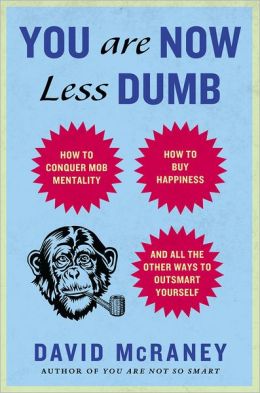
Review of David McRaney’s You Are Now Less Dumb, part 1

David McRaney’s second book, YOU ARE NOW LESS DUMB, extends the themes of his first book, in greater depth — there are 17 chapters in some 300 total pages, compared to 48 shorter chapters in the first book. And it’s anchored by two deep themes, the first and last chapters, about ‘narrative bias’ and ‘self-enhancement bias’. The chapters in this book to some extent consolidate and amplify ideas from the first book, but these two endpiece chapters describe basic themes that have many implications that the author, perhaps wisely, does not spell out.

Like the first book, the introduction and each chapter in this book begins with a theme, stated as a ‘misconception’ and a ‘truth’. Here are those from the introduction:

Misconception: You are a being of logic and reason.
Truth: You are a being capable of logic and reason who falls short of that ideal in predictable ways.

The introduction describes a contested football game between Dartmouth and Princeton in which fans of each school, watching an identical pre-recorded video of a key game, had vastly different reactions about which side was unfairly rough. We are all ‘naive realists’, McRaney says; we think what we see is what actually happens, but this is a philosophical idea long discredited by science. Eye-witness testimony is basically worthless [an idea that is, gradually, creeping into public policy].

This book, more than the first one, has deeply affected and channeled my thinking. It consolidates ideas I’ve been pondering for some time, and given them a framework for further thought.

The first, anchoring, chapter, is about ‘narrative bias’.

Misc: You make sense of life through rational contemplation.
Truth: You make sense of life through narrative.

A key psychological experiment recounted here is about three mental patients, each of whom believed he was the reincarnation of Jesus Christ. When confronted with each other, brought together in the same mental institution — what happened? (This experiment took place decades ago and would be regarded as unethical now.) Each one explained the others away, without abandoning their own personal narrative. Each one clang to his personal narrative.

Every culture finds ‘meaning’ in the world through narrative. These are the basic narratives that Joseph Campbell identified — the character who faces adversity, embarks on an adventure, and succeeds against great odds. Or–does not succeed; the tragedy. Both narratives appeal because anyone can map their own experiences onto one of these two templates.

The brain/mind [they are the same] tries to make sense of any experience by trying to detect causes. A revealing case is how Air Force pilots, subject to such high G forces that they black out, have experiences very similar to the so-called ‘near-death’ experiences: the tunnel, the white light, friends and family, memories. Even as it’s dying, the brain keeps trying the make sense of things, in a narrative fashion.

All humans reduce life to two questions: where did we come from, and why are we here?

Narrative psychology asks, why are these questions so important? It seems that *meaning*, to these questions, is more important than ordinary happiness. And meaning requires narratives.

McRaney touches on the ‘concept of mind’ notion that I’ve read about in Daniel Dennett and Jesse Bering. It’s the idea that babies, until they are two or three years old, don’t realize that other people have minds of their own. The naive notion is that other objects — the sun, the moon, the winds and the rains — also have ‘minds’, a notion that has given rise to many mythologies — or religions [they are the same? ;)]. McRaney remarks,

Out of that sense of self and other selves come the narratives that have kept whole societies together. The great mythologies of the ancients and moderns are stories made up to make sense of things on a grand scale. So strong is the narrative bias that people live and die for such stories and devote whole lives to them (as well as take lives for them).

Here is where I perceive McRaney taking a very diplomatic stance. He does not mention the word ‘religion’, or ‘faith’, even though this is obviously what he is talking about — but to make this explicit would make this a very different kind of book. One that might alienate many a reader. I think this is a wise decision, because as long as he does not alienate these readers, he can make them think about these biases. Making them think.

Enough for now. More in a later post.

Posted in Book Notes, Thinking | Comments Off on Review of David McRaney’s You Are Now Less Dumb, part 1

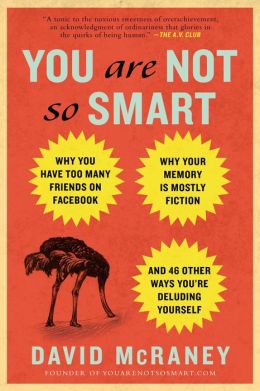
Review of David McRaney’s You Are Not So Smart

As I mentioned in a Facebook post last night, without bookstores to browse through, I discover titles and authors I might not otherwise have seen most often through web excerpts and interviews — at sites like Slate and Salon, Huffington Post, various science and skeptic blogs. As I recall my first exposure to David McRaney was an excerpt from his latest book, YOU ARE NOW LESS DUMB, on Salon a couple months ago — I quoted from it, here.

I then bought that book, and then his first book, YOU ARE NOT SO SMART from 2011 (both published by Gotham Books), and paused reading the second to read the first first.

It was reading these books that prompted me to recall LOGIC AND CONTEMPORARY RHETORIC, which I posted about here; these McRaney books appeal to interests I’ve had for decades: how to think logically, and how to see through illogical arguments; pseudoscience and why people believe things so passionately for which there is such dubious evidence at best; and, more grandly, the limits of human perception about reality, if the human mind is capable of perceiving what is real instead of basking in illusions of its own making (which in my recent reading is most acutely addressed by Jesse Bering’s THE BELIEF INSTINCT, which I’ll blog about eventually).

I’ve read books along this spectrum over the decades — books by Carl Sagan, Michael Shermer, Thomas Gilovich, and others — but in just the past couple three years it seems like there is a relative wealth of such books, McRaney’s and Daniel Kahneman’s big book (which I haven’t read yet), and others (or, just as likely, it’s my confirmation bias ticking in that I notice such books now that I’m attuned to them…)

Enough preamble. The difference between any of those earlier books that I read and the two by David McRaney is that McRaney isn’t focused so much on logical fallacies or the tricks used by others (advertisers, politicians) to sway you, as the way your mind is biased to *trick yourself*.

McRaney’s YOU ARE NOT SO SMART has 48 chapters in 300 pages. Each chapter, and the introduction, is headed by a two-part summary of its theme, contrasting the common misconception and the ‘truth’, e.g., for the introduction:

THE MISCONCEPTION: You are a rational, logical being who sees the world as it really is.
THE TRUTH: You are as deluded as the rest of us, but that’s OK, it keeps you sane.

Each chapter then follows with an expansion of the theme: a mixture of psychological case studies, the author’s interpretive elaboration, and occasional anecdotes from the author’s own life.

It’s a mix of cognitive biases, heuristics, and logical fallacies. Many of these, in this first book, are very familiar: confirmation bias, argument from authority, the straw man fallacy, the ad hominem fallacy.

This is principally a book about psychology, how the mind works, and it’s grounded in the many psychological experiments the author describes. To take the first chapter, about ‘priming’, which is how you are influenced (without being aware of it) by past experiences and your immediate environment into making decisions. One case study was a game that involved splitting $10, with greedier behavior observed by those who had just seen business related photos or items in the room they were in — and then who later confabulated rationalizations for why they made the decisions that they did.

Later chapters cover a couple very famous (and terrifying) psychological experiments — the 1971 experiment in which students were randomly assigned prisoner or guard roles, and over several days came to exploit those roles; and the 1963 Stanley Milgram experiment in which subjects kept giving higher and higher electrical shocks to a person in another room, as long the professor [the authority figure] kept telling them to do so. [Not mentioned in the book, but I recall the made-for-TV movie with none other that William Shatner dramatizing this study — The Tenth Level.] These experiments, and others, have huge implications about social policy that have yet to be incorporated into legal policy.

This is a terrific book for becoming more self-aware about how you think, and how what you believe may or may not reflect what is real.

McRaney is a journalist, not a psychologist himself, but this book is as compelling as anything by a university Ph.D. And his second book, YOU ARE NOW LESS DUMB, is even better — it’s deeper. (Yes let me mention that these rather flip titles don’t do the books justice; though if they attract casual readers, then I suppose they’re justified.)

I’ll address the second book in a later post.

Posted in Book Notes, Thinking | Comments Off on Review of David McRaney’s You Are Not So Smart

TNT for 2

My favorite song on the Neil Finn/Pajama Club album of a couple years ago, for some reason running through my head in that half-awake, half-dreaming state just before the alarm went off this morning.

Posted in Music | Comments Off on TNT for 2

Links and Comments, 6 Oct 13

Many interesting posts this past week, some already posted on Facebook, collected here mostly for my future reference.

Andrew Sullivan (The Dish) responds to a report about tea party voters. Sullivan:

The bewildering economic and social and demographic changes have created a cultural and existential panic among those most heavily concentrated in those districts whose members are threatening to tear down the global economy as revenge for losing two presidential elections in a row. They feel they have already lost and have nothing to gain from any constructive engagement with a president they regard as pretty close to the anti-Christ of parasitic minorities. They feel isolated in a more multi-cultural country. They feel spied upon and condescended to. They have shut out any news sources apart from Fox. It does not occur to them, for example, that Obamacare might actually help them. And you get no actual specifics on policies they like or dislike. It is all abstractions based on impressions.

More to the point, the bulk of these Republicans no longer believe in the Republican party. They identify more strongly with the Tea Party or Evangelical groups or Fox News than the GOP. On social issues, the defining issue is homosexuality – not abortion. That intransigence will alienate them them even further from the future mainstream. Their next big issue: denying climate change. Right now, I see no way to integrate these groups and people into the broader body politic or conversation. Their alienation is so deep it is close to unbridgeable. And further defeats will make their isolation worse, not better, their anger more, not less, intense.


Examples of telling lies to promote political/religious agendas: Texas fundamentalists want to teach Garden of Eden in science class


The Futurist magazine’s top 10 forecasts for 2014 and beyond (via Slate)
Big data, shrinking populations, AI, amateur science, and more


Sometimes you only need to read the headline…
Christian Group Promotes Upcoming Summit with a James Madison Quotation So Fake That Even David Barton Disavows It


Adam Lee at Daylight Atheism nicely summarizes the current Government Shutdown Blues.

There’s only one possible reason they’re so absolutist in their resistance to Obamacare: not because they think it’s going to fail, but because they believe it’s going to succeed. If they really believed that the law would be a huge failure, they could just sit back, wait for it to collapse under its own unpopularity, and then gloat and say “we told you so”. The fact that they’re fighting so tenaciously implies that they’re worried people are going to like it, and they know that if it’s a success, their original opposition will haunt them. They chose to redouble their opposition, trying to prevent voters from getting a chance to make up their own minds about it.


This is likely the most alarming and not entirely implausible post of the week: The Yale political scientist died this week. His life’s work tells us that American democracy is doomed.

Which is to say, the current US crisis may decay the status of American democracy, irrevocably.

And his analysis has a disturbing message for residents of the contemporary United States. The current atmosphere of political crisis isn’t a passing fad and it isn’t going to get better. In fact, it’s very likely to get worse. Much worse. And lead to a complete breakdown of constitutional government and the democratic order.


John Scalzi explains why the ACA [aka Obamacare] is of crucial interest to writers and other artistic types who, traditionally, live on the brink of desperation.
Why The ACA Matters to Me

I don’t have enough fingers and toes on my body to count off the writers in my own personal sphere who are hardworking, who are hustling as much as they can with their work, who had the medical boom dropped on them by life and were screwed because they didn’t have health insurance, or couldn’t get health insurance was even remotely within their financial means. I can’t tell you the number of writers I know personally who have gone begging online or to family and friends to cover a catastrophic medical issue. Not to mention musicians, artists, actors, and any other sort of creative people.

Later this post at ThinkProgress, Why The Affordable Care Act Matters To Artists, which quotes Scalzi’s post among others.


1st October saw this brilliant post on Slate, If It Happened There … the Government Shutdown, presenting the current crisis as it happened in another country, reported by American journalists. Note the loaded wording — “sleepy capital city”, “regime”, “intensely proud and nationalistic people”, “rule”, “a young fundamentalist lawmaker from the restive Texas region”, “its vast stockpiles of weapons of mass destruction”.

The capital’s rival clans find themselves at an impasse, unable to agree on a measure that will allow the American state to carry out its most basic functions. While the factions have come close to such a shutdown before, opponents of President Barack Obama’s embattled regime now appear prepared to allow the government to be shuttered over opposition to a controversial plan intended to bring the nation’s health care system in line with international standards.


Media Matters: What Epic Propaganda Looks Like:

There’s nothing wrong with being passionate and dedicated to a cause. But the right wing’s almost hypnotic, monomaniacal focus on opposing health care reform has been matched, if not outstripped, by its relentless desire to purposely lie about the new law year after year after year. That’s not passion, that’s propaganda.


I was tempted to Facebook this post by Bill Maher, but did not.

New Rule: Conservatives Who Love to Brag About American Exceptionalism Must Come Here to California

New Rule: Conservatives who love to brag about American exceptionalism must come here to California, and see it in person. And then they should be afraid — very afraid. Because while the rest of the country is beset by stories of right-wing takeovers in places like North Carolina, Texas and Wisconsin, California is going in the opposite direction and creating the kind of modern, liberal nation the country as a whole can only dream about. And not only can’t the rest of the country stop us — we’re going to drag you along with us.

Posted in Commonplace Book, Culture, Lunacy | Comments Off on Links and Comments, 6 Oct 13

Gravity

[Capturing my Facebook post as a blog post.] Just back from seeing Gravity. It’s quite a ride — spectacular in many ways. Terrific effects, portrayal of people in orbit over Earth, and even the simulated zero-G (or micro-G) movements look great, considering that they filmed it with actors suspended from cables. (This film must have been quite a physical feat for Sandra Bullock. This kind of acting is not easy.)

I do have two qualms. One is the aforementioned convenience of the shuttle and the Hubble space telescope being in the same orbits; more than that, it’s the shuttle and the Hubble and two (or was it three?) space stations all being rather implausibly close together (and in the same orbit as the debris). In fact, there’s no reason to think they wouldn’t be half way around the planet from each other, not to mention in different orbital heights and inclinations.

Second — something I haven’t seen mentioned anywhere: George Clooney did not have to let go. In that key scene, he and Sandra Bullock are attached by cable and get tangled up in cables dangling from the ISS. Once tangled, their momentum has stopped, relative to the ISS. It is not, as the film implies, as if George is ‘hanging’ and is about to pull Sandra after him. Once they’re tangled, they’re all in free fall next to the station.

Minor quibbles could address the luck with which Sandra Bullock manages to hit the right buttons. But, it’s that kind of movie.

I am still in the position of wishing that, someday, the technology of modern film making could be harnessed in the service of a truly great story. It hasn’t happened since 2001.

http://www.imdb.com/title/tt1454468/

–Update 6Oct13: Phil Plait and Neil deGrasse Tyson have both posted and tweeted about these faults and others. Are we nitpicking and missing the point? Or is this more evidence that people value story over scientific fidelity — a crucial point in the ongoing development of my theme?

Posted in Science, science fiction, Space | Comments Off on Gravity

Gone with Inherit the Wind

The oddest thing about this post is, why would a community college think to schedule a performance of “Inherit the Wind” with involvement of a director and support by a religious college, Martin Luther College, in the first place?

After seeing the poster for the audition, several MLC professors raised objections about the play’s subject to the administration.

“We felt it was not compatible with what [the school] teaches the Bible says about the universe and the world,”? said [MLC’s VP of Student Life Jeffrey] Schone. “This is a ministerial school. People employing our students need confidence about their views.”

Blogger Hemant Mehta, posting this story, responds,

I love that final line. As if what potential employers seek from these students is not a weakly-held truth but a confidently-held lie. Students won’t be employable if we keep challenging their firmly-held and completely-discredited views! So stop making them think! (Though I guess the statement makes sense, given what pastors say from the pulpit on a regular basis…)

I read the play Inherit the Wind in my teens, saw the movie a couple times, even saw a stage performance at UCLA when I was a student there. It’s dismaying that society has not much progressed in all these decades. The battle between faith and science is still being played out. And may forever play out. It’s part of inescapable human nature.

Posted in Religion | Comments Off on Gone with Inherit the Wind

Is the Younger Generation Turning away from Organized Religion?

Skeptic Blog:

http://www.skepticblog.org/2013/09/25/losing-our-religion/

We can all speculate about why younger generations are alienated from organized religion, and certainly there are many reasons. But knowing the current political trends in this country, we might suggest that one factor of great importance is how “organized religion” in this country is largely driven by the shrill and intolerant evangelicals (including the extreme Catholics like Rick Santorum), and their hate-filled message against gays, women, and sometimes minorities.

But Hemant Mehta argues that the regressive social policies of fundamentalists isn’t the only factor. He points to the fact that younger generations are more likely to learn from the internet, and less likely to obey everything their parents tell them, especially when they have questions that organized religion has no good answers for. Certainly, the virtual community of web-enabled young people can explore and learn about topics like atheism and evolution in a way that would have been impossible in many small religious American towns just a generation ago. Even if the social pressure of the conservative community censors or hushes up these topics in school and at the library, the internet opens a window that cannot be shut by local authorities—and younger people are more likely to find their own answers this way than ever before.
For those of us who value science and science education in this country, this is good news. As I’ve argued in several previous posts, the single biggest factor that causes us to fall behind nearly all the other westernized industrial nations (including Japan, South Korea, China, and Singapore, along with most of Europe) is religion. When you break down the polling, it’s always questions about evolution, the age of the earth, cosmology, and human evolution that nearly always cause Americans to flunk science literacy tests compared to other nations. These are all questions that reflect the creationist-evangelical influence on our culture. Thank gods, it is apparently declining.

In contrast to this discussion,

http://www.alternet.org/belief/breaking-their-will-sick-biblical-literalism-leads-child-abuse-and-even-death

Child protections have become established in most countries, and conversations about child-friendly religion are gaining ground. Even so, many children are subject to patriarchal groups that take parenting priorities from the Iron Age. Evangelical Christians, fearing that their religion is losing ground, have ramped up recruiting activities targeting high school and college students but also young children. Their tool bag includes afternoon club programs and enticing camps. Some churches, like that of TV’s Duggar family, promote a high birth rate, adding young sheep to the fold the old fashioned way. Many churches encourage members — even those who already have numerous children — to adopt.

Posted in Culture, Religion | Comments Off on Is the Younger Generation Turning away from Organized Religion?