Subtitled: How the universe organizes itself to create life, consciousness, and cosmic complexity.
(BenBella Books, June 2022, 306pp, including 26pp of acknowledgements, notes, and index)
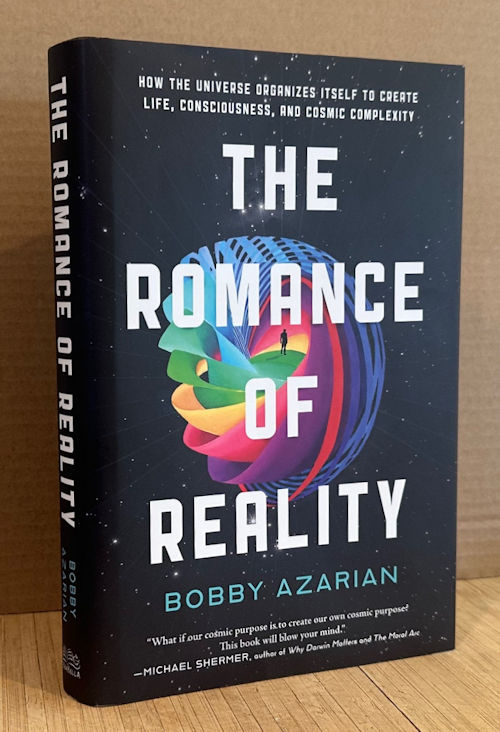
This is the third of three books I read this past January, all with vaguely similar themes, but each quite different in intent and conclusions from the others. I began this book back in September 2024, but then, with the coincidental appearance of Harari’s NEXUS in that same month, and its reference to Hidalgo’s WHY INFORMATION GROWS (from 2017 but on my shelves), I set Azarian aside to read Hidalgo, that September (posted about in November) and eventually the Harari, read last July (and not yet posted). Then this January returned to Azarian.
It’s not coincidental that Azarian referenced those two authors (indirectly) within the first 30 pages or so of his book, because his book is basically a synthesis of ideas from other writers. The difference between them and Azarian is that Azarian is anxious to challenge some of the big names in science writing, in favor a view that is… teleological? Even mystic?
As a book regardless of subject matter, its problem is that it’s both repetitious and *thick*. Or *dense*. One starts to glaze over. Couldn’t this all be summarized more cleanly? He’s always quoting others’ books, as if he knows his subjects only second-hand.
(Here’s a sample, admittedly out of context, from page 172:
Per the construcal [sic] law introduced in the prior chapter, this enables even more energy to flow through the system, organizing it faster, such that a positive feedback loop amplifies the size and complexity of the network. Out of molecular or behavioral chaos, dynamical order spontaneously emerges as new functional structure crystalizes from a quite enchanting entropic force. The individual components are now part of a higher-level system, with new global properties that constrain the behavior of the elements that make up the system.
)
Yet there’s a lot of good stuff here. In its amalgamation of themes, it resemble David Deutsch’s book from 1997 (reviewed here); he understands and aligns with Wilson’s consilience; and chapter 6 is a good summary of epistemology and science and how we know anything. Though once again, little of this is new.
And yet he makes it a point to disagree with the ideas of Sean Carroll, Daniel Dennett, Sam Harris… and not convincingly. It’s as if his shtick is being contrarian. As some writers are.
(I’ll note that the publisher is BenBella Books, a legitimate seeming publisher, but who’s not published any other book among hundreds in my nonfiction library. Also, there are lots of blurbs, but only familiar blurber is Michael Shermer. This was true about the two other books I read in January – as if these three writers sit outside the mainstream of current thought.)
The main theme of Azarian is that the universe is somehow preordained to develop life and consciousness. Other writers, like Carroll, has derived such ideas from the laws of physics, and subsequent ideas of complexity and emergence, but Azarian’s take is more insistently teleological than the takes of others. This strikes me as the same kind of *wanting to believe* that we’ve also seen in Alan Lightman and other writers. And as soon as you detect that motivation, beware: beware that they might be eliding over inconvenient facts and selectively presenting evidence to support their metaphysical yearnings.
Also: the author has never written another book. He doesn’t have a Wikipedia entry. None of these things necessarily mean anything. But: his claims in the introduction are so grandiose that were they justified, they would be much better known by now. I can only conclude his chain of reasoning has not impressed many others…
But, bottom line, after reviewing the detailed notes below. Even if the author seems trying too hard to reach a pre-determined conclusion, that conclusion is intermittently plausible. It’s certainly true, as I’ve gathered, that there is much in the basic structure in the universe that inevitably has given rise to the elements, the stars, to life, that has not required any supernatural entity to micromanage into existence.
(If you want to believe in God, be impressed by the way He set up the universe to automatically generate our vast universe and life on our planet, rather than thinking He micromanages its existence and our daily lives. And follow the implications of that: that many many other worlds likely harbor life as complex as life on Earth, since its emergence is built into the structure of reality. That Azarian’s point.)
Key Points
Early chapters summarize what we know about evolution (if not the origin of life), with claims that the emergence of life was inevitable. Given energy, life gains ‘agency,’ and how the second law of thermodynamics actually works. Then about entropy. How Prigogine explained about spontaneous order, about self-organization and dissipative structures.
In Ch4, how life is a better way to dissipate accumulated geothermal energy; life happens to a planet. (This is close to zeroing on when life evolved: as the interaction of molecules near deep sea volcanic vents, where lots of heat is present.) Thus life is inevitable, and likely exists on other planets, perhaps trillions of other planets. Further, living organisms have agency, and life on a planet is virtually impossible to destroy.
Ch 5 concerns emergence; life as a computational system; information; how living systems are informational systems.
In Ch6 he identifies ‘agency’ with ‘teleology’. Discussion of knowledge and how we acquire it. Many religious books, until the Enlightenment. Postmodernists who think there is no objective knowledge are wrong. Science has done in three centuries what religion and pure philosophy have never done. Science entails a practical method to always move us incrementally to the idea of absolute certainty and truth. Trial and error, adaptive learning, hypothesis testing, evolution: all variations of the same process. Evolutionary epistemology consists of evolution, cognition, and science. Later updated with Bayesian thinking. Similarly life is about survival, or persistence, or evading equilibrium. (This recalls David Deutsch.)
Ch7: this is a theory of open-ended knowledge creation. Purpose or progress in nature is not a paradox but a solution to a paradox. This sounds religious but is not. The laws of physics favored the emergence of consciousness. Three scientific philosophies are different perspectives on a single cosmic narrative: Universal Darwinism, evolutionary epistemology, and universal Bayesian-ism. EE-UD-UB, merging into a consilience.
Ch 8. So humanity’s desire to expand into space reflects a biological imperative. We are a way for the cosmos to know itself (as Sagan said).
Ch9 addresses hierarchy… Author imagines ‘poetic meta-naturalism’ playing off Sean Carroll, whom he thinks is too reductionist. Because nature does have a purpose. He discusses loops and levels. The former a Hofstadter term, and involves recursion and self-reference, leading to emergence and complexity. And we have levels, nested systems, smaller units becoming larger units: atoms/molecules/cells, continuing to the mind and beyond. Thus life’s emergence was ‘written into the fabric of the universe.’ Mainstream biologists have avoided such ideas to avoid any hint of teleology. Complexity goes with diversity. There’s no superior or inferior, but rather a web. A trend toward higher complexity. Even if there’s no conscious intent involved. But could something emerge that would be conscious?
Ch10 is a discussion of consciousness, what people have thought it was. Free will. How determinism gave way to indeterminism, chaotic systems. There’s no Laplace’s demon, no behaviorism; it was replaced by cognitive sciences. And information theory. Some go further into panpsychism, that all matter is imbued with mind; author says this is wrong.
Ch11 gets abstruse in a discussion of strange loops, among other topics.
Ch12 is about incompleteness and paradoxes. The mind is not a Turing machine. Hofstadter claimed self-reference as the source of self.
And Ch13 is about how a global mind may eventually emerge. There may be no end to the universe at all, no heat death or big freeze. But rather, a state of maximal complexity that might be indistinguishable from God. We can speak of this as a kind of goal, an entirely natural, not supernatural, one. The author revisits the fine-tuning problem, and the anthropic principles. The problem disappears in a multiverse, perhaps involving cosmological natural selection, in favor of universes with life. Another interpretation of quantum mechanics is ‘decoherence,’ which would explain why things are still there even when we look away. [[ Shades of Hoffman ]] Quantum Darwinism would be a true Theory of Everything. This even has implications for human morality, suggesting the obligation to expand and fill the universe with intelligence. Our obligations, therefore, are to do what’s good for the living network, the biosphere. What’s the meaning of life? Be aware; be meta-aware; make choices consistent with long-term goals. Take a cosmic perspective (cf Sagan). The greatest good for the greatest number of people. Be compassionate and progressive: knowledge is enlightenment, transcendence, and power. You are a cosmic imperative.
Detailed Notes
Introduction, p1
Right now we’re experiencing a paradigm shift. We’re not the center of the universe; life evolved. Now our worldview sees life as accidental and insignificant. Entropy is leading to complete disorder. Darwin’s idea led to the ideology of reductionism. And materialism. The reductionist worldview. But a new paradigm will show that life and intelligence has deep cosmic significance. This derives from complexity science, and dynamical systems. Life is a form of adaptive complexity, at the boundary between order and chaos.
He says: “a nested sequence of parts coming together to form ever-greater wholes” p5.4, so maybe extending Carroll et al. “At this moment in time… we are the stars of the show.” The universe is waking up – through us. Sagan quote. But existential success is not guaranteed for Homo sapiens. The book will argue that humans are autonomous agents with free will, 6.4. We will arrive at a ‘theory of everything’ that may be called a ‘unifying theory of reality.’ It will solve the hard problem of consciousness, free will, and issues of complexity and entropy. It will provide an ‘integrated evolutionary synthesis’. Three parts to the book… We will arrive at a ‘poetic meta-naturalism’.
Part One: Origins
Ch1, A New Beginning, p11.
- Thomas Huxley wondered how Man fits into the big scheme of things. The thesis of this book is, 11.8. We’re an intermediate step. The emergence of life wasn’t improbable, but inevitable. This suggests that extraterrestrial life must be common. Non-life became life through abiogenesis. 20th century scientists were sure life was an anomaly. That was just an assumption.
- P13, Darwin explained how life evolves, not how it emerged. Evolution is simple to summarize. … But it doesn’t explain how the first living organisms arose. Stroke of luck?
- P15, Life is not a fluke. The ‘chance hypothesis’ was accepted by Crick, among others. As did Hoyle, who compared the chance to a 747 being randomly assembled. Christian creationists seize on this, claiming divine intervention, option two. Option three: life emerged from increased complexity as soon as conditions allowed it. This was Sagan’s view. Stuart Kauffman put this forth in At Home in the Universe. 16b. But what is the mechanism?
- P17, Energy as the fundamental organizer. The simple answer is energy. It’s what gives non-life an ‘agency’. Energy flow is what thermodynamics is about. Especially the second law… to understand how complex adaptive systems like life can emerge and proliferate.
Ch2, Energy, Entropy, and the Paradox of Life, p19
- Quote by Strogatz.
- Start with the first law: energy cannot be created or destroyed; the total amount in a system is constant. Yet truly isolated systems are rare or nonexistent.
- P20: Entropy: a complex and confusing term, p20. Entropy is usually defined as ‘disorder.’ That can be misleading, outside of closed systems. [[ Yes Brian Greene just explained this, in 2020 ]] The total entropy does not correspond to the amount of organization that exists. There are two types of entropy. History. Steam engines. Dissipation. Entropy is the quantity of energy no longer available for work. This is thermal entropy. It doesn’t mean that the growth of life and complexity is prohibited.
- P24: Boltzmann Entropy: A Measure of Statistical Disorder. His explanation of heat as molecular motion.
- P25: Microstates versus macrostates. And he realizes the collective behaviors of system could be predicted statistically. Here’s where the notion of disorder came in. Examples of billiards, bathtubs, and coffee.
- P27, The birth of statistical mechanics. Skittles. Playing cards. Configuration entropy.
- P28, The way to evade a disordered fate. How to explain the complexity of our world? Because open systems don’t play by Boltzmann’s statistical rules. Earth gets energy from the sun.
- P29, Schrodinger solved the paradox of life. His 1944 book, What Is Life? Life survives by consuming energy. And there are plenty sources of energy for us to extract. Asimov’s “The Last Question.” Biology may exist to open new channels for energy flow…
Ch3, Unraveling the Mystery of Life, p33
- P34, Extending thermodynamic theory. Yet Schrodinger didn’t explain how life emerged. Ilya Prigogine came along in the 1960s with an idea.
- P35, Spontaneous self-organization and the second law. Examples of spontaneous order include whirlpools in bathtubs, tornadoes, Jupiter’s red spot. These structures form around gradients. Such organized systems help reduce gradients as quickly as possible. The emergence of self-organization. Prigogine called these dissipative structures. Example of convection cells.
- P37, Attractors create order by constraining chaos. … Phase transitions
- P39, The birth of non-equilibrium thermodynamics. Prigogine’s work gave rise to new fields of physics and chemistry. Especially studied at the Santa Fe Institute. New insights into how life might have begun.
- P40, A new paradigm for understanding life. Prigogine’s ideas could not be demonstrated in a lab. In 2015, the idea of dissipative adaptation. In 2017, molecules aligning… adaptations. Using computer simulations. More papers appeared about similar ideas. Leading to the conclusion that the second law favors the emergence of complex systems that, when sufficiently complex, we call organisms. 42b.
- P43, Collective autocatalysis catalyzes creation. How to get to the size of a cell? We need a process called autocatalysis. Processes in which a catalyst speeds up reactions of other molecules. Ref Paul Davies, The Demon in the Machine, about autopoiesis. All of this suggests that abiogenesis may have been inevitable. There’s still a long way to go to get a cell. What’s missing? Next chapter.
Ch4, The Emergence of Life on Earth, p47
- The topics of the previous chapter don’t get us DNA, enzymes, etc. So let’s consider the process of metabolism.
- P48, Energy flow, organization, and metabolism. Harold Morowitz. The Krebs cycle, that we learn about in high school. A key came in 1977 with the discovery of life in hydrothermal vents, using a Krebs cycle in reverse. And Eric Smith from the Santa Fe Institute.
- P50, Life: the universe’s great balancing act. In effect, self-renewing life served as a better way to dissipate accumulated geothermal energy. Life happens *to* a planet. Smith and Morowitz did a 2016 book…
- P52, Phase transition theory and the origin of life. Phase transitions happen at various levels of abstraction. Flocks of birds; emergence of civilization. Local interactions propagate through the entire network. The effect is chaotic, e.g as with the butterfly effect. Thus the behavior of life is unpredictable. But we can use statistical mechanics to predict trends. And natural selection can operate on thermodynamic variations. For the utility of absorbing free energy.
- P54, Questions and conclusions. Thus once life formed, it was able to survive. We can answer some key questions. Was life on earth an accident? No, it was the inevitable result of these various processes, 54.9. Is there life on other planets? Probably, at least on planets similar to Earth. How many of those would there be? Perhaps trillions. What is the relationship between life and the second law of thermodynamics? They exist in perfect harmony. If life was inevitable, how come the cell only emerged once in the history of the earth? Well, we don’t know that for sure; but we do see life everywhere on earth. Why has life been so hard to create in the lab? Life is complicated; replicating extreme temps and pressures is too. Earth had lots of time. Overall: we don’t need to depend on singular events to explain life; OTOH maybe life isn’t actually that ‘special’ after all. But this isn’t true, because living organisms have *agency*.
- P57, The game changer is agency. Autonomous agents can push back on nature, and cause things to happen. A living agent can manipulate the environment to maintain itself. Though that’s not necessarily sentience. Quote from William James. So where did agency come from?
- P59, The unreasonable robustness of biology. And why is life so robust and resilient? Our impression that life is fragile is due to our anthropocentric worldview. Life is a collective… 59m [[ Recall my notion that life on earth consists of a biosphere roughly stable in mass, that simply mixes up the ingredients in a regular way. Certain animals become certain other animals, and so on. ]] Life on a planet is virtually impossible to destroy. Even perhaps if the stars and planets run down…how do we explain this?
Ch5, Biological Information and Computation, p61
- The new genesis story is all natural but nonetheless magical: this is called emergence. Life is not just a bunch of chemicals. How it’s different can be understood through the concept of information. And life as a computational system.
- P62, What Is Information? Information and thermodynamics are intertwined. What is information? We glean information from the world around us. Examples of growth from babies to adults; Schrodinger realized it in What Is Life? Before DNA was discovered. This takes us to information theory.
- P64, Information according to Shannon. His 1948 paper. Reduce the ‘noise’ in a signal through error-correction tricks. Transmitting a message involves uncertainty, via noise, and this amounts to ignorance; conversely information is knowledge. The mathematics of information is analogous to that of entropy. So here’s information entropy, another kind. Information is associated with a reduction of disorder. There are problems with information being more or less useful depending on the recipient. Shannon ignored ‘meaning’…
- P67, Living systems are informational systems. John Maynard Smith emphasized to Dawkins how information was to the key in biology during the 20th century. Biological information has value only in the right context. Complexity science helps us measure information. Santa Fe again. Rovelli has extended these ideas. … Biological systems perform computation.
- P70, Living systems are computational systems. Living systems must solve various problems: find energy, avoid predators, etc etc. Evading the three Ds—death, decay, and disorder. Requires gathering information about surroundings and determining appropriate responses. Biological computation is called cognition. Examples of pursuing food.
- A system that can exercise control is called a cybernetic system. And can be said to be teleological, in an unconscious sense. These days the word agency is preferred. Norbert Wiener’s 1948 book on Cybernetics defined the field, with feedback, causal loops… Further questions remain, p73.
[[ Gist so far: rather dense, and obviously borrowing ideas from everyone in sight, but by the same token, a valuable summary of ideas about life that have been percolating for decades… even if modern writers don’t use the same terms anymore. ]]
Part Two: Evolution
Ch6, Natural Selection and Knowledge Creation, p77
- Lesson so far: the laws of nature not only allow for life, in certain conditions they also necessitate life. We still need to understand ‘agency’. Life is defined in thermodynamic terms. 78t. This ‘agency’ is what philosophers have called ‘teleology’.
- P78, Characteristics of Agency. Inanimate things are subject to physics in a way that organisms are not. Laplace was wrong, 79t. The question now is, how did biological information and computation emerge? We have to think about free will and consciousness in that context. We need not resort to supernatural intervention. And how significant is life in the grand scheme of things?
- P80, The Need for Knowledge. A sentient system needs knowledge about how the universe works. We use a systematic procedure called science. Is there a limit to knowledge? Wigner on mathematics. Later, Deutsch. 80b. A 2019 TED talk. Quantum computing and the many-worlds interpretation of QM. Quote 81t. Dennett approved. Other: Kurzweil. Dyson. Kevin Kelly. Life must also extract the free energy. For which it must possess a map or model of the environment.
- P82, A Unifying Theory of Reality. Knowledge creation integrates thermodynamics, information theory, and evolution. A theory of everything. Should explain everything. We’ll see consilience, cf Wilson. Based on a sound epistemology. An undervalued branch of philosophy. Let’s explore this further.
- P83, The Problem of Epistemology. What is knowledge and how do we acquire it? Beliefs about the world that are in some way correct. Not a trivial matter. Through most of history people believed religious books. But there are many, different, such books. How do we know what to believe? The Greeks considered this question but it wasn’t until the Enlightenment in the 19th century that this was formally addressed. They focused on experience, qualitative and subjective. Even knowing that our senses can deceive us. Per Shannon, knowledge reduces our ignorance about the world, 84.8. How do we do this? The ‘skeptics’ gave up and declared there’s no such thing as objective knowledge, or truth. But they, and the current postmodernists, are misguided. We can be certain of the knowledge acquired via science. Science has done in three centuries what religion and pure philosophy have never done. Science entails a practical method to always move us incrementally to the idea of absolute certainty and truth. Karl Popper was one of the first who saw this.
- P85, Karl Popper’s Epistemological Epiphanies. Popper wanted to redefine epistemology as the philosophy of science. He saw that problems create knowledge. Problems generate hypotheses, conjectures, etc. Some will be in error. We use evidence and inference, in an algorithm to find solutions. Popper called this algorithm conjecture and refutation. Same as hypothesis testing. In effect how evolution works. And AI. Solutions always lead to new problems. But all those solutions are recorded, and become accumulated knowledge, genuine progress. At the same time science is a creative process. Bayesian updating. Beliefs are constantly updated. But how did human acquire all their practical knowledge before science came along? Popper perceived this too: that science is just a refinement of whatever that earlier method was.
- P89, Adaptive Learning = Hypothesis Testing. And that earlier method has been called ‘trial and error.’ Since life is constantly presenting us with new challenges. If our intuitions don’t work, we adjust our ‘theory’ and try again. We don’t know the correct solution in advance. And so on… Now there’s the Bayesian brain hypothesis, 91t. It’s also an approach to machine learning in AI systems. And these are knowledge generating processes. But how did this happen before brains emerged?
- P92, Evolution is a knowledge creation process. The answer is DNA. Ontogenetic learning; phylogenetic learning. Theories are highly competitive. Popper understood that science is a Darwinian process.
- P94, Evolutionary Epistemology: A Unifying Paradigm. Evolution, cognition, and science. Donald Campbell in the 1960s. Evolutionary processes are learning processes, and vice versa. Adaptation and scientific knowledge. Evolution is not random, as creationists think. A lot of ideas about how these systems interrelate.
- P95, Adaptations Encode Knowledge. To be knowledge, information has to be about something. Examples: a dolphin’s streamlining contains knowledge of hydrodynamics. What problem is life trying to solve? Call it survival, or persistence, or evading equilibrium. All mean roughly the same thing.
- P96, Nature Selects the Most Stable Configurations. How this problem is mocked by creationists like Ann Coulter. Dawkins countered with the idea of survival of the stable.
- P97, Universal Bayesianism Updates Evolutionary Epistemology. Dennett and the intentional stance. Deutsch in Fabric of Reality.
- P100, Life is a signal among molecular noise. John Campbell’s Universal Darwinism. We can also call all of this universal Bayesianism.
- P101, Putting all the puzzle pieces together. An equation, 101.7. Carlo Rovelli. John Maynard Smith.
- P104, Origins finally explained. Diagram p105. …
- P106, Evolution as an inference engine. Emergent computation. Teleology; problems create progress.
Ch7, A Unifying Theory of Reality, p109
- This is a theory of open-ended knowledge creation. It explains emergent phenomena that TOEs (Theories of Everything) like string theory don’t, which dismiss them as epiphenomena. Those are reductionist positions in which only particle physics is real; everything else are constructions of the mind for survival purposes. [[ This is what Hoffman says, in part. ]] Quoting Brian Greene about how life and consciousness is fleeting. In contrast David Deutsch thinks there is no limit to growth of knowledge and purpose. Can only one be right? [[ but Greene allows for ‘levels’ above the reductionist particle physics. ]]
- P111, Unification over Reduction. As we send objects into space we’re creating examples of anti-accretion. Cf Sara Walker, 111.7. 112.5: the unifying theory of reality is at once a theory of cosmic evolution and a theory of intelligence. Recall reductionist philosophies. Quoting Greene as paradoxical.
- P113, Life is not a fleeting moment. There’s a distinction between adaptive complexity and ordinary dissipative structures in nature. We assume that if religion asserts something special about life, then science must say the opposite; e.g. Sean Carroll 114.8. Deutsch disagrees.
- P115, The Universe: A Work in Progress. So purpose or progress in nature is not a paradox but a solution to a paradox. Seth Lloyd doesn’t think organized complexity is transient. The nature of the universe is computational. Kurzweil talks of destiny. These ideas may look religious but are not. Christof Koch. The laws of physics favored the emergence of consciousness. Goes back to de Chardin. Bergson, Morgan.
- P117, Demystifying evolutionary progress. Realize that life is simply ‘adaptive complexity’, a mechanical process, not a mystical one. So there are three scientific philosophies that are actually just different perspectives of a single cosmic narrative: Universal Darwinism, evolutionary epistemology, and universal Bayesianism. These result in a diverse set of phenomena that are often studied separately. The framework, EE-UD-UB, provide a consilience.
- P119, Naturalizing cosmic teleology with natural selection. All of this is consistent with Darwin’s evolution. … Kauffman again. Kurzweil. Yet some don’t accept that natural selection inevitably leads to greater complexity and intelligence. Yet these objections can be seen as warding off any hints of religion…
- P122, The case against evolutionary progress. Stephen Jay Gould. To him life was a drunken sailor’s random walk, with no drive toward higher complexity. Dawkins countered with two arguments. Gould also insisted that human-level intelligence was merely a product of chance; no such thing as progress. Lewin again, 123. Spencer, Hitler, Dennett’s universal acid. Strength in diversity is the point as much as survival of the fittest.
- P124, Making the case for evolutionary progress. In some cases species do get simpler; they don’t get more complex. Robert Wright. Gould was right about many things but wrong in his interpretation of the larger story. He made two mistakes, concerning complexity and individual organisms. These will be addressed in chapters 8 and 9. The ‘modern synthesis’ has been extended over and over, and needs a new name: the integrated evolutionary synthesis. The rest of this book will use this to give us a proper ‘theory of everything.’
Ch8, The Integrated Evolutionary Synthesis, p127
- Dennett quote. We start with the second law of thermodynamics. To survive requires acquiring ‘free energy’ by acquiring information about the world a creature inhabits. Uncertainty-reducing information. Knowledge is power. So does humanity’s desire to expand into space reflect this biological imperative.
- P128, The power of prediction. Acquiring such knowledge is like Bayesian inference. Inference itself is close to a theory of everything. Pinker in 2017 on the Second Law. Life, or adaptive complexity, addresses entropy, or disorder, without any conscious intent. Even without brains.
- P129, Phylogenetic and Ontogenetic Learning. The former is generational learning. Competitive learning. Survival of the fittest. The latter is individual learning. The two correspond to competitive vs cooperative evolution. Mutation is an inventor and natural selection is a pruner. [[ lots of analogies like this throughout ]]
- P131, Weeding out unstable energy flow channels. Natural selection is doing global error correction. [[ someone else used the term ‘filter’ ]] Information is transferred from the world into life.
- P132, We are a way for the cosmos to know itself. Literally. Tegmark. Quote from Dennett about the best single idea anyone ever had – Darwin’s. We’re in a cosmic battle not unlike wars between good and evil. Order and chaos, life and entropy.
- P134, Evolution’s arrow emerges from knowledge accumulation. Back to the issue of complexity of life. Life changes depending on environment. A theory, or life, should be as simple as possible, but no simpler. Different niches on earth require different complexities… quote Olivia Judson: give energetic epochs. Problem spaces and solution spaces. Examples and details. Arms races. Red Queen. Some species must get more complex just to survive.
- P137, The laws of life. Life becomes more energy efficient. David Wolpert. The IES avoid the fitness tautology by speaking of energy-extraction. The constructal law, from Adrian Bejan. 138.3. This wasn’t understood until theories of information and computation matured…
- P139, Redefining fitness in thermodynamic terms. So natural selection maximizes fitness by improving energy flow and predictive models. Dissipative fitness. Consider how brains do tasks that supercomputers fail at, at a fraction of the cost.
- P141, Evolution increases empowerment. The idea of empowerment.
- P142, The relationships between entropy and uncertainty. Recall Boltzmann and entropy. What works, persists.
- P143, The good regulator theorem and the law of requite variety. [[ A recurring theme is how this idea over here is really the same as that idea over there. ]] Ashby’s law. A system has to have as many responses as there are challenges in the environment. E.g. cats and mice.
- P145, Niche emergence drives complexification. So why do niches diversify? Wilson Diversity of Life. Gaia; the need to leave the planet.
- P148, Energy flow as a measure of complexity. 2001 bk by Eric Chaisson: energy rate density. Lewis, Complexity. Sara Walker.
- P149, A new measure of complexity. Phi. From information theory.
Ch9, Hierarchical Emergence, p151
- This theory of reality implies that life will spread through the cosmos at large. Not in spite of challenges, but because of them. Adaptation.
- P152, A new spin on the second law. Energy flow. Stuart Kauffman calls this the fourth law of thermodynamics: a universe that maximized entropy, or minimized free energy, at the fastest rate possible will evolve toward a state that is increasingly complex, organized, alive, and intelligent. 153t. Despite the famous second law.
- P154, One cohesive cosmic story. These ideas go back….
- P155, Poetic meta-naturalism. A new scientific worldview. Sean Carroll. This idea is similar but different to his. Greene is too reductionist. Author argues that nature does have a purpose, to wake up and become aware. This involves loops and levels.
- P157, We are loops. Karl Friston. Dynamic equilibrium. Attractors. The living state is a loop. Citing Hofstadter on ‘strange loops.’ We’re recursive creatures. This involves self-reference.
- P159, Self-reference. Emergence and complexity. Chaisson again. Pal Davies. GEB. A ‘strange loop’ is a loop that crosses levels.
- P161, We have levels. Adaptive systems are nested systems. Examples. A hierarchical modular architecture. Units made of units all the way down. Social organisms. Chart p163: atoms/molecules/cells/ etc. These levels will continue to mind and beyond. These evolutionary transitions correspond to strong emergence. Weak emergence happens wherever there is a pattern. Nested series of phase transitions.
- P165, Evolving beyond earth. The idea that life’s emergence was ‘written into the fabric of the universe’ is no longer shocking. How far is it inevitable? To evolve beyond its planet of origin life needs intelligence. We need a recursive self-organization. Recall the two types of learning. Ideas of self-organization have been avoided by mainstream biologists. To avoid teleology. They need not worry.
- P167, Blind variation and selective retention. This is just a variation and selection mechanism. Substrate independence.
- P167, The meaning is in the metaphor. Self-similarity. Reflection principle. …
- P169, The biosphere is an autocatalytic set. Seth Lloyd’s bk. Kauffman. Wilson. Superorganisms. Transition theory. Bk by Smith and Morowitz.
- P171, Synergistic collective configurations. … How the biosphere is following a similar evolutionary trajectory as life itself.
- P173, All species matter. We can see how Gould and his critics can both be right. Complexity goes with diversity. Internet. The ladder of progress Gould was worried about is really a web. No superior or inferior. Similarly individuals in society, 174b.
- P175, Steps on the cosmic ladder. About Gobekli Tepe in Turkey. Harari about it. Evidence of cooperation. Big picture 176.5. The trend toward higher complexity: 176.9. Still, reductionist scientists resist this.
- P176, The Gaia Hypothesis. Still, there is no conscious intent involved. The biosphere is self-regulating. The Gaia hypothesis. Named by William Golding. DS Wilson uses God as a metaphor for Gaia. Recall how earlier forms of life created oxygen.
- P180, The biosphere becomes an organism. But it isn’t yet; it doesn’t reproduce, etc. West’s book Scale.
- P181, Meta-evolution. How social factors are selected. And now we have the Internet of Things. And how it and humans will evolve. A global brain or infosphere. And would this be conscious? We first consider how minds and mental models emerge from brain.
Part Three: Transcendence
Ch10, The Mind-Body Mystery, p185
- John Wheeler and the ‘it from bit’ movement. The universe is a computer. That idea merges with the ideas in this book… and Wilson et al. The Great Consilience.
- P186, The self-organizing universe wakes up. The reductionist program (Tyson, Greene) is now challenged by these new ideas. Davies, Gould, etc etc. More names! 187bff. Avoiding war with religion, yet again.
- P188, What is consciousness? Nagel and the bat. Descartes.
- P189, What is real? The Matrix. Elon Musk.
- P190, I think, therefore I am. Descartes: Dualism. Animals have no souls. Mind-body problem. The alternative: materialism. Denial of free will: Hossenfelder. Deutsch disagrees. Sam Harris. (Author thinks the denialists contradict themselves.) The courts, awards… Sara Walker.
- P193, The logic of Laplace. The idea that Newton’s laws of motion determine everything. Everything predictable, in principle. Determinism. (Author thinks this entails all sorts of paradoxes.) We would all be delusional. Jerry Fodor objected. but determinism slowly gave way…
- P195, The slow death of determinism. To indeterminism. Heisenberg. You can’t measure everything, even in principle. Then came chaotic systems. Thus, no such thing as Laplace’s demon. But this doesn’t rescue free will.
- P197, Laplace’s demon is truly evil. Remove belief in free will can lead to immoral behavior. Thus the evil demon. Recall behaviorism. It was replaced by…
- P198, Cognitive science saves the day. The idea that the brain is an information processing system. Studied via fMRI. Crick and Koch. Then integrated information theory.
- P200, Consciousness as integrated information. … but it leads to a big problem.
- P202, Integrated information theory’s panpsychism problem. Namely, that all matter is imbued with mind. Koch embraces the idea. Author says this is wrong because…
Ch11, Causal Emergence and Free Will, p205
- Sara Walker quote. We’re coming to the ‘romance’ part. Beware of anthropomorphization. We’ll discuss counterfactuals…
- P206, The many meanings of “mind.” Collective. Conscious. Unconscious. They’re all about information processing. You can have agency w/o consciousness. Free will requires the latter. Why Carroll’s poetic naturalism isn’t sufficient.
- P208, Levels of agent causation. About effortful control, as opposed to purposeful-looking behavior that is executed w/o conscious effort. Ideas of top-down causation were largely dismissed. Quote Dennett, then saying it’s not true today. Roger Sperry, quote 211.
- P212, Unconscious agency: the first level of control. Paul Davies and Sara Walker. The origin of life. Information control. Strong emergence. …
- P214, The macrostate is what matters. Erik Hoel. Kevin Mitchell. Instead of ‘mind’ think ‘information’. Anil Seth. …Hofstadter, I am a Strange Loop. How you can envision the world while your eyes are closed.
- P219, How brains bring about observers. Smry 219.6. ff. A key is self-modeling…
Ch12, The Strange Loop That Spawns the Self, p223
- Turing showed how a simple machine could solve any problem, given time and memory. Turing machines. Godel proved that view was wrong, in his incompleteness theorem.
- P224, The unprovable paradox. Based on the liar’s paradox. “I am lying.” The truth of the statement can’t be settled. Godel went further, but constructing statements that were true but unprovable. “This statement has no proof.”
- P226, The mind is not a Turing machine. So some truths exist that cannot be computed. Thus mathematics is never complete, just as reality is incomplete, forever in work. This was a blow to reductionism. Penrose in his 1989 book suggested the mind therefore is doing something beyond raw computation. How do minds do that? Understand? Presumably via conscious experience. Penrose also assumed the brain must be a quantum computer, an argument not taken seriously. Max Tegmark has argued against it.
- P228, Self-reference as the source of self. Hofstadter’s 1979 book keyed off this idea. He spoke of the self-engulfing television, 229. Judea Pearl: consciousness is having a model of yourself.
- P230, The neural correlates of consciousness. How the brain is organized. Hierarchical. Feedback.
- P231, Feedback loops create consciousness. Koch.
- P233, Global neuronal workspace theory. Dennett’s 91 bk.
- P235, Integrated world modeling theory. Other ideas…talking past each other.
- P237, Clearing the confusion about free will. Recall the experiments showing the brain decides before ‘we’ decide. More about Koch. Cotard’s syndrome.
- P240, The curious compatibility of destiny and free will. …
Ch13, Transcendence and Enlightenment, p245
- Quote Harold Morowitz. Summary so far.
- P247, The global mind wakes up. Multiple realizability means substrate independence; minds can be realized on different mediums… The internet isn’t aware of itself, yet, But a global mind may eventually emerge. We can’t know what, but something new will emerge.
- P249, Loops + Levels = Lift Off. Life will continue to expand into the cosmos. Kurzweil’s singularity. Post-biological, or hyperbiological. The process will accelerate. Recall Dyson’s sphere. Can this go on forever?
- P251, A happy ending means no ending at all. Perhaps there’s no heat death or big freeze at all. Seth Lloyd. Deutsch addresses dark energy in Beginning of Infinity. Kauffman.
- P253, Reaching a maximal state of complexity. What is the ultimate result? Perhaps something indistinguishable from god. Maximal complexity. Paul Davies, Sean Carroll, Lee Smolin.
- P255, A natural worldview for the spiritual and the secular. Thus we do live in a universe that is progressing to some kind of ‘goal.’ There’s a cosmic teleology. But entirely natural. Even mechanistic. No external metaphysical source. Thomas Nagel, 2012, Mind and Cosmos, invoked ‘nonphysical laws’ which was an error. What is considered natural will change over time. Like the multiverse. Despite Popper’s rule about unfalsifiability. All the claims of the creationists go away. …Are we in a simulation?
- P258, The fine-tuning problem. Goes back to the 1970s. Dennett in Darwin’s Dangerous Idea. How to explain this? It invites deism. Even Dawkins is OK with a god who devised the laws of physics and then sat back and watched. But it’s not required.
- P260, Fine-tuning solutions. Two versions of the anthropic principle. Sean Carroll allows that the strong principle boosts theism. But how would such a god have emerged? The weak principle argues that if the universe’s parameters were different, we wouldn’t be here to wonder about them.
- P262, The multiverse conundrum. The problem disappears in a multiverse. In which universes are isolated. Max Tegmark is happy with this; others are bothered by the idea that every possible universe therefore exists. Including those that have intelligent designers.
- P264, Cosmological natural selection. Which principle aligns with the narrative of this book? In a multiverse many universes would be lifeless. We’d still have to explain how we were ‘lucky’ to be in one with life. So we’re back to the strong principle. A third explanation is cosmological natural selection. Hawking and singularities. Smolin’s baby universes. Dennett. A Darwinian multiverse. Which would happen to favor universes with intelligent life. Paul Sorensen and others. Guth and Rees. This amounts to the teleological universe again. So maybe there is a god, one that resulted from an evolutionary process. Or maybe that process is god: an algorithm for eternal recursive emergence.
- P268, Making sense of quantum mechanics. Some of its ideas are common knowledge… Is reality random, or probabilistic? Seemingly so. There are two counter-ideas. The many-worlds interpretation. Which would mean that all logically possible universes exist…
- P270, Refuting the many-worlds hypothesis. By the same statistical argument – our existence would be so unlikely. The other way to take QM into account is via ‘decoherence.’ It explains why things are still there even when we look away. Quantum Darwinism. It will be a true theory of everything.
- P272, The quantum-to-classical transition—a form of natural selection. Q Darwinism explains how the classical world emerges from the quantum world. Via environment-induced superselection. Zurek. Carlo Rovelli. QBism.
- P275, What does a self-organizing universe mean for humanity? All of this calls into question the notion that you can’t derive ethics or morality from nature. That is, intelligence is consistent with the cosmic drive to expand and fill the universe with intelligence. Be part of the grand awakening of the cosmos.
- P276, The road to Omega. Thus: we should do what’s good for the living network, including the biosphere. This is a moral and spiritual obligation. (Which has nothing to do with the supernatural.) Quotes by Sagan and Einstein. So what is the meaning of life? 276b. What can we do? Be aware; be meta-aware. Make your choices consistent with long-term goals. Common interests; minimize conflict and promote cooperation. A cosmic worldview, or cosmic perspective. Sagan again. The greatest good for the greatest number of people. Compassionate and progressive. 278. Psychedelic experiences help. Hyperconnection. Embrace these challenges and find solutions for our problems. Knowledge is enlightenment, transcendence, and power. Be aware. You are a cosmic imperative.
Finally, noting some of the many books Azarian mentions, especially those in my library: Kauffman, At Home in the Universe; Lewis, Complexity; Began, The Evolution of Everything; Paul Davies, The Demon in the Machine; Holland on Emergence; Seth Lloyd, Programming the Universe; Sara Walker; David Sloan Wilson, Geoffrey West, Scale; Roy Gould; Lee Smolin, the Life of the Cosmos.