- How mathematics is behind the things we perceive as beautiful, via Marcus du Sautoy;
- What is Trump trying to accomplish by reducing the number of diseases medicine can prevent children from getting?;
- Several items show confusion on the right between concepts of communism and socialism;
- Pettersson #8.
The deep picture. Humans invoke God for things they find beautiful, without understand why they find certain things beautiful, and other things not. (Whereas God must surely be responsible for everything, including the ugly and disgusting.)
The answer, rather, is that humans have evolved to be pattern-seeking creatures, and see complex mathematical patterns as beauty. And why are we drawn to the beautiful? Perhaps because the order or beauty we perceive in mathematical structures are signs of structure, and health.

Big Think, Jonny Thomson, yesterday: The hidden mathematics behind why you find things beautiful, subtitled “The artistic and the mathematical mind are not so far apart.”
Quoting the Key Takeaways:
- Formalism is the idea that beauty in art can be explained through its formal, mathematical structures rather than subjective experience.
- When Big Think spoke with the mathematician Marcus du Sautoy, he argued that the Universe is inherently mathematical, with structures like symmetry, fractals, and prime numbers shaping both nature and human creativity — from cicadas to Shakespeare.
- Here we look at three suprising examples of the mathematics behind beautiful art.
I’m not so much interested in aligning current understanding with philosophical traditions. As I’ve said before, reviewing some of those philosophy books, many of those ancient arguments have been overcome by evidence. Some of what the ancient philosophers thought turns out to be simply not true.
Opening:
“Some people will hate what I say,” the mathematician Marcus du Sautoy tells me, “because it’s all about unweaving the rainbow. Some people want to retain the magic and don’t want to know why something’s working. That’s fine. But actually, for me, you know, the rainbow becomes much more interesting when you understand what is happening to the light that makes the rainbow like that.”
Then,
Du Sautoy, the Simonyi Professor for the Public Understanding of Science and Professor of Mathematics at the University of Oxford, and I are speaking about “formalism” in the philosophy of art — the idea that we can explain why something is beautiful by pointing out the formal parts that make it up.
Formalism holds that we can account for aesthetic judgments in non-aesthetic terms. Maybe we find a song beautiful because of its tertian harmonies, or we like a certain photo because the angular lines converge on a point. Formalism “unweaves the rainbow” by telling you exactly why you find something beautiful.
Yes, of course. I could go on with many details and examples, but for now I’ll focus on this article. His examples of “The mathematics of beauty” include:
The Golden Ratio
Pollock’s Fractals [it’s not true that any kid could have done Pollock’s paintings]
The Number-crunching Wordsmith
The piece ends:
For du Sautoy, mathematics is the hidden scaffolding of beauty, the invisible thread that connects art, nature, and the cosmos. If we look closely enough, we can see how far mathematics unweaves the rainbow to reveal deeper patterns beneath. Does that diminish the beauty? Does that dispel the magic? I think I’m with du Sautoy on this. It only makes it stronger.
\\\

CNN, yesterday: Trump signs executive order aimed at reducing number of recommended childhood vaccines
Once again, operating from no evidence whatsoever (except some vague statement about “I’ve heard that some people think…”), Trump thinks he can sign a piece of paper and change reality. As if certain actual diseases shouldn’t be cured. As if forcing multiple trips to doctors for a single vaccine is somehow better than a single trip.
For a century, medical scientists have developed vaccines to cure/avoid more and more diseases. Now Trump has decided, in effect, you don’t need to cure 17 diseases, 10 are fine. I think this is mostly to assuage the MAGA no-nothings who think vaccines are icky contaminations of their precious bodily fluids, or something; or who think the most remote, debunked, chance of some connection with autism is a worse fate than getting some of these diseases.
Where would this go on the Capability Immaturity Model? (Analogously, of course.) Probably -1: Obstructive. Or perhaps -2: Contemptuous, for their complete dismissal of scientific evidence in factor of superstitious intuition and conspiracy theories about government incompetence.
Well… natural selection will play itself out.
\
JMG, today: AMA Roasts Trump’s Lies About Childhood Vaccines
That’s the American Medical Association.
Vaccines are among the most thoroughly studied, effective tools we have to protect children from serious vaccine-preventable diseases. Decisions about how and when vaccines are used should be driven by rigorous scientific evidence, patient safety, and independent medical and public health expertise. Altering a proven vaccination schedule without credible evidence risks weakening public confidence and putting children’s health at risk. If you have questions about vaccines, talk to your child’s physician. Putting our children’s health at risk is not an option.
Never mind Trump’s insistence that the volume of vaccines given a child is the equivalent of a bottle of soda. He’s certifiably bonkers.
(And I’m not going to discuss this either.)
\\\
I’ve long noticed that most Americans have no idea what concepts like socialism or communism actually mean. Conservatives, who tend to defy Constitutional principles of American democracy more often than not (in favor of religious authoritarianism), simply use those words to demonize anything they don’t like.

JMG, today: Leavitt: Dems Will Turn US Into “Communist Hellhole”
“I believe that there are millions of Americans across this country who see these Democrats for who they are. These are radical extreme liberals, socialists, communists, whatever you want to call them, Sean.”
“Whatever you want to call them.” Remember, conservatives live in a black and white world. No nuance. Us vs. them.
\
Here’s a Fox guest who does understand some nuance, and reality.

JMG, today: Fox Guest: Trump Is Nation’s “Most Powerful Socialist”
“If Mamdani put price controls on product like pharmaceuticals, if he bailed out farms, if he took stakes in private companies, if he said the energy companies are making too much money, if he proposed credit card caps—you would all go apoplectic, as would your viewers. That’s what President Trump is doing. You could argue he is the most powerful socialist in the country today.” – Robert Wolf, former chairman of investment bank UBS Americas, speaking to Fox News.
\
Again, they hate “socialism” without realizing how American works.
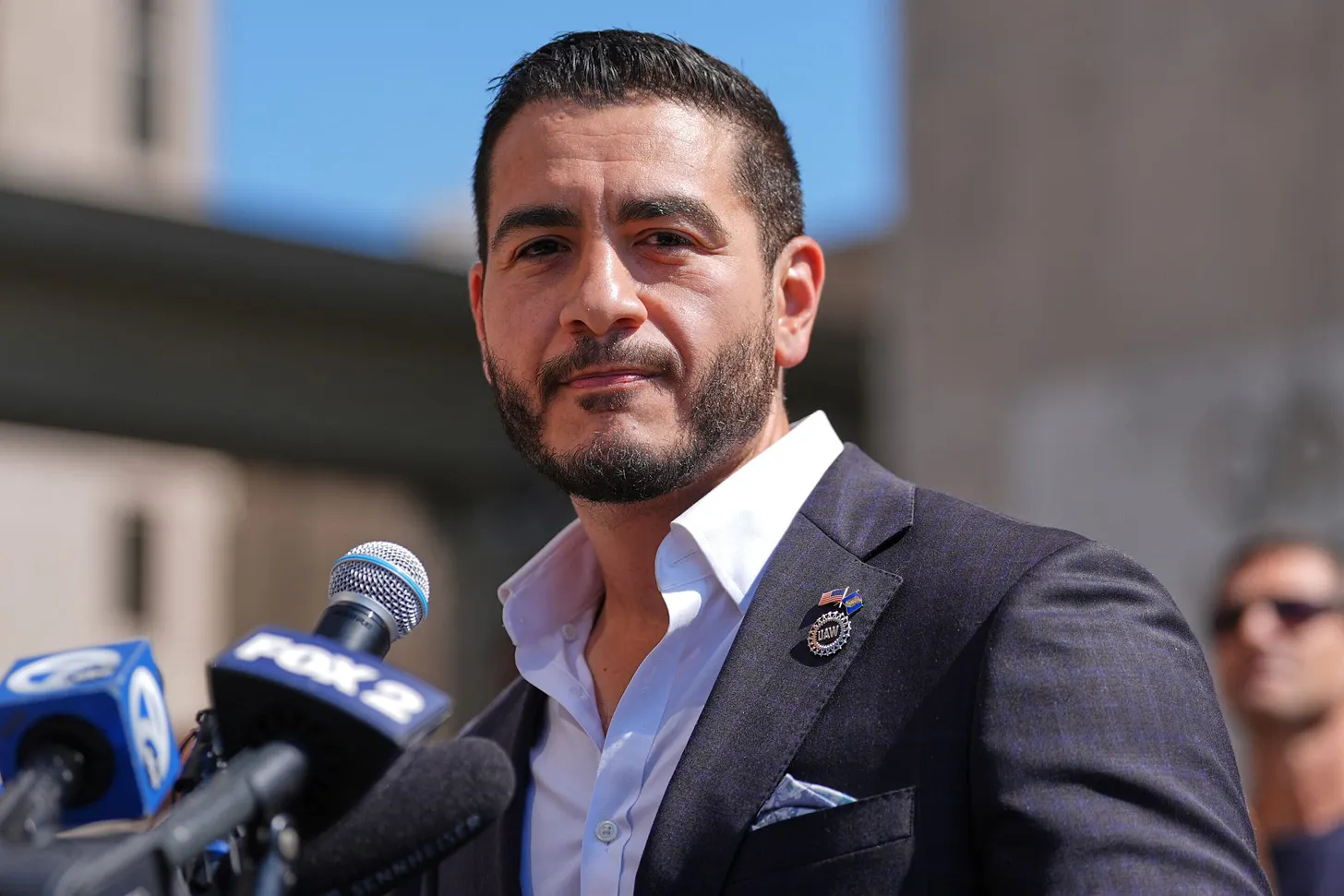
Paul Krugman, today: The U.S. Healthcare System is Already Mostly Socialized, subtitled “And there’s nothing radical about wanting to end insurance company parasitism”
Now that Abdul El-Sayed is the Democratic nominee for Michigan’s open Senate seat, the outcome of this crucial race will depend mainly on two things: Whether Republicans succeed in demonizing El-Sayed because he’s brown and a Muslim, and whether they succeed in demonizing him as a left-wing radical.
I will defer for the now the question of whether bigotry will be effective this year, although I will address it another day. What I want to address instead is El-Sayed’s signature issue — healthcare. Yes, El-Sayed advocates Medicare for All, a position the usual suspects denounce as “socialism.” I will get to the politics of his stance soon. Today, however, I want to talk about the substance.
Long piece.
Still, El-Sayed advocates a system under which the government would pay almost all medical expenses. Isn’t that socialism?
Well, if that is the criterion then much of U.S. healthcare is already socialist. In fact, the government’s role is so large that U.S. healthcare is better described as partially privatized socialism than as anything resembling a free market.
Krugman then goes into lots of details and cites lots of number. (As opposed to “Some people are saying things that they think might be true…”)
Which brings me back to El-Sayed. In supporting Medicare for All, he’s basically calling for an end to the partial, parasitic privatization of a healthcare system that is already hugely dependent on public funding. When one looks at it that way, it’s not at all a radical proposal.
…
So let’s be clear: El-Sayed’s healthcare platform is perfectly reasonable on the merits of cost, fairness and health efficacy. And with private insurers never more hated, while millions of Americans are losing their health insurance, 2026 may be its time.
\\\
Today