Gary K. Wolfe, How Great Science Fiction Works

This is a course released by The Great Courses (http://www.thegreatcourses.com/) in early 2016. The course consists of audio or video downloads or discs (as lead Locus reviewer Gary K. Wolfe delivers lectures on a set), and comes with a 200-page booklet summarizing the 24 lectures.

The following compiles principle titles mentioned in each text lecture, omitting titles mentioned only in passing, and adding titles in the “Readings” section at each chapter end that were not already mentioned in the text. (And omitting some titles listed there that seem egregiously misplaced, including two or three reference to Gene Wolfe’s The Book of the New Sun which nevertheless is not mentioned in the text.) Titles that get multiple paragraphs and have subheaders are indicated with *s.

1, Mary Shelley

  • *Mary Shelley, Frankenstein
  • Other readings:
  • Brian Aldiss/ David Wingrove, Trillion Year Spree
  • Adam Roberts, The History of Science Fiction


2, 19th Century Science Fiction

  • *Edgar Allan Poe, e.g. “The Unparalleled Adventure of One Hans Pfaal” and The Narrative of Arthur Gordon Pym
  • *Jules Verne, From the Earth to the Moon
  • *H.G. Wells, The Time Machine; The War of the Worlds


3, Science Fiction Treatments of History

  • Mark Twain, A Connecticut Yankee in King Arthur’s Court
  • Sprague de Camp, Lest Darkness Fall
  • Michael Moorcock, Behold the Man
  • *Connie Willis, Doomsday Book
  • *Isaac Asimov, The Foundation Trilogy
  • *James Blish, Cities in Flight
  • *Philip K. Dick, The Man in the High Castle


4, Evolution and Deep Time in Science Fiction

  • *Olaf Stapledon, Last and First Men; Star Maker
  • *Arthur C. Clarke, Against the Fall of Night
  • *Gregory Benford, In the Ocean of Night, and subsequent novels
  • *Stephen Baxter, Evolution; Xeelee sequence


5, Utopian Dreams, Dystopian Nightmares

  • *Ursula K. Le Guin, “The Ones Who Walk Away from Omelas”
  • *Sir Thomas More, Utopia
  • Francis Bacon, The New Atlantis
  • *Jack London, The Iron Heel
  • *Yevgeny Zamyatim, We
  • *George Orwell, Nineteen Eighty-Four
  • Other readings:
  • Margaret Atwood, The Handmaid’s Tale
  • Ray Bradbury, Fahrenheit 451


6, Rise of Science Fiction in the Pulps

  • Edgar Rice Burroughs: A Princess of Mars
  • Hugo Gernsback, Ralph 124C 41+
  • E. Smith, The Skylark of Space
  • Stanley G. Weinbaum, “A Martian Odyssey”
  • Lester del Rey, “Helen O’Loy”
  • John W. Campbell, Jr., “Twilight”; “Who Goes There?”
  • Other readings:
  • Mike Ashley, The Story of the Science Fiction Magazines, vol. 1
  • F. Bleiler, Science-Fiction: The Early Years


7, The Golden Age of Science Fiction Stories

  • Campbell’s influence as editor; Asimov “Trends”; Heinlein “Misfit” and “The Roads Must Roll”
  • *A.E. van Vogt, Slan
  • *C.L. Moore & Henry Kuttner, “Vintage Season”
  • Other readings:
  • Mike Ashley, The Story of the Science Fiction Magazines, vol. 1
  • John Huntington, Rationalizing Genius


8, The Spaceship as a Science Fiction Icon

  • Jules Verne, From the Earth to the Moon; Around the Moon
  • *Robert A. Heinlein, “Universe” (expanded as novel Orphans of the Sky)
  • Harry Harrison, Captive Universe
  • James Blish, Cities in Flight
  • Kim Stanley Robinson, Aurora
  • Robert Reed, Marrow
  • Anne McCaffrey, The Ship Who Sang
  • Frank Herbert, Destination: Void
  • Cordwainer Smith, “The Game of Rat and Dragon”


9, The Robot: From Capek to Asimov

  • *Karel Capek, R.U.R. (Rossum’s Universal Robots)
  • Lester del Rey, “Helen O’Loy”
  • L. Moore, “No Woman Born”
  • *Isaac Asimov, I, Robot; and two later novels
  • Jack Williamson, “With Folded Hands”


10, The Golden Age of the Science Fiction Novel

  • *Ray Bradbury, Fahrenheit 451
  • *Frederik Pohl & C.M. Kornbluth, the Space Merchants
  • *Arthur C. Clarke, Childhood’s End
  • Other readings:
  • Alfred Bester, The Stars My Destination


11, From Mars to Arrakis: The Planet

  • David Lindsay, A Voyage to Arcturus
  • S. Lewis, Out of the Silent Planet; Perelandra
  • *Ray Bradbury, The Martian Chronicles
  • *Kim Stanley Robinson, Red Mars; Green Mars; Blue Mars
  • *Frank Herbert, Dune


12, The Science Fiction Wasteland

  • *Jack London, The Scarlet Plague
  • *George Stewart, Earth Abides
  • *Walter M. Miller, Jr., A Canticle for Leibowitz
  • Cormac McCarthy, The Road
  • Neal Stephenson, Seveneves


13, Invasions, Space Wars, and Xenocide

  • *George Tomkyns Chesney, “The Battle of Dorking”
  • G. Wells, The War in the Air; The World Set Free; The War of the Worlds
  • Garrett P. Serviss, Edison’s Conquest of Mars
  • Thomas M. Disch, The Genocides
  • Orson Scott Card, Ender’s Game
  • Greg Bear, The Forge of God; Anvil of Stars
  • *Robert A. Heinlein, Starship Troopers
  • *Joe Haldeman, The Forever War
  • Other readings:
  • F. Clarke, Voices Prophesying War [nf]
  • Bruce Franklin, War Stars [nf]


14, Religion in Science Fiction

  • *James Blish, A Case of Conscience
  • *Mary Doria Russell, The Sparrow
  • *Robert A. Heinlein, Stranger in a Strange Land
  • *Octavia Butler, Parable of the Sower; Parable of the Talents


15, Science Fiction’s New Wave

  • G. Ballard, Crash; Concrete Island; High Rise
  • *J.G. Ballard, “The Terminal Beach”
  • *Pamela Zoline, “The Heat Death of the Universe”
  • Other readings:
  • Colin Greenland, The Entropy Exhibition


16, Encounters with the Alien Other

  • *Jack Finney, The Body Snatchers
  • Murray Leinster, “First Contact”
  • *Larry Niven & Jerry Pournelle, The Mote in God’s Eye
    *Stanislaw Lem, Solaris
  • *Karen Joy Fowler, Sarah Canary
  • *James Tiptree, Jr., “The Women Men Don’t See”


17, Environmentalism in Science Fiction

  • *Johanna Sinisalo, The Blood of Angels
  • *Philip Wylie, The End of the Dream
  • *John Brunner, The Sheep Look Up
  • *Ursula K. Le Guin, The Word for World is Forest
  • *Kim Stanley Robinson, Forty Signs of Rain, and sequels
  • *Sheri S. Tepper, Shadow’s End
  • *Paolo Bacigalupi, The Water Knife


18, Gender Questions and Feminist Science Fiction

  • *Ursula K. Le Guin, The Left Hand of Darkness
  • *Joanna Russ, The Female Man
  • Suzy McKee Charnas, Walk to the End of the World
  • James Tiptree, Jr., “The Women Men Don’t See” and “Houston, Houston, Do You Read?”
  • Doris Lessing, The Four-Gated City
  • Margaret Atwood, The Handmaid’s Tale
  • Other readings:
  • Brain Attebery, Decoding Gender in Science Fiction
  • Justine Larbalestier, The Battle of the Sexes in Science Fiction
  • Sarah Lefanu, In the Chinks of the World Machine: Feminism and Science Fiction


19, Cyberpunk and the 1980s

  • *William Gibson, Neuromancer
  • *Bruce Sterling, Islands in the Net; Holy Fire; Zeitgeist
  • Neal Stephenson, Snow Crash
  • John Kessel & James Patrick Kelly, Rewired: The Post-Cyberpunk Anthology (anthology)


20, The 1990s: The New Space Opera

  • *M. John Harrison: The Centauri Device; Light; Nova Swing; Empty Space
  • *Iain M. Banks, Culture novels: Consider Phlebas; The State of the Art
  • Dan Simmons, Hyperion Cantos
  • Alastair Reynolds: Revelation Space
  • Peter F. Hamilton, The Reality Dysfunction and following
  • Ken MacLeod, Newton’s Wake and following
  • J. Cherryh: Downbelow Station
  • Lois McMaster Bujold, novels
  • David Hartwell & Kathryn Cramer, The Space Opera Renaissance (anthology)


21, The Artifact as a Science Fiction Icon

  • *Arthur C. Clarke, “The Sentinel”; Rendezvous with Rama
  • Larry Niven, Ringworld
  • Bob Shaw, Orbitsville
  • Stephen Baxter, Ring
  • *Algis Budrys: Rogue Moon
  • *Boris & Arkady Strugatsky, Roadside Picnic
  • Gregory Benford: In the Ocean of Night, and sequels


22, Science Fiction’s Urban Landscapes

  • John Brunner, Stand on Zanzibar
  • Robert A. Heinlein, “The Roads Must Roll”
  • G. Wells, The Sleeper Awakes
  • *E.M. Forster, “The Machine Stops”
  • Robert Silverberg, The World Inside
  • *Arthur C. Clarke, The City and the Stars


23, Science Fiction in the 21st Century

  • *Nalo Hopkinson, Brown Girl in the Ring; Midnight Robber
  • *Nnedi Okorafor, Zahrah the Windseeker; The Shadow Speaker; Who Fears Death; The Book of Phoenix
  • *Lavie Tidhar, Osama, and others


24, The Future of Science Fiction

  • Jonathan Lethem
  • Michael Chabon
  • Emily St. John Mandel, Station Eleven
  • Junot Diaz, The Brief Wondrous Life of Oscar Wao
  • *Daniel Keyes, Flowers for Algernon


Posted in Book Notes, Science Fiction Nonfiction | Comments Off on Gary K. Wolfe, How Great Science Fiction Works

Linkdump: Science, society, conspiracy theories, the fear of NRA conventioneers

Science:

The Atlantic: Are We Living in a Giant Cosmic Void?. Maybe.

Scientific American: How the Science of “Blue Lies” May Explain Trump’s Support. Subtitle: “They are a very particular form of deception that can build solidarity within groups”

Guardian: Oldest Homo sapiens bones ever found shake foundations of the human story. (Well, newspaper headlines often exaggerate; but the history of science is a steady progression of filling in details and expanding the limits of what was previously thought settled.)

Sam Harris interview with Siddhartha Mukherjee: The Moral Complexity of Genetics. Mukherjee wrote the acclaimed book The Gene.

New York Times Sunday Review, Gray Matter column: You’re Not Going to Change Your Mind. It’s not just about confirmation bias:

But what if confirmation bias isn’t the only culprit? It recently struck us that confirmation bias is often conflated with “telling people what they want to hear,” which is actually a distinct phenomenon known as desirability bias, or the tendency to credit information you want to believe. Though there is a clear difference between what you believe and what you want to believe — a pessimist may expect the worst but hope for the best — when it comes to political beliefs, they are frequently aligned.

Jerry Coyne comments on Sean Illing’s interview of Robert Sapolsky

Psychology Today, via Alternet: The Deep Roots of Left vs. Right. Subtitle: And how to get both wings to fly together.

(This relates to my thought that, no matter what I might personally think is true or right, it takes a range of personalities and psychologies for a society to be functional. If everyone were just like me — or you– it wouldn’t work.)

Remembering that what we’re all really negotiating—the right balance of constraint and freedom, security and liberty—may make us more receptive to negotiation, and smarter negotiators too, not taken in by hyperbolic half-truths about the one true way.

Society:

QZ.com: A ‘coastal elite’ named Marie Myung-Ok Lee takes a car trip across southern US with her autistic son, and concludes, My road trip through Trump country taught me that staying in the liberal bubble has its advantages.

ThinkProgress: The strange origins of the GOP ideology that rejects caring for the poor. Subtitle: “No, that’s not what Jesus says.”

Handy term: Overton Window: the range of ideas the public will accept. It shifts over time, generally in a progressive direction — you don’t see conservatives campaigning against women’s suffrage, as they might have done a century ago — but lately the alt-right has made claims that their views — of nationalism, racism, white purity, etc., — has shifted this window back.

Is this an example?

Patheos.com: Wisconsin State Rep: ‘The Earth Is 6,000 Years Old, That’s A Fact’

Skeptoid.com: There Is No Finland: Birth of a Conspiracy Theory. Some people will believe anything.

LA Times Op-Ed: What happened when a 64-year-old liberal attended his first NRA convention

One common thread among the conventioneers I met was fear. Real, genuine fear. But that’s no accident. Protecting yourself from crime, real and imagined, is what the NRA is all about. The NRA’s America, unrecognizable to the vast majority of Americans except from television, is a very dangerous place. Lawlessness, crime and violence reign. Rioters rule the streets. Islamic terrorists are coming to your town. Unarmed women are rape bait. Unarmed men are cowards. It is twilight in America and no one is going to defend you. Except you.

NY times, Masha Gessen: Trump’s Incompetence Won’t Save Our Democracy. “History shows that stupidity and autocracy aren’t mutually exclusive. In fact, they go hand in hand.”

Posted in Conservative Resistance, Cosmology, Lunacy, MInd, Psychology, Science | Comments Off on Linkdump: Science, society, conspiracy theories, the fear of NRA conventioneers

The Need for Play: TOS #17: “Shore Leave”

The Enterprise visits a lovely planet where the crew discover that their daydreams and memories become instant reality.

  • This is a fun episode, but also sort of a kitchen-sink episode, in which many colorful things happen without much relationship to one another. You could swap out any of these independent storylines with any similar random events, and it wouldn’t matter.
  • This is a rare episode shot on location – not on a soundstage and not even on a backlot, like “Miri”, but away from the studio in a real natural setting. I didn’t know, until now, via Cushman’s book, where that location was. It’s a place called Africa USA, https://en.wikipedia.org/wiki/Marine_World/Africa_USA, north of Los Angeles in Soledad Canyon. It’s a wide spot in the Santa Clara river where an animal training compound was established in 1962. Coincidentally, I knew the area well, in the late 1970s and early ‘80s, when I was very into bicycling, and would ride long trips on weekends in every direction from the San Fernando Valley. I both bicycled and drove through Soledad Canyon many times; it was a backroad route on the way to Apple Valley, as well. (The area is also near where Steven Spielberg’s “Duel” was filmed.)
  • The compound was washed out in 1969, according to Wikipedia, and never rebuilt. As you watch this show, you see the river (not a lake) in several shots, and in the background, the dry desert-like hills on either side of this river valley.
  • A secondary location in this episode is the famous Vasquez Rocks (which was also used for two of the following three Trek episodes). Vasquez Rocks (https://en.wikipedia.org/wiki/Vasquez_Rocks) is likely one of the most familiar locations in TV and movie in history – those big slabs of angled sedimentary layers are instantly recognizable. You still see them routinely used in TV car commercials.
  • The episode’s story is familiar: the crew prepares to beam down to this idyllic planet to enjoy a shore leave after a weary three months in space, but strange things start happening: McCoy see a large white rabbit and little girl, straight out of Alice in Wonderland; Sulu finds a police pistol like one he always wanted; Yeoman Barrows meets Don Juan; Kirk meets both an old Academy prankster, Finnegan, and an old flame from 15 years before, Ruth.
  • It takes them a while to deduce the obvious: that these things appear in response to their thoughts about them, whether those things are imaginary or are memories from their pasts. And these things can be dangerous: both McCoy and a female crewman are apparently killed!
  • On the other hand, they all get some kind of emotional satisfaction from these events. Kirk has a five-minute brawl with Finnegan (surely the most spectacular fist-fight in the entire series), and realizes, at the end, that he enjoyed it – it was something he’d always wanted to do.
  • The story also features a recurring element necessary for story tension: the landing party gets cut off from the Enterprise via some convenient energy field, or radiation, or whatever. ‘Convenient’ because otherwise the landing party could just pull out their communicators and say “beam me up”! Time and again in these Trek episodes, you can see that such a random story element occurs precisely to prevent this from happening; otherwise the story would quickly be over. (We’ve already seen this in “Miri”, where the communicators get stolen; “The Galileo Seven”, where the effects of the “quasar-like phenomenon” cut off communications between the shuttlecraft and the Enterprise; and “Dagger of the Mind”, where a force field prevents a rescue party from beaming down.)
  • McCoy’s death in this episode was a legitimate shock, as Cushman points out. While in general, long before Game of Thrones, you could trust that the lead characters in an ongoing TV series could not die – if they seemed to, somehow it would be a trick, or they would be brought back – at this point in Trek’s first season, DeForest Kelley was not a named star in the series’ opening credits, and regular viewers had already seen one recurring character, Yeoman Rand, disappear from the show without explanation (as mentioned earlier, it was mostly about the difficulty of maintaining her suggestive relationship with Kirk). So anyone watching this episode when first broadcast might have legitimately been shocked by McCoy’s death. Of course, the guarantee of returning stars didn’t stop this gimmick from being used in future episodes – Kirk’s death, at Spock’s hands, in 2nd season “Amok Time”, for instance. You knew that Kirk couldn’t die, so the suspense was more about how his apparent death would be rationalized.
  • Cushman also describes an interesting production decision, by the film editor for this episode, Fabien Tordjmann. Filming of the show at Vasquez Rocks included numerous shots of Finnegan (played by Bruce Mars) taunting Kirk from various spots over the rocks, and when Tordjmann got all the footage, he had a hard time piecing it together to look like a coherent straight line action sequence. So he decided to emphasize the randomness of Finnegan’s appearances, adding a bit of surrealism to the show, as if various versions of Finnegan were taunting Kirk from different places. When the producers and director saw the result, they loved it.
  • At the end a kindly caretaker appears, a member of the advanced race that built this planet as a kind of ‘amusement park’. He explains that none of the effects are permanent: McCoy and Angela are just fine (and they both reappear, unscathed). It’s a planet for ‘play’. Kirk provides the key insight, and the central line of this episode: “The more complex the mind, the greater the need for the simplicity of play.”
  • This is another example of how in Trek the human crew on the Enterprise encountered advanced aliens whose presences only incidentally overlap with human exploration of space. I think this was a constant theme throughout the series, one perhaps not as appreciated as the humanistic idea that mankind had solved its own internal conflicts and had built an idealistic society.
  • Cushman provides considerable background about the development of the script, written by the famed SF author Theodore Sturgeon but then heavily rewritten by Gene Coon and Gene Roddenberry, the latter rewriting scenes on location as the show was being filmed. Sturgeon’s concept was over-the-top and potentially very expensive (showing, e.g., mechanical arms reaching up out of the surface of the planet to remove the dead or deposit imagined artifacts). And the network wanted the fantasy elements toned down. And the network didn’t want another ‘illusion’ show after “The Menagerie”, an obvious concept the crew might have considered anyway, but is brushed aside with a single line of dialogue.
  • The episode ends with another humorous tag, as the bridge crew chuckle about something Spock says; another Gene Coon touch, presumably, here more appropriate than most, as Spock repeats his objection to the idea of spending energy to relax.
  • The music is by Gerald Fried, his first for the series, and resembles the episode: a variety of interesting components that have very little to do with one another. I’ll discuss the score in a separate post about the first season TOS music.

Lawrence’s adaptation, in ST12:

  • The adaptation refers to Yeoman Barrows as ‘the girl.’
  • This very late adaptation is typically extremely literal, to the point of having Kirk recite his log entry from the beginning of Act One – though the order of this, and the scene with Sulu and McCoy on the planet, is reversed.
  • The first few lines of Rodriguez and Teller’s dialogue are omitted.
  • Does it omit the scene w/R&T and tiger? Also Sulu’s Samurai—he reports it, but we don’t see it.
  • The adaptation does correct the odd line of Sulu’s: “Someone beaming down from the bridge.” To say “from the ship.”
  • The scene near the end when the tiger appears to Kirk and Spock is longer, with several lines of dialogue; as the two men leave, the tiger “turned itself off.”
  • Also, Angela returns to the living just after McCoy sends away his two chorus girls, with a couple lines of dialogue. In the broadcast show, she just sort of appears in the background; perhaps cut for time.
Posted in Star Trek | Comments Off on The Need for Play: TOS #17: “Shore Leave”

Links and Comments: Tribal Epistemology

Out of all the links compiled for my previous links post, this is the most substantial, the one I have enough comments on to put in a separate post.

19 May: Vox, David Roberts: Donald Trump and the rise of tribal epistemology

Very long essay about how the media should or can respond to the problems of fake news and a divided American culture.

Over time, this leads to what you might call tribal epistemology: Information is evaluated based not on conformity to common standards of evidence or correspondence to a common understanding of the world, but on whether it supports the tribe’s values and goals and is vouchsafed by tribal leaders. “Good for our side” and “true” begin to blur into one.

Includes that diagram of news sources that shows how Trump supporters rely on Breitbart, Daily Caller, and Fox News.

The devolution of the right into unchecked tribal epistemology has involved, among other things, an absolute torrent of nonsense.

Millions of self-identified conservatives, in many cases majorities, believe that the Clintons have been involved in multiple murders, Sharia law has taken hold in the US, Obama is a Muslim (and a socialist) who was born in Kenya and seeks to destroy the US, Obama was planning a coup in Jade Helm, Democrats are running a child-trafficking ring out of a DC pizza restaurant, the UN’s Agenda 21 is an international conspiracy to increase urban density, climate change is a hoax, and on and on and on.

This is a very long essay that ends in despair — the writer asks, is there a solution?

The answer is … ha ha, jk

If you waded through all 7 million words of this post, you were probably hoping I’d finish with a solution, or at least some good suggestions. I am here to disappoint you.

This recalls the conclusion of Yuval Noah Harari’s review of THE KNOWLEDGE ILLUSION: Why We Never Think Alone, by Steven Sloman and Philip Fernbach, which I blogged about in this post. Perhaps there is no consensus reality, only allegiance to tribes, with self-serving notions about reality.

And to some degree, as I’ve maintained, it doesn’t matter; most humans get by and survive no matter what crazy things (superstitions, conspiracy theories, religious beliefs) they think are really true.

Or, perhaps the US is splintering into rival factions, as the SF author Marta Randall suggested in a recent Fb post:

There is a long and respected trope in science fiction speaking of a post- apocalyptic future in which the US no longer exists, and has been replaced by a number of semi-independent entities. In most of these stories the entities battle one another for scarce resources or maintain shaky alliances based on momentary advantages. We’ve all read these, or written these.

When I look at what this country has lurched through since January 20th, it comes to me that the transformation is already in progress, especially since Trump’s repudiation of the Paris Agreement and the response by individual states and municipalities to repudiate his repudiation and step forward on their own to support the Agreement. Regardless of what you may think of the Agreement itself, we are seeing a certain dis-uniting of the United States … The Balkanization of the country.

Maybe we are living in two disparate, overlapping countries, with truly different understandings of reality.

Actually, I do have suggestions for how not to become trapped inside a tribal bubble.

First — rely on news sources that existed before the internet. It’s the internet, and its ability to target communities of like-thinkers (on everything from politics to tastes in porn [Rule 34]) that has fragmented, or Balkanized, our culture.

Second — beware any news source that claims to stand up for a ‘truth’ that it claims is misrepresented by the so-called ‘mainstream’ media. Some of them may have a point, but many of them are in essence scams, playing to a base they know they can draw viewers, and make money, from.

Third — get out of the US bubble by checking news sites of other countries: BBC; Le Monde; Der Spiegel; Australia’s The Age. It’s fascinating to see how much they pay attention to US politics, and what they say. If you look at them and think they’re all part of a conspiracy to hide ‘the truth’, then the problem is probably yours.

\\

For example!

18 May: Vox, Alvin Chang: We tracked the Trump scandals on right-wing news sites. Here’s how they covered it. We’re experiencing these historical events very differently.

Posted in MInd, Politics | Comments Off on Links and Comments: Tribal Epistemology

Illusion and Reality: TOS #16: “The Menagerie, Part II”

In the second half of this two-part episode, revelations from an earlier Enterprise visit to Talos IV reveal why Spock has hijacked the Enterprise to take earlier Captain Pike, now crippled, back to that forbidden planet.

  • The second half of this episode is weighted toward the original Trek pilot, with less of the frame story. We begin with a long log entry by Kirk recounting the situation (for viewers who didn’t see the earlier show, in part). Note how Spock refers to the lead Talosian as the ‘Keeper’ though I never heard that term in the dialogue. (It recalls a ‘Keeper’ in Lost in Space, the year before, who also collected specimens of various species, including humans.) Instead, his fellow Talosians call him ‘magistrate’.
  • Pike makes a pointless and unnecessary reference to having come from the “other end of this galaxy.” The writers of the show were cavalier about the plausibility of distances traveled.
  • It’s fun how the Talosians anticipate Pike’s reactions as he realized he’s trapped in his cell. “Next, frustrated into a need to display physical prowess, the creature will throw himself against the transparency.” Pike hears this, pauses a moment, then does it anyway.
  • The first fantasy scene has Pike reappearing at the fortress on Rigel VII that the Enterprise just visited a couple weeks before. Vina is there, he realizes; why? It doesn’t matter, she assures him – everything he thinks is happening now will affect just as it did before. So Pike fights the barbarian ‘Kalar’ and kills him. We get a throbbing version of the iconic “Vina’s theme” as this scene opens, before fight music (with a thumping tuba) takes over.
  • So here’s the nub: Pike is given to understand scenes like this are illusions. In fact, he’s back in his cell. Is he really then, running around and potentially getting killed? Is this something like the holodeck in NextGen? No doubt others have thought about these things — there have been innumerable books written about the physics, philosophy, religion, etc., of Star Trek — but in this case I’ve never completely understood how this would work. Presumably Pike is lying in his cell, like a brain in a vat, and his potential for actually being killed, say, in such an illusion is directly related to whether he believes he is being killed.
  • Vina explains how difficult it is to resist their illusions, and how the Talosians, having destroyed their planet in an ancient war, took refuge in mental powers. Plaintively: “But they found… it’s a trap. Like a narcotic. Because, when dreams become more important than reality, you give up travel, building, creating. You even forget how to repair the machines left behind by your ancestors. You just sit… living and reliving other lives, left behind in the thought records.”
  • Thus we have the danger of contact with Talos IV, and the reason for the death penalty. (But not, yet, why Spock is taking Pike back there.)
  • Second illusion: picnic back home, a spacey city in the distance. Vina suggests that Pike can stay here, if he wants, forever. Pike resists; can’t they block the illusion control with emotion? Vina admits they can but, in tragic anguish: “But you can’t keep it up for long enough. I’ve tried! They keep at you, year after year, tricking and punishing. And they won. They own me.”
  • Third illusion: Vina as a green Orion slave girl, dancing lasciviously for Pike, who here owns some elaborate establishment, where he can afford to entertain a couple associates with such a dancer. Pike, realizing he’s being played, stomps out. Vina follows, alluringly…
  • This scene is interrupted by the Enterprise crew – or least two women of the landing party — managing to beam down into the Talosian facility. Vina, coming out of the illusion, cries, “No! Let me finish!”
  • The first time I saw the original pilot, “The Cage”, which had never been broadcast on TV, was at a special screening at UCLA, sometime between 1973 and 1977 when I attended there. It was a packed audience. This line got a big laugh.
  • There’s a scene in which the Talosian keeper, having clumsily opened a panel in Pike’s cell to place food inside, is captured by Pike, who tries strangling him. The keeper becomes an illusory monster—your standard issue sci-fi/horror movie monster. Trek, at least in its early years, was never above this.
  • The frame story has the ‘transmissions’ of these earlier events on Talos IV stop, mostly for the sake of a commercial break, and for a dramatic scene in which Commodore Mendez insists on a vote on the charges against Spock. They all, even Kirk, reluctantly, vote guilty.
  • But after the commercial break, the ‘transmissions’ resume, and we see the end story—why the Talosians wanted a human pair in the first place. To rebuild their planet. Pike and Vina are to lead “carefully guided lives”. But Number One resists, insisting that humans aren’t meant to become a slave race, and threatens to overload a phaser to explosion.
  • The Talosian Keeper realizes, finally, that humans aren’t suitable for their purpose. The Talosians realize that humans have a “unique hatred of captivity”, and that makes humans unsuitable for the Talosians’ purpose – to save their race by rebuilding their planet.
  • Pike has a lame line about not being apologized for his capture, as if it’s all about him.
  • The Keeper explains, humans were their last hope. “Your unsuitability has condemned the Talosian race to eventual death. Is this not sufficient?”
  • “Your race would learn our power of illusion, and destroy itself, too”.
  • As Pike and party prepare to depart, Vina holds back—she can’t go with them. In an elaborate (for the time) special effects transition shot (which took several hours to shoot, via Cushman’s book), we see her beautiful form change by stages into a disfigured, old hag. She explains that as the sole survivor of the Earth ship that crashed here, she was found a dying lump of flesh; they had no guide for “putting her back together”. This is a striking way to explain why Vina can’t return with the Enterprise crew – but, the Talosians are seen as humanoid, what other guide did they need?? This has always struck me as an egregious flaw.
  • There’s a bit of a mismatch in what scenes mean, in the original story, and in that story reconstituted as a flashback. In the original story the Keeper advises that not only will Vina resume her “illusion of beauty”, but will have “more”… and we see a shot of Vina, climbing back up the rocks to the elevator down into the Talosian compound, along with an illusion of Pike –! But in the frame story of “The Menagerie”, this line is followed only by a lingering shot of Vina in her youthful beauty.
  • Because, in the end story of the frame story, Kirk dramatically realizes what this has all been about, why Spock has brought Pike back to this forbidden planet: because Pike, disabled and immobile in a kind of life-support wheelchair, has a chance to live an illusory life as a healthy young man – and to save the Talosian race! As the Talosians intended all along. And so the scene of Vina and Pike climbing up the rocks is shown after the wheelchair-bound Pike, asked if he wants to go there as the trial on the Enterprise ends, and answering ‘yes’ (one beep), has been beamed down.
  • We end with some fine lines, as the Keeper responds directly to Kirk: “Captain Pike has an illusion, and you have reality. May you find your way as pleasant.”
  • Yet, as fine and dramatic as these revelations and final scenes are, I am still bothered by the central premise. If the disabled Pike is to live a beautiful illusory life with a lovely Vina, how does that help the Talosians rebuild their planet and save their civilization?

Blish’s adaptation, in ST4:

  • In a footnote Blish explains that he hasn’t tried adapting the two-part episode with the framing story in the present; only the historical story of Captain Pike.
  • The point about it taking 18 years for the signal to reach them is odd, because 18 light years is incidental considering the long distances they routinely travel among the stars.
  • Blish condenses the opening, omitting Pike’s hesitation and Dr. Boyce’s martini in Pike’s quarters. Even though as broadcast the scene sets up some of Pike’s fantasies later in the story.
  • Blish maintains the policy of these early books in maintaining the POV on a single character, in this case Pike. Thus, the briefing room scenes back on the Enterprise are omitted.
  • Blish provides some background about the Kalars, one of whom Pike fights in the fortress: “Breaking the Kalars’ hold over their serfs had been a bloody business, and made more so by the hesitancy of Starfleet Command over whether the whole operation was not in violation of General Order Number One. Luckily, the Kalars themselves had solved that by swarming in from Rigel X in support of their degenerate colony…” (Ellipses in original.) I suspect the reference to General Order Number One is anachronistic; when was that concept introduced? Surely not by the first pilot.
  • Blish also omits the scene on the planet as Spock and the others try to blast away the rocky knoll with a huge laser.
  • In the picnic scene Blish has Pike recall the conversation with Dr. Boyce, about wanting to retire to a place like this. Blish also has Pike identify the city in the distance as Mojave, implying the greenery around them is a desert reclamation project; this was not suggested in the broadcast version. (And Mojave remains a wide spot in the road today; at best a junction of two highways, and a large airfield nearby full of decommissioned passenger jets.) [[ but wait – do we have a recording of The Cage? Was it there possibly? ]]
  • Blish has more detail about the Orion traders, more conversation; perhaps from the original Cage script?
  • Blish restores the original ending, in which the Talosians not only restore Vina’s youthfulness, but provide her with an illusory copy of Pike himself. This shot was used in “The Menagerie” but was re-purposed to show the actual Pike, beamed down from the Enterprise, restored to youth along with Vina.
Posted in Star Trek | Comments Off on Illusion and Reality: TOS #16: “The Menagerie, Part II”

Linkdump: May to June 2017

I’m far behind on posting “Links and Comments”, and think I should try to do so daily. For now, I’m catching up on everything I’ve copied to my notepad documents for blog use, listing them in reverse chrono order, with only the barest of commentary, or none at all.

3 June: Salon, Amanda Marcotte: Climate change as culture war: Trump’s Paris pullout is a giant middle finger to the left. As Paris makes clear, right-wing attitudes on climate change are largely driven by hatred of tree-hugging liberals.

“The right-wing media views the world in us-vs.-them terms, win-lose terms,” Lisa Hymas, the director of the climate and energy program at Media Matters for America, said over the phone. “Liberals like the Paris agreement, so conservatives reflexively hate it.”

2 June: Religion Dispatches: Don’t Ignore the Role of “Christian Values” in Conservative Conspiracy

2 June: Vox, David Victor: Trump’s Paris climate agreement speech, annotated by an expert in energy and foreign policy: “…essentially every substantive paragraph in the president’s speech is anchored in sand.”

2 June: Slate, Ian Prasad Philbrick: Trump Thinks We Spend “Billions and Billions and Billions” on the Paris Climate Deal. We Don’t.

(My thought: Trump is a person who counts one, two, three, enormous.)

2 June: Slate, Oliver Milman: An Annotated Version of Trump’s Climate Speech: He got pretty much everything wrong.

2 June: Vox, David Roberts: The 5 biggest deceptions in Trump’s Paris climate speech. It wasn’t easy narrowing these down.

Here we come to the root of the matter: tribalism. The tribalist (or “nationalist” as they are often called) sees all relationships, including relationships among nations, as zero-sum contests. There are only strong and weak, dominator and dominated, winners and losers.

1 June: Slate, Susan Matthews: The Planet’s Loss Is Trump’s Gain. Pulling America out of the climate accord serves his short-term needs. To him, that’s all that matters.

\\

On other topics:

29 May: Salon, Keith A. Spencer: Watch these conservatives do mental gymnastics to convince themselves “The Handmaid’s Tale” isn’t about them

And the worst take of all:

“How ‘The Handmaid’s Tale’ May Be Too Close to Reality in California” by Collin Garbarino, also in The Federalist

This last item compares the system of slavery of fertile women in The Handmaid’s Tale to the process of gestational surrogacy in California, a process increasingly used by gay men.

Because the author apparently doesn’t distinguish between slavery and paid, voluntary, medical services.

You read that right: Garbarino is comparing the systematic rape of enslaved women in “The Handmaid’s Tale” with women who serve as surrogate mothers for gay men, to illustrate how in California “the ideology of gay rights speak with religious authority.”

Garbarino has achieved a rare feat: He has managed to offend and mischaracterize five constituencies in one article: sexual assault victims, gay men, surrogate mothers, LGBTQ rights advocates, and Californians. Impressive.

\\

30 May: The New Yorker, Manu Saadia: For Alt-Right Trolls, “Star Trek: Discovery” Is an Unsafe Space.

Because the trailer for the new CBS Star Trek series doesn’t show any white men.

\\

29 May: Slate, Mario Vittone: Drowning Doesn’t Look Like Drowning

Not politics! Rather, how humans idealize certain situation into story-patterns that often don’t jibe with reality.

\\

27 May: Salon, Conor Lynch: It’s not just Bernie: Socialism is back, and right-wingers have good reason to worry. Decades after socialism became a death zone in American politics, its surprise comeback has conservatives scared.

\\

26 May: Friendly Atheist, Hemant Mehta: The “Conceptual Penis” Prank Pulled By Skeptics Shouldn’t Be Taken Seriously

\\

26 May: Slate, Ben Mathis-Lilley: The Republicans Are the Party of Thugs and Nazis

(That is, it’s not that that’s how Republicans define themselves; it’s that thugs and Nazis are drawn to the Republican party. Why would that be?)

\\

26 May: The Conversation, via Alternet, John Baird: Our ‘Selfish’ Genes Contain the Seeds of Our Destruction—but There Might be a Fix. Are our genes leading to humanity’s downfall?

This keys off Stephen Hawking’s recent comment that humanity needs to find another planet within 100 years or face extinction, and discussing ideas of Richard Dawkins and Daniel Kahneman.

\\

27 May: Friendly Atheist, Hemant Mehta: A Public School Rightly Rejected an 8th Grader’s Graduation Sermon

An example of how an ordinary incident about how separation of church and state, the latter being a public school, is taken as an example of Christian persecution by Todd Starnes of (of course) Fox News.

\\

Seen recently but posted 10 Nov 2016: The Week, Damon Linker: Liberals think history is on their side. They couldn’t be more wrong.

Linker seems to be a non-conservative who nevertheless likes to shake up liberal and progressive presumptions. He’s right that there are no guarantees in history; but history does, overall and despite pockets of resistance and regression, have a liberal, progressive trend. I’ve only glanced through this and should read it in detail, and see if he addresses this.

\\

30 May: Slate, Daniel Denvir: Canada Figured Out How to Win the Drug War. Don’t fight it.

About how US Attorney Jeff Sessions is cracking down on the failed war on drugs; an example of how conservatives just *know* things to be so, despite evidence.

\\

19 May: New York Times Magazine, Martin E.P. Seligman and John Tierney: We Aren’t Built to Live in the Moment

Recent research revises earlier assumptions about what makes humanity unique.

What best distinguishes our species is an ability that scientists are just beginning to appreciate: We contemplate the future. Our singular foresight created civilization and sustains society. It usually lifts our spirits, but it’s also the source of most depression and anxiety, whether we’re evaluating our own lives or worrying about the nation. Other animals have springtime rituals for educating the young, but only we subject them to “commencement” speeches grandly informing them that today is the first day of the rest of their lives.

A more apt name for our species would be Homo prospectus, because we thrive by considering our prospects. The power of prospection is what makes us wise. Looking into the future, consciously and unconsciously, is a central function of our large brain, as psychologists and neuroscientists have discovered — rather belatedly, because for the past century most researchers have assumed that we’re prisoners of the past and the present.

\\

15 May: Slate, Ruth Graham: Shalts and Shalt-Nots: Why do the Ten Commandments occupy such a lofty place in the American sensibility?

Review of a book by Jenna Weissman Joselit, Set in Stone: America’s Embrace of the Ten Commandments.

\\

14 May: Vox, Sean Illing: How this 30-year-old book predicted todays’ politics. How TV has trivialized our culture and politics.

About Neil Postman’s book Amusing Ourselves to Death: Public Discourse in the Age of Show Business

\\

12 May: HuffPost, Ed Mazza: Stephen Fry Explains Why Some People Believe Everything Donald Trump Says. “The incompetent are often blessed with an inappropriate confidence.”

About the Dunning-Kruger effect

\\

8 May: Salon, Amanda Marcotte: Baby born clutching IUD? Free abortion vacations? Nope — but such urban legends are very useful to the right. Titillating stories can be more persuasive than facts, and the anti-choice movement loves its nutty urban myths.

As I’ve noted before, if there was a legitimate, intellectual, scientifically valid case against abortion, it could be made without resorting to misrepresentation and lies (like those covert videos intended to discredit Planned Parenthood). But that never seems to happen.

\\

6 May: New York Times Sunday Review, Seth Stephens-Davidowitz: Don’t Let Facebook Make You Miserable

The lives of your Facebook friends are not as great as what they portray; take solace, and don’t become depressed. Applies to you, and to me.

(I think I already posted about this on Fb.)

Posted in Uncategorized | Comments Off on Linkdump: May to June 2017

There’s Still Something Out There: TOS #15, “The Menagerie, Part I”

In a clever 2-part story within a story that uses footage from the first Star Trek pilot, “The Cage”, Spock hijacks the Enterprise to take the earlier captain of the Enterprise, Captain Pike, to the forbidden planet Talos IV.


  • This is a landmark episode in a couple ways – the only two-parter in the original Trek series, but more significantly a clever story within a story that allowed the show’s producers to use almost all of the footage from the original pilot, despite its having an almost completely different cast from what became established for the series. (The only common character was Mr. Spock.)
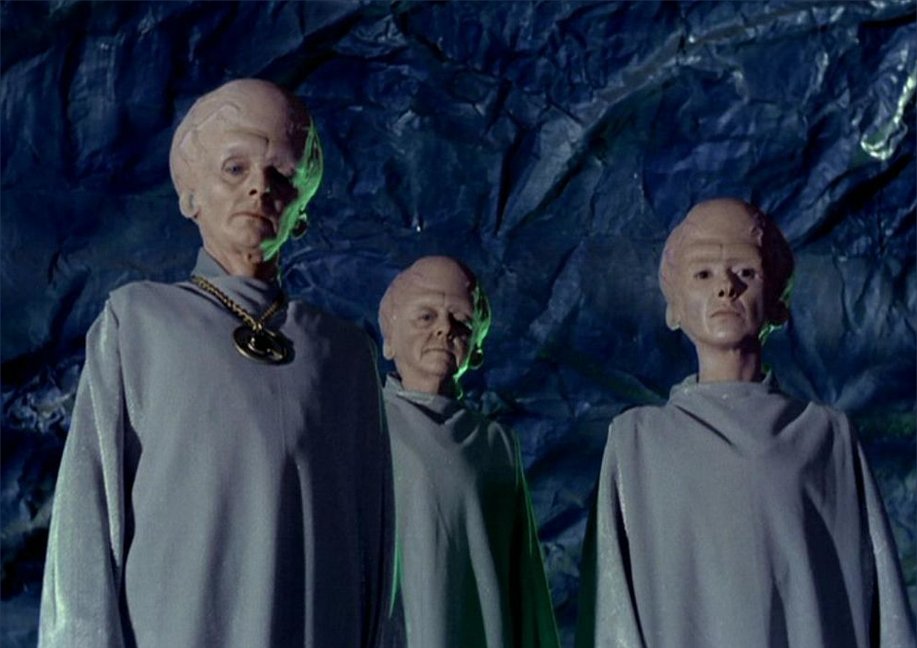
  • On the other hand, while the new envelope story cleverly summons the original pilot footage as something that happened on an Enterprise voyage 13 years before, that voyage, its encounter with aliens who can manufacture illusions, is rife with hoary pulp sci-fi clichés: big-skulled telepathic aliens; sword-wielding barbarians on an exotic planet; a green alien woman who is nevertheless alluring and perhaps irresistible to human males; reptilian monsters with big teeth.
  • Furthermore, the theme as developed by the envelope story undercuts itself. I’ll get to that later, in Part 2.
  • The frame story takes the Enterprise back to Star Base 11, site of the previous episode, “Court Martial”, some 60 days later, given stardates 2950.1 and 3012.4. For once the timing of the ship’s coming and going is plausible.
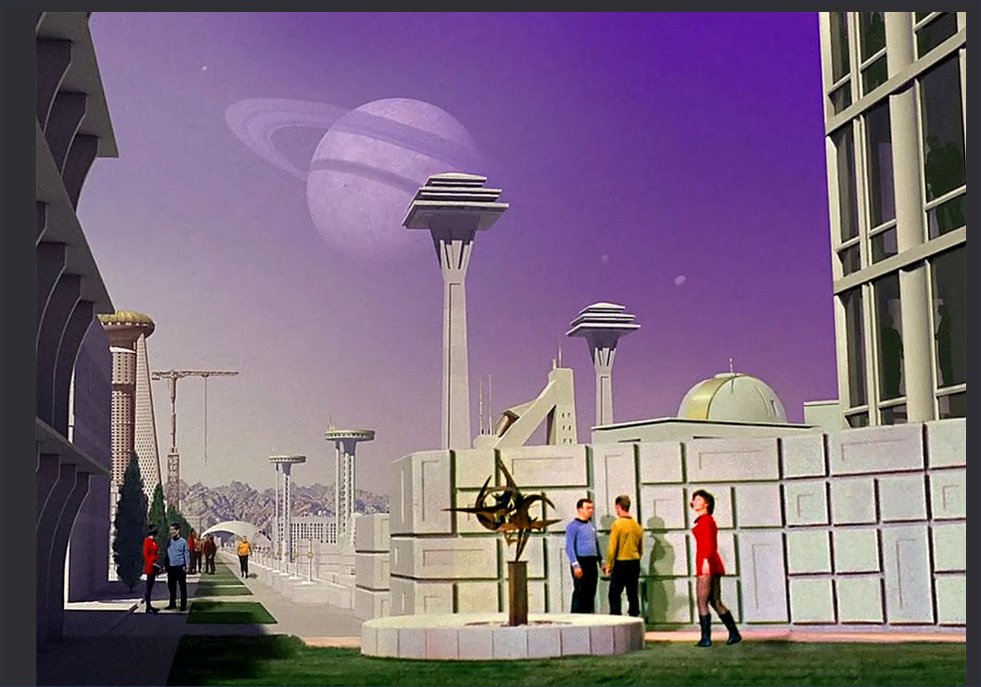
  • The enhanced graphics are especially effective in the early scenes as our crew beams down to Star Base 11—see image above.
  • The frame story is clever but a tad padded. We get a scene in the starbase “computer center” with Spock skulking about and then nerve-pinching a technician, just so he can insert and play pre-manufacturing voice tapes to direct commands to the Enterprise. Keying off “Court Martial”, however, Spock’s manipulation of such voice messages via various ‘tapes’ (colored pieces of square plastic he inserts into computer panels, as seen is many episodes) is at least consistently plausible. How did he manufacture them? Well, he’s Spock.
  • As Kirk and McCoy wonder about the puzzle of the message that drew the Enterprise to Starbase 11, despite the latter’s insisting such a message was never sent, they start to suspect Spock. McCoy insists that Spock, as a Vulcan, is “incapable of telling a lie.” Really? I’m not sure this is plausible, psychologically, among any social species, which could not endure without routine use of at least ‘white lies’. It’s an example of how Vulcans, and Spock, in this series, are idealized almost past the point of plausibility…representing some kind of perfect human that could never exist in the real world.
  • It’s curious that the approach to the planet Talos IV (site of the Enterprise visit 13 years ago) is “the only death penalty left on the books.” Because first, that the Federation still has a death penalty at all; and second, because what we find out about Talos IV is really so so so dangerous? Perhaps…
  • Trek physics: As Spock essentially hijacks the Enterprise and heads it for Talos IV, Kirk, left back on Starbase 11, follows in a shuttlecraft, just like the Galileo 7, along with the base Commodore Mendez (Malachi Throne). So… does the shuttlecraft have warp drive? Surely the Enterprise is using warp to transit from the starbase to Talos IV, another star system presumably many light years distant. The shuttle has trouble keeping up on its “ion engine power,” suggesting not. How then could the shuttle have expected to catch up the Enterprise? (In later episodes, e.g. 2nd season’s “Metamorphosis”, the implication was that the shuttle did have warp drive, to transit from one star system to another.)
  • There’s a slight glimpse of Spock’s quarters in one scene here, but revealing very little – nothing like the full exposure we get in 2nd season’s “Amok Time”.
  • As Kirk and Mendez arrive aboard Enterprise, and Spock has himself arrested, and then requests immediate court martial… the screen comes on in the courtroom (a rearranged Enterprise briefing room), and we see the footage of the first Trek pilot “The Cage”, starring Jeffrey Hunter as Captain Pike, with John Hoyt as the ship’s Doctor Boyce, and Majel Barrett (later Nurse Chapel in the series cast) as the ship’s 2nd in command, “Number One”.
  • In the opening moments of this scene, showing the bridge crew responding to odd signals, we have Number One say, “No, it’s something else. There’s still something out there.” That second line has, for some reason, become embedded in my mind as an iconic line. There’s still something out there.
  • Trek astronomy: As Spock, on the 13-year-ago Enterprise, reviews records of the earlier Earth expedition out here, we see a photo of the Pleiades – a well-known astronomical star cluster – as he talks about the Vega colony. We’ve just heard about this Enterprise’s encounter at Rigel VII. Never mind the Pleiades photo, this is the first of several, I think, infelicities of interstellar astronomy committed by Star Trek. The show wasn’t as ignorant about space and astronomy as other TV shows, e.g. Lost in Space, but the show was casual in its use of familiar star names without bothering about the plausibility of where those stars actually lie in the galaxy. That is: Rigel is a star in the constellation Orion, a very large star some 863 light years from Earth… and Vega is a star in the constellation Lyra, a smaller star nearly as bright as Rigel because it’s much closer to Earth at only 25 light years – but in virtually the *opposite* direction from Earth as Rigel. In no way is it plausible for the Enterprise, having fought a battle at Rigel, to head for recovery at Vega. (Why not just stop off at Earth?) This kind of thing happened again and again, every time the show resorted to using familiar star names.
  • In the next scene, ship’s doctor Boyce visits Captain Pike’s cabin, as the captain expresses stress and regret – as Kirk would do in “Balance of Terror” – and Boyce fixes him a… martini! It’s long been taken for granted, but it’s interesting how Trek assumed that alcohol would be present 300 years from now. Though not tobacco. (Apparently IIRC there was a push by a certain NBC advertiser to have the crew the Enterprise smoke cigarettes, but Roddenberry nixed that.)
  • As Boyce says, serving Pike the drink, in a famous line: “Sometimes a man will tell his bartender things he’ll never tell his doctor.”
  • Anachronisms: in one scene on the bridge a report comes literally printed out, out of a slot; in the transporter room, the junior technician, an Asian, is wearing eyeglasses (though he doesn’t in a later scene).
  • It’s mentioned in these scenes from the original pilot that the Enterprise had only 203 crewmen. The premise changed.
  • Spock’s character had a ways to become crystallized; as the landing party wanders around the planet Talos IV, they find a plant with bluish leaves, and when Spock touches them, he smiles.
  • And when the landing party finds the survivors’ camp, one of the junior officers brags about how quickly their new ships can travel: “The time barrier’s been broken!”. Perhaps a consideration about how technology changed over 13 years; more likely another premise that changed.
  • And then the young woman among the survivors, Vina, tempts Captain Pike with the ‘secret’ of how they survived – leading to Pike’s capture by the alien Talosians. This is the first appearance of the famously recognizable “Vina’s theme”, a sultry vocal that would later be repurposed in many guises.
  • At this point Part 1 ends.
  • Music, for “The Menagerie, Part I”, tracked. But much music was kept from the pilot “The Cage”, including “Vina’s theme”. More notes about music tracks to come in a later post.

Blish’s adaptation: see post for Part 2.

Posted in Star Trek | Comments Off on There’s Still Something Out There: TOS #15, “The Menagerie, Part I”

Genealogical Post: My Family Trees

Over the past year I’ve been perusing family trees on both my father’s and mother’s sides, each of which goes back several generations, on one side to the first generation born overseas that immigrated to the US – i.e., “first generation”. (It seems that the terms “first-generation” and “second-generation” are ambiguous, c.f. Wikipedia at https://en.wikipedia.org/wiki/Immigrant_generations; I will follow its advice that “among demographers and other social scientists” the term “first-generation” refers to foreign-born who first settled in the US.)

The details of my family history are likely to be of little interest to anyone outside my branch of the Kelly family – which is to say, my brother and surviving sister, my nephews and nieces – but there are general trends that might be of interest to other readers, especially about family sizes, infant mortality rates, and mysterious deaths at sea, among families and immigrants of the past century or two.

In the summary and details below, I’m bold-facing direct ancestors of mine.

*

Summary of father’s side

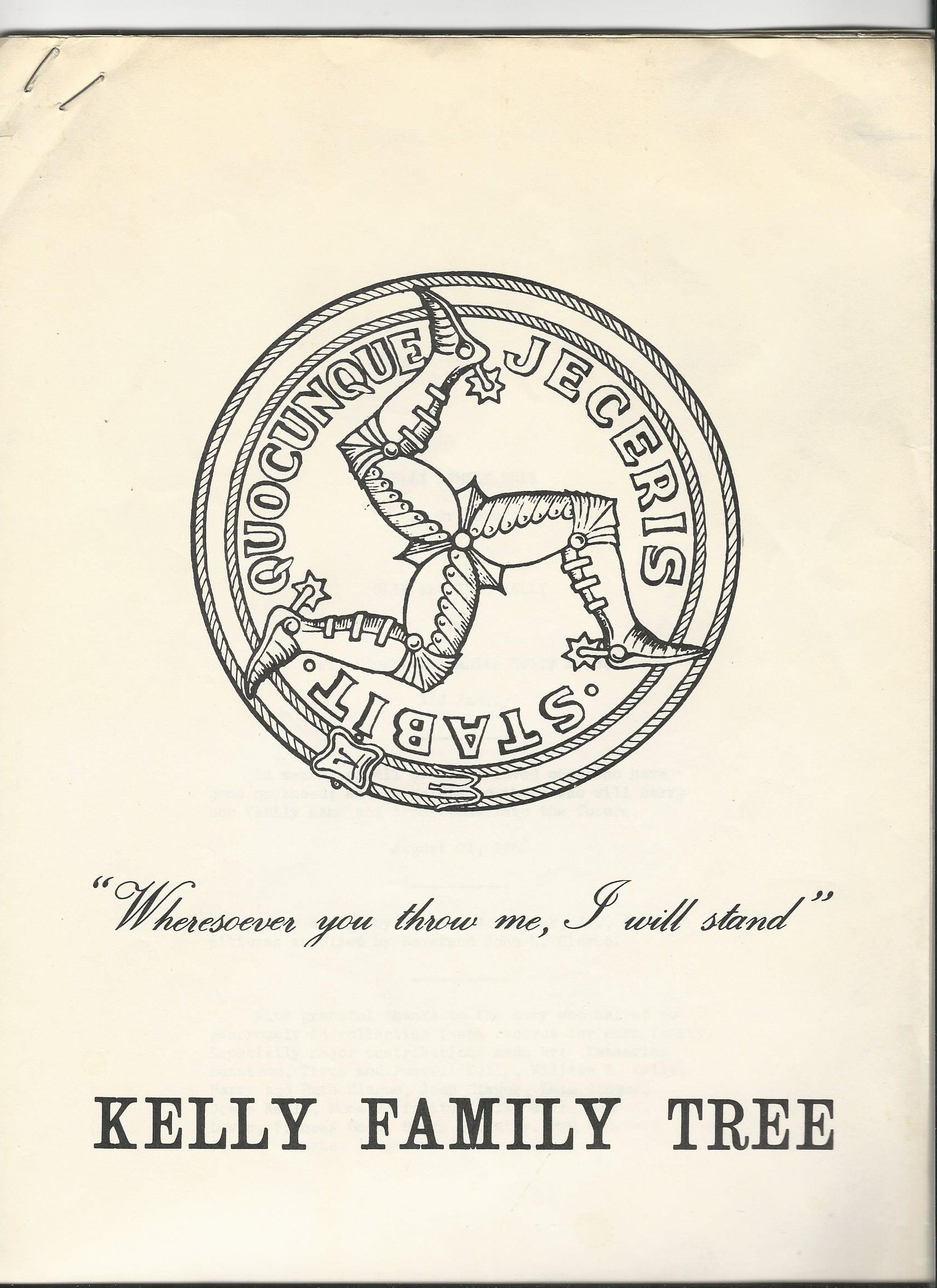
First, my father’s side – the Kelly family name side. While Kelly is usually thought an Irish name, my branch of the Kelly family hails from the Isle of Man, a small island between England and Ireland that has never officially belonged to either Ireland or Great Britain/the United Kingdom (per Wikipedia: https://en.wikipedia.org/wiki/Isle_of_Man). I have a copy of a Kelly family tree compiled in 1966, and apparently based on an earlier 1936 family tree, with introductory passages about the Isle of Man and its lore, including Manx cats, and a Kelly family emblem, a triskelion, on the cover. (Image below.)

I realize that this family tree is now fully 50 years old, but since I’m exploring my own family’s past, and not the many contemporary branches since I was born, it’s sufficient for my purpose. And relevant to any of my siblings and nieces and nephews who might be reading this.

  • My great-great grandfather was William Henry Kelly, born 9 August 1844 on the Isle of Man; likely the second or third of seven children. He arrived in Illinois in 1868, and by the usage above was a first-generation immigrant; he died 15 May 1921, at the age of 77.
  • My great-grandfather was William Henry (Harry) Kelly, born 25 June 1871, in Illinois; second of nine children (his father was 26 at the time of his birth); he died 21 November 1951, at the age of 80.
  • My grandfather on this side was Harry Emery Kelly, born 27 March 1902, in Illinois, an only child (his father was 30 at the time of his birth); he died in the Fall of 1992, at the age of 90.
  • My father was Robert Harry Kelly, born 5 September 1933 in Illinois; he was the 2nd of 3 children (his father was 31 at the time of his birth); he died 13 January 2001, at the age of 67.
  • I, Mark Robert Kelly, was born 30 August 1955, in Melton, England, while my parents were stationed overseas. (My father was 21, almost 22, when I was born.) I was the oldest of four children. And I’m still alive, now age 61.

So I am, by this count, to a first approximation, a fifth-generation Irish immigrant – if you consider the Kelly name to be essentially Irish in descent.

Summary of mother’s side:

The Pierce family tree traces four generations back on two sides, though typically only through the male ancestors.

  • My great-great-grandfather on my grandfather’s side was Darius Austin Pierce, born 14 Jun 1830 in Delaware, NY, and who died 23 Oct 1920, at the age of 90. (There’s nothing in these family trees about when Darius’ ancestors first came to the US.)
  • My great-great-grandfather on my grandmother’s side was Franciscus Peter DeVries, born 25 Dec 1825 in Hanover, Germany, and who died 22 Jan 1899 in Chicago, at the age of 73.
  • My great-grandfather on my grandfather’s side was William August Pierce, born 10 Apr 1878 in Knox Country, IL, and who died in Phoenix AZ, date unknown.
  • My great-grandfather on my grandmother’s side was Jonathan H. Curtis, born 2 Feb 1855 in Essex Country, NJ, and who died 10 Mar 1911, at the age of 56. My grandmother, Lelia, was the youngest of eight children.
  • My grandfather was Byron Leslie Pierce, born 11 Aug 1900 in Altona, IL, and who died when my mother was a child; I knew only my grandmother, Lelia Marjorie Curtis, born 22 Nov 1900 in San Jose, IL, and who died 5 Jan 1984 in Apple Valley CA, at the age of 83.
  • My mother was Helen Elizabeth Pierce, born 23 Jan 1934 in Kewanee, IL; she was older of two children (born when both of her parents were 33); she died, mysteriously in her sleep, 30 July 1986 in Tullahoma TN, at the age of 52. [Note: the DeVries family tree compiled by my uncle in 2003 has this death date wrong, as in 1983. I have no way to know if there might be other errors in that document.]
  • And I, Mark Robert Kelly, was born 30 August 1955, in Melton, England, while my parents were stationed overseas. My father was 21, almost 22, when I was born; my mother was 21.

– – –

Details of father’s side

Here’s a scan of the Kelly Family Tree that I have.
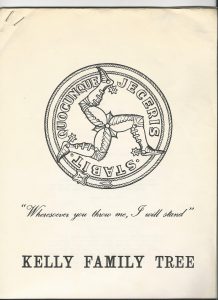
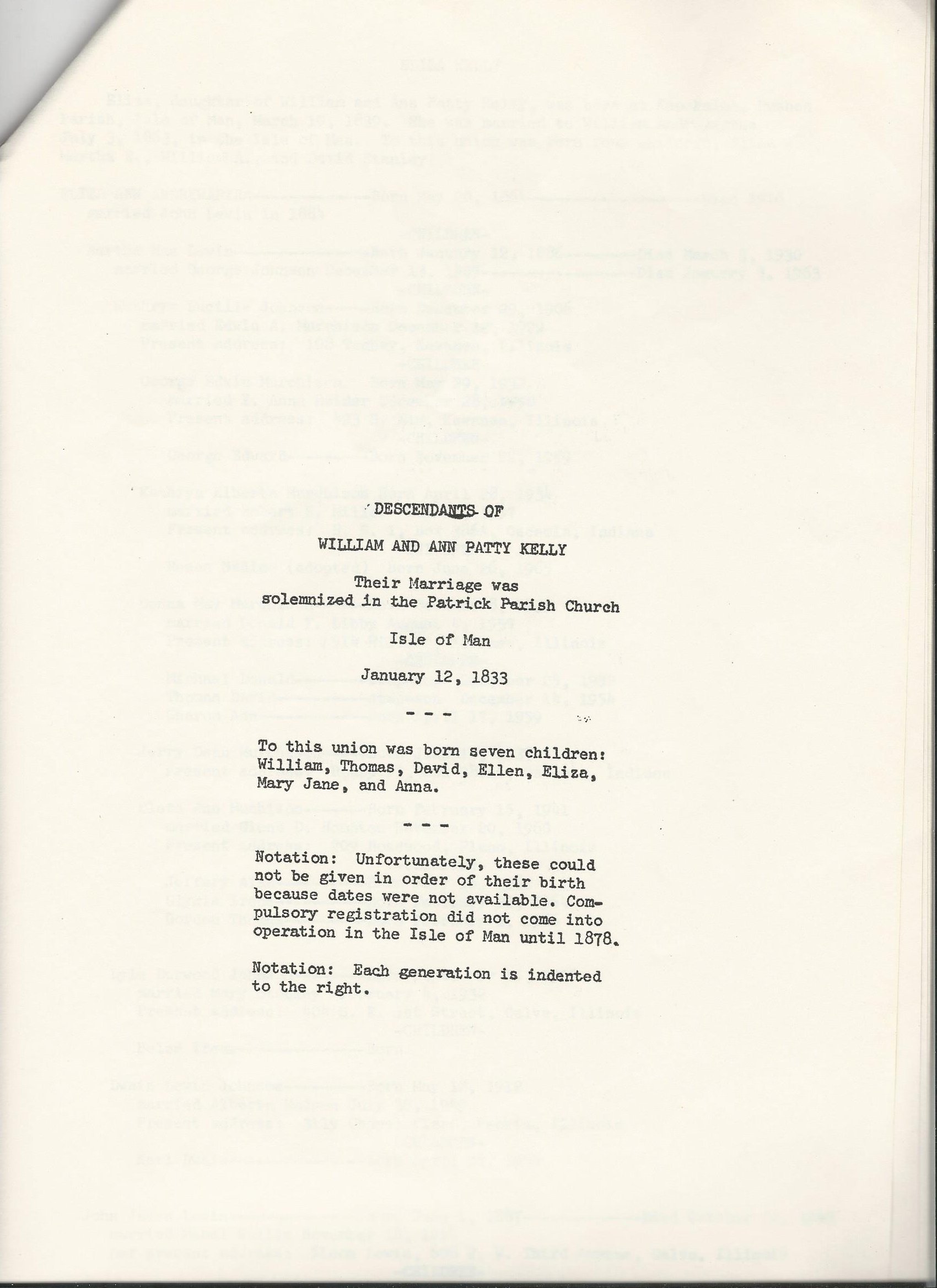
After five more pages of background about the Isle of Man, there is this page:
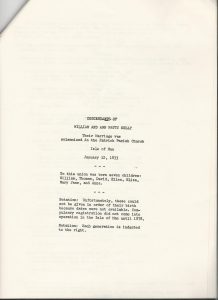
Here’s the text:

– – – – –

DESCENDANTS OF

WILLIAM AND ANN PATTY KELLY

Their Marriage was

Solemnized in the Patrick Parish Church

Isle of Man

January 12, 1833

– – –

To this union was born seven children:

William, Thomas, David, Ellen, Eliza, Mary Jane, and Anna.

– – –

Notation: Unfortunately, these could not be given in order of their birth because dates were not available. Compulsory registration did not come into operation in the Isle of Man until 1878.

– – – – –

My ancestor of those seven children is William Henry. Before following his family line down to present, here are summaries of the other six, omitting many details, in the order they’re compiled in the family tree:

  • Eliza: born 19 March 1839, married William Andrewartha on Isle of Man in 1863. They had four children, whose descendants ended up in northwest Illinois, in Kewanee, Peoria, Galva, etc.
  • Mary Jane (no birth date indicated) married Ceaser Cain, and had five children. One, never married, drowned at sea. Another, never married, died at 35. A third, Mary Jane, died at age 3. The other two, Augustes Cain and Margaret Ann Cain, married and settled in Illinois.
  • William Henry (born 9 August 1844) – see below.
  • Thomas: born 19 March 1847 on the Isle of Man; married Jane Craine Kewish in 1888; died in 1928. “Jane Kewish had two sons by a previous marriage, Robert and James Kewish, and they were raised by Thomas Kelly as his own sons.” Thomas and Jane had three children of their own. Two died in infancy. The third lived until 1966, and had five children. The first of these children, Bernice Elizabeth Kelly, born 1912, was married in 1932, had two children, and got divorced in 1936, giving her children up for adoption. (One of these children, Dorothy Jane, also married, divorced, and remarried, with children, living in Texas when this family tree was compiled.) Bernice married a second time with no children, and a third time in 1943, with further details I’ll not detail, except to note that they all ended up in Galva IL and environs.
  • David: born 10 December 1850 on the Isle of Man; came to Galva IL with brother Thomas, in 1868, following their older brother William. He married in 1878 to Christian Kennish, daughter of parents from the Isle of Man. Those parents, with 12 children, had migrated to Holt County, Missouri, in 1870. Their son “David Edward, moved to Holt County in 1880 where he bought and improved a farm of a new land in the same section as her father, in that new country. In February, 1890, he bought the first 80 acres of the farm he later enlarged at Greeley, Colorado. The family thenceforth made their home on that farm where David died December 28, 1928.” David and wife Christian Kennish had six children, only one of whom has a death date in this family tree compiled in 1966. Their descendants settled in Greeley CO, but also in Lincoln NB, Lander WY, and Van Nuys CA.
  • Ellen: born (born 1 October 1850 [This is what the family tree says, but this can’t be right, given David’s birthdate; even Oct 1851 is pushing it]), married to James Kelly, had seven children. Three of the children died at ages 15 and 13 and 19. The others had children who settled in Galva IL, with a couple in Sacramento CA, Ventura CA, and Delavan WI.
  • Anna (no birth date given) – married William Clague on the Isle of Man, and had five boys and two girls, one of whom was “Thomas, who drowned in the Irish Sea when he was sixteen years of age”.

First-generation:

Now to William Henry Kelly, born Aug 9, 1844, at Knockaloe, Patrick Parish, on the Isle of Man.

He came to Galva, Illinois, on Apr 23, 1868. So he was a first-generation immigrant. He married Katherine Rovilla Emry, daughter of David and Olive Jacobs Emry, on 12 January 1870. (Nothing is given about the ancestors of David and Olive Emry—whether they were first-generation immigrants, or what country they came from.) William Henry Kelly and Katherine Roville Emry had 11 children, most of whom had long lives, a couple into their 80s, though one, Katie Pearl Kelly, was born 6 Sept 1882 and died 16 Sept 1883.

Their second child was William Henry (Harry) Kelly, born 25 June 1871 – see below after this aside.

Aside:

A separate page of “interesting family records” for the descendants of William and Catherine (sic) Emery Kelly” in the family tree, is an excerpt from an 1885 book of biographical portraits of people living in Henry County:

He is, at present, the proprietor of 290 acres of land all of which is under an advanced state of cultivation. His farm presents the appearance of thrift and good management, and indicates that prosperity is the outgrowth of hard labor. … Mr. Kelly has been school director of his township, and politically, always cast his vote with the Republican party. His parents, William and Ann (Patty) Kelly, were natives of Ireland and of the Isle of Man, respectively. [Isn’t this backwards??] Her parents are Henry and Olive (Jacobs) Emery, natives of Pennsylvania and New York. They came to this country in 1856…

The family tree indicates that William Henry Kelly and wife Katherine (or Catherine) had five boys and six girls – three born from 1882 to 1887 were apparently missed by the bio quoted above. The 1882 birth was a girl, who died at 12 months. Of all the others, a couple lived until 40 or 50, but most of them lived to age 70 or 80.

These “interesting family records” also includes some background about the “EMRY FAMILY (Sometimes spelled Emery)”.

Catherine’s parents <b>Henry Emry and Olive Jacobs Emry</b> were born 1802 and 1808 [doesn’t say where] had 11 children (!), at least two of them (others don’t say) settled in the same NW Illinois area. Henry and Olive died in 1875 and 1859.

The last of their children, Catherine Rovilla Emry, born 15 February 1849, has this historical note in the family tree:

On October 7, 1938, Catherine Emry Kelly was given a place of honor by Knox College, Galesburg [IL], as the college celebrated the 80th anniversary of the famous Lincoln-Douglas Debate. She was nine years old when the original Lincoln-Douglas Debate was held and she accompanied her father, Henry Emry, to the Debate in a surrey from their home west of Galva. Abraham Lincoln was in Toulon [IL] for a political talk during the same campaign and at a reception she sat with her father directly across the table from Mr. Lincoln. In 1860 her father was a delegate to the presidential convention at the “Wigwam” in Chicago and it was at this convention that Lincoln was nominated for the presidency.

This highlight was related to her granddaughter, Catherine Kelly, several years before Grandma Kelly’s death: At the age of nine, Catherine Emry sat on Abraham Lincoln’s knee at Toulon Old Settler’s Picnic, and Mr. Lincoln commented to her father, Henry Emry, that Miss Katie was a bright-eyed girl, that she came from good solid stock, that she would become the mother of future generations and would guide her future family well.

Catherine Emry Kelly was born the year of the California Gold Rush and five years before Galva was founded. When she was born, her parents lived six miles west of Canton, Illinois. All of the ten other children were born in a log cabin, but she was born in a frame house. Her parents moved to Galva, later to the farm six and one-half miles west of Galva.

End of Aside.

**

Second-generation:

Then to William Henry (Harry) Kelly, born Jun 25, 1871 (died Nov 21, 1951). He would therefore be a second-generation immigrant in my family line.

He married Marie Peterson (born Nov 30, 1879), on Aug 29, 1898. Again, the Kelly family tree has nothing about her family – except for the fact that, when the it was compiled in 1966, she was still alive and living in Bishop Hill, IL.

And this is significant, as I’ve discovered recently searching the web. Bishop Hill was a Swedish ‘colony’ in northwest Illinois, not far from where my parents grew up, and I met this great-grandmother a couple times, living in Bishop Hill, before her death in the 1970s. (We called her Grandma Kelly.)

Wikipedia has some fascinating background about Bishop Hill at https://en.wikipedia.org/wiki/Bishop_Hill,_Illinois; there’s also the town’s own website http://www.bishophill.com/. It was settled in 1846 by religious refugees from Sweden, established as a religious, utopian community, “communistic in nature in which everything was owned by everyone and no one had more possessions than another.” The founder was murdered four years later in a domestic dispute.

Read more at the links.

Third-generation

William Henry Kelly and wife Marie had one son, Harry Emery Kelly, born Mar 29, 1902 — my grandfather; third-generation. (As with Catherine/Katherine, spellings were apparently inexact in those days.)

He married Helen Rapp (born 4 Feb 1902), on 30 Apr 1930. There’s nothing about her family in this Kelly family tree; all I know about her is that name Rapp is of Swedish origin, meaning ‘quick’ or ‘prompt’, and dating to the 17th century, before surnames became general in Sweden (http://www.ancestry.com/name-origin?surname=rapp).

(So if on my father’s side, my grandmother was full Swedish (indicated by the name Rapp), and my grandfather was half Swedish (via Bishop Hill) and half Manx (via the Kelly family line), that supports what I was always told growing up, that on my father’s side I was ¾ Swedish and ¼ Manx.)

I did not ever know my grandmother Helen. I must have met her a couple times as a young child, on family trips from Los Angeles to Illinois, including one memorable train ride and another car trip, but by the time my family moved to Illinois, in 1968, when I was 12, she had Parkinson’s disease, and was confined to a wheelchair, and could barely speak. She died only a year or so later.

My grandfather, my father’s father, was a genial yet at times cantankerous old man. He’d worked as a farmer’s hand, not a farmer, most of his life, and later worked for the John Deere company, manufacturer of tractors and other farm implements, in Moline Il. On one of the family trips from California to Illinois, he took us on a tour of the headquarters (https://en.wikipedia.org/wiki/John_Deere_World_Headquarters), and I have a few slides of that visit taken by my father.

That my grandfather’s was a relatively lower-class life was indicated by his house, which had no fireplace, as I only realized years and years later. There was a basement furnace. No fireplace, as you would think standard in every small-town or country house in rural America. (I have many photos of this house both of my father’s, in the early ’50s, and my own, when I was there in 1992. Will post eventually.)

Alas my most striking memories of my grandfather are from when we lived at his house for a few months during the moving transition from California to Illinois, before settling in Glen Ellyn in the Summer of 1968. The TV was on, some variety show, and he wondered out loud why such a show would put a n** (the N-word) on TV. And he wondered why the pop stars wore such long hair, so you couldn’t tell whether it was a girl or a guy. I remember even then being tempted to ask, at age 12, why does it matter? Why do you care? But of course I did not. He was a strong, sturdy, silent man, a product of his environment, with a firm conviction about the reality of his experience of the world, and reacted to a TV bringing the outside world of the 1960s, a world that must have seemed strange and alien. (Not to mention I was watching Star Trek episodes, in their original broadcast, on the TV in his living room, during the time we stayed in his house. Have no recollection of what he thought of those.) He visited us in California once or twice in later years, but aside from those trips, may well have never traveled much from home in his entire life.

He died in 1992, and I flew back to Illinois in the aftermath of his funeral, as my father, uncle, and aunt gathered in the house to sort through things, and divvy up belongings. I took home a few books that had belonged to my father and his siblings, and maybe some of my mother’s; books that had sat in the house attic for decades. A Bobbsey Twins chapter book. Three or four of my grandfather’s schoolbooks, small hardcovers, his name crudely handwritten inside, books dated 1897 and 1902. They’re on my shelves now, in my living room.

*

Harry Kelly and wife Helen had one daughter and two sons – my aunt, father, and uncle, in order, in 1931, 1933, and 1935.

Aside from relatives tracked through this Kelly family tree, there were other relatives that I knew, in those few years we lived in Illinois and visited my grandfather on weekend trips from our home in Glen Ellyn: my “Aunt Maude and Uncle Edwin”, actually my father’s aunt and uncle on his mother’s side. That is, she was Maude Rapp until she married Edwin R. Olson. They lived in Davenport, Iowa, one of the ‘tri-cities’ on the Mississippi River between Illinois and Iowa, and were (I see in retrospect) the best-off branch of our family. I don’t recall what Edwin did for a living—some executive position for a manufacturing firm, or city utility, I think?—but they had a very nice two-story home on a tree-lined street of stately brick homes, and regularly traveled the world. My (great-)Aunt Maude introduced me to stamp collecting, her own hobby, which I pursued for a couple years while we still lived in Illinois…before setting it aside as other interests prevailed.

Searching the internet, I think this is probably right: https://www.fold3.com/page/40625371_edwin_r_olson/. Edwin must have died in 1991, and when I went to Illinois in 1992, my Aunt Maude had been moved to a nursing home – a very nicely furnished apartment, actually. I reminded her about her inspiration about stamp collecting, and she gave me a booklet of collecting sheets of miscellaneous stamps she’d never cataloged. Probably the last of her collection. I still have them.

When Aunt Maude died, in 2005, she left an estate some of which, since my parents, including her nephew my father, had passed, trickled down to me. I got $4800. Since my father was one of 19 heirs (I have the paperwork), and my father had three other kids… her estate must have been something like $400,000. An impressive amount, considering when it must have accumulated. An outlier, along either of my family lines.

Fourth-Generation:

The aunt was Betty Anderson, a heavyset woman compared to the rest of her family, who married the relatively thin Stanley Anderson (their situation recalled the Jack Sprat Mother Goose tale) and had five children, who all have stayed their entire lives in or around Cambridge, Illinois, as far as I know. Stanley was the butcher in the town market, Wayne’s, his entire life. They had one boy, Ronnie, about 3 years older than me, and four girls, Christine (my age), Cheryl, Cathy, and Kelly.

By the time my family stayed in Cambridge in the early ’70s, Betty and Stan had a house built next door to my grandfather’s house, a split level house from a standard plan, having rejected a proposed custom open-floor (as we would call it now) design by my father.

Years later, when I returned to Cambridge in 1992, Christine and her husband had built their own house one more lot down, next door to her mother’s house.

You can see all these via Google Street View, in the northwest corner of Cambridge IL, where N West Street meets what’s now called Bowling Road.

*

The uncle was Bruce Kelly, who settled in suburban Chicago, Des Plaines, and spent his career as a high school shop teacher. He married Barbara, and they had three sons, who last I heard became missionaries. I have not had any contact with them in decades.

*

My father, Robert Harry Kelly, born 5 Sep 1933, married Helen Elizabeth Pierce, born 23 Jan 1934, on 25 Jul 1953. My father had grown up in Cambridge; Helen had been born in nearby Kewanee, but her family moved to Cambridge, where her father was the county sheriff.

They had four children. I was the eldest, born 30 August 1955, in England. Next came Susan Elizabeth, born 26 July 1958 in Apple Valley, CA. Then came Lisa Ann, born 20 January 1962 in Apple Valley CA just before the family moved to Santa Monica CA. And then Kevin Bruce, born 16 January 1964, in Northridge CA.

*

I’ll end this section about with some observations about my father’s Isle of Man/Irish ancestors, to note that they came to the US at a time when many Irish emigrated to England and the US, in the wake of the potato famine of the 1840s (https://en.wikipedia.org/wiki/Great_Famine_(Ireland)), and were subject to anti-immigrant bigotry, as recalled in the famous phrase “No Irish Need Apply”: https://en.wikipedia.org/wiki/Anti-Irish_sentiment#No_Irish_need_apply. At the same time, I have no evidence in these family trees that my ancestors were affected by those attitudes, or even that they were motivated to come to the US by the fallout of that famine (after all, they didn’t come from Ireland proper, so perhaps the famine didn’t affect them at all). Still, it’s worth noting this theme, since at the time the ‘Irish’ were regarded in the US as non-white, dangerous immigrants, in an attitude that has played itself out over and over again in the centuries and decades since. Human nature. People demonize outsiders. The latter link above has this striking quote from the esteemed Benjamin Disraeli (born 1804, who later became Prime Minister of the UK in 1868) in 1836.

[The Irish] hate our order, our civilization, our enterprising industry, our pure religion. This wild, reckless, indolent, uncertain and superstitious race have no sympathy with the English character. Their ideal of human felicity is an alternation of clannish broils and coarse idolatry. Their history describes an unbroken circle of bigotry and blood.

****

Details of Mother’s side

I also have a family tree on my mother’s side, compiled by her brother, my Uncle Bob, in 2003, shortly before his death. It more-or-less supports what I was always told, growing up, about my ancestry on that side of the family: a mix of French, German, English, and Swiss. Though these documents follow two branches upward, to ancestors of both my mother’s grandfathers, the entirety of these family trees is smaller than the Kelly family tree…I think because ancestors on this side had smaller families.

First generation, DeVries/Curtis line:

Franciscus Peter DeVries was born in Hanover, Germany, 25 Dec 1825, and immigrated to the US in 1854 through the port of New Orleans. He was a physician, practicing in Chicago. He died there 22 Jan 1899.

He married Ozelia Miller on 20 Aug 1856 in Pekin, IL; the only background mentioned about her is that she was born 1830 in Switzerland.

Second generation:

Francisus and Ozelia had six girls and two boys, the oldest of which was Margaret Tracia DeVries, born 13 Oct 1858 in Pekin IL, died 17 May 1928, in Galva IL.

Margaret married Jonathan H. Curtis on 27 Dec 1882 in Chicago. He was born 2 Feb 1855 in Essex County, NJ, and died 19 Mar 1911. There’s nothing about when his family immigrated, or where from, but Curtis is indicated as a “common English surname” on various internet sites.

(Of the other seven of Margaret’s siblings, only four of them are listed in this family tree has having married and had children, and only two or three children in each case. Two other siblings are indicated only as having married. By implication, those two had no children, and the second of the eight children, Henry, is only mentioned as having been born in 1860 and died in Chicago.)

Third generation:

Margaret and Jonathan had eight children, six girls and two boys, the youngest of which was my grandmother, Lelia Marjorie Curtis, born 22 Nov 1900, died 5 Jan 1984. (Interesting how my family line passes through the eldest child of eight in one generation, then the youngest of eight in the next!)

Second generation? — Pierce line

At this point the Pierce family tree shows another branch of the Pierce ancestry, beginning with Darius Austin Pierce, born 14 June 1830 in Delaware NY (and thus not ‘first-generation’ by the terminology I’m following here, though that’s what the family tree calls him), and died 23 Oct 1920 in “Of, Truro, Knox, Ill.” (sic)

The family tree has some details about the family status in the 1860, 1870, and 1880 censuses, but nothing about his ancestors or when they first came to the US.

Darius married Sylvia Maria Cadwell on 25 Dec 1860 in that same place, “Of, Truro” etc.; she was born 15 Oct 1842 in Truro, died 13 Nov 1913 in Altona IL.

They had eight children. Two of them are listed as born, with no death dates. Another died at age 2; another died at age 6. The others died at 80, 42, 38; one other married at 22 but has no death date.

The sixth child was William August Pierce, born 1878. It says he died on Phoenix, AZ, but not when.

He married Mary E. Jackson on 10 Apr 1898; she was born in 1879 in Indiana, and also died in Phoenix, no date.

William and Mary had four children. There are details about only one, Byron Leslie Pierce, born 11 Aug 1900. He married my grandmother Lelia, as the two branches of this family tree merge, and then extends to Helen and brother Robert, all their children (Mark, Susan, Lisa, Kevin, Paula, Steven), and all their children: to Jason, Kevin, Joshua, Jordan, Aaron, Benjamin, Ryan, and Joel.

*

And so Lelia Marjorie Curtis married Byron Leslie Pierce on 20 Sep 1921. Byron died 13 Jun 1946, at the age of 45, in the most dramatic incident on either side of my family tree. Quoting the Pierce tree:

Byron was Sheriff of Henry County at the time of his death. He was shot and killed by a recent discharged from a mental hospital while investigating a problem at the killer’s farm.

Details can still be found on a couple websites, including this Chicago Tribune front page, http://archives.chicagotribune.com/1946/06/14/page/1/article/kills-brother-sheriff-seized-in-gun-battle, from June 14, 1946, and this History of the Henry County Sheriff’s Office, http://www.henrycty.com/Departments/Sheriffs-Office/The-History.

Moreover, my grandmother, his widow, was “appointed County Sheriff of Henry County in 1946 to fulfill the term of her late husband…”, though it doesn’t say how long that term was. This is from my grandmother’s memorial, at http://www.findagrave.com/cgi-bin/fg.cgi?page=gr&GRid=7015347

In the late 1950s my grandmother relocated to southern California and settled in Apple Valley, where she lived until her death in 1984.

My mother had one brother, Robert Curtis Pierce, born 20 Jul 1935, who settled in southern California. I was close with my Uncle Bob for a couple decades in my adulthood, though I’d lost touch with him for some years by the time of his death in November 2003.

I have three high school yearbooks, 1950 to 1952, that include my father’s senior year, 1951, and mother’s, 1952. In 1952 my mother was homecoming queen. (Admittedly the entire class wasn’t very big, only 30 students.) The 1951 yearbook includes my mother, my father, and two uncles, Bob (on my mother’s side) and Bruce (father’s), who were all in the same school at the same time. My Aunt Betty must have already graduated before 1950. I’ll be posting some scans of photos from these yearbooks.

And in a subsequent posts I’ll explore, as I’ve already done partially in part in earlier posts, how my family ended up in California, where I grew up.
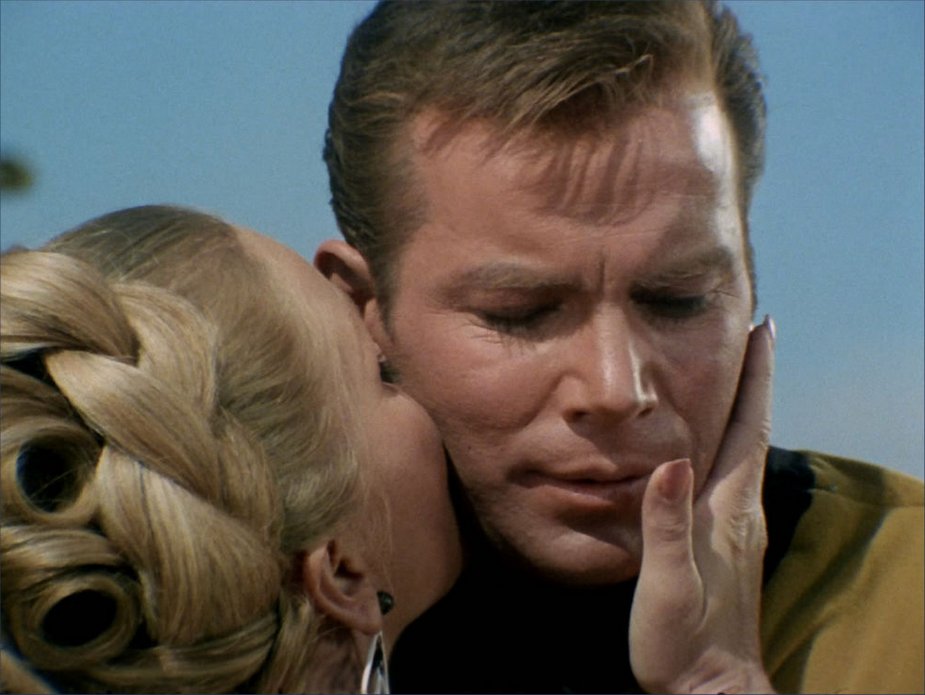
 

Posted in Personal history | Comments Off on Genealogical Post: My Family Trees

Link and Comments: American Narratives

David Brooks NYT column on May 26: The Four American Narratives.

He recalls his own characterization of the American unifying story as an Exodus story: one about people leaving oppression to settle a new promised land. A story that no longer unifies our fractured culture.

Now he references a speech by George Packer to the think tank New America — the speech itself does not seem to be online — that describes four rival narratives that inform today’s fractured nation. Then Brooks offers two more of his own. I’ll summarize in bullet points. Packer’s:

  • The libertarian narrative of the GOP: free individuals, free market, Americans as consumers and taxpayers;
  • The narrative of globalized America, that of Silicon Valley: lifelong learners, an open and connected world that overturns old elites and empowers individuals;
  • Multicultural America, in which Americans are members of groups identified by sins of the past and present, a narrative that dominates academia;
  • And Trump’s America First, backward-looking and pessimistic, in which the country has lots its identity due to the contamination of immigrants, and elites who have lost their allegiance to America in favor of an imagined global culture.. Packer: “This narrative has contempt for democratic norms and liberal values, and it has an autocratic character. It personalizes power, routinizes corruption and destabilizes the very idea of objective truth.”

Brooks offers two alternatives as the basis for the 21st century.

  • The mercantilist model, America as one major power in competition with rival powers China, Russa, Europe. To be American is to be a member of the American tribe.
  • The talented community, “America as history’s greatest laboratory for the cultivation of human abilities. This model welcomes diversity, meritocracy, immigration and open trade for all the dynamism these things unleash.”

Brooks concludes,

The mercantilist model sees America as a new Rome, a mighty fortress in a dangerous world. The talented community sees America as a new Athens, a creative crossroads leading an open and fundamentally harmonious world. It’s an Exodus story for an information age.

Posted in Culture | Comments Off on Link and Comments: American Narratives

Accumulated Links I Don’t Have Time to Comment On In Detail

Slate: Donald Trump Doesn’t Share America’s Values. The Transcript of His Call to the Philippine President Proves It.

\\

The Blaze (which I never look at but I saw via a relative’s Fb post): Fake academic paper published in liberal journal hilariously exposes the absurdity of gender studies

(Remember Sokal?) I actually know the work of Peter Boghossian and James Lindsay, but I don’t know what they were up to here. Jerry Coyne responded to this post here. I haven’t read any of these in detail and will not comment… except to say, one incident does not undermine the validity of gender studies, nor of peer review. I’ll also mention that, in the engineering world, “peer review” is a precise concept, one I refined the procedure for, and taught in training classes, back when I was working for Rocketdyne.

\\

Rolling Stone: Roger Ailes Was One of the Worst Americans Ever: Fox News founder made this the hate-filled, moronic country it is today.

\\

Alternet: http://www.alternet.org/belief/i-grew-fundamentalist-cult-handmaids-tale-was-my-reality: I was raised to be a helpmeet in a society like the one from Margaret Atwood’s prescient book.

\\

Patheos.com: See? I Told You the Earth Wasn’t Flat

\\

Salon: The Ugly American’s road trip: Donald Trump and America’s declining culture

Donald Trump as the ultimate ugly American.

\\

Excoriating David Brin post about the hypocrisy of Republicans, who railed against Obama (and Hillary) but give Trump a pass: May 21 at 2:09pm

Clinton and Obama had the only two, 8-year administrations with ZERO high officials convicted or even indicted for actual malfeasance of office – the only times that ever happened. And it happened despite over a billion dollars and 25 years of frantic probing by their enemies, desperately sifting every file and cabinet for some smoking gun, anything at all. The worst you nut-jobs ever found was Hillary making the same mistake with her email system that Colin Powell and Newt Gingrich made, with zero harm done. Ohhhh, lock her up!

Posted in Uncategorized | Comments Off on Accumulated Links I Don’t Have Time to Comment On In Detail