A Chilling Journey Through Worlds Beyond Imagination: TOS by James Blish

As noted a couple posts ago, in my series of Star Trek Rewatch posts, I’ve just reread James Blish’s first Star Trek book – published just over 50 years ago! – to note the changes he made from the original script versions of the seven episodes adapted there, or the changes that survived from the early script drafts he received that were changed by the time of filming. I’ve described points about the episodes “Miri” and “The Conscience of the King” in their posts. The other five episodes in the book are annotated here.

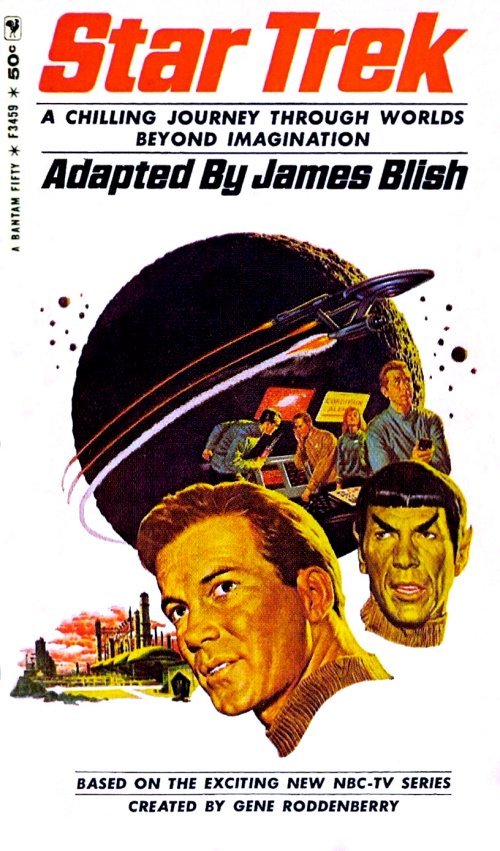
As I mentioned before, Blish wrote short story versions of these episodes from scripts, often early drafts of scripts that differed in substantial ways from the final shooting scripts, and did so without having seen the show himself — this was a time before the show was seen in the UK, where he lived. Clearly, the same situation applied to the cover artist of this Bantam paperback, James Bama, who not only casts a greenish glare over everything, but depicts the Enterprise with rocket fire shooting out all three cylindrical sections of the ship!

“Charlie X”

  • First, Blish renames the story “Charlie’s Law”, as in, be nice to Charlie or else.
  • Blish summarizes scenes as often as he transcribes all the dialogue from some scenes. The early Blish Trek books were slim paperbacks of 130 pages or so, containing short story versions of seven or eight episodes each, and so turning a 50-minute script into narrative with all dialogue intact was not feasible. (Or necessarily desirable; some plot developments are better summarized, in a short story narrative, while in a teleplay such developments *have* to be explained via dialogue.)
  • The story explicitly states that Kirk is fond of Rand – a point of possibility that, the producers of the show realized, led to Rand’s character being written out (so the possibility of a romance between them would not interfere with Kirk fraternizing with guest characters)
  • Twice in the book Blish calls Uhura “Bantu”.
  • Blish has Charlie make all the phasers on the ship disappear.
  • He references the other ship’s “Nerst generator” – a term from his own Cities in Flight stories, I recall, since when I first read and reread Blish’s early Trek books, I also read his quartet of “Cities in Flight” novels.
  • Blish expands a last-word line from Charlie, p18t: “Being a man isn’t so much. I’m not a man and I can do anything. You can’t. Maybe I’m the man and you’re not”. The script did not include, or omitted, the final line.
  • Blish omits the silly scene of the bridge crew turning every device on to challenge Charlie’s control.
  • The line about “I have taken my form centuries ago….” Is missing, but Blish has a different mysterious reference, as the Thasian explains why they can’t restore the crew of the other ship: “We could not help them because they were exploded in this frame; but we have returned your people and your weapons to you, since they were only intact in the next frame.” The oddness of the reference has a similar effect.

“Dagger of the Mind”

  • Again, Blish tends to summarize scenes rather than transcribe lots of script dialogue.
  • No issue here about a planetary force shield, suggesting that the planet’s atmosphere is sufficient deterrent to potential escapees.
  • Some lines from the deleted speech by Adams explaining his motives survive here, p37: “I’m tired of doing things for others, that’s all. … Trust mankind to reward me? All they’ve given me thus far is Tantalus. It’s not enough. I know how their minds work. Nobody better.”
  • Blish acknowledges the huge air duct but calls it a crawl-space meant for servicing power lines.

“The Man Trap”

  • Blish retitles it “The Unreal McCoy
  • Following an earlier script, the planet is Regulus VIII and the characters are named Bierce, not Crater – while Blish describes the encampment is being inside a crater (!).
  • Blish uses the term “petachiae” to describe the mottling on the dead man’s face.
  • Blish acknowledges that what Spock finds out about the “Borgia root” is only what the Bierces themselves said in an earlier report. (Otherwise, why would the Enterprise have details – and names – for every plant on every remote barely occupied planet?)
  • This version avoids the shoot-out with Crater in the broadcast episode; instead Kirk orders both Bierces aboard the ship.
  • Again, Blish follows a single character flow story line. Thus, he has none of the side scenes that we saw in the episode, with the creature changing into Uhura’s Swahili-speaking crewman, or the biolab scene with Rand, Sulu, and the silly plant “Beauregard”.
  • Blish adds a bit of speculation about why the race died out: “It wasn’t really very intelligent—didn’t use its advantages nearly as well as it might have” referring presumably to the shape-changing. Spock comments: “They could well have been residual. We still have teeth and nails, but we don’t bite and claw much these days.”

“Balance of Terror”

  • In this one you can tell Blish, having seen only a handful of early scripts sent to him for this book, and never having watched the broadcast show itself, wasn’t entirely clear about some of the series’ premises. In the opening of this story, as he builds toward justifying the occurrence of a wedding on the Enterprise, he says: “Traveling between the stars, even at ‘relativistic’ or near-light speeds, was a long-drawn-out process at best.” p54.6. Even though at other times he refers to the warp speeds.
  • He notes the blandness of the chapel.
  • He identified Spock’s homeworld, Vulcan, as a planet of the star 40 Eridani.
  • Blish has a nice line describing the Romulan energy weapon fired at the Enterprise: “Moving with curious deliberateness, as though it were traveling at the speed of light in some other space but was loafing sinfully in this one, the dazzling bolt…” I’m guessing this was not a description in the script.
  • In Blish’s version, no one has seen a live Romulan – but bodies were found in the first Romulan war and so they are known to be of the “Vulcanite” type – though this doesn’t lessen the dramatic reveal of seeing the Romulans, and how they are “dead ringer”s for Spock.
  • Blish understands there would have to be a *sphere* of satellites around the Romulus/Remus system, p59t.
  • Technical jargon: Uhura (for some reason it is her) detects what turns out to be the invisible Romulan ship via a “De Broglie transform” and then Spock calculates that the ship is on a “Hohmann D” transfer orbit back to Romulus. Needless to say, not terminology in any version of a script.
  • Blish also isn’t quite clear, in this first Trek book, about the relationship between the characters; Spock is a “funny customer”; “his manners are bad by Earth standards”, and no one particular likes him.
  • Big plot change: Blish’s story has Kirk take time out to complete the marriage interrupted at story’s opening.
  • Also a substantial change: since Blish realizes they’re in a single star system, Spock has noticed a cold comet and now realizes they can use it as a diversion. Not, as in the broadcast show, does the Romulan ship for some reason fly into it directly. (Still, Blish has Spock find the comet in an ephemeris. An ephemeris of what, all comets in all planetary systems everywhere?? Or for some reason, an ephemeris of comets in this one system? Blish may have known his biology, but apparently had no sense for scale in astronomy.)
  • (Also, of course, again, Blish omits all scenes in the broadcast episode on the Romulan ship itself, sticking to a single story line.)
  • Kirk uses the comet’s passage between the two ships to accelerate toward the Romulan ship and fire its phasers. Then comes the scene in which the phaser crew downbelow is disabled. Kirk has already sent Spock there, and sees on the intercom screen Spock struggle to hit the phaser fire button.
  • And in Blish’s version, both Tomlinson and Stiles die – avoiding the issue, in the broadcast episode, of how Spock managed to save one, but not the other.

“The Naked Time”

  • Blish avoids the contamination scene, in which Tormolen takes off his glove and exposes himself to an infection, entirely. Blish has Kirk make some plausible speculation about why the dead members of the observation station behaved the way they did, in response to having some infection (e.g., someone would take a shower with clothes on in a hurried attempt to decontaminate themselves).
  • Blish has the planet named some long technical string, and the nicknamed “La Pig”, rather than the Psi 2000 of the script.
  • Blish tries to rationalize the idea of the planet’s breakup, and how it would affect the Enterprise orbit, p79t: “As the breakup proceeded, the planet’s effective mass would change, and perhaps even its center of gravity – accompanied by steady, growing distortion of its extensive magnetic field – so that what had been a stable parking orbit for the Enterprise at one moment would become unstable and fragment-strewn the next.”
  • There are substantial differences between Blish’s version and the broadcast story, since the latter involved some elements introduced in the last stages of production. In particular: Spock’s breakdown in the briefing room, and the entire time travel sequence at the end, are not here. Nor is Scott’s phasering through the wall to get into the engineering room. Instead, McCoy’s antidote to the disease involves a gas spray into the ship’s ventilation system. Riley recovers in the response to that, and lets the others into engineering himself.
  • At the same time Blish has some remarkably implausible sequences in which, Kirk having thrown emergency bulkheads inside the ship, to stop the spread of the disease, has Uhura crawl between the hulls and communicate the McCoy by knocking on the metal in “prisoners’ raps”…! The crews’ communicators don’t work inside the ship?
  • Instead of Spock’s breakdown and recovery seen in the broadcast version, in Blish’s story Spock experiences a “general malaise” and excuses himself to his quarters. At the end of the story, he is heard crooning to himself in his cabin and playing some instrument that “nobody else on board could stand to listen to it”.
Posted in Star Trek | Comments Off on A Chilling Journey Through Worlds Beyond Imagination: TOS by James Blish

Blood thins. The Body fails. TOS “The Conscience of the King”

Kirk must determine if a Shakespearean actor is the same man as the infamous “Kodos the Executioner,” whose crimes Kirk witnessed 20 years before.


  • This is an offbeat, exotic episode, with strong characters and a powerful moral dilemma, that is nevertheless somewhat unsatisfying as a Trek episode – because there’s nothing particularly science-fictional about it.
  • The opening scene is striking—we might wonder for a few seconds if we’re watching the right show. (Is this Star Trek?)
  • The enhanced graphics, showing the exaggerated curving of the Enterprise orbiting the planet, are getting absurd. Did it not occur to the team doing these enhanced effects realize that this curvature was not the least bit realistic?
  • The is a stardate confusion as Kirk interrogates the library computer for background about Kodos. The stardate of this episode is 2817.6, and Kodos was presumably killed 20 years before. Yet the computer begins to say, “On stardate 2794.7, Kodos—“ before Kirk cuts if off. Someone was thinking here that one stardate meant one year, perhaps, rather than one day.
  • Do we understand that Kirk comes on to every pretty young woman who crosses his path – or is he being strategic and calculating, as he’s later accused, by playing Lenore along simply to get at her father?
  • The exterior of this planet, the sixth or seventh planet we’ve seen so far in the series, is showing production limitations – big lumpy rocks on a surface of sand. The lighting helps, but otherwise, it’s rather threadbare.
  • Yeoman Rand is seen for barely a few seconds. This was her last appearance in the show. Originally she had a scene where she interrupted Kirk and Lenore on the observation deck, but the show was running long and the scene was cut.
  • Why is McCoy drinking in the middle of the day..?
  • The observation deck scene comes very close to the criteria I established early on, in this introductory post. I know that this is one of the dozen episodes I never saw when first run; and I know that in syndicated reruns, this scene was always cut. I had read the scene in Blish’s version, of course. But I think I have seen the scene just once before, when this episode was included among the handful of episodes I bought on DVD (two episodes per disc!) back in about 2000. But that was likely the only time before now that I’ve seen it. Close, but not a scene I’ve *never* seen, as I’m wondering might exist.
  • Early drafts of the script had a different crewman, Daiken, as an eyewitness in danger from the Karidian troupe, and consigned to engineering (by the way, why is engineering otherwise so empty?). By final shooting script, he becomes Riley, perhaps because the actor was available again. Yet I wonder if anyone didn’t think of the irony of sending Riley down to engineering, all alone, when it was he who, infected in “The Naked Time”, locked himself in engineering and almost caused the destruction of the ship.
  • The episode has a unusual score, by Joseph Mullendore (listed without first name in the credits), quite unlike most of the series music, with some familiar themes in lounge music variations. His versions of the Enterprise flyby and orbit theme have a swanky, leisurely tone; and in fact the cocktail party music is a slowed-down version of the series’ main theme. On the other hand, the music for the two play scenes, at the very beginning and then near the climax of the story, is a charming, chamber music theme highlighting winds, appropriately baroque for scenes of Shakespeare plays. This music is very memorable, but I think never used again in another episode.
  • The scenes between Karidian/Kodos and Kirk are very dramatic, and Karidian has some striking lines, which he bitingly chews as he accuses Kirk of some kind of inhumanity: “I find your use of the word mercy strangely inappropriate, Captain. Here you stand, the perfect symbol of our technical society. Mechanized, electronicized, and not very Human. You’ve done away with Humanity, the striving of man to achieve greatness through his own resources.”
  • Kirk disagrees, of course, but the theme seems out of place in the current story; it’s more the eternal cry of the humanities who resent the modern world, its science and technology, even if the internet, or starships, allows them to spread their word. Some conflicts will never end, apparently.
  • Karidian again, avoiding a direct question about his past: “Blood thins. The body fails. One is finally grateful for a failing memory.” And then he cries out, an existential anguish: “I am TIRED…!”
  • Blish’s short story version follows the script very closely, with two notable alterations: there is no rec room scene, with Uhura singing her song over the intercom to Riley in engineering (as he’s poisoned). As with other scenes off the direct story-line, Blish omits it, and merely reports the consequences. Also, he omits Kirk requesting Karidian read into the intercom there to conduct a voice test.
Posted in Star Trek | Comments Off on Blood thins. The Body fails. TOS “The Conscience of the King”

Dying of Puberty: TOS “Miri”

The Enterprise discovers an Earth-like planet populated only by children, infected by a disease that doesn’t affect them until puberty, but a disease that affects the Enterprise landing party within hours.

  • The initial scene has the Enterprise picking up an “old-style SOS” from a planet hundreds of light years out from Earth – then reaching the planet, and seeing it is another Earth, a sphere with exactly the same continents as our Earth.
  • But no clouds! More like a globe than a real planet. A limitation of hurried special effects at the time, apparently. (The enhanced graphics version, linked above, adds clouds.)
  • This is surely the most absurd, and needlessly so, coincidence in the entire series. Later in the series we got planets patterned after Chicago in the 1920s, and Nazi Germany, and Rome advanced to the 20th century, but a duplicate Earth is far more unlikely than any of those. And it’s a pointless coincidence, because the story that follows in no way depends on the planet being a duplicate Earth.
  • Well, maybe except in a couple ways, implicitly.
  • First – well, first, let me step back. When I was obsessed by this series, in my high school and college years, there were scant resources that explored the development and production of the series. There was Stephen E. Whitfield’s The Making of Star Trek, in 1968 (published before the show’s third season, and cancellation), and then in 1973, David Gerrold’s two books, including The World of Star Trek, published at exactly the right time for my obsession in watching Trek reruns five days a week. (And there were ‘concordances’, by Bjo Trimble, that compiled references to every person and planet and stardate mentioned in the entire series – as I already had been compiling on my own, to an extent.) I devoured these books and read them repeatedly. And then, as I’ve said, by the time I left college, I’d turned my attention to literary SF, and my obsession with Trek mostly evaporated. I did dutifully watch every Trek movie that came out…once… though I think I gave up after the first NextGen movie. I watched the NextGen series when it was on, once, and have never rewatched any of it (though I still might, since I think general consensus is that it was superior to the original in some ways). I’ve looked back on TOS, The Original Series, fondly over the decades since, and read occasional memoirs by the actors involved (Nimoy, Shatner, Takei), but only occasionally watched it.
  • Now that I’m returning my attention to TOS, there are far more resources available, including detailed websites like Memory Alpha, and also, as I’ve recently found out, the immensely detailed books by Marc Cushman, These Are the Voyages, that document in detail the creation of the series and the production background of every single episode – from early drafts of each script, to how the scripts were revised, to the casting, to the production and how the directors worked, to the post-production issues about music scoring and special effects. And including the Nielsen ratings for how each episode fared, against the competition on the other two networks.
  • So: only in recently reading such resources, have I learned that one of series creator Gene Roddenberry’s selling points, to pitch the show to a network willing to finance and broadcast the show, was a so-called “parallel-world hypothesis”, the notion that other planets would evolve species similar to humans, and their history would evolve similarly to our own, even to the extent of parallel societies — to justify the idea of filming episodes supposedly set on other planets using existing studio backlot sets of western towns or city streets. Because though the Enterprise was “seeking out new life and new civilizations”, we could imagine that these new civilizations would be so much like our own that the production crew could use existing sets to film episodes supposedly set on alien worlds.
  • His pitch worked; the show sold, after a couple tries, to NBC.
  • And I think that’s why this episode starts with the absurd premise that another planet, hundreds of light years from our Earth, might have developed in exactly the same way. That way, when the Enterprise crew beams down, they can land on a street that looks like a mid-20th century street – using the Desilu backlot, in Culver City. It’s cheaper to do that than to create an entire imaginary alien planet.
  • Second – and also, to justify that the people on this planet speak English. Here’s another Trek cheat, that encounters with aliens invariably involve the human language English. We saw this first in “The Corbomite Maneuver”, wherein the alien Balok spoke English to the Enterprise, first via his scary puppet, and then in person – without explanation. We next saw an alien in “Charlie X”, as the Thasian appears on the Enterprise bridge, at the end – but the Thasians were advanced, cerebral creatures, and perhaps spoke telepathically (so that the humans on the Enterprise bridge only *thought* he was speaking English). Then there was “Balance of Terror”, in which scenes aboard the Romulan ship used spoken English, perhaps simply as a cinematic convention, until the end of the story, when Kirk and the Romulan commander speak directly to each other – in English. With no suggestion as to how this was plausible.
  • Later episodes of Trek suggested the use of a “universal translator”, a cylindrical, hand-held device that would automatically translate the language of any alien being to English, and vice versa. But I don’t think that was invoked in the series’ first season, which – remarkably, looking back now – involved only another couple episodes, after this one, in that entire season, that involve visiting truly alien species, who might not be expected to understand English.
  • Another resource I’ve recently acquired is La-La Land Records’ original series soundtrack collection, which I’m now following. For now, point is, this episode uses tracks form earlier episode, and has no original music.
  • Back to this episode in particular. The early plot has the Enterprise crewmen beaming down onto this planet, seemingly in ruins resembling mid-20th century Earth, populated only by children who talk about “the before time” and “grups” and “onlies”; and then quickly becoming infected by the disease that has killed all the adults on the planet, leaving only children. This suggests a recurring problem that the show might have taken more seriously: how do our people from the Enterprise, beaming down to *any* planet, protect themselves from pathogens? Apparently they don’t think about it. (Actually, they did think about it in “The Naked Time”, and screwed up anyway.)
  • The development of this story is reasonably intelligent – stuck down on the planet, infected and unable to beam back up to the Enterprise, Kirk and Spock and McCoy sift through records left by the deceased adults, and piece together the planet’s “life prolongation project” that led, 300 years ago, to the deaths of the adults, and the extended lives of children, who age only one month in 100 years. But as they do age, once reaching puberty, the disease affects them, and they develop blue sores on their skins, and quickly go insane and die, as we see two examples of in this story. As adults, the landing party quickly develops the blue sores …
  • They beam down a couple portable computers – toaster-sized boxes with a couple rows of buttons across the top. As with the control panels on the Enterprise bridge, there was no thought, back in the mid 1960s, to the kind of keyboard entry we take for granted on our computers today—these boxes, and the Enterprise control panels, consisted of rows of on/off switches, or buttons to push. So it’s amusing to see Spock, hearing computations from Farrell over his communicator and then punching three or four random buttons on his box to somehow enter that data.
  • This scene entails a bit of mathematical illiteracy – the line “12 to the 10th power”. What could that possibly mean?
  • Noticeably, these scenes as the crew compiles data and deduces what happened on this planet are conducted in rather hushed tones – a directorial decision, presumably.
  • And then the show depicts scenes among the “onlies”, the children who are hiding themselves from the Enterprise intruders, led by “Jahn”, played by the quirky actor Michael J. Pollard, who assumes, as they all do, that the adults, these new “grups”, are dangerous and must be fought. So he decides to steal the “little boxes” they use to talk to their ship. Which he does. This leaves the landing party, disconnected from the Enterprise, with only 170 hours, 7 days, to devise a cure for their infection, all by themselves, without the Enterprise computers’ help.
  • Their mission is to devise a “vaccine” to cure their disease. Though script-writer Adrian Spies (pronounced Spees, I just learned from Cushman’s book) was an admired scripter in Hollywood at the time, neither he nor the producers were much studied in science. A vaccine prevents someone from acquiring a disease; it doesn’t cure someone who already has the disease. (Perhaps a vaccine would prevent the kids from developing the disease as they hit adolescence, but the problem at hand is curing the Enterprise crew, who’ve already acquired the disease.) See Blish comments below.
  • And the plot develops with several dramatic scenes, as Miri’s crush on Kirk, compromised by Kirk’s comfort to Yeoman Rand’s infection on her legs, leads Miri to go back to Jahn’s kids, and plan a betrayal.
  • Then follows several scenes in which these kids chant, describing Kirk as “lovey-dovey”, how they should “bonk bonk” him on the head. Miri develops the same blue sores. Kirk confronts the children, and they mock Miri’s advice: “Tell them Jim, tell them Jim…”
  • But Kirk pleads with them, perhaps connecting with Jahn by pointing out that the food stores are gone, that they’ll all die soon, even if they won’t one by one get the disease. This is one of the great dramatic Kirk scenes, as he pleads with them: “Please let me help you”, and, “You’re gonna be *just* *like* *them*” he tells them, about their fear and hatred of the adults, grups, whom they still remember.
  • McCoy manages to concoct the ‘vaccine’ anyway, even without communicators to double-check calculation using the Enterprise computers. He injects himself with it, collapses… and his sores fade away.
  • The story finishes with the Enterprise departing, with reference to a medical team left behind to rehabilitate the kids.
  • Of course a recurring Trek flaw here is that we are left to presume that this collection of children, 20 or so, on these few streets that the landing party visits, somehow represent the entire planet. Are there not hundreds or thousands of other children who have survived across this planet, given this scenario? We never know. Again and again, throughout the series, a single crater or valley or soundstage set is supposed to represent an entire planet, even though we know from our own Earth that any one location is hardly representative of the variety of locations and cultures that we know here.

Blish’s Version

With this story I’ve begun re-reading the James Blish adaptations of the Trek scripts, which he was contracted by Bantam Books to write, and which were published beginning in January 1967 – part way through Trek’s 1st season – even though the show was not yet shown in the UK, where Blish lived, and Blish’s stories were often based on preliminary versions of the scripts (again, as indicated by Cushman’s book), not the final shooting scripts.

I’ve mentioned before that my impression was that Blish often improved the scripts, especially in his earlier books. (In the later books – the books generally included short story versions of half a dozen episodes, and so extended through 12 volumes – he became much more literal about almost transcribing the scripts, rather than novelizing them, since that’s apparently what the readers wanted.) My hypothesis about this was temporized by understanding, via Marc Cushman, that Blish was often sent early drafts of scripts, and not final versions.

That might explain some deviations of plot points. But in rereading his version of “Miri”, I stand by my initial claim that Blish – as great a genuine science fiction author as any of those Roddenberry hired to write for Trek (Robert Bloch, Jerry Sohl, Richard Matheson, and even, eventually, Theodore Sturgeon and Harlan Ellison) – did actually improve on the scripts he was sent. Reading, in Cushman, about how the scriptwriters we do multiple drafts based on producer feedback (mostly to make their idea consistent with the vision of the show and the characters), what Blish did was, in this sense, doing a final rewrite – or a rewrite based on some draft – that noticeably improved plot and scientific plausibility. (In particular, checking Wikipedia, Blish’s formal education was in biology.) Too bad he wasn’t at Desilu to help with the production of the show.

Case here—Blish’s “Miri”

  • Blish jettisons the absurd notion of a duplicate Earth, replacing it with a much more plausible idea that the planet visited in this story is an early Earth colony (in particular, a planet around the star 70 Ophiuchi), which explains the resemblance of Earth architecture and the natives’ speaking of English. In his story, the landing party beams down to the “central plaza of the largest city” on the planet.
  • His dialogue about the landing party’s investigation of the disease is more detailed and intelligent that the version that was filmed, and more likely than any earlier script. He discusses the idea of a “vaccine”, but then stresses the development of an “antitoxoid” to cure the adults.
  • There is much more intelligent discussion of the details of the biomedical investigation – biopsies of the blue lesions; discussion of spirochetes as secondary invaders that cause the mania; reference to Koch’s postulates; discussion of antibiotics to treat the mania; discussion of virus reproduction; and so on. Blish’s training as a biologist lent this story especially some scientific credence that Hollywood scriptwriters could not provide.
  • On the other hand, Blish tends to omit entirely scenes that don’t involve the Enterprise crew – here, e.g., scenes among the kids as they deride Kirk and wonder what Miri is doing with him. We get some of Kirk’s dramatic plea to the children, but only in a scene directly with Miri.

Music

I’m going to be paying closer attention to the musical scores in each episode, and will edit or amend earlier posts with such discussion. I had not realized, until examining that La La Land Records soundtrack compilation, and reading Cushman, how relatively few Trek episodes had scores written directly for them – some 30 out of 79 episodes over the three seasons. As was the practice at the time, and may still be for all I know, musical cues written for one episode were usually recycled for later episodes, via a gradually growing ‘library’ of musical cues by various composers. “Balance of Terror” and “The Corbomite Maneuver”, for example, had custom scores, albeit ‘partial’; both by Fred Steiner, both with strongly identifiable themes, as I think I’ve mentioned.

Of course anyone watching all the episodes over and over in syndication, usually in random order, would hear familiar musical cues again and again, without being able to place where each theme ‘originated’. Only now watching the shows in production order, and having these other resources at hand, am I finally able to recognize certain themes as belonging to particular episodes, and composers.

“Miri” was a “tracked” episode – no music written especially for it, but with lots of music drawn from earlier episodes. In fact, the scenes in which the maniacal young man runs out to protect his broken tricycle is scored with the “Balance of Terror” theme…

Posted in Star Trek | Comments Off on Dying of Puberty: TOS “Miri”

Dying of Loneliness: TOS “Dagger of the Mind”

An escapee from the penal colony on Tantalus Five leads to a confrontation between Kirk, a beautiful psychiatrist crewman, and the genial yet mad director of the colony.

  • The enhanced graphics for this episode depict the planet, Tantalus Five, as having rings! A cool touch, though irrelevant to the story. We also get a new depiction of the penal colony’s surface-side entry structure. In the original show, we saw a modified version of the lithium-cracking station matte from “Where No Man Has Gone Before”; now we see a completely different structure, a circular building on top of a round plateau, appropriate for a penal colony worried about escapees. See Memory Alpha entry.
  • The story opening depends on an escapee from the penal colony, who turns out to be staff, one Dr. Simon Van Gelder, boarding the Enterprise by hiding *inside a shipping crate* and then sneaking around the ship, disabling not one, not two, but three crewmen, to get on the bridge and confront Kirk with a phaser, demanding asylum. Spock disables him with his nerve pinch. For all the red-shirt security men we see here and throughout the show, actual security procedures seen here are remarkably lax.
  • Trek physics: As the Enterprise reverses course to return to Tantalus, the enhanced graphics show the Enterprise making an absurdly banked arc as it turns around. (It’s Star Wars physics—spaceships behave like fighter jets, that bank as they fly through an atmosphere. Real spaceships would never maneuver that way.)
  • The story inserts a romantic angle involving Kirk, by having his psychiatrist assistant, assigned by Dr. McCoy, to be a beautiful woman, Dr. Helen Noel – with whom Kirk has apparently had some kind of dalliance at the science lab’s “Christmas party” (one of the rare references in Trek to any kind of religious observance). Kirk is discomfited by her presence, in a way that seems pretty sexist by current standards of behavior. Are they both not professionals?
  • Similarly, Dr. Noel insists that Kirk call her “Helen”, and does the same when they meet Dr. Adams.
  • This episode introduces the Vulcan mind meld, a telepathic procedure whereby Spock joins minds with another person. He uses it here to connect with Dr. Van Gelder, whose conditioning has driven him catatonic, so he cannot bring himself to speak of his experiences without choking up in pain. The procedure involves Spock placing his fingers across Van Gelder’s face, then speaking slowly and suggestively, as if their minds are joined. As the scene plays, Spock’s face becomes blank, as if becoming the blank mind of Van Gelder. (In later episodes, this procedure evolved, so that Spock could speak the other person’s thoughts…)
  • Meanwhile, on the planet, Kirk and ‘Helen’, apparently after dinner, sneak into the ‘neural neutralizer’ room that Dr. Adams showed them earlier—admitting that that’s where Dr. Van Gelder had his unfortunate ‘accident’ – to try it out for themselves. Seriously, is this wise?
  • Kirk subjects himself to the beam, and at Dr. Noel’s suggestion, realizes he’s hungry. It works! A second suggestion leads to a fantasy scene in which Kirk carries ‘Helen’ back to his quarters after that science lab party…
  • But then they are discovered by Dr. Adams and his assistant, and Adams subjects Kirk to the full force of the beam.
  • Here’s the big flaw of the episode – what is Dr. Adams’ motivation? What is he trying to accomplish? Why did he destroy the mind of his assistant, Dr. Simon Van Gelder? And how does he think he can get away with applying this devastating technique to a starship captain, who is answerable to any number higher officials, who surely would come down upon Dr. Adams?
  • The simple answer, on the basis of what we see, is that Adams is simply another mad scientist – like Dr. Korby in the previous episode! – a scientist with a new discovery, driven to apply it where he can, for his personal gain, regardless of consequences to other people.
  • The deeper answer involves the motivation as written by the original scriptwriter, Shimon Wincelberg, in a speech by Adams – quoted in Cushman’s book, p277t, in which Adams expresses cynicism about humanity’s reward for his work, instead relying on the power he’s gained “over minds and thus over everything that counts.”
  • Roddenberry, as producer always the last rewriter of every script, deleted this speech. It conflicted with his premise about an idealistic future for humanity, in which petty emotions like greed, envy, and jealousy, would be overcome. But it left this story without a core motivation, except the standard ‘mad scientist’ trope, unfortunately just seen, in a different way, in the previous episode.
  • The end game of this story has Dr. Noel escaping Kirk’s and her confinement quarters via unrealistically large air ducts to find the power control room and deactivate the colony’s force field, allowing Spock to beam down and rescue them. These huge air ducts were a cliché; the notion was also used on Mission: Impossible (a sibling show, at Desilu) in the day, and has an entry at TV Tropes.
  • The story resolve with another fistfight, sigh; but this was typical of 1960s TV.
  • Yet the finale becomes thoughtful, even philosophical. The ‘neural neutralizer’ leaves a person’s mind blank, open to suggestion – but when Adams is left on the floor, after the fistfight, exposed to the beam, but without anyone there to offer suggestion, he dies. Some nice lines at the end. McCoy: “It’s hard to believe that a man could die of loneliness.” Kirk responds: “Not when you’ve sat in that room”.

Blish adaptation, in ST1:

  • Again, Blish tends to summarize scenes rather than transcribe lots of script dialogue.
  • There’s no mention here about a planetary force shield, suggesting that the planet’s atmosphere is sufficient deterrent to potential escapees.
  • Some lines from the deleted speech by Adams explaining his motives survive here, p37: “I’m tired of doing things for others, that’s all. … Trust mankind to reward me? All they’ve given me thus far is Tantalus. It’s not enough. I know how their minds work. Nobody better.”
  • Blish acknowledges the huge air duct but calls it a crawl-space meant for servicing power lines.
Posted in Star Trek | Comments Off on Dying of Loneliness: TOS “Dagger of the Mind”

That Was the Equation!: TOS “What Are Little Girls Made Of?”

The Enterprise finds archaeologist Dr. Roger Korby, Nurse Christine Chapel’s fiance and missing for many years, on a remote planet where he’s discovered the remnants of a race of androids — and claims discoveries that could revolutionize human existence.

  • In the opening, it’s odd that Nurse Chapel is on the bridge – until we realize this episode’s backstory.
  • In the enhanced graphics, nice view of this ice planet
  • Two previous expeditions failed to find them, why?
  • Beam-down point: a force-field shielding a cave from the ice outside. Why bother to build a force field at a cave opening? Understandable as a point of reference, to emphasize the underground isolation of Korby’s quarters; but not plausible.
  • The first appearance of redshirts! That is, ‘security’ personnel whose story purpose is to get killed off.
  • That up and down harp theme – as of this writing, I’ve just acquired La-La Land Records’ http://www.lalalandrecords.com/Site/STTOS.html original series soundtrack collection – an incredible collection, which I will blog about individually at some point — and will be paying closer attention to soundtrack composers and individual themes in future posts. The music in this series is one reason it’s been so enduring.
  • When we see the ‘bottomless pit’, it’s the gun on the mantelpiece—we know it’s going to be used, as indeed it is, moments later, and then again later in the show.
  • Brown seems forgetful – a nice directorial touch, given the backstory. (Because he’s an android, not a real person who’d have actual memories of Christine – Nurse Chapel.)
  • Andrea seems to be one of the earliest gratuitous sexy lady roles, in this series. Roddenberry was notorious for ‘sexing things up’ in episode after episode – one reason the first pilot, “The Cage”, was rejected.
  • Even in the enhanced graphics, the Enterprise is seen orbiting the planet in an obvious, completely implausible, arcing orbit.
  • In general, this episode is full of pulp fiction devices – the bottomless pit; the tall, crudely made-up Ruk; and the convenient yet implausible device that allows Ruk to imitate anyone else’s voice.
  • Korby reveals his discoveries gradually, worrying that his discoveries might so shock the outside world they would be rejected, without him explaining them in his own due time. He reveals that Andrea, like Brown, is an android; a computer, with no emotion.
  • And then he has Kirk duplicated – another duplicate Kirk story! [after The Enemy Within] – on a device, for no reason, that involves a spinning disk – perhaps simply for the visual effect of how the disc, spinning so fast, dissolves the differences between the two…. Anyway, it seems to be spinning so fast, surely both bodies would be stretched outwards by centrifugal force.
  • Kory claims the next step would be to completely transfer the ‘soul’ into the android duplicate – which could then be programmed for the better.
  • There are some nice split-screen scenes of the two Kirks.
  • The android Kirk goes back on the ship to get the ‘command packet’ from his quarters, a list of the next destinations of the enterprise. I don’t think we ever hear about a ‘command packet’ again in the entire series, though we do see Kirk’s security safe a couple more times (with different combinations).
  • The real Kirk confronts Ruk in what I hadn’t realized until now is the first of the series “Kirk outwits a computer” stories – he challenges Ruk about the “Old Ones” and why they built him, and why they were destroyed. Ruk has a revelation—“That was the equation! Existence! Survival must cancel out programming!” It’s a dramatic moment but the dialogue leading up to it doesn’t quite make clear what the issue is.
  • And then Kirk shoots Ruk, killing him with his phaser, in a manner in which the victim glows and vanishes. Is this the first depiction of this effect of the phaser? (The major technical issue about phasers is: how could so much mass simply disappear? Turned to energy? Where did the energy go? A blast of—no.)
  • Korby is injured and reveals himself to be an android as well.
  • And we see Andrea casually kill the duplicate Kirk, thinking it’s the real Kirk.
  • Basically all the bad guys kill each other. Roger, then Andrea, start going slightly batty, hesitating like malfunctioning computers, leading Chapel to conclude, heartbreakingly, that “it isn’t you”.
  • And so no one is left. There’s a nice line by Kirk: “ Korby… was never here.
  • But all of this is pulp fiction plotting. It conflates two issues: that android bodies might replace biological bodies, allowing humans to live indefinitely; and the idea that androids could be programmed, which really does lead to Orwellian speculation about how such programming could easily go wrong. And it sweeps all these issues away by having all the characters on the planet kill themselves by the end of the story.
  • Marc Cushman’s book mentions something I’d never noticed, when I watched the show decades ago (not then having read HPL): that the script writer, Robert Bloch, was a devotee of H.P. Lovecraft, and how this story re-imagines elements of HPL’s famous “At the Mountains of Madness”, about an ancient race who builds servants which survive them…

Blish/Lawrence adaptation, in ST11:

  • The adaptation omits one of Kirk’s first lines, to Chapel, as broadcast: “I understand you gave up a career in bio-research to sign aboard a starship.” Which sounds like a last minute addition to justify Chapel’s presence on the bridge and devotion to Korby.
  • This adaptation matches the broadcast version very closely, with only a handful of wording changes.
  • Ruk, however, is described more than once as “hairless ape-thing” and as a “Neolithic savage”, which is not how he turned out as made-up and outfitted in the broadcast show.
  • The adaptation clarifies a moment in the broadcast version I hadn’t understood—why, after the creation of the android Kirk, the real Kirk starts muttering imprecations about Spock’s half-breed interference. It’s to imprint the attitude onto the android as a potential clue.
  • The final confrontation between Ruk and Kirk is longer in the adaptation, with Kirk challenging Ruk on peace and disorder, before Ruk recalls the Old Ones; the broadcast version is tighter, with Kirk forcing Ruk to acknowledge the threat from Korby, and adds that peculiar line “that was the equation!”
  • There is more dialogue between Kirk and Korby at the end, as Kirk challenges Korby’s human response to Chapel’s suffering.
Posted in Star Trek | Comments Off on That Was the Equation!: TOS “What Are Little Girls Made Of?”

How science can explain why you don’t believe in science

Here’s another recent commentary from the San Francisco Chronicle, this by Caille Millner: Free speech is a joke when laughing is a crime

It’s nominally about the 61-year-old woman who was just *convicted* of “disorderly and disruptive conduct” for laughing out loud at an assertion, during a hearing about attorney general Jeff Sessions — who has a history of racial bias — that he had a track record of “treating all American equally under the law”. An assertion she found ridiculous, and so laughed — and now finds herself convicted of disorderly conduct and potentially facing a year in jail.

And comparing that, as a first amendment issue, to the UC Berkeley controversies in which conservative speakers Milo Yiannopoulos and Ann Coulter were prevented from speaking due to sometimes violent protests.*

And then she follows the line of reasoning about how free speech is required by a liberal society…

They tell me it ensures a “marketplace of ideas” from which people can pick the strongest ones. The assumption, of course, is that people will “inevitably” pick the best ones.

That assumption’s based on an Enlightenment-era idea about the rationality of human beings. It makes my heart swell with nostalgia.

And then this, one of many comments recently about how the ideals of the Enlightenment may be in danger — because those ideals are based on notions of the rationality of human thinking that turn out to be not true.

As for the inevitability of rational judgment, it’s past time to put that old chestnut to rest.

If you believe in science, you may be aware of the growing body of research about the profound limitations of the human mind to successfully integrate facts contrary to our long-held belief systems. (If you don’t believe in science, well, this might be why.)

Usually, people are swayed not by facts but by our emotions and our social group.

Bingo.

*My thought about the UC Berkeley controversies is, is that the best the Cal conservatives can come up with? Them and Donald Trump? So much for any kind of intellectual debates of ideas.

Posted in MInd, Science | Comments Off on How science can explain why you don’t believe in science

Links and Comments: Conservatives and the Just World Fallacy

Among the dozens of articles in mainstream and progressive media (not to mention outraged posts by many of my Fb friends) about the insidious effects of the just-passed ‘Trumpcare’ law by the House of Representatives, here’s one that explores how Republicans can be so gleeful about passing a law that will cause many people to lose their health insurance — that will advantage the rich, and disadvantage the poor. It’s because conservatives/Republicans think the poor and disadvantaged deserve their fate.

Salon: The “pro-life” party has become the party of death: New research on why Republicans hate poor and sick people.

A belief in the “just world hypothesis” is a unifying theme in Pew’s findings: Republicans and conservatives are more likely to hold the erroneous belief that good things happen to good people and that individuals who suffer disadvantages in life that are out of their control are somehow responsible for their circumstances. The just world hypothesis is a fallacy.

In reality, people exist in a society where their life trajectories are largely determined by impersonal social and political systems. Nevertheless, the just world hypothesis can be compelling. It allows the privileged, the powerful and the rich to rationalize their opportunities: “I earned it! Those people are lazy!” “Good things happen to good people! Those people are immoral and made bad choices unlike me!” “Their problems aren’t my responsibility!”

The Just World Hypothesis is a fallacy. It’s not true. It’s a bias in the human mind, more or less present in a range among all people like the many other mental biases, that exists because it allows some people to move on with their lives without taking responsibility for the world around them. You can see how in many circumstances it might promote individual well-being, and the promotion of their descendants — lest such individuals get bogged down by the enormity of random and inevitable injustices in the world around them. At the same time, intelligent self-reflective individuals can become aware of how the world actually works — and still get on with their lives.

Here’s an essay on this by the aforementioned David McRaney: The Just-World Fallacy.

The Misconception: People who are losing at the game of life must have done something to deserve it.

The Truth: The beneficiaries of good fortune often do nothing to earn it, and bad people often get away with their actions without consequences.

This doesn’t mean that Republicans are necessarily heartless. (There used to be a contingent of intellectuals who defended conservative positions — e.g. William Buckley, et al. — but by now they have become overwhelmed by the racist, heartless, nationalistic, xenophobic elements of society. There seems to be no one making intellectual defenses of current conservative positions any more.)

It means that people who are heartless in this way tend to be conservatives, and therefore Republicans. (Despite the huge irony of WWJD.)

It means, to speculate just a bit, that the constellation of mental traits that includes the perception of agency in all things (from “God” to “everything happens for a reason”), conspiracy theories, the idea of the ‘prosperity gospel’, and many similar ideas, align toward one side of human nature — a side of human nature that advantages group competition in evolutionary history (as opposed to those *other* groups who are undeserving, like the poor and the disadvantaged) — that is opposite to the aspects of human nature that are creative, skeptical, and more likely to perceive the world as it is, whose aspects are manifested in individuals who are therefore, ironically, less likely to survive on their own. Bottom line: human species survival, across centuries and millennia of changing locales, as the species has spread across the planet, and changing climate conditions, as ice ages have come and gone, depends on both groups; on in-group thinking, and on independent thinking. Human history, and politics, swings back and forth among these ranges.

Cf., as always, Haidt, McRaney, and Wilson.

Posted in MInd | Comments Off on Links and Comments: Conservatives and the Just World Fallacy

Links and Comments: On believing; Waking up; Health care fantasies

Here’s a long, multi-panel cartoon from The Oatmeal called Believe, which illustrates how readily or not we take in new information that conflicts with our previous assumptions, or foundational beliefs. (Via We Should Celebrate New Information Even When It Means We Were Wrong.)

It’s inspired by a three-part series on the backfire effect from the You Are Not So Smart Podcast.

Topics like motivated reasoning and the backfire effect seem to have drizzled down into popular culture — or perhaps I just notice such references myself, having discovered such ideas four or five years ago, especially through David McRaney’s books (e.g.), and whose blog is cited there, an example of confirmation bias. No doubt the vast majority of the population remains unaware.

\\

A Former Fundamentalist Describes How He Used to Think His Church (and Only His Church) Was Right

Tedious to say so but: there are fundamentalists in every religion, including the major ones popular on the planet currently, and since their beliefs conflict, they can’t all be right. More than likely, none of them are right. (Their communities of like-minded believers are functional, no doubt, and that’s why they endure. Not because their beliefs are true.) Realize this, and it’s possible to escape the fundamentalist trap, or at least to become aware of it, as this author did. And wake up.

\\

On continuing a cultural/psychological theme, here’s a striking op-ed in today’s San Francisco Chronicle, from a professor emerita at UC Berkeley Kristin Luker: We don’t shop for health care like peas. (Print title: Republicans living in health care fantasy.)

She describes three fantasies: that people shop for health insurance they way they shop for peas; that the patient is the consumer (no, physicians are consumers and patients are end users); and that health care is an individual matter. This last point strikes a chord with me — how conservatives are basically selfish, consigning the poor and disadvantaged to their fates, since taking care of them would be government overreach, while liberals are relatively generous and caring, and willing to support an inclusive society. (Conservatives should ask themselves, WWJD?)

Fantasy No. 3 is that health care is an individual matter. This is nonsense — all health is public health. Like it or not, even in gated communities, we share the air we breathe, the sidewalks and subways we use, and the surfaces we touch with the human beings around us. You can eat healthily, work out until your muscles bulge, and fasten your seat belt religiously, but none of that will help you if your taxi driver or the person sitting next to you in the subway has drug resistant TB. Or if the busser clearing the table next to you in a restaurant is hosting a particularly nasty case of a gut bug, which, because he does not have health insurance or sick leave, he is hiding as best he can from his employers.

So dream on, libertarians and Republicans. I wish you very good luck in your stubborn belief in self-reliance, often admirable in other circumstances. But when it comes to health and health care you are — if you will excuse the expression — nuts. You, like me, have a vested interest in insuring — in the literal sense of the word — the optimum health of everyone we meet, citizen and noncitizen alike.

If you insist on sticking to your principles, you can move to a desert island, or you can hope people will visit you in the hospital. And when we do, I promise you I will not tell you, as I bring you flowers and chocolates, “I told you so.”

In the same way, we all depend on the highways built by the government, recalling the line, “you didn’t build that”.

And why a childless person such as myself is perfectly willing to pay taxes to support public schools. Because society is a better place with an educated citizenry. It’s not all about me.

Posted in Religion, Social Progress | Comments Off on Links and Comments: On believing; Waking up; Health care fantasies

I Could Have Called You Friend: TOS “Balance of Terror”

The Enterprise encounters an ancient unseen adversary, the Romulans, who emerge from their Neutral Zone confinement to test Earth’s defenses.


  • This is a striking episode, one of the best, but also problematic in its astronomical illiteracy, in a way sadly typical of the series.
  • The episode could also rightly be criticized as little more than a wartime submarine drama translated into space. If fact that’s what it is – cf. this episode’s entry at, as always, Memory-Alpha, http://memory-alpha.wikia.com/wiki/Balance_of_Terror_(episode), which indicates the story’s basis in two such movies, The Enemy Below and Run Silent, Run Deep.
  • The story opens in the ship’s ‘chapel’, with Kirk about to conduct a wedding, between Angela Martine and Robert Tomlinson, who both, we learn later, work in the phaser control room. The chapel is as nondenominational as could be imagined, with candles and a lectern and no religious symbols at all. Kirk speaks of coming together in recognition of their “laws and many beliefs” — as close an acknowledgement to the existence of such beliefs you get in this show, which for the most part assumes a post-religious, secular society.
  • This scene and a closing chapel scene form nice bookends to the story, a story which is otherwise a space battle between the Enterprise and a ship from the Romulan empire. This is the debut in the series of the Romulans, a race of humanoid aliens who look very much like Vulcans, in particular Spock, but whose appearance are unknown as this story begins.
  • As in “The Corbomite Maneuver”, Kirk addresses the entire crew (via ‘intercraft’) to provide background and resolve for their current mission. Spock adds some history, showing a map, explaining how a war fought over a century ago between ‘Earth’ [the story here is presuming Earth as the source of the Enterprise’s mission, though eventually the role of a larger ‘Federation’ would emerge as the context for the Enterprise, rather than being so Earth-centric] and the twin planets Romulus and Remus, at a time when no visual communication was possible – thus, neither side knows what the other looks like.
  • To begin the astronomical issues: the map we see implies a flat plane between planets R&R on the right, the band of the neutral zone in the middle, and a row of ‘Earth outposts’, built on asteroids we’re told, on the left. The reference to asteroids implies R&R are two planets within a single star system; you don’t have asteroid belts out in interstellar space. If so, wouldn’t the outposts be a ring around the star, at some point further out than those two planets? (As outposts surrounding Earth and Mars might be.) Not a single band as seen on this map. Otherwise how would you prevent approach to those planets, from any direction in three-dimensional space?
  • Another similarity with “The Corbomite Maneuver” is that here we have an upstart navigator, in this case Stiles. He had family members who died in that earlier Romulan war, and who is as eager to go to battle as Bailey was in that earlier episode. While Bailey was motivated by general belligerence, though, Stiles is motivated by racial animosity…once he sees the Romulans’ similarity to Spock.
  • Episodes of Trek would occasionally focus on individual functions within the ship that all other times remained out of sight. In this case, we see the “phaser control room”, and hear the elaborate (and inefficient) chain of commands to fire phasers that begins at the bridge and relays through crewmen in that room – including the couple who were about to get married – before the phasers actually fire. (In the rest of the series, Sulu presses a button and the phasers fire.)
  • Astronomical issues: the Enterprise has warp drive, and uses it a couple times in this episode (while the Romulans do not), but at this point in the episode, as they’re presumably entering a star system, they estimate 8 minutes to the nearest outpost. Well, maybe that’s fair; even at multiple times the speed of light, it takes some time to move through a solar system. More problematic: though presumably entering a single star system (asteroid belt, remember), the bridge’s monitor screen still shows *stars streaming past*, as if the ship is swimming through a galaxy of stars at millions of times the speed of light.
  • Another first: several times headings of the Romulan ship are identified as “111 mark 14”. This has a nice ring of plausibility; in space, you can move in any direction toward any point of a sphere, not just any direction toward the circle of a horizon; and so you’d need two headings to specify the direction you’re headed. OTOH, as the series went on, most often the first number in such a heading was larger, the second smaller (and never negative), and this wouldn’t be the case moving back and forth throughout the galaxy.
  • Near the end of Act One, the alarmist Stiles worries about their being possible Romulan spies on board; Sulu agrees. Why would they think this? Turns out, via the Memory Alpha entry, the earlier scene in which the Enterprise talks to Hansen, before his outpost is destroyed, was significantly longer when first written and shot, before being edited down; in the deleted portions, Hansen had talked about how the Romulan ship resembled “our” starships, which plans might have been acquired via spies. Hardly plausible, given the neutral zone set-up for the past century, I’d think; but that scene would explain Stiles’ suspicion.
  • And then – again as in “The Corbomite Maneuver” – the bridge crew manages to pick up a signal showing the interior of the enemy ship. And they all look like Spock! With pointed ears and upswept eyebrows! Stiles and Sulu gaze daggers at Spock; Spock looks bemused.
  • Musical cues: this episode has a great, memorable seven-note up-and-down theme, played at times upside-down, inverted; and played variously, depending on orchestration and tempo, ominously, threateningly, or introspectively. Case study in how one short motif can generate a versatile score for an hour-long story. Music by Fred Steiner.
  • We see scenes inside the Romulan control room that the Enterprise cannot – their private conversations. Per convention, they speak in English. Unrealistic, of course, but no more so many English-language movie showing foreigners speaking English; though later, more sophisticated SF shows would show aliens speaking their own weird alien languages, with English subtitles displayed.
  • And the Romulan commander, we quickly see, is a fascinating character – tortured and uncertain, conflicted about why his government has sent him on this mission to test the Earthman’s strength. Apparently having been through many war campaigns (with whom? Rival Romulan factions? They can’t have fought other alien races, having been confined within their star system), he’s weary of suffering another. Mark Lenard’s performance here is one of the best guest performances in the series.
  • Astronomical issues: As Kirk, Spock, Scott, McCoy, and Stiles (why is the engineer, doctor, and navigator involved in command decisions? Presumably they’re all some kind of ‘senior staff’) plan strategy in the conference room, Spock observes that they are approaching a comet, and that the Romulan ship is heading for it. Kirk even has a large, physical book at hand, called “Table of Comets”. What?? Comets are components of individual star systems; there are potentially thousands of them, hovering in spheres at the outer reaches of such systems (e.g. our Oort cloud), while only one or two every year falls down toward its sun to display such a debris trail as depicted here. There’s no way any kind of dictionary of comets could ever be compiled, even within a single star system – and throughout all space is a ludicrous idea, and a serious miscomprehension of the scale of the universe and the objects within it.
  • And Kirk [Shatner] mangles the pronunciation of the comet, “Comet Icarus 4”, running the words together and accenting the middle syllable of the name.
  • Then we get some background about the Romulans vis a vis the Vulcans – background invented by the writer here, Paul Schneider, that became essential fabric of the Trek universe. Spock alludes to a ‘savage Vulcan past’ as reason to confront the Romulans.
  • Astronomical issues: Again, as we see the comet with its long tail approach, we still see stars stream past on the view screen.
  • The phasers are prepped but something burns out and for some reason, and to fix it Spock has to duck down beneath his bridge station, open a grate, and put out a fire. Why is this technical problem solved beneath his command post, and not, say, down in the phaser control room?
  • Trek physics: The Romulan ship fires its weapon – some kind of plasma cloud – that catches up with the Enterprise, even as the Enterprise reverses course at “full warp astern”. That would be many times the speed of light. Suffice to say, the various writers of these episodes, and even producer oversight, did not pay close attention to the physical implications of their premises about warp vs. impulse speeds.
  • Back on the Romulan ship, the weary commander (who’s never given a name), strategizes, with a memorable line: “I must use all my experience now…to get home.
  • And as in a submarine move, he orders debris put out through the chutes, to try to trick the Enterprise into thinking his ship has been destroyed.
  • The Enterprise, having lost the Romulan ship after passage through the comet tail, plays a “waiting game”, shutting down all systems. Which is illustrated by the bridge crew switching off all the panels around the bridge, so they sit in silent semi-darkness. We see a shot of the Enterprise ‘hanging’ motionless in space.
    • Does this make sense? Maybe for a submarine, but not for a starship. Surely the equivalent of radar could detect the physical bulk of either ship by the other. And the Enterprise crew continues to use their turbolifts to move around the ship, which surely involves some kind of power. This is probably the least plausible aspect of the submarine to starship story translation.
  • We get one of the rare scenes in which McCoy comes to Kirk’s quarters to counsel him, and relieve his anxieties. (We saw a similar scene in “The Cage”, between Dr. Boyce and Captain Pike.) Kirk, unsure if what he’s doing in this confrontation with the Romulans is right, wishes he were on a “long sea voyage” somewhere, with no responsibilities. “Why me?” and “What if I’m wrong?” McCoy answers with some cosmic perspective, slowly and thoughtfully:


    In this galaxy, there’s a mathematical probability of three million earth-type planets… and in all the universe, three million million galaxies like this one. And in all of that, and perhaps more, only one of each of us. Don’t destroy the one named Kirk.

  • This kind of thinking, understanding the scope of the universe and humanity’s place in it, is where Trek occasionally excelled.
  • And then Spock makes his clumsy accident, where he reaches up from beneath his control panel, and accidentally hits a button, that sends out a signal. The plausibility of this accident only works to the extent the submarine parallel works. Kirk makes the best of it; but the Romulan ship detects them, and attacks. The Romulan ship also dumps debris, including a nuclear bomb, that causes the Enterprise to tilt alarmingly from the plane of the camera’s POV.
  • The climax of the story is reached as the phaser control room encounters a sealant leak, causing a delay in Kirk’s final attack on the Romulan ship; and Spock, who (very oddly) happened to have just checked the status of that room (why is he wandering around the ship instead of being at his station on the bridge?), rushes back in to hit the red button to fire the phasers.
  • The Romulan ship, disabled, hangs at an alarming angle from the horizontal plane of the camera’s POV – more inaccurate translation from submarine physics.
  • Kirk offers to rescue the Romulan crew, but their commander, stern and doomed, fulfills his destiny. “I regret that we meet in this way. You and I are of a kind. In a different reality, I could have called you friend”. And then he activates the self-destruct mechanism in his ship, and the screen goes blank.
  • We then have a scene in sickbay, where we learn that Stiles, who was in that phaser control room, was rescued by Spock – a plot move that overcomes his instinctive bigotry toward the Romulan-appearing first office — whereas the other guy there, Tomlinson – the “boy who was getting married this morning”, McCoy reminds Kirk – has died. It’s a dramatic closure, but no one wonders, or explains, how Spock rescued one of the two guys from the phaser control room, and not both.
  • The dramatic arc ends back in the chapel, where the grieving Angela Martine is gazing upwards; Kirk comes in, offers words of consolation. “It never makes any sense. We both have to know that there was a reason.” (There’s a lovely mysterious vocal theme here, from IIRC the first pilot.) She assures him that she’s fine. And so Kirk leaves, walking down the corridor, a corridor full of crewman about their business, Kirk striding with efficiency and determination.

Blish adaptation, in ST1:

  • In this one you can tell Blish, having seen only a handful of early scripts sent to him for this book, and never having watched the broadcast show itself, wasn’t entirely clear about some of the series’ premises. In the opening of this story, as he builds toward justifying the occurrence of a wedding on the Enterprise, he says: “Traveling between the stars, even at ‘relativistic’ or near-light speeds, was a long-drawn-out process at best.” p54.6. Even though at other times he refers to the warp speeds.
  • He notes the blandness of the chapel.
  • He identified Spock’s homeworld, Vulcan, as a planet of the star 40 Eridani.
  • Blish has a nice line describing the Romulan energy weapon fired at the Enterprise: “Moving with curious deliberateness, as though it were traveling at the speed of light in some other space but was loafing sinfully in this one, the dazzling bolt…” I’m guessing this was not a description in the script.
  • In Blish’s version, no one has seen a live Romulan – but bodies were found in the first Romulan war and so they are known to be of the “Vulcanite” type – though this doesn’t lessen the dramatic reveal of seeing the Romulans, and how they are “dead ringer”s for Spock.
  • Blish understands there would have to be a *sphere* of satellites around the Romulus/Remus system, p59t.
  • Technical jargon: Uhura (for some reason it is her) detects what turns out to be the invisible Romulan ship via a “De Broglie transform” and then Spock calculates that the ship is on a “Hohmann D” transfer orbit back to Romulus. Needless to say, not terminology in any version of a script.
  • Blish also isn’t quite clear, in this first Trek book, about the relationship between the characters; Spock is a “funny customer”; “his manners are bad by Earth standards”, and no one particular likes him.
  • Big plot change: Blish’s story has Kirk take time out to complete the marriage interrupted at story’s opening.
  • Also a substantial change: since Blish realizes they’re in a single star system, Spock has noticed a cold comet and now realizes they can use it as a diversion. Not, as in the broadcast show, does the Romulan ship for some reason fly into it directly. (Still, Blish has Spock find the comet in an ephemeris. An ephemeris of what, all comets in all planetary systems everywhere?? Or for some reason, an ephemeris of comets in this one system? Blish may have known his biology, but apparently had no sense for scale in astronomy.)
  • (Also, of course, again, Blish omits all scenes in the broadcast episode on the Romulan ship itself, sticking to a single story line.)
  • Kirk uses the comet’s passage between the two ships to accelerate toward the Romulan ship and fire its phasers. Then comes the scene in which the phaser crew down below is disabled. Kirk has already sent Spock there, and sees on the intercom screen Spock struggle to hit the phaser fire button.
  • And in Blish’s version, both Tomlinson and Stiles die – avoiding the issue, in the broadcast episode, of how Spock managed to save one, but not the other.
Posted in Star Trek | Comments Off on I Could Have Called You Friend: TOS “Balance of Terror”

I Want to Live: TOS “The Enemy Within”

A transporter malfunction splits Kirk into two beings, one a savage Kirk, one a docile Kirk, while crew members on a freezing planet below cannot be rescued until the malfunction is fixed.

  • In the enhanced graphics, we see a nice planet below the Enterprise orbit.
  • The episode’s cute alien animal is a small dog fitted out with a unicorn horn and a weird long tail.
  • There are curious continuity errors: in the early scenes, Kirk’s shirt has no insignia at all. Then when the evil Kirk challenges McCoy for Saurian brandy, his shirt has the usual insignia; and in subsequent scenes, the docile Kirk’s shirt does also. As the story develops, the docile Kirk wears his green wrap-around shirt for much of the episode, presumably to allow viewers to easily tell the two Kirks apart.
  • This story, written by the accomplished author Richard Matheson (though as always presumably rewritten by the producers to conform to the Trek bible), is curious in several ways. First, it challenges the notion of the transporter, how it dissolves a person at one end, and recreates them (him/her) at the other. What are the implications of this? Is the essence of the person held in electronics somehow, in the interim? James Blish’s one original Trek novel was called Spock Must Die! and it dealt with a similar implication: suppose the transporter created two Spocks? In that case both Spocks are identical and claim to be real. What to do? The topic is the subject of metaphysical qualms. If a Trek transporter existed, would you go through it? That is, if the transporter recreated your entire physical structure, every molecule and every atom, would the result be you? Or would you worry about some essence, a soul perhaps, that might not be transported along with the physical body…? Or leaving the neuro-physiologically discredited notion of soul aside, would you worry that somehow something implicit in the structure of your brain, in an emergent way, not appear in a duplicate? And what if, as these stories suppose, a duplicate would be created? Is that your identical twin?… or some kind of zombie?
  • I think the best understanding of neurology is that such a complete duplicate would in fact be another creature with a ‘soul’, however you choose to think of it, equivalent to yours. On the other hand, I think the idea of such a transporter is not very plausible.
  • Trek premise: this is a relatively early episode, which is why, viewing this later, we can’t point out that the Enterprise has *shuttlecraft* which might go down to the planet to rescue the stranded crewmen.
  • At the same time, this episode exhibits the “it was raining on Mongo” cliché, the idea that some weather condition is happening everywhere on the planet; in this case, that the temperature is dropping in the area where the landing party, including Sulu, is stuck. Maybe so.
  • The evil Kirk hits on his yeoman, Janice Rand, claiming feelings they’ve suppressed, and seemingly about to rape her, until she scratches his fact and struggles free. This would be the first time in the series Kirk has displayed his amorousness, albeit in a violent, atypical way. Later, Yeoman Rand tries to explain, almost to excuse what her captain did: “I can understand, I wouldn’t even have mentioned it…” – which by today’s standards is remarkably lame.
  • In terms of the dramatic arc of this story, the ‘evil’ Kirk is captured and restrained relatively early; the last half of the episode consists of several discussions between Kirk, Spock, and McCoy, about the idea of good vs evil in the human personality, and how without the aggressiveness of Kirk’s ‘evil’ side, the ‘good’ or docile Kirk finds himself more and more difficult to make decisions. The script, and the direction, are very good here. Spock emphasizes that the docile Kirk’s *intellect* will help him prevail.
  • [Added thought, 2019: this dichotomy is analogous to that between the intuitive/emotional and self-reflecting/rational modes of the human mind — Jonathan Haidt’s elephant and rider, Daniel Kahneman’s System 1 and System 2 — a more nuanced distinction than simple ‘good’ vs. ‘evil’.]
  • McCoy has an iconic line in this episode – “He’s dead, Jim”, — though he’s talking about that alien dog with the unicorn horn.
  • The scenes of the crewmen, including Sulu, on the freezing planet below are striking – “Rice wine would be fine too” – but probably not plausible. 117 degrees below zero, and they are still alive huddled under heat blankets?
  • Spock’s comment to Rand, at the very end, is out of character, and rather unforgivably crude – she’s been assaulted and almost raped, and Spock wonders if she didn’t find that version of Kirk had some “interesting qualities”. The actress to who played Rand (Grace Lee Whitney) was unhappy about the scene, and you might wonder if Leonard Nimoy mightn’t have objected, if the series had been further along and his character more firmly established.

The Lawrence adaptation, in ST8, p31:

  • A fairly complete adaptation of the script, with minor variations perhaps revealing an alternate draft, or changes made during filming and edited. And also several odd wordings, as if the adapter(s) were not very familiar with watching the actual show.
  • The text calls the second Kirk the ‘double’.
  • There’s an encounter between McCoy and Kirk1 before McCoy sees Fisher—and Kirk2.
  • The adaptation omits ‘Saurian’ in reference to brandy. There are more lines here, including McCoy advising Kirk to drink the brandy in his quarters, and a call from McCoy to Spock before, as broadcast, Spock visits Kirk in the latter’s quarters. At the end of this scene Kirk reaches for “his Captain’s coat.”
  • P35 reference to Deck 12 being “corridors above” Kirk in his quarters.
  • Then the adaptation refers to the second Kirk as ‘it’.
  • P36 example of too much (dubious) character analysis, here in which we’re told that Rand has always thought Kirk was the most desirable man she’d ever met. Is that so?
  • Kirk is much more brutal to Fisher here than we saw in the broadcast version.
  • P38 the Kirk double “pries” open the door to his quarters, and then “unlocks” the door to the sleeping compartment. Had the adapters ever seen the show? (Is it possible copy-editors at Bantam who’d never seen the show made these changes?)
  • Note that the adaptation makes no attempt to explain why shuttlecraft aren’t used to rescue Sulu and the others. (They weren’t because the story was conceived and filmed before anyone thought the Enterprise might have shuttles.)
  • After the second Kirk is found and confined in sickbay, Spock’s analysis is much longer than as broadcast, and does not use the terms good and evil. The scene reads as if tightened for the better, albeit replacing terms like “positive and negative energies” with the more simple-minded “good and evil.”
  • Later McCoy, in the adaptation, uses the words wolf and lamb to describe the two sides that must be recombined. Here again, the broadcast version, which omits those words and stresses strength of command and intelligence, seems better.
  • P56 Quite oddly, it is Rand who wants to apologize to Kirk (when the second Kirk has escaped and finds her), rather than, as broadcast, her reacting rather passively to the second Kirk’s show apology.
  • When the two Kirks meet on the bridge, the adaptation has the first Kirk use his phaser to take down the double, rather than, as broadcast, the two of them both realizing, in dialogue, that they need each other.
  • The adaptation includes, and even repeats, Spock’s final lewd suggestion to Rand that the duplicate had some interesting qualities.
Posted in Star Trek | Comments Off on I Want to Live: TOS “The Enemy Within”