Links and Comments: Trump’s Lies; Right Wing Media; Christian Education Agenda; Blowfish Fallacy

Slate’s Will Oremus compiled The Lies, Exaggerations, and Obfuscations That Came Out of Trump’s Mouth While He Called the Media “Dishonest”. Bottom line:

When Trump or his advisers say things that aren’t true, it’s not their fault; the real villains are the media who report on it.

\\
Different audiences hear very different versions of the same event. The Atlantic: One Press Conference, Two Audiences, subtitled, “Viewers who watched it themselves saw a rambling, misleading performance. But those who relied on conservative cable newscasts or talk radio hosts got a very different impression.”

With examples from the press conference, Rush Limbaugh’s version, Matt Drudge’s version, and so on. The article ends,

The American right complains about the media as much as any ideological movement ever has, even as it wallows in a right-of-center media ecosystem far more dishonest and less rigorous than The New York Times on its worst day. Some of its most popular figures pander and mislead and constantly vilify the other side. Insofar as that other side writes off their entire audiences, the populist right-wing will keep winning. Its Achilles’ heel is that it relies on blatant misinformation to win. Can conservatives or libertarians or liberals pierce the bubble? Are they even trying?

\\
Among many other notices of this (e.g. Washington Post), here is Jerry Coyne: A theocracy in America? Influential conservative group calls for injecting God into American public schools. Coyne displays images of their “four assumptions and one pledge” and Phase II plans, which include posting the Constitution, the Declaration of Independence, and the 10 Commandments in K-12 public schools (*public* schools) and implementing select Bible classes.

I’m trying to imagine how proponents of this plan imagine they will explain the First Amendment to the Constitution to their students on their way to Bible class.

\\
Another article on a commonly identified logical fallacies: What do gorilla suits and blowfish fallacies have to do with climate change?, including how these are used deliberately to detract from the scientific consensus about human-caused climate change, such as the “blowfish fallacy”, how pointing out some minor inconsistency supposedly invalidates the whole enterprise:

“…it’s not much more substantial than claiming the Apollo 11 astronauts failed to file some paperwork and pretending this casts doubt on the veracity of the Moon landing.”

Posted in Conservative Resistance, Lunacy, Psychology, Religion | Comments Off on Links and Comments: Trump’s Lies; Right Wing Media; Christian Education Agenda; Blowfish Fallacy

Rereading LORD OF THE FLIES

Even before the reaction to Tr*mp’s election brought renewed attention to the famous dystopian classics like Nineteen Eight-Four [that’s the proper, bibliographic, title; ‘1984’ is a sort of nickname] and Brave New World, I had contemplated returning to some of these classic novels that bridge the literary and SF worlds, part of my program to revisit classic SF novels that inform my grand project via my ‘provisional conclusions’.
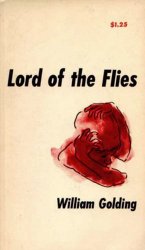
And even before the Orwell and Huxley novels, I decided, a good place to start would be that perennial highschool assignment, William Golding’s Lord of the Flies. It’s always been in the back of my mind as exhibit A to PvC #9: “In the event of any kind of species ‘reset’ … humankind would be left only with the evolutionary motivations given toward tribalism, the value of narratives over evidence, and the susceptibility toward supernatural perceptions, that preceded them – i.e., baseline human nature, optimized for animalistic survival.”

Lord of the Flies doesn’t exhibit that full range, but it does illustrate the erosion of social community into tribalistic savagery.

The book is so well-known I needn’t provide more than a cursory summary. Published in 1954, it describes a planeload of kids, all boys, all British, whose passenger cabin [apparently not the plane itself] crashes on a remote Pacific island, with no adults. The main characters, all about 12 years old or younger, are fair-haired Ralph, who assumes command with a totemic conch; fat Piggy, with asthma and specs; red-haired Jack, leader of a group of choirboys; and Simon, one of the choirboys who suffers some medical condition, perhaps epilepsy. The initial goals of the boys include building shelters and maintaining a fire at the top of the island’s mountain, to generate smoke and attract rescue. But there are rumors of a ‘beast’ on the island, and rivalry grows between Ralph and Jack.

(The book is just barely science fiction, in that it implies an atomic war that has both stranded the boys on the island and inhibits their rescue.)

A dead airman from some overhead battle parachutes onto the island, at night, and when glimpsed by the boys seems to confirm rumors of a ‘beast’. Meanwhile Jack and his choirboys become hunters, withdraw their group from the others, wearing clay warpaint, and become termed ‘savages’ in the book’s narrative.

Simon, the mystic, has a (perhaps epileptic) vision of a “Lord of the Flies”, a dead pig’s head mounted on a spike, that speaks to him of the real beast within them all; later, Simon ascends the mountain, discovers the truth about the dead airman, and descends to the beach to tell everyone about it, just as the hunters are reveling in meat and dance and chants — “Kill the beast! Cut his throat! Spill his blood!” — and, mistaking him for the beast, attack and kill him.

With Piggy’s specs the only source of generating fire, Jack’s forces raid Ralph’s friends on the beach, and then reject Ralph’s appeal for civility by rolling a boulder from their “castle rock” [fun fact: thus the name of Stephen King’s production agency] that kills Piggy. Ralph realizes he is their next target, and wakes in the morning to discover the hunters have set the entire jungle on fire, to smoke him out. He flees through the burning forest, landing on the beach, to discover a Naval officer there, rescue having been attracted by smoke from the fire.

\\

The book is popular in high schools because of its startling theme — being stranded on a desert island away from adults seems a lark, but it quickly turns sour, then savage — and for its relatively easy parsing into symbols, via the characters, the conch, the social roles. I remembered all that.

What struck me this time (the last time I read the book was in 1991) was that it’s a book full of mysterious passages. Some of these make more sense later on; others just provide perspective in a way that is only tangential to the book’s theme. These include:

  • The end of Ch3, a detailed passage about how Simon crawls into the bushes, to be alone, for the first time, and you don’t quite understand why;
  • p103-104 [page numbers are in the ancient Capricorn Books edition that I have, as yellowed as the internet image of the book I found and is pictured above, in which the entire text of the novel goes only 187 pages], as Ralph recalls his family’s house on the moors, and his childhood comforts;
  • Most especially, a long passage in which Ralph, on the far side of the island from the reef, looks out onto the ocean, p102:


    Down here, almost on a level with the sea, you could follow with your eye the ceaseless, bulging passage of the deep sea waves. They were miles wide, apparently not breakers or the banked ridges of shallow water. They traveled the length of the island with an air of disregarding it and being set on other business; they were less a progress than a momentous rise and fall of the whole ocean.

    This is the perception of wonder, of the mysterious, of the inhuman.

This last recalls to me Einstein’s famous quotation:

The most beautiful thing we can experience is the mysterious. It is the source of all true art and science.

To know what is impenetrable to us really exists, manifesting itself as the highest wisdom and the most radiant beauty, which our dull faculties can comprehend only in their most primitive forms—this knowledge, this feeling is at the center of true religiousness.

I would characterize, or extend, this as: the mysterious is the perception of an order of things that exists independently of humanity, and our wonder about what that order might be. It seems illustrated in Ralph’s perception of the vast, uncaring ocean.

Then of course there is a central key scene, in which Simon seems to talk to the “Lord of the Flies”, a dead pig’s head mounted on a stick and covered with flies. As Simon sees it, “his gaze was held by that ancient, inescapable recognition”, p128.2, and the Lord speaks to him, p132-133, “Fancy thinking the Beast was something you could hunt and kill! … You knew didn’t you? I’m part of you?”

This is mysterious, but it’s also pretty plain, and the author isn’t coy in revealing his theme. Another thing I noticed this time are the recurrent mentions of Ralph, ostensibly the sensible leader, feeling that his own thinking is going haywire. p70.7: “He lost himself in a maze of thoughts that were rendered vague by his lack of words to express them.”; p100.1: “A strange thing happened in his head. Something flittered there in front of his mind like a bat’s wing, obscuring his idea.”; p131.4: he is “puzzled by the shutter that flickered in his brain”. He has to keep reminding himself how to think rationally, as his compatriots become more and more irrational.

\\

Two technical comments: first, the island is described as being built of pink granite. This seems unlikely for a remote Pacific island, which are more typically, uniformly I think, volcanic.

Second, I’m sure I read somewhere how Piggy’s specs could not have been the types of lenses that could have been used to focus the sunlight and light a fire.

Story trumps.

\\

Then we come to the book’s central theme, or thesis, which the author spelled out, handily enough, shortly after publication (given in E.L. Epstein’s notes in my edition):

The theme is an attempt to trace the defects of society back to the defects of human nature. The moral is that the shape of a society must depend on the ethical nature of the individual and not on any political system however apparently logical or respectable.

He goes on to compare the rescue by the adults from the Naval cruiser with the “same evil” as life on the island, since the cruiser itself is built to act in a larger, global, conflict, to hunt enemies. “And who will rescue the adult and his cruiser?”

Based on the evidence of late 20th century and early 21st century science, though, I think his central premise is backwards, his moral quoted above. The evidence of modern neuroscience, of evolutionary psychology, suggests that this “same evil” is not actually a defect. It’s not a bug, it’s a feature.

The ‘savagery’ that the boys descend into isn’t “evil” or some kind of primal “sin” – it’s a survival strategy. And it’s present in all of us (just as Simon perceives), along with a vast suite of other survival strategies, built into us by evolution, ready to manifest themselves as needed depending on the circumstances the individual finds itself, whether alone in a jungle or forced to cooperate with a family, a tribe, a larger group. It *is* a function of social and political systems to temper individual selfishness (which survives in everyone, everyone’s temptation to cheat whenever they can, in minor and major ways), which sure enough would erupt in the event of a complete breakdown of social order (e.g. a worldwide catastrophe of some sort).

This survival strategy, this final resort to last-resort measures, isn’t “evil”, except in a context in which it does not apply. It’s what’s needed for individuals stranded in desperate situations to survive, at all, and then to survive and be able to reproduce — which would happen to pass that strategy on. Without it, calm, ‘civilized’ individuals and tribes, faced with circumstances of starvation in the face of, say, an ice age, would have perished. Did perish. The ones who didn’t perish, and are still here, are the ones who had those ‘savage’ resources to stay alive, and perpetuate the race that exists today.

(This reminds me that Golding’s second novel, after Lord of the Flies, was The Inheritors, a fiction of ancient history about a tribe of calm Neanderthals facing the onslaught of Homo sapiens, which might well illustrate the point I just made; but I read that one too long ago, and need to revisit it.)

E.O. Wilson described this tension between civility and savagery as a result of multilevel selection that pits kin selection against group selection – as quoted in this post (scroll down to chapter 3) reviewing one of his books,

Within groups selfish individuals beat altruistic individuals, but groups of altruists beat groups of selfish individuals. Or, risking oversimplification, individual selection promoted sin, while group selection promoted virtue.
Posted in Book Notes, Evolution, Species Reset | Comments Off on Rereading LORD OF THE FLIES

Zuckerman on Evangelical Immorality

Phil Zuckerman on The Immorality Of Evangelical Christians In The Age Of Trump.

Donald Trump has proven himself – by the hour – as a cold, heartless lover of lies and hater of humanity.

And 81% of white Evangelicals voted for him.

That’s right: those Americans among us who claim to love Jesus the most, who attend church the most, and read the Bible the most, and pray the most, and claim to be the most loving of God, are largely responsible for making this pock of a man the leader of our country, who is already causing – and will continue to cause — an inordinate amount of flagrant deception, pain, misery, violence, and immorality in our nation and the world.

And to top it all off, these Evangelical Christians have the perpetual gall to take the moral high-ground. They claim that they vote their values. They claim that secular people are immoral. The sanctimony reeks almost as bad as the hypocrisy.

(…)

Morality is a very simple thing: it is about alleviating the pain or suffering of sentient beings, helping when one can, not harming others, and treating people the way you yourself would want to be treated. End of story. Given this very simple and obvious explication of morality, we can clearly see Evangelical Christianity for what it really is, at least in its North American, early 21st century incarnation: immoral, uncaring, and blatantly harmful. Let’s consider some obvious examples…

He goes on to discuss banning refugees, healthcare, global warming, and so on.

Oh, well, they do care about fetuses. That’s true. They care about them so much, that everything else – from global warming to a lying, incompetent twitter president, from racism to gun violence, from Native American rights to corporate cronyism – don’t matter at all.

Recommended by this author: Living the Secular Life: New Answers to Old Questions. My review here.

Posted in Morality, Religion | Comments Off on Zuckerman on Evangelical Immorality

Anne Fadiman: EX LIBRIS

Here’s a pleasant, ‘occasional’ book of short essays about reading and books — a book about books. The author is the daughter of the famed Clifton Fadiman, an editor for Encyclopedia Britannica, an editor for Book-of-the-Month Club back in the day, and author of, among other things, The Lifetime Reading Plan, one of those volumes comprising intellectual ambition that I have occasionally dipped in to over the course of my life, and a radio and TV personality.

Anne Fadiman, one of his two children, was editor of The American Scholar for a time and published a small handful of books, including an award-winner about a Hmong family dealing with the American medical system.

I saw a reference to this book, Ex Libris, in the paper a week or two ago, and realized I had a copy of it, on my own shelf of books about books. It’s a small tidy book, like the image here except without the “National Bestseller” brag at the top or the review quote at the bottom, since mine seems to be a first edition.

It comprises 18 short essays on various bookish topics, such as:

  • How two bookish people combine their libraries upon getting married and living together; how to decide which ‘duplicates’ to dispose of;
  • Confronting a set of multisyllabic words which most people didn’t know (diapason, grimoire, mephitic, aspergill, etc.)
  • How most bibliophiles have an ‘odd shelf’ on some specific topic; hers is about polar explorations
  • Writing sonnets, and how she realized as an adult that her early work didn’t cut it
  • How people treat books—leaving them face down, etc—as a contrast between courtly love vs carnal love; the latter write in their books, turn down the page corner, etc. [I am courtly. I never write in books, never turn down page corners. If you see a book in my entire, vast library, that looks as if it’s been read, it’s because I bought it, used, that way.]
  • An old book from 1886 about ‘true womanhood’
  • Flyleaf inscriptions, and how they survive when books are sold or given away
  • Reading books in the location where their events took place, e.g. Thoreau at Walden Pond, etc.
  • The problem of gender pronouns; author disapproves of most solutions; how she encountered the word ‘ms.’ without realizing how to pronounce it, back in the day.
  • How her family proofreads restaurant menus, and signs, and instruction manuals
  • Fine pens with black ink, not pencils or computers
  • Books about food
  • About plagiarism, in an essay that uses footnotes and elaborate references to justify anecdotes or instances of reference or tribute
  • How the author loves to read catalogs that come in the mail
  • Building castles from books as children; children who grow up w/o books
  • Reading out loud
  • A pamphlet by 19th century English prime minister Gladstone about arranging books – anticipating the shelving system on wheels invented much later, and famously used by Charles N. Brown (and Robert Silverberg) in their home libraries
  • Visiting a used bookstore and how opportunities there are unlike shops with new books
  • Recommended reading – other books about books

I have two takeaways. First is the one reference in the book to science fiction. Anne’s father had a vast library, and on p124 she discusses it, and mentions, “The only junk, relatively speaking, was science fiction.” She doesn’t say what books.

Second — the running theme of the book is her childhood as growing up in a family that was literate, that reveled in books, that gained a thorough, pervasive, assumed state of familiarity about world literature. (Not including certain genres…) That’s a fascinating alternative-history fantasy for me; I’m the only one in my family, and the only one in my adult family, who’s interested in books and literature. I’m the outlier.

Posted in Book Notes | Comments Off on Anne Fadiman: EX LIBRIS

Links and Comments: Loyalty, Defiance, Imagined Realities

A revealing piece in today’s Slate: The Only Truth Is Trump, in which William Saleton reveals the subtext of Kellyanne Conway’s response to the Flynn debacle. His points:

  1. Loyalty within Trump’s circle is more important than loyalty to country.
  2. The only information that matters is what comes from Trump’s circle.
  3. The only standard of right and wrong is what Trump thinks.
  4. Trump’s secrets are as sacred as the country’s secrets.

This is autocracy, not democracy. Tribal loyalty, not adherence to the constitution, the law, reality.

On every principle—loyalty, secrecy, truth, right and wrong—Trump’s circle acknowledges only one standard and one master: Trump. That’s why the catastrophe of this administration won’t end with Flynn’s departure, or even with an investigation of Trump’s ties to Russia. It will end only when Trump is impeached and convicted.

\\

Related is a piece on one of the NPR/PRI radio shows I listen to most days, a talk with Yale University professor Jason Stanley, author of a book called How Propaganda Works.

He quotes Hannah Arendt (author of The Origins of Totalitarianism):

What convinces masses are not facts, and not even invented facts. But rather, open defiance. The movement is, the leader speaks, and you’re a follower if you repeat what the leader says. And that’s attractive.

This goes back to Bush’s “we’re not a reality based administration.” Karl Rove: “We’re an empire now, we create our own reality.” Always rooted in conservative, Republican administrations. (Since conservatives in general are more prone to imagined realities, and almost no scientists, whose devotion is to reality, are conservatives.)

Thus the familiar phrase, “Reality has a liberal bias.”

Posted in Conservative Resistance, MInd | Comments Off on Links and Comments: Loyalty, Defiance, Imagined Realities

Links and Comments: Human Biases and Christian Superstition

Friendly Atheist: What Caused the Oroville Dam Crisis? Some Christians Online Blame CA Liberals for Defying God.

Here in California our several years of drought have ended (at least in the northern part of the state) in so much rain that an enormous reservoir is threatened to overflow.

The reaction of some Christians is a typical self-serving superstition, the flip side of the claim by numerous evangelical leaders that the election of Donald Trump was due to divine intervention, e.g. Todd Starnes: ‘I Believe That We Experienced Divine Intervention Last November’. The way this mental fallacy works is that, whenever anything you approve of happens, you attribute it to God being on your side; whenever something bad happens to people you don’t like, it’s God taking his revenge. (And you ignore all the contrary cases, either way, like California’s abundant economy or tornadoes demolishing churches in southern states.)

Yes all humans are susceptible to such self-serving patterns of thought. But some cases like this it’s hard not to conclude that Christians who say such things are just not too bright. The area threatened by the dam overflow is inland California, a region far more conservative (and Trump supporting) than the coastal cities… which are in no way threatened.

Posted in MInd, Supernatural | Comments Off on Links and Comments: Human Biases and Christian Superstition

A Vision of Possible Futures

Here’s a great video called Wanderers, by Erik Wernquest, that depicts visions of a future in which humanity has “conquered the solar system” in the words of this frame article at ScienceAlert.com.

It’s narrated by Carl Sagan, whose introduction alludes to the ancient tension between the freedom of the nomad and the sedentary life of the farmer and citydweller, a theme visible all the way back to Genesis. Might humanity’s itching to wander propel, even justify, the exploration of space? At the same time, I’m cautious about the use of the phrase ‘conquer the solar system’, even as that theme has been an essential one for much of the past century’s science fiction. The way we’re ‘conquering’ our own planet seems to be irrevocably damaging its ecosystem – the sixth extinction.

Posted in Human Progress, Space | Comments Off on A Vision of Possible Futures

Link and Comments: Facts v Emotions

Slate, Jess Zimmerman: It’s Time to Give Up On Facts — Or at least to temporarily lay them down in favor of a more useful weapon: emotions.

Yet another article (by a former fact-checker) about how human mental biases deflect attempts to identify reality and truth, in favor of preconceived beliefs, beliefs that appeal to emotion.

In fact, by trying to stem the tide of untruths, we were probably making everything worse. Repeating a falsehood, even as part of a meticulously researched article that debunks it, actually reinforces the falsehood; the human brain seems to experience fact-checking as a statement followed by a bunch of Charlie Brown teacher noises.

There’s another reference here to George Lakoff, whose work I need to check out before trying to characterize it.

Great line from this article:

The thing is that trying to counter a lie with a fact is like trying to get a catchy tune out of your head by reading out loud from the dictionary.

His remedy?

You’ll hate it because we liberals tend to pride ourselves on caring about evidence, science, and accuracy. Being factually right, or at least grounded in reality, is something we value, something meaningful to our self-concept.

His remedy isn’t to ’empathize’ with the other side: “We must let go of the impulse to tell them that they’ve got their facts wrong — even when they do.” It’s to understand the emotions behind why they believe what they believe.

Figuring out how to counter falsehoods is going to mean assessing how lies benefit the people telling them. Do the things they believe without evidence make them feel safe? Do they make them feel moral? Do these beliefs contribute to a sense of being superior and unassailable?

Yes. Cf. Jonathan Haidt’s The Righteous Mind, the best book I’ve seen that parses the cultural and political divides as being a matter of the range of the spectrum of human psychological dispositions. (My comments on the book begin here.)

Posted in Conservative Resistance, MInd | Comments Off on Link and Comments: Facts v Emotions

Reading the Bible: Genesis, 1

This past month I’ve resumed my close reading of the Bible. I began last year, reading overviews of the Old Testament before reading the New Testament itself closely, taking notes on personal reactions, and reading commentaries and noting salient points from them. The sources I’m using were described in this first post on the topic, from March 2016 (other posts from 2016 can be found under the ‘Reviews’ menu item, above), and which can be quickly summarized and linked thus:

(I have other relevant volumes as well, including an “Illustrated Family Bible”, a volume for non-Christians that attempts to explain “Christian Mythology”, R. Crumb’s graphic novel version of “Genesis”, and a fascinating recent book that identifies an evolutionary subtext of the Bible. Trying to get as many different perspectives as possible.)

As I said in this post, I am “reading as a non-believer, inclined to skepticism, often to simple bemusement. The history of the world of supernatural claims is too broad to take any of them, even one that has inspired millions of adherents throughout history, seriously without any kind of thinking about their likely origin, and all the psychological and historical factors that went into their composition.”

It occurs to me now that there are two perhaps more primary reasons to study this now—

First, as Ehrman writes at the beginning of his Chapter One,

The Bible is the most commonly purchased, widely read, and deeply cherished book in the history of Western civilization. It is also the most widely misunderstood, misinterpreted, and misused.

There is repeated evidence that believers are no more likely to be familiar with the Bible, even vaguely, let alone to have read it, than nonbelievers. (Especially active nonbelievers who have reason to be nonbelievers; thus an Asimov quote, Properly read, the Bible is the most potent force for atheism ever conceived.)

Second, to become familiar with this cultural landmark and confront for myself, firsthand, this supposed fount of supernatural wisdom that provides, for many people, all the answers to the purpose of life and the origin of the universe. As other skeptics – Asimov, Coyne, Shermer – have done before me, I’ve set out to read my way through the Bible, reacting to what it says at face value, while at the same time consulting references and commentaries, from both believers and skeptics, for insight into subtexts and cultural assumptions.

One of the most striking conclusions I reached in what I read last year, is how thin is the so-called ‘evidence’ in the Biblical texts for supernatural claims that have become the foundation of thousands of Christian sects over two thousand years. The whole notion of Mary as a virgin, for example, seems to be based on one gospel writer’s dubious citation of an OT prophet, whose own story about a young woman used a term for her that might have meant virgin but just as likely merely meant a young woman. The gospel writer chose the meaning that suited his purpose, to make his story all the more remarkable; and from such a slender thread, has millennia of veneration followed.

But let’s move on. The OT is another kettle of fish, compared to the NT; far more ancient texts, and many variant texts edited together over hundreds of years, a situation apparently beyond dispute among scholars of the Bible, for decades in detail and centuries as a notion, yet a situation likely completely unknown to the vast majority of ordinary ‘believers’, who follow their religious community without any thorough, or even general, knowledge of their holy book.

I’ve started to read Genesis from the beginning, and will expand my earlier posts on what I read in 2016 with additional comments. Some general stipulations:

  • Oxford’s introduction to the Pentateuch, and to Genesis in particular, outlines the current understanding of where these books came from. In general terms: they were composed over many centuries, initially as oral traditions. These layers of different authors have been identified and teased apart beginning 300 years ago, and have become established scholarship over the past century. Oxford points out that the structure of Genesis moves from primeval history of the world (drawing from creation myths of older Mesopotamian cultures) to ancestral history of the storytellers, and acknowledges the dissonance between its creation stories and the modern understanding of the earth and universe and discovered by scientific inquiry in recent centuries.
  • All modern sources acknowledge four strands of composition: the J text, composed 10th century bce, in which ‘Yahweh’ or Lord is used; the E text, for Elohim, the name given God, and composed sometime after Solomon; the P text, Priestly, composed in the 6th century bce, during the Babylonian exile; and Deuteronomy in particular, composed sometimes in the 7th century bce.
  • The most obvious evidence for multiple authors of different texts that were later integrated into a single book are the various doublets and contradictions – two stories of creations, told one after the other; two stories of the flood, intertwined so as to avoid the impression of two separate floods; details in rival accounts that don’t match.
  • The ‘redaction’ of these various accounts was apparently conducted sometime in the 6th century bce, during the Babylonian exile.

Following are my annotations and comment by specific verse, much through Chapter 5 already posted, but now expanded a bit, then continued.

The two creations

  • 1:1, the traditional “In the beginning God created…” is more usually translated, these days, as “In the beginning when God created” or even “began to create”.
  • 1:2, note that before “let there be light”, there were waters (over which “a wind from God swept over the face of”). Thus, something existed before God got creation going, it seems. Why is this not generally acknowledged or understood, while everyone who thinks for the universe to exist, something or someone, thus God, must have gotten it going? This passage seems to undermine every claim that for the world to exist, God must have caused it. Oxford spells this out in a footnote, p11: “the text does not describe creation out of nothing… Instead, the story emphasizes how God creates order from a watery chaos.” So even Biblical literalists might ask, where did the watery chaos come from? Not God.
  • 1:6, and so we live in a dome with waters above and waters below. Do Biblical literalists really believe this?
  • 1:9, with the waters under the sky gathered in one place. One can imagine the limited view of the world of those who told these myths, who might know that the sea was over in that direction (e.g. west) and have no knowledge of any other seas or oceans, let alone the true immensity of the planet.
  • 1:16, “God made the two great lights—the greater light to rule the day and the lesser light to rule the night—and the stars”. This might be plausible if the moon were actually in the sky all night; but of course, on average it’s only in the sky at night half the time. (This reminds me of how often filmmakers depict the moon, for whatever phase its shown in, in the wrong place in the sky. I seem to recall E.T. as sinning in this regard, though I haven’t seen the film in ages.)
  • 1:16, and at the end of this verse, almost as an afterthought, “and the stars”. Incidentally. Presumably meaning the unimaginably vast universe that we have, in recent centuries, detected to exist; a mere footnote to the creation of the human abode.
  • 1:17, this claims the sun, moon, and stars are “set…in the dome of the sky to give light upon the earth.” Then why do billions of stars and galaxies exist that are not visible to the naked eye?
  • 1:21, “So God created the great sea monsters…” Sea monsters? KJV says “great whales”. You have to wonder what experience with large sea creatures the tellers of these myths had.
  • 1:24, “And God said, ‘Let the earth bring forth living creatures of every kind: cattle and creeping things…’” Curious how first on the list is cattle, an animal surely of prime importance to the herders who composed these stories, rather than, say, elephants or giraffes or lions, surely more impressive animals to anyone familiar with the entire globe as we now know it.
  • 1:26, “Then God said, ‘Let us make humankind in our image, according to our likeness…” The devout are pleased to think of themselves as the image of the creator of the entire universe (with arms and legs and everything else, presumably). A cat deity would presumably resemble a cat. (Cf. Jerry Coyne’s ‘ceiling cat’, and the poem by Yeats I quoted here.)
  • But a second point about 1:26 is that the phrase “Let us make man in our image” (KJV) or “Let us make humankind in our image” (NRSV) is that the two different words there are translations of the Hebrew word adam -! That is, the first man being called Adam wasn’t necessarily a name given to him, but a generic word for man, or mankind. Looking carefully through the early chapters of Genesis, there is a point at which the first man is referred to as Adam, a proper name, without comment, a rather slippery elision.
  • 1:27, in this first version of creation, male and female are created simultaneously.
  • 1:28, “Be fruitful and multiply, and fill the earth and subdue it; and have dominion…” A useful policy for any group in competition for survival with other groups, or with nature itself. The part about dominion and subduing alas justifies many people’s attitudes that are leading to the extermination of a large proportion of other species inhabiting the planet. (Cf Kolbert’s The Sixth Extinction)
  • 2:4, Here begins the second version of creation. The first one was about the seven days, in which on the fifth day God created humankind of both sexes—“male and female he created them” (1:27). The second version of creation involves shaping the first man out of mud, creating the female from his rib, and planting them in the garden of Eden. The first creation refers to the deity as “God”; the second refers to the deity as “Lord God”; these are the two separate accounts written by different people and stitched together much later, without much concern for consistency.
  • 2:9, And in the garden were two trees. An extremely potent metaphor: one is a tree of life, one is a tree of knowledge, and the latter is forbidden. Asimov spends several pages speculating on the identity of the four rivers flowing out of Eden. Two are obvious, two obscure.
  • 2:17, God promises they will die if they eat of the tree of knowledge of good and evil. Later they do, and God does not kill them, thus breaking his promise. Anyway, why create something, place it in plain view, then forbid it? If a human parent did this to a child, he’d be regarded as sadistic.
  • 2:19, In this version animals are created as potential ‘companions’ for man/adam, and man/adam names them all. It would be churlish to point out the number of species on the planet as we now understand, and the obvious implausibility of these passages that presume man/adam can inspect and name them all. Yet, there are people who believe the Bible literally true.
  • 2:22, woman made from the rib of the man. Miller, annotator of his Skeptical Annotated Bible (SAB), points out that 16th century anatomist Vesalius shocked the faithful by pointing out that women really do have the same number of ribs as men.
  • 2:24, “Therefore a man leaves his father and his mother and clings to his wife, and they become one flesh.” Wait, what, what? At this point, the sudden discussion of father and mother and how a man “clings to his wife”, seems premature and out of context, since so far in this narrative there’s only one man and one woman. Hmm.
  • Ch3, Asimov points out how the story of the talking serpent, a talking animal, is one of only two such incidents in the Bible (the other is a story about Balaam’s ass), is quite un-Biblical, more likely a vestige of a more primitive nature myth. (Asimov p31.7)
  • 3.8, the Lord God is “walking in the garden” and so the man and his wife “hid themselves”. This is oddly anthropomorphic on the first point, and beggars God’s omniscience on the second. This entire parable is perhaps related to early humanity’s concern about agriculture, which might have been thought a kind of slavery (to the land) compared to the freedom of hunter-gathering. (Asimov p32). Thus, for eating fruit from the tree, the man [not yet named Adam in NRSV until 4:25] is cursed to work the ground and eat the plants of the field (3:17-18). But note that God blames first the serpent, and then the women, before getting around to the man.
  • 3:22, the two trees represent wisdom and eternal life, two things the ancients must have realized were unobtainable. Why? Um, because God forbid them.
  • 3:24, “He drove out the man; and at the east of the garden of Eden he placed the cherubim…” But not the woman? More to the point, the first man and woman are driven from the garden, and barred from going back. So, did this garden still exist? Did any of the ancients try to find it again? Where would it have been?

Cain, Abel, other people, other gods?

  • Ch4, Oxford notes that the name Cain derives from the Hebrew word for create, while Abel is the same word translated as “vanity” in Ecclesiastes. On the agricultural theme, it is Cain, tiller of the ground, who is jealous of his brother the sheepherder. Asimov, p33, says Cain is taken to mean “smith”, since metal-working was important in early civilization. (And a smith is a kind of creator.) More generally, the story here can be seen to represent the tension the came with the agricultural revolution; the freedom of the nomadic herders gave way to the stress of being stuck in one place.
  • 4:7, “sin is lurking at the door”; what is this supposed to mean? An evil witch ready to sweep in and overcome the righteous? Oxford notes this is the first mention of sin in the Bible.
  • 4:15, the Lord puts a “mark on Cain” before sending him a way, a handful of words that have inspired long traditions of racism. (The Mormon church, in particular, long prohibited blacks to be priests, because the mark of Cain was taken to mean black skin.)
  • 4:14, “and anyone who meets me may kill me”. Even before 4:17 following, this implies there are other people around. Where did they come from, if all humanity descended from Adam and Eve, beginning with Cain and Abel?
  • 4:17, “Cain knew his wife”, a famous phrase about which it is completely fair to ask, where did she come from? The answer perhaps is that the context (of the second creation story) implies the Garden and the area where Cain and Abel lived was imagined to be the creation of one particular god, suggesting other tribes in other lands (such as Nod) had their own gods. The polytheistic theme is also suggested by the use of plural pronouns by the deity.
  • 4:17… Cain presumably remains a nomad; it is his son who builds a city. Asimov, p34, compares notions of farming vs roaming to the 19th century ideal of being a cowboy.
  • Ch5, the descendants of Adam listed here (from the priestly source) do not match those listed in Ch4 (from the Yahwistic source)…of course!
  • 5:3 and other verses: not only are the long lives of these generations implausible, so is how old all the men were before they had their first sons. Except that such exaggerations were common in the myths of other cultures at the time, I haven’t seen any good explanation or suggestion for such inflated numbers. Asimov, p36: “These ages were legendary, reflecting parts of earlier Babylonian tales picked up the Jews during the Exile…” And, as Asimov goes on to explain, these figures were used by some to deduce the time since creation: the Jews, in the Middle Ages, figured it to be 3761 B.C.; Bishop Ussher, in 1654, figured it to be 4004 B.C. Oxford makes the same comments about how the ages reflect similar Babylonian lists.
  • 5:24, “Enoch walked with God…”, a mysterious phrase which inspired several books of ‘religious fiction’, so to speak, about Enoch’s past and future, written from 20 bc to 50 bc (Asimov p37b).
  • 5:29, “bring us relief from our work and from the toil of our hands”; more agonizing about the difficulties of farming.
  • 6:4, the famous KJV phrase “there were giants in the earth” becomes in NRSV “The Nephilim were on the earth in those days…” because no one really knew what the writers meant. Asimov later speculates that more advanced tribes, with taller or thicker walls barricading their towns, might have so impressed newcomers, that the latter might have imagined the builders to be truly impressive in many ways, such as being giants.

The flood, the ark, Gilgamesh

  • The story of the flood and Noah resembles, of course, flood stories from other Mesopotamian cultures, with the difference here the emphasis on God unmaking the world because of the wickedness of mankind. Yet, if God had wanted to destroy the Earth and start over, why all this bother? Why not just another wind sweeping over the waters and start from scratch? Instead, the story as it stands seems obviously a kind of ex post facto explanation for an actual natural disaster, much the same way some religious people today blame, for example, hurricanes on gays, or whoever else they don’t like.
  • Gilgamesh is the best known early legend that also involved a flood; it was only discovered in 1872. I have a couple versions and will be reading them shortly.
  • Passing thought: taking the story at face value, how is it that only Noah and his immediate family are the only righteous people in the entire world? What about Noah’s ancestors, were any of them still alive? Well, no…. look at those genealogies and ages. If you map them out along a timeline [I happen to have such a timeline, which I assume accurately plots the numbers from the Bible], it turns out they had all already died… even Methuselah, who, coincidentally, died *immediately before* the flood hit – so the timeline claims, in tiny print. Maybe it’s not so much that only Noah’s family were righteous; it’s that no one else on earth was of the right blood, so to speak. Because the OT is all about how the earth is given over by God to one particular family, and the tribes they founded. (Why couldn’t God handle managing everyone else? Why prioritize one family line? Or is it because all those other folks were the creation of rival gods? Cf. the 1st Commandment.)
  • Chs 6-9, it need hardly be said that the story of Noah and his ark is implausible on any number of counts, e.g., there’s not enough water in the world to literally cover all the mountains (or even the ones around Mesopotamia); there are far more species of animals in the world that could have been accommodated on such a boat, and anyway what did they eat for 40 days, or was it 150 days (7:24)? And so on.
  • 8:13 and 8:14, one example of how two early account of the flood were later edited together, not very well, leaving numerous inconsistencies and contradictions.
  • Even on its own terms, what is the point? 8:21, the Lord realizes humankind is still evil! (If God is omniscient, why couldn’t he fix that?) Furthermore, 8:20, as the animals exit the ark, Noah builds an altar and promptly slaughters some of them! You’d think having made the effort to keep them alive, God and Noah wouldn’t be so casual about making them dead. Ah, but God “smells the pleasing odor”, hmm.
  • 7:11, Asimov speculates that an inspiration for the various flood legends was the plausibility of a tidal wave that swept up the Persian Gulf (perhaps triggered by a meteor!?). To people at the time whose entire world was a relatively small river area, it might well have seemed a flood of the entire world.
  • Asimov also points out that Ararat was a region at the time, not a particular mountain.
  • 8:22, so God comes to peace with wicked humanity, so to speak, and immediately promises…to restore the cycle of the seasons, “summer and winter, day and night, shall not cease.” This underscores the worldview of the time, the agricultural life.
  • Ch9, God hands down new rules to Noah and his sons, and makes a covenant with a ‘bow’ (rainbow). Then follows an odd story in 9:20 to 9:27, in which Noah gets drunk, one of his sons, Ham, sees his father naked, and when Noah wakens he curses not Ham, but Ham’s son Canaan, to be a slave. None of the commentaries has much of an explanation for why this story should make sense…except to justify later attitudes against the Canaanites.

Tower of Babel

  • Ch11 tells about the tower of Babel, claiming 11:1 “Now the whole earth had one language and the same words”, despite mentions in Ch10, several times, of different descendants and tribes of Noah who, e.g., 10:5, “are the descendants of Japheth, in their lands, with their own language, by their families, in their nations”. Again, we have a just-so story legend in this tower of Babel story, nothing like plausible history. Also 10:20, 10:31.
  • The point of the story being, in a childlike way, to explain the diversity of languages; in a more general way, to warn against ambition and the search for knowledge – a religious tradition that continues to this day, as fundamentalist creeds of all stripes strive to protect their offspring from secular knowledge. (Don’t learn too much about the real world, lest doubt affect your literal belief in fantastic legends.)

Abram and Egypt

  • 11:10, another long chronology that somewhat resembles Ch10, though it’s notable in Ch11 how the first-named child, presumably the eldest, is always male. Was it that females simply didn’t count? Also notable is how the ridiculously implausible long ages gradually temper, becoming almost believable, though still not believable is how long they lived before they had children.
  • 11:26 to 11:27 is another switchover from a Priestly to a non-Priestly narrative, thus the repetition.
  • Ch12, Again, is it foolish to wonder at this point, why the LORD prefers this one family? Here he is promising Abram and his “kindred” the lands that he shows – never mind the Canaanites already there (12:6). Isn’t this *obviously* an ex post facto justification for a land grab by an ambitious tribe who eventually prevailed, and could therefore claim divine providence?
  • Asimov, about Chapter 12, provides some background about Ur, from which Abram originally left – its success as a port diminished as the delta of the Tigris and the Euphrates filled with silt. Thus Abram moved on, settling eventually in the far west, bringing with him the various Babylonian myths that we see versions of here in Genesis. Canaan had already been occupied, since 4000 BC.
  • 12:10-:17, “Now there was a famine in the land”. No sooner does God promise Abram [later Abraham] the land of the Canaanites, than does a drought strike and Abram and wife flee to Egypt. Afraid he might be killed for his beautiful wife Sarai [later Sarah] he presents her as his sister. And so Pharaoh [Asimov notes this is a general term for the office, like today saying ‘the White House’ to mean the administration and not some specific president] takes her as his wife. For which the LORD afflicts plagues on Pharaoh. Does this make sense? Why doesn’t the LORD afflict Abram for lying? Anyway, the text doesn’t explain how Pharaoh understands how the plagues were due to Abram’s lie. What, given the setup, was Abram’s alternative? To be killed? Anyway, Pharaoh banishes them.
  • So, in retrospect, what was the intrusion of the rather brief Babel story all about? Because, apparently, the focus on the tower conflicted with God’s command to fill the Earth, while the subsequent blessing of Abram and his family is the advancement of that command.
  • 12:16, a typically casual reference to “male and female slaves”; Biblical morality.
  • Ch13, Wealthy Abram splits from Lot, and in :14 the LORD again promises Abram the land in every direction he can see. What about the people already there? (:7, both Canaanites and Perizzites.) Why doesn’t God care about them? Again, the implication that people of this time were essentially polytheistic – each tribe had its own god – explains much, including the need for the 1st commandment.
  • Asimov, p61ff, outlines the history of Egypt; Abram arrives during the ‘Middle Kingdom’.
  • Ch14 describes battles and Lot’s capture and Abram’s rescue of Lot. Asimov, p72, discusses the tradition that some of the tribes involved were giants, like the Nephilim earlier, and why such folklore was common.
  • 14:14, a famous anachronism is the citation of Dan, for a place that did not become named Dan for hundreds of years after the events here took place (and hundreds of years after a presumed historical Moses could have written Genesis); it was a key bit of evidence for Thomas Paine, as I noted last year.
  • Ch15, another covenant (involving animal sacrifice of course) and, :19, a long list of nations to be displaced by Abram’s descendants. One can only imagine what those nations’ oral histories might have contained.
  • :20 About the Hittites in particular, Asimov, p77, discusses that it was only discovered in 1906 that they established a substantial empire, for some hundred years; but the height of their power came during the years Abram was in Egyptian bondage, roughly 1750-1200 bce, and so the Bible is unaware of that history.

Abram and Ishmael

  • Ch16, despite contemporary standards of traditional marriage, it was apparently quite acceptable for a man whose wife was barren to take her slave-girl and bear children by her instead. So since Sarai can’t conceive Abram takes Hagar, an Egyptian slave-girl, and has a son, Ishmael. There being bad blood between Sarai and Hagar, the latter flees temporarily, but returns with an angelic promise to have many offspring. (First appearance of an angel?) About :2, Oxford notes that “ancient surrogate motherhood customs” allowed such arrangements.
  • Oxford has an interesting long footnote that outlines a ‘chiasm’ in the Abraham story, a pattern of events in which the early themes are resumed, in reverse order, after a central event. In this case the Hagar-Ishmael story is the center of the chiasm, after which comes another covenant (about circumcision), another hospitality story, another wife-sister story, etc. It’s fascinating to imagine that the oral tradition of reciting the lives of the ancestors, told over and over again, gradually took shape to emphasize such narrative patterns, to make the story both more easily remembered, and more compelling to listeners. Though at the same time, likely less accurate to what actually happened.
  • :7 vs. :13, not an angel, apparently, but actually the Lord.
  • Asimov notes how this part of the story backgrounds the establishment of the Ishmaelite tribes; later, the Muslims adapted these stories and embroidered them to establish themselves as descendants of Abram and Ishmael, both of whom are taken to have been buried in Mecca.
  • Ch17, a story that parallels Ch15, about a different covenant, this one about circumcision, and the Lord changes Abram’s name to Abraham. As Asimov explains, p80, circumcision was an ancient practice, for reasons unknown, and was not particularly important to the early Jews until the Babylonian exile, when it became a mark of distinction and was especially enforced. Since this was also the time the OT was put into its final form, Genesis was edited to stress the point.
  • :15 Sarai is renamed Sarah. God promises Abraham, now 99, and Sarah, now 90, another son (Abraham laughs at this), and though Ishmael will prosper, God’s covenant will apply only to this new son, Isaac. (why? Because history is told by the winners?)
  • :23-:27, and so they all get circumcised, in one day.
  • Ch18, the Lord appears to Abraham in the guise of three men, in a hospitality incident (to foreshadow the Sodom story, perhaps); Oxford notes “the motif of secretly divine visitors is widespread in folklore”.
  • :17-19, the Lord debates with himself. (If ever there was a passage about whether it is fair to wonder, how did the author of this book know that this happened? Who was the witness? – it is this one.)

Sodom and Gomorrah

  • :22-33, at length, Abraham bargains with the Lord about how many righteous men would prevent the destruction, based on some kind of hearsay “outcry” (in :20) of Sodom.
  • Ch19, the familiar story of the destruction of Sodom: two angels come to the city, where Lot lives, and are welcomed by Lot. But all of the men of the city (:4) demand that the guests be sent out, so that, the men say, “we may know them”. Lot, incredibly, offers his supposedly virgin daughters instead (he says they “have not known a man” but a few verses later refers to his sons-in-law), and is refused; the angels set about destroying the city, while the merciful Lord allows Lot and his family to escape.
  • Except that Lot’s wife, told not to look back, looks back, and is turned into a pillar of salt. (Why?)
  • Because, as Oxford notes, of the preponderance of salt formations around the Dead Sea. The oral teller of this tale could point to them as ‘evidence’ of the tale. Asimov, p82, speculates the natural disaster might explain the descriptions of destruction, suggesting that the entire story was an ex post factor ‘explanation’ for the disaster, much the same way modern Christians blame hurricanes on the gays. The Sodom story would be the first!
  • Some modern Christian apologists, some of them gay, try to explain the Sodom story as one about hospitality, not the “wickedness” (:7) of men eager to know other men. Surely it fits into the pattern of these chapters as one about hospitality, but reading this now, the theme of the wicked intent of the men of Sodom seems pretty clear as well. Still, there’s no trace of a clue as to why *all* the men of this one city were so wicked; that is, not the slightest plausible justification for this story as any kind of real event, rather than a superstitious morality play.
  • :30 And then (!) Lot’s daughters, apparently thinking they are the last people left alive on Earth, and there being no other man around, both contrive to sleep with their father, in order to produce another generation. Biblical morality, again. Their subsequent sons (always sons) become ancestors of the Moabite and Ben-ammi tribes, in another just-so tale of ancient ancestry.
  • Asimov, furthermore, speculates that whatever catastrophe this was that destroyed the two cities flooded the until-then dry southern portion of the Dead Sea, submerging the locations of Sodom and Gomorrah, leaving only Zoar, the place Lot flees to, dry.

Abraham and Isaac

  • Ch20 is a rewrite of Ch12, with Abraham traveling and describing his wife as his sister, to avoid being killed himself. They even fool the same king, Abimelech, again. In :12 Abraham claims his wife is in fact his half-sister; Oxford wonders if this is true, or merely an excuse.
  • Ch21, Sarah has child Isaac. Though at the end of Ch17, when all the men were getting circumscribed, the older son Ishmael was 13 years old, here he is described as a child, as he and his mother are sent away.
  • In :15, Hagar is ready to let Ishmael die, until God intervenes, pointing out a nearby well. Asimov points out the significance of wells in this time and area, and how this area, Beersheeba, is about the furthest south a well might have been dug.
  • :34, another anachronism, as Asimov (and others) p85 points out: the Philistines did not live in that area for another five centuries—right about the time Genesis was reduced to writing.
  • Ch22, in which God famously tests Abraham, demanding that he sacrifice his precious son Isaac. On its face it seems cruel, even perverse, yet of course believers have rationalized the story throughout history.
  • :12 Only when Abraham is about to make the sacrifice does God admit, “now I know that you fear God, since you have not withheld your son…”. Isn’t God omniscient? Why this cruel test?
  • :17 is notable, along with several later almost identical verses, for God’s promise to “make your offspring as numerous as the stars of heaven and as the sand that is on the seashore. And your offspring shall possess the gate of their enemies…” Which, even granting poetic license, has conspicuously failed to happen; the Jews remain an often reviled minority to the rest of the world.

Enough for now. Will finish rest of book, and review the various commentaries and versions noted above, over the next few weeks.

Posted in Bible | Comments Off on Reading the Bible: Genesis, 1

Pondering Immigration and the Future of the Nation

If there’s any one thing the United States might be remembered for, in future centuries or millennia long after the country has been superseded by newer, more advanced societies, it will be that it was a place for immigrants and refugees from less-advanced, more oppressive, countries around the globe. The entire country consisted of immigrants — the ones from Europe, beginning in the 15th century, who steadily exterminated most of the ‘native’ populations, themselves immigrants from Asia thousands of years before — immigrants who came in waves, one after another, claiming their refuge and then resenting, after a generation or less, the next wave who came after them.

Despite the ideals of this nation, these waves of immigrants have not been and are not immune to base human nature. Human nature is subject to xenophobia, to fear and demonization of strangers, of foreigners. Social contracts and rules of law are designed to overcome those base fears. But they do not always succeed.

Today on NPR I heard some man in Montana who seemed genuinely afraid that the Muslim hordes are about to flood in and take our [i.e. his] women.

And so the social ideals of even the US are periodically overtaken by psychological fears, social paranoia, authoritarian regimes. It’s happened before, and seems to be happening again. You might think the US, of any nation on Earth, might have the presence of historical mind to overcome those fears, and finally build, through social contracts, a more perfect union. But perhaps not.

Posted in Conservative Resistance, Human Progress | Comments Off on Pondering Immigration and the Future of the Nation