Links and Comments: Terrorists and Threats

Cartoon by Mark Fiore: Thank You. Love, ISIS.

Why? A piece by Nicholas Kristof in today’s NY Times explains. It’s called Overreacting to Terrorism? online and “Terrorists, Tubs and Snakes” in the print paper.

The basic problem is this: The human brain evolved so that we systematically misjudge risks and how to respond to them.

We over-estimate the danger of rare, unusual threats, while we ignore common, everyday threats that we learn to live with. Terrorists vs. car crashes. And disregard potential threats so long-range we think they won’t happen in our lifetimes.

This has been long-recognized; e.g. in the 1999 book by Barry Glassner, The Culture of Fear, subtitled “Why Americans Are Afraid of the Wrong Things…”

Just another example of how human “common sense” — a result of millions of years of evolution in relatively stable, predictable environments — goes haywire in the modern world, with so many new experiences and unfamiliar forces.

The result is our current political climate, with the Republicans, the conservatives, playing off instinctive fears of terrorist threats, highlighted and drummed up by the media (if it bleeds, it leads). The Republican hysteria about terrorists is playing into their hands; to the extent we curtail ordinary human rights and cower in fear, the terrorists have won.

Kristof again:

On the same day as the attacks, a paper by James E. Hansen and other climate experts was released arguing that carbon emissions are transforming our world far more quickly than expected, in ways that may inundate coastal cities and cause storms more horrendous than any in modern history. The response? A yawn.

Posted in Culture, Evolution | Comments Off on Links and Comments: Terrorists and Threats

Reading Around the Bible, 3: Mark

Some of these comments apply, of course, to Matthew as well.

  • All maladies are due to spirits or demons. It’s been noted by critics that the Bible contains no knowledge that was not known to its writers; that is, though supposedly inspired by God, who is omniscient, nothing he communicated to its writers includes anything that might have benefited or informed humanity beyond their local observations, such as the germ theory of disease or the idea that the sun and planets are celestial bodies, not merely lights in the sky. One ironic exception is, in Mark 7:3, the Pharisees’ complaint that Jesus and his followers were not washing their hands before eating. This is ironic because medical science didn’t actually believe in the efficacy of washing one’s hands before surgery, in order to not pass on infections to patients, until the late 19th century (IIRC). However, Mark (and Matthew too, I think), mention this only so Jesus can make a point about following the Commandments rather than the Pharisees’ Talmudic rules: Jesus thinks following the commandment that children who do not honor their parents should be killed is more important than washing one’s hands.
  • It’s remarkable how many people there are everywhere who are sick or lame.
  • 3:15, the apostles are authorized to cast out demons too!
  • 5:9, ‘My name is Legion’, a turn of phrase that SAB takes too literally (as a demon named Legion) was the title of a 1976 Roger Zelazny collection of three inter-related novellas; just one of *many* phrases in the gospels and the Bible as whole, of course, familiar in contemporary culture and discourse and as literary references, and which I won’t bother to cite.
  • 5:26, Jesus heals a woman who “had been suffering from hemorrhages for twelve years” (!) and had “endured much under many physicians”. The granddaddy of all faith healing narratives? The justification for people who to this day deny their children medical treatment, and pray instead? (Of course, medicine was rather primitive all the way up to 100 years ago or so.)
  • 8:31, Jesus obviously knows the story, or prophecy, he is to play.
  • 9:31, and other places in which Jesus himself prophecies that he will be killed and arise after 3 days: Asimov points out that, given the time of the arrest to the time of the resurrection, it wasn’t actually 3 days; it was 2 nights and one day. Asimov p236
  • 9:42, the commentator in the Oxford NRSV for Mark is different than the one for Matthew, and they say some strikingly different things to parallel passages in the two gospels. The commentator for Mark suggests the lines about cutting off one’s hand and plucking out one’s eye are metaphors and euphemisms for sins of male sexuality! (That two commentators in what is surely one of the most intellectually exhaustive annotations of the Bible currently available differ in their interpretations… speaks volumes, of course.)
  • 10:10, this time Jesus says you can divorce, but remarrying is equivalent to adultery. In any event, more advice that most Christians ignore.
  • 10:15, “Truly I tell you, whoever does not receive the kingdom of God as a little child will never enter it”. Get them while they’re young! (Children will believe anything.) Though again, the commentator thinks it’s not literal, but rather, as with so much Jesus says, a metaphor about the state of Israel under rule of the Romans.
  • Most remarkably, the end of Mark – the first gospel to be written – has none of the later sightings of the resurrected Jesus that we read about in Matthew; those passages, past 16:8, were added in the 2nd century CE (A.D.)!, according to the Oxford NRSV. Those later passages also include “signs” that “will accompany those who believe”, including speaking in tongues and picking up snakes with their hands, and how drinking deadly things will not hurt them. Sound advice for believers to this day who occasionally kill themselves as a result.

It’s been noted that Christianity is, among the general population (i.e. excluding the priests and the scholars), a tradition without much first-hand knowledge of the Bible. The atheists who seek to undermine religious fundamentalism (Sam Harris, Michael Shermer) are more familiar with the Bible than the vast majority of believers. Believers learn the traditions orally, through church sermons and Sunday School classes, and are never troubled by the grotesque, implausible passages of their holy book. So far, I find the Bible a fascinating artifact of primitive humanity, a storybook of discredited cosmologies and beliefs about how the world works, and, considering how long after the events most of its books were written, a prime example of how ‘history’ (of any kind, perhaps) is a result of the motivations of those who won and have an agenda to push.

Posted in Bible, Book Notes | Comments Off on Reading Around the Bible, 3: Mark

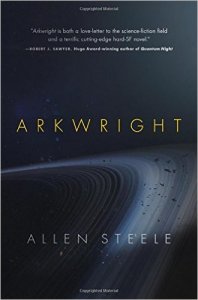
Allen Steele, ARKWRIGHT

I’ve read three recent 2016 novels in the past couple weeks, and am reading them faster than I take the time to key in notes and post summaries on my blog. But I will! First up is the last one I just read, Allen Steele’s Arkwright. Some of its content first appeared as a series of novelettes over the past couple years in Asimov’s magazine, and because of that, though its themes relate to those of Kim Stanley Robinson’s Aurora (review here; follow-up thoughts here), I don’t think it can be considered a *response* to KSR; rather, in a sort of equivalent to steam-engine time, both authors are rethinking standard assumptions about interstellar travel and colonization, and coming up with different solutions.

Steele imagines a famous science fiction writer named Nathan Arkwright, whom he describes as among the ‘big four’ along with Asimov, Clarke, and Heinlein, and known for his ‘Galaxy Patrol’ series beginning around 1950. The novel opens with his death in 2006, and his granddaughter’s attendance at his funeral, where she, Kate Morressy, meets three of his long-time associates: his agent Margaret Krough, fellow author Harry Skinner, and fellow traveler George Hallahan, a physicist. Kate learns that her grandfather established a foundation to invest his savings into a venture to build a starship within 100 years.

And because of problems with generation starships, and hibernation etc., (p100, which echoes KSR’s thinking), Arkwright’s scheme is to sent a starship full of eggs and sperm, to be combined into a set of infants to be raised by robots once the starship reaches its destination.

The book follows generations of Arkwright’s descendants as his idea for a starship is funded, built, and launched — it’s called Galactique, and its destination, a planet around star Gleise 667C-e, is dubbed Eos. This is a “generation starship” novel in the sense that it is about a starship whose launch involves generations — not because generations of passangers live on the starship.

The highlights of the book are the first part and the last part. (The middle parts are charming, though they involve many idealistic romances and little discussion of consequences, e.g. once the foundation’s ‘beamer’ saves the planet from the destruction, wouldn’t they become world heroes? No mention.)

The first part is an imaginary description of the first World Science Fiction Convention, in 1939, where there actually was a dispute (documented in real nonfiction books by Asimov and Knight) between the ‘Futurians’, who believed science fiction could be a force for social progress, and the leaders of the convention, notably Sam Moskowitz, who thought the Futurians communists. In Steele’s version, Arkwright and his friends — Krough, Skinner, and Hallahan — sit in a diner across the street from the convention, and invent their own league, the ‘Legion of Tomorrow’.

And the last section, which shifts perspective to a culture of 4-legged beings with a rigid religious society run by Disciples who believe in the unchanging ‘Gal’ in the sky, lore about the ‘chosen’ who came from Erf to Eos, and belief in the afterlife. This section completes the novel in a way that invokes the classic science fictional trope of the conceptual breakthrough, in this case, ‘everything you’ve been taught is wrong’, done here effectively and dramatically.

If I were to quibble about this book, it would be about the slightly too-easy dramatics of the middle sections, the generations of romances, and the predictable interference by religious zealots. But overall, I think this is a worthy epic that updates and reimagines science fiction’s ‘faith’ in the future in which humanity will expand beyond the physical scope of our planet, and the idea that human ‘faith’ in ancient stories can give way to acknowledgement and understanding of reality. This is what science fiction is all about.

Posted in Book Notes, science fiction | Comments Off on Allen Steele, ARKWRIGHT

Reading Around the Bible, 2: Matthew

Having finished the Old Testament a couple weeks ago, and passing over the Apocrypha for now, I decided to proceed with the New Testament by not only reading *around* it via commentaries by others, but to in parallel read the books themselves. I’ve finished Matthew. Of the commentators mentioned earlier, Miller is now of little use, while Asimov (who has 137 pages of commentary about just Matthew!) is of the most use, along with the very detailed footnotes in the Oxford NRSV.

Without pretending any kind of thorough analysis, I’ll list some initial thoughts of reading Matthew below. First, context from Pinker, p12:

Just as the Hebrew Bible offers a glimpse into the values of the middle of the 1st millennium BCE, the Christian Bibles tells us much about the first two centuries CE. Indeed, in that era the story of Jesus was by no means unique. A number of pagan myths told of a savior who was sired by a god, born of a virgin at the winter solstice, surrounded by twelve zodiacal disciples, sacrificed as a scapegoat at the spring equinox, sent into the underworld, resurrected amid much rejoicing, and symbolically eaten by his followers to gain salvation and immortality.

Asimov makes a related point, in his discussion of Matthew 24, p212:

It is important to remember that, in the century after the fall of the Maccabees, many men with Messianic pretensions arose and that every one of them had some following. Concerning every one of them, there rose wonder tales of miraculous feats and cures, tales that grew in the telling.

‘Grew in the telling’ indeed.

Pinker goes on to describe the Roman Empire and its Colosseum and its gruesome form of execution, crucifixion, which Pinker details in order to wonder how this punishment of Jesus was regarded by early Christians. Not with horror.

In allowing the crucifixion to take place, God did the world an incalculable favor. Though infinitely powerful, compassionate, and wise, he could think of no way to reprieve humanity from punishment for its sins (in particular, for the sin of being descended from a couple who had disobeyed him) than to allow an innocent man (his son no less) to be impaled through the limbs and slowly suffocate in agony. By acknowledging that this sadistic murder was a gift of divine mercy, people could earn eternal life. And if they failed to see the logic of all this, their flesh would be seared by fire for all eternity.

Pinker’s point is largely how this gruesome violence was thought perfectly ordinary in that era, and he goes on to describe the equally gruesome deaths (which “Christian martyrologies described … with pornographic relish”) of various early Christian saints, but my point in quoting the passage is because it points out what has always struck me as the essential incoherence of Christian theology — that given an omniscient God who could have arranged the initial conditions for humanity to be *anything*, he set it up the way he did, to bring about ‘sin’ upon his creations and then somehow to require the blood sacrifice of his ‘son’ in order to somehow ‘redeem’ believers. So much more plausible to understand it all as just one of many primitive myths, that happened to be preserved through the accidental preservation of written records (some of them at least; also been reading Elaine Pagels). That such stories of messiahs were going around is consistent with the apparent historical fact that no Roman history, for example, mentions Jesus (though one does mention John the Baptist); all of them might have been forgotten had the contingencies of history been slightly different…

So, Matthew:

  • Matthew is obsessed with how his story fulfills Old Testament prophecy; indeed, that seems to be why New Testament authorities placed it first among the four gospels, though the consensus of modern scholars is that Mark was written first, Matthew and Luke deriving from Mark and a now-lost document called Q.
  • It’s ‘tradition’ that the author of Matthew was the tax collector in 9:9, but only tradition, with no evidence. And all the gospels were written decades after the events they describe. (Again, one wonders what compelled those writers, decades after the fact, to do so.)
  • Matthew is so preoccupied with justifing his version of Jesus with OT prophecies, he is deliberately or accidentally not especially accurate, for the sake of a better story: thus the symmetry of three sets of 14 generations, which isn’t accurate, and if Joseph is not literally the father of Jesus, irrelevant.
  • It seems the only NT source for Mary being a virgin is Matthew’s deliberate or accidental misinterpretation of a story (not intended as a prophecy) from Isaiah 7:14 concerning what in the original was a Hebrew word that could have meant merely “young woman”. We suppose Matthew was motivated by the similar stories, as Pinker describes above, and needed the added force of Jesus’ mother being a virgin to place his story among them. (And from such a slender thread hang thousands of years of veneration of the Virgin Mary.)
  • As Asimov notes, p120.2: “But the Jews were, in those days, surrounded by a vast world of Gentiles who had traditions of their own. It was quite customary and usual in Gentile legend (almost necessary, in fact) that any great hero, any wonder-worker be the son of a god. A virgin could be impregnated by a god in magical fashion–this would not be impossible in the Greek tradition.”
  • Matthew, like the OT writers, is fond of the dream as a device for receiving wisdom or warnings.
  • Asimov has much fascinating speculation about the “historic Jesus”, i.e. suggesting social and political background of the time as plausible circumstances for how Jesus’ life developed as it did. Similarly, later in Matthew he speculates that Judas’ motives keyed off his being the only disciple who was Judean, not Galilean.
  • Not only is Matthew preoccupied with fulfilling OT prophecy, so is Jesus himself! (At least according to Matthew.) Thus does Jesus summon a donkey on which to enter Jerusalem. (So what’s the point? It’s not as if *all* those old prophecies were fulfilled.)
  • Jesus’ sermons were in the context of his insistence that the ‘second coming’ would occur in the lifetimes of his followers. Thus, an admonition to a wealthy man to give away all his riches (and follow Jesus) might make a bit of sense if the world was about to end. But considering…
  • Again, the tradition of Judas receiving 30 pieces of silver is found only in Matthew, and apparently only so Matthew could allude to an OT passage about 30 pieces of silver.
  • Less specifically, more broadly, the teachings of Jesus, e.g. the sermon on the mount, are full of broad directives that aren’t much better than OT laws and the harshest of which virtually all Christians today ignore. Divorce? Pluck out your eye or cut off your foot?
  • Asimov points out that one of Matthew’s OT fulfillment passage is simply wrong, p226, the one concerning the potter’s field where Judas threw his 30 pieces. “The two passages are therefore not parallel, as Matthew apparently felt, but, on the contrary, antithetical.”
  • The first witness of Jesus’ empty tomb, and thus supposedly the Resurrection, was Mary Magdalene, who was not, despite tradition, a prostitute, but rather a mad woman, “out of whom he [Jesus] had cast seven devils”. Of the disciples she told, even Matthew admits some of them doubted (28:17). (Asimov has a plausible reconstruction for how events surrounding a “historical Jesus” and a madwoman might, as they say, grow in the telling.)

Miller’s Skeptical Annotation makes a few additional interesting points: how repeated use of the phrase “unto this day” indicates that the book was written down later than the events it portrays; how a couple specific passages (7:6 and 18:15) have been used to justify practices of the Jehovah’s Witnesses to not speak truth and not investigate incidents of child molestation. And of course 27:25, used to justify condemnation of Jews forever as being to blame for the death of Jesus. [Which, it’s always seemed to me, is a paradox: if this whole blood sacrifice and resurrection of Jesus is arranged by God to redeem humanity’s sin, then how can anyone be to *blame* for Jesus’ death? It was supposed to happen!]

My purpose in all this isn’t to debunk the Bible (that’s too easy, and wouldn’t matter to ‘believers’ — which is a crucial point itself), it’s to examine it as the greatest single set of documents that must demonstrate both motivated reasoning and the biases of narrative. That is, why did these stories, the gospels in particular, get written as they did? What do the differences between them indicate about the motivations of the authors? Why did it not occur to someone to write these stories down until decades after the fact? Presumably social and political circumstances surrounding the followers of this one particular would-be messiah — in contrast to the follows of all the others — triggered something. Or was it mere chance, that the messiah around whom the first set of gospels were written were spread first merely because they were first? (Other gospels were lost or left out of the cannon.)

So the gospels are just the most prominent examples of histories written, innocently or deliberately, to serve some purpose that is distinct from the recording of nominally objective history. That idea of how stories matter, and why certain stories become more important than others, ideas which lie at the root of all of history, is what interests me. That speaks to why humans believe such stories at all, even those based on the slimmest of evidence, over, for example, the endlessly documented evidence for things in the real world but which humans prefer to ignore or deny.

Coincidentally, quite remarkably coincidentally, there’s a new book by Bart D. Ehrman, just published March 1st and which I didn’t see until last week, about precisely this subject: how stories of the past get written and how this applies to the gospels.. The book is Jesus Before the Gospels, subtitled “How the Earliest Christians Remembered, Changed, and Invented their Stories of the Savior”. I’ll be reading this one too.

Posted in Bible, Book Notes | Comments Off on Reading Around the Bible, 2: Matthew

Links and Comments: Trump; Democrats v Republicans; American exceptionalism; government regulations

As Donald Trump seems to be on the path to claiming the Republican nomination for president, Republicans who are appalled by him are increasingly expressing misgivings. Salon has this fascinating article about how some Republican pundits admit that the crude characterizations by Democrats of Republicans — “courting racists, placating religious lunatics, and using the culture wars as a political wedge” — turn about to be pretty accurate, based on the support for Trump.

Salon: The right’s shocking admission: Stunned by Trump’s dominance, some GOP pundits concede that Dems have been right about Republicans all along

The article quotes Bret Stephens, a “conservative columnist for the Wall Street Journal”:

Liberals may have been fond of claiming that Republicans were all closet bigots and that tax cuts were a form of racial prejudice, but the accusation rang hollow because the evidence for it was so tendentious. Not anymore. The candidacy of Donald Trump is the open sewer of American conservatism… It would be terrible to think that the left was right about the right all these years.

And Max Boot:

I’m a lifelong Republican but Trump surge proves that every bad Democrats have ever said about GOP is basically true.

Hmm.

This is, I’m thinking, rather analogous to protestations by theologians to attacks against religion, by Coyne, Carroll, et al, who accuse those writers of not being acquainted with sophisticated theology. Coyne et al respond with allusions to the Emperor’s New Clothes, and also to point out that, sophisticated theologians aside, the vast majority of believers do in fact accept basic fundamental myths, the 6-day creation, Noah’s ark, and so on, all the things the ‘sophisticated theologians’ (Coyne’s phrase) try to downplay as myths or legends.

And, it seems, a sizeable majority of Republicans are in fact racist, misogynist, hyper-religious, and anti-science.

This is not to say all Republicans are. But to understand that those people who are racist, misogynist, hyper-religious, and anti-science, are virtually all Republicans.

\\

Earlier– the Marco Rubio complaint that Obama has been trying to change America, as if that is a bad thing. It’s not; in fact, America is behind much of the rest of the world on many counts. Why do conservatives relish that? American exceptionalism?

From January, Salon: We’re No. 16! Why Donald Trump’s boorish American exceptionalism is so wrong

Just the latest example of much evidence about this. Americans like to think of themselves as exceptional — but so do citizens of other countries around the world. It’s human nature. When Obama pointed this out some time ago, he was accused of being anti-American.

\\

Finally, here is an essay by Nicholas Kristof that addresses the complaints by conservatives that America is over-regulated by big government.

New York Times: ‘Big Government’ Looks Great When There Is None.

Americans take for granted the benefits of ‘big government’, without realizing the alternative. Kristof travels to South Sudan:

In a country where to belong to the wrong tribe can be lethal, South Sudanese watch American aid workers arrive — a mixed salad of blacks and whites, Asian-Americans and Latinos, men and women — with some astonishment. These Americans come in all flavors of faith: Christians, Jews, Muslims, atheists and more. And while they may snap at one another, they don’t behead one another.

And

One lesson of South Sudan is that government and regulations are like oxygen: You don’t appreciate them until they’re not there.

Two political scientists, Jacob Hacker and Paul Pierson, argue that America’s achievements rest on a foundation of government services but that we Americans suffer from “American Amnesia” (that’s also the title of their book coming out this month) and don’t appreciate this.

“We are told that the United States got rich in spite of government, when the truth is closer to the opposite,” they write. Every country that journeyed from mass illiteracy and poverty to modernity and wealth did so, they note, because of government instruments that are now often scorned.

I think there’s a general principle here, which is my own idea and not something Kristof implied: that any society, no matter how advanced, will find things to argue about; the relative conservatives will complain about *something*, to appeal to tradition and to be wary of anything that would challenge the status quo, while the relative liberals will keep trying to expand options, push the boundaries, improve conditions. Human social evolution will always be two steps forward, one step back. But over the long run, liberals win; else we’d all still be living in caves.

Posted in Conservative Resistance, Culture, Politics, Religion, Social Progress | Comments Off on Links and Comments: Trump; Democrats v Republicans; American exceptionalism; government regulations

Links and Comments: Trump; Magic; Scalia and science; Cruz; God of the gaps

Partly because I’ve had a cold, or a couple different colds, for much of the past month, I’m behind on links and comments. So relatively briefly, here’s what I’ve collected. In reverse order, from most recent date.

\\

Slate: “How Trump Happened: It’s not just anger over jobs and immigration. White voters hope Trump will restore the racial hierarchy upended by Barack Obama.”

I think this is a large part of it. As the US, as throughout its history, attracts immigrants from many nations, the ‘white’ immigrants that for a while held majority status are getting sore that their privilege is being lost. (Recall that for a while that majority did not include the Irish.) At the same time, Trump is tapping into a base that is present in every population: the ‘authoritarian’ element that is paranoid and assigns blame to everything wrong to outsiders, those nameless ‘other’, whom Trump promises to get tough with.

\\

Triggered by this book: The Last Days of Magic, by Mark Tompkins. I compile new books listings every week, and for years have been struck with how fantasies, of one sort or another, far outnumber SF. This book asks, what became of magic in the world? A perennial theme. Answer: there never was magic in the world. There was human misunderstanding, and the projection of human protocols and values onto the inanimate world. There is an analog here to the Trump theme above.

\\

Jerry Coyne, among others, took note of a law clerk’s recollection of the late Antonin Scalia: A former law clerk: Antonin Scalia “generally detested science”.

Not surprising. Scalia was a Biblical literalist who actually believed in the devil. It’s my observation that the thinking behind Biblical literalism is rather the same as that of Constitutional originalism, the idea that the words of the Constitution need to be taken at face value, without any effort to understand the context in which it was written, or how words have changed. Coyne quotes:

Antonin Scalia generally detested science. It threatened everything he believed in. He refused to join a recent Supreme Court opinion about DNA testing because it presented the details of textbook molecular biology as fact. He could not join because he did not know such things to be true, he said. (On the other hand, he knew all about the eighteenth century. History books were trustworthy; science books were not.) Scientists should be listened to only if they supported conservative causes, for example dubious studies purporting to demonstrate that same-sex parenting is harmful to children. Scientists were also good if they helped create technologies he liked, such as oil drills and deadly weapons.

\\

Amanda Marcotte at Salon: Cruz’s last stand: Ted Cruz thinks he’s a messiah, but he’s a pathetic dunce about to fall on his face.

One of many, many articles about Cruz and his father, who are as certain of themselves as the Biblical prophets were about themselves (I say, as having been catching up on the Bible recently), and no more plausible, and just as scary, as they were.

\\

Connor Wood’s Science on Religion: No Space for God of the Gaps. A nice explanation for how whatever science can’t at the moment explain (like, I will add, the extraordinary series of steps needed for the process of blood coagulation) doesn’t justify belief in a god to do it. Appeals to this argument have fallen again and again over the past centuries, and will continue to fall, as more and more abstruse issues become explained by science. More at Wikipedia: God of the gaps.

\\

Another example of using familiar scales to visualize unfamiliar scales: Our Solar System: Scale Model in a City | Brain Candy TV

\\

No, the two parties are not equally bad. Sean Illing on a David Brooks column: Delusional David Brooks: His blind spot for Republican nihilism has become pathological

\\

Slate’s Phil Plait on Sean Carroll about the beginning of the universe, i.e., that there may not have been one. With a link to Closer to Truth.

\\

Thought during the night, three weeks ago: You have to leave the comfort of the light for the danger of the dark before you can see the stars.

Posted in Cosmology, Politics, Religion, science fiction | Comments Off on Links and Comments: Trump; Magic; Scalia and science; Cruz; God of the gaps

Reading Around the Bible, 1

I have never read any version of the Bible (or any other holy book), but over the years I’ve accumulated a couple versions of it, and several books about it. My parents were nominally Presbyterian, my mother sang in the church choir, and we kids (I was the eldest of four) attended Sunday school growing up. I decided I didn’t care to go any more at about age 15. But I still have the red-bound Bible, with fold-out genealogy pages in the center, given to me from the church in Reseda, California.

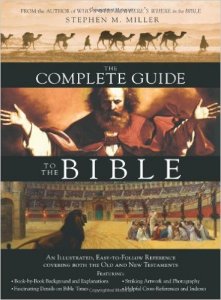
Recently, serendipitously, I noticed a glossy trade paperback in the gift shop at Andersen’s Pea Soup restaurant along Interstate 5, appearing to be a lavishly illustrated guide to the Bible. I glanced through it, noticing that it devoted several pages to each Biblical book, with summaries, sidebar discussions, and illustrations of art and photos of actual places, and lots of maps. (I love maps, and timelines.) It occurred to me that such a broad overview might be a way of easing into the Bible itself, at least of gathering an idea of its contents, before, or without, reading the ancient texts themselves. After all, the Bible is a foundational text of Western civilization and literature, aside from its roll as a religious text. So I tracked the book down on Amazon.

It’s The Complete Guide to the Bible, by Stephen M. Miller.

I bought the book and for the past month or so I’ve been working my way through it (I’m currently part way through the minor prophets) and several other books about the Bible already in my library. I have Isaac Asimov’s Asimov’s Guide to the Bible (in two volumes, one for each Testament); I have Richard Elliott Friedman’s Who Wrote the Bible?; and since starting Miller I’ve acquired Bart D. Ehrman’s The Bible: A Historical and Literary Introduction and John Riches’ The Bible: A Very Short Introduction (one of Oxford series of little paperback introductions on hundreds of topics), and two physical Bibles: the New Oxford Annotated Bible (4th edition, with the Apocrypha, which my unadorned childhood volume did not include) and Steve Wells’ Skeptic’s Annotated Bible (using the King James Version, and which is entirely online here, along with his annotations of the Quran and the Book of Mormon, but it’s handy to have a physical volume to consult).

Initial comments on these books:

  • Asimov, though best known of course as a science fiction writer, was an autodidact with an interest in history and culture to the degree he could analyze it, and writes his guide as strictly secular commentaries on people and places mentioned in the Biblical texts and how they relate to what is known from secular history; at the same time, he freely draws conclusions from the texts, and what is known about history, to speculate on the actual authors of the texts, and the actual times they were written, despite the nominally assigned authors. (Asimov also wrote similar guides to all of Shakespeare’s plays, and to Milton’s “Paradise Lost”.)
  • I read part of Friedman’s Who Wrote the Bible? years ago and was familiar with the basic idea: that (of course, one thinks), the Biblical texts that we know are amalgamations of many authors, passed along at first orally, over hundreds of years, and then edited into the versions we know today; Freidman describes the commonly known scheme of texts identified as J, E, D, and P. (This is why there are two origin stories in Genesis, one after the other; two accounts of Noah and his arc, stitched obviously together, and so on.) His book focuses on the Pentateuch, the first five books, traditionally attributed to Moses.
  • Friedman presents his thesis, though foreshadowed by a century or more by writers whose works were promptly put on the Catholic Church’s list of forbidden books, as still a tad controversial when he wrote in the late 1980s. But it turns out all the other books I have at hand, except Miller’s (whose point of view is that of a believer’s), acknowledge the same background, even Asimov, writing in the late ’60s.
  • The New Oxford Annotated Bible, which edition I selected to buy as the best current edition of the Bible, on the basis of the bibliography in Robert Wright’s 2009 book, has such extensive footnotes and annotations that it rivals the sums of Asimov’s texts, I suspect, albeit in much tinier print. It too is forthright about the multiple authors of the early books, later edited.
  • The Ehrman volume contrasts with Miller’s in that it discusses historical contexts, authorship, and why the early books of the Bible are best understood as myths and legends, not literal history. Ehrman is a prolific author of books that challenge simplistic readings of the Biblical texts, especially of the New Testament, exploring the political reasons why the gospels came together as they did, considering (as I’ve always known) how they weren’t written down until decades after the events they claim to document. At the same time, this Ehrman volume is a textbook, to the point of including topics for discussion at the end of each chapter, and so Ehrman seems to bend over backward to suggest [to believers who might be taking a class using this text], that it’s OK if the early Biblical books aren’t literal, that they are still meaningful.
  • And the Miller volume, to circle back around, is of course credulous, describing the events of each Biblical book with weary repetitions of how every misfortune that befalls the Jewish people is because God ‘allowed’ other peoples to invade them, etc. etc., or on the other hand renew promises of eventual redemption. The tone aside, it’s a surprisingly sloppy book — there are numerous captions in sidebar boxes that end mid-sentence, errors of layout and proofreading. And his chapter about Genesis doesn’t mention the Tower of Babel! (At the same time, I’m noticing, he dwells disproportionally on the minor prophets…) It’s fascinating to read various books *about* the Bible and see how differently they summarize and emphasize its content. A lesson in itself!

I’d intended a very brief first post about Bible reading, but let me close with a few initial reactions.

  • I’ve also browsed texts of ancient history, to understand how Israel and Judah fit into the scheme of things — to understand why, out of all the cultures that were present in the first millenium BCE, these texts that became our Bible survived while others did not. Surely the Assyrians and Babylonians and all the other enemies of “God’s chosen people” also discovered the technology of scrolls, around 600 or 500 BCE..? We have a scant few records of ancient texts, like Gilgamesh, but why no others? (Because the Library of Alexandria was burned down? Hmm.)
  • As a non-believer, with the just suggested perspective of historical context, nothing could be more obvious than that the early Biblical texts are creations myths and legends, often derived from those of other cultures and tribes, that were told and retold over centuries, orally, in ways that advance the ideals of the tribe. It’s all very interesting as self-serving history (there’s an angle here on how the current knowledge of psychological biases can inform all of this), but anyone who takes this literally is being, at best, naive.
  • And the incredible violence of the Old Testament. Why would anyone think this is any kind of guide to moral behavior? Even the heroes of Jewish history, David and Solomon, casually slaughtered enemies. I won’t attempt to draw any conclusions; this is an open question.

But on the last point, a couple quotes from Steven Pinker’s The Better Angels of Our Nature, whose thesis is that violence has, in fact, greatly declined over recorded human history — and at my casual browsing of Biblical stories this past month, I can be persuaded by. His book opens with descriptions of violence in the earliest texts that survive– Homer’s epics, and the Bible. First about the authorship, p11.2:

Modern biblical scholars have established that the Bible is a wiki. It was compiled over half a millennium from writers with different styles, dialects, character names, and conceptions of God, and it was subjected to haphazard editing that left it with many contradictions, duplications, and non sequiturs.

And about the violence, p10:

The Bible depicts a world that, seen through modern eyes, is staggering in its savagery. People enslave, rape, and murder members of their immediate families. Warlords slaughter civilians indiscriminately, including the children. Women are bought, sold, and plundered like sex toys. And Yahweh tortures and massacres people by the hundreds of thousands for trivial disobedience or for no reason at all. These atrocities are neither isolated nor obscure. They implicate all the major characters of the Old Testament, the ones that Sunday-school children draw with crayons.

So why is the Bible upheld as a moral standard..?

I will have several more posts, I think, over the next few weeks, as I finish reading *around* the Bible, and then perhaps begin to read specific books.

Posted in Bible, Book Notes | Comments Off on Reading Around the Bible, 1

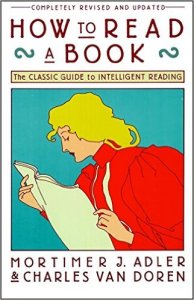
Rereading HOW TO READ A BOOK

Is this book anywhere near as commonly known as, say, THE ELEMENTS OF STYLE? I have the impression it was widely known at some point, and my 1972 revised edition is subtitled “the classic guide to intelligent reading” – the original edition was published in 1940. I picked up my copy off a remainder table at UCLA nearly 40 years ago, perhaps struck by the cheeky title – if one doesn’t know how to read a book, how could one possibly read this one?

Well, to answer my first question, since drafting part of this post a couple days ago, on Monday I saw two hardcover copies of this book at my neighborhood bookseller, A Great Good Place for Books, in the general nonfiction section — face out! So apparently it’s still in circulation.

To answer my second, rhetorical, question, HOW TO READ A BOOK is about how to read and digest and process books in ways more comprehensive than a straightforward, obvious, ‘elementary’ reading.

The authors are Mortimer J. Adler and Charles Van Doren. Adler was something of a pop philosopher, among other things, who oversaw the selection of the Great Books of the Western World (a set of titles a bit analogous to the Harvard Classics, which I am in custody of a set of, courtesy my forward-thinking parents, who filled my childhood home with various sets of encyclopedia and other volumes, though they did not read themselves). And in fact HOW TO READ has an appendix of ‘recommended reading’ that begins with Homer and goes through Solzhenitsyn.

This is a 400+ page book about various ways of approaching, inspecting, analyzing, and reading one book or many books on a given topic. These reading protocols are surely familiar, and easily discovered, to most devoted readers, though Adler & Van Doren’s focus was, as indicated, on the ‘classics’. They weren’t much concerned with popular fiction, or even any kind of current nonfiction books.

They describe four levels of reading: elementary reading, which is basic understanding of reading sentences and paragraphs; inspectional reading, which is the art of gleaning, in an hour or less, the topic and point of a perhaps substantial volume of nonfiction; analytical reading, the way to thoroughly read any book, depending on its classification; and finally, syntopical reading, which is about formulating questions on some topic and examining many books for the insight they can provide in answering those questions… a bit like ‘research’, though not exactly.

I haven’t actually re-read this entire book; what I’ve done, more-or-less, this past week, is a refresher inspectional read. Here’s what they mean by that:

  1. Look at the title page and preface, if it has one, and read each;
  2. Study the table of contents;
  3. Check the index to get an idea of the range of topics covered;
  4. Read the publisher’s blurb [i.e. the dust jacket description];
  5. Look through key chapters, and read any summary opening or closing pages;
  6. Finally, turn the pages, dipping in here and there, reading a page or a few, but never any more.

Their point of inspectional reading is to decide, given one’s time constraints, whether a book is worthy of a closer, analytical reading. Much of HOW TO READ consists of describing this third technique and how it applies to various types of books. The basic principles involve 1) find out what the book is about; 2) understand and interpret the book’s contents; 3) criticize it, in terms of your agreement or disagreement, on grounds; and 4) ask what of it?, i.e., does the book require any kind of response?

Of primary interest to me are the sections on ‘imaginative literature’ (by which they mean all sorts of stories, plays, and poems), and certain sorts of nonfiction more than others, science and mathematics. (They also have chapters on history, philosophy, and social science, which actually I’m lately investigating as well.) Their approach to ‘imaginative literature’ is mostly warnings about how not to treat it as nonfiction, and to immerse oneself in the experience; their approach to ‘science and math’ is mostly to consider the intellectual exercise, i.e. they think you are going to be reading classics like original texts by Darwin or Einsten, though they do have an afterthought about what they call ‘popular science’.

Their fourth level, syntopical reading, involves formulating a question or thesis, identifying a bibliography of books that address that concern, and analytically reading them against each other. In detail:

  1. Create a tentative bibliography of your subject;
  2. Perform an inspectional reading of all books on the bibliography, to identify which are key, which might be ruled out, other titles that might be added;
  3. ‘Bring the authors to terms’ by constructing a neutral terminology to map the authors to;
  4. Frame a set of questions and issues for which the authors might provide answers;
  5. Analyze the discussion by finding relevant passages that inform your subject.

(I’m condensing and paraphrasing steps outlined on pp335-336.)

In my own history, their points about inspectional reading have stuck, even to the idea of browsing books in a bookstore (back when people actually browsed books in physical bookstores… which I still manage to do now and then). Read the title, the book flap, the ToC; glance at the index, check for selected topics which you might think would be covered in a volume on this subject, and the bibliography if there is one. I would add: consider the ‘blurbs’ on the back cover; they give you an idea of who the publisher thinks this author aligns with, which both in fiction and nonfiction can reveal a great deal about where the author of the book at hand is coming from.

Lately, on this blog, I’ve been doing what they would call analytical readings, where I closely read substantial nonfiction books, take notes while reading, write up the notes in a Word doc, summarize and paraphrase those notes in a blog post, and quote selected passages from the author that I’ve noted while reading. [I might mention here that the authors of HOW TO READ advise to you *write in your books*, underlining or highlighting key passages, writing key points on the front and back endpapers, and so on. No; I cannot bring myself to do that.]

Aside from bookstore browsing (or Amazon browsing, to the extent that works), my version of inspectional reading, of novels, it to read the first 2 or 5 or 10 pages of any new novel that comes into the house… especially if it’s an author unfamiliar to me.

More recently, in the past year, I realize that I have begun what they call syntopical reading, if not quite as ruthlessly as they describe. That is, I’ve compiled a tentative bibliography on this blog of books addressing the very broad issues of cosmology, evolution, the mind, religion, morality, psychology, the future, all issues I need to examine at least broadly to understand how ideas of science fiction inform them. I have a parallel project of identifying key SF works, in some objective (not cherry-picking) fashion.

And so coincidentally, before coming across HOW TO READ during book rearrangement last week, I’d concluded that I need to do a sort of ‘inspectional’ reading of all those nonfiction titles on my bibliography. It might 10 years to read them all analytically (or syntopically), but inspectional readings might be finished in a few months, to cull the set down to those that directly apply to my project.

And one reason I read the Jo Walton book described in previous post, is as one of several complementary strategies for compiling an SF bibliography for that same grand project. Another, in progress, is paying close attention to Gary K. Wolfe’s “Great Courses” course in How Great Science Fiction Works. And another step, which I hadn’t actually realized was relevant to this relatively more recent project, when I began it many years ago, is the completion of sfadb.com.

Posted in Book Notes, science fiction | Comments Off on Rereading HOW TO READ A BOOK

Thoughts on Jo Walton’s WHAT MAKES THIS BOOK SO GREAT

Jo Walton’s WHAT MAKES THIS BOOK SO GREAT is a wonderful book, and I wish there were more like them. It’s not a book of reviews, so much as a book of reviews about *re*-reading books, and why she does so; most of the time, though not always, because she loves those books and finds something new in them every time. It’s a book full of chapters to inspire you to seek out the books she talks about, and reconsider those you’ve already read.

(I should mention that the book is a selection of columns she posted at Tor.com from July 2008 to February 2011, but only “about a fifth of the total posts that I made during that time”.)

The striking revelation of the book is that Walton is a constant, obsessive reader, taking a book everywhere she goes throughout the day, and a fast reader. She mentions that some favorite books she reads annually, and that on a day in bed, she can get through 4 to 6 books a day. I find that incredible. (At my best, during my college-year summer vacations, I could get through a 200-page paperback every day. These days, reading more substantial books, novels that are longer than those of 40 years ago and substantial nonfiction that requires patient attention, I feel accomplished to average 2 books per week.)

I’ve taken notes on this book about the books she discusses that she impels me to seek out or reread. At the same time, she has fascinations with authors I’ve sampled whom I have no further interest in — ahem, Bujold, Cherryh, Brust. I skimmed those chapters, and skipped a few (about Brust). (At best I’m inclined to revisit and sample Cherryh, whose first three books I read before moving on, rather as I did with Anne McCaffrey; it seems now, considering Walton’s attention and Russell Letson’s reliable reviews, there is something there in Cherryh I might want to pay attention to.)

Along the way, she has chapters about skimming; about why she rereads books she doesn’t necessarily like; about rereading books she liked earlier but which “suck” in the light of her own maturity or changing social standards; and so on. I almost wish there were more of this — discussion of how and why we read.

p104: “It’s the books I love that are the hardest to write about.”

My thoughts, as recorded part way through this book:

Reading many books, or reading about others who have read many books, is like speaking to many people who have intelligent, informed backgrounds from many different perspectives. You listen to them speak, without having to respond or defend any reasons you might differ in your opinion. Yet the intelligent reader will take everything into account, and continually reformulate their world view to account, or reject, everything, everything, they have read. It’s a continuous process of thinking about the world and updating one’s worldview to take into account all those other viewpoints you have read. It’s a way of expanding one’s consciousness and awareness about the world that would otherwise be limited by personal experience and local circumstances.

Posted in Book Notes, science fiction | Comments Off on Thoughts on Jo Walton’s WHAT MAKES THIS BOOK SO GREAT

Gilovich, 2, part 2

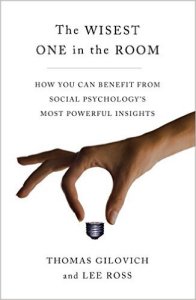
The second half of Thomas Gilovich’s and Lee Ross’ new book THE WISEST ONE IN THE ROOM: How You Can Benefit From Social Psychology’s Most Powerful Insights is four chapters under the heading “Wisdom Applied.”

Chapter 6, “The Happiest One in the Room”, begins with an anecdote about an athlete surviving an accident that crippled him, which he nevertheless came to regard as the *best thing* that ever happened to him, and goes on to discuss how, for example, people raising children are aware of the day to day toil of doing so, yet nevertheless consider it a worthy effort. Drawing on the earlier chapters, the authors point out that people who are happier don’t dwell on the past; they don’t denigrate rejected choices. And they’re less concerned about social comparison, i.e. worried about keeping up with the Joneses (so to speak; not their phrase).

So lessons to being happy: first, act like a happy person (see Ch4, “The Primacy of Behavior”). And more specifically,

  1. Apply the peak-end rule: take a shorter, more memorable (i.e. more expensive) vacation, rather than a longer, thriftier one. This is because our later memory of such events tends to highlight just two parts: the ‘peak’ best experience of the trip, and the ‘end’ event of that trip. Some principle applies to chores: don’t leave the worst chore until last.
  2. Experiences are better than material possessions; we talk about the former with others, but rarely about the latter. Valuing possessions speaks to the ‘hedonic treadmill’ of history, how despite the obvious advances in quality of life over the centuries, people today aren’t necessarily ‘happier’ than their ancestors were.
  3. Get up and go; avoid regrets; just get started. Find a ‘flow-state’, the condition of being deeply immersed in an activity that provides a deep sense of well-being. Being active is a buffer against low self-esteem.

And: pay attention to the young; spend money on others, not yourself. People are happier in nations with smaller gaps in wealth distribution.

Chapter 7, “Why We Don’t ‘Just Get Along'”, begins by considering the Middle East, and how to be a sophisticated consumer of news reports about such conflicts. There are psychological barriers to resolving conflicts, including considerations of ‘fairness’, the cognitive dissonance that results from compromise, and how some proposals of compromise became subject to ‘reactive devaluation’, p207, just because they’re proposed by the other side. [This is the state of American politics, since Obama, is my thought.]

Lessons: manage attributes: create a situation where a resolution *must* succeed. Offer a vision of a shared future resulting from a conflict resolution. Each side must control spoilers. Don’t bother with people who are invested in the status quo of the conflict and who can’t ‘afford’ to change. And realize that a slight shift, from 49% to 51%, can radically alter behavior.

Chapters 8 and 9 consider specific problems. Chapter 8 is about academic performance in public school, from racial differences among athletics to stereotypes in classrooms. It’s largely about self-fulfilling expectations by teachers, but students also suffer from ‘stereotype threat’, that notion that since their type doesn’t usually do well, it instills self-doubt that they themselves can do well.

Lessons: it’s about being ‘psych-wise’, and the authors point out ideas that don’t involve liberal notions of addressing root causes (poverty) or conservative criticism of ‘throwing money’ at the problem.

  1. Self-affirmation: have students periodically write an essay about some aspect of their lives that’s meaningful to them, something that affirms their life – just doing that, keeping it in mind, will bolster academic performance;
  2. Wise feedback from mentors, i.e. don’t patronize poor performance, but give honest, constructive feedback;
  3. Reassurance about belonging, having students understand that abilities grow with effort; it’s not just a matter of having an ability or not.

Chapter 9 is about “An Even Tougher Problem for the World”, climate change, why people don’t seem to take it seriously, and what can be done.

The good news is that some techniques have been discovered to encourage positive behavior, e.g. ‘social proof’, the idea that reminding people that their *neighbors* are doing certain things, like saving energy, by displaying this information on their monthly bills.

The global issue is more difficult. People are given to short term priorities, swayed by special interest groups, which in turn are driven by money in politics from those who stand to lose; and in the same way, the myth that there is some controversy about the evidence of human-caused climate change.

We can understand why people have difficulty addressing the problem, if not so much about how to overcome their resistance. The time frame of the effects of climate change is too vast; most people don’t worry much about the future beyond perhaps the future of their grandchildren p252t. Changes to address it would need to be permanent. Worry about free-riders; the drop-in-the-bucket problem; the ‘noisy signal’ problem, i.e. that the consequences of the problem are not easy to notice.

Addressing it, short of some magical technical solution, will likely require a change of social norms:

  1. Celebrate heroes; shame offenders; publicize the words of deniers;
  2. Realize that some social changes can occur relatively quickly — consider the social changes of only the past generation or two: how European wars have ended; how an African American has become president; how same-sex rights have expanded to marriage.
  3. And (again), realize that younger people affect olders.

What may ultimately be necessary is the creation of a social movement of the sort that has on past occasions transformed the world—a movement like the ones that launched both Christianity and Islam, or the one that transformed monarchies to democracies, or the one that ended slavery, or the one that is now empowering women across the globe….

[[ I.e., I would say, another phase of moral progress ]]

Finally, the authors’ epilogue tells a moving story about how Nelson Mandela united South Africa through a rugby match – told in the film Invictus – by using all the 5 elements discussed in this book.

Posted in Book Notes | Comments Off on Gilovich, 2, part 2