EO Wilson, Consilience, 3

Third post about Edward O. Wilson’s 1998 book Consilience: The Unity of Knowledge.

(first post; second post)

Chapter 4, “The Natural Sciences”, focuses on the nature of science and how scientists actually work.

The great divide among cultures on Planet Earth is not political, racial, or religious; it is the divide between the scientific and the prescientific. He evokes a comparison to “intelligent fish born in a deep, shadowed pool”, without the benefits of “the instruments and accumulated knowledge of the natural sciences” —

Wondering and relentless, longing to reach out, they think about the world outside. They invent ingenious speculations and myths about the origin of the confining waters, of the sun and the sky and the stars above, and the meaning of their own existence. But they are wrong, always wrong, because the world is too remote from ordinary experience to be merely imagined.

A powerful analogy, one that has appeared in science fiction, which I will eventually explore and elaborate.

Wilson describes science, p45.8:

Science is neither a philosophy nor a belief system. It is a combination of mental operations that has become increasingly the habit of educated peoples, a culture of illuminations hit upon by a fortune turn of history that yielded the most effective way of learning about the real world ever conceived.

And later defines it, p53m; Science is

the organized, systematic enterprise that gathers knowledge about the world and condenses the knowledge into testable laws and principles.

He explores themes that appear in his later, more recently read, book, The Meaning of Human Existence, which I blogged about in several posts ending here: how we perceive only the tiniest sliver of available light, or of other electromagnetic signals, some of which are perceived by other species. Evolution explains why.

Science has five principles: repeatability; economy; mensuration; heuristics; consilience, p53b. The method of science is firstly reductionism, (which is what offends so many critics), but in the service of synthesis and integration, with the goal of universal laws.

Wilson has some insightful description into the nature of how scientists work, and what their work means. A scientist has to be compulsive, working 80 hours a week (taking into account routine academic responsibilities, teaching classes, et al, before doing actual research), and how ultimately research, and original discovery, is all that matters. It doesn’t matter how a scientist makes a discovery — in this sense it is an art form — it only matters that the claim is true and can be validated.

Then there is the question of whether scientists close in on an ultimate, objective, reality. Wilson describes the philosophies of positivism, in Europe, then pragmatism, in America, with the combination of logical positivism (p61-62), culminated in a 1939 conference at Harvard. Mathematics, they understood, is tautological: given premises, you can conclude anything. p63.2: “Pure mathematics is the science of all conceivable worlds, a logically closed system yet infinite in all directions allowed by starting premises.” (I perceive a SFnal element here.)

Logical positivism halted, because they could not agree on basic premises about fact v. concept, theory v. speculation. Wilson states:

Its failure, or put more generously, its shortcoming, was caused by ignorance of how the brain works. That in my opinion is the whole story.

And so what I realize in reading this almost 20-year-old book is that a couple key issues I’ve come to understand only recently are not in fact all that new. Wilson identifies two key points: that the mind was built for survival, and the key to perceiving reality is to take into account the biases of how the human mind was built for survival, not perception of reality.

Wilson returned to the themes in this book not only in The Meaning of Human Existence, in 2014, but also in The Social Conquest of Earth, in 2012, which I have but have not yet read. And several key themes in this current book echo issues in his earlier foundational books On Human Nature (1978) and Promethean Fire (1983), which I read back then, and has informed my thinking ever since.

Posted in Book Notes, Human Progress | Comments Off on EO Wilson, Consilience, 3

Links and Comments: Narrative; the Limits of Rationality

I seem to have not yet mentioned yet another essay about how narrative is taking over the world. James Murdoch (CEO of 21st Century Fox) a couple weeks ago in Time Magazine: Storytelling—both fiction and nonfiction, for good and for ill—will continue to define the world:

Storytelling isn’t always positive. In the midst of the chaos of Iraq and Syria, ISIS masterfully tells its story of blood-soaked vengeance against supposed oppressors in their own lands and those from the West. Its stories sow the seeds of unspeakable atrocities from Raqqa to Paris.

Entrenched and compromised interests spin the fiction that science is more divided than united, and they sow seeds of uncertainty on issues of unquestionable priority: namely, the survival of our species on this planet.

Political hopefuls, for high office and otherwise, create elaborate narratives that they themselves don’t believe.

Stories matter.

The essay also touches on how the wired world will penetrate bubbles:

In 2016, from Lhasa to Tehran to Odessa, people will continue to seek and find forbidden things. In this connected world, the game is up. Censors cannot hide, and their victims have decided, and are empowered, not to take it anymore. Italo Calvino had it right in If on a Winter’s Night a Traveler: “In the decree that forbids reading there will be still read something of the truth that we would wish never to be read.”

I read that Calvino meta-novel years ago, and perhaps should revisit it.

\\

Last week’s New York Times Magazine had a long essay, Follow Your Bliss, by Jennifer Kahn, about self-help groups in Silicon Valley (and the Bay Area) teaching methods of “cold, hard rationality” to help people make better decisions and lead more efficient lives.

The essay recognizes the central quandary:

Our minds, cobbled together over millenniums by that lazy craftsman, evolution, are riddled with bad mental habits. We routinely procrastinate, make poor investments, waste time, fumble important decisions, avoid problems and rationalize our unproductive behaviors, like checking Facebook instead of working. These ‘‘cognitive errors’’ ripple through our lives, CFAR argues, and underpin much of our modern malaise: Because we waste time on Facebook, we end up feeling harried; when we want to eat better or get to the gym more, we don’t, but then feel frustrated and guilty.

The two major groups discussed are LessWrong and http://rationality.org/ aka Center for Applied Rationality (CFAR, mentioned in the quote), and the essay describes various workshops, training camps, and methodologies designed to identify problems and find solutions. They sound interesting, and there are lots of resources on those two sites, though the writer has some misgivings:

And while some exercises seemed useful, other parts of the workshop — the lack of privacy or downtime, the groupthink, the subtle insistence that behaving otherwise was both irrational and an affront to ‘‘science’’ — felt creepy, even cultish. In the days before the workshop, I repeatedly asked whether I could sleep at home, because I lived just a 15-minute drive away. Galef was emphatic that I should not. ‘‘People really get much more out of the workshop when they stay on-site,’’ she wrote. ‘‘This is a strong trend … and the size of the effect is quite marked.’’

As it turns out, I wasn’t the only one to find the workshop disorienting. …

This mirrors to some degree the reactions of people who realize the claims of their religious traditions, about the supernatural and the nature of the world, are implausible, and leave their churches, yet still feel a need to attend a church, in the sense that they feel the benefit of being part of a community. There was a question about this issue in today’s Dear Abby! Abby’s answer: the Unitarian church.

This social need, versus the realization that religious claims about the nature of reality are obsolete, is a central issue in many thinkers on these issue, as alluded in my previous post about the EO Wilson book. About which more soon.

Posted in Narrative, Science | Comments Off on Links and Comments: Narrative; the Limits of Rationality

Film Review: JOY

From Facebook, 18jan16:

We caught up with JOY today, the third film from director David O. Russell starring Jennifer Lawrence and Bradley Cooper, following SILVER LININGS PLAYBOOK (for which Lawrence won an Oscar) and AMERICAN HUSTLE. It’s a story about a rural American housewife, in the late ’80s or so, who lives with two kids, an ailing grandmother who watches soap operas all day, and in the basement, her father and her lounge-singer ex-husband. She has a talent for inventiveness, and after an incident on a sailboat with her father’s new girlfriend (played by Isabelle Rossellini!), she conceives a kind of mop with a self-wringer handle. Her ex connects her with an exec at the QVC shopping channel to sell it on late-night TV. The initial pitch does badly; she insists on a second pitch with herself doing the pitch, and becomes wildly successful. To a point.

The story has a traditional plot arc: initial success, followed by challenges that threaten to destroy that success, in one two three fashion, until a final validation. The best scenes are showcases for the actors: especially Jennifer Lawrence, in later scenes where she confronts the people trying to take advantage of her; with Bradley Cooper as he shows off the QVC set and its production; with Isabelle Rossellini as the hard-headed business-women who’s eager to cut losses and declare bankruptcy. (Robert De Niro’s best line, “I gotta admit I’m kinda proud of you”, is in the trailer.)

My personal reaction is that this illustrates why I could never be a business person.

http://www.imdb.com/title/tt2446980/

Posted in Films | Comments Off on Film Review: JOY

EO Wilson, Consilience, 2

Second post about Edward O. Wilson’s 1998 book Consilience: The Unity of Knowledge.

(first post)

Chapter 2, “The Great Branches of Learning”, seems a bit off the mark since it doesn’t address those branches directly.

Wilson says the Enlightenment thinkers of the 17th and 18th centuries got it mostly right, and he defines ‘consilience’ quoting William Whewell: “literally a ‘jumping together’ of knowledge by the linking of facts and fact-based theory across disciplines to create a common groundwork of explanation.”

He gives an example of how environmental policy, ethics, biology, and social science all meet at some common center, yet have separate methods and terminologies. Yet there’s nothing in principle that should separate them into inseparable disciplines.

He realizes he will be accused of reductionism, of ‘scientism’… to which he pleads guilty guilty guilty!

Philosophy, he suggests, has just two issues concerning science: the questions that science can’t answer, and the reasons it can’t answer them, p11.7

But he anticipates that cultural issues will eventually be enlightened by science, including the humanities, and the creative arts.

A big problem toward this goal is that universities have abandoned the idea of any kind of common understanding — there are fewer required courses, less and less presumed shared understanding, or general understanding of scientific issues. The same is true among lawmakers, pundits, the media 13.8. Yet he’s sure the long-term trend toward unification is inevitable.

Chapter 3, “The Enlightenment”, is much more interesting. I’ve read enough glosses on the history of science, of the scientific revolution and the enlightenment, to have a general idea of how those ideas mattered, and who the general players were. Wilson’s take is to emphasize how the Enlightenment *failed*, which he illustrates with an account of the life of the Marquis de Condorcet (whom I’ve encountered in not one but two other books read this past year — those by Jordan Ellenberg and Chris Mooney).

Condorcet was a brilliant mathematician, who applied his ideas to political theories, but he took up politics, chose the wrong side, and was condemned to prison where he died. He believed in the Enlightenment idea of laws of physics and perhaps of society, thus the idea of a perfectible society.

Wilson suggests that the ideas of social perfection aligned to tyrants who attempted to enforce social perfect to the point of condemning and executing naysayers — including, collaterally, Condorcet. Followed by what became the French revolution, and then the many tyrants of the 20th century.

I don’t think that Wilson implies that the scientific ideals of the Enlightenment — he considers Francis Bacon at length, and Descartes, and Newton — directly influenced those tyrants. But he does suggests that the Enlightenment ideals failed to satisfy issues about culture, in particular about human nature, and the failure to identify a basis for morality. At the same time, the idea of social perfection was seen by some as a trap, or an upset to the natural order: thus the beginning of stories about monsters, threats to the natural order that must be defeated. (A central SF theme, I think, especially about the ‘thriller’ genre.)

And then came the Romantic revolution, with emphasis more on naturalism and metaphysics, a trend Wilson follows all the way to the professional specificity of scientists, to the 20th century idea of artists to be unique rather than part of any tradition, to the late 20th century ideas of multi-culturalism, post-modernism, and deconstructionism.

Wilson identifies a central flaw of the Enlightenment scientists and intellectuals, who were deists:

The fatal flaw in deism is thus not rational at all, but emotional. Pure reason is unappealing because it is bloodless. Ceremonies stripped of sacred mystery lose their emotional force, because celebrants need to defer to a higher power in order to consummate their instinct for tribal loyalty. In times of danger and tragedy especially, unreasoning ceremony is everything. There is no substitute for surrender to an infallible and benevolent being, the commitment called salvation. And no substitute for formal recognition of an immortal life force, the leap of faith called transcendence. It follows that most people would very much like science to prove the existence of God but not to take the measure of His capacity.

Later, Wilson considers post-modernist views all the way to Michel Foucault, and opines, “To the extent that philosophical positions both confuse and close doors to further inquiry, they are likely to be wrong.” But at the end of this history, Wilson is optimistic:

Once we get over the shock of discovering that the universe was not made with us in mind, all the meaning the brain can master, and all the emotions it can bear, and all the shared adventure we might wish to enjoy, can be found by deciphering the hereditary orderliness that has borne our species through geological time and stamped it with the residues of deep history. Reason will be advanced to new levels, and emotions played in potentially infinite patterns. The true will be sorted from the false, and we will understand one another very well, the more quickly because we are all of the same species and possess biologically similar brains.

Here I will note that ideas that I’ve only become aware of in recent years — the idea of the human mind being optimized not for perception of reality, but for survival; the emphasis of *narrative*; and so on — are clearly identified in this 18 year old book. The ideas aren’t that new, though they have become clarified in recent years. In fact, Wilson describes how Francis Bacon, way back in the early 17th century, understood aspects of what we now call psychology — he used *stories* to put forth his ideas! (p26b). And he warned against various “idols of the mind”, 27t — idols of the mind, the marketplace — clear foreshadowing of the numerous mental biases identified by psychologists in the past couple decades.

Wilson concludes by granting that postmodernist ideas are like fireworks — most of them will burn out quickly, but a few might illuminate something interesting. And they cannot help but strengthen the traditional ideas they critique, which must endure that criticism. And if somehow they bring the whole grand scheme of modern science down — then we will start over. Because we must, we must understand.

Posted in Book Notes, Human Progress | Comments Off on EO Wilson, Consilience, 2

EO Wilson, Consilience, 1

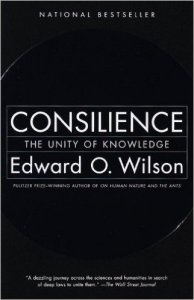
So now, after reading Edward O. Wilson’s The Meaning of Human Existence a bit over a year ago (last of five posts about it here), I’m returning nearly 20 years to one of his earlier, foundational I think, books: Consilience: The Unity of Knowledge, published in 1998, which I think I must have sampled a bit back then, but which for some reason never got around to reading through. (The cover of my first edition does not have any of the texts above or below those two lines that frame the title and author in this just-grabbed-from-Amazon cover image.)

(In general, I am sifting through my library of several hundred nonfiction books on everything from cosmology to evolution to mind to complexity theory to religion to the future of humanity in space, volumes accumulated over the past 40 years, culling them down to the essential volumes that relate [not necessarily support] to the framework of my ‘provisional conclusions’, digging up long ago compiled notes about some of them, and reading for the first time some of those I’ve yet to closely visit.)

I’m now only about a third of the way through this book, but I think I’ll begin compiling summary, and quotes, as I go. Wilson included his idea of a ‘consilience’ between science and the humanities in The Meaning of Human Existence, and so I proceed with some apprehension in this earlier book that there is no new grand insight to be discovered, only detailed justification. So far I’ve found that, yes, but also elegant, insightful writing, and detailed examinations of the historical and scientific backgrounds that support his thesis.

The first chapter is brief, autobiographical. Wilson grew up in Alabama, a Southern Baptist, enamored of critters in the woods, especially ants, frogs, and snakes, and how the 18th century Swedish naturalist Linnaeus had come up with a classification scheme (still used, of course) for all life. Then in college his mentor gave him a book on evolution by Ernst Mayr — his 1942 book Systematics and Origin of Species [Amazon — everything is on the internet!] — and it was to Wilson a revelation, an epiphany. Suddenly everything made sense in new way. He’d experienced what he calls an “Ionian Enchantment”, the notion, going back to the early Greek philosopher Thales, that the world is orderly, and can be understood.

And Wilson found himself “released from the confinement of fundamentalist religion.” He’d been raised a Baptist, had been born again, had read the Bible twice.

But now at college, steroid-driven into moods of adolescent rebellion, I chose to doubt. I found it hard to accept that our deepest beliefs were set in stone by agricultural societies of the eastern Mediterranean more than two thousand years ago…

But most of all, Baptist theology made no provision for evolution. The biblical authors had missed the most important revelation of all! Could it be that they were not really privy to the thoughts of God? Might the pastors of my childhood, good and loving men though they were, be mistaken?

He drifts away from the church, yet:

I also retained a small measure of common sense. To wit, people must belong to a tribe; they yearn to have a purpose larger than themselves. We are obliged by the deepest drives of the human spirit to make ourselves more than animated dust, and we must have a story to tell about where we came from, and why we are here. Could Holy Writ be just the first literate attempt to explain the universe and make ourselves significant within it? Perhaps science is a continuation of new and better-tested ground to attain the same end. If so, then in that sense science is religion liberated and writ large.

Here in this paragraph he displays more wisdom than any number of authors of crude atheistic critiques of religion (as I described them a couple posts ago), who think pointing out the lack of evidence for implausible supernatural claims should persuade people to abandon their faiths. It doesn’t work that way.

He concludes this introductory, autobiographical, chapter, with an evocation of Daedalus, and quotes Eddington: “Let us see how high we can fly before the sun melts the wax on our wings”.

Subsequent chapters include a fascinating history of The Enlightenment, and how it failed, and much insight into how science, and scientists, works.

Posted in Book Notes, Human Progress | Comments Off on EO Wilson, Consilience, 1

Links and Comments: Fear, Terrorism, Fear, and Religion

The New Yorker, January 2, 2016: Thinking Rationally About Terror, by Lawrence M. Krauss

How people overestimate the risk of low-probability (but highly-publicized) dangers, like terrorism, and seldom worry about more mundane dangers, like gun violence and auto crashes.

As far as the U.S. is concerned, it has been pointed out already—by the President, in fact—that about thirty-three thousand people die each year from gunshot wounds. That’s about four hundred thousand people since 2001. By contrast, setting aside 9/11, and even including the San Bernardino shootings, only fifty-four deaths have occurred because of domestic acts of terrorism during that time. Even if you include 9/11, the total death toll from terrorism amounts to less than one per cent of the death toll from gun violence.

A cynical individual might wonder who benefits more from the terror induced by terrorism: the terrorists themselves or the politicians and governments who use the public reaction to acts of terror for political gain? Hermann Göring, interviewed during the Nuremberg Trials, said, “The people can always be brought to the bidding of the leaders. That is easy. All you have to do is tell them they are being attacked and denounce the pacifists for lack of patriotism and exposing the country to danger. It works the same way in any country.” We need to be vigilant against those who seek to manipulate us—whoever they are.

The difference is that terrorism is historical rare, and thus novel — and it thus triggers emotional responses far out of proportion to the actual risk. Republicans, the party of conservatives, who are more given to fear, of course, play up the danger to score political points.

\\

Also involving politics, two examples of Republican politicians who seem unclear on the distinction between rule of law and theocracy.

Via The Morning Heresy:

Marco Rubio goes the Full Jesus in a new ad, in which he says, over a sweet and mellow piano underscore:

Our goal is eternity, the ability to live alongside our Creator and for all time, to accept the free gift of salvation offered to us by Jesus Christ. The struggle on a daily basis as a Christian is to remind ourselves of this. The purpose of our life is to cooperate with God’s plan, to those who much has been given much is expected and we will be asked to account for that. Were your treasures stored up on earth or in Heaven and to me I try to allow that to influence me in everything that I do.

This recalls an item from the David Silverman book I don’t think I mentioned: as he points out, “the US Constitution outranks everything, including religious texts”. He proposes an adaptation to official oaths, p52:

The current Presidential Oath of Office reads, “I do solemnly swear (or affirm) that I will faithfully execute the Office of President of the United States, and will to the best of my ability, preserve, protect and defends the Constitution of the United States.” Simply append “as the supreme law of the land” to the end. There! That is my kind of religious test — say yes to the supremacy of the Constitution as the law of the land or go become a preacher instead.

As it is, not just Rubio (and Santorum and Huckabee) but the vile Ted Cruz plays off the worst aspects of Christianity, not the best, as David Brooks explores in today’s paper: The Brutalism of Ted Cruz:

The best conservatism balances support for free markets with a Judeo-Christian spirit of charity, compassion and solidarity. Cruz replaces this spirit with Spartan belligerence. He sows bitterness, influences his followers to lose all sense of proportion and teaches them to answer hate with hate. This Trump-Cruz conservatism looks more like tribal, blood and soil European conservatism than the pluralistic American kind.

Posted in Culture, Politics, Religion | Comments Off on Links and Comments: Fear, Terrorism, Fear, and Religion

Review: The Outsider Test for Faith

John W. Loftus’s THE OUTSIDER TEST FOR FAITH: How to Know Which Religion Is True (2013) is a trade paperback book, one of a number of similar volumes I’ve perused over the past couple years, generally from Prometheus Books or small presses, a couple of them verging on self-published: Adam Lee’s Daylight Atheism (review here), Greta Christina’s Why Are You Atheists So Angry? (review here), and Peter Boghossian’s A Manual for Creating Atheists (review here), and a couple titles by Richard Carrier and Armin Navabi whose titles I won’t bother to mention.

These are books of varying quality, all designed to appeal to a small audience, all of them in some sense likely preaching to the atheist choir, but all of them, even the last two, making distinctive points and insights, which is why I keep checking them out. (The best is the one by Adam Lee, though the combined essays on his site are collectively better.) None of them, however, match the erudition or eloquence of the books by the atheist “four horsemen” – Harris, Dawkins, Dennett, and Hitchens, or, especially on grounds of eloquence, the British philosopher A.C. Grayling, whose The God Argument (despite its simplistic title) (review here) is my favorite of all these, because he spends half his time explaining not just why religious faith is discredited and obsolete, but why the alternates of rationality and humanism are so much more preferable.

The next volume at hand is by John W. Loftus, THE OUTSIDER TEST FOR FAITH: How to Know Which Religion Is True (2013). Significantly, Loftus was for some years an evangelical Christian and Christian apologist, before rejecting the faith in the 1990s and writing a book called Why I Became an Atheist: A Former Preacher Rejects Christianity in 2008.

The present books discusses a very simple idea, a ‘test’ to apply to one’s own religious faith, that Loftus originally proposed some years before writing this book.

Ironically, it’s hard to find in this book a concise description of what his test is, and how an average person should apply it. Part of the reason I suspect is that Loftus has discussed his idea in so many previous venues (including his own blog) that he likely assumes that everyone knows about the test he is talking about – and which he subsequently spends a large portion of the book defending the idea against various criticisms it has attracted over the years.

First he defines two concepts he abbreviates as:

RDVT: the religious diversity thesis, the elementary observation that religious faith varies widely around the world with distinct faiths largely confined to distinct geographical areas. That is, the overwhelming factor of which faith one grows up to believe in is where one was born; most people inherit their religion from their parents, as they do their language, cuisine, and politics. (What Adam Lee calls the Argument from Locality.) Loftus makes the elementary point, illustrated in two maps, that religious beliefs vary around the world, while “beliefs based on logic, reason, and critical thinking” (i.e. science), are uniform across the world. The maps in his book are in shades of gray; Jerry Coyne reproduces them in color here.

RDPT: the religious dependency thesis, the idea that evidence from biology, anthropology, and psychology show that religion is a consequence of human nature as it has evolved over the millennia. As the world grew larger to various tribes and cultures, their local gods grew greater, leading to the ‘evolution’ of monotheistic gods increasingly defined as greater than anyone else’s god. The ideas here are of course familiar from many recent books, including those he cites by Michael Shermer, Dan Ariely, and David Eller (and of which my favorite is Jesse Bering’s The Belief Instinct: The Psychology of Souls, Destiny, and the Meaning of Life from 2011, which Loftus does not mention).

So what is the test exactly? Here it is on pages 16-17: “The only way to rationally test one’s culturally adopted religious faith is from the perspective of an outsider, a nonbeliever, with the same level of reasonable skepticism believers already use when examining the other religious faiths they reject.”

This sounds completely reasonable on its face, though he doesn’t offer many specifics about how one should actually conduct or apply this test. (Again, perhaps he’s done so in previous writings.) On page 80 he mentions that one way would be for believers to read critiques of their own faiths, or of faith in general — (like this book!). He does point out that citations of holy books, anecdotes of conversion stories (he quotes William Lane Craig’s), are insufficient justifications for one’s faith; such rationales can be cited by believers of completely different religions.

This is all very elementary, of course, yet Loftus spends much of the book addressing criticisms he’s received on various grounds: on the validity of his provisional theses; on the validity of science itself; on whether the test presumes something hidden, or could be applied to any cultural beliefs, and so on. A penultimate long chapter discusses Loftus’ own analysis of how Christianity fails the test (as he wrote about more exhaustively in earlier books). A final chapter asks why we should have “faith” in *anything* (even the facts of ordinary daily life), and he says we shouldn’t — we should only accept anything based on relative probabilities derived from experience.

\\

So… my take on the book is that, like other rather crude atheistic critiques of religion, it dwells entirely on the implausibility of religion’s various supernatural claims, and the contradictory situation of adherents of rival beliefs being equally certain of their validity — rather than considering the cultural, social, and psychological reasons for why that situation has endured. It’s my observation and understanding that, for example,

  • The fact that believers of other religions exist around the world doesn’t, in fact, bother most people;
  • The beliefs and experiences of most people, as they grow up in shared cultural milieu, to some extent *mold* their brains, so they to some extent cannot change their minds, regardless of any evidence or reason

Loftus is not a smooth writer; aside from long-winded repetition throughout the book, he frequently rants, he occasionally sputters. Here’s Loftus reacting to an admittently lame defense from a friend about the friend’s belief in heaven, on the basis of seeing his dad and grandfather in a dream. Loftus:

Wow, isn’t that something? What does it take? I don’t know sometimes. But evidence? Who needs that when you have an experience? …

Ironically, then, when he quotes other writers they are usually more eloquent than he himself. One such writer I was not familiar with is a David Eller, who makes this point similar to mine above:

Christians, like other religionists, are not so much convinced by arguments and proofs as colonized by assumptions and premises. As a form of culture, it seems self-evident to them; they are not so much indoctrinated as enculturated.

Which I now realize Loftus quotes twice! On pages 60, and 147. There’s a longer passage by Eller quoted on pp58-59. Maybe I’ll track down his book.

\\

Loftus not only quotes better writers than he, but mentions what might be better ideas than his own. In a footnote on page 235 he mentions a precursor test by a mathematics professor, John East, which is described here: The Outsider Test for Faith and the Veil of Ignorance. East’s notion is to suppose that a person is told that when they wake up in the morning, they will be randomly changed into a person with a different religious view. But before bed they are allowed to write a letter to themselves, offering general advice on how to investigate religious options, without saying which one they should accept. What should they write?

My own thought as I read this book was that a more straightforward ‘test’ would be the following. Suppose a neutral outsider, say an intelligent Martian, arrives on Earth sincerely curious and completely unbiased, asking representatives of various religious faiths to explain, as persuasively as they can, why their faith is true and the others are not.

Or, if you want a person to sincerely examine their own beliefs, simply ask them to imagine what possible evidence, if any, would convince them that their religious faith was wrong. If they can’t come up with anything (as Ken Ham did not) then they are admitting they have no rational basis for their beliefs, and we may suppose there are not any. (Scientists, on the other hand, almost by definition, always have criteria for disproof in mind.)

So enough about that book.

Posted in Atheism, Book Notes, Religion | Comments Off on Review: The Outsider Test for Faith

Film review: THE REVENANT

From Facebook, 10jan16:

Today we went to see THE REVENANT, the film with Leonardo DiCaprio as an 1820s fur trader in the American northwest, mauled by a bear and left for dead by his compatriots, who manages to survive and return to take revenge (specifically against the man who not only left him for dead but murdered his son Hawk). It’s a grueling film, perhaps overshadowed by its publicity (at least among those of us who read the newspapers that cover the Hollywood film industry) — about how Leo did actually endure excruciating months of filming live scenes in harsh conditions, about the mostly CGI bear maul, and mostly about how Leo might finally win an Oscar, after so many nominations and losses. But as I rarely ask after seeing a film — what is the point? There have been many another more literary and insightful stories about revenge, and this film seems to be more of a stunt, by its director and lead actor, seeing how much Leo can endure, seeing how many graphic scenes of Indian attacks with arrows through the throats, or scalpings, or knife fights (as the film eventually resolves), the director can depict, and the audience can endure.

At the same time, it has lovely cinematography, in the sense of having frequent scenes of gorgeous mountain and sky views; some vibrant music by Ryuichi Sakamoto (albeit reminiscent of the ’70s era of electronic scores); and good performances by Domhnall Gleeson and Tom Hardy, who both seem to be in every other film we’ve seen this past year.

www.imdb.com/title/tt1663202/

Posted in Films, Uncategorized | Comments Off on Film review: THE REVENANT

Links and Comments: Conspiracy Theories, Cognitive Biases; Changing Minds; All Stories

Catching up on links and comments from this past week.

First, a couple book reviews in last Sunday’s NY Times Book Review.

First, a review by Adrian Chen of Suspicious Minds: Why We Believe Conspiracy Theories, by Rob Brotherton. Subtitle: “We are hard-wired to believe that nothing happens by accident”.

George Washington entertained conspiracy theories about the Illuminati.

Brotherton attacks the stereotype, which he says was popularized by the historian Richard Hofstadter in his influential essay “The Paranoid Style in American Politics,” of conspiracy theorists as a small band of tinfoil-adorned loonies — the paranoid fringe. Brotherton’s main argument is that we all possess a conspiracy mind-set to some extent, because it is hard-wired into our brains. “Suspicious Minds” details the various psychological “quirks and shortcuts” that make us susceptible to conspiracy theories.

For example, psychologists have discovered that we possess an “intentionality bias,” which tricks us into assuming every incidental event that happens in the world is the result of someone’s intention.

And especially this:

Paradoxically, the illusion of an evil, all-powerful conspiracy guiding events can be more comforting than the reality that humans are rarely in control.

\\

And this review, by Robert A. Burton (author of On Being Certain: Believing Your Are Right Even When You’re Not, a book on my shelves), of two books, Black Box Thinking: Why Most People Never Learn From Their Mistakes — but Some Do by Matthew Syed, and Failure: Why Science Is So Successful, by Stuart Firestein.

More about cognitive biases, Daniel Kahneman, Steven Pinker, and whether we can overcome those biases. Can there be a program for self-improvement?

This problem becomes particularly acute when a book both outlines our deeply rooted behavioral inclinations and simultaneously suggests that they might be overcome. The better your argument for our inherent limitations, the weaker become your bootstrap suggestions for self-improvement.

\\\\

Last week Michael Krasny, host of the nationally-syndicated radio program Forum, hosted a segment asking guests and callers What Have You Changed Your Mind About…And Why?.

What’s notable in this program about whether people have changed their minds about anything, and why, is that the political and scientific issues people have change their minds about are invariably from conservative/denialist positions to liberal/reality positions. Just saying. Note that the show is broadcast cross-country, so it’s not as if all the callers are from the relatively liberal Bay Area…

\\\\

The Atlantic: All Stories Are the Same: From Avatar to The Wizard of Oz, Aristotle to Shakespeare, there’s one clear form that dramatic storytelling has followed since its inception, by John Yorke.

An essential essay about how stories work and why they are appealing.

Also this, from The New Yorker: How Stories Deceive, by Maria Konnikova.

More and more discussion of how humans think in terms of *story*, and how it’s hard for humans to understand aspects of reality that do not conform to a familiar kind of story.

My follow-on thought: while I’d like to think about science fiction as being a way to explore understanding of reality outside the usual parameters of human culture, I have to admit that still, SF consists of a body of *stories*, stories which are more or less successful depending on their appeal to human biases, and so, how can it be trusted to reveal anything new?

But actually, SF has to some extent anticipated this. More on this in next posts.

Posted in Changing One's Mind, MInd, Narrative | Comments Off on Links and Comments: Conspiracy Theories, Cognitive Biases; Changing Minds; All Stories

Film Review: Room

Room is an incredibly powerful film, both on its own terms as a harrowing story of a mother and her 5-year-old son trapped inside a single room for the boy’s entire life, and for its metaphoric weight (which I admit struck me as much as the surface story). Loosely based on one or more real-life stories, the situation is about a woman kidnapped by a man who confines her to a garden shed in his back yard, with the only window a skylight, to use for his sexual pleasures. The result after the first two years is a son, Jack, who grows up entirely confined to Room, as they call it. They have a TV, the images on which Jack regards as “outer space”, not real. Everything inside Room is unique: bed, sink, lamp. In the opening scene, Jack wakes one morning and says hello to each of them. Hello bed, hello sink.

As Jack turns five, his mother Joy tries to explain that some of things she told him earlier weren’t entirely true, but now that he’s old enough, he deserves to understand. There’s a real world out there; there’s another side to the walls of the room. He doesn’t get it, he’s confused, he screams “I want another story!”. [Narrative!]

It’s not giving much away to say that Jack’s and his mother’s life inside Room takes up only the first half of the film. This is the power of the story’s metaphor: Jack escapes. He sees the sky for the first time! He discovers a *real* world so much larger than anything he has imagined. He brings about the rescue of his mother, and they return to her parents’ home to try to resume normal life. The first night, his reaction is, can we sleep in the bed? In Room?

Part of the conflict is about Joy, the mother, who is struck by an interviewer question about why she didn’t have her captor try to take Jack away, for a better life outside Room. No; she never considered it — her bond as a mother was too strong — but this consideration leads to drastic doubts. And she renounces any recognition of her captor as the boy’s ‘father’. And part of the conflict is about Jack’s adjusting to the outside world, of course. How he misses Room, and its comforts. And the final scene.

Great film, and something I rarely do after watching a film, I’m ordering the novel it was based on, by Emma Donoghue, who did the screenplay for the film.

IMDb: Room
Wikipedia: Room (novel)
Wikipedia: Room (2015 film)

Posted in Films | Comments Off on Film Review: Room