Refining My Thesis

My thesis about science fiction is that (for the most part) it reflects the framework of my Provisional Conclusions: science fiction recognizes humanity’s existence within a vast, ancient universe; it recognizes that human perception of reality is incomplete and sometimes misleading; it recognizes that human culture, including religion, is contingent; most of all it recognizes change and the scientific method as key factors in understanding how humanity interacts and engages with the greater universe; and finally it speculates on potential futures, negative and positive.

(That science fiction is concerned with issues outside the relative bubble of human culture, where mainstream literature resides, is why SF is so often considered ‘escapist’.)

Fantasy, in contrast, prioritizes elements of human nature and human culture – including the imagining of endless variations of the supernatural illusions humans are subject to – over concern or engagement with the greater universe, or concern with historical context. Horror may be either fantasy or SF, though if the latter, it responds to recognition of the greater reality of the universe with fear, as existential threat to one’s person or one’s species.

My project about science fiction (and this blog) is to explore to what extent typical and canonical SF works support, or depart from, this framework.

Posted in Uncategorized | Comments Off on Refining My Thesis

Sean Carroll’s Reading List

Sean Carroll is one of my favorite physicists who blogs, and whom I’ve linked several times before, most recently about his forthcoming book The Big Picture (due May 2016), and in a blog post a few days ago, he posted the bibliography he’s compiled for “further reading” for this new book, chapter by chapter:

Reading List

His themes in this forthcoming book somewhat overlap my themes, as far as I can tell, and his bibliography includes a number of books (maybe 20% of his list) that I’ve read or have on my shelves — including Steven Weinberg’s To Explain the World: The Discovery of Modern Science, which I blogged about at length here — and many of his other titles are similar to titles I have. I will be exploring his list.

Posted in Book Notes | Comments Off on Sean Carroll’s Reading List

Alan Lightman on Cosmology and Human Meaning

Yesterday I mentioned the Harper’s essay by Alan Lightman, What Came Before the Big Bang?, which concerns a couple different theories for that question: one by Sean Carroll and Alan Guth, a so-called “Two-Headed Time” theory, and another by Ukrainian/US physicist Alexander Vilenkin, expanding on the Hawking’s idea that asking anything about ‘before the beginning of time’ is nonsensical.

In either case, this issue is central to my theme that human intuitions are primed for our position midway between atom and cosmos, and the discoveries in physics about the very large and the very small, about a state of the universe so tiny and dense we cannot conceive it terms we understand, reveal the limitations of our comprehension, while that incomprehensible universe nevertheless exists.

One long para near the end of this piece captures this brilliantly:

In our short century or less, we generally aim to create a comfortable existence within the tiny rooms of our lives. We eat, we sleep, we get jobs, we pay the bills, we have lovers and children. Some of us build cities or make art. But if we have the luxury of true mental freedom, there are larger concerns to be found. Look at the sky. Does space go on forever, to infinity? Or is it finite but without boundary or edge, like the surface of a sphere? Either answer is disturbing, and unfathomable. Where did we come from? We can follow the lives of our parents and grandparents and their parents backward in time, back and back through the generations, until we come to some ancestor ten thousand years in the past whose DNA remains in our body. We can follow the chain of being even further back in time to the first humans, and the first primates, and the one-celled amoebas swimming about in the primordial seas, and the formation of the atmosphere, and the slow condensation of gases to create Earth. It all happened, whether we think about it or not. We quickly realize how limited we are in our experience of the world. What we see and feel with our bodies, caught midway between atoms and galaxies, is but a small swath of the spectrum, a sliver of reality.

\\

Immediately following this essay by Alan Lightman is a “from the archive” essay by none other than Fred Hoyle, from 1951, called Our Truly Dreadful Situation, in which that acclaimed astronomer (and science fiction writer) reacted to the then current discoveries of cosmology, the idea that those discoveries shed no light on “whether our existence has any real significance”, and how people got “very angry” by astronomers pointing this out.

But I do not like the situation any better than they do. The difference is that I cannot see how the smallest advantage is to be gained from deceiving myself. We are in rather the situation of a man in a desperate, difficult position on a steep mountain. A materialist is like a man who becomes crag-fast and keeps on shouting ‘’I’m safe, I’m safe!” because he doesn’t fall off. The religious person is like a man who goes to the other extreme and rushes up the first route that shows the faintest hope of escape, and who is entirely reckless of the yawning precipices that lie below him.

So these questions about the meaning of human existence, vs the increasingly apparent incomprehensible greater universe, have been around for more than half a century.

Posted in Cosmology | Comments Off on Alan Lightman on Cosmology and Human Meaning

Links and Comments: Science and Math and Religion

Radio interview with Lee Goldman, MD, about his new book Too Much of a Good Thing, subtitled “How Four Key Survival Traits Are Now Killing Us”. This is about the familiar idea that our species is optimized for survival in an environment quite unlike the modern environment. Thus we evolved to gorge ourselves on sweets whenever available, when sweets were rare — but now that they’re readily available, we’re still prone to gorging, thus obesity. The other four are about our taste for salt, our tendency toward violence, and (one I hadn’t heard before) how blood clotting kept people from dying from trauma and childbirth in our ancient past, but now more often has the deleterious effect of leading to heart attacks and strokes. (So much for ‘intelligent design’.)

\\

NPR: No Warp Drives, No Transporters: Science Fiction Authors Get Real

About The Martian, Kim Stanley Robinson’s Aurora (my review) and Neal Stephenson’s Seveneves (which I haven’t yet read).

\\

Harper’s essay by Alan Lightman: What Came Before the Big Bang?.

Short answer: nothing. Any more than there’s something farther north than the north pole.

\\

Website for a delightful short book, illustrated, about “bad arguments”, i.e. logical fallacies and cognitive defects. You can buy the book, An Illustrated Book of Bad Arguments from Amazon, which I’ve done, but the entire content is on this site.

\\

Finally, I’m reading a book by Mathew Hutson, The 7 Laws of Magical Thinking, subtitled, “How Irrational Beliefs Keep Us Happy, Healty, and Sane”. Most of his content is familiar to me from other sources, how superstitions and motivated reasoning pervade our thinking, even those of us who think ourselves rationalists. His spin on this is that these tendencies are part of the human condition, and that by recognizing them and taking advantage of them, you can improve your own psychological life. More on this once I’ve finished reading the book.

\\

But here’s an essay, at website This View of Life, on the same issue: God Is Watching You: How the Fear of God Makes Us Human, by Dominic Johnson. About how these irrational beliefs nevertheless function to promote human culture and society.

Posted in Cosmology, Evolution, Science | Comments Off on Links and Comments: Science and Math and Religion

Links and Comments: Politics and Religion

Three items by Jeffrey Tayler at Salon recently. First, in what I might call the pot-kettle-black category, Religion is the real problem: Donald Trump, Ted Cruz and GOP demonize Muslims, but too afraid to take on the real truth, where the real problem isn’t only Muslims:

More broadly, once one accepts, on the basis of no objective evidence whatsoever, religious propositions about the nature of reality, a supreme being, and mankind’s relation to alleged commandments issuing from that being, one confronts an inherent wild card: believers may decide to act on the texts they deem sacred, just as the texts tell them to do. Religion, in short, is the problem – and especially Abrahamic religion, with its monotheistic dogma dividing humanity into the saved and the damned.

Also by Tayler, Meet the Fox News atheist — the man Bill O’Reilly calls a fascist and Sean Hannity thinks is evil. About David Silverman, the president of American Atheists, who’s just published a book, Fighting God, and who’s had some number of vitriolic exchanges with the Fox folk. Tayler chats with Silverman about those two hosts:

“O’Reilly’s a very nice guy, a very intelligent man, he’s very knowledgeable. He falls for the ‘God of the gaps’ idea. That’s exactly what the cosmological idea is, and the idea from design is and the argument from morality. It’s all ‘God of the gaps.’ My personal opinion is that he’s too smart to believe what he’s saying.”

“Unfortunately, and unlike Mr. O’Reilly, Sean Hannity’s off-camera persona is exactly the same as his on-camera persona . . . . I have some fun with him off-camera, but it’s clear he doesn’t like me and I think he actually thinks I’m evil. I don’t think he has the ability to like me and disagree with me at the same time . . . . Because religion poisons people. Religion makes good people hate . . . . Religions creates divisions that shouldn’t be there. It gives us nothing but hate while saying it’s giving us love. This is a very good example of why religion deserves to die.”

(I bought Silverman’s book and have read some of it, and am not sure I can recommend it: it’s very blunt and rather crude, e.g. citing religious belief as “brainwashing” way too many times, without any nuance about the way religions serve cultural functions aside from the religious beliefs themselves, which are, admittedly, silly. I do like the way he observes that *all* religious beliefs are “cafeteria” religions — i.e., every believer selects which tenants of their holy book are important, and which to ignore. The examples are obvious.)

And then from Dec 13th, Follow Bill Maher’s lead, not Donald Trump: There’s a way to critique ideology behind religion without resorting to hate.

\\

An illustration of the Republican science denial that I discussed a couple posts ago: Tom Tomorrow on the Warped Physics of the GOP Universe.

\\

And one more, at Salon: Age of the Fabricating Faker: All the Republican candidates embody this condition — but none so much as Donald Trump.

We live in a time of dramatic make-believe. Almost half the voting population in the United States is at best skeptical about well-established scientific evidence, at worst in utter denial, when the evidence runs counter to their ideological beliefs. Corporations brand products more or less divorced from the outcomes they credibly are able to effect. Individuals increasingly advance their own interests by fabricating résumés and memoirs partially if not completely at odds with their actual biographical achievements. And politicians and political interests increasingly make up claims about the world, other candidates and themselves so at odds with any semblance of reality it should take a nanosecond of fact-checking to refute. And yet significant swaths of the electorate and of publics more generally are not merely convinced by the claims but seemingly have their base beliefs reinforced by such representations.

Motivated reasoning at its finest. The current version of “You can fool some of the people all the time…”

\\

A Salon discussion between Sam Harris and Sean Illing. Harris is notorious for calling out Islam for its tenants and for criticizing Islam apologists, like Reza Aslan and Nicholas Kristof. What appeals to me instead are his clear-headed takes on religion and faith in general:

But we shouldn’t lie about the zero-sum contest between reason and faith—and, therefore, between science and religion. Religious people do make claims about the nature of reality on the basis of their faith, and these claims conflict with both the methods and conclusions of science. If you believe that the historical Jesus was born of a virgin, resurrected, and will be coming back to Earth, you are a Christian. Indeed, it would controversial is to call oneself a Christian without believing these things. But each of these claims rests on terrible evidence and stands in contradiction to most of what we now know about the world. The odds are overwhelming that Jesus was neither born of a virgin, nor resurrected. And he didn’t ascend to some place in the sky where he could abide for thousands of years, in a form that leaves him free to use his powers of telepathy to eavesdrop upon the private thoughts of billions of people. Nor will he return from on high like a superhero, flying without the aid of technology, or magically raise his followers to meet him in the stratosphere for the Rapture. All of these expectations—which most Christians harbor in one form or another—entail claims about biology, history, physics, and the nature of the human mind, that defy the centuries of intellectual progress we’ve made on these topics. To believe any of these things is to ignore one’s commonsense and a dozen specific sciences at the same moment.

Of course, we can pretend that none of this is happening and that science and religion represent “non-overlapping magisteria,” as Stephen Jay Gould infamously said. But this is a lie. And it’s a lie that has many unhappy consequences. Ironically, one of the consequences, which I have focused on more than my atheist colleagues have, is that it bars the door to truly rational and modern approaches to getting what religious people claim to want out of life. We can’t develop truly rational and nonsectarian approaches to spirituality, for instance, if every generation is taught that faith in the divine origin of scripture must be preserved at any cost.

I’ve written and spoken a fair amount on these topics, because I share the sense that there really is something that religious people are right to want out of life and fear to lose under the glare of scientific rationality. It’s understandable that they’re afraid to lose an objective foundation for morality, because many overeducated people will tell them that morality is fiction—we just make it up to summarize apish preferences that were etched into our brains through evolution. Notions of good and evil have no grounding in truth, because they are just culturally derived ways of talking about emotions like shame and disgust. Thus, to say that something is “good” is not to say anything about reality. As I argued in The Moral Landscape and elsewhere, I think this is utterly false. There are perfectly rational ways to think about moral truth.

Religious people are also right to worry that many scientists and secularists believe that spiritual experience is synonymous with psychopathology or conscious fraud. Again, this is untrue. But if one hopes to save the baby in the bathwater of religion, one mustn’t ignore the fact that our world has been dangerously riven by divisive nonsense, simply because most people were told, since the moment they could speak, that one of their books was written by the Creator of the universe.

\\

Fortunately, says Sally Kohn at The Daily Beast, The Religious Fundamentalists Are Losing. One of many such essays over recent years, especially notable for how quickly this trend is progressing.

\\

Vox: A telling — and disturbing — anecdote about conservative media from a House Republican. About how conservative news media is feeding voting constituents with so much false information, which they forward to their congressmen, that it’s dramatically changing the way those congressmen work. Says Devin Nunes, (R-CA):

“I used to spend ninety per cent of my constituent response time on people who call, e-mail, or send a letter, such as, ‘I really like this bill, H.R. 123,’ and they really believe in it because they heard about it through one of the groups that they belong to, but their view was based on actual legislation,” Nunes said. “Ten per cent were about ‘Chemtrails from airplanes are poisoning me’ to every other conspiracy theory that’s out there. And that has essentially flipped on its head.” The overwhelming majority of his constituent mail is now about the far-out ideas, and only a small portion is “based on something that is mostly true.” He added, “It’s dramatically changed politics and politicians, and what they’re doing.”

Vox: Why conspiracy theories flourish on the right, which plays off the previous story.

In the popular imagination, conspiracy theories are the result of ignorance and psychological instability. But it turns out that’s not really true at all. Conspiracy theories are extremely common, even among well-educated, productive members of society. Some new research in political science helps home in on the circumstances and character traits that allow conspiracy theories to flourish — and casts a fairly grim light on the direction of American politics.

Again, motivated reasoning; with details about a new study about what sorts of people are most susceptible.

For liberals, more knowledge reduces endorsement of CTs, no matter the level of trust, and more trust reduces endorsement of CTs, no matter the level of knowledge — “knowledge and trust are both independently negatively related to liberals’ endorsement of liberal conspiracies.”

For conservatives, on the other hand, more knowledge increases endorsement of CTs among those with low trust; for high-trust conservatives, knowledge seems to have no effect — it neither increases nor decreases tendency to endorse CTs.

Conclusion:

The research suggests that there is only one way to mitigate or reverse this process: restore some level of trust in the US political system. But conservative elites — who have the ear of their base — have no incentive to do so, and it’s not clear that anyone else has ability to do so. Declining trust in institutions is broad and deep in America; it may very well be unstoppable. As long as it continues, conspiracy theories will play a larger and larger role in public life.

\\

Finally, Politifact’s Lie of the Year: everything said by Donald Trump.

Posted in Politics, Religion | Comments Off on Links and Comments: Politics and Religion

On Seeing The Nutcracker ballet

As I mentioned on Facebook yesterday, we saw a production of Tchaikovsky’s Nutcracker ballet at the San Francisco Ballet (click link for a 1-minute video sample), on Saturday 12/19, and had the good luck to snag first row seats, with the stage at an inch or so above eye-level and the orchestra pit directly below us. I confess I spent almost as much time watching the orchestra as watching the dancers (as I’ve done a couple other times in years past when I happened to be close enough to the orchestra at the philharmonic or opera performance); performing music, no matter how clever or passionate, is a job for these people, and so it’s not surprising to see them go through the motions professionally but without much visible enthusiasm. Unlike, say, popular soloists, like extreme case Lang Lang. (Curious note: the conductor was to our left, so we were above the 2nd violinists and the brass. At least three of the 2nd violinists used earplugs, against the brass players just behind them. How do they hear themselves play?)

As an aside, the orchestra appeared to be about 80% white and 20% asian, with a lone elderly black man performing on a bassoon. The ballet company, quite large for this particular production, with new sets of dancers for its many scenes, was somewhat more diverse: numerous asians (especially the stand-in for the regular dancer of the Snow King), several blacks, and dancers who seemed to represent the ethnic presumptions of the various 2nd-act dances, perhaps only through costume and make-up: russians, arabs, latins.

There were also a remarkable number (again, considering the many scenes in the 2nd act especially) of child dancers, meaning anywhere from age 8 to 15, I’d guess, and it looked to me as if they were having a terrific time. In response to my Facebook post, Gary Westfahl’s wife pointed me to his rather curmudgeonly essay on the subject of this ballet, titled Unknown Menaces to Civilization #3: The Nutcracker Suite, which strikes me as the reaction of someone who’s been obliged, more than a few times over the years, to attend performances of this ballet, which Gary claims no one really likes, especially the ballet companies, who dutifully put it on each year only to make money to sustain the remainder of the season.

He may be right. In my case, never having been obliged to attend this ballet at any time in my entire life, I don’t suffer from any kind of overexposure. Two points: I believe this is only the third ballet I’ve ever attended in my entire life, the first being some unremembered event on a field trip in grade school, the second being the Matthew Bourne production of Swan Lake, back in the ’90s, because, well because you know why. On the other hand, an LP of the Swan Lake and Nutcracker suites (not the entire ballets, just highlights knitted together into suites) was one of the few classic music LPs my parents owned, and which I grew up listening to. (Others were a similar pair of Gershwin suites, and the Grand Canyon Suite by Ferde Grofe.) Eventually I heard the entire Nutcracker ballet, and have a CD set somewhere, so I was very familiar with the music before having ever seen the ballet, or even having much idea of the ballet’s ‘story’. (Thus, one lumbering melody I’d always thought had a vaguely nautical feel, turns out to be music for a lumbering circus bear!)

Back to the orchestra: I noticed two or three players, especially one of the first violins on the other side of the conductor from us, who seemed to be having a really good time, responding to the music, smiling or almost swooning in the case of that first violinist. But most of the players, as I said, were relatively stoic.

The production itself was clever, especially in the way the sets ‘expanded’ in the first act, as the little girl fell asleep, the wooden Nutcracker grew into a life-size dancer, and the mice came out of the woodwork to battle the soldiers.

There were a fair number of children in the audience, all well-behaved as far as I could tell, and I couldn’t help but think that one reason this ballet might have persisted for so long is that, with its many children dancers up there on the stage seemingly having such a good time, it might be the greatest recruitment tool for new young dancers in the ballet repertoire.

Posted in Music, Personal history | Comments Off on On Seeing The Nutcracker ballet

Elizabeth Kolbert on Climate Change and Florida

Fine essay by Elizabeth Kolbert — whose 2014 book The Sixth Extinction I greatly admired — in the current New Yorker, The Siege of Miami, about how rising sea levels are already affecting that city. This dovetails with my previous post, in the sense that conservatives/Republicans are in denial about climate change — partly because of business interests (the oil companies contribute greatly to Republican candidates), and partly because of, as Chris Mooney explored, conservatives are in denial about anything that suggests they might need to change their take on reality, and their denial about any kind of action that might require government action.

As in that book, this essay is an effective mix of personal anecdotes, as Kolbert interviewed various people in that city, and general discussion the larger context of where humanity along the history of the planet, with occasionally startling revelations.

The amount of water on the planet is fixed (and has been for billions of years). Its distribution, however, is subject to all sorts of rearrangements. In the coldest part of the last ice age, about twenty thousand years ago, so much water was tied up in ice sheets that sea levels were almost four hundred feet lower than they are today. At that point, Miami Beach, instead of being an island, was fifteen miles from the Atlantic Coast. Sarasota was a hundred miles inland from the Gulf of Mexico, and the outline of the Sunshine State looked less like a skinny finger than like a plump heel.

Cautionary folks like to point out that the climate has always been changing. Yes, over many millennia; but not as fast as is happening now. Kolbert discusses Republican denial.

Rubio was asked to explain a statement he had made about climate change. He offered the following: “What I said is, humans are not responsible for climate change in the way some of these people out there are trying to make us believe, for the following reason: I believe that climate is changing because there’s never been a moment where the climate is not changing.”

And about how Florida governor Rick Scott instructed state workers not to mention the term ‘climate change’.

Scientists who study climate change (and the reporters who cover them) often speculate about when the partisan debate on the issue will end. If Florida is a guide, the answer seems to be never.

Some things are changing, others aren’t, yet.

Posted in Conservative Resistance, Politics, Science | Comments Off on Elizabeth Kolbert on Climate Change and Florida

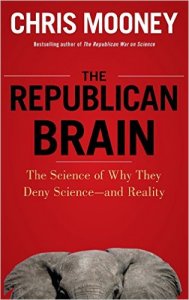
Chris Mooney’s THE REPUBLICAN BRAIN

As I alluded in my previous post, I’ve been reading Chris Mooney’s 2012 book The Republican Brain: The Science of Why They Deny Science — and Reality, which explores how psychology can inform the obvious fact that different people react to political and scientific issues differently, not only based on upbringing or social surroundings. I think the title of this book is unfortunate; surely it must alienate half its potential audience, those (Republicans) who would perceive it as some sort of partisan attack.

In fact, while Mooney acknowledges his own position as a liberal, the book is a fairly balanced, it seems to me. It looks at how variations in human personality traits lead to different takes about the world — these variations being essential parts of humanity’s evolutionary response to the world — and then, secondarily, about how in our present society, those traits being more conservative have become less accurate takes on reality; how conservative ideas about science and reality are more often wrong than those of liberals.

And here I will take an aside to put his ideas into my own broader context:

Keeping in mind that science fiction is, at its essence, the literary response to how change affects the human condition, that it arose over the past 150 years or so as such change became ever more and more rapid, and is becoming increasingly rapid, to the point where nowadays — at least in the prosperous west, though increasingly around the entire globe — new devices and apps appear every few months that potentially change the way we interact with our environment. Who can keep up?

At the same time, humanity evolved over millions of years in situations that were entirely stable, from generation to generation, compared to recent generations. This Chris Mooney book, The Republican Brain, explores the ranges of human personality traits and how they instantiate as moral beliefs and political attitudes. As I suggested in a previous post, surely this range of mental attitudes has a general survival advantage, in the same way any other kind of genetic diversity does: because a monolithic set of genes for any trait or attitude could result in extinction if environmental changes disadvantaged whatever those genes were primed for. Thus, we might suppose, both ‘liberal’ and ‘conservative’ attitudes are presumably essential for the well-being of the human species, across changing environmental circumstances over many many millennia.

But those many millennia were, as I said, relatively stable, unlike the past few thousand years and especially the past century or two. Thus… what might we suspect? Perhaps that the forces of conservatism, which value stability, might have increasing trouble keeping up. And that is my science fictional gloss on my approach to Mooney’s book.

And so, this is what Mooney’s book is bascially about: that conservatives/Republican ideas are more generally at a discord with reality, than liberal/Democratic ideas are.

He spends some time examining specific issues (which he did in an entire previous book), but mainly looks at studies of psychology, that identify key aspects of conservative and liberal mindsets, and how their ideologies satisfy particular psychological needs, aligned along a standard psychological identification of five personality traits — OCEAN: openness to experience, conscientiousness, extraversion, agreeableness, and neuroticism. Thus this book by Mooney echoes the Jonathan Haidt book I read recently, but while Haidt focused on moral intuitions, Mooney focuses on psychological traits. And they are, of course, rather similar.

So conservatism is about (p60)

the resistance to change and the acceptance or rationalization of inequality … Behind it all lays the deep human desire to manage uncertainty and fear, and to do so by finding something certain, stable, and unchanging to believe in and cling to.

While extreme conservatives, ‘authoritarians’,

are very intolerant of ambiguity, and very inclined toward group-think and distrustful of outsiders (often including racial outsiders). They extol traditional values, are very conventional, submit to established leaders, and don’t seem to care much about dissent or civil liberties. They are known for their closed-mindedness, and, indeed, their Manichean view of the world—good and evil, right and wrong, saved and damned, white and black. They have a need for order: Conversely, they can’t tolerate uncertainty. In America, they are often religiously conservative fundamentalists who believe the Bible is the unedited world of God.

In contrast, liberals are driven by a need for understanding, for inclusiveness, thus a need for change — attitudes the columnnist Jonah Goldberg hilariously parodies as “Cowardice and appeasement; comfort with confusion and ignorance; recklessness; indecisiveness and similar cognitive defects; terror mismanagement” (!), comments which echo those by Ann Coulter and Cal Thomas cited earlier (p60-61). It’s extremely revealing to see how conservatives view liberals.

Mooney echoes ideas I’ve seen in many other recent books: that factual arguments don’t convince anyone; that we are all subject to motivated reasoning (with background about the evolution of intuitive vs. reasoning in our minds, and how our later, System 2, minds ‘lawyer’ or rationalize our System 1 intuitive judgements –cf. Haidt); and how science is the method to overcome the reasoning biases of individual minds.

There were a couple ideas new to me. I’ve often thought, and perhaps expressed in this blog, the idea about running elections based upon some objective criteria to voters: ask voters about various specific factual issues, and count votes with accurate responses only. Does the voter know that the Earth revolves around the Sun, vs. vice versa? That kind of thing. Mooney describes a study that addressed this idea, and the result was counter-intuitive: voters with more accurate knowledge were *more* adept at creating arguments to support their [unfactual] views. Mooney calls these “smart idiots.” This underscores our species’ talent for motivated reasoning.

I do have some quibbles about the book overall. Mooney addresses various issues of policy and science, to describe how conservatives are wrong, yet more or less assumes that the expert consensus on these issues is the correct one. I can anticipate conservative responses: the consensus is a liberal conspiracy, and so on. You see this every day, as with Ted Cruz’ recent NPR interview: “Climate change is the perfect pseudoscientific theory for a big government politician who wants more power.”

Motivated reasoning. Today’s Science Friday on NPR had a segment that claimed that climate scientists, if anything, are *under-estimating* the potential damage of climate change, to avoid political repercussions, and how conservatives automatically resist any problem whose solution might involve government action, because government action must always be wrong.

I think Mooney might have more forcefully underscored why he thinks scientific consensus are accurate. (Historical examples, perhaps. Looking to the future, the climate change denials of Cruz and Rubio and all the other Republican candidates for president will live in infamy.)

Mooney does offer some evolutionary perspective — back to the beginning; why are we this way in the first place? p125:

Some thinkers suggest that evolution may have built us to vary in subtle but important ways because a society fares better when it has both “liberal” and also “conservative” tendencies in it. What would the core tendencies be? Something like maintaining order, versus generating innovation. Protecting and serving, versus creating and challenging. Once again, we’re back to the yin-and-yang view of our politics.

Which echoes my going-in position.

Finally, Mooney emphasizes [despite the title] that both conservative and liberal attitudes are essential to the human condition, and suggests what each ‘side’ might learn from the other. Conservatives: pay attention to facts.

And liberals:

  • Liberals should be more loyal to one another; stop, for instance, quibbling about Obama, or about differences among environmental groups [liberals can change! that’s their advantage!];
  • The media should emphasize fact-checking, and abandon the idea of ‘balance’;
  • Liberals should defend reality with *stories* that integrate the best facts and *move people*: “A narrative can change heart and mind alike.”

And finally, finally, the author wonders how does he know he’s right? Because he’s willing to be wrong. “I believe that I am right, but I know that I could be wrong.”

And, “Am I wrong about any of this? If so, you will have to show me where. I will strive to listen.”

And that is my position too.

Posted in Book Notes, Changing One's Mind, Conservative Resistance, Culture, Evolution, Politics | Comments Off on Chris Mooney’s THE REPUBLICAN BRAIN

Links and Comments from Sunday’s New York Times

I’m finishing up a book by Chris Mooney that explores motivated reasoning and how we are all subject to seeking out evidence that confirms our pre-existing views, and disputing evidence that challenges those views. And that nevertheless claims that conservatives/Republicans are far more wrong about basic matters of reality than are liberals/Democrats, and explains why this might be so. (It’s about psychology, in ways analogous to the issues explored in the Jonathan Haidt book.)

More evidence that this is so: All Politicians Lie. Some Lie More Than Others.

With a revealing graph showing results from PolitiFact rating statements from various presidential candidates since 2007, with Carson and Trump and Cruz rating worst, Obama and O’Malley and Clinton rating best.

The issue is perhaps whether voters care about what is true, or whether they care more about candidates who endorse their own version of reality.

And then there is the column by Nicholas Kristof, Take My Quiz on Religion (online title “How Well Do You Know Religion?”), a multiple-choice test about which various scriptural statements are derived from the Bible, the Quran, both, or something else.

HIs trivial point is that various statements of ancient morality come more or less equally from both — there’s nothing from the Quran especially more vile than many things from the Bible. To a disinterested religious observer such as myself, this simply means all these ancient texts are best viewed as anthropological artifacts, nothing more, remnants of earlier, primitive, unenlightened cultures. Examine them if you must, then grow up, move on, engage the real world.

Jerry Coyne finds Kristof’s piece a bit more insidious: Kristof osculates all faiths, avers that they’re equally wonderful. As if, since both holy books contain awful things, but that both also include good things, Islam is therefore just as good as Christianity and Judaism.

But at the risk of being accused of Islamophobia (as Coyne, and Sam Harris, are), Coyne observes this.

Of course there’s some [Christian] intolerance in America. But compare it to Iran, ISIS-controlled Iraq, Afghanistan, or Saudi Arabia. We don’t behead criminals, we don’t kill blasphemers, we don’t stone adulterers or throw gays off roofs, we don’t prohibit women from driving, we don’t have a religious system of law (one that gives women half the say of men), and we allow Muslims to be citizens (Saudi Arabia doesn’t grant that privilege to non-Muslims).

Maybe some religions really are worse than others.

And this leads to Ross Douthat’s column — on the same page as Kristof’s! — called The Islamic Dilemma. Douthat is one of a couple three conservative columnists at NYT, along with David Brooks; NYT isn’t entirely a liberal bastion. Douthat, is seems to me, is always finding ways to excuse religion, especially Christianity, from whatever offenses it commits in public life, or discordances from reality it exhibits. In this column he is exploring how Islam might possibly accommodate itself to a modern, pluralistic society, without changing so utterly as to become extinct.

Devout Muslims watching current Western debates, for instance, might notice that some of the same cosmopolitan liberals who think of themselves as Benevolent Foes of Islamophobia are also convinced that many conservative Christians are dangerous crypto-theocrats whose institutions and liberties must give way whenever they conflict with liberalism’s vision of enlightenment.

They also might notice that many of the same conservative Christians who fear that Islam is incompatible with democracy are wrestling with whether their own faith is compatible with the direction of modern liberalism, or whether Christianity needs to enter a kind of internal exile in the West.

(Note the link — the idea that religious communities can seal themselves off from the pluralistic, progressive world.)

The whole essay is worth reading, because it’s about how religious communities, especially those adhering to authoritative holy books, can or cannot survive in a world where all these communities are coming into irreversible contact with conflicting communities, and will have to learn how to live together, in the face of a reality so many of them deny.

Posted in Politics, Religion, Social Progress, Thinking | Comments Off on Links and Comments from Sunday’s New York Times

Spotlight

We saw Spotlight on Sunday, a film about the 2001 Boston Globe investigation into child abuse within the Catholic Church in that city, a film that just ranked #1 on the best movies of the year lists in both Time and Entertainment Weekly (you can see how a film about the importance of journalists are might appeal to journalist film critics). It’s very good, in a reporter-procedural sort of way (a comparison to All the President’s Men is not inappropriate), as a ‘Spotlight’ team of four reporters at that paper follow a story about a single incident of molestation into a much bigger story, in particular one with many priests more involved — 13? 90? — and how the abuse was known, and suppressed, by the highest levels of church authority, not just for a few years, but for decades. It stars a quirky Michael Keaton, a passionate Mark Ruffalo, and a subdued Liev Schreiber, and character roles by Stanley Tucci and Billy Crudup, among others (John Slattery from Mad Men).

The film shows a bit a standard plot structure, with turns of events the keep delaying the publication of the big story, but I especially appreciate that, despite a recurrent issue about earlier evidence sent to the paper that produced no response, the plot never devolves into what you keep thinking might be about good reporters vs biased reporters. On the contrary that issue resolves in a prosaically passive way, a way I suspect many of us can appreciate in the way we perform our jobs very well most of the time, not so well other times.

\\

Two or three more comments:

First, how the Mark Ruffalo character mentions that his investigations suggest that these priests don’t target boys because the priests are gay… but because boys are more shamed, and thus less likely to tell anyone, about their abuse. [This of course counters the right-wing defense of Catholic abuse as somehow being all about gays.]

Second, there is a creepy scene in which one of the Spotlight reporters confronts one of the priests at his front door, where the priest cheerfully admits what he’s done, about abusing young boys — but says, twice, as if it is very important, that he himself got no satisfaction from those events …and also mentions, offhand as if it is not necessarily relevant, that he himself had been ‘raped’ as a child. The film doesn’t have time to follow up or explore these comments, but it does suggest that the psychology behind all these incidents is not so simple as we might think.

And third, the film does mention the Catholic practice of celibacy as being a major culprit, though only once.

\\

Finally, I’m thinking this entire theme is an example of how society is moving from various levels of tribal allegiances, to the recognition and validation of individual human potential. In this case, the importance of deflecting criticisms of the Catholic Church, despite the harm caused to numerous individuals, because of the value of the Church overall. A point made more than once by various characters in this film. If there’s a trend in recent social history, at least in Western cultures, it seems to be about the value of the individual, in spite of social and religious institutions.

Posted in Movies | Comments Off on Spotlight