The Bay Area and the California Dream

It’s been especially lovely here in the Bay Area all this past week, with mild temperatures around 68 or 70 F (though a bit warmer in the Oakland Hills where we are), and sunny warm skies decorated with big fluffy white clouds, a kind of atmosphere rarely seen in SoCal, where I’ve lived virtually my entire life until 9 months ago.

I’ve also noticed the effect of living farther north, and farther west in the same time zone, as Los Angeles: the daylight is shorter, and in particular the sun rises later in the mornings. Yeong and I are up weekdays at 5:30, and in recent weeks it’s still pitch dark at even 7 a.m. This will change now that we’re off Daylight Savings Time, as of today.

These days I listen to KQED weekday mornings, in particular Michael Krasny’s 2-hour “Forum” program, which gets nation-wide exposure, judging from the callers they get from across the country. Last Tuesday there was an hour about how a Bay Area Writer Laments His Fading California Dream, about Daniel Duane, who had published an opinion piece in the New York Times, My Dark California Dream, the weekend before, on October 24th. Duane lives in ‘the city’, San Francisco, and was writing about the excessive real estate prices not just in the city but around the Bay Area, and about his perception of the how the drought in California, and the effect of climate change, has affected his annual visits to Yosemite and the Sierras, where the meadows have dried up and the wildflowers have vanished.

Since Duane lives in the city and loves it, he was not condemning the city, or California; he was just addressing issues that have made this area less than the ideal he grew up with. But what was remarkable about the callers in to that show on Tuesday was how so many of them repeated the theme: yes, there are problems, but this is still the greatest city and environment to live in, anywhere in the US, and they would not live anywhere else. The landscape, the culture, the diversity, the weather.

Yeong and I had difficulties finding a reasonable place to live, given real estate prices and commuting issues. But especially after hearing this feedback — and other programs on this same radio show about real estate issues in ‘the city’ — I think we were very lucky to have ended up where we are.

Yesterday we shopped, at the ethnic Asian shops north of Berkeley, and Costco, and the AT&T store, and a stop at BMW for motor oil — everything so close — with dinner later at Bourban and Beef on College Street, with bourban flights and my favorite cocktail, the Aviation. Today, a hike into a previously unexplored corner of Joaquin Miller Park, around Sequoia Arena, among the deep dark woods, only a couple miles from our house.

And just now: another gorgeous sunset.

Posted in Personal history | Comments Off on The Bay Area and the California Dream

Infrastructure: New Pages

Have initialized pages under ‘Provisional Conclusions’ for Links and Comments and Science Fictional Illustrations and Examples. Mostly outlines for now, to be filled in over coming weeks and months.

Posted in Website Issues | Comments Off on Infrastructure: New Pages

Links and Comments: Zuckerman on religion and violence; Islamic intolerance

From today’s Los Angeles Times, an op-ed by Phil Zuckerman, Think religion makes society less violent? Think again.

This echoes his book of last year, Living the Secular Life, which I blogged about here. The point in this essay is relevant to current politics — again, how the right wing, especially the religious zealots like Huckabee and Fox host Bill O’Reilly, imply that mass shootings in America are the result of increasing secularism. The evidence is otherwise — but again, as discussed in my previous post, the right-wing adheres to ideology and actively ignores and resists evidence. Zuckerman:

If it were true that when belief in God weakens, societal well-being diminishes, then we should see abundant evidence for this. But we don’t. In fact, we find just the opposite: Those societies today that are the most religious — where faith in God is strong and religious participation is high — tend to have the highest violent crime rates, while those societies in which faith and church attendance are the weakest — the most secular societies — tend to have the lowest.

With examples about countries around the world, and states within the US, that show increased religiosity aligns with increased crime-rates and matters like child-abuse, and vice versa.

What about within the United States? According to the latest study from the Pew Research Center, the 10 states that report the highest levels of belief in God are Louisiana, Arkansas, Alabama, Mississippi, Georgia, South Carolina, North Carolina, Kentucky, Tennessee and Oklahoma (tied with Utah). The 10 states with the lowest levels of belief in God are Maine, Vermont, Connecticut, Rhode Island, New Hampshire, Massachusetts, New York, Alaska, Oregon and California. And as is the case in the rest of the world, when it comes to nearly all standard measures of societal health, including homicide rates, the least theistic states generally fare much better than the most theistic. Consider child-abuse fatality rates: Highly religious Mississippi’s is twice that of highly secular New Hampshire’s, and highly religious Kentucky’s is four times higher than highly secular Oregon’s.

Of course, you can debate correlation vs. causation. But which ever way it works, how can you conclude anything positive about religious belief..? Whether effect or cause, it’s a bad sign, one humanity will, hopefully, outgrow.

\\

And in other news: New York Times: 2 Men Who Published Writings Critical of Extremism Are Stabbed in Bangladesh.

Religious (Islamic) extremists murdered two publishers for publishing work by a writer earlier murdered, all for accusing religious extremists of being intolerant religious extremists.

Posted in Conservative Resistance, Religion | Comments Off on Links and Comments: Zuckerman on religion and violence; Islamic intolerance

Links and Comments: This Week’s American Politics; … Heinlein

This has been a bizarre week, what with the third debate among Republican presidential candidates, and the reactions from the red-meat base and, on the other side, the intelligentsia who rolled their eyes about all the lies and distortion those candidates get away with — to the approval of the crowd.

I’ll echo, without being able to provide a link, a characterization of Ben Carson: he is single-handedly destroying the world’s ability to use “brain surgeon” as shorthand for “smart person”.

Among many of his remarks: Holy Crap: Ben Carson thinks our tax system should be based on the Bible. He clearly hasn’t read it very closely.

The events this week demonstrate this premise: For every complex problem there is an answer that is clear, simple, and wrong. — H.L. Mencken. The conservative, Republican, base seems to like simple solutions to complex problems — cut taxes! reduce the deficit! deport the immigrants! — despite the analyses from patient experts (e.g. Paul Krugman) who again and again keep explaining why these simple solutions are wrong, will backfire if implemented, and provide evidence — e.g. about the austerity policies of Greece, and Kansas, to take just one example.

As always in this blog, I don’t mean to make this simply about politics; my interest is about general principles. What is it about conservative vs liberal politics, that reflects general perceptions of human beings of the world? How is it that variant perceptions of reality reach such different conclusions? Is it because (as I suspect in some circumstances) mass delusions actually promote cohesion and survival of large groups, and understanding of the reality behind the delusions is irrelevant?

Yet for now, some links and comments from this past week.

Slate: Reality Sucks: Leading GOP candidates aren’t at war with the press. They just have a problem with the truth.

What happened in this debate wasn’t an attack by the press on the candidates. It was an attack by the candidates on the press. Harwood, Quick, and the other CNBC panelists were no harsher to the Republicans on Wednesday than CNN’s Anderson Cooper was to Clinton and other Democrats in their debate two weeks ago. What was different this time was the reaction. Presented with facts and figures that didn’t fit their story, the leading Republican candidates accused the moderators of malice and deceit.

\\

Slate: Scary Politics: Americans are scared about a lot of things—especially the government itself.

\\

Salon: Their lips are moving. They’re lying: Ben Carson, Rand Paul and the right-wing’s truthiness problem

\\

A general theme is that conservative politicians play to their base by denying any kind of science that would offend religious sensibilities (i.e. evolution) or business priorities… because they are playing to their base, and because they are financed by billionaires who deny any science that would threaten their profits. (That is, obviously, anyone who is invested in drilling for oil, or natural gas, or fracking.)

Slate: Neil deGrasse Tyson identifies this problem in which political candidates pander to voters — and says the voters themselves are the problem; without them the candidates would not need to pander to them.

\\

And part of all this, perhaps a more significant part than I’d thought, is, at Salon: The GOP primary’s theocratic X-factor: Inside the twisted worldview and junk history of David Barton.

Barton’s “history” has been repeatedly rebutted by academics and even conservative Christian scholars. His publisher withdrew his book on Jefferson when it was revealed to be made up from whole cloth. But none of that matters to the right wing true believers. His founding myth is much more comfortable for them than all that crazy Enlightenment stuff about reason and progress and rational inquisition that informed the real American revolution.


There is no doubt that Mike Huckabee admires him greatly, that Glenn Beck promotes him constantly, that he is the source of much of Ben Carson’s wild misinformation (whether directly or though Beck and other sources), and that he is very intimately involved with Ted Cruz’s campaign. If you wonder where these presidential candidates, and a good number of GOP politicians at all levels, have come up with this surreal alternative history that bears no relationship to reality, look no further than David Barton. He is the most influential right wing crackpot in American politics today. And that’s saying something.

Again: His founding myth is much more comfortable for them than all that crazy Enlightenment stuff about reason and progress and rational inquisition that informed the real American revolution. My latest provisional conclusion, not quite captured in my posted list, is that human culture is mostly about tribes, and allegiance to tribes. It’s not about perception or acceptance of reality. But allegiance to tribes is, ironically, what keeps the race going.

\\

Bottom line: Jeffrey Tayler at Salon: They really want a theocracy: The GOP candidates who want to make you bow to their lord.

Carson, Cruz, Huckabee. Scary.

And, almost incidentally, given my recent reading, this is where current American politics echo the stories of Robert A. Heinlein, who fully *75 years ago* wrote stories about a theological revolution that took over the US — reflected in his early short novel “If This Goes On–” — with the implication that this tendency in American culture toward religious fundamentalism has been here all along. I’ll have another post about Heinlein in particular, shortly.

Posted in Conservative Resistance, Heinlein, Lunacy, Politics | Comments Off on Links and Comments: This Week’s American Politics; … Heinlein

Rereading Early Heinlein, part 1

I reread three early Heinlein volumes in the past few weeks, and as with my Asimov rereads, these were revisits to stories I first read some 30 or 40 years ago, and mostly have not read since. Both Asimov’s and Heinlein’s stories had implicit “future history” over-arching narratives, which greatly influenced or at least informed later SF, as Donald A. Wollheim explained about Asimov in his book The Universe Makers, which I summarized here.

I was triggered to explore Heinlein again because of his early story “Universe”. (Asimov’s robot stories => Harlan Ellison’s “I, Robot” script => Harlan Ellison’s other scripts, including “Phoenix without Ashes” => other stories about the idea of a “generation ship” in which its inhabitants do not realize they are living in an isolated world => the daddy of all such stories, Heinlein’s “Universe”.) And its theme’s relevance to my current thinking.

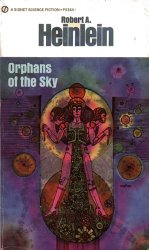
I reread the volume The Man Who Sold the Moon about 3 years ago — but before I had formulated my “Provisional Conclusions”, which are now channeling and informing my thinking, providing perspectives about what older stories mean today and might have meant then — and just reread volumes Orphans in the Sky, The Green Hills of Earth, and Revolt in 2011 in recent weeks. (I do not own first editions of those volumes; my collection consists of a set of a full dozen Heinlein titles published by Signet in the late ’60s and early ’70s, with very cool, abstract, cover paintings by Gene Szafran, as shown here.)

First of all, it’s extraordinary to look back at the bibliographic history of Heinlein’s and Asimov’s early stories. They both began publishing in 1939, as did other writers who became associated with John W. Campbell’s Astounding magazine, and they are principle reasons why in retrospect 1939 is identified as the beginning of the “Golden Age” of science fiction, when standards were raised in the field as it moved beyond its pulpish past. Asimov published a couple stories elsewhere before he cracked Astounding in July 1939 with “Trends”; Heinlein’s first published story, “Life-Line”, appeared there in August 1939.

I think it’s fair to say that Heinlein was by far the more mature writer, from the very beginning. As I’ve said, Asimov’s were often simply puzzle stories. Heinlein’s stories, in contrast, exhibited a familiarity with the real world, an understanding of politics and psychology, that surpassed Asimov’s perception.

Heinlein struck swiftly, producing some two dozen stories from 1939 to 1942, including many eventual classics, from “The Roads Must Roll” and “And He Built a Crooked House” to “Universe” and “By His Bootstraps” and “Waldo” and “The Unpleasant Profession of Jonathan Hoag”, before he was distracted by service in World War II and published nothing for the subsequent five years. While there have been similar blazing debut streaks by authors over succeeding decades – Larry Niven in the late 1960s, John Varley in the mid-1970s, William Gibson in the mid-1980s – I doubt that anyone’s record has matched Heinlein’s for quality and scope in so short a time.

Orphans of the Sky is the book form of two novellas from that early period, “Universe” and “Common Sense”, published five months apart, in May and October 1941; they weren’t published as installments of a serial, though they might as well have been. The book version wasn’t published until 1963! In contrast, among Heinlein’s earliest book publications were three from Shasta Press, a fan outfit: The Man Who Sold the Moon in 1950, The Green Hills of Earth in 1951, and Revolt in 2011 in 1953. (It’s odd how this last title is left out of some bibliographies, including the list of Books and Stories at the Heinlein Concordance (!), as if it were somehow illegitimate, while the central big story in that book, which was published as a serial in the February and March issues of Astounding, “If This Goes On—“, *is* included, though as far as I can tell that short novel has never been published in a separate book form.) These three books were compiled as forming the core of Heinlein’s “Future History”, diagrammed on a chart in the second and third volumes, which ranged from the earliest exploration of space, to a reactionary period dominated by religious zealots, to a revolution that led to the first colonization ships to the stars.

The novella “Universe” and its book completion Orphans of the Sky was the first major canonical story about what has become known as the enclosed universe version of the generation starship. That is, a way to send human colonists to other stars, without magical warp drives. The trip takes so long that you build an enormous starships with a livable environments inside, and the trip takes so long that generations pass aboard ship before it reaches its destination. (A durable theme – this year’s Kim Stanley Robinson novel, Aurora, is the latest consideration.) The consequence that Heinlein, and later SF writers, perceived was that after so much time, the inhabitants of the ship might forget their original mission, or even the idea that they’re on a ship, and instead, as each new generation is raised, assume that the reality of the shipboard life consists of the entire known universe.

(This is one prominent example of my Provisional Conclusion #2 — that for any of a number of reasons, you can’t count on ordinary human perception of reality, e.g. “common sense”, to be an accurate take on what is real.)

Heinlein’s “Universe” concerns inhabitants of such a starship. The story is crafty in that it indicates early on to the reader that the characters are in some kind of environment that is unlike ordinary planetary life – in the first couple pages, our hero Hugh “settles slowly” to the deck, and as he and his pals descend decks, they get heavier. They think nothing of it; but we understand what this means – that they are in a ship that is spinning to produce an artificial gravity.

The plot of “Universe” involves our hero Hugh climbing to the upper decks to contact the “muties” (a term we come to understand is short for both mutants and mutineers) who live near the center of the ship where artificial gravity drops to nothing; being shown the reality of the outside universe, outside the ship; and then returning to the lower decks to try to convince others that the conventional wisdom of their culture is a lie. The sequel, “Common Sense”, ironically employs that phrase to defend the common assumptions about what people on the lower decks assume is real, until a small band of rebels, including Hugh, escape the ship in order to complete its original mission: to colonize the planet that the ship was intended to reach.

There are two striking parallels between this story and a couple stories by Isaac Asimov: “Nightfall”, published in Astounding in September 1941, and “Reason”, the early robot story, published in Astounding in April 1941 – both so contemporaneous with Heinlein’s two stories, given lead times between submission and publications for any stories in that era (or even now), that it can’t be anything but coincidence… or perhaps, the influence of earlier forgotten stories that are lost to time.

First, both stories employ the idea that ancient truths, lost to the current generation, have been preserved in religious texts. Both stories, in fact, quote large passages of such texts! Asimov and Heinlein portray this situation differently. In Asimov’s story, the religious zealot strongly objects to any new evidence that might provide substantiation to the ancient narratives – because to provide evidence would be to remove the need for faith! In Heinlein’s story, an elder to Hugh calmly explains that the ancient texts [physics textbooks!] can’t be understood in any literal sense, but only metaphorically – in a bizarre passage about how the idea of “gravity” is only a poetic metaphor about romantic love (!).

Second, the passage in Heinlein’s “Common Sense”, in which Narby dismisses his vision of pinpoints of light visible outside the ship, is almost identical to the explanation by the creationist robot ‘Cutie’ in Asimov’s “Reason” (which I blogged about in detail here). Mere illusions, pinpoints of light on a black velvet background.

Will continue on next post. The stories in The Green Hills of Earth, and how “If This Goes On—“ (in Revolt in 2100) eerily presages current American politics.

Posted in Heinlein, Provisional Conclusions, science fiction | Comments Off on Rereading Early Heinlein, part 1

Links and Comments from Today’s New York Times: 25 Oct 2015

You can’t escape human nature: Norway Has a New Passion: Ghost Hunting.

As traditional religion has faded in many northern European nations, it’s being replaced in Norway by an increased tendency to perceive ghosts at every corner.

Ghosts, or at least belief in them, have been around for centuries but they have now found a particularly strong following in highly secular modern countries like Norway, places that are otherwise in the vanguard of what was once seen as Europe’s inexorable, science-led march away from superstition and religion.

While churches here may be largely empty and belief in God, according to opinion polls, in steady decline, belief in, or at least fascination with, ghosts and spirits is surging. Even Norway’s royal family, which is required by law to belong to the Evangelical Lutheran Church, has flirted with ghosts, with a princess coaching people on how to reach out to spirits.

And

Arild Romarheim, a Lutheran priest and recently retired theology lecturer, described the conviction of well-educated atheists and agnostics that ghosts exist as “the paradox of modernity” — a revival of old beliefs to slake an innate human thirst for a spiritual life left unsatisfied by the decline of the church.

This “thirst for a spiritual life” is, I think, an artifact for the way the human mind has evolved to perceive the universe in its own terms, not necessarily favoring reality of the actual universe: see the Jesse Bering book linked at Provisional Conclusions: Resources & Bibliography. And this is why I suppose religion and/or superstition, in one fashion or another, will never be completely overcome (despite Arthur C. Clarke, alas).

\\

Frank Bruni on What Family Really Means. He addresses recent debates within the Catholic Church, which like most faiths, is mostly behoven to standards set in holy books written by ancient tribes in eras when life was relatively short and savage, and tribal. If you think about it and twist your mind a bit, you can come to understand the motivations behind all those Old Testament rules about killing brides who were not virgins and men marrying their brother’s widows and masturbation and not wearing certain kinds of clothes as well as, by the way, condemning men who slept with men. Because in those days, it was all about doing everything to maintain the viability of the tribe, which would be endangered by any activity that threatened individual survival or did not promote the expansion of the tribe. (These motives are all understood as very basic evolutionary strategies, given those circumstances, though of course this understanding would be ironically and stoutly denied by the adherents to those religions who think human beings as special creations of a god and not subject to the natural selection forces that inevitably affect everything else in the universe.)

And yet, here is natural selection at work in one of the largest religions on Earth: if the Catholic Church does not change and adapt to modern times (when human life is not so short and savage, if perhaps just as tribal, as it was three thousand years ago), it will continue to fade, and eventually die. Natural selection will choose a modified version of that church to survive, and not the one that has condemned so many (to an imaginary Hell) according to those ancient proscriptions.

And so the current Pope is floating some changes, about divorce and cohabitation and single parenting. Many in the church, especially in Africa (the region of the world most radically opposed to gay rights), resist.

Bruni’s column is a poignant description of ‘families’ he’s know that do not fit the parameters of the traditional Catholic church. As he says,

I’m more impressed by families who are bound by choice rather than blood. For all that I’ve learned about family around my own Thanksgiving table, I’ve learned as much by watching people without dependable parents, caring siblings or nurturing spouses forge clans of a different kind.

I saw this happen time and again in the 1980s and early 1990s, when AIDS ravaged gay America and many sufferers found themselves abandoned by relatives, whose religions prodded them toward judgment instead of compassion. Friends filled that gap, rushing in as saviors, stepping up as providers, signing on as protectors. Where families were absent, families were born.

\\

The latest assault against reason is the resistance to GMOs, genetically modified organisms, which, perhaps ironically, is even more prevalent in Europe than in the US.

With G.M.O. Policies, Europe Turns Against Science

Without a trace of embarrassment, a spokeswoman for Nicola Sturgeon, the leader of the Scottish National Party, admitted that the first minister’s science adviser had not been consulted because the decision “wasn’t based on scientific evidence.” Instead, the priority was to protect the “clean green image” of the country’s produce, according to the secretary for rural affairs, food and environment.

“The worldwide scientific consensus on the safety of genetic engineering is as solid as that which underpins human-caused global warming. Yet this inconvenient truth on G.M.O.s — that they’re as safe as conventionally cultivated food — is ignored when ideological interests are threatened.” (My bold.)

(As an aside, not discussed here, is the issue about bananas, which some religious morons claim as evidence of God, for the banana’s supposed ideal design for human consumption; in fact, bananas have been modified over millennia by human beings into what we recognize today; here’s a link that displays what wild bananas were like before human selection intervened.)

Back to the article, which discusses, again, Africa, which promotes wild conspiracy theories about the dangers of GMOs: a crony to Zimbabwe president Robert Mugabe claims that “sexual dysfunction is a huge problem in the U.S.A., where males become impotent around the age of 24, at the prime of life” and this is due to GMO foods; and an incident in which the author talked with someone in Tanzania who claims biotech crops would turn his children homosexual [which of course would be a *bad* *thing*].

I think that this is evidence for my general conclusion that science denial is not about consideration of evidence and reaching conclusions that challenge some orthodoxy — it’s about adherence to tribal allegiances. Anything can be denied, at least in public, in order to be straight with your neighbors and social groups, those whom you depend on for day to day life. It’s human nature, and how that differs from the understanding of scientific reality.

\\

Finally, fascinated by ‘NPR Voice’ Has Taken Over the Airwaves. Ira Glass, the whole All Things Considered and Morning Edition staff, Terri Gross (whom these days I listen to almost every weekday).

So different from the tone of anger and outrage that typifies the right-wing media.

And brought to mind classic narrators. Rod Serling, mentioned here. And maybe my favorite: Vic Perrin’s “Control Voice” from the early ’60s anthology show The Outer Limits.

You are about to participate in a great adventure. You are about to experience the awe and mystery which reaches from the inner mind to — The Outer Limits.

Posted in Conservative Resistance, Culture, Evolution, Narrative, Religion, Science | Comments Off on Links and Comments from Today’s New York Times: 25 Oct 2015

Philip Glass: Naqoyqatsi: Religion

Best, most thrilling track from the 2002 score by Philip Glass of Godfrey Reggio’s film Naqoyqatsi, with cello by Yo-Yo Ma. Keep listening. It really kicks in around 5:00 — the contrast between those rising arpeggios, rhythmically erratic — one two three, one two three, one two three four one two three four — and then repeating, in contrast to the casual thump thump of the brass.

Something ineffable yet uplifting. For all that Glass is described as ‘minimalist’ for his repetitive structures, his over-arching themes are as gorgeous and compelling as anything by Puccini, say. His music is the combination of contrasts: the ‘minimalist’ arpeggios (which are really just torn apart chords) in service of relatively basic, traditional, melodic progressions.

Somehow, via Locus Online status, I got an invite to a prescreening of this film back in 2002, at the Hollywood Egyptian Theater, and Yeong and I attended.

https://en.wikipedia.org/wiki/Naqoyqatsi

http://egyptiantheatre.com/egyptian/egypt.htm

Posted in Movies, Music | Comments Off on Philip Glass: Naqoyqatsi: Religion

Sfadb progress

On an entirely different note from the past couple posts — I am back into production on SFADB.com to add additional Citations and Anthology reprints, as has been planned for years. Most of the citation records from various sources were compiled a full 10 years ago, and have been awaiting the transition of the site from SF Awards on locusmag.com to the newer site sfadb.com, and more recently the tedious task of verifying publication data about all the titles implicated by all those sources, i.e. at a minimum the year of first publication, and whenever possible the country and publisher of first publication. I’ve ameliorated this latter task by posting citation records in phases — for half a dozen of the largest sources, only the highest ranked citations first (Clute, Barron, Gunn) deferring the lower ranked citations for later, since they entail additional work to track down publication data.

Still, I do think I will have most of the contemplated content of the site, at least a minimal set, posted by the end of this year, as promised on the sfadb.com homepage. And that will include populating the two blank menu tabs at the top.

Posted in Website Issues | Comments Off on Sfadb progress

Contemplating a Lost in Space Rewatch

So I’m contemplated a “Lost in Space” rewatch – at least as much a rewatch as I can bear. The show greatly affected me when I first saw it at age 10 (it debuted in 1965, a year before Star Trek), but the show changed greatly in its second and third seasons, given to the camp nature of popular shows like “Batman” in its second, and then erratically trying to reclaim an action/adventure format in its third (in reaction to Star Trek, perhaps).

As I mentioned in my Jonny Quest post, I likely did not see many of these episodes when first broadcast on network TV, but only later, in syndication, and so only in abridged versions that were cut to allow additional commercial time. In fact, I didn’t discover the series in the first place, back in the Fall of 1965, until nearly half-way through that first season – so I never saw the origin story of the Jupiter 2 and how they got ‘lost in space’ in the earliest episodes until years later, in the early ‘70s, when I saw reruns on one of the local TV stations. Later in the ‘80s, once I had a VCR, I recorded late-late-night broadcasts of LIS episodes from another local LA station, though if I understand my checklist from that era, there were four or five episodes never included in those broadcasts…

More recently, a few years ago, I bought a DVD set of the first season of LIS, but have never watched more than the first half dozen episodes before now. So it’s fair to conclude that many, if not most, of the episodes following those early ones, I’ve never seen in their entirety.

On the other hand, I’m not sure I’ll care to, once I begin. The first season, though in black and white, was mostly a serious sci-fi [I’m using that otherwise detestable abbreviation advisedly] action/adventure show, roughly as plausible and serious as most sci fi [again] movies of the 1950s – which is to say, not all that plausible at all, to anyone who knew science and the reality of our place in the universe, but possessing a certain charm and often providing touches of genuine weirdness, of sense of wonder – just the mind-expanding thing to impress a 10-year-old. I think some of that survives the adult perspective, which is what I want to explore. The second season of LIS grew unbearably silly, and I doubt I’ll have the patience to sit through all of those episodes. The show recovered somewhat in the third season (again, feeling its rival Star Trek, I think), but only intermittently. Perhaps I’ll jump around and rewatch only certain episodes.

Before I’ve even rewatched the first episode, I have two themes to keep in mind as I look at this show again.

First, to recognize how the story and its many incidents are absurd and implausible – to this point: what do these assumptions, so often in error, imply about how telling a story about exploring space reveals the biases of the human mind about how it perceives the universe?

Second, to identify, as alluded above, those occasional incidents in the show that truly suggest weirdness, or sense of wonder, even if only what would impress a 10-year-old. They were there, and it’s those moments I want to revisit again, and try to understand from an adult perspective.

In a sense which I have yet to explain, this is all about Apple Valley.

Posted in Personal history, TV Sci Fi | Comments Off on Contemplating a Lost in Space Rewatch

Sundry Links and Comments

» A Publishers Weekly review of a book about expanding human perception: We Have the Technology: How Biohackers, Foodies, Physicians, and Scientists Are Transforming Human Perception, One Sense at a Time, Kara Platoni, Author

This is a superb account of human perception and the first, clunky but potentially breathtaking efforts to expand it.

PvC #2: there is almost certainly more to the universe than what people commonly perceive. But not in any way that appeals to human nature.

\\

A nice Jerry Coyne quote in this post

The world I want is one in which the strength of one’s beliefs about matters of fact is proportional to the evidence. It is a world where it is okay to reserve judgment if one doesn’t know the answer, and where it’s not seen as offensive to doubt the claims of others.

\\

Brain researchers show that using “transcranial magnetic stimulation,” to tweak the posterior medial frontal cortex of subjects’ brains, the result is to reduce “both belief in God and prejudice towards immigrants.”. In other words, belief and prejudice are things going on in certain minds, not something about the real universe.

\\

The term “politically incorrect” is way overused – as an excuse for any kind of bad behavior.
Herb Silverman in Huffington Post:

Some Republican presidential candidates have generalized “politically incorrect” to justify any bad behavior, which includes stereotyping, offensive comments, scientific ignorance, and refusal to answer difficult questions. Some proudly consider themselves politically incorrect because they would not vote for a Muslim, or because they don’t believe in scientific theories like evolution and climate change. Since when did rejecting the overwhelming consensus of scientists around the globe become a proud politically incorrect position? I suppose I’m politically correct because I like to make evidence-based and reality-based decisions.

Posted in MInd, Provisional Conclusions, Religion, Science | Comments Off on Sundry Links and Comments