Progressives and Regressives

The passage cited in the previous post reminded me of a Facebook post from Robert Reich, several weeks ago, which I managed to track down via Google and capture here for my reference.

Why is it that most progressives live in cities and on the coasts where there are major ports, while most regressives live in rural areas far removed from the nation’s major ports and cities? The same pattern holds in other nations and regions of the world. Historically, fascist movements have begun inland; liberal movements, around major seaports and cities. It’s probably because major ports and cities are far more exposed to the rest of the world, and to a diverse range of people and a broad range of ideas, while rural inland areas are more homogeneous and insular. America’s regressives — trying to stop abortions, prevent gay marriages, keep their guns, hold back immigration, militarize the border, limit voting rights, prevent the teaching of evolution, deny climate change, tear down the wall between church and state, and cut safety nets — reflect the values and views of those who are cut off from the realities of the 21st century. Our problem is they have disproportionate political power, and are determined to hold onto it as long as they can.

This verges on caricature; yet. The reason folks who live in rural areas tend to be ‘homogenous and insular’ is because the kids who grow up there — I’m especially thinking of the kids who realize at some some point they are gay — [this is not something they can control, something that is ageless throughout human culture, though this is a topic for another post] — tend to *move away* from those small town places, to the big cities. This is a long-recognized pattern. Thus the big cities become more diverse, and the small towns they left remain homogeneous, and insular.

A similar effect explains why journalists and university professors and show biz folks are more progressive. Partly first, because they are exposed to more diverse types of people and necessarily shed their prejudices about anyone who is different from themselves. And second, frankly, it’s because journalists and university professors are more informed about the world around them, not just within their specialties. The reason most journalists are liberal is because they know more about the world than most of their readers. The reason most university professors are liberal is because they know more about the world than the conservatives who, thinking they already have the answers to everything through their religion, don’t go to those universities in the first place. 😉 Or only go to ‘universities’ that exist to confirm their religious convictions — Christian universities — without challenging anything they might already think or believe… which deny, I would think, what universities should really be about.
Posted in Culture, Quote at Length | Comments Off on Progressives and Regressives

Conservatives and Liberals, and why we need both

I came across new blog on the vast Patheos website, Science on Religion, and this post by one Connor Wood, a PhD student at Boston University in religion and science, a post called Calling an End to the Culture Wars, which in turn links to his essay at CivilPolitics.org, from which I quote…

Conservatives are, for my purposes, people who exist close to the heart of a traditional culture, whatever that culture is. They tend to be invested in religion, because religion is another way of saying culture. They are not bigots per se, but they tend to distrust or act coolly toward those who live beyond the warm bubbles of their own traditions. Tribal beings, they are cocooned in worlds of constructed social meaning: culture.

Liberals, in contrast, are those who dwell at the flickering edges of their cultures, in the strange and eerie space between the spheres of the world’s traditions, religions, belief systems. They tend to be cosmopolitan, to live in places where many different cultures rub up against one another daily. Because of this exposure, liberals have perceptive, even burdensome insight into how each culture is flawed and deluded in its own, often very serious, way, and so they cannot allow themselves to buy into any of them wholesale. From a liberal perspective, to belong to a culture unthinkingly means to accept that culture’s injustices and stupid horrors: to grin blithely at the binding of women’s feet and the redlining of black neighborhoods. And so the liberal can never fully trust human culture. She is destined to live just at its peripheries, in the weird interstices between worlds.

Conservatives are microscopes. Liberals are macroscopes.

But conservatives, reliably, are happier.

The difficulty with being a progressive, radical, or liberal is that the scale of the world is far larger than a woman or man can ever be. There is a basic mismatch between the aspirations and dilemmas of liberal-leaning people and their meager status as individual, warm-blooded mammals who must live in family and tribe.

Posted in Culture, Quote at Length, Religion | Comments Off on Conservatives and Liberals, and why we need both

Frederik Pohl

I’m not sure it’s generally appreciated the extent to which Frederik Pohl underwent a sea change in the mid-70s, much as Silverberg had done a decade before [partly under Pohl’s editorship]. Pohl had been a significant writer in the ’50s, more of a significant editor in the ’60s, and then after a quiet period re-emerged as a major writer, an order of magnitude beyond his previous work. Initially with short fiction like “The Gold at the Starbow’s End” and “Shaffery Among the Immortals”, then with novels, first Man Plus (1976) and Gateway (1977), then with JEM and The Years of the City, with The Cool War and the Gateway sequels, and so on, with at least one substantial, if not always major, novel pretty much every year for another 25 years.

He was like Asimov, Clarke, and Heinlein, in that respect, all of whom had periods of silence in the ’60s and early ’70s until they reappeared with major works. As if to reassert the dominance of traditional SF after the passing turbulence of the New Wave. Not everyone welcomed their return. (I liked Gateway well enough, but at the time was more impressed by Benford’s In the Ocean of Night.)

I’ve read Pohl since the 1970 Ballantine release of collection Day Million, with reissues of several earlier collections, all with Escher-esque cover art by Ian Robertson. I only met Pohl twice, I think, once in ’78 at a book signing, because I have signed first editions of Man Plus and Gateway, and again about a decade ago, when I finagled my way to having dinner with Fred, his wife, and Charles Brown, on the last night of a convention, by offering to pay. (That works.) They were good conversationalists, as I recall, but finicky eaters.

Posted in Personal history, science fiction | Comments Off on Frederik Pohl

Does anyone ever change their minds about anything?

Via Andrew Sullivan

Why Even Your Best Arguments Never Work

The arguments people make are those that appear the strongest to themselves and the people who already agree with them. But such arguments tend to be meaningless to people who disagree.

How does this happen?

It starts with the universal desire to protect against threats to your self-image or self-worth. People are driven to view themselves in a positive light, and they will interpret information and take action in ways that preserve that view. The need to maintain self-worth is one reason we attribute our failures to external factors (bad luck), but our success to internal factors (skill.)

One line of research has found that self-affirmation—a mental exercise that increases feelings of self-worth—makes people more willing to accept threatening information. The idea is that by raising or “affirming” your self-worth, you can then encounter things that lower your self-worth without a net decrease. The affirmation and the threat effectively cancel each other out, and a positive image is maintained.

I find this kind of thing fascinating in a way even more than any particular political or scientific issue. Because it speaks to how human minds work, how they engage with the world. Every opinion or belief about science or religion or politics is hosted in a human mind, and human minds — so it seems — are riddled with biases that make it difficult to engage with the world as it ‘really’ is. And everybody does it; our minds all work basically the same way. This is why I’m fascinated by books like David McRaney’s, which explore cognitive biases, heuristics, and logical fallacies. Here’s a quote from the one I’m part way through — “You have a deep desire to be right all of the time and a deeper desire to see yourself in a positive light both morally and behaviorally. You can stretch your mind pretty far to achieve these goals.”

We all do this. We all engage in confirmation bias to seek out evidence to justify what we already believe, and ignore evidence that challenges it. We all use heuristics to simplify complex issues and get on with our lives.

But that doesn’t mean it’s hopeless to try to be aware of these biases and overcome them. I like to think that if I’m wrong about something, I’d like to know about it, and am willing to hear reasons why I should change my mind. At least I like to think that I am.

Posted in Quote at Length, Science, Thinking | Comments Off on Does anyone ever change their minds about anything?

Endeavour

Both boys are in town this holiday weekend, so the four of us headed (via lunch at a Korean BBQ place in a dicey part of town) to the California Science Center — one of a cluster of museums just south of downtown and USC and north of the Coliseum (focus of the 1984 Olympics) — where the space shuttle Endeavour has found its home, after the trip, almost a year ago now, on the 747 over Los Angeles, and the slow tow across the city from LAX to the Center.

The Science Center is largely an aerospace museum comparable to the Smithsonian’s in DC, or the Space Center in Huntsville AL, which I’ve been to several times — all of them preserving Mercury and Gemini and Apollo capsules, with mockups of satellites and rockets, and jet and experimental aircraft, such as the SR-71. Endeavour is obviously CSC’s crowning attraction. The facility is temporary, basically a large warehouse just big enough to hold it. An expansion of the center is planned, where the shuttle will sit upright.

I hadn’t planned to take pics, but started doing so on my iPhone when I saw this…

(Click or double-click to see huge photos)

IMG_0229

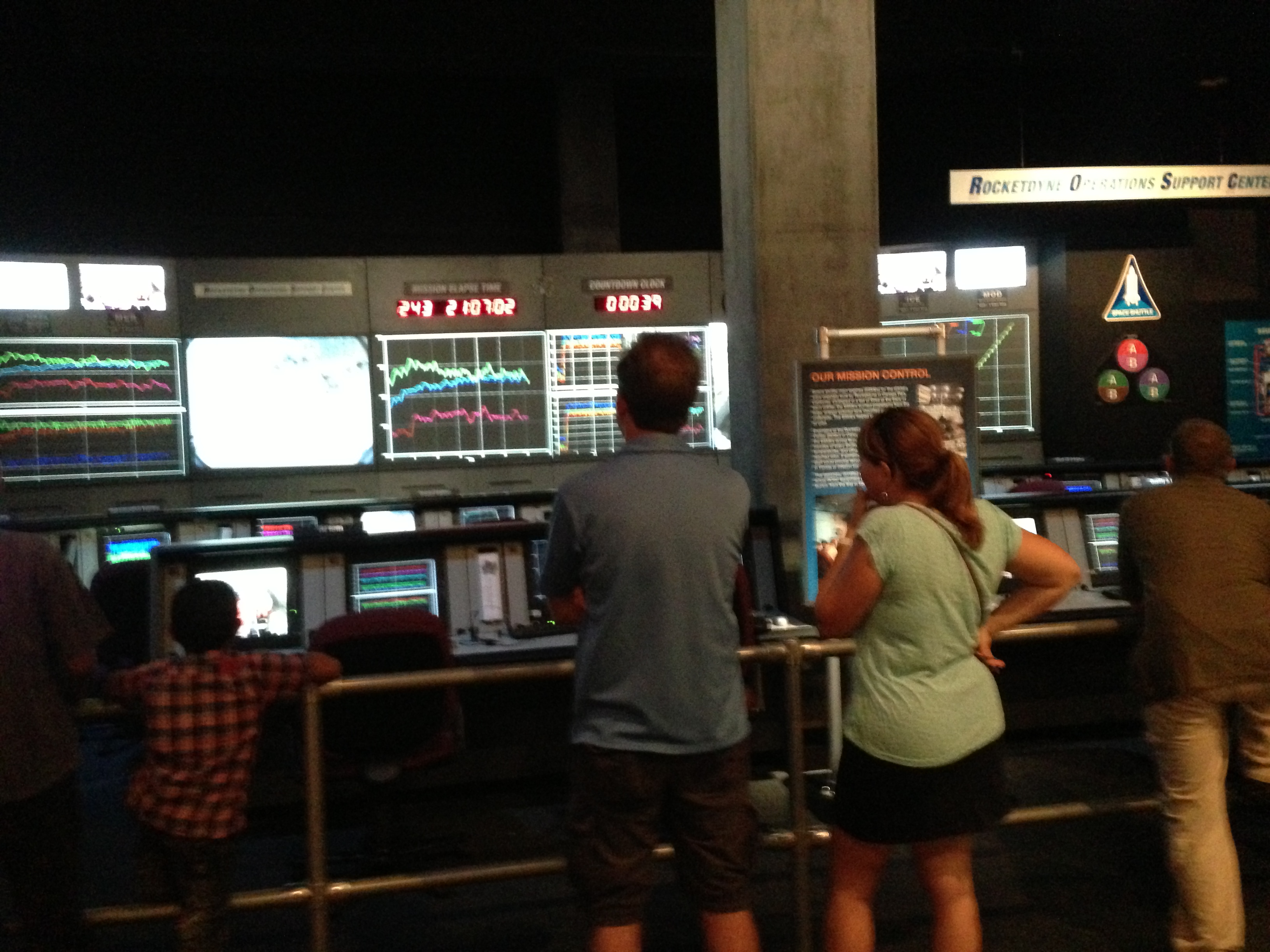
Not a great pic, but. This is the Rocketdyne Operations Support Center — ROSC — a set of computer consoles and screens that used to be a large room at my place of employment, in Canoga Park, CA. For the duration of the shuttle program, we maintained a sort of mini-Mission Control, where technicians would monitor the shuttle — in particular all the sensors in the SSMEs, Space Shuttle Main Engines — from before launch and especially for the 8 minutes of the launch while the SSMEs fired to put the Shuttle in orbit.

When the Shuttle program ended, Rocketdyne donated the whole facility — complete with desk chairs and Rocketdyne mugs — to the California Science Center.

(I never served duty in that room, being, as a software programmer, a couple steps removed from actual operations. But I’d been through the room several times.)

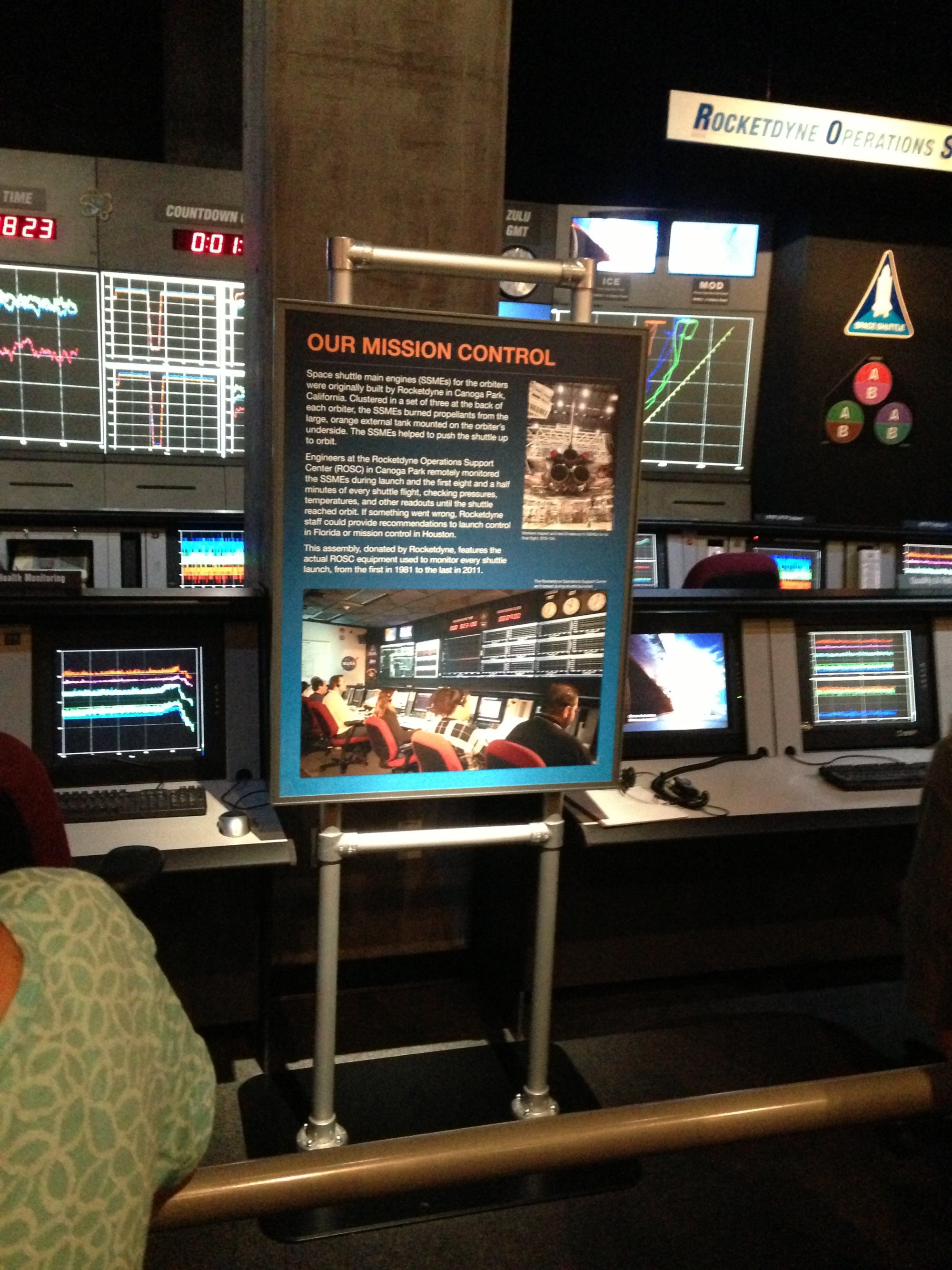
Here’s another pic of the ROSC, with the poster about where it came from.

Img_0232

Endeavour fills the space, so it’s hard to get good pics. Here are a couple.

IMG_0245

IMG_0242

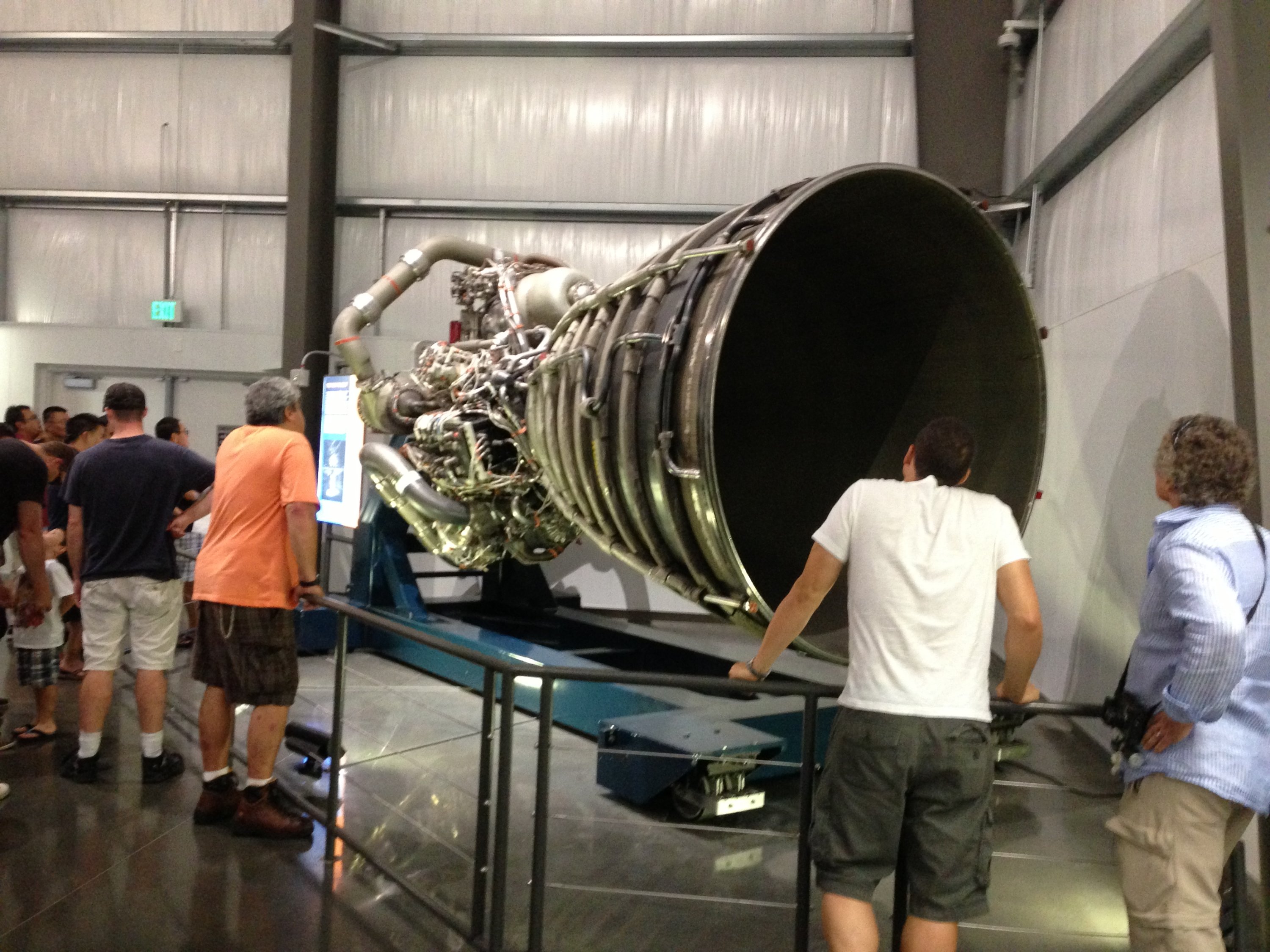
And, at the back, the three SSMEs.

IMG_0238

In the northwest corner — about where I was standing to take previous pic — is a mounted SSME. (Not in great focus, sorry.)

Img_0234

Img_0235

And in this pic, the black box in the middle center of the frame, about the size of a microwave oven, is the Controller, which contained the software that monitored the sensors, 60 times a second (IIRC), and sent commands to the engines from the cockpit to throttle up, down, and so on. The software for this Controller is what I spent most of the ’80s maintaining.

Img_0233

By ‘maintaining’ I mean, making small changes to the operating instructions as NASA decided such changes were needed. But also, occasionally, redesigning entire sections of the logic to make it more efficient. This box had 16K memory -! Every word counted. The biggest thing I did in the late ’80s was to redesign the entire sensor processing module, which had been patched over several years, to make it more efficient and save some 10 or 20% of memory that it had taken up.

At the back end of the shuttle, under the tail and behind the landing gear hatches, were two open panels…

Img_0240

We deduced these were the connections from the fuel tank to the SSMEs. Both liquid oxygen and hydrogen.

Not a very clear pic, but–

IMG_0236

These are Jimmy, Michael, and Yeong, looking at the SSME. Michael is finishing his second summer internship at Rocketdyne, and is more knowledgeable by now than I am, about how rocket engines work. He’s headed to UCLA for grad school next month.

Finally,

IMG_0244

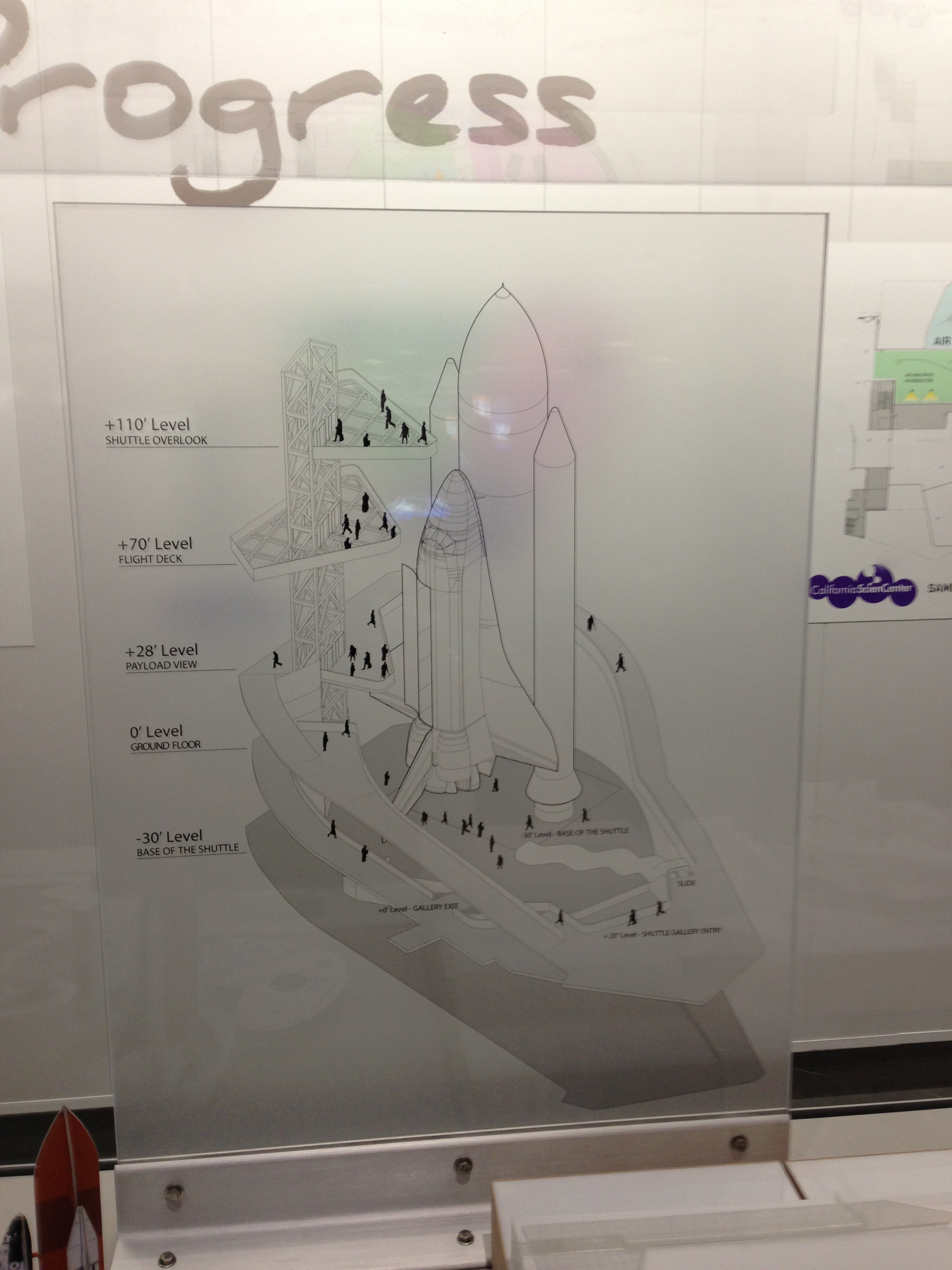
A schematic of what the eventual display of the shuttle will be, when it’s built. Upright, with fuel tanks and solids.

Posted in Personal history, Space | Comments Off on Endeavour

Respectful Insolence on the anti-vaxers; the healthcare crisis

Orac’s Respectful Insolence blog explores the motivations of anti-vaxers, via the recent news of the Texas church whose anti-vaccination advice resulted in an outbreak of measles (widely reported in the past few days).

Measles outbreaks, religion, and the reality of the antivaccine movement.

Orac (nom de plume of surgeon/scientist David Gorski) is brave enough to have read comments on various anti-vaxer sites. I almost never read comments on sites of any kind, since they mostly seem to be from trolls and loonies… (though at Little Green Footballs, Charles Johnson is frequently happy to reproduce numerous vile, vicious, racist comments from various right wing sites, and I do see those from time to time.)

Anyway, Orac draws this conclusion from those comments:

According to these people, parents who vaccinate their children are “ramming their beliefs down their children’s throats.” They also believe that vaccines are pure evil, entities whose only purpose is to kill, maim, and sicken, although why scientists who develop vaccines would want to kill, maim, and sicken children is never really explained. Usually it’s some sort of vague conspiracy theory in which these scientists and pediatricians, usually in the thrall of big pharma, want to ensnare children for the rest of their lives in pharma dependency, such that they have to take pills for diabetes, hypertension, asthma, and various other chronic health conditions. These are the people who are trying to influence others into not vaccinating. They are fanatical, and they are relentless. Indeed, they are very much like a religion.

Let’s emphasize this passage: “although why scientists who develop vaccines would want to kill, maim, and sicken children is never really explained”.

This rings bells with me, based on general attitudes about Obamacare and the long tradition of American anti-intellectualism on the right — as well as posts from my Tennessee family about their distrust of ‘big pharma’. (Those eggheads just can’t be trusted.)

It’s worth stepping back, and appreciating the bigger context. Which is, as I see it, that lifespans have increased over the past century, because medicine [like all science] has steadily improved, by its nature. But of course improved medical coverage comes at a cost. It involves more and more checkups, more tests, and more treatments. Those costs help people live longer and healthier, and of course they also benefit doctors and pharmaceutical companies, who provide those services. That’s what capitalism is all about; how could it not be so?.

It’s also the essence of the healthcare ‘crisis’ — as people live longer, more and more treatments are more and more expensive, and who’s going to pay for it?

So what do anti-vaxxers think is the problem with this? We live in a Capitalist society. What would be the alternative to the medical profession profiting from advanced treatments (including vaccines) to help everyone live longer, healthier, lives? Some kind of Socialism, in which taxes cover these services? Well, yes, perhaps that’s what Obamacare is about, to some extent. It’s worked well enough in various European countries. Otherwise those left out get sick and die on the streets, or are treated in emergency rooms, whose costs are passed on the rest of us as healthcare premiums. [I have to mention that objectors to Obamacare didn’t seem to mind nearly so much when it was Romneycare, inspired by a Republican think thank, in Massachusetts. It’s only when it’s associated with our black president that it become so objectionable.] (And of course I always wonder where the Christian response is, whose tenants apparently are about helping the poor, yet whose current response about any kind of social welfare programs seems to dismiss the poor as deadbeats.)

Posted in Religion, Science | Comments Off on Respectful Insolence on the anti-vaxers; the healthcare crisis

Plinks: Coyne responds to Frank; Religion becoming obsolete?; Dawkins’ response

Jerry Coyne responds to Adam Frank’s op-ed piece in NYT last week about science illiteracy. Coyne doesn’t dispute Frank’s points, so much as his recommendations.

But after reading it, I was disappointed, for although Frank’s piece is pro-science, it’s merely another op-ed calling our attention to the pervasiveness of creationism and climate-change denialism, decrying the decline of science in the U.S. in an unconvincing way, and failing to propose another solution beyond “get more kids interested in science.”

He’s not so sure as Frank is that science denialism is that much different today that in past decades.

So I’m not sure I agree with Frank’s assessment that our culture is now “less engaged with science and technology as intellectual pursuits than at any point I can remember.” There are tons of popular science books on the shelves these days, and although Carl Sagan and Steve Gould are no longer with us, we have Richard Dawkins, Brian Greene, Neil deGrasse Tyson, Dan Dennett, Steve Pinker, Lee Smolin, E. O. Wilson, Jared Diamond, and many others, as well as tons of nature shows on television. We are literally awash in popular science, as a visit to any bookstore can confirm.

So Coyne’s solution begins,

1. Weaken America’s hold on religion, which is largely responsible for climate-change denialism and completely responsible for creationism. These movements are brushfires that will re-ignite so long as faith is there to fuel them. We’re in a war not for science, but against superstition, which enables nonscientific views.

///

HuffPo:
Religion Becoming Obsolete? It Could Happen!

Research has shown that religion declines not just with rising national wealth but also with all plausible measures of the quality of life, including length of life, decline of infectious diseases, education, the rise of the welfare state, and more equal distribution of income.

The delusion of religion is not whether or not God exists, but in the absolute certainty of knowing the unknowable.

Like that last line especially.

///

Richard Dawkins created a twitterstorm last week over a comment about how few Muslims have ever won Nobel Prizes. He got a lot of flack for the implied racism of that comment, but to his credit, he responded in detail, taking some blame while expanding on his remarks and trying to put his tweet in context. It’s about what modern Muslims claim, as opposed to what they have done.

Calm reflections after a storm in a teacup

If you are so numerous, and if your science is so great, shouldn’t you be able to point to some pretty spectacular achievements emanating from among those vast numbers? If you can’t today but once could, what has gone wrong for the past 500 years? Whatever it is, is there something to be done about it?

His point meshes with the Donald Prothero comment that Arabic culture was, 1000 years ago, a pinnacle of civilization; what happened that caused it to fade? (Answer: religious extremism)

Dawkin’s response is a model of responsible, patient consideration for the points of his critics. The kind of thing you never see from the reckless predictions and accusations of the those on religious right, who are always wrong.

Posted in Religion, Science | Comments Off on Plinks: Coyne responds to Frank; Religion becoming obsolete?; Dawkins’ response

An Irish Poem

As a follow-up to my two posts of photos from Ireland. At a lovely Dublin bookshop called Hodges Figgis [no website of their own, but apparently associated with Waterstones], I bought a copy of Joyce’s DUBLINERS and a slim volume of poetry by W.B. Yeats. I’d thought, on those three days Yeong was in his conference, to sit in St. Stephen’s Green, only a couple blocks from the hotel, and read classic Irish literature. Alas, the weather did not cooperate; too drizzly. But I did read some of each book.

Here is the very first poem in the Yeats volume:

I passed along the water’s edge below the humid trees,
My spirit rocked in evening light, the rushes round my knees,
My spirit rocked in sleep and sighs; and saw the moorfowl pace
All dripping on a grassy slope, and saw them cease to chase
Each other round in circles, and heard the eldest speak:

Who holds the world between His bill and made us strong or weak
Is an undying moorfowl, and He lives beyond the sky.
The rains are from His dripping wing, the moonbeams from His eye.

I passed a little further on and heard a lotus talk:

Who made the world and ruleth it, He hangeth on a stalk,
For I am in His image made, and all this tinkling tide
Is but a sliding drop of rain between His petals wide.

A little way within the gloom a roebuck raised his eyes
Brimful of starlight, and he said:
                             The Stamper of the Skies,
He is a gentle roebuck; for how else, I pray, could He
Conceive a thing so sad and soft, a gentle thing like me?

I passed a little further on and heard a peacock say:

Who made the grass and made the worms and made my feathers gay,
He is a monstrous peacock, and He waveth all the night
His languid tail above us, lit with myriad spots of light.

From 1889. [I added some line breaks not in the original.]

Now, to my sensibilities this strikes me as an obvious mockery of human vanity. Other animals, imagining god, would imagine him in their image. (cf Jerry Coyne’s ‘ceiling cat’)

And so I was struck, in my Google searching for a copy of this poem, by this site where the poster thinks this poem is about…

pantheism, the concept that God is everything. If man rightly discerns that God created human beings in His image, then God, in fact, created everything else that exists in His image. If all things are reflections of one Creator, then each thing created can rightly aver that it is made in the image of the Divine.

This strikes me as a non sequitur. If everything exists in His image, then the concept of being created in His image doesn’t mean much of anything, does it? Certainly not anything humanity can take credit for.

Posted in Quote at Length, Religion | Comments Off on An Irish Poem

More Ireland Pics

From Yeong’s iPhone.

We were staying at the Conrad Hilton, which is just south of St. Stephen’s Green, as on this map.

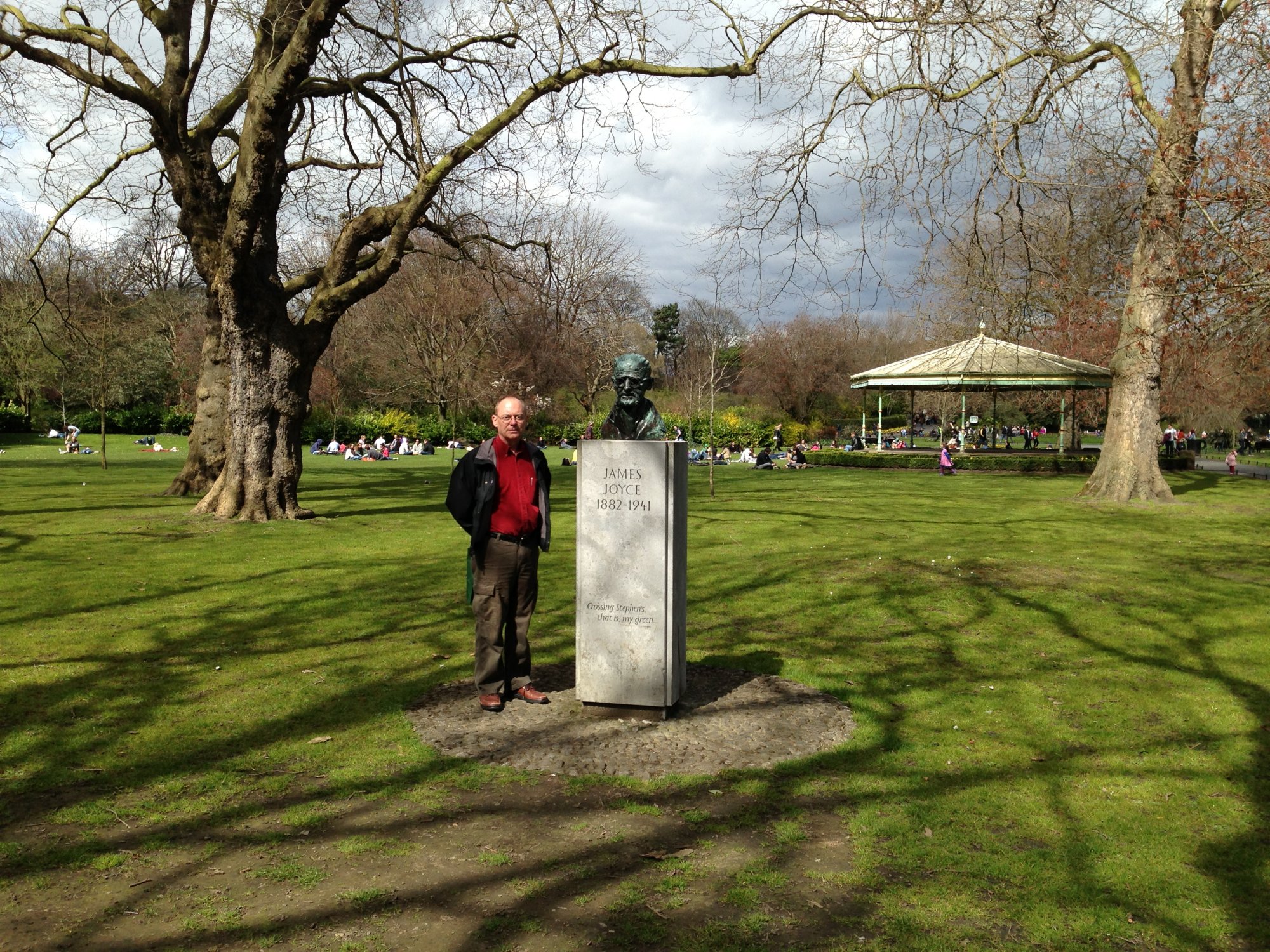
St. Stephen’s Green, the Central Park of Dublin, was just a short walk from our hotel. Wikipedia has details and a map. The park includes a bust of James Joyce. (Click on any of these thumbnails for much larger images.)

005

Here I am by the bust of James Joyce.

026

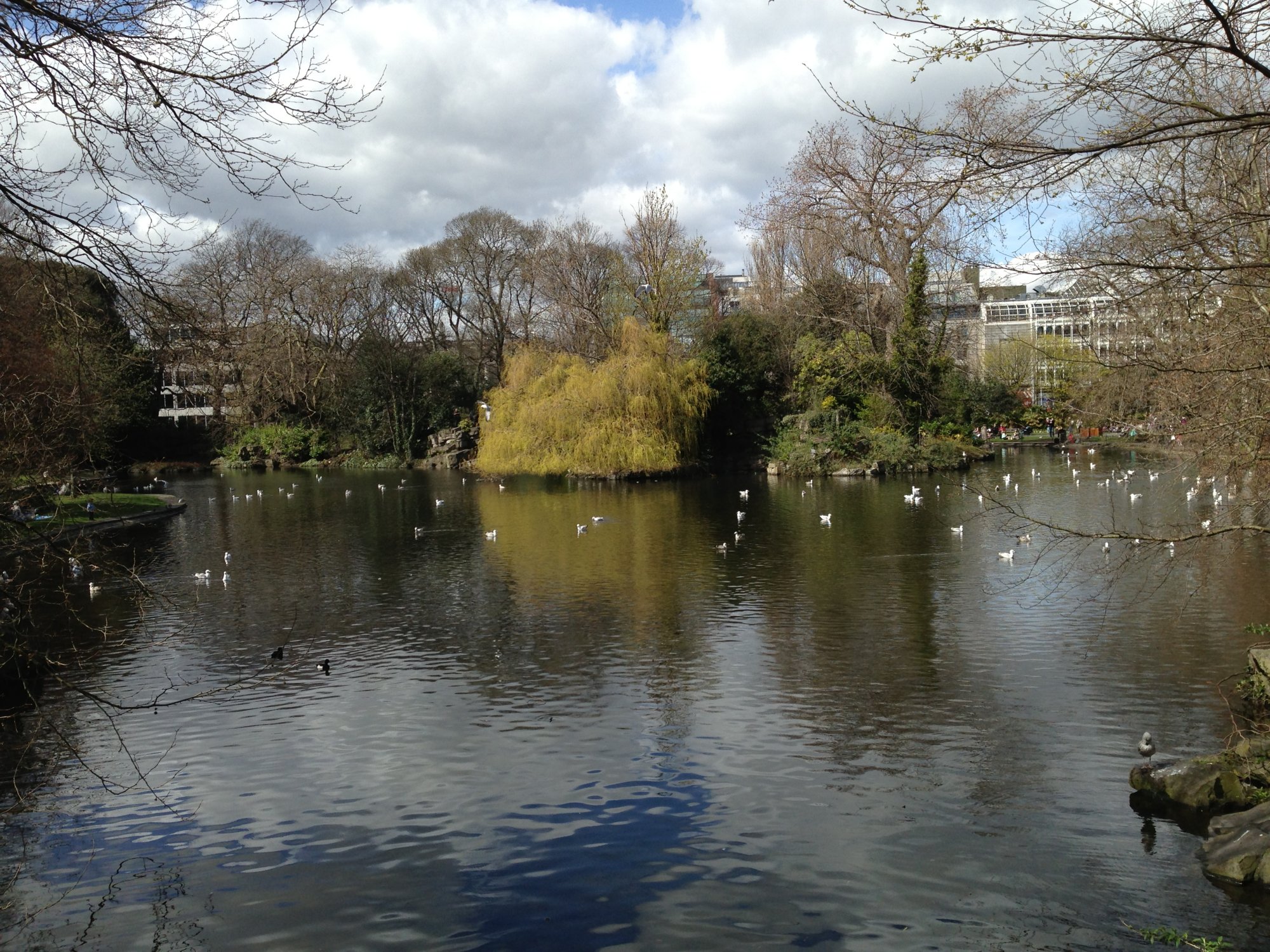
It has a couple ponds; here’s one.

006

At the northwest corner of the park is the Stephen’s Green Shopping Mall, an ornate structure that looks like this inside–

012

Though its contents are not as impressive as its venue; a lot of standard tourist souvenir shops, mostly.

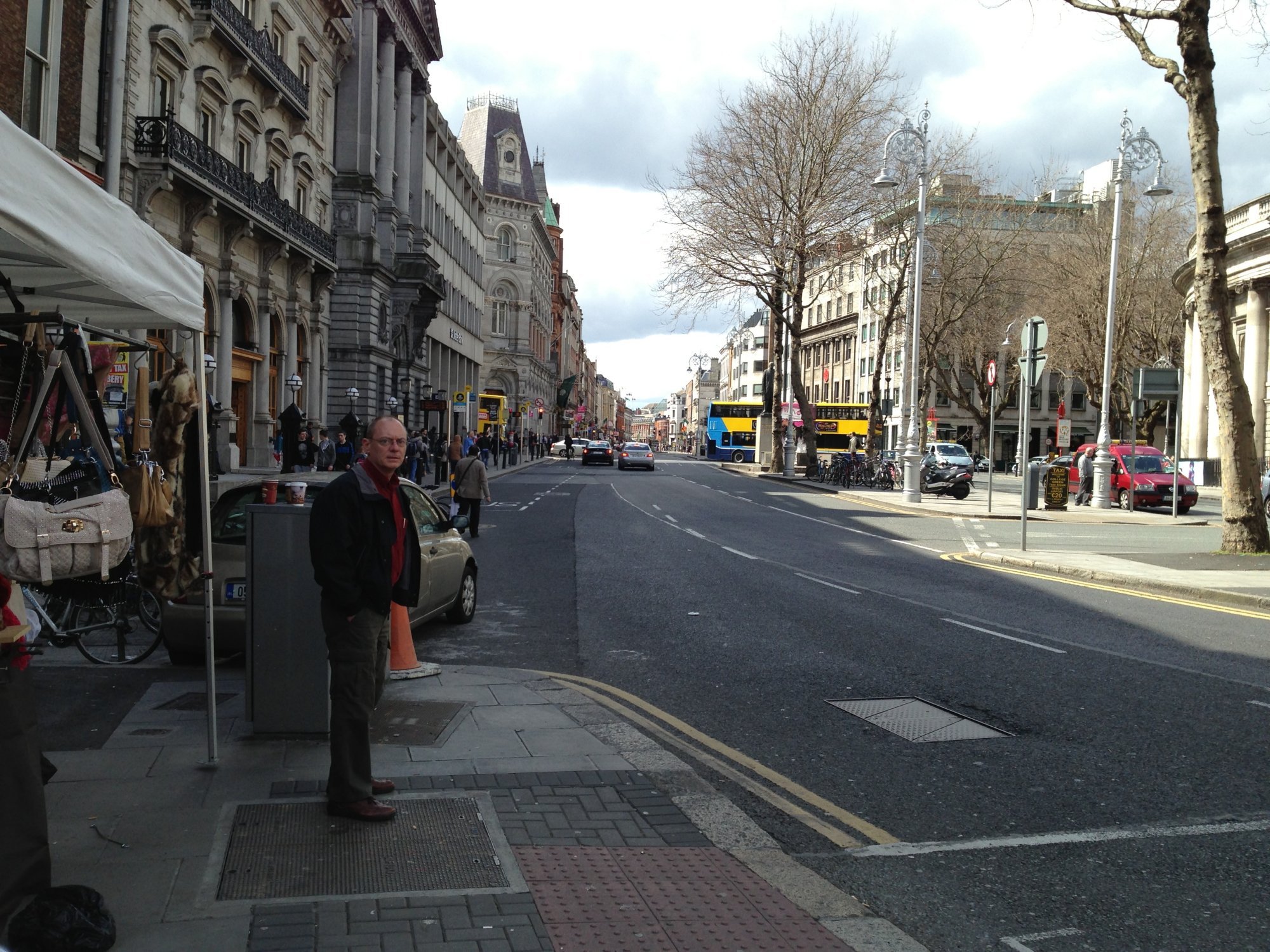
Here I am standing (not very upright) at the corner of Dame Street and Grafton Street, just across the street from Trinity College (to the right) and nearby a used bookstore, on the left, whose name I don’t remember and can’t quite make out from the Google image searches. A kind of used bookstore that has virtually vanished from large American cities, but that had lots of fascinating books on various art/literature/gay topics.

017

Here’s the River Liffey, which runs through the center of the city.

020

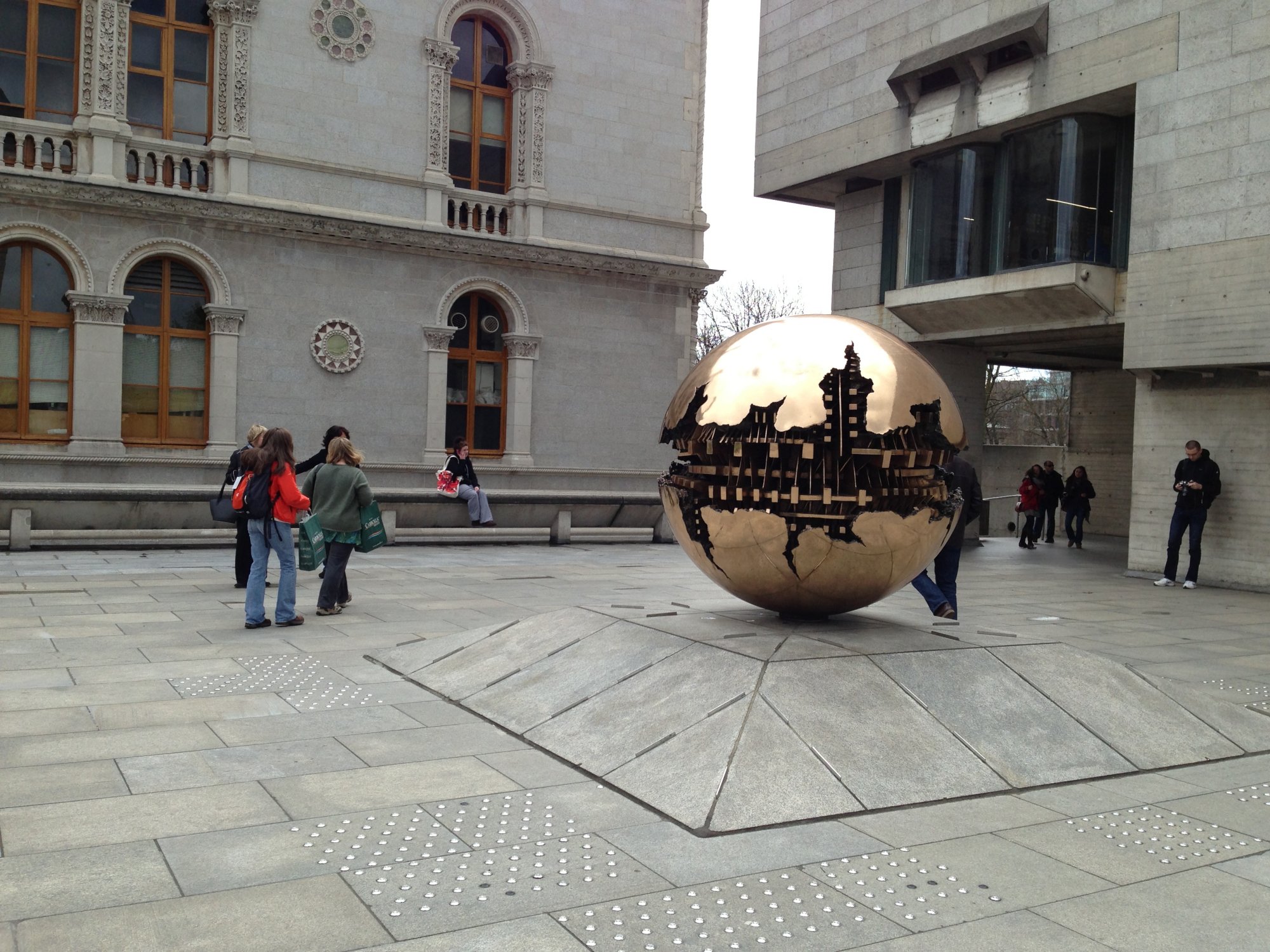
The central library at Trinity College is this modernist, cubist structure, with a Pomodoro Sphere sculpture in the front–

029\

(Coincidentally, we saw another Pomodoro sculpture in the front of the UN building in New York City, just a few weeks later — http://en.wikipedia.org/wiki/File:NYC_UN_Gift_of_Italy.jpg)

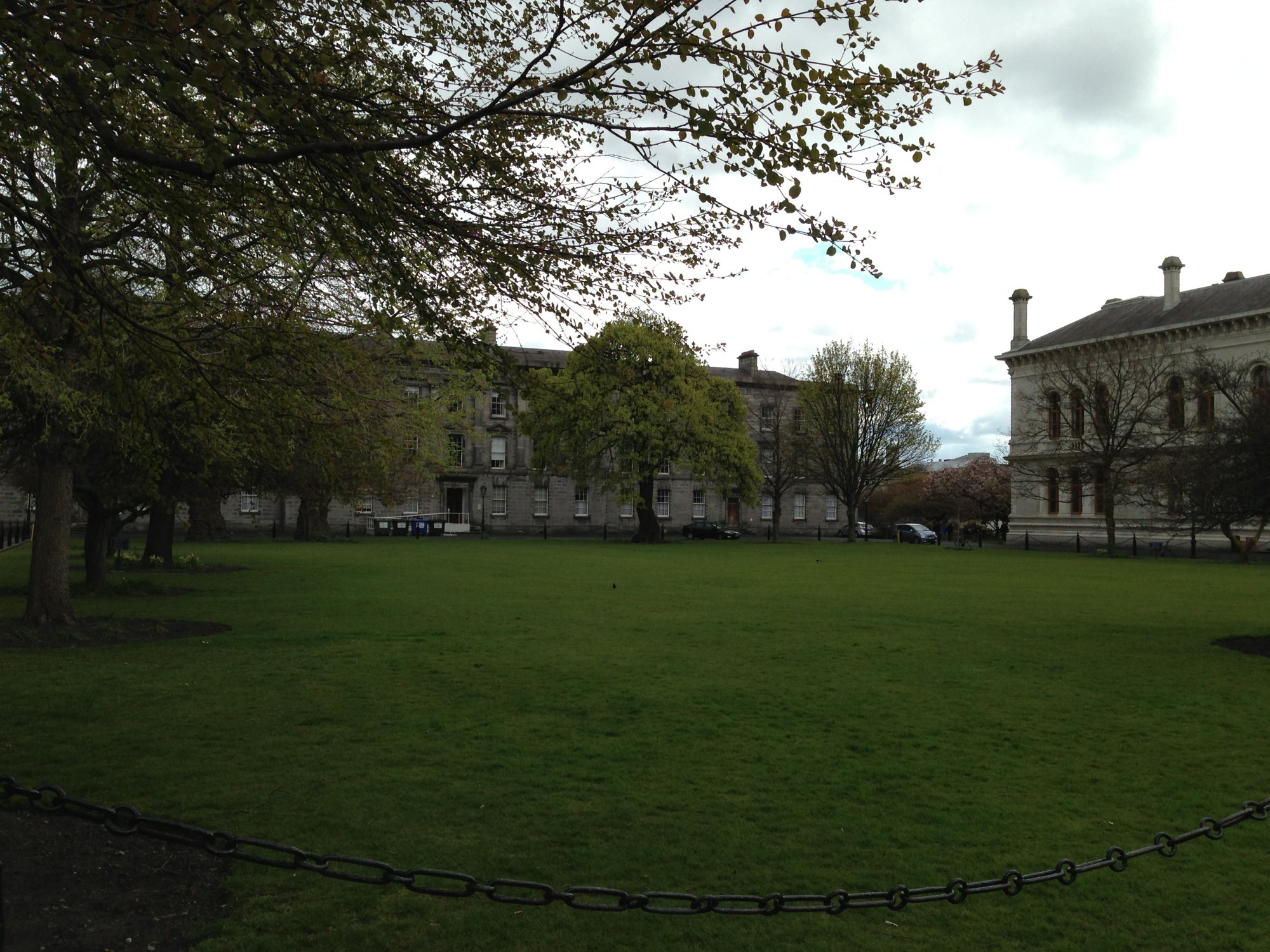
Trinity College is, somewhat like Harvard, which I visited briefly maybe 20 years ago, a campus of large rectangular structures surrounding greenworks and trees.

033

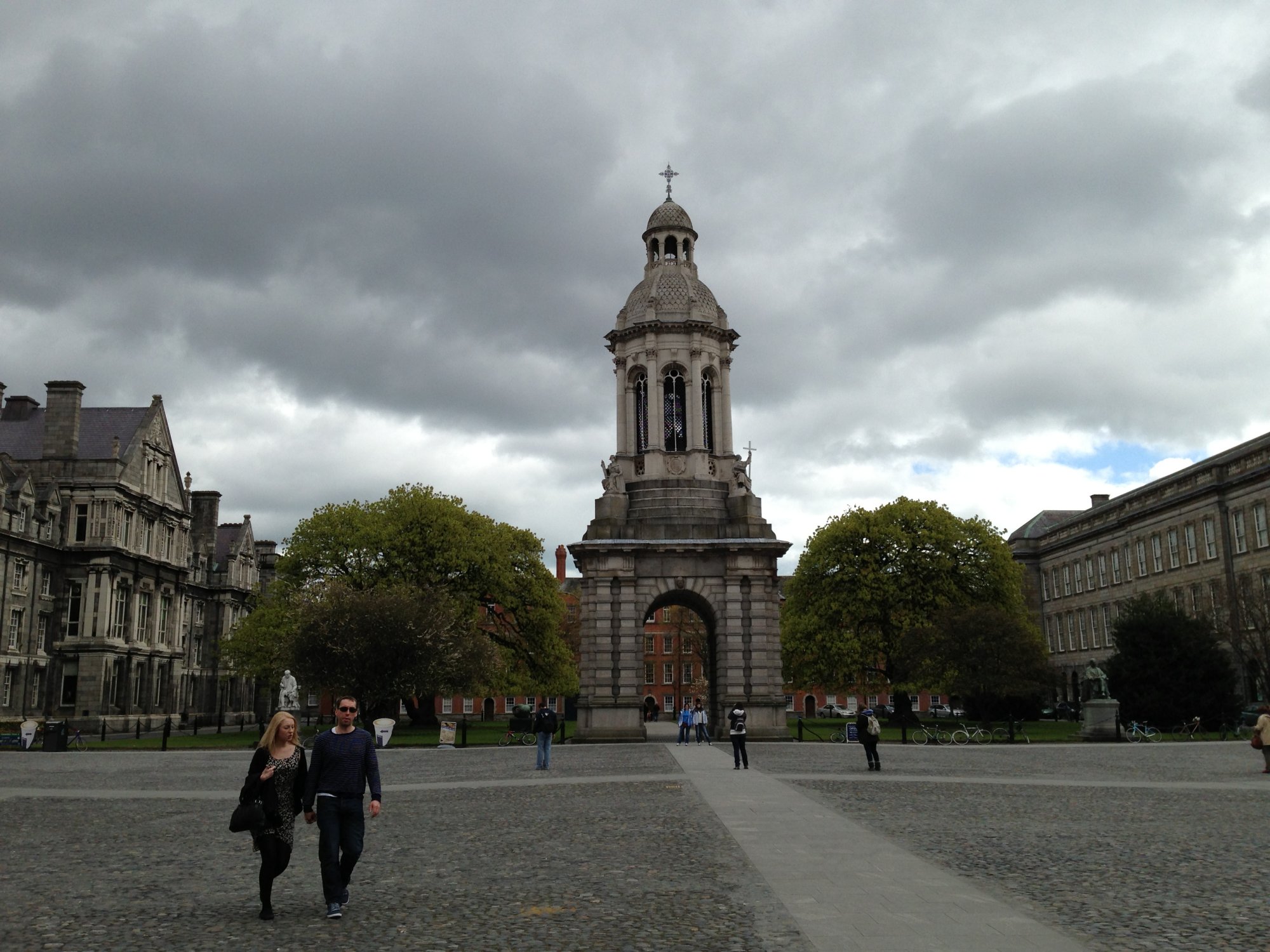
In the center of the campus is the Campanile.

035

It was a cloudy day.

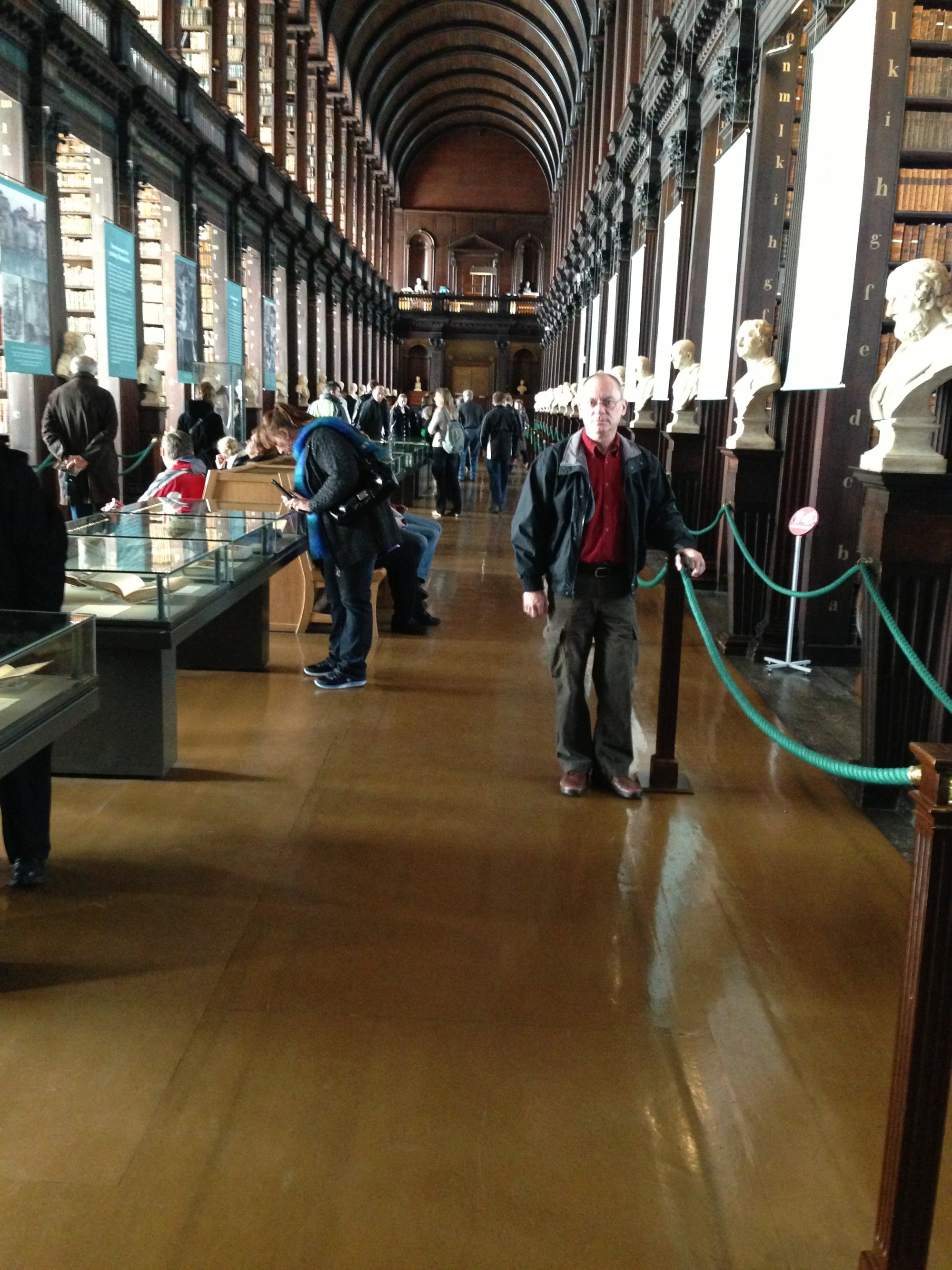
Then we went inside the Trinity College Library, a vast hallway with alcoves and shelves of varying heights. As the guide explained, tall books were put on the lower shelves, slightly less tall books on the shelves above those, and so on, with the smallest books on the top shelves. This seemed to be the the scheme, regardless of book subject or author.

Here’s a slightly crooked view, with me at right.

038

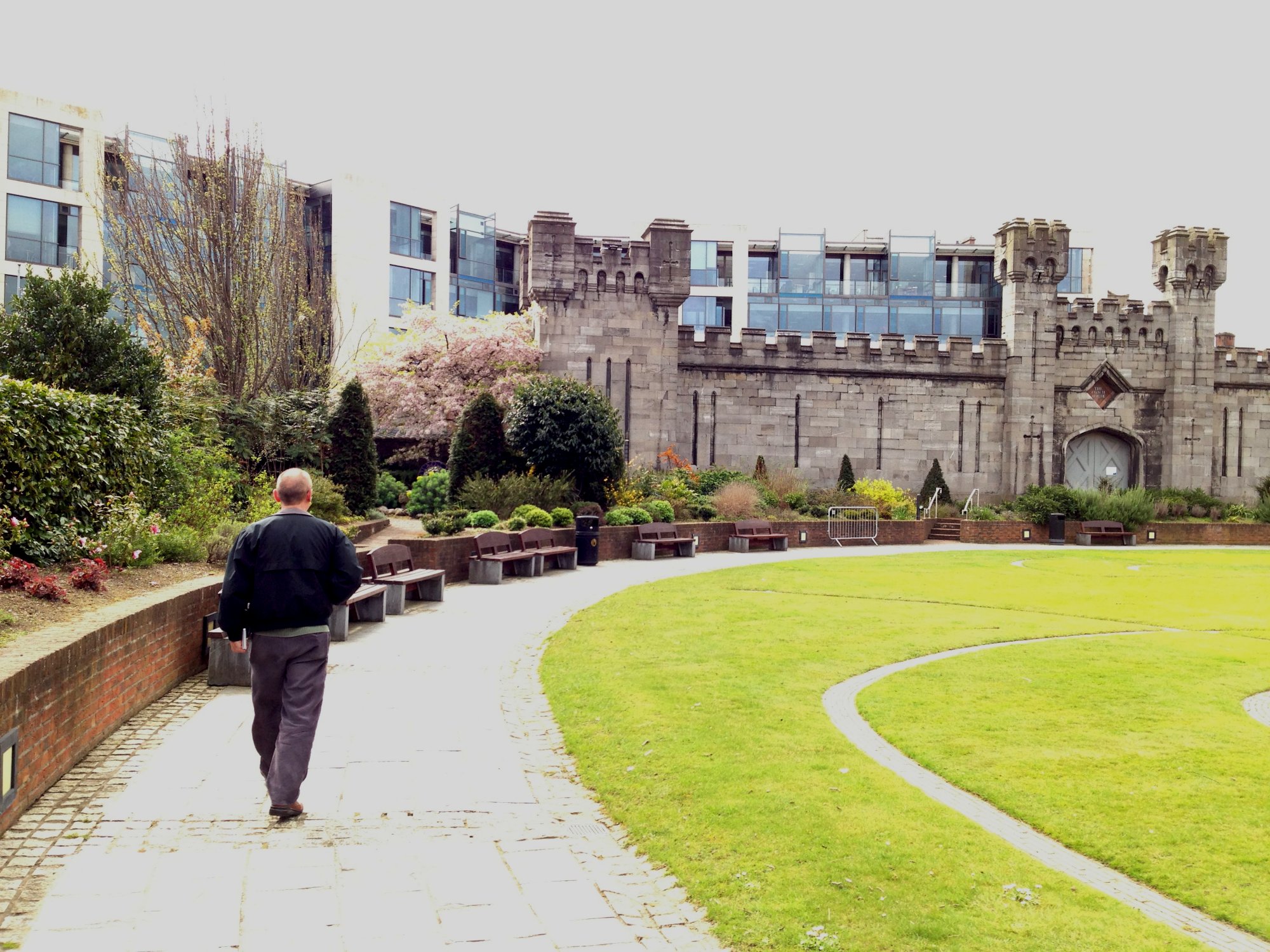
We visited Dublin Castle, but it was closed to visitors because of some diplomatic event. We were allowed to walk around the central gardens.

053

And we visited Christ Church Cathedral, across the street, with interesting catacombs.

064

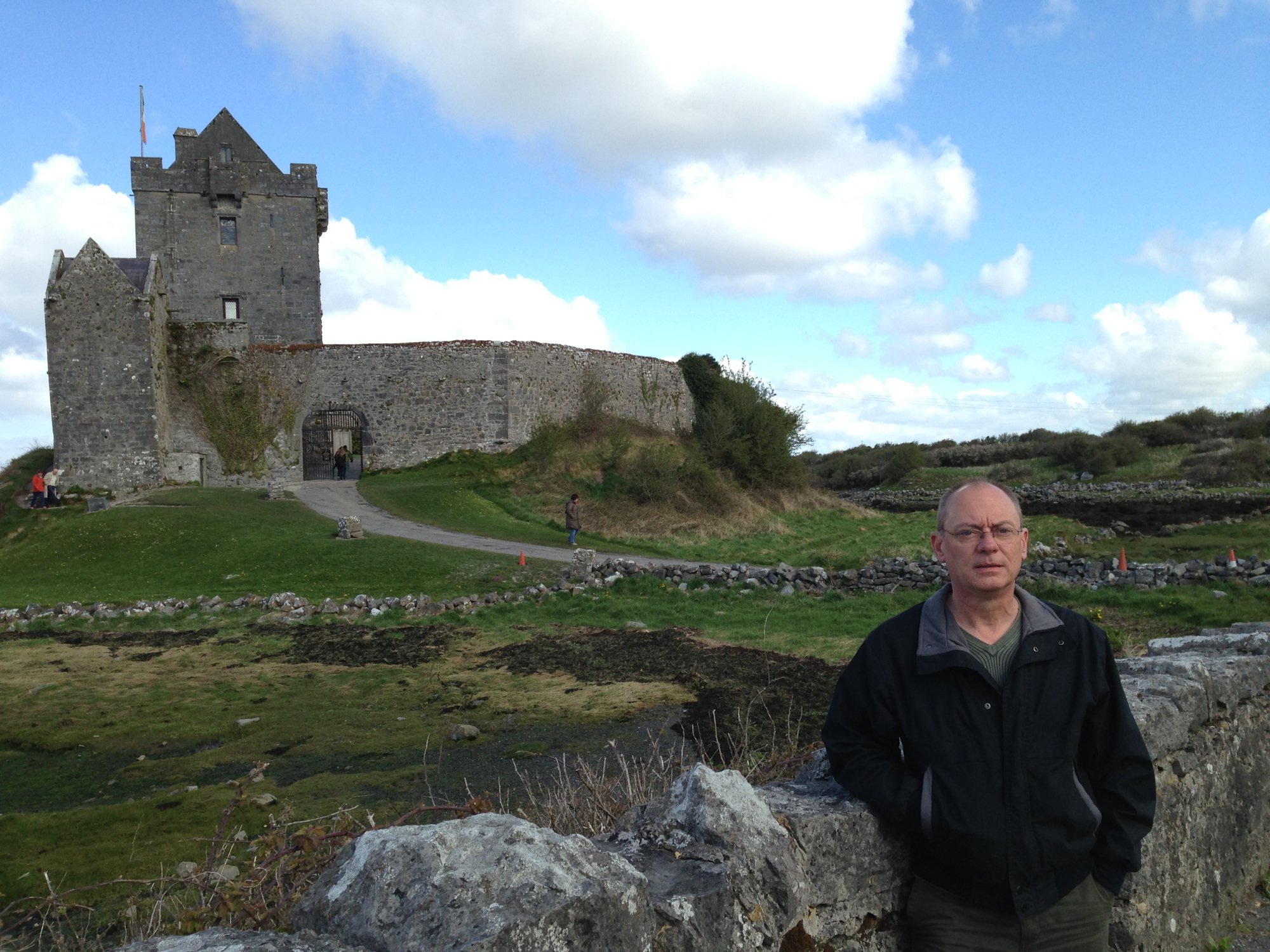
All of this precedes the day trip to the Cliffs of Moher. Here’s a picture of me in front of Dunguaire Castle.

080

And here’s a picture of our driving along the Ireland country roads.

085

Here’s a pic of our very nice rental car — an Audi A6.

123

And here is one final pic from the Cliffs of Moher.

113

Posted in Travel | Comments Off on More Ireland Pics

Dublin Notes and Photos

Only four months late, here are some notes and observations I had about our trip to Dublin in late April. Yeong had a business conference for three days, Tuesday to Thursday. We flew in the previous weekend, and stayed through the following weekend. I jotted these notes in an email at the time…

Overcast/rainy most of the time. The tour guide at Trinity College said they have four days of sunlight per year. Joke? Perhaps not.

People walk quickly along the sidewalks. I walk fast, and kept being by overtaken women of a professional air.

I realize downtown Dublin is a tourist hub, but why all the streets so full of pedestrians at midday? Especially young 20-somethings of mixed races. Trinity College students? Didn’t strike me as student types, judging from the guide we had.

Aside from these younger energetic folk, population overwhelmingly white, pale, to the point of being pink, with a noticeable portion of ‘gingers’ – red-haired people. Not unattractive.

Every fourth person or so on the sidewalk smokes, a much higher percentage than in any American city I’ve been to lately.

Everything here is built of stone or brick, as pointed out by our Trinity College tour guide; earlier buildings of wood rotted away. The complete opposite of building construction in LA, of course, where stone and brick crumble in earthquakes.

Everyone jaywalks whenever possible, but then this is true in most cities, except LA.

And, apparently in a tacit concession to tourists and visitors from countries who drive on the ‘right’ side of the road, crosswalks routinely have stenciled instructions on the pavement to ‘look left’ or ‘look right’ before jaywalking.

I’ll also try to upload a few photos from my iPhone here. I don’t take many photos anymore; I find the preoccupation of many tourists with taking photos (often of themselves) as opposed to just experiencing the place they’re in, to be perverse. Also, I’m just not a very good photographer; I stopped trying to take photos of awards winners at conventions after one photo in particular was ridiculed online (because I could not control that the subjects were looking off in other directions, or had funny expressions on their faces). So I stopped taking an SLR camera with me on trips years ago. But now I have an iPhone, which brings a camera along with it.

I don’t have any photos of Dublin, actually, just a few from the day trip we took to the Cliffs of Moher, and along the way we stopped at Dunguaire Castle (which I Facebooked about earlier). Here’s a pic. (Click for much larger image.)

IMG_0142

If I can find my Facebook post about this, I’ll link or quote it, but Fb does not seem easy to search among older posts.

Here is a view outward from the top.

Img_0144

Here is Yeong from the top, the view looking back toward the road.

Img_0146

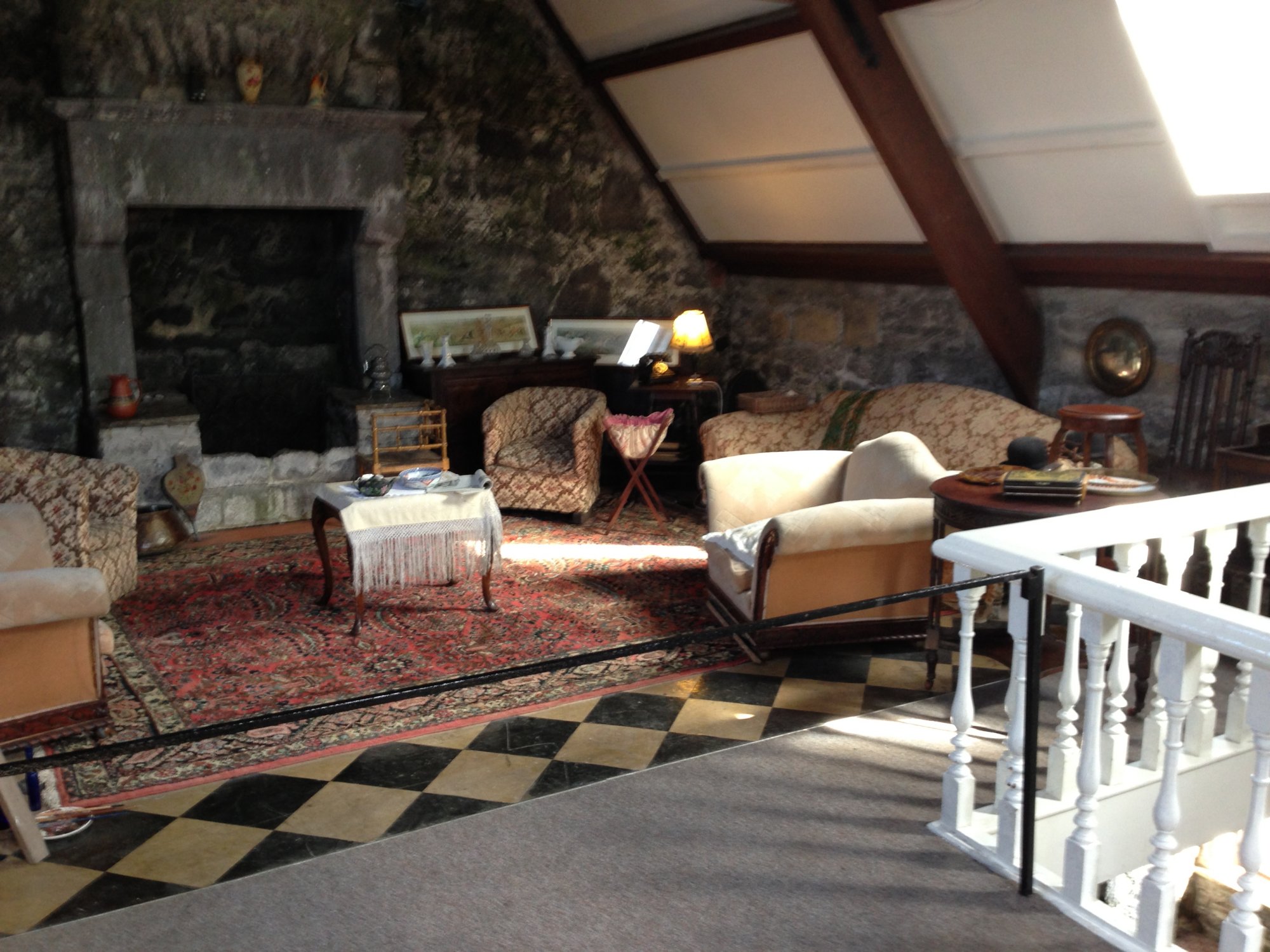
The top floor is lavishly furnished, and was occupied until only a few decades ago…

Img_0148

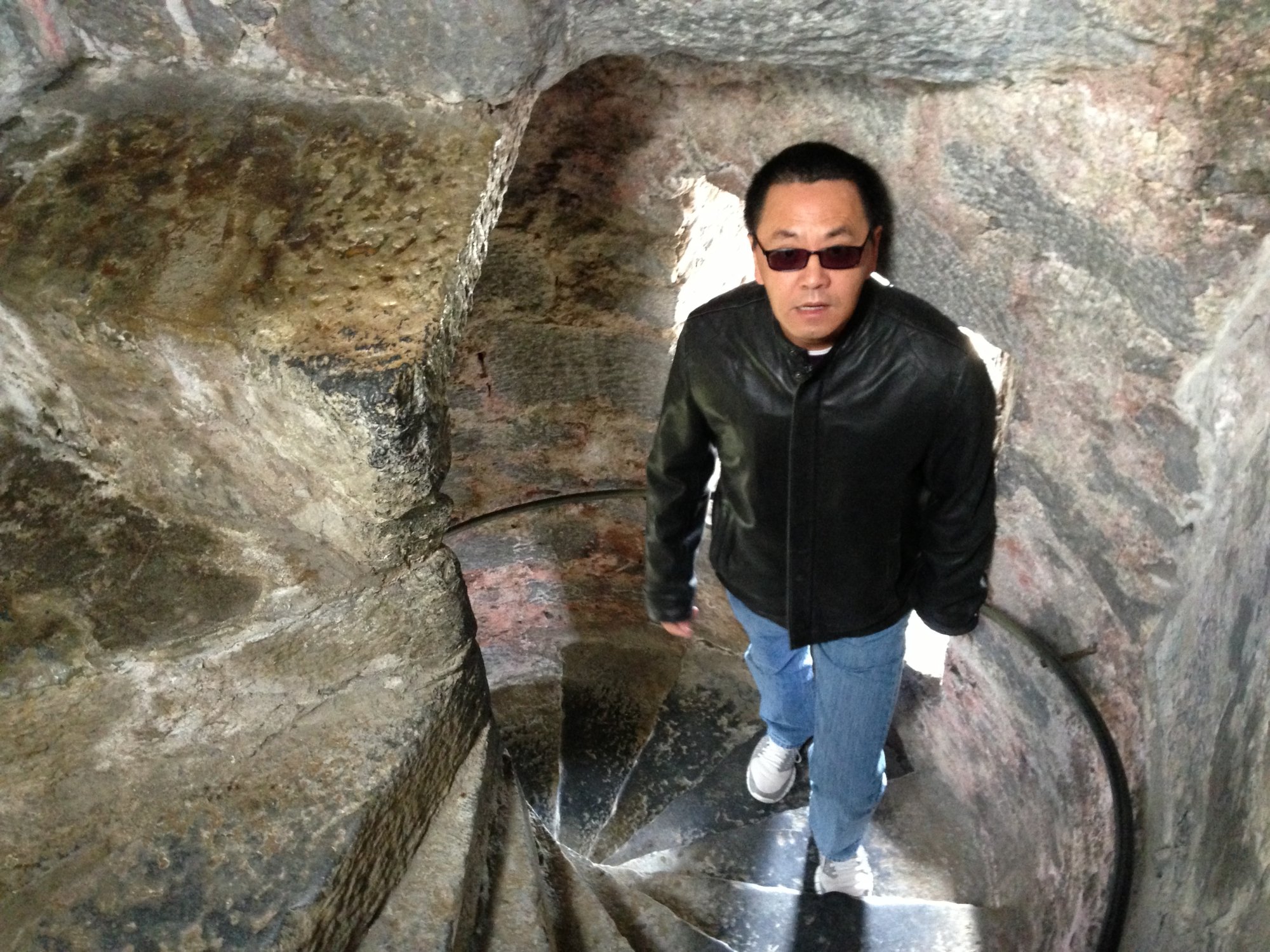
And the steps from floor to floor are narrow and spiral.

Img_0149

Onward to the Cliffs of Moher.

Img_0151

The cliffs are beds of shale and sandstone, some 300 million years worth, having been eroded by the continuous onslaught of the Atlantic Ocean. There are trails along the edges of the cliffs for a mile or two in either direction from the visitor center. We spent a couple hours walking back and forth. It’s easy to see how daredevil tourists might get too close and fall over, and there are signs warning about this. At the visitor center, I asked a clerk if anyone had fallen over recently. Not this year, she said.

Img_0152

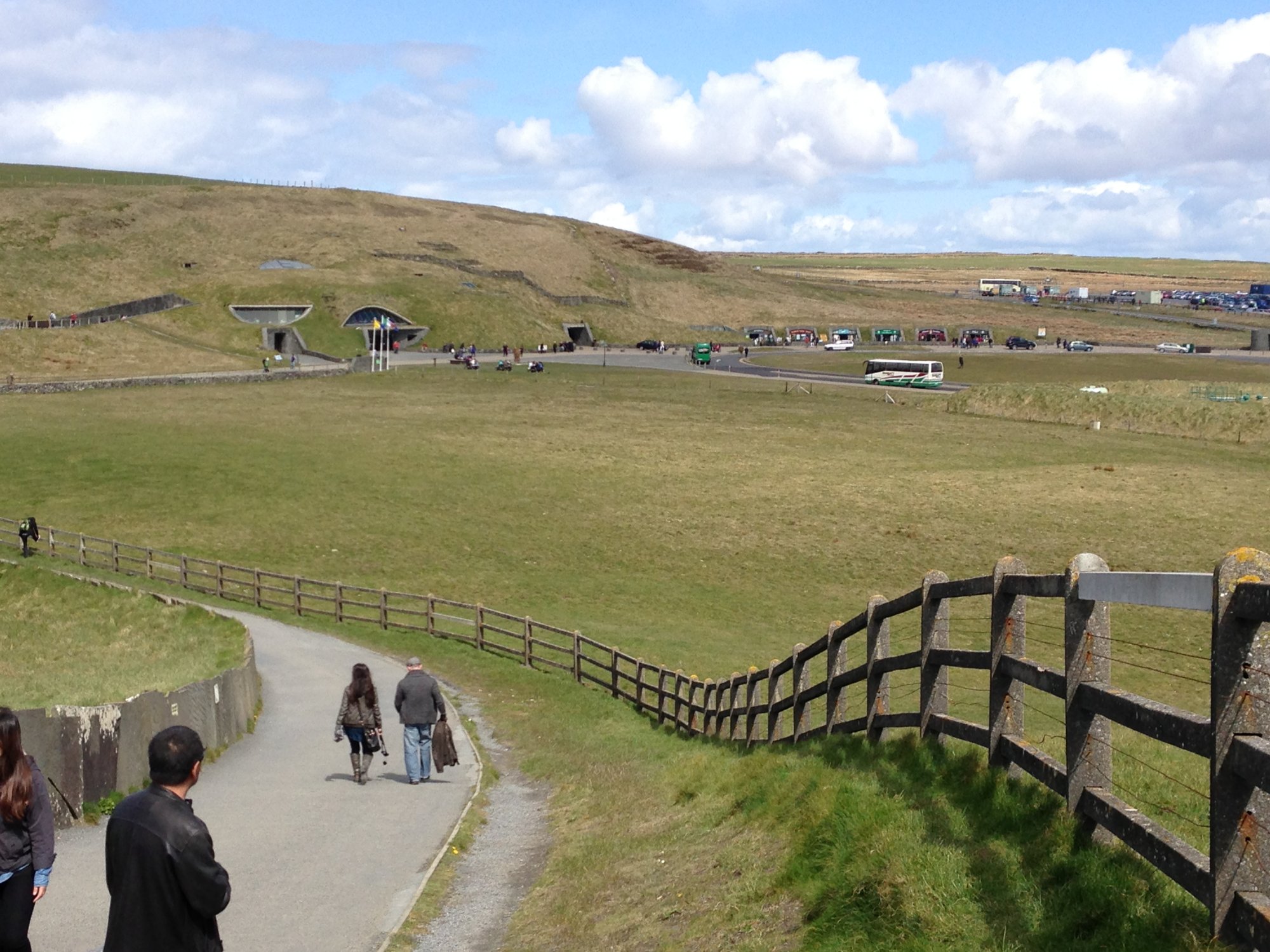
Finally, a view toward the visitor center from the cliff edge trail (with the cliffs just off camera to left). The visitor center and cafeteria are built into the hillside, much like Hobbiton.

Img_0157

That’s all for now. There are more pics, including some from Dublin, on Yeong’s iPhone. I’ll track them down.

Posted in Travel | Comments Off on Dublin Notes and Photos