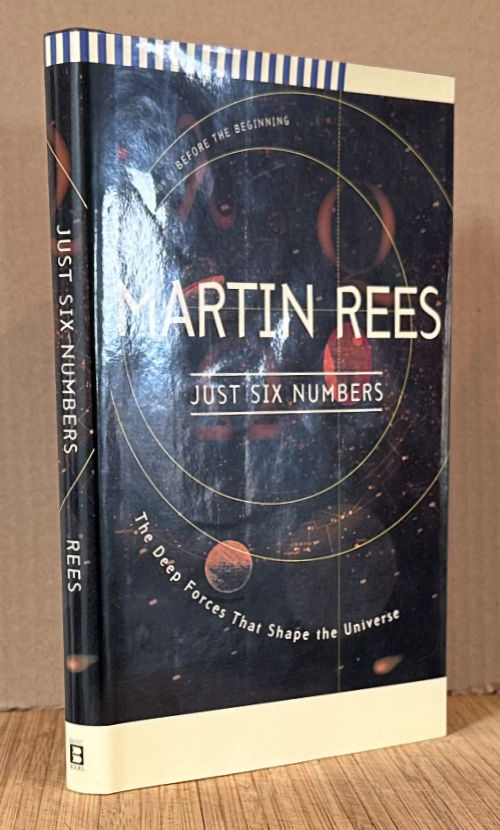
Subtitle: The Deep Forces That Shape the Universe
(UK 1999; this US edition: Basic Books, 2000, x + 173pp, including 12pp notes and index)
This is a book from a series of short science books (~200p each) published in the 1990s and 2000s by Basic Books. Rees is an astrophysicist whose early books were in his field, and whose later books (beginning after this one, and including ON THE FUTURE, 2018, reviewed here) became big picture in a different way, with musings on humanity’s future and the future of science.
This book is ostensibly focused on six key physical constants (or ratios) and how they determine that the cosmos we exist in is possible. If they were a bit different, we wouldn’t be here. This is a topic familiar to creationists who thus argue for a creator who set those numbers, though of course that doesn’t follow at all, as Rees explains. In fact, the book is also a clear, efficient overview of all the basic topics of cosmology. Black holes, gravity, the creation of heavier elements in supernova, the idea of a multiverse, etc:
Preface
Astronomy is the oldest numerical science. At the dawn of the 20th century, the outlines of our mapping of the entire universe are coming into focus. The picture that emerges is that of a ‘genesis event’ that led to the entire universe, with deep connections between stars and atoms, cosmos and microworld.
Ch1, The Cosmos and the Microworld
P1, Six Numbers. “Science advances by discerning patterns and regularities in nature, so that more and more phenomena can be subsumed into general categories and laws.” 1b. This book is about six specific numbers, which, if they were much different, would cause our universe not to exist, and us with it. These are N, E (the author uses a character that might be epsilon, but I will use E in this review), omega, lambda, Q, and D – pp2-3. Are their fortunate values just coincidence? Providence of a benign Creator? Author thinks neither; rather, an infinity of other universes may exist where these numbers are different.
P4, The cosmos through a zoom lens. –This is a prose description of what you see in Powers of Ten, which he credits. The universe covers a vast range of scales, of which we are aware of only a few in the middle. There are some 60 frames in this range, of which we span just 9.
P6, Large numbers and diverse scales. We’re midway in that range, in a range where complexity is possible. See ouroboros illustration p8. We can understand why the universe is big as a direct correlation to how long it took complex forms such as ourselves to evolve, roughly 10 billion years.
P9, Can we hope to understand our universe? It’s been said that theories are abandoned only when their proponents die; but that’s too hard. Several long-running cosmological debates have been settled; minds have been changed. Certainty about the Big Bang went from 90% years ago to now [he writing in 1999] near certainty. Space can’t be infinitely divided; there’s a granularity. At the largest scales, we don’t know; there may be millions of powers of ten further than we can perceive.
Ch2, Our Cosmic Habitat I: Planets, Stars and Life
P12, Protoplanets. In Orion is a great cloud of forming protostars and solar systems. Our understanding of the way they form has replaced the earlier ‘catastrophist’ scenario in which planets were very rare, as the result of two stars passing close by one another. [[ note the science fiction has *always* assumed lots of planets around all the stars ]]
13, Other solar systems? And now in the ‘90s we have ways of detecting planets around other stars: by the wobble of the star’s motion from side to side, and by slight differences in Doppler effects from its moving forward and back. NASA has plans to launch orbital observatories… 16b
17, From matter to life. But how often do we expect to find life? A second example in the solar system would boost changes enormously. And if life, intelligence? We know the evolutionary path to us is an outcome of time and chance; it would not rerun the same. But if there were aliens, they would use different units but measure the same ratios between physical properties, e.g. a proton is 1836 times heavier than an electron.
Ch3, The Large Number N: gravity in the cosmos
24, Newton’s ‘clockwork’. Gravity applies to everything, and it was the first force to be described mathematically. By Newton; the inverse square law; Principia, 1687. In a later book he described cannon balls and how a speed fast enough would put something into orbit. And thus the same principle applies to planets orbiting the sun.
26, Gravity on big and small scales. Its effects are different at large and small scales; thus movie miniatures, differently proportioned big and small animals. Galileo perceived these constraints on sizes of animals. And on life on other worlds, e.g. balloon creatures in the atmosphere of Jupiter.
27, The value of N and why it is so large. Gravity is amazingly weak compared to other forces; thus N, the ratio of atomic forces to gravitational forces, is 10^36 (a 1 followed by 36 zeros). Gravity is always attractive; electrical charges can attract or repel. We can quantify this by thinking of spheres, each containing 10x the number of atoms as the previous. Gravity catches up with atomic forces in objects about the size of Jupiter. That’s why smaller objects, like asteroids, aren’t round. Larger objects like stars stay formed due to interior pressures; else they would collapse into white dwarfs. Arthur Eddington realized you could theorize about the nature of stars, even if on a cloud-bound planet where you couldn’t see them.
If gravity were less feeble, e.g. N is 10^30, stars and planets would be smaller; evolution would be stunted; complex beings like ourselves would be crushed. Galaxies would be smaller, stars closer, precluding stable planetary systems. Stars would exist for only 10,000 years. Humankind could not have emerged if gravity were much less than N.
31, From Newton to Einstein. Einstein refined Newton and deepened our understanding of gravity. It might better have been called the ‘theory of invariance.’ His theory transcended Newton’s; analogy of climbing a mountain. Our intuitions match Newton’s; at high speeds we’d experience things differently, p33. You can’t exceed the speed of light—but you can travel as far as you like, by getting near it. Also, near large masses, clocks tend to run slow; this is taken into account by GPS satellites.
34, ‘Strong gravity’ and black holes. Places where strong gravity has effects: neutron stars, black holes. Small ones, some in orbit of other stars. Large ones, at the centers of galaxies. Black holes are very simple to describe: just mass and spin. Spinning black holes entail other issues… And there would be tidal effects, p38.
38, Atomic-scale black holes. An atom-sized black hole would require 10^36 – the same number – atoms.
Ch4, Stars, the Periodic Table, and E
40, Stars as ‘nuclear fusion reactors.’ How we know the age of the earth… and what powers the sun. The future of the sun: red giant, in another 5 billion years. We can theorize about stars and observe others at different stages of their evolution. Only in the 19th century did we discover that stars and galaxies are made of the same materials as our own planet. Heavier stars burn faster and live shorter lives. A 1987 supernova was the nearest one ever observed. And supernovae are significant because without them, the elements that make up the solar system would not exist.
P43 Alchemy in the stars. The periodic table, and 92 elements found in nature. Heavy stars transmute lighter elements into heavier ones, up to iron. An implosion and explosion throw these heavier elements out into space. The heat of the explosion produces traces of elements heavier than iron.
P45 The galactic ecosystem. The earliest stars had only the simplest elements, and no planets. Our solar system was formed from the debris of earlier stars that exploded; earth has mostly heavier elements because the hydrogen and helium escaped. Thus the oldest stars have the fewest heavy elements.
P47, Nuclear efficiency: E = 0.007. Thus astrophysics accounts for the proportions of the elements, and the strength of the force that binds the atomic nucleus. The nucleus of a helium atom weighs 99.3 percent as much as the two protons and two neutrons that went into it – the remaining 0.007% is what converted to energy. The ‘strong’ nuclear force operates across only short distances.
P48 The tuning of E. If E were smaller, the sun would still be there, but it would affect the formation of helium from hydrogen; it would get stuck at deuterium. There would be a universe only of hydrogen. If E were 0.008, no hydrogen would have survived the big bang, and there would be no water. And Hoyle predicted a problem in the formation of carbon, from beryllium, and was vindicated. Without that resonance, there would be very little carbon. Any change in E would affect the periodic table, either impoverishing it, or needlessly enriching it.
Ch5, Our Cosmic Habitat II: Beyond Our Galaxy
52, The universe of galaxies. So where did the protons and hydrogen atoms come from? About galaxies; different types. Most are in groups or clusters. Even in galactic collisions, individual stars rarely collide.
P54 The texture of our universe: the cosmic web. There are even larger aggregate structures. But such structures exist only to an extent; the universe is not infinitely fractal. This texture does matter; but we can still consider the entire universe basically smooth, and then consider whether it is static, expanding, or contracting.
P57 The expansion. Redshifts indicate the distant galaxies are all moving away from us. As in Escher’s cubic space division, there is no one center. This expansion began some 12 to 13 billion years ago.
60, Seeing into the past. Galaxies farthest away we see as they existed long ago. The Hubble Space Telescope shows millions of distant galaxies in otherwise empty patches of sky. Other land-based telescopes show promise.
65 Before the galaxies. Space isn’t completely cold; the microwave background radiation detected in 1965 is evidence of the big bang. Again, it came from no one point; it was not an explosion. Recalling Hoyle’s use of the term, as a joke.
P68 Nuclear reactions in the big bang. The first few minutes of the expansion weren’t long enough to transmit early hydrogen into heavier elements, just some 23% into helium. Hoyle was the first to argue that heavier elements weren’t formed early, but were expelled from stars. And the big bang also accounts for deuterium.
Ch6, The Fine-Tuned Expansion: Dark Matter and Omega
71, The critical density. We can predict that in 5 billion years the sun will die, and that the Andromeda galaxy will collide with ours, but we can’t predict much else besides that. Will the universe keep expanding? That depends on the competition between gravity and the expansion energy. But the actual density of the universe seems far less than that needed to bring expansion to a halt.
73, How much dark matter? Omega is the actual density to the critical density. It seems to be very low, but there’s much ‘dark matter’ that we don’t see. We can deduce additional gravitation sources from the high speeds we see objects moving. Possibly we need to rethink gravity, as a last resort.
76, What can dark matter be? Not dust, or it would block our view of distant stars. Small faint stars, brown dwarfs, perhaps. Or rogue planets, lumps of frozen hydrogen, black holes.
78 The case for exotic particles. But deuterium suggests dark matter isn’t ordinary matter at all. If dark matter were ordinary matter, theory implies there would be less deuterium than we see. Neutrinos are an option. There should be hundreds of millions of them for every atom. It was once thought they had no mass—but recent experiments indicate any mass they do have is far too little to account for dark matter. There are other hypothetical particles that might exist; underground detectors are looking for those. And there are other ideas.
81, Narrowing down the options. Description of three options—detecting dark matter; more about neutrinos or other particles; deductions from how galaxies form.
83 Why matter and not antimatter? Author suspects a new kind of particle. Why the asymmetry between matter and antimatter? There’s evidence of asymmetries between certain particle pairs. The matter remaining might be because of a difference in the ninth decimal place in numbers of original quarks and antiquarks.
86, The tuning of the initial expansion. Given that omega is at least 0.3, it must have been close to unity in early eras. See chart p87. If Omega were much different, the universe would have evolved differently, and we would not be here. It’s tempting to guess that unity was precise, for some deep reason. Sometimes this kind of reasoning works.
Ch7, The Number Lambda: Is Cosmic Expansions Slowing or Speeding?
Seeing back into the past. Is there enough dark matter to make Omega exactly 1? Can we tell if the expansion rate is changing? We need to observe distant, ancient objects. Quasars are too varied. Similarly galaxies. Best are supernovae.
93 Hunting distant supernovae. Type 1a supernovae can serve as ‘standard candles.’ Looking for and at this is an elaborate task. Two teams in the ‘90s came to a startling conclusion: the expansion seemed to be speeding up.
95 An accelerating universe? There would have to be some accelerating force. Einstein realized some force would have to counteract gravity, or everything would collapse together—his ‘cosmological constant’. The idea wasn’t needed when it was discovered the universe was expanding. But it’s still plausible. Empty space may be full of particle pairs or strings; why is lambda so small?
98, The case for non-zero lambda. The case is currently strong, from evidence such as the patchiness of the universe. If lambda were larger, gravity would have been overwhelmed before galaxies formed.
99 The long-range future. It used to be thought the far future would see a Big Crunch. Now we can predict the deaths of stars and galaxies, and the eventual decay of all matter. And if lambda is not zero, visible space will become emptier and emptier…
Ch8, Primordial ‘Ripples’: the Number Q
103, Gravity and entropy. Nature and art are most appealing when neither regular or random. Our intuition about entropy doesn’t apply when gravity is involved, e.g. losing energy sometimes speeds things up, as a satellite in orbit.
105 From the big bang to galaxies. The formation of galaxies was sensitive to the environment of the early universe. They depended on slight irregularities in density. We call Q the ratio of two energies, the energy needed to break something up, and its rest mass. For clusters of galaxies, this number is about one in 100,000. That is, gravity is quite weak, and the universe is quite homogeneous.
107, Ripples in the microwave afterglow. We should see those ripples or fluctuations in the microwave background radiation, to about one part in 100,000. The 1990s saw the mapping of those fluctuations, with NASA’s COBE satellite. That Q is so tiny is remarkable…
109, The evolution of ‘virtual’ universes. We can simulate virtual universes in computers, e.g. figure on p111. Early galaxy formation involves quasars, active galactic nuclei, whose light reveals the nature of those early galaxies, and the nature of the black holes that they form.
113, How much is predictable? We can summarize what’s been happening since the big bang, 113.6. Temperature contrasts grow, enabling complexity of which we are a part. However Q was initialized, given its value cosmology can be predicted (unlike biological evolution).
114, The tuning of Q. If Q were smaller, aggregations would be smaller; gas might never condense at all and there would be no stars. If it were bigger, the universe would be turbulent and violent, with large regions collapsing into black holes. The actual value of Q also makes cosmology easier… and this is not just a handy coincidence.
Ch9, Our Cosmic Habitat III: What Lies Beyond Our Horizon?
(quote by St. Augustine, about how the world was made simultaneously with time)
117, How believable is the big bang story? Various measurements that might have refuted the big bang have been made: objects with no helium; measurement of background radiation; neutrinos; deuterium abundance; temperature fluctuations implying Q. (See figure p119) But extrapolating from the earliest moments after the big bang is difficult.
120, Unification in the microworld. We need to relate gravity to the other forces; this hasn’t been done. The first step came with the unification of electromagnetism with the nuclear weak force (by Weinberg and others, 121m). The particles discovered in the ‘50s and ‘60s fell into patterns and were modeled with quarks—nine types—these related to the strong nuclear force. The grand unification to include all these forces seems to require temperatures of 10^28 degrees.
123 The ‘inflation’ concept. Among many puzzles is why the universe is so relatively uniform, with Alan Guth’s inflation offering a solution, happening about 10^-13 second from the big bang. The expansion was exponential.
126, Can we test the inflation theory? The ‘flatness’ of the universe would seem to support the idea. …. Gravitational waves, detecting from satellites, or from the collision of two black holes.
128 Other relics. Magnetic monopoles; never observed. Or miniature black holes.
130, From ‘nothing’? The universe can emerge from a tiny speck because the *net* energy can be zero. But physicists should take care not to claim the universe arises from ‘nothing’—in the philosophical sense.
131, Beyond our horizon to the multiverse. And inflation theorists suggest that the number of doublings might be in the hundreds, not just 25 to account for what we can observe. Or, our big bang might be one in an infinite series. For which we would use the word multiverse.
Ch10, Three dimensions (and more)
Quote from Kepler about how he thought the number of perfect solids dictated the number of planets.
134, Why D=3 is special. About D and how it equals 3. In three dimensions there are five platonic solids; in four dimensions, six, and in all higher, just three. Three d’s lead to inverse-square laws; four d’s would imply inverse-cube, in which orbits would not be stable. For several similar reasons, three d’s seems ideal.
136, Time and its arrow. Time is a fourth dimension, but it works only in one direction. Ref Martin Amis and Kurt Vonnegut. Perhaps time will ultimately be understood as the consequence of something deeper.
139, Wrapped-up dimensions on large scales? We don’t see patterns like the Virgo cluster repeat themselves. But space may wrap on itself and extremely large, or ultra-small scales.
140, The microstructure of space and time: quantum gravity. We know that energy comes in packets, quanta, which in turn leads to the idea of the Planck length and Planck time. We have no resolution of quantum mechanics and Einstein’s gravity; they operate in different domains. But we need this unification to understand the first instants of the big bang, or the inside of black holes. Our ordinary intuitions break down.
143, Superstrings. This is the most ambitious approach. The idea is that the entities of the universe are not particles, but vibrating strings, vibrating in 10 dimensions. But how does this imply our four dimensions? Are there other possibilities? These theories are very complex and have no empirical support. But it accounts for Einstein’s general relativity. And these theories offer insight into ideas about the entropy of black holes.
Ch11, Coincidence, Providence – or Multiverse?
EO Wilson quote from Consilience.
148, What does the fine tuning mean? The Mandelbrot set has a rich structure, but most algorithms yield dull patterns. We’ve seen how adjustments to the six numbers would yield universes in which we would not exist. Is that the only explanation? This is unsatisfying. Others see Paley’s argument from design; currently John Polkinghorne. Another idea is that our big bang wasn’t the only one.
150, The multiverse. It’s not mere metaphysics, because we can imagine developments that would rule it out. The difficulty is understanding the earliest moments of our own universe. The values of the six numbers might derive from some deeper theory, or ‘accidents of history’, as when phase transitions occur. Different values would lead to vastly different universes.
154, The Mystery of Lambda. In most universes, lambda would be vastly higher than in ours.
155, A Keplerian argument. Some cosmologists prefer the simplest possibilities. But recall Kepler, ellipses, and Galileo’s upset. So go easy with Ockham’s razor. That our universe allows complexity would be no more surprising than the observation that we exist on a particular planet near a particular star, and not at some random point in space.
158, Progress and prospects: a resume. Consider how much progress has been made in the past century. In the future there will be better observations, and armchair theorists looking at data online. Perhaps complete understanding requires a ‘final’ theory. Even if it is found, cosmology would still be an environmental science, using emergent concepts, 160m. Like the number of different chess games, the number of possible outcomes in the universe is vast. And maybe there is an infinity of things infinitely replicated.
\\