Subtitled: The Unreal Reality of Mathematics
(Basic Books, 1995, x + 164pp, including 14pp of further reading and index)
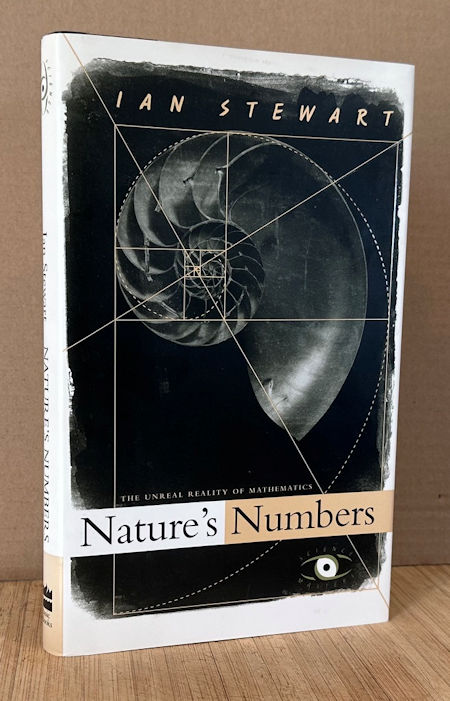
One more in this series for now. Despite the title, this is not a book about a subject similar to Martin Rees’s in JUST SIX NUMBERS. This is rather an introduction to various basic ideas of mathematics, and how math is about more than numbers.
Moreover, it builds to an introduction of the new concepts of math and physics that began to emerge in the 1980s and continued for a couple decades. Chaos, fractals, Fibonacci numbers, complexity, emergence, and so on. Stewart also co-wrote two larger books with Jack Cohen exploring these concepts in greater detail: THE COLLAPSE OF CHAOS in 1994, and FIGMENTS OF REALITY in 1997. Stewart and Cohen later teamed up with fantasy writer Terry Pratchett to write a series of four books called THE MAGIC OF DISCWORLD, contrasting how physics supposedly works in that universe with the new ideas about our own universe. I reviewed the first of them way back in 2015, here.
I have a bookshelf of a couple dozen titles on these various concepts, including James Gleick’s relatively well-known CHAOS (1987) and others by John L. Casti, Stuart A. Kauffman, Murray Gell-Mann, et al.
Key Ideas
- Patterns in nature are clues to the rules that govern natural processes. New patterns have only recently been recognized: fractals and chaos.
- Math is about solving the puzzles behind the patterns, and then making predictions.
- Math is about more than numbers, of which there are many kinds. It’s also about operations and functions and data structures. We knit related facts together with proofs, which are like stories without plot holes.
- There are both fixed laws and regular changes. Some things we can solve exactly, others we can approximate as best we can (e.g. the three-body problem).
- There was no distinctions between pure and applied mathematics until recently; examples of wave equations and the functions of violins and drums.
- Nature is full of symmetries, which human minds find attractive, but many effects exhibit ‘spontaneous symmetry breaking,’ as with ripples in a pond. The universe never had perfect symmetric uniformity.
- Life exhibits rhythms, typically simple oscillations, with examples of animal gaits.
- The universe might be deterministic but that doesn’t make it predictable, as explained by chaos theory, or nonlinear dynamics. QM describes how randomness exists at microscopic levels. Systems are sensitive to initial conditions, while chaotic system tend toward ‘strange attractors.’ Complex systems can result from simple laws.
- The world exhibits surface simplicities, though they emerge from complex interactions of many components. Examples of water dripping from a tap, population dynamics, and the number of petals on a flower.
- Finally, the author dreams of a new way of thinking, ‘morphomatics,’ to handle these ideas, to supplement traditional math that focuses on rules and information.
Detailed summary
Prologue: The virtual unreality machine
Author describes a dream in which imagines space into being and then populates it with objects and shapes… and then saves it, like a computer file. It’s like the virtual reality systems we already have. This is how mathematical imagination works. This book will be a trip through the mathematical universe.
Ch 1, The Natural Order
Nature is full of patterns, which humans recognize and classify with mathematics; the patterns are clues to the rules that govern natural processes. New patterns have only recently been recognized: fractals and chaos. It’s easy to recognize patterns — numerology — but more difficult to tell which are significant. Shapes are geometrical patterns; there are patterns of form, of movement. ..
Ch 2, What Mathematics is For
Math is the way to solve the puzzles behind the patterns. To make predictions. Rates of change are handled with the calculus. Such tools are useful to scientists and of more ‘pure’ interest to mathematicians. Questions of how animal shapes form, e.g. can be examined mathematically with computers.
Some patterns are significant — the period of resonance behind satellite orbits; some are not — the chance alignment of stars in Orion’s belt. Mathematics allows you to predict such patterns, and also to control them. Math earns its keep by supporting the technology around us, though it’s kept hidden in the background. It usually takes a long time for new math to appear as technology… a century or more.
Ch 3, What Mathematics is About
Math is about more than numbers, but numbers are so useful that everyone is taught how to use them, which gives the false impression.
Counting was done even before there were numbers… by tallying fingers, or scratches, etc. After numbers, fractions were invented; later the concept of zero. Then negative numbers, and irrational numbers to comprise the ‘real’ numbers. And then imaginary numbers, and complex numbers.
Another mathematical object is an operation. Another is a function (or transformation). All these things can be thought of as processes turned into things — abstracts treated as if they were actual, physical objects. Data structures are ways to build things by thingifying processes…
Mathematics is also like a landscape of related facts that have a metaphorical distance between them, and some facts that rise above others like prominences. Knitting them all together is proof. A proof is like a story without plot holes; it has to work. Example: proving a fact about the transformation game of turning one word SHIP into another DOCK one letter at a time.
Ch 4, The Constants of Change
The old debate of fixed laws vs. constant change has gone mostly to the former, by virtue of science; Newton is regarded a triumph of rationality over mysticism. Yet some changes are quite regular, e.g. the path of a cannonball, a parabola, which resolves to a constant acceleration. Newton discovered that changes in nature can nevertheless be described by mathematics, usually these days in ‘differential equations.’
But ‘solving’ has come to mean different things. At first it meant finding an exact formula to predict a physical system (e.g. Newton’s two-body gravitation). Then it meant finding an approximation where no exact formula could be found (e.g. the three-body problem). Then it meant finding a description where even an approximation proved impossible. This isn’t so much a retreat as the discovery that some physical systems *cannot* be reduced to formulas (1994 discovery about three-body problem); they must be understood on their own terms.
Ch 5, From Violins to Videos
The distinction between ‘pure’ and ‘applied’ math was not one anyone worried about until this age of specialists; Gauss did number theory but also invented techniques of orbital calculation and surveying.
An example of a development arising from a combination of pure and applied studies began with vibrating strings, as on a violin. The idea was to ‘solve’ the possible vibrations; Euler came up with one solution, Bernoulli with another that involved combinations of sine waves; it turned out they were both right. Then study moved to two dimensions, the movement of a drum surface. The ‘wave equation’ that was formulated turned out to apply to many different realms, including electricity and magnetism. Michael Faraday established the connection between these; James Clerk Maxwell developed four differential equations to describe their relationship. And the wave equation was derived from these. It implied that electromagnetic waves traveled at the speed of light; that therefore light itself must be an e-m wave; this led to the discovery that the different wavelengths of light corresponded to colors… and to other things. Heinrich Hertz was the first to generate e-m waves that came to be called ‘radio’… and the rest is history.
Such discoveries might have happened in many other ways; but to have someplace to start from, to reach such a goal, requires recognizing the basic problems that are described by mathematics.
Ch 6, Broken Symmetry
Though nature exhibits a lot of symmetry (and human minds find symmetry attractive), there are many effects which are not as symmetric as their causes, so-called ‘spontaneous symmetry breaking’.
Symmetry can be described in terms of transformations — e.g. flips, turns, and slides. An example of broken symmetry is the ripples caused by tossing a pebble into a still pond. We feel patterns like these must be caused by something; but so-called B-Z chemical reactions, where color changes exhibit ripple-like patterns over time. (Due to minute chemical imbalances that propagate.)
Symmetry also appears in molecules (benzene), cells (centrosomes), viruses, etc. The universe at large exhibits symmetry in spheres, spirals, etc.
The principle underlying all these various symmetries is symmetry breaking, which starts from the bland uniformity that exists in a universe that is mass-produced. If the universe started at a single point, how did differences arise in the expansion?
Well, because there was never perfectly symmetric uniformity to begin with; differences arise in relative positions of atoms in a molecule, e.g., so that they are not all equivalent. The sample principles occur throughout nature. Mirror symmetry is more mysterious, but the weak nuclear force is not mirror symmetric.
Just as electricity and magnetism are symmetric in Maxwell’s equations, perhaps the four fundamental forces were symmetric in the early universe at high energies; but they have become broken in the universe we live in now.
Ch 7, The Rhythm of Life
Life exhibits rhythms everywhere, like the gait of a horse which, the experiment showed, does lift all its feet off the ground at once while trotting. Gait analysis…
The organizing principle is oscillation; it’s the simplest option aside from remaining still. Oscillations arise out of ‘Hopf bifurcation’, where one input splits into two; a sort of symmetry breaking, in which it is the temporal symmetry that is broken. Analogous breaking patterns can be applied to explain animal locomotion.
Different types of animal gaits — p99-100. It turns out the different gaits of particular animals correspond to the basic types of oscillators for two or four or whatever legs. The faster an animal moves, the less symmetry its gait has; speed breaks down symmetry, to minimize oxygen consumption.
At the opposite extreme, symmetry not broken, are southeast Asian fireflies that all flash in unison. Analysis shows all the oscillators get synchronized…
Ch 8, Do Dice Play God?
The legacy of Newton was a completely predictable universe; but determinism and predictability are not the same thing, and chance seems to be a great feature of our daily world — dice play God. Chaos theory, or nonlinear dynamics, claims to explain this.
Quantum mechanics features complete randomness at microscopic levels, while classical mechanics still applies in large enough systems. Yet ordinary objects are also unpredictable: horses, dice, even a medium-fast trickle of water drops.
One problem is that initial conditions cannot be known with complete accuracy, and any inaccuracy grows at each step of a prediction until nothing at all can be said about the state so many steps in the future. This is ‘sensitivity to initial conditions’. A system displaying this is said to be chaotic… even if there are simple, deterministic causes for it.
These studies grew out of Poincare’s idea of ‘phase space’, a plot of all the possible state of a system, e.g. pig/truffle populations. Different choices of initial conditions may lead to differently shaped curves. The curves for dynamic systems are ‘attractors’, and chaotic systems tend toward ‘strange attractors’ of fractal shapes. Exhibiting chaos means ‘predicting’ in the sense of describing statistical results, not predictions of the outcomes of individual events.
This is a fundamental shift in our understanding of cause and effect… (p119) Complex systems, e.g., might result from simple laws after all. The irregular faucet exhibits a period-doubling that can be characterized by a number discovered by Michael Feigenbaum, about 4.669, and called delta… a number perhaps as fundamental as pi.
The significance of chaos may be great for science and engineering; chaotic systems respond more quickly to outside stimulus. It’s possible to use the right tiny initial effect to produce the desired large effect as a result… The key to finding the true determinism in quantum mechanical effects may lie in such hidden variables.
Ch 9, Drops, Dynamics, and Daisies
Despite chaos, the world exhibits surface simplicities. While under the simplicities lie great complexities; investigating science this way leads to the ‘reductionist nightmare’. The idea of ‘complexity theory’ is that large scale simplicities emerge naturally from complex interactions of many components. It’s a quiet revolution popping up all over the sciences.
Three examples. First, water dripping from a tap. What shape are the waterdrops? Not tear-shaped at all. (See p130.) There is a singularity involved, where the tip of the needle-shaped attachment to the drop touches the drop, just before separation; this was simulated by equations in 1994. Further experiments revealed the number of successive narrowings goes up as the viscosity of the fluid increases…
Second, population dynamics. A 1994 cellular automata simulation of a population of foxes and rabbits, with certain elements of chance, revealed different amounts of interesting information at different scales. At an intermediate scale they found a chaotic attractor in four-dimensional phase space — i.e., a four variable differential equation was sufficient to characterize the rabbit population to within a few percent, which is far better than traditional science would expect of a simple equation.
Third, the numbers of petals in flowers, which mostly fall into the series 3, 5, 8, 13, 21, 34, 55, 89. It’s not strictly a matter of genes, but also physical, chemical, and dynamical properties of matter. This Fibonacci sequence of numbers was developed to describe growth in rabbit populations. Recently a new theory of the dynamics of plant growth accounted for the pattern. It involves the primordia from which new plant parts emerge, and noting that successive primordia emerge at an angle of 137.5, which is that fraction of a circle remaining from the golden angle, or golden number, which is itself the limiting value of the ratios of successive values in the Fibonacci sequence. Why are primordia separated by the golden angle? Descriptively it was shown that this produces the tightest packing of successive layers of primordia. Experimentally it was shown that successive primordia, to space themselves most evenly, get separated by just that angle.
Epilogue, Morphomatics
The author describes another dream. This one is a way of thinking, “morphomatics.” It’s about how the universe goes from simple laws through various levels of complexity before collapsing into patterns at different scales. Nature’s patterns are emergent phenomena. We need a new science to explore this, to complement current science. A theory of form. Unfortunately many branches of science are going into the other direction, focusing rules and information, which do not explain the apparent sense of purpose in many things. Just as calculus and chaos theory were invented as needed, so we need morphomatics.
//