Links and Comments: Loners, Law and Religion, Our Anti-Science Leaders, the Roots of Science Denial

Atlantic: How Loners Are an Evolutionary Insurance Policy

This echoes my comments about how diversity is needed in the human race because different attitudes and skills may be needed in situations that require different ways to survive. Though the article isn’t about humans at all.

There are other contexts in which loner behavior might prove evolutionarily crucial as well. Couzin and others have found, for instance, that some forms of loner behavior can lead to the emergence of leaders in groups. “Are these differences predetermined?” Couzin says. Or are they products of “a decision-making strategy that depends on both the physical and the biotic environment around the animals?”

Finding answers to these questions will be difficult. But in the meantime, the work demonstrates that to truly understand how collective and cooperative behaviors evolved, and how they continue to operate, researchers may need to study the seeming misfits that don’t participate.

\\

NY Times: Storytelling at the Supreme Court: Two recent cases on religion are about more than the tales they tell.

Why the law, and religion, is about story-telling, not truth or reason.

The court heard two cases dealing with religion during its recent weeks of telephonic argument sessions, and on the surface both display this quality of shared premise. You might call it the “of course” principle: Of course nuns shouldn’t be expected to subsidize birth control for their nonprofit institution’s employees. Of course a religious school should be free to hire and fire teachers whose job it is to impart to young students the core meaning of the faith.

In this column, I want to unpack those “of courses.” …

\\

Salon, Mario Livio: Our anti-science leaders are the geocentrists of today: Galileo would have seen a familiar impulse in the politicians who reject scientific predictions on the coronavirus

Put bluntly, what Galileo established as separating science from other types of “revealed” truths was this: facts and the ability to make testable predictions mattered. There weren’t anymore your facts and my facts, neither were there facts and “alternative facts”. There weren’t revealed facts or aspirational facts. Facts came in only one flavor — observable. Observations, experiments, and reasoning based on reliable data became the only acceptable methods for discovering facts about the world.

Galileo was punished by the Church, of course.

Given his own experience, Galileo might not be that surprised to hear that political considerations would make grim predictions about the spread of the coronavirus targets for science deniers at high places. He would be far more surprised — in fact probably perplexed — by the anti-vaccine science deniers, because those are putting their own children at risk. He would be besides himself over the science deniers of climate change.

\\

The Conversation (via Pocket Worthy): The Thinking Error at the Root of Science Denial: Could seeing things in black-and-white terms influence someone’s views on scientific questions?

This reflects my thoughts that religious fundamentalist thought, the need for certainty and “knowing” that God has a plan and everything happens for a reason, is uncomfortable with the perpetually provisional nature of science. (And in turn, when things happen that don’t seem to have a cause or reason, conspiracy theories are invented to explain them.)

This widespread rejection of scientific findings presents a perplexing puzzle to those of us who value an evidence-based approach to knowledge and policy.

Yet many science deniers do cite empirical evidence. The problem is that they do so in invalid, misleading ways. Psychological research illuminates these ways.

….

In my observations, I see science deniers engage in dichotomous thinking about truth claims. In evaluating the evidence for a hypothesis or theory, they divide the spectrum of possibilities into two unequal parts: perfect certainty and inconclusive controversy. Any bit of data that does not support a theory is misunderstood to mean that the formulation is fundamentally in doubt, regardless of the amount of supportive evidence.

There is no “proof” in science.

Proof exists in mathematics and logic but not in science. Research builds knowledge in progressive increments. As empirical evidence accumulates, there are more and more accurate approximations of ultimate truth but no final end point to the process. Deniers exploit the distinction between proof and compelling evidence by categorizing empirically well-supported ideas as “unproven.” Such statements are technically correct but extremely misleading, because there are no proven ideas in science, and evidence-based ideas are the best guides for action we have.

I have observed deniers use a three-step strategy to mislead the scientifically unsophisticated. First, they cite areas of uncertainty or controversy, no matter how minor, within the body of research that invalidates their desired course of action. Second, they categorize the overall scientific status of that body of research as uncertain and controversial. Finally, deniers advocate proceeding as if the research did not exist.

With examples from climate change deniers, creationists, and anti-vaxxers.

Posted in Culture, Evolution, Science | Comments Off on Links and Comments: Loners, Law and Religion, Our Anti-Science Leaders, the Roots of Science Denial

Notes for the Book: a Hierarchy of Awareness

Here’s another theme that will inform my book, if I survive to write it.

Our understanding of the universe, our understanding of physics and biology, of deep history, is biased by the way we learn to understand and think about the world from our earliest awareness as an infant. Key books I’ve read over the past decade that inform this theme are by Jesse Bering and Andrew Shutlman, but these ideas are implicit in many others.

  • As an infant and child, we form ‘intuitive’ theories about how the world works, based on genetic proclivity (e.g. the detection of agency that enables the infant to respond to its parents, and later to perceive intent in random events that are the basis for superstition and divinity) and the experience of the world at certain scales. People who grow up and never examine those naïve assumptions consider them ‘common sense.’
  • As an adult, one can learn how the world actually works, even if (as Shtulman indicates) educated adults never entirely overcome those innate proclivities. One can, furthermore, consciously learn science, become aware of humans’ innate psychological biases, and train oneself to detect and avoid rhetorical fallacies. (At the level of human interaction, one indulges in these biases and fallacies because the point is to win, not to be right. Trying to be right is science.)
  • Next perhaps is pursuing science into realms where it’s impossible to develop intuitive understand, e.g. quantum mechanics, which we know works because we have QM equations that make predictions that have proven true over and over, for decades. In effect, we surrender any personal, intuitive, understanding to the algorithms of the equations, because they work, and they indicate a level of reality completely separate from the part we interact with and think we understand.
  • Finally, perhaps, are the deeper issues which may be impossible to understand on any level – why the universe is the way it is, e.g. the fundamental physical constants. They seem arbitrary. If they are not, perhaps we will never understand why. (One answer of course is, if the constants weren’t as they are, we wouldn’t be here to ask the question; thus the multiverse hypothesis.) In this area is the intriguing notion that SF sometimes speculates about: would truly alien aliens think differently than us? Could they be more intelligent than us, as we are to dogs? And perceive things clear to them but incomprehensible to us, as we understand things incomprehensible to dogs? And if they do have some hyperintelligence, how did that intelligence come about? Did it evolve or was it engineered?

The last points are where science fiction explores; and an example is the hyperintelligence that visits the Earth in Fred Hoyle’ 1957 novel the Black Cloud, which I reviewed recently for Black Gate. (https://www.blackgate.com/2020/05/07/a-scientists-science-fiction-novel-fred-hoyles-the-black-cloud/). Not only does the Cloud perceive deep problems of the universe, when it tries to transfer its knowledge to human beings, they die. There is the suggestion of a greater reality beyond anything humans can perceive, or understand. Hoyle’s book was an early exploration of this theme; there are many later.

On the third bullet, I’ve acknowledged in my memoir essays how I “hit a wall” of intuitive understanding, both in physics and in math, at certain points, in my undergraduate education. The geniuses of the world are those who perceive complex truths intuitively, as if they are obvious. This is a general theme in science fiction, too. Most people live their lives by rote, relatively speaking; the geniuses who perceive higher truths are a tiny minority.

Posted in The Book | Comments Off on Notes for the Book: a Hierarchy of Awareness

Notes for the Book: Simplex, Complex, Multiplex

Several themes are starting to gel, so perhaps I’ll record some of my current thoughts as they now stand. Just the act of writing a blog post helps me organize and clarify them. I still find myself learning: almost every nonfiction book I read (I’ve read about 10 so far this year, not so many, given pandemic distractions) provides some new perspective, some incidental, some profound.

Briefly, the book I’m gathering my thoughts about will be a consideration of how science fiction informs our understanding of the world, and, moreover, provides insight into potential aspects of the world that we don’t yet understand. I’m developing the notion of various hierarchies of complexity, knowledge, and understanding, and the book will review how these apply to what we already know — how what we know has changed over the decades and millennia — with science fictional examples of stories and novels that illustrate the levels in those hierarchies, and more crucially, how the best science fiction tries to look around the corner, so to speak, from what we know to what we might come to know, or what might exist and be true that we may never comprehend.

Here’s a simple hierarchy, one I don’t think I’ll use directly, but perhaps one that planted the seed in my mind, decades ago, about different ways of looking at things, when I first read the book it’s from.

The idea is from a 1966 novel by Samuel R. Delany, Empire Star. It’s short but complicated, with many incidents that reflect off each other at the end as a kind of time/space vortex sends characters traveling through time, so that we’re able to see causes and effects in many different ways. (Near the end of the book he provides variations of temporal sequences that illustrate how the same events differ in cause and effect from different characters’ perspectives.)

The running metaphor of the book is his distinction of the simplex, and complex, and the multiplex. David Gerrold, on Facebook, recalled these ideas in a long post about a month ago. (Here’s a direct link to his post) I reread Delany’s book a couple weeks ago and Gerrold’s summary of how these ideas are introduced is pretty accurate:

Two characters are standing under a steelwork bridge. One of them tells the other to look up. That’s the simplex view of the bridge.

Then he tells him to move a ways down and look up again. This is a different view of the bridge. Now he has a complex view of the bridge.

Then he has him walk along while looking up and watching the interplay of motion among the steel beams — that’s the multiplex view of the bridge.

Gerrold then goes on align these three ideas with people who live in a rural community, people who live in more than one community, and people who travel internationally; from one to the next, the perspective and understanding of the world increases. However — he goes on to state, that doesn’t mean one of these states is necessarily superior to another. They are all useful in their ways, in their contexts.

This parallels my thoughts in this blog about political divisions, Jonathan Haidt’s ideas of moral foundations theory (which I explored in this post), that differences in psychology among people help understand political differences. But that’s not to say any one perspective is more correct than another; they’re all part of the diversity of the human race, all potentially useful given whatever circumstances might challenge the race’s survival. You never know which strategy will be needed in any given circumstances; you must not therefore force the entire race to conform to some ideologically correct view.

Still, this is giving the benefit of the doubt. Can we be sure some position along a spectrum like this is not superior, depending on how we define that word, to others? Isn’t knowledge better than ignorance, for example? Well, there are people who would disagree, those who value tradition over any knowledge that would challenge it.

But my thought in revisiting Delany’s triad of “exities” is to wonder if there isn’t a fourth level. Here’s where science fiction comes in. The most ambitious science fiction tries to go beyond what we know, everything cosmopolitan and everything extrapolated based on existing knowledge, to consider if there are realms beyond human understanding. What would we call this? Cosmiplex, perhaps? I’ll think about this.

Meanwhile, a cursory Google search of these terms turn up a 2016 blog post by a Finnish post-grad student in philosophy (whose name isn’t evident). He quotes the original Delany at length, and also quotes a book by Ian Stewart and Jack Cohen, Figments of Reality, which I have but haven’t read, as well as the same authors’ The Science of Discworld, which I have read and commented about, here, in 2015). And their comments about a proposed fourth type of mind, in a novel by David Zindell, which they reject because “the concept of omniplexity is a simplex thought”.

Hmm. I will think about this.

Posted in Philosophy, science fiction, The Book | Comments Off on Notes for the Book: Simplex, Complex, Multiplex

Links and Comments: Conspiracies! Conspiracies!

Over the past several weeks there’s been an outbreak of stories and articles in the various legitimate media (New York Times, NPR, The Atlantic, The New Yorker, et al) about conspiracy theories related to the coronavirus pandemic. So many articles! Could this be mere concidence? Or perhaps… a conspiracy! By mainstream media to fool people into thinking conspiracy theories are bogus? Or real? Pick and choose whatever you want to believe, and if so-called “experts” dispute want you want to believe, than clearly there’s a conspiracy theory going on.

I’ve linked a bunch of articles recently on Facebook, captured in this post (with more to follow), mainly to challenge a bout of posts by a couple of my Facebook friends, only a couple of them out of 500 or 600.

But if there’s one thing I’ve learned in my life — something I’ve truly changed my mind about, since a couple decades ago — is that you can’t change someone’s mind by patiently showing them evidence and expecting them to reach logical conclusions. That’s not how people work. People are concerned with group identity, and with *winning*, not with identifying truth. This informs much current politics (e.g. the conservative cry of “owning the libs”).

Conspiracy theories, is my provision conclusion, are the extreme, malignant forms of the natural human instinct for narrative. How human perception of the world around them turns everything into a story. This thing happens *because* of that thing. How children think rain happens *in order* to water the plants, and so on; adults, some of them at least, understand that the world is not fraught with agents. Still, the popularity of stories, everywhere, in literature, movies, political analysis, theology. The idea that everything happens for a reason. I’ll develop this theme more in my book, because it is a key idea in epistemology, how we know what is true, why people think they know what is true.

For now: items I’ve posted on Facebook in recent weeks.

The Atlantic: The Coronavirus Conspiracy Boom: Nearly a third of the people we polled believe that the virus was manufactured on purpose. Why?

The piece ends:

And if the one in three Americans who believes that the effects of COVID-19 have been exaggerated choose to forgo crucial health practices, such as social distancing, frequent hand-washing, and wearing a mask, then the disease could spread faster and farther than otherwise, and could cost many thousands of lives.

More generally, this:

New York Times: Why Coronavirus Conspiracy Theories Flourish. And Why It Matters. Subtitle: “Unseen villains. Top-secret cures. In their quest for reassurance during the pandemic, many people are worsening more than just their own anxiety.”

Since this article isn’t free to non-subscribers, I’ll quote a few passages:

The belief that one is privy to forbidden knowledge offers feelings of certainty and control amid a crisis that has turned the world upside down. And sharing that “knowledge” may give people something that is hard to come by after weeks of lockdowns and death: a sense of agency.

The conspiracy theories all carry a common message: The only protection comes from possessing the secret truths that “they” don’t want you to hear.

“People are drawn to conspiracies because they promise to satisfy certain psychological motives that are important to people,” Dr. Douglas said. Chief among them: command of the facts, autonomy over one’s well-being and a sense of control.

The belief that we have access to secret information may help us feel that we have an advantage, that we are somehow safer. “If you believe in conspiracy theories, then you have power through knowledge that other people don’t have,” Dr. Douglas said.

Italian media buzzed over a video posted by an Italian man from Tokyo in which he claimed that the coronavirus was treatable but that Italian officials were “hiding the truth.”

In Venezuela, President Nicolás Maduro suggested that the virus was an American bioweapon aimed at China. In Iran, officials called it a plot to suppress the vote there. And outlets that back the Russian government, including branches in Western Europe, have promoted claims that the United States engineered the virus to undermine China’s economy.

One of the crucial things I’ve learned in my life is that you cannot show someone authoritative evidence and expect them to change their minds. There is good evidence, and bad evidence; conspiracy theorists can find evidence online to support any idea, no matter how outlandish. Just as the Flat-Earthers do.

\\

Forbes: Why It’s Important To Push Back On ‘Plandemic’—And How To Do It

Plandemic is part of a disturbingly successful trend in which deep-pocketed purveyors of pseudoscience produce slick, professional videos as credible-appearing documentaries. The lighting, narrative structure, the pacing, use of imagery, camera angles, editing techniques—these are all common documentary filmmaking conventions that we’ve come to associate with factual information.

The people producing this video know what they’re doing, and they’re very good at it. On a subconscious level, no matter what words are being said, this video feels factual simply because of how it was produced. It’s intentionally manipulative. It’s a textbook example of effective propaganda.”

And:

Conspiracy theories like those in this video are actively, directly harmful and dangerous. They can influence people’s behavior in ways that harm those people and public health—including you personally—in general. We can’t afford to let these ideas run unchecked.

If you don’t push back on them, even to those you love or don’t want to upset, you’re enabling them. You’re allowing people to spew harmful, dangerous nonsense that kills people and demoralizes the millions of health care providers trying to save lives.

The bottom of the article has various debunking resources that address the claims in the film.

\\

Slate, Dahlia Lithwick: Whose Freedom Counts?. Subtitle: “Anti-lockdown protesters are twisting the idea of liberty.”

My take: those insisting on re-opening are doing so in defiance of, or oblivious of, the inevitability of further spreading of the virus and increasing the number of deaths. It’s like a parable I’ve seen a couple times, once recently, which I’ll paraphrase: a man offers you $3000, on the condition that, if you accept it, someone in the world, somewhere, someone you don’t know, will die. Would you accept it? Now, the $3000 is the personal “liberty” to escape lock-down, to force a re-opening that would oblige many people to go back to work, and inevitably, to spread the infection and increase the number of deaths.

My prediction is that, despite the re-openings of many states underway, most people will continue to stay home (as I certainly will do), and the economies of these states will not magically rebound. Those who insist on going out will spread the infection, because some of them are infected but asymptomatic, and will infect others, some of whom will die.

This is an unprecedented event in all of our lives, and I understand why many people have trouble coming to terms with it.

Here is Dahlia Lithwick, who further down this essay invokes another writer about the difference between “freedom to and freedom from.” Lithwick:

The words freedom and liberty have been invoked breathlessly in recent weeks to bolster the case for “reopening.” Protesters of state public safety measures readily locate in the Bill of Rights the varied and assorted freedom to not be masked, the freedom to have your toenails soaked and buffed, the freedom to open-carry weapons into the state capitol, the freedom to take your children to the polar bear cage, the freedom to worship even if it imperils public safety, and above all, the freedom to shoot the people who attempt to stop you from exercising such unenumerated but essential rights. Beyond a profound misunderstanding of the relationship between broad state police powers and federal constitutional rights in the midst of a deadly pandemic, this definition of freedom is perplexing, chiefly because it seems to assume not simply that other people should die for your individual liberties, but also that you have an affirmative right to harm, threaten, and even kill anyone who stands in the way of your exercising of the freedoms you demand. We tend to forget that even our most prized freedoms have limits, with regard to speech, assembly, or weaponry. Those constraints are not generally something one shoots one’s way out of, even in a pandemic, and simply insisting that your own rights are paramount because you super-duper want them doesn’t usually make it so.

May 9:

Science Magazine: Fact-checking Judy Mikovits, the controversial virologist attacking Anthony Fauci in a viral conspiracy video.

Politifact: Fact-checking ‘Plandemic’: A documentary full of false conspiracy theories about the coronavirus

Daily Beast: Discredited Doctor and Sham ‘Science’ Are the Stars of Viral Coronavirus Documentary ‘Plandemic’: Coronavirus Grifters.

Washington Montly: Do Republicans Have a God-Given Right to Infect You?: The “Open-Up-Now” crowd’s flawed constitutional reasoning.

New York Times, Jamelle Bouie: The Anti-Lockdown Protesters Have a Twisted Conception of Liberty.

It seems many of us are living in alternate worlds, simultaneously.

\\

May 11:

Three more.

The Atlantic: If Someone Shares the ‘Plandemic’ Video, How Should You Respond?

The Week: The making of a coronavirus conspiracy theory

And here’s the New York Times summary, buried in today’s print edition on page B4, because it’s a fringe story. If there were any truth to it, all the reputable news sources would be all over it, because they’re in competition with each other, and would want to be first to expose any actual conspiracy (cf. Watergate).

Virus Conspiracists Elevate a New Champion, subtitled, “A video showcasing baseless arguments by Dr. Judy Mikovits, including attacks on Dr. Anthony Fauci, has been viewed more than eight million times in the past week.”

\\

And finally, if anyone hasn’t noticed, disgruntled, fired employee Judy Mikovits is on this tirade because she’s *promoting a book*! Plague of Corruption: Restoring Faith in the Promise of Science, with a foreward by notorious anti-vaxxer Robert F. Kennedy, Jr. And indeed, in the week after “Plandemic” was released, the book was #1 on the Amazon Bestsellers page.

Posted in Lunacy, Meaning, MInd, Psychology | Comments Off on Links and Comments: Conspiracies! Conspiracies!

More Standard SF Furniture: Robert Silverberg’s The 13th Immortal

As I said in my previous post, I suspended reading for some weeks once the coronavirus lockdown began, in mid-March; things were too unsettled and uncertain to allow for the indulgence of sitting down and turning inward into a book. It was much more important to pay attention to everything going on in the outside world. And so instead I replayed most of the Myst games, over five or six weeks. As I finished those, or stalled on a couple of them, I returned to books. At the end of April, I began reading again: the first Asimov robot novel, then this rather incidental Silverberg novel, and since then a few more. Since I still have a backlog of 1950s “classic era” science fiction novels that I read a year ago to base future Black Gate columns on, I’ve decided to relax my purview for reading and especially reread the great SF novels from all decades since the 1950s. But more about those later.

There are reasons to occasionally read more ordinary novels from past decades, as I did with Robert Silverberg’s COLLISION COURSE (review at Black Gate here: https://www.blackgate.com/2020/04/09/a-fascinating-ordinary-1950s-sf-novel-robert-silverbergs-collision-course/). I’m a long-time Silverberg fan, especially for his mature work that I discovered in the early 1970s, yet my justification for reading his very early novels from the 1950s and 1960s is to identify the “standard SF furniture” of the time – the assumptions about space, and aliens, and ESP, and so on, that informed 1950s SF and which have lingered in popular culture via the franchises Star Trek and Star Wars, yet which have been overcome, derided, dismissed, by advancing scientific understanding, and abandoned or superseded by better ideas in the best SF of subsequent decades.

For this post, instead of copying in my complete summary notes (which sometimes I write as I read, sitting by the computer, and so which are extremely detailed), I will summarize more concisely, as a courtesy to any readers I might have.

So. Robert Silverberg’s THE 13TH IMMORTAL was, as he explained in the introduction to the 2004 Cosmos paperback edition, the first novel he wrote after winning a Hugo Award for “Most Promising New Author” in 1956. After winning that award, he pitched a novel to Donald A. Wollheim, publisher of Ace Books, which in that decade published “Ace Doubles,” in which two books were published, back to back, with a front cover on each side. He sold it, wrote it, and that’s how this novel first appeared.

Setting

The setting is some hundreds of years in the future, after a nuclear war. The entire world has been divided up into Twelve Empires, each ruled by an immortal Duke. Mutant animals, and humans, inhabit the landscape.

Plot

  • Dale Kesley works on a farm in Iowa, without memories of his early life. He’s visited by a man, Dryle van Alen, who is from Antarctica, who says he’s been looking for Dale for a long time. But the key to Dale’s identity is another person, Daveen the Singer, who also needs to be found. Despite his suspicion and confusion, Dale, on the basis of his having no memories of his early life, leaves the farm with Dryle.
  • They travel to Galveston, then via steamer to South America, and in Argentina are pursued by bandits. DvA disappears, and Dale is taken captive.
  • He’s taken the local Duke in Buenos Aires, Don Miguel, who assumes Dale is an assassin, and makes a deal with him to travel north to assassinate the North American duke instead, in exchange for his adopted daughter.
  • Dale travels to Chicago, encounters a mutant human who seems to know the future, and meets Don Miguel, who condemns him to prison. A mutant frees him; he travels south to a Mutie city, then a colony of artists in Kentucky, then to a mechanical city in Texas, then to a hobo camp, to eventually reunite with the mutant…who is actually the missing Daveen, and who has the power to magically transport them both to… Antarctica, a beautiful, high-tech city, in contrast to the squalor of the rest of the world.
  • Where Dale receives various revelations: that Dale is an immortal; that the other Dukes are sterile, and the Duke of Antarctica is… Dryle van Alen.
  • And finally: this has all happened before. Dryle is immortal, but not sterile, and therefore a threat to the other dukes; Dale, years before, wanted Antarctica to reach out to the rest of the world; his father refused, had Dale conditioned and hidden on a farm in Iowa to protect him from the other dukes.
  • But now, Dryle agrees, he will abdicate, and Dale, now a man, will take over, and help rebuild the world.

Comments

  • So, the standard sf furniture: the post-apocalyptic aftermath of a nuclear war; mutants, both human and animal, resulting from that war; the idea that mutant humans would have magical powers (precognition, teleportation); the idea that the world would split into advanced and primitive societies.
  • And immortality. It’s not explained early on why the dukes are immortal; it emerges that immortality was a mutation, and the rare few who acquired it gradually assumed power, dividing up the world between them, leaving the odd 13th one exiled in Antarctica.
  • A running theme is that Dale never understands why all this is happening to him.
  • And the notion that the protagonist doesn’t know his true identity is a standard plot device in SF and fantasy; if I recall correctly, this was also the main revelation of Silverberg’s most popular book, from 1980, Lord Valentine’s Castle.


Posted in Book Notes, Robert Silverberg, science fiction | Comments Off on More Standard SF Furniture: Robert Silverberg’s The 13th Immortal

Coronavirus Diary May 2020: Replaying the Myst games

Here we are at the middle of May, some seven or eight weeks in to stay-at-home orders here in the Bay Area – when it started, my partner began working from home, except for the one day a week he would go in to work, his site’s senior staff alternating days to be on site. His first day working from home was March 17. For the next five weeks I suspended reading of books entirely. Things were too unsettled and uncertain to allow for the indulgence of sitting down and turning inward into a book. It was much more important to pay attention to everything going on in the outside world. I’d started Brian Greene’s intriguing UNTIL THE END OF TIME, and left it suspended around page 30. Still there.

Instead, inspired by a New York Times article I linked on Facebook, https://www.nytimes.com/2020/03/24/arts/coronavirus-myst-nostalgia.html, about the comfort of replaying computer games from years past (the article writer’s childhood; my 40s and 50s), I did in fact, over five or six weeks, replay all the Myst games, including the associated Uru and Obduction. Well, not played; I followed walkthroughs posted on various online sites, to revisit the games’ environments, their beauty, without having to re-solve all their puzzles from scratch. And, well, I played RealMyst not the original Myst. The issue is that the early games in the franchise were what were derisively called “slideshow” games in which the player could move only to certain preordained positions or nodes. In Myst and Riven and Myst III the point of view at each node was fixed. By Myst IV you could at least swivel around from each node to see your surroundings in every direction… That was true of Myst V too. RealMyst, Uru, and later Obduction, were vast improvements: the player, using arrow keys, could move freely in any direction, look around from any spot.

I should set the context that I have never been a “gamer,” and in particular have never had any interest in “first-person shooter” games or racing car games or any games that involve competition with other players. I’m a solitary guy. In fact over the 30 some years since I bought my first computer—a genuine IBM PS/2 (https://en.wikipedia.org/wiki/IBM_Personal_System/2) for some $2000, in 1987—I’ve played various solitaire games in part out of compulsion and in part as a mechanism to distract my conscious attention while my deep mind ponders other things. This is a legitimate thing. In the ‘90s there was Tetris; later things like Minesweeper; more recently Microsoft solitaire card games, and especially, currently, Microsoft’s Wordamant, where I play every month’s map and every day’s Daily Challenge. The Myst games, of course, are another league entirely than the solitaire games that take a few minutes each per round.

The first Myst game came out in 1993 and I was given it as a gift, by my long-time friend Larry Kramer, in 1994, for my birthday. I had to buy a new PC – a Gateway desktop, in a huge tower – to play it. Four years later, in 1997 (as I was launching the initial Locus Online website), I had to buy yet another new computer to play Riven. Trying it on the Gateway caused it to hang whenever I came into a scene with one of those spinning domes. The new one was a HP 8175 PC (Pentium II 233, 48 meg RAM, 56K modem, 17” monitor)—note the modem, this was pre-wifi, and the careful attention to specs about random access memory. The only people who worry about such stat’s now, I gather, are the gamers, whose new adventures require greater and greater computer power and memory and sophisticated graphics cards. Oh, and those collecting large video or music files. (For later games, I once had to purchase new graphics card, or several times install updated graphic drivers.)

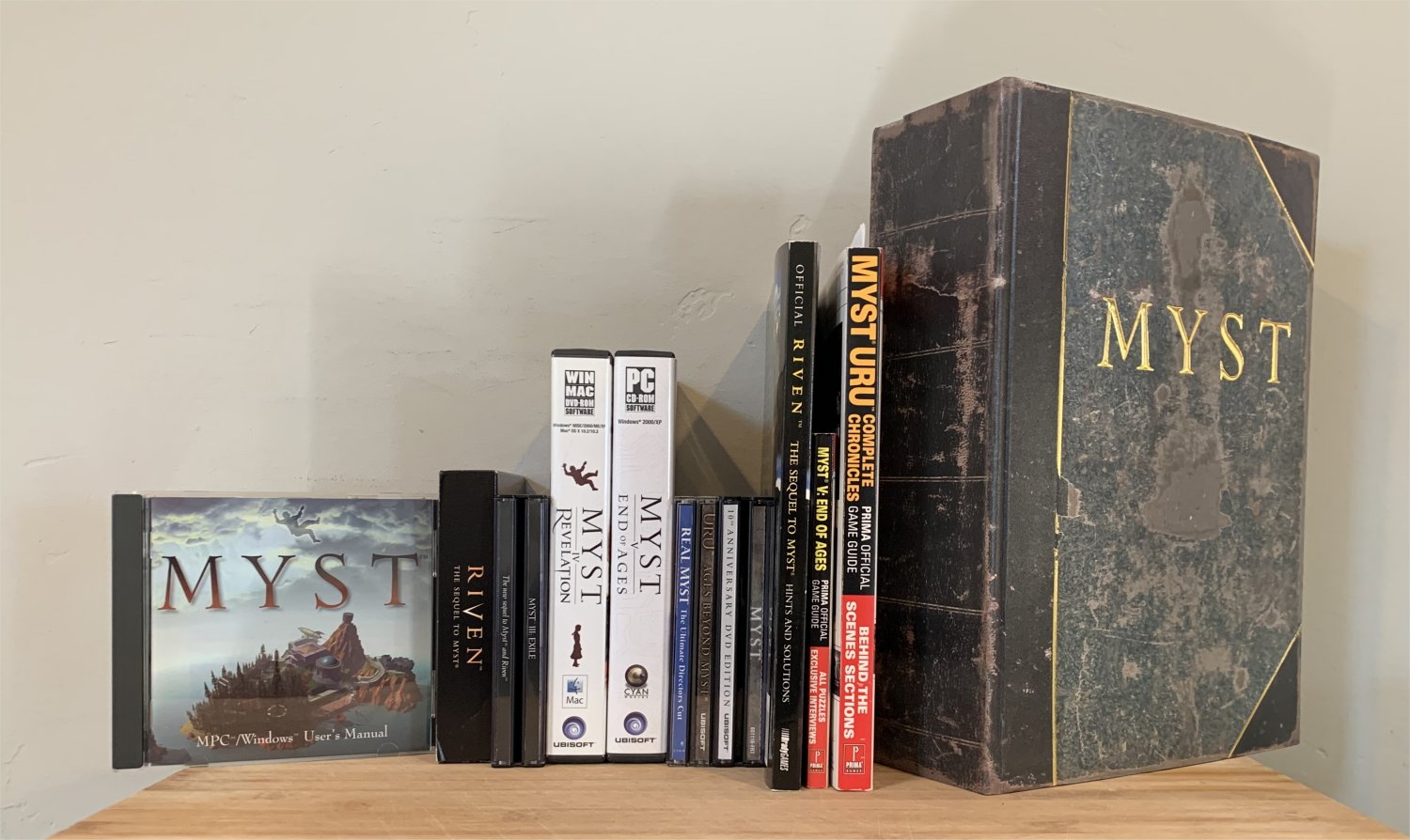
Over the following 20 years, I eagerly purchased each new Myst game as it was released. Here’s a photo of all the physical editions I have, from the first releases of all the games through Uru and Myst V (IIRC the Uru expansion packs were downloads), a “10th Anniversary DVD Edition” of the first three games, the three print guidebooks I have, and finally the recent Myst 25th Anniversary Collection, which I helped fund on Kickstarter, with versions of all the games that will run on modern computers, encased in a big box that mimics the “books” used in most of the games.

And since I keep records about everything, I’ll note the following:

  • Myst, 1994, took me 10 days to complete
  • Riven, 1997, two weeks
  • RealMyst, 2001, was straightforward because it was the same puzzles as Myst
  • Myst III, 2001, two weeks
  • Uru, 2003, almost a month
  • Myst IV, 2004, almost a month
  • Uru expansion packs, 2004, 3 or 4 days each
  • Myst V, 2005, four days
  • Uru Live (online, the PC game with additional areas to explore), 2007; intervals over several months as new areas were released at intervals
  • Obduction, 2016, two and a half weeks
  • The Witness, 2016, almost a month

Keep in mind I had a day job in all these years (up to 2012), and since 2001 have had a live-in partner who disapproves of computer games, so I was only able to play them evenings, weekends, or on the sly. Yet, each time a new game was released, I was obsessed about it until finishing—I remember once I drove home from work at lunchtime because I’d had an insight into solving some puzzle, and needed to check it out immediately.

I’ve included The Witness here as the only game I’ve found over all these years that remotely approaches the beauty and complexity of the Myst games. I’ve tried others – e.g. Rhem, Schizm – but they pale in comparison, consisting mostly of convoluted puzzles without the underlying real-world sense of living places where, unfortunately, the power had been turned off (for example).

While all the Myst games involved a solitary player in some strange, bounded environment, having to solve puzzles of various types, they varied in the exact goal of the game-play, and the player’s interaction with other characters. Key points:

  • All of the games involve one or more characters with whom the player interacts, or at least listens to. In the first game, game creators Robyn and Rand Miller played the three roles of Atrus, the man created Myst by writing a “linking book,” and his two crazy sons Sirrus and Achenar. (I’ve always thought it odd that these names are one letter away from names of bright stars in Earth’s sky.) In later games professional actors, some quite good, were brought in to play other characters: John Keston (https://en.wikipedia.org/wiki/John_Keston) plays Gehn in Riven; Brad Dourif (https://en.wikipedia.org/wiki/Brad_Dourif) as Saavedro in Myst III; Juliette Gosselin as the girl Yeesha in Myst IV; David Ogden Stiers (https://en.wikipedia.org/wiki/David_Ogden_Stiers) as Esher in Myst V.
  • With the except of Uru, I think, all the Myst games offer multiple endings, one a successful or happy ending, the other or others unsuccessful or tragic ones. Which ending you reach depends on your interaction with the characters, usually about who you decide to trust. The ambitious player can save game progress at a key point, and restart it to take different paths each time to see all the endings.
  • The games all have musical scores. As with the actors, in the first and second games one of the creators, Robyn Miller, did the music; after that professional composers, Jack Wall and Tim Larkin. While the music in the later games is slick, Miller’s music in the first remains the most iconic and haunting.

As game technology advanced, the manner of game-play changed from game to game, as mentioned above. Also, while the games all had similar puzzles to solve, there was usually something distinctive about each game.

  • Uru’s game-play advances by finding and touching seven “journey-cloths” in each world, enabling return to the player’s central private island called Relto.
  • Myst V you have a “slate” on which you can draw a shape or icon and then set the slate down on the ground; then when you step away from the slate, creatures called Bahro (as in Uru) approach the slate and interpret your mark and do something useful to solving a puzzle.
  • Myst IV you can “touch” things with your cursor and hear the sound of what tapping each item would be. And certain objects trigger memories of a character’s interaction with that object.
  • Myst III includes elaborate animations at the end of each age that take’s the player’s POV on some on a ride, on a trolley, back of a bird, or rollercoaster.

I will confess that I’ve never completed any of these games without searching out at least one hint. In the ‘90s game guides were published as trade paperback books, and I have them for Myst and Riven; since 2000 or so, when everything went online, there have been any number of sites that offer hints or walkthroughs or even YouTube videos showing how to solve every puzzle. I remember the exact point I got stuck in Myst: in the Mechanical Age there’s a control panel on top of an elevator, and the key to getting there is that you hit the “down” button in the elevator and then *step out* of the elevator in the brief interval before it starts moving. Then the control panel moves down and you can access it.

In contrast to the five Myst games, Uru was open-ended, with two “expansion packs” released a year after the original game to extend play and exploration of the underground city of the D’ni. Then the entire game went online, with additional areas added over a period of months in 2007. I played through some of those, but some of the “garden ages” required interaction between multiple players logged on at the same and able to interact. I found those annoying, as defeating one of the prime attractions of all these games: they were mysterious places one could explore privately. I didn’t want to have to interact with a bunch of strangers over the internet! Yet there were some intriguing differences between the main Uru games as installed on your PC, or accessible in Uru Online, so I did play most of the game online.

*

So do I have any favorite games or parts of games? Or anything I found relatively unpalatable or annoying? I think as I played them over the years, as they were released, I thought each new game was better in some way that the previous ones, if only because each had some new aspect of game play, or ways to interact with the environment. Yet I confess I never paid completely attention to the narratives behind the games—the rivalry between the boys, whey Gehn captured Catherine, and so on; and so the interruptions by Saveedro and Esher, the fragments of remembered conversations in Myst IV, were intrusions to be sat through. (There were two or three novels based on the games in the ‘90s; I never looked at them.) Perhaps that’s one reason I’ve replayed Uru, or parts of it, more often than any of the other games; after the introductory challenge by Yeesha, you’re off on your own, all alone.

I also look back more fondly on those games that were more than a hub world with three or four satellite worlds (or ages). Thus Riven, its ages more interconnected, and Uru, with its potentially indefinite collecting of new ages represented by books on you private home island in the sky Relto. I liked the music especially in the early games, and how the music enhanced the darker, moodier ages: Amateria in Myst III, Kadish Tolesa in Uru, Todelmer in Myst V, Kaptar in Obduction.

Fortunately a year or two ago I helped Crowdstart a 25th anniversary reissue of all the Myst games and Uru in versions suitable for modern computers. There was a long period, in the mid-2000s I think, when you couldn’t replay the original Myst or Riven, because they were incompatible with then-current operating systems.

And next is something called Firmament, https://fulfillment.fangamer.com/kindling/firmament, due some in 2020.

*

So since March 25th, when that NYT article appeared, I’ve played through, following online walk-throughs, all the games, including Obduction, with two exceptions. In Myst III I’m stuck at the same point I was originally, deep in Edanna near the glowing orchids, where you’re supposed to see a path through a rotting log in order to go further down. The game is too dark, the node movements too crude, and I can’t find the path down. And in Myst IV, I’m stuck at the monkey puzzle in Haven, with nothing happening when I spin the horns however slow or fast. Also I find the game-play interface most annoying in Myst IV; it’s nodal, and it’s slow, with a second or two pause after clicking before moving to the next node. So as I write, I’m paused at those points, but have finished the others all the way through.

Now maybe it’s time to get back to reading books.

Posted in Games, Personal history | Comments Off on Coronavirus Diary May 2020: Replaying the Myst games

Academics

(This is another essay to become a section of my “memoirs,” to be promoted to a page rather than a post, eventually.)

It’s a truism that once you become an adult and have a career job, no one cares about your GPA (Grade Point Average) in high school or college, or even what college or university you graduated from. (At best the university you graduated from got you interviews with companies who otherwise would have ignored you.)

Still, sometimes a look back at report cards and college grade reports can be interesting, even revealing. (I’ve seen a couple of my Facebook friends quote comments from their earliest report cards, to illuminate or contrast their early performance with their eventual careers.)

And since I’ve saved all my report cards, all the way from kindergarten, I think I’ll show some of them there, and comment about them.

I do have two particular points to make.

  • First, the earliest report card comments were generally correct about my later academic performance. At the same time, I did not always excel in subjects that later became my central interests.
  • Second, my college records from UCLA and later CSUN showed that my academic performance was dramatically different when I was just attending by rote, versus when I had a goal to reach. A B average at UCLA, and an A average at CSUN.

Kindergarten

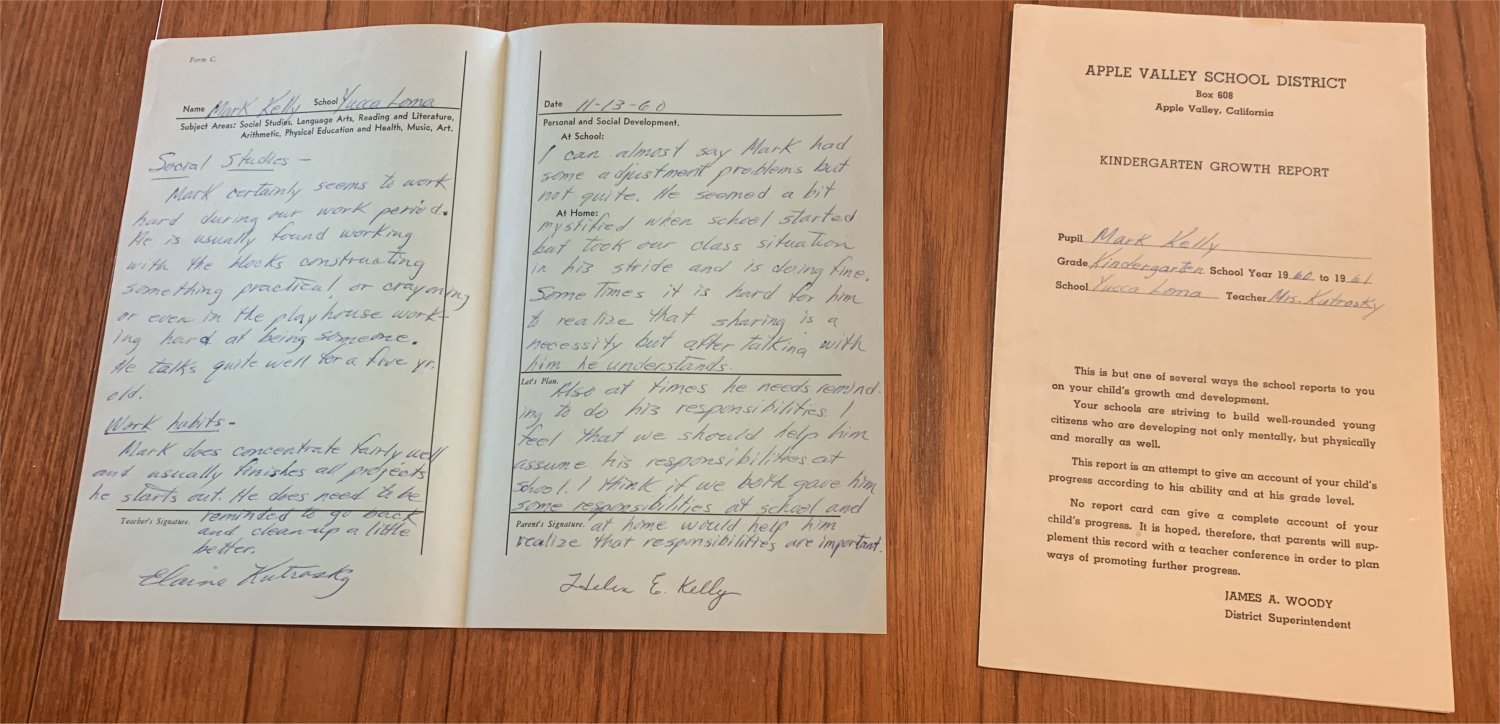
This was in Apple Valley, 1960-61, at Yuca Loma Elementary School, in the windy Mojave Desert. I have two artifacts from this. First, a “Conference Summary” from November 13, 1960; I had been in school a couple months. There’s a long hand-written comment by my teacher, Elaine Kutrosky.
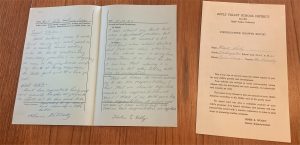
She wrote:

Social Studies—

Mark certainly seems to work hard during our work period. He is usually found working with the blocks constructing something practical, or crayoning or even in the playhouse working hard at being someone. He talks quite well for a five yr. old.

Work Habits—

Mark does concentrate fairly well and usually finishes all projects he starts out. He does need to be reminded to go back and clean up a little better.

I can almost say Mark had some adjustment problems but not quite. He seemed a bit mystified when school started but took our class situation in his stride and is doing fine. Sometimes it is hard for him to realize that sharing is a necessity but after talking with him he understands.

Also at times he need reminding to do his responsibilities. I feel that we should help him assume his responsibilities at school. I think if we both gave him some responsibilities at school and at home would help him realize that responsibilities are important.

And it’s signed by my mother, Helen E. Kelly. (I’m not sure what “responsibilities” referred to exactly. Cleaning up better?)
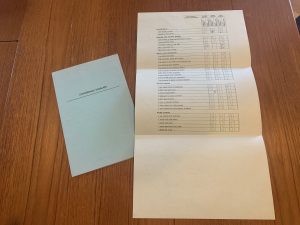
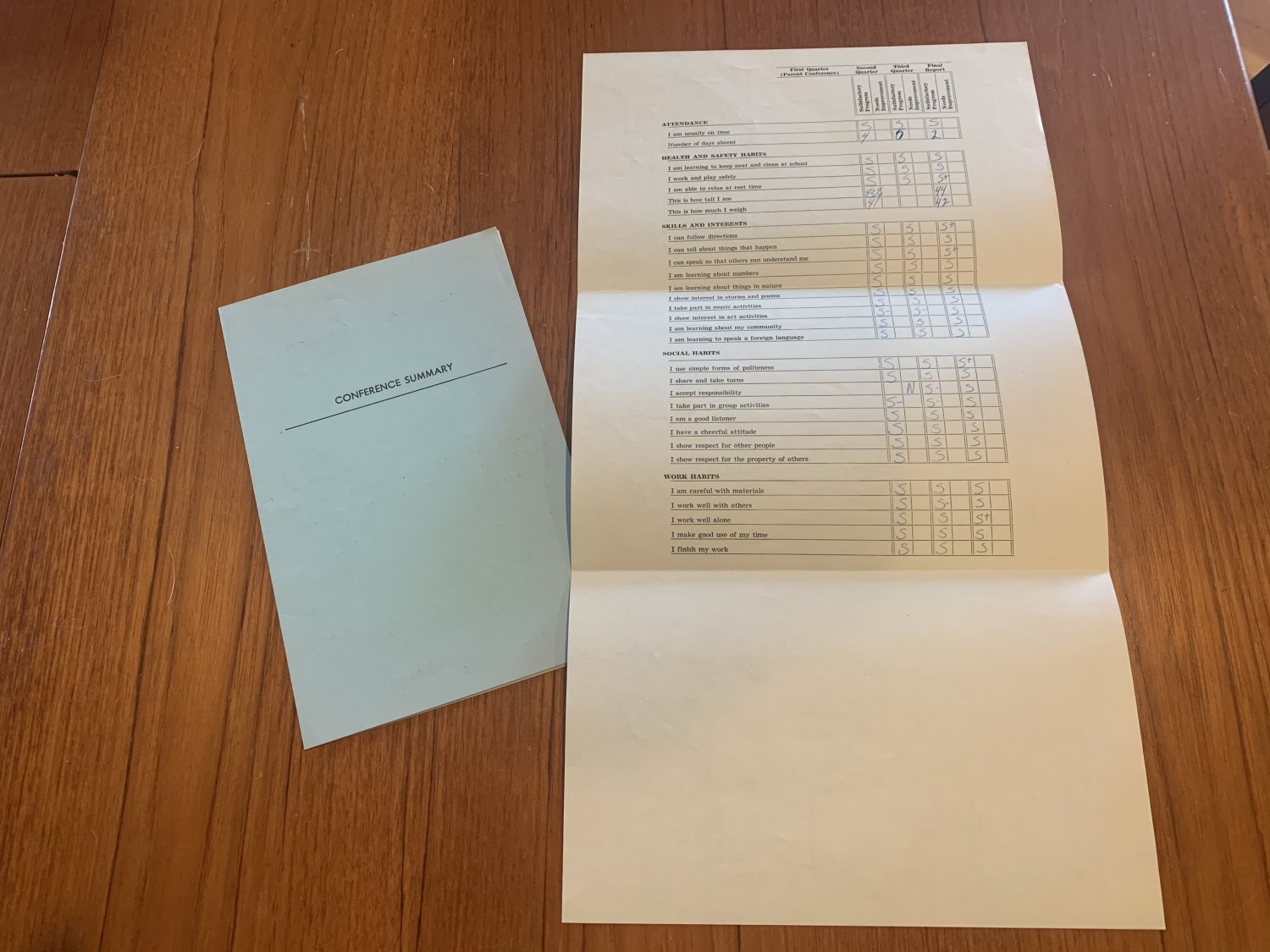
And I have my report card, or “Kindergarten Growth Report.” The scores are S, for satisfactory, S+, S-, or N, for needs improvement. I got one N, for “I accept responsibility.” I can’t imagine now what that meant. I got S+ scores for being able to relax (i.e. when we took naps on towels laid out on the floor), following directions, speaking well, being polite, and working well alone. (I’m still very good at this last item.)

The one comment from Elaine Kutrosky was “Mark seems to have potential for being a good student.” Note that this time my mother signed it as Mrs. Robert Kelly.

Grade School

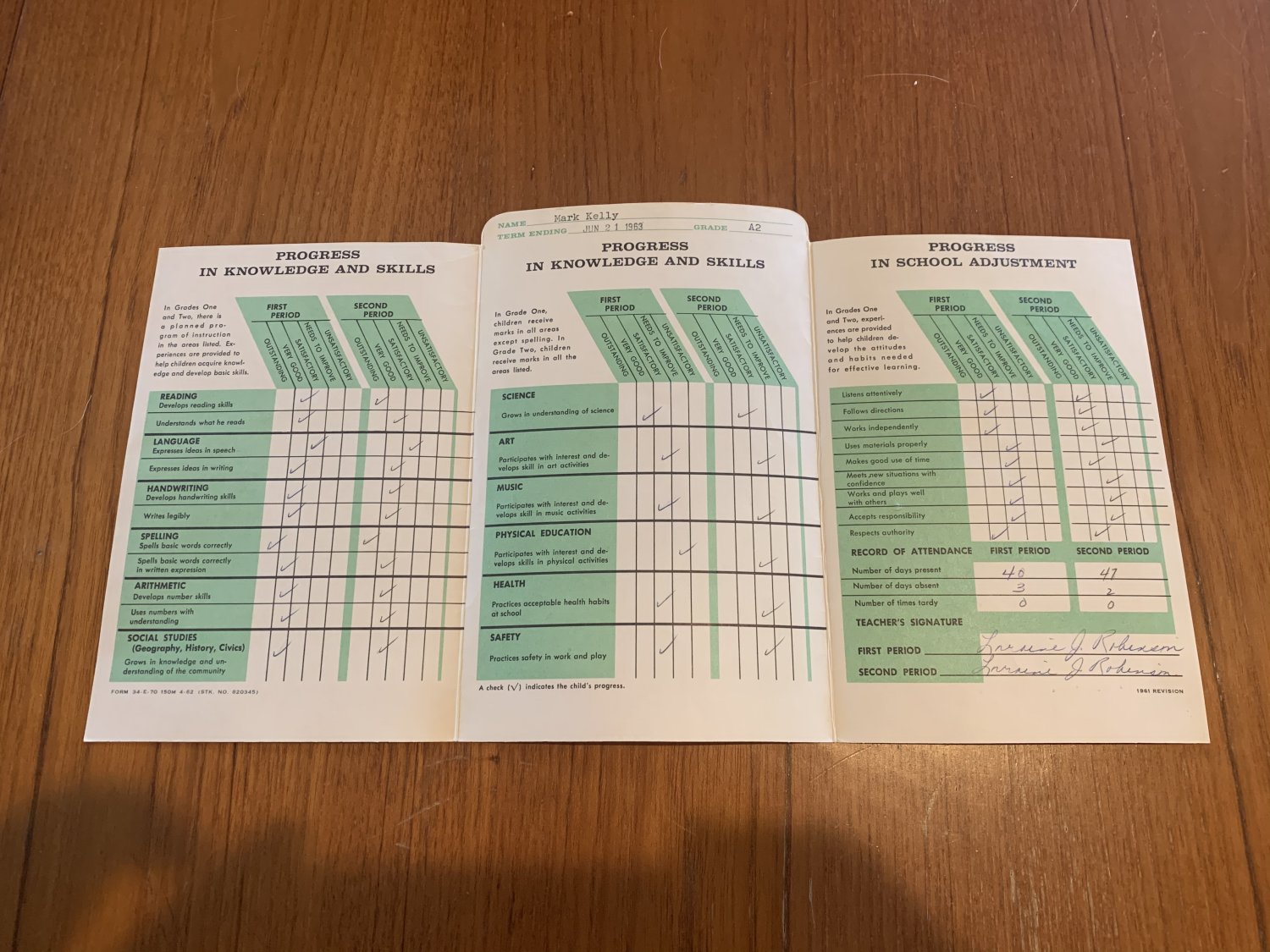
I don’t have a report card from the few months I attended Grant Elementary in Santa Monica, finishing first grade. The next card I have is from the end of second grade (A2 meant advanced 2nd grade, while B2 meant beginning 2nd grade). Throughout elementary school we were graded on “knowledge and skills,” on the one side, and “school adjustment” on the other. The former group included Reading, English, Mathematics, Civics, Science, and other subjects; the latter group covered Effort, Work Habits, and Citizenship.
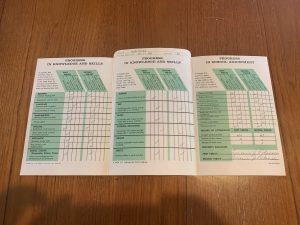
The possible scores are Outstanding, Very Good, Satisfactory, Needs to Improve, and Unsatisfactory. If these correspond to grades A to F, then in the second period I got As only for reading and spelling. Otherwise I got Bs and Cs, the latter mostly in School Development.

This time my father signed the card.

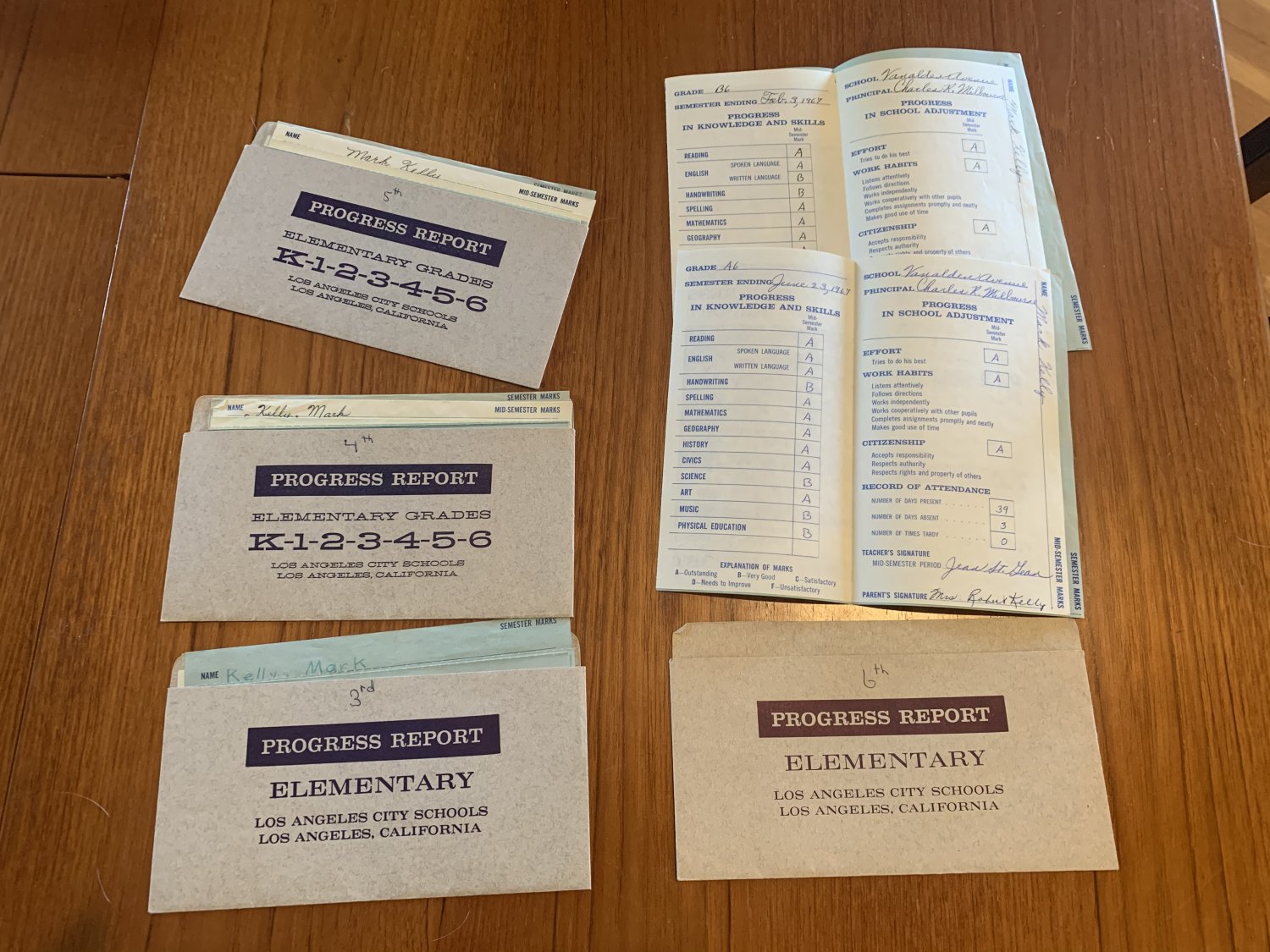
In grades 3 through 6 we got report cards that looked like this. Again, in 3rd grade, I got high marks for reading and spelling, otherwise Bs, except a C in physical education. (As I’ve said elsewhere, I hated the enforced games, like dodgeball.) Yet in contrast to 2nd grade, I improved and got As in Effort, Work Habits, and Citizenship. In 4th grade I got similar marks, mostly As, Cs only in handwriting, music, and P.E. Slight variations in 5th grade.
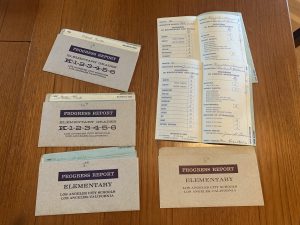
At the end of the 6th grade – the ultimate judgement of elementary school – I finished with 12 As and 4 Bs. In those last two or three years, I’d always been recognized as one of the top students in each class. (As I recall, given the size of the school, each year’s class occupied two classrooms, about 30 students in each classroom.) But, as I walked out of Vanalden Elementary School for the last time, I understood that one or two other students had higher percentages of As than I did. Oh well; I would never see most of the other students there again.

It’s curious that a couple of those Bs were in science, and music, which later became core interests of mine. What did science consist of in 5th or 6th grade? I don’t recall. And in 5th grade, when I got a C in music, that was the year we got “tonettes,” (https://en.wikipedia.org/wiki/Tonette), a basic wind instrument in plastic, like a simple recorder (https://en.wikipedia.org/wiki/Recorder_(musical_instrument)), which I recall being pretty good at, or at least enjoyed. I suppose I wasn’t that good. (Later, I my 20s, I bought a plastic recorder from a music store at the Northridge Mall and played around with it for years, playing simple tunes from folk music or movie scores. I still have it, but haven’t played it in years.)

Junior High and High School
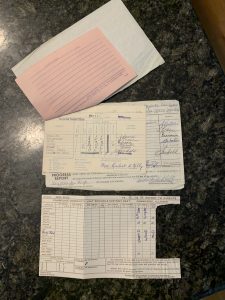
As explained on my Personal History page for these early years, the key fact about the six grades, from 7th through 12th grades, is that I attended five different schools over those six years. That was a consequence of family moves to Illinois and back, and of course the transition from Junior High to High School.

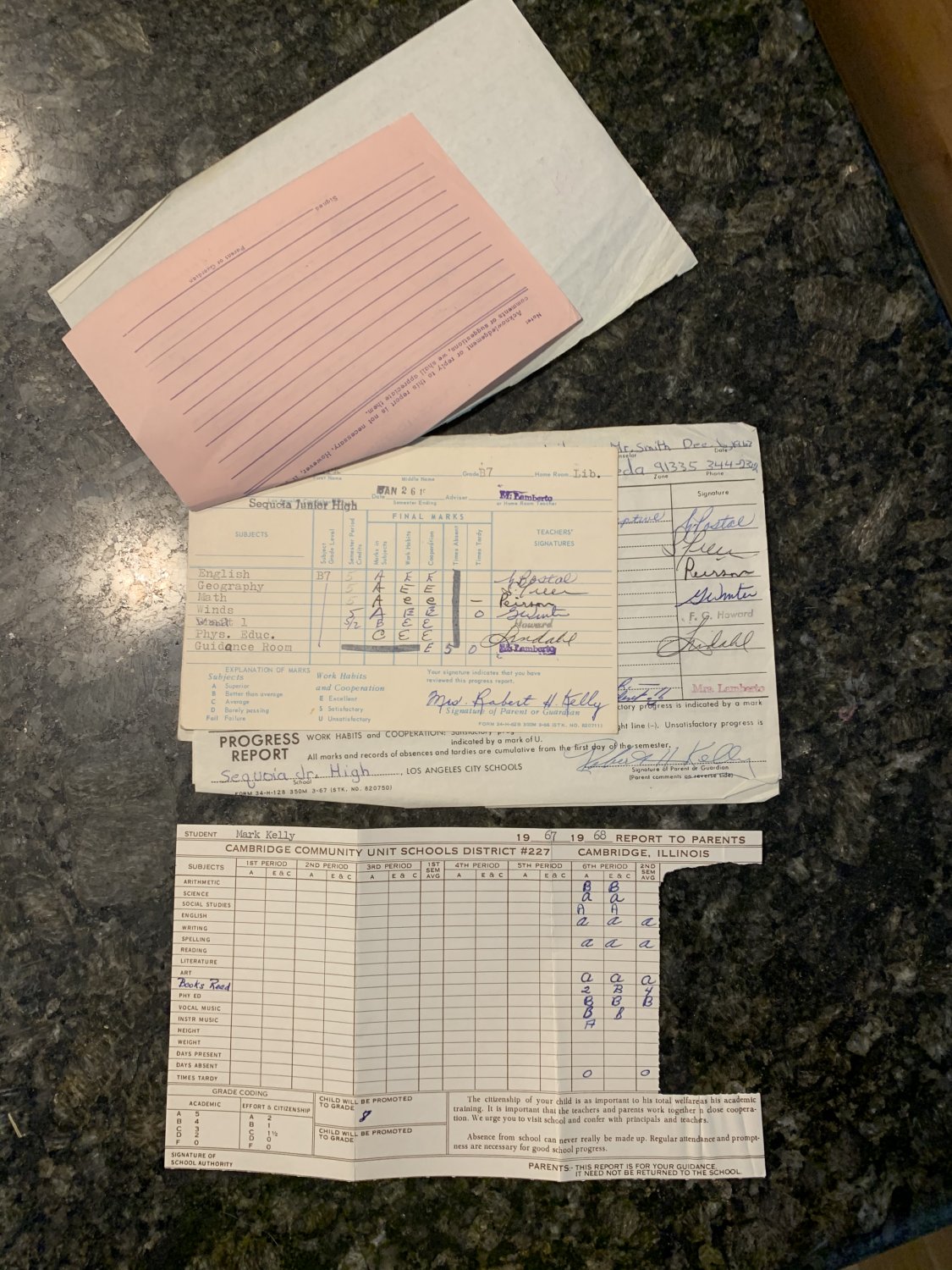
I began at Sequoia Junior High for the 7th grade. I have “Progress Reports” with no grades, just comments. “Tops in class” my math teacher wrote. My English teacher wrote “good student—very perceptive”; my Geography teacher wrote “outstanding”; my homeroom teacher Mrs. Lamberto wrote in October “Use guidance room time wisely—read—study” but by December wrote “a ‘joy’ to have in H.R.—real gentleman of a student.” I also have a separate “Complementary Report to Parents” from my Geography teacher, dated 11/17/68, saying “Mark does very fine work.”
I have two report cards, one with four As (English, Geography, Math, Winds [music, beginning clarinet], one B (in wood shop), and one C (Phys. Ed.). The second with the same subjects, my grade in English fallen to a B, my grade in shop, now drafting, an A, and my grade in P.E. a D(!) – this was when we had to throw softballs, and I was ‘uncoordinated.’

And then a mid-school-year transfer to small town Illinois, to Cambridge Community Schools. I have one report card. Mostly As, but a B in arithmetic, and in vocal music (I don’t remember that class at all), and in Phys Ed, yet an A in instrumental music, even though, as I’ve written elsewhere, the move promoted me into a class of students with more practice learning instruments than I’d had, and I felt I never caught up, was always a minor 3rd rate performer.

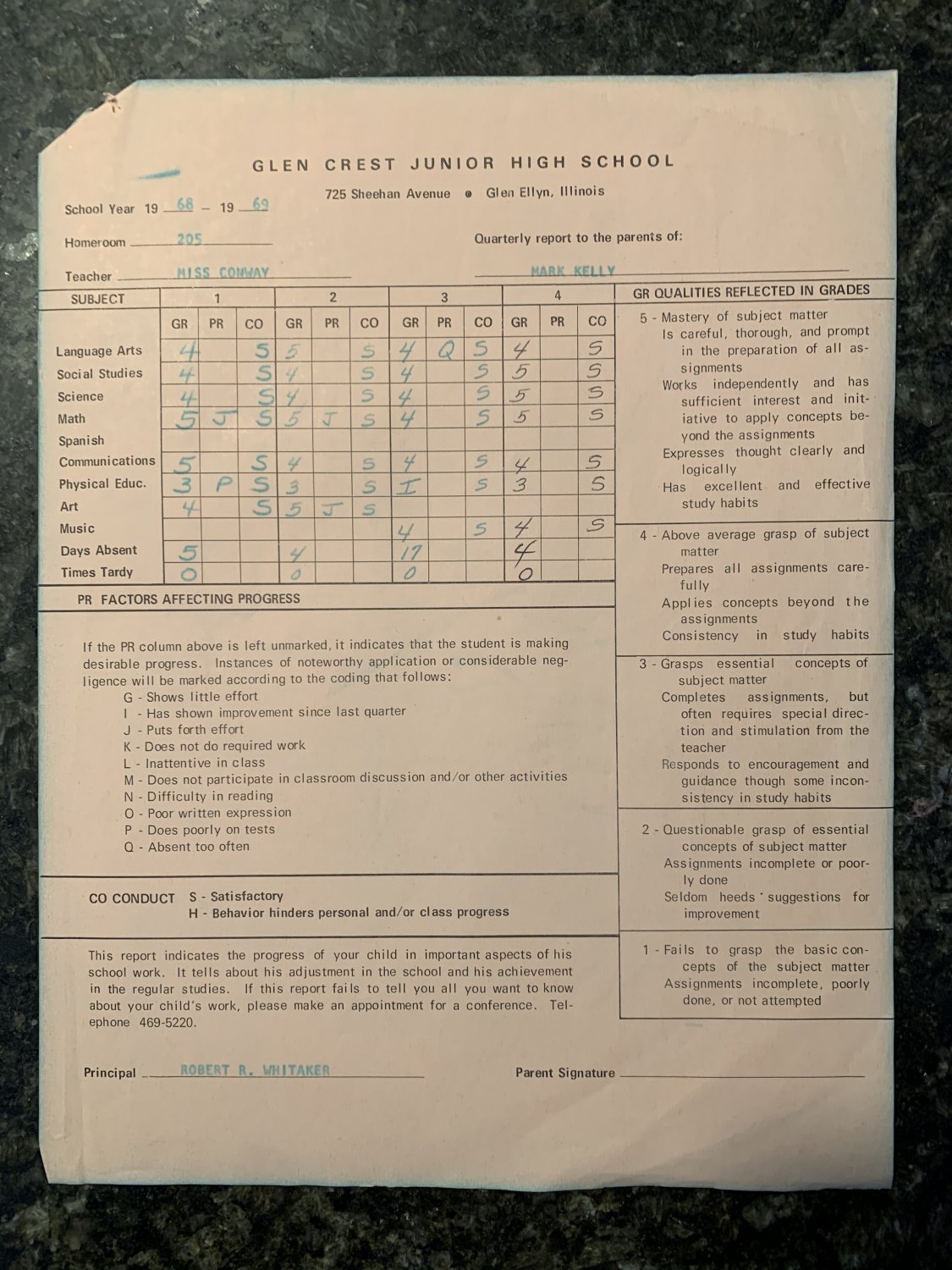
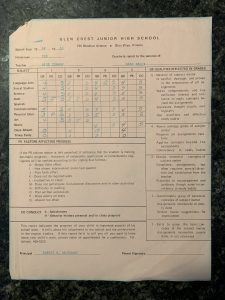
And then Glen Crest Junior High School, in Glen Ellyn IL, for one year. A school that used numbers rather than letters. I got 5s in Social Studies, Science, and Math; 4s in other subjects except (of course) a 3 in Physical Educ. My conduct was Satisfactory in all cases.
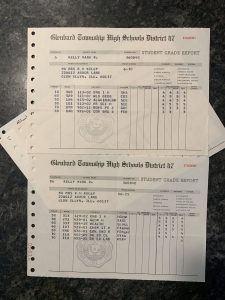
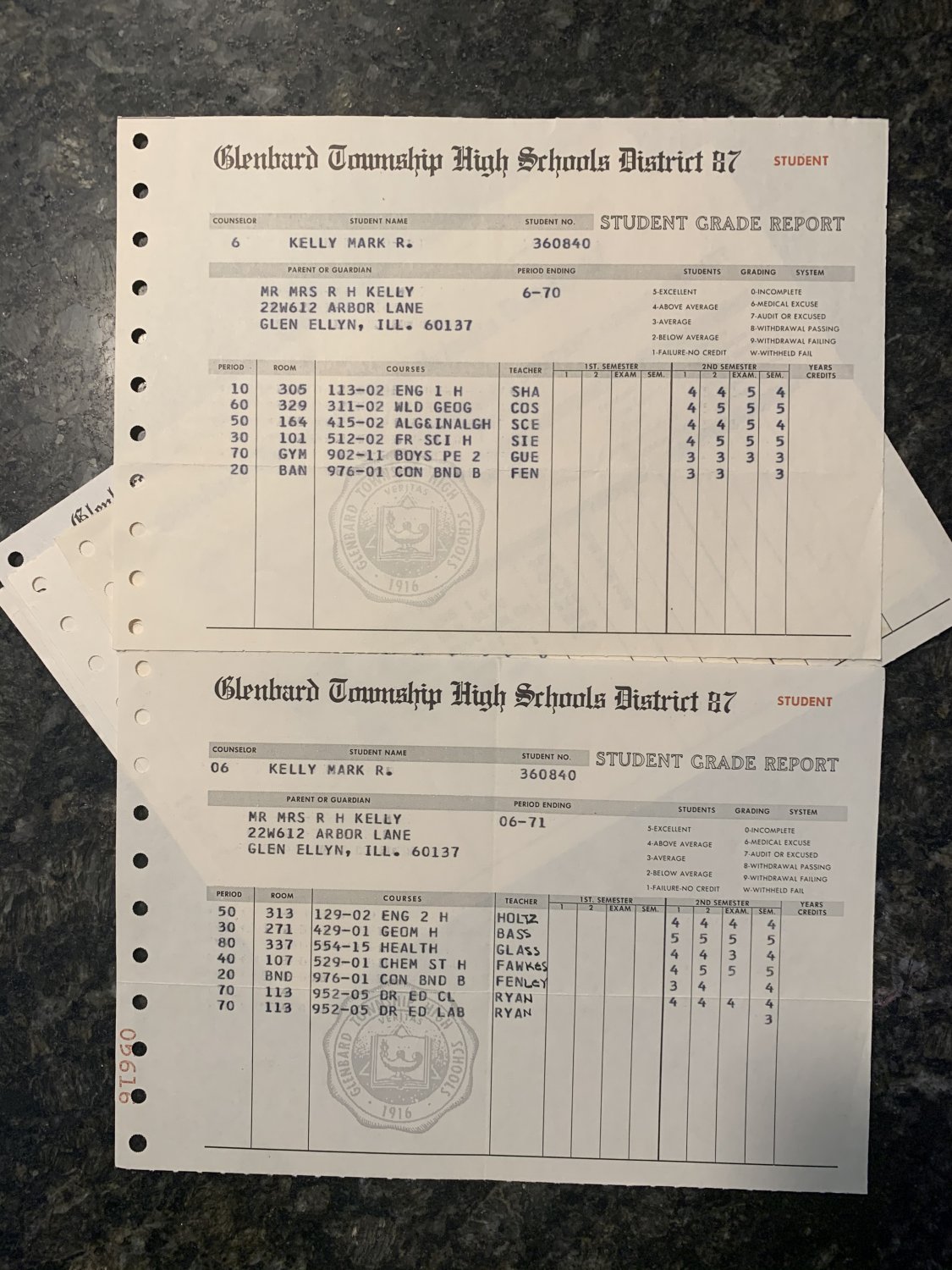
And then to Glenbard Township High Schools, for two years. I attended Glenbard East (https://www.glenbardeasths.org/). At the end of these two years, I got 5s in geometry, geography, freshman science, and chemistry. 4s in most other subjects including English, algebra, health (this was sex education), concert band, and driver’s ed. (We had driving simulators, in class, and then drove real cars out on the icy-slippery local streets.) And P.E.

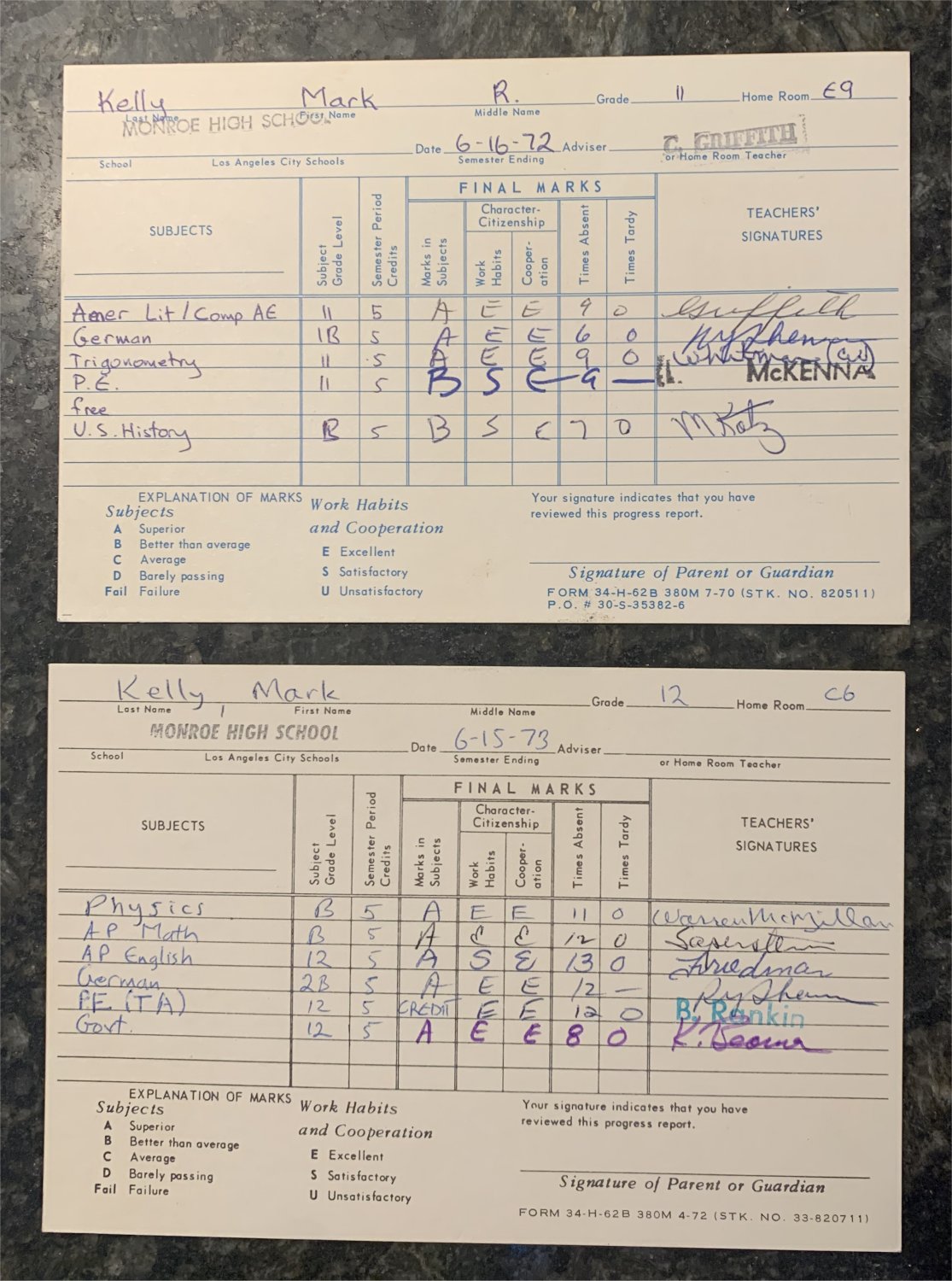
And then back to California for the last two years of high school, and James Monroe High School in what was then known as Sepulveda, now North Hills (either way, a 91343 postal zone district of the city of Los Angeles). I was doing really well in high school in Illinois, but the high school in California didn’t quite trust those grades, and so didn’t enroll me in as many advanced placement classes that I might otherwise have been enrolled in. Thus, for example, I had no science course in the 11th grade, when ordinarily I would have taken biology; so I never had a biology course in high school. In my first semester I had Advanced algebra/trigonometry, US History (which as I’ve described wasn’t a comprehensive course, but rather a series of 10-week studies on particular topics), German, and typing. And P.E. I’ve discussed the significance of the typing class, even though I got a B; As in the first three, a C in P.E.
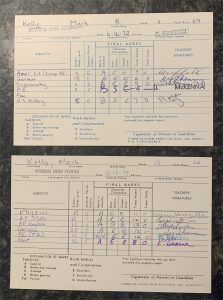
My final high school marks, in June 1973, were better. I got As in physics, AP math, AP English (that memorable course with Mr. Eugene Friedman, who in addition to having us read classic novels and plays gave us weekly quizzes on current events via Newsweek Magazine, who had a monthly soiree at his house, on Louise Ave., for his students), and a credit for P.E. because Mr. Friedman had worked with the P.E. teacher to have me work as Friedman’s assistant instead of attending P.E. class.

I graduated 40th in a class of 1000.

And so my high school marks were high. As described in my Personal History for this era, I took the PSAT, did well, interviewed with CalTech and MIT, and ended up at UCLA.


IQ test

In the 11th grade, after scoring well on the PSAT, one of the things that happened, in addition to being summoned and recognized by the college counselor, was that I was pulled out of class one day for a private session with some visiting official, who gave me what I gather was an IQ test, or some test about identifying special students. I don’t know; I never heard the results. I do remember a couple particular things about the test.

First, one part was a page of simple arithmetic problems. I started at the top and worked my way down. The instructor said, the ones at the bottom count more. Feeling manipulated, I determinedly kept working them in order. And the time ran out, I didn’t finish the entire page. What was being tested here?

Second, another part was that I was given a blank page and asked to draw a human. I can’t sketch for beans, but I tried to do something, and what I realized was that I was using just the upper left corner of the sheet to draw and small figure – not the entire page, with a large sketch centered in the middle. Was that what was being tested?

As I said, I never heard anything about the results of this test. Presumably I was not identified as any super-extraordinary student.

College Entrance Exams
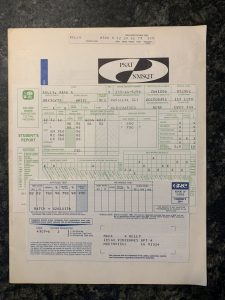
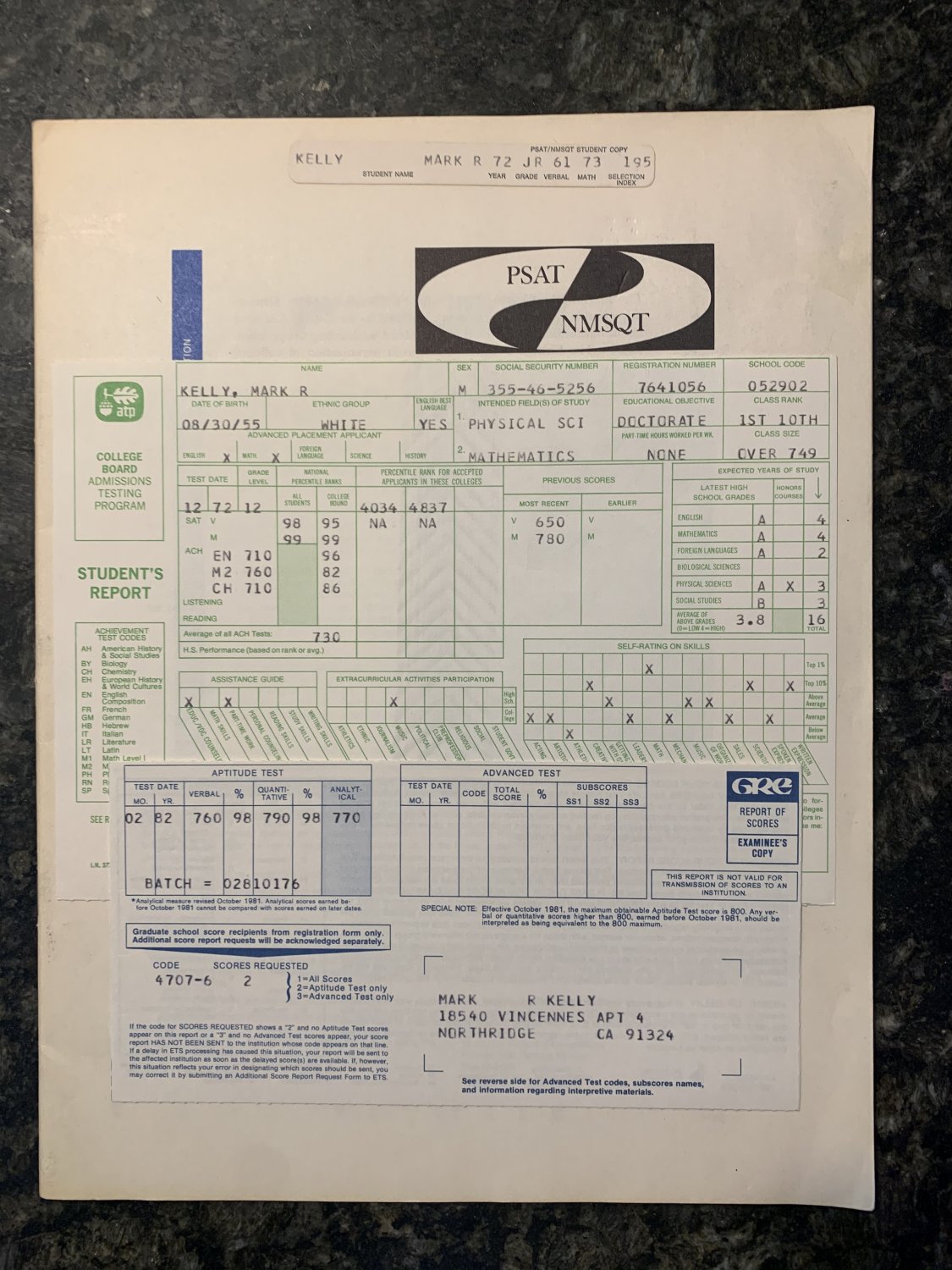
I took the Preliminary Scholastic Aptitude Test, PSAT, sometime in 11th grade (as discussed in my Personal History essay). I scored 61 verbal, 73 math. According to the booklet that accompanied my results, those corresponded to about 95 and 98 percentile of all juniors who later entered college (and higher for all juniors). I was among the top four scores at my high school. This is what attracted the attention of the college counselor/AP English teacher, and got my photo on the front page of the Valley News and Greensheet, along with all the other 11th grade high-scorers in the San Fernando Valley (population at the time about a million).

The PSAT doubled as a test for the National Merit Scholarship Qualifying Test (NMSQT). I don’t remember the details of that program; I think it depended on the college you went to, parents’ income, and so on. Since I went to nearby UCLA, where the tuition was something like $200 per quarter (three quarters a year, not counting summer), I didn’t qualify. So I never got any kind of scholarship.

Then in 12th grade I took the SAT, Scholastic Aptitude Test, which is used by the colleges you apply to, along with your high school GPA, and in some cases personal interviews (as I had with representatives from CalTech and MIT). And, optionally, you take various Achievement Tests in particular subjects.

You can retake some of these tests, but from the paperwork I have, I only took the SAT once. Verbal 650, math 780; 98 and 99 percentiles among all students, 95 and 99 among college bound students.

I took several Achievement Tests, a couple of them twice. Math 2: 760 the first time, 800 the second time. English: 710. Chemistry: 710. American History (why did I take that? I never had a decent history course in high school. Maybe it was required.): 460.

Some six years later, as I enrolled at Cal State Northridge for a Master’s Degree (which I didn’t finish), I took the GRE, the Graduate Record Exam. There were three scores, for verbal, quantitative, and analytical. I scored 760, 790, and 770.

UCLA, 1973- 1977

I’ve said this many times in various places, that attending UCLA, living at home with my parents and younger kids, commuting to school over those four years, was the worst situation I could have been in. Parents: sent your kids away to college. Let them live on their own. That’s as much a part of the college experience as taking university courses. Whereas I was stuck at home, with three younger noisy siblings; my four years at UCLA, driving there every day from home, were to me an extension of high school.

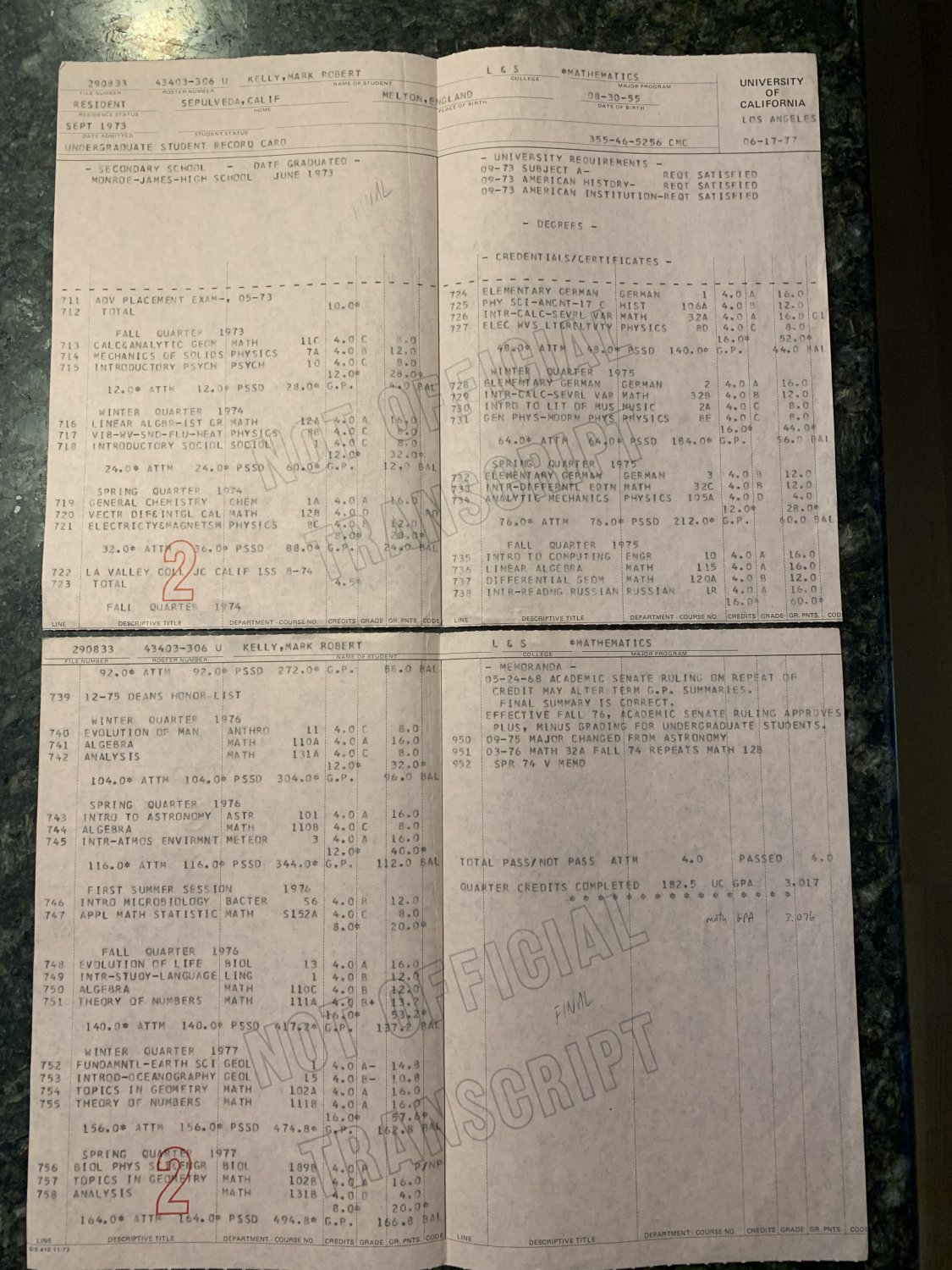
At UCLA, I did OK. My initial ambition was to study astronomy, my early passion. But an astronomy major entailed studying physics for the first two years, and I did OK only up to a point. Many people, I’ve understood from some of my Facebook friends, have a point in their studies, especially in physics or math, where they suddenly don’t “get it.” Their intuitive understanding of the subject disappears. (This evokes a deep theme, the idea that perception of reality is limited or enabled by one’s native intelligence, one that I’ll explore in my book about science fiction.) For me, it was the third quarter of my sophomore, quantum physics, Feynman diagrams, and I just didn’t get it. I couldn’t work my way through them. I got Cs, even a D, in those courses.
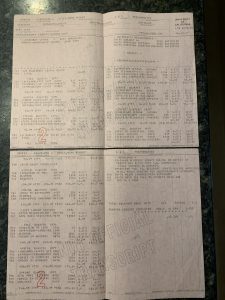
I didn’t have any clear goal about a career. At the end of my sophomore year, I changed major to math, where I’d done better. As in any major, certain core courses are required, and beyond them are various options, specific courses of study one can select from; every field has specialties. I did better in some core courses than in others, and so I gravitated toward the fields I did best in. I hit a wall with what’s called “analysis,” which is the justification from first principles of calculus. It involved much study of infinitesimals, and asymptotes, and I struggled. On the other hand, I liked, and did well, in math classes on discreet topics: number theory (elementary topics there involve prime numbers and the Fibonacci sequence), linear algebra, group theory especially, and so on. I moved from getting Cs in math classes – my major! – to getting As.

I notice, riffling through my files, that on my SAT tests I identified my career goal as “doctorate.” My early ambitions to become an astronomer would obviously have indicated that direction, since there are few industry jobs for astronomers. During these years at UCLA, I had to recalibrate. For a time I considered becoming a teacher, say, a high school math teacher. Even then, I felt I was good at explaining things. (….whatever happened to that?)

As I look at my “Undergraduate Student Record Card” (shown here), i.e. my grades while in UCLA, I recall another issue about attending college. Having taken AP, Advanced Placement, courses in high school, I had license to skip introductory college courses in those subjects. In retrospect, bad idea: college courses are faster and more rigorous than those in high school. My first quarter at UCLA, I took math 11C – skipping 11A and 11B – and got a C. Similarly physics; I got a B, then a C in second quarter. I should have started from the beginning, in college.

CSUN, 1980- 1983

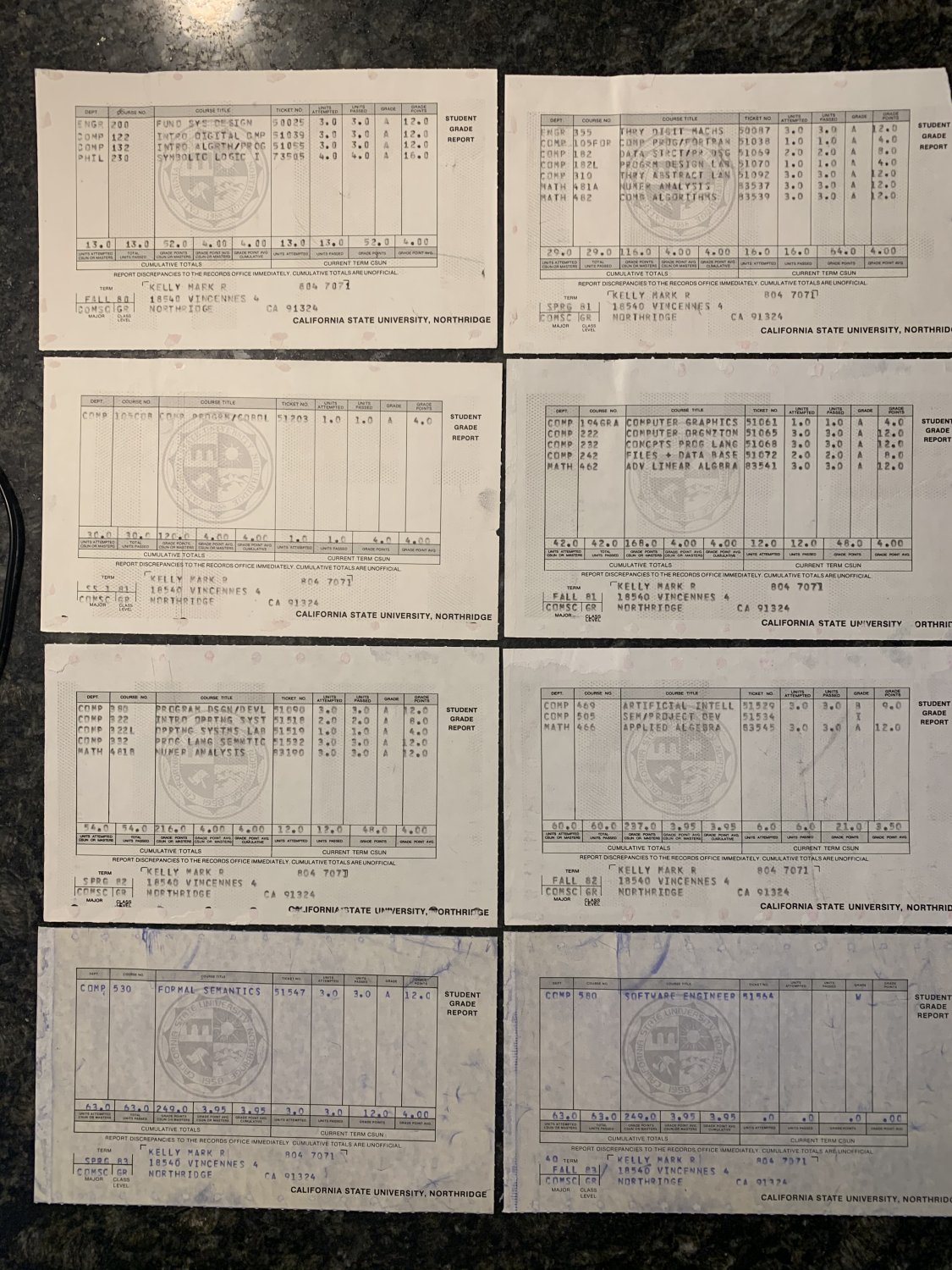
Here we come to the second point in my introduction. After working a non-technical job for a couple years after finishing UCLA, I rallied myself and decided to go back to school, this time in the more useful field of computer science. Part of the timing here is that I had to have supported myself for a couple years before I was eligible for student loans and work/study. Thus, I quit my day job and lived, for two full years, on student loans and a part-time job on campus. I took a full load of courses in each of four semesters, over two years. I enrolled at first for a second bachelor’s degree. Having the first such degree, I was exempt at CSUN from various “breadth” requirements, courses outside your major required to broaden your horizons. So I only had to take computer science courses, and some peripheral engineering and philosophy (i.e. formal logic) courses, to satisfy the requirements for a B.S. in computer science. I also took a few math courses, some of them perhaps required (e.g. combinatorial algorithms) but some perhaps just for fun.

Anyway, for four semesters running, plus one summer session, I got straight As. In 22 different subjects. (Some were small courses like labs or 10-week intros to old computer languages like Fortran and Cobol.) Of course, there’s a substantial difference between a UC school and a Cal State school; the Cal State campuses are middle-tier universities, somewhere between community colleges and the top-tier UC system. So it would always have been easier to get straight As at Cal compared to UC, whatever my determination.

By Spring of ’82 I’d decided to pursue a career job, and got much assistance from campus programs to bring corporate recruiters on site. But I’d also decided to continue school, and changed my intentions from a 2nd bachelor’s degree (which I therefore did not receive) to a master’s degree. I started work in June ’82, but kept taking courses in the evenings for another year and a half, three semesters. The Cal State colleges, unlike University of California campuses, served many students who worked during the day and took classes at night.
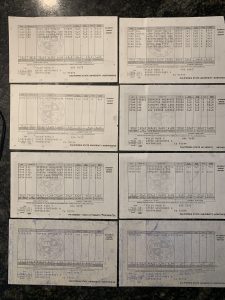
But it was a lot of work. In Fall ’82 I enrolled in two full courses and one prep course on how to develop a thesis. Too much work. I dropped the latter, got an A in one of the others, but only a B in the third—only because I didn’t complete the special project required for the A. I took one course in Spring ’83, and got an A. And then I took one class in Fall ’83, one which required writing two or three big papers, and was not keeping up—so I dropped it and got an incomplete. Ironically, that last course was in “software engineering,” i.e. the process by which industry software projects are planned and managed – exactly what my day job was all about!

So I finished with a cumulative GPA of 3.95, without a degree. But the courses at CSUN had served their purpose. I had a full-time professional job, one that I kept, with variations in assignments, for 30 years.

Certificates and Awards
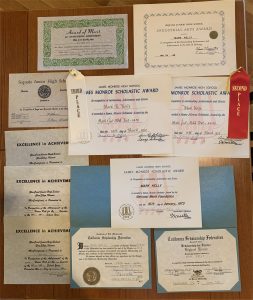
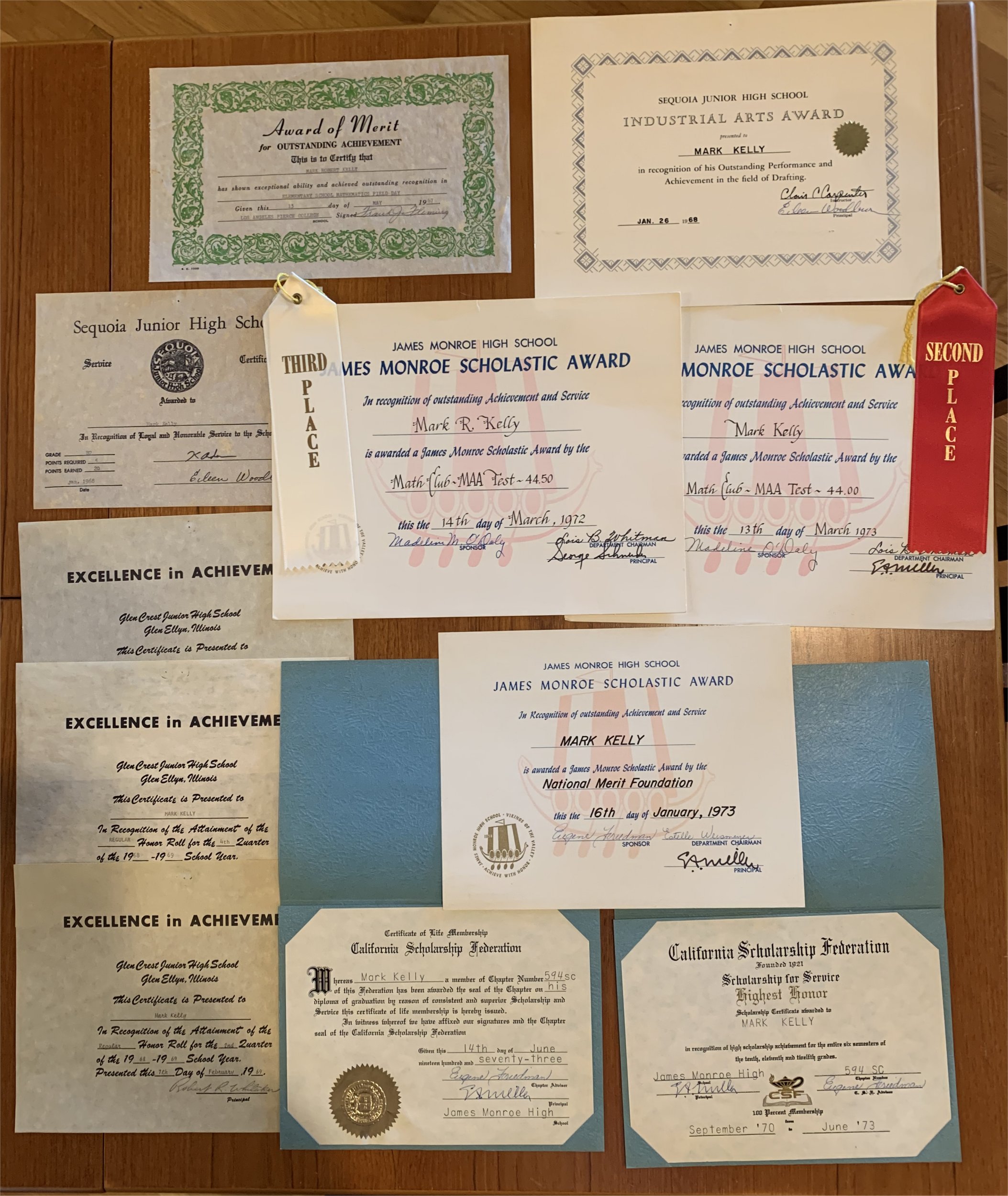
If in Boy Scouts you got lots of badges and patches, so many that you need a vest-like “patch jacket” to display them all, but no paperwork, in school and college (and later at work) you lots of paperwork in the form certificates and awards that one could frame and put on your wall (but no badges). Here are some photos of a bunch of them from Junior High and High School.

The earliest, at upper left, is for participating in an “Elementary School Mathematics Field Day,” in May 1967, i.e. near the end of 6th grade. I don’t remember this.

The next, upper right, is an “Industrial Arts Award” in 7th grade for having done well in that drafting course. I suppose my father was tickled, him being an architect.

The next two items, with ribbons, were for participating in Math Club test, the MAA; again, I don’t remember the details. I was 3rd in my school one year, 2nd the next.

The three at the bottom were consequences of my having scored well on the PSAT, and having become a finalist for the National Merit Scholarship and a life member of the California Scholarship Federation. My membership in that federation never had any consequences beyond receiving these certificates.

And the ones along the left are various “service” and “honor roll” certificates for having had high GPAs in 7th and 8th grades.

I’ll have a bunch more analogous certificates and awards when I summarize my professional career at Rocketdyne.

Another IQ Test
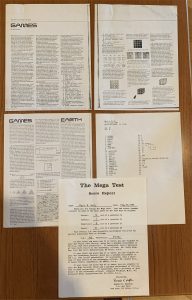
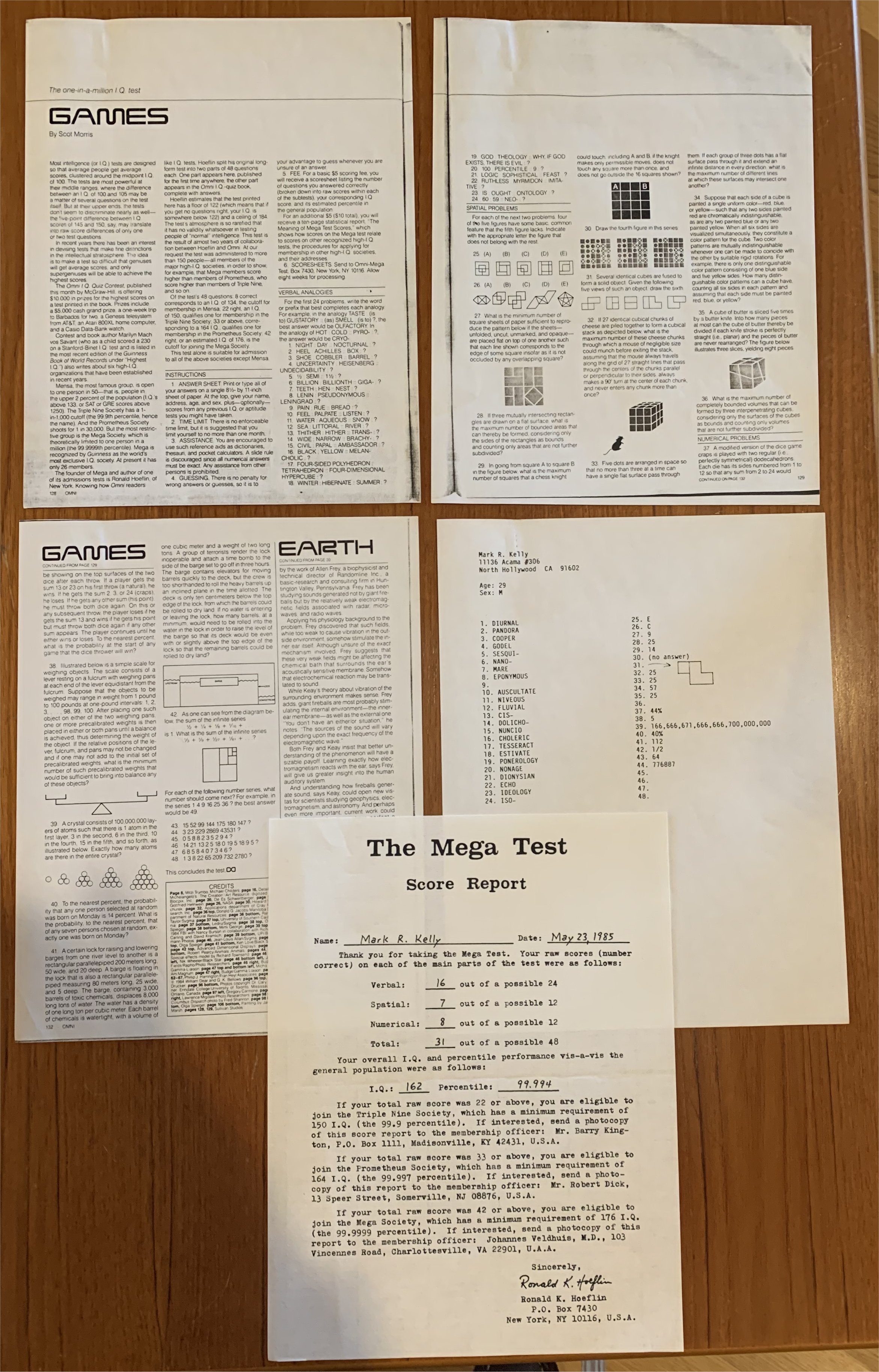
A few years later I took another IQ test, this one self-administered. That may sound odd, but the test was deliberately designed to be extremely difficult and not open to the casual looking up of answers. It was called the Mega Test – it even has a Wikipedia page, https://en.wikipedia.org/wiki/Mega_Society — and was designed to discriminate among those who score highly on standard IQ tests. (I seem to recall that I did take a standard IQ test at some point, and scored 132? But I have no record of it.) The test was published in Omni magazine in early 1985, and readers were invited to submit their answers, taking as much time as they needed to work them out, for scoring. I spent a considerable amount of time—I have a folder full of several dozen sheets of paper with calculations and diagrams trying to work out the answers – submitted my answers, and got a scoresheet in return dated May 23, 1985. Of the 48 questions, I answered all but 7, but I got only 31 correct and so was incorrect on several I thought I’d figured out.

Anyway, I got 31 of 48 correct, corresponding, according to their booklet, to an IQ of 162.

I can’t find the test itself anywhere online, though there’s a similar one here, http://miyaguchi.4sigma.org/hoeflin/ultra/ultra.html. But I’ll photograph the photocopies I have of the test I took, along with my answers and results. (I’ve inserted this photo at especially high resolution so you can read all the original questions.)

I never bothered to apply to Mensa (or similar organizations); I wasn’t interested in joining a club, I just took the test for fun, as a solitaire puzzle to see how much of it I could figure out.

Final Point

Of course, there’s an obvious third point to make: there’s not a high correlation between high grades, or a high IQ, and success in life. I had a decent career, earning a bit over six figures a year by the end of it (in 2012), but I didn’t move into management or become any kind of expert. Outside work I built some databases, wrote some reviews, created a couple websites. I even won a major science fiction award. But I’m not the least bit famous, and it’s unlikely anything I’ve done will be remembered once I’m gone.
 

Posted in Personal history | Comments Off on Academics

Links and Comments: 28 Apr 2020

One of today’s news sites links to an article about how Trump, and science-deniers in general, aren’t trying to fight science per se, but are trying to “claim the prestige of capital-s ‘Science.’”. Adam Laats at the History News Network:

Fights against science itself tend to lose, but fights for the right to call bad ideas “Science” can go on for generations. [discussion of evolution-denial] … When President Trump says his decisions will be based on a “hunch,” he is repeating the tactics of generations of creationists. It might sound at first like he is rejecting the need for scientific credentials or expertise. In fact, though, Trump is positioning himself as superior to those experts, not against them.

This reminds me of the common perception that Trump supporters don’t care that he lies all the time, that he’s an idiot, that he’s a despicable person; it’s about “owning the libs.” There’s something about a resentment of intellectuals, people who understand complicated things that others do not, that drives some people to use any means possible to win, by any disreputable means possible. A weird kind of American exceptionalism.

And another example of how resistance to established science is driven by psychology, not by evidence or reason.

\\

Coincidentally, reviewing my notes about Fred Hoyle’s 1957 novel The Black Cloud, I see a wrote down a passage about an encounter between a Home Security official and a professor of astronomy at Cambridge, about how to deal with the investigation of an approaching interstellar dust cloud.

The two men were mentally too dissimilar for more than a half hour of conversation between them to be possible. When the Home Secretary talked, it was his aim to make those to whom he was talking to react according to some pre-arranged plan. It was irrelevant to him how he succeeded in this, so long as he succeeded. Anything was grist to the mill: flattery, the application of common-sense psychology, social pressure, the feeding of ambition, or even plain threats. For the most part like other administrators he found that arguments containing some deep-rooted emotional appeal, but couched in seemingly logical terms, were usually successful. For strict logic he had no use whatever. To Kingsley on the other hand strict logic was everything, or nearly everything.

The difference between politics and science.

\\

A couple weeks ago the New York Times Book Review ran a review by George F. Will of Andrew Bacevich’s anthology of essays, American Conservatism. Two weeks later several letter writers responded, noting especially conservatives’ history of racism and antipathy toward civil rights. And this:

Nothing summarizes American conservatism more succinctly than its devotion to cherry-picking those intellectual arguments that reinforce its members’ preconceived notions.

Preconceived, often religiously-inspired, notions are what they’re trying to conserve, despite the evidence of the real world. You can always find Some Random Guy with a blogspot page, or some random YouTube video, to support any position. Just as you can selectively quote Bible verses to support any position you like (as Christians did in the 19th century to defend slavery).

\\

Two op-eds from last Saturday’s NY Times.

Timothy Egan, How Republicans Became the Party of Death. Subtitle: “People are disposable. So is income. For the ‘pro-life’ party, one is more important.”

(This expands on a comment I made in a Facebook post a couple weeks ago.)

When Lt. Gov. Dan Patrick of Texas doubled down this week on prior remarks elevating commerce above life — there are “more important things than living,” he said on Fox News — he was speaking for a significant slice of his party. People are disposable. So is income. But one is more important.

All of this follows Trump’s obsession with money over human life, with markets over medicine. On Wednesday, just as the United States reported its largest daily death toll to that date, Trump tweeted: “States are safely coming back. Our Country is starting to OPEN FOR BUSINESS again.” So much for the departed.

Given that Trump is an alpha-male simpleton with no filter, it’s never difficult to find the true motive behind his tactics. As he has said, he wants all the authority and none of the responsibility. If we lose a quarter-million Americans, it’s the fault of governors running their respective shows. If the number is far less, it’s because he took charge.

When I think about how many doctors and nurses, how many cops, firefighters and other first responders, how many grocery store clerks and delivery people, how many parents and grandparents would lose their lives to get to that immunity threshold, I realize there’s only one choice.

That is: to err on the side of life. Lucky for us, most Americans already feel that way. Most Americans expect no quick fix. Most Americans are willing to be patient. And if this holds, most Americans will reject the party of death in November.

Trump’s denial of responsibility and eagerness to take credit, reminds me of … how the faithful view their God. Any bit of good fortune, like this story about a poundcake, is taken as evidence of God’s mercy. But God can never be blamed for those killed in the tornado, or those dying from coronavirus. Those are attributed to “God’s mysterious ways,” or more likely, to whatever various preachers or politicians personally dislike: abortion, the gays. (Example from Pat Robertson.)

At the same time, here’s Drew Holden’s The Lockdown Isn’t So Simple for Conservatives. (The print title was “Why Some Conservatives Resist the Lockdown.”)

One of the reasons it’s proving so difficult to organize a broad response is that the means needed to fight the coronavirus challenge basic principles of autonomy and liberty. This pandemic forces a rethinking of how our own rights may conflict with — even endanger — the well-being of others, when each of us could be an unwitting disease vector for the virus.

This last sentence is precisely the point. Going on:

This is an unpleasant thought experiment for limited-government conservatives, who center our politics on the importance of individual liberties. A lockdown runs counter to the spirit of rugged individualism that takes on near-mythic proportion in America, particularly among libertarian-minded conservatives.

But conservatives shouldn’t conflate the ephemeral necessity of collective sacrifice in pursuit of the greater good with an assault on individual freedom, particularly in moments of crisis. Not every compromise is a harbinger of tyranny.

The coronavirus pandemic, it has been said, lays bare the underlying structural problems and inequities that exist in our system. As we attempt to marshal a collective response to the virus, our own instinct to see the world through only our own eyes presents yet another impediment that we must confront together.

Posted in Conservative Resistance, Politics, Science | Comments Off on Links and Comments: 28 Apr 2020

Apple Valley: Interludes

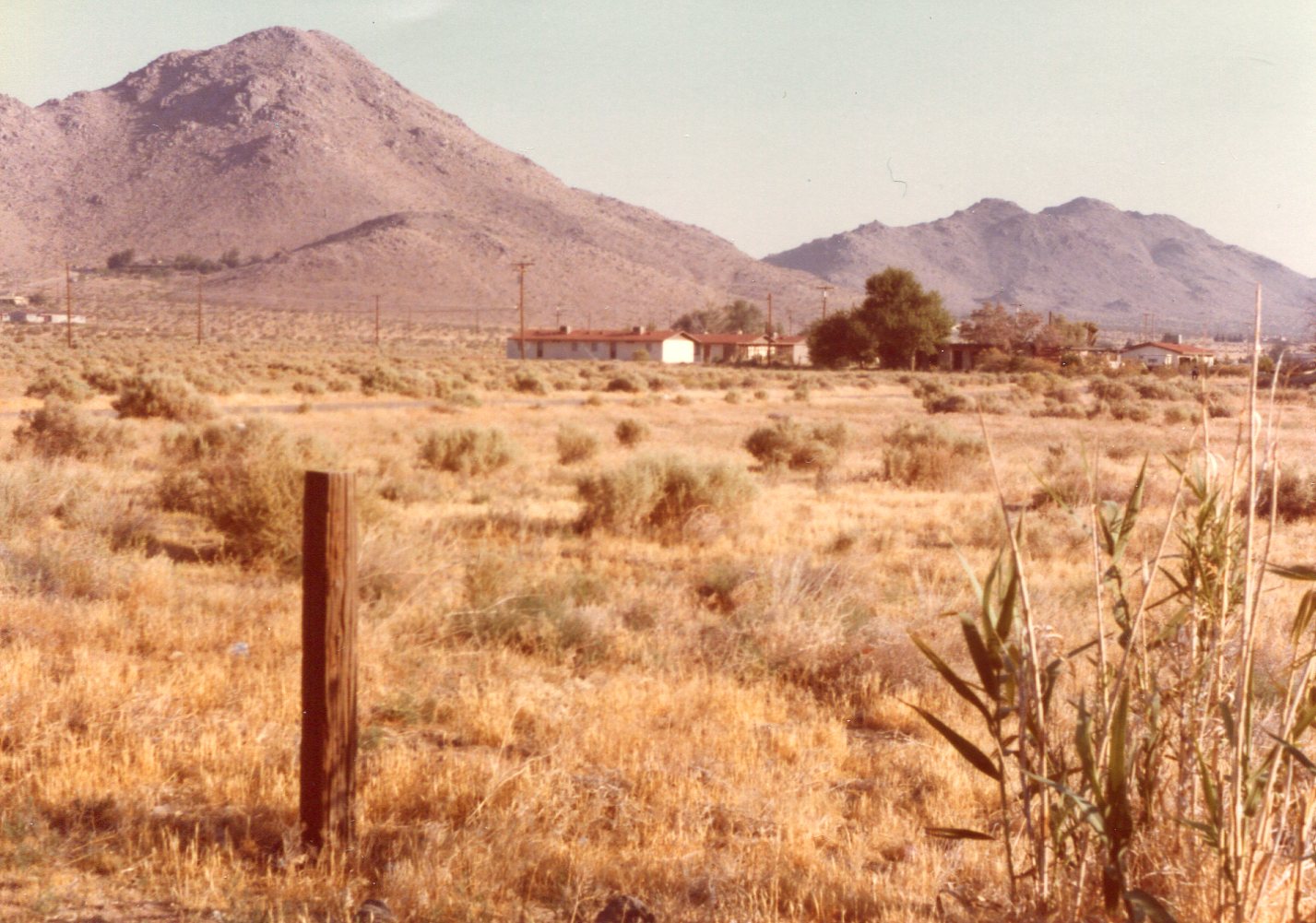
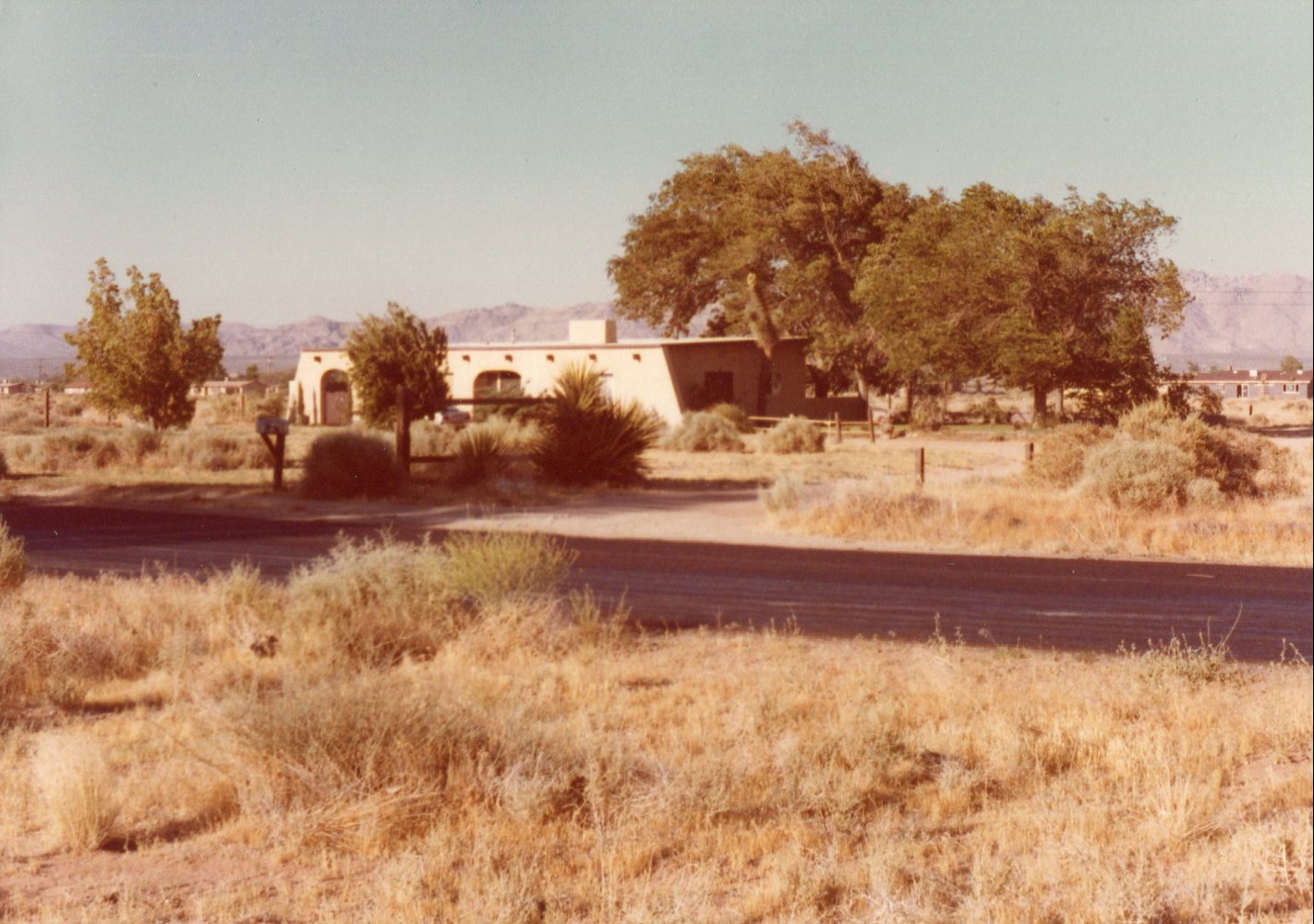
I lived in (until kindergarten) or visited Apple Valley from the very late 1950s until the mid 1980s, with a couple visits even later than that. It’s the place I think of as “home” more than any other place in the world. I spent some the happiest times of my life there, especially during parts of seven summers in the ’70s (see third phase below), as alone as I could be.

\\

First Apple Valley: 1958 to 1962 (living there)

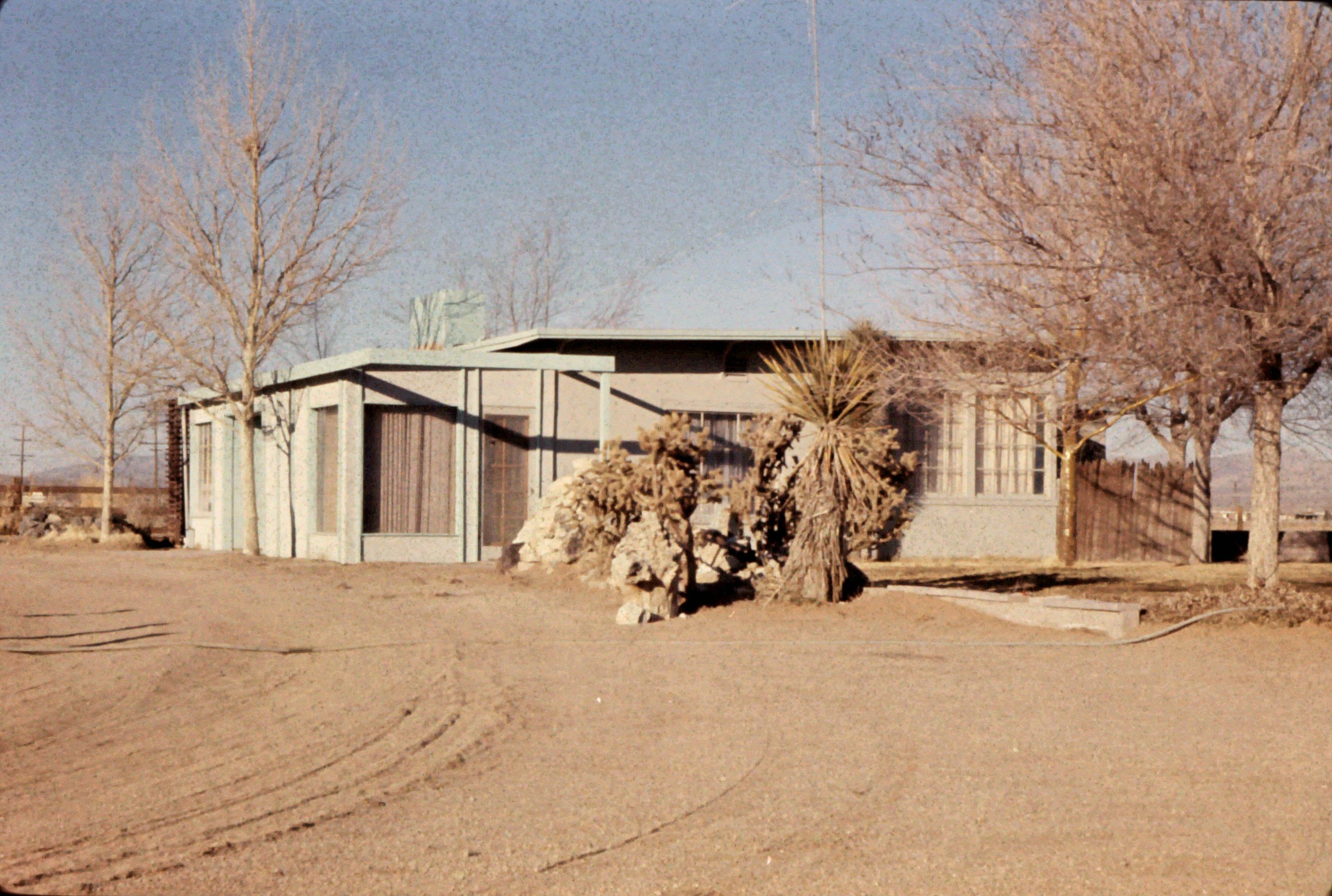
My family moved to Apple Valley around 1958, when I was three years old. We rented an apartment for a while, then rented a small cinder-block house in the far northeast part of the valley, and then settled into the house on Winnebago Road, shown here. (This is covered in family history, here and here and here.)

I have only a few specific memories from these years. In 1960 I started kindergarten, riding a big yellow school bus from a corner half a block from the house to Yucca Loma Elementary school (https://sites.google.com/avusd.org/yuccaloma-new/home) some 7 miles away. My memories of attending school there include 1) we brought towels from home to use during nap time, when we spread the towels out onto the floor; 2) the wind came up every afternoon, as I’ve explained, and during afternoon recess I and other boys would huddle in the corner of the low block wall surrounding the outdoor jungle gym, against the wind. (I didn’t climb up and down the jungle gym.)

Also in this period I was into plastic toy cars; see photos here. Outside were those big skies and hills that surrounded the valley protectively. In the daytime jet fighters flew low back and forth over the valley; to the west, northwest of Victorville, was George Air Force Base (https://en.wikipedia.org/wiki/George_Air_Force_Base), decommissioned in 1993 but at the time we lived there a training base. The jets screamed across the sky.

This is when I had a coloring book with outlined drawings of things like horses and mountains, lakes with sailing boats, and big puffy clouds in the sky, mostly things beyond my personal experience.

And near the end of this phase was when that desert superbloom that I remember, in Spring of 1962, occurred.

Other photos from this era on the Second Apple Valley house page.

\\

Second Apple Valley: 1962 to 1967 (family visits from Reseda)

In 1962 (half-way through my 1st grade) the family moved to Santa Monica for 6 months, and then to Reseda for several years. (Family history here.) My grandmother, “Grammie,” had already moved from Illinois to California, and we moved her into the Apple Valley house, which my father had been unable to sell. (He kept ownership of the house until sometimes in the 1970s, when he sold it to my Uncle Bob.)

During these nearly 6 years the family tradition would be to drive to Apple Valley about once a month for weekend visits with my grandmother. Typically we would leave Friday evening after dinner. At almost exactly 100 miles, the trip, at that time entirely on two-lane mountain and desert highways, took a solid two hours. (California State Route 14, https://en.wikipedia.org/wiki/California_State_Route_14, now known as the Antelope Valley Freeway, was finished through the mountains in 1964, shortening the trip a bit. [I’m always amazed at the detail of Wikipedia’s entries on any kind of interstate or highway.])

We would be there all day Saturday and Sunday until afternoon, returning home in time for Sunday dinner. Thinking back, I wonder where we all slept each night. The house had only two bedrooms. I think the answer was that my parents slept in the master bedroom, otherwise my grandmother’s; she slept on the sofa; and all four of us kids slept in the second bedroom, with one large (full-sized?) bed for the girls, two slender singles for the boys, taking up nearly all the floor space in that room.

And what did we do on those weekends? I only recall a couple things. We went to church Sunday mornings; this period would have been when, attending the local Presbyterian church, we met Roy Rogers and Dale Evans (or possibly that was in phase one). And later in the period, my father and I did a hike, in the rocky hills east of Apple Valley’s “village,” for boy scout credit, climbing over huge boulders up a gully where the rain water would gush.

There was a trip to a fish hatchery (of all things), which I remember; there was a trip to a garbage dump (according to my journals), which I vaguely recall was out near Oro Grande.

It was half way through this phase, in the Fall of 1965, when I discovered the TV series Lost in Space, and on reflection all these years later I wonder if my attraction to the show was that it was set in a place that looked just like the desert where I grew up! Or close enough. (Years later I would discover that for the pilot and early episodes, filmmakers actually did do some location shooting out in the desert, though far north of Apple Valley at the Trona Pinnacles (https://en.wikipedia.org/wiki/Trona_Pinnacles) and in Red Rock Canyon (https://en.wikipedia.org/wiki/Red_Rock_Canyon_State_Park_(California)).)

So was one of my earliest interests in anything science fictional triggered by nostalgia for a childhood landscape? Did Apple Valley inspire me to science fiction? That’s probably imposing too much story on coincidental events. But it did lead, as the years past, to the appreciation of the desert as a science fictional landscape.

This phase came to an end as we left California to move to Illinois, in the Spring of 1968. We made the trip in the family car, that Chevelle station wagon by then, staying one night with Grammie in Apple Valley before heading northeast across the country. As we left the house, we drove back through Victorville to get on Interstate 15, then headed northeast…and along the back of Bell Mountain. It was unrecognizable. Our view of its perfect shape for all those years had been from a privileged position.

\\

Third Apple Valley: Seven Summers in the Seventies (visits from Sepulveda, 1971 to 1977)

In the Summer of 1971 we moved back to California from Illinois. As we had done when we moved there, we left Illinois without having a house to move into, and so my father parked my mother and us kids in Apple Valley for the summer, with our grandmother, while he went to LA to work and to shop for a house. We arrived in Apple Valley about 25 June, and moved into our house in the LA suburbs, in Sepulveda, in mid-August.

After three entire years away, in an area of the country far more different from Apple Valley than Los Angeles was, returning to the desert was both a homecoming and a revelation; its strangeness and appealing isolation struck anew with full force.

By this time I was in high school, entering the 11th grade that fall. The family resumed its occasional weekend trips to visit Grammie, but at a reduced rate, perhaps four or five times per year. I suppose because all four of us kids were in school by then, and had things going on.

And I was of an age when, still living at home (even through four years of college at UCLA), I began pursuing my own interests, and grew a little frustrated at being in a house with three younger children. (I did not have high school friends to hang out with…) This played out in two ways. First, just as I declined to continue attending church, I sat out some of the weekend trips to Apple Valley, and stayed home just to have some time by myself.

Second, the reverse: over the summers for several years, I managed to arrange stays in Apple Valley of a couple weeks or more, sometimes with the other kids there but often by myself. These private retreats became of central importance to me. From 1971 to 1977 (the family moved away to Tennessee in early ’78) there were seven of these summers, that I look back on fondly, and have never been able to recreate. They were my refuge, my Seven Summers in the Seventies, when I was able to revisit the landscape of my childhood, escape household circumstances to read my books, look at stars through my telescope, and be myself away from the squabble and cigarette smoke of my family.

In was during these summers, weeks at a time being in the desert every day, that I noticed patterns that I hadn’t paid attention to as a child. Mornings were crisp and clear, and still. The San Gabriel range to the southwest stood blue and sharp against the morning sky. But the winds came up invariably at mid-day, blowing from the southwest toward the northeast. As smog from the “Inland Empire” (as it came to be called) of Riverside and San Bernardino pushed its way through the pass and onto the high desert floor, the view of those mountains vanished in the haze.

  • In 1971, my mother and us kids spent about 6 weeks in Apple Valley while my father went to work and looked for a house in LA. The family had a 2nd car by then – a used Buick Skylark with peeling paint on the hood – that my grandfather had driven out for us, so after he left we had a car to get around in AV. My grandmother was working, as a receptionist for some kind of social services office in Victorville, in a building at Victor St. and 7th St (the latter the main drag in town), and across from a bowling alley long since torn down. I read some 22 paperback books during those 6 weeks, mostly books I’d acquired in Illinois and managed to pack in the interstices of the telescope box. I also had the telescope.
  • In 1972 I spent 4 weeks in AV from late June to late July, returning home earlier than planned for a family vacation, a car trip to Oregon (Crater Lake), Washington’s Olympia peninsula, and the Oregon Coast (Salishan Lodge). This was the summer I had my father’s old clunker bicycle from Cambridge, that somehow we managed to move with us. I would ride from the house to “the village” area of town, a half mile stretch of commercial district along Highway 18 at Navajo. There was a pharmacy there that had a decent magazine rack and paperback book rack. On one such trip, the right pedal broke off, out of its socket, and I had to awkwardly finish the trip home pushing on just one pedal…
  • Summer of 1973 was the period between high school and college. I spent a week in AV in early July, another 10 days in early August. A family vacation—a drive to Illinois—fell through. I applied for a couple summer jobs and did not get one (I didn’t want to bag groceries yet was overqualified for the one I applied for—I recall I had to fill out an enormous application with questions about which people we admired and why, which I realized later must have been a ploy to weed out kids who wouldn’t focus on their job).
    • Piano. During these second and third summers, my grandmother still had her job, so I would spend weekdays alone at the house. She had the piano that my family had had in Reseda, back when my mother had given me some informal lessons. (I still have a stack of the lesson books she’d used as a child.) I never had formal lessons, but I could play pieces from those lesson books. (Fun fact: back in the ‘30s and ‘40s when my mother was growing up, you could subscribe to magazines of piano sheet music, some pieces simplifications or reductions of classical pieces, some full original scores. One issue a month, with 30 or 40 pages of music. The days before TV! I have some of those too.) At best, I could finger my way through the entire original score of Beethoven’s Moonlight Sonata (1st movement), with its steady rhythm but increasingly complex accidentals.
    • Transcriptions. I also tried to write down, from tape recordings, a couple three pieces of music that entranced me. One was the main theme of the 1973 film The Day of the Dolphin, score by Georges Delerue, that I first heard on TV; another was the opening of the last movement of Mahler’s 9th symphony; another was the main theme of Stanley Kubrick’s film Barry Lyndon, a piece by George Handel. They all had had such clear, open chordal structures and harmonies, and the Mahler such clearly separate lines among the various strings, that I think my piano reductions were pretty accurate.
    • Astronomy. I had my telescope, I had my Star Observer’s Guide, by the summer of ’72 I had Brown’s What Star Is That?, and by 1974 I had Norton’s Star Atlas. I would sit out in the evenings and split doubles and find Messier objects. Moreover—I would occasionally sleep outside the entire night, in a sleeping bag on a chaise lounge, in order to wake up an hour or two before dawn and see another quarter of the sky than was visible after sunset. There were no dangerous desert critters. On the contrary, there were a couple stray cats that found me, jumped up on my sleeping bag, and befriended me. (Years later – 1980 or ’81 – my grandmother had adopted a couple stray cats, one white, one black. I was in a college computer science program at the time, learning about various historical computer languages. I named them Snobol and Cobol.) It was dark enough at night that the glare from a street light, a mile away, interfered with my night vision. I would block the light with my hand, or avoid looking that way, while looking through my telescope, to see the deep sky.
    • Jet planes. It was during these summers, either standing outside at night (I would step outside several times an evening, always, while my grandmother watched TV after dinner) or sleeping out overnight, that you could hear… high overhead… the faint roar of jet planes. They would move from the southwest to the northeast. That is, a standard flight path for planes leaving LA heading northeast would be directly over Apple Valley. (Whereas, I observed years later taking many such flights, returning flights from the east or northeast would aim first for Big Bear Lake, then angle the plane due west for LAX.) Moreover, when you looked up into the night sky to spot the plane, it would be over *there*, 10 or 20 degrees across the sky in the direction of travel from where the sound seemed to come from. Because it took that long for the sound to reach the ground.
  • 1974. After taking a summer course (Freshman Comp) at Valley College, I spent 6 full weeks in AV, from early August to mid September. Grammie had just retired from her job, so she was home all the time. Kevin and Lisa spent one of those weeks there. We must have gotten that old bike fixed, because I rode around to libraries and bookshops. (In those days even small towns like Apple Valley and Victorville had two or three new and/or used bookshops each.) This was the summer a stray dog chased me on my bike and scratched my leg sufficiently badly that Grammie took me a doctor.
  • 1975: Just two weeks in August, but the second week Lisa and Sue were there too, the latter with her ever-running radio.
  • 1976: After taking two summer courses at UCLA, I spent two weeks in AV myself, just before construction began on a remodel of the house by my Uncle Bob. Earlier in August my high school buddy Phil Klutch, taking pilot lessons, flew me to Apple Valley for a weekend. During the day he took me up again for some practice stalls. That means stalling the engine and going into free fall for a few seconds, then starting the engine back up. Of course, I got sick
  • 1977: Just after graduation from UCLA, two weeks, and instead of being dropped off and picked up, I drove the Skylark and had a car there. This is the summer I sat in the yard, looking northeast, and read new hardcover novels by Varley, Pohl, Bishop, Leiber.

This what the house looked like after the remodel in 1976. An extra room was added at the front left (behind a tree in this view), enclosing the laundry room and created a large dining room, and the entire house got this mock-adobe facade.

\\

Fourth Apple Valley: Apple Valley visits with my Uncle Bob (1978 to 1982)

My family moved back east in 1978, and I stayed in LA, working a job and going back to college, but having no car. I bicycled everywhere. (See sidebar essay about bicycling.) My Uncle Bob, now owning and having remodeled the Apple Valley house, took to visiting his mother there regularly now that my parents were gone. And so often I rode along with him. He would go once a month or so, do whatever chores needed doing, and relax. These trips were more efficient that my family’s had been; Uncle Bob wouldn’t leave until Saturday morning, and then return first thing Sunday morning. He’d pick me up at my apartment, we’d stop for breakfast along Highway 14 in Canyon Country (this is about the time I started drinking coffee), and be up there before noon. He’d run back into Victorville, or to “the village,” for supplies to do this or that home repair. These were about monthly in ’78, but ramped down to only three in 1981.

During this period I got my first camera, in May 1979, and in ’79 and 1980 I took lots of my own photos of the house, the hills, Bob’s car (a Mazda), later in ’82 my own car and my uncle’s Cadillac.

Meanwhile I got quite fit riding my bicycle everywhere, and at my most ambitious, and to connive yet more visits to Apple Valley, I embarked on 100-mile rides from my place in Northridge all the way through the mountains and across the desert to Apple Valley. And in one case, from Apple Valley back home; each time I arranged it so Uncle Bob could pick me up or drive me there for one leg of the trip. I did two of these in 1980, and one in 1981. Only the middle one was more than a couple days; that one was about 9 days, during which I cycled the fringes of valley, read books, maybe did some sky watching. (I think at some point I’d left my telescope at the Apple Valley house, since I never used it down in LA.) Unfortunately I don’t have photos from those bike trips, mainly because my SLR camera was too bulky to fit into the bike carrier along with whatever else I was taking.

\\

Fifth Apple Valley: Until my Grandmother’s Death (1982 to 1984)

In June 1982 I got a professional job and bought my first car. Now I could drive to Apple Valley any time I wanted! Except, I didn’t have the time for the week or weeks long excursions of earlier years. I had no vacation the first year on the job. I was still taking classes, at night, that Fall. So weekends at best.

And the visits themselves were getting less pleasant, because Grammie was getting batty with age. She’d always had silly peccadilloes -– one was her off-hand, obviously unserious brags, e.g. when seeing someone perform an athletic event on TV, she would say that oh she could do just as well if only she bothered to try. Ha ha. Check back at the hundredth repetition. (Another: Thanksgiving dinner was always a success because she made the gravy.)

A couple times I took friends with me to Apple Valley – once Phil Klutch, my high school and UCLA friend, for a “star party,” and once a fellow grad student named Taro. Those were awkward visits. What are your interests, Taro asked her? Oh, music, literature. In fact she sat around watching TV all day, and I never saw her read a book.

Here’s another memory just now — at some point, in the ‘70s, my parents taught my grandmother to smoke. My parents were near-chain smokers, as I’ve mentioned, and in the ‘70s people still smoked in offices, in restaurants, on planes. My parents convinced my grandmother that smoking a cigarette was a nice thing to do after dinner. So she did, for years, just the one each day. When I was there for summers or weekends, she would dutifully light up as we watched the TV news after dinner. I would move to the far end of the sofa away from her chair. She never took the hint. (There were no windows to open.)

I should give my grandmother some credit. She lived a long life, one shocked in her 40s by the death of her sheriff husband when my mother and uncle were about 13 and 12 — so she raised them herself from then on. Just 12 or 13 years later, following her children to California, she uprooted herself from a life in small town Illinois and settled, eventually, in the completely different environment of high desert California. There she settled in; she found a church community to belong to; she worked until her mid-70s; she lived there fully 20 years. She was always congenial.

\\

Sixth Apple Valley: Glancing Visits (1984)

My grandmother died in early 1984. Services were held at her church in Victorville, but no funeral – her body was flown back to Cambridge, Illinois, to lie beside her husband.

My Uncle Bob had talked for years about perhaps retiring to the Apple Valley house, had my grandmother lived even longer; but in 1985 he was only 50 years old, and not ready to retire. So over the months after her death, he cleared the house of her furniture and effects. (I got her 10-volume set of an encyclopedia called The American Educator, from 1938, which of course I still have. Fascinating to look back at what they thought about various subjects, 80 years ago.) He sold the house in November 1986, for $55,000, and according to Zillow, it hasn’t been sold since. Google views now show the property razed of all the trees and a big fence surrounding the house itself (it’s 15791 Winnebago Road, Apple Valley, CA).

My records indicate a couple trips to the house later in 1984. Once in May to pick up the encyclopedia, and a set of water glasses with cacti designs (all of which have, alas, broken over the years since then, though I’ve kept the last one, in pieces, in my display cabinet), and a bicycle – I think at some point I had two bicycles, and had left one at the Apple Valley house. And a trip in June to get my telescope, on my way to a bicycle club event at Big Bear Lake.

There was a final visit in 1985, when I spent the night in a motel, on my way to pick up my friend Larry from a bicycling event at Calico, northeast of Barstow. And a close pass in 1986 when I drove a couple guys from work, very early one morning, to see Halley’s Comet before dawn, from an area south of Highway 18 between Apple Valley and Lucerne Valley (we didn’t stop at the house).

\\

Seventh Apple Valley: Return visits since 2009

Over the next twenty years I had no occasion to go to Apple Valley, or even past it. Perhaps returning from a trip to Big Bear with someone, we took the back route home, through the desert along Highway 18? But never to just go there. It’s not a resort town, there’s nothing much to do.

But a new, final phase began in 2009 with a series of nostalgia visits. In October of that year my partner Yeong was out of town (in Europe on business), and I drove his recently purchased Subaru SUV (with its Nav function, the first of our cars to have one) to the area on a day trip. In part I was curious to explore some of the far north and eastern pockets of the valley, on the sides of Fairview Mountain, that I’d never explored because the dirt roads are too rough for an ordinary passenger car. So from Woodland Hills I drove through the mountains on Sierra Highway, through Little Rock, across the remote roads (where I’d ridden my bike on those centuries) through Adelanto, to Apple Valley, and poked around for a few hours on some of those roads. Of course I drove past the house. Though I never did find roads all the way around Fairview Mountain.

A year and a half later, in April 2011, Yeong away in China visiting family, I drove my six-month-old M3 on another day trip to the desert. One aim of this trip was to find a remote road (I used Barrel Springs Rd. south of Little Rock) to get the car up past 100 mph, if only for a few seconds. I also visited Wrightwood, a ski resort on the north slopes of the San Gabriel Mountains that I’d never had occasion to go to. Once in Apple Valley I drove out to the airport, just to check it out (Phil Klutch and flown us there back in 1976), and also visited the Victor Valley Museum in Apple Valley, which had opened in 1992. It was an interesting blend of natural history, about the landscape and indigenous people who once lived in the area, and memorabilia concerning Roy Rogers and Dale Evans, movie and TV stars who had settled in Apple Valley (and who are buried at the cemetery in the northeast corner of the valley).

It was during these trips that I saw, of course, how the area had changed. More and more houses. On Winnebago Road, where in the ’70s the half-mile stretch where we lived had perhaps three houses, widely separated, on each side of the road, now almost every lot was built. Along Highway 18 just south of the house there was now a Walmart (!) and a Target (!) in a two-block shopping center also filled with generic fast food restaurants. — This has been the course of American society, over 50 years, as national chains have replaced the local businesses that once made every village and town a unique place. The small market in “the village” where my Grandmother had shopped was now garden shop; the larger chain supermarket at Highway 18 and Navajo Rd. that succeeded it in the ’80s was closed and vacant. The main road through Victorville, 7th Street — a curving, gradually rising road from the Mojave River on the north up to the surrounding desert floor a couple miles south — was mostly shuttered, in favor of the big mall down the Interstate at Bear Valley Road. It was my personal illustration of the maxim, You can’t go home again.

Six years later, in June 2017, on the way home from an overnight trip to LA (from Oakland, where we’d moved in 2015), I took the long way home and drove through Apple Valley, barely stopping. I had a specific goal, though, to take photographs at a couple key places. One was Vasquez Rocks, just north of LA and on the way to the desert. They’re distinctive angled sandstone outcrops familiar from location shooting of dozens of films and TV shows over the decades (including Star Trek’s “Arena”). The second was to get a photo of the back side of Bell Mountain, which looks completely different than the symmetric profile view from the south, from the Apple Valley house. That done, I drove north through Barstow and west over Tehachapi Pass – a highway I’d never had occasion to drive on before – to Bakersfield and north home. (I posted about that trip here: http://www.markrkelly.com/Blog/2017/07/06/trip-report-apple-valley-2017/.)

And finally, just two years ago now in February 2018, I did a proper weekend trip to Apple. On a Friday I rented a car (a small SUV) rather than put miles on my M3, and I stayed at a motel in Victorville. I spent two full days in the area and drove home Monday. I found a small used bookshop in AV along Highway 18 that sold every book for a dollar. I poked around the now vacant Apple Valley Inn, and visited a tiny “Apple Valley Legacy Museum” in a corner of that property. I drove out to the far corner of the valley, the area where the 1st Apple Valley house was, and is now an area called Sycamore Rocks, with higher-end homes than throughout most of the area. (Mentioned here: http://www.markrkelly.com/Blog/2017/07/10/apple-valley-dreams/.) And I explored an area east of the Village called Thunderbird Ranches, with a couple hundred homes, some quite large, but all accessible only by dirt roads. Went back to the area of the house and took some photos.

On Sunday I moseyed through the “old” part of Victorville, then headed south on the Interstate to the big mall at Bear Valley Road. From there, into Hesperia, just to get an idea of the place; again, one of those areas I had never had reason to explore. East of Hesperia, where the southern edge of Apple Valley runs along the slopes of the San Bernardino Mountains, I headed east until the roads forced me back onto Highway 18. Out to Lucerne Valley then, the intersection where the highway splits off southeast into the mountains where Big Bear Lake lies. Back along Bear Valley Road. I discovered something called Lone Wolf Colony (https://www.lonewolfcolony.org/), something like half a city block fenced off and with trees and shrubs inside. My Boy Scout Troop held a camp-out there, years ago! It has the appearance of an enclosed trailer park, though its site describes it as a “a recuperative health facility” with cottages and an RV park. There was an entry gate; I didn’t go in.

And I made one other serendipitous discovery that day. Driving back west on Bear Valley Road — now heavily lined with shopping center and commercial properties — I turned into Victor Valley College, and discovered, just off campus, the fish hatchery! Perhaps noticing Mojave Fish Hatchery Road was the first clue. This was amazing because I remembered being there once, with my father, when I was very little, in the years we lived in Apple Valley. Why should there be a fish hatchery in this remote desert town? Well, it’s along side the Mojave River, which flows north out of the San Bernardino Mountains and splits a ridge of hills at the junction of Victorville and Apple Valley. Apparently it’s a county function to keep parts of the river stocked with fish. Why would my father and I have been there? No idea. But it was a thrill discovering, quite by accident, a place that triggered such an old memory.

That night, after dinner at one of the row of restaurants by the shopping mall, I drove out to the far corner of Apple Valley to look at stars. It was windy, and chilly, and a surprising number of large trucks came down Dale Evans Parkways near me — there are a couple warehouses, one a Walmart Distribution Center, in the middle of the empty north valley, that of course weren’t there years ago. But I did confirm my teenage memory of seeing, passenger jets flying overhead, from LA in the southwest to points far to the northeast, but it was too windy to hear their sounds.

I reflected yet again on the allure of this area.

First, the attraction is partly about the raw topography. It’s all out there in the visible openness of the landscape, the hills and valleys, the knolls and bluffs, not shrouded by woods or grasslands or trees. The simplicity of the street maps is given multiple new dimensions, not just height, but visibility of surrounding areas, the changing horizon from one place to the next, the extensive horizons in so many places that puts everything in a larger context — as if refracted through another dimension.

Second, looking at the stars… The paradox is that, the clearer and darker the skies, the more stars are visible, and the less obvious are the traditional constellations, because their prominent stars are drowned out by the surrounding sea of only slightly less brighter stars that are visible in a very clear, very dark sky. This is especially true in binoculars (not in telescopes, where you tend to focus on specific stars or objects); the field of view in binoculars shows even more stars than you see with the naked eye, more stars than you knew were there, and implying even more if your light-gathering power were even greater. The deep sky view is seemingly infinite, more and more, greater and greater, and implying one’s own local pocket of experience is infinitesimally tiny.

The next morning I drove home. I’ll probably never be there again.

Posted in Personal history | Comments Off on Apple Valley: Interludes

My History with Pseudo-Science (Briefly) and Science

I went through a brief phase of interest in pseudo-science.

  • Beginning at that 7th grade book fair when I bought (in addition to Blish’s Star Trek), an early edition of Ripley’s Believe It or Not, and a book by Frank Edwards called Flying Saucers—Serious Business. A year later after the move to Illinois I bought (in Cambridge) two more Frank Edwards books, Flying Saucers–Here and Now, and Stranger Than Science. The last title was a collection of nearly 100 two- or three-page anecdotes about anomalous phenomena, like those documented by the better known Charles Fort. The other two were full of fuzzy photographs and anecdotes about unidentified things in the sky. I was quite compelled by these, at age 13, that summer in Cambridge; I would go outside and look up in the sky and wonder if I would see my own flying saucer. About this time I also read a couple books by Erich von Däniken (Chariots of the Gods?) that claimed ancient human civilization were influenced by visiting alien astronauts.
  • I got over this, becoming less credulous, as I read the work of scientists like Isaac Asimov, who dismissed flying saucers with a shrug (“Every reported sighting is either a hoax, a mistake, or something that can be explained in a fashion that does not involve spaceships from the distant stars”), Martin Gardner, and others. It was easy to find other books which demolished, for example, von Däniken (Ronald Story’s The Space-Gods Revealed); a similar book was The Bermuda Triangle Mystery—Solved, by Lawrence David Kusche, that patiently examined every case of a plane or a ship that had  vanished in a supposedly mysterious way in that part of the Atlantic, and showed that every one of them involved shoddy evidence or natural circumstances that explained it.
  • The lesson I took from all these was that there are lots of credulous people with a need to believe mysterious things, and a lot of writers who, honestly or not, are willing to supply them dubiously sourced anecdotes. (Why is there is never good evidence that aliens in spaceships are visiting us? Never any physical evidence?) In contrast, I came to learn, there are phenomena for which there are endless mountains of evidence that many people reject on fatuous grounds because they threaten their religious myths. The explanations on both sides are psychological.
  • It’s worth stating that there is, if anything, an inverse relation between interest in science fiction, and credulousness about pseudo-science. Asimov and others report being asked that since they write science fiction, they must believe in flying saucers, right? No, no, no. SF writers and readers know more about science than the average person and so understand which claims are valid and which are bunk.

Meanwhile I discovered real science, outside of school, and over time, particular writers I’ve followed my entire life.

  • Earliest were those early books on astronomy, including one by Isaac Asimov. I discovered other Asimov nonfiction books in 1968 and 1969, some collections of essays published earlier in magazines, like Is Anyone There?, others books on scientific topics for general readers, like The Double Planet and The Universe: From Flat Earth to Quasar. (These were paperbacks previously published in hardcover.)
  • When I began reading the science fiction magazines at the end of 1969, I discovered that one of them, The Magazine of Fantasy & Science Fiction, published a new essay by Asimov in every issue! Asimov had a Ph.D. in biochemistry but he was an autodidact and loved explaining things in essays and books; he wrote books on astronomy, chemistry, mythology, Shakespeare, the Bible, and much else. The F&SF essays were collected every year and half or so into hardcover books from Doubleday (Adding a Dimension, From Earth to Heaven, etc etc.) and then in paperback from Lancer, Discus, and others, and I collected some of them in paperback (shown in the pic) and read others from the library. Asimov was a polymath and wrote prolifically; his essays and books were the best entry-level treatments of various basic scientific topics one could imagine (and since they dealt with basic topics they would all still be accurate today, except perhaps discussions of the size and age of the universe; quasars were cutting edge topics in the ‘60s).
  • But Asimov was a generalist crisply summarizing basic material. More interesting nonfiction writers came along one or two a decade, discovered by different ways. (There were earlier such writers, like George Gamow and Fred Hoyle, who books I found, usually in paperback, decades after they first been published. The writers below are the ones I discovered as their new books came out.)
  • One of the earliest was Carl Sagan, an astronomer at Cornell. As described on my science fiction page, I’d started following the annual SF awards, the Hugos and the Nebulas, in about 1973, after I’d discovered Locus. A new SF award was founded that year, different than the others by being juried, and named after the late editor of Astounding/Analog magazine, John W. Campbell, who’d died in 1971. In 1974 the Campbell jury gave out a special award for nonfiction – which it’s never done since—and the winner was a book called The Cosmic Connection, by Carl Sagan, a book and author I’d not heard of. I suggested to my grandmother it would be a nice birthday present (my birthday is in August), so she ordered the book through a local bookshop and gave it to me when it arrived in May. Sagan’s particular interests included the Search for Extraterrestrial Life (SETI) and he was instrumental in designing the plaques attached to the Pioneer spacecrafts (https://en.wikipedia.org/wiki/Pioneer_plaque), plaques with astronomical diagrams and also line drawings of nude figures of a human male and female. The diagram was reproduced on the back cover of the book, and no doubt caused my grandmother a moment of embarrassment when she saw it.
  • Sagan went on to write and host the TV series Cosmos in 1980, certainly a key event in my life, and several later nonfiction books, as well as a science fiction novel, Contact, in 1985, a rare foray into fiction for a major scientist. (Musical triggers? From Cosmos I discovered Vangelis, and Shostakovich.)
  • In the same year I had that summer course at Valley College (discussed on my personal history, from Santa Monica to UCLA, page), a freshman comp course, where the most interesting topic was in the textbook Logic and Contemporary Rhetoric, which described, with dozens of examples, logical flaws and rhetorical gambits used mostly by politicians and advertisers, but which I realized also applied to… purveyors of pseudo-science. Sagan, coincidentally, had hosted a symposium to study the evidence that UFOs were alien spaceships, published as UFOs: A Scientific Debate in 1972. Between these two, any lingering fascination with pseudo-scientific subjects evaporated, and I became attuned to understanding the psychological motivations for belief in pseudo-science, which was explored fully in books in the ‘90s and later beginning with Michael Shermer’s Why People Believe Weird Things in 1997, and blossomed into the evolution of psychology into a rigorous science based on clinical studies, a subject that has matured in the 21st century, marked by substantial books by Gilovich, Kahneman, Haidt, and others.
  • Next came E.O. Wilson, a biologist and naturalist at Harvard who published, in 1978, a book called On Human Nature. How did I hear about that? Probably because I’d been attuned to science fiction awards for several years, and was also aware of general book awards like the Pulitzer and the National Book Award. In 1979 Wilson’s book won a Pulitzer, unusually as a science book to win in the Pulitzer category for general nonfiction. In early ’79 I joined the Book of the Month club and chose it as one of my four free introductory volumes. It was fascinating, and a bit controversial, for outlining why Wilson felt there was such a thing as human nature, that was not arbitrarily malleable, and that there were differences between males and females. In the 1970s, and perhaps the ‘60s with the civil rights revolutions, when there was a priority was on equality, the popular notion – which I probably held too – was that boys and girls had different inclinations merely because of the way they were raised. Wilson, and many others in decades following, explored why that is not true; thus I changed my mind. (Wilson went on to write substantial later works like Consilience, The Social Conquest of Earth, and The Meaning of Human Existence, which I’ve summarized here on my site. He wrote a novel too! Called Anthill.)
  • The later exploration by psychologists of human psychological biases, things like confirmation bias and the backfire effect, explain why you can’t change someone’s mind by laying out evidence and expecting them to come to a logical conclusion. Another thing I’ve had to change my mind about. It turns out people are intuitive lawyers, trying to win, not to be right, and will rationalize away any kind of evidence that challenges their prior beliefs, or the shared beliefs of their community. And such psychological insights, as they apply to politics, even explains why so many people, incredibly, support Donald Trump.
  • Also about this time I discovered Douglas Hofstadter’s Godel, Escher, Bach: An Eternal Golden Braid, also a Pulitzer winner. I read it and was fascinated, but I admit his later works have been too abstruse, not to mention lengthy, for me to do more than glance through.
  • Over the following decades I had several methods of learning about significant nonfiction books. I had discovered the magazine Publishers Weekly in college libraries, and would browse its several dozen short reviews in each issue, of books scheduled for publication in future months, for titles that sounded interesting. I still read PW every week, or at least its reviews. College bookstores, especially at the time UCLA’s, had large selections of general books in addition to textbooks. So too did the several independent bookstores in Westwood Village near campus, stores long since driven out of business by chains like Barnes & Noble and then by Amazon.com.
  • And another key method was, in the early ‘90s, that I began to read The New York Times, with its book review section, the most substantial in the country.
  • And so later key nonfiction writers, discovered one way or another, were Jared Diamond, Richard Dawkins, Sam Harris, Daniel Dennett, Robert Wright, Steven Pinker, and many others.
Posted in Personal history, Science | Comments Off on My History with Pseudo-Science (Briefly) and Science